Ask ChatGPT

 The CFO Playbook
29 Oct 2026 · 40m · 22 chapters
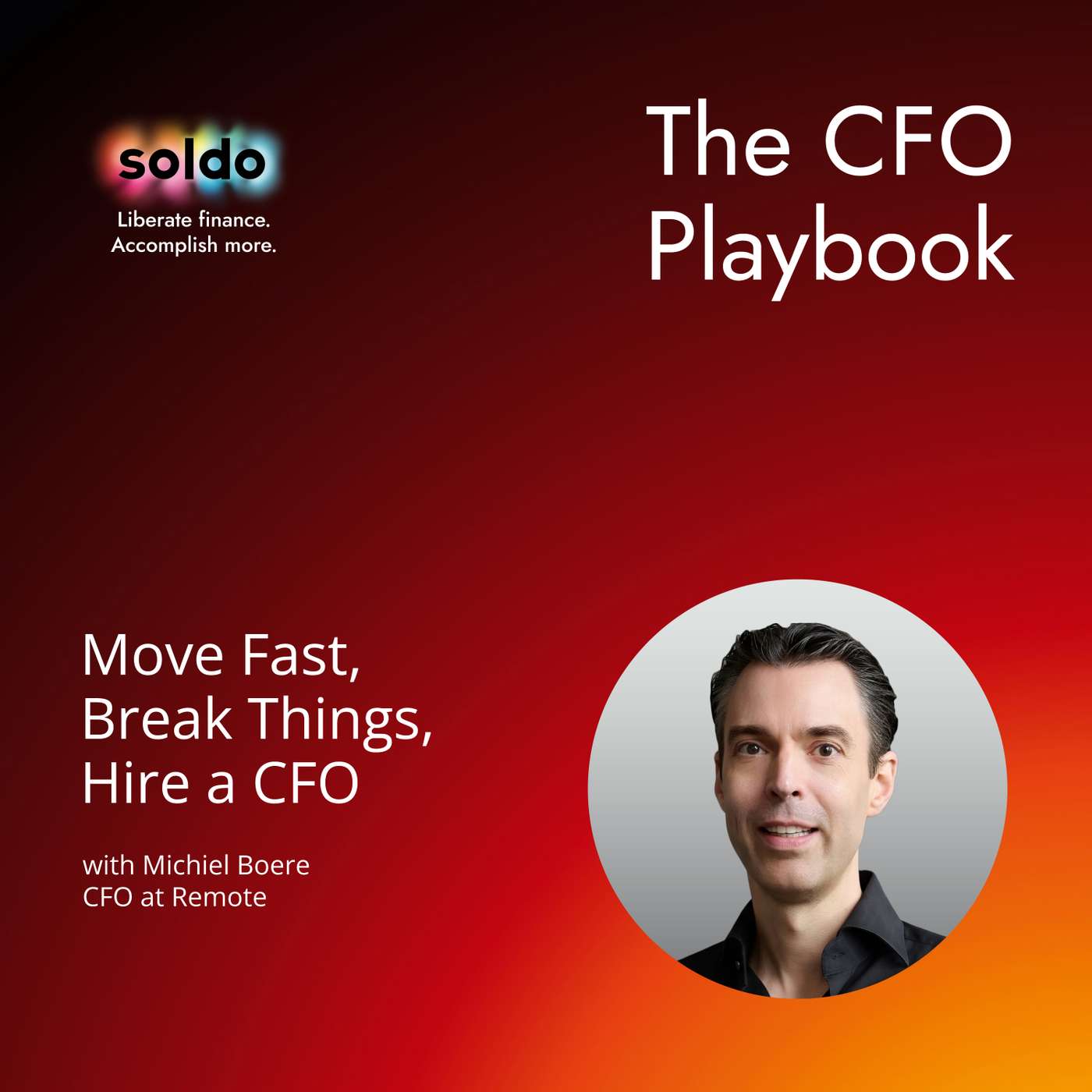
Michiel Boere, CFO at Remote, discusses scaling global finance operations using automation and AI agents, staying human-in-the-loop for low-error decisions, and managing AI costs and ROI. He connects lessons from Uber’s rapid growth and pandemic volatility to Remote’s move toward cash-flow positivity and AI-enabled treasury workflows.
Michiel Boere lives just outside Amsterdam. He joined Remote in April 2023. Previously, he spent seven years at Uber (2016 onward), including becoming CFO of Uber Eats just before the pandemic; he helped shift Uber Eats from burning about $1B EBITDA per year to EBITDA positive.
AI can automate “hard” administrative work but humans must own final decisions due to imperfect information and hallucination risk. Under-investing in AI is riskier than over-investing; AI budgets will likely be set as headcount-plus-tokens. Forecasting shouldn’t be over-rotated; decision-making under uncertainty remains central.
“Bob” agent processes treasury back-office emails and organizes bank statements; “Tim” agent manages global money movement/investment efficiency; a “supervisor agent” double-checks other agents’ outputs.
Written by AI. May contain mistakes.
Discussion of Michiel Boere's background and the role of CFO at Remote.
“I was waiting for who would bring the word AI up the first time.”
Exploring Michiel's responsibilities and the structure of the finance team.
“This episode of the CFO Playbook is brought to you by Soldo.”
Discussing the challenges faced by CFOs in fast-growing companies.
“So your role at remote, how do you describe what you as CFO does there today, Nikhil?”
Celebration of Remote becoming cash flow positive, a significant milestone for CFOs.
“You do need to have those fingers in all of the local pies as far as regulation and compliance and tax and consent.”
How automation and AI have changed the finance team's operations.
“I remember in my first CFO role, I think there was a Dutch company, but we had an entity in Germany and I believe also in Belgium.”
Specific examples of AI implementations within the finance team at Remote.
“The finance team has essentially, in the past year or two years, been able to handle increasing volume without adding a lot of people to the team.”
Discussion on the balance between AI automation and human decision-making in finance.
“And look, automations and AI is two parts of the same thing for us, right?”
How the finance team's culture has shifted in response to increased automation.
“the room for error in finance is very low and often zero which is not the same for all other departments in the company.”
Michiel shares his background and how he transitioned into finance.
“And all of a sudden there's all of this far more fulfilling work to do.”
Learn about the speaker's transition from consulting to becoming a CFO.
“studies and basis that rounds you in numbers and statistics.”
Discover the challenges and lessons learned during the speaker's time at Uber.
“As part of your journey, of course, and I know it's something you probably get asked about all the time, but you spent seven years at Uber.”
Explore how the speaker managed the profitability of Uber Eats during the pandemic.
“there's pressure inevitably as well and you know the the chaos that comes with that What have you learned?”
Understand the importance of decision-making amidst uncertainty in business.
“From the inside, the business was crystal clear to be a very viable business.”
Examine the evolving role of AI in financial decision-making and its implications.
“I think it's important to realize that you're going to have imperfect information and you're going to have to accept that fact.”
Analyze how AI has transformed business strategies and models in recent years.
“Six months later, ChatGPT launched And I'll say with a wry smile, perhaps, that's the point at which everything changed.”
Discuss the ongoing challenges and trust issues related to AI in finance.
“But it doesn't mean that every single company is building a durable business model there.”
Explore the trust issues surrounding AI in finance and its slow adoption.
“the conversations we were having here on the show, and I don't know about the other conversations you were having, it comes back to trust, doesn't it?”
Discuss the current state of AI in finance and the challenges of adoption.
“This stuff is ready and it is already doing prime time work right now.”
Learn how to manage AI expenses and understand ROI in finance contexts.
“different geographies in terms of adoption of AI as well, more generally.”
Discover how finance leaders are reallocating resources due to AI.
“will not be looked at in isolation anymore as we go further.”
Insights from Michiel Boere on automation and finance trends.
“Thank you for sharing that with us just now.”
Michiel shares key advice for CFOs and the importance of decision-making.
“If you could automate one part of your role, which part would it be?”

Get the gist, explore an idea or ask about something said.
 Claude
On The CFO Playbook, what are the key points of this episode?
Searching your listeningAutomatic transcript. May contain errors.
0:00Hello and welcome back to the CFO Playbook podcast with me, David McClelland. And here on the CFO Playbook, we get under the skin of how world-class finance leaders leverage technology, set goals, make plans, manage teams, and much, much more. My guest today is CFO of Remote, a company that handles payroll and employment for businesses in almost every corner of the world. After seven years of helping to scale Uber's operations, he's now rewriting the finance playbook for the age of AI. If a company grows extremely fast, there are always things that get deprioritized in the beginning. Move fast, break things, then fix them later on, I guess is part of that story.
0:39Move fast, break things, hire a CFO who can then fix those things. So when I joined Uber in 2016, it was a rocket ship. I was waiting for who would bring the word AI up the first time. It's a little bit of a trick I played there and you lost. Even with all the AI tools in the world helping you, you're still going to have imperfect information and you need to make a decision. What's been your experience of managing how much AI costs in an organization? There is a much higher risk of under-investing than of over-investing. Become great and practice at being a decision maker under uncertainty. That is something that will always have value and it's something that is critical for a CFO to learn and to apply over time.
1:23The CFO Playbook is here every month with exclusive finance leadership insights. So make sure you subscribe, browse through our back catalogue and get in touch as many of you do. Your suggestions really do help to shape our show. Right, let's meet today's guest. This episode of the CFO Playbook is brought to you by Soldo. Trusted by over 25 ,000 organisations across 31 countries, Soldo combines pre-programmed cards, an intuitive app, and a powerful management platform to replace manual processes with efficiency and control. To find out more or to book a demo, visit soldo.com.
2:07Welcome to the CFO Playbook, Michiel Bura, CFO App Remote. How are you doing? Hi, David. Good. How are you? I'm really well, thank you. Great to speak to you. Whereabouts in the world are you speaking to us from? I live just outside of Amsterdam, so it's a nice morning here. Very briefly for now, and we'll go into a lot more detail later on, of course, what does Remote do? Remote helps companies around the world to hire, manage and pay people wherever they are based. So we basically want to make sure that people can get access to great work opportunities no matter where they live around the world.
2:45and that businesses get access to talent that they desperately still need and that they can't always find in their immediate vicinity. Sounds like an admirable goal that you have there. So we'll peel away some of the layers of that in a few moments' time. In fact, what I'd like to do today, Michiel, is to learn more about your CFO role at Remote. Explore what your finance team looks there, where, as I understand, AI is playing an increasing part of your day-to-day. I'd also like to go back in time a little bit, understand your journey, including your time at Uber and what lessons you've taken from working there.
3:23And then, well, back to the present, let's see if we can get to some of the practicalities of managing things like AI, AI spend, AI investment in a modern organisation and what that means for you and the people on your team. Does that all sound like a good plan for you? Sounds great. Let's dive right in. Right. So your role at remote, how do you describe what you as CFO does there today, Nikhil? Being a CFO at remote is a pretty broad role. So as we are active all around the world, we have a pretty large finance team because we need to do compliance and reporting and tax in all of those countries.
4:05So we have a fairly large treasury team, a fairly large tax team, a fairly large accounting team, because we have to deal with all the obligations that we have around the world, which is essentially part of what we sell to our clients. We sell the fact that we do the hard work around the world so we can employ people for you or we can run payroll for you. The finance team is about 150 people at the moment. Okay. To give you an idea of the scale, we have many, many hundreds of bank accounts. We have many dozens of audits that we complete every quarter. We have a seemingly unlimited amount of tax obligations that we have to file each month.
4:47That's the nature of operating globally as you do. You do need to have those fingers in all of the local pies as far as regulation and compliance and tax and consent. But that's also part of the big value add that you bring to your customers as well. Yes, yes. I remember in my first CFO role, I think there was a Dutch company, but we had an entity in Germany and I believe also in Belgium. And I remember that managing and operating that entity was just an enormous pain. Because if you don't have the expertise and you don't have the people in a certain country, it's very difficult to operate in that country.
5:26I was the first CFO that we had. And since then, I've essentially focused on making sure we clear the backlog of all the work that there is to do when you join as a first CFO. Clean up the mess, create that platform for future growth and establish the processes, like you say, as first CFO. So I'm sure there were some processes that were there beforehand, but whether they were robust enough to enable the growth journey that remote itself wants to go on, I guess that's also a big part of your role. If a company grows extremely fast, there is always things that get deprioritized in the beginning.
6:07And many of those things are administrative things that need to happen, right? So that's something that I focused on very much in the beginning. And something that I've seen, it's almost all CFOs when they join as a first CFO into a company, they have to sort of clean up everything that's been left behind from the fast growth that has happened up until that point. Move fast, break things, then fix them later on, I guess, is part of that story. Move fast, break things, hire a CFO who can then fix those things. Earlier this year, remote passed 300 million AIR average recurring revenue, annual recurring revenue, sorry.
6:45And it became cash flow positive. So congratulations. Thank you. I guess. How was that as a moment? So becoming cash flow positive, I think, is one of the most important milestones for CFO, because it means that from that point on, you start to operate slightly differently, right? You go from how much runway do I have and when is my next fundraise to essentially what's the, how can I use our cash most efficiently to grow as fast as possible for the next years to come? In terms of how you do your work, what the day-to-day looks like, the tools that you have available to you and so on, how would you say that has changed over the last 12 or 18 months or so?
7:27The finance team has essentially, in the past year or two years, been able to handle increasing volume without adding a lot of people to the team. And we've done that by implementing automations in every part of the team. that has led to essentially us being able to handle much, much bigger volumes with the same amount of people. So when you talk about automation there, Michiel, obviously I have to bring up the AI thing because AI-driven automation is a big part of conversations across many industries right now and here on CFO Playbook. We talk about that an awful lot. What role is AI actually playing?
8:06Apart from the party tricks and all of the promise, where is the actual value that it's delivering? So as you're talking about automation there, have you got any examples of things that, I don't know, used to take someone three hours, three days to do, but they're not having to spend that anymore. They're spending a lot less time that's enabling them to do something else with higher value to the company instead. I was waiting for who would bring the word AI up the first time. It's a little bit of a trick I played there and you lost. No, I'm very happy to have lost. I'd say I've won in that one.
8:36Yeah, maybe you've won. And look, automations and AI is two parts of the same thing for us, right? So to give you some idea of how we're implementing it. So one of the things that the treasury team has implemented is essentially a few agents that do some of that work for them. So there is a back office bot that they conveniently called Bob that does a lot of the work required on the back office to analyze the emails that come in, store bank statements in the right folders, and analyze them immediately straight from the emails. A lot of the administrative work has already been done for them by an agent.
9:21And we also have, for example, an investment manager. They call it Tim, Treasury Investment Manager. That's an agent that essentially makes sure that we move our money around the world in the most efficient way to make sure that we can invest a good chunk of that. So those are some sort of the automations that have helped automate the recurring administrative work that teams need to do, such that they can then focus on the analysis and the decision making that comes on top of that. obviously we've been speaking a lot about ai agents within our organizations things that are goal-oriented and can go away and make those decisions and take actions themselves and with bob and tim we've got a couple of great examples there your agents i guess the question is how much agency do you give your agents uh where are the humans in the loop there and what haven't you let to your AI agents touch yet?
10:22Yeah, yeah. So that's a good question. So decision-making is usually done by humans. We were worried, would they make the right judgment calls when presented with information? Would they start hallucinating? So we actually added another agent on top, which is a supervisor agent, which checks the work of the other agents. So we are adding layers on top, including AI layers on top to make sure that we sort of control and double check the things before a decision is made. I think this is very important in finance because in finance the room for error in finance is very low and often zero which is not the same for all other departments in the company.
11:15But in finance that's usually the case. so um you have to make you have to be very careful when you introduce ai um to make sure that you reduce the probability of error as much as possible and you keep humans um in decision making process and coming on to the humans there there's another element to this as well there's more of a kind of cultural side as well so what what have been the reactions to to the increased automation to the increased agency of the bots there what have been your human reactions to those because there's a spectrum of potential responses there from excitement and i know the engineer in me gets very excited about how you describe what you're building there to obviously the kind of fear well what does this mean for me and the role that i have traditionally performed in this function i do think there has been a bit of a cultural transformation going in the past 12 months or so there, right?
12:14Where at first people, many people also in our company were a little bit hesitant and watching what would happen. But in the last three to six months, I think the vast majority of people have become incredibly excited about what they can do. And we've really helped everyone to get there with training. People realize this is not going to go away. This is the way that a career in finance, whether you're an accountant or a tech specialist, this is the new normal. And in your next job and in your next job, the first question will be, how much did you work with AI? What did you do with it? So they've realized that this is becoming part of what I do and part of what I need for my career as well.
13:02So there is a certain inevitability coupled with enthusiasm of what they can now automate. and if you are like in many jobs you can automate the what used to be the boring parts so actually what's left is is the exciting parts and it does seem to be a journey I mean I put that spectrum of people who are excited and people who are fearful and very often the journey that I see and I hear about is people who start off with the I'm not too sure about this but when you take them on the journey with you, when they see the opportunity, when they see the, oh, okay, that's what it means. And all of a sudden there's all of this far more fulfilling work to do.
13:43That's when they go on that journey from the uncertainty through to the excitement, as you described there. Let's come on to your journey, Michiel. How did you find your way into finance, first of all? I did applied physics when I was in college, which is a great analytical studies and basis that rounds you in numbers and statistics. So it's been very useful actually to have that as a background. But I must admit, I did not know the concept of EBITDA when I graduated. I did not know the concept of accruals. I could not even make a pivot table in Excel when I graduated. So I didn't have much practical work skills, I would say, when I graduated.
14:36So then I did a few years in consulting where I learned some of these things. That has been very useful. And I stumbled into my first CFO job, which was a company, an e-commerce company in the Netherlands, relatively small. And then once you are in finance, you're in finance, right? So then the next UFO jobs will present themselves over time. As part of your journey, of course, and I know it's something you probably get asked about all the time, but you spent seven years at Uber. Lots of different things happened when you were there and we can come on to those. But you didn't begin there in finance necessarily, though, did you?
15:14That was a role that, again, you, well, maybe stumbled or maybe grew into during your time there. Yeah, yeah. So when I joined Uber in 2016, early 2016, this was right before all the madness and the chaos in the press started. It was a rocket ship. And I was very excited to join. And I joined with a team of one. And that grew, I think, within a year, I was running three different marketing teams. so it was really a rocket ship when a finance role became available people asked me I thought you were in marketing I'm like no I was never originally in marketing I'm really a finance guy at heart and I am so I got back into finance and then right before the pandemic started I switched to Uber Eats I became CFO of Uber Eats I think I became Steve over Uber Eats a month or two before the pandemic started.
16:22And that was a very interesting time because then in March 2020, we suddenly saw the ride-sharing business going down probably 70, 80 % at the lowest point in a matter of probably a week, probably a month or two, I would say. it's a little bit blurry for most people how how much April 2020 unfolded so we saw the ride-sharing business absolutely go off a cliff and at the same time I had just joined Uber Eats and that was going up up up every week so we were in a bit of a weird situation at the time in Uber because we had this profitable business that was was going down and we had this unprofitable business that was really growing very fast.
17:19And we had to manage that dynamic. There was a layoff that we did, I think, in May 2020, even though the Uber Eats business was growing very fast. And then over the next couple of years after that, I spent most of my time making sure that the Uber Eats business went from burning a billion of EBITDA per year to becoming EBITDA positive. so we did that over over the next couple years and now the company is completely recovered also on the ride sharing side obviously and and the two divisions are now almost equal size i think still as a cfo in what is a dynamic you know you mentioned the kind of rocket ship growth there there's pressure inevitably as well and you know the the chaos that comes with that What have you learned?
18:12And I guess drawing a line between then and where you are right now at remote, what did you learn about decision making and dynamic environment, high pressure, and sometimes particularly, you know, maybe using the pandemic as an example there, where there's a lot of uncertainty, you've got uncertain data in front of you. So what are the kind of key lessons that you've learned from that environment that are holding you in good stead for roles like you have right now at remote? Yeah, I think a couple of things. So what I remember from that time is that we would make a new forecast every couple of days and every couple of weeks in the beginning.
18:54And we were always off and not off by a little bit, off by a lot. things would always turn out to be much worse or much better than we had even imagined in our scenarios right so forecasting has its purpose but don't over rotate on it is what I would say and fast decision making was needed that was the thing fast decision making is something that I probably learned back then and that I still carry with me today. The other thing that's very important when we were looking at how to make Uber Eats profitable is to really understand the unit economics, the unit P &L. What does$1 of revenue, where does it come from and how is it divided up into pieces, into incentives that are going back to consumers or to restaurants or to couriers and how much of it is used internally for really, and once you understand that UniPNL very much, once you understand it very deeply, then you can start to manage that UniPNL and you can look at every single country and look at what's the trajectory here of this country on that P &L?
20:15And what do we need to do in this specific country to get us closer to profitability or to get us growing faster? So how do you manage some of the potential negativity or the potential generalization when you have the specific numbers there and you've got the longer-term vision on your forecast as accurate or not as they may be? So from the outside, many people doubted the Uber business model for a very, very long time. Probably up until 2022 or 2023 even. Even after they went public. So many people doubted it and saw just huge losses. And that made the news every time Uber lost another X billion dollars last year.
21:02From the inside, the business was crystal clear to be a very viable business. The thing is just that you can be profitable in some countries and you can really see the strength of the business model there while burning enormous amounts of money in other countries where you're in a situation where you're competing heavily by giving out incentives to every part of the marketplace. So the headline overall company number can be highly negative, even though within the company you can see that many, many pockets are already at profitability. And that was the case for ride-sharing and later on also for Uber Eats, where it was crystal clear the path that we needed to walk, and we just need to get every country on that path.
21:59And there were many doubters on the outside. But if you look at the company now, it's generating almost$10 billion in free cash flow per year. So I think it's clear that the proof was there ultimately. In a large organization, it might not always be easy to execute quickly on a decision. So what have you found in terms of what tools you need and then what strategies you need, whether that's communication or building relationships to make sure that, A, you've got the information that you need in order to make the right decision at that time, with confidence and then B, to make sure that actually that decision gets acted upon as quickly as it needs to be from your point of view.
22:43Yeah. I think it's important to realize that you're going to have imperfect information and you're going to have to accept that fact. And even with all the AI tools in the world helping you, you're still going to have imperfect information and you need to make a decision. I'd say it's getting even worse with AI because AI will present to you as if it's crystal clear, right? With confidence. With confidence, this is crystal clear. This is what you should do. But AI ultimately is not held responsible for making the wrong decision that it has advised you, right? So the good news for CFOs is that this decision-making and business judgment is still very much needed.
23:26And you can use AI to help you, but you're responsible for the decision. So that's the good news because that judgment is still needed and it has to be made in situations where you don't have perfect information. I think what's very important for CFOs is to have a great relationship and trust with the CEO. That's critical. So that's also how I pick my CFO roles. It's extremely important to be in a management team and especially with a CEO where there's mutual trust because that's important when, to your point, when decisions need to be implemented, that's what matters. Let's come back to the present day then.
24:16And obviously we're talking a bit about the role that artificial intelligence plays in decision-making. You've been with Remote April 2023. Six months later, ChatGPT launched And I'll say with a wry smile, perhaps, that's the point at which everything changed. So it's fair to say you've seen at first hand in your time at Remote how this current wave of AI has grown, how it's impacted, how businesses work. In what way do you reflect now a few years on the change? because it would be easy, maybe too simplistic to say everything's changed, but certainly an awful lot has changed and an awful lot is still to change.
25:03So for the general public, sometimes it feels like JetGPT was the birth of AI. But of course, that was not really the case. JetGPT was the beginning of essentially the democratization of LLMs to the general public. But other AI techniques, especially machine learning, was already used for years or decades even, I think, in many companies. And especially also in the technology at Uber, machine learning was part of the core technology that we applied all the time. So it's not as binary as it is in our minds or in the general public sense that when ChatGPT came out, that's the eureka moment. But a lot has changed since then simply because the pace has accelerated incredibly.
26:03So what previously took 10 years in the progress of AI, I think then took only one year and now maybe it takes only one month. So we see the progress, I think, and the adoption have accelerated tremendously after that point in time. And we're now at the point where it's starting to dislocate a lot of previously held truths and conceptions in a pretty fast way, even over just the last couple months. So valuations of private companies have completely changed in the past 12 months. Of course, the credit market is now even being affected. I think there's a lot of hype and bubble in some parts of it, even though most of the AI bubble is real, but also the value is real.
27:01But it doesn't mean that every single company is building a durable business model there. So what we focus on and what I believe has value in the long term is doing the hard things. And doing the hard things means going to a country, setting up shop, making sure you can run payroll there, doing your VAT filings there, doing all the reporting that you need to do somewhere, making sure that you have a good relationship with regulators and all the things that come with that. Those are, I would say, the hard things. It's the business infrastructure. It's the infrastructure behind, in our case, behind paying people.
27:44So we think that the hard things will always have value. The soft things will be easier to automate with AI. So the value of that is slowly deteriorating. From a maturity point of view, maybe a year or so ago, the conversations we were having here on the show, and I don't know about the other conversations you were having, it comes back to trust, doesn't it? And you mentioned hallucinations and whatever on the kind of generative side of AI, and you rightly point out machine learning, deep learning, that's been around for decades. But there was still not quite the trust, even 12, 18 months ago, that AI was ready for some of the core financial work.
28:27How you've described Bob and Tim as your agents, you are there now. This stuff is ready and it is already doing prime time work right now. Are there any areas still where the maturity isn't quite there, would you say? Or really are the limitations more about how willing, how able we are to bring AI more into our core business processes from a finance point of view? Yeah, so I think the adoption of AI in finance has been slower than in other functions. but sometimes we tend to forget that yes AI makes mistakes and can hallucinate but humans also make mistakes yes we go like I think back to my Uber days actually where we have autonomous vehicles sometimes get into an accident but people also sometimes get into an accident more often even so and the same is true for for finance processes.
29:29That yes, I think using AI has, it's not always 100 % perfect, but then humans also make mistakes. So I do think we're going to see more and more adoption in finance now. Like I said, treasury is one where we're pretty far. We can automate a lot of things on the tech side as well in our company, and we are doing that. But what probably keeps finance a little bit slower than other departments is that finance interacts with auditors and with regulators more than some of the other functions. And for them, it's not always obvious or clear or not even allowed to use AI, right? if you need an audit trail or if you need logging or if you need to answer questions from your auditor, you can do a lot of that with AI, but it has to be accepted by that.
30:30And that acceptance, I would say, is not always there yet. And we operate all around the world. And also, I think, yes, there is a big discrepancy between different markets, different geographies in terms of adoption of AI as well, more generally. Let's look at the other side of the coin of using AI in an organization and the stage that we're at right now, there have been lots of proofs of concepts, lots of pilots, lots of experimentation with AI. And now it's about where the rubber hits the road. And it's about value, about return on investment. Plenty of, I'm sure our listeners are being asked to justify AI spend in the world of token cost inflation as well, maybe to control AI spend as well right now.
31:18What would you say to them? What's been your experience of managing how much AI costs in an organization, putting a value on what value it's giving you, and then managing that spend? There is a much higher risk of under-investing than of over-investing. A year or two ago, we would focus mostly on how can we And how can we contain the spend? Should we set a budget per employee? I think what you'll see going forward is that budgets will be set as a combination of headcount and tokens, right? So next year, I think many engineering departments will get a budget that they can spend either on engineers or on tokens.
32:01And they can sort of make the decision themselves on what the trade-off is there. And if they want to spend 10x on tokens, then they're going to have to grow slower in headcount. So that's probably where I think it's moving a little bit. And then lastly, asking about, I know we're all asking, what's the ROI of this AI spend? But if we take a step back, I think in a few years we're going to find that question maybe a little silly. because it's like looking back now, 20 years and saying in 19, or maybe 30 years, maybe saying in 1991 or 1995, what's the value of giving everyone a computer, right?
32:48Like how do we measure the ROI of giving everyone a computer? And then 10 years later, what's the value of giving everyone access to the internet, right? Should we do that? What's the ROI on that, right? Whereas right now we look back and we're like, we don't ask that question anymore. It's just a normal thing, right? So we have to find a new modus operandi for how to deal with the spend because of course the AI spend can grow extremely fast and we're seeing that internally as well. But the question of ROI, I think, will not be looked at in isolation anymore as we go further. And I think the question will go back to, hey, we have a department that is gusting about this in total, people and AI.
33:33do we think that's the right level of investment into a department that does X? And I think that's a journey that perhaps you and I have been on in our working lifetime as well, you know, computers in the workplace, but then access to the internet, mobile as well, being able to bring your own device, you know, whether you move from on-premise tech to SaaS solutions and so on. And in hindsight, yeah, it all becomes a bit of a no-brainer. So as much as the technology questions that are being asked in some ways are new actually they're very similar to some of those that have been around before so that kind of benefit of hindsight and experience is really useful there final one for now before we move on to our final round of quick fire questions here obviously a lot of the manual menial repetitive work is being freed up and you mentioned your ai agents earlier on i'm sure there are countless other examples across the organization as well, not just in finance.
34:34Whereabouts are you best able to reinvest that time in higher value activities? Would you say there's one particular or some particular areas where you are now able to index much higher than where you were able to when those menial tasks were still being performed by human hands? Yeah, I would say that I'd go back to what I said earlier on investing in the hard things right so I'd say I would I would advise almost every CFO to think about what are the real hard things that we do as a company for our customers and how can we double down on that because those things will have value in the long run and that's what we are investing in and that's the value people come to you remote for the hard stuff so if you don't double down on that then what are you going to double down on that and the hard It's not always the most complex stuff, right?
35:31What we're doing at remote is not rocket science either. But we're doing things that companies find hard and that are hard because they require the knowledge and interaction and expertise that's needed to operate in a country where you've probably never been. Michiel, it's been really interesting to hear about your journey, but also where you've landed now at remote and how you're looking at growth, how you're looking at empowering your workforce and thinking about artificial intelligence and the places where it is and isn't being used. Thank you for sharing that with us just now. As always on this show, we finish with some quickfire questions for our CFOs.
36:17So I'm going to dive right into those. If you could automate one part of your role, which part would it be? There are some things that require finger spits in the full or that are just good practice if you do it yourself and if you look at things yourself. So, for example, we talked about forecasting. I think forecasting requires a level of knowledge around the organization and intuition that can be augmented with AI, but not completely automated. So it's judgment calls that I think are going to be important. So it's a bit of a cop-out, but I would not automate everything. And I would also not automate a lot of the things in your personal life, actually.
37:03I'm very happy that in the morning I get to make a coffee manually and I have a physical newspaper that I can read. And those things, I think, have value beyond the digital. What emerging tool, habit or idea do you think every CFO should be paying attention to right now, Mikhail? I think every CFO should pay close attention at the moment to the pricing models of the frontier labs. so all the big labs are experimenting or testing different pricing models subscriptions large subscriptions, small subscriptions team subscriptions but also a lot of pay per token pay per use pricing models and of course they feel the heat of cheaper models and so this will evolve a lot over the next three to six months even, I think, but especially in the next year.
38:09And it will be very impactful. So make sure you're not locked into one vendor and you keep an eye on where you want to go, which model you want to pick, or if you want to do model switching. Most CFOs are very worried about their token bill going up every month. It's a really interesting point across the C-suite, I think. And as you start looking at open source models, as well as the kind of more closed models that we see from some of the frontier providers. That battle, there's a lot of ground still to go, I think you're right, over the next 12, 18 or so months. Thank you for bringing that up.
38:51Which finance leader, past or present, would you most like to see sit in your CFO Playbook podcast hot seat? I would love to hear next from Deepa Subramanian. She's the CFO of DailyPay and we worked together at Uber. She's great. Deepa is great and I would love to hear from her next. And finally, here on the CFO Playbook podcast, we're building an actual playbook, an actual book, a collection of top advice from finance leaders that we plan on turning into a resource for the community. So, Michiel, what top piece of advice for a finance leader would you like to enter into our CFO playbook? I would say become great and practice at being a decision maker under uncertainty.
39:39That is something that will always have value and is something that is critical for a CFO to learn and to apply over time. Michiel, it's been great to speak with you today. Thank you for joining us on the CFO Playbook. Thank you. My pleasure. And thank you all for joining us too. Don't forget to join us every month here on the CFO Playbook for more insights from finance leaders. But for now, from me, David McClelland and all the team here. Bye bye.
What does it take to lead finance when AI is changing how the work gets done?
Want more insights from finance leaders? Subscribe to Progressive Finance, Soldo's new newsletter featuring practical leadership insights, finance trends, and conversations with CFOs and industry experts: https://substack.com/@progressivefinance
Is there someone you'd like to see on The CFO Playbook? Email us at: [email protected]
In this episode of The CFO Playbook, David McClelland is joined by Michiel Boere, CFO at Remote.
Remote helps companies hire, manage and pay people anywhere in the world. Michiel describes what it takes to run finance for a business that operates in almost every country. His team of around 150 people manages hundreds of bank accounts, dozens of audits every quarter and a constant flow of tax filings. He was Remote's first CFO, and he explains what that meant: clearing the backlog that fast growth leaves behind, and building the foundations that helped the company pass $300 million in annual recurring revenue (ARR) and become cash-flow positive.
Michiel tells David how AI agents now handle much of the repetitive work in his team. "Bob" is a back-office bot that processes bank statements. "Tim," the Treasury Investment Manager, moves cash around the world efficiently. A supervisor agent checks their work, and humans still make the decisions. He also describes the culture shift that followed, as hesitant team members became enthusiastic adopters.
Michiel also looks back on seven years at Uber, where he moved from marketing into finance. He became CFO of Uber Eats just before the pandemic and helped take it from burning around $1 billion a year in EBITDA to being EBITDA-positive. He shares what that period taught him about fast decision-making, knowing your unit economics in depth, and not relying too heavily on forecasts. He also explains why he thinks companies are more at risk of under-investing in AI than over-investing.
In this episode, you'll learn: