Ask ChatGPT
 The ConTechCrew
13 Oct 2026 · 43m · 18 chapters
Construction technology fails when leaders skip people and process; better leadership and management strategy matter more than “slapping new tech on old workflows.” The episode also argues that owners can drive shared data standards by changing contract/spec language, enabling efficiency for contractors and better project outcomes.
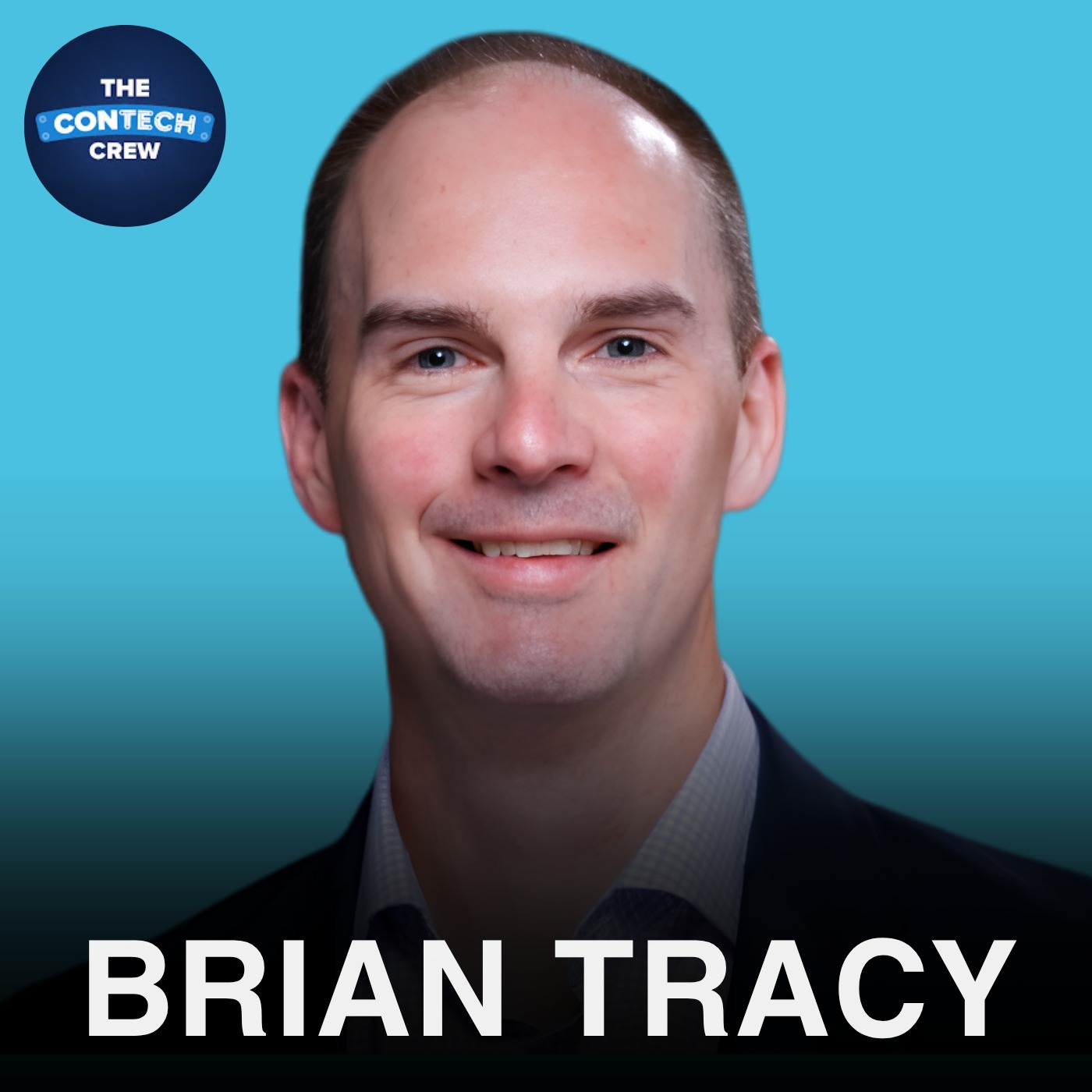
Brian Tracy (not the famous author). Background: structural engineering degree; worked for GC Kiewit; 15+ years in owner’s rep, construction management, consulting/advisory; director of a CM group; also teaches/trains and leads technology strategy (CMAA technology subcommittee, conferences/white papers/podcasts). Host Nathan (The Content Crew) and other recurring hosts are mentioned but not profiled.
~98% of tech projects go over budget/schedule due to unprepared people and misunderstood processes; “people, process, product” framework; start with enabling interoperability and standards, not forcing everything to connect.
Notre Dame course “Managing Construction Technology”; owner photo documentation spec switched to 360 photos; contract/spec changes for digital twins/360 video; San Francisco city/county partnering reform after marketplace feedback.
Written by AI. May contain mistakes.
The hosts share personal updates and excitement about upcoming events.
“Feels like forever, but we're recording again.”
Brian Tracy discusses his career in construction and technology.
“So, Brian, tell us a little bit about you.”
Discussion on the relationship between technology and leadership in construction.
“He talked about it with a few others on the committee, and we were skeptical that we'd be able to produce a written book on technology that would be relevant by the time it hit the shelves.”
Brian explains his approach to teaching construction technology.
“I was given the opportunity to be an adjunct in the construction management elective.”
Explore why technology projects often fail due to a lack of focus on leadership and people.
“they still hit home and you'll be sitting there thinking about, oh, we should be applying that to Gen AI.”
Discuss the significance of the 'people, process, product' framework in construction management.
“And at this kind of message that regardless of what perspective you're coming from, there are still, unfortunately, a growing minority of folks that have this belief that, yeah, it's people first.”
Delve into the dynamics between owners and contractors and the importance of collaboration.
“And then we have to overcompensate and give extra tough love to the other players just so they don't feel like we're up on them.”
Explore the barriers preventing effective construction management and data sharing.
“But about how you engage people up and down the chain.”
Gain insights into the functions and importance of construction management in project success.
“I want you to take a step back even further because I'm listening to you two talk about this and you're talking about the data and you're talking about what owners want.”
Learn how great construction managers integrate various stakeholder perspectives.
“And you're bringing the expertise and the perspective of the other players on the project.”
Discover why adaptability is crucial for construction managers working with diverse needs.
“once in a while and we don't hear it as just a CM.”
Explore the value of being a generalist in managing construction projects effectively.
“Hey, thanks for the opportunity to discuss what you need.”
Learn how terminology and roles differ between federal and private construction projects.
“I mean, again, Brian, you're more in this, but my understanding as an outsider is that really if the owner's, well, like a federal project or something like that, they probably wouldn't even use the term owner's rep.”
Understand the significance of empathy and relationship-building in construction leadership.
“the general process of things, I'll have to learn a new term for this thing, but I know where it fits into the overall picture.”
Discover how the integration of technology can enhance construction project delivery.
“But you know the constraints that they have in order to deliver, whether it be, hey, listen, you can't mobilize that crew in that kind of time because they've got all these other jobs.”
Learn how to view constraints not as limits but as opportunities for innovation.
“I have a delivery team, an operational technology team that can look at that and go, we actually use this.”
Learn how to create a successful operational pathway for construction projects.
“What is this thing that we're building, this facility, this asset, this whatever, what is it going to need to operate successfully for its ownership team?”
Discover how to connect with Brian Tracy for further insights and networking.
“Like I said, we go on forever, but the show has an ending and it is now.”

Get the gist, explore an idea or ask about something said.
 Claude
On The ConTechCrew, what are the key points of this episode?
Searching your listeningAutomatic transcript. May contain errors.
0:00On this week's show, Preparing the Future with Brian Tracy from Osonio Incorporated.
0:17Alright, Nathan, what is happening, buddy? Feels like forever, but we're recording again. Feeling okay, feeling sore. Kind of glad we did not go mountain biking this morning. I don't think my body could have handled it, so that was a good call on your end. I did go, but I went for a much mellower. Well, I didn't get up early, I'll be honest. After being on the road for two and a half weeks, I didn't want to get out of bed early. And you know, I can roll out, roll on the trail and roll back home. And I did not go hard. It was just a stretch out. All right. Well, I had a big hike Sunday. You had a ride Monday.
0:47We're good. There we go. And Brian, sporting the Notre Dame. I love it. You made your way back. Sounds like you entered a game yesterday. I had a different kind of physical workout yesterday, a long, joyful day of tailgating, a long, joyful night of watching a football game. Thankfully, it worked out. And now back in the flow of things for the work week. Happy to be here. Well, congrats. It was a nail biter for a bit, but getting the win is the key, right? At the end of the season, they don't look at how close it was. They look at the wins and the loss column these days. That's right. One nervous wreck down, 11 more to go.
1:22Well, we will come back because Brian's got more than just a cool connection with Notre Dame in the end. But guys, remember, check us out on YouTube.com forward slash at the contact crew. And remember, if you want to see and meet us in person, we're going to be at Trimble Dimensions this year. So that's right. Live on stage with Mark Schwartz and Josh Levy and yours truly. And we're going to be talking about what they're up to and it's going to be a lot of fun. but you'll also be able to catch us while we're there. So come on by and meet the crew. Maybe you'll be the next guest. Hey, contact crew.
1:58Slapping new tech on old workflows isn't enough anymore. You need to rethink how the whole job connects. And that's exactly what's happening at Trimble Dimensions 2026 this November in Las Vegas. Join the smartest minds in construction to solve your biggest hurdles, labor, cost, risk, and visibility. With over 700 sessions, a live off-site where you can see automation and work in the dirt, and the construction startup competition. You'll walk away with solutions you can use on Monday. Plus, the team is capping it off with an epic party at the Omniot. Stop reacting to problems, connect to your data, and get back to getting stuff done.
2:41Register now at Trimble.com.
2:47All right. So, Brian, tell us a little bit about you. And you got a couple of different balls in the air right now. And it's really cool to see. So tell us a little bit about you, how you got here. And we'll go from there. My day job has always been, and still to this day, remains focused very much on operations. My degree is in structural engineering, but I wanted to go where the people were. So I went and worked for general contractor, Kiewit, one of the big ones out there. and learned so much for them and then have spent the last 15 plus years doing owner's rep, construction management, consulting advisory, all of that other stuff, thinking about the bigger project where, you know, you have to get it set up right for the GC and the trades to come in and do their job.
3:32And then you have to prepare the owner to manage it correctly. So I learned so much throughout and continue to learn every day about just the, in the weeds, in the field, how things work and how to deliver better project outcomes. So that remains my profession. But along the way, my own curiosity, my own volunteering for things has led to a couple of other fun offshoots within my career. One of them has been teaching and training. I've always kind of considered myself a coach at heart and I've done enough youth football in middle league to back that up. But at every stop in my career, I've had some chances to do training development at others, whether it's just the project team I'm with or the division in the company I'm with or the whole company or doing a guest lecture.
4:22And it's all been really wonderful. And now I can look back and see that it is built incrementally to bigger things. I didn't know in each given time when I was saying yes to this and this. It's something I love to do. And it's really the biggest part of my job now as the director of a CM group within a company to make sure that my team has the resources they need to succeed for their clients, that we're putting them in the right place for their skills and where they want their careers to go, and that we're able to talk them through the issues they're seeing with their projects, with their clients, and solve them.
4:54That's the teaching and training side. And then finally, the technology side started because I'm just one of those people who said, yeah, I can probably connect your printer for you. And AJ Waters and I were at QIT at the same time, didn't know each other, but we're going through parallel tracks of raising our hand once or twice and then suddenly becoming, oh, you're the tech guy. Here, try out this new device. Here, try out this new piece of software that we, hey, we just bought a company. We need to train everyone on how to do it. And that followed me through each step of my career as well, having a role within the company, whether it's just a specialist on tech or the whole company's tech strategy, to be in charge of that, leading best practice teams and writing charters and all that fun stuff.
5:37About a decade ago, I was invited to be part of the Construction Management of Association of America, CMAA's technology subcommittee. And that's been such a joyful part of my career because I meet amazing people from the best firms in the industry. We can do anything but share a file, is our joke because of all the different firewalls and protocols, but it's seeing people and the firms they're with and the organizations of all shapes and sizes serving all different types of clients, all the different stages of tech maturity and bringing in partners to learn things. And I've had the pleasure of sharing that for a couple of years.
6:16As a part of that, we design conference presentations and white papers and our own podcasts. And that's how I kind of got hooked up with Nathan is our great friend, Kurt Maldivan, introduced us. And I've convinced Nathan to help the committee and we presented together last year in Nashville at CMA National. Nathan just blew the audience away. And we've tried to be our good partner for the ECI summit and bring a lot of attention and cooperation with that. So throughout my career, I've sort of built the engineering and construction skill set, the teaching and training skill set, and then the technology skill set.
6:56And unbeknownst to me, those three things led to a couple of cool things I never would have thought would have happened. The first was Kurt had a relationship with the book publisher, and they approached him about writing a book on construction technology. He talked about it with a few others on the committee, and we were skeptical that we'd be able to produce a written book on technology that would be relevant by the time it hit the shelves. That was our fear. And we eventually put our heads together and came around to the idea of when we interact with technology, what does that really mean to us?
7:32What do we see when we look at successes or failures, and frankly, far more failures and successes, there seem to be a lot of root causes that are common. And it's not the product. It's usually that it's the people that are involved, weren't properly prepared, weren't properly resourced. The process that technology solution was put in place to solve wasn't truly understood, wasn't truly diagnosed. The analogy we like to talk about all the time is you're doing it backwards. You're someone in leadership gets sold on a great product. It's like watching the pharmaceutical commercial and thinking, should I talk to my doctor about that?
8:12Well, if the doctors never brought it up, probably not. But inevitably, if a firm just gets locked in on this product and they try this product and sometimes you could force it in and make a fit, a lot of times it's not the fit. and that bad taste sticks with the firm for a long time and prevents them from really becoming able to use technology in a good way. So what we tried to do with the book was explain what we saw in those failures and put together a playbook for how do you get one implementation right? How do you flip the normal process and start with understanding the people and the processes involved and coming up with an answer to how do we make our best thing better?
8:57How do we make our worst thing not worse? How do we improve the experiences of our employees? And only when we can answer that, what it would look like, then we say, okay, is there a product or is there an application that would help us do that? Then you go look for a product. The book talks about getting that first one right, how to sustain that success because it's not just like building a project. It's like being an owner. You're handed an asset and you have to take care of it for its entire life cycle. You have to maintain it. You have to make sure that it's still performing in the way that it's been to.
9:34And then you have to understand when it's no longer doing what it was meant to do and it's time to sunset it or replace it with something else. And that's just one. And as we talk to people that work within companies, especially people who it's their job in some way, shape or form to get their hands around their whole technology strategy. And we asked them, how many different pieces of tech are you talking? On the light side, it's dozens. And on the heavy side, it's in the triple digits. And so you have to follow that same approach for every single one. If you really want technology to do its job of making your business better, making your people happier.
10:14So then the book goes into how do you create the kind of culture where that sustained success is possible because it becomes a critical part of the operations of your business. And so that's the part of the textbook that is the playbook and can be applied to any technology, hopefully for as long as we're doing this. And then the book looks at modern day technology topics and applications through that framework. And we tell real stories from industry of firms and people generally using that approach for good, sometimes not using the approach and learning the consequences as a way of showcasing.
10:55Here's how it applies today for digital twins, for data governance, for modular manufacturing. So we spent the better part of four years writing that in our spare time. And thankfully, that's out now. And we just get to talk about how we can best use it. And one of the unexpectedly great ways that I've gotten to use it was my alma mater. So let's back up 11 years. I was given the opportunity to be an adjunct in the construction management elective. And that was a joy and so much work. And I love doing it. and I kept the relationships with the department. And so a couple of years ago, they wanted to find ways to better incorporate emerging technology into the civil construction management curriculum.
11:35And I said, well, here's a couple of good ideas and happy to send you thoughts from the book. And then three months later, I wasn't asked. I was told, well, you're going to teach a class next spring about this and give us a synopsis by tomorrow for the registrar's office. And off we went. So I'll stop rambling for right now, but I can talk more about that experience. What do they call that course? Well, we took the easy way out and we just copied the title of the book, which is Managing Construction Technology. The reason why is there are so many great courses in higher ed that'll teach you specific tech skills.
12:08There are great Blooming courses out there. There are great VDC courses out there, great robotics and drones and AI courses out there. What I didn't see in everywhere I've looked, and if someone has one, great, send it my way because I'll learn from that. What I didn't see was a course on strategy and management, which is if you look across the industry now, most of the top 400 firms and a lot of firms below that have put someone into a leadership position for not IT, but technology applications management. And there's all these titles, right? I think we came up with 50 different ones we put in the book that didn't exist 10 years ago, whether it's chief or vice president or head of innovation, transformation, digital delivery, all that sort of stuff.
12:52Firms have these people in place. They don't have a playbook. They don't have a predecessor to look at. They don't have a mentor who's been in the industry 30 years doing this. They're figuring it out on the fly. So the book was partly for them and the book is partly for people who are coming up and learning the industry right now in college to learn how to do the leadership, how to do the management and the strategy of it. And so the discussion that we came to with Notre Dame was what a cool course this is we to offer, but no one else is doing and teach people to think from that sort of framework and then go into their eventual firms and organizations and have that skill set, have that knowledge, have that playbook that they could evangelize.
13:36Just to be able to think about it and to have the framework. To your point, the book in a lot of the stories you tell probably, I don't say they won't age well, but they won't be whatever it is. But the principle, a lot of books I've read over time. Yeah, sure. The story they're talking about, like how big things get done, talks about stories of building structures that now we look at very differently. But the problems they encountered that it's talking about, the fundamentals, they're still there. they still hit home and you'll be sitting there thinking about, oh, we should be applying that to Gen AI.
14:09We should be applying that to this today. And so it's always the fundamentals give somebody and no one is teaching that exact piece because there's a reason technology fails on a pretty regular basis. And I want to go outside of construction. Like this is what's interesting is it fails on a regular basis everywhere. I mean, how big things get done talks about 98 % of all technology projects go over budget, but they blow their schedule out of the water. And if you start digging in, it's even worse. It's just because we don't focus on people aren't ready. Process is not fully vetted. And we're enamored with the technology.
14:53The shiny tool will solve my problems. Nathan, I'll go back to the biking. I was in the bike shop today and I was talking about grinding up the hill and they were like, well, you know, these new ones with, you know, this amount of gears and this shock that automatically locks. And I'm like, or maybe I should just, you know, train a little more, work harder, work a little harder. And then my great bike that doesn't need to be replaced. So the technology can't solve it. I'd love for any other institution, whether you're a company or a college or anything to just steal this course, because the reason we wrote the book, the reason I do the committee, the reason we do the presentations is this helps us all.
15:33There's such a labor shortage. There's such demand for people in the industry that we don't have to be protected. I want everyone to get better at this. I want all of the partners on my projects to already be native and fluent on these things so I don't have to teach them every project how to do some of these great technologies that I know will improve the outcome. So anyone who wants this, I'm happy to coach you as I like to do and give it away. And I love what you say about the universality of this, even if the specific examples don't aren't as applicable. I rounded out the course with other really smart books, one of them, The Innovator's Dilemma.
16:09And the stories they tell, because it was written in the 90s, right, about the floppy disk drive, I still, I ate them up and I was making notes in the margins. They're like, oh, it's just like this right now. And here's the applicability. Checklist Manifesto, where they talk about just the transition into hydraulic elevators and the free flight checklist. Like all these things are still universally applicable for the reasons you said. And I think one thing we skipped over for listeners, and of course, we'll put the link to the book in the show notes, but the subtitle to the book is people, process and product.
16:39Jeff, we're continually preaching, right? And I think that's kind of the beauty, the irony, whatever of all this, that so often as a trade, as a GC, as an architect, as whoever, you feel like you're the only one that thinks this way and feels this way and that all the others are the enemies, right? And at this kind of message that regardless of what perspective you're coming from, there are still, unfortunately, a growing minority of folks that have this belief that, yeah, it's people first. It's understanding what are those standard processes and how are we going to speak to each other. Taxonomy is kind of this term that keeps coming up that starts with the stakeholder perspective that you come from.
17:13And so I just I love that as I learn more about CMAA, the tech committee, what everybody was saying. It's like, yeah, guys, you're saying the exact same thing as all the GCs, as all the trades. We're all saying them within our little silos. And so how do we get everybody to say it together? And I think starting at the universities is a great way to go. None of us are authors by default. We're just five people who love tech and working in AEC. But at some point, we said we need a consistent voice for the book so it doesn't sound so scattered. And we settled on that people process product framework.
17:43And then we thought, that sounds like a pretty cool subtitle. Look how smart we are. And then we go research. You know, this concept has been around for a really long time. we just accidentally fell into the same idea. But I think it's all in the stories of how you are addressing it. And so I know you put me on the spot. I was very fortunate to be one of the, I guess, the guest lecturers in your Notre Dame class. You can tell me how many of these questions were from you or from the students, but they're really good, really tough questions. I'll start in our data interoperability and industry structure category here and flip this on you as to in your CM role.
18:14So what is the biggest barrier preventing CMs or owners from adopting shared data standards? across construct. Because I think a lot of GCs and trades will go, oh, well, you pull all the purse strings, you can control everything, right? But maybe that's not necessarily the case. I guess, yeah, help us understand how your half lives. And I don't want to spend a whole lecture's worth on this. No. With soundbite. And by the way, thank you for the willingness to be a guest speaker in the class. That was my secret to the classes. Well, they'll get bored with me very quickly. Let me bring in as many other smart people as I can.
18:45And you were right at the top of the list and they were blown away with what you have to say. and they clearly got why you do what you do when they learned about the way the industry is broken in its approach to this and they came away full believers in CDX and CPC and just the way you're trying to make the industry better. This is not a fair question because you can answer this so much better than me and you did. No, but as a CM, as a GC, I would answer it differently. Yeah, as a CM, how would you answer that? As a CM where most of the time we're hired by the owner, right? We're paid by the owner, but we feel like we owe a duty to the project to make sure the project is completed successfully, even if that means giving tough love to the owner, because that is what's needed for the good of the project.
19:35And then we have to overcompensate and give extra tough love to the other players just so they don't feel like we're up on them. Every player in the process thinks that we'd love to advance technology, but it's not our role to do so. The owner thinks we don't have, we're not building it. We don't have any expertise in this. How could we possibly influence that? And to them, I would say very easily, because you as the owner set the conditions for what you're buying. You're telling the marketplace, I'm handing out money and I want this. And if you say, I want this delivered in this way, the market will give it.
20:16We deliver sustainable buildings all the time now because that's what owners expect. We could deliver data-rich, fully correct digital twins at the end of a project. If that's what the market started demanding, the market would respond to that. And so that I say to the owners, it costs you almost nothing to just change two sentences in your contract or your specification and sometimes we do sneak that in with like digital twins or 360 video or just like very simply wrote with the CMA tech committee the project photo documentation spec because most people are still using the professional photographer do an eight and a half by 11 glossy every other week and nobody reads it so we just switched it with 360 photos on a platform of the owner's choice the four major milestones.
21:06And it doesn't cost anything more in the bid process. And then the GC gets around to reading the spec and they're like, how do I do this? And we say, here's a$500 answer to that question. And it's going to make everyone's lives better, even your own. That's the owner. The GC has an incredible opportunity because they usually see the most return on it. And even the trades, because they're the ones who are really self-performing the work, the more efficient they can be, the less rework, the better sequencing, the fewer delay claim arguments, the safer the workers are. All these things I could talk about on and on and on.
21:43And then from a GC's perspective, having a good flow, having to use less contingency, finding better trusted partners, being more efficient with the things you're self-performing, all those things improve your bottom line, improve your marketability, improve your client relations. a lot of GCs are just as intent of, we just can't afford to, right? Where our margins are so tight, our operations are so baked in, we don't want to disrupt everyone. And there's a good conversation to that of try it once. If you follow the playbook that we talk about, there are good ways to find low risk pilots or opportunities because you know you've picked a high potential solution and you can put a really good team on that and just evaluate.
22:28You're not reinventing what you do. And I think the biggest fear people have is that it changes something and it might be worse. And if you can approach it and like we're skipping a lot of chapters here, right? But about how you engage people up and down the chain. But fundamentally, if you approach it from a, we just want to improve something about the way you do things every day, you get people to be more open to that sort of thing. So I can give similar examples for vendors, for architects and engineers, for third-party providers, for public agencies. There's not a town out there that wants their permitting to be slow and inefficient, but they feel like they are doing it the best way that they can, even if it's inefficient.
23:09But you would say that the owner's highest priority right now, just generalizing, would be for their contractors and others to be as efficient as possible. that's more important than operations data or owner handover data, some of that other digital twin stuff, I would assume. But I don't know. Is that still the case or is that changing now with AI? That's a provoking question. Contractors want to be efficient more than owners want contractors to be more efficient. Right. Yeah. What owners want. Yeah. Rare is the owner that has the luxury of an unlimited marketplace. and a lot of the time when we have a conversation with an owner, it's there's the what you can do and what you should do conversation of we wrote you a really strong contract.
23:53Let's try and think of ourselves as a partner with how we want to administer the contract, administer the relationship because just like you can push people for a certain amount of time and get a little bit more out of them and then you lose that ability forever. The same is true with relationships between owners and contractors. You can really write a contractor and not be a very partner-focused owner and get one project done. And then the next project, they don't bid. And as that continues, and one of the best presentations I ever saw at CMAA was by city and county of San Francisco, whose leadership looked at why their projects cost so much more than the market average and why some of the best contractors of the area didn't work for them.
24:35And they said, we're the problem. Let's go interview the marketplace and say, why do you charge more? Why do you not bid us at all? And they got great feedback about why as an organization they have historically not treated contractors well. And they created a brand new approach to partnering and to project management. And it paid for itself 10 times over within the first year because of the better project outcomes and the better bid results that they got. Owners want contractors to be happy. Owners want contractors to be profitable, be good. Owners want the good contractors to keep coming back.
25:13Yeah, you hit the law of diminishing returns, right? You can keep riding them for so long and then you're going to be the one who loses that. I want you to take a step back even further because I'm listening to you two talk about this and you're talking about the data and you're talking about what owners want. What can you give me the elevator pitch on what is construction management? because I think it's very misunderstood in the industry and it changes depending on where you are in the world. But what's the best way, Brian, you can explain it so people understand what would you say it is? More than a people person.
25:49It's a great question. And what a fun opportunity to promote this thing I didn't know existed. When I was getting my degree in structural engineering, I knew I loved construction. I just thought, well, my only option is to go work for a GC. And that was lovely, but it was working for that GC and being on a couple of projects that were problem projects, not because of anything the owner did or the contractor did, because of the way they were designed from the very start, that there was no way this was ever going to work out, right? The budget wasn't correct or the schedule wasn't correct or the program was the owner just actually didn't ask for what they really wanted.
26:27it. And it was that experience that made me say to myself, if I ever get a chance to work earlier in a project process or be a part of the bigger picture and help use the expertise I've gained as a builder to work with owners from the start and listen to what they think they need and help them design a better outcome, I'd love to do that. And that's what my time in this part of the industry has let me do. So you'll hear a lot of different functions that people within construction management firms might do. They might be inserted into an existing construction project to just eyes and ears, observe and report, just keep the trains on time, fill out these things.
27:15That's fine. That's a good service to perform. They might be asked to be an augmentation of staff on an owner's where we lost a person, we need to plug someone in for a while, or we've got this big thing and it doesn't make sense for us to scale up and scale down for this big thing. Can we bring in a team to sit next to us who knows our process, knows our culture, sort of be our owner's representation? Or you can have that at a portfolio level where you're doing program management. In all of these instances, you're acting as an advisor in a consulting role, hopefully in an educational consulting role to the owner.
28:03And you're bringing the expertise and the perspective of the other players on the project. So great CM firms or great CMs can understand those perspectives of everyone else in the project to make sure that their voices, that their wants and needs and wishes are considered when those people are not in the room. when a project is just sort of a spark and in its infancy and being thought of so that as an owner eventually evolves that into now here's an actual project for the market to respond to and we're going to bring this team together. You are bringing the right team together in the right way so that their contractual motivations let them behave the way that they tell you in the interview that they want to behave.
28:54and that at the end of the day, they're delivering this product that the owner can go step into and say, this is perfect. Yeah, this isn't what we needed and this is too late for that. You did say one thing there that I'm trying to separate and just kind of understand because you said kind of act as owner's reps. Do you see your guys as augmenting owner's reps? Where does the owner's rep thing fit or is it something you do sometimes and something you don't do? How does that fit? Because we hear that owner's rep thing once in a while and we don't hear it as just a CM. Like I hear the CM being the owner's rep as well.
29:26But so explain that in kind of your words there. The largest ability I've needed to bring as a CM is adaptability or flexibility. And I said that word listen deliberately because the secret to success for the firms I've worked with, the teams I've been a part of, the really amazing colleagues I have is you have this giant toolbox. but you don't know which tool you need to pull out until you actually understand what the need is. And it's creating a relationship of trust with a client, whether it's a large agency or a single nonprofit with, they need help and they don't even know what kind of help they need.
30:09And to just really think about what their needs are. And sometimes that is just, you need someone to come by every so often and just check on this, or you need someone to fulfill this very specific role in the project where your team doesn't have that expertise. But sometimes it is truly like you just need to hand the keys over and pay the bills for the next couple of years and then come back when it's ready, when you're ready to be trained on it, because that's what's right for you at that time. So I don't have a matrix or a hard and fast set of rules as to when you go agency CM, owner's rep, staff org, lump sum, fixed fee, hourly billing, because it really, to me, the best experiences and the happiest clients come from not coming in with the predisposed point of view.
31:05Hey, thanks for the opportunity to discuss what you need. And let me hear that, talk to other smart people that I trust and come back with some ideas that we think could get you what you need. And so like the reductive way of explaining all this is we're not designing it. We're not building it. We're not managing it, but we're there to executive produce the whole thing of ensuring that the right players who need to do the next thing are ready and are the correct people and are there and then they do it properly and we verify that and then we hand it off to the next person. Yeah, it makes a lot of sense as to why you do this gig because it's having an understanding of the multiple different perspectives and then having a perception of that and how it's going to impact an overall job and understanding that, you know, an electrical contractor is focused on this and what does that mean to the owner is like for it to go through and eight filters and it's a telephone game unless you're sitting there and saying like no we need to get this to them so that they can do fabrication they can do material ordering they can do those things and it gets to you and you can explain that to the owners that hey why are we tapping into material purchasing already or i'm using there's so many things that they cannot understand i'd hazard a guess that it goes together with why you have that focus on technology and the way you do because some groups need somebody to help everything you know you need to train the people get the people right you need to fix and understand the process and then you need to help go pick the technology some people have some of that figured out like these they really do kind of mimic each other in certain ways so it's not surprising to me that both those things are in your wheelhouse and things that come honestly to how you execute.
33:03I mean, again, Brian, you're more in this, but my understanding as an outsider is that really if the owner's, well, like a federal project or something like that, they probably wouldn't even use the term owner's rep. Like they use the term CM because it's a federal job. Private owners, it may depend. Some of them may call it a CM, some may call it an owner's rep, but the role to me is truly representing the owner's interests. Whereas a GC that's not on a very progressive design build, whatever job, because that's where it gets really gray. But in a more traditional federal type job, a GCs kind of protect their interests of what they bid on and the trades that they've contracted with.
33:41And it is contractually a battle. That's how we've set it up for since the beginning. And so, yeah, I think it's interesting, right? Because you're on the other side of the fence, right, Brian? So you're spot on that trying to get the federal government to change the nomenclature of these for anything is to change what you can't, except what you can't. So that's okay. That comes to the adaptability. You call it this and that's not all that different from anything in the industry where if you go contractor to contractor, owner to owner, city to city, the same thing can be called different things.
34:08If I can understand the general process of things, I'll have to learn a new term for this thing, but I know where it fits into the overall picture. And I really think this experience has made me believe in the value of being a generalist and that a generalist can be a very important part of a project because on any job, I don't know as much about electrical as the electrical trades. I don't know as much about concrete as the concrete. I don't know as much about commissioning as the mission agent or how to run the facility as the owner, but I am that interoperability agent between all those. And it's a fun challenge to have general understanding of where the project is and to be able to communicate that in the right way to a trade worker, an inspector, a mayor on the same day and make sure that they all understand.
35:08And Jeff, to your point, it does absolutely help to foster better, I don't know if empathy is the right word, but understanding and appreciation of where the end of the line of decisions go. Because it is very easy in a detached leadership meeting or office to look at a schedule and say, well, let's just do this. And then you have to say, that's a line on your chart. Those are humans. And they won't be able to do that. That's a subcontractor that can't just do that because this job is one of 40 for them. And they've got to be giving that perspective of, that's a great idea in theory. Here's why it probably wouldn't work if we went and executed it.
35:51What's the next best idea? Yeah. And that's where it gets those decisions got made before there was people like you helping make that decision. And that became adversarial. And it's well, it was like, no, it's because we don't understand. And it's not our expertise. Right. That like you said, you're just enough of a generalist. You don't get down to the exact how the electrical does it. But you know the constraints that they have in order to deliver, whether it be, hey, listen, you can't mobilize that crew in that kind of time because they've got all these other jobs. Or maybe you even understand that, you know, we've got other trades that have to hit there first.
36:28And if you tweak that lever, then we have to tweak these other levers and none of that's going to come together. And a generalist needs that. You know, that's what the generalists are great at is understanding the entire view. and those owners have completely separate businesses to run to be experts in right they're not there's very few of them that want to really be an expert in building anything they want to be experts in what it is that they do so they need an expert in what in construction that represents them too i think that's something that's key and you sort of hit this this is what i want the industry to understand is you went back and said you know during this book you found directors of innovation.
37:08You found a digital delivery people. You found BIM and VDC folk. We're doing the industry a disservice by not making that part of an operational technology group in each of those areas that understands their business and how projects are delivered so that those teams across the project teams can work better together to fit in the same constraints and have the same understanding. We can't expect a CM to understand the owner of a CM and running a CM to understand every new dang technology that comes out and how it might impact data structure, data governance, project delivery, et cetera. We need people who work on that in our organizations and understand how that fits.
37:52And then when you guys say, listen, we need digital documentation and we're going to 360 before every major release. I have a delivery team, an operational technology team that can look at that and go, we actually use this. Does that fit your need? Can we use that? Oh yeah, that fits. We can use it. So again, this goes, and I hope you were talking about being a generalist and going to David Epstein's range because I love his inside the box now, which talks about the constraints because to me, the contractual writing is the constraints that drive how the project is delivered. And if done correctly, creates better outcomes over time, right?
38:34That constraints are actually not limiters. They're actually accelerants because they give us a realm in which to work and move forward. So I think that's why the CM world has become such a big part of construction and such a needed part. So it's really cool to see you guys and you personally focusing on the technology side. You wrote the book on it, right? And that's laying a groundwork for other groups to adopt it, learn it, teach it. And I love the idea of steal from it. I suggest, and it will be in the show notes that everybody goes steals this and learns more because Brian, I think we could sit here and talk about this all day.
39:10Sure. Maybe I'll finish with one thing, Brian, because I know we've got a lot of VDC and BIM folks on here and I'm hearing everything you're saying. I'm like, okay, yeah, you're the generalist that has to be in charge of this single source of truth, even though it might not even necessarily be yours on the project, but yet there's all these rules and constraints that like is ultimately going to piss somebody off because in order to get everybody to get along, like somebody is going to have a dissent, right? Like, how do you see the future of this? Paint me a picture of what the future of your role in kind of the tech setup of all this, where everybody can live in their Procore and project site and what viewpoint, whatever they're in, but that you still kind of hold the keys to it, right?
39:47Because I think you are the conductor at the end of the day. Okay. Let me see if I can take a couple of things and land this plane. Jeff, I really like the framework you brought up about constraints. We talk about that in everything we do. And to us, it's not just contracts. Every problem that comes up, every issue that comes up just adds, this is a problem, but really this is just one or two new constraints. And it's our job to use constraints and create a solution given those constraints. So I really like that. And And then Nathan, kind of along the same way, like constraints, the constraint is infinity.
40:18And I love hearing you talk about how interoperability doesn't mean everything and every data point touches every other thing and every data point. Because then you only need one thing to fail for it not to be a good single source of truth. And that's probably not what you really need. It's very much like the analogy I started with of you're doing it backwards, wanting everything to connect just because that sounds like what you need is not sustainable and it's probably not achievable. But working the other way of how do I enable other people to be successful and how do other people enable me to be successful and what has to go back and forth between us for that to happen?
41:03And it could be data and it could be processes and it could be communication style, could be a physical object. Starting from that and then how do we design the process and is there a tool that lets us do that, I think is how we get towards the future. Very rarely in human history, in construction or anything else, do you make something better by throwing out everything that already works just because of a couple of things that don't and force everyone to do a new thing. And I think that to get from today to forever, people will have to change some of the things like you like doing it this way.
41:42The industry is kind of moving it this way. How do we help you evolve in that way while still letting you be efficient, letting you be productive? but it's that kind of conversations of where can we create common standards? Where can we create places of shared collaboration, but not go overboard, but do it in service of the end goal? What is this thing that we're building, this facility, this asset, this whatever, what is it going to need to operate successfully for its ownership team? and then how do we create that pathway as we are creating this project from inception to programming to design to construction and closeout so that we're collecting this and building that end state as we go.
42:29Well said. I like the idea that's the mic drop. It's like we can't throw everything out. And that was the disruption in the beginning that we were all looking at. And it's like, no, disruption is not a good idea. It's evolution, change a few things at a time, update, maintain consistency. So you nailed it. Like I said, we go on forever, but the show has an ending and it is now. Brian, let people know where to go learn more about you because I know after this episode, they're going to want to learn more. I appreciate that. I'm pretty findable. I'm not the famous author, Brian Tracy. I'm the other guy, but I'm sure through the show notes, you could find me LinkedIn, go to Asenia's website, go to the Notre Dame College of Engineering website, and you can find that.
43:07Or just ask Nathan. He's got my number. I'll connect you. We'll have it in the show notes for you. We'll have it out there. Nathan, And it's always a pleasure to sit down with you, my friend. Thanks, man. This was fun. Yeah, I enjoyed this one. Thank you. This was, I think there's quite a few new theories out there we're going to be playing around with for a while. Yes, more to come. And thank you for tuning in today to geek out for our interview with Brian Tracy. To read all our news stories, learn more about our guests, and to listen to this show, visit thecontectcrew.com. This is The Content Crew signing out.
43:35Until next time, enjoy the ride and geek out.
In this episode, hosts Jeff Sample and Nathan Hood sit down with Brian Tracy, Director of Construction Management at Ausonio Incorporated, to explore a more sustainable approach to construction technology: people first, process second, product third. Brian shares lessons from his career in construction management, technology strategy, teaching, and training, including the ideas behind Managing Construction Technology. The conversation goes beyond individual tools to examine why technology implementations fail, how owners and construction managers can influence change, the importance of interoperability and shared standards, and why the industry's future may depend more on thoughtful evolution than wholesale disruption.
Brian Tracy is a structural engineer by education and an experienced construction management professional whose career spans general contracting, owner's representation, consulting, advisory services, technology strategy, teaching, and professional development. Brian is also an adjunct instructor connected with Notre Dame's College of Engineering and a co-author of Managing Construction Technology, a book focused on creating successful technology strategies through the framework of people, process, and product.
[00:00] - Episode Teaser
[02:49] - Brian Tracy's Journey Through Construction, Training & Technology
[06:46] - Why Construction Technology Implementations Fail
[10:15] - Building a Repeatable People, Process & Product Strategy
[13:05] - Teaching Construction Technology Strategy at Notre Dame
[18:14] - How Owners Can Drive Better Technology Adoption
[25:28] - What Does a Construction Manager Actually Do?
[33:04] - The Construction Manager as a Generalist & Interoperability Agent
[39:34] - The Future Is Evolution, Not Disruption