In short
Podcast Episode Summary: Disaster Media with Matt Pearce and Emma Kemp
Podcast Title
The Culture Journalist
Episode Title
Disaster Media, with Matt Pearce and Emma Kemp
Episode Description In this episode, hosts Emilie Friedlander and Andrea Domanick explore the evolving role of journalism in the context of climate disasters, focusing on recent events such as the Los Angeles wildfires and Hurricane Helene. They are joined by media experts Matt Pearce and Emma Kemp to discuss the impact of these disasters on information dissemination, the role of traditional versus new media, and the challenges faced by journalists.
---
Key Themes and Discussions
- The Impact of Climate Disasters on Journalism
- Evolving Ecosystem of Information: Climate disasters reveal not only the physical impacts of climate change but also the shifting dynamics of media and information.
- Community Response: Journalists and local communities switch to mutual aid efforts and resource sharing, emphasizing the need for timely and accurate information in crises.
- Media Expertise and Experience
- Guest Introductions:
- Matt Pearce: Former reporter for the *Los Angeles Times*, now a Substack newsletter writer focused on local news and media policy.
- Emma Kemp: Environmental media studies researcher and assistant professor at Otis College of Art and Design, co-founder of No Canyon Hills.
- Personal Experiences: Both guests share their experiences with the wildfires, highlighting the challenges in accessing real-time information.
- Sources of Information During Disasters
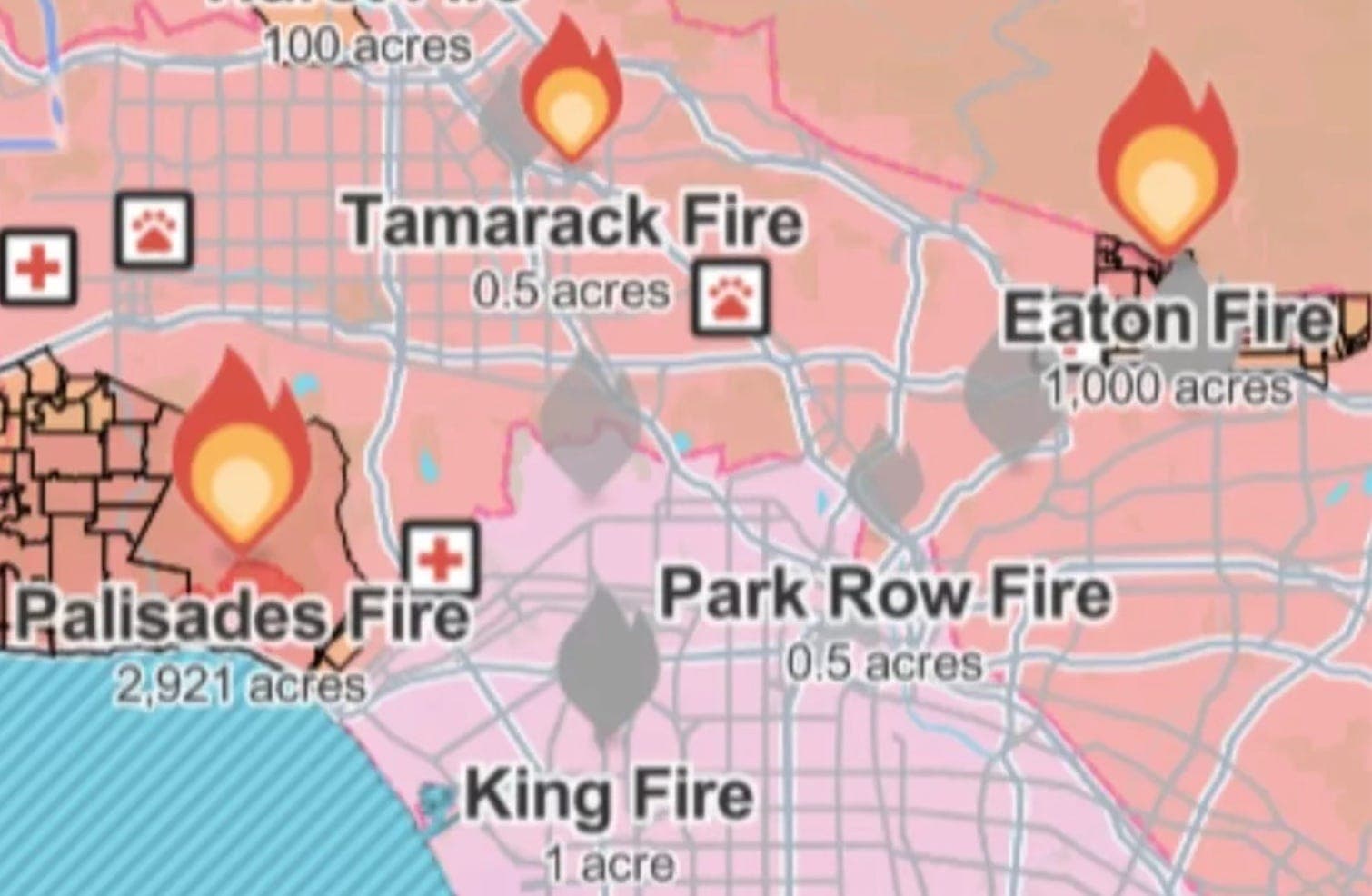
- Watch Duty App: A critical resource that aggregates real-time information about fires, shelters, and evacuation alerts. It illustrates a shift from traditional media to more decentralized, community-driven information sources.
- Comparison with Traditional Media: While legacy media faces challenges in timely reporting due to staff reductions, they still play a key role in storytelling and humanizing the disaster experiences.
- Importance of Local Journalism
- Civic Engagement: Local journalism serves as a crucial source of information and community bonding during crises, illustrating the emotional impact of disasters on residents.
- Maintaining Attention on Climate Issues: Traditional media must balance immediate crisis reporting with long-term investigative journalism about climate change effects and accountability.
- The Role of Technology and AI
- Mixed Reactions: During the wildfires, there was skepticism about using AI for information gathering, with many preferring human sources for critical updates.
- Future of AI in Journalism: There is potential for AI to help with data aggregation, but concerns remain about accuracy and trustworthiness.
- Future Media Landscape
- Resilience in Reporting: There is a need for innovative community platforms that can adapt to crises, such as Watch Duty or localized radio stations that serve as communication hubs during disasters.
- Grassroots Movements: Examples like No Canyon Hills highlight how community-driven media can address urgent local issues while fostering civic engagement and environmental consciousness.
---
Conclusion The episode underscores the evolving responsibilities of journalists in the face of climate disasters, the crucial role of local reporting, and the importance of community engagement in disseminating information. As climate-related events become more frequent, the media landscape must adapt to provide accurate, timely, and accessible information while fostering community resilience and accountability.
Final Thoughts
- Climate disasters reveal both the human capacity for resilience and the limitations of our current media systems.
- Improving community engagement and information dissemination can enhance the existing media frameworks to better serve the public during crises.
---
Additional Resources
- Follow Matt Pearce on [Substack](https://mattdpearce.substack.com) and [X](https://x.com/mattdpearce?lang=en).
- Learn more about Emma Kemp on her [website](https://emmakemp.com) and Instagram [@NoCanyonHills](https://www.instagram.com/nocanyonhills/).
- Support independent journalism and join the conversation at [The Culture Journalist Substack](https://theculturejournalist.substack.com).
---
This episode reflects the necessity for media to adapt in the face of increasing climate crises, emphasizing the role of journalism in community resilience and public awareness.
Written by AI. May contain mistakes. Listen to the episode to check what was said.
Transcript
Automatic transcript. May contain errors.0:22Hey, pals. This is Emily, here with Andrea, and you're listening to The Culture Journalist, a podcast about culture in the age of platforms. So Andrea, what was your experience of the Los Angeles wildfires like? Well, first, fortunately, I was safe. There were a few close calls, but me and my family were safe. But I worked through them. This was my first time covering a disaster as part of a news organization in a newsroom. I guess the only precedent I'd have to that was covering COVID, which I did a lot of reporting around, but I was a freelancer then. So it was a little bit different. We all jumped in.
1:03It was very much an experience of watching the disaster unfold in real time and being in a lot of different chat rooms and coordinating with other people. Now let's add this. Now let's do this. And then for the next two weeks, it was kind of an all hands on deck, dropping all the other work situation, morning meetings, making calls, sending people out, quickly turn around audio, produce, edit, add. And then it became, I'd say for past the first month, even really a question of continuously amassing resources and thinking, what do people need right now? How do they need it? One thing that really became, I think, like a hallmark of our coverage, in addition to just, you know, regular broadcast reporting for radio, were these resource guides that I was updating multiple times a day, still updating, actually, that, you know, amassed everything from, you know, public transit closures, the locations of different shelters that are open, updating when different shelters were full, here are animal shelters, here's where to go find food and clothing.
2:07And then it became adding a section of like how to help, you know, realizing this was a story everyone was following and people just kind of wanted to know, A, the lay of the land? What do I need to know? How do I prepare myself? And then also, how can I help? So then there was a separate resource guide for that that was also continually updated. And then coordinating how we wanted to literally broadcast this information on the airwaves, and then, you know, disseminating it on social media, even down to printing QR codes that we were putting up places and really thinking about how do we serve different communities as the story evolved?
2:42And what is it that they need right now, all in addition to, of course, telling their stories. So it sounds like a very, well, very good work. Thank you for doing that. And also, like, it's very different from like your typical day to day at KCRW. Yeah, very different. But it was really heartening to see how we all just kind of came together and how we overcame a lot of sort of challenges and workflows. You know, they always say like necessity as the mother of invention. And I was kind of blown away at like, how effectively we were able to provide these things. Totally. And of course, you and I were in touch throughout all of this.
3:23But I'm just curious what the experience was like, for you watching this happen from afar on the East Coast, which was very different from my experience. Yeah, it was just really troubling, I guess. I heard that someone say that in LA, for most people who are actually on the ground, you might not have actually physically seen the fires. But for a spectator on the other side of the country, all you saw was like the biggest, most climactic blazes and images, especially on like mainstream media. I can only describe it as sort of like feeling of a piece with the moment of like Trump taking office or something, meaning the sort of general sky is falling feeling and like really adding to that, like what the hell is going on here?
4:11Like the world as we know it is shifting on its axis. Yeah. So all of this has gotten Emily and I thinking climate disasters like the LA wildfires in January and Hurricane Helene last fall, which Emily, I know impacted some people that you care about, they're not just laying bare the realities of climate change. They're also exposing the hidden dynamics of another kind of ecosystem, which is that of media and information. From journalists compiling mutual aid spreadsheets to country music radio shows that became community message boards when the internet went out, these calamities are shining a spotlight on the evolving role of journalism and how we access information.
4:52They're also raising new questions about what that information should be, whose responsibility it is to vet and disseminate it, and what the media of the future might look like. You know, as climate disaster becomes a more regular feature of life, and access to timely and accurate information increasingly becomes a matter of life and death. To discuss all this, we've tagged in two media experts who, like me, are based in LA and have had to confront climate disasters firsthand. One of them is Matt Pierce. He's a former LA Times reporter with experience covering everything from hurricanes to internet culture.
5:28These days, he writes a Substack newsletter on the state of local news and media policy and is a senior policy advisor for the nonpartisan think tank Rebuild Local News. Our other guest is Emma Kemp, who longtime culture journalist listeners might remember from one of our earliest episodes on Ghost Kitchens. She's a researcher and writer and assistant professor at the Otis College of Art and Design, who specializes in environmental media studies. And she's also a co-founder of the non-profit land conservation coalition No Canyon Hills. Matt and Emma join us to talk about their experiences on the ground as both media consumers and producers during the wildfires.
6:07We also get into the sources of information that became essential and those sources of information that just sort of fell away. the limitations and opportunities of AI in a crisis, and how climate disasters will transform both what traditional and non-traditional media look like, and how we understand their role in our lives. We'll be right back with Matt and Emma after the break. California dreaming On such a winter's day On such a winter's day On such a winter's day
6:57The Culture Journalist is an independent project that relies on word of mouth and is funded entirely by listeners. If this pod had something meaningful to your life and you want to access everything we put out, please consider supporting our work by becoming a paid subscriber over at our sub stack. paid subscribers receive access to our discord community the cujo plex full access to bonus episodes and more goodies our bonus ups are where we get personal and experimental recent ones have included a conversation with brandon hagen of vinda bar about what it's like to have your indie band randomly blow up on tiktok an oral essay by emily revisiting her former years as a kim's video clerk and a conversation with teddy brown about the unseen algorithms actually running our world You can get it all right now by subscribing over at theculturejournalist.substack.com.
7:51Hey guys, we are here with Emma Kemp and Matt Pierce. Thanks so much for coming on, guys. It's so good to be here. Thank you for having us. During the wildfires, how did you get your news? I was just at home in my apartment in Koreatown, and I had a sort of different experience of this disaster. This is not my first disaster. I used to be a reporter for the Los Angeles Times. I was on the national desk for a long time, covered a lot of different types of disasters. What was new for me was that I took a buyout from the LA Times about a year ago. And so this was one of the first major disasters that I had lived through effectively as a civilian in Los Angeles.
8:32And it was somewhat bewildering to me because I realized that the experience that I had as a professional journalist in disaster situations, which is much different from the experience that I had as a civilian, part of it was just being inside of my newsroom Slack channels where you would just get bombarded by a fire hose of raw information coming in from a bunch of people who are reporting on what's going on. And you don't get that, obviously, as a civilian and realizing when I hopped over to the LA Times website when the fires were breaking out, it didn't have a lot of information yet. I mean, the LA Times has also been massively reduced through layoffs and buyouts in recent years.
9:12So it has a much smaller staff covering these things than it used to. And they were slow getting into motion. I also, you know, I'm a cord cutting millennial. I don't have a TV in my apartment. And so I had this very strange experience on the first night when the fires were really rampaging through parts of Los Angeles where it felt like I just couldn't really get good information anywhere. And these were fires that I could see from outside of my windows. And I was trying to get some sense of how bad it was and not feeling like I had a great sense of what was even going on at the time. And it was very alienating to me as somebody whose entire career had been built around informing people about what they need to know in exactly these sorts of situations.
9:50I lived in Tujunga, which is a sort of semi-rural neighborhood just northwest of Altadena. And so when the Eton fire started in Altadena, it was traveling sort of towards Tujunga and northwestern paths along the base of the San Gabriel Mountains. And so my household, me and my surrounding neighbors, we were in a text chat group and we all downloaded Watch Duty. And that was really our primary resource. So live updates during the fires. My neighbors and I, we slept in shifts the first and second night of the Eton Fire so that we could make sure that someone from our group was awake and monitoring the act in the event of needing to evacuate.
10:33And so, yeah, that was really our primary kind of resource. For those of us who are not in LA, can you briefly tell us what the Watch Duty app is? Yes, it's an app that's actually a sort of private nonprofit group that started this app and it tracks fire emergencies. It pulls in data and sort of aggregates live updates from evacuation bulletins, evacuation alerts, information coming from the fire department. and it kind of models the scale of the fire for you. And you can really see almost in real time, like as fires are popping up and the app is being populated with information. It was really absolutely critical in delivering information to us in real time.
11:17It's like everything you want in an emergency. And it also has like evacuation shelters and animal shelters and that sort of thing. It's like a centralization tool and it's nonprofit and just run by 200 volunteers, most of whom are former firefighters. I believe, who are like just monitoring channels and like updating you. And just so I understand, like, why were you paying attention to this app instead of like alerts or like text messages from the city? Is it that it collates everything together? Yeah. What was the deal with that? It's a really good question. I mean, when I first downloaded the app, I honestly didn't know too much about the app.
11:54And so I had this lingering question of like, should I sorely and wholeheartedly trust this pandemic that doesn't appear to be verified by any like government agency as far as I could tell with like protecting you know my safety and my lives but it was really the only truly functioning resource that seemed to be available to us in real time which I think it brings up a really good question like as a social body should we expect our government to be able to protect us in moments of crisis you know the city and the county did eventually send out these alert text messages and two of them were sent in error.
12:30And one of them I received at four in the morning when I was like prepared to evacuate and it was chilling. It was heart stopping. You know, me and all my neighbors woke up, everyone's freaking out, the alarms are all going. And we start to look on watch duty to verify the government message. And we're like, huh, watch duty is not updated to say this. That's kind of weird because we've been really relying on watch duty. And then, you know, it turns out that the county message was sent in error. And is it that there's journalists verifying the information on watch duty? I believe there are volunteers that work for the nonprofit that are sort of updating based on like listening into LA fire audio and news broadcasts and things like that.
13:12There are some channels of verification happening on the app because I was also using Facebook groups and the Citizen app, which we can talk about after. I re-downloaded it during the fire because it was, again, this point of access of immediate surveillance within the local community. And if anyone saw smoke or fire, it was immediately published on there and then I would cross-reference it. I was also using the Ring Doorbell Neighborhood app because many people's Ring Doorbells were recording images. And there was a really lively conversation happening on that app also. And so there was a lot of work being done to cross-reference data from these different info hubs.
13:51But WatchDuty had a process of verification that those other apps didn't. Yeah, one of the things that's really, really compelling about Watch Duty and the thing that made it the breakout resource of this disaster was that it's kind of an inversion of the way that, you know, traditional journalism might cover a disaster like this, where your digital news sites and TV stations and newspapers, you know, is leading with stories and quotes and paragraphs of text or maybe images of fires. is WatchDuty is very spatially oriented. You know, you load up the interface and it starts with a map and it's overlaid with the disaster zones because when you're in a disaster zone and when it's your life and your house on the line, it's really like the physical location of the fire that becomes the most urgent data that you have to deliver with people very quickly and transparently.
14:40And so WatchDuty's great success, I think, as an informational product is just that it puts that information right in front of everybody as the base experience of the app. And yet it's backed up by stuff that's actually pretty similar to traditional journalism. Each fire in the app has its team of reporters and journalists who essentially monitor that event and verify that the information being transmitted through the publicly accessible data streams on which watch duty is reliant, checking to see if that's real, because it's true. Public officials did send out erroneous evacuation alerts or the alerts came too late.
15:19And so you did have human beings there on the back end behind the maps and the data who were essentially doing reporting. It's just their work was a little bit more in the background than what you might see on a traditional news outlet that would cover disasters like these in the past. Yeah, exactly. And I should also add about Watch2D that part of why it was created was one of the founders had moved to Northern California and there was a fire near his house and he couldn't believe how piecemeal the process was to get access to information. It's like if you wanted evacuation orders, you had to check with one bureau or jurisdiction.
15:55And if you wanted location of shelters, you had to check a different website. And if you wanted the fire perimeter or like a red flag alert zone, there was a different thing. And part of that is just because, you know, these agencies like primary jobs aren't to make like really good apps and websites and tools like they only have so much staff that can put this stuff together. And so, you know, part of the service of Watch Duty is to overlay and aggregate all these things. So it's all in one place. You know, what else I really liked about the app was that it had live cams. And I don't know, Matt or Andrea, if any of you were watching those, but you could zoom in and click on these cameras that were positioned in close proximity to the fires.
16:34And you could watch in real time live, You could watch these immense fires just like approaching the camera and one by one the cameras would go offline as they were engulfed. And I screen recorded a lot of those videos because they were just sort of these incredible live recordings of fire just advancing towards the camera. The last image the camera would take before it would shut off was just like this wall of like orange flame and then the camera went dead. And that happened one by one to like all of the cameras that were in Altadena. And it was, yeah, it was really, really moving and kind of terrifying to witness that.
17:11But I, that was another part of the app that was kind of important to me. Yeah, what's so interesting about Watch Duty is exactly that it ties together so much publicly available data, which, of course, you know, a lot of us may not spend our days thinking about exactly how much of our exterior lives are being filmed or photographed in a given moment or tracked in some way. But WatchDuty, at least from a public safety perspective, ties together the publicly available government data with these live streams so you can tie together all this data in one really neat package so that you can understand it as a viewer.
17:47And what's really so interesting to me about that as a professional journalist is that this kind of mirrors something that's been happening in some larger high-end professional newsrooms with the creation of visual investigations teams that will, you know, stitch together footage of the January 6th sack of the U.S. Capitol and, you know, tie together all these video cams to try to create geospatial storytelling. and that stuff is some of the state-of-the-art journalism that's being done in a lot of larger newsrooms. And I think what's so interesting about Watch Duty is that this kind of reduces that same concept of collating a lot of available video and data into one place in a real-time stream that's very easily accessible and essentially monitorable by the public.
18:33It's very impressive. Yeah. I was just going to say that I'm a big fan of the work that Bellingcat, for example, does all like the forensic architecture program at Goldsmiths University in London, which are not media organizations per se, they're not publishers per se, or journalists per se, but they bring together groups of individuals really interested in open access investigation and kind of tools for investigation that use geospatial data and mapping and image analysis and new forms of technology and AI in order to piece together intelligence and information in service of social justice. And so I think it's interesting to see like an app like Watch Duty begin to integrate some of those technological kind of processes.
19:21And then, yeah, Matt, to hear you talk about how media outlets or higher end media outlets, as you were saying, have the capacity to be able to also start to kind of integrate those tools into their work. Yeah, it's so interesting. It's the same sort of methodology that you might use to investigate war crimes is something that you can adapt for just regular Angelinos to track a wildfire coming closer to them. Yeah, it's wild. I want to zoom out beyond Watch Duty a little bit, though obviously it's going to continue to be a part of this conversation. What sources of information became essential while this was going on and which felt less essential or sort of fell away?
19:59So I think Watch Duty, of course, which we're talking about over and over again, was really critical. But I thought that this ended up becoming a very impressive moment for legacy media, especially as resources swung into place and the work of traditional journalists started taking anchor, which is that there are political dimensions of this whole disaster in Los Angeles, starting with the fact that Mayor Karen Bass wasn't in the city. When the fires broke out, she was on a diplomatic trip in Ghana, and it was actually a Sky News journalist who cornered her on the jetway at LAX when she finally landed a full day after the fires had broken out and asked her what was going on with the fire response.
20:45And it caught her really flat-footed and unable to respond in that moment and kind of fed into this quick political narrative that was developing that the mayor was perhaps not on top of events as they were breaking out. And this was a storyline that kept unfolding throughout the early days of the disaster. The LA fire chief was heavily criticizing the city for not giving the fire department enough resources to cover the fire. And there was a broadcast interview with Fox 11's Gigi Graciette with fire chief Crowley talking about, you know, did you have enough resources to respond to this disaster and getting a fairly resounding known response, which was a stupefying political event in Los Angeles, you know.
21:26And television, commercial television, you know, often gets criticized in a lot of conversations about local media coverage and, you know, serving the needs of community members sometimes. But it was live television broadcasts that were covering a lot of the dramatic human stories that were happening beneath the data of, you know, people trying to evacuate from their longtime homes in these neighborhoods and engaging in these, you know, citizen acts of heroism. But also at the same time, failed mayoral candidate Rick Caruso phoning in to give kind of complaining television interviews while this was going on.
22:02Like literally soft launching his campaign on local news while the Palisades was still burning. Yes, but not his his shopping facilities in the Palisades. Yeah, while he has private firefighters putting out his little Palisades village. So there's this horrific humanitarian event that's happening and you have tens of thousands of people who their lives literally depend on the success of apps like WatchDuty. And yet also for millions of other people who aren't perhaps in immediate harm's way, the disaster is, among other things, a political and an emotional event. And there's, you know, something beyond the data that's happening there for people.
22:44And something that I found was interesting sometimes, and I would talk to friends or acquaintances about how they were processing information about the fires, you know, apps like WatchDuty were a little bit less significant for them, except insofar as they could give them some geographic idea of what was happening with the fire. But some of them were just told me that they were really interested more in the human stories of what it was like to actually live through a disaster like this because they were not in harm's way. They wanted some mechanism of storytelling to try to give some idea of what this thing felt like, which is a totally different media experience from somebody who is watching the flames approach their house.
23:22Yeah, that's a really good point. I'm glad that you brought that up. For me, who I was covering in KCRW's newsroom, it was a mix between getting information for the folks who needed it. Like there was like the folks that you needed to evacuate. There was like the safety concerns and then there were the human concerns. And like that gradually, you know, over the course of a couple of days, like sort of became one in the same. But I found for me, it really like reaffirmed the value of local news. Like that was the first time I can remember watching local television news in a really long time. because they were there you know they were there like unstoppably around the clock you know just I just remember that first night on January 7th like it started out you know there was like the regular newscast chunks like from six to eight or five to eight whatever you know and then it was supposed to be like entertainment tonight or whatever and things just kept falling away and falling away and they kept broadcasting and they you know they were there and there was that there's very much that need beyond essential evacuation info of just like people being there and telling you what's happening and talking to others and watching it happen in real time, you know, being able to see like, oh, the fire just jumped PCH and it looks like, you know, Palisades High School is on fire, you know, and we would like grab that information and like put it on the air right away.
24:37So having people in a place telling you what's going on, it's an easy thing in our, you know, current information ecosystem to forget the value of that. There was also this moment in the fires when it already seemed like it had gotten about as bad as it could get. There was a new fire that broke out in the Hollywood Hills. And suddenly a lot of people thought that there was this third front opening in the Siege of Fire. And there was this wonderful live broadcast shot of one of the L.A. fire choppers delivering a perfectly placed payload to douse a whole fire line in the Hollywood Hills. And so many people who saw that clip, it was so cathartic to see like the firefighters finally get the upper hand on one and like really kick that fire's ass.
25:28And so that's not something that's like. It really was. Yeah, I remember that. Yeah, it's not something that's like, oh, my God, I need this because I have to evacuate my family. It's more like we're all kind of suffering here and we need some tales of heroism to demonstrate that, you know, the tide is turning and that, you know, we're going to get through this thing somehow and that the indomitable human spirit and our, you know, amazing, heroic firefighters and, you know, all the people who are pitching in to do something about it are having some sort of positive impact. We aren't just solely and completely at the mercy of nature.
26:03And I think that was something that, again, like legacy broadcast. It was just killer at telling those stories. Yeah. I remember there was one house in that same Hollywood Hills fire and it was starting to catch on fire. And it just felt like because, you know, you kind of watch these other fire and the Palisades fire, like just become disaster from these tiny things into disasters in real time, which is also like a horrific thing to bear witness to. And I remember seeing this fire and the helicopters focusing on it. And then you see people arrive and like put the fire out, like just when you were so sure like this, here it is another one, we're watching another one happen in real time.
26:39Kind of circling, you know, back to the question I started with here about what sources of information became essential and which felt less essential and fell away. One thing that sort of stood out to me from that experience was this kind of tension between as far as like the audience need, right? The general public's need is like this tension between what you can get immediately and what you can get accurately. so kind of thinking like what can you get on social media on citizen you know where people just randos are out there like showing videos versus you know verified information that takes a little bit more time that you're going to find from traditional media resources i was wondering if if you guys felt that as well or if you can speak to that a little bit yeah absolutely there's a tension between between like immediacy and like value of the information and then i think there's also a question of sort of the proximity of the audience to the crisis and so for instance Matt you know as you were just talking a little bit about you know the image of the the firefighters and the choppers like drop in the water and and like those kinds of stories are really important and I think that legacy media did a fantastic job of covering the sort of emotional valency of the of that moment but I and I think there's like a different need for the obviously for the folks who are like in trauma mode with their cars packed deciding whether they need to leave their house or not maybe for the last time you know like for those people it's like you don't really like I was in the evacuation mode and so I wasn't really capable of processing stories about it and I really didn't watch any like I don't have a tv either but I wasn't like watching news coverage on my laptop and I was not very interested in being on social media generally.
28:25During those times, I was really focused on just responding to sort of fire intelligence, you know, and notification. Like in terms of information, I was watching, there's a guy named Dr. Daniel Swain. He's a climate scientist at UCLA. And during the fires, he was doing these broadcasts on YouTube, maybe like an hour, two hour sessions every day. And he was really looking at the sort of projections of the fire and fire analysis and I suppose I found that that was where I was going for information but I do think that it's interesting today to in a moment where we are so many of us not only in LA but just around the world we're living in these moments of immense crisis and trauma pretty frequently and I think there's a distinction that needs to be underscored between the roles of like different forms of media and so I think the legacy media plays a really important of role in culture and society, which obviously is delivering news to the public.
29:20But I also think it's about analysis and investigation and critical thinking and reflection and storytelling and, you know, holding power accountable and all of these things. And then I think there's the type of new media that is emerging, social media, crowdsourced media, app technology, which is really about delivering data in a really digestible and immediate way. And I think, as we've discussed, Watch Duty is a really quite a successful example of that. And then I think there are less successful examples, as you pointed out, Andrea. Citizen app, for example. Yes, there's an immediacy in the sense of someone down the street is witnessing something and I get to see it as soon as they upload it.
Read the full transcript
29:59But the veracity of that information is questionable. And there's a big downside to that kind of app.
30:08If you like what you're hearing on this episode, there's a place where you can join the conversation. It's called Cujoplex, and it's a private online hangout zone on Discord where smart, cool weirdos just like you, you know, people who like talking about the evolving state of independent culture, can congregate, share links, and talk about the news of the day. We've had some great conversations lately about creative economies, media theory, AI, politics, the future of journalism, and even the records and TV shows we've been obsessing over this year. Some of our chats have even inspired episode ideas.
30:44You can get access to Cujoplex along with our monthly bonus episodes by signing up for a paid subscription over at our Substack. That's theculturejournalist.substack.com. Were there any media sources that you all normally pay attention to that you just like completely kind of tuned out during that time? It's like, this is going to be all garbage or something. Oh, oh yeah. I had an embarrassing TikTok addiction on the first night of the fires when I was still trying to figure out. And I hadn't learned about Watch Duty yet, hadn't downloaded yet. So I was like in the proverbial wilderness. And so at one point or a couple of times, I cracked open TikTok, which, of course, is dominated by its algorithmic recommendation feed.
31:32And it was just totally hopeless and clueless. Like at certain points, it showed awareness that like a gigantic disaster was immediately around me. But it was serving me up kind of junky videos about it. And then it would serve me up something completely unrelated when I would swipe the video. And I had this really vivid sensation on that first night of the fire when I was swiping through the TikTok app, realizing that TikTok did not care whether I lived or died. And I at one point also popped over to X, the new sort of Vichy version of Twitter. And it was like just loaded up with conspiracy theories and fear mongering and a lot of like right wing trolling in particular, which has been encouraged under Elon Musk's ownership.
32:25And that used to be the place for breaking news journalists, including myself, to go gather and share the latest information. It was really invaluable as a source like that over the previous decade. And I got on there and I was just like, this is awful. I mean, it's mostly for right wing opinion formation, which, you know, if you're a right winger, then like that's really great for you. But for most people looking for anything else, it was pretty, pretty useless. And so that was another really interesting experience from this disaster was, you know, in those moments when I look towards social media.
32:57I mean, so many of our social media platforms now are dominated by pretty heavy handed algorithmic recommendation engines. And that's such an interesting curatorial decision in a disaster situation. I guess not even a curatorial decision, it's just a business decision by the platforms. But, you know, one of the most important things in a disaster is chronology and timeliness and getting the newest information the fastest and the latest. And that's no longer how our social media platforms are set up because over the past, you know, five to 10 years, they've been switching over to recommendation algorithms based on engagement and other factors.
33:35And that is something that I think perhaps people without even realizing it has altered the way that they encounter disasters on social media when they're on social media. So overall, I give pretty, pretty poor marks to the social media platforms overall as breaking news resources. But I did have a couple of friends who said that their number one favorite combination during the disaster was WatchDuty app with the Reddit threads for the Los Angeles subreddit. And that turned out to be a favorite pairing for some people because a lot of that was very heavily human curated. Makes a lot of sense. Yeah, I'm so glad that you brought that up, Matt, because, yeah, for me, I'm not a big TikTok girl, but I am admittedly a big Instagram girl.
34:21And I just, like, barely went on Instagram. I'd go on it periodically to, like, do my due diligence, like, from a work perspective. But what it really did was highlight to me just how willfully insular the narratives of social media have become. And obviously, like, we all, you know, intellectually know that, but we can't escape it either, right? They're such a regular part of our lives, whether you're, you know, helping create the news or you're just someone consuming it. And just it was it was almost it was like a tonal difference. It just was like this this gut feeling of like nothing I need is going to be here.
34:55Like, let's let's go back to the real news, you know. And I just I just found that realization to be kind of particularly interesting. It really underscored something we all think about, but maybe don't give enough credit to. writing for semaphore the ceo of the ankler janice min lamented that the wildfires quote exposed a ravaged los angeles media ecosystem she wrote this is kind of a long quote so bear with me in my multiple text chains was the constant question what's the best place to get information the answers were a hodgepodge of new apps and websites watch duty genesis wildfire viewer Google Docs shared by neighbors about what burned down, Roan drone footage and Instagram reels.
35:39Not once did anyone cite a Los Angeles media outlet, save for old school local broadcast news channels. Setting aside the fact that this is perhaps insulting or this is quite insulting to the journalists who were reporting their hearts out during the fires. Do you agree with this reading of what media should look like in the event of a crisis? like there should be this sort of like centralized sorts of information that is a legacy media and that those sources of information in this case failed? Or do you think that this leaves something to be desired? I think there's totally two sides to the story and two ways to view that particular experience of the fires, at least from a media perspective.
36:14The first off is that legacy media has been hammered. And I'm talking in terms of its employment levels of local journalists, its ability to respond and cope quickly to huge disasters that are novel in character and require some adaptation by your newsrooms. That's a place where the long-time shrinking of the business models for television, for newspapers, really hurt you when you're trying to swing into action during a really uncertain situation like this. You just have less productive capacity to be able to adapt to and respond to and deliver the absolute best stuff when it really truly matters.
36:55And so that's something that's also real. But the other thing is real is that information consumption, you know, especially in the United States, but also basically everywhere these days, it's an environment where a lot of the risk and the responsibility for knowing about a disaster and getting information about it has been shifted from institutions onto the public and onto individuals. And so, you know, it's kind of your responsibility to go figure out what's going on with this fire that's burning, you know, a couple of neighborhoods over from yours. It's your responsibility to go decide what kind of website that you're going to go to to get information or what app to download.
37:31You may have some extremely limited and sometimes erroneous situations where public safety officials will send an emergency alert directly to your device. But otherwise, we live now in this very risk-shifted information environment where, you know, in the old days, you'd be watching three TV channels and each of them had news departments that would cut in and deliver the latest on a big disaster in the area. Or if you were just getting it through a newspaper every 24 hours or so, even if you would just subscribe for the sports section, you know, news about the disaster would be on the front page.
38:05This is a world now where it's kind of on you to figure out what's going on with this disaster. And information consumption is also a muscle. It's on you to decide whether you're going to go seek out good sources or to find those good sources or to hear about them or whether you're just going to kind of flail around because you've just gotten out of the habit of reading traditional news sites that might be providing that kind of information. So I think that's something that absolutely cuts both ways. You have newsrooms that have much diminished capacity to cover these events, but you also have consumers who are basically responsible for their own informational welfare.
38:40And a lot of them aren't very good at it. hasn't that kind of to a degree always been the case though it's just there's so many more you know quote-unquote options for them now than there were before there are and there aren't you know what i mean like you said like before it was just like there's the newspaper and like the radio station and like a handful of tv stations and now there's a multiplicity of options so is it really like i mean even what i'm asking cuts both ways but i just wanted to flag that no i think it's Totally true because like it always, you know, you had some basic degree of responsibility to be aware of your environment.
39:13But I think what's different now is that a lot of our sources of information, I mean, this is kind of basic, but like a lot of them just aren't even based here. You know, you might in the old days have a locally operated and locally owned radio station or a locally operated and locally owned TV station where the matter of a fire in your environment is a direct, immediate concern, both to your listenership, but also to the ownership of the people who work there. But if you live in an environment of like informational platforms, those companies aren't here. They're elsewhere. They're operated by pretty hands off and absentee algorithms.
39:48And I think that like my experience of encountering the platforms that now deliver, you know, a large percent of my informational diet is that they kind of don't care about this stuff. and they kind of have abandoned a lot of their civic mission that I think you would still see attached to more 20th century forms of media. And, you know, some of that might be the lack of FCC regulations on internet companies the same way that traditional broadcast companies might have. Some of it is that I think these companies genuinely are less responsible than what we had in the 20th century. There's just less civic spirit.
40:21It was funny, just a quick interjection. And when you were describing Watch Duty, I was like, where do we have anything even resembling that in the traditional media anymore? And I was like, the only newsroom I could think of that could like anywhere get close to like simulating something like that would be the New York Times. In terms of like the amount of resources they have and the ability to generate these like rapid fire timelines and stuff. Like they're not in L.A. I wonder if it opens up like a new way of like kind of imagining the sort of depth of rapport and all the possibilities for legacy media, you know, because I do recognize that like a ravaged LA media ecosystem, I know that was the quote.
40:58It's a little bit of a disingenuous way of, I think, framing it. I mean, the LA Times has been really gutted out, has matched most very well over the last few years. And I think I was reading, though, that during the first month of January, so during the fires, that its site visitors went up like over 100 % compared with December 2024. And it's like a 50 % increase from last January. So people clearly were looking to the Elish Times and to our local paper for news and guidance during this catastrophe. But I also, you know, I recognize that media apps are able to be, they're more nimble. They can respond quickly because they don't have to craft story in the same way.
41:48And I think what reporters and journalists are really good at is crafting a story that gets, you know, to the heart of an idea for a moment and communicates something about it to the public. And I think that's, you know, that's what worries me about any kind of loss of legacy media is that we're losing that kind of in-depth reporting and storytelling. But maybe if the media apps take on the sort of direct notification kind of mode, it maybe allocates more time and resources to in-depth reporting. Totally. I think there's a kind of a negative space surrounding that Janice Min quote that you read, Emily, that I think is worth acknowledging.
42:29You know, where she said that, you know, not once did I see anyone cite a Los Angeles media outlet, say for old school local broadcast news channels. And I read that and I was like, besides the L.A. Times, what is she referring to? You know, there's not the L.A. Weekly anymore. I don't really see that as like the role of L.A. Mag. I mean, they're a magazine and they have a digital presence, but sure. But, you know, there's the local TV stations and there's the radio stations and the LA Times. So I don't know what else she was expecting people to even cite, which I also think speaks to the larger picture here of information access and why we're seeing people turn to these alternatives so much.
43:09Or maybe it's like she was just a giant subtweet of the LA Times because she's the CEO of the LA Times. Jen now runs a competing entertainment news business. So perhaps this is not completely and utterly. No, I mean, I think I think there is something true in her remark in the sense that, like, especially I mean, if you if you're an older Angelino, you remember when the L.A. Times was much more of a hegemonic news source for the city. And that's just that's just not the case anymore. And there is a lot of different types of media in L.A. now and mostly smaller. And I think that limits the ability of people to have a shared source of information about these crises, which in a way is like I saw this all the time when I was covering disasters elsewhere as a journalist for the LA Times.
43:57But like really one of the things that happens in disasters like these, that they do become civic bonding events. And very often it's radio, for example, or broadcasts that become a kind of civic rallying point for people whose entire lives have been upended. And so that actually is one of the great strengths of 20th century media, especially compared to, you know, more contemporary forms of social media, which is that they are a gathering place and they do serve that role as a rallying point or maybe a discombobulation or recombobulation zone after a tremendously upsetting event. And I should say that my sort of criticisms of the first night of LA Times coverage being a little shambolic, I mean, they very quickly then got themselves into motion and been delivering a lot of like incredibly important investigations and other day to day news updates since then that I think have been reflected in the fact that the audience stats have been ticking upward.
44:55And I just wanted to add on to what Matt was saying there about the notion of civic bonding during catastrophe, during crisis, and kind of attach that to what we're talking about in terms of the reorganization of our media landscape. Because I think that with the rise of social media, we see citizens, users, readers becoming active participants more and more. And one thing that I noticed about this particular scenario was that many of my community members and friends and neighbors, as much as we were using apps and media to get information, it didn't really feel like enough to just get information.
45:31And so a lot of the role of the apps that we were using was to organize response efforts. And I think that also speaks to a lack of function on the part of the centralized agency to deliver aid. Although I think that it's happening now. But in that immediate moment during the fires, everyone was really organizing how to help with evacuations, how to deliver food to people. you know just like lots of energy and momentum occurring in various instagram chat groups and threads and whatsapp groups to help organize and then it was interesting seeing sort of the la times and the new york times actually pick up on that and some of the work was written about so yeah i thought that was interesting yeah there certainly were a lot you saw people using the internet for good you know actually i would love to just pounce on instagram all day every day go after it for things that I think are bad.
46:28But no, I think actually Emma touched on something where Instagram in particular does play, I think, a really positive role later in disasters like these, which is that when you have the power of publishing in the hands of local businesses and local nonprofits and other civic leaders, I'm talking like maybe when the immediate crisis is passed, that stuff becomes like a really effective nexus for all sorts of community organizing and community updates. And I should actually, for all that I would, you know, condemn Mark Zuckerberg for everything that he's done to us, that is something that I think has been very positive in sort of later stages of disaster recovery.
47:08Yeah, I want to circle back a little bit to the original question here. Should we be conflating the media, how we've traditionally thought of journalism, among its other responsibilities, storytelling, getting people information, is centralizing the plethora of information that is now out there in our contemporary information ecosystem, also the responsibility of media and journalists? Or, you know, who is the onus on when it comes to finding and centralizing this kind of information, especially because how much there is and how many disparate sources there are, just the act of bringing all these pieces together has kind of become its own additional form of labor?
47:48Yeah, honestly, I look to our hegemonic monopolistic technology platforms to take a little bit more responsibility in trying to feature the high quality local information and environments like these, because I do think that the ability to try to reach all of the public and to be a tentpole for, you know, every Angeleno or whoever else in a disaster zone has been affected like this. It's literally beyond the capabilities infrastructurally of any news outlet that exists today or is going to exist tomorrow. I mean, how we encounter information now is heavily determined by third-party companies that make billions and trillions of dollars off of controlling that access to local news outlets.
48:33And so I don't know, you know, in the United States, we don't really have a tradition so much anymore of having government regulation force companies like that to host information. You know, there used to be some pushes along those lines with the Federal Communications Commission in the 20th century with broadcast. And that was premised on, you know, broadcast airways being a limited resource that had to be regulated. And these companies were perhaps common carriers or things like that. We don't really have that same kind of legal regime for giant tech platforms. So we should talk about that. I mean, if we're going to have these monopolistic platforms that control the information that we get, I do think it's reasonable to expect that in situations like these in exchange for allowing them to continue to exist as monopolies, then yes, they should have some greater civic burdens for trying to be an affirmative source of, you know, quality information in this kind of environment.
49:26Yeah, I think I agree with Matt. I mean, I but I also I just think we have in the U.S. especially such a fractured and sort of fragile relationship to authority and to like trust in authority. And so when I think about trying to centralize across these various distributed modes of information and hubs, you know, the question is like, who do we trust to do that? And who will the public trust to be a centralizing force? And I think it's a really important question. And, you know, as Matt suggested, yeah, perhaps the onus and the responsibility and the funding probably should come from the tech monopolies.
50:08But again, it's like, what do we risk by having them aggregate? And it brings up questions of censorship and access and who is compiling and what is being compiled and what is being shown. And so it's a really fascinating question. And I don't think there's an easy answer, but I don't think it can be the responsibility of the media outlets itself. I think that's the legacy media, traditional media, whatever we want to call it, is under-resourced and overburdened as it stands. And I feel like asking them to also do the work of aggregating various sources, that doesn't quite seem like it should be their role.
50:47But I don't know exactly whose role it should be. Well, it's interesting also that people in a time of crisis will do this work for free, or they'll just take it upon themselves out of the goodness of their heart. And I'm not saying that should be the case, but it's also acceptable for people who are not professional journalists to want to join in and want to help, right? And a lot of those people did help. And I wonder if there's a conversation to be had about giving people more actual tools to do like their own authoritative reporting or if that... I've seen like conversations about this like in traditional media as well.
51:24Like, is there sort of a moment where the media also views itself as an institution that teaches the public how to newsgather if they want to do so. Annalie, this is one of the great, I think, dichotomies and dilemmas of the information environment in a disaster situation like this, because what you'll see in a disaster is literally the best of human nature. I mean, often in other types of disasters, when there's a tornado or an earthquake or something and your house gets knocked down, you're most likely to get rescued by your neighbor rather than the fire department or the National Guard. I mean, Rebecca Solnit has written a book about this paradise built in hell that talks about humans' tendencies to band together in disaster situations and how we often overstate the risks of, you know, what you might otherwise think of as a quote unquote lawless environment.
52:19And I think you can absolutely see that with something like Watch Duty, where you will have some volunteer labor contributing because people really believe in it. But on the other side, the consequences of a totally decentralized, individualistic information environment is also reflected in the media that we also currently have on social media, where you have places like X, where there are crisis entrepreneurs will use a disaster to gain attention and literally make money. And it's so funny that like a lot of very valid criticisms of the profit motives of 20th century media companies have only become even more hyper concentrated with social media and the creator economy where individual content creators are far more directly exposed to market forces than 20th century media outlets ever were.
53:14it's like a really brutal assigning editor sometimes you can just see directly what gets engagement but i did i did want to touch on something that emma emma touched on where the united states is an outlayer i mean the whole world is experiencing this phenomenon with the shift to more fractured information environments but one place where we do still stick out is the fact that like we don't have a really well-funded public broadcaster the way that a lot of other advanced democracies do. You know, the BBC in Britain, the CBC in Canada, ABC in Australia. You know, the Australian Broadcasting Company, part of its mandate and its charter and its mission when they're justifying why taxpayers should be funding a massive public option in an age of, you know, abundant information is exactly for its availability to be an emergency informational resource for all parts of Australia, including places that are underserved by traditional market media.
54:16And that's something that we don't quite have in the U.S. I mean, we're massively underfunding the Corporation for Public Broadcasting. That means the grants that stations like KCRW are going to get a lot smaller than what they might be in other countries that have a higher priority of having a public option in situations like this. And so when we have a conversation like this about the media and its responsibility and its role in a disaster like this, It's also contained within this very narrow intellectual framework where we're talking about a country that has left it to the private market and to individual actors to try to make the best of really bad situations.
54:53And it should be noted that most other countries choose not to have their information environments structured precisely like this. That's a really great point. And given all this, what did the wildfires to you reveal about the role of the journalists specifically in the times of environmental crisis? Was there a way in which they helped kind of clarify the purpose of journalism for each of you? I don't think the wildfire clarified the role of climate journalism for me in any kind of way. I think that the reporting that has occurred subsequent to the giants, specifically around Karen Bass and the sort of emergency response systems that we have in place and the sort of relationships between our civic infrastructure and our local governance and our broadcast systems.
55:47I think the reporting that's happening there is really important and really powerful. There's been one or two good articles that have emerged on the role of climate catastrophe and climate change in terms of or in relation to this particular megafire incident. and another really good article I read, I believe, I think it was in the New York Times actually, about sort of building in, you know, building in vulnerable, fire vulnerable areas and the role of sort of L.A. city planning and how we, you know, how we kind of build and develop Los Angeles and how that contributes to these kind of catastrophes.
56:31So I think the report in there is really strong. Again, I think it's a distinction between these kinds of stories and investigative reporting and those sort of in the moment media sources that we're looking to during the fires themselves. I've spent a lot of time thinking about this one, again, just because it's been so much of my life for the past couple of months. I mean, I've felt more focused in my work than I have in a very long time and about the role of a station like the one I work out or just the role of local journalism specifically. And, you know, I think one of those things is like telling telling people stories like that's one thing that there's no incentive for, like elevating stories that are otherwise not going to get heard and experiences like through climate disasters that are not otherwise going to get heard unless there is some kind of, you know, algorithmic or financial incentive attached to it.
57:26you know, the way that people are impacted by these. And that's one of the things that like, we really focus on at my workplace. Like we're not really a breaking news organization, but taking the long view, looking at things like cultural impact, being on the ground, you know, with folks whose stories would otherwise get overlooked and making sure they stay in the conversation and are being incorporated into the broader public narrative. Like I see that as something that that kind of only journalism can do. And feel free to push back if you guys disagree with me, because again, I'm coming at this from like a very subjective perspective, right?
58:03And also going back to the centralization thing that we were talking about, like I actually kind of do for better or for worse, think it's now a journalistic responsibility to be helping centralize information as it comes out, like the kind of refrain that I had while the fires were still going on was like, I'll be the person with 72 tabs open so you don't have to be, you know, and it started with like kind of putting out the default, like I think every news outlet out there had like kind of a basic thing on their website that was like, here's the emergency numbers, like here's a link to like Metro and like all the road closures and all that kind of stuff.
58:40And, you know, here's where you can track what's going on with the fire department and blah, blah, blah. And, you know, most outlets like fell away, you know, within a couple of days of continuing to update that stuff once the initial information was out there. And we kind of made a point of continuing to exhaustively update our resource guide daily for at least a month. And I was completely blown away by the amount, and again, I'm not saying this to be self-serving, it's more just kind of something I was genuinely surprised about, like how much response that kind of thing got and how appreciative people were at having a consistently updated, categorized place, especially like you know when people are dealing with being outside of their house and like no longer having any belongings and stuff like that and and having a dedicated space to go and just kind of find links to all the information if nothing else um and i think that's part of like the what the role of journalism has become is like sifting through and collecting and vetting organizing and making that information as useful to the public as possible when there is more information than ever like it's kind of its own form of journalism now in my opinion should it Should it be?
59:48I don't know. But I think it's just a fact of the reality. I mean, this is something that I got really interested about because, you know, sifting and analyzing and synthesizing. This is the province of a lot of artificial intelligence development these days. And so I sent out a survey to, you know, subscribers of my Substack and friends just to ask, like, how are you using artificial intelligence during this disaster? Because, I mean, the fundamental, like, I don't know, crisis that we're all living through every time you crack open your phone is we're all in an environment of massive information overproduction.
1:00:24Like, the human brain cannot possibly process all the information that is available, nor would you know how to find all of it. And so this is the great promise of, you know, technologies like AI. But I was just curious, given the amount of AI take-up there's been in the consumer marketplace, people are using it for all sorts of little stuff these days. and sometimes bigger stuff. I was very curious to see, you know, how people were using AI, if at all, during the fires. And the responses I got were really interesting because it mostly showed a drop-off in how people were using AI to sift through information.
1:01:01Like people mostly weren't going to chat GPT or Anthropic to try to suss out information about the fires. They felt like pretty strongly that they wanted to get information from a human. They wanted to know that there was a human being on the other side of this data collection who was making decisions about what they were going to see. And they were largely avoiding algorithmic sort of meddling that, you know, they didn't know whether the information was accurate. And so there were a lot of kind of embedded beliefs that artificial intelligence summaries of the information that's scraping may not be accurate.
1:01:40And so it should be noted that when the shit was hitting the fan that really mattered, people turned away from AI because they saw the technology as unreliable. The one place where there was an exception to that was I also asked about people just using social media with AI powered recommendation algorithms. And that was the part where there wasn't a drop off in usage. You know, people in terms of the stories that are being told or videos being elevated, you know, social media did have some staying power for people, even the heavy handed recommendation algorithms, which I count as a version of AI, even if it's not.
1:02:19sort of commonly talked about that way. So people were still kind of using the technology for its curatorial and sorting powers, but they were way more skeptical when it really counted of, you know, synthetic summaries and things like that. Yeah. I wonder, at least with social media algorithms, it's like, it's sorting the opinions of people as you see who is saying what. And I wonder, like, even as you know there's conversations in in in ai currently people are working on models that like have citations for example but even then i don't know if people would i don't know if people are going to trust it i don't know if they'd ever be able to trust it on the same level as like an expert or a journalist i think it's really it's really fascinating um just to know the sort of skepticism and you know rightly so the skepticism that we have towards uh ai summaries in terms of the accuracy of data being presented to us when we use chat gbt and yet the sort of willingness to consume information that is presented by non-expert humans on social media um i and i assume and i'm just guessing here but i assume it's that we as humans believe that humankind generally is operating from a position of truthfulness or a sort of you know that people have a sort of moral compass and ethically uh attempting to share correct information even if they're wrong about it um and we don't extend that same kind of leniency moral ethical kind of relation to that to the ai uh but i i will say that during the fires you know i wasn't really watching reels and stuff on Instagram, but I occasionally, if I went to the dark place and they did go there, like a lot of the information I was receiving was incorrect and it wasn't incorrect on purpose.
1:04:14It was just, it was misinformation because it was non-experts who were taking up a public platform to share advice, do this, do this, don't do this. But actually, because I was involved in other communities that did have experts, I knew that that advice was erroneous, although I'm sure many people didn't. So I do find that just interesting kind of anthropologically. Oh, yeah. People are wrong all the time. I actually, there was, okay, so I want to talk about really specific AI usage that fascinated and kind of worried me. So specifically, there was a really big information gap after the immediate fire disaster where people were like the air outside.
1:04:56Is it safe to breathe? Do I need to have a mask on? Yes. Yeah. Like, am I going to get mesothelioma because of the asbestos? Like, am I breathing in somebody's house? Am I going to get lead poisoning? And this is the thing where like it's basically beyond the clarity of even the best experts to provide precise information about the level of risks, partially because first off some of this stuff you kind of don't truly know exactly how dangerous it is second off like you don't know the precise level of exposure or risk you have at any given portion of the city is the soil more toxic here is it less toxic here am i safe if i'm farther away from the fire is the aqi reading for traditional like la air pollution is that a reliable stand-in for knowing if the air outside is poisonous.
1:05:48Like this is something that is basically beyond sort of immediate measurement for each person who's making health decisions. And so I had a couple of people, you know, saying that when they did use AI, sometimes it was for like health advice where they're trying to ask the AI, like it's a doctor, you know, okay, given all these factors that I'm such and such far away from the fire and this is the stuff that's in the air and that's burning, you know, How much risk am I in? Because I think it's a question that no one has an exact answer to. And even the answers that you will get from experts are sometimes conflicting.
1:06:25And that was really one of the huge information gaps that I'm still wrestling with after the fires, where that whole moment where the city was like, is it safe to breathe? And I still don't, I couldn't still give you a confident answer here, you know, a couple months later. it's really something that struck me and how people are trying to get information that basically wasn't there yeah i'm so glad you brought that up because there was also i don't know if you guys noticed this but i think there's kind of this phenomenon of like people not wanting to take yes for an answer like if they would hear on one climate panel you know top top top experts like people that were deep in the you know trenches of the maui fires and all that saying you know as long as you're 10 to 15 miles away from the burn zone like you'll be fine i'm in chat groups and I had friends that would like, you know, hear that and read that and be like hearing that they were safe made them not believe it.
1:07:17You know what I'm saying? I find that to be like symptomatic of the information ecosystem. Like unless you're hearing bad news and that you're like totally screwed because we're so acclimated to that urgency. I find that people are just going to want to keep consuming and consuming until they get to the result that seems the most doomed. You know what I'm saying? I think it goes the other direction, too. It's also people want to be told that they're OK. You know, they want to be told that it's OK to take your mask off. You don't you don't have to worry too much. And like that's a really wild space to be in when you're making decisions in a sort of low information environment.
1:07:49It's weird. There's so much so much data and so low information at the same time when you're facing a question like that. Emma has rightly pointed out in the comments that it probably hasn't been safe to breathe in L.A. for decades. That's what I've weirdly taken comfort in. So looking forward, as these sorts of climate disasters become more and more frequent, how might climate disasters like the LA wildfires, like Hurricane Helen, transform what media looks like, both traditional and non-traditional, and how we understand its role? Can you imagine things just almost shifting as a result of the need to cover more and more of this stuff, or this happening more and more?
1:08:27I mean, I imagine that the local government agencies are looking at apps like WatchDuty, you know, hopefully, ideally, wondering how to kind of scale that at the local government level or to at least invest in it or to have some kind of relationship with an app that can be kind of trusted at that scale to do that kind of media work in terms of data delivery in a crisis. I think that we're going to see more and more people trying to become involved in their community broadcasting. You talked a little bit earlier, I think, Eldrea, about the notion of like citizen journalism and what that would look like.
1:09:09And I, you know, I think it's we're right to be wary of arming all of the citizen users with a high tech microphone and camera. But I do feel that more and more we're in an environment where people are skeptical and resistant to kind of legacy authority, really, and challenging it. And I imagine that one way that might be reflected in our media landscape is just that there maybe will be more kind of localized and smaller kind of groups emerging from within communities. then I think the work needs to be done to make bridges between folks who are experienced and like reporters and journalists who've been doing this work for a long time and have a lot of knowledge and understand how it works.
1:09:56There needs to be bridges built between those things. Otherwise we do it we end up in a really dangerous place so we have you know all prepared or unprepared people presenting facts that are not in fact true and that can be very harmful. And the line is also between, you know, legacy media and new media or whatever is just becoming also increasingly porous. Like most journalists do not have staff jobs anymore. They're working on their own and they have that training. But yeah, I don't think we can make that hard divide anymore. So like, what do we do with that? I was thinking even of how the LA Times, the Instagram kind of report in the LA Times 404 platform, which is a sort of interesting bridge, right?
1:10:38Because it takes the legitimacy and kind of credentials of a legacy media like the LA Times and it extends it to a much younger kind of audience using Instagram Reels as the sort of publishing format. And the reporters tend to be younger and very social media savvy and are reporting in a manner and a style that is accessible to a younger audience. Like I see that as an interesting bridge. And it was one of the kind of cool things that LA Times has done is do that. And I wonder, I don't know, are there other examples that anyone here sees of sort of legacy media making a concerted effort to bridge in that same way?
1:11:19Yeah, I mean, I can't think of any off the top of my head. I wonder if it comes back to the case for like publicly funded journalism, where a few view journalism as being in the public interest, especially in a time of crisis like this. that's obviously a reason to back that idea. And also it doesn't have to just be, you know, giving money to the LA Times or whatever. It can also be funding, you know, civic organizations that teach citizens how to do this and pay them. Yeah, this is something that I now spend a lot of my time on exactly because the United States, relative to other advanced countries deeply under-invest in terms of how much it spends on public media and public interest journalism.
1:12:05So that's something that obviously needs to be corrected. Because I think in a situation like this, infrastructure is the whole bald game. I mean, one thing I'll say for larger traditional news organizations, which rightly come under a lot of criticism, the way that many institutions do for not being sufficiently responsive, is that having a division of labor, having different reporters on different beats who aren't having to respond always to like the big thing of the hour gives you the opportunity to investigate the long tail of these disasters. Because remember, like the disaster isn't just when the fire is like literally burning, but you know, in all the air that you're breathing afterward and the people who lost their houses and what happens to the insurance markets and the way that people process these disasters, not just what happened, but who is responsible.
1:12:51And if someone is responsible for how bad it got, what are the kinds of decisions that policymakers could make to try to alleviate the next one of these disasters from being as bad? And so having, you know, built in reporting staffs, having established audiences who know to look to you for information when the shit hits the fan, all of that stuff is the whole ballgame, because otherwise you have something that's more like what we have now, which is an increasingly depleted information environment that's increasingly fractured. There's just not a lot of flexibility and capacity there to respond the next time one of these things hit.
1:13:28I will say one piece of good news, though, which is I think that watch duty is thinking of expanding to other types of disasters like flooding, for example, or maybe maybe hurricanes, which is something that would be more geographically distributed across the U.S. in particular. So I think there are, among the success stories that we do have, there are ways to replicate them for other communities and to help build up that infrastructure so that you don't have so many people flailing around when the next totally unexpected event happens. There are ways of preparing even for things that you don't know are coming.
1:14:00I think where this question gets really fascinating and kind of next level is when you think about the possibility that like, you know, L.A. had the Internet, at least. But over here with Hurricane Helen, there were like large parts of North Carolina around Asheville where there was no Internet. There was no cell service for days and days and days, probably weeks. And people still found ways of sharing and transmitting information. And one example that I find very touching, my partner and I, he's from North Carolina, so we were kind of like tuned into this. There was a radio station. I think it might have been like Kiss FM or something, but like a digital Kiss FM country station that just like stopped its regular programming and turned into like this radio message board thing where we just be people calling in one after the other being like, hey, here's what's going on in my town.
1:14:55This road is closed. This road is open. Or people calling in and saying, hey, I'm looking for so and so. I'm actually calling from Colorado and I'm looking for my friend who lives in this specific town. If anybody knows where they are, can you call into the show? And it was just like such a pared down example of what media could look like. But I found it very beautiful. And I don't know, it got me thinking about like, does this mean that we need to start creating those kinds of resources right now? You know, or like building that in our local communities, like citizen radio stations, for example, that could serve as resilient in a time of crisis.
1:15:33Yeah, I love that story. Like that makes my heart feel so full. I mean, one thing we were talking about, again, I'm not trying to keep making this about the radio station I work for or anything. But, you know, one thing that gave us a lot of clarity was just like, of course, there's like all these Internet radio stations out there and this and that and social media. But it was not lost on us, like the value of having terrestrial radio stations. towers. And, you know, there were power outages and internet outages and all of this, you know, not nearly to the extent that there was, you know, in Nashville and Helen, like it, there was a gravity of like knowing that like we could just kind of keep going and like we would be available for people to tune into like kind of no matter what happened, as long as they had, you know, a couple of batteries and a radio or like whatever kind of access to that, like the signal is strong.
1:16:19And it just felt, yeah, it was a kind of like simplicity that I think like brought kind of a lot of focus to the work of like ultimately like you just got to keep putting information out there so people can find it on this one channel in addition to the million other channels that we were trying to navigate circling back to like let's meet all the audiences where they're at wherever they're at while we can but it was nice knowing that like ultimately this service was still there does that make sense yeah it makes sense and it's really haunting and it you know it's like similar i think to you know how i was on on the watchdue app how i was watching those those cameras that were just they were just broadcasting and overtaken by the fire but it similar kind of resonance to what you're talking about that just this you know the image in my mind of just you broadcasting and you know even if just one person has has some batteries left and gets to hear it they're not alone you know i think that's the human kind of element of of reporting and of communicating of reaching someone right that's like why are you at the core of it like you're trying to connect with someone out there in the world and be useful to them in some kind of way and that's at the heart you know of what we do exactly there's a real like almost like selflessness to it it's like the whole reason some of these mechanisms or media kind of were started was was to be like a beacon of like there's other people out there right i think that's why like in more remote areas that's like why people still listen to radio and stuff like that it's corny but like a lot of it does come down to like that just fundamental like connection that that provides emma i'd love if you could tell us a little bit about your work with the no canyon hills project but also what can it tell us about what a climate resilient media platform might look like yes uh so no canyon hills is a it's a group a grassroots non-profit group and movement and eco-media platform.
1:18:09I started with another person named Mateo Altman almost two years ago, and it began as a sort of direct response to the impending destruction of a mountain here in Tujunga, a range in the Vadugo Mountains, over 300 acres of the Vadugo Mountains that a private developer owns and you know 20 years ago this developer got entitlements by la city council to essentially demolish the the mountain to grade it to destroy the biodiversity and instead turn it into like a luxury private gated community of over 200 mcmansions um and yeah about two years ago he began applying for the grading permits for that project and so no canyon hills was a group that formed to oppose the impending grading of the mountain but it very quickly became a community space to talk about and to get folks from not only Los Angeles but actually kind of all over to get involved in sort of land use discussion in their towns and in their cities and in the areas and so it's grown into a really kind of a vibrant group of people that drop in and out and It's really organized around the production of media artifacts that share information and call people together, to gather, to do science, to collect data, to dialogue with local governments, city officials, city council.
1:19:41That's what we're doing. And so in terms of climate resilient media platforms, we are largely organized via social media. So in terms of resilience, if the power goes out, I have to train my 60 chickens to become powering chickens, I guess. But no, I think that one of the things we're really interested in doing as an organization is encouraging local people, wherever they are, to figure out how they can interface with their local government in the really critical kind of dialogues that need to happen on the ground around climate resilience, around land use, around land stewardship, conservation, around biodiversity, and all of these sort of interrelated factors that significantly impact the future of our climate reality on this planet.
1:20:29That's a great endeavor. I feel like the fires have sort of brought about, not just the fire, obviously this project like predates that, but we're sort of seeing, I guess, the sort of like saplings of a lot of like community organized media like your project or you know this isn't necessarily traditional media outlet but like the kind of work that we saw mutual aid LA during during the fires and the resources and like expertise that they were pulling together to kind of help push things forward and and keep that momentum going and keep people organized instead of just kind of like fracturing into like immediate gratification volunteer work for lack of a better term and I'm seeing a lot of that crop up I was amazed at how much I've seen during the fires and and the momentum that's kept going from that, which I guess kind of goes into our last question, something that I'm thinking a lot about, which is how do you guys think we keep people's attention, that media and journalism keeps people's attention on these issues after the initial disaster subsides, especially when our news ecosystem is like so geared towards the next breaking news headline?
1:21:32How do we, especially with maybe the limited resources that local in these rooms might have, stay on top of information that's maybe less immediately urgent, but I would argue perhaps more critical to the outcomes of these disasters. I wish I had a really great answer to this. And my concern is that I don't. You're like, I've actually been sitting on the solution this whole time. I've been busy, quietly patenting it so that I can reap the rewards for myself. No, I mean, this is part of the reason why I took a public policy job with Rebuild Local news, which develops policies to basically create more public funding for local news outlets exactly because, you know, the commercial imperatives and even for nonprofit newsrooms, the imperative of following, you know, later more breaking news stories that are impacting your community.
1:22:26It's just it's more than anyone can really bear with the resources that we have. And so I took a job that's basically aimed at trying to create more resources for local news outlets of all kinds so that you have more capacity to try to cover this stuff. Because otherwise, you know, I'm also like an attention economy person and it's just brutal out there. You know, the attention market is the single most competitive market that we have. And, you know, covering stories that have implications for climate change, but also zoning and insurance. Like a lot of stuff is not sexy, breaking news that people are going to be just like, you know, swiping desperately on their phones to scroll down on.
1:23:10But it's incredibly important because it affects the course of disasters like these. And so you kind of need people who are able to follow boring stories and then figure out how to tell them in a really compelling way to the public so that the public is better prepared when the next one of these comes along. Or if something went wrong, that, you know, the people who are responsible are doing what they can to make sure that the problems get fixed. And so in some ways, the problems that we face as journalists are the problems that have always existed for us, which is how do you hold on to the attention of a desperately distracted and overwhelmed public who we are trying to serve and, you know, over time have other priorities.
1:23:53And I don't think there's an easy answer to that. And whoever does come up with an easy answer is probably going to be a trillionaire. Well, it's not going to be me, but I agree with Matt. It's a really complicated question. And I lament the sort of dismantling of the humanities at the educational level also because I feel like what we really need to preserve is storytelling and is folks that want to report on crucial stories and deliver the news to people in a way that is compelling and interesting. And there is a lot of interesting work happening in the podcast space. Shout out to what we're doing right now.
1:24:34But in terms of breaking news media and media platforms, something that we've tried to do with No Canyon Hills is to realize and accept that attention is extremely limited. And actually, many people don't have the capacity to take in information unless it directly impacts them in some way. So the question becomes, like, how do you reach people beyond just the immediate community that is affected, right? Because in order to really have change at scale, at the sort of civic level, you need to have broad buy-in from a larger base. And so how do you do that? So something we've tried to do is to engage the arts, graphic design, visual media, participatory events to really get people involved to link the stuff that we're talking about with their own lives in some ways.
1:25:30So those are just some of the strategies that we as a sort of media platform are employing. You know, our case is unique because we're not a news organization, right? We're a weird, indistinguishable group of people that have a kind of particular goal, but the goal has sort of telegraphed out into a much broader and larger directive as we've been working. So, yeah, I think one of the most like critical mistakes that we see some of the best and most well-intentioned like traditional media organizations make is like just kind of presuming the value of their stories and their content unto itself and not really thinking about what are people going to do with this information?
1:26:12You know, I think we live in a world of such needing to ascribe like utility to whatever we put out there in the attention economy and thinking about if you're going to put it on this platform in this format, how do we want people to engage with it? And it sucks because it requires like so much more work and time. But, you know, I think the most like despairing and like damaging thing that can be done is creating a really potently like written and beautiful story. And it just kind of disappears into the ether and no one reads it. I have two more thoughts. Yes. Which is like another tactic is just writing like really, really wonky stuff about like the people who are in charge of things and how they go wrong and letting those stories have their impacts.
1:26:54And it's like less about making the public care per se, but just like holding people accountable. Right. On the one hand. And on the like broader mass cultural scale, I'm sure there is going to be in the next, you know, 10 years more and more of a climate related youth movement. Right. There's going to be protest groups. It could be cool to become a climate activist or you hope I can only see that happening. Right. And then, you know, using culture journalism to capture that moment and not call them terrorists or whatever. Does that make sense? yeah totally like vice for climate activism no or just like not calling the resistance terrorists and yeah and spreading fake news about them but actually like celebrating them and presenting it as like a valid thing to do i guess i feel like if you're gonna do anything of note you're gonna get called a terrorist by somebody at this point in time yeah i and this is not to say that this is not an endorsement of like this is not how to blow up a pipeline even i'm saying like not not acting like a cop when people actually try to do something or raise awareness of something.
1:28:03Yeah, it's gonna because it's you're right, Emily, like, because it's gonna become a way of life. Like it just is. It's going to become imbued in the culture even more than it has already because it's an undeniable fact of life. And it's going to become that more so it's going to be shaping so much. Yeah. And I think there needs to kind of be narratives and cultural language and folks embedded to tell those stories the right way. Totally. All right. Well, Emma and Matt, this has been really fun. Is there anything else that either of you'd like to add? I just want to say thank you. It's really nice to talk with all of you about this.
1:28:36Really appreciate it. This has been so fun. Yeah, thanks so much for coming on. Yeah, I feel like I could honestly keep talking about this for another two hours, but we all have shit to do.
1:28:50This episode of The Culture Journalist was produced and edited by Emily Friedlander and me, Andrea Dominic. Our theme music is by Mark Donica. To check out more, head to our Substack. That's theculturejournalist.substack.com. And if you like what you're hearing, leave a rating or review on Apple Podcasts or share us with friends to help support independent journalism.
From the publisher
The Culture Journalist is a podcast about culture in the age of platforms. Episodes drop every other week, but if you want the full experience — including bonus episodes and our eternal parasocial friendship — we recommend signing up for a paid subscription.
Paid subscribers also get access to CUJOPLEX, a private Discord server and online hangout zone where independent culture fans who like talking about things like creative economies, media theory, current events, and the future of entertainment and journalism can congregate, share links, and talk about the news of the day.
Climate disasters like the Los Angeles wildfires in January and Hurricane Helene last fall aren’t just laying bare the realities of global warming; they’re exposing the hidden dynamics of another kind of ecosystem: Media and information.
From journalists compiling mutual aid spreadsheets to country music radio shows that became community message boards when the internet went out, these calamities are shining a spotlight on the evolving role of journalism and how we access information. They’re also raising new questions about what that information should be, whose responsibility it is to vet and disseminate it, and what the media of the future might look like — you know, as climate disaster becomes a more regular feature of life.
There’s a lot to unpack here. So we’ve tagged in two media experts who, like Andrea, are based in LA and have had to confront climate disasters firsthand. Matt Pearce is a former Los Angeles Times reporter (and co-founder of its first union) with experience covering everything from hurricanes to internet culture; these days, he writes a Substack newsletter on the state of local news and media policy and is a senior policy advisor for the nonpartisan think tank Rebuild Local News.
Longtime listeners might remember Emma Kemp from one of our earliest episodes on ghost kitchens. She’s a researcher and writer and assistant professor at the Otis College of Art and Design who specializes in environmental media studies, and co-founder of the non-profit land conservation coalition No Canyon Hills.
Matt and Emma join us to talk about their experiences on the ground as both media consumers and producers during the wildfires; the sources of information that became essential, and the sources of information that just sort of fell away; the limitations (and opportunities) of AI in a crisis; and how climate disasters will transform what both traditional and non-traditional media look like.
Follow Matt on Substack and X. Check out his pieces on Watch Duty and on AI use during the wildfires.
Check out more from Emma on her website and at No Canyon Hills. She also sells chickens, eggs, and coop supplies over at Party Fowl.
The cover of “California Dreaming” by Jarvis Cocker featured in this episode was purchased from the LA fire benefit compilation Los Angeles Rising. Check it out, along with a collection of other compilations released to fundraise for wildfire relief, here.
This is a public episode. If you'd like to discuss this with other subscribers or get access to bonus episodes, visit theculturejournalist.substack.com/subscribe