
 Ask ChatGPT


- Podcasts
- The Daily Stoic
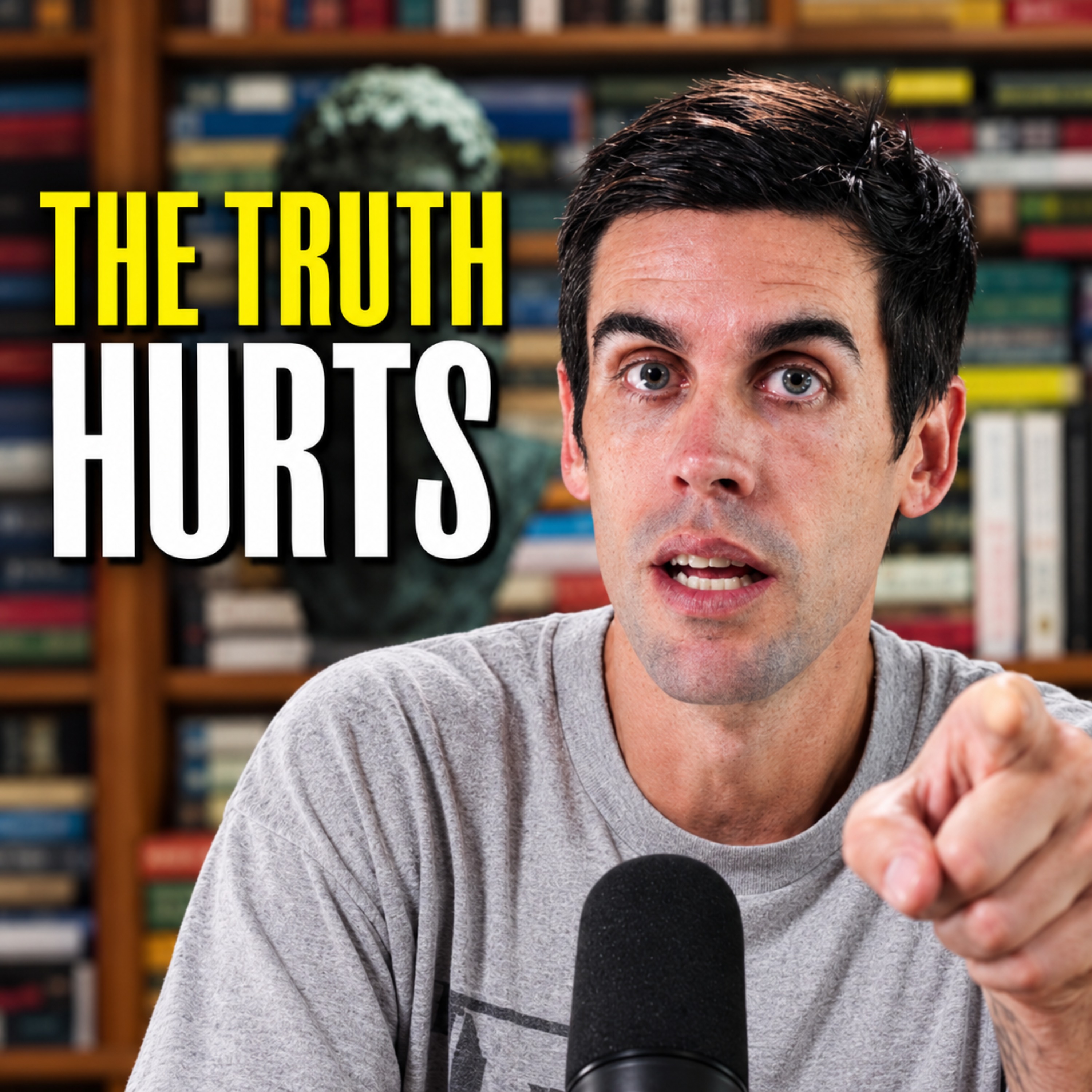
- 16 Brutally Honest Stoic Reminders
In short
Stoic “brutally honest” reminders about wasting life, controlling emotions, resisting external manipulation, and living with humility, acceptance, and mortality. The episode argues that saying “yes” too often, consuming endless real-time media, chasing approval, and catastrophizing steal attention from what matters. It claims circumstances don’t care about you; only your response is within your control. It also stresses “taxes of life” (costs like delays, criticism, relationship strain) and that no one can truly harm you without your consent.
Guest backgrounds
No guests are interviewed; the host references Stoics (Marcus Aurelius, Seneca, Epictetus) and other authors.
Key claims
You’re “dying before your time” if you don’t learn to say no; humility enables learning; credit/recognition isn’t required for doing good; acceptance (amor fati) supports happiness.
Notable examples
porch hammocks sponsor; “slave” metaphor for media/algorithms; Seneca’s image of a career lawyer seeking approval; “Alexander the Great and his mule driver” dying alike.
Written by AI. May contain mistakes.
Chapters
1:07
Brutally Honest Stoic Truths
Discussion on the importance of honesty, inspired by Stoic philosophy.
“Stoics didn't do was mess around and they certainly didn't beat around the bush.”
2:00
Wasting Your Life
Exploration of how saying yes too often leads to a wasted life.
“that come from the new 10th anniversary edition of The Daily Stoic, which has sold more than 3 million copies in 40 languages.”
3:18
The Cost of Information
Emphasizing the importance of deep knowledge over superficial information.
“They are tuning out from the clickbait and the sensationalism, and they are tuning in to history and psychology and philosophy and biography.”
5:30
Control Over Reactions
Understanding how external factors shouldn't control our emotions.
“In the way that food engineers are engineering products designed to titillate our taste buds or that Silicon Valley engineers are designing algorithms designed to be as addictive as gambling or smoking.”
8:12
Taxes of Life
Discussing the inevitable costs of life and how to manage them.
“None of this is aimed at you personally.”
10:41
Seeking Approval from Others
Critique of the desire for external validation and its futility.
“And so if we can reduce the amount of things that we have, if we can reduce trying to acquire or retain things that we don't really need, then we can lessen this cost a little bit.”
14:00
The Futility of Seeking Approval
Explore why valuing others' opinions can be misguided.
“And the irony of this, as Mark Sireles points out repeatedly, is that the people whose opinion we are so cravenly coveting are not all that great.”
15:10
Mindset and Perspective
Discover how our thoughts shape our experiences and outlook.
“This is one of my favorite quotes from Marcus Arulius.”
17:22
The Importance of Humility in Learning
Learn the value of humility and listening for growth.
“he didn't know, he was able to know more, right?”
18:43
Reflections on Career and Legacy
Consider the true purpose of work and letting go of ambition.
“He wanted to be successful and he became successful.”
Show all 14 chapters
21:13
Facing Problems Head-On
Understand that true change comes from addressing issues directly.
“You have to have those hard conversations.”
23:16
Doing the Right Thing
Discuss the Stoic view on virtue and recognition.
“Maybe there are things you can do to prevent that from happening.”
24:56
The Art of Acceptance
Learn about the Stoic practice of acceptance in life.
“And I know that that's hard for people to hear, especially ambitious, successful, important, powerful people.”
26:17
Embracing Mortality
Explore the Stoic understanding of death and its implications.
“As we come to an end to the video, I think it's fitting that we address the end of everything.”

Ask about this episode
Get the gist, explore an idea or ask about something said.
 Claude
On The Daily Stoic, what are the key points of this episode?
Searching your listeningTranscript
Automatic transcript. May contain errors.
0:00Ryan Holiday: We were looking to spruce up our front porch. The weather's finally getting better. We wanted to spend some time hanging out outside with the kids. So we got these awesome hammocks and we actually got them from today's sponsor, Wayfair. If you drove by our house, you'd see us out there with our kids reading. We've got this new kitten all hanging out in the hammocks. It's been awesome. and that's because on Wayfair you'll find quality materials that stand up to real life. They sell furniture and decor that's built to last and when you shop with Wayfair Verified it's your shortcut to durable pieces that are hand vetted by product specialists using their 10-point quality inspection.
0:33Ryan Holiday: They've got thousands of products at every style and budget whether you're simply replacing an appliance or transforming your home from top to bottom this holiday season. Wayfair's got great reviews as well, so you can find more than 20 million verified five-star reviews from real shoppers. Find pieces made for real life and get even more value with Wayfair Rewards. Join Wayfair Rewards today and get 5 % back on every purchase. Head over to Wayfair.com to shop all things home. W-A-Y-F-A-I-R.com. Wayfair, every style, every home. One of the things the Stoics didn't do was mess around and they certainly didn't beat around the bush.
1:12Ryan Holiday: That was something that Marcus Aurelius hated. He said he hated people who said, let me be honest with you here. He said, you should just be honest all the time. You should come out and say what you mean, even if that might offend some people, even if it might hurt some feelings. That's what we're going to talk about in today's video. Some harsh but essential truths about life that the Stoics want you to know that the Stoics not only weren't afraid to say, but no needed to be said. These lessons aren't necessarily going to make you feel warm and fuzzy inside. They might challenge some of your most deeply held assumptions, and they might make you feel a little rough.
1:56Ryan Holiday: But ultimately, I'm very confident they're going to make you better. And by the way, these are all lessons that come from the new 10th anniversary edition of The Daily Stoic, which has sold more than 3 million copies in 40 languages.
2:13Ryan Holiday: You are wasting your life. Seneca said you are letting people lay waste to your life. He says you're wasting it in pointless grief and foolish joy and greedy desire and social amusements. Says how much little of your own life was left to you. You are dying before your time. Look, I get it. It's hard to say no. Feels like you're going to hurt someone's feelings, it feels like you're going to miss out. But if you don't say no to invitations, to requests, to the stuff that everyone else is doing, you're not going to be able to say yes to the things that you should be doing. I know it's even harder to say no to certain time-consuming emotions from anger to excitement to distraction, obsession, lust.
2:55Ryan Holiday: And while none of these impulses or commitments feel like a big deal, they add up. And then there's so very little left. And if you're not careful if you are always saying yes and you have not learned how to say no how to be ruthless to the things that don't matter you will die as seneca said before your time because you are paying for these things with your most precious resource which is your life you can't stay on top of everything it is impossible epictetus reminds us that if we wish to improve we must be content to appear clueless or stupid in extraneous matters we shouldn't try to keep up appearances of being knowledgeable he said i think what he's saying is is something that feels very true in this 24 7 media environment that we live in right we have been conditioned to think that consuming journalism consuming real-time information whether it's in a newspaper or on tv or on social media that this is our duty as informed citizens and yes it is important to be an informed citizen especially in a democracy but consuming endless amounts of real-time information is not how you become informed if you actually want to know what's happening pick up a book right go to history Read Thucydides, read Plutarch, read Epictetus, read Marcus Aurelius, read great biography, whether it's Robert Caro and Doris Kearns Goodwin or Edward Gibbon.
4:33Ryan Holiday: This is what informed people do. They are tuning out from the clickbait and the sensationalism, and they are tuning in to history and psychology and philosophy and biography. They are going to first principles as opposed to consuming endless amounts of trivia. So you are going to have to not know about some things. You are going to have to be content, as Epictetus said, to be known as uninformed about a certain topic. You are going to have to say, I didn't hear about that. I'm not following that. I don't know about that. I don't care about that. And this is going to take some confidence. This is going to take some discipline.
5:14Ryan Holiday: but ultimately it's going to give you the gift of real wisdom and understanding, which is far better than knowing about every single breaking story or latest hot take.
5:30Ryan Holiday: You are a slave. Think about all the things that jerk you around like a poet, somebody or something that gets inside your head, gets inside your heart, that makes you do this or prevents you from doing that, that consumes your attention, right? In the way that food engineers are engineering products designed to titillate our taste buds or that Silicon Valley engineers are designing algorithms designed to be as addictive as gambling or smoking. Think about the way that media stories and social media tugs at our heartstrings or plucks at our outrage and anger. We are all being driven and controlled by external forces, right?
6:13Ryan Holiday: We're pulled by gossip, by work, by fear, by suspicion, by desire, by lust. Marcus Aurelius is saying that you have to look at what has this power over you. You have to look at what is controlling you, what's pulling you. The Stoics are saying what controls your aversions and desires controls you. And if that person is not you, it doesn't matter how strong you are, how rich you are, how famous you are, how powerful you are. You are a slave. They want you to pay attention to the things that rile you up, the things that make you nervous, the things that make you anxious, the things that make you insecure and question, why does this have this power over me?
6:55Ryan Holiday: Is this something I want directing the course of my life or am I going to break free from it? Am I going to take the phone out of my pocket and put it in a drawer? Am I going to stop comparing myself to other people? How long am I going to let this ambition or this fear make me feel less than somebody else? And then ultimately, I think what Stuart gives us is a set of values and principles, virtues, that are far better than these forces that we can depend on and lean on, that can be a far better North Star, a compass to direct our actions and feelings and emotion towards.
7:38Ryan Holiday: The sooner you realize that situations don't care about you, the better you're going to be. One of my favorite passages in meditations is Marcus Reel is actually quoting someone else. It is a fragment from a lost play by Euripides. He says, you shouldn't give circumstances is the power to raise anger because they don't care at all. I think what he's saying here is that the earthquake doesn't care about you. The economy doesn't care about you. The hurricane doesn't care about you. The brick falling from a building doesn't care about you. The plague doesn't care about you. The world doesn't care about you.
8:13Ryan Holiday: It doesn't know you exist. None of this is aimed at you personally. You don't have it uniquely good or bad, and you don't get a choice, right? Nobody asked. Only thing you have any control over, the only thing you get a choice about is how you respond to these things, how you play the hand that you have been dealt. So we need to stop wasting our time and our breath getting angry at things that are completely and utterly indifferent to us. Stop emoting at inanimate objects. Stop anthropomorphizing. Stop taking things personally. Stop making it about us. It's not about us at all. We didn't even factor into the equation.
8:58Ryan Holiday: So let's choose calm over anger. Let's choose laughter over tears. Let's choose joy over misery. Let's choose courage over fear. Let's not add punishment on top of the punishment that life is going to met out at us.
9:18Ryan Holiday: Everything in life has a cost. Seneca calls these the taxes of life. And he said that you have to pay the taxes of life gladly. Delays are a tax on travel. Criticism is a tax of being public. Disagreements and frustrations being let down. These are taxes on a relationship. The long hours are the tax on a career that you like. And then of course, there are the taxes on the money that you make, right? Nothing is free. There is a cost, a downside to everything. Now you can resent this. You can be surprised by it. You can take it personally or you can pay the costs gladly you should also be aware the stoics would say when those costs are not worth paying and when they are superfluous right fear and paranoia can be the cost of success is that a good thing seneca talks about how slavery resides under marble and gold, right?
10:26Ryan Holiday: How the things that we own end up owning us. We're afraid of losing what we have. And so we paid this price for them literally, and then figuratively we're paying this other price on top. And so if we can reduce the amount of things that we have, if we can reduce trying to acquire or retain things that we don't really need, then we can lessen this cost a little bit. Thank you.
11:25homes. Hire the right pro today.
11:35Ryan Holiday: Seneca reminds us that no one can make us upset. No one can frustrate us. No one can piss us off. He says no one can really harm you without your consent. You've only been harmed when you make the assumption that you've been harmed. Elsewhere, he says, if someone succeeds in provoking you, understand that you are complicit in taking the offense. What he means here is that the other person did the thing, but how that makes you feel is on you. Whatever your reaction is to their remark or to their action is about you and not on them. Right. And he was saying this 1900 years ago before the internet trafficked in what we now called outrage porn.
12:20Ryan Holiday: And we had this endless cycle of scandal and faux indignation and talking heads battling it out. You have to understand that someone can't get inside your head and make you feel or do anything. That is on you. They said what they said and then you decided that that was offensive or humiliating or degrading, you decided that what they said was wrong. You decided that you were going to let it rattle you and consume you. And so when we understand that we as adults are responsible for our own emotions, we're responsible for our own sense of self, you know what's going to happen? We're not going to be so fragile.
13:05Ryan Holiday: We're not going to be so easily jerked around like a puppet, as the Stoics were saying, and we can keep an even keel and focus on what matters.
13:17Ryan Holiday: The people you are trying to impress aren't even impressive. It's honestly pretty sad the lengths that we will go to impress people, to win their favor, to win their affection, to win their approval, right? Like we'll wear uncomfortable clothes because we're told that they're cool. We'll eat stuff we don't like, or we'll do acquired tastes because we want to be like everyone else. Even if something isn't working for us, oh, that's what's trendy. That's where everyone else wanted to go. And then we'll just go along with it. Our affect or how we talk changes when we're around different groups of people because we want to fit in.
13:53Ryan Holiday: You know, we'll sit around eagerly, desperately waiting for a call or a text, wanting to be included, needing to be included. And the irony of this, as Mark Sireles points out repeatedly, is that the people whose opinion we are so cravenly coveting are not all that great. You know, they're flawed, they're distracted, they're wowed by silly things. He says, you know, think about what this person just submitted to in private. Think about their opinion about other things. Why would we care so much about their opinion about us? He even says this about posthumous fame. We go, I don't care what people think now, but I want to make something that stands the test of time.
14:34Ryan Holiday: As if, Mark Stavrila says, the people in the future won't be just as silly and stupid and short-sighted as the people alive now. To say nothing about whether we'll be around to enjoy it. This is ultimately very ridiculous, the Stoics would say. Our desire for other people's approval. Mark Stavrila says, we all love ourselves more than other people, but for some reason we care about other people's opinions more than our own. even though those people are misguided or stupid or have totally different values than us.
15:09Ryan Holiday: If your thoughts suck, your life is going to suck. This is one of my favorite quotes from Marcus Arulius. He says, your mind will take the shape of what you frequently hold in thought, for the human spirit is colored by such impressions. If all you see is negativity, if all you see is risk, if all you see is what could go wrong, if you have this perpetually negative, small-minded outlook, you're going to find that the world is very small, that the world is negative. Now, this isn't to say that the law of attraction is true or whatever, that if you just think good thoughts, it will make everything good.
15:46Ryan Holiday: But it is true that our frame, how we see things, what we bring to things is going to matter. If we are closed-minded, we will see far less than if we are open-minded. If we are curious, if we have a sense of adventure, if we believe in our own agency and our own ability to find the good to make good out of things, well, I think we're going to have a better go of it than someone who doesn't.
16:20Ryan Holiday: You are not as smart as you think you are, and I would say that thinking you're smart actually makes you stupid. Epictetus talks about how our conceited opinions are the problem. He says it is impossible for a person to begin to learn that which he thinks he already knows. And Epictetus, who of all the Stoics is the closest to a professor or a teacher would see the best and the brightest young students of Rome. And he saw, as Zeno did before him, how conceitedness was the primary impediment to wisdom. Like if you're a know-it-all, you can't know anything else. There's a famous Zen story about, you know, a teacher filling up the cup and it overflows.
17:03Ryan Holiday: And he says, yeah, your mind is like this cup. A good student is empty. A good student has room for things to be poured into it. But if you are conceited, if you are a know-it-all, it is impossible for you to know anything more. So humility is the key to growing and learning. This is the prophecy that Socrates gets from the oracle at Delphi, that by knowing that he didn't know, he was able to know more, right? The Socratic method is going around asking questions. And it's the asking of questions. It's the curiosity rather than the certainty that allows you to grow and learn and be made better.
17:45Ryan Holiday: You are talking too much. Zeno's famous line was that we have been given two ears and one mouth for a reason. When we open our mouth, we are closing our ears. This goes back to the idea of conceitedness and ego being the enemy of learning and growing and being made better. A smart person is willing to listen. A stupid person is not. There's a story about a Spartan who sat at a dinner table quietly the whole time, just listening. A conceited person turns to him and says, you haven't said anything the whole dinner. Are you stupid? And he says, a stupid person wouldn't have been able to be quiet the whole dinner.
18:22And so when we're able to listen,
18:24Ryan Holiday: when we say less than is necessary, we can grow and learn. When we are chatting, when we are talking, we are closing ourselves off from learning.
18:38Ryan Holiday: Your career is not a life sentence. Seneca was ambitious. He was driven. He wanted to be successful and he became successful. And yet he said it was a shameful and disgraceful sight. The lawyer whose dying breath passes well at court at an advanced age, pleading for unknown litigants and still seeking the approval of ignorant spectators. It's funny. I was talking to Stephanie Rule, the MS Now host the other day, and she was telling me about this time she worked in finance before she got into the news business. And she was down in Florida and she checks into this fancy hotel. And there in the lobby, she sees someone from her old finance days, a guy who'd made more money than he could ever possibly need, far from home, away from his family, traveling from city to city, trying to round up capital for one more deal.
19:29Ryan Holiday: We see this in politics, elderly politicians who have become senile, who have lost a step, who are vestiges of a previous era, who just cannot resign. They cannot let power go. And the Stoics saw this as a cautionary tale, as we all should, right? Who wants to be the person who can never let go? Whose whose life is so meaningless and empty that they'd rather be on the road making more money or being in the mix of things than they would be enjoying that success, right? Like, is the purpose of your work to stay in harness until you're carted off in a coffin? Like, look, it's good to take pride in your work, but it is not everything.
20:14Ryan Holiday: And if you cannot let it go, as Seneca was saying about this lawyer that he saw, then you do not have a career. The career has you.
20:29Ryan Holiday: Travel or a change of scenery is not going to solve your problems. This one hits me hard from Seneca. He says, what good is it to cross an ocean or move to a new city? If you really want to escape your troubles, you don't need to go to another place, but to another personality. He quotes Epicurus elsewhere. He says, you know, every man flees himself. We like to think we can get away from our problems. That it'll be different over there, right? That the change of scenery will change us. How does that actually work out? Not so well in practice. We take ourselves and our problems with us. Wherever you go, they say, there you are.
21:07Ryan Holiday: At the end of the day, you have to get serious about solving what is in front of you. You have to go to the root of it. You have to do that hard work. You have to have those hard conversations. Now, this isn't to say that we can't travel, that we can't go on vacation, that we can't try new things, that we can't take a new job or try to make a change. Of course, just understand that nothing is going to be the magical panacea, the magical solution to all our problems. This one thing is not going to fix us. It's not going to make everything different. You're never going to get away from it all. Only way you're going to change it is by facing it, by getting serious right here and right now by doing the things you know need to be done.
21:50Ryan Holiday: You are the source of your suffering. And by the way, much of this suffering is unnecessary. Two of my favorite quotes from Seneca. He says, those who suffer before it is necessary, suffer more than is necessary. He also says, there is nothing so certain in our fears that there is not yet more certain in the fact that most of what we dread comes to nothing. Basically, we suffer more in our imagination than we do in our reality. That our catastrophizing, our worry, our anxiety, our dread, this is a bad use of our creativity. Well, what if they say this? Well, what if this happens? Well, could this happen to me?
22:29Ryan Holiday: We just torture ourselves. And the truth is, since we're mostly not in control of what happens, we're adding to that suffering. Like, look, the bad economic news may come out. The journalist might write a hit piece about you. You may get cheated on. Things are going to happen. But waking up every day and torturing yourself that today might be the day that that happens or that it could be happening right now and you don't know about it, what you're doing is adding to the suffering. If that happens, the Stoics say, meet it as it comes. deal with it without whining or weeping or feeling self-pity.
23:06Ryan Holiday: But don't, before it happens, torture yourself with dread and doubt and paranoia and frustration and resentment and insecurity. Be here in the present moment. Do what you need to do now. Maybe there are things you can do to prevent that from happening. But just the emoting and the worry and the torture is adding suffering on top.
23:33Ryan Holiday: You don't deserve credit and you aren't entitled to credit. The Stoics think you should do the right thing, not because you'll be recognized for it, not because you'll be appreciated for it, not because you'll be well compensated for it. In fact, they were willing to concede that you might not be. Mark Sturulus talked about how the reward for being a good king was to earn a bad reputation, but he was ready for that. He was resigned to that fate. He said that when you do a good thing, that's great. If someone benefits from that thing that you did, even better. He said, but don't be the fool who expects the third thing.
24:13Ryan Holiday: Says when you have done well and another has benefited from it, why like a fool do you ask for the third thing on top? Credit for the good deed or a favor in return. Seneca writes a whole essay on benefits, like on doing good things for people. And he said, the person who takes credit for what they give destroys all feeling of gratitude. Do the right thing because it is the right thing. Understand that the right thing is not always gonna be recognized and rewarded in life. What's the alternative? Only doing the right thing when you are confident there's gonna be a reward? Or doing the wrong thing and being the kind of person who does the wrong thing because you're mad that people don't appreciate you enough?
24:52Ryan Holiday: No, that's unthinkable. We do the right thing because it's the right thing and we don't need the third thing on top of it.
25:02Ryan Holiday: Acceptance is the key to happiness. And I know that that's hard for people to hear, especially ambitious, successful, important, powerful people. Like you think I didn't get where I am by practicing acceptance. No, I got where I am by refusing to accept things, by changing them, by making them the way that I wanted them to be. And I get that. And that's why you need to learn this skill more than any other person. And the Stoics talk about this idea, this idea of the art of acquiescence as a key skill in life. Do not seek for everything to happen as you wish it would, Epictetus says, but rather wish that everything happens as it actually will, and then your life will flow well.
25:47Ryan Holiday: You have to convince yourself, Mark Shrela said, that this is a gift of the gods, that this is the way things were meant to be. That isn't to say you never change things, you never improve them, but what you don't spend a lot of time is lamenting them for being the way that they are. Because as we said, they don't care about you and they never asked your opinion. The idea from Nietzsche, this idea of amor fati, is instead of wishing things to be otherwise, you're glad that they are the way they are. You're glad you were dealt this hand because it gives you the opportunity to be what you could be in this moment that you couldn't be in any other moment.
26:26Ryan Holiday: As we come to an end to the video, I think it's fitting that we address the end of everything. The Stoics would say the harshest and most important truth is that we are all mortal. We are all going to die. We all face the same end. Whether you conquer the known world or you shine the shoes of the people who do, death is the great and radical equalizer. Mark Scherriles says this in meditations. is Alexander the Great and his mule driver, they both died and the same thing happened to both. So the next time you feel yourself getting high and mighty or conversely, low and inferior, remember it all ends up in the same place.
27:08Ryan Holiday: In death, no one is better, no one is worse. All our stories have the same finale. And this should both be liberating and empowering. It should also be deeply clarifying. This is why we can't waste time. This is why we can't let things lay waste to our lives. As Seneca said, when we started this, life is short, don't waste it. All you get is this one shot. So be here now, be present, be good, be the person you are capable of being and enjoy it while you have it. So look, if you liked any of this and you want some more stoic truths and life lessons, check out The Daily Stoic because you can grab anywhere books are sold or totally for free, you can sign up for the Daily Stoic email, which is one bit of Stoic wisdom delivered directly to your inbox every single day.
27:59Ryan Holiday: It goes out to over a million people all over the world. It's totally free. There's no spam. And you can sign up right now at dailystoic.com slash email.
From the publisher
The Stoics didn't sugarcoat the truth. They believed in saying what needed to be said, even when it was uncomfortable, unpopular, or hard to hear.
Watch this episode on YouTube: https://www.youtube.com/watch?v=BmU0jyTu28s
🎟️ DAILY STOIC LIVE | Ryan Holiday is coming to a city near you! Grab tickets here | https://www.dailystoiclive.com/
🎙️ AD-FREE | Support the podcast and go deeper into Stoicism by subscribing to The Daily Stoic Premium - unlock ad-free listening, early access, and bonus content: https://dailystoic.supercast.com/
✉️ FREE STOIC WISDOM | Want Stoic wisdom delivered to your inbox daily? Sign up for the FREE Daily Stoic email at https://dailystoic.com/dailyemail
--
Stop online threats before they become real-world attacks. Visit ironwall.com/DAILYSTOIC and request a free Risk Assessment to see exactly how exposed your executives are.
Hosted on Acast. See acast.com/privacy for more information.
More from The Daily Stoic
All episodes
We use cookies.They keep VO running smoothly and help us improve it. Privacy policy