
 Ask ChatGPT


- Podcasts
- The Daily Stoic
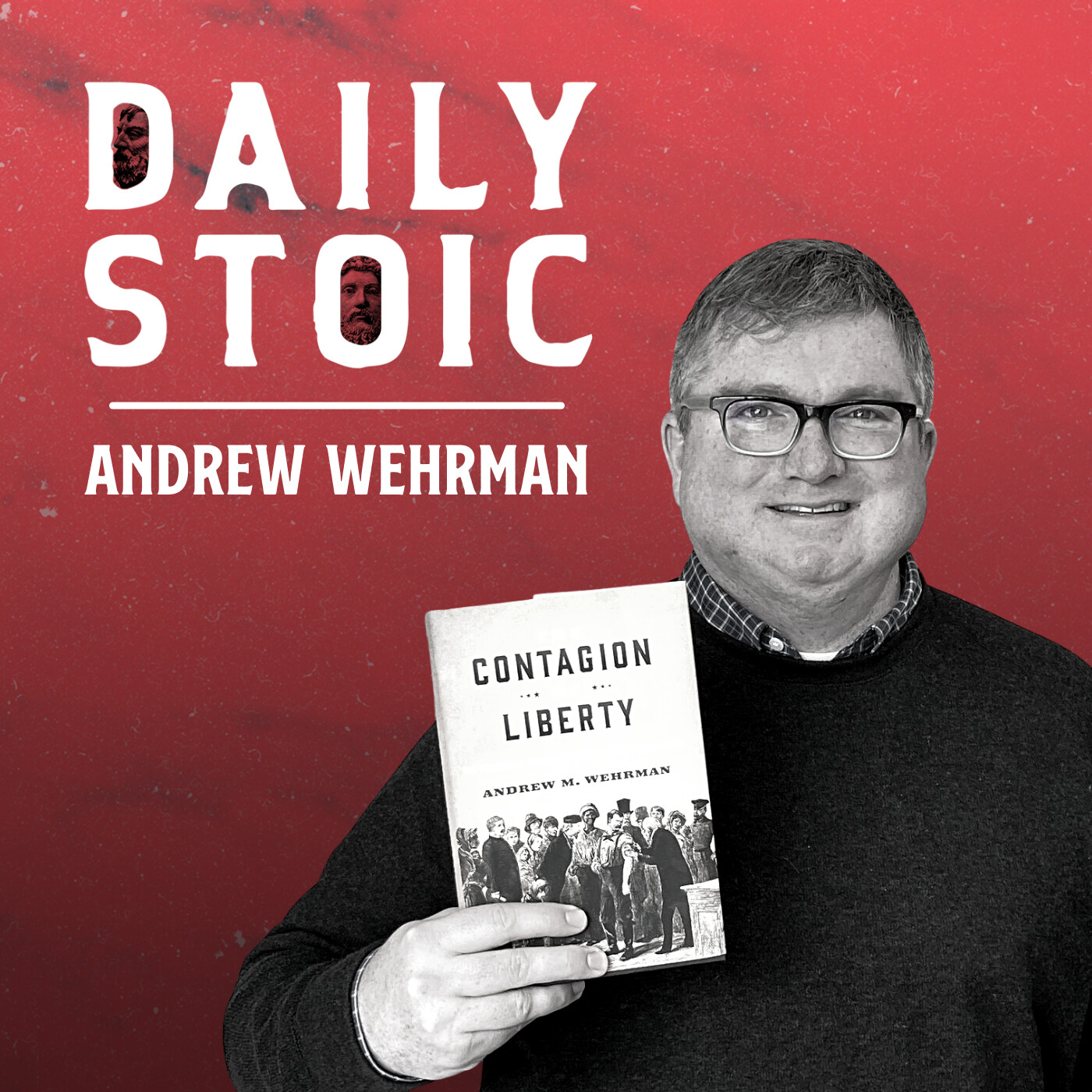
- Andrew Wehrman On Why It Is Crucial To Study Pandemics Of The Past
In short
Main points
- Host: Ryan Holiday
- Description: Exploration of Stoicism, featuring lessons drawn from ancient Stoic thinkers and modern discussions with notable figures.
- Episode Overview: Ryan Holiday interviews historian Andrew Wehrman about his book The Contagion of Liberty, discussing the historical parallels of health crises and their societal impacts, particularly focusing on smallpox during the American Revolution.
Written by AI. May contain mistakes.

Ask about this episode
Get the gist, explore an idea or ask about something said.
 Claude
On The Daily Stoic, what are the key points of this episode?
Searching your listeningTranscript
Automatic transcript. May contain errors.
0:00My family owns a 2023 Toyota 4Runner and honestly it's my favorite vehicle I've ever owned. Around town, it's smooth and reliable, but where it really shines is on our trips into the backcountry. We've taken it on backpacking adventures to Colorado and New Mexico, loaded it up with gear, and never had to think twice about whether it could handle the terrain. That's what Toyota Trucks are built for. Off-road confidence, rugged durability, and the freedom to explore. Toyota has a long history with the outdoor community, and they're committed to helping more people get out there and experience what nature has to offer.
0:29From remote trails to scenic byways, Toyota Trucks empowers you to take the detour, roam freely, and discover places that still feel wild and untouched. And they're not just making great trucks, they're working to expand access to adventure so more people can connect with the outdoors and pass that passion on to the next generation. Discover your uncharted territory. Learn more at toyota.com slash trucks slash adventure dash detours. That's toyota.com slash trucks slash adventure dash detours. You probably heard the headlines about all the different cuts to foreign aid and food benefits. This is having a profound impact on the world's poorest people and the world's poorest communities.
1:08But, you know, just hearing about that, that's not what stoicism is about. Stoicism is, to me, what you're going to do about it. And that's where GiveWell comes in. GiveWell is trusted by tens of thousands of donors each year because they provide free and independent research that helps you understand how to have a big impact. GiveWell has spent the last 18 years researching global health and poverty alleviation, and they direct funding to the highest impact opportunities. Over 150 ,000 donors have already trusted GiveWell to give more than$2.5 billion over the last several years, and research suggests that these donations will save over 300 ,000 lives.
1:47I myself am one of those donors. I donate to GiveWell every year. It means a lot to me. And you can find all their research and recommendations on their site for free. And thanks to the donors that sponsor this research, GiveWell doesn't take a cut from your tax-deductible donation to their recommended funds. And if this is your first gift through GiveWell, you can have your donation matched up to$100 before the end of the year, or as long as matching funds last. To claim your match, go to GiveWell.org and pick Daily Stoic from the drop-down menu under Podcast. That's how they know that you heard about GiveWell from The Daily Stoic, and you'll get your donation matched.
2:20That's givewell.org, code The Daily Stoic to donate or find out more.
2:31Welcome to The Daily Stoic Podcast, where each weekday we bring you a meditation inspired by the ancient Stoics, a short passage of ancient wisdom designed to help you find strength and insight here in everyday life. And on Wednesdays, we talk to some of our fellow students of ancient philosophy, well-known and obscure, fascinating and powerful. With them, we discuss the strategies and habits that have helped them become who they are and also to find peace and wisdom in their actual lives. But first, we've got a quick message from one of our sponsors.
3:21Hey, it's Ryan Holiday. Welcome to another episode of the Daily Stoic Podcast. You should know by now that Marcus Aurelius lives through a major pandemic. I actually name it partly after him, the Antonine Plague. It's a devastating pandemic that lasts not for a couple of years, but 15 years. And then we flash forward to the founding of America, influenced as it was by Stoic philosophy. And once again, they're in the middle of a similar outbreak. A smallpox is the scourge of the 18th century. And Washington has to make the decision about using this newfound technology of inoculation to protect people from this disease.
4:06And that's why I was actually fascinated to talk to today's guest, Andrew Wehrman. He's a historian, a writer, and associate professor of history at Central Michigan University. He's a PhD from Northwestern and an MAT and a BA from the University of Arkansas. And he's an expert on that period of American history, colonial and revolutionary America, and the history of medicine and disease and public health. And I wanted to talk to him because I'm fascinated with the intersection between liberty and freedom, and then our obligations to each other, right? The Stoics talk about, actually just talked to Peter Singer about this also, the idea of the expanding circle.
4:49What are our obligations to other people? How do we serve the common good? How do we make sure that our decisions don't have negative externalizations on other people? How do we protect the most vulnerable of society? And instead of getting into a big debate about what's happening right now, which is always controversial and partisan, I just wanted to talk about this idea going way, way back and how it intersects with philosophical ideas, how it intersects with constitutional ideas. And I really enjoyed this conversation. Professor Wehrman has a fascinating book called The Contagion of Liberty.
5:25He's written articles for The Washington Post and The Boston Globe, NBC News, among many others. He was a finalist for the LA Times Book Award in history. and we just have a lively conversation about stoicism, about the common good, about the history of epidemics and pandemics, a bunch of other stuff. Enjoy this conversation. You can follow him at Prof Wurman and andrewwurman.com.
5:57I got an amazing night's sleep last night. One, because my six-year-old fell asleep in the car at like six o 'clock and he transferred him from the car seat to the bed and it stuck, which is just magic. So he's in bed way earlier than normal. But I sleep really well every night because I have a Eight Sleep Pod 5 Ultra, which is Eight Sleep's best product. I've used Eight Sleep for many years now, and it's just totally transformed how I sleep, made me sleep better, made my wife sleep better. It's amazing. So basically Eight Sleep is this topper that goes over your mattress. It can heat and cool both sides separately.
6:37It can raise and lower each side separately. So it helps you fall asleep faster, stay asleep, and then wake up better. Eight Sleep buzzes me to wake gently every morning as opposed to some loud blaring alarm. And then I can check the app and it tells me my sleep score. It even helps me optimize my day based on how I slept. If you want to survive the holidays like a pro and just generally sleep better, head over to eightsleep.com slash Daily Stoic and use code Daily Stoic to get$350 off your very own Pod 5 Ultra. The best part is you still get 30 days to try it at home and return it if you don't like it, but I know you will.
7:19Trust me, your body will thank you for this investment in better sleep, shipping to many countries worldwide. See details at eightsleep.com slash Daily Stoic. I'm picking my kids up from school today and then doing our weekly routine, which is I take them over to Whole Foods. We get all our groceries for the week. Then we have dinner. It's one of their favorite things to do. It's one of my favorite things to do. And then my wife loves it because she doesn't have to take care of it. This holiday season, whether you're a guest or hosting the big dinner Whole Foods Market, has what you need to delight everyone at your table.
7:48They even have heat and eat sides from the prepared foods department. You can make Whole Foods your one-stop shop. Everything follows Whole Foods Market's strict ingredients standards so you know it'll be delicious and good for you. You can also order online for pickup and even delivery in select zip codes to skip the crowds. Shop everything you need at Whole Foods Market, your holiday headquarters.
8:14I read this book several years ago called The Republic of Suffering. and it was about sort of the effects on the psyche when you would go through something like the US Civil War when just so many people died. And she talked about this thing in there, like what it must have been like for just almost every family to lose a child to either war or disease or collateral damage. And I think about this when I was thinking about your book and when I think about pandemics in generally and all the things that used to just sort of senselessly and relentlessly claim people. Like what it must have been like to live in a time where a kid could just get sick at a moment's notice and you were totally helpless to do anything about it.
9:03And then it just, you know, it overwhelms your house. You don't know what to do about it. How do you think like infectious diseases in the past affected people? How do you think about what it must have been like to live in a time when these things happened and we had almost no understanding of what to do about them or how to prevent them? Yeah, well, thank God that the saving grace of COVID was that it really didn't affect children to nearly the degree that it did, older people. So we didn't have to experience that quite as directly, but I think there's a sense that people in the past, however distant a past, didn't care about their children in the same way they had them.
9:54And of course they did. Of course they had deep feelings, and we can read about them in their diaries and journals and letters. And it was always awful and tragic, even in times where there was high infant mortality. Every one of these deaths just weighed on family members, brothers and sisters, as well as parents. And we know that. Benjamin Franklin, when his son Francis died at the age of four from smallpox, it was such a tragedy. Franklin was just wrapped with guilt about it. This is the story of Franklin having been an advocate of inoculation for smallpox, but hadn't actually gone through with the procedure for Francis.
10:53and he was devastated by it for years and years. He wrote about it in his autobiography. He had a portrait painted of Francis that he took with him when he traveled, when he traveled to London and back. It was something that is hard to even imagine the stages of grief that people in the past would have gone through. I think that's a really good point. I just had to put my dog down and it was devastating and terrible. And I remembered as I was sort of going through this, there's a bunch of different museums have them. You can see pictures of them online, like the different epitaphs that the Romans wrote for their dogs.
11:37And you see this like overwhelming outpouring of grief for an animal, you know, 2000 years ago. The idea that, yes, there was senseless violence and cruelty and loss was much more common in the ancient world statistically, but that doesn't change the fact that you love this person and now you don't have them anymore. That is the tragedy and the timeless reality of the human experience, that this stuff happens. Yeah, loss was common, but love was too, and it always has been. And so that's the terrible nature of it and how thankful we ought to be to experience that less and less. And it's also, you know, it's so hard to think about what it must have felt like.
12:35Actually, speaking of Benjamin Franklin, I read this book a couple of years ago. I think it's called Storm Kings. And it was talking about how things like tornadoes, even until like the 1700s, we like didn't understand. And no one had really even seen one. Like we hadn't tracked them. And obviously the populations were so much more sparse that like, you know, you didn't go, oh, a tornado is coming. That's why I woke up in the middle of the night and I was in a tree, you know, and I couldn't figure out what happened. And a lot of, they were speculating a lot of like what we would think of God's wrath was that like events of weather that people just didn't understand, right?
13:19I'm just bringing this up to make this point of like, we understand to a certain degree how pathogens are passed, how viruses work, bacteria, the effect that certain diseases have on the body. it must have been so profoundly terrifying and disorienting to just not really know. I mean, I guess they had these sort of rudimentary and in some cases, totally inaccurate understanding of what these diseases or viruses were doing. But also it must have just been like, this person was here with me today and they're gone tomorrow. And I don't really know why other than that they got very sick and there was nothing I could do about it.
14:02They were afflicted. And yeah, the vocabulary of it was, you know, and they would call on religion, of course, to help understand these events, to maybe try to rationalize them. Um, but, uh, you know, they, they develop some tools to deal with, uh, grief and mysterious things that happens yet. Uh, it's hard to imagine, you know, not knowing what a, what a tornado was or what it looked like or the, uh, to predict when they're coming. Yeah. You can't go back and understand what it must've been like to not know something like, like to, to even know, like they had all these ideas of like where cholera.
14:49or yellow fever came from, the idea that it's being passed from mosquitoes. It never occurred to them. And so they have these kind of general aversions or suspicions. Sometimes they're kind of helpful, sometimes they're not. But just even, yeah, the idea that someone in your house gets sick and you're not, do you know to stay away from them or not? Right? Like, do you, or does now everyone get it? Because you don't even understand. I mean, they don't even understand how to wash hands yet. Like how late our understanding of some of these things was. And certainly like the Romans didn't get the contagiousness of disease.
15:34That comes later. Quarantine wasn't invented yet for them. They had to have some sense of it. I think that the people who have encountered people who were sick are the ones becoming ill. You know, they had some sense of like with leprosy and other things that coming into contact with lepers was bad. But yeah, in a general sense of how to stop a disease, you just couldn't. Well, yeah, I think about this. So Marcus Aurelius probably dies of the Antonine Plague, some version they think of smallpox, which we'll talk more about. But we know that towards the end of his life, he gets sick and he sends his son away, right?
16:25The son who's supposed to succeed him, he sends him. So he would have had some sense probably that, hey, I can't be around the person that I want to see really bad. I can't be around. And the sadness of that, it brings you back to COVID, like people dying in adjoining hospital rooms or hospital wings or families not being able to visit each other. Again, how timeless it is. But even our modern understanding of, hey, this is really hard, but at least I understand what's happening intellectually, just how overwhelming and terrifying it would have been to not know. Was this my fault? Did I do something wrong?
17:09Did I anger the gods? Yeah, it just, I get very sad just thinking about how it's almost like a child that doesn't understand, hey, you're going to sleep, I'm going to sleep, we're going to wake up and see each other, but they don't understand what's happening, right? And how scary it is when you don't understand what's happening. It was scary enough during COVID and to think about blaming yourselves if your household got it. Was it that trip that I didn't need to take somewhere that did it? Or I wanted to make sure that my kids, if they caught it at school, didn't feel like they were the ones who did something wrong, right?
17:55That sense of blame that so often goes on with disease would be even so much more profound when you don't even understand how it spreads. Or the feeling of like, why was I spared? Let's say you're some Roman family or you're some family around the time of the American Revolution, or it's the 1918 pandemic and everyone in your family gets it. They die or have devastating health effects and you're just fine, right? Like, why me? There's this, another story about Marcus Aurelius. Again, we tend to think of the Stoics not having emotions, but someone mentions the people that died during the plague in this trial, and he just bursts out into tears.
18:39And I wonder how much of it was like, you know, why did I survive and all these other people died? I'm sure survivor's guilt was very real when these things were so much more fatal, unpredictable, and poorly understood. They had to be. I mean, survivor's guilt in that it was so random in who lived and who died. Marcus Aurelius had what, like 12 children die before adulthood or something like that, and many of them in the plague? He had 12, and I think less than half made it to adulthood. And I think about that. People go, you know, why did Marcus Aurelius' son Commodus, you know, why was he the way that he was?
19:22He was about as bad as Joaquin Phoenix's character plays him in Gladiator, or so we think. But you're like, what would that do to a person? What would it do to a person to watch half of your siblings die? To say nothing of the terror and the unpredictability, just of that happening during your formative years to other people. We think about what the effects of COVID are going to be on the population. Just imagine if that happened to your parents, how that would affect how your parents raised you. I mean, these are things that we struggle to deal with today with all our tools and breakthroughs in psychology and medicine.
20:04And I mean, they were basically like, all right, rub some dirt on it. And that would have affected you profoundly as a human being to see all that death. Well, this isn't going to come as a surprise from a historian who studies disease. But yeah, I mean, it's crucial that we understand these diseases and pandemics as part of history, that we don't just think of history as the bare words of people in the past or that real humanity, real events affected them. And especially, I think when we study American history, my subject, or even Roman history as well, we don't have that. We don't usually study medicine, disease, the real things that people were focused on that brought both tragedy, but sometimes miraculous healing and things like this into their lives.
21:08Yeah, that is a weird thing. It's a fascinating thing that you study and a very important thing you study because maybe it's that people just don't understand or study history enough. So to then study the effect of a disease or a pandemic on the history that you're studying is a bit much to ask of people. But when I was reading John M. Barry's book, The Great Influenza, you're like, oh yeah, this was like the defining event of the 20th century. And it's not talked about in literature. It's not talked about in history. It's not talked about in popular culture, but it was at the time. There's just this kind of like, well, that was really unpleasant.
21:50Let's move on from that. And the same, yeah, the same is - I was gonna say, you think that's happening now? Yeah, it wasn't until we went through COVID that I was like, oh, Marcus Aurelius' Meditations is a plague book. He was writing the entirety of this through a plague. That would have been the thing he woke up and thought about almost every single day. and I've been studying this for over a decade and I've really not even considered the effect of that on him and his decision-making in his life for more than like 10 seconds. Yeah, well, I'm curious about how that has affected your reading of it through COVID.
22:29For me, I was working on this book on smallpox in the American Revolution before COVID happened. And the argument was there. I understood that it was happening, but living through a pandemic myself really helped me sort of crystallize my thinking about how disease affected people, how it would have made people angry, how people would be checking the newspapers to read about case counts and where quarantines were being held. And at the same time, because they're reading about the pandemic that's going to affect them or possibly affect their children, they're reading the other news too about news from parliament, news from England, and kind of getting angry about all of it at the same time.
23:19It made me think about our revolution differently when you said it in that pandemic context. Totally, yeah. You think of the American Revolution as a political event or a military event, but it's intersecting with this medical event at the same time. And that tends to be true in a lot of cases. I was thinking about this during the pandemic. I was reading there was an influenza outbreak in the United States that killed like 100 ,000 people in 1968. And so we think of 1968 as this sort of year of political unrest and disruption. But a lot of people would have been coming home from the hospital, right?
24:05You know, thinking about should they do this or that? Or even if they weren't, it's still an undercurrent of what's happening. And yeah, it's often this major thread that just gets totally ignored from or disconnected from a thing that it was very much bound up in as the history was unfolding in the moment. A source of anger, agitation. I think about it a lot when we think about January 6th in 2021, that this was January 6th. The insurrection at the Capitol took place just before, months before the vaccine for COVID was generally released to the public. This was sort of at the peak time of death and dying during COVID.
24:55And many of the insurrectionists, if there's a Venn diagram, it's probably pretty close to a circle of the same people who were angry about shutdowns and closers and vaccines were the ones that were also angry about the election. They sort of channeled and festered along with each other. Yeah, that's really interesting. I mean, and also, I know we were just talking about how, you know, people love people, so it hurts whenever. But also when you think about something like the American Revolution, which drags on for all these years and has this terrible death toll, it's intertwined with the terrible death toll of the infectious diseases.
25:32And in some cases, inseparable, right? You might get a letter that says, hey, your son or your brother or your father died, you know, in George Washington's army. but the distinction between an on the battlefield death and an in-camp death doesn't matter to you that much as an individual, but you might not even see yourself as the, you don't see yourself perhaps as the victim of a plague. You see yourself as the victim of this cruel and terrible war. And basically for all wars up until relatively recently, you were much more likely to die of other stuff than on the battlefield. But that's probably not the message that's coming home.
26:16That's right. Well, and there was an idea during the revolution, it was known that smallpox was affecting the camps, affecting soldiers. And there was worry on the home front that soldiers were going to return home from the camp and then infect their families, infect their wives. So there There was pressure from local communities, but also pressure within families for those soldiers to get inoculated, right? There was this preventative that was available in the 18th century. We can talk about it. But this kind of bottom-up pressure to do something about it, to make governments do something, to make the army do something about it, calling on George Washington to implement inoculation schemes.
27:01But you're right. There wasn't a distinction made between if a person really died in battle versus died in camp or died in one of the prison ships of the British that were just notorious for disease. It all sort of blended together, and any of those deaths was tragic. Yeah, to you, your loved one is a casualty of the war. you're not saying, oh, they were fighting in a war and they died of X, even though they are a casualty of war because these camps are so unsanitary and the prison ships are so terrible. But I'm just saying like, when you think about the sacrifice that people are making and the way their identity and the country's identity is tied up in what's happened and what's been given, there's actually two kind of distinct events happening, but they get blended into one.
27:55And yet we only study it as a war, right? We study it as a political movement, a war, but actually there's this undercurrent that's affecting the outcome that's directly contributing to what names are in the newspaper the next day as a casualty. But yeah, they're not necessarily dying by musket fire. They're dying because smallpox and cholera and typhus and all these other things are just running rampant through the ranks. Yeah. The revolution and both the war and the sort of broader political context, you can't fully understand them without understanding the disease that's affecting society at the same time, that even far from battlefields, communities are dealing with smallpox.
28:46When soldiers are going into the army, they're worried about catching it, it's pervasive. Yet, as we think about the revolution and it gets written up historically, that part disappears. And so the same way when people were writing about World War I, the tragic conclusion of the influenza isn't part of it. It's something else if it's remembered entirely. Well, yeah, I'm glad you brought that up because it's like, okay, we look at the flagging support for the revolution. It's going poorly. People's patience and commitment to it is waning. And we celebrate Washington crossing the Delaware because we only think about it as a military endeavor.
29:38We don't think about the steps that Washington takes, and we should talk about it, to inoculate the soldiers, the public health messaging that might have been just as consequential, both militarily and in terms of morale, in terms of saving, preserving, protecting soldiers. because again, we think about it in the military context and not this holistic societal, you know, concept that it's in to go to World War I, a great example, which John talks about in The Great Influenza. You know, we think about the collapse for the support of the League of Nations and we go, you know, was Wilson too idealistic?
30:19Was the American Congress, you know, did the Senate just fail to ratify it Because there's isolationist tendencies. And it could also just be people were overwhelmed focusing on the fact that everyone was dying of the influenza, right? And that's where the backlash is coming from. And by separating the two, we really miss the full heroism and tragedy of what's happening in these events. Yeah, and certainly the courage and sacrifices of the people that are involved and missing those debates, missing those actions, it has ramifications down the line as Americans in COVID in 2020 have to sort of re-remember, if at all, how they've handled disease in the past.
31:12Are quarantines legal? Did the founding fathers want them? The answer is yes. But because we've disconnected all of these things or history isn't often about public health matters, generally these kinds of things get forgotten.
31:36Human, your body has a performance superhighway. 60 ,000 miles of blood vessels that deliver oxygen and nutrients to every cell. This, of course, is your cardiovascular system. It's the foundational system that powers everything we do. Both elite athletes and longevity experts invest directly in the cardiovascular system because supporting healthy blood flow is critical for energy, recovery, mental clarity, and overall performance. That's where human comes in. That's human with two Ns. They started out of research at the University of Texas, near where I live, and have 15 years of experience making award-winning supplements for nitric oxide production and healthy blood flow, now used by over 160 pro and college sports teams.
32:24Human Cardiovascular Health Daily is a plant-based and made from clinically studied ingredients like grapeseed and seed kelp extract. It supports nitric oxide production for healthy blood flow and energy while also supporting blood pressure and helping support the delicate interlining of your blood vessels. Just two capsules each morning will power energy and recovery while also playing the long game by supporting long-term vascular health and healthy aging. Human has an exclusive offer for our listeners. You can visit human.com slash stoic for an extra 15 % off your first purchase. That's enter code S-T-O-I-C.
32:57Stoic at checkout. That's human with two N's dot com slash stoic for an extra 15 % off with code stoic at checkout. Well, it's almost here. Christmas is just a couple of days away and maybe you're scrambling. You're like, what should I get my dad? What should I get my mom? I got to get something to my sister. People love showing off pictures of their kids and that's where today's sponsor comes in. I've gotten one as a gift. I've given it as a gift. The Aura Digital Picture frame. It's easy to use. It never gets old. You're constantly updating it with new pictures. Or a digital picture frames are so much better than any digital picture frame I've ever seen.
33:34It's got a high resolution. It's got a color calibrated display. You can add video. You can have two pictures come up at the same time, picture and a video. It'll pair photos together for you, like two pictures of the same person or from the same day. It's really easy to set up. You just download the app, connect the frame, and then you can pick photos and videos right from your phone from anywhere in the world. And there's a reason Oprah added it to her favorite things three different times. For a limited time, save on the perfect gift by visiting AuraFrames.com to get$35 off Aura's best-selling Carver Matte Frames, named number one by Wirecutter, by using promo code STOIC at checkout.
34:10That's A-U-R-A frames.com, promo code STOIC. This deal is exclusive to listeners, and frames sell out fast, so order yours now to get it in time for the holidays. Support the show by mentioning us at checkout, Terms and conditions apply.
34:28Again, the past seems so distant from us, and then it's like they have all the same problems as us. I think about like one of the first laws the U.S. Congress passed was a series of whistleblower protections because they wanted people to point out military contractors and fraud. Right. So you're like, oh, wow. OK, the Congress is like, hey, we've got to protect these whistleblowers. And then you think about Washington and his sort of vaccine mandates for the soldiers. You mentioned Ben Franklin. Like, as I understand it, maybe you could tell me the story, but as I understand it, Franklin and his wife disagree over whether they should inoculate their son and she wins out.
35:07The son tragically dies and like their marriage is never the same. That's a pretty modern, like there are couples that have been having some version of that argument, unfortunately, like in the last year. That's definitely one of the theories with Franklin and Deborah and potential theory of sort of why they were never married. There's more to it than that, but there would have had to have been, you know, arguments within a marriage when that kind of tragic event happens. And Franklin, you know, considered himself the educated one. He had been writing about the miracle of inoculation in his newspaper and in his almanacs and was promoting it.
36:01And so there's speculation that perhaps there was doubt within the household. Now, Franklin himself did not explicitly blame Deborah. He doesn't say that in the autobiography. There are some textual clues. himself. Yes, within letters where he talks exactly about the sort of, he doesn't name names, but he says, you know, when some couples, husbands and wives disagree over inoculation, but they should agree to it for the good of the child. And so it's within that that people have speculated, ah, maybe this is it. Maybe there was a split between them on the issue. Again, and I also feel that kind of sadness and empathy again, where the inoculation for, say, smallpox was miraculous, but it was like, what was the chances of dying of a smallpox vaccine then or an inoculation?
37:01It was relatively high, right? Yeah. Because the dose was so strong. Well, the dose was strong. It was just the initial inoculation, inoculation for smallpox that was introduced to the colonies in 1721. One, the irony and just fascinating detail, crucial detail, was that a black slave, an African slave named Onesimus, told his owner, Cotton Mather in Boston, about this procedure. That you use a little bit of the smallpox matter, the pus from a smallpox sore, and insert it into the skin of the arm. And by doing that, it gives the person a mild case of smallpox. But yeah, they refined that procedure over the decades, but there was still usually around a 1 % mortality rate from inoculation itself.
38:04And that compares to a 15 % to 30 % mortality rate for smallpox itself. So people making this decision, it's a tough one, right? You've got a one in a hundred chance of death by giving yourself an inoculation or getting inoculated versus, you know, a 10 or 15 chance out of 100 from natural smallpox, which you don't even necessarily know if you're going to get it or not. And so it was Franklin who was using those statistics and saying, look, the statistics went out. Inoculation works. It's a better probability, better odds. Parents owe it to their children to get inoculated. And over the decades, this becomes more and more popular.
38:56Americans take real pride in inoculation. They claim that they invented it. They sort of ignore the African origins of it. They don't sort of ignore it, purposefully ignore them and claim it as a colonial invention. They say it wasn't the British that gave this to us. It was colonists who were for it. And it's true that Britain's North American colonies were the most advanced in the world in terms of adopting inoculation, sponsoring it, holding mass general inoculations of towns. Boston was one of them, but there were other places too. and the demand for that procedure, as dangerous as it was, was growing and growing towards the American Revolution.
39:48And that was one of the shocking things when I wrote the book, right? I was thinking I would find pockets of resistance, people who were sort of like modern anti-vaxxers saying this is too dangerous to be used or doubt that it worked or had religious ideas against it, that this was playing God in a way that they didn't want. And you don't see that. There were no soldiers who protested Washington's inoculation order. They all cheered it. They all wanted it. Inoculation was expensive to get. Otherwise, doctors charged a lot for it. And if the army was going to provide this for free, the soldiers lined up for it.
40:29There were no protests over inoculation during the war. Am I wrong in remembering, speaking of this being a colonial versus royalist thing, am I wrong in thinking that one of King George's children died of an inoculation? You're right. Yeah. Late in the war, 1782, 83, I think two of his children, um one maybe died of smallpox the other from from inoculation um yeah uh and that's one of the reasons that inoculation spread a little bit slower in in europe uh because royal families tried it and had some tragedies but we know that royal bloodlines are not always the best right Thin line. Because hemophilia and thin blood.
41:12And so royalty tended to suffer from a mortality rate from inoculation at a higher percentage than did common people. Well, yeah. And you just think, again, with some empathy and just sort of the terror of it, like deciding to roll a one in 100 chance with yourself, that's a decision an adult can make. but to have to make that for a child and maybe i don't know the specific odds on a child maybe it's better or worse but to make that for your child it must have been horrible and you can see why that would tear a couple apart or you could see how the aftermath for someone like king george if you're already of shaky mental health which he was just how how devastating that would be to know you made the decision with the odds and then the odds did not come out in your favor.
42:10That's just a horrendous, horrendous choice. I mean, it's not quite Sophie's choice, but it's close. Well, and there were many people that talked about this and John Adams and Franklin, among others, said, you know, the choice was better to know in your mind that you did, you trusted in modern medicine, you did what others were doing, you did what was expected, what statistics were proving correct, but that would be far better than not acting. Franklin wrote, you know, when his son died, that the tragedy of not doing something is so much worse than trying your utmost to protect your loved one and then seeing them die.
43:01But yeah, it's the same thing. John and Abigail Adams were apart from each other during the smallpox epidemic in Boston in 1776. John Adams was in Second Continental Congress on the committee to write the Declaration of Independence. and he and Abigail are writing each other letters throughout their lives, but the letters during the smallpox epidemic are some of the most potent, and you can really get a sense of what people were going through. And Abigail writes to John, and she says, if the opportunity comes up to inoculate my children, I'm going to take all of my treasure of children, she writes, and get them inoculated.
43:40I'm willing to run you in debt for it, no matter what it costs, And I'm going to do it whether you want me to or not. And of course, John Adams writes, of course, do it. This is what I want as well. He agrees with her and then writes that he wants to see public hospitals built in every colony to provide access to inoculation throughout. But he's worried. He's getting updates from Abigail on each of the children. Some get through it pretty easily. Others suffer with more pox. And they all end up surviving, all of his children. But, of course, he is constantly worried about his kids at the same time as Jefferson's preparing the Declaration of Independence.
44:30He's on that committee doing all these really important things in preparation for independence and guiding the war effort. In his mind and in the minds of all the other delegates, they're thinking about the suffering around the country. Well, I loved the book. I thought the title was interesting, The Contagion of Liberty. There's kind of a tension there, a paradox. Was there a sense at that time that there was also a public health benefit to the individual making that decision or no? Yes. They understood that by, and it's the only way that it worked because inoculation, this is before vaccination, before that is invented, an inoculated patient could spread smallpox to other people for about three weeks after being inoculated.
45:27So they had to be quarantined if you were inoculated for about a month. And so there was an acute awareness that when you're inoculated, you impact others. And so they would try to inoculate as many people at once as possible, whole communities together. There was an understanding that, yeah, inoculation helped your neighbors as well as yourself. It was that inoculation, that's the contagion of liberty in the title, right? This is the thing, the small self-sacrifice that ultimately leads to this sense of independence from disease. And, of course, the fact that so many Americans made this sacrifice, the fact that George Washington called for the soldiers of the revolution to go for it, he had to be convinced of that.
46:24He changed his mind and decided to allow the soldiers to inoculate. But it was that the duality of gaining independence from smallpox at the same time as independence from Britain was something that was understood. When the Declaration of Independence was first read in Boston, it was during one of these mass inoculation campaigns. All the people that heard it had experienced inoculation. Many of them were still suffering from it. They would have understood it really distinctly that smallpox disease had to be stopped in order for independence to be won. Yeah, it's this tension of asserting independence and autonomy at the same time you're getting hit smack in the face with the interdependence and the inseparableness of everyone together and thus the obligations inherent thereof.
47:30Liberty required obligations to other people. That's how they understood it. This idea of personal liberty, that I can do what I want and the government has to allow that. That's a later concept that comes about in the 19th and 20th centuries. Liberty for colonial Americans was a kind of permission to act with the consent of all of your neighbors and with everyone else in mind. You had to ask for liberty in a town meeting to build a fence that might block your neighbor's land. That's what liberty meant. Now, you could build it, but without the consent of your neighbors, it would get torn down.
48:23So people would ask in town meetings for the liberty to inoculate, and there are all these town meetings and debates over it. If we allow you to inoculate, that might start an epidemic. So maybe we'll tell you to stop and we'll hold out for a while longer. Or maybe the town would decide that we'll all inoculate together. If we all do it at the same time, then there's less risk. And so in the book, I talk about lots of episodes where towns are making these decisions together. Well, yeah, because how free are you if you break the bonds of what was actually not a profound form of tyranny? I've come to understand in my study of the American Revolution.
49:11A lot of the grievances, let's say, are a bit exaggerated, right? In theory, in practice, everyone, a representative democracy or republic is obviously a superior form of government. But it's not like the colonists had this oppressive boot on their neck, really, compared to most people at the time. The economy is, in most senses, thriving, and people are living good lives compared to in other places. But this understanding of, hey, we're not really free if we're all dying of a disease that with a small amount of collective action, we could also be free of. It's this weird kind of perverse modern understanding of liberty where it's like, I'm free to menace you with my assault rifle or I am free to poison the public rivers or whatever.
50:07It's this weird understanding we have today of liberty where these things which are supposed to encourage collective flourishing and health and happiness actually get perverted to enable a percentage of the population to do the exact opposite and thus deprive everyone of liberty. Yeah. I mean, all that. There were strict rules against any individual spreading disease. You could be whipped for wantonly or wickedly going about town if you knew that you had a disease. There were laws in many of the colonies for innkeepers and tavern keepers to look at travelers to see if they showed signs of disease.
51:01If so, it was their responsibility to report them. Colonial Americans were surprisingly good at actually stopping epidemics of disease through these methods, through quarantines and inspections. They wouldn't have thought of any kind of intervention if it's for the public good in a time of a pandemic as being something contrary to liberty. The purpose of having a society or having a government is to protect the lives of the people. Why else do you form governments? That's John Locke's. This is the first reason, is to protect people's lives. And that gets connected to health as well, that governments should do everything in their utmost, that they have a duty to protect the health of their citizens, just as citizens themselves have duties to look after their own health and their own lives.
52:01Yeah, it's a strange place we've gotten to. I've talked about this before, but Viktor Frankl famously said that he thought on the West Coast of the United States, we needed a statue of responsibility, that there would be a statue of liberty and a statue of responsibility, and that these two counterbalanced each other or enable each other. And there does seem to be a collapse of that sense. The idea that our fates are tied up with each other, that you really can't make an individual decision that affects the public health. and it's almost like a tyranny of the minority where the person who says, I want to pretend this doesn't exist.
52:52I don't want my life to be impeded or limited in any way by the indisputable existence of this pathogen or crisis or whatever. So everyone else is going to have to be at the mercy of my delusions because I'm free to do that. Yeah. As citizens, we have duties as well as rights in the same way, and that gets forgotten. Yeah, that was one of the weird parts to me about COVID. Obviously, our hopes for the vaccine being a stop on transmission was exaggerated or overstated. Like the data, especially as the different variants came out. Yeah. But I always found it illustrative that the first thing that people who were opposed to vaccines or vaccines mandates would say was it has zero impact on transmission.
53:52It does nothing to stop transmission, which, of course, was objectively not the case. It wasn't 100%. It probably wasn't 50%. But the idea that it was 0 % was said and insisted on so many times that it almost became true. The reason this was said, I felt like, was to absolve people of even the nagging inkling that they would have an obligation to do something that benefited other people. I mean, even just the idea that like, hey, do you have a right to take up a hospital bed for something that was easily treatable or the severity was mitigatable? I feel like, to me, that's a pretty clear duty as a human being.
54:40I mean, obviously, a hospital's job is to accept and help anyone. But can you as an individual, can your conscience justify taking up a hospital bed that you don't have to be on, I would say no. Yeah, I think about that a lot. And I think that it's important to note that I think by far the vast majority of Americans acted as responsibly as they could. They followed guidelines. They tried to stay safe and separate and wear masks and got vaccinated overwhelming numbers of Americans. But I think you're right, The people that have really dug in their heels in resistance to everything and continue to do so when it's true that the reason that we're in the situation that we are now is thanks to vaccines.
55:35Even though COVID is not completely gone, transmission is down, cases are down, certainly deaths and debilitating injuries are down thanks to vaccines. And I think the people that are still unwilling to say that are the same folks who, if they really thought about it introspectively, would realize that perhaps they behaved monstrously during this, you know, once in a century, terrible pandemic and saying that people should ignore public health guidelines or should avoid getting vaccinated because of it.
56:18So we live on a Halloween street. We knew it was a Halloween street when we moved there. And then it has quickly become a Thanksgiving and then a Christmas street. Everyone's vying to outdo each other with their decorations. And I'll admit it sneaks up on us, especially as the competition gets more and more. The holidays are here. and if you're looking for holiday decor or last minute refreshes around the house, get what you need fast with Wayfair. That's where we got a bunch of our Christmas decorations and a bunch of essentials because we have some of my wife's family visiting us for the holidays.
56:57Blankets, linens, all that kind of stuff. You can get all of it at Wayfair. You can also get big stuff like sofas and dining tables, beds, desks, and more, all shipped for free. They don't have huge delivery fees for furniture. Find all your must-haves from furniture and decor to appliances and cookware all in one convenient place. Get last-minute hosting essentials, gifts for all your loved ones, and decor to celebrate the holidays for way less. Head to Wayfair.com right now to shop all things home. W-A-Y-F-A-I-R.com. Wayfair. Every style, every home. This episode is sponsored by BetterHelp. This time of year is wonderful.
57:31It's quiet. It's peaceful. It's beautiful. It's also stressful and bleak and dark. And then there's the whole family stuff. You got to make sure you're taking care of yourself and you got to make sure you're taking care of your mental health. This time of year can be not just stressful, it can also be lonely. And therapy can help you make space and time to focus on getting well and feeling good. Consider trying BetterHelp online therapy in December as a way to close the year with clarity rather than chaos. With over 30 ,000 therapists, BetterHelp is one of the world's largest online therapy platforms.
58:06having served over 5 million people globally. And it works. It's got an average rating of 4.9 out of 5 for a live session based on over 1.7 million client reviews. This December, start a new tradition by taking care of yourself. And our listeners get 10 % off at BetterHelp.com slash Daily Stoic Pod. That's BetterHelp.com slash Daily Stoic Pod. Well, yeah, I mean, we were just talking about this with the Franklins or with King George, where let's say you make the decision to inoculate your kid and it goes terribly, how that would weigh on you. And then you think about the person who makes the decision not to do it and something happens to their child.
58:51It takes a strong person and it might even take, if you think about forces like cognitive dissonance, we're almost evolutionarily designed to not take responsibility for that decision because it's so terrible that it would crush you. And so I think we had this weird response in the pandemic where certain people objected to it, behaved monstrously, as you said, and we kept hoping they would change their mind. and I feel like that was inherently irrational that like someone, people who murder people and spend 20 years in jail have trouble coming to terms with the consequences of their actions, right?
59:36Like the idea that someone would be like, hey, you know, this once in a lifetime event happened and I was part of the problem, not the solution. I have moral guilt. You know, the human mind is really good at finding a reason to not feel moral guilt. So, of course, conspiracy theories, rationalizations, you know, cherry pick statistics, et cetera, are going to come into play there as a protective blanket, a soothing ointment, so you don't have to feel shitty. Yeah, I think that's a really good way of looking at it. When we think about my folks in the revolution, the people that I study, and one of those rationalizations that happens is there's a terrible – the epidemic is worse.
1:00:28It's felt the worst in the South and among enslaved people. They suffer the most. And it's because tighter quarters, better health or worse health. Yeah. And and because many plantation owners and slavers did not inoculate their slaves, even though that they they they knew that they ought to do it. Some did. George Washington inoculated all of his enslaved people at at Mount Vernon. Thomas Jefferson did not. And Jefferson put all of the blame on these deaths in the South on the British. The British were doing it on purpose. They were spreading smallpox. They were acting terribly. And none of it on Southerners who hadn't gotten their slaves or hadn't encouraged people to get inoculated.
1:01:21It's a similar sort of thing. Jefferson goes about and tries to estimate the numbers of deaths that the British caused by spreading smallpox, rather than looking at the numbers that might have been saved if inoculation had been more pervasive in the South as it was in New England. Oh, that's a really fascinating viewpoint. So the modern equivalent of that would be, hey, look, it's really easy to blame the pandemic on its origins. It's really easy to blame the spread of the pandemic on government failures, on anti-vaxxers, COVID deniers, etc. But obviously at the highest level, our income inequality, structural and systemic racism, the structure of society itself, even if everyone had played ball, we still would have been quite vulnerable because we don't have a great social safety net.
1:02:17We don't have equal access to health care. You know, like I worked in a vaccine clinic a number of times here in Texas, and obviously there's a whole bunch of blame for how, you know, sort of Texas responded. But then just watching the different waves of people, like the people who got it at first towards the people who got it later, it's not moral superiority that separates them. It's access to information. It's access to time off. It's access to child care. You know, it's these it's it's fear of doctors, etc. etc.
1:02:57That's something that everyone is complicit in. Our political system, the structure of American life, even if everything else had gone well, the death toll still would have been higher than it, quote unquote, should have been because we have accepted injustices that become visible in the course of something like a public health crisis. Absolutely. And I think many of those structures have origins at the very beginning of the country, and certainly in the same way that Jefferson was blaming the British, others blamed Black people themselves for getting sick and started rationalizing that Black people were just an inferior race, that you see sort of the birth of racism as part of this rationalization of how disease works without the sort of thinking about how to solve those issues of equality that might erase those problems.
1:04:06Yeah, yeah. It's easy to find reasons to not have to look in the mirror and go, I have accepted something that is unfair and unjust that trickles the consequences down to vulnerable people. And, you know, yeah, you watched people during the pandemic, you know, be very, very careful until they were good. You know, we're all on the same team. You know, we're all in this together. We got to spread these messages, et cetera. and then their family was good or their family got it. And then they're like, my interest in this pandemic is officially over. Life goes back to normal. The idea that, hey, yeah, in communities where information is not as good, where living conditions are not as good or countries that are further down the waterfall of these supplies or benefits of modern civilization, it's not over for them.
1:05:09And just because it doesn't affect you personally as much anymore doesn't mean that you are not culpable. I think that's interesting about Washington and inoculating his slaves. And I wonder also, I was just thinking about this because I wrote a piece about this for Daily Stoic. Washington was in a place financially to free his slaves at the end of his life. Jefferson, who was much more financially irresponsible, was not. And how much even some of our abilities to make, quote unquote, virtuous decisions are rooted in the privileges or the economic position that we happen to be in in a given moment.
1:05:52Yeah, I mean, both of these people, Jefferson and Washington, were in places where people listened to them. A well-placed speech or article in the newspaper talking about freeing one's slaves and the responsibilities would have gone a long way, even if they weren't in the position economically to do it themselves. they might have done that. But yeah, I think that's an accurate description of where they were financially. And of course, Washington frees slaves upon his death, but most of the slaves living at Mount Vernon belonged to his wife, to Martha. And so those remained enslaved afterward.
1:06:39the entangling the public health in the United States got off to this really strong potential the United States was fighting smallpox people in in Europe were amazed by Americans ability to stop a disease that was endemic in Europe, ever-present. But in the early United States and the United States during the revolution, these inoculation campaigns during the revolution were stunning to people in other countries. But what held it back again was slavery. It was southern slavery that really made a difference um that that that stopped these campaigns from being really universal the other was that um uh american colonists did not uh seek to inoculate native americans um they thought that inoculation would probably be too dangerous for them they also and largely thought...
1:07:53Didn't mind if there were fewer of them. Exactly. So they thought it benefited the expansion across the continent in a really callous way. John Adams, at the same time that he's having his children inoculated and calling for hospitals, also says a consolation of the pandemic of the smallpox is that the Indians have got a fair dose of it, I think he says. Uh, and so, uh, I think it with, with my book and the, and the contagion of, of liberty and the title going back to it, um, there was an understanding that providing inoculation provided independence and good health. Um, but it's important to also look at who was, who was kept from it.
1:08:41Um, who was kept from gaining that, that sense of liberty. It was slaves in the South. It was Native Americans in the West. And I think it's important to think about in our own society who has the benefits of the system and who's being kept out of it. No, I think that's a very good point. The sort of original sin of slavery is not just that it was unjust and terrible to the enslaved people, but that everyone, all of us who are heirs to both that tradition and the bounty, the wealth that came from that plunder and exploitation, We're actually all fundamentally impoverished by it as well, because at the root of the founding of the country was this sense that some people are lesser, some people are expendable, some people we don't have to fully extend all of the rights and obligations and responsibilities to.
1:09:41and that that was inherently corrupting and it's stolen from us our ability to fully realize the beauty of what Jefferson was talking about in the Declaration of Independence. We can't quite get there because he didn't quite mean it when he wrote it. We're getting closer, but the legacy of that is still there and always will be there. It turns us all into hypocrites, but it also makes us less healthy. Yes. Yeah, Isabella Wilkerson has this wonderful book called Caste, and she's talking about how the responses, the public health response to the crack epidemic, which was basically, it's these people's problem.
1:10:27It's not a true public health emergency. Had we responded differently then, how might everyone have been benefited now that we dealt with opioids and fentanyl, right? Because when it's happening to another community, you tell yourself it's their fault. I don't have to do anything. I don't have to sacrifice. My liberty is what counts. But if you could muster empathy and most of all resources to do something about it, everyone is better because you get a stronger public health edifice and culture and tradition that protects you from future epidemics or drugs or outbreaks or whatever it is. Yeah.
1:11:10I mean, imagine if Americans had had more empathy in late 2019, early 2020 for people in China, for people in Italy, and responded more quickly. I mean, it's hard to do that kind of thinking, but empathy is always what's needed in these sorts of situations. When vaccination was first introduced into the United States, it was superior to inoculation. It didn't cause deaths. The mortality rate was basically zero. when you were vaccinated with cowpox, you didn't spread it to other people. It was a medical innovation supreme. And so when the first people were vaccinating in the United States in the year 1800, so after Washington had died, this is when Jefferson was president, But you could vaccinate yourself and not worry about spreading it to your family members.
1:12:24You could vaccinate yourself and your neighbor next door didn't have to complain. There was no town meeting that was necessary. Right. So it didn't seem like we needed any government at all. People could choose to be vaccinated. It didn't affect anyone else. Yeah. If there's a there's an epidemic, really, people need to go get vaccinated. but there weren't these kind of mass community efforts like there were during the revolution. And it's the irony that the benefit of vaccination, this medical gift, was presented as more of this private choice. And then the people who don't make that choice or can't because they can't afford it or they're kept out were the ones that were blamed for being sick.
1:13:12And I see that with COVID and the mRNA vaccines, these amazing new technologies. It's a miracle and amazing that a vaccine came out so quickly. There were estimates, I know you know this, at the beginning of the pandemic when things were looking really bad that it might be three years before a vaccine would be through with trials. And thank God that we've had them now for a couple of years already. Um, and, uh, but, uh, again, the, that the, uh, new technology seems to bring with it, um, additional, uh, societal problems that we need to think about and deal with. Well, I thought the book was fascinating.
1:14:02I think it's really important that you wrote it. And, uh, it's only by studying something hopefully as uncontroversial as a, as a smallpox epidemic, you know, many centuries ago that we can hopefully learn some things, notice some flaws in our thinking, but also our capacity for collective action. And then hopefully we can apply those lessons to the current more partisan, politically charged era. So I think the book's really important and I'm so glad we got to have this conversation. Well, I'm thrilled to get the chance to talk about it. And I hope people get the same kinds of things out of it that you did.
1:14:47Thanks so much for listening. If you could rate this podcast and leave a review on iTunes, that would mean so much to us and it would really help the show. We appreciate it. I'll see you next episode.
1:15:08Look, ads are annoying. They are to be avoided, if at all possible. I understand as a content creator why they need to exist. That's why I don't begrudge them when they appear on the shows that I listen to. But again, as a person who has to pay a podcast producer and has to pay for equipment and for the studio and the building that the studio is in, it's a lot to keep something like the Daily Stoic going. So if you want to support a show but not listen to ads, well, we have partnered with Supercast to bring you an ad-free version of Daily Stoic. We're calling it Daily Stoic Premium. And with Premium, you can listen to every episode of the Daily Stoic podcast completely ad-free.
1:15:55No interruptions, just the ideas, just the messages, just the conversations you came here for. And you can also get early access to episodes before they're available to the public. And we're going to have a bunch of exclusive bonus content and extended interviews in there just for Daily Stoic Premium members as well. If you want to remove distractions, go deeper into stoicism and support the work we do here. Well, it takes less than a minute to sign up for Daily Stoic Premium, and we are offering a limited time discount of 20 % off your first year. Just go to dailystoic.com slash premium to sign up right now or click the link in the show descriptions to make those ads go away.
From the publisher
Ryan speaks with Andrew Wehrman about his new book The Contagion of Liberty: The Politics of Smallpox in the American Revolution, how and why responses to health emergencies in the past are strangely similar to those of today, how major historical events always coincide with medical events of the day, the wisdom that studying history can impart on us, and more.
Andrew Wehrman is a historian, author, and an associate professor of history at Central Michigan University whose work focuses on popular politics of medicine in early America. His writing has appeared in The New England Quarterly, The Boston Globe, and The Washington Post. He has been awarded the Muir Whitehill Prize in Early American History, and his most recent book The Contagion of Liberty, is currently a finalist for the LA Time Book Prize for History. Andrew’s work can be found on his website andrewwehrman.com.
✉️ Sign up for the Daily Stoic email: https://dailystoic.com/dailyemail
🏛 Check out the Daily Stoic Store for Stoic inspired products, signed books, and more.
📱 Follow us: Instagram, Twitter, YouTube, TikTok, Facebook
See Privacy Policy at https://art19.com/privacy and California Privacy Notice at https://art19.com/privacy#do-not-sell-my-info.
More from The Daily Stoic
All episodes
We use cookies.They keep VO running smoothly and help us improve it. Privacy policy