
 Ask ChatGPT


- Podcasts
- The Daily Stoic
- Arthur Brooks’ Ultimate Philosophy Masterclass (PT. 1)
The Daily Stoic26 Mar 2026 · 36m · 11 chapters
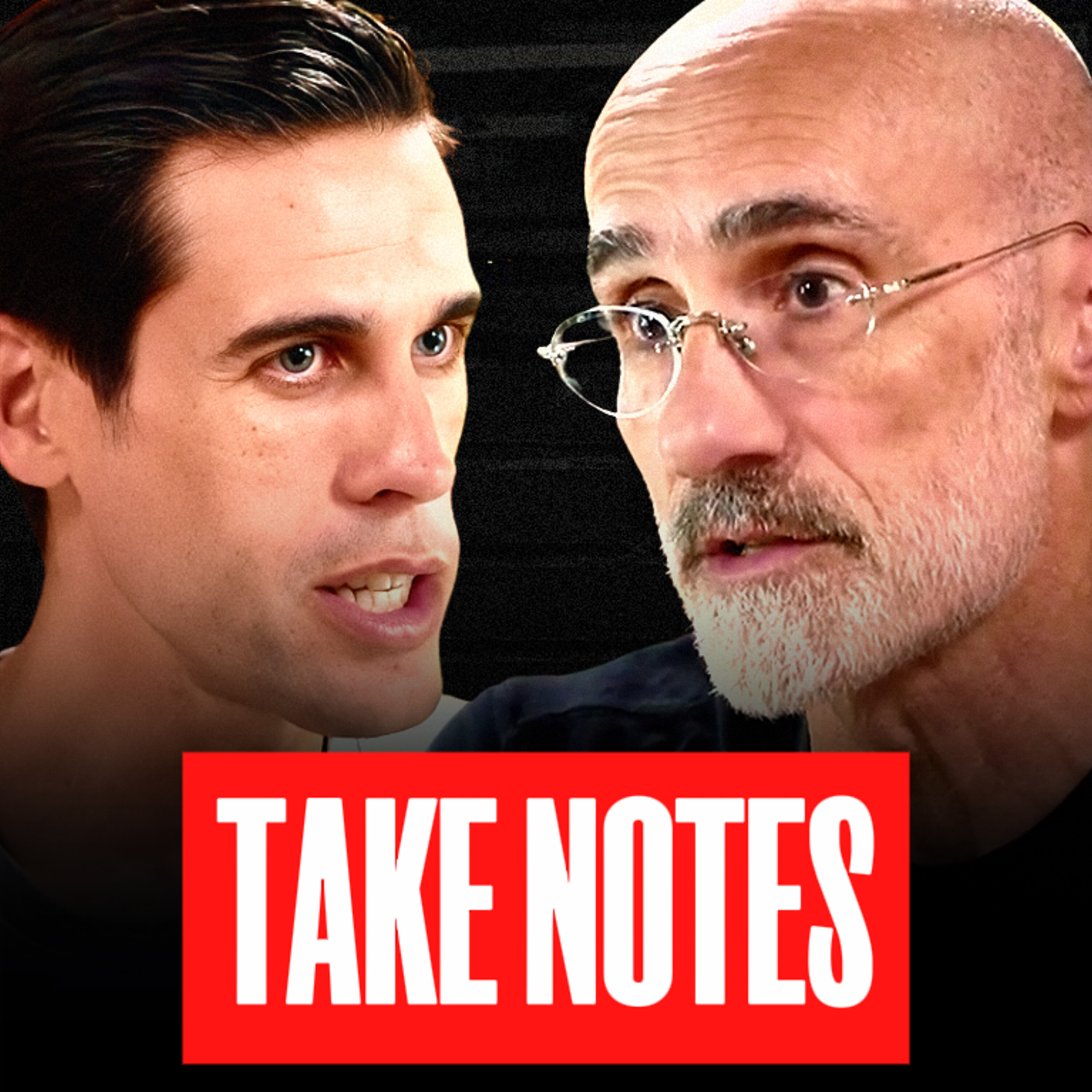
Arthur Brooks’ Ultimate Philosophy Masterclass (PT. 1)
In short
Arthur Brooks’ “Ultimate Philosophy Masterclass (Pt. 1)” on what ancient philosophers teach about living well today, moving through Socrates, Plato, the Cynics, Skeptics, Nietzsche, and Aristotle, with links to purpose, happiness, humility, and responsibility.
Guest backgrounds
Arthur Brooks is a philosophy/popular-audience writer and speaker (The Atlantic columns; bestselling books including Build the Life You Want). Host is Ryan Holiday (Daily Stoic Podcast).
Key claims
Wisdom emerges from many perspectives (convergent evolution/emergent order metaphors). Socrates teaches humility (“I know that I don’t know”) and outward learning. Plato emphasizes transcendent truth and the philosopher’s obligation to return to the cave. Cynics and Skeptics provide “transgressive” and “anti-pose” humility through radical reduction and “I don’t know.” Nietzsche forces questioning of essence vs existence and inherited assumptions. Aristotle reframes happiness (eudaimonia) as enjoyment/satisfaction/meaning through virtue practiced amid suffering; progress and moral aspiration over animal impulse.
Notable examples
Diogenes smashing his cup after realizing he can reduce needs; Diogenes telling Alexander to stop blocking the sun; Plato’s cave; Dalai Lama’s “meditate so the whole world feels better” (as Platonic obligation); “arrival fallacy” (gold medal then depression).
Written by AI. May contain mistakes.
Chapters
4:50
Exploring Ancient Philosophers
A discussion about the various ancient philosophers and their relevance today.
“And you can also grab his books here at The Painted Porch, From Strength to Strength, Build the Life You Want.”
7:18
The Nature of Truth and Knowledge
Insights on the concept of truth and perspectives in philosophy.
“Well, I've kind of likened it to convergent evolution where like different animals have similar adaptations.”
10:01
Socrates and Humility
Discussion about Socratic teachings and the importance of humility.
“And so that's the fullness of your domain.”
14:00
Plato's Teachings and the Allegory of the Cave
Explore Plato's core teachings and the concept of enlightenment through the Allegory of the Cave.
“it's the salient truth that you'll be able to uncover from time to time.”
16:40
Buddha's Perspective on Enlightenment
Understand Buddha's views on enlightenment and how it relates to helping others.
“He says, this is why I tell Westerners not to become Buddhists because they're doing it for the wrong reason.”
19:40
Cynicism and Its Modern Relevance
Learn about the Cynics, particularly Diogenes, and their critiques of modern materialism.
“To begin with, we don't understand them.”
22:20
Nietzsche's Philosophical Contributions
Examine Nietzsche's teachings and the importance of questioning philosophical assumptions.
“And so they're quite different in this particular way.”
30:17
Cultural References and Historical Context
Explore how historical references shape modern philosophical ideas.
“And sometimes we'll read, yeah, we read something from Socrates, or you read something in meditations and you go, that's a beautiful idea.”
32:29
Aristotle's Influence on Happiness
Understand Aristotle's view on happiness and the importance of change.
“But does it have a thousand years of human experience behind it?”
35:15
Defining Eudaimonia and Modern Misconceptions
Learn about eudaimonia and how modern views misinterpret happiness.
“Because it's not, I think when people think happy, they think grinning from ear to ear, living your best life.”
Show all 11 chapters
37:32
The Sweetness of Suffering
Discuss the value of suffering in achieving moral aspirations and happiness.
“And, you know, a lot of it is like, get the hell out of bed.”

Ask about this episode
Get the gist, explore an idea or ask about something said.
 Claude
On The Daily Stoic, what are the key points of this episode?
Searching your listeningTranscript
Automatic transcript. May contain errors.
0:00Ryan Holiday: I know it's not good for me to just run. I need it for my mental health, but it takes a toll on me physically and I need to mix it up. So one of the things I'm trying to work on this year is doing more diverse kinds of workouts and specifically doing more strength training. And that's where today's sponsor comes in. Tonal provides the convenience of a full gym and the guidance of a personal trainer anytime at home with their one sleek system. designed to reduce your mental load tonal is the ultimate strength training system helping you focus less on workout planning and more on getting results plus there's no more second guessing on your form tonal gives you real-time coaching cues to dial in your form which i need a lot of help on and it helps you lift safely and effectively plus tonal sets the optimal weight for every move and then adjusts it makes a tiny bit harder each time in one pound increments as you go and as you get stronger right so you're always challenged which is one of the other things, right?
0:56Ryan Holiday: We get in our rut. Even though we're doing something positive, we're doing it in a way that's actually getting progressively easier instead of progressively harder. So right now, Tonal is offering our listeners 200 bucks off your Tonal purchase with promo code TDS. That's tonal.com and use promo code TDS for 200 bucks off your purchase. That's tonal.com promo code TDS for$200 off. Shopping at Whole Foods is one of the things I do in our family, like the grocery shopping is my job. So I was glad to be able to do that even on vacation. And then, you know, being here in Hawaii, it was the same Whole Foods experience we're thinking about, but then also a bunch of regional stuff too that they only have at this Whole Foods.
1:39Ryan Holiday: We love shopping at Whole Foods because there's always new flavors and foods to choose from whichever Whole Foods you are like, whichever Whole Foods you happen to be at. So save on regional flavors at Whole Foods Market, and maybe I'll see you at the Whole Foods in Austin sometime. Three, four times a day, I reach over and I grab my wife's phone and I check something. Not social media. I check the Shopify app. Because Shopify is how I see how the Painted Porch and the Daily Stoic are doing. We've been using Shopify for almost 10 years now. It's great. And we're not the only ones using it. Shopify is the commerce platform behind millions of businesses and brands all over the world.
2:20Ryan Holiday: They do 10 % of the e-commerce in the U.S., from household names to Gymshark and Allbirds to little brands just getting started and little things in between like Daily Stoic. Everything is all in one place, making your life easier and your business operations smoother. And if you get stuck, Shopify is always around to share advice with their award-winning 24-7 customer service, which we have used many times at Daily Stoic and with The Painted Porch. It's time to turn those what-ifs in to sales with Shopify today. Sign up for your$1 per month trial today at shopify.com slash stoic. Go to shopify.com slash stoic.
3:01Ryan Holiday: Shopify.com slash stoic. Welcome to the Daily Stoic Podcast, designed to help bring those four key Stoic virtues, courage, discipline, justice, and wisdom into the real world.
3:20Ryan Holiday: Hey, it's Ryan. Welcome to another episode of the Daily Stoic Podcast. Maybe you can hear that. I'm in my office and my kids are stomping around upstairs making quite a bit of noise, So I will keep today's episode short because I want to get right into it. It's with one of my absolute favorite people to nerd out about philosophy, someone who has done a whole hell of a lot to bring practical philosophy of all different types, from all different schools to a huge audience, mostly through his column at The Atlantic and then through his bestselling books, including one he recently did with Oprah called Build the Life You Want.
3:59Ryan Holiday: Arthur Brooks came out to the Painted Porch here in Bastrop. I think he's been on the podcast more than anyone else, or at least close to. He's close to being inducted into, what, the four-timer club or the five-timer club? I don't remember exactly. But I do remember this conversation because we talked about Socrates. We talked about Plato. We talked about the cynics. We talked about Nietzsche and what we can learn from these ancient philosophers about living a good life today. Arthur has a new book. It comes out on March 31st. It's called The Meaning of Your Life, Finding Purpose in an Age of Emptiness.
4:34Ryan Holiday: And if you're feeling lost or struggling, you want to find purpose, which is what we're here to do. I think Arthur is a great resource in that regard. He's also going to be doing a free live workshop on March 27th. You can listen to him talking with Rainn Wilson and Hoda Cobb, Chip Conley, Simon Sinek, Andrew Yang, Maria Shriver, Dan Buettner, and Chris Williamson. And you can also grab his books here at The Painted Porch, From Strength to Strength, Build the Life You Want. And his new book, The Meaning of Your Life, Finding Purpose in an Age of Emptiness. Here is me, Arthur Brooks, digging in on ancient philosophy.
5:16Ryan Holiday: What I'm noticing about your columns, tell me if I'm wrong, but I feel like you are going through the philosophical schools one by one. and saying, like, here's something from each one, which I think people don't do enough, right? Because people are like, I'm a Buddhist, I'm a Stoic, I'm a Christian, and you kind of just stay in your lane. And obviously there's something about going really deep into one school of philosophy. But what I like about the ancients is how familiar they were with all the other ancient schools. So I thought maybe we'd just kind of go through them. And one of my favorite lines from Seneca is he says he'll quote a bad author if the line is good.
5:55Ryan Holiday: And he quotes Epicurus more than he quotes any of the Stoics, which I always thought was really interesting. That he was not just familiar with his quote unquote opponents, but he really liked their ideas and he could engage them.
6:08Arthur Brooks: Yeah, there's a lot to take from all different ways of thinking.
6:12Ryan Holiday: Yes.
6:13Arthur Brooks: And when it comes to philosophy, but by the way, it's the same thing with behavioral science. I can talk about the whole approach that I've taken to the study of happiness for the past seven years. I started off by figuring out what was wrong with it. And then I rebuilt it in a particular way that required that I have more than passing familiarity across a bunch of different disciplines and then within the different disciplines as well.
6:34Ryan Holiday: Do you find that they're all saying really similar things, though? Like at the core, when they boil down that there are some essential truths that all the schools have? No doubt.
6:43Arthur Brooks: I mean, no doubt that there is something behind it. there's a basic physics behind it. Yeah. But it's funny. It's kind of like what, that's what Schopenhauer calls villa, which means will in English. And what that means is that that's the ultimate truth that you can't actually see. And so you can get at it. Yeah. You can get at it. That's the shadows on the cave wall for Plato, of course. That's what Hegel would call geist. You know, that's the ultimate truth behind, which means ghost. And for him, that was kind of God. Yeah. In its way. but you can only get it through a glass darkly as saint paul put it yeah and so this is all this
7:18Ryan Holiday: whole thing right so you just did it you just gave me like there you go five people saying the same
7:22Arthur Brooks: things and we could look at who searle or any of those guys or or or um you know any of those subjectivists yeah who would say that actually there isn't that but the the reality comes to
7:33Ryan Holiday: exist at the moment and at the point of your perception yeah that's i don't think that's right
7:40Arthur Brooks: I think there is an underlying objective reality, but you only get it by coming at it from many different perspectives because when you're sitting only in your home, it's through a glass too darkly.
7:50Ryan Holiday: Well, I've kind of likened it to convergent evolution where like different animals have similar adaptations. So you go, oh, it must have descended from a common ancestor. Right. And it's like actually the common ancestor is just the need. Like it's helpful to have an opposable thumb. Or flying is a great way to escape from things that are trying to eat you. And so different species, bats and birds and, you know, apes and different animals have similar things. But you can't actually trace it back to like some one animal, one person figured it out and then everyone's a branch. Obviously, what's that line about where it's all table scraps from the Feast of Plato or whatever?
8:34Ryan Holiday: Sometimes it's that. But a lot of times, like, we actually don't have much evidence of the Buddhists and the Western philosophers overlapping, at least when the ideas were being formed. Later, you're like, wow, it's very similar. And that's kind of the point.
8:48Arthur Brooks: That's the point. So you just gave the biological metaphor for of the philosophical. And then there's, of course, the market metaphor. And the market metaphor is what is what Hayek talked about, which is called emergent order. Emergent order says you need lots and lots of people doing lots of different things in different ways in different places for different reasons. and then what will emerge is a wisdom. The wisdom emerges from the micro decisions of people all over the place. The truth emerges as you see the similarities between different philosophers coming at it from different angles. The biology will actually produce certain phenomena on the basis of congruent need.
9:23Arthur Brooks: Yeah. And so it's the same basic idea. Sure. And that's why you have to be looking outside your tiny little worldview.
9:30Ryan Holiday: Yeah, they're trying to navigate ships at sea and they're figuring out different ways of doing it, but there's only so many ways to do it. And it turns out they come up with kind of similar innovations. That's right.
9:41Arthur Brooks: And that's why academics are often so radically wrong while so unbelievably smart is because we are trained when we get our PhDs not to do that, precisely to not do that. And so you can be just like as great as you could possibly be to try to be right, but going in the wrong direction. You're getting better and better and better at walking 180 degrees off truth.
10:03Ryan Holiday: Sure, sure. And - But you're a specialist in X. Yeah. And so that's the fullness of your domain. You're not going, well, what if there's something totally the opposite of X or in a totally different discipline or domain, you have tunnel vision.
10:16Arthur Brooks: Exactly. That's why I started my career over on the basis of not doing that seven years ago.
10:22Ryan Holiday: Let's start with some schools. Should we start with Socrates who brings the wisdom down from the heavens? What do you think Socrates has to teach your average person about life? Where do we start?
10:33Arthur Brooks: So the average person can learn from Socrates the basic idea of humility, that your knowledge, that your enlightenment will come when you're not blocking that truth with yourself. Yeah. When you're not standing in the way with your own shadow of the truth. that's a that's the socratic idea that i the only thing i know is that i don't know anything that concept yeah and which is of course a contradiction in terms but it's a beautiful contradiction in terms because when you basically say i don't know man then what you can do what you're actually doing so what socrates would say um if you bring it forward to what a modern semi-modern psychologist would say william james the father of modern psychology is that socrates helps us go from the me self to the I self.
11:20Arthur Brooks: The me self is that which I'm thinking about myself and my rightness. The I self is that in which I'm just looking at the world and learning.
11:26Ryan Holiday: Right.
11:27Arthur Brooks: And that's humility. The I self is humility.
11:29Ryan Holiday: So he's just going around asking questions, not making statements.
11:32Arthur Brooks: He's, plus he's actually not reflecting on his own brilliance and rightness. Yeah. He's, it's sort of a non-defensive understanding of the world. It's an openness to the rest of the world. It's a beautiful kind of outward focus on actually trying to learn things.
11:47Ryan Holiday: One of the things I've been taking pains to point out about Socrates, though, is it's easy to see him as this intellectual figure. Like he's he's your academic. He's living off the the largesse of the success of Athens. He's, you know, walking around in his toga. Life must have been simpler and easier then. But I think you point out, no, he's in the middle of a great power conflict. He serves in a war. He lives through the time of the 30 tyrants. Like not everyone likes him. He lives in Athens as Athens is going through incredible turmoil. And like, we think of it as classical antiquity. To him, it was the most advanced time in human history.
12:27Ryan Holiday: And it was scary and uncertain and not the past.
12:32Arthur Brooks: Yeah. And that's because we weigh in after any one of these phenomena. We have what you have in your own life. What we all have is something a psychologist called fading affect bias. Fading affect bias is that which you look back on prior times, strip out the discomfort from those times and only enjoy the learning that one got. And so fading affect bias in your own life is, for everybody watching us right now, is that they went to college when they were 18 years old. And they were incredibly lonely and unhappy and calling mom every single day. So come pick me up. I hate it. And then they go back for their 10-year reunion and 20-year reunion for college.
13:09Arthur Brooks: and they're seeing their friends that they met in their first semester of college. Best years of my life. Best years of my life. That's fading affect bias. Yes. Because they learned a lot and made great relationships, and the discomfort of the moment wasn't there. The discomfort that was Socrates' own life is stripped away and is completely irrelevant, even though it was the most important thing to him.
13:28Ryan Holiday: He had a shitty marriage.
13:29Arthur Brooks: Yeah.
13:29Ryan Holiday: Like, that's one of the things you hear him talk about all the time, and everyone knew. It's like, Socrates did not make a great marriage choice. They did not get along. Yeah. And part of what allowed him, he saw that even that though, as a kind of philosophical practice. Right.
13:42Arthur Brooks: And indeed, you know, there are things that each of us deal with all the time. You know, we have children and soon enough, you're going to have teenagers. And let me tell you, super fun. Yeah. And, and these are difficult things that occupy most of your brain space. The current difficulties and, you know, it's a mess. Your life is an actual mess, but the things that you're doing that will be passed on are not the current mess. it's the salient truth that you'll be able to uncover from time to time. And that's what people remember about Ryan Holiday. And that's a lot of what you'll remember about these years for yourself as well.
14:14Ryan Holiday: Yes. Okay. So Plato comes from Socrates. What do you think Plato's main teaching for people is?
14:21Arthur Brooks: There's so much. I mean, there's so much. For me, as we were talking about a little earlier, this is the first time that we start to see there's a truth. There's a transcendent truth. But we're changing all the time. The changes are kind of a distraction from the ultimate truth, but there's an ultimate truth that underlies all of this stuff. And a lot of people, by the way, are true Platonists. They're true Platonists because they believe that change is extraneous and the unchanging is actually the reality. And that's a very, very Platonic ideal of what's going on. And that's the whole idea that came to, you know, all the way up to the 19th century existentialist philosophers and even absurdists who said there's an underlying truth.
15:06Arthur Brooks: I mean, Hegel, Schopenhauer, et cetera, they believed that too. And they were highly Platonist in this way.
15:13Ryan Holiday: And you mentioned the cave. I think the cave is the, the allegory of the cave is one of Plato's most interesting concepts, which is the idea that there is this truth, but most of us are looking at shadows. We're chained in a cave, he said. and we can sort of see out on the outer parts of the cave, light being reflected and we see these shadows. We don't know what they are.
15:33Arthur Brooks: So there is a reality. Yes. And all we get is the shadows and we have to do the best that we can with the shadows to figure out what's going on. Yes. Right. And then we escape from the cave. Exactly right. But there is this truth, unchanging truth. Yes. And all the dynamics and things of it are what confuse us and we have to sort of triangulate across the images as best we can.
15:51Ryan Holiday: Yeah. And we discover what this truth is having left the cave. Right. Right. Our obligation. Yeah. What is Cato says? Is it Plato's cave or Cato's play? Yeah, exactly. So Plato says you escape from the cave, you get some sense that, oh, what I was looking at before are only shadows. And as I understand it, he believes that then the role of the philosopher, the human being, is you're obligated to try to come back and communicate to the other people in the cave what those shadows were.
16:17Arthur Brooks: Right. Your obligation is once you actually have greater enlightenment is to share that particular enlightenment. which goes forward into all sorts of schools that people aren't even aware of.
16:26Ryan Holiday: Well, Buddha wrestles with this exact thing. Well, this is super important.
16:29Arthur Brooks: And so, you know, I've worked with the Dalai Lama for the last 12 years. And the Dalai Lama says that you can't actually benefit from meditation until you stop trying to get the benefit from meditation. I say, whoa. He says, this is why I tell Westerners not to become Buddhists because they're doing it for the wrong reason. I said, what's the wrong reason, your holiness? And he says, you want to meditate so you feel better. You need to meditate so the whole world will feel better. That's an incredibly Platonic idea.
16:53Ryan Holiday: Right?
16:54Arthur Brooks: The whole idea for you to find enlightenment is so that you can bring it to others.
16:57Ryan Holiday: Yeah. Buddha wrestles with, should I just continue to pursue my own enlightenment or should I teach enlightenment? Should I take on students? And there is this kind of obligation. And I think you could trace it to this idea in Plato, but in all the schools of thought that with insight and understanding and wisdom comes responsibility.
17:17Arthur Brooks: Right. And so the whole concept is what does the monastic life mean? under the circumstances. And that's a really interesting medieval Christian idea, actually from the time of St. Benedict in the 6th, 7th, 8th centuries, early on, but then into the Middle Ages of the scholastics. You know, what are you supposed to do if you're actually a monastic? And the whole idea is teach other people, like St. Thomas Aquinas, or are you supposed to actually just pray for other people? Yeah. Or are you just supposed to be a pure contemplative? Right. What is the right approach to that? And Plato would have a strong view.
17:48Ryan Holiday: Well, the Stoics and the Epicureans have this debate too. Should we participate in public life or not? And what does it mean to
17:57Arthur Brooks: participate in public life? Of course, there's another wrinkle on that. Yes, of course. We'll get to them in a second. Because you are, even though presumably you're not going to run for public office.
18:05Ryan Holiday: Yeah, I do. I do think the ancients had a much more limited definition of public life because there were only so many ways to contribute. Running an enormous company that employs thousands of people might be making a far bigger difference than being a senator and also running a gig.
18:22Arthur Brooks: And yet you're a lot more in public life like Plato. You personally, you're doing the public intellectual gig. It's just that you have the means to disseminate these ideas way, way, way beyond anything he could have imagined.
18:33Ryan Holiday: Yes. Yes. And although the irony is I had James Rahman here and he wrote this book, Plato and the Tyrant, Plato's forays into politics are are a cautionary tale against thought leaders and intellectuals sometimes participating in public life because you're, well, he was an easy mark, which is interesting. Easy mark for? Dionysus, the tyrant. He goes and he advises a king who is making pretensions about wanting to be a philosopher king, but really wants to be a tyrant with the propaganda and reputation. Well, you want a power. Yeah, exactly. And Plato is complicit in it in the way that, you know, a generation or two later, many generations later, Seneca and Nero fall into the same.
19:18Arthur Brooks: And in other words, intellectuals are easy to roll.
19:20Ryan Holiday: Yes. Yes. Because you don't have the experience and you don't even you don't necessarily even understand what you represent to the people in power and how you can be a tool for that. Yeah. Okay, so what about the cynics? I find the cynics to be fascinating, Diogenes being the most famous of them. But I feel like they have a lot to teach us in today's very materialistic world. To begin with, we don't understand them. Yeah.
19:43Arthur Brooks: Because we cast aspersions of people who are cynical. Yes. I mean, the whole idea of the skeptics and the cynics, different schools, of course. Yes. That there's something that's kind of suspect about the character. You know, you don't want to be a cynical person because you're just negative all the time. And that's exactly getting it wrong. Yes. How do you characterize the school of cynicism?
20:02Ryan Holiday: I say they're like the punk rockers of the philosopher world. They are transgressive and radical. And they are, by taking it, too far actually providing us insights about sort of a moderate middle ground. Like if everyone lived as Diogenes lived, the world would be a horrible place. But if everyone lived according to ambition and trying to make as much money and get as much power and valued all the wrong things, you also get a really bad society. And he's the, not the court gesture, because that's almost too dismissive. But he's like the hippie, sort of like, none of this matters, man. You know, like, and in so doing...
20:42Ryan Holiday: Not even that. Not even saying none of it matters.
20:43Arthur Brooks: He's saying, this is stupid. Yes. So it's worse than whatevs.
20:47Ryan Holiday: Yeah.
20:47Arthur Brooks: He's making fun of your suit and your tie and your fancy car.
20:52Ryan Holiday: Right. And I mean, the famous story about Diogenes that I love is, you know, he has very few possessions, but he walks up to the well and he gets a cup of water and a young boy runs up and gets water with his hands. And Diogenes realizes that even here, having reduced what he thought his needs were to nothing, actually has one more that he can get rid of and he smashes his cup on the ground.
21:15Arthur Brooks: What a piece of work. Imagine me marrying that guy.
21:17Ryan Holiday: Yes, I don't think you want to. Although, you know, so Zeno, the founder of stoicism, his philosophy teacher was named Cretes. I'm forgetting Cretes' wife's name, but she was a a famous cynic philosopher too. So we tend to think of it as this primarily male world, but there were fascinating cynical philosophers in marriages, which, you know, if they were totally abstaining and rejecting all convention, they would have rejected even that.
21:46Arthur Brooks: And then the skeptics who just knew nothing. I just, I know nothing. Yeah. Who just, they banked on knowing nothing. So no matter what, they said, I don't know.
21:59Ryan Holiday: And sometimes the extreme cases tell us something like it's not exactly a defensible position or a scalable position, but in the extremeness of it gives us color and another angle to understand ourselves. Right.
22:12Arthur Brooks: And there's a humility to it. Yes. There's a real humility to it. So there's a kind of a pose with the cynics and there's an anti-pose with the skeptics. And so they're quite different in this particular way. The Syracinics are interesting because what they do is they can make you realize that life is hilarious. By the way, you go fast forward in history and you find that a lot in Nietzsche. Yep. So the whole competitive set of ideas between what the Greeks were doing, which is that essence precedes existence, and then what the existentialists were doing in the 19th and 20th centuries, which is that existence precedes essence.
22:49Arthur Brooks: In other words, meaning either comes before you're born or you're born and then you find your meaning. that that's the big conflict between ancient philosophy and christian philosophy and all the things that that you and i are stock and trade yeah and what the modern existentialists do and nicha's like no no no there is no essence there is no meaning it's like so how am i supposed to live just to have a good laugh man yeah just have a good laugh well the the humor of the philosophers
23:14Ryan Holiday: is not something i think your average person is clued in on yeah right like because philosophy seems dry philosophy seems academic philosophy seems confusing and then you it's all of the above in many cases but you read diogenes the cynic and and you're like oh this dude's fucking hilarious yes yeah he's a badass like he goes up to alexander or alexander the great comes up to him as he's sunbathing and alexander the great says i'm the most powerful man in the world what can i do for you and diogenes looks at him having reduced his needs to nothing and says you can stop blocking the sun. Get out of my way.
23:52Ryan Holiday: And, you know, that's like, that's not just funny, but it's, it's badass.
23:57Arthur Brooks: Yeah. And, and Nietzsche is hilarious too, by the way, and probably the best writer of all of the, all the 19th century absurdists and existentialists.
24:06Ryan Holiday: Yeah.
24:06Arthur Brooks: He's a beautiful writer, incredible writer. It's really, really worth reading Nietzsche, even in English.
24:11Ryan Holiday: Well, let's fast forward. What do you think Nietzsche has to teach people? Where would you go?
24:15Arthur Brooks: To truly question your understanding of essence and existence.
24:20Ryan Holiday: Okay.
24:20Arthur Brooks: And it's really, really worth understanding it because we come with the biggest problem philosophically and by the way, scientifically, and in terms of almost everything that we do is an inability or unwillingness or just an ignorance about our own assumptions going in. That's a huge problem because it's garbage in, garbage out effectively. But that doesn't mean that your assumptions are garbage. But if you don't question them, you actually, it's very, very hard to grow because you're constrained to the philosophical outline that you've been given based on your assumptions. And a lot of what Nietzsche is talking about is questioning this fundamental algorithm of life, which is, did your life have meaning before you were born?
24:59Arthur Brooks: Or were you born and have to go find your life's meaning? And he breaks it all apart, like, you know, smashing his cup.
25:05Ryan Holiday: And he has a lot more to question, right? Socrates has, you know, a couple hundred years of philosophy to question. Nietzsche has 2 ,500 years and 2 ,500 years of Christian teachings too. So he's inherited a stabler world. Sort of, although I strongly suspect
25:23Arthur Brooks: that Socrates was relying on a lot that simply wasn't written down.
25:28Ryan Holiday: Yeah, the pre-Socratic philosophers.
25:30Arthur Brooks: And who were very sophisticated, but we don't know. Yeah. And what Nietzsche had was a lot of stuff that had been written down. Yes. And so the Socratic tradition was writing stuff down that had been preserved in the oral tradition.
25:41Ryan Holiday: Yeah.
25:42Arthur Brooks: And who knows what's a bigger library. That's true.
25:46Ryan Holiday: That is the interesting thing about, you know, the ancient world, is we tend to compress it down to this period. We go, Socrates, Aristotle, Plato, they're all kind of around the same time. Diogenes is in there. And you're like, Zeno to Marcus Aurelius is like 600 years. Yeah.
26:03Arthur Brooks: You know, or... It's like 300 BC to 300 AD or something like that. It's a huge swath of time.
26:10Ryan Holiday: Like they would have been like Marcus, the Roman philosophers would have come to Greece as tourists and said, look at these ancient ruins. I know, I know. You know, and. It's like looking at the Liberty Bell in Philadelphia or something.
26:25Arthur Brooks: Yeah, yeah, yeah.
26:25Ryan Holiday: But much older in many cases, right? Like it would have gone through, it would have been built and rebuilt and then destroyed by an earthquake and then ravaged by the Persians and then rebuilt. They would have just seen generation after generation and generation. They would have experienced it differently. They would have been still polished and shiny in some cases. But like they would have they would have come and gone. The smartest people who ever lived centuries ago walked where I'm walking. And it's like we're all tourists going back to this period. Right. Is kind of a beautiful.
26:59Arthur Brooks: It is. And the thing, however, that's worth, I think it's always worth remembering is that no doubt in the time of Socrates, he was looking back to philosophies that have been that he could chart back to the ancient Egyptians. Yes. And so Socrates was as far ago from us as the Egyptians were to him. And that's a long time ago. And if we move over to India, for example, I mean, that's a, Hinduism is a 6 ,000 year old religion. Lord Krishna lived in Mathura in the, you know, the Hindi heartland 6 ,000 years ago. And there's a little bit written, but the whole point is that the idea has reached us.
27:34Arthur Brooks: And for us to say, knowledge is limited to what's been written down in books is like for our kids to say, knowledge is limited to what's on the internet. It's the same basic idea. And that's actually obviously not true for all sorts of reasons.
27:54Ryan Holiday: We've got an employee here at Daily Stoke. I won't say who because it's kind of private, but they've been using Monarch, today's sponsor, to track their progress as they try to pay off their student loan debts. I'm a college dropout, so I don't have any debt, thankfully, but I can only imagine how overwhelming it would be to have this thing hanging over you. And she's been using the app to budget and save, and it's bringing her a little bit closer every day to being debt-free, which I can only imagine would be a huge relief. Monarch shows you exactly where your money is going. It helps you redirect it towards what matters.
28:28Ryan Holiday: With automated tracking and clear projections, you can actually see yourself getting closer to being debt-free or hitting your savings milestone instead of just hoping it happens. Unlike most other personal finance apps, Monarch is built to help make you proactive and not just reactive. and Monarch helped users save over$200 per month on average after joining. You can set yourself up for financial success in 2026 with Monarch, the all-in-one tool that makes proactive money management simple all year long. You can use code stoic at monarch.com for half off your first year. That's 50 % off your first year at monarch.com, code stoic.
29:09Ryan Holiday: If you're selling online or out of a storefront, full-time, or a side hustle, you know it's a challenge people gotta find you you gotta wait for them to walk in well today's sponsor whatnot flips that on whatnot you go live and sell directly to people in real time they see what you got they ask questions and they buy and you know what they keep coming back whatnot is the largest dedicated live shopping platform whether it's beauty collectibles electronics luxury fashion even cookies sellers are building real thriving businesses on whatnot whatnot buyers spend more than an hour a day on the app and they're not just browsing, they're bidding and buying and coming back.
29:46Ryan Holiday: So you can go live, show off your projects and turn that into real income. People selling on whatnot sell 10 times more than on other major marketplaces. And that's because you're not just listing products, you're building real connections with buyers. For a limited time, whatnot will match your first$150 sold in the first month. You just got to visit whatnot.com slash sell to start selling. W-H-A-T-N-O-T dot com slash sell, whatnot.com slash sell.
30:16Ryan Holiday: Yeah, that this is a thing that goes way back. And sometimes we'll read, yeah, we read something from Socrates, or you read something in meditations and you go, that's a beautiful idea. And you don't realize that that is them riffing on things. Like what I love is when you, when you, there's this play by Joseph Addison called Cato that was popular in the 18th century. And once you read it, you go, oh, like 80 % of what the founders were saying was just them quoting this play. Like we might say immigrants to get the job done or like you quote the Godfather or something. It was a cultural touchstone at the time.
30:51Ryan Holiday: We lose the illusions that they're riffing on. And in some cases, if you really go in, you go, oh, actually, okay, the footnote is telling me this comes from a line from a play by Euripides or whatever. But if most of it was oral, we wouldn't know that actually Socrates is a recycler.
31:08Arthur Brooks: Yeah, yeah. Of course he's a recycler. That's the point. And that's exactly sort of the whole point of what we're discussing here. You're not going to be doing good work unless you're mostly recycling. So the body of knowledge, when it's actually useful, is like sourdough bread, right? Sure. And that means it has this old thing in it.
31:26Ryan Holiday: Yeah, the starter.
31:27Arthur Brooks: And the starter is the most important thing in sourdough. that's the most important thing and it can be really old or you know the yeast and bread can go back literally the ancient egyptians is what it comes down to and if you don't have it you don't have bread and and you know the truth is that i mean it's probably you know you know as you know you and i we do a lot of talks on the outside it's kind of what we do for a living and you know 20 percent of a has got to be some old stuff that you've been working on and the jokes that you know that work and the big ideas and that's the spine of your talk of your new talk yes if it's 100
31:58Ryan Holiday: percent new it sucks yeah because you're you're doing it by trial and error with a new audience
32:03Arthur Brooks: yeah and this is a profoundly conservative worldview by the way but i think it has the the virtue of being largely correct is that when somebody comes out of the out of left field with a completely new way of seeing human nature it's always wrong and it's actually destructive and
32:18Ryan Holiday: dangerous what hasn't been tested in actual human experience yet and it hasn't been through boom times and depressions, wars. And like, yeah, if you if you came up with some totally new philosophy, it might sound really great. It might work great in a TikTok. But does it have a thousand years of human experience behind it? That's the problem with utopianism.
32:39Arthur Brooks: That's the problem with utopianisms all throughout history is that they've always been a failure and led to, you know, large scale destruction, death and suffering precisely because they're not sourdough.
32:51Ryan Holiday: Yeah, you got to take something, old wine and new skins, as they say.
32:55Arthur Brooks: Yeah. I mean, the problem with that is that, that of course is from the gospels and it says that old wine and new skins breaks the new skins.
33:01Ryan Holiday: Well, we skipped Aristotle. Give me something from Aristotle.
33:04Arthur Brooks: So of course, Aristotle was almost forgotten until the middle ages and considered, you know, and also ran to play it because it was a Neoplatonist in the middle ages. So by the time you get to the 12th and 13th centuries, you know, I have Avaros and you have Maimonides and of course, Thomas Aquinas from the three great Southern European Abrahamic traditions. And they were all Platonists. They were all Platonists. But especially Aquinas, he rediscovered Aristotle and brought Aristotle to what at the time was a modern audience. And he said, this is the guy. This is the guy. I mean, Plato's okay, but Aristotle, he's the guy.
33:36Arthur Brooks: Why? Because he was a full spectrum scientist. But there was also this one weird thing that he did that Plato didn't do. He said that change isn't a distraction from reality. It is reality. That's a big deal. That's the whole idea that dynamism is the essence of reality itself. And so, you know, you as a person are different than who you were and who you're going to be. And that change, that first derivative of Ryan-ness is the essence of Ryan-ness. And that's a pretty big deal when you think about it. Because that's just the dynamic understanding of oneself. and to be celebrating the change. And that has a lot to do with how we understand modern behavioral science.
34:15Arthur Brooks: We, I mean, the underlying unchanging essence of ourselves is not very interesting to us. What we want to make is progress. Yeah. We're just like, progress, progress. That's the essence of what a good life is really all about.
34:27Ryan Holiday: When his point that virtue is something not that you have as an essence, but it's something you are doing and getting better at doing.
34:36Arthur Brooks: That has been super, super influential in my own work. Yeah. Which is this one-third philosophy, one-third neuroscience, one-third behavioral science. Yeah. It's kind of the three parts of the pie, as I'm putting it in there. That I started off doing this work years ago saying, I want to find the secret to happiness. And that's wrong because you can't be happy. What you can be is happier. Yeah. Which is an Aristotelian notion as opposed to a Platonic notion.
35:03Ryan Holiday: Yeah.
35:03Arthur Brooks: You can get happier. And the goal is putting yourself, your life on a jagged, messy path toward happier-ness.
35:13Ryan Holiday: And his definition of happiness, eudaimonia, maybe give us that definition. Because it's not, I think when people think happy, they think grinning from ear to ear, living your best life. And it's not quite that. Well, it's not that at all, actually.
35:27Arthur Brooks: So the biggest mistake that the moderns make is thinking happiness is an emotion. Happiness is a feeling. It's not. It's not even one of the basic emotions, according to behaviorists who do work on emotions, the basic emotions researchers. Happiness has feelings associated with it, like Thanksgiving dinner has a smell. So feelings are evidence of happiness, which is really, really important thing to keep in mind, because if you're actually looking for the feeling per se that you're searching for a vapor, you're going to be about as nourished as if you're trying to get the ultimate smell experience on Thanksgiving Day.
36:00Arthur Brooks: Yeah. Happiness is enjoyment and satisfaction and meaning. That's what happiness is all about. And that experience of going from pleasure to enjoyment, which is what it means to grow up and be a responsible person, but also to be a happier person to drive satisfaction, which is joy that comes from accomplishment after struggle and meaning, finding the meaning of your life, the why of your existence. there's tons of suffering in that. Tons of suffering in all three of those bins, which is, you know, and that's very Aristotelian. Eudaimonia means a good life well lived. There's actually, there's not an adequate translation.
36:36Arthur Brooks: I mean, everybody, we all struggle with actually what does eudaimonia mean? It's the good life and the good life has lots of suffering in it. And so therefore, the modern eliminationist strategy, which is to say that if you're feeling sad and anxious, you're broken and you need therapy. Yeah. That is profoundly anti-Aristotelian, but it's also an exercise in futility because you can't get enjoyment, satisfaction, and meaning unless you're like suffering. Bring it on. Which is stoic, by the way.
37:04Ryan Holiday: Of course. Yeah. He's saying that you have to be doing the things that humans were meant to do and specifically what were you meant to do. So it's a lot of like when people talk, I got to find my purpose. Like that's what Aristotle is saying. When you get there, you're a lot closer to happiness than anything else.
37:22Arthur Brooks: Right, which is why, you know, Aristotle was a great theorist and the Stoics are very practical. I mean, they're working out eudaimonia. That's the Stoic philosophy. He's like, how do we do this thing? How do we get this eudaimonia? And, you know, a lot of it is like, get the hell out of bed. Yeah. You know? Yeah. Which is this, and it's extremely Aristotelian in its way.
37:41Ryan Holiday: Yeah, I think that like, this is more Stoic than Aristotelian, but it's like, what are the things that I'm glad I did after? that I hated while I was doing it. Like going for a run, you feel great after. It's not that fun while you're doing it. Jumping in a cold plunge. You're not, you don't love the period of jumping in. You don't love as you come up for it, but you love 20 minutes after.
38:02Arthur Brooks: Yeah, let me ask you a question. Do you love writing books or having written books?
38:07Ryan Holiday: Well, that's the joke that painters like painting and writers like having written.
38:10Arthur Brooks: Yeah.
38:10Ryan Holiday: I try to make a distinction between writing and publishing. Writing is in my control. Publishing is not. So like, sure, am I glad to be done with a book? And is there something about that? Because books involve suffering, as all projects do. So I get that. I do make a distinction, though. Like, I actually try to work on enjoying doing the thing, because it's the only part of it that's up to me. Yeah.
38:34Arthur Brooks: And that's a really important thing to keep in mind because there is a lot of suffering. But in the dynamics of the whole thing, if there's nothing good for you in the journey, then you'll fall prey. Sure, as we're sitting here to the arrival fallacy, a very well-known phenomenon that says, when I get to the end, then I will feel pure bliss.
38:50Ryan Holiday: Yes.
38:51Arthur Brooks: Which is axiomatically wrong.
38:53Ryan Holiday: If the whole thing is suffering, then you need external results to make it worth the suffering. Right. You have to figure out how actually you enjoy practice. Right.
39:04Arthur Brooks: Like you enjoy the doing of the thing. And then the question becomes, which is a very stoic and both Aristotelian, kind of a stoic.
39:12Ryan Holiday: Yeah.
39:12Arthur Brooks: You know? Yeah. He set the ships in motion, I guess. Yes. Is how much did you enjoy the suffering?
39:18Ryan Holiday: Yeah.
39:18Arthur Brooks: See, this is the thing. People are like, they try to dichotomize and they say the process should have enjoyment, but it also has a lot of suffering. And if you only suffer so you can get to the enjoyment of the end, the arrival fallacy will hunt you down and kill you like a dog. Right. Which means you'll win the Olympic gold and be depressed for six months because you feel like your life is over. The real trick here, the real stoic trick is enjoying the suffering.
39:43Ryan Holiday: Yes. Do you enjoy the suffering? I do. I do. I've had to work. I don't think you're just naturally there because there's this part of you that wants to avert and avoid suffering wherever possible. But then I try to go, oh, you know, this is actually like a dream. Like I get to do this. Yeah. This is my job. I'm very lucky. And I try to enjoy it and then try not to rush through it also.
40:05Arthur Brooks: And this is probably the most profound Aristotelian point of all, which is because he was a good biologist as well as a philosopher. And he asserted in many, many places in the writings that human beings have kind of two spaces that they can live in. There's animal impulse and there's moral aspiration. Animal impulse and moral aspiration. And now we know why. The reason that we actually have a choice of living in one of these two spaces is because we have a prefrontal cortex. that's astonishing in its complexity beyond any supercomputer that exists or will exist. I mean, it's one third of our brain by weight.
40:38Arthur Brooks: And, you know, your dog's prefrontal cortex is wafer thin, which is why it has only animal impulse. But if you follow what Mother Nature is telling you, what your urges are, all you'll do is the things that will immediately slightly raise your odds of survival and passing on your genes. Aristotle points out, as do all the good philosophers and religious traditions, that you can actually choose to stand up to Mother Nature, to stand up to your animal impulses and live in your moral aspirations. And when you're making that choice, the suffering is sweet. That's the point. This is, I mean, this is a key point of Aristotle and everybody else, by the way.
41:16Ryan Holiday: Thanks so much for listening. If you could rate this podcast and leave a review on iTunes, that would mean so much to us and it would really help the show. We appreciate it. And I'll see you next episode.
41:48Arthur Brooks: We'll see you next time.
41:58Arthur Brooks: Visit our kitchen showrooms in-store or go to Menards.com for free estimates today. Plus, check out our weekly flyer for all of our hot deals going on now. Save big money at Menards. The Bleacher Report app is your destination for sports. Right now, the NBA is heating up, March Madness is here, and MLB is almost back. Every day there's a new headline, a new highlight, a new moment you've got to see for yourself. That's why I stay locked in with the Bleacher Report app. For me, it's about staying connected to my sports. I can follow the teams I care about, get real-time scores, breaking news, and highlights all in one place.
42:41Arthur Brooks: Download the Bleacher Report app today so you never miss a moment.
From the publisher
What are you missing by only seeing the world through one philosophy? In this masterclass, Arthur Brooks and Ryan walk through the biggest schools of thought and reveal how they fit together in a way most people never see.
Join Arthur on March 27 for a free live workshop -- along with his friends Rainn Wilson, Hoda Kotb, Chip Conley, Simon Sinek, Andrew Yang, Maria Shriver, Dan Buettner, and Chris Williamson. Together, they will deconstruct the 'Meaning Gap' and share the raw, unscripted truths about finding purpose in a chaotic world. You can register here.
👉 Preorder Arthur Brooks’ NEW book The Meaning of Your Life
📚 Grab copies of Arthur Brooks’ books From Strength to Strength and Build the Life You Want
Arthur Brooks is a social scientist and one of the world’s leading authorities on human happiness. He is a Harvard professor, columnist with The Free Press, host of the podcast Office Hours, CBS News contributor, and internationally acclaimed public speaker. His previous books have been translated into dozens of languages and include the bestsellers Build the Life You Want (co-authored with Oprah Winfrey), From Strength to Strength, and Love Your Enemies.
Follow Arthur on Instagram @ArthurCBrooks, YouTube @DrArthurBrooks, and X @ArthurBrooks
🎙️ AD-FREE | Support the podcast and go deeper into Stoicism by subscribing to The Daily Stoic Premium - unlock ad-free listening, early access, and bonus content: https://dailystoic.supercast.com/
🎥 VIDEO EPISODES | Watch the video episodes on The Daily Stoic YouTube channel: https://www.youtube.com/@DailyStoic/videos
✉️ FREE STOIC WISDOM | Want Stoic wisdom delivered to your inbox daily? Sign up for the FREE Daily Stoic email at https://dailystoic.com/dailyemail
See Privacy Policy at https://art19.com/privacy and California Privacy Notice at https://art19.com/privacy#do-not-sell-my-info.
More from The Daily Stoic
All episodes
We use cookies.They keep VO running smoothly and help us improve it. Privacy policy