
 Ask ChatGPT


- Podcasts
- The Daily Stoic
- Arthur Brooks’ Ultimate Philosophy Masterclass (PT. 2)
The Daily Stoic28 Mar 2026 · 48m · 27 chapters
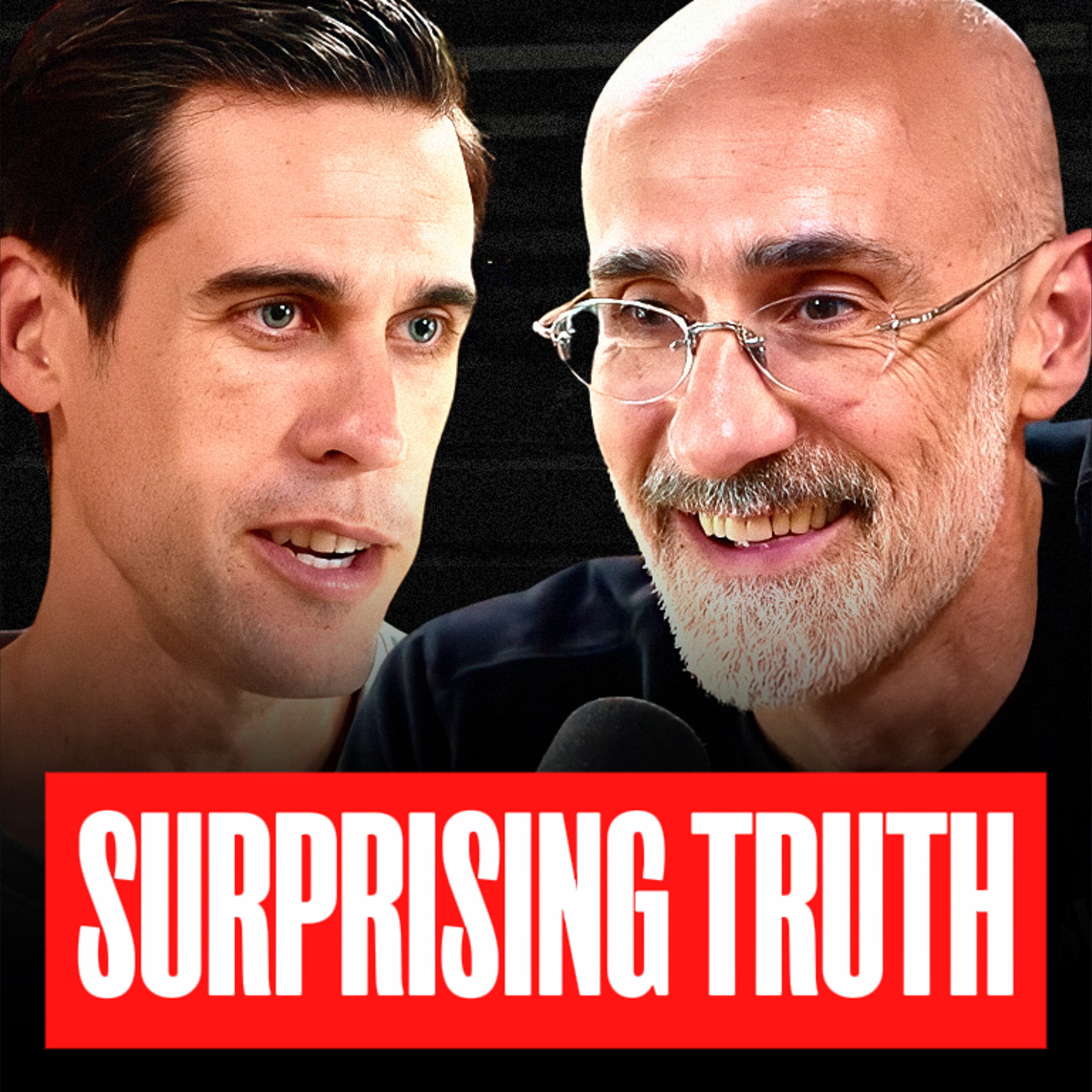
Arthur Brooks’ Ultimate Philosophy Masterclass (PT. 2)
In short
Part 2 of a philosophy “masterclass” on how different traditions explain happiness and the good life, focusing on transforming suffering into meaning. It contrasts Epicurean enjoyment vs pleasure, Buddhist dissatisfaction/attachment vs detachment, and Christian moral aspiration (love of God and neighbor) vs “animal impulse.” It also touches on Camus’ purpose amid absurdity, Montaigne’s epistemic humility, and debates about individualism (Rand/Emerson) and community.
Guests
Arthur Brooks, a Harvard social scientist and leading authority on human happiness; Harvard professor, Free Press columnist (formerly The Atlantic), host of Office Hours, CBS contributor; author of Build the Life You Want, Strength to Strength, and Love Your Enemies. Host: Ryan Holiday (Daily Stoic).
Key claims
Meaning comes from what we do after suffering (not from the event itself). Epicurus’ “enjoyment” = pleasure + people + memory; satisfaction rises by wanting less (but not to “want nothing”). Buddhism’s four noble truths: life is dissatisfaction, attachment causes it, detachment frees you. Christianity reframes impulse into love: love God and neighbor; love is willing the good of the other. Camus: Sisyphus is happy because he has something to do.
Notable examples
Epicurus’ “small pot of cheese” vs luxury pleasure; Buddha’s asceticism as attachment; Epicurus’ letter “the happiest day of my life, the day of my death”; Jesus’ Sermon on the Mount (“love your enemies”); Sisyphus rolling the boulder; Montaigne’s “what do I know?” during religious violence; Emerson’s self-reliance vs Rand’s “Galt’s Gulch” individualism.
Written by AI. May contain mistakes.
Chapters
4:04
Epicurus and His Philosophy
Exploring Epicurus' views on pleasure, enjoyment, and happiness.
“All right, so give me, I think we can skip the Stoics.”
7:37
Mindfulness and Living in the Present
Discussing the importance of mindfulness and being present in life.
“And so what we can learn from him today is about this pillar of happiness.”
11:47
Buddhism and Its Core Philosophy
Examining the four noble truths and the essence of Buddhist philosophy.
“And this is, of course, a notion that this came out of the Vedic and Hindu traditions.”
14:00
Hinduism and Its Diversity
Explore the complexities and variations within Hinduism compared to Buddhism.
“And at its core, what people don't really understand about Hinduism, it's not a thing.”
15:01
The Bhagavad Gita's Teachings
Understand the spiritual lessons from the Bhagavad Gita and its significance in Hindu thought.
“And the reason that this India subcontinent is largely Hindu today is because of the claim, the argument based on sort of evangelists that were going through the countryside saying, don't you want God?”
17:10
Humans' Innate Need for Worship
Discuss the anthropological findings on the necessity of religion in human societies.
“and that once you understand the metaphysical essence of who you are, not to be Gnostic, not to say that the body falls away because it's unimportant.”
21:00
Interconnections of Faiths
Examine the historical interactions between Stoicism and Christianity.
“And when you just read the, the, the Christian version, you're like, this is the Christian, you're not thinking that all of these faiths and ideas are, are intermixing with each other and walking the earth.”
22:41
Christianity's Moral Aspirations
Discuss the essence and moral teachings of Christianity and their significance.
“believe it as a person but i recognize that the the best way for you to understand it even from the inside is by understanding the influences from the outside.”
25:22
Radical Teachings of Jesus
Explore the revolutionary ideas introduced by Jesus and their historical impact.
“But fundamentally, your people are there for your pleasure and use.”
28:01
The Radical Message of Christianity
Explore how Jesus' teachings challenge societal norms.
“Because that's what we're made to do is to, that's what we were just talking about.”
Show all 27 chapters
28:36
Christianity vs. Roman Philosophy
Discuss the contrast between Christian values and Roman imperial ideals.
“But care about the people that the Roman empire uses up and smashes and destroys when they get in.”
29:18
The Sermon on the Mount's Transgressiveness
Understand the radical nature of Jesus' teachings on love and morality.
“it comes back and it comes back and it comes back.”
30:19
Coercion vs. Persuasion in History
Examine the shift from coercive power to persuasive diplomacy.
“But by the way, this changed back to philosophy.”
31:09
Ayn Rand's Philosophical Context
Analyze Ayn Rand's views in contrast to traditional philosophical teachings.
“We'll do kind of a lightning round with some of these other ones as we wrap up.”
31:37
Emerson's Influence on Individualism
Explore Ralph Waldo Emerson's unique brand of individualism.
“It's like, hey, the little guys are parasites.”
33:18
The Balance of Individualism and Community
Discuss the necessity of community alongside individual liberty.
“Which, you know, we think of Unitarians today as people who believe in up to one God.”
34:08
Intellectual Humility and Modern Academia
Investigate the decline of intellectual rigor in contemporary academia.
“Emerson would say nature is that form of transcendence.”
35:36
Montaigne and the Value of Curiosity
Learn how Montaigne's ideas on curiosity and humility remain relevant.
“Cancel culture and, you know, radical activism and, you know, the whole anger that actually that we see in a lot of it today has to do with the fact that we're just we're just not good intellectuals enough.”
36:49
HelloFresh: A Solution for Home Cooking
Discover how HelloFresh simplifies the home-cooking process.
“Every time I read Montaigne, I say, I wish I knew more.”
39:08
Helix Sleep: Finding the Right Mattress
Understand the benefits of customizing your sleep experience with Helix.
“by plan so i told you i was at this airbnb here in maui on this trip we took and uh oh man the mattresses were not good.”
40:26
Camus and the Absurd
Delve into Albert Camus' philosophy and its implications on purpose.
“Oh yeah, so the absurdist school, often distinguished from the existentialists, of course.”
42:03
The Absurdity of Existence and Camus
Explore the absurdity of life through Camus' philosophy and experiences.
“that's the point is that he had, he had a purpose.”
43:10
Philosophers in Public Life
Discuss the importance of philosophers engaging in public life and moral responsibility.
“Because you can't work out your ideas unless you're completely alive, which is what they.”
44:30
Existential Literature and Meaning
Delve into the works of existentialists and their reflections on life's meaning.
“This is just theory as far as I'm concerned.”
46:08
Tolstoy's Journey to Finding Meaning
Learn about Tolstoy's quest for meaning and how he shifted his perspective on life.
“and it was actually—so people know, you know, civil disobedience, So they think there's this through line from Emerson, from Thoreau to Gandhi, who were not that far apart in time.”
49:17
The Role of Suffering in Meaning
Understand how suffering contributes to finding meaning in life according to various philosophies.
“a very Dostoevsky-esque idea that people are starting to rediscover in these Russian existentialists, Christian existentialists.”
52:11
Philosophy as a Survey of Wisdom
Reflect on the expansive nature of philosophy and its relevance to modern life.
“If happiness can only come from things going very well, then it's only available to a small percentage of people, a small percentage of the time.”

Ask about this episode
Get the gist, explore an idea or ask about something said.
 Claude
On The Daily Stoic, what are the key points of this episode?
Searching your listeningTranscript
Automatic transcript. May contain errors.
0:00Ryan Holiday: Shopping at Whole Foods is one of the things I do in our family. Like the grocery shopping is my job. So I was glad to be able to do that even on vacation. And then, you know, being here in Hawaii, it was the same Whole Foods experience we're thinking about. But then also a bunch of regional stuff, too, that they only have at this Whole Foods. We love shopping at Whole Foods because there's always new flavors and foods to choose from whichever Whole Foods you are like, whichever Whole Foods you happen to be at. So save on regional flavors at Whole Foods Market, and maybe I'll see you at the Whole Foods in Austin sometime.
0:34Ryan Holiday: Three, four times a day, I reach over and I grab my wife's phone and I check something. Not social media. I check the Shopify app because Shopify is how I see how the Painted Porch and the Daily Stoic are doing. We've been using Shopify for almost 10 years now. It's great. And we're not the only ones using it. Shopify is the commerce platform behind millions of businesses and brands all over the world. They do 10 % of the e-commerce in the U.S., from household names to Gymshark and Allbirds to little brands just getting started and little things in between like Daily Stoic. Everything is all in one place, making your life easier and your business operations smoother.
1:17Ryan Holiday: And if you get stuck, Shopify is always around to share advice with their award-winning 24-7 customer service, which we have used many times at Daily Stoic and with The Painted Porch. It's time to turn those what-ifs in to sales with Shopify today. Sign up for your$1 per month trial today at shopify.com slash stoic. Go to shopify.com slash stoic. Shopify.com slash stoic. Welcome to the Daily Stoic Podcast, designed to help bring those four key Stoic virtues, courage, discipline, justice, and wisdom into the real world.
2:01Ryan Holiday: Hey, it's Ryan. Welcome to another episode of the Daily Stoic Podcast. The basic premise of Stoic philosophy to me is life is going to kick you around. It's going to kick your ass. It's going to go sideways. And you got to be able to handle that. You got to be able to not be broken by that. And then, this is the most important part, you got to be able to turn it into something. You got to find meaning and purpose in it. You got to be able to rise to that challenge and then use that challenge to become better than you would have had it never happened. It's actually something I talked to David Kessler about a few years ago.
2:33Ryan Holiday: He's an expert on grief. He worked with Dr. Kubler-Ross on the stages of grieving. And he adds a new step, a sixth step, which is about how do you find meaning from grief and loss. Let me play a little chunk of what Ian and I talked about.
2:47Arthur Brooks: There's some disconnection that I've heard over the years from people in grief. And as I started to talk about it, it became so apparent. Everyone was like, well, David, there's no meaning in a child's death. There's no meaning in a murder. There's no meaning in a betrayal, in a car wreck, in a divorce, in a pandemic. and I realized, oh, the meaning isn't in the horrible thing.
3:11Ryan Holiday: Yeah.
3:11Arthur Brooks: The meaning is in us.
3:13Ryan Holiday: It's what we do afterwards. And that is precisely what Arthur Brooks and I talked about in today's episode as well, how you transform suffering into meaning. We did kind of a masterclass on all the different philosophical schools, the Stoics, the Buddhists, Catholicism versus Stoicism, Arthur's own inner conflicts and more. I think you're really going to like this episode. If you don't know who Arthur Brooks is, well, you should. He is a social scientist, one of the world's leading authorities on human happiness. He's a professor at Harvard, columnist with the Free Press, formerly The Atlantic, host of the podcast Office Hours.
3:49Ryan Holiday: He's a contributor to CBS and a wonderful speaker. He did a book with Oprah called Build the Life You Want. Did the bestselling book from Strength to Strength and a book called Love Your Enemies. All of those are available at The Painted Porch, but let's just get into it with Arthur Brooks. Here is part two of our masterclass on philosophy.
4:10Ryan Holiday: All right, so give me, I think we can skip the Stoics. Does it get enough of that here? They can't get enough here. They can't get enough. Tell me about Epicurus.
4:19Arthur Brooks: Epicurus, well, of course, who is way before Epictetus. Yes. I mean, it's what, 250 years before? Greek Roman. Yeah. So Epicurus predates a lot of this stuff. And Epicurus, who is completely misunderstood today, because it's the whole idea of eudaimonia versus hedonia. Yeah. Right. And hedonia, which is hedonist and hedonic and all these words come from it as if it's the pursuit of unbridled pleasure. That's actually not right in a bunch of different ways. Pleasure is a limbic phenomenon that occurs in the limbic system, an ancient console of tissue that's up to 40 million years old, predates Homo sapiens.
4:53Arthur Brooks: That's what produces your emotions, negative and positive, which you need to survive and thrive to be sure. If you hit the lever of pleasure over and over and over again, you're tapping the limbic system and you're being managed by those pleasures. That's the reason that, you know, your friends from high school that wanted to feel good all the time are still living in their mom's basements because they couldn't make anything in their lives because they were being managed by their limbic systems.
5:15Ryan Holiday: Delayed gratification is that other part.
5:18Arthur Brooks: Yeah, well, it's among other things. I mean, the whole idea that we're talking about here is the other part. So that's how we think of hedonism. That's not Epicurus. Epicurus talked about enjoyment, not pleasure.
5:31Ryan Holiday: Right. Right.
5:32Arthur Brooks: Pleasure and enjoyment are related, but pleasure is a component part of enjoyment. Enjoyment is pleasure plus people plus memory. And it moves experience into the prefrontal cortex, executive centers of the brain, where you can manage your pleasures and you can make permanent memories. And in so doing, that's why it's a component part of happiness, enjoyment. And so if you're doing something that's addictive and you're doing it alone, you're probably doing it wrong. That's the whole idea. And that's really important to Epicurus because Epicurus is all about enjoyment, which means he's surrounding himself with people.
6:07Arthur Brooks: And they were talking about pleasant, non-conflictive, big ideas and living an extremely deep moral existence. This was not like a constant drunken orgy that was going on.
6:18Ryan Holiday: And I do think the best Stoics had a strong Epicurean streak.
6:23Arthur Brooks: Right. And the first person who, I mean, Epictetus trashed Epicurus, right? And just it was a complete, it had nothing to do with it. It was just using him as a foil.
6:32Ryan Holiday: When I think Epictetus having such a life filled with profound suffering, like first 30 years of his life, he's a slave. Yeah. I think there's probably something about him just at a human level that's like, fuck that guy. Like a rich guy. That rich guy in his commune with his weird cult. Yeah, he doesn't know anything about, you know, he didn't have to, nobody broke his leg for sadistic pleasure. You know, Epicurus never had to see Nero's court. Right. You know, like there's he probably looked at Epicurus the way some of us look at an academic philosopher or a guru or something. You don't live in the real world or Mar-a-Lago.
7:08Ryan Holiday: Yes. Right.
7:09Arthur Brooks: I mean, it's something where you're like, really? Yes. You know, and so for sure. But that's not what Epicurus was all about. Epicurus, it was a very I mean, libertines, you know, the Berkeley generation of 68. They couldn't have lived with Epicurus. No, they wouldn't be able to put up the rules. Right. Because Epicurus' whole idea is if you're actually going to live in a state of semi-permanent enjoyment, you better not reduce it to pleasure. You better not reduce it to pleasure. And that's a really important distinction. And so what we can learn from him today is about this pillar of happiness.
7:41Arthur Brooks: Is Epicurean enjoyment as opposed to Epicurean pleasure is one of the best ways that you can become happier. It's incomplete. Indeed, it's incomplete. That's why the Stoics are better on the meaning pillar of happiness. the moderns are better on the satisfaction part and the epicureans are really really good on the
7:59Ryan Holiday: enjoyment part no and that's why i say you fuse them together and you get something really powerful because there there's actually something pretty spartan about epicurus right he's like you know there's the joke about the spartans that uh hunger is the best flavor yeah you know like and and there's something about for him he reduces his needs down pretty low and then he's like this is great. Everything's awesome. I don't have to reach for anything. I don't have to go without anything. It's all very accessible and practical and realistic. He's not saying pleasure is, you know, flying in a new Gulf Stream to have lunch in Paris.
8:32Ryan Holiday: He's saying, you know, this small pot of cheese is miraculous if you think about how it was made and if you savor every bite of it.
8:42Arthur Brooks: That's right. And the whole idea is, I mean, on the satisfaction pillar, your animal impulse tells you that it's about what you have and having more, which is the Gulf Stream, etc., which leads to ruin, absolute personal ruin. Talking about anything else, just personal ruin, because you can never have enough. It's actually better described as what you have divided by what you want. And the denominator is more important because a very efficient way to get greater satisfaction in your life is by decreasing the denominator by wanting less. And so this Epicurean notion of wanting less, wanting less, wanting less, wanting less and watching your satisfaction rise and rise and rise or enjoyment in this particular case.
9:20Arthur Brooks: But of course, asymptotically, it doesn't work. You can't go to wanting nothing.
9:25Ryan Holiday: Yeah.
9:25Arthur Brooks: Because if you want nothing, well, I mean, wanting for nothing, I suppose, that's a heaven, I guess.
9:30Ryan Holiday: Right. Which is not what he was trying to create. I just think, like, I think about his garden and the simplicity and the beauty and the long evenings in it. It's a pretty simple thing.
9:41Arthur Brooks: What it is is really in modern thinking and in Buddhist thinking, but really in modern thinking, it's really a lot about mindfulness. Yeah. And that mindfulness is a very hard thing to do because the human brain, the prefrontal cortex is designed for you to time travel. Yeah. Retrospectively, prospectively, and mindfully. Those are the three time zones that are actually in your head all the time. Most people spend the least amount of their time here now.
10:04Ryan Holiday: Yeah.
10:04Arthur Brooks: That they don't spend their time mindfully. So Marty Seligman, my great mentor in the positive psychology business of happiness, he says that we shouldn't be called homo sapiens. We should be called homo prospectus because we live in the future. 20 to 50 % of your cycles on average are living in the future. If you're an entrepreneur or a striver, like the whole audience for the show, it's more like 80 % of your time. And you're missing your life. Epicurus's point is don't miss your life.
10:34Ryan Holiday: He's saying actually this is better than the vacation that you are pining for this present moment.
10:41Arthur Brooks: Don't build castles in the sky. Don't do that. And don't be wishing that you could go backwards in time. Don't be enjoying your memories and don't be enjoying your fantasies. Enjoy this now.
10:51Ryan Holiday: Yeah.
10:52Arthur Brooks: And that's super hard to do. As a matter of fact, there's all kinds of evidence that our brain isn't even designed to do that very well. You know, when you put people in fMRI machines and you say, think about nothing, then you turn on the default mode network and set up structures in your brain, you'll start thinking about the future automatically.
11:09Ryan Holiday: Well, there's a famous letter that Epicurus writes where he goes like, on this, the happiest day of my life, the day of my death. And that's what the letter opens with. He's saying, and again, for people who think that Epicureanism is hedonism, he's trying to say, you can be happy on the day that you die. Right. So it's definitely not related to what you have. And it's not because he has some delicious last meal or something. He's just saying, this is the day that I have now. So it's the happiest day of my life.
11:39Arthur Brooks: I'm alive right now. And being alive right now is awesome. Yeah. That's the whole thing. And good. We should all try to do that more. I'm not very good at that. Are you?
11:47Ryan Holiday: No. All right. So you mentioned the Buddhists. Maybe let's. We're going back in time a little bit. Let's go back. Buddha was a contemporary of Socrates.
11:55Arthur Brooks: Yes. So that was about 500 BC. And this is, of course, a notion that this came out of the Vedic and Hindu traditions. And so Gautama, Prince Gautama, Siddhartha, Buddhist prince, Hindu prince, completely sheltered from ordinary life, very, very rich. Wonder what's outside the walls of my castle. He goes outside and he sees all the suffering for the very first time in his life and questions everything that he's ever been taught. This is, you know, approximately 500 BC. Decides to, you know, figure it out on his own, becomes a complete ascetic. Right. Just like the mendicant, ascetics, everything.
12:31Arthur Brooks: It doesn't eat anything, is starving, miserable, the whole thing. And he realizes that that in itself is a form of attachment. Yeah. That asceticism is a form of attachment. And under the Bodhi tree where he's sitting, which is still, you know, famous, famous, you know, metaphor for all kinds of enlightenment that we would get. He figures out the eightfold path of Buddhism. But fundamentally, that philosophy is based on these four noble truths. The first is that life is, This is dukkha in Sanskrit. Life is suffering. That's actually not a good translation. It should be it. And you'll appreciate this as a Stoic.
13:02Arthur Brooks: Life is dissatisfaction. That's what it really should be. Because it is. It's not satisfying. It's not the way you want it to be. And there's a reason for that. We're aspirational creatures, which is why we're so unhappy and we're so successful. Because we're in the hunt. Okay, so this is animal impulse versus moral aspiration. The second noble truth is that the source of our dissatisfaction is attachment. Attachment to worldly things. The third noble truth is that the secret to actually breaking free from this dissatisfaction is detachment from these things. And the fourth, and you're like, okay, okay, okay, okay.
13:38Arthur Brooks: And then the fourth noble truth is the eightfold path of Buddhism, which is the rest of your life and a whole bunch of other lives.
13:42Ryan Holiday: Yeah. It's like, ah!
13:45Arthur Brooks: It's what it comes down to, which is why Buddhism is hard. It's a really, really hard thing. But this sets in motion this whole idea that and it's a fundamentally non-theistic religion, whereas Hinduism that it sprang from is is profoundly theistic. And at its core, what people don't really understand about Hinduism, it's not a thing. It's a family of related religions largely in the Indian subcontinent with a few other outposts like Bali where they're related, but there are very non-trivial differences between the variants of it. fundamentally at its most esoteric forms, it's profoundly monotheistic.
14:26Arthur Brooks: And it's very much like Christianity insofar as that you have Brahman, which is the Godhead, has Brahma, Vishnu, and Shiva, which are the three manifestations, three in one, kind of a trinity, and then a whole bunch of other avatars and manifestations of God. The Buddhists are real different than that, really come out of a very different tradition than that. And that's why Christianity is much closer to Hinduism than it is to Buddhism. We think of the karmic religions as kind of all the same. Big differences, as it turns out. And Buddhism took over almost the whole subcontinent for hundreds of years.
14:58Arthur Brooks: And then there's a Reconquista where Hinduism came back. And the reason that this India subcontinent is largely Hindu today is because of the claim, the argument based on sort of evangelists that were going through the countryside saying, don't you want God? You want God, don't you? Don't you want to have a relationship with God who loves you, God who created you. And people are like, yeah, I want that.
15:21Ryan Holiday: I want that. Again, that convergent evolution, that there is some part of the human condition that wants that, or needs it.
15:28Arthur Brooks: Yeah, and anthropologists have studied this whole, and again, for those who are Hindus who are like, you know, throwing stuff at the laptop right now, sorry, I mean, this is a -
15:37Ryan Holiday: This is the religious studies interpretation.
15:38Arthur Brooks: Yeah, well, this is a Catholic who spent the last 12 years studying with the Dalai Lama, okay? So, which is appropriate humility, you know, on this. But this is a really interesting thing because, you know, today we lump the karmic religions together and the Abrahamic religions together. But in this case, Buddhism is super different than the Abrahamic religions and especially different than Christianity, the goal of which is to live forever. The Buddhist goal in its essence is to break out of the cycle of birth and rebirth, which because life is suffering and stay dead, man.
16:14Ryan Holiday: Yeah, to embrace the impermanence of it all. So the Bhagavad Gita is a Hindu text. It's one of the Hindu holy books.
16:22Arthur Brooks: And that's the epic adventure of Lord Krishna, who's an avatar of Vishnu, the god Vishnu.
16:28Ryan Holiday: What do you think that teaches us?
16:29Arthur Brooks: So a lot, because it's this huge— It's like the Odyssey. It's like the Odyssey, basically. And what it is is that it's supposed to teach you about life itself. It's the experiences of this guy who's an avatar who has got heavenly sight. It's sort of kind of a, what is it, the homeostatic union of metaphysical and physical in this guy, in this Lord Krishna. And fundamentally, it's about him living this earthly existence, but a heavenly, with a heavenly will. And the way I read it, again, with appropriate humility, is that this is an opportunity for everybody to understand that there are spiritual beings living a physical existence.
17:05Arthur Brooks: That you are too. You would say in Christianity, there's a Christ-likeness to Ryan. and that once you understand the metaphysical essence of who you are, not to be Gnostic, not to say that the body falls away because it's unimportant. On the contrary, it's the fusing of these two things. That's the essence of life itself. And that you can have a profoundly metaphysical, spiritual transcendent existence in your ordinary life of like going into battle and marrying a girl and having your kids and paying your bills and all that.
17:33Ryan Holiday: Each one of us is kind of a microcosm of this larger spiritual journey. Yeah.
17:39Arthur Brooks: And so people see themselves in Lord Krishna. Yeah. They kind of see themselves in Ulysses. Yeah, sure. They see themselves. That's the whole point of a lot of these great epic...
17:48Ryan Holiday: It's the hero's journey, but from India.
17:51Arthur Brooks: Yeah, it really is. It really is. And that's because there's nothing new under the sun. Sure. But, oh, back to the point that you were making a minute ago, though, that anthropologists have found that there are no civilizations ever found that are not religious. Hmm. And what that suggests is that humans are built to worship. It doesn't mean every single person is religious, because there's a ton of different experiences and different, I mean, just physical differences between people, to be sure. And the psychology being the biology, you might not have a very strong religious tendency. You might or might not.
18:24Arthur Brooks: And different people do. But the whole point is, in the main, humans are made to worship. That's a very, very strong hypothesis.
18:38Ryan Holiday: If you're selling online or out of a storefront full time or a side hustle, you know, it's a challenge. People got to find you. You got to wait for them to walk in. Well, today's sponsor, Whatnot, flips that. On Whatnot, you go live and sell directly to people in real time. They see what you got. They ask questions and they buy. And you know what? They keep coming back. Whatnot is the largest dedicated live shopping platform, whether it's beauty, collectibles, electronics, luxury fashion, even cookies. Sellers are building real thriving businesses on Whatnot. Whatnot buyers spend more than an hour a day on the app, and they're not just browsing, they're bidding and buying and coming back.
19:15Ryan Holiday: So you can go live, show off your projects, and turn that into real income. People selling on Whatnot sell 10 times more than on other major marketplaces, and that's because you're not just listing products, you're building real connections with buyers. For a limited time, Whatnot will match your first$150 sold in the first month. You just got to visit whatnot.com slash sell to start selling. w-h-a-t-n-o-t dot com slash sell, whatnot.com slash sell. We've got an employee here at Daily Stoke. I won't say who because it's kind of private, but they've been using Monarch, today's sponsor, to track their progress as they try to pay off their student loan debts.
19:52Ryan Holiday: I'm a college dropout, so I don't have any debt, thankfully, but I can only imagine how overwhelming it would be to have this thing hanging over you. And she's been using the app to budget and save, and it's bringing her a little bit closer every day to being debt-free, which I can only imagine would be a huge relief. Monarch shows you exactly where your money is going. It helps you redirect it towards what matters. With automated tracking and clear projections, you can actually see yourself getting closer to being debt-free or hitting your savings milestone instead of just hoping it happens. Unlike most other personal finance apps, Monarch is built to help make you proactive and not just reactive.
20:31Ryan Holiday: and Monarch helped users save over$200 per month on average after joining. You can set yourself up for financial success in 2026 with Monarch, the all-in-one tool that makes proactive money management simple all year long. And you can use code stoic at monarch.com for half off your first year. That's 50 % off your first year at monarch.com code stoic.
21:00Ryan Holiday: it's interesting how easy it is to do the kind of religious studies interpretation of all the religions but your own you know you can be like this is what they taught this is where they live this is how it evolved this is what it meant this is the technology in it like this white work but it was fascinating to me in in athens this summer you're standing at the painted porch of stope where stoicism comes and you go wait wait so saint paul came here met with the stoics and then they walked up together next to the Acropolis and he gave the, the, one of the most famous speeches in all of Christianity.
21:31Ryan Holiday: And when you just read the, the, the Christian version, you're like, this is the Christian, you're not thinking that all of these faiths and ideas are, are intermixing with each other and walking the earth. Like Jesus and Seneca are alive in the same time in the Roman empire. And they're, they're both teaching philosophical teachings. One, we come to call a religion and the other stays philosophy. But what do you think philosophically the broad strokes Christian tradition can teach us?
22:00Arthur Brooks: And that's harder for me because I'm in the middle of it. That's what I mean. So that's something like I go to mass literally every day. And so, yeah. So that's, uh, and so for me, that's a, for you're a Stoic, I'm a Catholic.
22:09Ryan Holiday: Yeah. And I also grew up Catholic.
22:11Arthur Brooks: Yeah. Yeah. Yeah. So you've got some of that wiring.
22:13Ryan Holiday: I think that's why Stoicism lands with me because they have the same cardinal virtues.
22:16Arthur Brooks: Well, yeah, for sure. But also it's worth pointing out that one of the reasons i mean catholicism christianity is unbelievably imperialistic yes it just give me that's good i'll take it yeah you know i like it i like it
22:29Ryan Holiday: imperialistic and that they just take from yeah from anything and then absorb it and they reinvented
22:33Arthur Brooks: it's sort of the america of religions yes they like the columbus thing it's a it's a melting pot and and which is not to say that it's not true in the country i actually believe i really really believe it as a person but i recognize that the the best way for you to understand it even from the inside is by understanding the influences from the outside. That's a really important thing to do. And even in the ancient world, by the way, there was a lot of Eastern philosophy that was worming its way into it because there were a lot of people coming from all over the place. I mean, you look at what in the Acts of the Apostles, what was going on in early Christianity, and they talk about people meeting from all over the world.
23:06Arthur Brooks: And so the idea that somehow because of the internet, we're able to see what's going on. No, no, no. Then too.
23:11Ryan Holiday: Yeah. We think of the Romans as being like blonde with blue eyes or something, you know, It's like Denmark or something, right? Yeah, it's like, no, no, no. It's profoundly influenced by Carthage and Turkey. And, you know, like, I mean, the Romans land, Roman explorers land in China during Marcus Aurelius' reign. Right. And so you're like, this is, they're all intermingling. Right. But anyways, what's the main Christian philosophical truth that we need?
23:37Arthur Brooks: So the Christian philosophical, well, truth, the advance, as far as I see it. And again, this is where my humility has to hit its apogee because, you know, I'll be learning this for the rest of my life. And my wife's a theologian, by the way. So, I mean, I'm getting it, you know, mainlining it at home all the time. So Christianity is purely about the space of moral aspiration, right? It doesn't deny that there is animal impulse. It doesn't say that animal impulse is evil, but it's all about getting as far into being the person that you're meant to be, which is in the image of God. as you possibly can.
24:12Arthur Brooks: And it's a worked out version of the entire method. Yeah. Of actually how to do that. And so often, you know, people ask, okay, so what, at its essence, what is it? Your animal impulse for you to live the best possible life is sort of three principles. Yeah. And the three principles are love things, use people, and worship yourself. That's animal impulse. And the reason is because stuff out there is just like, I want a bigger cave, I want more animals, I want more buffalo jerky. I want more camels. I want more people in the ancient environment. We lived in bands of 30 to 50 individuals.
24:49Ryan Holiday: We owned slaves and conquered.
24:51Arthur Brooks: But even before that, I mean, in our environment. And so even in the time of, you know, the ancient philosophers, they were still, that was a graft from the brain that had, the human brain that had been evolved 250 ,000 years ago. Right. Which hasn't changed very much. No. And we've had more or less the same intelligence since the beginning of the Pleistocene. Right. About a quarter million years ago. And so we're designed to be a kin-based hierarchical species, and we want to rise in that. And that means that other people are there for our pleasure and advancement. That's how we see other individuals.
25:18Arthur Brooks: And now, of course, we bond to them as kin, and we have, you know, all this biochemistry that makes us, you know, you see your kids in oxytocin, right, et cetera. But fundamentally, your people are there for your pleasure and use. And then you're the center of everything because, you know, the prefrontal cortex has got you in the psychodrama, which in the psychodrama is, you know, it's Ryan's lunch and Ryan's money and Ryan's podcast and Ryan's bookstore and Ryan, Ryan, Ryan. It's so boring. And so the result is the world of animal impulse, it makes you animal successful and utterly miserable.
25:55Arthur Brooks: And God, according to the Catholic Church, according to the Christian religion, can set you free to your moral aspirations. And that has a different formula.
26:04Ryan Holiday: It's like, this is kind of the transition from Old Testament to New Testament, right? It's like clans and families and people doing fucked up stuff to each other. then Jesus and everything after Jesus is about this moral aspiration.
26:18Arthur Brooks: Yes. The new covenant, which is that, you know, today I give you a new teaching. Yeah. Love your enemies and pray for those who persecute you. Matthew 5, 44, the Sermon on the Mount sums it up, right? Right. And well, I mean, the summary is the Shema, which is Deuteronomy 5. You will love the Lord your God with all your heart and all your soul and all your means in the original translation. That means everything you got. Yeah. You're going to love the Lord. And then Jesus says, and you'll love your neighbor as yourself.
26:43Ryan Holiday: Well, that's what I was going to say. Hillel's summary, he's asked to, you know, to define Christianity while standing on one leg. And he says, love thy neighbor as thyself. All the rest is commentary. You feel like that's a fair summary?
26:55Arthur Brooks: Yeah, except the Shema is incredibly important, which is to love God. I mean, okay, love by God. No, no, no. Love God. And that's huge because everything in that is about faith.
27:04Ryan Holiday: Right.
27:05Arthur Brooks: Somebody you can't see with whom you have apparently one-sided conversations, a lot of cumbersome rules love no no love him and that's really important why because aquinas in 1265 defined love is to will the good of the other as other notwithstanding your feelings which is super very stoic very stoic love to love is to will the good of other people whether you feel it or not because it's not a feeling it's an action yeah it's an action it's an action it's a decision it's a commitment right it's and that's huge and that's really really central to christianity and And that really gets to the Christian formulation of a good life, which is the formula, which is different.
27:45Arthur Brooks: Remember, it's like love things, use people, worship yourself. Yeah. It's kind of changed the verbs and nouns around. Use things. Right. Yeah, man. Abundance. Beautiful. Dominion over the. Yeah, for sure. But it's just, it's great. Yeah. It's great. Love people. Love people. Because that's what we're made to do is to, that's what we were just talking about. Sure. And worship the Lord. Right. And worship God. because only God is made for worship. And that's the Christian teaching for the life that we want to live, which is the life of the people we're supposed to be. That was sort of that simple formula.
28:20Ryan Holiday: And it's interesting that the Romans clash with the Christians so much and you realize what a radically transgressive idea Jesus is bringing into the world by saying, love thy neighbor as thyself, good Samaritan care, basically care about love your enemies. Right. But care about the people that the Roman empire uses up and smashes and destroys when they get in. It's like when you read about the Roman empire, as fascinating as it is, you go, unless you're the emperor or a senator or one of the families, it's a shitty place to be. Right. And so what, what, what, what, what the Christian sort of invention is that no, no, no, it's actually, you know, the meek shall inherit at the earth.
29:04Ryan Holiday: It's the little guy that actually matters. That's who this is all about. That's who you have to care about.
29:09Arthur Brooks: And the Roman philosophy of might makes right is then is articulated again, again, and again, and again throughout history, most notably Nietzsche and then Ayn Rand. I mean, it comes back and it comes back and it comes back. And the defense against that is always Christianity. Christianity is always the defense. No, no, no, no, no, no, no. Read it again. Read it again. The truth of the matter is this, you know, the whole concept of the enlightenment is problematic as it is for Christianity, comes from the idea that if you, and again, this is Matthew 5, 44, in the Sermon on the Mount, where he says this, like, Jesus says this crazy thing.
29:42Arthur Brooks: He says, you've heard that you should hate your enemies and love your friends. Today, I give you a new teaching, love your enemies and pray for those who persecute you. The most transgressive teaching of all time, which is use things, love people, worship God. It's the gospel of love, not Notwithstanding your feelings is what it comes down to. This stoic principle that comes through the, you know, this, the metaphysics of the stoic principle is what it comes through. It's like fight against that lower part of your nature to aspire to the Christlike part of your nature. That's what you want to do.
30:10Arthur Brooks: And that will give you the best life. That will give everybody the best life. That's who you're supposed to be. That's how you get to heaven. And heaven starts here. Yeah. But by the way, this changed back to philosophy. You know, the idea in ancient Roman times and most of history forever is that Mike makes right. That if you want, there are people who disagree. Coercion is the only tool. Negotiation and persuasion come from that idea that you can love your enemy.
30:38Ryan Holiday: Sure. Whether your enemy, yeah, even if they're wrong, even if they do bad things, you're equal in some sense.
30:44Arthur Brooks: And you, by the way, if you persuade somebody, it's win-win. If you negotiate with somebody, it's win-win. If you coerce somebody, it's win-lose. we went from a world of win-lose into one that's largely win-win because of this idea. The crusades and religious wars not with STEM. Of course, because there's always the exceptions. Well, that's the human... Of course. That's the animal impulse that's puncturing its way into the moral aspiration again and again. And it will always be thus.
31:09Ryan Holiday: We'll do kind of a lightning round with some of these other ones as we wrap up. Are we almost done? How long have we been going? An hour. Really? I thought it was like 15 minutes. We'll be here for five hours if we do every school. But I think Ayn Rand is interesting. I always have loved Christopher Hitchens rejoinder to the idea of the virtue of selfishness. And he said, I'm not really sure humans need any help in that department. I know. And I've always felt that like there's an interesting parallel or contrast between the allegory of the cave, which we're talking about, and Galt's Gulch in Atlas Shrugged.
31:38Ryan Holiday: It's like, hey, the little guys are parasites. They're taking from you. They don't appreciate your genius. They don't understand that you know truth. retreat to your fantasy world where only the smart entrepreneurs and the geniuses hang out. Fuck everybody else. That is the opposite of what Plato was saying you do with enlightenment.
31:59Arthur Brooks: It's quite Nietzschean. It's really quite Nietzschean. There's a version of that in more modern America that I love. It's my favorite philosopher. Okay. Ralph Waldo Emerson. Yes. I love Emerson.
32:11Ryan Holiday: You think he's Randian?
32:13Arthur Brooks: Randian? He's like, he's Randian, but not awful. Self-reliance is everybody, everybody should read Self-reliance. Yes. Self-reliance is like a tall glass of cool water on a summer day in Bastrop, Texas.
32:26Ryan Holiday: It's stoicism and Christianity mixed together.
32:29Arthur Brooks: But with a little Randianism, a little objectivism in there, right? It's like the sturdy lad from Vermont or New Hampshire. Yes, yes. Who builds it, makes it, farms it, and always lands on his feet like a cat.
32:44Ryan Holiday: Yes.
32:45Arthur Brooks: That's a moral superiority as far as Emerson is concerned.
32:48Ryan Holiday: But the difference between Rand and Emerson is Emerson is that guy, right? Although most of his money comes from his dead wife. There's that. But he's funding the whole transcendental scene. He's paying for it. He's generous. He's helping slaves in the Underground Railroad. He's a good friend. And he is generous to a fault, right? The obligation is there.
33:11Arthur Brooks: That's why the Rand stuff doesn't do it for me, but Emerson. But here's the problem that I have, though. Here's my internal conflict. I'm a Catholic. Yeah. And Emerson's not, man. I mean, Emerson is like a... Jesus, maybe. Well, he's a heretical Unitarian. Yeah. Right? Which, you know, we think of Unitarians today as people who believe in up to one God. Right?
33:34Arthur Brooks: And it's all cool, man. But no, no, no. I mean, Unitarianism was a real going concern, you know, in that part of the 19th century, the 1840s, etc. But the rugged individualism, which just speaks to me, I love it. I love it so much. That's the best part of what being American is supposed to be. That's what it's supposed to be. But the truth of the matter is that it's very, very incomplete because we need community. We need people. I believe we need God. We need to transcend ourselves. The only way we can transcend ourselves is to transcend ourselves toward the divine and transcend ourselves toward one another.
34:07Ryan Holiday: What about nature, though? Emerson would say nature is that form of transcendence.
34:11Arthur Brooks: Sort of. I mean, but basically he's individualism. And so I'm always, my inner conflict is the fact that I'm, you know, 75%, you know, right on board with, you know, the Pope. Yeah. But there's that 25 % of Emerson that's calling me and pulling at me out. And, you know, I have a big, big, a big, strong libertarian streak in me, but it's an Emersonian libertarian streak. That's what it is. It's not that it's not that kind of mild creepiness that actually comes from the radical me only and the weak are cursed.
34:46Ryan Holiday: If it's liberty fused with a strong sense of personal obligation and virtue, it works. If it's you're free to do whatever you want and fuck these guys, it's a pretty vicious place. Or everybody. Yes. Fuck everybody but me. That's a problem.
35:02Arthur Brooks: It seems to me, and there is a balance in there, and this is actually one of the things that's really great about studying multiple philosophies, which of course you've done, is that you can live in multiple worlds at the same time and you can understand yourself better. The problem is, and this is the academic problem, is when you go in one particular direction, you're not actually going to be testing any of your ideas as a result of that. And that's how you can get more and more and more and more weird and wrong. And that's a lot of what's happened in academia, these weird, exotic ideas of the human person that lead to these fads and panics in American life and ruined universities.
35:36Arthur Brooks: Cancel culture and, you know, radical activism and, you know, the whole anger that actually that we see in a lot of it today has to do with the fact that we're just we're just not good intellectuals enough.
35:45Ryan Holiday: So speaking of a multidisciplinary approach, let's go back in time a little bit. He doesn't get a school attached to him, but I think Montaigne is a figure.
35:55Arthur Brooks: I know very little about Montaigne. Really? I mean, I've read Montaigne, but I know very little about Montaigne.
36:00Ryan Holiday: But I think it's interesting of all these guys, he doesn't get a school, but has so much to teach us about intellectual humility.
36:07Arthur Brooks: Yeah, but epistemic humility, that's where that comes from. Yes.
36:09Ryan Holiday: What do I know?
36:10Arthur Brooks: Yeah.
36:10Ryan Holiday: And that curiosity, I just think it's fascinating. And I have a book in the bookstore. I'll give you that. It's my favorite biography of him. But like the idea of it's when you realize he was living in the middle of the Reformation and the Counter-Reformation where thousands of people are being burned at the stake for having differing religious beliefs. And he's like, what do I know? And they're discovering the new world. And people are like, oh, it's filled with cannibals. And he's like, we draw in quarter people. We're not so great. And I think there's something beautifully open-minded and yet based very much in the classics in Montaigne that's worth.
36:48Arthur Brooks: Yeah, yeah, yeah. Every time I read Montaigne, I say, I wish I knew more. Yeah. You know, for sure. And, you know, it's funny because there's a balance there, too. I mean, you can become the cynic who says everything is, you know, everybody's fat and stupid, right? But that's not a good way to live either. I mean, it's a good thing to say to actually be able to recognize all the wonderful things that your culture does well, maybe better than other places, and then want to share it as opposed to being triumphalist about it. That's right. And then also having an open mind to say there are other things that we can learn and we can be better at at the same time.
37:21Ryan Holiday: Yes. He traveled a lot. And one of the lines about him is that he loved meeting anyone he came across on his travels except other Frenchmen. Because he didn't need to meet another. He was French. He didn't need to meet any friends. He wanted to meet people who are different than him. Yeah.
37:37Arthur Brooks: Yeah. That sort of makes sense. And, you know, you see that a lot. You see that a lot with people who are really trying to learn about the outside world that there's almost nothing more ignoring knowing the people from their own hometown. I was like, I don't want to talk about the Seahawks.
37:56Ryan Holiday: Look, I like home-cooked meals. I just don't like the process of getting all the stuff to then cook at home. I don't like having to think about dinner. And I'm like, when it's time for dinner, I want the dinner like pretty fast. But then I also want to eat well. And I like stuff that tastes good. That's like a pretty complicated set of needs there. And it actually fits perfectly with today's sponsor. and it's why we love HelloFresh. They take the mental load of what's for dinner off your to-do list. HelloFresh makes it easy to do more home cooking with recipes that feel good and taste delicious night after night.
38:32Ryan Holiday: They have more than 100 recipes every week. It doesn't matter what your allergies or preferences are, you can make something work. They've got three times the seafood with no upcharge and you can even have guests over, make them grass-fed steak ribeyes or serve seasonal produce like pears and apples and asparagus. we love hellofresh and i think you'll love it too just go to hellofresh.com slash stoic 10 fm to get 10 free meals and a free zwilling knife which is 145 dollar value on your third box offer is valid while supplies last free meals are applied as a discount on first box new subscribers only varies by plan so i told you i was at this airbnb here in maui on this trip we took and uh oh man the mattresses were not good.
39:17Ryan Holiday: I did not sleep well. The kids did not sleep well. I wish that they had Helix mattresses. If you've ever slept on a Helix, you will know why so many people love them. Basically, you take this Helix sleep quiz that matches you with the perfect mattress based on your personal preferences and sleep needs. We've got the midnight mattress at our house. It's, you know, medium firmness, not too firm, not too soft. And that's probably why it is their top selling model helix is the most awarded mattress brand tested and reviewed by experts like forbes and wired they've got free shipping seamless delivery and the whole process is super simple they deliver the mattress right to your door with free shipping in the u.s and you can rest easy with the happy with helix guarantee that ensures seamless returns and exchanges risk-free customer first experience the helix guarantee is designed to ensure that you're completely satisfied with your new mattress and includes a 120-night sleep trial and limited lifetime warranty.
40:12Ryan Holiday: Just go to helixsleep.com slash stoic for 27 % off. That's helixsleep.com slash stoic for 27 % off. Make sure you enter our show name at checkout so they can know we sent you helixsleep.com slash stoic.
40:30Arthur Brooks: What about Camus? Oh yeah, so the absurdist school, often distinguished from the existentialists, of course. Camus is super interesting. I mean, Camus is because his medium, he's kind of like Ayn Rand in the sense that he was a novelist.
40:44Ryan Holiday: But he's actually good at it. His novels are short and exciting and interesting, and there's no 90-page speeches.
40:52Arthur Brooks: There's no 90-page speeches. That's absolutely true. Camus is, I mean, so if we read one Camus, we'll read The Myth of Sisyphus, right? Yeah. That's the one thing to read. I remember trying to read it in eighth grade. If we're talking happiness, that's the one we should do. That's the one to read. And I've written about the myth of Sisyphus because there's one key idea in the myth of Sisyphus that I just tried to, I mean, there's a lot of stuff that Camus says, but, and it's basically this. So everybody knows that something as Sisyphean is an exercise in futility. The whole idea is something's futile.
41:23Arthur Brooks: He's pushing the boulder up the hill. He almost gets to the top and falls back down because there's, you know, the Greek myth of Sisyphus who's being punished for all time by never being able to accomplish his task is the whole thing. And he goes through this and he does a philosophical treatise on this, but here's the last part. The last point that Camus makes. The most important point is what everybody misses. Because everybody's like, yeah, Sisyphus, that'd suck. Yeah, life is like that. Life is kind of absurd and dumb, right?
41:46Ryan Holiday: You roll it up and it rolls back down. Doesn't this suck?
41:49Arthur Brooks: Another day, another day, another day. But Camus says in the end, one must suppose that Sisyphus was a happy man because he had something to do. But that's the point. Yes. that's the point is that he had, he had a purpose. Was it a futile purpose? Yeah. But welcome to life, man. I mean, just like feed yourself and keep your biological organism running and, and try to pass on your genes a little bit. And you're not, you're just actually just like everybody else and trying to pretend that you've got this unique goal and it's got this mission, unlike any, you know, a world historic figure here, you know, and, and actually you're just like absolutely everybody else.
42:30Arthur Brooks: And you're rolling the boulder up and it's rolling back down. But But, you know, God bless you. You got something to do. Lucky you. What I think is fascinating about Camus, and I'm just starting to read about him more, is he's supposed to be the embodiment of these modern philosophers who, like Nietzsche, go, God is dead.
42:47Ryan Holiday: It's all meaningless. It's stupid, absurd, silly. Then you look at his life and here he is speaking out about the moral issues of his time. He's in the French resistance in World War II. He is actively, this is not a nihilist in practice. And he is, in fact, you know, in the thick, he is involved in public life in the way that Stoics say you have to be involved in public life.
43:13Arthur Brooks: Because you can't work out your ideas unless you're completely alive, which is what they.
43:17Ryan Holiday: But also they aren't ideas, they're ways to live. You have to, the philosopher is not just a person who arranges them well on the page.
43:24Arthur Brooks: Which is the problem with Epicurus. Yes. Because he was sitting in his garden. Yeah. Right. He was actually out. He wasn't out in the world. Most great religious movements, by the way, have been those that are in the world. I mean, it's really interesting when you actually look at it, even in the Catholic world. You find these great movements that are trying to, you know, work for a better world at the individual level. Catholic worker, et cetera. Catholic worker, but even some that are not utopian and not even progressive at all. What they're trying to do is to build a better world. and they're understanding their own theology, like Mother Teresa, through the way that they're lifting people up at the margins of society in the poorest places in the world, which is a really interesting thing and an important thing to do.
44:03Arthur Brooks: And that's kind of Camus in the way that he's actually living his life and a lot of the way, and which we don't remember, of course. But then you've got, you know, like Sartre, you know, just sitting there smoking up, you know, Camel Strait and a Galois and is, you know, sipping an espresso. And he was kind of living this intellectual's existence, It's hermetically sealed existence, which is one of the reasons that when you read Camo, you're like, I can kind of understand life through this. And you read Sartre, or at least I read Sartre, and I'm like, I don't get it.
44:31Ryan Holiday: Yes.
44:32Arthur Brooks: I don't get it. It doesn't, this is all theory. This is just theory as far as I'm concerned.
44:36Ryan Holiday: Well, I think the fall and both the fall and the plague are two striking books for this moment. I mean, the fall is basically this smart guy's walking through the streets of Paris and he hears someone go into the river and he's busy. so he's like not my problem and he's haunted by the idea later that he could have done some it's a moral allegory about indifference to the suffering and pain of someone else it's basically he's talking about World War II but he's probably also talking about people like Sartre who are philosophers in this moment where the world is on fire and they go I've got some reading
45:14Arthur Brooks: to do I know and we didn't even talk about the Russians who are contemporaneous to the Russian existentialists who are having this huge moment. I mean, you gave me the diary of wisdom from Tolstoy.
45:24Ryan Holiday: Oh, calendar of wisdom, yes.
45:25Arthur Brooks: Calendar of wisdom. You gave it the last time I was here, as a matter of fact. But yeah, and Tolstoy and Dostoevsky are having this huge moment right now. This is the next big thing for young people.
45:33Ryan Holiday: Think so?
45:33Arthur Brooks: For sure. I mean, it's like a lot of people that continue to be super interested in Stoicism, but the Russians, and apparently, and how do I know this? Because my publisher says that everybody, there's manuscript after manuscript that's coming in about Russian existentialism. Huh. largely on the Tolstoy-Doskievsky, who were contemporaries but didn't know each other. But a lot of what we're talking about here, you can learn just by reading The Brothers K.
45:57Ryan Holiday: Well, what's interesting, too, about that Tolstoy book is that— Calendar of Wisdom, that's right. It's so good to read right before bed. And it's very—I mean, there's a lot of Catholic teaching there, too. Yeah, yeah. Well, he was super religious. Yes. But what I thought was interesting is I did a lot of research on Gandhi for the Justice book, and it was actually—so people know, you know, civil disobedience, So they think there's this through line from Emerson, from Thoreau to Gandhi, who were not that far apart in time. But actually, Gandhi finds out about Thoreau through Tolstoy. And you go, oh, OK, this is this is how it's all floating around.
46:32Ryan Holiday: And that it was his it was Tolstoy's religious thinking. Like, as far as we know, Gandhi doesn't read any of Tolstoy's fiction, but he reads his sort of spiritual and religious writings. things and that's partly what inspires like the movement that changes the world and then we get
46:47Arthur Brooks: the civil rights movement from there it's just incredible and the dostoevsky stuff that is really coming back right now and by the way the the probably the most interesting thing that informs a lot of the stuff from tolstoy is his autobiography yeah where he talks about his near suicide at 51 and he's looking for meaning he's looking for me i have a book coming out on meaning in march the end of march called the meaning of your life and one of the the the main first big chapter starts with the story of Tolstoy where he says, I thought I could find meaning through my writing and I couldn't. And then I tried to find meaning.
47:17Ryan Holiday: By the way, one of the best and biggest to ever do it. And he's like, it didn't work.
47:20Arthur Brooks: He was nominated for the Nobel Prize in literature four times. I mean, that's how, by the way, how new he is. It's like 1910, you know, but he says, and then I looked to biology and science, which we were in this technocratic moment then, which Dostoevsky called the palace of crystal, which meant all a mathematically worked out world off a lot like AI. And he said, I looked for in biology and science and he studied deciduously and he couldn't find meaning there. And he concluded that meaning didn't exist. And by the way, he had 13 kids. And so he had a lot going on. And he said, I concluded that life had no meaning.
47:56Arthur Brooks: It was meaningless. And so I had nothing left to kill myself. And so he goes off to just like to a little village. It was this little tiny little village. And he just lived among the peasants. He was a super famous rich guy. Nobody knew who he was. Yeah. Like nobody knew who he was. And they were just going, they were illiterate and they were farmers and they were just going to church and saying their prayers and living their family lives and having their parties and having a good time and all that. He realized, oh, oh, meaning is love.
48:26Ryan Holiday: Yes.
48:26Arthur Brooks: Meaning is love for God. Meaning is love for your family. Meaning is authentic friendship. Meaning is actually working for other people by sanctifying your work through what you do if it's, you know, plowing the field. And he said he understood meaning after that. And that's how he found meaning in his own life was by actually living his life in real life as opposed to using highfalutin ideas to try to find it somehow out in the ether. which is ultimately man that's that's us too sure you know it's it's us too it's like you know your your grandfather grandfather holiday you know he never i guarantee you never came home from work and you know said to your grandma honey i had a panic attack behind the mule today yeah it is too busy well because he was too busy living yes and and he understood the meaning of his life that's a very Tolstoy-esque idea, a very Dostoevsky-esque idea that people are starting to rediscover in these Russian existentialists,
49:23Ryan Holiday: Christian existentialists. So maybe to bring it to a close, talking about meaning, talking about the existential vacuum, maybe we conclude with Frankl, Viktor Frankl.
49:32Arthur Brooks: Yeah, Man's Search for Meaning, his most famous book, of course.
49:35Ryan Holiday: Yeah.
49:35Arthur Brooks: Yeah. Well, he starts by quoting Nietzsche. In the introduction of the book, he quotes Nietzsche, and everybody says it's Viktor Frankl because it sounds like Viktor Frankl. It's Nietzsche. A man can, what does he say? He can bear any what as long as he has a why.
49:51Ryan Holiday: Yeah.
49:54Arthur Brooks: And Nietzschean concept. But of course, Viktor Frankl, his whole point was that meaning is everything. Yeah. That if you don't know the meaning of life, there is no reason for life. And, you know, that's one of the three pillars of happiness. There is enjoyment, there is satisfaction, but meaning is absolutely the most important. And that's, of course, the one that is most absent today is meaning. the why of what we're actually doing. That's why, I dare say, besides the fact that you're just an incredibly good writer, people want your stuff. Because they want meaning. They're looking for the meaning of their lives.
50:23Arthur Brooks: And they can't find it in all the bobbles and doodads and googahs and nonsense that the distracting world is giving them. So this new book that I've got talks about how we've changed our brains, that we've walled off literally, physically the parts of our brain that we need to assess questions of meaning. And the only way we can do that That is by going back and living more like Grandpa Holiday, but with Ryan Holiday's books.
50:45Ryan Holiday: But also, I think maybe a through line between most of the philosophical schools, particularly the Eastern ones who talk about it so much more specifically, Viktor Frankl is saying, and then, of course, his experience is confirming it, there is none of these things without suffering. You have to transform suffering into meaning. That's the trick of the human experience.
51:04Arthur Brooks: And in fact, if you don't suffer, there is no meaning, which of course is one of the biggest mistakes that we make in the therapy industrial complex today is to say that if you're sad and anxious, there's a pathology that needs to be fixed. Yeah. You know, I tell my students they're studying at Harvard. If they're not sad and anxious, they need therapy. Right. You know, that's the truth of the matter. And unless they lean into it. I mean, the great trick, the great stoic trick, the great Christian trick, the great trick of life is not just to start each day and say, I'm grateful for the things that I'm going to enjoy this day.
51:36Arthur Brooks: It's to say, I'm grateful for the suffering that will befall me this day. Bring it on.
51:41Ryan Holiday: Yes, I can handle it. That's what resilience is.
51:44Arthur Brooks: No, I'm going to learn from it. It's not even just I can handle it. It's just that my life, it's like I will, I'm not fully alive unless I have aversive experiences and I'm dealing with them like a responsible, grown up, fully developed person.
52:00Ryan Holiday: Yeah.
52:00Arthur Brooks: And that's our goal.
52:02Ryan Holiday: That's the goal. And if meaning can be derived from suffering, then it means you can be happy and thrive in any condition in any kind of life. If happiness can only come from things going very well, then it's only available to a small percentage of people, a small percentage of the time. It's a much more resilient and robust formula.
52:26Arthur Brooks: That's right. And that's why that's where Epicureanism gets it wrong, is that it's got one pillar of the happiness formula. And there are a lot of people who are really, I mean, it's like they take what they see to be stoicism and they push it to the, okay, if it's not hurting me, I don't like it. anymore. But that's wrong too. I mean, that's incorrect. That's also a misunderstanding of stoicism, of course. But that's why Epicureanism is an incomplete philosophy for the human person, in my view, because it doesn't understand that core fact that we are, and again, this gets back to my Christianity.
52:57Arthur Brooks: Why does God allow these things to happen? Because they must, because we actually can't become the people that we're supposed to be. We can't be fully alive. who was it it was saint uh irenaeus um who said in the fourth century the glory of god is a man fully alive and today it would be translated as a person fully alive of course there's no gender exclusivity about this you're not alive that's the glory of god if you're actually not having a full range of human experiences and if your whole goal in life your philosophy and practical
53:29Ryan Holiday: life strategy is to eliminate right the normal parts of life that you don't like you're dead
53:35Arthur Brooks: Yeah. You're dead. And that's one of the reasons that people can't find meaning today is because they're being told that.
53:40Ryan Holiday: Well, I think we did it. We did about 2 ,500 years of ancient philosophy in one hour and 22 minutes. I think this is quite a masterclass we just did.
53:47Arthur Brooks: And, you know, it's like a folk story for all the stuff I got wrong. That's all I can say. I'm just a French horn player who got a Ph.D. as a social scientist. There's a lot I don't know.
53:56Ryan Holiday: Well, I don't even have a Ph.D. So this is just us, as we said, remixing things we've heard from other people. But I think that's what philosophy is. Philosophy is not specializing in an arcane or specific period, right? Philosophy should be a survey course of all of the wisdom, the sum total of wisdom of 5 ,000 years of human experience. That's what it's supposed to be.
54:21Arthur Brooks: Yeah, I think that's right. And we can title this Ryan and Arthur make sourdough.
54:27Ryan Holiday: Well, you want to check out some books? I got some for you. All right. thanks so much for listening if you could rate this podcast and leave a review on itunes that would mean so much to us and it would really help the show we appreciate it and i'll see you next episode
54:59Thank you.
From the publisher
What did Epicurus, Buddha, and Viktor Frankl understand about meaning that most people never question? In Part 2 of this masterclass, bestselling author and Harvard professor Arthur Brooks joins Ryan to break down Epicureanism, Buddhism, Christianity, and other schools of thought, revealing what each one gets right (and wrong) about happiness, meaning, and how to actually live.
Arthur Brooks is a bestselling author, Harvard professor, and one of the world’s leading voices on happiness, meaning, and human flourishing. Through his books, columns, and teaching, Brooks helps people build more meaningful, satisfying lives grounded in both philosophy and modern research.
👉 Preorder Arthur Brooks’ NEW book The Meaning of Your Life
📚 Grab copies of Arthur Brooks’ books Strength to Strength and Build the Life You Want
Follow Arthur on Instagram @ArthurCBrooks, YouTube @DrArthurBrooks, and X @ArthurBrooks
🎙️ AD-FREE | Support the podcast and go deeper into Stoicism by subscribing to The Daily Stoic Premium - unlock ad-free listening, early access, and bonus content: https://dailystoic.supercast.com/
🎥 VIDEO EPISODES | Watch the video episodes on The Daily Stoic YouTube channel: https://www.youtube.com/@DailyStoic/videos
✉️ FREE STOIC WISDOM | Want Stoic wisdom delivered to your inbox daily? Sign up for the FREE Daily Stoic email at https://dailystoic.com/dailyemail
See Privacy Policy at https://art19.com/privacy and California Privacy Notice at https://art19.com/privacy#do-not-sell-my-info.
More from The Daily Stoic
All episodes
We use cookies.They keep VO running smoothly and help us improve it. Privacy policy