
 Ask ChatGPT


- Podcasts
- The Daily Stoic
- BONUS | 7 Simple Stoic Habits That Will Transform You In 2026
The Daily Stoic30 Dec 2025 · 20m · 10 chapters
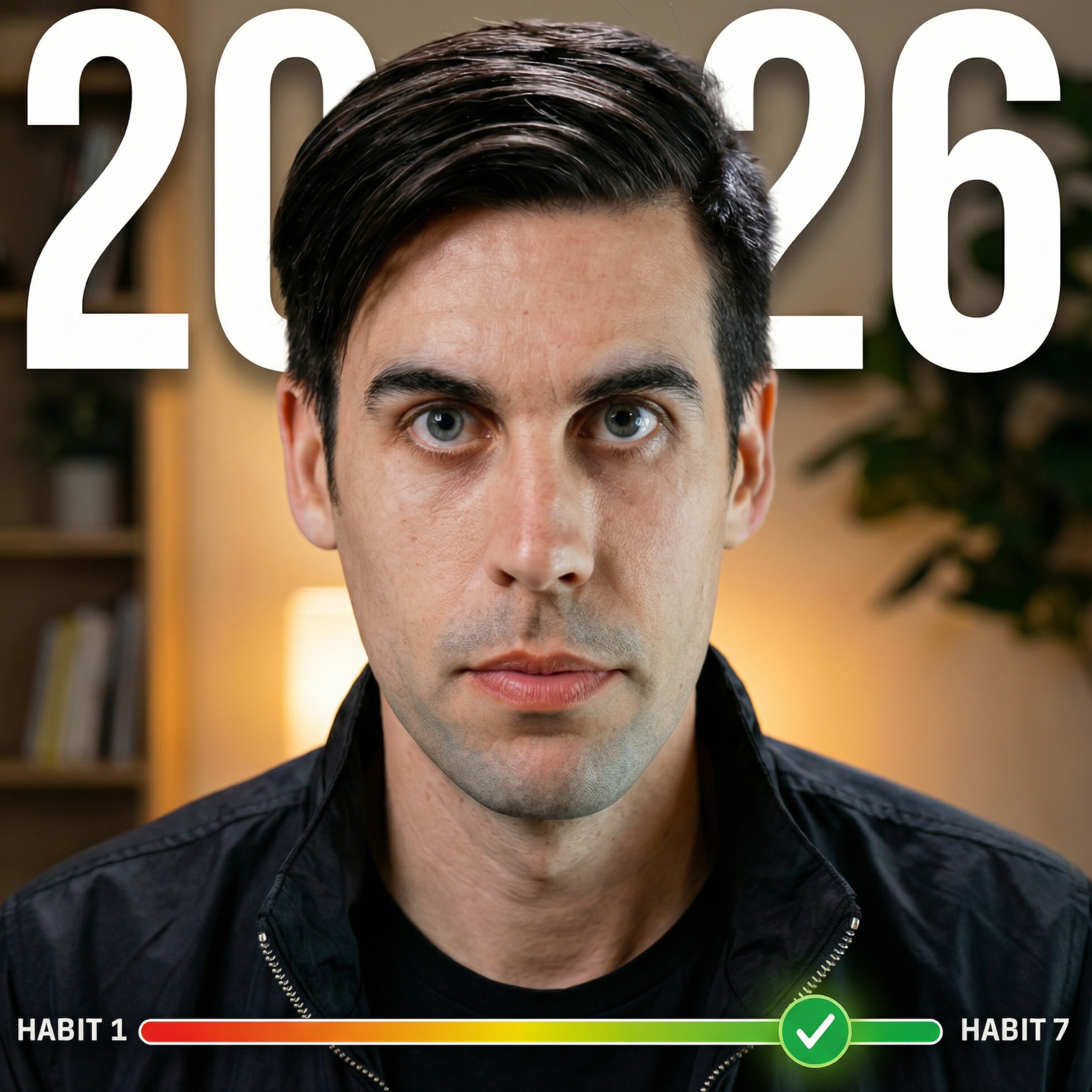
BONUS | 7 Simple Stoic Habits That Will Transform You In 2026
In short
A year-end bonus episode urging listeners to make 2026 their “best year yet” with seven Stoic habits: journaling (work it out on the page), waking early, doing hard challenges, walking for mental clarity, learning one thing per day, aiming for common-good/generosity, and daily memento mori (thinking about death to prioritize).
Guest backgrounds
No guests are interviewed in this episode. The host references a prior interview with Jesse Itzler and cites Toni Morrison, John F. Kennedy, Anne Frank, and Marcus Aurelius.
Key claims
Journaling/doodling reduces escalation under stress; early mornings create discipline and peace; hard goals build confidence and persistence; walking generates ideas and calm; small daily learning compounds; service makes Stoicism social; remembering death cuts distractions and urgency.
Notable examples
Kennedy during the Cuban missile crisis; Marcus Aurelius’ Meditations and dawn routine; Toni Morrison writing in the dark; Jesse Itzler’s “Misogi principle”; Seneca on treating the body rigorously; Seneca’s “one thing a day” letters; the host’s walking and “couple crappy pages a day” writing rule.
Written by AI. May contain mistakes.
Chapters
0:45
Reflections on the Past Year
Reflecting on personal growth and resolutions as the year ends.
“Here we are at the end of one year and the beginning of another.”
1:52
Journaling: A Powerful Habit
Discussing the benefits of journaling as a transformative habit.
“This can be the time that you finally answer Epictetus' famous question.”
4:08
The Importance of Waking Up Early
Exploring how waking up early can enhance productivity and life fulfillment.
“So if you're going to pick up only one habit in 2026, journaling would be a pretty good one.”
9:14
Embracing Hard Challenges
Encouraging listeners to tackle hard challenges for personal growth.
“We treat the body rigorously, Seneca said, so that it's not disobedient to the mind.”
11:32
The Magic of Walking
Discussing the mental and physical benefits of walking regularly.
“So let's do hard things this year, which by the way, is why we call this thing we do every January, the Daily Stoic New Year New You Challenge.”
14:03
The Power of Walking
Discover how walking can improve your life and writing process.
“It helped me get through kids that didn't sleep.”
15:10
Daily Improvement and Learning
Learn the significance of small daily improvements and knowledge acquisition.
“You show up, you don't make excuses, you don't procrastinate, you also don't let yourself be a perfectionist.”
16:21
The Importance of Generosity
Explore how setting goals for the common good can enhance your life.
“Hey, I'm gonna try to learn one thing a day.”
18:22
Reflecting on Mortality
Understand the Stoic practice of memento mori and its empowering effects.
“I promise you, you will have a happier, more productive and more meaningful year.”
19:38
Prioritizing Time and Urgency
Learn how to focus on what truly matters by reflecting on time's value.
“The Stoics say, memento mori, remember you are mortal.”

Ask about this episode
Get the gist, explore an idea or ask about something said.
 Claude
On The Daily Stoic, what are the key points of this episode?
Searching your listeningTranscript
Automatic transcript. May contain errors.
0:05Ryan Holiday: Welcome to the Daily Stoic Podcast, where each day we bring you a Stoic-inspired meditation designed to help you find strength and insight and wisdom into everyday life. Each one of these episodes is based on the 2 ,000-year-old philosophy that has guided some of history's greatest men and women, help you learn from them, to follow in their example, and to start your day off with a little dose of courage and discipline and justice and wisdom. For more, visit dailystoic.com.
0:56Ryan Holiday: Here we are at the end of one year and the beginning of another. And I think it behooves us to ask ourselves, what do we have to show for it? Did we do what we set out to do? Did we meet those resolutions, make those goals? Were we the person we were capable of being in 2025 or in any year? And I think if we're honest with ourselves, we have to say that we weren't. In fact, I would say that neither you or I are anywhere near our full potential. What happened? Well, we got busy. Life happened. Motivation faded. Old habits die hard. Same patterns reasserted themselves. In today's episode, I want to talk to you about doing it differently.
1:39Ryan Holiday: I want to talk to you about how you can make 2026 or any year, whenever you're watching this, the best year yet. Because this can be a turning point. This can be the moment that you make changes. This can be the time that you finally answer Epictetus' famous question. How much longer am I going to wait to demand the best of myself?
2:05Ryan Holiday: How did the most powerful man in the world start and end his days? He spent them alone, whether he was in his palace in Rome, whether he was on the front with the Roman army, whether he was traveling, whether he was sick, whether he was tired, didn't matter. Marcus Aurelius spent time with his journal. In fact, Meditations, his famous book, survives to us, totally unique from all other philosophy books. He wasn't writing it for you or for me. He was writing it for himself. He was taking time out of his day, out of his busy life, to work it out on the page. This habit of journaling is one of the most basic but most powerful practices you could start this year.
2:51Ryan Holiday: In my book, Stillness is the Key, I talk about Kennedy in the missile crisis. Russia had just moved ballistic nuclear missiles into Cuba, and there, in a moment, the world is now on the brink of nuclear war. Kennedy is just one bad decision away, not from losing an election, but destroying the planet, killing millions of people. So what does he do to handle this immense stress? He does the same thing that Marcus Aurelius is doing. He pulls out a pad of paper and he doodles. He writes notes. He works it out on the page. Instead of working it out on his opponent, instead of working it out on his advisors, he's working it out on the page.
3:26Ryan Holiday: As Anne Frank would say, it's because paper is more patient than people. You want to know why Kennedy doesn't escalate during the missile crisis? You want to know why power doesn't corrupt Marcus Aurelius? I think journaling, doodling, writing it out on the page is an important part of it. My journaling practice, I do every single day, sometimes in the morning, sometimes at night. It doesn't matter how you do it. It doesn't matter where you do it or what you do it on. Take some time to put it down on the page. Your mind will thank you. Your colleagues will thank you. Your family will thank you.
4:01Ryan Holiday: Your future family, your grandchildren and great-grandchildren, if they ever get their hands on it, they'll thank you. Work it out on the page. So if you're going to pick up only one habit in 2026, journaling would be a pretty good one.
4:19Ryan Holiday: Look, I get it. You're tired. You've got a lot going on. It feels great to sleep in, but a foundational habit for this year and every year for every day should be waking up early. After all, Mark Surilis opens book five of meditations with what? This famous passage. He says, at dawn, when you have trouble getting out of bed, tell yourself I have to go to work as a human being. What do I have to complain of if I was going to do what I was born for? The things I was brought into the world to do? Or is this what I was created for? To huddle under the blankets and stay warm. But it's nicer here, he said.
4:56Ryan Holiday: So you were born to feel nice instead of doing things and experiencing them? Mark Surrealis isn't talking about getting up early to go to your crappy job. He's saying you get up to go live your life, which by the way, is ticking away. There's something sacred, holy, special, beautiful about the mornings. I don't love getting up early, but I love having gotten up early. And that's why this is such an important habit. Get up, get a jump on the day. Don't wake up on your back foot already late, already rushed, be intentional, be purposeful. Now look, if you have trouble getting up early, you're not a morning person, I do have a book recommendation for you.
5:33Ryan Holiday: I read it to my kids on a regular basis. It takes discipline to wake up early. It also takes discipline to wind down properly to go to sleep. But the point is, wake up early because it's quiet. Wake up early because you want to send a message to yourself that you're not the person who hits the snooze button. Toni Morrison, the great Nobel Prize winning author, she woke up every morning in the dark for years to write. She said she wanted to get up. She wanted to sit at her desk at her small apartment. She wanted to right as the sun came up and light filled the room. She said it was also important that she got all her writing done as a single mother before she heard the word mom for the first time.
6:11Ryan Holiday: So when are you at your best? When do you have the most peace and quiet? Before the phone calls have come in, before the emails, before the news, before all the things you have for the day, right? That's when you wanna get up and get after it. It's a great time to journal, I would add. I know it's not easy, it's not always fun, but that's why it's such a great habit. Send a message that you decide that you know you're not meant here to huddle under the covers and stay warm. You're meant to do things. You're meant to make things. You're meant to fulfill your potential. You're meant to live this life.
6:42Ryan Holiday: It's here. Get up. Get after it. Get moving.
6:53Ryan Holiday: It's spring here in Texas, and that means new kinds of bugs. We are dealing with it because we have a house at the bookstore. We have Tracy's up the street, our little grocery store, and we don't like bugs and the customers don't like bugs. Well, Pesty has helped make hanging outside at home more enjoyable by keeping the bugs at bay with their DIY pest control kit. The Pesty kit comes with everything you need to do your own pest control. Pro-grade pesticide. That's the same stuff that the pros use. Sprayer, mixing bag, gloves, instructions. You can even get a kit customized to the season, location, and weather.
7:32Ryan Holiday: And with Pesty, it starts at just$35 a treatment. With their DIY kit, there's no strangers in your house or appointments to make. Pesty gets rid of over 100 types of bugs from spiders to ants to roaches and scorpions. It's also kid and pet friendly. Get bugs out of your house with Pesty. Just go to Pesty.com slash Doik for an extra 10 % off your order. That's Pesty.com slash Doik for an extra 10 % off. Three, four times a day, I reach over and I grab my wife's phone and I check something. Not social media. I check the Shopify app. Because Shopify is how I see how the Painted Porch and the Daily Stoic are doing.
8:07Ryan Holiday: We've been using Shopify for almost 10 years now. It's great. And we're not the only ones using it. Shopify is the commerce platform behind millions of businesses and brands all over the world. They do 10 % of the e-commerce in the U.S., from household names to Gymshark and Allbirds to little brands just getting started and little things in between, like Daily Stoic. Everything is all in one place, making your life easier and your business operations smoother. And if you get stuck, Shopify is always around to share advice with their award-winning 24-7 customer service, which we have used many times at Daily Stoic and with The Painted Porch.
8:46Ryan Holiday: It's time to turn those what-ifs into sales with Shopify today. Sign up for your$1 per month trial today at shopify.com slash stoic. Go to shopify.com slash stoic, shopify.com slash stoic.
9:13Ryan Holiday: I know getting up early is hard, but that's the point. Doing hard things is good for you. The Stoics knew this. We treat the body rigorously, Seneca said, so that it's not disobedient to the mind. The Stoics sought out challenges. They weren't people who just sat in their desk writing about philosophy. They weren't huddling under the covers and staying warm. No, they got up and got after it. They sought out things that were hard. I interviewed Jesse Itzler on the Daily Stoke podcast recently, and he talked about this. He called this the Misogi principle, which is like, pick one big thing that you're going to tackle each year.
9:49Ryan Holiday: I think that's great advice. As we look at a new year, what's something really hard that you're going to throw yourself into doing? You're going to start a company. You're going to build that shed in the backyard. You're going to run a marathon. My goal for 2025 is I wanted to run the original marathon. I ran from marathon to Athens. It kicked my ass. It was so hard. But on the other side of that, I'm a person who knows now more what I'm capable of. I know that I'm a person who can set a really hard goal, not give up on it, train for it, go for it, and then do it. Even in the middle of it, when it was hard and I wanted to quit, I forced myself to push through.
10:25Ryan Holiday: That's what Seneca is talking about when he says We treat the body rigorously so that it's not disobedient to the mind. All these things are training. There's little bits of training, like little hard things to do. As we said, get up early, go in a cold plunge, go for a run. That's all great. But I would also urge you this year to set a big goal, something hard you're going to try to do, something that's going to challenge you, something that feels like a stretch. So you have to be the person who stretches to get there. So you have the opportunity, the motivation. So you are facing the temptation to quit.
10:58Ryan Holiday: So you're having to make trade-offs. So you're having to make adult decisions and then do it and commit and push through and come out the other side. My writing, my relationship, my raising my kids, all of this is informed by the hard physical stuff that I do. And I have confidence that I'll be able to do things, solve problems, keep going, because I know that I'm the kind of person that doesn't quit when things are hard. In fact, I like when they're hard, right? It excites me. It challenges me. I get better when other people are quitting. That's what you cultivate when you do hard things. So let's do hard things this year, which by the way, is why we call this thing we do every January, the Daily Stoic New Year New You Challenge.
11:40Ryan Holiday: We call it a challenge because it's supposed to be challenging. It's 21 days of stoic inspired challenges. That means they're not easy. Some of them are hard. Some of them are weird. Some of them are uncomfortable. But that's the whole point. You get better for being challenged. You get better for being knocked down, as Seneca said. Becoming Olympic class, Epictetus reminds us, takes sweat. It's supposed to be hard. Carry yourself with a strong sparring partner, he says, and see what a better wrestler and athlete you become. So that's what the Daily Stoic New Year New You Challenge is built around.
12:15Ryan Holiday: We're launching on January 1st. Me and thousands of other Stoics all over the world are going to be doing it. We come up with new challenges every year. There's a community element. There's live Q &As with me. You get a calendar to mark your progress. There's a bunch of other awesome bonuses in there. I'd love to have you join us. It's one of my favorite things we do at Daily Stoic. One of my favorite things that I get to do personally each year. I look forward to it. I have a ton of habits that I've picked up from the challenges over the last eight or nine years that have made my life better that I practice to this very day.
12:44Ryan Holiday: So I hope to see you in there. You can sign up right now at dailystoic.com slash challenge.
12:51Ryan Holiday: look i'm not saying this is going to solve all your problems i'm just saying there's not many problems it's going to make worse i'm talking about going for a walk i've always been a big walker then we had kids i started walking them every chance i could then we got a puppy last year and now i'm definitely doing two walks a day what you find is that walks are a kind of magic They clear your head, they calm your nerves, they pull you away from distractions that get you out into nature. Seneca said that the mind must be given over to wandering walks, and so must you. As you're thinking about planning your day and your life in 2026, I'd urge you to get outside, get moving, go for a hike, walk down to the mailbox, take a few laps around the block, take your phone calls on the move.
13:38Ryan Holiday: I even do my Zoom calls walking, and you'll be amazed at what happens. You get healthier, but also ideas pop in your head. You meet people, you see things, you calm down in ways that you otherwise wouldn't be. Nietzsche has this great line. He said, only ideas had while walking have any worth. So yeah, sure, walking is a physical activity. It's exercise. But I think it's really about your mental state. Walking has helped me write books. It helped me get through kids that didn't sleep. It's helped me in my relationships. It got me through a pandemic. It's helped me stay grounded through chaotic times.
14:13Ryan Holiday: As I said, walking is a kind of magic.
14:20Ryan Holiday: You're not magically or immediately going to become a new person just because a new year happens, right? It takes work. It takes time. Epiphanies are overrated. Transformations are rare. It's usually a gradual thing. Zeno, the founder of Stoicism, would say, well-being is realized by small steps, but it's no small thing. This is my philosophy in life too. I've written something like 17 books over the last decade and a half, along with writing the Daily Stoic email every single day, along with doing these videos, along with raising kids. I do a lot. And so people sometimes ask me, how do I write so much?
14:57Ryan Holiday: How do I get it done? And the answer is, I do a little bit every day. There's actually a great writing rule, just a couple crappy pages a day. Show up, put your ass in the chair, do the thing. And the discipline of writing is the same as the discipline of doing just about anything difficult. You show up, you don't make excuses, you don't procrastinate, you also don't let yourself be a perfectionist. Show up, get a little bit better, do a little bit more, make a contribution, add to the momentum. Seneca actually said that this was the path to wisdom too. His exchange, his letters with his friend Lucilius, what they're doing is they're each sending each other just like one thing a day.
15:35Ryan Holiday: Seneca said that each day we want to acquire something that will fortify you against poverty, against death, against misfortune. And he says, run these ideas, these insights, these lessons over in your head. He says, digest one every day. So if you set a rule or a goal for this year that you were just going to pick up or learn one single thing every day, it didn't have to be big. Again, And it doesn't seem like much, but where would you be 12 months from now, 365 days from now? And where would you be times 10, times 20, times a whole life, right? One gain per day adds up in a big way, especially because many of these lessons, many of these things we acquire compound on top of each other.
16:18Ryan Holiday: This is kind of the habit that beats all the other habits. Hey, I'm gonna try to learn one thing a day. I'm gonna make one small improvement a day, one change a day. even one a month would add up in a big way. Whether it's a book or a business or an anthill or an oak tree, impressive things often come from humble beginnings. Slow and steady, consistent, that's what it's about.
16:47Ryan Holiday: Most of our goals, most of our resolutions, most of our intentions are kind of selfish, right? It's our goals, our improvements, our growth. That's what we're thinking about. And this is good, right? It's better than not thinking about this at all. But what if you tried to be more generous this year, kinder, more helpful? What if you tried to have more positive impact? I think too many people misread stoicism. They think it's an individualistic philosophy. They think it's a disconnected philosophy. And this couldn't be further from the truth. Stoicism is not there to make you a better sociopath.
17:23Ryan Holiday: Mark Surrealis talks about the common good like 80 times in meditations. He actually says that's what a good life is. He says a good life is good character and acts for the common good. So you can't have your best year yet if that year is all about you. Think about what goals you could set that would have a positive impact on someone else. Think about how you could be of service this year. And not only does it have a positive impact on the world that has an impact on you too because it gets you out of your head it's easy to despair to be frustrated to be disappointed to be disillusioned about everything that's happening in the world one way we can always be sure we have something to feel good about is to do good that's what marx really said good fortune is good intention and good actions for other people there are crazy times it's easy to be overwhelmed but if you were less self-absorbed less how does this make me feel and more about how can I make others feel good?
18:18Ryan Holiday: How can I make the world a better place? How can I leave this better than I found it? I promise you, you will have a happier, more productive and more meaningful year. And it doesn't have to be huge things, right? It could be picking up trash on the side of the road. It could be lending a hand to a friend. It could be trying to cheer someone up or just asking someone a question or holding the door open for them. It could also be making a donation. It could also be getting involved in politics or volunteering. It could be many things. You don't have to save the world, but you do have to make a contribution.
18:55Ryan Holiday: As we wrap up 2025, I think it's worth noting how fast that time went. The ancients say tempest fugue, right? Time flies. It didn't seem that long ago that we were sitting here planning out this new year that lay before us. And now that year is gone. It's dead forever. This is something Seneca points out. He goes, you got to remember, death isn't this thing in the future. You're not moving towards it. He says, death is happening now. The last 12 months are dead and gone. You will never get them again. And that's why as our final habit, one that I think will transform your year and your life, is so important.
19:32Ryan Holiday: And it might seem depressing at first. It might seem odd. It might not seem fun. But it is essential. And it's, I want you to think about death every day. The Stoics say, memento mori, remember you are mortal. I remember a few years ago, a friend emailed me on a Friday. I saw it. I said, you know what? I'll respond on Monday. And by Sunday, he was gone. He'd fallen dead of a heart attack on a hike. But the reason the Stoics practice memento mori is that life is short. You could leave life right now, Mark Sreya says in meditations. Let that determine what you do and say and think. Your friends can go.
20:05Ryan Holiday: Your family can go. Nothing is certain except the fact that we will all go at some point. Marcus Torellus knew this. He lived in a time of very high infant mortality. He lived through a plague, and he also knew from this practice that he himself would die. But the practice of memento mori, which he writes about in meditations, was not meant to be morbid necessarily. It was meant to be empowering. Because when we remember death, we're reminding ourselves how valuable our time is. We're cutting out inessential things like pointless phone calls or people picking our brain. We're not gonna spend time ruminating on what's happened or anxious about the future.
20:37Ryan Holiday: It's gonna remind us that, hey, all that time you're spending at the office is time you're spending away from your family, time you will never get back. Memento Mori helps us say no. It helps us prioritize. It gives us a sense of urgency, a sense of clarity, and a sense of priority. Opportunities are going to come and go in the year ahead. Distractions are going to pop up. Things are going to seem appealing. They're going to seem important. But when you remember how temporary your time is, you remember how ephemeral things are, it's easier to focus on what really matters. It's the craziest thing in the world, Seneca says, we protect our property, we protect our money, but we are frivolous with our time.
21:13Ryan Holiday: He said, life is not short, not in the way we think it is. It's that we waste a lot of it. And that's why it's so essential. It's something you have to do this year. Think about death. Let it give you a sense of time and urgency. Stop wasting your life. Get after the things you need to do. Make the changes you need to make and have a great 2026.
21:37Ryan Holiday: Every day I send out one Stoic inspired email totally for free, almost a million people all over the world. If you want to take your Stoicism journey to the next level, I would love for you to subscribe. It's totally for free. You can unsubscribe at any time. There's no spam. Just go to dailystoic.com slash email. Love to see you there.
22:08The Bleacher Report app is your destination for sports. Right now, the NBA is heating up, March Madness is here, and MLB is almost back. Every day there's a new headline, a new highlight, a new moment you've got to see for yourself. That's why I stay locked in with the Bleacher Report app. For me, it's about staying connected to my sports. I can follow the teams I care about, get real-time scores, breaking news, and highlights all in one place. Download the Bleacher Report app today so you never miss a moment.
From the publisher
Here we are at the end of one year and the beginning of another. What do we have to show for it? Did we do what we set out to do? Did we meet those resolutions?
Make 2026 the year where you finally bring yourself closer to living your best life. No more waiting. Demand the best for yourself. The Daily Stoic New Year New You challenge begins January 1, 2026. Learn more and sign up today at dailystoic.com/challenge.
👉 Get The Daily Stoic New Year New You & all other Daily Stoic courses for FREE when you join Daily Stoic Life | dailystoic.com/life
🎥 Watch the video episodes on The Daily Stoic YouTube channel: https://www.youtube.com/@DailyStoic/videos
🎙️ Follow The Daily Stoic Podcast on Instagram: https://www.instagram.com/dailystoicpodcast
✉️ Want Stoic wisdom delivered to your inbox daily? Sign up for the FREE Daily Stoic email at https://dailystoic.com/dailyemail
🏛 Get Stoic inspired books, medallions, and prints to remember these lessons at the Daily Stoic Store: https://store.dailystoic.com/
📱 Follow us: Instagram, Twitter, YouTube, TikTok, and Facebook
See Privacy Policy at https://art19.com/privacy and California Privacy Notice at https://art19.com/privacy#do-not-sell-my-info.
More from The Daily Stoic
All episodes
We use cookies.They keep VO running smoothly and help us improve it. Privacy policy