
 Ask ChatGPT



The Daily Stoic podcast explores the teachings of Stoicism through daily meditations inspired by great Stoic thinkers like Marcus Aurelius and Seneca. Host Ryan Holiday interviews various notable figures and provides insights into how Stoicism can be applied to modern life.
Written by AI. May contain mistakes.

Get the gist, explore an idea or ask about something said.
 Claude
On The Daily Stoic, what are the key points of this episode?
Searching your listeningAutomatic transcript. May contain errors.
0:00I'm picking my kids up from school today and then doing our weekly routine, which is I take them over to Whole Foods. and we get all our groceries for the week. Then we have dinner. It's one of their favorite things to do. It's one of my favorite things to do. And then my wife loves it because she doesn't have to take care of it. This holiday season, whether you're a guest or hosting the big dinner Whole Foods Market has what you need to delight everyone at your table. They even have heat and eat sides from the prepared foods department. You can make Whole Foods your one-stop shop. Everything follows Whole Foods Market's strict ingredients standards so you know it'll be delicious and good for you.
0:33You can also order online for pickup and even delivery in select zip codes to skip the crowds. Shop everything you need at Whole Foods Market, your holiday headquarters. I got an amazing night's sleep last night. One, because my six-year-old fell asleep in the car at like six o 'clock and he transferred him from the car seat to the bed and it stuck, which is just magic. So he's in bed way earlier than normal. But I sleep really well every night because I have a 8 Sleep Pod 5 Ultra, which is 8 Sleep's best product. I've used 8 Sleep for many years now. And it's just totally transformed how I sleep, made me sleep better, made my wife sleep better.
1:14It's amazing. So basically, 8 Sleep is this topper that goes over your mattress. It can heat and cool both sides separately. It can raise and lower each side separately. So it helps you fall asleep faster, stay asleep, and then wake up better. Eight Sleep buzzes me to wake gently every morning as opposed to some loud blaring alarm. And then I can check the app and it tells me my sleep score. It even helps me optimize my day based on how I slept. If you want to survive the holidays like a pro and just generally sleep better, Head over to 8sleep.com slash Daily Stoic and use code Daily Stoic to get$350 off your very own Pod 5 Ultra.
1:58The best part is you still get 30 days to try it at home and return it if you don't like it, but I know you will. Trust me, your body will thank you for this investment in better sleep, shipping to many countries worldwide. See details at 8sleep.com slash Daily Stoic.
2:15Welcome to the weekend edition of the Daily Stoic. Each weekday, we bring you a meditation inspired by the ancient Stoics, something to help you live up to those four Stoic virtues of courage, justice, temperance, and wisdom. And then here on the weekend, we take a deeper dive into those same topics. We interview Stoic philosophers. We explore at length how these Stoic ideas can be applied to our actual lives and the challenging issues of our time. Here on the weekend, when you have a little bit more space, when things have slowed down, be sure to take some time to think, to go for a walk, to sit with your journal, and most importantly, to prepare for what the week ahead may bring.
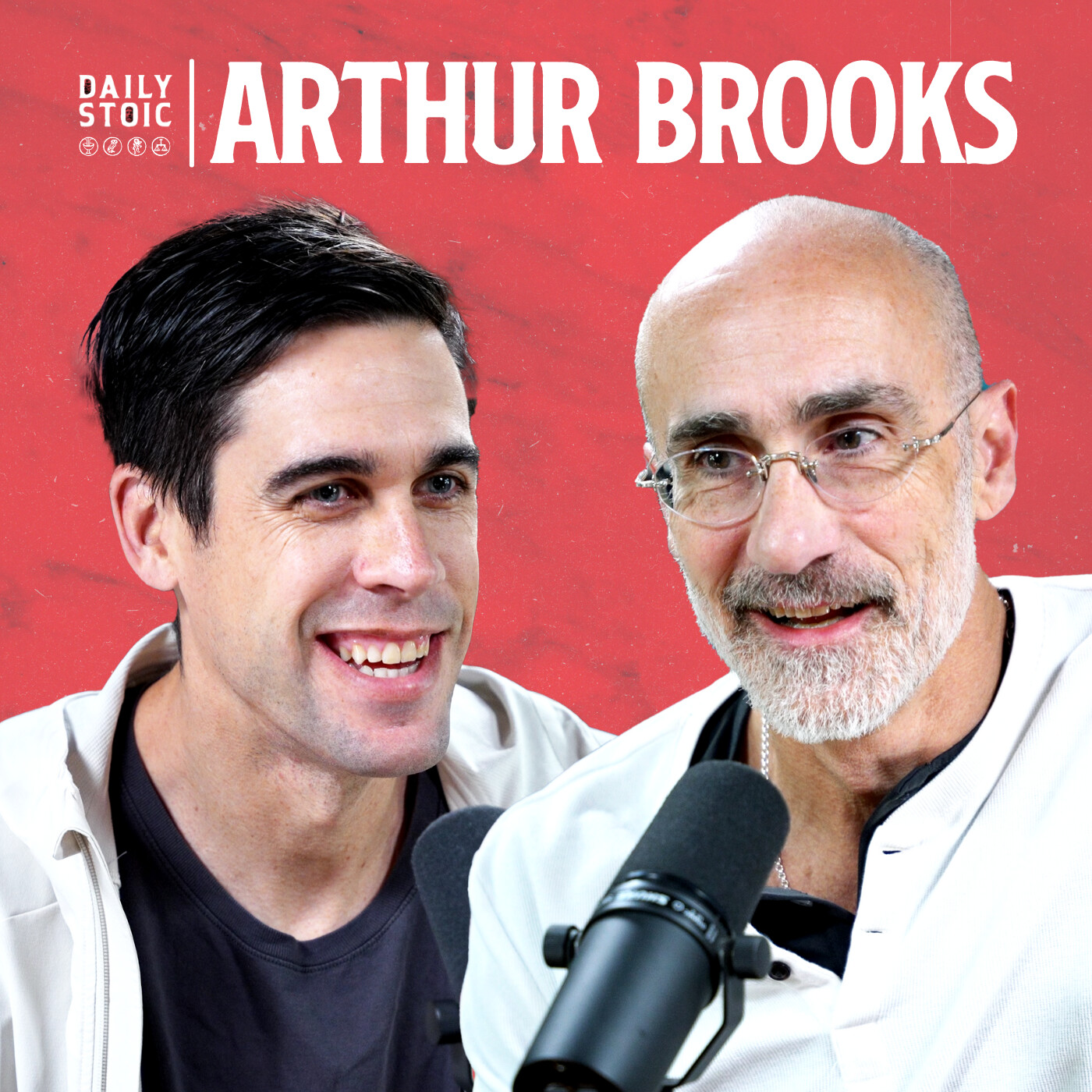
3:09Hey, it's Ryan Holiday. Welcome to another episode of the Daily Stoic Podcast. it's one thing to be a fan of someone's work and then you can also you know get a glimpse of who they are as a person and I love it when you get a glimpse of who someone is as a person and it confirms what you took from their work my grandmother it's her bonus grandmother Dolores she's in her 90s she told me she'd read this article about this guy Arthur Brooks She wondered if I'd heard of him. And I said, not only have I heard of him, I've interviewed him a bunch of times. He's a nice guy. I gave Arthur her address and he sent her a signed copy.
3:52She was very excited. And then they've been exchanging letters. And it was so sweet. When someone takes time out of their very busy schedule, in Arthur's case, from his friendship with the Dalai Lama and Oprah Winfrey and God knows who else, I just thought that was incredibly sweet. And then funny enough, I got a text from Austin Kleon, one of my favorite people in the world, certainly one of my favorite writers. And he said, hey, should I read this Arthur Brooks book? I said, not only you should read it, you got to read these articles. He's great. And I've got another interview coming with him very soon.
4:31So that is what I am bringing you right now. We are talking about Arthur's new book, Build the Life You Want, the art and science of getting happier that he co-wrote with Oprah Winfrey. I think we had a great conversation. I always do. And what I really appreciate about Arthur is that he knows the Stoics. I asked him one of my favorite questions, which is what do the Stoics get wrong? And I think he had a great answer for that. I've got some other episodes with Arthur that I'll link to. You can check those out. I think Arthur's work is not just about personal development, but how do we develop ourselves so we can be better in the world, which is, of course, what I talk about in the new book, Right Thing Right Now.
5:10Good values, good character, and good deeds. You can preorder that at dailystoic.com slash justice. You can follow at Arthur C. Brooks on pretty much every platform on YouTube. He's arthurbrooks123. I'll link to that. And without further ado, I'll bring you the one and only Arthur Brooks.
5:36Yeah, how are you? You look good. I'm doing great. Lots of good stuff. You're writing a new book, of course. I am. I'm still doing this Cardinal Virtue series. So Justice is next. It was done, but comes out in June. And then I just started Wisdom. Nice. Yeah, I guess I'm mentally preparing myself, unfortunately, for Justice to be the worst-selling one in the series. What does worst-selling mean for you? Well, yeah, still pretty good. It's all relative. But the tricky part of that one is like, well, I guess it says something about society that if you're like, I'm writing a book about justice, most people are going to be like, no thanks.
6:13Well, prudence is the one people don't want. Well, prudence is wisdom, right? Yeah. Okay. So that's why you, okay, I got it. Yeah, of course. Well, so that's been the perennial struggle with the book, which is, okay, you can't write a book on temperance. So you got to make it about discipline. Right. Because nobody wants temperance. Right. Then you can't do justice because justice means legal justice or social justice, even though both those things are important. That's what it means to people. But no one's, other than people who are law professors, they're not like, I want to read a book about that.
6:47So that's having to become about doing what is right. And then prudence is how wisdom is sometimes rendered. Knowing the right thing to do. Yes. Knowing the right thing to do. but also I think to me that's the bucket where education and learning and knowledge and truth and all those things come in have you read the you know Peeper's yeah I mean that's that's the best book on the floor right yes yeah yeah no he's amazing and then C.S. Lewis has like an amazing essay on the eternal virtues the nice thing about Peeper is that he defines them in a way that's that's expansive well I think he does a really good job of showing how they're all interrelated with each other yeah yeah like courage is doing the right thing when you're afraid.
7:30Prudence is knowing what the right thing is. Temperance is the right amount of the right thing. And then justice is like, who is it for? Who does it help? Yeah, exactly. And that all hangs together. Yes. These are interconnected virtues. You really can't separate any of them. That's an interesting part of the fundamental virtues. Did you sign a contract for the four books? I did. But for a good reason, which is that, you know, the publishing is, they don't look at how many books you've sold. They look at how many your last, They look at how your last book did to decide the next one. So I very much wanted to see them as a package and not want, you know.
8:07Anyway, so far, discipline has outsold everything by maybe 50%, 60 % because that's the most straight down the middle of what everyone wants. Yeah, it's the most stoic of your books and that's your audience. And I don't know about you, but I like having what I'm supposed to do. I like having the contract of like, I have to deliver a book by this time. Yeah, I'm not sure how I feel about that, actually, because I keep interrupting my schedule. I mean, I wasn't doing this. I mean, I wasn't on this wheel until I was 55 years old. Right. I was just doing books about AEI stuff. Sure. And then stopped.
8:45Yeah. Now I'm doing more in your world. because i'm well now now you're reaching a popular mass audience of potentially anyone not just the people in that world yeah i'm sort of specializing in strivers in old strivers no it's amazing it's amazing well speaking of which i was going to say i feel like you're in danger of disproving your professional decline theory i'm aware but it's no i'm actually even worse i'm not taking my own advice oh okay that's worse than disparate because you know i'm on my crystallized intelligence curve big time i mean i'm not trying to do i'm synthesizing the best stuff of other people into a a narrative that actually makes sense with metaphor and pattern recognition and that's pure crystallized intelligence yeah what i'm not taking my advice on is walking away is chipping away yes and chipping away to find the statue that i'm that the truly beautiful creation that is within.
9:44But rather, I'm actually adding, there's more and more detritus, more and more stuff stuck to me. There's this beautiful passage in Seneca where he's talking about the sort of old man still pleading cases, still striving, still trying to get attention, win one more thing. I imagine it's extremely hard, whether you're Tom Brady or Joe Biden, to walk away when you're still winning or still feel like you can win. Right. Yeah. And so I walked away from AI. It was unprecedented, right? It was like, sayonara, suckers. Do your best, right? And like - They're supposed to pry you out of the corner office of the crowbar.
10:25That would be the, yeah, exactly. Right. That would be the, you know, that would be the president of the United States. Yes. That would be Joe Biden, right? On a very small scale. Yes. And then did this new thing. And it's like, I'm going to see. I'm just going to do good. I'm just going to do good. And went, you know? it blew up then oprah called but maybe it's a corollary to the theory which is um you find you are very fortunate the the ultimate lottery is to find a thing that you can do that ages like wine instead of like milk and writing is one of the few particularly of the creative or entertainment uh professions where you really can do it forever and there are some pretty clear examples of people who did their best work late in life but they didn't do their most innovative work later in life what they did was they did their best synthetic work later in life inevitably so writing speaking teaching is the future when you're old for sure for sure that is crystallized intelligence yeah the problem is doing it too much yes the problem is how much you do it so the the way to do is to move to bastrop texas no no i mean there's a lot here that you're doing right now i'm sure you're too busy i'm sure you're very much so i'm sure crazy stupid busy i'm sure eight episodes this week which i should have done yes i've heard that and because you're batching and once you start batching on something then it's hard to do your absolute best work when you're batching yes um and that means that you're too busy you're probably on tour sort of yeah i mean who's not on tour life is book tour book tour is life yeah right does book tour ever stop well and what is a book tour and what is a paid talk tour yeah Victor is meaningless.
12:05Because, you know, back in the day, you'd be doing readings at bookstores. Yeah. And now everything's for pay. Yes. Yeah, yeah. You're not taking free gigs, I hope. No, no, definitely not. And it's hard. I only do Catholic stuff for free. It's very hard. I think, I've said this before, but saying no to money is one of the hardest things to do in the world. And you're financially independent, right? Yes, but what does that mean? Who actually makes decisions as if they are financially independent? Almost nobody. even the wealthiest people. I think it's hilarious. Like I go to these conferences and I go, I don't need this.
12:38Why am I here? And then like the eighth richest man in the world is also on stage. And you're like, why is he here? And he's actually getting a fee. Yeah, because it's so hard to say, even when you have an unfathomable amount of money, it's still apparently hard. Ray Dalio's still on tour, man. And he's still writing books. And you know that when they offered him that book deal, he was like negotiating about it. You know what I mean? Like there is that, whatever the thing that makes you good at accumulating money makes it very hard to stop accumulating money. Just as it's hard for Tom Brady to go, I shouldn't get hit in the head anymore.
13:13Right. So I have a whole protocol that I give guys based on this that I'm following for people on how to retire. Okay. Because I'm talking to guys. I mean, I'm talking to, we're not on the air, right? We're not taping right now, right? No, no, we were. But you haven't said anything. If you want anything, cut, but we just sort of go. So I'm talking to, okay. Huge CEO about how to retire. Yeah. And he's 80 hours a week his whole life. Yeah. And he knows it's going to be a problem, right? So the way to retire when you're at, I mean, you're still, I mean, it's all there. Yeah. But you know you have to because you don't want to get a shove.
13:50Yeah. Is you actually put together a schedule that doesn't go from 80 hours a week to zero. And then your wife doesn't want you following her around the house. Sure, sure, sure. It's like, I've married for better for worse, but not for lunch. Yeah, yeah. Right? I had to set up my own life the last 30 years. Yeah. You can't just come back. And now you're around. Yeah. I mean, what's the deal? So the answer is to figure out what you think are the best 20 hours. Okay. Right? And that means you're going to take two or three clients, consulting clients. You're going to sit on one for-profit board, on one nonprofit board that you really care about.
14:24And you're going to mentor like one person you think is really promising. And that's going to blow up into more than that. is the whole point. But here's the deal. Think about the thing you most hate in your life when you're busy, busy, busy, busy, busy. And I know what it is for you and me and for him. You don't have time to pee between your things. I know if I have things scheduled back to back, I'm fucked up. That's not the schedule of a person who is successful and independent and has autonomy over their life. Right, yeah, yeah. But it drives you crazy that you don't have enough time. So you're out to lunch with a friend.
15:03Yeah. And you're like, sorry, dude. Right? And that's not nice. Hard endings. You're at the gym. And you're like, I'd actually like to go an extra half hour because I'm feeling good today. Sorry. Yeah. I actually have to pack up and go. And so you're always stopping the things that you want to keep going. The nice thing in life is if you're doing interesting things, but you don't have to stop something if you want to keep doing it. Yeah. And so the way to do that is you need more time between things. lots and lots of time between things. So most people there here's, so here's a very interesting research on this that talks about being busy.
15:36So there's a sweet spot of busyness when it comes to happiness. If you're too idle, it's a huge problem. If you're too busy. Now, what we find is looking at the data on idleness and busyness, the optimal number of discretionary hours in the average workday is 9.5. Okay. Okay. The average number of discretionary hours a person gets is 1.8. Now, the reason it turns out that it's 9 point, that they get 1.8 when they need 9.5 is, and that they're going in the wrong direction is because they're more afraid of idleness than they are of busyness because idleness is more miserable than busyness. And so they overcorrect and make a mistake in the wrong direction.
16:15That's what most people do. Yeah. Right. And so, So because idleness is terrible. What you do is when you're idle, you immediately default, go into the default mode network of the brain, the brain apparatus that makes you go ruminate and, you know, perseverate and think about your teenage kids and bad stuff. Yeah. Right. And it's no fun. It's really miserable. The default mode network is really bad. People avoid it like the plague. Yeah. And so they schedule themselves. They overschedule themselves. They look at their schedule. They're like, I only have four things on that day. Yeah. I'm going to put in more because they're implicitly afraid of the default mode network and idleness.
16:49You got to get over that fear and say the ideal day has three things in it. Yes. The ideal day has a thing. And you also know yourself to protect the part of the day when you actually need to be thinking and writing and doing creative work. And then only parts of the day that you can schedule up where they make sense and you have tons of time between them. And so I'll tell people to just make three or four commitments and then have days that never have nothing, right? They'll have two or three things in it. And then you'll be able to make them last as long as you want them to make. And you're always going to start filling in things from there, but you have to build your schedule that way.
17:27Yeah. My, my assistant, I've told her like, I've no more than three things in the calendar in a day. And ideally some days with nothing. And it's not that I'm not doing nothing. I'm not working. It's not that I'm not working. It's that I haven't scheduled any interruptions or random commitments or obligations. And so those are the best work days. But I'm also at three going, you know, or two going, well, I'm going to go for a run now, or I'm going to head home early and see what my kids are doing. You know, I, it's, I have the freedom to make good decisions as opposed to. That takes discipline.
18:00You're a disciplined person too. So a lot of people won't do that. So the way to think about that though, is that you have to, if you're a creator, like you or me, we're writers. Fundamentally we're, you know, idea dudes. Yeah. Right? Yeah. We're not working on a steel band. Yeah. You have to understand how your brain chemistry is optimized for ideas. That's a super important thing. Yeah. Toni Morrison said you have to know when you are at your best. She's like, when do you make contact with the muses is what she was saying as a creative. And you have to know when that is. And her thing was she liked to watch the sun come up while she wrote.
18:35And she had to do it before she heard the word mom. Yeah. And so it's getting up very early. Yeah. And you seem like, this is the earliest I think we've ever done this podcast. And you got here early. So I get the sense that you're an early person. Yeah, well, almost everybody actually is. See, this is the thing. So people are like, no, I'm a night person. Probably not. Yeah. Do you like to get up early? Probably not. I don't like to get up early. I've gotten up with an alarm clock every day, but I get up at 445. Okay. And that's called Brahmamutra. So in ancient sort of Vedic wisdom, the idea is it's called the creator's time.
19:08and there's something and there's a lot of research that shows that the creator's time an hour and a half before sunrise that when you actually with the ignition of your day is then the day's yours yeah it's really it hurts man it's it's never been not painful for me at 4 45 in the morning because that's not what i want i was a musician all the way through my 20s i was like i'm an 8 30 in the morning guy to get up to roll out of bed when the sun is warm but so this is the way to do it and optimally for your brain chemistry it works for almost everybody as well. So 4.45 in the morning, I work out real hard for an hour and almost every morning.
19:43So I missed 11 days in 2023. Wow. In the gym. Yeah. Because it's so important. I missed today, by the way, because I get in at one o 'clock in the morning. So anyway, but it's - Well, thank you for coming. I love being here. And then it's an hour and then I'll do my spiritual work. So I go to mass or say my prayers or whatever. A lot of people will meditate. And then you can actually be, then use your caffeine. Yeah. Don't use caffeine too early. Yeah, to wake up. Yeah, don't use caffeine to wake up. And there's a whole lot of brain chemistry behind that. Huberman talks about that a lot, but it's actually pretty simple.
20:17The whole point is you don't want to block the inhibitory neuromodulators in your brain because then they'll be looking for a parking space. And then when you metabolize the caffeine, it'll all go in at two or three o 'clock in the afternoon, you'll crash. So wait for at least an hour and a half, two hours before you have caffeine, and then sit down to work at 7.30 in the morning and you'll get three uninterrupted, you know, max dopamine hours of focus and creativity. Well, I find it, so you wake up, let's say you work out or you spend time, you know, talking to your spouse or you wrestle with your kids.
20:48And then you, maybe you do a little work, whatever, you didn't get sucked into email. You got some stuff done early. Yeah, don't look at the license, right? You always say this. Yes, but let's say you just do that in the morning and then you're driving to something, you get in the car, it's 10 a.m., you get a flat tire and you spend the next five hours by the side of the road waiting for someone to come pick you up or whatever, right? You're like, cool, because you already won. You already got, you feel like you stole a march on the day. Yeah. Because you got up early, you did some stuff, you crossed some stuff off, and then you're like, I guess it just wasn't in the cards today that everything else would go well.
21:25Right. But if you wake up, you're behind, you check social media, so you're mad about this. Right. CNN was running as you were getting dressed on the TV. So you just feel like the world's falling to pieces. And yeah, then you're straight into caffeine and then you're running to some meeting that you didn't want to do. And then something goes wrong. You're like, this day is the worst. The day shot. No, no, for sure. This is the reason that McRaven at here at UT Austin gave that famous - He was right here like two weeks ago. Yeah, famous speech, make your bet. His whole point was get your first win.
21:57Yes. Right now, it should be get up at 445 and make your bet. Yeah, yeah. Because, but you have to build it around that. I mean, when I was 19 years old on my own for the first time, not in college. I mean, like you, I found myself not in college. And I was working for a living. I was 3 ,000 miles away from my family. And I remember waking up in my little apartment by myself at 19 for the first time. And it wasn't at 4.45 in the morning, by the way. It took me a little while to get that one down. But I remember opening my eyes and going, well, how am I going to start my adult life? And I thought, I'm going to do something I've never done before.
22:31I had one stick of furniture, which was a bed. On the ground or was it raised off the ground? It was raised off the ground. Good for you. You're ahead of the curve. Well, it was a supposedly furnished apartment. It wasn't me who bought that. And I made that bed. Yeah. And I'm like, huh. And that was literally the first time I'd ever thought about that. And I have made my bed ever since then, since I was 19 years old. But that was the small wind. And life is built by the day. And the days are built on the winds. Yeah. And the winds start in the morning. And this is the point. And so if you guard that and have a protocol for that that's productive, that leads you to be able to do something really good before somebody can take it away from you, you can't lose.
23:11But it is interesting how perennial this battle to own the morning, to do it right is. I remember I was 19. I was in my college apartment, which was also furnished. So that's why I had a bed off the ground. And I get my copy of Meditations. It comes from Amazon. I had to wait a couple days for it to arrive because Prime didn't exist yet. you know and i read this passage in meditations from mark coeruleus uh let me find it i think he says at dawn when you have trouble getting out of bed tell yourself i have to go to work as a human being what do i have to complain of if i'm going to do what i was born for the things i was brought into this world to do or is this what i was created for to huddle under the blankets and stay warm and he says but it's nicer here and then he says so you're born to feel nice you know and then And then he goes, he's like, you know, the dancer is up.
23:56The baker is up. The bugs are out. The dogs are up. You know, he's like, this is what animals do. He's not saying you got to go be a wage slave at your crappy job. He's saying, though, that we have purpose. I think, what was Dante's line? Like, under the blankets is no way to fame. You're not going to win the day staying in bed. You're not going to be who you're meant to be staying in bed. And then there in this passage, you're reading the most powerful man in the world arguing with himself about it. It's like, nobody's a morning person. The morning people are doing it out of willpower and strength and habit and philosophical principles.
24:33And you're just as capable of that too. I remember I typed up that passage, I printed it out and I taped it on the wall next to my bed. Me too, me too, me too. Yeah. Me too. It was hugely impactful. It really was because you see that and you think, huh, I don't like how I feel about me when I lose that first battle. Yes, when you hit snooze. Yeah, it's not even snooze. It's called in a number of religious traditions. I can't remember what it's called. It's called the magic minute, right? Because that's the decision. You're deciding who you are. Yeah, it's like, who am I today? Yeah. Who do I want to be today?
25:11Okay, so you hit the snooze, and you hit the snooze three or four times, I get it. It's not the whole thing. Don't stay in bed. I mean, you don't have to do that. But the whole point is when you win that victory, it sets you up on a particular trajectory. And doing that is critically important because you don't have, that's the frame. That's actually the frame of the day. But there's a lot of neuroscience behind it too. Yeah. So it's like the Stoics had it right and they didn't have the neuroscience. Now we've got the neuroscience to show how right the Stoics actually were from the beginning. It's also kind of just, it's like a microcosm of like the hero's journey, right?
25:42It's like, it starts with the refusal of the call. You know what you're supposed to do. Right. Are you going to answer? And not answering is kind of part of it, but eventually you got to come around and do it. And the quicker you do it, the quicker you get on your way to what you're meant to do either that day or in your whole life. There's a query that I often get about this though. Okay. Which is, if it's so good, why does it feel so wrong? Huh. And there's an answer to that, which is important. Which is that Mother Nature doesn't care if you're happy or really if you win in a lot of ways. The animal path and the divine path diverge around the decisions that we make as human beings.
26:24So one of the things that we know is that the evolutionary imperative is for you to be as comfortable as possible and husband your strength. So it's normal that Mother Nature says, stay under the covers. Yeah. Right? Because you don't know if you're going to be running away from a tiger today. So don't, like, get out of bed for nothing. Yeah. Right? I mean, life is short. And, of course, for animals. And if you were living in the Pleistocene, it probably would have been for you, too. But that's the point about actually having a really developed prefrontal cortex, which is 30 % of the weight of the human brain, is that you can actually choose the uniquely human path over the animal pressures that you're actually getting.
27:02The animal pressures say get as many calories and as many mates and as much rest as possible. Yeah. And that's wrong. That's actually just wrong. Mother Nature doesn't want you to have the happiest life. Mother Nature wants you to live another day and have some babies. Yes. That's all Mother Nature wants. If we just listen to Mother Nature, like after you're 30 or 40 years old, if you've already had kids, nature's like, I don't need you anymore. You're superfluous. So we've already decided to reject that premise. So you might as well also reject the premise that it's more comfortable than just huddle under the covers.
27:31Yeah, yeah. And what Marcus Aurelius is talking about, as was Epictetus and Seneca and everybody else in between, is that there's a divinity to that rejection. There's a divinity to that, that sort of muscular attitude toward your own life. Yeah. That there's something about it that goes beyond the animal nature of it. And that's a beautiful thing to confront that. Like, I get it, it hurts. And that's the point. Yeah. You know, that becomes part of the point of the exercise is the internal struggle that you face every single day. You can't face the struggle of life until you face the struggle with you first thing in the morning.
28:04And that very first moment when the alarm clock goes off, it's like, who's gonna win? Yeah. Who's gonna win? And if you win. I there's the central myth of of western culture like the one of the founding myths that for some reason we have lost and I think more people should know about it is the is the choice of Hercules right Hercules comes to a crossroads and he can choose between virtue and vice the hard way and the easy way the way that gives him everything he wants the way where he has to earn all the things that he wants. And this is the story that Zeno hears. Socrates tells it. This is the story that Zeno hears when he washes up in Athens, and it's the founding story of Stoicism.
28:46It's also, John Adams proposed it as the symbol for the seal of the United States. Not the eagle clutching the arrows, but the choice of Hercules, choosing the harder way, not the easier way. I didn't know But almost no one knows that story. And I think the idea that it's the strongest person in history is struggling with this choice, the easy way or the hard way, the way of the gods or the way of the lowest self. Kili's choice is instructive on this, right? Where he had the choice to live out an easy, happy life on his farm and a long life or go to an almost sure death but in glory. Yes. Right?
29:24And he chose the latter path. Yeah. Because he felt that that was the – now his motivation was legacy. Yes. But that's, and that's a little bit different to be sure. Sure. But to choose the harder path because it's the harder path. Yes. That's an incredibly empowering victory that each one of us can have. And it starts with this tiny little choice. Yes. And why? Because all choices start with tiny choices. Yeah. And, you know, this is the nature of everything. It's a branching design. This leads to this, leads to this, leads to this. Start someplace is the bottom line. Yeah. And that, as soon as that clock goes off, that's the first one.
30:02Look, if you're listening to this podcast, you've probably heard of HelloFresh, right? They're the number one meal kit in America. They make home cooking easier with chef-crafted recipes and fresh ingredients delivered straight to your door. This fall, they're serving up even more to love. It's not the HelloFresh you remember. It's even better. HelloFresh is bigger. They've doubled their menu. You can choose up to 100 options each week. It's healthier. You can choose from 15 plus high protein recipes, and they now help you eat greener with veggie packed recipes that have two or more veggies per week.
30:36And it's tastier. You can get steak and seafood recipes delivered every week for no extra cost. They have three times the seafood options. They also have hearty fall recipes like classic beef chili or honey glazed pork tenderloin. We just got home from a week away. We're trying to think about what we're going to eat this week. It was such a relief to see that HelloFresh box sitting on our doorstep when we got home. They've got everything you need for the recipe that they pick out. There's no last minute trips to the store. Plus, the meals are delicious and easy to make. The best way to cook just got better.
31:08Go to HelloFresh.com slash stoic10fm to get 10 free meals plus free breakfast for life. One box with active subscription. Free meals applied as a discount on the first box. New subscribers only varies by plan. That's HelloFresh.com, Stoic10FM, to get 10 free meals plus free breakfast for life. Well, it's almost here. Christmas is just a couple of days away, and maybe you're scrambling. You're like, what should I get my dad? What should I get my mom? I got to get something to my sister. People love showing off pictures of their kids, and that's where today's sponsor comes in. I've gotten one as a gift.
31:44I've given it as a gift. The Aura Digital Picture Frame. It's easy to use. It never gets old. You're constantly updating it with new pictures. Or a digital picture frames are so much better than any digital picture frame I've ever seen. It's got a high resolution. It's got a color calibrated display. You can add video. You can have two pictures come up at the same time, picture and a video. It'll pair photos together for you, like two pictures of the same person or from the same day. It's really easy to set up. You just download the app, connect the frame, and then you can pick photos and videos right from your phone from anywhere in the world.
32:16and there's a reason Oprah added it to her favorite things three different times. For a limited time, save on the perfect gift by visiting AuraFrames.com to get$35 off Aura's best-selling Carver Matt frames, named number one by Wirecutter, by using promo code STOIC at checkout. That's A-U-R-A frames dot com, promo code STOIC. This deal is exclusive to listeners and frames sell out fast, so order yours now to get it in time for the holidays. Support the show by mentioning us at checkout. terms and conditions apply.
32:50What I love about your work, and I'm curious how you think about it, is that, so you're very eclectic in the philosophies and the philosophers that you pick from. One day you have a column about the advice of Epicurus, then it's the Stoics, then it's Schopenhauer. You actually read my column. Of course, I love it. Brian Hall reads my column. Everyone reads your columns. It's like the most read column in the history of the Atlantic, I'm sure. and that's a pretty long tradition, right? I mean, you're up there with Emerson and Whitman and Perot. It's great. But I just like that you sort of, it seems like what I make up is that you wake up and you go, what can I learn from a school I don't know that much about today?
33:30Or what do these people have to tell us about this? Which I think is different than how a lot of people think about it, which is they go, I am this. I believe this. And you seem to be willing to take from anyone in anything that has something to teach you. Yeah, this is one of the, so I left academia. I was actually a French horn player for the first 12 years of my career. But then I went to graduate school, became an academic, did very conventional academic work. I was writing academic journal articles for huge audiences of 14, 15 readers, doing stuff of highly mathematical work, quite esoteric.
34:09And then I went and I ran a think tank for a long time. And as I was in the think tank, I was thinking, hmm, what do I wish I could do? And the answer is, I wish I could actually look at the whole world and take what's best to ask the questions and answer them using all these different traditions. And I formulated this theory of the case that basically says all the most interesting questions in life, they come from the theologians, philosophers, historians, and artists. That's where the really interesting questions come from. They don't come from social scientists like me. Social scientists say, I could answer that question, which maybe nobody's ever asked.
34:42because I have good data to answer it. That's the wrong place to start the story, right? Look at where the interesting questions are. Then expose them to the mechanism of causation, which usually comes from biology. Because psychology is biology, is really what it is. And so you have to understand the neuroscience in my field. Then the social science comes in. Then the social science says, we've done a bunch of experiments. Is this right? Was Seneca right? Yeah, he usually was. Surprisingly so, yeah. And then last but not least, how do you use it? How do you use it? And so it's a four-step process again and again and again.
35:15Philosophy, neuroscience, social science, management, self-management. And that's really where it comes from. So you have to listen. So I'm listening. But you also have to read widely. And it's a thrill. It's unbelievable. Every place you look, there's a column. Every place you look, there's an idea. Everybody's philosophy and theology. And so I study a lot of world religions. And I go to India a lot. You know, with my lab, we're going in April to see the Dalai Lama and do a conference with the Dalai Lama, which is great. And I'm going to meditate with the Tibetan Buddhist monks and, you know, outside of my tradition.
35:51But the whole point is it's outside my tradition. Yeah, that's lovely, the idea of thinking outside your tradition. Because otherwise you're dogmatic or fundamentalist and you're needlessly blinkering yourself to what other people have explored or understood. My favorite quotes from Senegal, he says, I'll quote a bad author if the line is good. And then he says, not that everyone from a different school is a bad author, but his point is I'll take from anyone. And he says, and actually that's the whole point. You have to read like a spy in the enemy's camp. Yeah, yeah, yeah. Which is like, which you see him do because in his letters to Lucilius, the philosopher he quotes the most is Epicurus.
36:28He's not quoting Zeno or Chrysippus or Cleanthes or Cicero. He's quoting the person who he's supposedly diametrically opposed to, but he's so intimately familiar with that guy's work. And he's not quoting all the areas that they disagree. He's quoting the areas that they agree, that he says, oh, that's actually great. It doesn't come from a source like from my religion or from my philosophy, but that doesn't mean it's wrong. And I'm going to celebrate that and I'm going to share that with you. That's actually the secret to our world, quite frankly. And there's a really interesting example of that that I got just from one of my students.
37:04So I just finished my class at HBS yesterday on leadership and happiness, which is a big science of happiness seminar. I have two sections of 90 MBA students and a really long waiting list of people who want to get into the science of happiness class. It's super fun and really interesting. There's a lot of science in it. But it's always based on these philosophical principles. And we were talking about – there's a whole lecture that we do on finding your purpose. How do you find your purpose? And it starts with this whole idea of essence and existence. Yeah. And that dichotomy in philosophy is super interesting.
37:33What comes first, your existence or your essence? Do you have to discover your meaning or do you have to invent your meaning? Okay. So the existentialists say that it doesn't exist and you have to invent it. Yeah. Right? You have to make up a reason to get out of bed every morning. Exactly. But the Stoics would say it already existed and you've got to find it. Yeah. Right? And Christians and the Jewish philosophers and the Muslims, everybody up until the existentialists. And the nihilists say there is no meaning, so stop trying. Yeah. Right? So Nietzsche would say that. Okay, so I'm lecturing on that.
38:00And a student really astutely says, well, so a modern thinker on this, of course, is Viktor Frankl. Yes. Who is all about finding meaning and purpose. Yes. And he quotes in his most famous book, Man's Search for Meaning, which everybody who listens to this podcast has read Man's Search for Meaning. My aunt gave me that book when I graduated from high school, and it may be the greatest present that I've ever gotten. Incredible, because it changes your life. Yes. And he starts that book by quoting Nietzsche. Huh. This is weird, right? I mean, the father of nihilism, at least as we understand it.
38:33And he quotes it with this very famous quote from Nietzsche that says, a man who understands his why can endure anyhow. Yeah. Right? Okay, and you think, and one of my students says, Professor, what's the dealio? I mean, it's like, so Viktor Frankl quotes Nietzsche to motivate his own work about looking for the why of your life. Why, why, why, to quote our friend Simon Sinek. Yeah. Right? Okay. But wasn't he a nihilist who didn't believe that there is a why? And I'm like, huh, huh. So you go back and you look at it. Another one of my students, and I said, I think it's got to be a misquote. It wasn't.
39:07It turns out that he says, a man who understands his why can endure any how. And then he goes on to say, no one cares about happiness except the English. It's just a weird aphorism. He's clearly derisive about the idea. He believes there isn't a why. But if you're going to be deluded enough to finding it, then you'll be able to get through life. That's his point. And that's a very Nietzschean point. That's even more depressing is the whole point. There is no why, but knock yourself out, is what he's saying. Viktor Frankl says, I'll take that first part, just like Seneca. I'll take that first part and I'm gonna understand it non-ironically.
39:40And I do believe there is a why and I am going to endure anyhow. And you're gonna be able to as well. And he's saved millions of people from misery. It's also, sometimes I think about nihilists and I go, you sure worked really hard on this book that you wrote of this book of nihilism that you wrote. Do you know what I mean? Like you still, you can't read Nietzsche and not see a person who really cares about what he's doing. It might be insane, especially towards the end. It literally was. But he's slaving over each sentence. He really feels like he has something he has to communicate. Yeah, I know.
40:13You know what I mean? Some truth he has to get to, effectively the opposite of nihilism. Do you know what I mean? It's pretty ironic, I know. And it just shows you can have a theory of something and contradict the theory in your actions. Yes. And we do that all the time. Well, people say that at the Stokes. They go, meditations is depressing, right? And I go, this dude buried six children. He experienced a devastating plague. He was betrayed. Some suspect his wife was unfaithful to him. He didn't want to be emperor. Rome is dark and dirty and awful. And what is he doing? He's waking up every day early, doesn't have to, waking up every day, not, you know, blunting his senses or pain with pleasure or cruelty or whatever.
40:57Right. And he's writing these notes to himself. In a tent on the battlefield. Yeah, writing notes to himself about how to be better. And he's trying really hard. That's the, this is a work of profound optimism and hope and perseverance. Right. And on par with Viktor Frankl, you know, where you go, if the actions show us that he's not depressed and cynical and dark, because Seneca has that quote about how sometimes even to live is an act of courage. Getting out of bed and then continuing to keep going and to just not give up is a statement of hope and inspiration. What this book did for so many of us, the meditations.
41:37I mean, this is the first thing to read. Yeah. The Meditations of Marcus Alreda, this is the first thing to read, right? This is probably the easiest, most accessible work of philosophy ever written and the most universal. Because it was his diary. Yes. It was not intended to, it was not intended to be read by anybody as far as we know. Yeah. And it's the most empowering thing I ever read. The most empowering thing that I ever read, especially for when I was young, it was incredibly important. There were other things too, you know, Tompas, like Kempas, the, you know, the meditations of Christ, which is incredibly important, but it's kind of like, it's stoicism.
42:10It's Christian stoicism. And you realize that the root of a lot of these things, this thinking that we have, that's most empowering to us, how could it be, how could it be conceived of? is depressing. On the contrary, this is basically bring it on. This is life. This is life. There's a lot I don't choose. Bring it on. And this is one of the ways that I use stoicism to talk about the best way to live, the best way to understand happiness, because I'm a happiness specialist. And so much of the misguided work that we've had in happiness is just positivity, just positive thinking. That's the wrong way of thinking about it.
42:48Happiness has these parts enjoyment, which is not pleasure. Yeah. Satisfaction, which comes from managing your wants, not maximizing your haves. Meaning, which actually requires a lot of suffering and pain and sacrifice, or you're not going to actually find this meaning. The route to happiness goes through unhappiness. And suffering. Yeah. Suffering is incredibly sacred, but you can't see that until you understand how the Stoics actually conceived of this and wrote about it really eloquently. You must suffer and you must embrace that suffering in a very positive way. It's not like, okay, okay, I'm going to put up with this.
43:23No, I don't know what this day is going to bring. I'm going to be grateful for all the dessert I get to eat, but man, there's going to be things I don't like. And I'm grateful for that too, in advance. Yeah, Cassius Dio, the ancient historian who's writing roughly around the time of Marcus Reelus, he catalogs all the things that go wrong when Marcus Reelus comes to power. There's a plague, there's floods, there's wars. He goes, Marcus, all the personal struggles bearing children, his marriage, his son. And he goes, Marcus Aurelius doesn't meet with the good fortune that he deserved. He says his whole reign is involved in a series of troubles.
43:58And he says, but I, for my part, admired him all the more because amidst extraordinary difficulties, he both survives and preserves the empire. And you go, oh, Marcus Aurelius is Marcus Aurelius because everything went wrong. Under normal circumstances, under everything going right, without the suffering, without the pain, without the problems, he's just a regular guy. He's Tiberius or Antoninus or Hadrian. You know, he's not - He's just one of these guys who had extreme comfort. Yes, he's not. And where does he go? How does his character break? What temptations does he fall prey to? He's great because of what he went through, which is the essence of what Viktor Frankl is saying.
44:43Like, it's not supposed to be easy. It's good that it's hard. Yeah. And that's where you find the stuff that defines you and you make the choices that define you. Yeah, that's an astonishingly important point because we always tend to oscillate in our preferred form of self-care. So if you go back to the 60s, by the way, your photographic memory of this quote is astonishing. I've said this quote many, many times. Yeah, but reps are one thing. It's like, I mean, we're looking around at the books here. That's like your brain. anyway the um so you go back to the 60s and you know the hippies would say if it feels good do it yeah that is the best way to ruin your life yeah that's that that is why because it profoundly misunderstands the difference between pleasure and enjoyment yeah of life pleasure plus people plus memory equals enjoyment which is a source of happiness and if you keep hitting the ventral tegmental area of the limbic system of your brain over and over and over again you'll just be an addict nobody's ever said the secret of happiness meth no right and they're like oh i did this psychedelic it changed everything and that's why i do it over and over and over and over or you know anything that actually can capture your brain and mother nature has all these things that can capture your brain and that we have in the lab you know taken sexual activity and turn it into pornography which is the the the you know the opioidization of sex yeah you know it's horrible for your brain terrible for your brain straight thc or what you know it's you know slot machines which, you know, there's all kinds of, we know why we want those particular, we want to be looking for things that have uncertain rewards.
46:17I mean, it has in nature that exists, but slot machines are unnatural and they'll capture your brain. And the same thing with fentanyl as opposed to natural endorphins in your brain when you have pain, et cetera. So what we find is that people who search for pleasure, if it feels good, do it, are going to ruin their lives. Now the opposite, but similar life philosophy that we see today, especially among young adults is if it feels bad, make it stop. Yes. That's the same thing as if it feels good, do it. Yeah. And it's equally misguided. And it will screw up your life. Yeah. If it feels bad, make it stop.
46:48And if you go to, you know, campus counseling services and say, I'm feeling anxious and depressed, they'll say, eh, something's wrong. Yeah, yeah. No, I mean, at my university, if you're at Harvard and you're not anxious and depressed, something's wrong with you and you need therapy. You know, show me a 20-year-old who doesn't have those feelings. Right. Now, to be sure, it can be maladaptive and can be exaggerated and can become a clinical health problem. But all of these things are dials. They're not switches. Right. And the point is that the dials turned up too high, okay. But the dials shouldn't be at zero, and it's not a binary phenomenon.
47:18Life has suffering in it. Yeah. And so the whole point is not don't go searching for pleasure as your modus operandi. And don't try to get rid of your suffering. You need to be fully alive. Yeah. So St. Irenaeus, the great fourth century saint. Now we're in my territory. Yeah, sure. The glory of God is a man fully alive. What does this mean? Forgive the gender-specific language. They all talk that way, right? A person fully alive is a person who's, like Teddy Roosevelt would say, the man in the arena. That's pure stoicism. That's pure stoicism. It's like, bring it on. This is the day the Lord has made.
47:59I will rejoice and be glad in it. That doesn't mean I will rejoice and be glad in all the fun stuff. That means I will rejoice and be glad in all of it. And that's how you master the day. That's how you master your life is understanding this. Because only then can you learn. Only then can you grow. And only then can you be happy in this fulsome sense of meaning, satisfaction, and ultimately enjoyment of all the things that come your way. What's so amazing about Man's Search for Meaning is you read this book and you get this sense like, okay, this guy went through this horrible stuff. but he's sort of unfazed by it.
48:31He's still happy. He's still joyful. He still has purpose and meaning. But then during the pandemic, they put out an edition. They found this sort of lost work of Viktor Frankl. And Daniel Goleman wrote the intro, but it's called Yes to Life. And it's like a series of lectures and some letters. I haven't read that. It's in the book, sir. I'm going to give it to you. It's incredible. But there's this one letter like midway through. And this is right after he's liberated from the concentration camps. And he returns home and everyone he's ever known or loved is gone. His life's work has been destroyed.
49:06It's like the gravity - He found out that his purpose, which was his wife - Yeah, he - It's gone. Yeah, in the middle of it, he's just in the middle of it. He hasn't gotten the full bill. The sheer cruelty and awfulness and devastation of it is hitting him. And he writes this letter to these friends and he's like, why should I continue this? Like you see him actually wrestling with it and you realize he's not just naturally sunny and optimistic and just endures this with unlimited patience and farsightedness. No, he's having to have this exact conversation with himself. And there were moments when he doubted it.
49:57There were moments when he would have gone the other way. Like it's work. It's work. Do you know what I mean? I do. And it was so, he's saying, so the amazing part of this book, and I recommend it to everyone, it's called Yes to Life. And then the subtitle is In Spite of Everything. So he's saying, yes, continue in spite of all of it. Not yes to life because life is amazing. Life gives you what you want. He's saying, no, life, yes to life in spite of the Holocaust. in spite of cruelty, in spite of being cheated on, in spite of bankruptcy, in spite of the prison sentence you're about to face. You know, it's in spite of everything.
50:32Yeah, for sure. And once you recognize that life has a lot of life in it, then you can actually start managing your life. You can start managing. And you're not trying to torque it such that you can avoid these things. On the contrary, you can learn from these things. You can find what the meaning actually is in these things. And that's, at the end of the day, that's all my work's about, is about, you know, the experiences of human life per se. And that's a, it's funny because, you know, the study of human happiness has a lot of different manifestations to it in the way. And so it's sort of in the pop literature, happiness is all about feelings.
51:07It's not. And this of course gets back to Aristotle. It gets back to, you know, looking for the good and, you know, in Plato's work, but that, you know, when Aristotle talked about eudaimonia, which is, you know, the basis of most of how Stoicism works. Eudaimonia is a good life well-lived, you know, with duty and naturalness and all the things that really go into it. And there's nothing in eudaimonia, the concept, the ancient Greek concept of happiness that is at odds with unhappiness at all. Yes to life, man, in spite of all of it. And then, then, then you'll actually be alive.
51:45you probably heard the headlines about all the different cuts to foreign aid and food benefits this is having a profound impact on the world's poorest people and the world's poorest communities but you know just hearing about that that's not what stoicism is about stoicism is to me what you're going to do about it and that's where give well comes in give well is trusted by tens of thousands of donors each year because they provide free and independent research that helps you understand how to have a big impact. GiveWell has spent the last 18 years researching global health and poverty alleviation, and they direct funding to the highest impact opportunities.
52:25Over 150 ,000 donors have already trusted GiveWell to give more than two and a half billion dollars over the last several years, and research suggests that these donations will save over 300 ,000 lives. I myself am one of those donors. I donate to GiveWell every year. It means a lot to me. And you can find all their research and recommendations on their site for free. And thanks to the donors that sponsor this research, GiveWell doesn't take a cut from your tax-deductible donation to their recommended funds. And if this is your first gift through GiveWell, you can have your donation matched up to$100 before the end of the year, or as long as matching funds last.
53:00To claim your match, go to GiveWell.org and pick Daily Stoic from the drop-down menu under Podcast. That's how they know that you heard about GiveWell from The Daily Stealick, and you'll get your donation matched. That's givewell.org. Code The Daily Stealick to donate or find out more. You hear that? That's not just a Toyota truck. That's the sound of no crowds, no alerts, no distractions, and no telling what you'll find next. You know, like a detour. So why would you ever take a tour when you could take a detour? Toyota Trucks.
53:48So you seem to have a secret power to me, which is that you can operate in different worlds. And you also seem to be a networker sounds like a slur. Washington. No, no, but I mean, you're probably one of the only people that's collaborated with the Dalai Lama and Oprah. You're probably one of the only people in the world to ever collaborate with Oprah. What is the skill there that maybe people don't appreciate or understand?
54:20I've never thought about this before.
54:24I didn't approach Oprah Winfrey. You know, the whole point was, well okay so let me back up a little bit and and and i don't know about the premise of the question because i don't know if it's true i never thought about it before but when i started doing the work on on happiness it was on the basis of discernment so i had run a think tank for a long time and i've been worked in you know i wasn't i'm not a politician and i don't care that much about politics but i care about public policy and i ran a think tank for 11 years in washington dc Free enterprise-oriented think tank in Washington, D.C.
54:57called the American Enterprise Institute. Some people know about it. And when I left, I was 55 years old. I said, okay, what am I going to do next? And every 10 years, I take my whole career down to the studs. I have what's called a spiral career. So it's like a classical musician and academic and then CEO of this think tank. And I'm going to do the next thing. What is it going to be? So I spent six months thinking about it for 15 minutes a day. That's the discipline. So the Buddhists call it panna, which is a word in Pali. And the Sunnisists, the ancient Greeks would talk about. They're looking for the divine knowledge on the basis of finding one's ethical, through ethical discernment.
55:36The discernment of spirits in the Catholic tradition. I spent 15 minutes a day, and I wrote a mission statement for myself, which was this. I'm going to spend the rest of my life lifting people up and bringing them together in bonds of happiness and love. using science and ideas. Yeah. That's what I'm going to do. That's what I'm going to do. I don't know what it's going to look like, but that's what I'm going to do. And then I started doing that and tried to make it magnetic so that people who could use it and would find it winsome and would find it helpful would approach me. That was what I was trying to do.
56:11Yeah. And maybe I was going to sit in a shack by myself, right? Yeah. And maybe the phone was going to ring. And the latter happened. so i started off by um i took a position at harvard but and i said i want to teach this thing that's based on my mission they said take a shot yeah we've never done that before at the business school yeah right and the whole point was leaders should be happiness teachers yeah i'm not trying to make just happier leaders i want leaders to be happiness teachers because that's leverage for this particular mission and it was popular and then went to the atlantic and started this column four years ago.
56:46And they're like, how many columns are you doing happiness? Like a million because everything is, is a possible as you know. And what happened was that people, it turned out that when you have the right mission and the mission is outwardly focused on, on lifting other people up, then if it's right at the right time, people will approach it. Yeah. And so I went from a supply mission of here's some whiz bang policy ideas. What do you say to a demand focus, which is here's this thing. Do you want it? I have an idea on how to live better. I have an idea on how you can be happier. I have an idea how you can live with other people up.
57:23And I offered it up to the universe. I said, want it? And maybe not, but it turns out they did. Yeah. It turns out they did. And that's ultimately what we, now we all have to make a living. Yeah. You know, we all have to make a living, but each one of us has an opportunity to offer something up to the universe in a spirit of love, in a spirit of giving. And it was my great mission to do something like that. And I hadn't really done it before because it was a little bit too much about me. Okay. And when it was about you. Yeah. Everything changed. So you stepped back and yeah, the I, I don't recall seeing I in your columns very much.
58:07Yeah. I mean, I'll use my, my weird life as an example. Yeah. So it's not about my feelings, but I'll have a particular example. And the reason is because I want to relate to people. But the whole point is basically this in more philosophical terms. I went from the me self to the I self. Yeah. So the I self is outwardly focused. The me self is looking in the mirror. The me self is really dangerous in what the world tells us to do. And it's mediated by, you know, Instagram or something, which is the ultimate mirror, right? And by the way, there's mirrors every place. Yeah. And to stop doing that, I actually worked with this guy who, he was a fitness influencer, right?
58:44I mean, this guy was shredded, diced to the socks, man. And he was miserable. He didn't eat anything he wanted for 10 years. And so finally he realized that the problem was that it was all mirrors. Yeah. So he literally got all the mirrors out of his house. He took every mirror out of his house. and then he started showering in the dark. So he couldn't see his own body. Yeah. And he was only happy after several months of actually doing this and his life changed because he went from - It's monitoring progress less and probably also rooted more in, how do I actually feel? Yeah. So the life is a, I realize this is abstract, but this sort of gets to the point.
59:26Life became for me a pilgrimage. There's an ancient, there's a Zen Buddhist koan and koans are riddles that the Zen Buddhist monks will tell the junior monks so that they'll actually have to ponder them and gives them something to chew on while they just sit there yeah while they're chopping the wood and carrying the water and and so there's a Zen Buddhist koan of a a junior monk who's walking down a trail in the woods and he sees a senior monk walking toward him and he greets the senior monk and says where are you going yeah and the senior monk says I'm going on a pilgrimage the junior monk says oh, where's your pilgrimage taking you?
1:00:02And he says, senior monk says, I don't know. Senior monk says, how do you not know where your pilgrimage is taking you? Why don't you know? The senior monk says, because not knowing is the most intimate knowledge. That's the I self. That's saying, here's the mission. It's a pilgrimage. Where's it going? I don't know. What's the point? I love you. That's the point. And then the world changes. No, the universe changes in its orientation toward you. That was the proposition. And that's more or less what happened. And Ryan, I can't believe it. I can't believe it. Sure. I was looking in the mirror for years and years and years and years.
1:00:45And look, I mean, I've been influenced by Stoic philosophy and your work for a lot longer than I've known you. And it's been very, very helpful to me. But when I was 55, I said, okay, okay, let's give it a shot. Let's try to live this way. Yeah. And it's been good. It's been good. And I don't know where it's going to take me. Maybe it ends tomorrow. You know, maybe it ends tomorrow. You know, I'm turning 60 in May. And my family doesn't make it through our 60s. Right? Yeah. It's a tricky decade. Yeah. But who knows? You know, who knows what actually? And that's actually, how old was Marcus when he died?
1:01:2459. Yeah. Something like that. Okay. Yeah. Okay. Can you be good with that? You know what I mean? Can you, are you doing it so you have some period in the future where you get to do what you want or be who you are? Or could you do it day to day? I can live day to day. I love my wife and I love my kids and I'm a grandfather. And my work is outwardly focused. I'm on a pilgrimage and not knowing where I'm going is the most intimate form of knowledge. So what I would take, if someone goes, how does this guy collaborate with these people, write this awesome column, work for these prestigious institutions?
1:02:02Part of it is you stop caring about checking those boxes and achieving those things. And you really lose yourself in creating value or saying what you feel like needs to be said. And there is, it seems crazy. Like when I go, my books really started selling when I stopped checking to see how many copies they were selling. You know what I mean? When I stopped, when that stopped even being, well, yeah, when that stopped even being the goal, right? Like that stopped being how I measured success. You told me something very profound about this that had a big impact on me. One time when we were talking, so it was like the fourth time we've done this.
1:02:40Yes. You said that the goal is inherently an exercise in futility insofar as that it does not endure and that will lead to suffering as a result of that. And you gave me an example of that. Okay. You said, I wonder what it's like to have a number one New York Times bestseller. It's got to be awesome. That's a box to check. It's a box to check. It's a box to check. Somebody told me that. It's like, yeah, it's okay. And I'm like, well, let me try. Yeah, yeah. And you said you got it. And you're like, great. And the next week, number one was Trump's kid. Yeah, yeah. And he rigged it. Like, they used, like, PAC funds or campaign funds to pay for it.
1:03:18Yeah, but even if he didn't rig it, the point is, it's ridiculous. The goal, I mean, I got it, you got to have goals. But this is the whole point about how goals are supposed to work in the I-self. Yeah. Intention without attachment. You have to go in a particular direction. There's a great word in Spanish, rumbo. And rumbo is a navigational term. It means that the word in English is rum line, R-H-U-M line. It's a sailing term. It means you've got to go in a particular direction towards something, and you can't move effectively or efficiently unless you have a straight line toward that thing. But you must not be attached to the rum line, right?
1:03:57Because you're going to be blown off course. Yeah, you tack. If you're dogmatic, and if you're only thinking about that, You'll fall prey to all kinds of psychological problems like the arrival fallacy. It's going to be so great when I'm number one. And then it's like Trump's kid. And you realize how absurd that whole thing was and it becomes disappointing to you. And that is the whole idea in Buddhism of intention without attachment. Intention without attachment. That's what a pilgrimage really is. The pilgrimage is the intention. The lack of dogmatic need to get to a certain goal, thinking that it's going to be so particularly wonderful, is the non-attachment to that particular goal.
1:04:36And it took me a long time. I wish at 35 I'd been able to do that, as opposed to waiting until I was a little bit older. But better late than never is the whole point. And when you do that, then you become more magnetic to really good things happening. And so when Oprah Winfrey called me, and by the way, I don't mean to underestimate how important it is that I have an incredible team. Yeah, sure. You know, it's like, how do you do all this stuff? Well, I don't do it. Yeah, yeah, of course. You're surrounded by amazing people, and so am I. They make it possible for us to do these things, but they want to be part of the project too, which is really important.
1:05:09And so when Oprah Winfrey called and said, ah, the column's cool, like the last book, why don't we do something together? I'm like, yeah, that's a great idea. It wasn't like, check. Yeah, sure, sure, sure. Or like, finally, I like, you know. I made it. Yes, yes. She walked into the trap that I set. You know what I mean? Because that takes all the joy and meaning out of it if it was all preordained or planned or the perfect execution of a strategy. Exactly. So I have a question for you about this. Okay. Because you understand exactly what I'm talking about here. And this is your life too. Yep. How do you reconcile that with the 48 laws of power?
1:05:51Oh, interesting. Well, first off, I love Robert Greene. He's wonderful. As a human, right? He's a wonderful guy and he's an incredible writer. Yes. Right? And he's, but his point is very, very strategic. Sort of. I think first you have to understand who Robert is and how he wrote that book. So he's - And everybody else in the audience knows that that was your origin story. Yes, yes. So he's 40, he's 40 something years old. He's tried every job you could possibly imagine. He's never found his thing. But he loves ancient history, whether he's reading Machiavelli or Sun Tzu. He loves that world. He's a history nerd.
1:06:31And so for him, the book, aside from whether it's true or not, or whether it's good strategy or a good way to live or not, you have to see it first as like a puzzle that he put together. It's a work of art where he captured the through lines between all these different schools of thought, all these different eras of history of what made people do what they did and how they achieved those things. So a lot of them being the not good people, Caesar Borgia or, you know, or. He's in hell in the Inferno. Of course, of course. But what made them do what they did? These people are enigmas. And what Robert did in that book is figure out the physics and the motivations and the strategies of that.
1:07:22So it's, I think primarily he's, first, I think you just have to see it as this masterwork of like, he captured it. He got it. So this is analysis more than prescription. Totally, totally. It's the Sopranos or, you know what I mean? It's a work of art capturing a thing. I think it's really important, and Robert says this, the 48 laws of power is not immoral. It's amoral. He's saying this is how the world operates and has operated, particularly in boardrooms or Hollywood or the court of Louis XIV. So that's what he's trying to put down. Now, he's not saying you should do all these things. He's saying, though, if you think that the boss that hired you really just wants you to succeed and they don't have their own fragile little ego that if you succeed too quickly or too prominently, they're not going to become immediately sensitive and insecure about that and try to crush you.
1:08:23You're being naive. So the first law of power is never outshine the master. He's not saying that you should be the master that doesn't let anyone outshine you. He's saying, when you get your first job, understand that your boss is not your dad and they're not just happy for you. And by the way, your dad probably isn't as happy for you as maybe you think they should be because they have their own sensitive little ego. So I think it's really important to see the 48 Laws of Power not as a prescription, but as a description of reality. And then when you read his other books, particularly Mastery, then you sort of unlock the puzzle that is Robert Greene, which is someone who loves, I think what's so fascinating about The Forty Lines of Power is just how beautifully it's designed.
1:09:05Yeah, yeah. The thousands of books that went into reading that. It's a gorgeous book. It really is. That's very helpful, Ryan. Yeah. That's very helpful because I've loved that book for a long time. But don't see it as the manual for how to live. Yes. See it as a book to help you understand the world. Yeah, or see it as, so, the tightest doicism here, Incharidian, which is Epictetus's work. I think Erasmus also has a work called Incharidian. In Greek, it means handbook, but there's also this connotation of a defensive weapon, right? It's something to protect you, right? Like the ideas in the book are something to protect you.
1:09:42I think if you also see the 48 Laws of Power as an understanding of the world, I'll give you a... So my first job out of college, I was working for Robert, but I was also working at this talent agency, like this big Hollywood talent agency. And one of the guys there was sort of the inspiration for the Ari Gold character. And so I'm working at this talent agency and I'm researching for Robert. So I always had a copy of the 40 Laws of Power on my desk. And somehow the main guy, who's not my boss, gets this sense that I'm this like kid who's plotting and can't be trusted. And he just takes a sheer dislike into me and is basically looking for an excuse to fire me.
1:10:23And eventually he does on sort of this, I've told the story before, but it wasn't fun. I get sort of kicked out. And I end up at American Apparel after this. Robert Greene gets me a job there. And I go, Robert, what happened? Like, how do I succeed here instead of how it went poorly there? And he gave me this advice that I think about all the time. He's like, the problem was you had one ally there, which was your boss. And then you had this other guy who you turned into an enemy or decided was your enemy. And they canceled each other out. and then you got kicked out. He's like, you're starting with this new place.
1:10:57How do you think about cultivating multiple relationships, delivering value for multiple key people? So you're indispensable, right? And so he's not saying, here's how you get to the top and stab people in the back. He's saying, see how it didn't go well last time? That wasn't your fault. That was that person's fault. But you have to understand the politics that are happening inside a large organization or a company. and you've got to sort of defend yourself against that and prepare for it. And then also probably a certain amount of acceptance too. But that's how I think about Robert's. I get it.
1:11:33Yeah, that makes a lot of sense. I like that a lot. Don't see this as the owner's manual for the rest of your life. See it as a way to understand what's actually going on around you. Yeah, I mean, look, it's a very popular book in prison, right? I bet. And you could imagine one person, they're joining the Aryan Brotherhood, and they read the book and they're like, this is how I'm going to rule this prison with an iron fist. Right. And then you can see another kid that's there maybe on, you know, trumped up charges or they made some terrible mistake. And now they're in the most wicked, fucked up environment they've ever been in in their life.
1:12:08And they should also read that book. Right. Because where they sit at the table or how they speak to someone could be the difference between life and death. Yeah, I thought it useful for academia. Yes. The knives are sharp because the pie is so small. Prison.
1:12:24That was Kissinger. It was. It was Kissinger. And you notice he left academia. Yeah, yeah. For the nicer world of the White House. Of, you know, the State Department. All right, last question. And then I'm going to go give you this book. What do you, and I feel like you're one of the few people that I could give this question to off the top of their head and you can give me a good answer. What do you think the Stokes got wrong? That's a hard question because not a lot. Yeah. Here's how I'd go after that one. St. Paul has a lot of stoicism in him, right? In the epistles of St. Paul in the Bible.
1:13:04Early Christianity is hugely stoic. Yes. But it takes one extra twist. It takes one extra turn of the screw beyond that. Where St. Paul says, he talks about the thorn in his flesh. And he says, when I am weak, then I am strong. and he uses his weakness as a form of strength with other people. And in so doing, he gives his heart away to others. Where I think you can take one more turn. So I'm not going to say that the Stoics got it wrong. I think the Stoics didn't quite get there. I think there's one more pass, which is pure love. Yeah. Which is pure love. So I can live a stoic lifestyle, but it's a little, it's a, if read textually, it's a little desiccated for my taste.
1:14:01Interesting. At the end of the day, happiness is love. At the end of the day, that's all you have. Now, I sound like I'm John Lennon or something, but that's not what I mean. That's not what I mean at all. Because when I talk about this, when you find that the habits of the happiest people fall into four categories, faith, family, friends, and work. And when I mean faith, I don't mean religious faith. I don't necessarily mean my faith. I give people four examples when I'm talking to young people. Study the Stoics. Walk in nature before dawn. Study the fugues of Johann Sebastian Bach. Join a meditation group.
1:14:35Or the fifth one is follow the faith of your youth, which in my case is Catholicism and it's the center of my life. But the whole point is you need to transcend you. That's what faith actually means. family, friends, which are relatively self-explanatory, although woefully underpracticed, and work, which is serving other people. The point is love of the divine, love of your family, love of your friends, and love of everybody is expressed through your work. That's the ultimate secret to it. Now, I know, I'm positive that Epictetus got this. How could you not as a slave? Well, I don't know. Do you know what I mean?
1:15:08Yeah, yeah. The humility part of it. I'm sure Seneca did, right? Right. I'm 100 % sure Cicero did. I mean, he was writing this stuff for his son. Yeah. For his peace sake, whom he loved. Right. Yeah. But the work itself renders incomplete to a lot of readers today because it only, here's how I'm thinking about it. Life has two parts to be successful. To have a successful life, which means a happy life and a complete life. There's preparation and there's performance. Yeah. Life is preparation and performance. Sports is preparation. Music is preparation and performance. You can't stop with preparation.
1:15:45You got to go on to the performance. You got to get on the stage. You got to get on the field. And that means improvising and that means loving. And that means, and a lot of the way that people read the Stoics today and a lot of the ways that it's interpreted and understood is all preparation. And so it's all wind sprints. It's scales and arpeggios and a lot of that. And the whole point is the practice of that is the practice of giving your heart away, of loving and being loved. So I don't think the Stoics got it wrong. No, they just, if you think about meditations, it's just what he happened to write, not everything he thought, but it can feel like an omission.
1:16:21Well, he didn't write this. Maybe he had a second diary full of sentimentality. Yeah, right. No, no, that's a great point. But the meditations is not a sentimental book. No. It's an empowering book because it's not a sentimental book. Look, the problem in our society today, it's all feelings. And the reason that people read meditations and it changes their life is because it's like, huh, I don't have to be shackled to those feelings. I get it. I completely get it. But the truth is that if you stop with just what Marcus says in the meditations, it's not enough. I think that's right. Yes. He does say, this is one of my favorite passages.
1:16:55As soon as you said that, I thought of it. He says, from Sextus, he says, not to display anger or other emotions, to be free of passion. So that's your standard view of stoicism. But then the second part, he says, and yet full of love. And so, you know, he clearly learns this, but it's not evident in meditations that he's full of love. We have some stories, you know, he cries multiple times, the loss of a tutor, the victims of the plague. You do get the sense that he's this feeling. They foolishly left the empire to his maestral son. A true reader of the 48 laws of power would have dispatched Commodus, which Marcus does not do.
1:17:32No, no, he couldn't, he couldn't, great emperor, couldn't not do that one big sentimental thing. I mean, he was a complete person, but a lot of people who are reading it are a point of, and a point in their life where what they need is the starchiness of, you know, the laws itself. Yes. The laws themselves. And that's how a lot of people will read Seneca too. It's very empowering because it's so bracing. Yes. Is the whole point. It's refreshing. Totally, because it's so countercultural. Yeah. So, and it's always been countercultural, by the way. It's always been unbelievably. Well, the Christians didn't like it.
1:18:08You know, like. And then they adopted it. Yes. Right? Well, the Stoics didn't like the Christians, and then the Christians didn't like the Stoics, and then they actually both kind of merged together. Yeah. Over the thousands of years. And so, when I read this stuff, for example, what I don't, I don't like Epicurean philosophy. Yeah. You know, I don't actually trash it. I don't like Epicurus at the end. You know what I mean? I don't have respect for Epicurus. Yeah, to avoid suffering. That is the antithesis of Epictetus. There's a reason that Epictetus was trashing Epicurus hundreds of years after he died, which is pretty unfair.
1:18:41So that's the point. I am fully prepared to, I assume that the Stoics were full people, but what comes to us today is probably what we need the most, but it isn't complete. And this is what I tell my students. start with the stoics but don't stop there that's great yeah well let's stop there
1:19:07thanks so much for listening if you could rate this podcast and leave a review on iTunes that would mean so much to us and it would really help the show we appreciate it and I'll see you next episode
1:19:28The world is full of tours. But you don't choose a Toyota truck to follow the beaten path. You choose it to find the places in between. The detours, where each adventure pulls you toward the next. And wrong turns to no right. So why would you ever take a tour when you could take a detour? Toyota Trucks. My family owns a 2023 Toyota 4Runner, and honestly, it's my favorite vehicle that I've ever owned. Around town, it's smooth and reliable, but where it really shines is on our trips into the backcountry. We've taken it on backpacking adventures to Colorado and New Mexico, loaded it up with gear, and never had to think twice about whether it could handle the terrain.
1:20:16That's what Toyota Trucks are built for. Off-road confidence, rugged durability, and the freedom to explore. Toyota has a long history with the outdoor community, and they're committed to helping more people get out there and experience what nature has to offer. From remote trails to scenic byways, Toyota Trucks empowers you to take the detour, roam freely, and discover places that still feel wild and untouched. And they're not just making great trucks, they're working to expand access to adventure so more people can connect with the outdoors and pass that passion on to the next generation. Discover your uncharted territory.
1:20:46Learn more at toyota.com slash trucks slash adventure dash detours. That's toyota.com slash trucks slash adventure dash detours.
📘 Grab a copy of Arthur's book Build the Life You Want: The Art and Science of Getting Happier.
📺 Listen to Arthur's last appearance on The Daily Stoic Podcast.
IG: @arthurcbrooks
📔 Pre-order your copy of Right Thing Right Now: Good Values. Good Character. Good Deeds. at dailystoic.com/justice.
✉️ Sign up for the Daily Stoic email: https://dailystoic.com/dailyemail
🏛 Check out the Daily Stoic Store for Stoic inspired products, signed books, and more, including the Amor Fati Medallion.
📱 Follow us: Instagram, Twitter, YouTube, TikTok, Facebook
See Privacy Policy at https://art19.com/privacy and California Privacy Notice at https://art19.com/privacy#do-not-sell-my-info.
