
 Ask ChatGPT



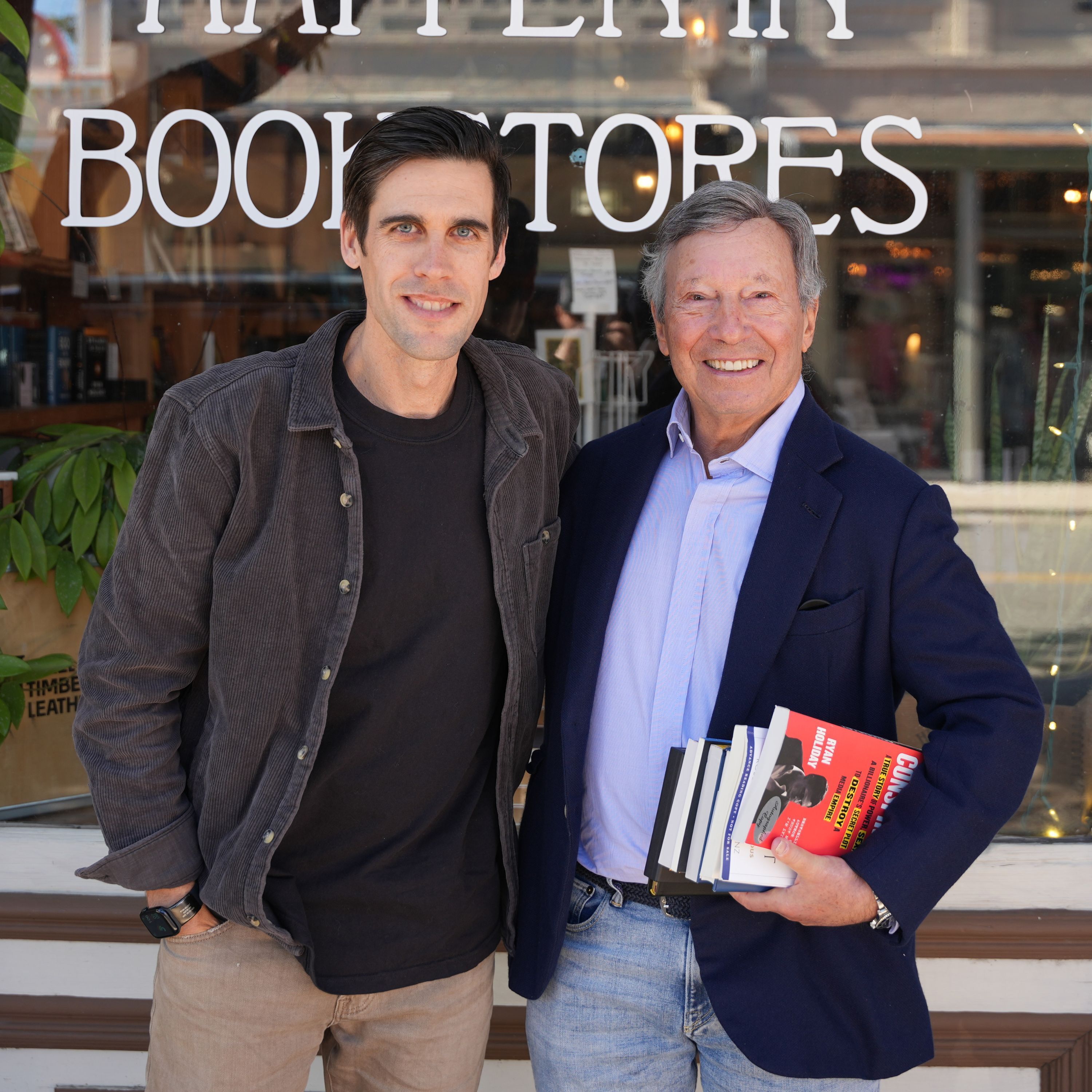
In this episode, Ryan Holiday continues his conversation with billionaire Robert Rosenkranz, exploring Stoicism's relationship with wealth. They discuss the significance of detachment from riches, personal growth through business, and the essence of true success.
Written by AI. May contain mistakes.

Get the gist, explore an idea or ask about something said.
 Claude
On The Daily Stoic, what are the key points of this episode?
Searching your listeningAutomatic transcript. May contain errors.
0:00I'm recording this on a Monday, and Monday is our grocery store day in our family. I usually pick my kids up from school and we go over to Whole Foods, get all our groceries for the week. Although here very shortly, we're going to go over there to get our Thanksgiving turkey because they've got a bunch of great options. Turkeys start at$1.49 a pound if you have Prime with organic birds at$2.99 a pound. And they only carry no antibiotic ever turkeys that will bring quality to your table at a great price. Whole Foods has great everyday prices on all your Thanksgiving essentials, whether you celebrate with a massive family or just a few close friends.
0:37Everything they sell has high standards to help you shop with confidence. Enjoy so many ways to save on your Thanksgiving spread at Whole Foods Market. Why choose a Sleep Number smart bed? Can I make my sight softer? Can I make my sight firmer? Can we sleep cooler? Sleep Number does that. Cools up to eight times faster and lets you choose your ideal comfort on either side. Your Sleep Number setting. Enjoy personalized comfort for better sleep night after night. It's the final days of our Black Friday sale. Recharge this season with a bundle of cozy, soothing comfort. Now only$17.99 for our C2 mattress and bays, plus free premium delivery.
1:11Prices higher in Alaska and Hawaii. Check it out at a Sleep Number store or sleepnumber.com today. This message comes from Capital One. With the Spark Cash Plus card from Capital One, you earn unlimited 2 % cash back on every purchase and get big purchasing power so your business can spend more and earn more. Steven, Brandon, and Bruno, the business owners of SandCloud, reinvested their 2 % cash back to help build the company's retail presence. Capital One, what's in your wallet? Find out more at CapitalOne.com slash Spark Cash Plus Terms Apply.
1:49Welcome to the weekend edition of The Daily Stoic. Each weekday, we bring you a meditation inspired by the ancient Stoics, something to help you live up to those four Stoic virtues of courage, justice, temperance, and wisdom. And then here on the weekend, we take a deeper dive into those same topics. We interview Stoic philosophers. We explore at length how these Stoic ideas can be applied to our actual lives and the challenging issues of our time. Here on the weekend, when you have a little bit more space, when things have slowed down, be sure to take some time to think, to go for a walk, to sit with your journal, and most importantly, to prepare for what the week ahead may bring.
2:41Hey, it's Ryan. Welcome to another episode of the Daily Stoic Podcast. Now, one of the criticisms I get for my work is that I make money from it. I've always found this criticism strange. First off, there's a lot of worse ways to make money than working really hard on a book and selling it to people. But, you know, a philosopher at a university is also compensated for their work. And I actually think that transaction in some ways is less above board than maybe it seems like on first glance. I'm not nobody's taken out undischargeable debt at 18 years old to pay for a copy of The Obstacle is the Way or The Daily Stoic, right?
3:29Right. Nobody feels like their future depends on them having to do this. But if doing this doesn't help their future, they actually don't end up getting a job from there's no recourse. Right. I have no problem with the university system per se, but but it is not a flawless system either. And then, you know, sometimes people go, what would Seneca think about this? And I go, I got to be honest, I don't give a shit what Seneca would think about how I make my living because Seneca lived on an estate tended by slaves. And Seneca inherited an enormous fortune and Seneca made his money working for Nero.
4:06Right. And when I was talking to today's guest, Robert Rosenkranz, who is a hedge fund billionaire, private equity billionaire and a student of stoicism, he was pointing out that I am a capitalist, right, because I make things and sell them. And it's true. I was talking to my son the other day and he was asking about, you know, like copyright. And I was explaining how we have a rental property. and I was explaining how we own this thing and when people want access to it, they rent it, right? So I guess that makes me a capitalist in that sense. But I was like, my books, right? When somebody wanted to make a movie about one of my books, they had to purchase the rights to it because it's a piece of intellectual property.
4:48When someone wants to translate it in another language, intellectual property. The audio book for the Daily Stealick, the term is coming up And my publisher is going to have to bid on those rights again. Again, intellectual property. All writers are entrepreneurs. All creatives are entrepreneurs. The people whose podcasts you are listening to, the people whose YouTube videos you watch, these are capitalists by definition. Even if you might have views of what you do with your money later, you are still engaging in this system, the system that we have, the system that we have long always had. And by the way, Adam Smith studies stoicism as a college student and informs very much the work that he writes before The Wealth of Nations, A Theory of Moral Sentiments.
5:34So we've had some wealthy people on The Daily Stoic over the years, not just, you know, professional athletes and actors and business people, but we've had multiple billionaires on the podcast. I remember we had one guy on the podcast once and I sort of overheard him talking beforehand about like an$80 million house he was buying. So that's obviously unfathomable wealth compared to what I have accumulated from the success of my books. But that is kind of a stoic point about wealth as well, that there's always someone that makes you feel poor. And that if you are motivated by feeling rich, you're probably never going to get there, that that's not what it's about.
6:16But if you get good at creating value and you do it over a long enough period of time or you do it at scale, suddenly you can do quite well for yourself. One of the things that Seneca said was, you know, it's OK for a philosopher to be wealthy. There's nothing in philosophy that mandates you take a vow of poverty and that you grind your way through life. He's saying what matters is that the money that you have isn't stained by blood. And I actually think that's kind of, you know, it's interesting that he says that because if there's any of the philosophers whose money was stained by blood, it was Seneca.
6:53And that's a problem. And I guess I think about this with my eyes. I charge a fair price, I think, for my stuff. When we make stuff for Daily Stoic, we try to ethically manufacture it. We try to treat the vendors fairly. We try to be environmentally conscious. I try to pay our employees fairly. I actually think about when we make stuff and we grow the business, like, am I employing more people? Am I helping other people realize their dreams? You know, and this is to say nothing of it, are we delivering things that people want? And if they don't want them, guess what? This is one of the nice parts about capitalism.
7:24Like people go, nobody needs a daily stoic coin. And I go, you're right, nobody needs it. But some people want it. And those people can freely purchase them if they like. That is the good part about capitalism, right? You don't have to participate in things you don't want to participate in. And if it turns out that I'm wrong, that nobody wants it at all, guess what? I'm the one that goes bust, right? It's my problem. I think of things that I like, that I'm interested in, and I try to make them. And if it turns out that people share that affinity, share that interest, or I'm good at making them interested in it, then it works out.
8:02But if it doesn't, you know, it doesn't. And that's on me. Maybe this is a little bit of the virtue of courage in there. They're taking risk and betting on yourself, trying to change the world of the market a little bit. So, again, this whole topic, it goes way back in stoicism. I just find it, you know, so, so fascinating. This all, of course, being relative. And that's actually kind of the subject of today's guest's book, The Stoic Capitalist, Advice for the Exceptionally Ambitious. This isn't like an academic just writing about what the Stoics would have thought philosophically about wealth or the philosophical implications of wealth.
8:35This is thinking about stoicism and money from someone who has quite a great deal of it, who made it in the arena, so to speak. And that's why I wanted to have Robert on the podcast. We did part one earlier, and now this is part two. I really enjoyed this conversation. I think you will too. If you want to know more about what the Stoics can teach us about how to make money, kind of think about money, how to be wealthy in the true sense of the word, well, I suggest you check out The Wealthy Stoic, our Daily Stoic Guide to Being Rich, Happy, and Free, which is a sort of deep dive into the Stoic teachings on this topic.
9:09It is not about how to make money. It is how to think about money. If you want to check that out, I'll link to that. You can also join Daily Stoic Life and get this course and all of our courses for free. And then Robert's new book, The Stoic Capitalist, is really good. And I think you'll like it. And I think you'll enjoy both parts of this conversation. Enjoy.
9:28What is it like? I mean, I'm sure there's people listening who think I'm rich. I would look at someone like you and go, no, that's what rich is, right? It's always different. It's always more than what you have. No matter what you have, someone who has a bigger one. And that's my other favorite thing is you talk to people or you read about it and you go, these people have all the money in the world. And what are they waking up doing? They're calling reporters from Forbes to try to jockey for a different spot on this list, which is total bullshit. The whole list is made up, basically. But that at that level, this, I guess, is what Seneca is talking about.
10:02Having it is not enough. You have to have people know that you have it or you have to be ranked as having the most. But anyways, I think people are probably curious about what it feels like to have so much that you don't even have to think about it. Do you know what I mean? I've heard this phrase post-economic where suddenly like anything you would think about is no longer a financial concern. Is it as magically freeing as people think it would be? Or do you still have the habits and mindsets that you picked up as a six-year-old with your parents not being able to pay the electric bill? Well, to me, what was exciting to me about creating wealth was the process.
10:50The process was in a way joyful. The thrill of the chase? Well, it was the idea of being involved in a pursuit that used a very broad range of abilities. And I think this is incredibly important. And it's not just about money. It's about a well-lived life. If you find something to do in the world that engages all of your abilities, that encourages you to put all of your energy, that develops your full range of talents, that's, to me, essential to a well-lived life. And the business that I was in of doing leveraged buyouts did do that, did engage me in such a broad way and did make me feel that over time I was continuing to grow, continuing to learn.
11:44So it was really the process more than the – I mean, the money was great, but the joy was really in the process and not in the money. I've tried to get there to get to a place where I love writing books. And if you love writing books, published books come out of the other side of that. Like if you like the verb or the noun, which do you like better? I like doing the thing. And, you know, Marcus really talks about this in meditations. He talks about nature's inadvertence, these things that are sort of accidental byproducts. Like even meditations, he doesn't sit down to write a philosophy text that's going to survive for 2000 years.
12:24No, it's a self-help book, literally, to help himself. Yeah, he's loving the process of kicking these things around, putting himself up for review, getting better. And the accidental byproduct of that is this work of lasting philosophical value. And I imagine there's part of that in building a business. You love all the decisions that go into it and finding the opportunities and setting up the culture and all. And then ideally the profits and the success and then the generational wealth is an incidental byproduct of loving that process. I mean, in your earlier question, you sort of asked me about when you don't have to think about money, is that a sort of a liberating thing?
13:16or what happened in that score. I actually tried consciously to do that really from a quite early age in the sense that my lifestyle was never a burden. I'd much rather live a simpler life where I didn't have to think about personal living expenditures than live a grander life where I was always worried about could I afford this, could I afford that, could I afford the other thing. And my parents, who had to worry about paying electric bills, I didn't have to want to worry about paying anything. So I just lived beneath my means always. But as my means expanded, that sort of beneath my means turned out to be a pretty luxurious lifestyle by most people's standards.
14:04Yeah. If your needs are small, that's a way to become prematurely wealthy. Right. I guess you could say that. And then as your success grows or your wealth grows or the funds you have access to improves, maybe there's a little bit of Epicureanism that we can – a dash of Epicureanism that we can add in there, which Seneca certainly does. It says if you have it and you're not going to become addicted to it or you don't think it says anything about your value as a person, you can also enjoy it. Actually, there's a great line. You might like this. Okay, so Marcus Aurelius loves Antoninus, and what he says about Antoninus to me is maybe what we're trying to get towards.
14:46He says that you could say of him, as they say of Socrates, that he knew how to enjoy and abstain from things that most people find it hard to abstain from and all too easy to enjoy. He says,
15:30were critical of him and saying, what is this? You're living so lavishly. What kind of Buddhist are you? And his response was, no, you're just seeing the surface of things. And I'm a better Buddhist because I see the essence of things. So it was really kind of interesting. He was also love debate. So this became one of my heroes. I mean, I get it as a talking point. I just don't, I don't find it that noble that Warren Buffett lives in a house he bought in the 60s. You know what I mean? Like, it's not either good or bad. It just... Yeah, I agree with you. I mean, if your wealth enables you to live a richer and fuller life, I mean, I have beautiful homes, but I've enjoyed the process of creating them.
16:20I've enjoyed working with the architects. I've enjoyed the aesthetic judgments involved in them. I've enjoyed the ideas that are being expressed, which are kind of almost philosophical ideas about how to live well. And it's about creating environments that are contemplative, that are conducive to conversation, that are conducive to social events, that are conducive to listening to music or reading books, or just give you aesthetic pleasure and give your guests aesthetic pleasure, but in a thoughtful way. I mean, why not? Why forgo that? Yeah, I mean, I guess one argument would be, well, you could give it all to someone right now.
17:01You could give it all right now to people who have nothing, right? And I don't just mean to put this on you because it's true for all of us. There are people starving in Africa. We all have extra. We could do things that are extra for us but would be essential for them. What is the philosophical justification of driving a nicer car than you need to or having a vacation house or adding in a big addition to your house? I think philosophically, I sometimes wrestle with that. How do you think about it? Well, I mean, I think it's a classic kind of philosophical divide between Rawls and Nozick. Okay.
17:47So Rawls writes about distributive justice and what is the fair allocation of stuff. Yeah. And he sees the government's role as embodying some notion of fairness and redistributing wealth in accordance with that notion. Nozick felt like, no, that's the wrong question. It's what is the fair process of acquiring goods or claims to services. And if the process is fair, i.e. it doesn't involve force, it doesn't involve coercion, it doesn't involve dishonesty, it's just a result of free exchanges between free people making rational decisions, that's all you should ask. If the process is fair, you don't meddle with the result.
18:44We just took our kids to an outdoor performance at the Nutcracker. They had a snow cone. And then they went insane in the car ride home. And one of the things I try to remind myself when that's happening is that I don't control my kids' behavior, especially when they're too far gone like that. But I do control how I respond, right? That's stoicism, but it's also what Dr. Becky talks about. Dr. Becky is a clinical psychologist and a best-selling author, and she founded Good Inside, which is there to give parents practical, actionable tools for handling those everyday challenges with confidence.
19:19My wife introduced me to Dr. Becky's books. I love them. I've recommended them a million times. I've had her on the podcast. And as it happens, Dr. Becky is hosting two live Q &A events for Good Inside members. I am one of them. She signed me up for about a year and a half ago. I've loved it ever since. On December 1st, you can join Dr. Becky for her How Not to Raise Assholes event, which is about avoiding entitlement and raising kind, empathetic kids. And on December 15th, she's hosting her How Not to Lose It over the holidays event, which I'm sure we could all use. As I said, I'm a big fan of Dr.
19:57Becky. She's been a great influence for me as a parent and just as a human being. And Daily Stoic listeners can join for 15 percent off with code STOIC15. You just got to head over to goodinside.com to catch the events. Thanks to Toyota Trucks for sponsoring this episode. When I bought my ranch in 2015 out here in Bastro County, I drove my car about halfway down the dirt road that we live on, thought this isn't going to work, stopped, parked it, walked the rest of the way home, borrowed my wife's car, drove in Austin and bought a truck. What I bought was a Toyota Tacoma. And this truck wasn't just transportation getting me to and from my house.
20:38It unlocked a whole different style of living for us, not just on the ranch, but in our little Texas towns. There were places I could go now that I couldn't go before, especially out here in the piney forests, through the fields, and on the unpaved roads like the one that I lived in. We got to go deep into the hill country's wild beauty. We've driven all the way out to East Texas. We've driven across the country. And by we, I mean not just my wife, but both my kids who I drove home from the hospital in that truck. Toyota trucks are built for those who understand that the best adventures happen when you're willing to veer off course.
21:18Because you never know when you'll end up on a Toyota adventure detour. And of course, this is stoicism too, because every detour, every obstacle is an opportunity. But it's helpful if you can handle the difficulty inherent in that. If you've got the resilience and the right companion to make it wherever the road takes you. Discover your uncharted territory. Learn more at toyota.com slash trucks slash adventure dash detours.
21:50Well, Seneca said, you know, it's fine for a philosopher to be rich, provided that his money is not stained in blood. And what's interesting about Seneca is you could argue that he fails that test, right? That, I mean, he gets a good chunk of his money from a murderous, deranged dictator that plenty of the other Stoics resisted. But I think there's probably something in the middle of the two of those, right? Because the process can only be fair and just in a functioning society or a rules-based order, right? Like you can't be a billionaire from certain foreign regimes and say, oh, well, I got mine through a fair process because your country is fundamentally unfair, right?
22:38Like the process, the game was rigged. You may have played the game fair, but the game itself was rigged or exploitative or unjust. But yeah, I think that makes sense. It's just, there is something, I think, this sort of stoic principle of justice where, yeah, you can go, hey, I got this in a fair way, but I am chasing a 1 % increase in my personal pleasure that would have a transformative impact on someone else. which I guess is where the idea of needing to be generous also comes in. That, you know, as they say, if you've been blessed, be a blessing. To me, that's obviously a biblical idea, but I think the best Stoics illustrate that also.
23:21How do you think about, you have an interesting section in the book where you talk about someone who basically came into your office to fuck you over and you were naturally quite angry about this, but you make a distinction, which I think is an important one, and the Stoics certainly make too, the distinction between getting angry and doing something out of anger, or getting angry and acting angrily. Well, you're practically paraphrasing one of the chapters, which is you can get angry, but don't act angry. And I think that's a sort of a general Stoic principle that I think is vital in almost any pursuit, which is that your emotional response is automatic.
24:04But how you act on that emotional response should be a conscious choice and you should take responsibility for it. In the particular story that you're telling or referring to, this bank, which was one of the larger banks in New York at the time and had been a lender to deals that I had initiated had a dodgy loan and they wanted me to take it off their hands. And I owned a substantial insurance company with a portfolio so I could buy the loan in the insurance company. And they said, look, if this gets into trouble, we'll buy it back from you. And I knew that they couldn't put that in writing because of regulatory considerations, but the loan then did get into trouble.
24:52And they wouldn't buy it back. And they had excuses. And then they needed my consent to a general arrangement called extend and pretend, where they were going to not make the borrower pay off, but hope that he would sometime in the future. And I said, no, I'm not going to go along with that. And the president of the bank comes into my office, and he was a very impressive figure. and he basically said look you may be legally right in doing what you want to do here but if you persist in this it's going to be very damaging for your reputation not only with our bank but with the other banks in the syndicate and i felt this guy was a bully that he was pushing me around that i had done a favor for him and now he was uh screwing me over and i was really genuinely angry But I hit the pause button, I went to the men's room, and I realized I've got to capitulate.
25:50And if I'm going to capitulate, it's in my self-interest to do it with as much graciousness as I could muster. So I did. And I thanked him for coming to my office and thanked him for explaining why this was so important to the bank and to my reputation, and fine. And then comes the stoic part of the story, which is that I had the impression of him as a bully. But after this transaction, he said, Bob, if you ever need a favor from this bank, come directly to me. So, you know, the exact opposite of a bully. I mean, a gracious guy, gracious. I was trying to be gracious in defeat, but he was equally gracious in victory.
26:40So I love that story, actually. Well, sometimes in business and life, you just have to accept that you're going to get fucked. That's just a thing that I think people who are successful and driven have an especially hard time with. Because you go, I didn't get here. I didn't get where I got by accepting things or letting people push me around. But even Marcus Aurelius had to swallow stuff he didn't like and had to accept people behaving in ways that he didn't like. But Spinoza says this too. He says that it's simply human nature to use your power to protect what you consider to be your vital interests.
27:24And so this bank or the head of this bank was acting the way he should act, using his power to protect the vital interests of his bank. And the lesson from that is not, oh, my God, capitalism is a vicious system or banks abuse their power. But this is just part of human nature. and if people don't act the way you think they should act, maybe the problem is not what they're doing, but the problem is in your expectations. We use that word act, which I think is interesting because one of Epictetus' metaphors is that we're all actors in a play. We've all been assigned different roles and our job is to act those roles well.
28:14And I think that's helpful not just to go, hey, I was born tall or I was born short, I was born in this country or that country, I was born in this era, that era, to understand sort of where we are and some of the ceilings, limitations, you know, factors that are acting on what we have or don't have. I think it's really helpful. But I've also found that metaphor from the Stokes to be very helpful in understanding other people. Like, is a play without villains possible? Is a play without comic relief possible? You know, like, I try to go, this person is doing their job. Like, I hate them. I hate their job.
28:49Their job sucks. I'm glad I'm not that person. And I don't like that I'm on the receiving end of their things, but like the director wrote the play this way. And I don't mean that in a, like a religious sense. I just mean, like, what did you think you could make it, you know, decades in finance and not meet, you know, an asshole who throws their weight around? Of course, you know, like we sometimes think that everyone is going to be the good guy and that's not how plays and tragedies and entertainment works. Like everyone has a role. The person in front of you in traffic is playing the role of the slow person in traffic.
29:24But I think there's, to me, an issue or the way Epictetus writes about it. He's coming from a place in a society where there was really very little mobility. You were really in the place where you were born more or less, and that was it. And I feel like I'm incredibly lucky to have been born in America, which valued as much as anything the idea that people of ability, regardless of their circumstances at birth, could get a great education, could build a business or a fortune, could aspire to a position of power and or respect in the society. And that's in part why I may have come to Stoicism late, because it's not about ambition, or at least Stoicism doesn't write a lot about ambition, because people are coming from a place where you were pretty much born into a role.
30:25And I think if this book has an original contribution to make, it's really applying these ideas to a world in which ambition is possible and is rewarded. Yeah, look, dynamism and agency and meritocracy, these are inventions that come after the Stoics. And I mean, there are things we're still struggling with today. I mean, we have a society with a lot more agency and dynamism than the Greeks or Romans did. But hopefully the future will have even more, right? Like hopefully we're things that, I mean, certainly in your lifetime, things have gotten fairer. People have gotten, opportunity has been equalized in a way that it wasn't.
31:05You know, different races and genders and religions have more seats at the table than they did before. That's all great. And so, yeah, the Stoics didn't understand certain things. And also the idea that you don't have to have a feudal slave society. That's an invention that comes after the Stoics. The idea that there are ways to resolve problems other than violence is an invention that comes after the Stoics. The idea that one country can't just steal the sovereign territory of another and turn them into a vassal state. This is an invention. And I think the Stoics, if you picked up and dropped Epictetus and Mark Strelis and Seneca in today's world, they would get with that program really quickly.
31:52But they just didn't fully have access to it. And that's the really powerful thing about paradigms. Like Epictetus, even though he's a slave, doesn't seem to question the right or wrongness of the institution of slavery. And maybe that's a flaw in stoicism, that it's a little bit too much about acceptance and not enough about human agency. I agree. I mean, I wouldn't say it's a flaw about Stoicism, but the Stoics came from a society that simply didn't have those same opportunities. And I think those ideas can play out in a different kind of society that does value meritocracy, that does provide these avenues for people to realize childhood dreams where those dreams might be a million miles away from where they started.
32:44Yeah, some of these things aren't possible until someone shows us they're possible, which to its credit, Marx always talks about in meditations. He says, know that if it is humanly possible, you can do it also. And it's not until you get these. I'm actually a big believer in the great man of history theory. I think history was shaped by individuals who did things that people didn't think were possible. Some of those were monsters, Hitler, and then some of them were Gandhi who show us, you know, hey, this is a better way to do that. And the Stoics obviously could only conceive of the things that they could conceive of and the things that were possible.
33:22And we have another 2 ,000 years of history of creators and activists and thinkers and philosophers and scientists who showed us that different things are possible. And hopefully, I think one of the things we take up is that although there are still the things that are in our control and the things that are outside of our control, and a lot of those fundamentally don't change, other people, the weather, et cetera, more things are in our control. Death is still a fundamental reality, but we've learned, hey, if you don't drink water out of lead pipes, you know, you'll live longer. You're absolutely right.
34:01And, you know, that distinction between what's within your control and what's not, it's not a black line. It's not a big sign telling you. So I find and I believe that it's better to give yourself the benefit of the doubt. That if you try to change something that's important to you and fail, at least you've had an opportunity to learn something. Whereas if you don't try at all, you're nowhere. Yeah, just because you believe you can do something doesn't mean you can. But if you don't believe you can do something, it almost certainly will not be done by you. Exactly. There's a line, another line from Marcus Relius that reminds me of a rule you have that I thought you might be able to explain.
34:44You had this investing rule. But Marcus says that what he learns from his philosophy teacher is to read attentively and not be satisfied with just getting the gist of it. Exactly. You say we should always read the footnotes. Tell me about this. Okay. Well, this is in a chapter dealing with investing and investing is weird. It's one of the, the SEC makes you put on the prospectus that past performance is not an indicator of future performance or doesn't predict future results. And the SEC is right, but it's kind of weird. I mean, if you're a good violinist today, you're probably going to be good tomorrow.
35:28If you're a good heart surgeon, you're going to be good tomorrow. If you're almost every other human pursuit, the past does predict the future. So why in investing does that not pan out? And I write about a number of different reasons. One is that some good results are based on luck. One is that some good results are based on running a small amount of money and that it doesn't translate. So if past performance is not a good guide, what can help you? And it's really thinking very critically about the manager, the strategy. and reading the footnotes is simply a way of, I mean, the manager will have, you'll look at a track record and then you'll read a pitch deck, which is the things the manager wants you to know.
36:22But the things he doesn't want you to know are usually in the financial statements and even beyond that in the footnotes. So he doesn't necessarily want you to know how much he's borrowed in order to achieve his results. He doesn't want you to know that he's taking his own money out. He doesn't want you to know that there's maybe some self-dealing transactions between the fund and a brokerage operation. Maybe the past performance only looks like good past performance, but it actually wasn't. Well, that's another thing. Maybe what the footnotes will tell you is the performance is a result of marks.
36:59So these are securities that maybe don't have an active public market, it's private capital, private equity, or private debt, and the manager, because there is no active public market, the manager has sort of set the marks. And if you read the footnotes, you'll know that, and then it can give you some skepticism about, well, the whole track record is based on that he says that what he bought at a dollar is now worth $2. It doesn't matter what Zillow says my house is worth. It matters what someone will buy it for. Like the valuations are bogus. Yeah, exactly. The gist of it would be, hey, I like this guy.
37:38The numbers look pretty good. He comes highly recommended, man or woman. And reading the footnotes says like, no, I'm actually going to see if this is true or not. Is that the idea? Well, yeah. I mean, that's certainly one of the elements of diligence in picking managers. But I I think, again, there's quite a bit in the book on individual, what makes a good investment strategy. Stock picking is a bad strategy. And I explain why. But a good strategy might be operating in a little niche that people don't understand very well and there's not very much competition. Right. Or something that's asymmetrical where you have just people in the marketplace who either don't have information or who are forced to act in irrational ways.
38:31Maybe they're forced to sell. Let's take an example of bonds that have been downgraded or in default. Well, most institutional investors, insurance companies, banks, regulated enterprises like that are forced to sell. by regulators or forced to sell by rating agencies. So you have asymmetry. Well, that can create a very good strategy. So a debt might have been, they might not be able to possess something that you looking at find to be safer than their black and white rule is allowing them to - Yeah, or they may be unable to make a judgment. I mean, look, every security is a good buy at a price.
39:11Yes. So they may know that at 50 cents on the dollar, this is a pretty good bet, but they can't hold it at 50 cents on the dollar. They can't hold it at all. So if the best they can get is 30 cents on the dollar, 20, they've got to sell. And that's kind of asymmetric behavior and a strategy that would give, you know, that in my mind would be an attractive strategy. Right. The gist is it's bad. In that case, just zooming in on that, the gist, to extend this metaphor, the gist is their rules tell them, I can't hold this. It's bad, not valuable, whatever. And you really looking at it go, actually, hey, no, at a certain price, it is a good investment.
39:52And I'm not beholden by the same rules or constraints as you are. So by having read the footnotes, done the work, actually, this thing is great. Yeah, exactly so. And when you find a strategy that has that asymmetry, that's an interesting place to look as an investor. It's easier to just get the gist of things. It takes more time to do your due diligence and to read the footnotes and to question your own assumptions, doesn't it? Well, of course it takes time and it takes engagement and it takes presence of mind to do that. But if you're going to succeed in any pursuit in life, you ought to be a student.
40:30You ought to be mindful. You ought to be thoughtful about what the hell you're doing.
41:00Kind of our thing. Wherever you sell, businesses that grow, grow with Shopify. Sign up for your$1 a month trial at shopify.com slash listen. Shopify.com slash listen.
41:15So Seneca said if you put all the wisest people in a room, they would struggle to wrap their heads around the fact that we value property and money more than time. That time is the most precious resource, but we don't treat it as such. Even very wealthy people don't treat it as such. Why is this? Well, because we're not all Stoics. I've done things in my own life to try to very consciously maximize time. Like what? Well, every once in a while, I'll take a yellow pad day, what I call it. I'll go to a rare book library or someplace where I'm not going to be disturbed. I'll turn off my phone and I'll think about, okay, let's think about the people in my life.
42:02What relationships may have outlived their usefulness? What relationships might need repair? Who are some people that I'd like to really spend more time with? Who are people that I'm spending time with that I'd like to spend less time? Be really conscious about that. Have I fallen into bad habits? Am I spending my time in ways that are unproductive? Are there opportunities that I should be seizing? Are there risks that I should be thinking about? Are there changes in the world that will create either risks or opportunities that I haven't thought of? And by spending a full day like that, I come away with a much clearer sense of how I should be allocating my time.
42:49Yeah. Marcus Aurelius has a great train of thought that for peace of mind, do less. Yeah. But do it with greater concentration. Yeah. And I really take that lesson to heart. My house sits next to an empty lot or we thought it was going to be an empty lot forever. And then someone bought it and was building a house on it. And when they cleared the property, they cleared a bunch of trees that were technically on my property. And I said, hey, you know, you cleared these trees on my property. You got to we got to work something out here, you know. And he said, oh, I'll take care of it. I'll plan something new on your side.
43:24Don't worry. And I said, OK. And then, you know, they were parking trucks on my front lawn and messing stuff up and it's going on. And I finally got to a place where I was like, you know, you can't keep doing this. And then he showed himself to be, you know, one of those people. These people exist in life who decided not just to do something that negatively affects someone else, but then to be a jerk about it. And I remember going, okay, I could sue this person. I could argue with this person. I could fight with this person. then I could be upset about this injustice that's been done to me. But, you know, in the big scheme of things, it's not enormous.
44:01And what am I going to recoup here? And then I thought, I have money, so I can easily just fix this problem. I thought of what Seneca talked about, which is, we'll be so mad if someone builds on our property, right? If they cross the property line, we'll get very upset. But we'll let someone steal our time. And what I was going to do is I was going to allow this person who already stole or damaged my property, I was going to allow them to steal my time on top of this. And I thought, you know what, this is what money is for. And I just paid to fix it. And we don't talk to this person. And they can go on being themselves.
44:39But to me, there's a really important stoic lesson of, you know, they say throwing good money after bad. Often what we do is throw time after money or after a mistake or after a negative experience that actually ends up costing us far more than whatever the original expense was. Yeah. I mean, you're absolutely right. And, you know, you feel like your neighbor has treated you unjustly. Yeah. And you're angry. But then the question is, what do I do about that anger? Do I spend a lot of time trying to right this wrong? Or do I say, you know, in the grand scheme of things, this doesn't matter very much.
45:23I'll just write a check. Now, one of the advantages of wealth is that maybe you resolve this dilemma in a different way. Like I have a house in Aspen. And next to me was another property that came on the market for sale. And it was the ugliest house in Aspen. And I knew whoever bought it was going to tear it down and I was going to have a construction site next door. So I bought it myself. Sure. I tore it down myself. I built something that I loved, which was an art barn, and I loved the process of building it. So, you know, wealth does give you the ability from time to time to convert what might have been an irritant into what might have been an opportunity for creativity.
46:11Yeah, no, I totally agree. And I would say, like, look, if he's abusing children in his basement or he's stealing taxpayer money, there's another part of me that goes, hey, this is an important thing that I need to fight for the principle of or I need to get justice for. But in this case, it's like a tree or whatever. You know, like we can sometimes get caught up in needing to be right. And like in your story, you could be right or you could just pay to make the thing go away. Right. And that's your story. Yes. Yes. That's your story. And you absolutely, I think, came to the right Stoic conclusion.
46:44Yeah. It's like, are you going to try to impose your will on this person or win the argument? Or are you going to preserve the most valuable thing that you have, which is - Your time. Your time. And also your sanity and happiness. So like, let's say my time's not valuable, but this is this thing that Stoics talk a lot about. If in getting revenge or getting your justice, you're stressed, you're angry, I'm short with my children, you know, I'm spending all day at the courthouse or whatever, not just costing myself time, I'm becoming worse as a result of this victory. And so it's kind of a Pyrrhic victory that we often end up winning.
47:21Yeah, that's fair comment too. I mean, if you're angry and you're coming home and you're feeling, you know, the sense of a grievance and injustice, I mean, not only it's hard to take care of your children, it's hard to take care of your own health. It's hard to make decisions that serve your interests well. It's a vicious circle. All right. So last question. I saw this interview with the founder of Kinko's once, and someone asked him what his definition of rich was. And he said, look, there's lots of people that have lots of stuff. He said, but being rich is having kids who want to come home for Christmas.
48:01And I'm just curious, when you have, by any means, people would say is an enormous fortune, what do you find as a parent, as a human being, you ultimately end up valuing the most? I mean, ultimately, it's at least in terms of children, I wanted my children to have possibilities in life that I didn't feel I have. I wanted them to be able to be scholars if they wanted or public servants if they wanted or do. I wanted them to be able to live a productive life in whatever pursuit without feeling this constraint that I felt of trying to establish financial security. So that seemed very important to me.
48:49But it also seemed important to me to put your relationship with grown children in this sort of category of things that you really can't control. You know, maybe you have some control over your kids when they're young. And even that, a lot of it is genetic accident. but I think there's an acceptance or there should be an acceptance of the idea that these are adults and they are who they are and you don't have much control over it if it works out in a way that you have a warm nice relationship with them that's great but if it doesn't work out that way maybe that's something that you should accept with stoic detachment yeah someone was I posted that video one time on Daily Dad and someone responded, actually, if you're rich, you should go visit your kids for the holidays.
49:47Don't make them come to you, which I thought was an interesting lens at looking at the situation too. But yeah, I mean, I think our job is to help our kids become who they want to be, not what we want them to be. But that can be hard when you're used to getting your way, I imagine. Not you specifically, But like for people who are masters of their universe, the powerlessness that you have over your children and rightfully in the sense that it's their lives and they're going to do what they want with them, that can be a difficult thing for people to accept. You know, I must say for me, it wasn't.
50:28I felt philosophically – first of all, I was very analytic as a parent. So I had read these twin studies where twins from radically different environments turned out to have almost identical educations and look the same and married women who look the same. And then in reading all these biographies, I mean, it was all different kinds of parenting. I mean, a lot of people were brought up by servants and really had no real involvement with their parents. Other people, you know, had brothers or sisters or siblings who didn't amount to much from the same environment, same parenting. So I just sort of intellectually had this idea that parenting had only limited influence and that kids were going to have to learn for themselves success felt better than failure.
51:26And if you cared more about your kid's success than they do, you're setting yourself up for sort of an emotional blackmail. And in my case, I was rebelling against my parents, but I was rebelling against their bad ideas and their failure. I didn't want my kids to rebel against success. So I wanted them to sort of develop a sense of ambition from their own experience. I want them to live the fact that succeeding feels better than failing. Yeah. Give them room to fail. But also when you begin to have a reputation and a platform and, you know, it can be hard to not see your kids as a reflection of you.
52:08I think that's a very tempting thing. I remember I was reading an article about that college admissions scandal and they have one of the, you know, billionaire investor, whatever, parents on the wiretaps. And he goes, I just I can't have a son who goes to Arizona. You know, like he couldn't have a kid go to University of Arizona because all of his friends' kids were going to Harvard and Yale, you know, like. And so the idea that your your kid's choice of college says something about you is such a narcissistic and toxic thing to foist on them. Yeah. I mean, that goes back to what we were talking about, about self-esteem.
52:46If your self-esteem comes from the opinion of others, you're in pretty shaky ground. Yeah. Yeah. And it's going to set up a lot, like, it'll go great if your kids agree and want to go to the school that you want them to go to. And, you know, whatever, I hope the dice roll that way for you. But the chances of that happening are slim. So, or it's setting you up for a lot of conflict, right? And so to get in a place where you want your kids to be who they want to be, that's the recipe. Like Epictetus talks about how if you want to be happy, wish for things to be as they are. I don't think he means that so much passively.
53:24I think he means it for scenarios like this. If you want your kid to be a certain way, that's setting you up for potentially a lot of unhappiness. If you want your kid to be what your kid is and you want them to do what they want to do and pursue what they want to pursue in life, now you're much more aligned. And the chances of that being a good relationship, I think, are higher. I agree. Absolutely. I love it. Well, I thought the book was really interesting, and I'm so glad we got to talk. Well, so am I. This was really great.
53:58Thanks so much for listening. If you could rate this podcast and leave a review on iTunes, that would mean so much to us, and it would really help the show. We appreciate it, and I'll see you next episode.
54:26Look, ads are annoying. They are to be avoided, if at all possible. I understand as a content creator why they need to exist. That's why I don't begrudge them when they appear on the shows that I listen to. But again, as a person who has to pay a podcast producer and has to pay for equipment and for the studio and the building that the studio is in, it's a lot to keep something like the Daily Stoic going. So if you want to support a show but not listen to ads, well, we have partnered with Supercast to bring you a ad-free version of Daily Stoic. We're calling at Daily Stoic Premium. And with Premium, you can listen to every episode of the Daily Stoic podcast completely ad-free, no interruptions, just the ideas, just the messages, just the conversations you came here for.
55:20And you can also get early access to episodes before they're available to the public. And we're going to have a bunch of exclusive bonus content and extended interviews in there just for Daily Stoic Premium members as well. If you want to remove distractions, go deeper into Stoicism and support the work we do here? Well, it takes less than a minute to sign up for Daily Stoic Premium, and we are offering a limited time discount of 20 % off your first year. Just go to dailystoic.com slash premium to sign up right now or click the link in the show descriptions to make those ads go away.
For the Stoics, riches weren’t evil but attachment to them was. In Part 2 of their conversation, self-made billionaire Robert Rosenkranz and Ryan dive into the power of living within your means, mastering your mindset, and finding deeper purpose in your work. They discuss how your upbringing influences your relationship with money, why detachment leads to true freedom, and what really defines success.
Robert Rosenkranz became a self-made billionaire as a pioneer in private equity, multi-strategy hedge funds, and the insurance industry. He launched the acclaimed NPR program, Open to Debate, funded Impetus Grants to extend human healthspans, and is founding an innovative cultural institution in New York to showcase immersive work at the intersection of visual art, sound, music, and technology.
📕 Grab a copy of The Stoic Capitalist: Advice for the Exceptionally Ambitious by Robert Rosenkranz
💡The Wealthy Stoic: A Daily Stoic Guide to Being Rich, Happy, and Free explores how stoic ideas can be applied to personal finance, wealth-building, financial mindset, and how it can help you overcome common financial obstacles and challenges
Get The Wealthy Stoic: A Daily Stoic Guide to Being Rich, Happy, and Free & all other Daily Stoic courses for FREE when you join Daily Stoic Life | dailystoic.com/life
🎙️ Follow The Daily Stoic Podcast on Instagram: https://www.instagram.com/dailystoicpodcast
🎥 Watch top moments from The Daily Stoic Podcast on YouTube: https://www.youtube.com/@dailystoicpodcast
✉️ Want Stoic wisdom delivered to your inbox daily? Sign up for the FREE Daily Stoic email at https://dailystoic.com/dailyemail
🏛 Get Stoic inspired books, medallions, and prints to remember these lessons at the Daily Stoic Store: https://store.dailystoic.com/
📱 Follow us: Instagram, Twitter, YouTube, TikTok, and Facebook
See Privacy Policy at https://art19.com/privacy and California Privacy Notice at https://art19.com/privacy#do-not-sell-my-info.
