
 Ask ChatGPT



Gavin Newsom discusses how Stoicism shaped his life and leadership—ego and power, agency over victimhood, translation and rereading, and Stoicism’s ethical focus (not emotional suppression). He also connects Stoic ideas to modern crises like the COVID pandemic, Silicon Valley culture, and the loss of traditions/rituals.
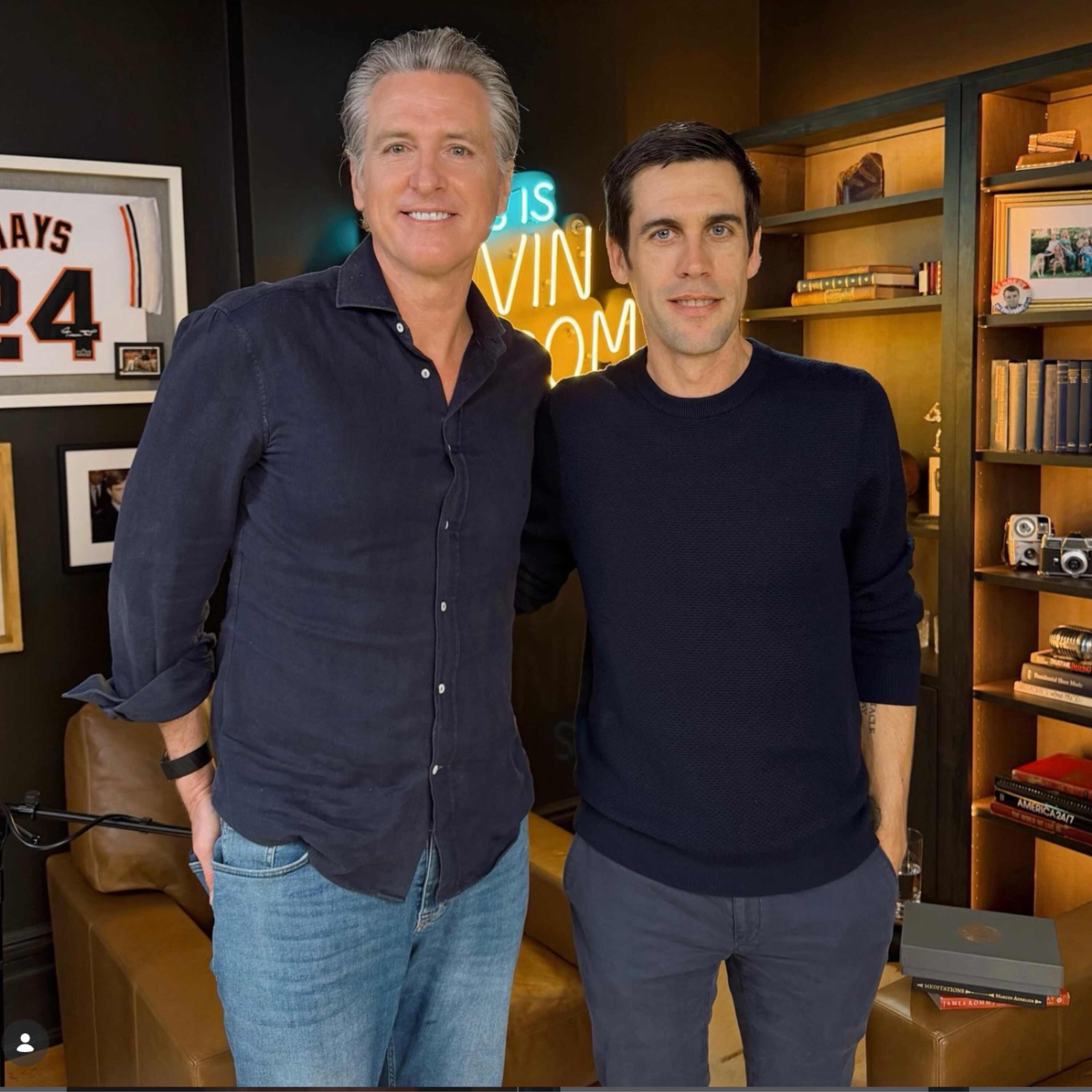
Ryan Holiday is the host of the Daily Stoic Podcast and a Stoicism author/publisher (Daily Stoic; The Painted Porch). Gavin Newsom is California’s governor and a memoir author (A Young Man in a Hurry), describing his long-term engagement with Stoicism.
Stoicism is a philosophy to keep reading, not just having read; “Meditations” is personal and disarming; power can “dyed purple” corrupt; “obstacle is the way” includes learning to respond ethically to people who harm you; Stoicism is meant to pull concern outward via “circles of concern,” countering selfishness and “sociopath” misreadings.
Dr. Drew recommending Epictetus/Marcus Aurelius (2006); Marcus Aurelius weeping during a plague court case; pandemic-era rereading of plague passages; Zeno lecturing at Athens’ Stoa; founders’ Roman/Stoic influences (Cato/Seneca/Marcus); “empathy is the death…” and “zero introspection” remarks from Elon Musk/Andreessen.
Written by AI. May contain mistakes.
Ryan discusses his connection with Governor Gavin Newsom and Stoicism.
“Welcome to another episode of the Daily Stoic Podcast.”
Gavin Newsom shares his journey into Stoicism and its impact.
“My son thought that was a very cool experience.”
Discussion on the historical context and relevance of Stoicism today.
“There's a reason that they're the ones that are most well-known.”
Explore how Stoicism has been passed down and evolved through history.
“But the genius of them is the layering on top of each subsequent generation, trying and riffing.”
Learn about Zeno's journey and the inception of Stoic philosophy.
“Pokila, which is the painted porch in Athens.”
Understand how personal experiences shape one’s interpretation of Stoic texts.
“There's the one that can destroy your health and the one that can destroy your character.”
Examine how our understanding of philosophy evolves with our experiences.
“This notion that the river's changed or step in the same river.”
Learn how to see personal challenges as opportunities for growth and resilience.
“And then he says, you know, the impediment to action advances action, what stands in the way becomes the way.”
Explore how philosophy can guide individuals towards a better life in today's society.
“It's sort of the core part of what you said is sort of for you, if you were going to distill the essence of stoicism, this notion that we have agency.”
Discuss the importance of introspection in leadership and personal accountability.
“I mean, I struggled with it a little bit in the book, even, you know, who I was becoming.”
Explore how Stoicism intersects with Catholicism and its virtues.
“And that he said the purpose of the philosophy is pulling these outer rings inwards.”
Learn about the Stoic influences on the American founding fathers.
“I mean, back to your point in terms, even the books, you just thank you for the books, but just reminding me, the founding fathers, the direct inspiration from these greats.”
Discover the balance between freedom and virtue as envisioned by early America.
“And, you know, that does go back to, I think, the founding of America, which we've fundamentally misunderstood.”

Get the gist, explore an idea or ask about something said.
 Claude
On The Daily Stoic, what are the key points of this episode?
Searching your listeningAutomatic transcript. May contain errors.
0:00Ryan Holiday: When we open the bookstore, we have Tracy's down the street. One of the things that happens when you have a business is like you get all these people that are trying to sell you these different products and services. Oh, this is the right platform. This is the right tool. This is what you should use. Most of it's not good. Most of it's a scam. Most of it doesn't help. But the most important choice we made with the Paint and Porch, other than physically where we were, was using Shopify. We have used Shopify for over a decade, first with Daily Stoic, now with The Painted Porch. It's a choice we've never regretted.
0:33Ryan Holiday: It's a major part of the business, and we wouldn't have succeeded without it. They've grown with us over the years. We've grown with them for almost 10 years now. It's great. And we're not the only ones using it. Shopify is the commerce platform behind millions of businesses and brands all over the world. They do 10 % of the e-commerce in the U.S., from household names to Gymshark and Allbirds to little brands just getting started and little things in between, like Daily Stoic. Everything is all in one place, making your life easier and your business operations smoother. And if you get stuck, Shopify is always around to share advice with their award-winning 24-7 customer service, which we have used many times at Daily Stoic and with The Painted Porch.
1:18Ryan Holiday: It's time to turn those what-ifs into sales with Shopify today. Sign up for your$1 per month trial today at shopify.com slash stoic. Go to shopify.com slash stoic, shopify.com slash stoic. As a business owner, I'm super familiar with how important a strong internet connection is to keeping everything running smoothly. A slight delay in the internet connection in the store, it could mean missed sales, a lag in a Zoom call or a podcast recording could mean you lose everything you were doing. When every minute matters, every transaction, every customer, you cannot rely on a subpar internet connection.
2:03Ryan Holiday: You need a provider that's reliable. You need Spectrum Business. Spectrum Business keeps businesses of all sizes seamlessly connected with fast, reliable internet, advanced Wi-Fi, phone, TV, and mobile services. They offer 100 % U.S.-based customer support 24-7 to help you stay up and running and are sure to have the right plan for you with tailored connectivity solutions and packages built for every business budget. Millions of business owners rely on Spectrum Business to keep them connected. Visit spectrum.com slash business to learn more. Restrictions apply. Services not available in all areas.
2:35Ryan Holiday: Welcome to the Daily Stoic Podcast, designed to help bring those four key Stoic virtues, courage, discipline, justice, and wisdom into the real world.
2:50Ryan Holiday: Hey, it's Ryan. Welcome to another episode of the Daily Stoic Podcast. Okay, so a couple of months back, I'm listening to a podcast. I'm listening to Ezra Klein's podcast. And the governor of California is on there. I'm from California. I no longer live there. And the governor of California starts suddenly talking about stoicism. Listen to this.
3:15Gavin Newsom: I hate to bring this book up because it's such a universal, obvious book. I had never read it. I've had 10 copies. I finally picked it up off the shelf. I'm like, what the heck? meditations from Marcus Aurelius. And I'm like, where the hell have I been? Or where's that book been?
3:30Ryan Holiday: You see, man, you got into podcasting and immediately the Stoics.
3:33Gavin Newsom: I'm telling you. Can't be a real podcaster and not get into the Stoics. How could you not? I don't think there's, perhaps there's never been more important and impactful words ever written.
3:45Ryan Holiday: So I ended up reaching out and we got connected. It turned out that Gavin Newsom had read The Obstacle is the Way and was reading meditations and some other stuff on Stoicism. And we ended up connecting. And I ended up going out there last month. I took my oldest son. We went on a little father-son trip. And I swung by the governor's mansion and we talked Stoic philosophy. I thought it was cool. Look, you can totally disagree with his politics. I think it's hard to miss his sort of sincere interest in the philosophy here. And look, I'll take it from whoever it comes from. Like, look, would I sit down and do a podcast with Ron DeSantis of Florida?
4:30Ryan Holiday: I mean, I'm not a huge fan of him, but if he was sincerely interested in the philosophy, I would talk to him about it. I happen to think Gavin Newsom is a vastly superior politician than Ron DeSantis and, you know, certainly the very large disparity between their death rates in the COVID pandemic, I think are, you know, a pretty stark and vivid illustration of their differences in competencies. Do I agree with everything that Gavin Newsom has ever done? Absolutely not. In fact, one of the things we talk about in the episode, which surprised me, is I'd actually said something negative about him in one of my books, and he sort of pushed back on that.
5:13Ryan Holiday: I was actually surprised at how seriously he took that. So anyways, look, I know this is going to be a somewhat controversial episode, but it's not going to be a political episode in the way that perhaps you might think. This is going to be me and the governor of one of the largest states in the union, one of the largest economies in the world, my home state, talking about the philosophy that I have made my life's work. So I think that's interesting unto itself. I read his memoir, A Young Man in a Hurry, which I related to in a lot of ways, not just, again, as a Californian, but as a person who experienced some of that same ambition and drive, insecurities, mistakes, all of that.
6:00Ryan Holiday: Let's just get into the episode. I'll just keep this intro shorter so I don't piss anyone off and allow this to speak for itself. Now, this is a chunk of his podcast. This is Gavin Newsom, which you can listen to the full episode of anywhere you listen to your podcasts. But anyways, thanks to the governor for having me on the show. Thanks for the time he took to talk to my son. My son thought that was a very cool experience. And thanks for letting me see the governor's mansion, which I had not ever really even seen, despite growing up not that far from it. Anyways, let's get into it. Here we go.
6:37Gavin Newsom: A hell of a time, American peril. And then you're hardly an old man. Your wife's saying, I told you so, I told you so, I told you so. Mom and dad are like, Jesus, how did we raise you, young man? Yeah. Or not. They're probably more generous.
6:52Ryan Holiday: Yeah.
6:53Gavin Newsom: So where are you now in terms of just you go on a walkabout? Is that when you picked up meditations?
6:59Ryan Holiday: No, I found, the irony is I found stoicism before. When? And in college, I was in, I found the Amazon receipt for that the other day, October 2006. So it's going on 20 years.
7:11Gavin Newsom: And what was the motive? You remember the motivation for even making the purchase?
7:15Ryan Holiday: Yeah. You want to know who told me about the Stoics? There's no way you could guess. There's no way you could guess. Robert Greene would be the safe bet. No, it was Dr. Drew. Okay.
7:30Gavin Newsom: Why not? Dr. Drew.
7:32Ryan Holiday: I was writing for the college newspaper and I went to this, I got invited to this conference in West Hollywood, which was sponsored by Trojan condoms. And he was giving a talk. And after the talk, I was just, I was like, you know, a young kid, I was just hungry for advice and direction and all these things. And I just said, hey, you got any book recommendations? And he turned me on to the Stoics and changed the course of my life.
7:57Gavin Newsom: Which Stoic and which book?
8:00Ryan Holiday: He told me first about Epictetus, about Epictetus and Mark Sturelius. And, you know, obviously it took a while for them to seep in. But, you know, sitting in Riverside, California, reading Mark Sturelius' Meditations.
8:12Gavin Newsom: And was that the first book? Was that the book?
8:14Ryan Holiday: I think that was the first one. Yeah. And I just, I was like, what is this? You know?
8:19Gavin Newsom: And it really was that immediate?
8:21Ryan Holiday: Yeah. Yeah. A hundred percent. I didn't know there was writing like this. I didn't know there was advice like this. I didn't know it was what I was looking for, but it was exactly what I was looking for.
8:30Gavin Newsom: And did you know that was about stoicism, that he was about stoicism? Or was it just the most powerful man in the world and that intrigued you in its life lessons?
8:40Ryan Holiday: We're only a few years out from the movie Gladiator at this time. So I think I was a little bit primed. But there was something about, I think at the core, young men are looking for direction, right? And they're looking for direction, particularly now in a world where a lot of the old sort of traditions and explicit and implicit instructions in that regard are gone. And so there's this just kind of existential void. There's this leadership void. You just don't know how to be a person. And it's not like there are these rituals or these groups or this kind of process by which you become a man. That just doesn't exist.
9:20Ryan Holiday: And so to sort of pick up the private thoughts of the emperor of Rome, and he's talking to himself about how to not just be, you know, a productive person and a strong person, but also a wise person and a good person and how to deal with, you know, everything from his temper to his anxiety to his, you know, sort of fear of death or his frustrations with other people. I just, I didn't, if you had asked me to define philosophy in my late teens, I would have said, I don't know, it's like, you know, it's those people in togas or it's those people on college campuses, you know, asking impossible questions about things for which there are no answers.
10:08Ryan Holiday: You know, it like that. It's first thing it's for people smarter than me. Right. And and then to read the Stoics, you go, oh, no, no, this is for people trying to be human beings like and trying to just deal with the difficulties of life. and uh that is what i think struck me so much about meditation because even compared to the other stoics you know whether you're reading seneca or epictetus they're they're at least talking to an audience and and there's something so personal and disarming about meditations because here it's it's it's not meant for publication it's it's it's just a guy it's like a guy's inner monologue it's like the the the angel on his shoulder you know trying to be like you're better than this you should do this try to do that what about this and and so i think i was just i was blown away and then particularly that he is such a good writer that even his notes to himself are some of the best philosophy ever written i think that that that all is what struck
11:17Gavin Newsom: So all of a sudden this book speaks to you and your time of life, your state of mind, Epictetus. Similarly, you mentioned the big three of Stoics, but these aren't the OGs of Stoicism. I mean, the broader Stoic construct for you, when did that click versus more of a contemporary version of Stoicism that they represented?
11:40Ryan Holiday: The OGs of Stoicism, you go back to, you get Zeno and you get Cleanthes and Chrysippes. Cato being maybe another one that maybe some people have heard of. You know, that was the process of kind of tracing it back. Backwards, yeah. I think most people should start with the big three of the Stoics and work their way back. There's a reason that they're the ones that are most well-known. And that is a really cool thing. It just blows your mind about history where you're like, okay, to Marcus Aurelius, Stoicism was ancient philosophy.
12:13Gavin Newsom: Ancient philosophy.
12:14Ryan Holiday: Like 500. Like, Zeno is to Marcus Aurelius what Shakespeare is to us.
12:21Gavin Newsom: I was quoting Plutarch the other day. The imbalance between the rich and the poor is the oldest and most fatal ailment of all republics. Says it, you know, I don't know, 50, 70 AD.
12:32Ryan Holiday: Yes.
12:32Gavin Newsom: The oldest and most fatal ailment.
12:36Ryan Holiday: And you take Plutarch, right? Again, yeah, probably one of the great biographers. Truman would talk about how whenever he had a problem as president, he could pull out, he said, I'd pull out my old friend Plutarch, and he would have the solution to my problems. But Plutarch is writing about Caesar and Cicero and Demosthenes and all these Greek and Roman figures who were to him what he is to us. Not quite that far, but we think about ancient Greece and Rome as this kind of like brief moment, as opposed to a civilization that lasted hundreds and hundreds and hundreds of years. Even the decline and fall of Rome is like 900 years, you know, maybe a little bit less than that, depending on where you want to date it to.
13:24Ryan Holiday: But the point is that you give us comfort in the US. It does a little bit, but it gives you, you just realize that, that they were like when they were going through stuff, when, when, when Marks realist is living through a civil war or Cato is living through a civil war or Seneca is in exile or enduring the reign of Nero, what are they turning to? They're turning to the ancients who we are also turning to. And then what we have is generations. This is why they call philosophy the great conversation because it's these core ideas that were sort of brought into existence at some point. But the genius of them is the layering on top of each subsequent generation, trying and riffing.
14:11Ryan Holiday: Just as the founders, I gave you Jeffrey Rosen's The Pursuit of Happiness. the founders were turning to the Stokes. My nine-year-old is obsessed with Hamilton, the play Hamilton. The most famous play in the Western world in the 18th century was a play about Cato. And it was as famous as Hamilton is now. And in the way that, you know, like if you go immigrants, they get the job done. People know what you're talking about. When George Washington would talk about, you know, looking at events through the calm light of mild philosophy, or when they say, I regret I have, but one life to give for my country.
14:52Ryan Holiday: These are lines from that play. And so it's this great tradition of these ideas being just so perfectly expressed and the example being so powerful that people have been turning to it over and over again. And that's the really powerful thing. Stoicism wasn't Marcus Realist. It was 600 years of it in Greece, in Rome. And then, you know, I mean, it continues on up. It's not like people haven't been talking about it and riffing about it in the 1800 years since. They absolutely have.
15:22Gavin Newsom: And so it's just
15:24Ryan Holiday: this energy I think you tap into and you go, oh, these are ideas that have really been tested in the crucible of human experience.
15:32Gavin Newsom: Was the word stoic. I mean, when Zeno was 300 BC or something, he said, I declare myself a stoic. Or was he declared a Stoic?
15:45Ryan Holiday: Well, I think it's to Zeno's credit that the philosophy is not called Zenoism, right? There's a little bit, right at the beginning, there's some humility. So the founding story of Stoicism is Zeno's a merchant and he deals in this rare purple dye. And that dye being a commodity in those days. Dye in purple. Yeah, we think of like, it's funny where the Strait of Hormuz is shut down, global trade, that's the modern thing. It's like, no, the purple dye was this commodity that was made across multiple islands in the Mediterranean and it would get traded and moved around. Like the same navigational issues we're having right now, people were talking about then.
16:32Ryan Holiday: But he suffers this shipwreck. He washes up in Athens and ends up there discovering philosophy. And that's where Stoicism starts. But he just begins lecturing about these ideas on the Stoa Pokila, which is the painted porch in Athens. And that's what Stoic means. It just Stoa means porch. It doesn't mean anything. These are just the guys from the porch, bullshitting and talking and and sharing. It is funny then that he would talk about that this merchant of purple dye, his philosophy would become the philosophy you associate with Marcus Aurelius because I could tell you mouthing the words there.
17:13Ryan Holiday: One of the powerful lines in meditations is Marcus Aurelius says, this is a reference to being emperor. He says, be careful that you are not dyed purple. And he's saying that make sure that power doesn't corrupt you. God bless. Because the Roman emperor was one of the few that could wear the color purple.
17:31Gavin Newsom: So you're reading all of this, you're portaled to this beginning with meditations, which has had an outsized influence and on everybody that's ever picked up. When did you pick it up? I picked up all the wrong versions. Yeah. Couldn't understand a damn thing. Interesting. I look back, it's interesting. I must have 15 or 20 different copies.
17:51Ryan Holiday: Wow.
17:52Gavin Newsom: And it took me listening to you on damn YouTube to go, here's the one I recommend i like start reading like wait this makes some sense because the translations are you know time of back to decades and decades ago so i think my father someone you know was around and then he my uncle says here's a book you should read i'm like jesus you know last thing so they just sort of collected dust but there were a few efforts yes and they just didn't go anywhere because it didn't speak to me with the kind of language that i understand today i i do i don't
18:20Ryan Holiday: believe in miracles but i went on amazon and i just bought a random copy that i got it was just The first one, I got the copy that changed my life, and I've now recommended it to so many people. That just, that's the first, the algorithm blessed me. Blessed you. For someone who's so critical of algorithms, in that one case, the algorithm blessed me.
18:38Gavin Newsom: By the way, one of the things I love that you do is you'll go back to the same, you'll go to different translations. Yeah. And you're able to sort of lay them out. And I mean, it shows, I mean, you know, how language has radically changed. Well, that. And how important the translation is.
18:53Ryan Holiday: Yes. I mean, so I don't speak Greek or Latin, so I don't know exactly. But it is interesting when you read all these different translations, you go, oh, like, this is the same idea, 15 different cuts on it. And what a big role the translator plays. And also what a big role the moment in time that you're in plays.
19:14Gavin Newsom: So true. How you interpret it in the context of something contemporary.
19:18Ryan Holiday: So I've been reading meditation for 15 years and then 2020 pandemic hits and I'm reading meditations. And all of a sudden there's all these references to the plague and to pestilence. And you realize, oh, this is a plague book. This guy wrote in the middle of the Antonine plague, this 15 year pandemic that killed millions of people.
19:41Gavin Newsom: And you never picked up on that. I mean, necessarily.
19:44Ryan Holiday: I guess I just, you don't, you think he's being metaphorical.
19:47Gavin Newsom: Yeah.
19:48Ryan Holiday: And then you realize he's being literal. Like one of the passages I thought the most about during the pandemic is this one where he goes, there's two types of plagues. There's the one that can destroy your health and the one that can destroy your character. And then you watch over the next two years, people get radicalized. People turn off their hearts and their neighborliness to other people and in other cases lose their mind. come, you know, do and say things they would have been shocked by just a few years earlier. And you go, oh, he must have seen that. You know, he must have seen that. And I think there's a famous story about Marcus Aurelius.
20:33Ryan Holiday: He's presiding over some court and one of the lawyers makes this reference to the victims of the plague. And he just bursts into tears. And so you think, number one, I thought the Stoics don't have emotions.
20:47Gavin Newsom: I thought they don't care about people.
20:49Ryan Holiday: And here he is just sort of weeping over these untold thousands of people who have died. In some cases, people we would have cared deeply about and been very close to. And you go, oh, that's not what Stoicism is. Isn't this, fuck you, I got mine. Or like, I got a strong immune system.
21:08Gavin Newsom: Did you think it was when you first heard about it? Because so many people see it as just, yeah, I'm just, I will have no emotion. I'm just being stoic, you know, sort of rigid, robotic. I think what I was, I was attracted to stoicism for the reason that young men have been attracted to stoicism for centuries, which is it's about getting your shit together, getting it on lock, you know, that sort of ownership and control of the self,
21:34Ryan Holiday: which I think if anyone needs help in, it's young men. So I think that was my initial attraction to it. And then, and I think I was attracted to it, trappings of power and, you know, all the things that make it, you know, interesting and unique compared to, I don't know, existentialism or some other school of philosophy. But over the years, you realize, oh, this is actually a profoundly ethical philosophy. This is about our connections to other people. This is about our responsibilities to other people. when they're talking about excellence, they don't simply mean professional excellence. And that actually professional excellence is pretty common, but professional and personal excellence, like sort of rounding that package out is actually the sort of thing to be more ambitious about.
22:24Ryan Holiday: So I think my initial attraction to it was one thing and then what it works on you. And I think it's interesting to hear you talk about sort of starting and stopping it over the years. It's important that people understand stoicism is a philosophy you should be reading, not a philosophy you have read.
22:49Ryan Holiday: In Texas, a lot of the bugs are just not cool. The ants bite, spiders are poisonous. There's all these kinds of wasps that I didn't even know existed before. Scorpions, oh man, it's crazy. and pest control is just a part of living here, owning a home or a store or anything. It's your problem, honestly. And the easiest way to keep bugs away is with Pesty. And when you sign up, Pesty will send you everything you need to do your own pest control. The Pesty kit comes with everything you need to do your own pest control. Pro-grade pesticide. That's the same stuff that the pros use. Sprayer, mixing bag, gloves, instructions.
23:28Ryan Holiday: You can even get a kit customized to the season, location, and weather. And with Pesty, it starts at just$35 a treatment. With their DIY kit, there's no strangers in your house or appointments to make. Pesty gets rid of over 100 types of bugs from spiders to ants to roaches and scorpions. It's also kid and pet friendly. Get bugs out of your house with Pesty. Just go to Pesty.com slash Doik for an extra 10 % off your order. That's Pesty.com slash Doik for an extra 10 % off. This episode is sponsored by BetterHelp. I don't know about you, but the idea of therapy can bring up some resistance, right?
24:03Ryan Holiday: Some hesitation. Not only does it take a lot of time, but it requires you to get vulnerable. It requires you to get outside your comfort zone. And that resistance can get in the way of doing something that's good for you. And so one way we can reduce that is by virtual therapy. And that's where today's sponsor, BetterHelp, comes in. knowing that if I have to drive across town, if I have to wait in traffic, if I have to look for parking, these are all excuses I'm going to use to not take the time to do this thing that I know that I should do. BetterHelp makes starting and sticking with therapy easier.
24:39Ryan Holiday: You take their quiz, they match you with a licensed therapist. You can communicate with that therapist however you want. Phone, video, text. You can join over 6 million people to date who have gotten help with BetterHelp. May is Mental Health Awareness Month. Find support and have someone with you in therapy. Sign up and get 10 % off at betterhelp.com slash dailystoicpod. That's betterhelp.com slash dailystoicpod.
25:08Gavin Newsom: Also, you make the point, and I don't remember exactly who said it, but you never swim in the same river twice. Yes. This notion that the river's changed or step in the same river. I'll swim in it too. I like that too. American, just up the block where you were growing up. But we change as well. Yes. And back to this, you know, you're reading it again and that we're in a plague. And all of a sudden you're reading it as, I mean, almost as a new visitor to the same, same old.
25:34Ryan Holiday: Well, I think it's so fascinating that, yeah, you picked up a book when you were one age, you picked it up again. Another, it continually wasn't working. And then at some point, and I bet if you actually laid those translations out side by side, they're not that different. They're not that different.
25:48Gavin Newsom: I think you were, you were profoundly different. Well, I was trying to find language, period. I wrote a book about my own learning disability. So just, I mean, literally the words, just above my pay grade, that needs to be explained to me. I remember it's Shakespeare class in college. I mean, you're toast as a dyslexic. You're like, wow, me do thoth. I mean, Jesus. So you're like immediately trying to find a Cliff Note version or something on TV that you could claim that I read or understood. Yeah, so no, it's, so you did all that, you know, so you're reading this, but you weren't necessarily going, wait a second.
26:21Gavin Newsom: this is my new path, my career, that I'm going to become, you know, I'm going to translate this to a whole different audience, that I'm going to be able to express this with new media. I'm going to be able to get a whole new generation to understand and bring to life these extraordinary figures.
26:38Ryan Holiday: No, I mean, I was introduced to the Stoics in 2006, and my first book on Stoic philosophy came out in summer of 2014.
26:46Gavin Newsom: So, and what was the inspiration? What, what, what said, you know, I have to do my version of this. But plenty written about Stoics.
26:53Ryan Holiday: Yeah, I don't know. I wrote my first book because I wanted to be a writer, and I knew that that book had to come first. You couldn't write the Stoic books and then the media book. So I knew how to get the media book out of the way. So I did the media book first, and then what I really wanted to write about was the Stoics. But no, I thought I had this idea for one Stoic book about this one passage from our history. That was it.
27:18Gavin Newsom: Again, obstacles. what stands in the way becomes the way yes i love it come on i know i heard you say this somewhere i mean i just i just it's too good it's the best it's the best someone what some impediment to action becomes the action yes it's the way becomes the way but you want to know something
27:35Ryan Holiday: funny about that quote again you you evolve your understanding of these things as you get so i wrote the book the obstacles away mostly about how we deal with like professional obstacles right like how you're trying to like do something and something gets in the way which is obviously what he's partly talking about there but the fuller quote which obviously i knew is i i edited to put some ellipses in there but mostly what he's talking about is is is annoying people and obnoxious people he's he's saying people can cause problems for us they can get in our way but you know we all he says we always have the ability to accommodate and adapt he says we can convert this to our own, you know, our own potential acting.
28:17Ryan Holiday: And then he says, you know, the impediment to action advances action, what stands in the way becomes the way. And then you go, oh, okay. So when he's saying some, some person comes up and says something horrible to you or some, some, some person screws something up for you or some, some person, you know, is just constantly stressing you out or abusing you or whatever it is. What he's saying is that that's an opportunity for you to be the better person, the bigger person, to grow as a person in wrestling with and handling what this person is doing to you. And so you go, oh, OK, like when the Stoics are saying the obstacles away, they don't necessarily mean, oh, this is a chance to, you know, hey, this this huge recession that we just got plunged into is actually a chance for you to retrench in the business and tighten things up and come back smarter and and and leaner and, you know, more organized.
29:16Ryan Holiday: It may be, but he's saying, actually, you know, this person who just broke your heart or this person who just lied to you or stole from you or this person who just said something horrible to you, they're a chance for you to grow as a human being in how you respond to them. That is obviously not my reading of the passage when I'm 19, but it's how I understand it 20 years later.
29:41Gavin Newsom: And you understand it. It's sort of the core part of what you said is sort of for you, if you were going to distill the essence of stoicism, this notion that we have agency. Yeah. That, you know, it's not what happens to us, how we respond to what happens to us.
29:55Ryan Holiday: Yeah. Yeah. I'd be curious, like, to find some line of work in which that's not the case. The case. Right. Like you wake up and somebody gives you the news and then you figure out your job is to say, here's what we're going to do. Yeah.
30:10Gavin Newsom: But so much of our life is this sort of victim mentality that, you know, that it's fate and we can't control our own fate. Yeah. You know, the system's rigged against me. There's nothing I can do. Nothing one person can do.
30:24Ryan Holiday: Yes. This is whose fault it is. This is why it should have gone the other way. Just a lot of a lot of dwelling on why it happened as opposed to what you're going to do about it.
30:36Gavin Newsom: Yeah. So it's interesting to me, just, you know, I, I write a little bit and, uh, some of my, my friends like, why are you writing about Tony Robbins? And, but it's interesting. I, I, I write about it cause I was, you know, around your age and all of a sudden my contemporary version, dare I say, was this guy with, you know, who self-described with big teeth on, you know, on infomercials selling me cassette tapes. And I listened to those today and I'm like, what so much is, you know.
31:08Ryan Holiday: Well, I do think that there's a little bit there that's just a complete indictment of philosophy as a whole these days. Like that that is that's what Socrates is doing. That's what that's what Aristotle was doing. They were trying. I mean, Socrates gets killed for corrupting the youth, which is to say teaching the young boys what they need to know about life that their parents didn't want them to know. Right. Or challenging convention or teaching them a new way of thinking. And I guess it just says something that philosophy does not speak to people in a way that it's supposed to. It is supposed to be the guide to the good life, which, you know, to me, the American dream is both a financial dream, but also a sort of a moral and a spiritual dream of a better life.
32:04Ryan Holiday: And philosophy is supposed to be part of that. And it's just not. And I think we're in extra trouble when organized religion has not just fallen away, but also alienated huge swaths of the population, whether you're talking about the abuse scandals in the Catholic Church, which is what I grew up in, or you're looking at the sort of political radicalization of sort of evangelical faith. And so if you're not going to have traditions and sort of rituals, you're also not going to have religion. Where are people supposed to learn this stuff? And it's, I think, created a huge vacuum that certain bad actors have stepped into Phil.
32:54Gavin Newsom: And you haven't become a bad actor. Thanks. You talk about, you know, because you talked, we can go back to sort of March 2020 and sort of the beginning and we could talk about that pandemic. People, you know, I mean, it explains more things in more ways on more days of everything. Sure. Our relationships, back to truth and trust, certainly our politics. I didn't fully absorb it, appreciate it at the time and what we've become on the other side and what people became. They were unrecognizable to this day that went through that process. We can get to Elon Musk in a minute, but I knew him well before.
33:30Ryan Holiday: That's my favorite part of your book. You talked about how you came of age as all, you came of age at the same time as all those Silicon Valley people.
33:41Gavin Newsom: I was with Larry and Sergey at Google. And when Steve Jobs taps us on the shoulder and says, hey, he wasn't interested in me. He was interested in Larry and Sergey to show us, pulled out of his back pocket, the first iPhone. And we're like, you know, it was like a joyride. We're going with our fingers like, oh, we. And they were all by, you know, they were just in there was sense of optimism back to when you were writing this book.
34:01Ryan Holiday: So what happened? Like, I think that that quote where Elon Musk is on Rogan and he says, you know, empathy is going to be the death of Western civilization. That to me was one. And then when I watched Marc Andreessen talk about how he has zero introspection and he's like, I never look backwards. He goes, I never look backwards. It's like, by the way, that's not what introspection is. Just to be like, you clearly don't even know what it is. Like introspection is looking inwards, just to be clear. Not looking backwards. But he goes, you know, the great men of history, they didn't look around. It's like the bad ones, you know, the ones who were responsible for genocides and pointless wars and ecological disasters and economic calamities.
34:43Ryan Holiday: Yes, they had no sense of introspection or history or perspective. But the great ones, whether you're talking about FDR or Truman or Theodore Roosevelt, Washington or Lincoln. The best of the best in your mind.
34:57Gavin Newsom: All the greats.
34:59Ryan Holiday: And I just named a bunch of white dudes, so I'm sorry. But like, you know, you could - We could talk about that too and where women are in the stoic history. You could expand. But the point is that the great historical figures are by definition profoundly considerate and conscientious people. And when they're not, it is responsible for their biggest failings. And so what's happened? What the hell happened? Yeah, what happened?
35:28Gavin Newsom: And what happened to you that you didn't fall prey to all that? I mean, your rise has just gone. I mean, you were wildly successful before the pandemic. But, you know, I mean, now the ubiquity in your success, it's just exploded.
35:44Ryan Holiday: Yeah.
35:45Gavin Newsom: But it suggests that people are, they're not, they haven't necessarily been sold that bill of goods either. That they're looking for something different.
35:53Ryan Holiday: I mean, look, I've definitely experienced some success at small potatoes compared to being, you know, one of the richest or most powerful people in the world. So I don't want to judge people whose thing, you know, whose, you know, sort of experience is something I can't even comprehend. But it does seem weird that these people, many of whom I also knew or met over the years and thought were one thing and sort of revealed themselves to be another. What's your explanation?
36:20Gavin Newsom: I'm struggling with it. And I've been struggling. I mean, I struggled with it a little bit in the book, even, you know, who I was becoming. I mean, I was, you know, and, and, you know, God bless. I was reading one of your books a few years ago and took a little indirect shot at me. And I thought it was completely legit. What did I say? You just say, you know, back, I don't want anyone to get back. I don't know. One of the most important stories you always say is what during the plague, what Marcus really did. He sold all the things. And here I was going to a damn restaurant.
36:46Ryan Holiday: Oh, did I make a restaurant?
36:47Gavin Newsom: And you made it. And I'm like, you know what? Fair. And it was legit. It hurt. It hurt. Because it was right. And of course, I knew I was no greater critic of me than me. And so I appreciate it. But so, you know, but a lot of what I write about in this book, I mean, talk about ego.
37:02Ryan Holiday: Yeah.
37:03Gavin Newsom: No, there's some words in there. Right. I mean, the whole thing. I mean, I just, I laid it all out. I laid myself out in this sort of journey of discovery, this memoir of discovery and discovering myself and my own, you know, but, you know, expectations and how I was living in other people's expectations. Yeah. I was kind of losing myself and how now, and I think it's why sort of really dove deep into your work. It's just so sort of all coincided. I'm like, oh, you know, just literally just breathe again and have perspective and grace and humility.
37:37Ryan Holiday: So you're saying introspection. Introspection. Like the thing they are running away from. Running away from.
37:43Gavin Newsom: The coarseness. That's why I've got, forgive me, I didn't mean to put you behind these knee pads. And I think about with Trump, I mean, the obstacle is a way to me, it's so profound in the context of how I'm dealing with the challenges and the obstacle. It stands in the way of, from my perspective, decency, lack of character, all those cardinal virtues that you write so beautifully about. There's no sort of justice and there's no sort of what courage really is and temperance, all these found in what discipline looks like. It's an anathema to what we have today. But I think about, all right, obstacle is the way.
38:17Gavin Newsom: Stands the way, becomes the way. So how we can sort of with agency, you know, manifest and take responsibility and have the discipline and the character to, you know, not just identify the problems, but begin to march strategies and iteration to address these problems and to move in a more enlightened direction. And again, you've been a huge part of that for millions of us. It's but but certainly for the guy sitting here as a current occupant of the governor's mansion.
38:47Ryan Holiday: that's uh unbelievable to me i think you know there's this passage of meditations where mark talks about fighting to be the person that philosophy tried to make you love it and i think about that that's what he's doing in meditations is he's trying he's trying to be better than whatever he could get away with or whatever you know he would he might just be on his own um he's sort of aspiring to be some greater self and it does feel like in the sort of silicon valley kind of like leadership class, there is this, and Trump, I think, obviously hastened it, but it's this kind of like, why? Why should you try to be better?
39:28Ryan Holiday: Just do what you want. Yeah. Get yours. When you're famous, they let you do it. And it's like the embracing of that and the idea of like, why? One of my favorite headlines of all time, there's this Huffington Post headline from 15 years ago and it says that i don't know how to explain to you that you're supposed to care about other people and that that and and it really does feel like like there was this concerted effort in a small group of people to just let themselves off the hook for being responsible for or to
40:05Gavin Newsom: anyone despite the incredible power and privilege that they enjoy there you go there you go and we're I mean, it's, and we're living with the consequences of that. I mean, we, you know, we've hit on, you know, young men, but you, you, you know, subtly made the point. I'll make it more expressed. Young men are in crisis. Yeah. And it's interesting how you connect tradition and rituals and, you know, now, I mean, we're seeing a little bit now with religion. People are fighting religion a little bit again, but we've lost those institutions, that connection to each other. I am because you are this notion of Ubuntu, this commonwealth, you know, and this.
40:43Gavin Newsom: and of course with algorithms and now this manosphere broadly defined and Hustlers University and Bugatti, Bugatti, get mine and all the just patriarchy that comes in there. And these guys sometimes trying to attach these damn -
41:01Ryan Holiday: I know, I know. I try to say stoicism is not a formula for you to be a better sociopath. God bless you. It's supposed to do the opposite. It's supposed to help you. Because look, we're all inherently selfish. We are all self-interested. The Stoics talk about this. Like you come out of the womb being like inherently not just dependent on others, but you will suck your parents dry literally and figuratively so you can survive. That's what your genes are designed for you to do. And that maturation or growth, the Stokes would say, is the overcoming of that, realizing that you have these obligations and duties to not just these people immediately around you, but everyone else.
41:55Ryan Holiday: There's this Stoke named Hierocles, and he talked about the circles of concern. And that he said the purpose of the philosophy is pulling these outer rings inwards. And to me, when I heard that, I was like, oh, that's what they were talking about in church as a kid. That's also what Jesus was talking about. And so there is actually a—Catholicism especially, because it has those cardinal virtues, that I think you sort of, you immediately recognize it in the Stoics that, oh, this was the tradition before that tradition. Yeah. That there's a lot of overlap there.
42:35Gavin Newsom: Yeah. Well, I love it. I mean, just even when we were celebrating the 250th anniversary of the Declaration, best of Roman Republic, best of Greek democracy. Yeah. I mean, back to your point in terms, even the books, you just thank you for the books, but just reminding me, the founding fathers, the direct inspiration from these greats.
42:52Ryan Holiday: You know, Washington is the only one of the founders who doesn't read the Stoics in Greek or Latin.
43:00Gavin Newsom: Like he only reads them in English.
43:03Ryan Holiday: Because they were so familiar. Like Jefferson has Seneca in French on his nightstand when he dies. And so like these were incredibly literate philosophical figures. And, you know, the primary influence on the founders was not, you know, those English legal thinkers. It was the it was the when they're writing the Federalist papers and they're masquerading as these Roman characters. They're thinking about Cato. They're thinking about Seneca. They're thinking about Marcus Aurelius. Those are the people who are influencing them the most. And, you know, that does go back to, I think, the founding of America, which we've fundamentally misunderstood.
43:49Ryan Holiday: This idea that, yes, on the one hand, this is a country about freedom, where the state can't tell you how to be or how to live. your individual behavior is not legally prescribed the way that it would be in another society. But they were very much of the mind that all that freedom was to be counterbalanced by a sense of virtue in the people. And John Adams said like, hey, without it, we're fucked. Like the Constitution cannot, is not strong enough. He says a, like a whale through a net. Like a whale through, I love that.
The real test of philosophy is not what it teaches us in quiet moments, but what it demands from us when power, pressure, and ego enter the room. In today’s episode, Ryan talks with Gavin Newsom, the Governor of California, about Stoicism, leadership, responsibility, and the dangers of power without introspection. They discuss ego, the crisis facing young men, the loss of shared rituals and institutions, and why philosophy still matters in public life.
🎥 Watch the full episode on Gavin Newsom's podcast, This Is Gavin Newsom: https://www.youtube.com/watch?v=s4VNpUtXdiM
🎙️ Listen to the full episode on Spotify and Apple Podcasts
📚 Check out Gavin Newsom's memoir: Young Man In A Hurry
🎙️ AD-FREE | Support the podcast and go deeper into Stoicism by subscribing to The Daily Stoic Premium - unlock ad-free listening, early access, and bonus content: https://dailystoic.supercast.com/
🎥 VIDEO EPISODES| Watch the video episodes on The Daily Stoic YouTube channel: https://www.youtube.com/@DailyStoic/videos
✉️ FREE STOIC WISDOM | Want Stoic wisdom delivered to your inbox daily? Sign up for the FREE Daily Stoic email at https://dailystoic.com/dailyemail
See Privacy Policy at https://art19.com/privacy and California Privacy Notice at https://art19.com/privacy#do-not-sell-my-info.
