
 Ask ChatGPT


- Podcasts
- The Daily Stoic
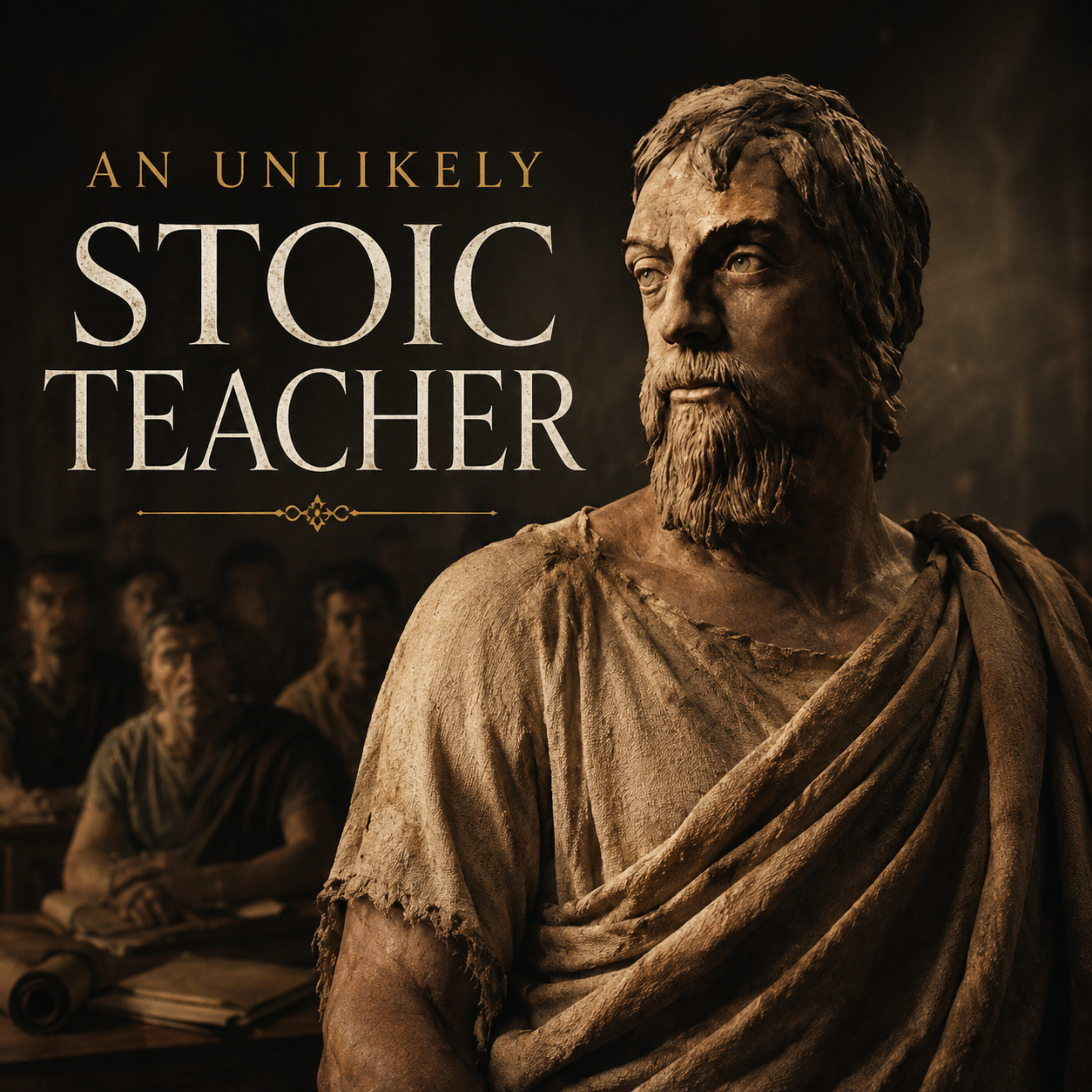
- How Epictetus Captured The Mind Of Marcus Aurelius
In short
How Marcus Aurelius encountered Epictetus and why Epictetus’s Stoicism shaped Marcus’s self-mastery, especially as he was being groomed for power and fame.
Guest backgrounds
Professor William O. Stevens, professor emeritus at Crichton University; longtime scholar of Marcus Aurelius and Epictetus; wrote Stoic ethics book and the biography Marcus Aurelius, Philosopher King.
Key claims
Junius Rusticus loaned Marcus Epictetus’s Discourses, a “great book recommendation.” Marcus likely read Epictetus in his early-to-mid teens. Epictetus’s teaching style made students feel “exactly what he wanted,” emphasizing freedom from coercion and bad appetites. Marcus’s omission of Seneca may be intentional or due to Seneca’s perceived hypocrisy/wealth and political entanglements.
Notable examples
Socrates as Epictetus’s top hero; Diogenes as “shortcut to virtue”; Epictetus’s slave origins (name meaning “slave”); Marcus quoting Epictetus from memory years later.
Written by AI. May contain mistakes.
Chapters
0:45
Personal Journey to Stoicism
Discover the host's personal story of how they encountered Marcus Aurelius.
“There's an element of serendipity to them.”
2:42
Introduction of Professor Stevens
Meet Professor William O. Stevens and his work on Stoic philosophy.
“and some of those places like in Europe, you know, you can't just go dress like you're slobby American.”
5:12
Marcus's Encounter with Epictetus
Explore how Marcus Aurelius was introduced to Epictetus's teachings.
“We know that Rusticus loans him a copy because he mentions that in Meditations.”
10:00
The Impact of Epictetus on Marcus
Discuss the profound influence Epictetus had on Marcus Aurelius's philosophy.
“I mean, it's probably, you know, when he's, you know, in his teens, when he's in his early to mid-teens, roughly, because that's when he's studying with, you know, Sextus and other philosophy teachers of his.”
14:00
The Life and Influence of Epictetus
Explore the background of Epictetus and his journey from slavery to influence.
“And this is a guy who was born into slavery.”

Ask about this episode
Get the gist, explore an idea or ask about something said.
 Claude
On The Daily Stoic, what are the key points of this episode?
Searching your listeningTranscript
Automatic transcript. May contain errors.
0:00Ryan Holiday: Welcome to the Daily Stoic Podcast, designed to help bring those four key Stoic virtues, courage, discipline, justice, and wisdom into the real world.
0:14Ryan Holiday: The right book at the right time. It can change everything, right? How did I come to read Marcus Aurelius? I was at a conference as a college journalist sponsored by Trojan condoms of all things, and I asked for a book recommendation, and one thing led to another, and now I have a podcast about stoicism. You know, probably exactly like your story. All of our origin stories to this philosophy, and in fact to many of the books that have changed our lives, are random. There's an element of serendipity to them. But usually it comes with some kind of recommendation. And for Marcus Aurelius, right, this is how he comes to Epictetus.
0:58Ryan Holiday: The discourses of Epictetus are handed to him by Junius Rusticus, his philosophy teacher. It's one of the great book recommendations in history. A teacher gives it to a young man who is being pulled towards power and fame and responsibility and empire. And so these words from a former slave teach a man with incredible influence and power about the importance of self-mastery. And that's what I wanted to talk to today's guest about, Professor William O. Stevens, who is a professor emeritus at Crichton University. He's a longtime scholar of both Marcus Aurelius and Epictetus, who wrote this great book on Stoic ethics.
1:38Ryan Holiday: And then he's more recently written a biography of Marcus Aurelius called Marcus Aurelius, Philosopher King. And in this little chunk of today's episode, I wanted to ask him about how Marcus came to encounter Epictetus, what struck him about it, and who fired Epictetus's imagination as well, and how the teachings of a slave had such a powerful impact on someone destined to rule so many. Marcus Aurelius being groomed for power. Epictetus talking about freedom, literal and figuratively. Marcus surrounded by palaces and status and expectation. Epictetus saying, none of this matters. Doesn't matter how many people you are in charge of if you are not first in charge of yourself.
2:27Ryan Holiday: And perhaps that's why Marcus kept coming back to him, why I keep coming back to both of them. And probably why you're listening to this podcast as well. Do check out Marcus Aurelius, Philosopher King by Professor Steve. Stevens, and I hope you enjoy this episode. We're traveling internationally this summer, and some of those places like in Europe, you know, you can't just go dress like you're slobby American. You got to dress up a little bit. Can't show their shoulders, can't wear shorts. So I'm going to take some of the stuff I bought from Quince because it holds up well, looks good, it's fancy without being uncomfortable.
3:03Ryan Holiday: I'm going to try to pack clothes that are light, airy and comfortable. I can use them in multiple settings. You've certainly seen me in some of these things. If you've ever watched a Daily Stoke video or seen me talk live, I want something that looks good on stage that I'm not going to sweat through. It's not going to get super wrinkled. Quince has got great t-shirts. They've got great light sweaters. And everything at Quince is priced 50 to 80 % less than similar brands. They work directly with ethical factories and cut out the middleman. So you're paying for quality, not brand markup. And Quince goes way beyond clothing.
3:37Ryan Holiday: They've got sofas and ceramic cookware, premium bedding. It's the kind of brand you end up recommending to everyone for everything. Elevate your summer wardrobe. Go to quince.com slash stoic for free shipping on your order and 365 day returns now available in Canada too. That's Q-U-I-N-C-E dot com slash stoic for free shipping and 365 day returns. Quince dot com slash stoic. They're saying that every day your business is late to AI, you fall two days behind. So how do you keep up when the competition is moving faster? Well, there's NetSuite next. You probably know NetSuite. It's the AI powered business management suite that securely connects all your data.
4:18Ryan Holiday: And it's a unified suite that brings your financials, inventory, commerce, HR and CRM into a single source of truth, trusted by over 43 ,000 customers. And NetSuite Next is the next huge leap in how business gets done because AI is built into everything you do. It automatically surfaces custom insights throughout your day. AI agents work alongside to help you solve problems and handle routine work. Anytime you have a question, you just ask, just like having a conversation with a colleague. NetSuite is customized for a wide variety of industries, so it supports the way your business truly works.
4:51Ryan Holiday: Whether that company earns millions or even hundreds of millions of dollars, it's time for NetSuite Next. For the first time ever, you can try NetSuite Next for free. If your revenues are at least in the seven figures, go to netsuite.ai. It's built for every industry, ready for every boardroom, netsuite.ai. What do we know about Marcus's introduction to Epictetus? We know that it's a formative book. We know that Rusticus loans him a copy because he mentions that in Meditations. But what else do we know? How does the world's greatest book recommendation happen? Gosh, I don't know of any more details than just that.
5:37It seems that we don't know whether Marcus knew of Seneca. So I don't know if he knew of Seneca's writings, which is surprising because, of course, For us, Seneca's corpus is so much bigger than Marcus's writings, the discourses, and the Enchiridion, and Musonius's lectures combined, right? So there's so much more Seneca that we have. It's disappointing that he doesn't mention Seneca.
6:12Ryan Holiday: Donald Robertson told me he thinks that's a conspicuous or an intentional omission. I'd be curious what your opinion was. Yeah, I mean, I can see that. So Donald thinks that he did know about Seneca, but Seneca's take on things didn't float his boat. Yeah, I mean, that's plausible, I suppose. It would, I mean, it's one way of explaining why he doesn't mention because he, because it supposes that he knew full well about Seneca's output, philosophical output, but chose not to mention it or comment on it. I don't know. That strikes me as a little weird. It's easy. It's pretty easy to criticize Seneca for a certain kind of hypocrisy, given how much money he did make, not ever becoming emperor, not becoming poor like Antoninus, right?
7:03Yeah. But lending out money at exorius rates of interest, right? At really high interest rates and raking in the interest and becoming extremely wealthy, right? Yes. And then talking about riding his wagon and his driver being barefooted and how embarrassing it was because it didn't. So there is so much consciousness with, you know, how Seneca's, how he carries his wealth, projects his wealth. And he recognizes he's supposed to be frugal and austere and he praises himself for doing that. I can see that might have been off-putting for Marcus if he knew about the guy and those sorts of stories.
7:42Ryan Holiday: Or just his complicity with Nero, period. you know, I could see sort of condemning him for that reason as well, right? Yeah. And that's, I mean, when I was younger, I thought, wow, yeah, you know, it's easy to, you know, criticize Seneca and think poorly of him in that regard. On the other hand, you know, it could be that Seneca believed optimistically that he could have a very positive formative influence on Nero. Right. And there are precedents here, right? With Aristotle and Alexander the Great. How did that work out? Well, you know, he was quite a conqueror, that Alexander Magnus guy, right?
8:20But, you know, Aristotle's not going to convert him into a philosopher, right? Not very much. Because again, he's pursuing conquest. That's his goal that he's setting for his good life, right? So with Epictetus, I mean, I'm inclined to think that it's the kind of experience that you and I have when we discover Epictetus for the first time and we read it And this guy is electrified. And like Arian says in the prefatory letter, right? This guy, this teacher Epictetus had the power to make his students feel exactly what he wanted them to feel when he was teaching, when he was lecturing. So he had a connection with his students.
9:02He's just so immediate and powerful and forceful in his teaching style, his energy. and his earnestness, right, his passion for teaching Stoicism as a source of freedom and liberation. This is what liberates you from human misery. This is what frees you from bad appetites and being imprisoned, being held captive to the power of others as they threaten your life or threaten to take your property away. Hey, look how Socrates handled that. He was not threatened. He could not be coerced. And stoicism is the armor for resisting any and all coercion. And I think that resonated. I mean, I just have to imagine that's what resonated with Marcus when he read the discourses.
9:55Ryan Holiday: Do we have any idea how old he is when this happens? Like when he would have come to Epictetus? I mean, it's probably, you know, when he's, you know, in his teens, when he's in his early to mid-teens, roughly, because that's when he's studying with, you know, Sextus and other philosophy teachers of his. And so Junius Rusticus says, well, if you're interested in philosophy, if you're into philosophy and you like the figure of Socrates. I've got the guy for you. I've got the guy for you. Read what Epictetus, because Socrates is Epictetus's biggest hero. Right. Zeno. It's not Chrysippus. It's Socrates, right?
10:35Socrates is number one. And in second place is Diogenes of Sinope, the cynic, the dog philosopher. He lived his talk. He walked his talk, as Socrates did. But Socrates had to do it with a wife, with kids, you know, serving as a soldier in the Athenian army, right? Whereas Diogenes, shortcut to virtue. Cynicism, as they say, is the shortcut to virtue. No spouse, no kids, no citizenship. You've got your cloak, your staff, and a leather sack that you keep your food that you beg off of strangers, right? That's a hard row to hoe for most of us. Whereas for Stoics, you have relationships with friends, family members, you have a job, you live in a house, you don't live in a jar.
11:25Do you think there was something
11:28Ryan Holiday: transgressive about Marcus's attraction to Epictetus? Like here you have this kid, he's on this path, he's being drawn towards power, success, fame, you know, palaces. And what lights him up is a poor slave. You know, do you think there was some attraction there that might've been part of it? Yeah. Well, I mean, there was a tug of war between philosophy and rhetoric. Yeah. And they're fighting over Marcus, right? Because with Franto, Franto wanted him to fall in love with oratory, with rhetoric. And he pushed hard, hard, hard for that. And we know that he was very disappointed when Marcus said, my heart belongs to philosophy.
12:11Yeah. That is my discipline. That is where my head and my heart are, is with philosophy. and Franto was very disappointed and they continued to correspond. But you can understand that. I mean, as a retired philosophy professor myself, you know, when I've had really, really bright students and I'm trying to share with them my love and passion for philosophy and how it is transformative and is used to transgressive, right? Especially these days, right? You know, to be that reflective in a very serious way, the life of ideas, is exploring concepts seriously as a good way to live your life. I mean, that's going upstream.
12:54That's really going upstream. And so, you know, when I present that to bright students and they're thinking, well, I like philosophy a lot, Professor Stevens. But, you know, I'm also thinking, you know, chemistry. Yeah. And I'm also thinking, you know, I want to go to law school. And so I'm going know, study, you know, government and, you know, that sort of thing. It's like, okay, I guess political science, sure, you know, I see that, but, you know, isn't the most interesting part of that political philosophy because you need the philosophical foundations, right? And so, you know, students go one way or another, that's up to them.
13:33So I can understand Franto's disappointment. But for Marcus, yeah, Epictetus really, really won his heart. And that's what he wanted to do, but it wasn't to be. And it's clear he knows his Epictetus.
13:47Ryan Holiday: I mean, he is quoting him from memory, you know, years probably after or because he's constantly read and reread him. But yeah, there is just something remarkable about the influence on a seemingly powerless person on such a powerful person. Yeah. And this is a guy who was born into slavery. Epictetus, it's not even a real name. Right. Basically means slave, right? Acquired. Yeah. And so he was acquired by one master from another master and he was given that name. And so that's what he went by. His mother was a slave. So he's born into slavery, the slave son of a slave mother. Right. And, you know, and we don't know much at all about Epictetus's.
14:35We don't know about his childhood. But, you know, he made his way to Rome and his master allowed him to study with Musonius Rufus and he was a natural. And thank goodness Arian wrote down his discourses. And so they survived. They were copied and, you know, and that's how they got into Junius Rusticus's library and found their way to Marcus. So yeah, I mean, he knows his Epictetus. He does. He knows his Epictetus very well. And there's just so much earnestness there. Epictetus gets it. This is about freedom.
15:20Another game day. But while he's glued to the TV,
15:24Ryan Holiday: I'm winning my own way with Mistplay. Let's go! Mistplay rewards me just for playing free mobile games. I earn points and swap them for gift cards to Amazon, Uber Eats, and Sephora. Yeah! We won! And I just redeemed a Target gift card. Woo! Download Mistplay today and turn your downtime into rewards.
From the publisher
One of history’s most powerful rulers was shaped by a teacher he never met. In this episode, Ryan talks with Professor William O. Stephens about how Marcus Aurelius discovered Epictetus, why the former slave’s teachings hit him so deeply, and how those ideas about freedom, power, and self-mastery helped shape the philosopher king.
William O. Stephens is a philosopher specializing in Stoicism, ethics, and ancient philosophy. He earned his Ph.D. from the University of Pennsylvania and spent over 30 years teaching at Creighton University, where he is now Professor Emeritus. His work spans topics like friendship, ecology, and human nature, with a focus on Stoic thought. His latest book is Marcus Aurelius: Philosopher-King (2025), and he is also the author of Marcus Aurelius: A Guide for the Perplexed, Epictetus’s Encheiridion: A New Translation and Guide to Stoic Ethics, and Stoic Ethics: Epictetus and Happiness as Freedom.
Check out more of William Stephens’ work at https://WilliamOStephens.com/
📚 Grab a copy of Marcus Aurelius: Philosopher-King by William Stephens
🎟️ DAILY STOIC LIVE | Ryan Holiday is coming to a city near you! Grab tickets here | https://www.dailystoiclive.com/
🎙️ AD-FREE | Support the podcast and go deeper into Stoicism by subscribing to The Daily Stoic Premium - unlock ad-free listening, early access, and bonus content: https://dailystoic.supercast.com/
🎥 VIDEO EPISODES| Watch the video episodes on The Daily Stoic YouTube channel: https://www.youtube.com/@DailyStoic/videos
✉️ FREE STOIC WISDOM | Want Stoic wisdom delivered to your inbox daily? Sign up for the FREE Daily Stoic email at https://dailystoic.com/dailyemail
See Privacy Policy at https://art19.com/privacy and California Privacy Notice at https://art19.com/privacy#do-not-sell-my-info.
More from The Daily Stoic
All episodes
We use cookies.They keep VO running smoothly and help us improve it. Privacy policy