
 Ask ChatGPT


 The Daily Stoic
29 Apr 2026 · 39m · 15 chapters
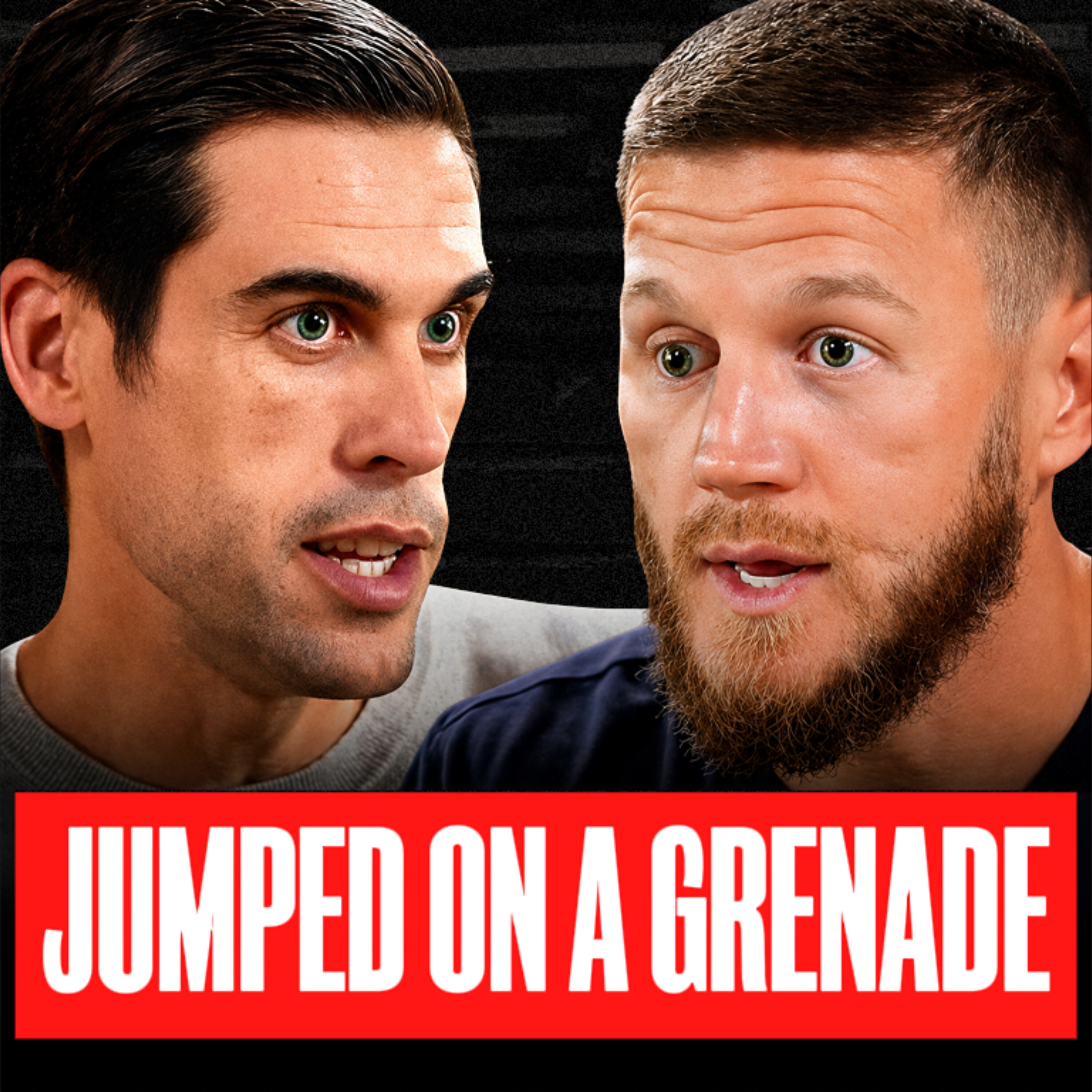
Courage as a split-second act and, more importantly, the long endurance afterward; Stoic framing of what’s in your control during recovery and life’s ongoing frustrations.
Kyle Carpenter, U.S. Marine Corps veteran and Medal of Honor recipient; discussed his Afghanistan rooftop grenade incident and his years-long rehabilitation. Ryan (host), author of The Daily Stoic and interviewer.
“Five seconds” is only the visible moment; real courage includes preparation, tradition, and the “unknown” of what comes after. Perspective is built through suffering; Seneca’s idea that even living is courage. Use Stoic “two handles” (interpretation): choose hope plus grit while accepting reality.
Kyle’s rooftop grenade in Afghanistan (he smothers the blast, saves a buddy, survives with lasting injuries). Comparison to Tom Hudner Jr.’s father, Medal of Honor recipient Tom Hudner, who crashed his plane to try to rescue Jesse Brown (first Black U.S. Navy pilot); Brown’s last words: “Tell my wife Daisy I love her.”
Written by AI. May contain mistakes.
Ryan discusses the story of Kyle Carpenter and his act of bravery in Afghanistan.
“Welcome to another episode of the Daily Stoic Podcast.”
Discussion on dealing with pests in Texas and the importance of pest control.
“And then I was even more interested in the journey that came after.”
A conversation about Tom Hudner's courageous decision in the Korean War and its implications.
“I just spent the past two days with him.”
Learn about Kyle Carpenter's harrowing experience in Afghanistan and his reflections on courage and survival.
“Why do you mean you wish you took every bit of it?”
Explore the deeper meanings of courage beyond the battlefield with Kyle Carpenter.
“whether it's for Hutner or for you or for anyone, there's like the split second decision, right?”
Explore the different facets of courage, including endurance in recovery.
“You don't know whether you're going to survive or not.”
Discuss the challenges faced during recovery and the importance of perspective.
“And when I experienced those final moments and to wake up to this unexpected bonus round that I'm living now, of course there are difficult days.”
Learn how to maintain perspective in the face of daily frustrations and challenges.
“But I do wonder, like, how how transferable and sustainable is that perspective?”
Understand the transition from military life to confronting the challenges of recovery.
“And, you know, just from the, the stoicism side of things to, um, understand what's in your control and out of your control.”
Discover how pain and adversity can teach valuable life lessons.
“And 21, 22 year olds are not great at patience and being told what to do, you know, and you're just like, on top of all that, you're just like, yeah, you want to go back to your life and you can't.”
Delve into the emotional and physical challenges faced during recovery.
“And I think people, it's meant something to people.”
Explore the role of mindset in overcoming recovery challenges and finding joy.
“Which is maybe I went from the Taliban being my enemy to buttons being my biggest enemy now, but, uh, so the physical side of it as well.”
Learn about the importance of choosing a positive perspective in difficult situations.
“And it can turn you into a perpetually pessimistic person.”
Learn how the stories we tell ourselves influence our perceptions and resilience.
“Or you can grab the handle of like, why am I alive?”
Discover the balance between hope and accepting reality in overcoming struggles.
“That's like, as you said, like, I just know I'm not quitting because as long as these people are helping me, I'm not going to give up.”

Get the gist, explore an idea or ask about something said.
 Claude
On The Daily Stoic, what are the key points of this episode?
Searching your listeningAutomatic transcript. May contain errors.
0:00Ryan Holiday: Yo, Chi-Town, that tax refund just hit. And you know what time it is. It's time to rev up your refund at Mercado Ford. Right now, Mercado Ford will match your tax refund down payment dollar for dollar. Up to$2 ,500 on a new Ford Explorer, Bronco, or Maverick. That's real money matched. Plus, stack those savings with financing as low as 3.99%. Upgrade your style. Rev up your refund at Mercado Ford or shop now at MercadoFordChicago.com. With approved credits, a dealer for details. Offer expires for 30-20-26. Welcome to the Daily Stoic Podcast, designed to help bring those four key Stoic virtues, courage, discipline, justice, and wisdom into the real world.
0:45Ryan Holiday: Hey, it's Ryan. Welcome to another episode of the Daily Stoic Podcast. Okay, so I gave a talk in Austin, I guess this was back in September, maybe October. And I'd had a kind of a crazy day in Austin and I'd come straight from the podcast studio and I told this story. We know physical courage, I think, when we see it, right? Physical courage is Kyle Carpenter, who I interviewed today. He was on a rooftop in Afghanistan. A grenade comes in in a split second he throws himself on top of it. He absorbs the majority of the blacks, he saves the life of his buddy and quite literally loses his own. He wins the meadow bottom for this.
1:32Ryan Holiday: But it's that flash, that moment when you do the incredible thing. He and I talked about something that I'm writing about in my next book. It's a man named Tom Hudner. Tom Hudner is flying to Korea in the early days of the Korean War. He's a wingman to a guy named Jesse Brown, the first black naval pilot. And Brown takes a bit of flack, it goes down to a snowy field near the Chosun Reservoir. And in an instant, Hudner, circling above, sees that his friend isn't leaving the plane. The canopy is up, but he's still in the plane, and he's waving. And without a thought, he crashes his own plane next to it in the hope of pulling him from the wreckage.
2:25Ryan Holiday: It's unsuccessful. Brown is hopelessly stuck, and his last words to Hudner are, tell my wife Daisy I love her. And when Hudner returns to his ship, he has to rescue by a helicopter. He's not only beating himself up for not having successfully rescued him, but believes he's going to be court-martialed. The policy was you leave a downed pilot because they couldn't afford to use two pilots for everyone to crash. These moments of incredible selflessness when one puts their own interests behind someone else's interests. That's obviously like transcendent physical courage. Obviously, I couldn't interview Tom Hudner.
3:15Ryan Holiday: He's no longer with us. As I said, I had interviewed Kyle Carpenter that day. And I was fascinated by this decision that Kyle had made in a split second, a decision most of us can't imagine. And then I was even more interested in the journey that came after. So this is me talking to Kyle. You can follow him on Instagram at chicksdigscars. That's Chick just with a K, C-H-I-K-S, digscars. And you can grab signed copies of his memoir, You Are Worth It, at The Painted Porch.
3:59Ryan Holiday: In Texas, a lot of the bugs are just not cool. The ants bite. Spiders are poisonous. There's all these kinds of wasps that I didn't even know existed before. Scorpions? Oh, man. It's crazy. And pest control is just a part of living here, owning a home or a store or anything. It's your problem, honestly. And the easiest way to keep bugs away is with Pesty. And when you sign up, Pesty will send you everything you need to do your own pest control. The Pesty kit comes with everything you need to do your own pest control. pro-grade pesticide that's the same stuff that the pros use, sprayer, mixing bag, gloves, instructions.
4:38Ryan Holiday: You can even get a kit customized to the season, location, and weather. And with Pesty, it starts at just$35 a treatment. With their DIY kit, there's no strangers in your house or appointments to make. Pesty gets rid of over 100 types of bugs from spiders to ants to roaches and scorpions. It's also kid and pet friendly. Get bugs out of your house with Pesty. Just go to pesty.com slash dope for an extra 10 % off your order. That's pesty.com slash dope for an extra 10 % off. It's pretty remarkable. Our time is our most precious resource. It's the thing we have the least of. And then we spend it in the most frivolous ways.
5:14Ryan Holiday: It occurred to me just how much time I was spending getting in my car, driving across town, finding parking, going up to my therapist's office to sit down for what I thought I was spending one hour of my time on self-care, on working on myself, on thinking about things, processing stuff. But actually, I was spending like an hour and a half, sometimes two hours, because the process was so inefficient. And that's where today's sponsor comes in. If you've considered going to therapy, but maybe you feel like you don't have time, you don't have energy, or you don't have money, you should check out BetterHelp, because BetterHelp makes starting therapy easy and continuing therapy easy as well.
5:52Ryan Holiday: BetterHelp matches you with a therapist based on your preferences, their clinical experience, and over a decade of matching expertise. You can easily switch therapists at any time. But most of all, you can do the therapy from your own home, from your phone. Join the 6 million plus people who've gotten help from BetterHelp, the platform you can trust. You can just click the link in the description below or you head over to betterhelp.com slash dailystoke to get 10 % off your first month of therapy.
6:24Ryan Holiday: Do you know the story of Tom Hutner? Do you know who that is? He won the Medal of Honor in Korea? I just spent the past two days with him. Or not him, his son. His son. No way. Tom Hunter. Yeah, absolutely. Really? Yeah. He is an exceptional individual, just like his father. Was his son in the service too? Or what does his son do? No, he was not. Oh. But yeah, two very successful sons. And now he helps with Medal of Honor-related endeavors and just helping us in our mission. Really? I just read this book about him and I saw that the picture was taken by Tom Hudner Jr. And I was like, oh, so I didn't know the sun existed.
7:04Ryan Holiday: But I'm fascinated by the story. It's in the book that I'm doing now. How crazy. Yeah. So for people who don't know, he's a pilot in Korea. Correct. And he's a wingman to Jesse Brown, who's the first black pilot in the Navy. And Brown takes a shot to his oil tank, has to crash in this field in the Chosin Reservoir. and then as they're circling, he sees that he doesn't get out of the plane because you couldn't eject, they're too low. And this is the crazy thing. So right before they took off, the skipper of the ship goes, if anyone goes down, he's like, I'll court-martial anyone who tries to rescue them.
7:45Ryan Holiday: Because he's like, we can't afford to lose two planes and two pilots. Right. He's like, wait for a helicopter. We will send a helicopter. I don't want anyone trying to rescue anyone. And then Hudner sees his friend go down and immediately disregards the orders and crashes his plane in this snowy field in the Chosin Reservoir and attempts to rescue Brown from the plane who's like hopelessly stuck in there. and Brown's last words are, you know, tell my wife I love her. I wanted to ask you about it because I'm fascinated with this story, like that decision to do the craziest thing that a person could do.
8:31Ryan Holiday: You're one of the handful of people who might have some insight into that thought process. What a small world and how unbelievable that this is the first topic that's brought up. I have so many questions about this now. And I just spent two days with him. But, you know, obviously it was a split second decision out of love for his friend and fellow service member. But as I've examined just, you know, for me personally, my journey in those five seconds on the roof, you know, I feel like just like a championship on the football field or getting an A on a test. very few things can be executed in the moment that they are without planning or thought or preparation before.
9:25And so I feel like, although the entire world only examines those five seconds on the roof, you know, I feel that, you know, one, I was just as a recipient and all of my fellow recipients will say, we just happened to be in that moment, in that time and place, and we had the opportunity to step up the way we did. I think that's the beautiful thing about the human spirit is that anyone can step up in a time of need, no matter how small or how large of an act. But those moments on the roof were a culmination of the love and support throughout my life that I received from my parents. It was a culmination from, and I think a lot of people think, oh, Marine Corps, combat oriented, you know, hardcore, whatever you think of when you think of Marines, good or bad.
10:23Everyone thinks it's all about training. And every day we're just throwing grenades around the place, fake grenades, and hey, who's going to jump on it?
10:30Ryan Holiday: Like fumble recovery drills on a football team. You're practicing this thing over and over again. Was there ever a moment where that was a thing you had to consider doing? We do training with grenades, and I think it's just a byproduct of being in uniform and training with grenades that you think about things like that. And just in general, going into combat, am I going to be able to step up the way that I need to? Am I going to step up instead of back down when the bullets start flying? But it was never a tangible moment of training. I guess that's what I'm curious about. Is it a conscious decision or is it something more like the training and the moment and the stories and the tradition?
11:21So many people think it's training, but an amazing aspect of the Marine Corps, especially through boot camp, is through the difficult moments of training, when you're worn down, when you've been out training and you're tired and you're hungry and you've been exposed to the elements for days on end. And your drill instructors, it's a very intentional part of boot camp that in between those moments, they'll sit you down and they teach you about the history of the Marine Corps. Right. Those that came before you, those stories of unfathomable courage. I mean, I remember sitting there in boot camp during the crucible, our big final event before we received our Eagle Globe and anchor.
12:03and I believe I speak for all of us when sitting there I just thought I mean who could who could do something like this how can someone and now I understand more not for my action but just from from being a Marine and having that time and service but just unfathomable acts of courage, those that from all branches, Marine Corps aside, just those that at 17, 18 years old in World War II, when they knew that the chances of making it onto the beach, making it to the beach even, and then past the beach and surviving what lay ahead were such a minuscule chance. Right. And when those doors open, they charge for it anyway.
12:55Right. And I think a lot of people just in conversations I've had or just, you know, the love and support that I'm so humbled to be given. And sometimes it seems like, oh, Kyle, the first guy in history that jumped on a grenade. But you look back at every conflict and there are those that, you know, grenade or not, not only went above and beyond, but gave that last full measure of devotion for each other for a purpose greater than themselves or any individual. and so that's why I say I was just happened to be on that roof and in those moments but again it was a culmination of so many different things in my life for my family coaches on the athletic fields growing up and and I think ultimately I'm just so thankful that I reacted the way I did Now, granted, I wish I could have taken every bit of that grenade, but at least I can live my life and not always wonder why I didn't or if I could have.
14:09Ryan Holiday: Why do you mean you wish you took every bit of it? Because the Marine that I was with, my best friend, he was injured as well. So I wish I could have taken every bit of that blast. But, you know, I still I feel like gave my best effort. And so now I can live my life not wondering, but just being proud that I was able to step up as the Marine and the friend that I needed to be in that moment. But also going back to, you know, those moments in boot camp to have tried my best to uphold the legacy and the path that the Marines that came before me laid with unfathomable amounts of courage and sacrifice.
14:53Ryan Holiday: I feel like the tradition is a huge part of it because, you know, your average person doesn't feel like they're maybe capable of doing that. And I think a big part of the training is not like, hey, how many pull-ups can you do and how far can you run and how much can you lift? Although that's obviously all part of it, but it's in the process of putting you through that and accepting you into the tradition that you feel like suddenly you're capable of or that you're an heir to this thing. Even though you're not actually related, you're all part of this lineage that goes back and includes every single one of those people.
15:28Perfectly said, yes.
15:29Ryan Holiday: in that moment? Are you thinking, hey, this is my job? Are you thinking this is my friend? Do you think anything at all? In the book, it makes it sound like you kind of just, a thing happened and then you woke up after and you're like, where's my face, basically. So I'm just curious how much thinking is going on. Well, I should have thought I'm about to kick this thing right back off the roof. But strangely, and I appreciate you having my book and reading it, but strangely, I don't remember any of the moments leading up to the blast. Now, unofficially, which, you know, the Medal of Honor that was awarded to me, although it never is and never will be an individual award or recognition, but that came from over two years and almost 300 pages of investigation.
16:27Ryan Holiday: It's not a thing they give lightly based on one person's opinion. Correct. You need multiple opinions. You need forensic blast evidence. And so, you know, they talked to me in the very beginning and I really had nothing helpful to contribute. But even if I did, I think it's important to note that if you are injured in whatever incident they are investigating, you can't be an eyewitness. Because if you have any sort of head trauma, obviously your facts might not be that accurate. Safe to say I had some head trauma. But I don't, you know, unofficially, I would say the only thing that I remember before wasn't really anything cognitive.
17:11Yeah. It was just, you know, knowing how you and your body feels. I remember almost as if I was an empty shell. I don't have any visual recollection. I just, I felt like I was on my knees and my body was falling forward. And then I felt like I got hit in the face really hard. But my actual kind of somewhat coherent thoughts followed the blast. And I remember being extremely confused. And my vision was as if I was looking at a TV with no connection, just white and gray static. Like my ears are ringing extremely loud, just as they are this very moment that we're doing this podcast.
17:55Ryan Holiday: Oh, they just they just remain ringing. Yeah. Yeah. Which is, you know, can be daunting at times, but just got to remain focused. And, you know, every day is driving on for the mission. But after I felt like I got hit really hard in the face, that was followed by extreme confusion and disorientation. so much so that I was trying to just to get a grasp of where I was and what happened. And I've been in Afghanistan for over four months now. And so my first thought was, okay, I'm pretty sure I was in Afghanistan. The last thing I can remember, I was on a roof, but what could have injured me this bad on a roof?
18:42And then I thought, Maybe I got off of the roof, went on a foot patrol because the vast majority of our injuries over there, at least for my unit at the time, was stepping on IEDs. Right. Because we were so far out in rural territory behind enemy lines. We had to get helicoptered in and we had no vehicles. So everyone thinks military nowadays. We always have vehicles to roll around in. but very few roads to where we were and the roads that were there were more pedestrian walkways paths for livestock so you don't have to go through the fields and damage crops and they wouldn't support heavily armored vehicles and before we got there they had tried that and the banks of the river would collapse and marines were drowning from being trapped in these armored vehicles.
19:35So we only had feet everywhere we went and, you know, traditional Marine style. Part of the tradition also. Right. Yeah, exactly. And so I thought maybe I went on a patrol, stepped on an IED and just the roof is the last thing I can remember. And that thought process was interrupted by, of course, what I thought was my buddies messing with me because Marines and service members are experts at messing with each other. It's kind of like our secondary job. And I thought, man, you know, whatever's happened, I can't believe in this banged up state that I'm in, that my buddies are pouring warm water all over me.
20:17And that fragmented piece allowed the other ones to kind of fall into place. And I realized like, oh man, whatever's happened, my buddies aren't messing with me and that's not warm water, I'm profusely bleeding out. And so at that moment, you know, while getting just, I would say tired, but that would, that would be an understatement. It's probably the life leaving your body. Just, just drained, draining to and from your core. Right. Just hard to describe. But at that moment, when I realized that, I knew that was it. I thought about my family, how devastated my mom was going to be when that government car pulled into the driveway or those two Marines in uniform knocked on the front door to tell my family I would not be coming home alive.
21:09And lastly, I said a quick prayer for forgiveness for anything I had done wrong in my life. And I faded from consciousness in the world for what I thought was the last time. So you thought you're dying? certain without a doubt that that was it uh and you know I couldn't feel my face except for it to get a little graphic here I remember when I first woke up I was trying to I was trying to feel my mouth or my jaw with my tongue but nothing was there and so but these final moments you know I was kind of because I couldn't feel my face I I really didn't have that deep of sense of what was going on, but I remember kind of crying a little bit in my head, not because it wasn't, why am I here?
22:03You know, why did I even do this? Why am I in this position? It was more just, you know, I just turned 21 over there on my birthday, crawling through a field, getting shot at, thinking, man, I hope one day I can get my first cold legal beer, you know? Yeah, legal. Yeah. But I just turned 21 and it was more just. The heaviness of the moment. The heaviness of the moment and maybe in some sort of subtle way, just knowing that, you know, this is it. And I guess I don't get to experience the rest of my life. Sure. Now, in hindsight, I still wouldn't change anything because I truly felt in my heart and I knew and I saw every day that we were there just helping a fellow struggling human being.
22:53But, you know, with that said, the world faded away. I thought that was it. And to my very unexpected and pleasant surprise, I woke up about five weeks later. and instead of a hot dusty rooftop, it was a strange hospital room with Christmas stockings hanging on the wall beside my bed and about three or four inches of snow outside on my window pane. And, uh, but, but that moment of waking up, my first thought was completely opposite of the last one that I had. And I thought, no way I cannot believe I survived. that. But that moment, although I had three years left of a recovery, 40 to 50 plus surgeries, that moment really began this journey of self-discovery, purpose, and perspective that I've been on.
23:49It's crazy to say, but about 15 years now.
24:01Ryan Holiday: Usually when people are thinking about supplements or training, they're thinking about recovery, they're thinking about protein, they're thinking about creatine. But one of the most overlooked pieces is gut health. If your gut is not dialed in, everything else struggles to work the way it should. And that's where Momentous Fiber Plus comes in. Momentous Fiber Plus addresses one of the most overlooked foundations of long-term performance, that is gut health. because fiber is not just about digestion. It's the key driver of gut health, which directly impacts a bunch of things, nutrient absorption, energy stability, recovery, focus, mood, and overall performance.
24:39Ryan Holiday: Momentus Fiber Plus is a complete three-in-one formula with soluble fiber, insoluble fiber, and prebiotic resistant starch. Like everything Momentus makes, Fiber Plus is built with a science-first formulation, clean and minimal ingredients, and no artificial additives or artificial flavors. And right now, Momentus is offering our listeners up to 35 % off your first order with promo code DAILYSTOIC. Head over to livemomentus.com and use promo code DAILYSTOIC for up to 35 % off your first order. That's livemomentus.com, promo code DAILYSTOIC. It all comes down to hiring. You gotta find the right people for your team and you gotta bring them on board and you gotta onboard them quickly.
25:19Ryan Holiday: You know, just throwing up a job posting and hoping you get lucky. I've just found, well, you don't get lucky enough. If you want to find quality hires, well, you should check out Indeed right now. People are finding quality hires on Indeed right now. In just the 30 or so seconds we've already been talking, people have made dozens of hires on Indeed, according to Indeed data worldwide. Their sponsor jobs posted directly on Indeed are 95 % more likely to report a hire than a non-sponsored job. So join more than 3.3 million employers worldwide that use Indeed to connect with quality talent that fits their needs.
25:58Ryan Holiday: Spend less time searching and more time actually interviewing candidates who check all your boxes. Less time, less stress, more results. When you need the right person to cut through the chaos, this is a job for Indeed-sponsored jobs. And listeners of this show get a$75 sponsored job credit to help get your job the premium status it deserves at Indeed.com. That's Indeed.com right now. and support the show by saying you heard about it on this podcast, indeed.com slash dot terms and conditions apply.
26:32Ryan Holiday: What's crazy to me is like, you know, you read the Medal of Honor citations, whether it's for Hutner or for you or for anyone, there's like the split second decision, right? To go on a grenade, to crash the plane, to do the thing. And that's what we call courage, right? Like that moment. but i mean you're talking about like your ears are still ringing from the event 15 years later like that's a day-to-day thing that you have to deal with i think about he crashes the plane then he he basically wakes up and he's like holy shit i survived the landing it might not work right and he you know so he kind of wakes up and then then he's like well shit now i'm down here right and now that's actually the hard surrounded by a hundred plus thousand totally yeah he's he's just to sprint across this field all he has is a service revolver even even if he had just crashed in alaska it would have been bad like he's exposed to the elements like he could have frozen right and so now and now the hard part like now the actually courageous difficult thing comes now like the what's he going to do and he obviously he's not thought through well then i crash and And then the helicopter pilot will come.
27:46Ryan Holiday: Like he's not thinking about that. I think why it's courage is that it's this leap into the dark. You don't know how it's going to work out or that it's going to work out. In your case, you're going on the ground. You don't know whether it's going to, you're going to get there in time or not. You don't know whether you're going to survive or not. And then you're certainly not able to go like, and then three years in the hospital and then learning to do this again and feeling this again. And so we almost overemphasize which is the most impressive part of the experience. Like, what's the real ordeal?
28:19Ryan Holiday: Is it the raising your hand? Is it, you know, that part? Or is it all the stuff that comes after this? We don't think of courage as like endurance, but it's that too. That was very well said, Ryan. And I could not agree more. And I appreciate you recognizing that because I'm most proud of what I've done after the blast. And whether that's the battle through recovery or all the way to the marathons or just continuing to push myself into that unknown, which I'm not bragging on myself for my story. but um there's this line from seneca that i think about he says sometimes even to live is an act of courage you know just the absolutely the keeping going like again we think of the courage as these sort of punctuated moments and the heat of battle or the firefighter that runs into a burning building or whatever um and that's obviously one part of it but then the other part is the waking up the next day and the day after and the day after when you're dealing with the consequences of those couple of seconds that you did the thing.
29:31Yeah, absolutely. And when I experienced those final moments and to wake up to this unexpected bonus round that I'm living now, of course there are difficult days. There are long, dark, scary, and painful nights through the hospital. And even out of the hospital, life is hard. It's a hard earned journey. But to have experienced those final moments and to wake up, I can't help but to not try to make the most of it.
30:09Ryan Holiday: Yeah. And I think that's where I was wanting to get at. But I talked to one of the Vietnam POWs and he was saying, you know, any morning you wake up and the locks on the inside of the door, that's a good day. Wow. You know, because they spent seven years with the lock on the wrong side of the door, right? They can't get out. And I think that's you appreciate that. It makes sense. But I do wonder, like, how how transferable and sustainable is that perspective? Right. Like, so you have this moment of courage. You do this thing. like one thing you could take from that is like anything that's not getting blown up by a grenade is better than this right uh or anything is better than not getting blown up by a grenade but i imagine you're still like what the fuck is this traffic like how how quickly does just the regular frustrations of life kick in or do you find you're able to maintain that perspective no that that's a great point and yeah of course you know little things in life that uh shouldn't you know still kind of get to you sometimes but i think for anyone grenade aside i think it's extremely um you know important to always work on and be able to refocus on that perspective yeah the things that that really matter.
31:35And, you know, just from the, the stoicism side of things to, um, understand what's in your control and out of your control. That's been extremely helpful for me because throughout my recovery, you know, I went from being in the best shape of my life, carrying a machine gun in Afghanistan, you know, 18 minute, three miles, and just always having a plan as a Marine, whether that is what today holds or what this specific patrol holds. You know, we knew what routes we were taking. We knew our, our points that, that we needed to hit and what village we were going to and what the mission was. But when I woke up, it was complete opposite yeah you know at first i didn't know if i could make it to that next breath and i remember just laying there on my side and you know the b all the beeping machines are so annoying it's uh it gets kind of you know starts to wear on you almost and you know in the beginning when my pain spiked or i was having difficulty with whatever it was the machines will start going off and then you got to get yourself back under control and you got to calm your heart rate.
32:57And so at first I didn't know if I could make it to that next breath or not, which a machine was helping me at first. But when I got off that, didn't know if the 40 or 50 surgeries, every single one, you know, going into it, you do the pre-op, you're there at 4 a.m. You do the pre-op, you do the surgery. Some of them were nerve transplants or transfers, um, at which take two to four months to make that connection regenerate. So you have to stay persistent and you have to keep working at it. Even though nothing is happening, you have to just hope and trust that your hard work and your focus and dedication will eventually allow that nerve to reconnect.
33:39But, you know, then it was, I didn't know if the next surgery would take. And another aspect is when something catastrophic happens or you face extreme adversity, you know, a tough lesson is that the world keeps spinning.
33:53Ryan Holiday: Yeah. Understandably so, obviously, you know, people care a lot after it happens and then they go back to their lives. Yep. Which, uh, which, you know, I understand it's the way it is, but all of my friends who didn't go into the military were living their best life in college. And all of my buddies who thankfully did not get injured We're still in Afghanistan together operating. But my life was a complete, you know, unknown, I guess. Yeah. And 21, 22 year olds are not great at patience and being told what to do, you know, and you're just like, on top of all that, you're just like, yeah, you want to go back to your life and you can't.
34:34Yep. And so I guess as time went on, you know, I had to, I had to grapple with that.
34:41Ryan Holiday: Yeah. And, you know, although I realized that you don't have to have a perfect plan, you just have to, you know, be willing to say, you know, my, I guess, mantra kind of became just, you know, keep working hard. Try to be a good person, do the best you can and help others around you. And it's got to lead you somewhere good. It's got to lead you to that light at the end of the tunnel. I think that's right. Because look, I wrote this book, The Obstacle is the Way. And I think people, it's meant something to people. And I think, you know, generally the idea is true that there's an opportunity in everything.
35:22Ryan Holiday: But that can feel very flippant to someone who, you know, just found out they have cancer or somebody who just got blown up by a grenade. Like, you actually have this beautiful note in the acknowledgments that really hit me, which I think is very well said. You said, The lessons of life, silver linings, and perspective that I share in this book did not come easily or quickly. At times, silver linings only become apparent because I was forced to search through the darkness. And perspectives only became clear after years of deep thought and personal growth. These lessons originated from pain and suffering.
35:57Ryan Holiday: But sometimes the most difficult struggles teach us the most beautiful lessons. like i imagine in in many ways the the recovery in the hospital was the most challenging part personally emotionally physically because it not just goes on and on but you have time to think about it and feel sorry for yourself and be angry and hope and despair you like now all of a sudden the real emotions and the struggle and the having to figure out what this means and what you're going to do about it. That's like your problem in a way that it's not in five seconds on a roof in Afghanistan. Yeah, absolutely. The mental side of it, emotional side of it, but also how am I going to do buttons now?
36:46Which is maybe I went from the Taliban being my enemy to buttons being my biggest enemy now, but, uh, so the physical side of it as well. Uh, but you know, like so many things in life, there is two sides to that story. There was the daunting, the unknown, the difficult side of it, but there was the side that, although it's, it's kind of heavy to be told, Hey, you have three more years left here for us to kind of put Humpty Dumpty back together again. But that also gave me time to think about all of that. To think about that perspective, which if I had to summarize my journey in one word, it would be that.
37:30Perspective. Correct. Because I could look at, you know, it's always foundationally it's, well, I'm here. Yeah. When I thought that I wasn't going to be. You shouldn't be. Correct. Yeah. But then it gets to, and some of this came from those I recovered with. Quadruple amputees, triple amputees with their newborn sitting on what's left of their legs, zooming off to therapy every day with a smile on their face. And so it gave me the time to think, hey, my arms might be super banged up, but I still have them. Yeah. Most of my body might be shredded to pieces, but I still have two good legs that can get me up and inch me forward.
38:19And it's not about the limbs. I think just what I'm saying is it's about the mindset and looking at what you have compared to what you don't have. And I think that comparison, it can do do wonders for you and take you amazing places or that comparison can become the thief of joy.
38:43Ryan Holiday: Yeah. And it can turn you into a perpetually pessimistic person. And also, you know, I saw in the hospital and before I say this, I want to note that I think struggle, adversity and most things in life should never be compared. Yeah. You know, my buddy Andy Stump said, you know, I've done more than some and less than others. Yeah. And that really stuck with me. But with that said, and again, not comparing, but I saw that there were those in the hospital with me because 2010 was a very violent year in Afghanistan. Most of the hospital rooms, I think, except for mine, because I was one of the ones in the worst shape.
39:29I needed a one to one. I needed kind of some other stuff going on in my room, a lot of machines. but every single room had two beds and two patients in it. And there was even a time where the least injured were out in the hallways. And so a lot of casualties were there and a lot of wounded warriors recovering. But I saw that there were some that had, and all struggle is relative, but there were some that had much more minor injuries, but they just never left the hospital. And I saw that their mindset and not their injuries were holding them back. And so, although of course I had terrible days and painful days and days where, you know, I wondered if I was going to be able to keep pushing forward.
40:26Although I kind of in a way, I didn't feel like I had a choice because there were so many people pouring their love and their hearts and everything they had into getting me better. But, you know, in life, you can learn from people, good and bad. You can take good and bad examples and lessons from people and seeing that just, I guess, kind of planted a seed that, hey, one thing I have, you know, I might not have functioning limbs. I might've lost my eye. Most of my teeth are blown out. But one thing I have is my mindset, is my attitude, and is my care for myself and wanting to get better for myself and for those around me.
41:15And I'm thankful through all the medication and injuries that I kind of had that insight because it never left me. And... Do you know who Epictetus was, the Stoke philosopher? Absolutely. Absolutely.
41:29Ryan Holiday: So Epictetus is tortured by his—he's a slave, but he has this cruel master who tortures him. He breaks his leg at one point. And so he has this—he's crippled the rest of his life, which is, I guess, the term they would use then. And so he's coming at this, not from like some tenured academic perch, but like a dude who really suffered and went through stuff. And his thing was that we every situation has two handles. You know, we get to decide what we're going to try to pick it up by. And yeah, you can you can grab the handle that says, hey, I'm alive. This is good. Or you can grab the handle of like, why am I alive?
42:07Ryan Holiday: This is horrible. And that handles kind of everything. The lens through which we decide to interpret the events or the position we're in is kind of the first step. Because if you get that one wrong, all the other steps are really hard, I feel like. If you're like, I was singled out. This is horrible. This is insurmountable. You know, you can tell yourself a story that becomes a self-fulfilling prophecy. Now, just telling yourself it's wonderful and I'm never going to suffer again and it's all going to great. And that's that's the thing that those Vietnam prisoners talked about. Like the story you're telling yourself is I'm going to be home by Christmas.
42:48Ryan Holiday: This is going to be over really soon. That's also a bad handle because because life doesn't really care that that's what you think. Like, but if you if you so it's the key is sort of picking something that's both hopeful, but also got a kind of a grit and a determination to it. That's like, as you said, like, I just know I'm not quitting because as long as these people are helping me, I'm not going to give up. That's that's not like, oh, you know, if you get in a car accident and the doctors say you're never going to walk again just because you go, I'm going to walk again. And sometimes that works, but not always.
43:27Ryan Holiday: That's not magically going to give you your legs back. Yeah, there needs to be accepting of reality in there as well. But I think there is tremendous power, and I would say that's even an understatement, to embracing the struggle.
43:53the Amen
The Medal of Honor is the highest military award in the United States, given for extraordinary courage in the face of danger. In this episode, Ryan sits down with Kyle Carpenter, the youngest living recipient, to talk about what that kind of courage really looks like and what comes after it.
Kyle received the Medal of Honor after throwing himself on a live grenade to save a fellow Marine in Afghanistan. It was a split second decision that changed his life. But as he explains, that moment was only the beginning.
Kyle Carpenter is a medically retired United States Marine who received the United States' highest military honor, the Medal of Honor in 2010.
📚 Grab a signed copy of Kyle’s memoir, You Are Worth It, at The Painted Porch | https://www.thepaintedporch.com/
👉 Follow Kyle on Instagram @ChiksDigScars
🎥 VIDEO EPISODES| Watch the video episodes on The Daily Stoic YouTube channel: https://www.youtube.com/@DailyStoic/videos
✉️ FREE STOIC WISDOM | Want Stoic wisdom delivered to your inbox daily? Sign up for the FREE Daily Stoic email at https://dailystoic.com/dailyemail
See Privacy Policy at https://art19.com/privacy and California Privacy Notice at https://art19.com/privacy#do-not-sell-my-info.
