
 Ask ChatGPT



Host: Ryan Holiday
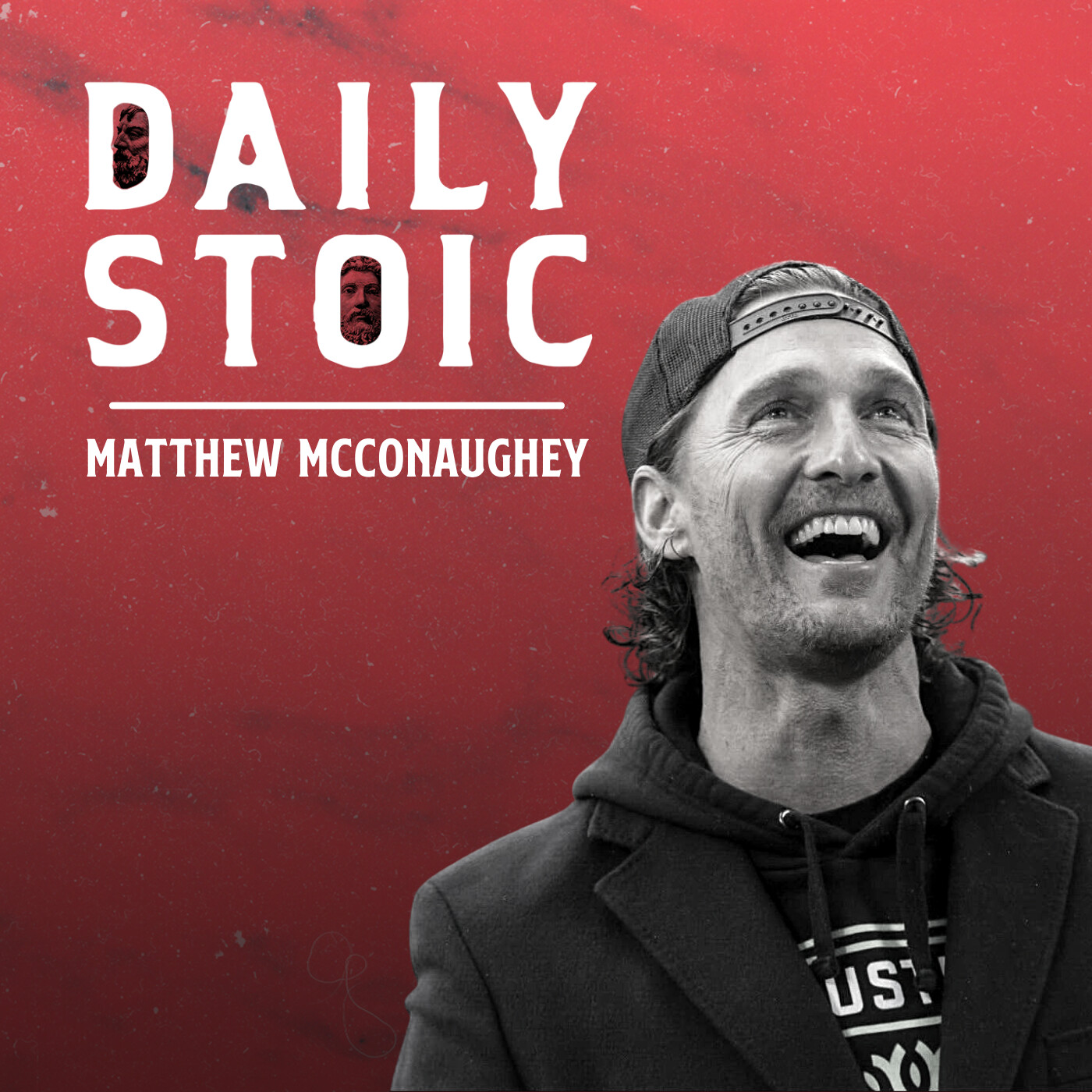
Matthew McConaughey
Two-part interview
Exploration of McConaughey's course "Roadtrip – the Highway to More" and discussions on life, love, and the significance of presence.
Written by AI. May contain mistakes.

Get the gist, explore an idea or ask about something said.
 Claude
On The Daily Stoic, what are the key points of this episode?
Searching your listeningAutomatic transcript. May contain errors.
0:00My family owns a 2023 Toyota 4Runner and honestly it's my favorite vehicle that I've ever owned. Around town, it's smooth and reliable, but where it really shines is on our trips into the backcountry. We've taken it on backpacking adventures to Colorado and New Mexico, loaded it up with gear, and never had to think twice about whether it could handle the terrain. That's what Toyota trucks are built for. Off-road confidence, rugged durability, and the freedom to explore. Toyota has a long history with the outdoor community, and they're committed to helping more people get out there and experience what nature has to offer.
0:29From remote trails to scenic byways, Toyota Trucks empowers you to take the detour, roam freely, and discover places that still feel wild and untouched. And they're not just making great trucks, they're working to expand access to adventure so more people can connect with the outdoors and pass that passion on to the next generation. Discover your uncharted territory. Learn more at toyota.com slash trucks slash adventure dash detours. That's toyota.com slash trucks slash adventure dash detours. You hear that? That's not just a Toyota truck. That's the sound of no crowds, no alerts, no distractions, and no telling what you'll find next.
1:15You know, like a detour. So why would you ever take a tour when you could take a detour? Toyota trucks.
1:30Welcome to the weekend edition of The Daily Stoic. Each weekday, we bring you a meditation inspired by the ancient Stoics, something to help you live up to those four Stoic virtues of courage, justice, temperance, and wisdom. And then here on the weekend, we take a deeper dive into those same topics. We interview Stoic philosophers. We explore at length how these stoic ideas can be applied to our actual lives and the challenging issues of our time. Here on the weekend, when you have a little bit more space, when things have slowed down, be sure to take some time to think, to go for a walk, to sit with your journal, and most importantly, to prepare for what the week ahead may bring.
2:24Hey, it's Ryan Holiday. Welcome to another episode of the Daily Stoic Podcast. When I had Rick Rubin on a couple of months ago, we ended up talking much longer than I thought, and I split that into two episodes. I felt like it was more bite-sized that way, closer to the idea of what Daily Stoic is. And I think I'm going to start doing that more on some of these longer episodes. If someone comes into the studio or we really get into it, I'll split it up into two parts instead of trying to cram in another guest every week. I think it lets the episodes breathe a little bit. It's the idea of less is more, which as we were talking about last week, it's sort of the theme of today's guest's newest launch.
3:09You've seen Matthew McGonaghy in a million movies. You've seen him win best actor awards. You've seen him in commercials. Maybe you read his book, Greenlights, which is great. There's also Greenlights Journal. Maybe you saw him on the news helping pass historic legislation to protect kids and young people from gun violence. Just a fascinating guy, a character in every sense of the word, but mostly all the good senses of the word. And we had a really in-depth conversation. I brought you the first hour earlier this week. Now I'm bringing in the second hour. And if you haven't checked out his new course, Road Trip the Highway to Mort, very much recommend it.
3:52This guy's like a renaissance man. He writes books. He acts. He's an investor. He's a father, political activist, professor at UT, helped design the Moody Center. This dude is just, man, living a fascinating life, taking the green lights where they come up. And just someone I'd like to say has become a friend, although a friend from afar. We have not hung out. We just talk from time to time, and I always enjoy it. And I think that comes off in today's episode. It's one of my favorites. This is part two. Listen to part one if you haven't. And remember, you can follow him on all social platforms, especially now on YouTube, at Matthew McConaughey.
4:34And I'll link to the new course, Road Trip the Highway to Moore. you'll get a really good sense of how cool it is in today's episode because I went through it. I took the course, found a bunch of awesome stuff to talk about, which he and I do in this conversation, but I'll link to it in today's show notes. Or you can just go to artoflivinevent.com slash roadtrip, or if you just Google Matthew McConaughey roadtrip, it should come up there at the top. Also, I think you'll really like it. And it's always a treat to get a peek inside this guy's head because there's not many people thinking or living like he is.
5:10And that's why I wanted to have him back on the podcast. You can listen to our episode from way back in late 2020 also. And you can grab his book, Green Lights, here in the Painted Porch as well.
5:30You probably heard the headlines about all the different cuts to foreign aid and food benefits. This is having a profound impact on the world's poorest people and the world's poorest communities. But, you know, just hearing about that, that's not what stoicism is about. Stoicism is, to me, what you're going to do about it. And that's where GiveWell comes in. GiveWell is trusted by tens of thousands of donors each year because they provide free and independent research that helps you understand how to have a big impact. GiveWell has spent the last 18 years researching global health and poverty alleviation, and they direct funding to the highest impact opportunities.
6:09Over 150 ,000 donors have already trusted GiveWell to give more than$2.5 billion over the last several years, and research suggests that these donations will save over 300 ,000 lives. I myself am one of those donors. I donate to GiveWell every year. It means a lot to me. And you can find all their research and recommendations on their site for free. And thanks to the donors that sponsor this research, GiveWell doesn't take a cut from your tax-deductible donation to their recommended funds. And if this is your first gift through GiveWell, you can have your donation matched up to$100 before the end of the year or as long as matching funds last.
6:44To claim your match, go to GiveWell.org and pick Daily Stoic from the drop-down menu under podcast. That's how they know that you heard about GiveWell from the Daily Stoic and you'll get your donation matched. That's GiveWell.org, code the Daily Stoic to donate or find out more. I got an amazing night's sleep last night. One, because my six-year-old fell asleep in the car at like six o 'clock and he transferred him from the car seat to the bed and it stuck, which is just magic. So he's in bed way earlier than normal. But I sleep really well every night because I have a 8 Sleep Pod 5 Ultra, which is 8 Sleep's best product.
7:22I've used 8 Sleep for many years now. and it's just totally transformed how I sleep, made me sleep better, made my wife sleep better. It's amazing. So basically Eight Sleep is this topper that goes over your mattress. It can heat and cool both sides separately. It can raise and lower each side separately. So it helps you fall asleep faster, stay asleep, and then wake up better. Eight Sleep buzzes me to wake gently every morning as opposed to some loud blaring alarm. And then I can check the app and it tells me my sleep score. It even helps me optimize my day based on how I slept. If you want to survive the holidays like a pro and just generally sleep better, head over to eightsleep.com slash DailyStoic and use code DailyStoic to get$350 off your very own Pod 5 Ultra.
8:14The best part is you still get 30 days to try it at home and return it if you don't like it, but I know you will. Trust me, your body will thank you for this investment in better sleep, shipping to many countries worldwide. See details at eightsleep.com slash dailystoic.
8:32What I think is interesting though, you just said there's these parenting moments that you're glad you're there for, right? And you listed some, they asked you a question, they're playing, they're vulnerable about something. You know, you listed a bunch of stuff, but you didn't pick any six flags moments, right? Those are free moments. They're ordinary moments. They don't require any scheduling. It's just regular life, what Jerry Seinfeld calls garbage time. Yeah. Also, it's not just with children, but with friends and lovers. Parents. Parents of being just in the same room, in the same house.
9:15Yeah. Passing by each other without saying a word. Yeah. But knowing you're there. I, I, I, I look, I selfishly have my office very close to my house, like real close. I can't help it. I like to get just a faint ambionic sound of my kids laughing or, or my, my, the home life happening right over there. Just an earshot. Just, just for me, I'm too far away from it. I'm kind of looking, you know what I mean? I'm looking, I'm kind of, you know? Now, you know, and then do I go, hey, when they come in the door, like we started this conversation, I'm on my son comes in looking for the iPad. Do I go like, oh, does it go through my head?
10:02Like, remember I told you last night I was going to need this at 8am. Why didn't you take the iPad? Yeah, it does. God all goes through my head, but I loved it. Come in, comes in and looks for me. Great. Right. Being around just for a look, a smile, a walk by, an arm around, a kiss on the forehead. Hey, I'm making so-and-so for lunch. You want any? That's the best. Yeah. Oh, you want me toast that bread? Ooh, yeah. Butter, olive oil. Butter, good stuff. When they ask you to get them stuff? Yeah. Yeah. Yeah. Have you read The Boy, The Fox, The Horse, and The Mole? Have you read that kid's book?
10:57No. Oh, it's incredible. I'll send it to you. I carry it in the bookstore. It's amazing. It's by this guy, Charlie Mackesy, who's this brilliant illustrator. But there's this line in it, and the kid says something like, Like, sometimes I find it hard to say I love you, so I just say I'm glad we're all together. That's it right there to me, right there. Same room, you can hear them spending time together, even if they're on the iPad. You know, we're supposed to feel guilty that they're on their screen time. I don't give a shit. I'm just glad we're all in the same room. I hear you. And then, you know, this is one I'm enjoying recently.
11:38so our kids are close enough where the boys compete all right yeah so there's a little sibling competition sort of like anything you do is like ah that's i'm gonna belittle it and you know and oh that's not cool but but to hear my boys go have a similar game that they play together on an ipad and to hear their laughter and they're using the voices and then talk about, oh, remember that time when you did the thing and hear them going over on the side going, yes! And sometimes that is on an iPad or sometimes that is on a video game. But it's that I've seen that also if that's after the sun went down, I've seen that lead to Oh, the youngest for the first time in a while enjoyed catching the pass of the ball from his brother.
12:44Yes. And for the past few months, he didn't catch it from me. He didn't want to catch it from Big Bro, though. Yeah. Because he's throwing it. I don't want to catch his pass. But now, because of that time they had last night where they laughed and came together, some music or that game. And now, first thing in the morning, they're out there throwing passes of whatever ball it is in the backyard. And little bro who was pushing everything big bro was doing away is now giving 100 percent, diving catches and going, good pass. Wants to catch that ball. Four, brother. Four, big brother. Doesn't want to drop one.
13:26Four, big brother. That's beautiful to see. Well, speaking of road trips, right? Some of the best things we have done as a family have come from things or places that my son has heard about in a YouTube video, right? You watch some video of somebody snowboarding down a sand dune, right? He didn't know that was a thing you could do. And I was like, let's see if there's any of those in Texas. And there is in Monaghan's, right? Monaghan State Park. so we took an eight-hour road trip together and we didn't snowboard we went down on a sled but the idea is you can learn about things through the screen that's my life by the way it would be weird if i was like anti-screen i've been learning about the world through my computer since i was a teenager opened up so many things he learns about something and then what you do you take the green light when they're open or interested in something and you say i can help you see that in person let Let's take this up a notch.
14:27Let's do this. Let's get in the camper and we'll go there. Yes. There's a great way to use the tool and access of information in places, the virtual access, to then go, let's go see it in reality. Let's go experience it in reality. Now, I want to pivot here for a second on a note on that. Because I'm loving our discussion on the assets of it. And assets of digital and media and et cetera. And I agree with you. I'd be an old-fashioned nostalgic fool to be sitting here going like, oh, I don't ever want to be that guy. I'm not that guy. But what about, I have a fear when you see that, when we see that, that our children and myself, I'm guilty of it.
15:31I see that sand dune in Monaghan. And we get in the car and we go eight hours to go do it. And we're so excited.
15:41And the reality is it's a letdown. Mm-hmm. The hill wasn't as steep. The, the, the, the, didn't go as fast as it looked like they were going on the video. The sand's too hot. Eh. Five minutes after one rundown, I'm done. Well, we did it. That, that, that, that, that pain, that pains me and I, and I, and it, it happens sometimes.
16:12And it's a larger fear of mine, almost a more existential level of, I mean, reality's a bit of an underdog right now. But not just the beautiful sights, right? I think about how much beauty we take for granted all around us, right? Like, you know, you go, oh, I can't wait to watch the sunset over the ocean in Hawaii. But the sunset in Austin is pretty good, too. You know, and how often do I make the time to see it? Or another road trip, we went out to Big Bend. You know, you're looking at the stars. They're obviously brighter and bigger there because there's less light pollution. But I was taking out the trash last night and I looked up and I was like, fuck, it's pretty good at my house, too.
17:04I can look at this every single night, but I get distracted. I'm too busy looking at the ground or at my phone. And so I think it's a general practice you got to have to go like, what is magical and amazing? And what am I taking for granted about this moment, about this environment? You know, like a poet doesn't write about roses and sunsets all the time. What they find the ability to do is to find beauty in the mundane and the ordinary. And I think that's the skill you want to cultivate. So you'd be saying, hey, McConaughey, no, reality is not an underdog. It's just what we're looking at, what we're seeing.
17:51Yeah. What's the reality? What are you seeing or how are you seeing it? Well, you know, I was just telling this story recently. You know the movie Gladiator, one of the greatest movies of all time. And I don't know why it didn't hit me until I was rewatching it, but the opening scene in Gladiator, right? Maximus is standing there and it's cold. You can see the steam coming off the ground. He looks at this branch, a bird lands on it. he touches the wheat bending low under its own weight, to borrow a phrase from Mark Sturilius in the Stoics. It's this beautiful scene, right? You think it's beautiful, and then it zooms out just a little bit, and you realize he's on the front.
18:37They're about to fight this terrible battle in this nasty, violent place. And to me, I love that idea. Think about movies as a metaphor here. you choose the lens, right? The zoomed in lens, it's beautiful. The zoomed out lens, it's not beautiful, but sometimes it's the opposite. Sometimes you're too zoomed in and you got to zoom way out and you see the beauty. It's all about the lens and the angle of the camera that we decide to look at at the world. Amen. And our aperture. Yeah. Yeah. Yeah. I mean, that's I love that I would say that myself and most of us if we're gonna say which one of those should we start on would be I think it'd be most healthy for us to move forward with wider lenses right now than close up lenses usually yeah um um you know my my brother I got a brother rooster he got the cataract surgery.
19:43I forget what it was on his eyes. And he hates it. He hates it. I'm like, why? He goes, man, I miss all the fuzzy edges, man. You get all these damn details, man. It's like, oh, I got anxieties I never had before.
19:58I'm like, yeah, sometimes, man. Sometimes that 8K we're talking about, that high def and the zoom close up on 120 lens. We're like, uh-oh. Oh, geez no i didn't want to see that you know but we also in the version of head down tighter lens yeah oh wow look outside a wider lens a macro lens can just hell at least get relax us you know and help us see see differently the one the one thing that's almost certain in the wider shot is that you are smaller right it shrinks you down proportionally This is the shot of the Earth from space, the blue marble shot. Every astronaut has spoken about how the most life-changing, psychedelic understanding overtakes you when you look at Earth from a distance and you see that everything is connected, everything touches each other, everything is small, none of the things that you think matter actually matter.
21:01and the things you have been putting off feel so urgent and important and the oneness of everything is there. That is one of my posters for selfish, right there. That's what I'm getting at. That's what I'm working to define and explain and understand, right there. You just said it. And you said it, oneness, singularity,
21:32self-ish in all those things where, you know, as a, there's a, that view, that point of view does two things. And if you're a believer and some would call that, oh, I'm the tiniest of a speck in God's palm. Yeah.
21:54There's, you can either be, and then with that comes humility. Mm-hmm.
22:03And you can go for, I know for a long time in my life, that feeling made me feel like less. Huh. That made my shoulders crunch over, made me lower my head, lose confidence, feel like, oh, then what's it all for? But something, I don't know, something, I guess, spiritually 20 years ago or so hit me. It was like, all of a sudden I felt quite empowered selfishly with that blue dot with that speck. And then, ah, it took pressure off. Oh, beautiful. Oh my gosh. Yes. That's right. Nothing that I do matters. Oh, that's why it all matters. Thank you. Now I'm, now I'm, I've come alive. More of me is coming out.
22:52Yes. yes oh this little blip of timer and that's oh it's a spec who cares yes that's why it matters so much more and to feel that way and not intellectually feel that way but to understand actually feel that way is is is a magic place to to to to to be if we when we can yeah a stoic philosopher called that the oceanic feeling. So the paradox of it is that you feel very small, but you also feel part of something very big. And that's the paradox and the beauty and the the overwhelmingness of it is that you are humbled and elevated at the same time. Yay. Yay. Humbled and elevated at the same time.
23:44Well, look, I wanted to ask you a couple of questions about the course because I loved it. you are like the king of the one-liners, right? The sort of little, almost Zen Cohen's little paradoxes of your own. I wanted to riff on some of them with you. One of my favorites is you said, I want to be less impressed and more involved. What does that mean? I love that one. I'm kind of glad I can laugh when you said that. Um, so that's something that came to me soon after my dad passed away and left this life. Um, I was finding a career in Hollywood. I was so happy to be there or at least so thankful.
24:38This is that line of where we got with gratitude that an over exaggeration of it, a reliance on it can become a debit. I was had a reverence for where I was. People. Wow. Possible. Stardom. Successful actor. Fame. Whoa. Oh, and to the extent, and I was just telling, I had this conversation with one of the Coen brothers. I've always loved the Coen brothers. And I was just telling Joel this story the other day. It's like, you know, I had a meeting with you and your brother and John Malkovich early in my career. He's like, oh, you did? He's like, oh, yeah, I remember that. I go, probably easy to forget because I was an absolute dud in that meeting.
25:31I came into that meeting with such reverence for you and your brother. And I was at the table. And I mean, the natural gap to enter the conversations. I was like, afraid to put my foot in my mouth. Had no rhythm. Didn't have the confidence. I was just, and then when they did say, so what do you think, Matthew? I gave like a stock freaking chat GBT answer or something. It was just stock. It was not within the moment. It was like, it was boring. not and and I walked away going I blew it well I blew it because I wasn't involved I was so impressed with being there and so around that time and with the courage and clarity and sobriety that you get when you lose a loved one like I just my father just moved on the world becomes flat things that you I revered wow lowered inward eye level I was like oh that's mortal I'm in that I'm engaging in that.
26:30I'm going to be myself in that. I'm going to listen and I'm going to reciprocate back and forth with the present moment, what's in front of me. At the same time, things that I looked down upon, things that I was patronizing and ending on, that's not worthy, rose up. And I was like, oh, I'm eye to eye with that. That's human. That's real. Don't you dare judge that, McConaughey. Uh-uh. Don't you put that down. Don't you belittle that. Look that in the eye. Engage with that. I quit being such a wuss. And that's where that came to me in a dream one night. And I went out and I carved it in a tree. And I know exactly the tree at the end and where it is.
27:05It's in Santa Monica. Less impressed, more involved. And it comes from, it's great to have gratitude. It's great to have, we need to have respect. But we have to be more than just happy to be here. Yeah. If I have such a reverence for you, if I'm so impressed with talking to Ryan Holiday today right now, Oh, my gosh, man. This last hour we've talked would have been a hell of a lot more boring if you didn't find it boring. It would have just it would have been stock. I wouldn't have been here. I'd have been like listening to what you say and then trying to go follow up and add a little thing on to what you said and go, yeah, yeah, yeah, yeah, yeah, yeah, yeah, yeah, yeah, yeah.
27:45Conversation is kind of boring. It doesn't have dynamic. It wouldn't have been real. I wouldn't have really been myself because I've been so impressed. I would have been not been involved. So going forward with respect and gratitude, but not such a reverence for mortality and mortal things as to not be engaged with them to be able to give more of ourselves to. So we have to be less impressed and more involved to give more of ourselves to our life, to our relationships, to challenges in front of us, to pleasures and promises and wins and losses. Be there with them. They'll be impressed. They'll be so impressed with them.
28:22They're mortal. I love that. It's the idea of like, if not me, then who, right? Like, why should, oh, I'm just as good as any of these people. Why can't I be involved? Why can't I do it? Yep. All right, so what does majoring in the minors mean? Majoring in the minors. Oh, well, I think this comes from something in the course when I was talking about balance. I think that's the section it was in.
28:53Getting out in the weeds, getting caught up in things that don't matter? Yeah, well, it's also part of, in the course, about defining more of what we value, more value. And we have to measure, well, look,
29:10do I have a lot of hobbies that I'm really spinning about? a not really fair dynamic amount of my day, too much of my day on and less on my career? Sure. Am I spending too much time on the minors and not majoring? Am I majoring too much in my minors? Am I, for me, like in my life, I had, it was around, I don't know, somewhere in the late nineties. I got a phone call from my office where I had a badass office, production office in Venice, had a staff of six paying the rent, paying the salaries and I'm in Texas. My phone rings back when the phones were not our mobile device, but the number would come up as it did on my, on my, on my phone number coming up.
29:58I see it's from my office. I reached out to pick up the phone and my hand stopped. And I remember looking at the phone and then looking at my hand going, why'd your hand stop mid grab? And I went, because I don't want to pick up the call from my office. And then I went and I let it ring out. And I went, you don't want to pick up the phone call from your office, from one of your employees that you're paying, from the office in Venice that you're paying the rent for. What are you doing? That doesn't make sense. Yeah. And I let that phone ring out. And as it did, I picked the phone back up, dialed my lawyer and said, I want to shut down my music label and I want to shut down my production office.
30:50I want to pay a solid severance to everybody. But I want to I want to be working my charity, want to work on my family and I want to be an actor for hire. and so what that did was I got rid of I had like music label I had movie development I had a couple other things I was kind of doing minors little and so I had like eight proverbial campfires on my desk every morning including you know the the the the my charity including my acting career They were all campfires. So what I did is I got rid of about five of the campfires and I was left with the three things that were most important to me. And those three campfires turned into bonfires.
31:40I started majoring in my majors and I got rid of five minors that I was majoring in, trying to major in. And I was kind of making C pluses in everything. And when I got rid of five classes and concentrated on the three that I really wanted, I started making eight. Majored in my majors, quit majoring in my minors and got rid of them. Do less better, basically. Yes. Yes. I got more after I when I got when I had less things that I said that look I only got and I we have this conversation with my talk about parenting again I got teenagers coming up their life's starting to get big they're starting to have well I want to do this but I also got this thing I was like yeah 24 hours in the day they ain't giving any more for the first time you're starting to have to go there's a consequence here I can only do this or this yeah how do we balance that you're going to have because you can't do it all up until a few up until a couple years ago for my kids was like you can do it all sure when you want to and now things are starting to overlap and interests are starting to overlap so we're going don't have to have the answer right now but you're gonna start measuring which one do you want to give time to
33:20The End You could take a detour. Toyota Trucks. Thanks to Toyota Trucks for sponsoring this episode. When I bought my ranch in 2015 out here in Bastro County, I drove my car about halfway down the dirt road that we live on, thought this isn't going to work, stopped, parked it, walked the rest of the way home, borrowed my wife's car, drove into Austin and bought a truck. What I bought was a Toyota Tacoma. And this truck wasn't just transportation. getting me to and from my house. It unlocked a whole different style of living for us, not just on the ranch, but in our little Texas towns. There were places I could go now that I couldn't go before, especially out here in the piney forests, through the fields, and on the unpaved roads like the one that I lived in.
34:12We got to go deep into the hill country's wild beauty. We've driven all the way out to East Texas. We've driven across the country. And by we, I mean not just my wife, but both my kids who I drove home from the hospital in that truck. Toyota trucks are built for those who understand that the best adventures happen when you're willing to veer off course. Because you never know when you'll end up on a Toyota adventure detour. And of course, this is stoicism too, because every detour, every obstacle is an opportunity. But it's helpful if you can handle the difficulty inherent in that. If you've got the resilience and the right companion to make it wherever the road takes you.
34:51Discover your uncharted territory. Learn more at toyota.com slash trucks slash adventure dash detours.
35:04Well, there's an arrogance to it too, right? It's like, how many people are killing themselves to be great at the thing you're trying to major in? Me, it's being a writer. You, it's being an actor, right? It's one of the most competitive industries in the world. And to do it at a high level demands so much of a person. And then here we can find ourselves going, yeah, I can do that with 30 % focus. Yeah, I can do that while I'm multitasking. I can do that while I don't have enough time to sleep, while my family life is disrupt. I can half-ass that and be great. That's how good I am. And maybe for a short period, maybe if every condition is favorable, maybe while your metabolism is good or whatever, but there comes a time where you got to go, hey, if I want to be world-class at this thing, I got to have a world-class commitment to it too.
36:06yeah yeah and look
36:11you know part of the slippery slope is we pull it off sometimes when we're working on reserve we pull it off and you look back geez that was just as good as when you spent twice as much time on that bro
36:27we pull it off sometimes when we go yeah i can compartmentalize yeah i'm here just second yeah Okay, I'll be right there. What do you say we've got 10 minutes? Great. Let me check out into the rest of my world and reenter.
36:44But it starts to leak. It's a fine line right there where that doesn't start to leak because that 10-minute break, that compartmentalization starts to bleed over into the major, into what we're really majoring in. Yeah.
37:03and especially if we're succeeding and you got people going it was great you're going was yeah great okay because i needed you to tell me that because i got a whole bunch of shit i'm doing i think it was good i connected the dots but you're telling me it's great great thank you okay now that that's where you start to get a little outside and it's not a singular feeling that you know. You know. You know. Ain't no one else got to tell you. You know. Yes. Yes. That is exactly what I wanted to do. And if it's not what I wanted to do, I was relaxed enough to be so present that it became something even better and more true than what I wanted to do.
37:46Yes.
37:50And without permission, without approval, that's I think when it's, when it's, when it's, we're in the world-class section. And who knows how much better it could have been, right? That's the thing you can't measure, right? The opportunity costs, the invisible graveyard of could have been 5 % better, 10 % better, could have been transformatively better, transcendently better, but you'll never know because you, you don't get it. You don't have anything to compare it to. Look, the assets are always invisible. The debits are sometimes very apparent in most things, but the assets are almost always invisible to measure.
38:34I don't know you know if I go do world press for weeks or months and the movie comes out and it's a hit do myself and everybody around the shoot I'll go you know because you did all that press that really was a big part of it yeah we all say that we don't know if I do no press and the movie's a hit You go, see? But then you go, I think what it would have done if you'd have done press, it could have done even better. Or you don't do press, and then it comes out, and it's a bomb. Or you do all the world press, and it's still a bomb. You're like, so you sublimate a little bit, and you give yourself an excuse to go, well, it only opened at eight.
39:22We thought it was going to open at 16. Jeez, if I wouldn't have done that press, I might have opened at six. So, I mean, I think you're trying to measure to the upside. Or, I mean, to me, the more interesting variable is the next role you were doing, how was it impacted the prep you could have done, the headspace you could have gotten into that you didn't do because you were out doing extra press for the last thing, right? Like I think it's like, hey, I'm doing speaking, I'm doing media, I'm doing all this cool stuff. What I'm not doing is reading. What I'm not doing is thinking. What I'm not doing is, you know, yeah, I'm not doing the stuff that actually adds up to the finished product later on.
40:11But the cause and effect is so much less measurable. Well, it goes back to what you're saying earlier, what you're working on this year, just the doing of and F the result. And just dispatch. Dispatch true stuff for you and it lands where it lands. And you might be right on it. I mean, there's versions of saying, what do you mean press? What do you mean package? What do you mean market? I just do and dispatch. And people come to it at the gum do it. I mean, there's purity in that too. We're going, I put it out. It's true. I didn't need it to reciprocate and tell me, hey, we approve. I'm just dispatching.
40:50Trust me. I know I've had successes. I've told you that story, I think, in the work we did in Dallas Buyers Club. Jared Leto and I met on the last day of set when the last scene was done, and they yelled, cut, that's a film rap. We went, hey, how you doing? Matthew said, Jared. And people go, what do you mean that's when you met? We talked the entire time, but he was always talking me through the lens of his character, Rayon, and I was talking him through the lens of Ron Woodruff, and he was always stealing shit from me like Rayon would do to me, and we were kind of through that lens, and it was fun.
41:24Yeah. And we didn't want to break that wall. Now, what did that mean? We were so head down just doing the actual work. We never got objective to go, oh, hey, I think we're doing pretty good. There was never – you never got out. You never got out. Hey, you know, and we got incredible results from that. And did that – did our way of working have something to do with those results? I got to believe it did. And the fact that you were not running a record label while you were doing that has an invisible contribution, too. I have to look in the successful life I lead right now, the big life I've got, family and friends and careers and these and this, that and the other.
42:08And the way I like to test myself to have different categories going on in my life. I'm about to go do an acting job now. And I, the pressure I'm putting on myself now is to really make this an absolute one singular self-obsessed vacation.
42:29Where when I go to set, that's it. I'm on set and that's my world until it's time to leave that day. And I'll take that little exit out of that world to see my kids and family and have a meal and talk about the day and sleep on it and then come back in. But, boy, I'm putting the pressure on myself to go, give yourself that 12 hours, 12 to 14 hours every day for that to be your singular obsession. You've earned that vacation, and you'll do your best work. That would be very selfish of you, McConaughey. And we'll see. You know, because now, you know, I'm preparing really well. I'm feeling confident.
43:09Got butterflies as well, but I'm feeling like I'm preparing pretty well. And you got to watch that. Well, I'm so prepared, dude. what I can handle. What else you got? Yeah, I'll take that meeting. Come on over. Yeah, come on out to the set. Yeah. You got to watch it. It's discipline. It takes so much discipline.
43:29Yeah. Yeah. So you talk about stress in the course also. You basically said what I took to mean that not all stress is created equal, right? People are like, I've got to get rid of this stress. Some stress is good. Yes. Stress has gotten a bad rap, man. We threw, we threw, we threw the stress over there as the, as the, as the, the, the, the status quo boogeyman. I mean, we may stress the bad guy out of the bat out of the gate. Yeah. I mean, first off stress means you give a damn Bravo. Sure. We could all use a little more of that. Um, giving a damn. Sure. If you got any ambition for self-improvement or career or fatherhood or parenthood or being a better friend or being better, healthier, you're reaching into chaotic.
44:23You're dipping the leg over into chaos to try and make some order and evolve. Sure. Get better. Improve. Stressful. Resistance is how you grow. Amen. Amen. So we've seen to have thrown everything into stress and call it stress. One thing is I think we do wrongly, but two, to say stress is bad. All stress is bad is the second thing I think we do wrong. I was listening to this NPR and this child psychologist had gone on and he said, look, you talk to children and teenagers and even younger these days. And he said, what's the biggest challenge in your life? They go stress. and go what do you mean stress stress of what and their list their linney the litany of things that they were stressed about were i don't make as good a grades as suzy i don't have as cool a shoes as bobby i i'm not as good at this sport as jenny and he was like well that's not actually stress that's envy and when the children went envy oh they all of a sudden felt like oh i can deal with that.
45:29I can deal with envy. I just felt I was drowning under what I was calling stress. But to call it what it really is became a different thing and gave stress a break. And they were able to deal.
45:45The second half of that is, again, we were talking about earlier, just a minute ago, that there's a lot of good stress we have. You're supposed to have it. And then there's some things you don't need to be stressed about. One of the expressions that I heard that was life changing for me, again, it's a little privilege, but they said, if money can fix the problem, you don't have a problem, right? So a lot of times we're stressed about things that we could easily solve. We're just being cheap or we're being lazy or whatever. I remember I was talking to a friend during the pandemic. The money didn't wait.
46:27If money can fix the problem. You don't have a problem. You just have a bill you have to pay.
46:42That's tremendous. I'm sorry. No, no. I remember I was talking to a friend of mine, a very successful friend of mine. And he was like, this is during the pandemic. He was like, do you wear a mask when you go to the grocery store or whatever? And I was like, why are you going to the grocery store? Like you can get this shit delivered at this point. Like it's 2022 or one or whatever it was. Like you are stressing about a thing that is way below your pay grade at this point. And you could eliminate a lot of that stress by automation or outsourcing or whatever. That is so Iron Maiden of you.
47:28That is tremendous. Oh, yeah, I hear you. I hear you. I hear you. Yeah. There's some validity to that, for sure. There are... Look. You know, if...
47:53there are places where I would say if you got courage, then stress is not the problem. If you're willing to work at it, then stress is not the problem. If I'm willing to forgive, then stress is not the problem.
48:13There's a lot of different values that if we leaned into more, Stress wouldn't become the problem. They become.
48:24No, here's a great example of it, right? If you are confident in your ability as an actor and you have a strong sense of your worth as a human being, why should an audition stress you out? You either get the job or you don't. It doesn't change your value as a human being, right? Like people ask me when I go on stage, if I have stage fright and I go, not really. I mean, I know, I know, I know what I'm talking about and I'm never going to see these people again. The worst case scenario here is that it doesn't go well, which is not that bad of a scenario. I still get paid, you know?
49:07I had no idea. This is some of the funniest shit I've ever heard you say. This is great. And I mean that in a very complimentary way. I hear you. Look, and you can tab. I know I tab this on to the end of my list of things why I shouldn't be able to stress in situations like that. I always remind myself, Ed, you're going to die. Yes. So it's a what. Yes. Yes. Now, let me ask you this, though, because I think that I know I had to wrestle with this in my own life, and I think it's fair to say I've seen other people wrestle with this, that let's look at the reflection of that. Sure. You tell some of us at some times in our lives, hey, don't stress about that.
49:58we say fuck it and like get sloppy. Sure. And irresponsible and like, you know, just shit on the whole thing. And you're like, no, whoa, whoa, whoa, whoa. Okay, you needed some guardrails. You needed a pressure test. You needed some stress. You just, I didn't tell you to just say fuck it. There's a difference. Yes, yes. The boxer Floyd Patterson was talking about this once. He was fighting to defend his title against Inmar Johansson. And he gets in the ring and he goes, I wasn't afraid. And he's like, that's why I lost. You know, he didn't, he was too confident. He was too calm. And he had ignored the very real possibility that he could lose and that this was a matter of life and death, right?
50:57You need some stress. You need gravity pulling on you, or yeah, you become untethered or complacent. If the body is just laying in bed, the muscles atrophy, right? You need stress and resistance and tension to stay at peak shape. So let's talk about some things that we stress about, though, that are really just bullshit we shouldn't stress about. I mean, you gave a good list of, hey, I've gone out there. I know what I'm talking about. I mean, what's the worst thing that can happen? And you're not going to be irresponsible with that. You're still going to prepare. You're still going to try to be on point.
51:45But at the end of the day, you're like, what's the big deal? It just did not go well. But look at the stress we have more in the present day. And let's go back to even kids and adults. Sure. More approval. Again, quantity versus quality. I want more approval means more likes. Okay. From the strangers or from the people that you know and you really care about?
52:22I mean, you see people dispatch, and I want to say it's not just kids. I want to be clear about that because we do it as adults. We dispatch something into the world, and even with the social media, and the response defines our identity and our mood and our attitude and our approach the entire day, if not week.
52:52and that's not a, at least it's not a healthy, constructive, or even truthful thing to stress about. Yeah. Yet, it is because it's rewarded. Because the higher number is rewarded. You do get the gold medal. You do get paid. if you do have more quantity-wise. So I understand where the stress is coming from, but it's a mirage.
53:35Function is the only health platform that gives you the data that most people never get. And it gives you the insights to start doing something about it too. With Function, you get access to over 160 lab tests annually, from hormones to toxins to markers of heart health, inflammation, and stress. And for an additional fee, you can also access MRI and chest CT scans, all tracked in one secure place over time. It's a near 360-degree view to see what's happening inside your body, which is why so many top health leaders are all behind function. If you want to give someone or yourself something truly meaningful this year, give them the clarity that comes from knowing their health.
54:12Most gifts fade, but this one helps your loved ones stay healthy. And you can own your health for just$365 a year. That's just a dollar a day. You can learn more. Join using the link. Go to functionhealth.com slash dailystoke or use code dailystoke25 for a$25 credit towards your membership. I'm picking my kids up from school today and then doing our weekly routine, which is I take them over to Whole Foods. We get all our groceries for the week. Then we have dinner. It's one of their favorite things to do. It's one of my favorite things to do. and then my wife loves it because she doesn't have to take care of it.
54:44This holiday season, whether you're a guest or hosting the big dinner, Whole Foods Market has what you need to delight everyone at your table. They even have heat and eat sides from the prepared foods department. You can make Whole Foods your one-stop shop. Everything follows Whole Foods Market's strict ingredients standards so you know it'll be delicious and good for you. You can also order online for pickup and even delivery in select zip codes to skip the crowds. Shop everything you need at Whole Foods Market, your holiday headquarters.
55:17No, you're right. Like, I think about it as a parent, for instance. If I didn't know what other parents are doing or what other parents thought about this, would I care about it at all? Would I feel insecure? Would I feel like I wasn't doing a good job? Or as a writer, if I didn't know what so-and-so just sold or how much they got paid or what their publisher was putting up from a marketing budget, would I be happy with what I have? Almost certainly, right? This is beyond my dreams that I ever could have accomplished as a writer, especially given what I write about. So, so, so much of our stress and our insecurities, I feel like are rooted in the comparisons we're making, um, which, which we can tune out.
56:06and we, even if we can't, we should remind ourselves, Hey, maybe they're lying. You know, you know, I think about, I think about things that have been announced about me, how many copies I've sold or how much money I made or whether I did this or that. And I go, that wasn't right. That was inflated by 20 % or 30 % or whatever it was. Right. Um, and I go, okay. So when I see somebody else's thing that makes me feel insecure, let's just, uh, Let's give a little haircut to it. And it's probably closer to the ballpark of, if I am going to compare myself, let's make sure we're dealing with real numbers here.
56:45Let's not compare ourselves against the idyllic Instagram image of what our friends look like. But hey, actually, in two weeks, they're about to get divorced. So maybe you don't need to feel so. You don't need to be comparing your marriage against theirs. So you're not saying, hey, it's false math. You're just saying that's not the math that I measure myself by. That's why that's a lie for me. We have to individually go, what do we value? What matters? What quantity equals quality for us? And that is my measurement. And yeah, it's not as high of a number as over here, but those numbers are not necessarily inflated.
57:30For me though, they're just a lie. It's not my measurement of wealth. Oh, definitely. Definitely. Yeah, yeah. And it's like, what are you trying to do? What kind of life are you having to have? I mean, I think about your idea here of a road trip. If you don't know where you're trying to go, right, your road trip is probably going to run into some problems. I'm not saying there isn't anything about figuring it out as you go and being open to spontaneous changes and whatever, but you got to have some sense of where you're trying to end up. There's this great image. Seneca says, he says, happiness is having a sense of the path that you are on.
58:11And he says, not being distracted by the paths that crisscross yours, especially the footprints of those who are hopelessly lost. you know if you know where you're going if you have a sense of the direction you got a north star you can just motor on your way and some people are going to be faster than you some people are going to be taken off ramps uh that that you might wonder about but you know that's not what you have to be focused on you have to go in the direction that you set out to go in and that's tranquility and happiness and peace right there. Yeah. I,
58:53you know, I've never heard that Seneca quote, but that's what I, in my travels, that's what I, a similar thing I've gotten understanding from communities and people that are from billionaires to people who didn't have electricity and tribes in third world countries. seems like whatever definition of happiness is having something to look forward to, which is a version of what you did. Yeah, more values. Having values that you are oriented around. And you're going to, you know, I said it earlier, you've got to have plans to be present. Yeah. And if I don't have something I'm looking forward to, and so a place I want to get to, I don't know how to be present.
59:39I'm anxious. I'm looking over. I'm like, huh? What'd you say? You know, I don't know how to take a vacation, you know, if I don't have that. And trust that one at a time with that big picture in mind is how I will get there. Sure. That mile marker one at a time. Yes. Get me to the final destination. But keep that big in mind. Because if you stare at that, you trip along the way or you run out of gas because you never looked at the gauge, right? But at the same time, you've got it up there. Now be down and mind tend to your business and behave and do what it is that you, what's in front of you at the time.
1:00:20I do like the leniency of letting yourself let magic happen and find magic with the exit. off of our highway toward our direction. And the basic sort of kindergarten way that I try to scale my perspective when I do this, it seems to work better than when I don't, is, hey, just pick out north, south, east, west. Just go that direction. And pretend your highway's got 16 lanes, bro, and you can swerve. You can get all the way over in the left lane and be doing 120 with barefoot out the window and cruise happy for you. You can swing it all the way back to the far right lane and be cruising at maybe 30 miles an hour in a 70 just because you need to take some time over here and put it at 10 and 2 and get your shit together.
1:01:21Yeah. You know, you may even pull over and have to do a little maintenance. Definitely have to pull off and get some refuel sometimes. Get off that feeder. Go ahead and venture off. Let your nose lead you. Let your ears take you. You hear the sound of music and follow to go turn that corner down where that highway exits off and turn it into a two-laner, turn it into a blacktop, turn it into a dirt road and come across the shindig that you're like, oh, look what I found. Yeah, sure. Just don't U-turn. Don't, don't, don't, don't go back. Don't go back because you're going to get out there and go, oh, I'm far from home.
1:01:57Oh, I'm getting cold feet. I think I've gone far enough. No, keep going. keep going. I think what we do, most of us, myself included, is turn back too quick. Yeah. Well, it's that, I think I've talked to you about before that, Icarus in reverse. Oh, it's getting hot. Wings are going to melt. That trigger goes off in us when it's still like 45 degrees Fahrenheit. Your wings ain't close to melting, bro. You ain't close to the sun. Go. Yeah. Keep going. do your maintenance along the way. Trust that you're headed in the right direction. Trust in that north, south, east, or west star. And like I said, left lane 120, fine.
1:02:45Right lane 35, pull over, do some maintenance, refuel, take a feeder, road exit, get off to get off. But just don't turn around and pull the parachute and head on. Yeah. Or what you thought was home, because it's actually not home anymore. Sure. Yeah, and you got to be open. And you don't know, I can't imagine that your plan last year involved you lobbying both parties of Congress in light of a terrible tragedy. You helping pass very significant and I think groundbreaking legislation that hopefully will have some serious impact. That wasn't an off-ramp that you had planned. but you had the resources because you weren't so bogged down and you had the values to be able to go, this is something I got to stop off and do.
1:03:37Yes. That was not in the plan though. You're right. That was a reaction to life happening and having the resources to go, we're pulling out of the driveway. Let's go down there. values we know we need we need we believe we can go down and give some value to the situation at least to maybe hopefully help stabilize some things in the chaos then i um you know the in the one of the wild things with those sort of reactions in life and i and i i wrote about this in an Esquire article back when, but, and I've done it, you pull out the driveway and it's, you don't have a return ticket. You can't plan for that either though.
1:04:30That's what's scary and awesome about those and can be magical and devastating. It's just, that's the risk you're and it's a one-way ticket. Yeah. And that's been something that's been, you know, somewhat of a challenge and struggle for Camilla and I since. You know, that could have easily and in some ways still could to become our full-time singular obsession, you know? Sure. I tell you what, I tell you what, what challenge that I did not foresee from that. To revisit it, and it's probably why I won't be able to talk much longer about it here. To revisit it gets… Heavy? Yeah. And dark and sad.
1:05:36Yesterday was like a tough day, especially for Camilla. Day anniversary. Yeah. And we both find ourselves really measuring our words when we put a word out. Sure. Because it feels sacred and we don't want to trespass. We don't want to speak for. It's not our place. No. Anyway, it's beautiful and awesome and devastating. But, yeah, you don't know. You don't know when you pull out of the driveway or when you get off those feeder roads. You react to something where that's going to take you. And that's part of, shoot, man. As much as I love to prepare and I know you love to prepare, that's the most awesome things in my life have happened with those X's with taking those values off the road and going let's go find out it's head the same direction let's go find out and you know what we'll do the math later we'll see we'll understand the meaning and the science of this situation later because I did not prepare for it or didn't know I was preparing for it.
1:06:58Yeah. Well, it was beautiful and inspiring. And I think at the end of your life, we talked about this at the beginning, those moments where things flash forward. I think it's going to mean more to you and to other people than other things that you probably wanted to do and strove for. I think you're going to be like, wow, I was a part of that. and I think it's lovely. I hope so. Well, this was amazing. I think the course is fantastic. Of course, I love the book and the journal also. We didn't even talk about journaling, but this was amazing, man, and I really, really appreciate it, and I hope to see you soon.
1:07:39Great to catch up with you. Hope to see you soon as well. Likewise. I'm going to get the kids down to your bookstore there too. Come out. Appreciate it. All right, man. Keep it up. Less for more. Less is more. It's a trip.
1:08:04Thanks so much for listening. If you could rate this podcast and leave a review on iTunes, that would mean so much to us and it would really help the show. We appreciate it. I'll see you next episode.
1:08:29Look, ads are annoying. They are to be avoided, if at all possible. I understand as a content creator why they need to exist. That's why I don't begrudge them when they appear on the shows that I listen to. But again, as a person who has to pay a podcast producer and has to pay for equipment and for the studio and the building that the studio is in, it's a lot to keep something like the Daily Stoic going. So if you want to support a show but not listen to ads, well, we have partnered with Supercast to bring you a ad-free version of Daily Stoic. We're calling it Daily Stoic Premium. And with Premium, you can listen to every episode of the Daily Stoic podcast completely ad-free.
1:09:16No interruptions, just the ideas, just the messages, just the conversations you came here for. And you can also get early access to episodes before they're available to the public. And we're going to have a bunch of exclusive bonus content and extended interviews in there just for Daily Stoic Premium members as well. If you want to remove distractions, go deeper into stoicism and support the work we do here. Well, it takes less than a minute to sign up for Daily Stoic Premium, and we are offering a limited time discount of 20 % off your first year. Just go to dailystoic.com slash premium to sign up right now or click the link in the show descriptions to make those ads go away.
Ryan speaks with Matthew McConaughey in the second of a two-part interview about his new course: Roadtrip – the Highway to More, the importance of being close to the ones you love, the sense of oneness that comes with zooming out your lens, why he is striving to be less impressed and more involved, and more.
Matthew McConaughey has been working in Hollywood for over 25 years, appearing in acclaimed films, including Interstellar, A Time to Kill, The Wolf of Wall Street, and Dallas Buyers Club. His work in the latter film won him the 2013 Academy Award for Best Actor. McConaughey also works as a producer and spokesperson, and recently released his first book, the bestselling memoir Greenlights. He also founded and runs the Just Keep Livin Foundation to help kids lead active and healthy lifestyles. You can follow his work on Twitter @McConaughey, Instagram @officiallymcconaughey, and YouTube at Matthew Mcconaughey, and you can find his Roadtrip course at artoflivinevent.com/roadtrip
✉️ Sign up for the Daily Stoic email: https://dailystoic.com/dailyemail
🏛 Check out the Daily Stoic Store for Stoic inspired products, signed books, and more.
📱 Follow us: Instagram, Twitter, YouTube, TikTok, Facebook
See Privacy Policy at https://art19.com/privacy and California Privacy Notice at https://art19.com/privacy#do-not-sell-my-info.
