
 Ask ChatGPT


- Podcasts
- The Daily Stoic
- Rainn Wilson On How His Deepest Struggles Led To His Best Roles
In short
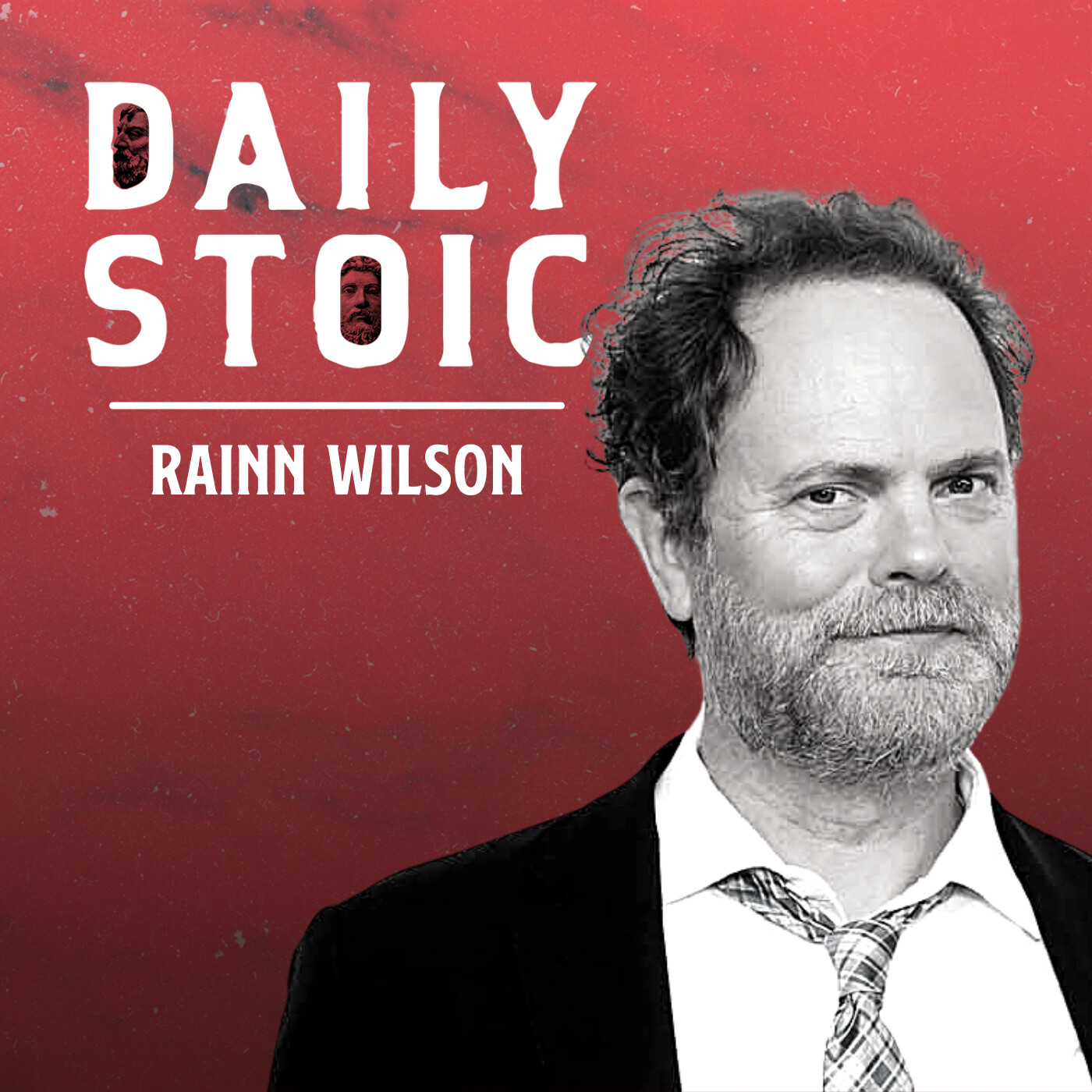
The Daily Stoic features conversations that explore Stoic philosophy through insights and experiences of various individuals, including actors, writers, and thought leaders. In this episode, Ryan Holiday interviews Rainn Wilson, best known for his role as Dwight Schrute in The Office. This episode is the second part of their conversation, focusing on philosophy, personal struggles, and the intersection of creativity and adversity.
Written by AI. May contain mistakes.

Ask about this episode
Get the gist, explore an idea or ask about something said.
 Claude
On The Daily Stoic, what are the key points of this episode?
Searching your listeningTranscript
Automatic transcript. May contain errors.
0:00I got an amazing night's sleep last night. One, because my six-year-old fell asleep in the car at like six o 'clock and he transferred him from the car seat to the bed and it stuck, which is just magic. So he's in bed way earlier than normal. But I sleep really well every night because I have a Eight Sleep Pod 5 Ultra, which is Eight Sleep's best product. I've used Eight Sleep for many years now and it's just totally transformed how I sleep, made me sleep better, made my wife sleep better. It's amazing. So basically, Eight Sleep is this topper that goes over your mattress. It can heat and cool both sides separately.
0:38It can raise and lower each side separately. So it helps you fall asleep faster, stay asleep, and then wake up better. Eight Sleep buzzes me to wake gently every morning as opposed to some loud blaring alarm. and then I can check the app and it tells me my sleep score. It even helps me optimize my day based on how I slept. If you want to survive the holidays like a pro and just generally sleep better, head over to eightsleep.com slash Daily Stoic and use code Daily Stoic to get$350 off your very own Pod 5 Ultra. The best part is you still get 30 days to try it at home and return it if you don't like it, but I know you will.
1:20Trust me, your body will thank you for this investment in better sleep, shipping to many countries worldwide. See details at 8sleep.com slash daily stoic. You probably heard the headlines about all the different cuts to foreign aid and food benefits. This is having a profound impact on the world's poorest people and the world's poorest communities. But, you know, just hearing about that, that's not what stoicism is about. Stoicism is, to me, what you're going to do about it. And that's where GiveWell comes in. GiveWell is trusted by tens of thousands of donors each year because they provide free and independent research that helps you understand how to have a big impact.
1:59GiveWell has spent the last 18 years researching global health and poverty alleviation, and they direct funding to the highest impact opportunities. Over 150 ,000 donors have already trusted GiveWell to give more than$2.5 billion over the last several years, and research suggests that these donations will save over 300 ,000 lives. I myself am one of those donors. I donate to GiveWell every year. It means a lot to me. And you can find all their research and recommendations on their site for free. And thanks to the donors that sponsor this research, GiveWell doesn't take a cut from your tax-deductible donation to their recommended funds.
2:34And if this is your first gift through GiveWell, you can have your donation matched up to$100 before the end of the year, or as long as matching funds last. To claim your match, go to GiveWell.org and pick Daily Stoic from the drop-down menu under Podcast. That's how they know that you heard about GiveWell from The Daily Stoic, and you'll get your donation matched. That's givewell.org, code The Daily Stoic to donate or find out more.
3:01Welcome to the weekend edition of The Daily Stoic. Each weekday, we bring you a meditation inspired by the ancient Stoics, something to help you live up to those four Stoic virtues of courage, justice, temperance, and wisdom. And then here on the weekend, we take a deeper dive into those same topics. We interview Stoic philosophers. We explore at length how these Stoic ideas can be applied to our actual lives and the challenging issues of our time. Here on the weekend, when you have a little bit more space, when things have slowed down, be sure to take some time to think, to go for a walk, to sit with your journal, and most importantly, to prepare for what the week ahead may bring.
3:55Hey, it's Ryan Holiday. Welcome to another episode of the Daily Stoic Podcast. This is part two of my interview with the one and only Rainn Wilson. We don't talk a lot about the office in this interview or in part one. Why? Because it's the middle of an actor's strike and a writer's strike and I want to support that. Actually, I was with my kids when we were doing the launch for Daily Dad back in May in New York City and a march of writers walked by and got to sort of explain what was going on to him, that the people who make the stuff, write the stuff like I do, but write the stuff that he sees on television and movies, these people are, you know, striking to get paid fairly and to participate fairly in the upside of the things that they create and to be protected and not exploited.
4:46And then when we were in LA for the summer, we obviously passed a lot of different picketers and he always liked me to honk the horn as I went by. So anyways, we're not talking about The Office and you might go, oh, well, how could you find two hours of things to talk about with Rainn Wilson? Well, if you listen to part one, you'll know it's because Rainn Wilson is a fascinating guy, a spiritual guy, a thinker, and his new book, Soul Boom, Why We Need a Spiritual Revolution, is all about precisely that. And in this big in-depth interview, he and I talk about his faith, putting yourself out there, you know, what does enough look like?
5:21What does happiness look like? What does contentment look like? What does presence look like? A bunch of awesome stuff. I really enjoyed this interview. As I said in my part one intro, I was just also just kind of blown away. It didn't feel real. And, And he correctly spots me as a fan of The Office before I've even said a word about it, which I'm sure he's quite well-practiced in. And we had a great conversation, and I wish him all the best. This new book is actually quite good, Soul Boom, Why We Need a Spiritual Revolution. He wrote another book called The Bassoon King, and then he is the creator, co-founder of Soul Pancake, which makes awesome YouTube videos.
5:59And there's also a best-selling book about that. I think you're really going to like this interview. I definitely think you should check out the book, which was a Globe and Mail bestseller, a Publishers Weekly bestseller, and a New York Times bestseller. And like I said, it's great. And enjoy my interview with the one and only Rainn Wilson.
6:30the more that we work on our own personal spiritual and philosophical uh selves you know finding meaning and hope and and um and and vision then we can bring that to the world and And the more we are of service in the world toward the quote-unquote common good, then that feeds our soul even more. And it makes us even more kind of wise and arrived. What do you think? You mentioned the word depression. I do have to ask, isn't that just another word for feeling bummed out? Oh, wow. You quoted The Office in my face. Oh, my God. I'm so sorry. Was that a Michael Scott line? or he's about to jump off the building to prove the point, you know?
7:19I think it's your line to be honest. I think you say, maybe, I think you might say it. I don't remember. I'm sorry, I'm sorry. That's awesome. I love it. I was like, I saw a glint in your eyes. I was like, where is he going with this? No, no, I think it's interesting, right? Because I get this from both sides. So on the one hand, people who are academic philosophers or people who are much smarter than me and much more classically trained in philosophy, they'll get upset about what I write about stoicism because they'll say, oh, this is life hack philosophy or this is life hack stoicism that he's sort of just distilling it down into self-improvement principles.
7:59Then it's funny, the people who are just interested in self-improvement principles get really mad when you veer off into the nitty gritty of the philosophy in the sense of what it actually obligates you to do, the sort of ethical obligations that come along with it. But I actually do think both are really important. And I think you did a TED Talk on this. It is really cool and empowering when people learn for the first time that, hey, these people who lived a long time ago, whether they're Eastern philosophers or Western philosophies, monks or thinkers or scientists or psychologists, they have come up with really cool tricks, exercise, spiritual exercises, ways of thinking that can radically improve your life.
8:49And given the fact that the vast majority of people don't think there's anything usable or applicable for them in philosophy, that can be such a powerful way into spirituality or philosophy, the idea that, hey, if you do this thing, it will make your life better. You'll be happier. You'll be less stressed out. You'll get along with people better. You'll lose your temper less. I think there's a lot of value in those sort of little self-improvement tricks and tips. Yeah. And that's, it's, it's funny. That's, I've been thinking about like, so, you know, my publisher has been asking what's the next book and you talk about hacks and, and I did, you're right.
9:27I did a, I did a talk on spiritual life hacks because again, if spirituality is a just church, like, oh, I feel good when I go to church and I'm singing and the pastor gives an inspiring sermon. And then I go about my day and my week and it doesn't affect me at all. It doesn't make my life better. It doesn't influence me for the better. Then that's bullshit. And the same, from the same token, if it's all just woo woo, kind of new agey kind of feeling, um, you know, crystals and incense and, and spirit worlds and stuff like that. And it doesn't make your life better when you're going to work and you're driving your truck and you're dealing with your kids and, you know, um, then it's, then that's bullshit too.
10:14So, um, uh, but I, I know that there are spiritual tools from the world's great faith traditions that can make people's lives better, that can certainly address the mental, the current mental health crisis, um, as well. you know one of them and i think you talk about this too and the stoics talk about it a lot is is suffering and uh what is your tattoo again your tattoo is like the obstacle right the obstacle is the way yeah so there's uh suffering obstacles tests and difficulties have been talked about from the dawn of time in both religious circles, spiritual circles, and in philosophical circles.
11:04Why is life so damn hard? Why isn't it easy? Why is it hard? Why is there conflict? Why do we not always get what we want? You know, I think the Stoics really were the original inventors of the serenity prayer. You know, God grant me the serenity to accept the fact, you know, the things that I cannot change and the courage to change the things I can. You know, what is in our control and what is not in our control. And there's this daily battle in ourselves, like, you know, why can't I get cast in this lead role in this film? Gosh darn it, you know? That's, well, that's not in my control. Well, what is in my control?
11:45Well, I can write a film where I play a lead role in it and I can, with determination and courage and fortitude and follow through, try and get funding for it and make that happen, right? So I'm just using an example, like from my own life or career, let's say. So there are these tools like dealing with suffering, dealing and overcoming adversity that Lord Krishna was talking about. Yes. 3 ,000 years ago, 3 ,500 years ago, that is in the Talmud, that is in the Bhagavad Gita, that is certainly in the writings of the Buddha, that can help make our lives better. And when you get a spiritual conception of like, we are souls, we are spiritual beings having a human experience, it can put everything into perspective about why there is suffering and what the purpose of that suffering is.
12:54and you know what i always when i talk to young people about you know suffering anxiety depression mental health stuff because it's all linked because i do think that a lot of young people today and maybe you've noticed this ryan although you look i think you're like 40 but you look like 20 um uh i have no idea how old you are i mean i literally if someone said ryan holiday is 23 i'd be like yeah that makes sense if someone was like he's 47 i'd be like i could see that so So 36. All right. Smack in the middle. 36 with a long baby face. Yes. But I do think that young people today have this kind of weirdly mistaken thing about difficulty and struggle.
13:39Like it shouldn't exist. Like, why am I not getting what I want? I should be just getting what I want. And I'm not. And I'm so overwhelmed by that and pissed off about it. and you know what guess what kitties we're we're struggling and it works on a number of different levels you know animals struggle to turn on a nature show animals struggle humans struggle but there are ways to overcome the struggling to have an understanding of the struggling to to take meaning from it to take meaning from it exactly and that's where i was going like when i talk to young people like to say, Hey, aren't you glad for some of the struggle that you've had in your life?
14:24Like what, what can we, what struggles, conflicts and obstacles and suffering have we experienced that we're actually incredibly grateful for at the end of the day, because it has brought us wisdom and, and meaning. So that's just one example of drawing from the world's great faith. and philosophical traditions to enrich our lives. There's a Freud quote that I love. He says, in retrospect, the struggle will strike you as most beautiful. And I think that's largely true. In the moment, it's terrible and awful, and it doesn't change the fact that it wasn't your fault, that it wasn't fair, that it shouldn't have happened.
15:07But as you move on, as it is integrated into your life, as it ceases to be such a big part of it because you have additional experiences, because you make changes or you adjust or new opportunities come as a result of it. You look back on these moments that felt so devastating, a breakup, a bankruptcy, some scandal or a controversy, some mistake that you made. You look back on it and you see how it got you to where you are now, which you are happy with, which you are proud of, which you find meaningful. And then it also strikes you how much in the moment you resisted the thing happening to you, how much you fought against it when you would have been better practicing a thing that I think gets a knock unfairly in the Stoics, like when you would have been better practicing a little resignation or acceptance, embracing the suck or the the unpleasantness of the situation and just allowing it to be integrated into your life and into your identity much more quickly.
16:15That's, I, I've told this story a few times before, forgive me if anyone's heard it, but to me, it really profoundly illustrates what we're talking about. And that is when I was a theater actor in New York, which I did for 10 years before I came to LA. And then it was another like four or five years before I got the office. Um, so I had been acting professionally for 15 years before I played Dwight and I got cast in my first Broadway play. This was around 1995 or so. And I, um, 10 years before the office and, uh, I was so stressed out about it and overwhelmed. And I was like in my head, in my head about it.
16:59And in my head, I was like, Oh my God, I could get a New York times review and I could get a Tony nomination and I could, I could get signed by the William Morris agency. It was a huge opportunity for me. Sure. And I got very overwhelmed by it. And guess what? I sucked the pressure, the tension, the perfectionism, uh, just kind of rendered me really tense and not pleasant. And I just was really stuck in my head and lost. And, and when that, and I suffered so much, there's nothing worse than doing a play that, you know, you suck in because you have to do it for four or five months and you're doing eight shows a week.
17:43You show up and you're like, fuck, I'm going to suck again. Damn it. And you just do it again and again. You know, if you do a movie and it sucks, Like you spent, okay, you spent a month or three months on the movie and then it's not a good movie and like, all right, moving on. And the audience isn't there in front of you. Yes. The audience isn't there not laughing at jokes you're telling, you know, over and over and over again that you're trying to do. So it was, I really suffered a lot. You know, I was talking to my, my wife was going to graduate school at the time. I was talking to her sobbing on the phone in the middle of the night, not sleeping.
18:22really in bad shape. And when I finished the play, I said, never again, never again am I going to do that. I'm going to find my authentic voice as an actor. I'm quirky. I'm kind of weird. I'm going to embrace that. I'm not going to be trying, try to be something to please someone else. That's a stoic thing too, right? So I'm not going to jump through all these hoops to try and please other people, but I just need, I, I gotta be me, baby. And, um, I fired my agents and I really just changed how I was as an actor at that point. I was just like, you know, and not that I didn't have struggles after that, but I had different kinds of struggles.
19:10So the, um, uh, the point is, is that I never would have gotten Dwight in the office had I not gone through that suffering on that play, uh, in on Broadway because finding Dwight was embracing my nerdy weirdness. And if I hadn't totally embraced that, I never would have gotten the role of Dwight. I would have been trying to be, I would have been like, I should be auditioning for Jim, you know, or something. And so I'm so grateful for like the most miserable six months of my life. I'm so grateful because it opened so many doors. One of my favorite metaphors from the Stoics is from Epictetus, who knew, I think, a bit about what it's like to get dealt a shitty role in life.
20:05I mean, he's born a slave in Rome. It's about as bad a hand as you can get. But he says, you know, we're all actors in a play. We didn't write the script. We're not the director. We can't just trade roles with whomever we want. We have to figure out, basically, he's saying to just act the hell out of the lines we've been given. That's what life is. Now, thankfully, we live in a society today where people have a bit more agency. Rome was a very hierarchical, stratified place. Thankfully, there's not such a thing as a person being assigned the role of a slave necessarily. But I think the general idea is probably one you relate to, that to be great as an actor, you have to accept fundamentally the powerlessness of your situation in the sense that you don't control the material necessarily.
21:01You don't control the director. You don't control the marketing budget. You don't control when it comes out. You don't control if a strike intervenes or a pandemic happens and theaters are shut down. All you control is when they say action and you have a handful of lines to say, do you show up and do you do the best job you possibly can? And this idea of, you made it sound a little bit like you felt like the life of an actor is not a relatable experience. But I do think fundamentally, we all are actors in this play where we're not the main characters, no matter how much we would like to be. The material is not as good as we would like it to be.
21:40The role is a bit more constrictive than we would like it to be. But we have an opportunity to do a really great job in the handful of minutes we're on stage or on camera if we choose to step up and to be present for that. Hmm. Yeah, that's very well said. That's really beautiful. How do the Stoics address kind of suffering and adversity in terms of character building and finding meaning and purpose? Well, the idea of the obstacle is the way, it comes to us, Mark Surio sort of jots this passage down in meditations. He says, the impediment to action advances action. What stands in the way becomes the way.
22:30And basically what he means is that stuff happens, right? You have this plan and then that plan is blown apart or you wanted things to be this way and now they're this way. That stuff happens to us in life and that's outside of our control. But what is inside of our control is how we respond to what's happened. So the idea isn't that you can magically turn every shitty situation into a wonderful situation, but that even these shitty situations, the ones that involve suffering, are opportunities to practice philosophy or to practice better, to practice virtue. that they're a chance to be patient, they're a chance to forgive, it's a chance to be courageous, you know, it's a chance to be creative, you know, that in the obstacles that life throws at you, one path might be blocked, but in blocking that path, it inherently opens up a different path.
23:27Might not be the one we want, might not be as good as the other one, but it is a chance to do that. I think Marcus Aurelius' life is a great example of this. I mean, this guy, he's the first and maybe only philosopher king that ever got the shot, right? The problem with leadership for 2 ,000, 3 ,000 years has been the right people never get into power, right? And here you have a fundamentally decent person who's smart, who's trained. He has a 20-year apprenticeship under the previous emperor, his stepfather Antoninus Pius. And then it's his turn. He's finally the guy with the power. He has all these plans.
24:11And then there's a plague. There's a series of floods. Then there's like an endless war. It's like he never gets the chance to do any of the things that he wants. And so on the one hand, it's this sort of missed opportunity and that 20 years of peace and prosperity disappear right as they hand him the reins. And yet it's still an opportunity for all these other forms of greatness, patience, forgiveness, strength, moral leadership, not being corrupted by power. There's a coup and Marcus Aurelius has to you know, respond to this coup without becoming a murderous dictator. And so I think the idea for the Stoics is like, you don't control when you're alive.
25:00You don't control most of what's happening while you're alive, but you control who you are, you know, how you act in that role that you've been assigned. And that that's where meaning and greatness and purpose really comes from. uh that's cool that's that's amazing that's amazing um the so the buddha of course taught you know life is suffering and i've talked about this in the book he really the word is dukkha from the sanskrit pali and dukkha means kind of anxious discontent uh so life is anxious discontent. We're never just satisfied with what we have. And we're in that position because that's what's kept humanity alive throughout the eons.
25:52If we were just always satisfied, we would have died out by now. So, oh no. That's evolution. What's that? That's evolution, right? How can we have more offspring, be more successful? That's the driving thriving force of growth and change and survival. And anxious discontent of like, do I have enough food stored up for winter? Oh no, I want more food. I would need more, more, more. So this contemporary materialism of feeling like I'll be more sexually attractive, the more stuff I have, the nicer car that I have, that I'll be more liked if I have more stuff that I'll have a higher status as more stuff.
26:32It comes from our, you know, our base, you know, the amygdala, the base part of our brain, right? And, oh no, this tiger is going to eat me. I hear a rustling in the branches outside of my cave. Oh no, that could be a bear that's going to eat my face. So there's a constant anxious discontent kept us alive and we're wired for anxious discontent. So in a certain way, our work is to contradict the anxious discontent of being alive for the Buddha and the Buddhists, you know, all billion of them, it's hard to lump them all into one thing, but essentially, you know, the second noble truth is that, you know, that the suffering is optional and it comes from desiring, from hankering, you know, from craving.
27:19Expectations. Yes. And you can eliminate suffering by eliminating the craving, by, you know, looking at that, You know, if you're like, oh, I want more stuff and I want a nicer TV and I want a nicer car. I'm so miserable because I don't have it. You can, you can examine that in your life. And if you can release that, then you can release a lot of the suffering around that. And there's all kinds of tools to be able to do that. I mean, probably your listeners kind of know this. It's kind of Buddhism 101, but from the, from a Baha 'i perspective too, to another level of suffering, we are souls having a human experience and we move on to another planes of, of, of existence in the divine realms, um, under the auspices of a all knowing, all loving creative force that I call in the book, the notorious G.O.D.
28:19and the notorious G.O.D. has differentiated from a lot of contemporary ideas around God as sky daddy. So it's not sky daddy. We're talking about the notorious G.O.D. So something altogether much greater and wilder and more encompassing than a guy with a beard with an agenda. But the suffering and obstacles that hit us and we overcome, they grow our spiritual qualities and our spiritual virtues. I don't know how you would relate that from a philosophical standpoint, but kindness, humility, compassion, creativity, joy, love, honesty, all of these qualities of the divine from a Baha 'i perspective, you know, from a, I'm not sure, from a Stoic perspective, that's just like our leadership qualities or character traits that we develop, but that we take these with us on our journey after our body falls away.
29:26So that suffering is there for a very good reason. It's to sharpen the knife. It's in the fire of adversity that the gold is purified, that the blade is sharpened in the fire of tests and adversity. And we take this with us as we move through our spiritual journey. And this is also in every kind of, to some degree or not, in every faith tradition.
30:03I'm picking my kids up from school today and then doing our weekly routine, which is I take them over to Whole Foods. We get all our groceries for the week. Then we have dinner. It's one of their favorite things to do. It's one of my favorite things to do. And then my wife loves it because she doesn't have to take care of it. This holiday season, whether you're a guest or hosting the big dinner Whole Foods Market, has what you need to delight everyone at your table. They even have heat and eat sides from the prepared foods department. You can make Whole Foods your one-stop shop. Everything follows Whole Foods Market's strict ingredients standards so you know it'll be delicious and good for you.
30:37You can also order online for pickup and even delivery in select zip codes to skip the crowds. Shop everything you need at Whole Foods Market, your holiday headquarters. Thanks to Toyota Trucks for sponsoring this episode. When I bought my ranch in 2015 out here in Bastro County, I drove my car about halfway down the dirt road that we live on, thought this isn't going to work, stopped, parked it, walked the rest of the way home, borrowed my wife's car, drove in Austin and bought a truck. What I bought was a Toyota Tacoma. And this truck wasn't just transportation getting me to and from my house.
31:12It unlocked a whole different style of living for us, not just on the ranch, but in our little Texas towns. There were places I could go now that I couldn't go before, especially out here in the piney forests, through the fields, and on the unpaved roads like the one that I lived in. We got to go deep into the hill country's wild beauty. We've driven all the way out to East Texas. We've driven it across the country. And by we, I mean not just my wife, but both my kids who I drove home from the hospital in that truck. Toyota trucks are built for those who understand that the best adventures happen when you're willing to veer off course because you never know when you'll end up on a Toyota adventure detour.
31:56And of course, this is stoicism too, because every detour, every obstacle is an opportunity, but it's helpful if you can handle the difficulty inherent in that. If you've got the resilience and the right companion to make it wherever the road takes you, discover your uncharted territory. Learn more at toyota.com slash trucks slash adventure dash detours.
32:23It's certainly in stoicism, Marx really says, you know, he says, a strong stomach digests what it eats. He says, a fire takes anything you throw into it and turns it into flame and brightness and heat. And the idea is that life is sort of testing us constantly, giving us raw materials constantly, and it's our job to kind of convert them into energy or fuel. We don't have to. We can be sort of snuffed out by it, I guess, if we choose. But we can also choose to take the experiences that we have and be made better, stronger, wiser, more compassionate, more experienced as a result of what we've gone through.
33:10That's amazing. That's great. Do you have all these memorized or do you have like a professor of stoicism texting you these like, here, Ryan. You know how Joe Rogan has the guy that like pulls up the clips on the screen? Jamie, pull this up, Jamie. No, you know, what's actually been really cool about my study of stoicism and maybe you've experienced this in yours, I think it's more a testament to the power of journaling and philosophical work, which is the process of writing about Stoicism, like the Daily Stoic, I wrote the book, The Daily Stoic in 2015, it came out in 2016, but the month it came out, it was like August or October, I started The Daily Stoic, the website.
33:56And so I started with this daily email. So I've done the daily email now for almost eight years. And then now also, we try to do a video every day and I've had these conversations on a weekly basis. So the result is I've talked about the stuff so much in communicating them that they've sort of been inserted into my brain and my muscle memory. I'm not saying I'm perfect at applying them. I'm saying the exact opposite. I'm not. But I do have both a kind of a recall and then also kind of a deep connection with the ideas because I've gone over them so many times, which is actually the Stoic practice.
34:40You would say that for Eastern philosophy, meditation is where it's at. That is the philosophy practice. Well, for the Stoics, it was writing. And Mark Surrealist's meditations was not intended as a publishable philosophical work. That was his philosophical practice that happened to just not be destroyed. And it's pretty remarkable. I mean, some people go, oh, it's a little repetitive. It doesn't always make sense. It seems to revisit the same themes over and over again. And it's like, yeah, that's because it's not for you. It was for him. Right. He was writing. That's what meditations translates to, to himself in Greek.
35:22It's actually funny. He's a Roman writing in Greek because that's the language of philosophy in the ancient world. He's trying to practice it. And it's kind of come for me, this sort of repetitive practice of I'm always thinking and talking about them. again, that's not the same as being able to, to roll, to draw them out, you know, in the big moments of my life. But I, I do feel like I've gotten better at it as time has, has gone on. That's interesting. Um, are you familiar with the artist's way Julia Cameron's work? Yeah, of course. The morning pages. Yeah. So that whole idea of morning pages is so similar in a way And what it does too, so it's all connects, right?
36:04So meditation connects to psychology of Freud and Jung, especially in the idea of the subconscious. I've been doing a lot of hypnotherapy recently, which I find fascinating because it's essentially like when we go about our days, we are, our consciousness is the tip of the iceberg. We think of our consciousness as everything and we think of it as being just a brain activity. But our whole reality, and this is backed up with innumerable psychological testing, our subconscious is like the rest of the iceberg that the Titanic ran into. And you can access the power of that subconscious in so many ways.
36:56Meditation is, in some ways, you could look at it just from a psychological lens as a way to just tap into the resilience, wisdom, and serenity of your subconscious self. um there's that wonderful aspect of meditation where you kind of separate from yourself you know as as michael singer talks about in the untethered soul you know you realize oh i am not my thoughts and i'm not even my feelings and you have that's home blowing you have this awareness of yourself oh look it's like yourself looking at yourself from a 20 000 foot view oh my gosh there's me and look, I'm having thoughts and feelings, but I'm also witnessing myself having thoughts and feelings.
37:47So we are the witness. We are the witness. So what is that? What is that consciousness? You can access this in hypnosis and in hypnotherapy. I've found it really fascinating and morning pages access that, that part of that creative flow part of yourself, that left brain part of yourself that doesn't play by the rules and can just kind of come up with like incredible stream. People do the morning pages and do her work and they're like, Oh my God, I'm an artist. You know, you can be an accountant your whole life and you're, and you're just writing stuff like, where did this come from? You know, and that going to Rick Rubin and the creative circle, and the origins of creativity and the muse from ancient Greece that this is coming from something other than me.
38:42I didn't write this. You hear that all the time. I didn't write this song. The melody just came to me. I didn't write this poem. It just came out. I didn't write this novel. It came out. I've literally had that experience many times while acting where it's like, I, this isn't my conscious brain. There's something else guiding me. You can look at it as a muse. You can look at it as the Holy spirit. You can look at it as the unconscious and, and accessing the unconscious. Um, this is a very long winded way of saying that, uh, journaling as a form of meditation is just as relevant as, you know, sitting on the floor cross-legged for an hour.
39:25It's all about tapping into something deeper and more true than our very busy little calculator brains. And there is much more to the experience of being a human being than that. Well, I think in meditation, you're sitting there and you're noticing these thoughts sort of coming in. The Buddhists talk about sort of like clouds. They're just sort of rolling in and you can watch them. You realize there's, you try to touch them. They're sort of not really anything to them. You're getting some distance with your, from your thoughts. And then in journaling, you have a similar experience, which is, you know, you're writing.
40:02And so you're, you're physically creating distance. Like this thing was in your brain and now it's on the page. So you have a foot, even a foot and a half of distance allows you to, to see and think about your own thoughts with a little more objectivity. And then also there's this sense of like, whoa, where did that come from? That's not me. I don't agree with that. I don't like that. I don't have to do that. And so in both exercises, you're fundamentally getting a disconnect in a positive way from your own thoughts or realizing that you have the power to say, just because I think it doesn't mean I have to be it or doesn't mean I have to act on it or doesn't mean I have to continue to carry it around.
40:48And I think that's why both those exercises are at the root of two very different, very distant philosophies that are kind of coming upon in their own way, the same type of exercise or experience. Yeah. And I think, you know, we're talking about you and I coming maybe from two very different perspectives, but doing a similar kind of work, which is, hey, young people who might feel a little lost right now, overwhelmed or anxious, there's a lot of different tools out there. Yes. There's tools. Tried and true. Tried and true millennial. I don't mean millennials, but through the millennia and some come from spiritual traditions and some come from philosophical traditions.
41:40Of course, they were all influenced by each other. Um, you know, it's, uh, that's one thing we don't really, we don't really know, but like, so the Greeks who influenced the Stoics, you know, they, um, how much were the Greeks, the ancient Greek philosophers, you know, influenced by the Torah and the Talmud and the, and the Jewish philosophers. and how much were the Jewish philosophers influenced by the Zoroastrian philosophers? Because when you look at some, anyways, it gets very esoteric, but some Greek ideas really seem to come directly from Zoroastrianism because all of a sudden Zoroastrianism was all about like Ahura Mazda and there's good and evil and you're angel and devil and there's light and darkness and that's inside of us and it's outside of us.
42:36and people, if you give into the darkness, you go to a fiery kind of hell existence. And then the Greeks were talking about it. And, and it's interesting because Jesus and the Bible really wasn't talking about it. And the whole idea of like burning in hell as an, in, you know, as some kind of kingdom that exists after our bodies die, you know, with, with a presided by a devil, like that's a Zoroastrian idea that went to ancient Greece that was put into practice in the Christian church about 300 years after the death of Jesus. He did talk about Gehenna. Anyways, it gets very esoteric, but it all influences itself.
43:27And I - It totally does. I mean, one of my favorite ones I like to point out to people is like, before he became known as St. Paul, he was known as Paul of Tarsus, which is - Yeah, Saul of Tarsus, yeah. Yeah, which was at the time the home of Stoic philosophy, where he almost certainly was introduced to those ideas if not sort of deeply interested in them. And so it's all kind of in the water. You know, it's like, who was the first person to take a rock and chip away at it and make it into something sharp? You know, it's both something that was probably independently discovered, but also as soon as it was discovered, it spread around.
44:10And I think I have trouble making much of a distinction between any of the spiritual traditions, which you also make this point in the book, when they all kind of boil down at some level to the same fundamental truths about the human experience. Because at the end of the day, they're all dealing with the same fundamental humans. It doesn't matter when you lived or where you lived. The fact that the vast majority of things are outside of our control, the fact that we have this anxious desire to achieve and do things and procreate, that we are mortal, that there's people who have different moral compasses than us, people that do bad things.
44:53And then we wonder, are they going to get what's coming to them? These are just fundamental parts of the human experience that all the philosophical and spiritual traditions are reckoning with at some level. So it shouldn't surprise us that they come to some shared conclusions. And the point I really want to, that I make in my book and that, and I think you and I share this idea is like the stakes are really fucking high. so this is not rain and ryan having fun with philosophy and talking about these ideas that are kind of like here's our little hobby and you know there's you know these are like fun and interesting little quotes and and stuff as some kind of academic game or something like that like our world is on the verge of collapse we can pretend it's not but it really is all the systems are breaking down, healthcare system, agriculture system, education system, you name it, certainly the political system, this next election is going to be a doozy.
45:58But then we've got, you know, war in Europe that we haven't seen since World War II. And we've got China arming the South China seas, and we've got climate change, and we've got mental health epidemic that is affecting a good half of the young people today. So, and they're dying in droves and suicide has become the number one cause of death for young people. So the stakes are high. This is not some academic exercise on the side. We need to put into practice these ideas and especially
46:37fundamentally ideas, practical ideas that can help us serve one another, love one another, be compassionate to one another, build community at the grassroots with one another, and strive to make ourselves better people so that we can help others. Martin Luther King said, you know, the most pressing issue is what are we doing for others? The most pressing question is, you know, what are we doing for other people? And so that's why I wrote soul boom. Um, I really, uh, now I need to, like you did, I need to kind of move. And actually I'd love to get your information because I want to talk to you about your experience on the, with the daily stoic newsletter and, and website and now social media and, and video and podcasting and whatnot, not, because I just think these ideas are, they're life and death ideas.
47:39And it's, this isn't about what's the best political candidate. This isn't about what's the best legislation. We'll figure that out and hopefully make good, solid reasoned choices there. But it's, it's much bigger and broader and more pertinent than that. I think you're right that philosophy is fundamentally a matter of life and death, right? The Stoics called it the open door, but then later, you know, in the 20th century, some of the existentialists are sort of, they basically just, you know, to put it out there, they go, why shouldn't you just kill yourself, right? Like that's the stakes of philosophy, right?
48:16Philosophy is sort of asking yourself, doing the work, getting down to finding the meaning, the reasons to carry on, finding out how to cultivate a good life because the alternative is why have a life at all, right? And so I think they are trying to fundamentally answer these really important questions. And I think I take heart in the fact that this is a two, three, 4 ,000 year old struggle that smart people have been thinking about this for a long time. They come to different conclusions, but they all are coming fundamentally to the conclusion that you should stick around. Life can be good. You can find meaning amidst suffering and pain and frustration, but that it's not just going to be handed to you and it's not necessarily obvious.
49:12And yeah, you talk about people dying deaths of despair. Despair is a killer. And if you don't have meaning and values and a sense of what it's all about and why, it's really hard to endure the blows of fate and fortune and just waking up every day in the 2020s. you're exactly right and i go back to that kung fu and star trek idea that you know unless we work on the kung fu part of ourselves our inner wisdom our serenity our vision our our morals and values yes i said morals that's right right and wrong believe it or not there is right and wrong that exists, you know, from the Platonist, it would be the forms, right?
50:05But I do believe that it exists beyond just what our civil society views as right and wrong. You know, in Eastern Africa, genital mutilation of, you know, preteen girls is de rigueur and totally accepted. I don't think it's just my Americanness that kind of says, no, that's wrong. That's not just because I'm living in contemporary California. That's just wrong. It's just wrong. It's wrong. Invading a sovereign nation because you want to colonize them is wrong. When Russia does it, it was wrong. When we did it, it's wrong. It's just wrong. So we work on the Kung Fu part of ourselves so that we can make the world better.
50:51And that's where I think, again, so much of the spiritual and philosophical discussion falls short of, you know, we make ourselves wiser so that we can work on justice from a stoic perspective. All the virtues are related. Yes. From the spiritual perspective, we seek to become compassionate, wise, and serene so that we can serve others, so that we can make the world a better place and spread the light wherever we go. That's beautiful.
51:38This episode is sponsored by BetterHelp. This time of year is wonderful. It's quiet. It's peaceful. It's beautiful. It's also stressful and bleak and dark. And then there's the whole family stuff. You got to make sure you're taking care of yourself and you got to make sure you're taking care of your mental health. This time of year can be not just stressful, it can also be lonely. And therapy can help you make space and time to focus on getting well and feeling good. Consider trying BetterHelp Online Therapy in December as a way to close the year with clarity rather than chaos. With over 30 ,000 therapists, BetterHelp is one of the world's largest online therapy platforms, having served over 5 million people globally.
52:22And it works. It's got an average rating of 4.9 out of 5 for a live session based on over 1.7 million client reviews. This December, start a new tradition by taking care of yourself. And our listeners get 10 % off at BetterHelp.com slash Daily Stoic Pod. That's BetterHelp.com slash Daily Stoic Pod. Well, it's almost here. Christmas is just a couple of days away. And maybe you're scrambling. You're like, what should I get my dad? What should I get my mom? I got to get something to my sister. people love showing off pictures of their kids and that's where today's sponsor comes in i've gotten one as a gift i've given it as a gift the aura digital picture frame it's easy to use it never gets old you're constantly updating it with new pictures aura digital picture frames are so much better than any digital picture frame i've ever seen it's got a high resolution it's got a color calibrated display you can add video you have two pictures come up at the same time picture and a video.
53:19It'll pair photos together for you, like two pictures of the same person or from the same day. It's really easy to set up. You just download the app, connect the frame, and then you can pick photos and videos right from your phone from anywhere in the world. And there's a reason Oprah added it to her favorite things three different times. For a limited time, save on the perfect gift by visiting AuraFrames.com to get $35 off Aura's best-selling Carver Matte Frames, named number one by Wirecutter, by using promo code STOIC at checkout. That's A-U-R-A frames dot com promo code stoic. This deal is exclusive to listeners and frames sell out fast.
53:55So order yours now to get it in time for the holidays. Support the show by mentioning us at checkout. Terms and conditions apply.
54:06Mark Cirillo says that which does not transmit light creates its own darkness, which I don't know exactly what that means from a scientific perspective, but I have always thought that that at some level means like you have to sort of be what you want to see in the world. You have to sort of take what's good and reflect it outwards. And if you're negative, if you have bad values, if you see only what's wrong in the world, that also kind of becomes its own thing. Mike Tyson said, that which does not kill you makes you stronger. Michael Scott said, you miss 100 % of the shots, the goals you don't make.
54:56And Wayne Gretzky also said that. Yes. Michael Scott quoting Wayne Gretzky. Thank you. I wanted to ask you about that, actually. we talked about sort of anxious desire. And then we talked about sort of expectation. What is it? I imagine you wanted this thing for a long time. You wanted to be successful. You wanted to be famous. You wanted to do great work. You wanted to break out. And that happens. what does it actually feel like to get there? Was it a delivery of every, a delivery on all your hopes and dreams and expectations, or was there a little bit of a letdown? Yeah, it's interesting because this became front page news a week or two ago because I did, I think Bill Maher's podcast.
55:49And I was talking about this idea of suffering and you know, the human struggle for happiness, finding happiness. And I mentioned, like, I spent a great deal of time on The Office really unhappy. And of course, it was misquoted and taken out of context and said, Rainn Wilson, miserable on the set of The Office. Rainn Wilson spent the entire office unhappy. You can Google it. It's incredible how the media works. Headline after headline after headline, making it seem like I'm this ungrateful, miserable fuck. And, uh, the fact is, is that no matter how well things are going for us as human beings, we have a tendency towards anxious discontent.
56:41And my, my dukkha, my suffering, my anxious discontent on the side of the office was, you know, I wanted to be a bigger movie star. I had a crack at doing a bunch of movies. They didn't turn out very good and people didn't really watch them or actually some of them, they are pretty damn good, but people didn't watch them and they didn't work at the box office and okay, that's fine. But at the time I was just pulling my hair out like, ah, damn it. I want this movie deal. And why can't I have this? And why can't I have that? And how come he's getting offered this and I'm not? And, you know, you know, envy and pettiness and, um, you know, self-seeking and, um, you know, again, I'm so grateful for that test.
57:28Cause I look back on it now. I'm like, you dipshit, you were on the, you had it all. You had it all. It was the greatest job ever. Why couldn't you have just enjoyed it more? And I wasn't, I wasn't a spring chicken. I was, you know, I, I got cast in the office. I was 38, I think when I started playing Dwight, you know, so well into my forties and I was, you know, by this last several years, I was in a much better place. You know, it was, it was kind of earlier on year three, four, five, right in that area of the office. And, um, but yeah, I had, I mean, it was, it was beautiful. It was a great group of people and a beautiful job and nice pay and we got along great.
58:14And I was playing one of the great TV characters of all time. And, um, you know, lots of doors were open to me and getting invited to festivals and hotels and this and that, and the other thing. And, uh, just enjoy it getting nominated for Emmys, like revel in it. That doesn't get better than this. It really doesn't like, oh, you, you're a TV star, but oh, you need to be a movie star. We want more. We're never satisfied. Never satisfied. What did the Stoics say about that? They said that exact thing. I think Seneca's line was, and I don't think he's being glib here. Obviously, real poverty exists, but he said, poverty isn't having too little.
58:58It's wanting more. I think he wasn't speaking of the people who are actually impoverished. He was looking around at the other rich, powerful, famous people in Rome, of which he was one, and he saw how poor all of them were because they were comparing themselves to the people who had more, or they wanted everything. They weren't content with having a lot. The world was not enough. And I I think that's what we do ourselves. You know, we tell, I think about this all the time. I go, my dream was to write one book. I thought if I could write a book, that's what I wanted to do more than anything. And so, you know, I am well beyond playing with house money at this point.
59:47I want to keep doing good and I want to keep doing more because I get enjoyment and satisfaction and meaning. And I think it helps people. But I do try to remind myself like, Like, if it sucks while I'm doing it, like, what is that about? What a fundamentally dumb way to do it. If doing it is torture, I don't have to do it anymore. I've already won. Like, why not just have fun while I'm doing it? And by the way, that does seem to actually create better work. Yes, having fun while doing it and enjoying.
1:00:25it's the Bhagavad Gita says you are not entitled to the fruits of the labor, just the labor. You are entitled to the labor, but not to the fruits of the labor. So good. And wow, I love that you're going to, you out quoted me. I love it. I know the Gita. It's amazing. Of course. So I'm going to read from the second greatest book next to the Bhagavad Gita and next to the Daily Stoic. Soul boom? Soul boom. Because I just want to read this one thing. I say, we end up with a culture that mirrors the famous quote by John D. Rockefeller, who when asked by a reporter, how much money is enough? Responded, just a little more.
1:01:11And that's how we live. How much is enough? Just a little more. Oh, if I just get a little more, then I'll be happy. How much is enough? And can I make a little bit more? That pretty much sums it up. To quote the esteemed philosopher David Lee Roth, money can't buy happiness, but it can buy a yacht that sails right next to it. Maybe. I don't know. I'm watching Succession right now. They didn't seem too happy. They were on a nice boat. I don't know. This is going to blow people's minds, but I don't know a lot of happy people in Hollywood. And I've met a lot of multi, multimillionaires and billionaires and not terribly happy.
1:01:55There is not an inverse. What is it? No, there's not a correlation between money and happiness. That's not to say that I don't really enjoy the fact that I don't have to worry about how I'm going to pay my rent because I did spend years and years and years and years in that situation and it sucks. And if you're thinking about that, it's really hard to have these conversations. Sure. If you're like, shit, how am I going to keep my lights on? How am I going to keep my cell phone? How am I going to keep my car insurance? So I want to be sensitive to that, but it is absolutely true that this is an essential part of the human condition that we need to address no matter what strata we're at.
1:02:38That's something that was very, very helpful to me. I too, because my work has sort of had some unique fans. I've met very successful athletes or business people or billionaires or whatever. And you go, oh man, they must have the life. It must be so cool. I remember this one guy, he was like, oh, come meet me in New York for lunch. And he met me, he gave me this address. The address is his yacht on Chelsea Piers and takes me in his yacht around the Statue of Liberty and back. And you're like, imagine how cool it would be to be that successful. And then invariably, every one of the conversations I have with these people, it at some point comes down to they want to write a book and they want to ask my advice about it.
1:03:25And I go, they have everything in the world. They have all the money in the world. And what do they want to do? They want to do the thing that I get to do. So it comes back to the idea of, I better appreciate and be grateful for the fact that I get to do it, right? That I get to do it. And I'm sure Hollywood is one of those industries also where the most powerful, important people in the world, in every other line of work, deep down, what they'd really like to be is they'd like to be some of the things that you take for granted and get to do some of the things that you take for granted. and the fact that everyone else wants it and is jealous of it doesn't necessarily mean that it's good, but it should give us some perspective and make us appreciate what we're lucky enough to get to do.
1:04:14Indeed. Yep, absolutely. Speaking of which, I interviewed your colleague, Michael Schur, a while ago. I think it's funny that multiple philosophical books have come out of that show. So actually, you know, BJ's books are pretty great too. My kids are obsessed with them. Oh, yeah, that's great. That's interesting. And yeah, there could be a lot more written. I mean, Mindy Kaling is a brilliant writer and Greg Daniels, our showrunner, he's a fantastic thinker. He's got an incredible mind. So hopefully one day we'll be met with some philosophical work from Greg Daniels. And hopefully soon we get Creed Bratton's memoir because his life story is zonkers.
1:05:06Well, as we wrap up here, I had one sort of question just, and I thought it's worth sort of clarifying for the listeners. They might be wondering, you know, why we haven't talked a ton about The Office, which I am a huge fan of. Talk to me about the position you guys are in and what's going on. And as an author, I look at the Writers Guild and the Actors Guild, and I'm jealous because the Authors Guild is basically non-existent. We're all sort of lone wolves. We don't have any collective real ability to come together and fight for sort of the successful authors just get to go on and be successful.
1:05:51They don't really get to or think much about the other people. that are struggling and vice versa. So talk to me about that, just as I think it's always worth communicating what a group is taking a stand about. Well, yeah, and you should get Mike Schurter. He's on the negotiating committee. Yeah. You should get him involved in this conversation. I don't know all the details, but I will say this, that so the writers and actors are on strike. Like, essentially, this is very different than any other strike that's ever happened because this is a completely different business model. In the past, strikes have been like, oh, our contract is up and we want 10 % raises and the studios only want to give us 5 % raises.
1:06:37And so we're going on strike and blah, blah, blah. So, but this is different. This is like, when you started watching The Office, it was a very different television landscape than it is now. So streaming services, you know, subscriptions and DVD. I've watched the office on DVDs. That doesn't exist anymore. That's crazy. Someone sent me a DVD of their favorite show. I don't think I have a DVD player in that. I don't know how to watch it. Yeah, yeah. My computer doesn't have a slot. Yeah, that's what she said.
1:07:12The, but yeah, so there's a number of different things on the table, you know, with the new streaming model, of course, the streamers have gotten greedier. If you knew how little we made in residuals for our run on Netflix, you would, your jaw would drop. Um, even though the office was watched something like, you know, 7 billion hours of the office watched worldwide or something like that. It was crazy. Like we just got a pittance. Um, So there's not a correlation between streams, viewers, and pay, and there always has been. And so you're not rewarded for your efforts to make a hit show. And that's why there's so much, one of the reasons why there's so much crap on these streamers.
1:08:00But yeah, so it's fair pay and, you know, they're trying to get, you know, So network shows had 22 episodes in large. We had a writer's room of 13, you know, and they were employed for 10 months out of the year and made a really good living. Now they want to do, you know, eight episodes on Netflix, but they still want to own you for 10 months out of the year. But they only want to do eight episodes. They don't want you on the set and they want to pay you less and have a smaller writer's room. So it's all kinds of issues like that. Like it's a whole new landscape. The problem is, is that none of them are really doing that well, except Netflix and Apple and Amazon.
1:08:46They're a whole different beast because they sell widgets and they happen to have a side business, a side hustle with some content, hoping that if they had good content, you'll buy more widgets from them. So that's a different business model. You can't compare what Apple does to what Sony does. And so that, how do you get them all on the same page? And some of the other streamers are just not working. The business model for Paramount Plus, for Peacock, you know, some of these things, it's just, it's not working. And they're, they're burning through money. There's this gold rush to try and get subscribers.
1:09:22It's an unsustainable system. You know, it's not, how do you find growth? Once everyone has decided what they're subscribing to, you know, maybe a few people switch from, I'm going to switch from Peacock to Paramount Plus, or I'm going to switch from HBO to Disney, and I can only allocate X amount of dollars for these subscriptions. But once you've maxed out, then there's no growth. And when they buy rights, it's worldwide. It's very complicated. I'm not even doing it justice, but needless to say, we're up against a lot of greedy bastards. and you talk about justice and the Stoics fighting for justice.
1:10:03This is not about me. I've got enough money. This is not about the stars. This is about middle-class actors and writers trying to put their kids through school and pay their mortgages. I was in that boat for many years before I was on the office. I understand what it's like to be there. This is about a fairness for working class, middle-class artists in Hollywood. Well, I think that actually ties pretty well into what we're talking about, which is, you know, there is a divergence of interest, right? The super successful actors, the people who have made enough, and then the people who are struggling.
1:10:38And what is beautiful, whatever you think politically about sort of unions or labor, is when a group of people sort of come together and sort of all decide to sacrifice, even though they bear that sacrifice differently and it costs different amounts. But when people come together and sort of get engaged politically, they get engaged in sort of the economy and they try to set rules or standards or sort of use – they come together to be stronger as a group than any one individual would be. And we're all sort of, I think it's important that we remember that we are all the lucky recipients of groups coming together and doing that in the past.
1:11:28That's why there's an eight-hour workday. That's why there's a weekend. That's why, although some of these laws are being overturned, it's why children don't have to work in mines or factories. at least. We're all the lucky recipients of people. It's why you have a pension fund or whatever. Health insurance, it's because people came together and took stands and took risks to hopefully go, hey, here's what we'd like the future to look like. We don't have complete control over it, but we can try to set the rules to be at least fair or sustainable. That's very well said. And let's draw a larger line there to a soul boom.
1:12:09Sorry, I'm going to bring it back to my book. Yeah. But what the hell? You know, we need a spiritual revolution because we need to do that on a global scale. For a lot of issues. For a lot of big, big issues. And this isn't about Democrats and Republicans. This is about human beings sharing the limited resources of this planet, acting as if those resources are unlimited. and living together in peace and harmony and cooperation
1:12:40and fighting for justice on a global scale and seeking ever greater wisdom, not just individually, but collective wisdom. Beautifully said, and you say it beautifully in the book, and I'm so glad that we got to have this. It was a total honor for me. I really did enjoy the book. You can see I took quite a few notes. Wow, look at that. Impressive. There we go. This was awesome. Well, I really appreciate it. Ryan, it was a pleasure. A big fan of yours. I'm so happy for your success and the work that you do. And I hope we can speak again and meet in person and high five and wrestle. Wrestle for charity.
1:13:24Yes, yes. We'll wrestle over our, that's how we'll settle our philosophical differences. I love that. Through Mortal Kombat.
1:13:36Thanks so much for listening. If you could rate this podcast and leave a review on iTunes, that would mean so much to us and it would really help the show. We appreciate it. I'll see you next episode.
1:13:57my family owns a 2023 toyota 4runner and honestly it's my favorite vehicle that i've ever owned around town it's smooth and reliable but where it really shines is on our trips into the back country we've taken it on backpacking adventures to colorado new mexico loaded up with gear and never had to think twice about whether it could handle the terrain. That's what Toyota trucks are built for. Off-road confidence, rugged durability, and the freedom to explore. Toyota has a long history with the outdoor community, and they're committed to helping more people get out there and experience what nature has to offer.
1:14:27From remote trails to scenic byways, Toyota trucks empowers you to take the detour, roam freely, and discover places that still feel wild and untouched. And they're not just making great trucks, they're working to expand access to adventure so more people can connect with the outdoors and pass that passion on to the next generation. Discover your uncharted territory. Learn more at toyota.com slash trucks slash adventure dash detours. That's toyota.com slash trucks slash adventure dash detours. Look, ads are annoying. They are to be avoided if at all possible. I understand as a content creator why they need to exist.
1:15:04That's why I don't begrudge them when they appear on the shows that I listen to. But again, as a person who has to pay a podcast producer and has to pay for equipment and for the studio and the building that the studio is in, it's a lot to keep something like the Daily Stoic going. So if you want to support a show but not listen to ads, well, we have partnered with Supercast to bring you a ad-free version of Daily Stoic. We're calling it Daily Stoic Premium. And with Premium, you can listen to every episode of the Daily Stoic podcast completely ad-free. No interruptions, just the ideas, just the messages, just the conversations you came here for.
1:15:47And you can also get early access to episodes before they're available to the public. And we're going to have a bunch of exclusive bonus content and extended interviews in there just for Daily Stoic Premium members as well. If you want to remove distractions, go deeper into Stoicism and support the work we do here. Well, it takes less than a minute to sign up for Daily Stoic Premium, and we are offering a limited time discount of 20 % off your first year. Just go to dailystoic.com slash premium to sign up right now or click the link in the show descriptions to make those ads go away.
From the publisher
Ryan speaks with Rainn Wilson in this second of a two-part conversation about the best entry points for the average person into philosophy and spirituality, why the serenity prayer applies to everyone, how the struggles he experienced in his early acting career led to him landing the role of Dwight Schrute, why he wishes that he enjoyed his time on The Office more, his take on the state of the writers’ strike, and more.
Rainn Wilson is an actor, comedian, author, podcaster, writer, and director. He is most known for his role as Dwight Schrute on the NBC sitcom The Office (2005-2013), for which he earned three consecutive Emmy Award nominations for Outstanding Supporting Actor in a Comedy Series. Highlights of Rainn’s extensive film and television credits include Galaxy Quest (1999), Almost Famous (2000), Full Frontal (2003), Six Feet Under (2003-2005) and Mom (2018-2021). Outside of acting, Wilson published his autobiography, The Bassoon King, in 2015, and co-founded the digital media company SoulPancake in 2008, and as an author and podcaster he spreads a message of building togetherness and community by way of spiritual and philosophical awakening within the global culture. You can follow Rainn on Instagram @rainnwilson and Twitter @rainnwilson, and on soulboom.com.
✉️ Sign up for the Daily Stoic email: https://dailystoic.com/dailyemail
🏛 Check out the Daily Stoic Store for Stoic inspired products, signed books, and more.
📱 Follow us: Instagram, Twitter, YouTube, TikTok, Facebook
See Privacy Policy at https://art19.com/privacy and California Privacy Notice at https://art19.com/privacy#do-not-sell-my-info.
More from The Daily Stoic
All episodes
We use cookies.They keep VO running smoothly and help us improve it. Privacy policy