
 Ask ChatGPT


 The Daily Stoic
22 Nov 2025 · 58m
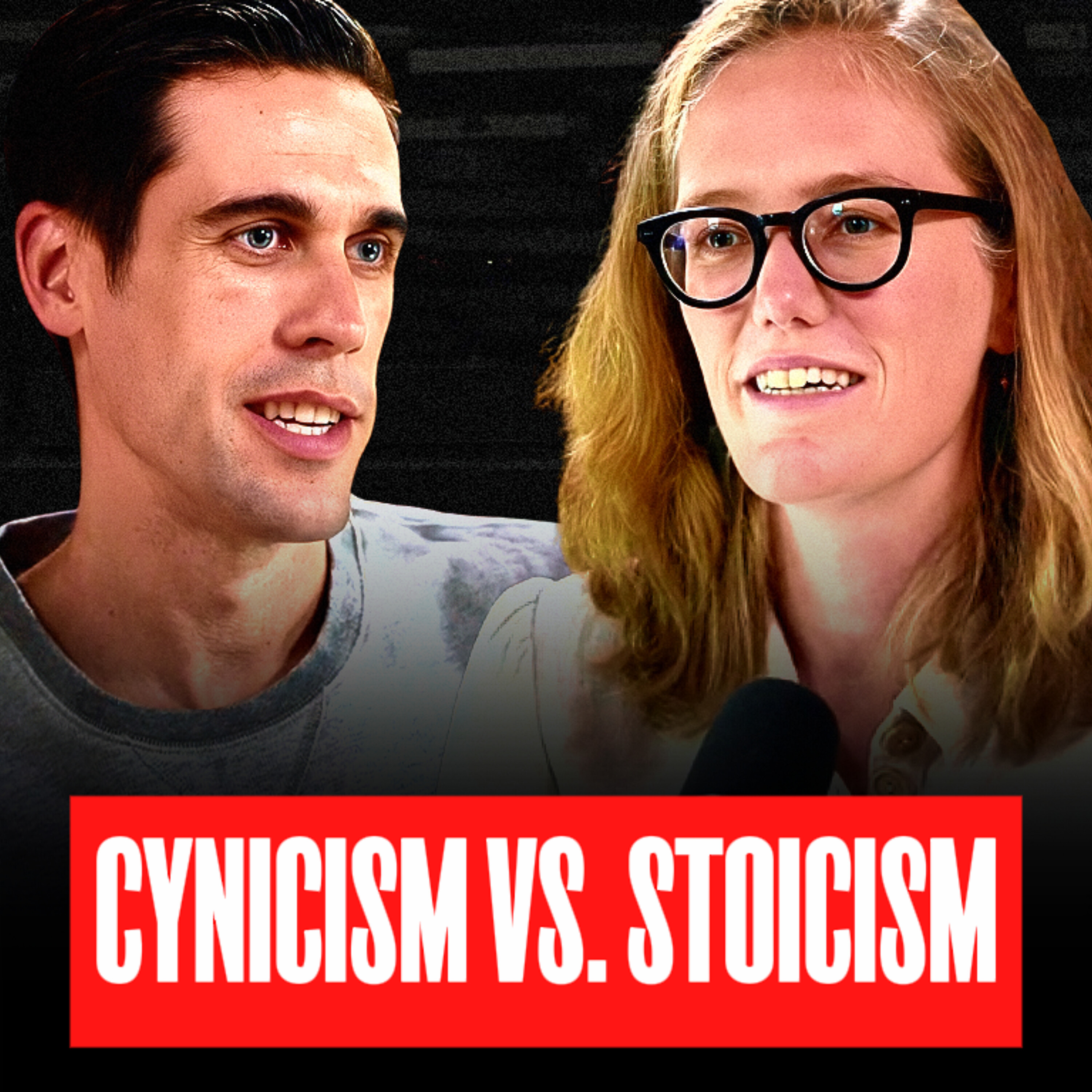
In this episode, host Ryan Holiday continues his conversation with classicist Inger Kuin, delving into the distinctions between Stoicism and Cynicism. They explore the philosophical roots of both schools, focusing particularly on the figure of Diogenes and his contributions to Cynicism, and how these ideas relate to Stoicism.
Written by AI. May contain mistakes.

Get the gist, explore an idea or ask about something said.
 Claude
On The Daily Stoic, what are the key points of this episode?
Searching your listeningAutomatic transcript. May contain errors.
0:00I'm recording this on a Monday, and Monday is our grocery store day in our family. I usually pick my kids up from school and we go over to Whole Foods, get all our groceries for the week. Although here very shortly, we're going to go over there to get our Thanksgiving turkey because they've got a bunch of great options. Turkeys start at$1.49 a pound if you have Prime with organic birds at$2.99 a pound. And they only carry no antibiotic ever turkeys that will bring quality to your table at a great price. Whole Foods has great everyday prices on all your Thanksgiving essentials, whether you celebrate with a massive family or just a few close friends.
0:37Everything they sell has high standards to help you shop with confidence. Enjoy so many ways to save on your Thanksgiving spread at Whole Foods Market. Why choose a Sleep Number smart bed? Can I make my sight softer? Can I make my sight firmer? Can we sleep cooler? Sleep Number does that. Cools up to eight times faster and lets you choose your ideal comfort on either side. Your Sleep Number setting. Enjoy personalized comfort for better sleep night after night. It's the final days of our Black Friday sale. Recharge this season with a bundle of cozy, soothing comfort. Now only$17.99 for our C2 mattress and bays, plus free premium delivery.
1:11Prices higher in Alaska and Hawaii. Check it out at a Sleep Number store or sleepnumber.com today. What can 160 years of experience teach you about the future? When it comes to protecting what matters, Pacific Life provides life insurance, retirement income, and employee benefits for people and businesses, building a more confident tomorrow. Strategies rooted in strength and backed by experience. Ask a financial professional how Pacific Life can help you today. Pacific Life Insurance Company, Omaha, Nebraska, and in New York. Pacific Life and Annuity, Phoenix, Arizona.
1:48Welcome to the weekend edition of The Daily Stoic. Each weekday, we bring you a meditation inspired by the ancient Stoics, something to help you live up to those four Stoic virtues of courage, justice, temperance, and wisdom. And then here on the weekend, we take a deeper dive into those same topics. We interview Stoic philosophers. We explore at length how these Stoic ideas can be applied to our actual lives and the challenging issues of our time. Here on the weekend, when you have a little bit more space, when things have slowed down, be sure to take some time to think, to go for a walk, to sit with your journal, and most importantly, to prepare for what the week ahead may bring.
2:39Hey, it's Ryan. Welcome to another episode of the Daily Stoic Podcast. In some ways, the bane of my existence is what people think the word stoic means, right? I think I say this in the intro of The Daily Stoic. Not only is stoic an unappealing and misunderstood word to most people, particularly in America, but stoic philosophy doubles it, right? Adding the philosophy on the end means people go, ugh, right? And I've been battling this since I went out with the book proposal of The Obstacle is the Way. Are people actually going to be interested in this when they have these preconceived notions of what these words mean?
3:20And of course, Stoicism is not the only school where this is true, right? Epicureanism seems to mean hedonism to people or gluttony or even in the ancient world, this was a problem. Epicurus was presented even by some of the Stoics as this perverted weirdo who was corrupting people and living in sin and excess, which of course, this is not what Epicureanism is about at all. Now, the same is true for cynicism. At least Epicureanism sounds fun, right? Cynicism sounds negative and short-sighted and small-minded and sarcastic and rude and mean and all these things, right? But like with lowercase stoicism and uppercase stoicism, lowercase cynic and uppercase cynicism have very different origins, very different meanings.
4:17And the schools are not that different from each other. I think it was Marshall, the Roman poet, said the difference between the Stoics and the cynics is that there's a shirt between them, meaning that the Stoics were a little better dressed than the cynics. Diogenes the Cynic, who we're going to talk about in today's episode, was a transgressive, rebellious, fascinating figure. But actually, Stoicism would be impossible without cynicism. Zeno's first teacher was a guy named Crates. The founder of Stoicism was tutored by a philosopher named Crates, and also his wife was a fascinating Cynic philosopher.
4:55Crates was known as the door opener. I talk about him in Wisdom Takes Work. He's the door opener who opens the door to philosophy for Zeno. So in today's episode, which is actually part two, part one, I ran earlier in the week. My guest, Professor Inger Kuhn, talked about cynicism versus Epicureanism versus Stoicism. We talked about the invention of this lowercase cynic, where the cynics might actually have things more right than the Stoics. Then I want to recommend some books, because when we walked through the bookstore, she and I continued this conversation and ended up talking about philosophy quite a bit more.
5:30As I said in part one, Professor Kuhn is a researcher, writer, and teacher focused on the intellectual history of ancient Greece and Rome. She's an associate professor of classics at the University of Virginia, home of Gregory Hayes also, my favorite translator of Meditations. She's originally from the Netherlands, so she publishes in English and Dutch. You can go to her website, ingerkuhn.com, and be sure to pick up her book, Diogenes, The Rebellious Life and Revolutionary Philosophy of Diogenes. the cynic. I really like this conversation. I really liked her. And I think you will like this episode.
6:03Do check it out. And as I said, please come see me. I'm going to be in Seattle here very shortly. I'm giving a talk on December 3rd, I believe. At Seattle, you can buy tickets at dailystoic.com. And then I'm going to be in San Diego and Phoenix in February. Grab all of that at dailystoiclive.com.
6:23So let's talk the difference between the Stoics and the Cynics, because the Stoics are directly descend from the Cynics. I mean, Zeno's teacher is Kratis, the Cynic. So how does this happen? And what do you see as the major differences between them? Okay. This is a great question. Big one, big one. So, I mean, essentially what happens is that Zeno founds his own school, right? And comes to be known as the Stoics after the place where they meet, as is all sort of well known. And what, so I would say there's sort of two, there's sort of a big philosophical difference between the two. And then there is, shall we say, a historical difference between the two, right?
7:12Where the Stoics were quite invested in distinguishing themselves from the cynics and saying, like, we are doing our own thing. We are doing something different, right? This is important to them precisely because the cynics were the guys who lived in the street, right? So that's where that comes from. At the same time— Like, we're not the sexual perverts like them. Yeah, exactly. At the same time, the Stoics cannot really deny their connection to the Cynics because then they cut their own tie to Socrates. And sort of Socrates as the important forefather of living a contemplative life of philosophy is a forebear that the Stoics do want, which means that they have to accept the genealogy from Socrates to Anticines to Diogenes to Cratus to Zeno.
8:00Got it. So they are in this bind where they're both wanting to underplay the connection, but they can't completely deny it. So in a historical sense, it's clear that - Descends from the other. Exactly. And that Crates himself in person was a student of Diogenes. They lived at the same time and that Zeno then lives at the same time as Crates and is a student of Crates. So that all sort of works just fine from a historical perspective. Then in addition to sort of needing this distance, there's also pretty fundamental differences philosophically. And I think the sort of the most impactful difference ultimately is that for the Stoics, there is a divine organizing principle that is at the heart of everything.
8:55And that means that the world is ultimately well-organized, right? To put it a little bit in a banal way, right? But for the Stoics, ultimately, there is the understanding that the world is well-organized, such as it is. And the thing to do is to understand this organization and then to bring yourself, bring your inner self in line with this organization, simply put. Now, for the cynics, there is no such overarching organizing principle, right? There is no divine organizing principle that ties at everything together. And for the cynics, that also means that the status quo, the world that we live in, such as it is today, is not necessarily the best of all outcomes, right?
9:43And Diogenes and the Cynics, they definitely love the world, right? They think that the human body is an awesome thing in terms of everything that it can do. They admired a natural world. They admired the fact that the sun warms us, that we can drink water from the river, that animals are able to take care of themselves and find food just like that. And if we are a little bit more like that, then we can live a good life with what nature has given us. Living in accordance with nature. Yeah, exactly. Exactly. But beyond that, there's nothing about this world that's necessary, right? So when it comes to the social structures, the city that we live in, sort of the societal institutions, for the sinning, these are not necessary.
10:34Precisely because, for instance, animals seem to be able to do without them quite well, right? And that has a lot of downstream consequences in terms of how Diogenes thinks about kingship and how he thinks about rulership, right? Whereas for the Stoics, it makes a lot of sense to live in an autocracy because ultimately there is one divine organizing principle in the cosmos. So why would there not be an emperor on Earth? One believes in order and systems and logic and the other is a little bit more random and anarchic that like, hey, this is all made up and you can choose to believe in the made upness, but you don't have to.
11:20It doesn't mean anything. This is just how things are. God didn't make them this way and they don't have to remain this way. Exactly. Yeah, exactly. So the society that we live in, the status quo, is not God-given, is not divine. That's not part of nature. Exactly. It's not part of nature. And anything that's not part of nature for the cynics is open to questioning and is not necessary. And this would include things like the moral order, like, hey, this is why you can't masturbate in public. People are like, you can't do it. And Diogenes is like, why not? You know? And so it does. Yeah, it's like one believes there's such a, you know, that Margaret Thatcher thing where she says, there's no such thing as society.
12:06There's just individuals and their families. Right. Although she's obviously coming at it from a very, but Diogenes is saying like, this is all made up. You can do whatever you want. And the Stoics are like, no, no, no, there's a reason for all of this. And whether there is a reason or not, probably have some fundamental fear of the anarchy that comes if you question it. So it's like, even if there is no reason, this is better than the alternative. So let's, there's a conservatism to stoicism that maybe isn't lowercase conservatism to stoicism that is not there in Diogenes. Yeah, yeah, yeah, absolutely.
12:43And I think sort of when you said earlier about masturbating in the market square as a moral question, I think Diogenes would say it's a question of etiquette, right? It's not a moral question, right? Right. Like moral questions are are about justice. Yes. Right. And about, you know, and about. He's saying etiquette is stupid and it doesn't matter. Yes, exactly. Exactly. And the Stoics are like, yeah, but we'll all descend into apes killing each other if there's no etiquette. And is morality just another version of etiquette, a more extreme version of etiquette? And ultimately for the Stoics, it's about understanding and making sense of society such as it is.
13:26Yes. Right. In order to adjust to it and in order to sort of lead the most, you know, the most virtuous and dutiful life within that context, within your station, within the city that you live in. Yeah. Whereas for cynics, we're questioning it to see if maybe there might be a better way to live. Is that the fundamental flaw of Diogenes, though, which is like he can do it because everyone else buys into the other system and he is able to exist not as a parasite, but as a as an exception to the rule. But if that was the rule, everyone would starve. There would be anarchy or or there would be just a lot less people would be able to live.
14:07Right. Like you need for the world that we have it then and now you need people who go to work every day. So I agree with you that if we had a society that consisted solely of Diogenesis, right, that there would be sort of a lack of constructiveness in a sense, right? There would be a lack of coherence and constructiveness. And this would be a problem. The society without Diogenesis is extremely dangerous. Yes. It's Sparta or something. Yeah, because if you have a society without any diogenesis, then there is no pushback. There is no questioning. There is no sort of bringing things back to the human measure and sort of deciding, well, but how does this affect me in my everyday life?
15:03And do we really need to be doing this? Is this really the best of all possible outcomes? And this is, you know, this sort of, again, goes to the heart of this, you know, philosophical impurity or ambiguity in Diogenes in the sense that he does live on the fringes of society and he lives on alms and in order for him to, you know. Someone has to be making the money to give to Diogenes. Exactly. Right. Like there has to be. Somebody made the jar that he lives in. Right. You know, he doesn't live in a hut. He's not an off the grid survivalist who can do anything for himself. That's what's so interesting about him.
15:43Right. Like he's not going off into the woods and living off the land. No, he is living off the refuse of society. Yeah, because he thinks is stupid. Yeah, but exactly. But at the same time, he does think like he does still appreciate his fellow humans just enough that he thinks that they are worthy of what he has to say. That's true. He's not an antisocial. He's not a hermit in that sense either. He's just like, why are you going to that job, man? Right. Exactly. Exactly. Is this a good job? Do you believe in this job? Does this job align with your ideas of justice? And if it doesn't, you should stop going to that job because you don't actually need that money.
16:32You don't actually need that car. You can always live in a jar. Exactly. Exactly. So so and this is ultimately what Diogenes means by freedom, right, is the freedom to be able to make those choices and those decisions because you are not afraid of being a beggar and you have taught yourself to be able to live on the street and to live on on very little. And because you have boiled down life to its essence in that way, right, you are able to be happy with your handful of beans and your, you know, stale bread. Right. And that knowledge, that preparation then allows you to be independent and to say to Alexander, no, I don't need anything from you.
17:20Just get out of my sunlight. That's all I need. Well, Diogenes is able to say that to Alexander in a way that Seneca is not able to say that to Nero. And so you go, who actually gets it right? It's interesting, too, how much this boils down to that expression about the narcissism of small differences. Like the Epicureans and the Stoics, way more in common than difference. Yeah. The cynics and the Stoics are way more in common than difference, especially because, like, yeah, it's not like the Stoics were like the man and then Diages is not the man. First off, because they're obviously, you know, is literally training under one.
17:53But like the Stoics are questioning so many of the assumptions that also believe you should live in accordance with nature. I think, is it Juvenal who says between the Stoics and the cynics, they have only a shirt between them? And it's like one is wearing clothes and the other is like, we don't even need clothes. And so it's just like the degree to the extremes with which you're willing to take it. Like the Stoics are like, we love all the philosophy stuff, but somebody has to serve in the army and somebody has to clean the streets. And like somebody has to do this stuff. And Diogenes is saying like, not us, you know.
18:33And then I think the Stoics are saying, if we don't do it, either nobody's going to do it or someone worse is going to do it. And that's, I think, one is making this kind of pragmatic, you could say, responsible choice. And it's not that the other is irresponsible, but there is something I think both in the Epicureans and in the Cynics that's like, well, we don't want to be bothered with that stuff. we're going to retreat to the garden or we're going to just ask her questions, but like somebody else makes sure that the soldiers are manning the city walls.
19:12Thanks to Toyota Trucks for sponsoring this episode. When I bought my ranch in 2015 out here in Bastro County, I drove my car about halfway down the dirt road that we live on, thought this isn't going to work, stopped, parked it, walked the rest of the way home, borrowed my wife's car, drove into Austin and bought a truck. What I bought was a Toyota Tacoma. And this truck wasn't just transportation getting me to and from my house. It unlocked a whole different style of living for us, not just on the ranch, but in our little Texas towns. There were places I could go now that I couldn't go before, especially out here in the piney forests, through the fields, and on the unpaved roads like the one that I lived in.
19:57We got to go deep into the hill country's wild beauty. We've driven all the way out to East Texas. We've driven across the country. And by we, I mean not just my wife, but both my kids who I drove home from the hospital in that truck. Toyota trucks are built for those who understand that the best adventures happen when you're willing to veer off course, because you never know when you'll end up on a Toyota adventure detour. And of course, this is stoicism too, because every detour, every obstacle is an opportunity. But it's helpful if you can handle the difficulty inherent in that. If you've got the resilience and the right companion to make it wherever the road takes you, discover your uncharted territory.
20:39Learn more at toyota.com slash trucks slash adventure dash detours. We just took our kids to an outdoor performance at The Nutcracker. They had a snow cone and then they went insane in the car ride home. And one of the things I try to remind myself when that's happening is that I don't control my kids' behavior, especially when they're too far gone like that, but I do control how I respond, right? That's stoicism, but it's also what Dr. Becky talks about. Dr. Becky is a clinical psychologist and a best-selling author, and she founded Good Inside, which is there to give parents practical, actionable tools for handling those everyday challenges with confidence.
21:20My wife introduced me to Dr. Becky's books. I love them. I've recommended them a million times. I've had her on the podcast. And as it happens, Dr. Becky is hosting two live Q &A events for Good Inside members. I am one of them. She signed me up for it about a year and a half ago. I've loved it ever since. On December 1st, you can join Dr. Becky for her How Not to Raise Assholes event, which is about avoiding entitlement and raising kind, empathetic kids. And on December 15th, she's hosting her How Not to Lose It Over the Holidays event, which I'm sure we could all use. As I said, I'm a big fan of Dr.
21:57Becky. She's been a great influence for me as a parent and just as a human being. And daily Stoic listeners can join for 15 % off with code STOIC15. You just got to head over to goodinside.com to catch the events.
22:18So this is where cynicism and Epicureanism have a lot in common in the sense that they withdraw from political life in a way that the Stoics very much did not. At the same time, it's this kind of pragmatism, right? Well, if I don't do this thing that I have an inkling might be wrong, a worse person will do it, right? I mean, these are the kinds of decisions that totalitarian regimes are built on, right? Sure. But also functioning democracies, right? Like both of them. Yes, yes, yes. Yeah, absolutely. But in the case of a functioning democracy, right, to be able to say, I will do this job, right?
22:57Even though I don't feel like it today, right? I would rather sleep in, right? I would say that that's what a functioning democracy is built on. But I will do this job because, you know, and I know it's an unjust task that I'm contributing to, right? Because if I don't do it, someone else would do it, right? That's like, I don't, you know, I don't think that's part of a functioning democratic regime. And I think that's precisely why Diogenes' thinking is so important, is so powerful, because it forces you to ask that question every day. You're absolutely right. They have so much in common, right?
23:36The Stoics and the Stoics have so much in common. And there's so much that the Stoics learned and took from Diogenes and from Cretes. And this has all to do with, you know, precisely the notion that we should not be afraid of death, the notion that we should actually think about our lives and like spend time thinking about how to live our lives well, that we should not get lost in luxury goods, that we really don't need all that much to be happy. Right. These are all these are all things that they share. Cultivating that kind of resilience. Like one of my favorite stories about Diogenes is he's seen begging a statue.
24:15Right. Exactly. What are you doing? I'm practicing being rejected. Exactly. And you just go, oh, yeah, there's there's this this idea that like exposure therapy, basically, like doing hard, uncomfortable thing like Diogenes. You go, he's a homeless person, but that's a difficult existence. I mean, it's cold there in the winter, it's hot in the summer, and he is exposed over the years to the elements. He has a toughness that you're not typically associating with the philosopher. But he's kind of like, in the way that Marina Abramovich is effectively an athlete, he is an athlete in terms of inhabiting the human body and finding out what it's capable of.
24:54Yeah, exactly. And this is what the Stoics and the Cynics share, this notion that by preparation, whether that's mental preparation or whether it's bodily preparation, you can prepare yourself and therefore be more free and be less afraid because you know that you have that resilience and you know that you're capable of these things. And, you know, this is why for Diogenes, it's really important to know that he can live without nice food and live without wine. But once he's trained his body, it's fine to have a glass of wine because he knows he can do without it. And he can reject Alexander the Great because other than death, there's nothing Alexander can do to him.
25:36Right. There's nothing Alexander can take from him. Exactly. And he realizes in that moment that that makes him more powerful than Alexander. Or it frees him to speak truth to power that Aristotle cannot because Aristotle doesn't want to lose his job. Yeah. Right. And Diogenes doesn't have a job. Right. And so he's like, you suck. You know, there's an empowerment. The powerlessness creates an empowerment. Exactly. And that's why this anecdote is so important. And that's why we all love it so much is because it says so much about power that power only exists when you let the other person wield power over you in that way.
26:22And if you are Diogenes, you don't need anything from Alexander and you are not afraid of him. And that means that even though he's Alexander, his power goes up in smoke. And Alexander realizes that in that moment. That's why he's so impressed with Diogenes. And this is what he takes with him for the rest of his life. And I mean, I think we haven't talked about this yet, but I think sort of one of the places where you really see the difference between the Stoics and the Cynics is when it comes to the question of slavery. And also the difference between Aristotle and Plato and the Synex and the Stoics, because this is something that was so ingrained in ancient society, was so much a part of everyday life that for the Stoics, it is wallpaper, right?
27:10It's part of society and it's something that they cannot, do not venture to think outside of, right? Even Epictetus the slave doesn't seem to go like, this isn't right. It's more like, it's happening to me. I wish it wasn't happening to me. But the idea that the institution itself is an injustice. Right. It's remarkable how many centuries it takes us to get around to that. Exactly, exactly. And sort of for Epictetus, he comes to terms with his condition of enslavement by going within and seeking freedom inside of him. And ultimately, this leads the Stoics to really not think about slavery all that much, right?
27:50Because they have sort of gone within and decided that inner mental freedom sort of obviates real life slavery in the world. But Diogenes does not make this step, right? And I think this is sort of the most powerful moment where you see that Diogenes is able to think outside of the status quo. And precisely because the world is not necessarily as it should be. There's no reason why the status quo should be good. You don't have to revere it, right? You don't have to try to make sense of it as it is. You can say, no, actually, this is ridiculous. And that is what Diogenes does do centuries before anyone else and more clearly and in a much more principled way to say that this notion of one human being owning another human being is completely absurd.
28:48Right. And and the Stoics, as much as they take from Diogenes, they don't take that. Yeah, it's like society needs the sort of freaks and hippies and artists and weirdos who question everything, a lot of which not shouldn't be questioned, but there are good answers to why. And then there's the bucket, the handful of things that it actually turns out the reasons are pretty spurious. Yes. And Diogenes, by effectively rejecting everything, is able to be right about this thing that—what's interesting, too, is I feel like the earlier Stoics are more cynical, more of the cynic school. And then by the time we get to Rome, now you have so many additional centuries of the status quo being the status quo that it's harder for them to question.
29:39like like cato thinks rome is a republic by the time it gets to seneca there's been so many bad emperors and so much civil war that he's just like this like let's just go to with the most stable of the people you know and and by the time it gets to marcus aurelius he's not like like the idea in gladiator that he would give it up is so like no like there is that lowercase c conservatism to the Stoics that the more transgressive, radical early Stoics would not have conceived of. Yeah. And I mean, sort of a more socio-historical way of thinking about that is that sort of like as Stoicism becomes institutionalized and as Stoicism sort of seeps into the upper regions of society, the Stoics start to become people who have much more to lose.
30:30And at that point, it becomes much more difficult for them to sort of be as critical and as principled and as questioning as the cynics are. What's very, Upton Sinclair says, it's very hard to get someone to understand something that their salary depends on them not understanding. Right. And yeah, it's like the feature and the bug. The Epicureans and the cynics are always on the outside so they can see things clearly. The Stoics slowly but surely get absorbed to not just be the inside, but kind of the dominant view of the elites in Rome. And so they have not just the sort of fear of change, but they also have, in some cases, good reasons.
31:10But just they just go, do you understand the cost? Not like the literal cost, but it's like that's easy for you to say. You don't have to make said decision or you don't have that's easy for you to say, let me tell you all the reasons why. You know, and that is the that's just the they evolve further and further from each other to the point of being probably incomprehensible to each other. Right. Yeah. No, I mean, they like stoics become so invested. They are insiders in a way. And from the inside, it can be really difficult to see. And if you are no longer communicating with people who are on the outside, then you've lost that that opportunity.
31:54Yeah. The other one where I think the cynics are more right than the Stoics, or it takes a while, is Zeno is not just taught by Cratis, but by Cratis' wife. And there is an equality of the sexes. I mean, there's some misogynistic comments from Diogenes, but there was a kind of equality in the lowliness of cynicism that it takes a while, takes maybe until Musonius Rufus, who also teaches, has these interesting essays on whether women should be taught philosophy. And he says, yes. But like as Stoicism gets absorbed into the social hierarchy of Rome, certain questions are no longer asked and certain radical notions of equality go away.
32:36Yeah. And what's interesting about this to me is that Diogenes himself does not explicitly really have an awful lot to say about women other than some off-collar remarks, for sure. But it is then with the next generation, with Kratis and his wife Hipparchia, that it becomes clear that there is there's nothing about cynicism that precludes women from participating in it. And then it is Hipparchia who sort of takes up, like, seizes that opportunity. And then it becomes a feature of cynicism precisely because to be a philosopher and to, like, ask these questions, you do not have to have wealth. You do not have to be sort of a ruling member of your polity because philosophy has become this much more basic day-to-day thing as it is for Diogenes.
33:32And there is virtue in not having anything. And there's virtue in not participating in the polis as a political actor. So all of these things that sort of would preclude a woman from being a serious philosophical actor before are gone in Diogenes' thinking. And then Hipparchia and Kratis sort of draw the natural conclusion from it, which was there already at the start. It just wasn't realized in Diogenes' lifetime. Yeah, he just personally didn't seem to care that much about it. Right, exactly, exactly. And then once Hipparchia sort of joins the ranks of cynic philosophy, she becomes a figure who's quite popular in imperial cynicism and sort of is featured a lot in the cynic letters.
34:21And sort of her ownership of philosophy becomes important. And I do wonder if that does not also influence Masonius Rufus, who is a little bit of an outlier among the Stoics. He's not a Roman senator in the way that these other Roman Stoics all seem to be come from the best families and inherit power and status. Yeah. And then Mussonia sort of continues to think about this question. Like, well, why why shouldn't women be studying philosophy? Virtue is virtue. What does it have to do with your genitals? Yeah, exactly. Nothing. Yeah. And then also here he is teaching probably the most cynic adjacent of the Stoics.
35:02Right. Epictetus is the closest, I think, because also he sees Rome from the outside and isn't part of the elite. So he is less, you know, he's more radical. He is more indifferent to the things that, you know, Marcus Aurelius is sleeping on a hard mattress by choice. Seneca is practicing poverty one day a month. And Epictetus is like, no, no, this isn't a game. Right. This is life. Yeah. Yeah. And also, I think when you're reading Epictetus, you hear Diogenes a little bit more than a lot of the other Stoic writing. There's something about Epictetus's insistence, sharpness, wit, and also very much sort of the active, ongoing educational situation that you see in his writings, that he's always in conversation with someone.
35:54Also not a writer, unlike Seneca or Marcus or these others. Exactly. Exactly. That feels close to Diogenes. And then we get the mirror of the Alexander and Diogenes when Hadrian, who's obsessed with Greece, stops in and attends Epictetus's lectures. Right. And you're just like, again, some people are like, did it happen? Did it not? And it's like, it probably did happen. And it would make sense. And there's something that they probably both would have appreciated in the moment, the irony and the contrast between master and student. It's just a remarkable little scene. Yeah. Yeah. And I mean, I think for Hadrian, like all of Greek culture, all of the Greek world was entirely where his heart was.
36:38And he was sort of invested in it from head to toe. So there's an element of it where it's like you find out like Paul Ryan's a Rage Against the Machine fan and you're like, you like it, but you obviously don't fucking get it. Right. You know, and there's something like Marcus really seems to have sincerely liked the philosophy. Hadrian seems to have really been a student of it, but like effectively puts zero of it into. It's like he likes like the images and the symbols. Right. But not any of the ideas. Yeah. Yeah. And I mean, I think also that for Marcus Aurelius, the fact that we can read the meditations, but that it's so, you know, that they are not written as public facing documents.
37:24Right. I mean, we are really seeing him there in his private moments. So we see him struggling with these things in an honest way that I think is believable and makes sense for a ruler. But in terms of, you know, would Diogenes say, you've really understood me, Marcus Aurelius? Maybe in some moments into meditations, but not in his actions. And he would have stamped on his carpets. Right. Yeah, exactly. Exactly. And, you know, Marcus Aurelius went on being Marcus Aurelius. Yeah. You know, no matter sort of what he understood, as did Alexander, you know.
38:27access to over a thousand airport lounges. The VentureX Business card. What's in your wallet? Terms and conditions apply. Find out more at CapitalOne.com slash VentureX Business.
38:44Why do you think the three words have been done such an injustice in the English language? Is it as true in other languages like Stoic, Epicurean, Cynic? It's like they're not even in the ballpark of what they meant as philosophies. Yeah. When and how does that happen? So I can speak specifically for cynics. And I agree with you that all three words have sort of really suffered, but perhaps cynic the worst, I would say, because it's such a negative word, right? It's like almost exclusively a negative word, cynic with a lowercase c. So when this happens is in the 18th, 19th century, like the late 18th, early 19th century.
39:28So up until that time, the word cynic in the vernacular European languages only means a cynic philosopher in the spirit of Diogenes. Got it. Like it means the philosopher, not an attribute of a person adjacent to the thing. Exactly. Exactly. Like that latter word does not yet exist. The uppercase becomes the lowercase. Exactly. So at this time, the lowercase is introduced. And the lowercase is introduced with reference to Rousseau. And what's really interesting about this is that Rousseau himself aligns himself to some extent with Diogenes. And Diogenes was a very popular figure in the French Enlightenment in general because he places such an emphasis on the human use of reason and is sort of so anti-authoritarian and anti sort of the traditional divisions in society, which is all very much at home in the French Enlightenment.
40:31So Diogenes is a popular figure. Uppercase cynic is a positive term. It's about intellectual independence. then the problem with Rousseau becomes that there is sort of a big mismatch between his philosophy and the way he lives his life. Yeah, he's a shitty person. Yes. And he's not ashamed about being a shitty person. Right. For people to know, he has like five kids and he just, one after another, gives them up for adoption. He just doesn't want them. Yes. Yeah. Among other things. And he's very open about this. He's not embarrassed about this at all. Do you think he's a sociopath or something?
41:05What do you think it is? Oh, I really don't know. I mean, I think maybe like when I think about Rousseau and sort of this problem is that he was like where Diogenes would say, yes, I've changed my mind or yes, this is not entirely not entirely consistent with me. Right. I think Rousseau was trying to make it all fit. Right. And sort of that's where he becomes a hypocrite and somewhat crazy. I was thinking about this. Rousseau is like if Camus actually had murdered someone. You know what? Like if the stranger wasn't a novel and he just murdered someone just to see what it was like. Rousseau has elements of that.
41:46Yeah, absolutely. So it is in reference to Rousseau that this lowercase cynic word is invented, right? And sort of then comes to mean hypocritical or living your life as if there is no difference between good and bad. Sinek becomes nihilist. Exactly. Yeah, exactly. And sort of the notion that there are no standards of justice and that it doesn't matter, right? It's a very pessimistic worldview, which is the absolute opposite of what Diogenes thinks, right? Diogenes thinks that it is possible to be a good person and to live a good life. And he thinks that this is something that everybody can do and he wants to teach everybody about this.
42:36He's an idealist in a weird way. Yeah, yeah, yeah. You know, they say like a cynic is a spurned idealist. He's not spurned. Right. He just believes it and he believes it to these preposterous extremes, which he, for the most part, puts into practice. Yeah, exactly. Exactly. And it is the fact that he really believes this, right, that to my mind makes that he's absolutely not a lowercase cynic. Yes. But I think he is sort of able to be an idealist because he does not pretend to be flawless. Right. And there's this other anecdote, which I really love, where he says, I'm sort of like a choir director and I sort of give the pitch to the chorus, but I give it a little bit higher because I know that they will not quite be able to hit the tone.
43:28So if they are sort of striving for what I'm seeing for them, they will get very far in the right direction. So there is sort of this understanding that, you know, what he is doing is not systematic, is not perfect, right? He is setting a tone for us that we can sort of go towards. And I think it is precisely because of this acceptance of this impurity that you're protected against becoming a spurned idealist, right? Because you were never an absolutist idealist anyway, right? And being an absolutist idealist is so dangerous, you know, because it is impossible, right? And then once you get knocked down, once you sort of fall into the abyss, then what are you going to do?
44:21Then you're sort of in this place where it's like, well, it's not possible to do the right thing anyway. So why even bother? And, you know, none of it matters. That's when you become a lowercase cynic. Yeah. If Diogenes was a cynic in that sense, he wouldn't have spent all this time trying to teach people. Oh, absolutely. He would have given up on them. Like, he doesn't like some of the people in Athens, but he seems like he likes the people of Athens more than Socrates does. Do you know what I mean? Why would you say that? I just mean, like, well, first off, he manages to be transgressive and different and provocative and nobody kills him.
44:57Right. You know, like, in a way, Diogenes has better social skills than Socrates. Like, I can't get over the fact that Socrates goes on trial and, you know, like 51 percent of the jurors vote to acquit him or vote to convict him. And then when he gives his speech at sentencing, like 55 percent vote to convict him to death. Like, he's so obnoxious that, you know, they say Art is getting away with it. But Diogenes, for the most part, gets away with it in a way that Socrates doesn't. And I think just to go against this idea of being cynical and nasty and antisocial, I think the people of Athens humor Diogenes.
45:46There is more fondness than you might presume or it wouldn't have allowed to go on. Right. Yeah. No. And I think that Diogenes is shamelessness and and his give and take, as it were. Right. Are what sort of there's there's just something about the moment that allows you to like when like when you're in an exchange with Diogenes. Right. Like somebody comes up to him and says and says, did you know that movement is not possible? Right. And he's trying to sort of like open this very theoretical, complex, philosophical dilemma that people were excited about at the time. And Diogenes just gets up and walks a circle around him.
46:26There's your featherless biped. Right. Exactly. Exactly. And these moments are so absurd and disarming that they allow you to look at yourself and look at the world differently in that moment in like sort of a very performative, direct way. Whereas if you're in a conversation with Socrates and, you know, I fell in love with ancient philosophy because of Socrates, because of Plato. These were my first people and my first authors. But often when you read a platonic dialogue where Socrates is questioning someone, it's like such a slow burn. Just say what you fucking mean, dude. Like he makes you think that you're doing so well.
47:10He makes you think that you're like onto something. And he's like, oh, really? Oh, really? Well, let's go to the next step. And then only at the very, very end is like, oh, wait a second. Everything of what I just said is nonsense. And we're only finding out now. I think there's in a way this is an extreme position, but there's something kind of intellectually dishonest about the Socratic method. Right. Like he's able he knows what he thinks, but he never has to say it. He just relentlessly questions you until you question what you thought. And then his implication hangs there. Yeah. Right. And I think there's something refreshing about Diogenes who just says what he means in a clever, straightforward way.
47:55Yeah. From the jump. Yeah, exactly. Exactly. It's very direct and transparent and quick. And it's, you know, it's a performance. It's a moment. It's like a punk song. Yeah, it's a moment. It's a punk song that you can share and then you are altered. And I see, you know, I'm going to be like very nuanced here. Like, I think that the Socratic method is amazing precisely because it takes you through your own arguments and sort of you go step by step and you sort of get there yourself. Right. And I do think that that's beautiful and that's really important. It's just that when we read. Being interrogated by Socrates, though, is different.
48:37Oh, exactly. Exactly. And also, like, when we read Plato's account of these interrogations, which, of course, you know, are written after the fact and are scripted in a certain way, it's, you know, it's just so clear and it just makes the interlocutor look so bad. And it makes, you know, and I agree with you that there are many moments where it does feel like Socrates is being dishonest. Like, you clearly know where this is going. Like, why does it have to be like this? Yeah, I think it was Macaulay who said, the more I read about Socrates, the more I understand why they killed him. And, yeah, Diogenes gets away with it, you know, and that's an impressive feat, I think.
49:22Absolutely, yeah. Well, I think the book is amazing and I think more people should know who he is. So thank you for writing it. Thank you so much for talking with me about it. You want to check out some books real fast? Yeah, let's do that. Let's do it. Oh, OK. So do you know about Ambrose Pierce, the American cynic? No. He's like our most famous cynic. So, OK, so he's he wrote The Devil's Dictionary. He's known famously as the cynic. He fights in the for the Union in the Civil War. And he writes this famous story called An Occurrence at Owl Creek Bridge, which is probably the most famous. Have you heard this short story?
50:01No. It's like an amazing short story. It's like super good. So then he becomes like this sort of muckraking journalist in the Gilded Age. He's like temporary with Mark Twain and stuff. And so everyone, he's like lowercase cynic because he's calling out all the bullshit and the horrors of his time. But like people aren't getting like Diogenes. He's this idealist at heart. He's like, I don't understand why we're letting these railroad barons buy our democracy. He's this fascinating guy. Oh, I'm so excited. Thank you. And so the crazy sort of irony of it is he's actually stoic. Like, his father's name is Marcus Aurelius Bierce.
50:41Yes. And his uncle, who's also a Civil War general, is named Lucius Verus Bierce. Oh, my God. So he's kind of speaking his classical tradition. Yeah. And he's more, I haven't looked that much at what he said about God. But he has this devil's dictionary, which has these hilarious things. Let me give you his definition of a philosopher. It's so good. The phrasing is good. I don't want to do it. Ambrose Bierce. I had no idea. You never even heard of him? No. I had no idea this guy existed. I am so excited. This is what I'll be bringing on in the line. It's amazing. And the stories are like, there's not a great biography of him.
51:18Cary McWilliams, who was like a sort of muckraking journalist in the 1900s, read a biography about him, but it's very out of print. So The Devil's Dictionary is his most famous work, because most of his journalism, other than this one short story, is all forgotten. But his definition of a philosopher is, all are lunatics, but he who can analyze his delusion is called a philosopher. That's excellent. So that one's good. That's really good. The two stories I would read, so he has, okay, so, yeah, Occurrence of Alkyd Ridge, start there, and then read a Parker Adderson philosopher, which is this short story about this Union soldier who's caught as a spy, and he is, like, being interrogated, and he's this brave sort of prisoner.
52:08and he's aping all the things that a stoic or a cynic would say if they're about to be a sentence to death which he knows is his thing and then like at the last second and all of his things have a twist so I won't but at the last second they tell him oh you're not going to be executed by firing squad you're a spy you're going to be hung and then we see whether he means the philosophical pretensions or not so he's I think you'll really like him Yeah. Okay. Um, what else might you like? What do you think like the best edition of like, if someone was like, I want to read Diogenes other than your biography, because we've been trying to round out the philosophy.
52:48I think I read the Penguin but what do you recommend to people? I mean, I think the, uh, I think the Penguin edition, uh, by Robin Hart is really good because it's quite complete and it has sort of like, It has basically everything you need in English. There's also, in this series, in this Princeton series, there is a recent one. Is there one of the agenies? Yes. Yeah, yeah. And I think it's called How to Say No. How to Say No. Okay. This series is incredible. No, it's a great series. I don't know why it's also in Latin. I think it would be more accessible if it was just... Oh, I was just going to say, I think it's so nice that they're bilingual because, you know, maybe it'll tempt people into seeing if they can read some of this on their own.
53:43So yeah, How to Say Now is the Princeton one about Diogenes, which I think is great. Okay, all right. Yeah, he's sort of like Musonius Rufus, where there's just not a great... Have you read this? Yeah, yeah. I mean, I think her translated. I thought it was really good. Yeah. it's what I give to my students. The title is not good. It's almost as bad as like cynic or stoic where you're like wait so okay like because it's it so comes down to the words right it's like that one should disdain hardships to me sounds like it's saying like avoid hardships exactly in the same way that like uh like apathy or resignation or um indifference are these words that like mean the opposite of what no and it's exactly like also same word uh or a similar thing with scorn yeah with students like i always talk about scoring like what do they mean you should score it yes well what it means is that you shouldn't allow yourself to be bothered by it but you shouldn't avoid it right you should be ready for it and yes if if you encounter it then you have to you know not be uh derailed right that is what it means but yeah i mean those are Are these things better in other languages?
54:56Like, how does Dutch render the... Are there similar problems? Or it's like, no, no, no, because our word is, you know, like a bazillion consonants in it. There are similar problems, yeah. I mean, you know, the only thing that I really like about German is that they actually came up with two different words for modern cynicism and for ancient cynicism, where modern cynicism is cinismus with a Z, and then ancient cynicism is kinismus with a K. See, that's brilliant. So that is really, really helpful. So helpful. I wish we did that in other languages, but not in Dutch. When the Germans also would be like, well, why don't we just mash like 15 words together and call that a new word?
55:38Yes. They like to do that too. But we like to do that in Dutch a little bit as well. Yeah. We don't do that in English very much. No, everything's its own middle word. I know, but the nuance of it is interesting. Have you read, just I'm writing about it now, have you read any of Stockdale? I have not. Do you know who that is? So Stockdale's, maybe this book I think is really interesting. Yeah, no, I've definitely, I've definitely, I know his story, but I haven't read him yet, so I'm excited. It's more overtly philosophical than you would think. Like, so as he's parachuting in, he says like, he knows he's gonna, he's like, I'm entering the world of Epictetus.
56:18He's explicitly thinking of a POW camp as a training ground to be a philosopher, which is heavy and very interesting. Yeah, and also so true to the Stoics and the Cynics. To sort of say, okay, this is what I'm experiencing. This is happening to me right now, and this is what I've trained for, and I'm ready for it, and it's an opportunity to sort of to develop myself even further and but also the idea that the philosophers are not having easy tenured lives oh yeah in the sense of like like even Diogenes you oh but it's like he's living thousands of miles from I don't know hundreds of miles how far it is exactly but he like exile must not have been fun like he might have made a light of it but he's sent away from and he loses everything, you know?
57:14Like, there is this sense of, like, I love this. They did a new edition of Viktor Frankl, and it's Yes to Life, and then the subtitle is In Spite of Everything. There's something about that, of the ancient Stokes, of just having a rough go at it that I think is powerful. Yeah, and also the very basic, I mean, it almost sounds like a platitude, but I do think it's so meaningful to say that philosophy is something that you live, right? It's, it's, it's something that's in your experience and it is in the everyday and it is in the very smallest thing and like in your very smallest position. And it's, it's not an armchair activity.
57:56Well, I think that's probably why Diogenes was just so dismissive of that. Like the thing about like, what's a human? It's a featherless biped or the, the like, Oh, we can't walk or you can't move. And it's like, let me show So he's just like, I don't have time for this bullshit. Let me, like, these are not the questions we should be asking. The questions are not like, how do we know if we live in a computer simulation? It's like, what am I supposed to do about the fact that the government just took my stuff and threw me in jail? Yeah, yeah. No, and especially if you were sort of pursuing all of these hyper-theoretical abstract questions, but in your everyday life are sort of being very unreflective and very unethical.
58:39I mean, that is what just gets Diogenes mad, right? And then she gets all of us mad. What do you think he thought of Aristotle from actually working for Alexander? Oh, I mean, I think he thought just as badly of it as he thought of Plato going to Sicily, right? I think he would have had no respect, right? James Rahm was actually just here. Yeah, I saw. He spoke about, what's the tyrant's name? Dionysus. Yeah, yeah, yeah. It's fascinating. That they would both, because his book about Seneca, I loved, that two smart people would get snookered so badly by something that like, and I guess this goes to your point about being on the outside or the inside, that was so transparently obvious to everyone else who thought about it.
59:28And then you're like, oh yeah, there's all these, like you see it now these smart people who who like there's obviously dumb people who fall for demagogues right all the time that's what a demagogue does but what's more interesting and then of course more terrifying is the mental gymnastics that a smart person can do to be like actually this isn't horrible and it's good and that's why i should participate yeah yeah exactly and and i mean i think it's i think it's a combination between you know wanting wanting to be part of of the moment right and sort of being misguided about what happens what your best exactly wanting to be in the room where it happens right and being misguided about um the trade-off between impact and also being misguided about what impact is right i mean diogenes goes into the marketplace because he thinks that's where it can have impact because that's where everybody will see him and and talk to him and he does um and yeah i mean yeah i think it's a combination between wanting to be in the room where it happens and sort of you know being sensitive to status being sensitive to status of the king and being like well if the king wants me to come and also that the superpower of kings it's the brutality often and the violence and the power but also they're really good at provoking that reaction in people like they're really good at making you think that you're important to them and that they need you and that you can restrain them and you know like they're they're the superpower is it like the superpower of a trump is his ability for every person to meet him and go oh it's gonna go differently with me and you like that elon musk is gonna be like no i think it's gonna go well it's like anyone with like so what is that ability and i think that's what's what what both plato and nero fall for and diogenes has no like doesn't entertain it for a second he sees alexander exactly for what he is yeah no and i think you know for diogenes he meets alexander and if if alexander had wanted to change his life after he met Diogenes great yeah right but Diogenes was not going to go to Alexander and was not going to change himself and drop everything because he thinks he's the one and because he thinks well whoo it's Alexander I mean he was ultimately just not intimidated by Alexander he was like okay Alexander is just the same as the fishmonger I talked to yesterday and if Alexander wants to talk to me.
1:02:13That's just as interesting as talking to the fishmonger. That's great. But it's not an all different. I bet he sees him clearly as unchangeable in a way that Aristotle fools himself about. That he would listen. Yeah, no. And also, for Diogenes, he sets the terms, right? So, okay, if there was maybe some hope for Alexander, the very first step is that he comes to him instead of expecting Diogenes to go there. So it's already in that motion that you see the big difference between Diogenes and everyone else, that he won't go and visit them. Yeah, I have a quote that I keep next to my desk, and I think they were Pompey's last words.
1:03:03It's a line from Sophocles. He says, whoever goes to the court of a tyrant becomes his slave, even if he goes there a free man.
1:03:17Thanks so much for listening. If you could rate this podcast and leave a review on iTunes, that would mean so much to us and it would really help the show. We appreciate it. And I'll see you next episode.
1:03:45Look, ads are annoying. They are to be avoided, if at all possible. I understand as a content creator why they need to exist. That's why I don't begrudge them when they appear on the shows that I listen to. But again, as a person who has to pay a podcast producer and has to pay for equipment and for the studio and the building that the studio is in, it's a lot to keep something like the Daily Stoic going. So if you want to support a show but not listen to ads, well, we have partnered with Supercast to bring you a ad-free version of Daily Stoic. We're calling it Daily Stoic Premium. And with Premium, you can listen to every episode of the Daily Stoic podcast completely ad-free.
1:04:33No interruptions, just the ideas, just the messages, just the conversations you came here for. And you can also get early access to episodes before they're available to the public. And we're going to have a bunch of exclusive bonus content and extended interviews in there just for Daily Stoic Premium members as well. If you want to remove distractions, go deeper into Stoicism and support the work we do here. Well, it takes less than a minute to sign up for Daily Stoic Premium, and we are offering a limited time discount of 20 % off your first year. Just go to dailystoic.com slash premium to sign up right now or click the link in the show descriptions to make those ads go away.
What can Diogenes teach us about the roots of Stoicism? In today’s episode, Ryan and classicist Inger Kuin break down the real gap between Stoicism and Cynicism, discussing why one trusted order and structure while the other thought most of society was nonsense. They get into Diogenes’ legendary stunts, the Stoics’ attempt to distance themselves from him, and why the world still needs people who question absolutely everything.
Inger Kuin is a researcher, writer, and teacher focused on the intellectual history of ancient Greece and Rome. She is Associate Professor of Classics at the University of Virginia. Originally from The Netherlands, she publishes both in English and in Dutch.
Check out Inger’s website: https://ingerkuin.com/
Be sure to pick up a copy of Inger’s new book Diogenes: The Rebellious Life and Revolutionary Philosophy of the Original Cynic.
📚 Books that Ryan recommended to Inger:
Tales of Soldiers and Civilians: and Other Stories by Ambrose Bierce
Thoughts of a Philosophical Fighter Pilot by James Stockdale
Moral Ambition by Rutger Bregman
🎟️ Come see Ryan Holiday LIVE: https://www.dailystoiclive.com/
👉 Support the podcast and go deeper into Stoicism by subscribing to The Daily Stoic Premium - unlock ad-free listening, early access, and bonus content: https://dailystoic.supercast.com/
🎥 Watch the video episodes on The Daily Stoic YouTube channel: https://www.youtube.com/@DailyStoic/videos
🎙️ Follow The Daily Stoic Podcast on Instagram: https://www.instagram.com/dailystoicpodcast
✉️ Want Stoic wisdom delivered to your inbox daily? Sign up for the FREE Daily Stoic email at https://dailystoic.com/dailyemail
🏛 Get Stoic inspired books, medallions, and prints to remember these lessons at the Daily Stoic Store: https://store.dailystoic.com/
📱 Follow us: Instagram, Twitter, YouTube, TikTok, and Facebook
See Privacy Policy at https://art19.com/privacy and California Privacy Notice at https://art19.com/privacy#do-not-sell-my-info.
