
 Ask ChatGPT


- Podcasts
- The Daily Stoic
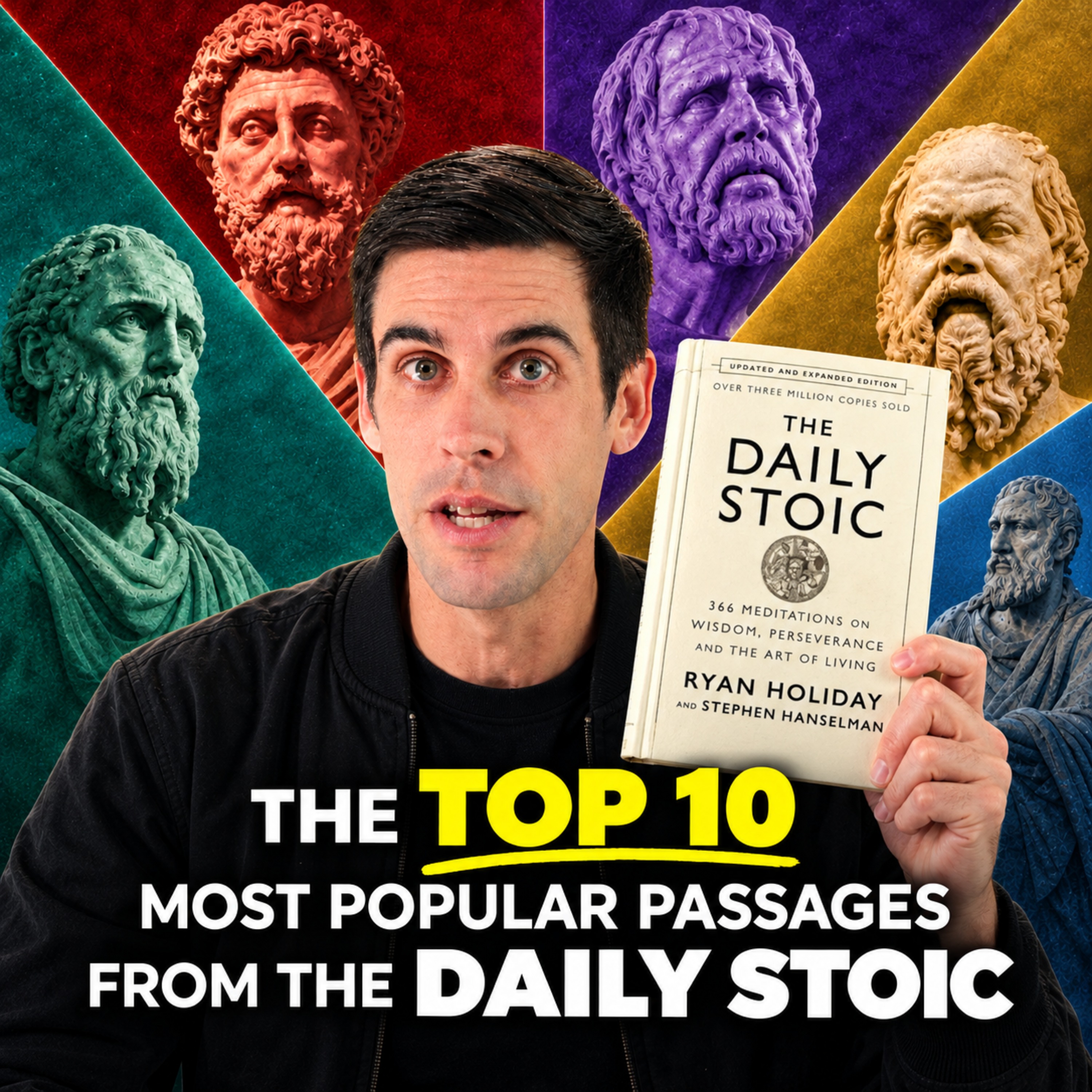
- The Top 10 Most Popular Passages From The Daily Stoic
In short
A 10-year anniversary episode where The Daily Stoic’s host reads the “10 most popular” passages from the book, explaining why they resonate and how to apply Stoic ideas day to day.
Guest backgrounds
No guests are interviewed; the episode features the host and references historical Stoics (Epictetus, Seneca, Marcus Aurelius, Zeno, Seneca) plus psychologist Albert Ellis and philosopher Nietzsche.
Key claims
choose the person you want to be and then act; treat obstacles as opportunities; observe cause-and-effect in your thoughts (CBT-like); aim for progress, not perfection; seek mentors; cooperate with others; take walks to refresh the mind; practice makes you the “project”; remember death as an equalizer; accept (and even love) what happens (amor fati).
Notable examples
archers aiming at targets; forgiveness when hurt; walking for creativity/problem-solving; Alexander the Great and a mule driver meeting the same end.
Written by AI. May contain mistakes.
Chapters
1:41
Reflecting on 10 Years of The Daily Stoic
Discussion on the journey of The Daily Stoic and its new edition.
“366 short meditations, one for every day of the year, including sleep years, that was designed to teach you about stoicism and to help you actually practice it.”
5:50
The Most Popular Passages from The Daily Stoic
Preview of the 10 most popular sections from the book.
“It's signed, numbered, there's gold foil end pages.”
7:01
Be the Person You Want to Be
Exploration of Epictetus's philosophy on personal identity and action.
“I'm going to read to you the 10 most popular sections of the Daily Stoic that have resonated with people all over the world.”
8:13
The Obstacle is the Way
Understanding how obstacles can lead to personal growth.
“While it's true that someone can impede our actions, Mark Stavilius famously says in meditations, they can't impede our intentions or our attitudes, which have the power of being conditional and adaptable.”
9:46
Observe Cause and Effect
Examining the importance of recognizing thought patterns.
“Through the work of the psychologist Albert Ellis, stoicism has reached millions of people through what's known as cognitive behavioral therapy or CBT.”
10:49
Measuring Our Days
A look at how Stoics approached the idea of perfection and daily efforts.
“December 15th, a simple way to measure our days.”
11:40
Finding the Right Mentors
Exploring the importance of mentorship and historical wisdom.
“Seneca's great line was that we don't get to choose our parents, but we do get to choose whose children we are going to be.”
15:17
The Purpose of Morning Routines
Explore how Marcus Aurelius emphasizes the importance of working with others.
“Marcus Aurelius was the emperor of Rome.”
16:46
The Benefits of Walking
Discover how walking can refresh the mind and stimulate creativity.
“Seneca believed that every person should take wandering outdoor walks.”
18:16
The Inevitability of Death
Understand the Stoic perspective on death as a great equalizer.
“Professionals don't have to justify spending time training or practicing their work.”
Show all 11 chapters
20:18
Embracing What Happens
Learn about the Stoic practice of accepting and loving your fate.
“November 1st, Accepting What Is Something happened that we wish had not.”

Ask about this episode
Get the gist, explore an idea or ask about something said.
 Claude
On The Daily Stoic, what are the key points of this episode?
Searching your listeningTranscript
Automatic transcript. May contain errors.
0:00Ryan Holiday: Look, hiring is make or break for a business, especially if you're a small business. You can't just hope that you find the right people. Hope is never a strategy, but when it comes to recruitment, it's not going to work. So when the pressure's on and you need the right hire, this is a job for sponsored jobs. Indeed, sponsored jobs gets you the quality candidates when you need them the most. It's how you get your job seen. And with Indeed Sponsored Jobs, you'll get matched with and hire quality candidates who can drive the results you'll need. And plus, with Indeed Sponsored Jobs, you only pay for results.
0:35Ryan Holiday: People are finding quality hires on Indeed right now. In the minute or so we've been talking here, companies have made dozens of hires on Indeed, according to Indeed data worldwide. So join the 3.3 million employers worldwide that use Indeed to connect with quality talent that fits their needs. And listeners of this show will get a$75 sponsored job credit to help your job get the premium status it deserves at Indeed.com slash podcast. Just go to Indeed.com slash podcast right now and support the show by saying you heard about Indeed on this podcast. Indeed.com slash podcast. Terms and conditions apply.
1:09Ryan Holiday: If you're hiring now, then this is a job for Indeed sponsored jobs. Welcome to the Daily Stoic Podcast, designed to help bring those four key Stoic virtues, courage, discipline, justice, and wisdom into the real world.
1:28Ten years later, this is new again.
1:32Ryan Holiday: It seems unbelievable, but it's true. Ten years ago today, we published a book called The Daily Stoic. And the idea was simple. 366 short meditations, one for every day of the year, including sleep years, that was designed to teach you about stoicism and to help you actually practice it. Now, I obviously could not have imagined where the book would go. If I had, it would have been not just egotistical, but basically insane to predict any of this. Something like 3 million copies have been sold now. It's been translated into 40 languages. And I've heard from, you know, athletes and soldiers and CEOs, parents, heads of state, students, stay-at-home parents, and everyone in Tweet.
2:22Ryan Holiday: People keep it on their nightstand. They carry it in their bags. They listen to it on their commute. They give it to friends, come back to the same pages over and over and over and over again, Which is why I'm excited to be able to say that 10 years later, we are releasing it again. Not with a new cover slapped on it or commemorative foreword in front of what is effectively the same text. But no, we went back through it page by page and made the book better. And that might seem like a strange thing to do on a book that sold so well, but I think it would be stranger if it didn't. Because the whole point of stoicism is that you're supposed to keep progressing, keep examining yourself, keep practicing, keep getting a little bit better.
3:08Ryan Holiday: Keep learning, as Seneca wrote, to the end of your life. And I'm not the same person that I was when I wrote this book 10 years ago. I'm not the same person I was last year. When The Daily Stoic came out, I was 29, newly married, about to become a father. I've learned a little bit in the time since, right? Raising two boys, opening a bookstore, building businesses, losing mentors, succeeding at some things, failing at many others, living through a pandemic, writing a couple more books, thousands and thousands of these emails and podcasts, spending another 10 years reading Marcus and Seneca and Epictetus and the other Stoics.
3:48Ryan Holiday: So when Steve and I decided to go back through the Daily Stoic, we asked ourselves this question. If we were making the book today, knowing what we know now, how would we make it better? That's what we did. We revisited the texts. We added something like 60 new translations, give or take, including a bunch of Stoics who weren't in the first edition. We brought in Stoic ideas and concepts we wish we'd included the first time. We improved the stories and the meditations. We added illustrations and some bonus chapters. We revised entries where, you know, another decades of studying and practicing gave me a better sense of how to actually say what I was trying to say.
4:29Ryan Holiday: And I think the daily stoic, like basically anything in the stoic genre, isn't meant to be read once. It's supposed to be something you are reading, not something you're done with. Because maybe a passage that you barely noticed five years ago might be exactly what you need today. something you underlined at 25 could mean something different to you at 35. The words might be the same, but you aren't. I know I'm not. And so that's what the new 10-year anniversary edition of The Daily Stoic is. It's out in the world. And I'm excited to bring it to you. You know, it's been a crazy ride doing this book.
5:08Ryan Holiday: And I feel so grateful to all of you who've made it possible to listen to this podcast or subscribe to the email or read the book. Like, I just wouldn't have predicted any of this 10 years ago. I have no idea what the next 10 years will bring. I think Stoicism will still be relevant. You know, we have 2 ,400 years, give or take, of it standing the test of time. I think that's going to continue. I've changed a lot. The Stoic words, I think, still ring true. I want you to present in an even better form in this new edition. if you've had the Daily Stoic on your bedside, if you've marked it up, you dog-eared your copies, you've carried it from apartment to apartment.
5:46Ryan Holiday: I wanted to make something that was worth another decade. So that's what the leather edition is about. It's signed, numbered, there's gold foil end pages. It's a special cream paper. There's a cool ribbon in there. And by the way, if you want a signed page from the manuscript of this new edition, I'll send you that too. You can grab all that at dailystoic.com slash ds10. And let me get into a little special episode we have for you this weekend. Enjoy. A little over 10 years ago, I sat down to write this book, The Daily Stoic. We didn't know if it would work. We didn't know if people would be interested in it.
6:25Ryan Holiday: We didn't know who would be interested in it. We certainly didn't predict that it would sell millions of copies, be translated in 40 different languages, that it would influence teams on their way to the Super Bowl, special operators on the way to do dangerous heroic missions that it would reach all sorts of people who didn't think philosophy was for them and maybe didn't even know what stoicism was. This edition has become this edition, the 10 year anniversary edition. I know because of Goodreads and Kindle and Audible, which pages people have lingered on the most, which ones they've shared the most.
6:58Ryan Holiday: And that's what we're going to talk about in today's episode. I'm going to read to you the 10 most popular sections of the Daily Stoic that have resonated with people all over the world. So let's get into it.
7:17Ryan Holiday: May 2nd. Be the person you want to be. First, tell yourself what kind of person you want to be, Epictetus famously said, and then do what you have to do. For in nearly every pursuit, we see this to be the case. Those in an athletic pursuit first choose the sport they want, and then they do that work. An archer is unlikely to hit a target she did not aim for. The same goes for you, for all of us, whatever we are after. You are certain to miss the target if you don't bother to draw back and fire. Our perceptions and our principles guide us in the selection of what we want, but ultimately our actions determine whether we get there or not.
7:59Ryan Holiday: So yes, spend some time, real uninterrupted time, thinking about what's important to you, what your priorities are, but then work towards that and forsake all the others. It is not enough to wish and hope. One must act and act right. June 30th. The obstacle is the way. While it's true that someone can impede our actions, Mark Stavilius famously says in meditations, they can't impede our intentions or our attitudes, which have the power of being conditional and adaptable. For the mind adapts and converts any obstacle to its action into a means of achieving it. That which is an impediment to action is turned to advance action.
8:48Ryan Holiday: The obstacle on the path becomes the way. Today, things will happen that will be contrary to your plans. If not today, then certainly tomorrow. As a result of these obstacles, you will not be able to do what you planned. This is not as bad as it seems, however, because your mind is infinitely elastic and adaptable. You have the power to use the stoic exercise of turning obstacles upside down. The idea that takes one negative circumstance and uses it as an opportunity to practice an unintended virtue or form of excellence. If someone hurts you, it's a chance to practice forgiveness. If something is hard, it's a chance to get stronger.
9:34Ryan Holiday: Try this line of thinking and see whether there is a situation in which one could not find some virtue to practice or derive some benefit. There isn't one. Every impediment can advance action in some form or another. April 16th, Observe Cause and Effect. Through the work of the psychologist Albert Ellis, stoicism has reached millions of people through what's known as cognitive behavioral therapy or CBT. As a form of therapy, CBT helps patients identify destructive patterns in their thoughts and behavior so they can, over time, direct and influence them in a more positive direction. Of course, Marcus Aurelius had no formal training in psychology, but his words here are as important as any doctor's.
10:24Ryan Holiday: He's asking you to become an observer of your own thoughts and the actions those thoughts provoke. Where do they come from? What biases do they contain? Are they constructive or destructive? Do they cause you to make mistakes or engage in behavior you later reject? Look for patterns. Find where cause meets effect. Only when this is done can negative behavioral patterns be broken. Only then can real-life improvements be made. December 15th, a simple way to measure our days. The Stoics didn't think anyone could be perfect. The idea of becoming a sage, the highest aspiration of a philosopher, wasn't realistic.
11:07Ryan Holiday: This was just their platonic ideal. Still, they started every day hoping to get a little bit closer to that mark, to do a little better than yesterday. There was much to gain in the trying, they thought. Can you actually live today like it is your last? Is it even possible to embody completeness or perfection in our ethos, that is our character, effortlessly doing the right thing for a full 24 hours? Is it even possible for more than a minute? Maybe not. But if trying was enough for the Stoics, it should be enough for us too. June 7th, finding the right mentors. Seneca's great line was that we don't get to choose our parents, but we do get to choose whose children we are going to be.
11:57Ryan Holiday: We are fortunate that some of the greatest men and women in history have recorded their wisdom, folly, in books and journals. Many others have had their lives chronicled by a careful biographer, from Plutarch to Boswell to Robert Caro. The literature available at your average library amounts to millions of pages and thousands of years of knowledge and insight and experience. Maybe your parents were poor role models or you lacked a great mentor. Yet if we choose to, we can easily access the wisdom of those who came before us, those who we aspire to be like. Zeno, the founder of Stoicism, did both.
12:37Ryan Holiday: He had conversations with the dead, meaning he read the classic texts. And he also had a great teacher, Kratos, who is known in Athens as the door opener, which all great teachers are. Whoever we are lucky or unlucky enough to be born to is just the beginning of who we can learn from, who we can emulate and be led by. My kids actually saw an ad for this the other day on YouTube, and they asked if we could try it. And we did. We had a lot of fun. Whatnot is a totally different platform for buying stuff. It is a live shopping app. It's really fun because I think you want to see who's selling you this stuff.
13:18Ryan Holiday: You want to see what they have to say about it. Whatnot is where sellers shine and find their people. Repeat customers that come back to see your face instead of just a logo. Whatnot is the largest dedicated live shopping platform. Beauty, collectibles, electronics, luxury, fashion, even cookies. Sellers are building real thriving businesses. Anyone can sell. Your business can be big or small, can be just starting. And people selling on Whatnot sell 10 times more than on other marketplaces because you're not just listing products, you're building real connections with buyers. Whatnot users spend something like an hour a day on the app.
13:53Ryan Holiday: They're not just browsing, they're engaged, they're buying, they're coming back. You go live, you show off products in real time, and you turn what you love into real income. Search Whatnot, W-H-A-T-N-O-T in the App Store, download and start selling right away. We were looking to spruce up our front porch. The weather's finally getting better. We wanted to spend some time hanging out outside with the kids. So we got these awesome hammocks and we actually got them from today's sponsor, Wayfair. If you drove by our house, you'd see us out there with our kids reading. We've got this new kitten all hanging out in the hammocks.
14:23Ryan Holiday: It's been awesome. And that's because on Wayfair, you'll find quality materials that stand up to real life. They sell furniture and decor that's built to last. And when you shop with Wayfair Verified, it's your shortcut to durable pieces that are hand vetted by product specialists using their 10 point quality inspection. They've got thousands of products at every style and budget, whether you're simply replacing an appliance or transforming your home from top to bottom this holiday season. Wayfair has got great reviews as well so you can find more than 20 million verified five-star reviews from real shoppers find pieces made for real life and get even more value with wayfair rewards join wayfair rewards today and get five percent back on every purchase head over to wayfair.com to shop all things home w-a-y-f-a-i-r.com wayfair every style every home
15:16Ryan Holiday: July 21st. Made for working together. Marcus Aurelius was the emperor of Rome. He didn't have to get up early. He didn't have to get up and do anything. In fact, plenty of the emperors didn't. That's what makes it so remarkable that in 812 of Meditations, he says, whenever you have trouble getting up in the morning, remind yourself that you've been made by nature for the purpose of working with others. Whereas even unthinking animals share sleeping, he says, it's our own natural purpose that is more fitting and more satisfying. If a dog spends all day in bed, your bed most likely, that's fine.
15:55Ryan Holiday: It's just being a dog. It doesn't have anywhere to be, has no other obligations than being itself. According to the Stoics, though, we humans have a higher obligation, not to the gods, but to each other. What gets us out of bed each morning, even if we sometimes fight it like Marcus sometimes did, is to render works held in common. Civilization and country are great projects we build together and have been building together with our ancestors for millennia. We are made for cooperation, synergia with each other. So if you need some extra boost to get out of bed this morning, if you need something more than caffeine can offer, use this.
16:39Ryan Holiday: People are dependent on you. Your purpose is to help us render this great work together. And we are waiting and excited for you to show up. June 21st. Take a walk. Seneca believed that every person should take wandering outdoor walks. He said that so the mind might be nourished and refreshed by the open air and deep breathing. In a notoriously loud city like Rome, it was impossible to get much peace and quiet. The noises of wagons, the shouting of vendors, the hammering of a blacksmith, all this noise filled the streets with piercing violence, to say nothing of the putrid smells of a city with poor sewage and sanitation.
17:29Ryan Holiday: So philosophers went on a lot of walks to get where they needed to go to clear their head to get fresh air. Throughout the ages, philosophers, writers, poets, and thinkers have found that walking offers an additional benefit. Time and space for better work. As Nietzsche would later say, it is only ideas gained from walking that have any worth. Today, make sure that you take a walk. and in the future when you get stressed or overwhelmed, take a walk. When you have some tough problem to solve or a decision to make, take a walk. When you want to be creative, take a walk. When you need to get some air, take a walk.
18:10Ryan Holiday: When you have a phone call to make, take a walk. When you need some exercise, take a long walk. Nourish yourself and your mind. solve your problems along the way. May 5th, you are the project. Professionals don't have to justify spending time training or practicing their work. It's what they do, and practice is how they get good at it. The raw materials vary from career to career, just as the locations and the duration vary depending on the person in the profession. But the one constant is the working of those materials, the gradual improvements and proficiency. According to the Stoics, your mind is the asset that must be worked on most and understood best.
18:54Ryan Holiday: While we are making things in the world, we are also making ourselves. For the Stoics, we are both artisans and artifacts. Are you putting in the hours? December 18th, what comes to us all. Both Alexander the Great and his mule driver, Marcus Aurelius writes in Meditations, were brought to the same place by death. They were either received into the all-generative reason or scattered among the atoms. There aren't many truly egalitarian experiences left. When Benjamin Franklin observed that in this world, nothing can be said to be certain except death and taxes, He couldn't have known how good some people would get at avoiding their taxes.
19:39Ryan Holiday: But death? That's still the one thing that everyone experiences. We all face the same end. Whether you conquer the known world or shine the shoes of the people who do, at the end, death will be a radical equalizer, a lesson in abject humility. The next time you feel yourself getting high and mighty, or conversely, feeling low or inferior, just remember, we all end up the same way. In death, no one is better, no one is worse. All our stories have the same finale. November 1st, Accepting What Is Something happened that we wish had not. What's easier to change? Our opinion or the event that is past?
20:31Ryan Holiday: The answer is obvious. Accept what happened and change your wish that it had not happened. Stoicism calls this the art of acquiescence, to accept rather than fight every little thing. And the most practiced Stoics take it a step further. Instead of simply accepting what happens, they urge us to actually enjoy what has happened, whatever it is. Nietzsche, many centuries later, coined the perfect expression to capture this idea, amor fati, a love of fate. It's not just accepting, it's loving everything that happens. To wish for what has happened to happen is a clever way to avoid disappointment, because nothing is contrary to your desires.
21:20Ryan Holiday: To actually feel gratitude for what happens, to love it, that is a recipe for happiness and joy.
21:51Mississippi is breaking new ground for business at a historic pace. Amazon, XAI, Toyota, Milwaukee Tool, and GE Aerospace have all tapped into our deep talent pool, prime geographic location, and welcoming communities. This is bigger than mega sites. Mississippi offers a thriving business ecosystem with affordability, greater collaboration with energy partners, and record-breaking speed to market. Looking to expand? Break new ground at Mississippi.org.
From the publisher
The whole point of Stoicism is that you’re supposed to keep progressing, keep examining yourself, keep practicing, keep getting a little better, “keep learning,” as Seneca wrote, “to the end of your life.”
The new 10th Anniversary Edition of The Daily Stoic is out NOW! 👉 Grab your copy here: https://store.dailystoic.com/pages/the-daily-stoic-10
🎟️ DAILY STOIC LIVE | Ryan Holiday is coming to a city near you! Grab tickets here | https://www.dailystoiclive.com/
🎙️ AD-FREE | Support the podcast and go deeper into Stoicism by subscribing to The Daily Stoic Premium - unlock ad-free listening, early access, and bonus content: https://dailystoic.supercast.com/
✉️ FREE STOIC WISDOM | Want Stoic wisdom delivered to your inbox daily? Sign up for the FREE Daily Stoic email at https://dailystoic.com/dailyemail
--
Stop online threats before they become real-world attacks. Visit ironwall.com/DAILYSTOIC and request a free Risk Assessment to see exactly how exposed your executives are.
Hosted on Acast. See acast.com/privacy for more information.
More from The Daily Stoic
All episodes
We use cookies.They keep VO running smoothly and help us improve it. Privacy policy