
 Ask ChatGPT



Host: Ryan Holiday
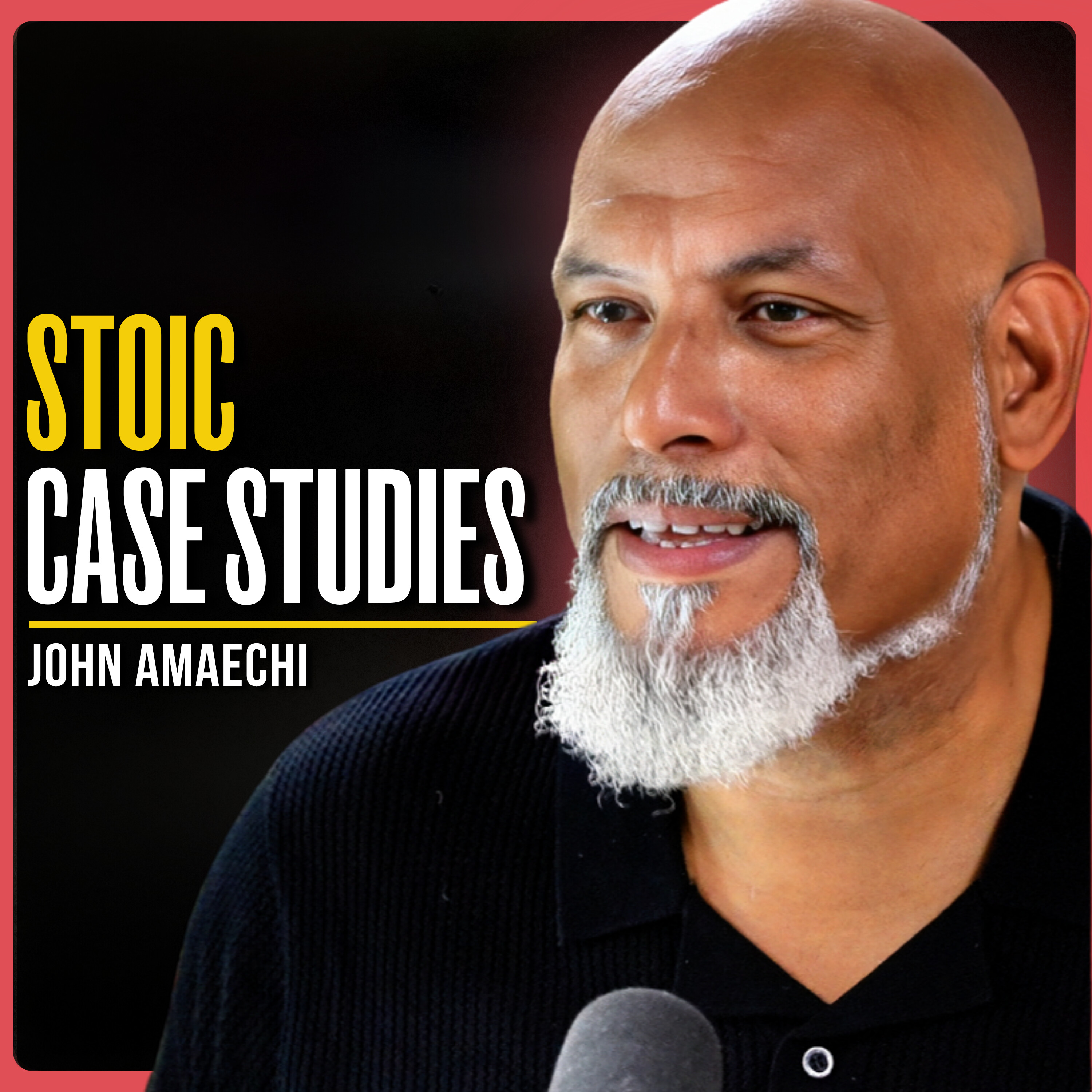
John Amaechi, psychologist, consultant, and former NBA player
In this episode, Ryan Holiday continues his conversation with John Amaechi, focusing on moral challenges and ethical dilemmas that have persisted through history. The discussion revolves around integrity, the significance of loyalty, and the complexities involved in making sacrifices for principles.
Written by AI. May contain mistakes.

Get the gist, explore an idea or ask about something said.
 Claude
On The Daily Stoic, what are the key points of this episode?
Searching your listeningAutomatic transcript. May contain errors.
0:28Why choose a Sleep Number smart bed? This message comes from Capital One. The Capital One VentureX Business Card has no preset spending limit, so the card's purchasing power can adapt to meet business needs. Plus, the card earns unlimited double miles on every purchase, so the more a business spends, the more miles earned. And when traveling, the VentureX Business Card grants access to over a thousand airport lounges. The VentureX Business Card. What's in your wallet? Terms and conditions apply. Find out more at CapitalOne.com slash VentureX Business. What can 160 years of experience teach you about the future?
1:05When it comes to protecting what matters, Pacific Life provides life insurance, retirement income, and employee benefits for people and businesses building a more confident tomorrow. Strategies rooted in strength and backed by experience. Ask a financial professional how Pacific Life can help you today. Pacific Life Insurance Company, Omaha, Nebraska, and in New York. Pacific Life and Annuity, Phoenix, Arizona.
1:33Welcome to the weekend edition of The Daily Stoic. Each weekday, we bring you a meditation inspired by the ancient Stoics, something to help you live up to those four Stoic virtues of courage, justice, temperance, and wisdom. And then here on the weekend, we take a deeper dive into those same topics. We interview Stoic philosophers. We explore at length how these Stoic ideas can be applied to our actual lives and the challenging issues of our time. Here on the weekend, when you have a little bit more space, when things have slowed down, be sure to take some time to think, to go for a walk, to sit with your journal, and most importantly, to prepare for what the week ahead may bring.
2:24Hey, it's Ryan. Welcome to another episode of the Daily Stoic Podcast. My wife came in the office and said, dude, everyone loves the guest today. And I go, who? What? I sort of lost track of time. I'm talking about John Amache, who was the guest. We ran part one of the episode earlier this week. had gotten there a little early and he just like had everyone in the store eating out of the palm of his hand. A big personality, a big dude. He's incredibly tall, which is why he was picked to play basketball, I imagine. I told this story a little bit in part one. He doesn't start playing basketball until late in high school.
3:05He's English. So basketball wasn't, you know, sort of the sport people are pushed into there. You know, ends up coming to America, plays college basketball, goes into the pros. As I said, in part one, famously turns down$17 million from the Lakers in 2000 to play in Orlando, where he was getting paid$600 ,000 a year. So a really principled, interesting kind of out-of-the-box guy, after he played basketball, he went on to be a psychologist. He got his PhD, and now he works with teams and high performers and all sorts of interesting people. And that's really ended up being the theme of both of these episodes.
3:42This idea of integrity, living by your principles, being a good leader, and how, you know, how you do one thing is really how you do everything. And we really ended up discussing a bunch of sort of fascinating stoic case studies. And I think you'll really like this episode. As I said, John is an English psychologist, a consultant, former professional basketball player. He played at Vanderbilt and at Penn State. He had a professional career in the NBA. And then after he retired from the NBA, got his PhD in psychology, he wrote a memoir called Man in the Middle. He now has a leadership book called It's Not Magic.
4:18He signed a few copies of It's Not Magic here at the Painted Porch. Let's get into it.
4:26Let me ask you, there's a story that Stoics loved that I wrote about in Right Thing right now. And I think about a lot. So there's this Roman general named Regulus and he's fighting Carthage. and he ultimately ends up getting taken prisoner. So he's rotting away as a prisoner of war in Carthage. And finally, you know, the war goes on. And finally, Carthage, seeing an opportunity, says, you know, we'll let you go back to Rome and we want you to negotiate a cessation of hostilities. But the condition is, if you can't, you have to come back. You have to give us your word that if you can't successfully broker this peace, which he claimed he thought it could do, you have to come back.
5:04That seems a bit unrealistic to people, but there's all sorts of conventions that we agree to as society, particularly in war, that we agree to. In war, they used to have prisoner exchanges where you have a prisoner, we have a prisoner, we'll swap, but neither of them can go back in the army. And it's an honor system. So he takes it. So he travels back from Carthage all the way to Rome. As he gets to Rome, he'd been in Carthage a long time. he could see that they were actually losing the war, that they were sending him to negotiate not from a place of strength, but weakness. And so he goes, he delivers their offer.
5:37He says, these are the terms. And he says, but to the Roman council, he says, look, but before you make your decision here, let me say, I don't think you should take this offer. I think you can win this war. And I think they're about to lose it. So I don't think you should do it. And they go, thank you very much. Okay, we're not going to do it. And so everyone's excited. Regulus is home. They're going to win this war. And he goes back to his house and he starts packing his things. And his wife is stunned. His children are stunned. The Roman council is stunned because he hadn't told them that he was planning on going back.
6:14I said, what are you talking about? And he says, I gave them my word that if I could not broker a peace, I would return. And he goes back where they promptly put him to death, right? They don't go, thanks for keeping your word. They go, you failed. You're worthless to us now. And he's trampled to death by an elephant. That's how they kill him. And right before he goes back, someone asks him, they go, this is insane. You gave your word to the enemy. You don't have to keep it. And he says, look, if I keep my word, and I think he knew what would happen. He says, if I keep my word, I alone will suffer.
6:47But if I break my word, all of Rome will suffer. And his point was, no one will trust a Roman prisoner, dignitary, ambassador, general ever again, because they'd just been betrayed by him. And I think he also thought the converse, that if he kept his word, even though he would go back and face certain death, that people would learn, oh, you can trust a Roman, even when it's not in their direct interest. But I'm curious your reaction to that story. It's not quite turning down$17 million. No, no. But it is this idea that, hey, the most important thing here is I do what I say or I keep my word. Oh, God.
7:30I'm going to use the word context again. So I can see why the story appeals. Yeah. It feels removed from reality because we're talking about a historical thing. Thousands of years ago. And the reality is if you are being held hostage by somebody who says, if you, I don't know, if you convert to Catholicism, we'll let you go. Or we'll at least let you live. Yeah, it's under duress. Then you should convert to Catholicism. Sure. I'm an atheist. You should convert to, I would do it right now. Yeah, I'll convert to Catholicism. I will go through the motions of anything you tell me to do, because this is not a chosen context for me.
8:10But just to play devil's advocate here, You're Brittany Griner. You have been captured playing basketball in a foreign country. And they come into your prison cell and say, if you make a statement against your country or you admit to a bunch of false crimes or whatever, we'll let you go. Do you do it? The false crimes I'd be more hesitant about. The statements about the country, absolutely. Do that right now, today, right now. Do it. Nobody, at least nobody should be fooled by this idea that dying in order to say America is the greatest country in the world, in order to dying, in order to say Britain is the greatest country in the world.
8:55Many Brits believe that. I don't think it's valuable as a thing. So it's not something that we should die for. It's not sensible to die for. You shouldn't die in a dispute with your neighbor because they want to take your flag down. These are not good ways to die. These go in the Darwin Awards, right? They're not good. They're not sensible. This man had a daughter, family, and wife and partner, and went to be trampled by an elephant in a meaningless display for people who never valued him in the first place. And certainly... But do you think it's meaningless if we're talking about it 2 ,000 years later as an example about the power of keeping your word?
9:35But I think there are better examples of the power of keeping your word that don't require your death. Hmm. And I think they're just as powerful. I always think these stories, and again, this is not to disparage this. I think there's great things about this. Even though I was listening to it, it was forcing me. It's that brilliant thing again, where you hear a story and it forces you to suddenly stress test some of the things you believe. And it's like, I do believe that a person's word is important. I think one of the few reasons why people say me instead of, I don't know, Simon Sinek or something.
10:07One of the few reasons that people do that is that there is a real sense of authenticity and principle and integrity. And I love that for me and for my team. I'm not going to be kidnapped by, I don't care which entity it is, whether it's ICE or whether it's some force of the European Union or some terrorist organization. And I'm not, my word with them, our contract is moot. Well, I think that's what's so interesting about this story is, and I think the ancients did a better job than we do of taking events in literature and history and myth and using them to ask these questions. Like what's so interesting about a lot of the Greek plays is they were writing the same story over and over again.
10:49And each playwright is, one is arguing the same story means this. The other one is taking the same story and inverting it. You know, should she have murdered her children to spite her husband? And, you know, from one lens, it's the most horrific crime ever. And then another version, she's somehow perversely the hero of the story. It's this idea you take the event and you you can always take another slice on it. And so, yeah. Right. Is this story illustration of the power and the length to which one should go to keep their word? Or is this a proud, foolish man who is abandoning his family to keep a promise to an enemy because he's play acting, you know, the hero?
11:31Right. And so you can see it all these different ways. So I think that's what's so fascinating about it. Just I think this is why people are fascinated by your story, because it's like, OK, either it was the bravest thing to do or the dumbest thing to do. And you can see it either way. Oh, no, you should see it both ways. Yeah. This is the thing about when people reject broadly everything related to identity at this stage, it seems to me. But intersectionality is such an interesting thing to look at. It means that I can be both brave and courageous and have integrity and incredibly stupid and without foresight and without kind of emotional foresight because I kind of intellectually knew what was happening.
12:12I had no idea about the impact it would have me because I just didn't explore it well enough. And maybe if I had, I would have done something different. But so I can be all of those things at the same time. I was all of those things at the same time. But that is for you, for other people's gaze. Right. They look at me with that multiplicity of things. Whereas I, even as I'm talking about this, the image in my brain that I'm seeing is the pages of all these books flying around me in chaos. And so if you're looking from the outside, it's like, what the hell is going on there? But I'm sat at this table and the air is still and I know who I am.
12:48And that's the bit that I've got. And I know it looks confusing from the outside, but it is confusing. No, no. And if you think they're simple and black and white, you're not doing any real thinking. It's probably coming from some sort of ego or emotional place. There's a really great F. Scott Fitzgerald story about this guy who's asked to sort of do something at work. He's like, he has to screw over these farmers for his Wall Street boss. And at the end, in the meeting, he ends up telling the farmers what's happening and screws his boss. And Fitzgerald does this great paragraph where he sort of riffs on how it's this brave, magnificent, selfless thing until you think about he has a wife and kids and now he just lost his job.
13:33And so, you know, there's the principle and there's the consequences of the principle. And if you're a lone, solitary figure, it's clearer than if you're part of a community, part of a group. Okay, you go to this Regulus story and he breaks his word, right? And it's interesting, I didn't think about it until this other moment. What if there's other prisoners? What if he goes back and they kill him, but they spare the other prisoners? What if by not returning, Carthage just immediately executes the other prisoners that remained behind? All of our moral questions exist in a context or with overlapping other moral considerations.
14:10And so there's always this complexity to it. I do think that changes it, right? Sure. It remarkably changes it, but it changes it in a way that is simpler because the contract of integrity has to exist between, that's why I focus on integrity with myself. His contract now isn't with his captors, it's with the other prisoners. Exactly right. And they don't even have to know that this is a thing, but I know that it's a thing. I know if I return, 60 people go free. Yeah. It's easy for me. No brainer. But the interesting part is when you start asking how many people. Sure. It's the same thing, though, as$17 million.
14:47Is there a number? If it was$50 million. Well, you said$100 million. You said$100 million for Rory. And I was like, oh, am I that? Do I have that much integrity? Sure. I'm not sure I do. I'm sure I do. Sure. Yeah. I'm certain of it because I love money. I'm not one of these people who's like, oh, no, a cabin in the wood. I like nice stuff. And I'm huge. So everything I want is really expensive, right? I can't, I'm carrying my luggages with me for the next 10 days. It's carry on. Because if I put it underneath and it gets lost, I'm not just replacing it right away, right? And so I have become accustomed to a life that has got luxuries in it that aren't just little luxuries.
15:29They're really nice. And so I like money a lot. I like being aligned with my principles better. And I also like the fact that I'm not sure anybody can say they have principles until they've been dinged. Yeah. It's not a principle until it costs you money. Has run into it. And it could be money. It could be status. It could be something else, but it's got to be dinged. Somebody's got to tap that thing for you to know it's there. and I'm not sure that I would feel as comfortable if I hadn't had it dinged a little bit and significantly. I used to bank with Goldman, not Goldman Sachs. Who's the bank that crashed?
16:04Now, it's Lehman Brothers and I should know that because I lost everything. Wow. Lost everything. So what I did have was gone. I picked Lehman because they were the oldest bank and I thought they would be the most conservative and the least likely to be trouble. And then I woke up one morning and they were gone. So in the end, if you'd taken the money, you'd end up in the same place. Yeah, I was penniless and I ended up living in my sister's front room for a while. This is after being an athlete. Actually, I think this is the first time I've mentioned it ever. But as most people imagine this transition that was amazing, I remember I was one of the three athletes chosen, former athletes chosen to be an ambassador for the London 2012 Games.
16:46And I remember in the run-up to the Games, I was living in my sister's front room, getting down to London on the train, arriving and being kind of tubing and walking, but I had no money for anything else. And so here I was, I go to an event where the Olympic, you know, those people, officials were showing up and I would be grabbing food, putting into my thing, grabbing bottles of water, putting, cause I had nothing for anything else. And I was just playing at having money because people just imagined I did. I assumed you're an MBA player. Yeah. Do you want to go to dinner tonight? Uh, no, sorry, I really can't.
17:23There was a whole period like that. Well, and that's rough on your identity if you don't have some sense of who you are outside of the stuff or the status. Yeah. And, you know, it didn't mean I had nothing, but it meant I had very little. And it meant that I was, you know, starting my business at that point and trying to kind of build it up. Having gone through that, I thought I'd have a bit more of a cushion at that stage. Sure.
17:55We just took our kids to an outdoor performance at the Nutcracker. They had a snow cone. And then they went insane in the car ride home. And one of the things I try to remind myself when that's happening is that I don't control my kids' behavior, especially when they're too far gone like that. But I do control how I respond, right? That's stoicism. But it's also what Dr. Becky talks about. Dr. Becky is a clinical psychologist and a best-selling author, and she founded Good Inside, which is there to give parents practical, actionable tools for handling those everyday challenges with confidence.
18:30My wife introduced me to Dr. Becky's books. I love them. I've recommended them a million times. I've had her on the podcast. And as it happens, Dr. Becky is hosting two live Q &A events for good inside members. I am one of them. She signed me up for it about a year and a half ago. I've loved it ever since. On December 1st, you can join Dr. Becky for her How Not to Raise Assholes event, which is about avoiding entitlement and raising kind, empathetic kids. And on December 15th, she's hosting her How Not to Lose It over the Holidays event, which I'm sure we could all use. As I said, I'm a big fan of Dr.
19:07Becky. She's been a great influence for me as a parent and just as a human being. And Daily Stoic listeners can join for 15 % off with code STOIC15. You just got to head over to goodinside.com to catch the events. Thanks to Toyota Trucks for sponsoring this episode. When I bought my ranch in 2015 out here in Bastro County, I drove my car about halfway down the dirt road that we live on, thought this isn't going to work, stopped, parked it, walked the rest of the way home, borrowed my wife's car, drove into Austin and bought a truck. What I bought was a Toyota Tacoma. And this truck wasn't just transportation getting me to and from my house.
19:49It unlocked a whole different style of living for us, not just on the ranch, but in our little Texas towns. There were places I could go now that I couldn't go before, especially out here in the piney forests, through the fields, and on the unpaved roads like the one that I lived in. We got to go deep into the hill country's wild beauty. We've driven all the way out to East Texas. We've driven across the country. And by we, I mean not just my wife, but both my kids who I drove home from the hospital in that truck. Toyota trucks are built for those who understand that the best adventures happen when you're willing to veer off course, because you never know when you'll end up on a Toyota adventure detour.
20:33And of course, this is stoicism, too, because every detour, every obstacle is an opportunity. But it's helpful if you can handle the difficulty inherent in that. If you've got the resilience and the right companion to make it wherever the road takes you. Discover your uncharted territory. Learn more at toyota.com slash trucks slash adventure dash detours.
21:00One of the reasons people think that integrity is too hard or too expensive or whatever is they don't just imagine the thing you'll get for it. They've extrapolated out. You get the 17, you invest it and you enjoy it your whole life, whatever. right and i think one of the things that it's not that you know sometimes people think that the memento mori stuff for stoicism or the the focus on all the things that could happen is a little dark but it's also freeing because it's like you don't actually own the money either it can get taken away like that right your life can get taken away like that and so in that moment as you're bleeding out on the side of the street you're not like i'm so glad i took the 17 right Because you don't get that then either.
21:42But you do get to keep the integrity for the few seconds. So you got to ask yourself, you know, hey, what actually matters? What do I actually possess? What's truly mine? So you watch these people sell their souls. I mean, we're seeing this now in American politics, sell their souls to get a job or to keep a job that you can lose for other reasons. By the way, everyone else who's made that same bargain, did it pay? Are you sure you're being as self-interested as you think you're being? Or are you actually just deluding yourself? People will sell their soul for an IOU that you're not actually going to get to cash.
22:23That's very true. Yeah. I think some decisions are worth compromises. I'm not sure this example you gave about the politicians are selling out, but I've just gone through the process. What do they call it? When you get rid of your citizenship. I used to have American citizenship. Oh, renounce your citizenship. So I renounced my citizenship a couple of years ago. What for? Some people are doing it for tax reasons. Sometimes you have to do it for another citizenship. It's not for tax reasons. So I work with some entities in the government in the United Kingdom where dual citizenship is inconvenient for working at security clearance levels.
22:52So that's one of the reasons. It's not the only reason. The other reason is that if I'm going to be associated with a country that I am disappointed in, I need to be associated with only one country I'm disappointed in, right? Right. And so that was a big part of it. It's like, I'm really disappointed. I used to live in this country. I lived in Scottsdale, Arizona, and I thought this country would be my home. I remember when I played in the league, I would come home to the UK. I'd do a couple of basketball camps and I'd see my family and then I'd leave. And when I was leaving to come back to Phoenix, I knew I was coming home.
23:28And then I've realized that that is not possible for me. And that realization that it's not home here because it feels... So, for example, I'm going to South Korea. I'm going to Shanghai. I'm going to Dubai in the next three, four weeks. And all of those places feel safer to come to. From a governmental point of view, this is not about people. This is just the government. When I come through the airport, I know that nothing will happen to me. There's a steady hand on the wheel. Whereas one of my colleagues, I don't know if this is just administration-based, but one of my colleagues, who is a French national, was detained for 36 hours.
24:07She's a sociologist. And that's terrifying. And I've never been detained all the times I've run in and out of China, despite the fact that I'm a member of Amnesty International and vociferous about my comments and have been in the past about China, right? So that's why. But it means I had to go through the O1A visa process, which is terrifying. I had to give them the links and passwords to all of my social media. And my team and I have made a decision about what kind of social media we would do during the process. And so even there, that feels like a compromise to my principles. But like there's a larger principle I'm trying to protect.
24:44And not just my self-interest in earning money in America. But so, yeah, there's always a compromise to this. Yeah, right. Right. Where do you like the the the person who is unable to compromise? Again, if you're the lone wolf, you know, maybe you get to do that. If you're the monk, you get to do that. One of my favorite stories about the Stoics and this idea is there's this guy, Cato, who's a famous Stoic. He's famously principled, never compromises. And Pompey the Great comes to him and proposes an alliance that, you know, back then it would be like your daughter marries me. or our kids marry, proposes a marriage alliance.
25:24And Cato says, like, get the fuck out of here. You know, he says, I will not be bought by way of women's apartments, you know. And so Pompey the Great, you know, because alliances are a part of politics, allies with Caesar instead. And Plutarch, the ancient historian, goes, here in this moment, because of his principles, Cato brings about the destruction of the Republic that he was so principled in defending and goes to his death defending. I mean, he commits suicide rather than live in Caesar's tyranny or Caesar's Rome. But if he just let his daughter marry Pompey, which by the way, she wanted to do, like it wasn't an alliance.
26:10It wasn't a false. Yeah, like the women were told, and again, these are all stories more than they are exact historical events, I'm sure, but like the women were pro the alliance and he wasn't. And so to the ancients, this was an example of sort of purity, which is wonderful philosophically, but problematic politically, actually intersecting and bringing about, you know, the exact same, the exact thing that you are principally defending. And so, yeah, we often think of compromise as this bad thing, but it's what makes the world work. But yeah, because compromises, that's one word for it. But in science, if we are unmoved by evidence, and also even emerging evidence, which forces you to think slightly differently, then there'd be trouble.
26:58There'd be dragons, right? So I like the idea that people change my mind. I like the idea that people force me to kind of ting like a tuning fork my principles and say, maybe I'm taking this the wrong way. And then even in the book, I write about this idea of I'm amazed by people who want to be right right now. And that's what when they really talk about principles, what it really is, I want to be right right now versus winning in the long run. Yes. And winning not just as a number, but as this bigger picture thing that they've really visioned and looked at. Yeah. And to me, that's another one.
27:34And that's, you know, I look at that story and it's like, I love the purity of the principles. Yet at the same time, it almost sounds like people like that, they never touch their principles anymore. They're protected. They're covered in, what's that poppy stuff that you put them on? Bubble wrap, right? They're covered in bubble wrap and they haven't touched them in so long that they now just have to kind of assume where it is. Yes. And I think there's something about, actually, in the larger picture of this, if I just look down two months or three months or five months or a year. Does this principle really make sense in the scheme of things?
28:09Well, that's what leadership is, right? And I think it's not this magical thing. It's this ability to see where everything fits in its place and to be able to go in the small picture, this seems like it matters, but in the big picture, it doesn't. Or conversely, you know, this small thing actually matters a great deal. And that's what leaders do. And they take those stands even, you know, you can imagine him making that, not wanting to make that alliance because it would dent his perception of being the principled person who's above such things. Yeah. There's a hubris to that. It's made me think of this principle thing.
28:49It's made me think of this. There was this unhoused guy. I lived off Regent's Park, not the posh bit. I always say Regent's Park's adjacent, which for people who live in London know that's very posh there but houston station is right around the corner it's not posh that's where i lived and i had this ground floor flat and there was this i was i always used to play music i was playing some sam cook and something else and this unhoused guy was was he just stood there and he had a piece of paper and he started i've got it in my house this picture of sam cook that he did with a sharpie wow i thought it was remarkable and he gave it to me i said you know let me give you some money for that he said no no i just said you know really use the bathroom and i was like it makes you think right one of the things about not having a house sure that's one of those how to impugn someone's dignity more than find you can't find a place to go to the bathroom so came in used the bathroom i just don't had a barbecue so i had some food left over and so i packaged it up when he was about to leave i said here's some stuff and i said what's in it he's what's in it that's a fair question, right?
29:50What's in it? And I said, well, there's some broccoli and some chicken or whatever. I said, I can't take it. I'm vegan. And it was such an interesting thing for me because my initial thing was like, am I being punked? Are there cameras around right now? Because it's like, this man was not a lot of bone, not a lot of skin on the bones. And it's like, wow. And so, okay. So I separately wrapped some of the veggies up and gave them that, but it's just So one interesting thing, I'm not sure you talk about, is there a number? I'm pretty sure if I get hungry enough, I don't eat fish or seafood, not for any intellectual reasons.
30:23I just don't like the texture. But yeah, yeah, I'll eat that. I'll eat that. Awful, I'll eat that. There's almost nothing I wouldn't do in order to not even survive, but feel like my belly was full. Right. And I just, I still haven't examined that story in my head, but it just sparked me there. I want a fascinating situation to maintain that principle. Yeah. Well, and look, you said no one should ever die for their country or, and it's, it's interesting because there's all these contexts that change it. Like I, I brought up Brittany Griner and I think that's sure. She's a basketball player who gets taken prisoner.
31:01What are her loyalties? You know, uh, but what if you're a POW, like you're actually a prisoner of war and you're fighting in said war? Well, now, you know, maybe you swore an oath. Maybe you would be used as propaganda against. So it's like depending on our roles, depending on our obligations, these things take on different contexts, right? They do. They do. I still maintain. But, you know, are we really in an age where, oh, I suppose, you know what, that's ridiculous. I've just answered my question before I asked it. I was going to say, are we really in an age where a normal person of good conscience couldn't imagine that if somebody was taken hostage, whether it be by a terrorist organization or a foreign power, and you suddenly saw them on the news saying, you know, in a nice suit or whatever else, and food around them, saying, yeah, America is the best place, the worst place in the world.
31:56And I am so glad that I'm here and these people are taking care of me. I wanted to believe, as I was saying it, that, you know, normal people with good conscience would see through that and see that it's a survival strategy. I could understand and would empathize with anyone. Would I hope to hold myself to a higher standard? Oh, come on. No, you've got people who love you. I don't know. I'm writing, I'm writing a book right now about this guy, James Stockdale. Do you know who Stockdale is? He's one of the prisoners of war in Vietnam. So he shot down over Vietnam. John McCain is, I'll give you a Yeah, yeah.
32:27Do you know the John McCain story? He's a prisoner. But you know, he could have left. Yes. So do you think he should have left? I'm not sure that he did. I'm not sure. I don't know the story in full, right? But I don't know what he did. So his father is the theater commander in the area. So as soon as they find out they have basically the admiral's son, they're like, you can go home right now. Because they wanted to send the message that it was a fundamentally morally unjust war that was being waged hypocritically by the capitalist powers. Here, the admiral's son is getting special treatment. So it's a trap, right?
33:07They're saying you can go because they want to use him leaving as a weapon of war. And this is putting aside whether we should have been in Vietnam or not, which we definitely shouldn't have been. But the regulation, the rule as the code of conduct that all the military guys had been under was that one, you cannot accept special treatment in exchange for testimony or special favors or whatever, but also that if prisoners would be released, they would be released in order of how long they'd been there. So there wouldn't be, oh, you're of a higher rank, you get to go home earlier or your dad is important so you get to go home earlier.
33:52So they're trying to get him to make an exception to not just embarrass the country, but to also break the spirit of the other prisoners. Yeah, I... But he has a family. Yeah, I think when you're part of an institution, if you adopt the kind of rules, especially military or pseudo-military institutions, I get that. That's what I mean. I suppose you have conflicting... Well, yeah, part of my challenge, though, is that the very people who would kind of look at that story and value it so highly are the same people who in their actual lives should really be wearing like an F1 driver's jersey. Right.
34:31You know, they should be wearing that jumpsuit with all the badges of all the compromises and gifts and promises that they've taken. And that makes it less powerful for me. The very people who speak of fidelity, for example, are the very people cheating. The very people who speak of the sin of homosexuality are the very ones with a boyfriend in the back. It's like I find it hard that some of these stories that are supposed to teach a way of life, a way of living more than a way of life, that they use as a weapon. But it's not even they're not consistent. It's that they use these things knowing that they don't believe these things.
35:08What an interesting weapon to have. You speak this way, whether it be from a pulpit or from a senatorial office or whatever else. You speak this way while you live a different way. It makes this thing that you're doing not a philosophy or a valuable insight to be shared. It's just a bludgeon for other people's children to die by.
35:36human your body has a performance superhighway 60 000 miles of blood vessels that deliver oxygen and nutrients to every cell this of course is your cardiovascular system it's the foundational system that powers everything we do both elite athletes and longevity experts invest directly in the cardiovascular system because supporting healthy blood flow is critical for energy, recovery, mental clarity, and overall performance. That's where human comes in. That's human with two Ns. They started out of research at the University of Texas near where I live and have 15 years of experience making award-winning supplements for nitric oxide production and healthy blood flow, now used by over 160 pro and college sports teams.
36:24human cardiovascular health daily is a plant-based and made from clinically studied ingredients like grapeseed and seed kelp extract it supports nitric oxide production for healthy blood flow and energy while also supporting blood pressure and helping support the delicate interlining of your blood vessels just two capsules each morning will power energy and recovery while also playing the long game by supporting long-term vascular health and healthy aging human has an exclusive offer for our listeners. You can visit human.com slash stoic for an extra 15 % off your first purchase. That's enter code S-T-O-I-C, stoic at checkout.
36:59That's human with two N's, dot com slash stoic for an extra 15 % off with code stoic at checkout. The wait is over. Dive into Audible's most anticipated collection, The Best of 2025, featuring top audiobooks, podcasts, and originals across all genres. Our editors have carefully curated this year's must-listens, from brilliant hidden gems to the buzziest new releases. Every title in this collection has earned its spot. This is your go-to for the absolute best in 2025 audio entertainment. Whether you love thrillers, romance, or nonfiction, your next favorite listen awaits. Discover why there's more to imagine when you listen at audible.com slash best of the year.
37:50Well, look, I think, and this is what I'm exploring in the book, like the same sort of rigidity or the sort of the commitment to the thing, even though it's bad for you, right? That makes, I think, that sacrifice seem so superhuman and impressive is also part and parcel of this war machine in a place that it shouldn't have been, that not enough people were questioning and not enough people were ultimately going, hey, I'm not going to be a part of that. principles and these stories of heroism and selflessness and whatever, they can either inspire, they can also be used to kind of keep people in line or get them to do something that is very much not in their self-interest, but seems like greatness, but is actually, you know, complicit in some larger flawed system or, and that's, you have to be able to zoom out and see history from all the different angles.
38:53And at least I would say this, so I don't necessarily agree with a lot of Senator McCain's policies. Of course, me neither. However, I do, and I don't know everything about him, but it does appear, I've met a couple of people who've met him in the past, before he passed. And I do remember that there's this story that I have been poo-pooing a little bit, right? And then there's him in the middle of his campaign with a woman who is most definitely a vociferous bigot, calling President Obama a Muslim, and he, in the calmest, kindest way, but also the firmest, most principled way, stops her in a way that is completely not in his best interest.
39:35Forget 17 million, there he lost. Or, you know, he's very much opposed to the Affordable Health Care Act, very much opposed to Obamacare, and would have liked to see it repealed. And he cast the deciding vote famously to prevent the effort to repeal it because he felt it was violating what he had talked about many times, which was the way the Senate procedures are supposed to be observed. And so there's a handful of moments. And I think that the tragedy of someone like McCain is not those examples. It's that he wasn't always those examples. But the other way to think about it is nobody is that all the time.
40:21Like Ta-Nehisi Coates had this great line where he's like, not everyone's Jackie Robinson and Jackie Robinson wasn't always Jackie Robinson. Very true. Sometimes people who are cynical or nihilistic can try to take moments of greatness like that and go, well, what about X, Y, and Z with that same person as a way of going, well, that wasn't great. And really it's more like, no, no, it definitely was great because of X, Y, and Z because they were able to do it in that, they were able to bat, you know, 400 in one season. The fact that they didn't do it all the time doesn't mean that they weren't great.
40:55It means that it's really fucking hard to bat 400. Yep. So I suppose, even as you said that part of my brain wanted to challenge it, right? So I think there's a difference between Jackie Robinson and Senator McCain or any senator, right? And I don't just mean historically in context. I mean, we reach into history for Jackie Robinson. Senator McCain reached out to the world. He chose to be a senator. He chose to raise unbelievable Machiavellian amounts of money, right? to do the thing that he did, as all senators must. We place him there. And he didn't necessarily choose it. It was a product of his time and who he was and some good decisions and some bad decisions.
41:38But we don't imagine that his whole life somehow had to be. But if you choose to say that I am a representative of all of the people in my state, such a remarkable statement to make, right? All of a sudden now, yeah, if I voted you because you talk about this story, then that story should be resonant in the decisions that you make. I should be able to see that story manifest. So I should expect nothing else than the thumbs down when the time comes. Yeah, that's true. We're all flawed people doing the best we can. Are we, though? Are we all doing the best we can? Are we all? That's true. Yeah. Because I think we are all flawed people.
42:17That's true. Not everyone is trying their best, and some people are not trying at all. Yeah. There's a lot of phoning it in, it seems to me. But I would say that I think I tend to, Alex Haley said the job of the writer is to find the good and praise it. My impulse is to find moments of greatness and go like, that's amazing. Not your story about choosing$17 million. My instinct is not to go. But where all the other times that he chose money over his word, right? Because I think the idea is you want more people to aspire to be like that and not try to find ways for people to rationalize not having to ever do that.
43:01I agree with you. I suppose I don't countenance it as looking for the positive. Part of the reason for this book is the idea of I'm tired of people thinking that there's something magical about some of the figures we talked about. I want people to know that there are ordinary things you can do on a day-to-day basis that will be dull, onerous, challenging in the smallest possible ways. And they will help make you the kind of person that is successful in a way that's meaningful to you, congruent with who you are, even better at understanding who you are. And it won't make you into somebody famous necessarily.
43:40but it appears to me that the way you could become famous nowadays is more about being unexamined rather than being examined. And my thought is that if you're examined and dutiful and willing to do some small things daily and not manifesting them, because I don't believe in that, but rather that I don't think there's good evidence for it. But those things are the things that can make you look remarkable in the eyes of others who've not yet started that journey. And that's a different thing to me. And then - No, no, I think you're right. And a more accessible thing. I think the powerful stories have resonance and they're able, people are able to be entertained by them and they're important.
44:18But yeah, there is this element, like when we look at, we tend to think of courage as like, did it win you a Victoria Cross or a Medal of Honor? Like, was it transcendent? And this neglects day-to-day moral courage to just be like yourself or to take minor risks. And so there is this tendency, I think, to put these things up on a pedestal and act like they're for other people or they're unattainable or they're the things you do once in some great moment of crisis or consequence as opposed to a day to day person that you are. Yeah, I do think that that, I think it's partly done by people to gatekeep excellence or being seen as excellent.
44:59But it's also, and I heard, maybe I didn't hear it, maybe I read it, something about imposter phenomena, which I talk about quite a lot. What this person countenances is a more generous view of imposter phenomena, right? And they were suggesting that actually it's a really convenient thing for people to have imposter phenomena. It's really convenient if the little voice in your head that tells you you can't do stuff. Yeah. That's great. Well, that means I don't have to do it. Or at least I don't have to do it as hard because I'll never make it anyway. That's what the voice tells me. And so rather than challenging and examining that voice, there is some part of you that finds it, even as it is injurious, you find it convenient.
45:37Yeah. And I think so that's why I said when you're talking about, you know, people are broadly good. It's like this is the stuff that's happening inside people. And it's fascinating to me. It's not neutral. It's not bad. It's not good. It's just really complicated. Yeah, it's like, and in a way, what would I do if I was prime minister during the Blitz? Oh, boy. You're not going to be prime minister during the Blitz, but you're having to decide whether you're going to lay people off or not or whether you're going to, you know, do this or that. You have all these data, like the trolley problem. You're never going to pull the fucking lever and run people over with a train.
46:14And it's interesting as a thought exercise, but you are making day-to-day ethical decisions that have very real consequences for yourself and others. And there is this just sort of fantasy land or theoretical land that we prefer to live in as opposed to the day-to-day choices. It is far more fun to, as an intellectual exercise, to think about those other things, rather than just say, what about me? What did I do yesterday? What are the choices that I made? I've been going to the same coffee shop for three years, and I still don't know the name of the person who serves me with a smile and knows my name.
46:52It's like, there's a choice for you. Yeah. I don't think it's a big consequential biggest one in the world, but it is an interesting one. By the way, it's one you have now and that you have complete and total control. Yeah. And also there's a rich, I think people think of it only as difficult and challenging rather than there's a richness missing. Yes. Right. So, so I, there's a coffee shop called the Watch House. I moved from, I used to live in Covent Garden, right in the center of London. And I moved because it was too loud. I got old and it just got too loud. I need to be in bed at 1030 and it was too loud.
47:23And I've moved it to the city, which is dead and a good view. And I like it that way. But the coffee shop that was by my house, I go there all the time. And these wonderful people, there's a part of me moving that was properly difficult because it's like, I won't have this right on my doorstep. These relative strangers, I learned about them coming to this country. I learned about them taking various different academic studies and courses. I learned about their dreams and aspirations. I learned about the challenges they were thinking between, should I stay at this job? I'm the manager now. This is great.
47:57it gives me some flexibility in hours, but there's more money I can make at this other place over there. I had that conversation while getting a coffee. It's an amazing richness, I think, that you miss if you don't choose to make some better decisions. I agree. You want to go check out my store? Oh, yeah, I do.
48:18Thanks so much for listening. If you could rate this podcast and leave a review on iTunes, that would mean so much to us and it would really help the show. We appreciate it and I'll see you next episode.
48:56to exist. That's why I don't begrudge them when they appear on the shows that I listen to. But again, as a person who has to pay a podcast producer and has to pay for equipment and for the studio and the building that the studio is in, it's a lot to keep something like The Daily Stoic going. So if you want to support a show but not listen to ads, well, we have partnered with Supercast to bring you a ad free version of Daily Stoic. We're calling it Daily Stoic Premium. And with Premium, you can listen to every episode of the Daily Stoic podcast completely ad free, no interruptions, just the ideas, just the messages, just the conversations you came here for.
49:41And you can also get early access to episodes before they're available to the public. And we're going to have a bunch of exclusive bonus content and extended interviews in there just for Daily Stoic Premium members as well. If you want to remove distractions, go deeper into stoicism and support the work we do here. Well, it takes less than a minute to sign up for Daily Stoic Premium and we are offering a limited time discount of 20 % off your first year. Just go to dailystoic.com slash premium to sign up right now or click the link in the show descriptions to make those ads go away.
Moral challenges have existed throughout history, and we all handle them in our own way. In today’s Part 2 episode, Ryan continues his conversation with former NBA player turned psychologist John Amaechi. They discuss the ethical dilemmas that have endured for 2,000 years, the role of compromise, and the complexity of loyalty and sacrifice.
John Amaechi is an English psychologist, consultant and former professional basketball player. He played college basketball for the Vanderbilt Commodores and Penn State Nittany Lions, and professional basketball in the NBA for the Orlando Magic, Utah Jazz, and Cleveland Cavaliers.
Since retiring from basketball, John got his PhD in psychology and has worked as a psychologist and consultant, establishing his company Amaechi Performance Systems.
Follow John on X @JohnAmaechi and on Instagram @JohnAmaechiOBE
📚 Grab a signed copy of It’s Not Magic by John Amaechi at The Painted Porch
🎙️ Listen to Ryan's solo episode You Are What You Won't Do For Money on Apple Podcasts and Spotify
👉 Support the podcast and go deeper into Stoicism by subscribing to The Daily Stoic Premium - unlock ad-free listening, early access, and bonus content: https://dailystoic.supercast.com/
📖 Preorder the final book in Ryan Holiday's The Stoic Virtues Series: "Wisdom Takes Work": https://store.dailystoic.com/pages/wisdom-takes-work
🎙️ Follow The Daily Stoic Podcast on Instagram: https://www.instagram.com/dailystoicpodcast
🎥 Watch top moments from The Daily Stoic Podcast on YouTube: https://www.youtube.com/@dailystoicpodcast
✉️ Want Stoic wisdom delivered to your inbox daily? Sign up for the FREE Daily Stoic email at https://dailystoic.com/dailyemail
🏛 Get Stoic inspired books, medallions, and prints to remember these lessons at the Daily Stoic Store: https://store.dailystoic.com/
📱 Follow us: Instagram, Twitter, YouTube, TikTok, and Facebook
See Privacy Policy at https://art19.com/privacy and California Privacy Notice at https://art19.com/privacy#do-not-sell-my-info.
