
 Ask ChatGPT


- Podcasts
- The Daily Stoic
- You Don’t Need Your Books
The Daily Stoic16 Sep 2026 · 18m · 12 chapters
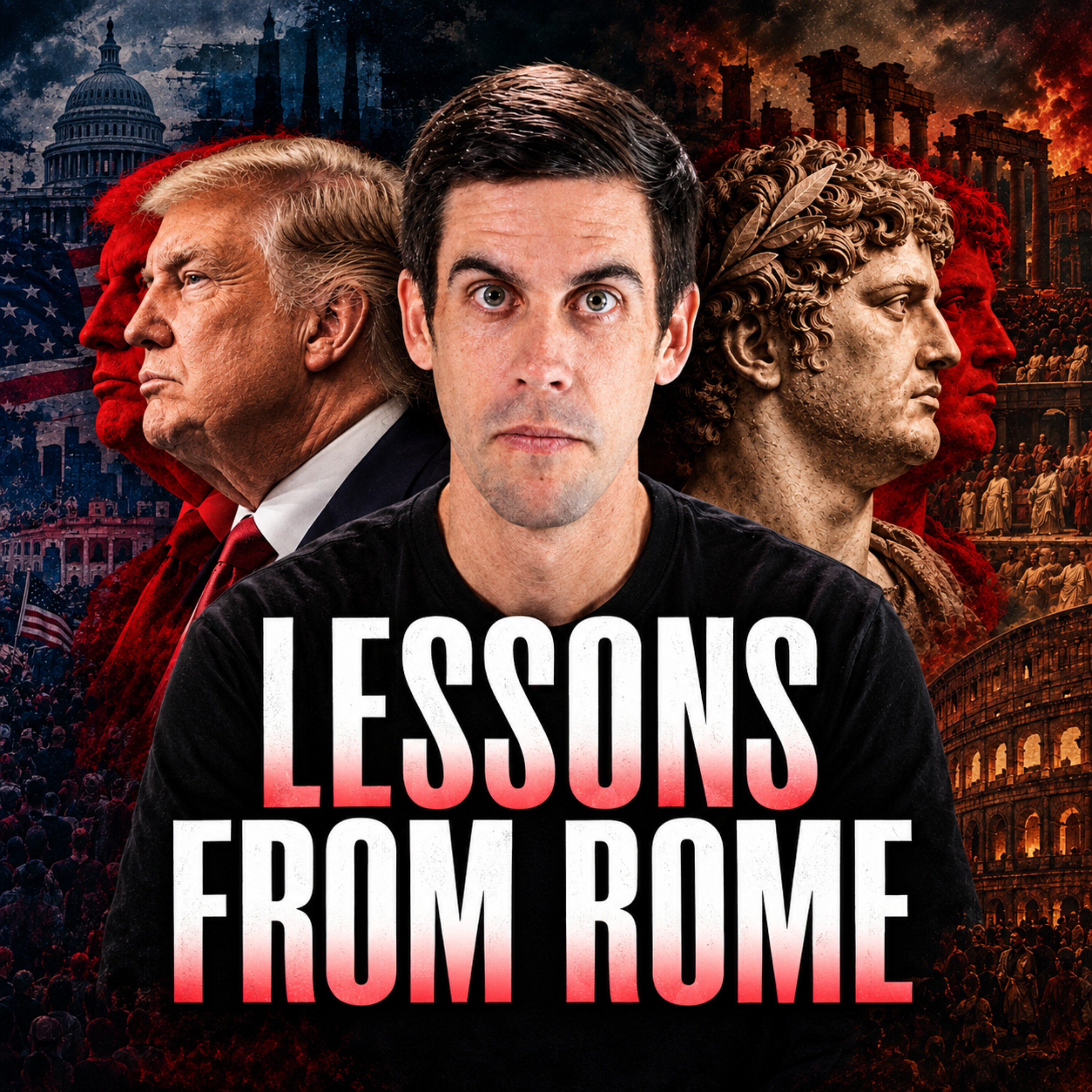
You Don’t Need Your Books | 9 Stoic Lessons From Roman Politics
In short
Stoic lessons from Roman politics, arguing you don’t need books to live Stoicism, but you do need a disciplined way of reading and applying ideas in real political life.
Guests
None mentioned; this is a solo Daily Stoic episode by the host.
Key claims
Stoicism is practical “in the arena,” not theoretical; wise people must participate in public life rather than cede power; principles must be tempered with pragmatism and compromise; avoid complicity with corrupt rulers; philosophy is a practice that keeps leaders from becoming “Caesarified.”
Notable examples
Marcus Aurelius reading “without books” via the Logos; Cato refusing Pompey’s alliance; Pompey shifting to Caesar and ending the Republic; Cicero stopping Catiline’s coup; Seneca tutoring Nero then enabling him too long; Thrasia opposing Nero; Augustus’s teachers Athenodorus (count letters before anger) and Arius Didymus (“make haste slowly”); Marcus selling palace furnishings during the Antonine Plague; Marcus on honest competition and memento mori.
Written by AI. May contain mistakes.
Chapters
0:15
The Importance of Reading
Discusses Marcus Aurelius and the deeper meaning of reading beyond books.
“You might think that Mark Shrelis was never far from his books.”
2:05
Read to Lead Challenge
Introduction to the Read to Lead Challenge and its goals for better reading.
“where we're trying to help you not just become a better reader, but put what you read into practice to change your life.”
2:51
Stoics in Politics
Explores Stoics' involvement in politics and public life.
3:20
Cato and the Political Challenges
Analyzes Cato's principles and their impact on Roman politics.
“Seneca said that's the difference between the Epicureans and the Stoics.”
7:40
Seneca's Complicity
Contrasts Seneca's choices with Stoic opposition during Nero's reign.
“But he's stopped the last second by Cicero.”
9:10
Living Well in Power
Discusses how Marcus Aurelius maintained virtue amidst power and luxury.
“You might as well try to stop it while it still might make a difference.”
12:58
Stoic Lessons from Augustus and Antoninus Pius
Discusses teachings of Stoic philosophers to Roman leaders and their relevance.
“But Augustus has two stoic teachers, Athena Doris and Arius Didymus.”
14:01
The Burden of Leadership in Ancient Rome
Explore the challenges faced by Emperor Antoninus Pius and the expectations of leadership.
“When Antoninus Pius becomes emperor, this is the temple dedicated to him and his wife.”
15:01
Lessons from Competition and Integrity
Learn how competition reflects character and the importance of integrity in sports and life.
“Or, said are you gonna keep your distance a little bit, you're gonna learn from it?”
16:29
Marcus Aurelius: Secrets to Resilience
Understand how Marcus Aurelius navigated his tumultuous reign through philosophy.
“to make you better to not do those things that other people do.”
Show all 12 chapters
18:13
Memento Mori: The Reminder of Mortality
Discover the significance of memento mori and its application to modern life.
“As they led a Roman emperor or general through a triumphal arch, the greatest accomplishment and honor that you could receive in the ancient world, to march in triumph.”
19:15
The Importance of Doing Good
Reflect on the value of contributing to the common good regardless of recognition.
“It's easy to wonder why we're doing all this.”

Ask about this episode
Get the gist, explore an idea or ask about something said.
 Claude
On The Daily Stoic, what are the key points of this episode?
Searching your listeningTranscript
Automatic transcript. May contain errors.
0:00Ryan Holiday: Welcome to the Daily Stoic Podcast, designed to help bring those four key Stoic virtues, courage, discipline, justice, and wisdom into the real world.
0:14Ryan Holiday: You don't need your books. You might think that Mark Shrelis was never far from his books. And considering he was sometimes spotted reading at the Colosseum as the Gladiator Games raged below, this is not far from the mark. He loved to read, And he tried always to have a text from a philosopher or a dramatist or a historian with him. But as it is for all of us, we don't always get our way. Sometimes life intervenes. And it clearly did for Marcus Aurelius. He spent years in dusty Roman army camps. He spent months on horseback over the course of his life. There would have been times, as there are for all of us, that he was in a rut and just hadn't found anything good recently.
0:56Ryan Holiday: And so he laid there, staring at the ceiling or thinking or having a conversation. And perhaps that's what he's referencing in this interesting passage in Meditations, where he says, A philosopher without clothes and one without books. I have nothing to eat, he says, as he stands there half naked. But I subsist on the Logos. And with nothing to read, Marcus says, I subsist on it too. He is saying that there is more to reading than just books. We have to process what we read, think about it, digest it, pull it apart. We have to sit with the ideas. We have to understand them. We have to do this before moving on to the next thing, before consuming more and more.
1:37Ryan Holiday: To be a great reader, it's not enough that you read, it's how you read. And the best thinkers and leaders like Marcus Reus have a specific reading practice to get the most from every book that they open. from Cato to Epictetus and Marcus and James Stockdale. Leaders know how to turn these words into works, as Seneca wrote. And that's what we are talking about all month in the Read to Lead Challenge we're doing here with Daily Stoic, where we're trying to help you not just become a better reader, but put what you read into practice to change your life. You're going to do it at your own pace, but we're going to be doing it together.
2:15Ryan Holiday: I'm going to be recommending books. We're doing a Q &A together. And the idea is we want to help you get more out of your reading, find books that will change your life, how to digest and understand books above your level, so to speak, and how to put what you read into practice. You'll put these skills to use, not just in the challenge, but hopefully for the rest of your life. If you sign up by September 22nd, you can join the live Q &A with me and thousands of other Stoics all over the world in the Read to Lead Challenge. You can sign up right now at dailystoic.com slash read to lead. And remember, if you join Daily Stoic Life, you get this challenge and all our challenges for free.
2:50Ryan Holiday: That's dailystoiclife.com.
3:20They were all politicians. They all held public office. Seneca said that's the difference between the Epicureans and the Stoics. The Epicureans only got involved in public life and politics if they had to. He said the Stoics get involved unless something prevents us. The Stoics were not theorists. They were not outsiders. They were not academics. They were involved. They were in the fray. They were in the arena literally and figuratively as we have to be. Because if wise people, if good people, if people who try to live and act with virtue. If they don't seek public office, if they don't participate in public life, if they don't vote, if they don't speak out, you know what is happening?
3:56They're ceding that floor to the people who are not.
4:04Okay, so you might think that Stoic philosophers are impossibly idealistic or impossibly theoretical or impractical and that they might have made for bad politicians. They might have been frustrating to deal with. And to a certain extent, this is right. Cato is one of the towering stoics. He's incredibly idealistic and committed and principled. And this causes one of the major political problems for him. I'm here in the Roman Forum. And it was probably here that Cato is approached by Pompey as Rome's political system is breaking down. And Pompey proposes that they become political allies and that their families intermarry.
4:42And Cato's incensed. He says, I will not be bought by way of women's apartments, even though actually it turns out his daughter was actually interested in the marriage match. He thinks that this isn't how politics should be done. Well, what Plutarch tells us is that this actually spells the end of the Roman Republic, because what Pompey does instead is he becomes allies with Caesar, who then does overthrow the Roman Republic. Pompey later breaks with Caesar. But the point is, there was this chance for Cato's principles and Pompey's political power to come together to preserve the Roman Republic.
5:13They could have collaborated. They could have done some compromise. And by the way, that's what politics is. It's about compromise and collaboration. Cicero criticizing Cato would say that problem with Cato is that Cato thought he lived in Plato's Republic. In fact, he lived in the dregs of Romulus. He lived here in the real world. And so this is somewhere where Marcus Aurelius adds to the political philosophy, right? Marcus Aurelius actually writes explicitly in Meditations. Remember, you do not live in Plato's Republic. He tried to be pragmatic. He tried to compromise. He tried to work with people who were not always amazing, right?
5:46He tried to get good out of bad people, which is something, for instance, that Lincoln was famously good at. Politics is an art. And we have to understand that this philosophy, although it is in many ways impossibly idealistic courage, discipline, justice, wisdom, those things also require moderation and collaboration and connection. Ultimately, they are only good insofar as you can bring them into the real world. Marx Realist talks about, he says, look, there's brambles in the path, go around. He says, if a cucumber is bitter, throw it out. He tried to be pragmatic and realistic. He tried to get real things done in the real world.
6:22If your political philosophy, if your personal philosophy doesn't allow you to do that, what good is it? Now, there's no question that Cato was an incredibly impressive and brave and principled figure. The problem is that at times this made him not a very good politician and it made him incredibly difficult to work with. Rome's political system was janky and creaky and falling apart. It was in desperate need of updating and moderation. So Cato's sort of lowercase c conservatism made him so resistant to change. He missed many opportunities to save the thing he was so committed to. The great Stoics managed to merge these two things together as we have to be able to merge them together in our own lives.
7:09Right down behind me are the ruins of Mamertine Prison, which isn't a super well-known historical site, but it should be a much better known one. In 65 BC, when Caesar wins the election of consul, there's a loser in that election. There's this sort of faux populist named Cataline. He's from an old money family. He can't wrap his head around losing to someone like Cicero. And so he attempts a coup he alleges, electoral fraud and all this stuff. Maybe this is sounding a little bit familiar to you. But basically he tries to overthrow an election and this coup attempt almost succeeds. But he's stopped the last second by Cicero.
7:46And ultimately he's thrown in this prison and Cicero and Cato, two Stoics, put him on trial and eventually he's executed. It is a narrow run thing. The Roman Republic is almost overthrown here and it is saved by these two Stoics. I tell this story because it is an important lesson. The Stoics were not just in the mix. They were willing to sacrifice and save and fight for their country. They did not want to be complicit. I think we can contrast this with a couple generations later. Seneca gets this job tutoring the future Emperor, a boy named Nero. And at first Nero seems like he's going to be a good leader.
8:17The first five years of Nero known as the Quinquennium Neronis. The five good years of Nero. But the five good years don't last. And they give way to bad years. Nero starts to lose his mind. He becomes corrupt. He becomes deranged. He becomes cruel. He becomes an egomaniac. And Seneca turns on him eventually, inevitably, but for far too long he is complicit. He tells himself he's the adult in the room. He tells himself that that he's getting good things out of a bad person. He tells himself that if he quits he'll be replaced by someone worse. All of which continues to enable Nero to be a bad ruler, to do bad things to people.
8:53And there are other Stoics who choose a different path. The Stoic opposition who we've talked about before, they fight back against it. Thrasia gives his life. Eventually Nero does come for Seneca. That's the irony. That's why you shouldn't be complicit. That's why you have to stand up. That's why you have to speak up. It's gonna come for you eventually, inevitably anyway. So you might as well do the right thing while you can. You might as well try to stop it while it still might make a difference.
9:21I'm standing here where Marcus Aurelius lived, the emperor of Rome, in an enormous imperial palace. hundreds of rooms, slaves and soldiers, every imaginable luxury. But he said something really interesting about it. He said, it's possible to live well even in a palace. And he might go, of course it's easy to live well in a palace. You have every amenity you could possibly imagine. That was sort of his point. He thought that these things were corruptive. He thought that these things would change you. And so that's what he was trying to do in meditations. He was trying to fight to be the person that philosophy tried to make him.
9:52Not the soft person that the palace wanted to make him, that his predecessors had been, but someone that was still within all this luxury, within all this power, within all this responsibility, still good, still decent, still humble, still hardworking, still doing his job. So that's the idea, that it's possible to live well even in a palace.
10:14Ryan Holiday: Every day your business is late to AI, you are falling multiple days behind. We actually talk about AI a lot here, the Daily Stoic and Painted Porch staff meetings. I mean, all the important stuff we do ourselves, but we think about where can we find efficiencies, where can we double check our work, where can we notice connections or filter through information that maybe otherwise we would have not seen. And if you're not having those conversations with your team, it sounds like you're already too late. And if you're lost when it comes to how AI can help you, well, fortunately, there's NetSuite Next.
10:51Ryan Holiday: You probably know NetSuite. It's the AI-powered business management suite that securely connects all your data. And it's a unified suite that brings your financials, inventory, commerce, HR, and CRM into a single source of truth, trusted by over 43 ,000 customers. And NetSuite Next is the next huge leap in how business gets done because AI is built into everything you do. It automatically surfaces custom insights throughout your day. AI agents work alongside to help you solve problems and handle routine work. And anytime you have a question, you just ask. just like having a conversation with a colleague.
11:24Ryan Holiday: NetSuite is customized for a wide variety of industries, so it supports the way your business truly works. Whether that company earns millions or even hundreds of millions of dollars, it's time for NetSuite Next. For the first time ever, you can try NetSuite Next for free. If your revenues are at least in the seven figures, go to netsuite.ai.com. It's built for every industry, ready for every boardroom, netsuite.ai.com. This episode is sponsored by BetterHelp. I've made no secrets, because it's not a secret and not something I'm ashamed of, about going to therapy, right? I've been going to therapy longer than I've been doing the Daily Stoic podcast, longer than I've been a writer.
12:04Ryan Holiday: Basically, the first time I got a job with health insurance, I found myself a therapist. Actually, no, I'm thinking about it. No, I got my first one when I was in college. and this is something that today's sponsor better help is great at and makes easier better help does the initial matching work for you so you can focus on your therapy goals they've got a short questionnaire that helps you identify your needs and preferences in 12 plus years of experience and the industry leading match fulfillment rate they usually get it right the first time but if you're not happy with your match you can switch to a different therapist at any time got over 30 thousand of them.
12:41Ryan Holiday: Better is a feeling defined by you. And for BetterHelp, it's a BetterHelp therapist who really gets you. So sign up today and get 10 % off at betterhelp.com slash daily stoic pod. That's betterhelp.com slash daily stoic pod. So right behind me here was Augustus's house, the first emperor. But Augustus has two stoic teachers, Athena Doris and Arius Didymus. Okay, So what did these Stoic teachers teach first emperor of Rome? Well, they taught him when his name was Octavian. The first one was this idea that before you get angry, you should count all 24 letters of the alphabet, the Latin alphabet having only 24 letters then.
13:19Athenodorus tells Octavian that before he gets upset, he should count all of these letters. The idea in Stoicism is the pause and the reflection before you take the action, putting the impression, putting the feeling, putting the emotion to the test. It's not that we don't have the emotion, it's that we try not to act on the emotion in the heat of it, right? Because this is so often when we do the thing that we regret, when we make the mistakes that cause problems for people. And then the second, this is Octavian's favorite saying, Faustina Lente, make haste slowly. Stoicism is deliberation. It's a discipline.
13:51It's not too fast, not too slow. The virtues being a midpoint between two vices.
14:00It was remarkable in the ancient world, and it's remarkable now,
14:03Ryan Holiday: When Antoninus Pius becomes emperor, this is the temple dedicated to him and his wife. His wife was ecstatic. She thought, you know, we finally made it. And he says, not only have we not made it, we have lost even what we've had before. His point was that this job was going to be not just very difficult, it was going to be expensive and it was going to require them to live and operate by even stricter standards before. He was disciplined before, he was honest before, but now that he was the emperor, he would have to be even more scrupulous. even more strict, even more above reproach. I think this is the example that Marcus Aurelius was thinking of when in the depths of the Antonine Plague, he sells off the palace furnishings to pay down Rome's debts.
14:45He refuses gifts and money because it would compromise him. In our time of political corruption now, this all seems very quaint, but it is an example we should remember and try to hold our politicians to.
15:00it would be wonderful if everyone we encountered in life was honest if they were on the level if they were generous if they were respectful if they were decent but they're not right life is full of cheaters and liars poor losers and bad winners and we see this in sports right that's why sports is such a great training for life marks really some meditations talks about you know when you're boxing in the ring and someone is biting or gouging or cheating you have to to decide are you gonna throw in the towel and quit and leave? Or, said are you gonna keep your distance a little bit, you're gonna learn from it?
15:33And then most importantly, he says, the best revenge is to not be like that. To be an honest competitor, to be a good competitor, to be a good winner and a good loser. And this is the famous boxer statue. 2 ,500 years ago, some unknown Greek artist just perfectly captured a guy who's been knocked around and kicked, he's clearly been gouged, He's bleeding, his cauliflower ear is struggling, one of his feet is raised. You can just see the detail of it. And that's why Mark Sreles' metaphor is so vivid and timeless, just like the statue is. You're gonna encounter people like that. Seneca talks about being unpleasantly surprised by that.
16:12That makes this blow's land heaviest, makes the betrayal feel all the worse. You gotta go in with your eyes open, gotta be aware, gotta accept and embrace the reality of what life is like and then don't let it affect how you are as a competitor except to make you better to not do those things that other people do.
16:36We know that absolute power corrupts absolutely. Almost all the Roman emperors were bad if not evil. We know that they sag under the responsibility, the temptations of their position. So how is this guy? How is he the one exception to that rule? Well, this book right here is the secret. Here's a guy who is the most powerful person in the world for 20 years. He has to fight wars that he didn't start. He buries half of his children. He has to lead through a plague and natural disasters and coup attempts and personal health issues. Everything you could possibly imagine. He doesn't have the good fortune that he deserves, one ancient historian laments.
17:16His whole reign is involved in a series of troubles. So how does Marcus Aurelius get through it? How does he escape being Caesarified, stained purple? How does he not break under all the strain and stress he is subjected to? This book is the answer. This book was the reason. It's because here in meditations, Marcus Aurelius is writing notes to himself. He's practicing philosophy. He's reminding himself who he's supposed to be, what he's supposed to do, what actually matters. philosophy then is a practice the fact that it survives to us as a book is a quirk is an accident but the real benefit that the real genius of this book is what it was for the guy writing it.
17:55Mark Surrealis' Meditations is a book for the writer and then for the reader. The writer benefits from having written it and from its specificity from the fact that it was intended for an audience of one it's somehow over the centuries had an audience of millions And if you haven't read it, you are missing out.
18:19As they led a Roman emperor or general through a triumphal arch, the greatest accomplishment and honor that you could receive in the ancient world, to march in triumph. Supposedly on the chariot of the great general or the emperor was a person whose job was to whisper in their ear, memento mori, memento mori, remember you are mortal. It wasn't a threat so much as a reminder that ego is the enemy, that you are not a god, that you are not invincible, that you may have achieved this great, incredible thing. You are not that special and the rules still apply. And it's a great little whisper, a great little reminder that we can practice in our own lives, in our great moments of accomplishment to remember not just that we are mortal and that life is short, but that the rules still apply that ego is the enemy, that gravity is still there, that we are not exempt.
19:14It's easy to despair. It's easy to get discouraged. It's easy to wonder why we're doing all this. Why are we staying good in a world that's so bad? Well, there's a passage in Marcus Aurelius' meditations from almost 2 ,000 years ago that I think is worth remembering. and it's worth remembering that this was said by the most powerful man in the world. He says, have I done something for the common good? Then I share in the benefits. He said, try to stay centered on that and not to give up. You do something good, it's good. It's good for you. It's good for the world. Whether you're thanked for it, whether you're appreciated for it, whether it's reciprocated, that's not in your control.
19:51Keep doing good. Do good because it's good. Try to stay centered on that and try not to give up. It doesn't matter what other people are getting away with. It doesn't matter what's being recognized or celebrated. What matters is that we accept what's outside of our control. We treat people as they should be treated and we approach our thoughts with care and try to remain rational in a time of irrationality.
From the publisher
Marcus Aurelius loved to read and tried to always have a text from a philosopher or a playwright or a historian with him. But, as it is for all of us, we don’t always get our way—sometimes life intervenes.
Turn the words into works 👉 Read to Lead: A Daily Stoic Reading Challenge | Ryan Holiday walks you through not only the system he's used for writing his bestselling books, but also the reading practice he uses in his life every day—to help him be a better professional, a better parent, and a better person: https://challenge.dailystoic.com/readtolead
📚 Get Read to Lead: A Daily Stoic Reading Challenge & all other Daily Stoic courses for FREE when you join Daily Stoic Life | dailystoic.com/life
🎟️ DAILY STOIC LIVE | Ryan Holiday is coming to a city near you! Grab tickets here | https://www.dailystoiclive.com/
🎙️ AD-FREE | Support the podcast and go deeper into Stoicism by subscribing to The Daily Stoic Premium - unlock ad-free listening, early access, and bonus content: https://dailystoic.supercast.com/
✉️ FREE STOIC WISDOM | Want Stoic wisdom delivered to your inbox daily? Sign up for the FREE Daily Stoic email at https://dailystoic.com/dailyemail
--
Stop online threats before they become real-world attacks. Visit ironwall.com/DAILYSTOIC and request a free Risk Assessment to see exactly how exposed your executives are.
--
Wealthfront’s high-yield cash account: https://www.wealthfront.com/stoic
This experience may not be representative of other Wealthfront clients, and there is no guarantee of future performance or success. Experiences will vary. Ryan Holiday, who’s a client of Wealthfront, receives cash compensation from Wealthfront Brokerage for paid testimonials in his podcast, creating a conflict of interest. More details available via the referral link. The Direct Deposit Plus Investing Program from Wealthfront Advisers LLC and Wealthfront Brokerage LLC provides eligible clients a 0.25% APY increase above the base APY on eligible Cash Account balances (up to an overall boosted rate of 4.30% for a limited time when including the three month 0.75% APY boost for new clients) when you direct deposit $1,000 a month, plus open, fund, and maintain an investing account. Wealthfront may change or end the program at any time and determine eligibility at its discretion. Terms apply. Full details at wealthfront.com/promo-terms.
The Cash Account, which is not a deposit account, is offered by Wealthfront Brokerage LLC ("Wealthfront Brokerage"), Member FINRA/SIPC. Wealthfront Brokerage is not a bank. The Annual Percentage Yield ("APY") on cash deposits as of January 30, 2026, is representative, requires no minimum, and may change at any time. References to the APY for the Wealthfront Cash Account, including any APY increase, are to the APY paid by insured depository institutions that participate in our cash sweep program (the "Program Banks”). Wealthfront Brokerage does not pay interest. Wealthfront Brokerage sweeps cash balances to Program Banks, where they earn the variable APY.
Instant and same-day withdrawals use the Real-Time Payments (RTP) network or FedNow service. Transfers may be limited by your receiving institution, daily caps, or participating entities. New Cash Account deposits have a 2–4 day hold before transfer. Wealthfront does not charge fees for these services, but receiving institutions may impose an RTP or FedNow Fee. Processing times may vary.. Fees & Eligibility requirements may apply to certain checking features.
Investment advisory services are provided by Wealthfront Advisers LLC, an SEC-registered investment adviser. Investing involves risk, including the possible loss of principal. Securities investments are not bank deposits, bank-guaranteed or FDIC-insured, and may lose value.
See Privacy Policy at https://art19.com/privacy and California Privacy Notice at https://art19.com/privacy#do-not-sell-my-info.
More from The Daily Stoic
All episodes
We use cookies.They keep VO running smoothly and help us improve it. Privacy policy