
 Ask ChatGPT

 The Dart Board with Daniel Dart
26 Aug 2026 · 35m · 21 chapters
Episode topic: Tacora Capital’s asset-based lending strategy for venture-backed fintech/insurtech (and related sectors), how the firm is bucketed with LPs, and how Carrie Findley built the team and expanded into asset buying via a REIT wrapper.
Carrie Findley (guest) is founder of Tacora Capital, started ~Feb 2021 with Peter Thiel backing; previously spent the back half of her career at Third Point cutting deals with venture-backed financial services companies (e.g., SoFi, Upstart, LendingClub, Prosper). She’s based in Austin and has a figure-skating origin story.
Tacora fits poorly into “credit vs private equity” buckets; they aim to lend money and get it back (target ~18% lending, ~14–15% to investors after fees) while taking equity/warrants for upside. She says “follow your passion” is bad advice; “hard work compounds” (Bill Ackman) is the real driver. She built Tacora from 2 people to ~12 without formal recruiting.
lending against portfolios of loans/leases/invoices/receivables/purchase orders/statutory capital; fund sizes and deployment/harvest timing (fund 1 ~$350M; fund 2 ~$700M); asset-buying ancillary strategy using a REIT (e.g., mortgage servicing rights with a16z/Ribbit/Valen; home equity investment options via Point Digital).
Written by AI. May contain mistakes.
Learn about the nuances of asset-based lending and its challenges.
“I mean, no one knows where to bucket it, but we usually do best with LPs who don't have defined buckets.”
Explore how Carrie started Decora Capital and her strategies for growth.
“It's kind of a rarity that I get to have someone that not only do I admire a ton and look up to, but also I consider a good friend.”
Discover Carrie's experiences at Third Point and her decision to start her own fund.
“And we're in the process of deploying that.”
Learn about Carrie's early life as a figure skater and her college choices.
“And I would say I kissed a lot of frogs.”
Understand why Carrie chose Austin to launch her fund and its impact.
“I didn't want to go to UCLA because it was six blocks from my house.”
Get insights into Decora's Fund II size and potential future strategies.
“Yeah, I think Joe has been a big magnet for the community.”
Explore how Carrie built her team and her approach to company culture.
“And most of what we buy is from venture-backed prob tech companies.”
Learn about the uniqueness of Carrie's fund strategy and its education aspect.
“because the strategy I would say is unique enough to where I can't think of multiple contemporaries for what you're doing.”
Hear about the challenges and realizations Carrie faced in starting her firm.
“When you think about having started the firm, is there anything that you had thought would be true that you think differently on now or vice versa from just building your own firm as opposed to working somewhere else?”
Discover how Carrie has successfully built her team through networking.
“I found it very scary and I should not have been scared.”
Learn how Keri Findley built her team at Tacora Capital through connections.
“I met Claire before Takora when I was trying to figure out how to start a fund.”
Explore the different fund structures employed by Tacora Capital.
“And then a question, as you're building out the new strategies, are you running them out of a commingled fund or you're running separate funds for those?”
Discuss the nuances of investing in equity versus warrants and the risks involved.
“you structure the equity position, do you always take those or are they set up as options?”
Understand how venture funding impacts the formation of companies in the market.
“People, when they face challenges is when you start to really see them.”
Discover the importance of consistent effort during challenging times.
“But overall, you can raise a seed round pretty easily.”
Keri shares insights from her experiences in the finance industry and overcoming challenges.
“And it was not, I do not know Bill Ackman, but that's the best advice and the most fruitful advice that anybody has ever given that I have listened to and utilized.”
Keri discusses the nuances of following one's passion versus being realistic in career choices.
“On the other side of that, is there any bad advice that you've gotten or what I'd say a standard dogma that you disagree with?”
Keri shares insights gained from personal struggles, including divorce and its impact on friendships.
“As long as the ego feels good, you're living it up.”
Discussion on evolving friendships and the importance of genuine connections over time.
“Oh, I don't care what people think about me.”
Keri discusses her hopes for the future and reflects on a potential career change to teaching calculus.
“Yeah, there may only be a dozen of us, but we stick together and together we're like an impenetrable force.”
A conversation about the lasting impact of influential teachers on personal and professional lives.
“were going to do that was not in finance, what would it be?”

Get the gist, explore an idea or ask about something said.
 Claude
On The Dart Board with Daniel Dart, what are the key points of this episode?
Searching your listeningAutomatic transcript. May contain errors.
0:00I mean, no one knows where to bucket it, but we usually do best with LPs who don't have defined buckets. That has been something where if someone has strict buckets, we don't sit. We were in a meeting in Atlanta last year where we were getting tossed in the meeting between credit and private equity. We're not a private equity fund. There's no reason to put us there. But our returns, you know, the credit guy said this throws us off our benchmark. The private equity guy was like, well, your MOIC isn't high enough. You know, it's like it doesn't perfectly fit into any basket. We do asset based lending to mostly venture backed businesses, meaning we lend money.
0:37My only goal is to lend money and get it back. And that's it. Today, we have a really exciting guest joining us. A good friend of mine, Carrie Finley, founder of Decorah Capital. Carrie started Decora five and a half years ago with backing from Peter Thiel. After spending the back half of her career at Third Point, cutting deals with some of the biggest new FinTech companies in the world. Today, we get into how she built Decora from two people to a team of 12 without ever having to run a formal recruiting process. We also talk about the difference between lending against assets and buying them and why follow your passion is the wrong way to approach your future.
1:17But compounding hard work is what actually gets things done. She's one of the sharpest people I know, and I'm really excited and honored to have her on the show. So without further ado, Carrie Finley, welcome to The Dartboard. Thank you for having me. I am so excited to have you. It's kind of a rarity that I get to have someone that not only do I admire a ton and look up to, but also I consider a good friend. So really excited to dig in today. Just to set the tone of things, can we start by giving a little background first on Tecora Cup? Yeah, so Tecora is a fund I started about five and a half years ago with backing from Peter Thiel.
1:59It was about February 15th of 2021 when he offered to fund what I wanted to do next. It was one of the most humbling moments of my life and incredibly exciting as well. And from there, we went off to kind of figure out how to start a fund. We started Takora. It was myself as the partner and Claire Council as my junior partner. We started investing on the first day of 2022. You know, 2021 was a tenuous time where the market was really overinflated. And so we were struggling with how to not only start a fund, but how do you start investing? When do you start investing? So we went from there to launching the firm in June of 21.
2:40And then, you know, kind of we're waiting for the market to soften a little bit, which it did in October of 2021. Started investing in 2022. Fund one was about$350 million. We do asset based lending to mostly venture backed businesses. We lend money against portfolios of loans, leases, invoices, purchase orders, receivables and statutory capital. So we mainly work with fintech and insurtech businesses. or businesses in areas like logistics or something that have a fintech or insurance bent. And we're a team of 12. We raised fund two at the end of 24, early 25. And we're in the process of deploying that.
3:21Very interesting. And so now to go back in time, prior to that, you were at third point. How did you end up at something like this? Because I know there was a little bit of a period where there was a few different options of stuff that you could do. How did you end up picking this? So, you know, let's call it like biotrition. But the second half of my time at Third Point, I was trying, spent my entire time trying to cut deals with venture-backed businesses. We did a deal with a company called SoFi. We did a deal with a company called Upstart. We did a deal with a company called Lending Club, Prosper.
3:54So kind of any company that was in the financial services or lending space. So my last half of a decade-ish that I was at Third Point, I spent my time trying to figure out how to cut deals with those businesses. And then because of that, got to know the venture capitalists who were funding those businesses. And a lot of those venture capitalists had ideas of starting a credit fund, not being just fintech, not being just equity. And I think from there, there was a lot of different people who were interested in starting a fund. And I would say I kissed a lot of frogs. What I realized over time was that what you give up in starting your own business is freedom, but really you're inheriting somebody else's problems.
4:36You're inheriting the bureaucracy that goes along with their organization. You're inheriting other people's fears and other people's dreams. And you're kind of getting in the middle of those. And how you do that and then how you kind of build your business with those already kind of set up problems is, you know, kind of up for debate and a lot of questions. And so when Peter, you know, after spending a lot of time, made this offer to do it alone, not off of somebody else's platform. And at that point, you know, just seeing the bureaucracy of other organizations, it was really exciting. That's amazing.
5:12And now going back even farther in time, you were a figure skater. Give me a little bit about that. Give me the origin story. I mean, I think how everybody becomes a figure skater. You go to a birthday party, you're five years old, and you love the feeling of the wind hitting your face. The feel like gliding feels like, you know, flying a little bit. And so I think that's how it starts for everybody. I think you go to a birthday party and you come home and you're like, Mom, I love that. I want to do that again. And then your mom signs you up for group lessons. and then eventually you're one of the ones in the group who's doing a little better than the other ones in the group.
5:53And then you do private lessons and then you're at a point where you're skating every day at 5 a.m. And then you went from that, you were on what national team? And then how did you go from there to Columbia to Third Point? I mean, I applied to every college that I thought would take me. I'm from LA. I didn't want to go to UCLA because it was six blocks from my house. I didn't want to go to USC because I come from a Bruin family and going to USC would have been like, you know, not acceptable in my family. And so then you're like, okay, where do I want to go? Like, I wasn't going to get into Stanford.
6:28I wasn't going to get into Harvard. And so you kind of are like, okay, well, where am I going to go and who will accept me? And I got into schools like Columbia and Northwestern. And my parents really wanted me to go to a school that was one plane flight from Los Angeles. And so Columbia and Northwestern were top of that list. I love it. And then from there, then we take the journey. We're through Third Point. And then you're also based, like myself, in Austin. How did you pick Austin as a home base to launch the fund? It was 2020. I lived in San Francisco. And Joe Lonsdale, who's a VC, who's moved to town, I was at his house for game night.
7:05And he's like, I have bad news game nights over we were doing a weekly game night and I was like what do you mean and he's like I'm moving the whole community to Austin and then he's like where are you gonna go and I was like I don't know I'm gonna stay here and he's like why don't you come for out to Austin for the weekend why don't you check it out and I came for the weekend I was like wait there's no COVID here this is amazing and so then I was like okay I'm gonna stay for six months and now six years later, here I am. Yeah, I think Joe has been a big magnet for the community. And now I feel like just recently, there's been like another magnet.
7:39It's really thriving here. So it's exciting to see it happen. So now shifting, we're at fund two. How big are we at now? And then are you expanding into other strategies? What does the future look like at twerp? So fund two was 700 million. We were incredibly lucky and very thankful. You know, deployment's a little below where we would like it to be. So we'll see for fund three what the size ends up being. And then, you know, I would say we have another strategy, which is asset buying instead of asset lending. Technically it's in a REIT. It's like a little comp, like the way I think about it is like in a little bit of a neurodivergent way, which maybe because I'm a little neurodivergent, our core strategy lends against assets.
8:20Our ancillary strategy buys assets. And most of what we buy is from venture-backed prob tech companies. So property-related businesses, real estate tech, whatever you want to call it. And so everything we do, we want to be in and around service to the venture community and venture founders. And so we look at this as a way to service them better. Our one fund right now buys mortgage servicing rights in partnership with an Andreessen Horowitz, Ribbit, and a Thrive-backed company called Valen. And we have a company that buys something called Home Equity Investment Options from a company that I'm on the board of called Point Digital.
9:00I also want to know, as you built the firm, you're really kind of emerging managers. I spent a lot of time with emerging managers. How big was the team on day one? It sounded like just two of you. How big is the team now? And I'd be curious, as you build the team and you think about geographic coverage, and I kind of have a little bit of inside baseball, How do you think about where they're going to be based and how do you run that on a day-to-day basis? So when we started, it was me, Claire, and an interim COO, and that was it. Now it's about a team of 12. I would love it to never get bigger because I like to really know the team and know everyone on the team.
9:38From a geographic diversity standpoint, I take the approach of I would rather have the right people in the wrong places than the wrong people in the right places, and that is just the way I think about it. However, when you think about employees and who you want them to be and where you want them to be, high level is that us having people in areas where sourcing is going to be more viable is better. So there's no, you know, fun venture parties in Tulsa, Oklahoma. There are a lot of fun venture parties in San Francisco. Not that I want my team out at parties all the time, but parties are where people congregate and therefore where you meet people.
10:16and therefore where you meet entrepreneurs and therefore where you get good ideas. And I want my team constantly coming back with ideas. Like that's the major goal. See as many ideas as possible, come back, sort through the bad ones and hopefully fund and be partners with the good ones. When you think about that in your pitching LPs, because the strategy I would say is unique enough to where I can't think of multiple contemporaries for what you're doing. So I would expect you're educating LPs along the way. How do you think about raising a fund where people may not fully know where to bucket it?
10:52I mean, no one knows where to bucket it, but we usually do best with LPs who don't have defined buckets. That has been something where if someone has strict buckets, we don't sit. We were in a meeting in Atlanta last year where we were getting tossed in the meeting between credit and private equity. We're not a private equity fund. There's no reason to put us there. But our returns, the credit guy said this throws us off our benchmark. The private equity guy was like, well, your MOIC isn't high enough. It doesn't perfectly fit into any basket. We do asset-based lending to mostly venture-backed businesses, meaning we lend money.
11:29My only goal is to lend money and get it back, and that's it. I want to lend out money at 18%, get it back to investors at about 14, 15, minus fees. That's it. And then we have equity positions in every single business that we lend to. And if they do well, those equity positions can be very valuable. Our fund one was$350 million. And there's like six or seven positions that I think will probably return north of$100 million each in the equity position to the fund. And then a couple that are going to return eight figures as well. So it is not, and it's not for the faint of heart, it's not a like easy, fun business, but talking to LPs, it's a lot of education.
12:10But to the extent they've invested in somebody like Victory Park or like Adalia, it makes it a lot easier because those guys are big, they're institutional, and overall they've really helped to get institutions caught up on what specialty finance is. And so we're just doing specialty finance, the only difference is our target. When you think about having started the firm, is there anything that you had thought would be true that you think differently on now or vice versa from just building your own firm as opposed to working somewhere else? Yeah. So working in a place like Third Point, they have all these people who work in the non-investment roles.
12:50They have IR, they have treasury, they have accounting, they have finance, they have operations. And there's so many people doing so many things. I didn't understand it and it was scary. and what I didn't know was scary. And I was like, okay, this is how I screw this up. I don't have those 50 people there and I don't know what they all do and I don't know how to do what they do and I'm putting myself at a lot of risk by starting my own firm. That was what I thought originally. There were, you know, I looked at doing this strategy in partnership with a firm that already existed for a long time because I was so scared.
13:25I would say now it's not as scary as I thought it was and it's not as bad as I thought it was and I'm happy I did it on my own and didn't inherit somebody else's problems and only have our own problems. It is one of those things where I looked at that as like this nebulous blob I didn't understand. I found it very scary and I should not have been scared. And then when you think about hiring and recruiting, I'm always curious with the process because I know a few of your team members, they're fantastic. How do you run a recruiting process so you can build people into the right culture. What does that look like?
13:59And we've never run a recruiting process. Everybody has been in network. I met Claire before Takora when I was trying to figure out how to start a fund. She was at one of the places that I had looked at doing this with, got to know her over time, did some deals with them, and she joined me day one. Megan came to us from 8BC, Joe Lonsdale's firm. She was close with the group of young associates there. And then when we needed to hire another person on the team. She had somebody that she had worked with at Silicon Valley Bank that she really liked working with. He joined us. He's great. And then when we were looking for someone else, Claire had a friend from, I want to say undergrad, who was at Wells Fargo in the lending group who joined us.
14:41And that's been great. Jonathan, our COO, came to us through one of the CEOs of one of our portfolio companies. He's been great. A hot R controller came to us through Cohn Resnick, our auditor, they were shutting down their Century City office and he lived too far to commute to downtown LA and he's been great. Louis I met through a friend, so let's call that a little more of a random process, but he's been great. And then Katie came to us through a fund I had invested in and got to know for a long period of time and she's been great. I have not had, nobody so far has left because they wanted to.
15:17They've left because we've told them it wasn't a good fit. And, you know, with our new strategy, we just hired someone out of Amherst. Point Digital introduced me to him. He's been great. I mean, it's really been like, hey, Carrie, we found someone we think, you know, uniquely would be a good fit with you. They're people I know well, and so far they've always been right. That's so interesting. And then a question, as you're building out the new strategies, are you running them out of a commingled fund or you're running separate funds for those? Separate funds. So we have the asset lending strategy and the asset purchase strategy.
15:51They're not in the same fund. And then the asset purchase, you're using a REIT. So is that set up? How does that set up? How does that look? It's a fund that like once we meet the REIT rules, we'll convert to a REIT to help with taxability. Wow. That's so fascinating, man. My dad's a CPA. So I grew up in a family that talked about tax all the time. So the idea that a REIT is, it's not complicated. It's just a tax strategy and it's just tax efficiency. So we're still doing the same investments. We just changed the wrapper. The wrapper is a REIT instead of a fund and it helps US people not get double taxed on specialty finance assets.
16:28And then is that like an evergreen structure? Once you convert it to a REIT, it has an end life. If we take it public, it will convert to evergreen. Are you going to take it public one day or not? That's the hope. We'll see. A couple of years. Wow. That's very, very exciting. Then I'm going to invest. I'll be like, man, I'm an LP. You know that I can call you and ask you questions. Anytime. Fascinating. And then are there any other strategies that you think down the road you may explore? Not as of today. I mean, we'll see what else comes up. The market changes, the world changes. Maybe our strategy gets competed away.
17:00I mean, we just don't know. What do you mean by it might get competed away? I mean, I keep hearing about other funds starting up that are going to compete with us. And eventually maybe there are 20 of us and like then there aren't 20 times the amount of deals and then we're not doing this anymore. We'll find something else to do. Do you think what else would it be? Because I feel like there's all sorts of specialty finance opportunities. It'll always be in and around credit and specialty finance, but I just don't know what. I see this as like a great opportunity today. And then when you structure the equity position, do you always take those or are they set up as options?
17:35How do you think about that? They're usually, it depends how early the company is. If the company is very early and the equity is very close to zero, we take equity. If not, we take warrants. And then explain warrants to people who may not know. A warrant is basically a call option. You have the right to buy the equity for 10 years at a set price. They can be really bad for tax, but because you can have to pay taxes on them. But basically, you know, if a company just raised a hundred million dollar valuation and the employees we buy in at the employee price are getting a 409A at 33 million and we own 1 % of that company, we would have$330 ,000 is what it would cost us to exercise 1 % of the company in warrants.
18:23We have 10 years though. So the company could be worth zero and then we wouldn't exercise at$330 ,000, or the company could be worth a billion dollars, and then we would exercise at$330 ,000. So it's basically the right to buy in the future shares of a company at a price today. And then when you think about it over the long term of the fund life, is it a three-year deployment? What's the deployment and what's the kind of harvest life of it? Yeah, so fund one was four-year deployment, three-year harvest. Fund two was three-year deployment, two-year harvest. I think fund one was a little too long.
18:56Fund two was a little too short. We're iterating and learning. Fund three will probably be four and two. And then what do you think about the upside long term? Is there more upside on the warrants or on the credit? Oh, of course on the warrants. I mean, the credit is capped upside. Credit is definitionally capped upside. We're going to get, you know, our interest and that's it. And then the warrants, if the company does well, can have meaningful upside to the funds. And then you said fintech, and then are you looking at more hard tech stuff now just because the market seems to be shifting that way?
19:27I mean, we would look at hard tech to the extent there were financial assets or contracts. So, yes, but we are not doing equipment financing. We did an equipment deal in Fund One that has been the worst deal I've ever done in my career. Financial services assets, they're easy to understand how they work, where the money flows. With a hard asset, you run the risk of theft. and, you know, I joke, but it's true. I could work out my worst deal with a good actor on the other side, but working out your best deal with a bad actor on the other side is hard. And we had a deal where, you know, and it's been actually all of our issues have had the same pattern, which I don't really know how to fix, but our problems have been, we know and like a founder.
20:11Some venture capitalist, maybe like yourself, says to him, you need a co-founder to start for us to feel comfortable with you starting this business. He goes out and finds a co-founder. We fund them in their financial service or equipment deal. The guy that we've known and the co-founder he found don't get along, aren't working out. And somehow our guy gets pushed out. And now we are stuck with the co-founder who didn't want our debt, wasn't the reason they did it, and wants to find every way out of it, including, in some cases, saying, I'll steal your equipment if you're going to make me, if you're going to try and call the loan or the equipment.
20:51It has been very hard in those situations where the co-founder you know and like is no longer there, and you're dealing with somebody who does not want to pay you. and then because i i think then what do you do you fight and fighting's not fun and i don't enjoy it and people joke that i like it but like i actually just don't like being taken advantage of and i like getting my investors money back yeah i had i had advice from one of my mentors when i was starting the fund and he was like hey you can actually fuck up a lot and people will still back you as long as you act with really good integrity but if you're a piece of shit you're gonna fuck yourself when things go bad tell people right away and be straightforward but it's like yeah i'd never heard that thing you can fix a a bad deal with a good actor but you can't fix a good deal with a bad actor i think it's very true and i also think sometimes being a venture capitalist there was an old saying like you don't really know who you invested in until six months later and i found sometimes like you'll meet someone you'll be like it's great and then you'll get into it and be like oh my goodness this is not good you don't see what people are like until they face challenges is how I view it.
22:06People, when they face challenges is when you start to really see them. Yeah. So most of it is lent against invoices and stuff like that, or is it - Yeah. Loans, portfolios of loans, leases, invoices, purchase orders, receivables, and statutory capital. So is that more cyclical than I would first imagine, just based on where venture dollars are going? It is. I mean, there's a lot less company formation than there was in those spaces. You know, I'm hopeful that people will start to start companies again on insurance, but yes, they're very cyclical based on where venture dollars are going, as you said.
22:44So like, you know, 2014, 15, anyone could start a fintech company. And then there was a lull right when the guy who had started the lending club got fired and that had some issues. Then there was another big boom. and then there was a lull in 2020 and then there was a boom in 21 and then a lull in 22. And now I would say the market's picked up except for things like financial services and insurance. But there's still a company here or there that can raise a lot of money. But overall, you can raise a seed round pretty easily. You can raise an A round pretty easily, but then you have to get profitable because the growth capital just is not there to support you.
23:23I never thought about the cyclicality of those businesses. Shifting gears a little bit, there's a few questions that I like to ask everybody. And the first is, what is the best advice that you have ever received? Hard work compounds. And when things are bad, just do a little bit of work every day. And eventually you'll find that you've compounded your way through it and you'll be out the other side. When things are bad and things feel like they can't get any worse, you just have to work a little bit at the problem every single day. And then every day, the work compounds, the work compounds, and then one day you're on the other side and you didn't even realize it.
24:01And who taught you that? It was actually Bill Ackman. And it was not, I do not know Bill Ackman, but that's the best advice and the most fruitful advice that anybody has ever given that I have listened to and utilized. Yeah, it rings really true. I think sometimes building stuff and you're pitching LPs and you're dealing with all these partners. And And I think sometimes I cover so much surface area meeting LPs and like every once in a while I'll run into one that like I just do not see eye to eye with. And I can have certain days where it just feels like low. You're just like, oh my God, this is so hard.
24:38And then there's other days where like everything seems to go right, but I've never thought about it of like hard work compounds. Is there an example of something throughout your life where you can be like, hey, this is an example of that working? I mean, just going back to mortgage-backed securities right after the financial crisis, going through and building the model and building every metropolitan statistical area in America and building what I thought the price action was going to be based on supply and demand and how many houses were in foreclosure and where big corporates were opening stores and where they were closing stores and building in all these factors and building out a house price model and a default model for every metropolitan statistical area.
25:22it was painstaking. It took me years to perfect it, but many months of working on it for five hours a day to even get it usable. But that was the best thing I ever did. It led me to years of first buying all day mortgage-backed securities, then subprime mortgage-backed securities, then re-remix, and then buying re-performing and non-performing mortgage loans. And every time information came out of those MSAs, I would drop it in, it would update, and it would give me what I thought was going to happen next in that area, it compounded. And that hard work that I used building those models, you know, served me for about a decade.
25:59Wow. On the other side of that, is there any bad advice that you've gotten or what I'd say a standard dogma that you disagree with? Follow your passion. I mean, I agree. I agree. But why? Because I totally agree. I think it's like horrible advice but i'm curious why you think you know you have to be realistic and like follow your passion i could have been the best figure skater i could have been and i still wouldn't have been anywhere near where i needed to be to go to the olympics or do the things you want to do and also then what do you do when you're 25 your body isn't what it was when you were 18 and now you know so follow your passion is it's follow your passion until real life and stuff gets in the way.
26:44Be realistic. Follow what you're good at. Find something that you are uniquely better at than other people and follow that. And it should be something that also has a future where you can do something and you can do it for a long period of time. Yeah, I agree. When you're like a kid, there's like five options. You're like firefighter, police officer, athlete. Pick one of this. These are like eight things that you're passionate about. You don't know anything. If you had asked my 16 year old self anything about finance, I would not have known. And so I don't agree with that. I think it's like boilerplate.
27:23Yeah, the passion one, though. Sorry, I'm like in my head, I'm like going off on all these tangents. You know, one of my investors had two very young girls. They were like four and five and they were both obsessed with Disney. And he's like, this is how people get into the Disney cult. They get it at this age. They never get off of it. And And then they go work at Disney for a third of the pay that they would get working somewhere else. Yeah. No, it's the same in like the music and film industry. The tradeoff is brutal. But you probably sell pretty well at bars to people of the opposite sex, which has value.
27:57It has value. Like I always say that New York runs on money, DC runs on power, and LA runs on ego. As long as the ego feels good, you're living it up. Okay. Now, I also love to ask, what is something in life that you went through? That was brutally difficult at the time, but upon retrospection is really valuable. I mean, I would say getting divorced was awful and crazy. And, you know, I unfortunately had an ex who was in the same-ish industry and the girl he was dating was in the same-ish industry. And they went on a no stone unturned to attempt to ruin my reputation. They called companies I advised.
28:37They tried to get me fired from boards, advisorships, all this stuff. and you know I learned a lot I'm very thankful for the experience I never want to go through it again but I think it really gives you a nice window into who people are you know I was on Instagram the other day and someone had a quote of lose your job get sick lose your money and find out who your friends are I mean you know go through a nasty divorce and find out who your friends are it gives you a nice window into who people are you get like the opaqueness of that window goes away and you really get the transparent view. You get the people who were just with you for the fun times, not for the long time.
29:14Your friends are this summer there for you. Some kick up your call every day at three in the morning when you're crying. You know, shout out to my best friend, Haley. Like, and some just, you know, tell you they're really busy and they have their own stuff going on. You really find out who people are. And that's the best gift I have ever been yeah i um it's weird thinking back to about going to prison like i can make a really strong argument it's the best thing that ever happened to me not that i want to go through it again but it did it showed me certain things gave me an outlook and one of the things that someone told me that i try to find now or remember is search for the believers and don't convince the skeptics whereas i think for a lot of my life i cared about what people thought rather than sticking to the people that actually just had my back?
30:02Oh, I don't care what people think about me. It's like a battle. Has it always been that way? No, I used to really care. I don't anymore. I mean, when I started at Third Point and people used to say good or bad things about me to my boss, you lived and died by that. I cared what people thought. And then I started to realize that they were, a lot of them were just self-interested. They didn't actually think that about me. They thought something about themselves and then projected that onto me. And some actually probably thought that about me, but the ones that said great things about me didn't like me as much as they said.
30:36And the ones that said bad things about me didn't dislike me as much as they said either. So one day you just have to stop caring. Once you've gone through a lot of hell, and I know you have been as well, and mine different, obviously, you just have to stop caring. What good does it do you? You're not gonna change their opinion. You're not gonna convince them. And interestingly, the ones that say the worst things are usually the people I didn't know at all and just heard it from somebody. Yeah. As I've gotten older, once you do kind of find your tribe, it's so much nicer. Whereas like I would say I knew a lot more people when I was younger, considered a lot more people friends a mile wide and an inch deep.
31:20And now I feel like, you know, I'm an inch wide and a mile deep. Like I have a much smaller community, but I feel like my community is so much more resilient. Yeah, there may only be a dozen of us, but we stick together and together we're like an impenetrable force. Yeah, I totally agree. You solidify your friendships. They're hopefully there for the long haul and we'll be there with you through the ups and the downs. Yeah, it's fascinating. Okay, now one more question before we go. Where is Carrie in 10 years? hopefully doing the exact same thing and then are you based in austin because i'm also going to mention that you have a place in montana that i've never been to and apparently there's amazing fishing up there so hopefully more montana less austin especially in august but october to april there is no better place than austin texas uh april to october we're gonna have to see it's weird i think my favorite time of being in austin is actually the summer i really enjoy it and sometimes like i'll sit with my door open it'll be like 110 degrees inside my office and annie will come in and just be like dude what are you doing you're crazy so i think that's an illness but you know to each their own yeah and then so okay in 10 years we got the reet set up we're on like fun five is there if there would be because we have a few more minutes and so since I got you here, I want to ask just a few kind of random questions.
32:45If there was a job you were going to do that was not in finance, what would it be? I have no idea. I've never thought about that. I'm really good with numbers. So probably a calculus teacher. A calculus teacher? I've actually always wanted to teach calculus as my retirement gig. I love it because like in my mind, you're such a outlaw badass. The last thing I would have ever you ever expected you to say is I want to be a calculus teacher. So I think my calculus teacher changed my life and I would love to change somebody else's life in that way. Like, I don't think I'd be here in finance if I didn't have Mr.
33:23Schuessler, who was a kick-ass calculus teacher in the late, very late nineties in Los Angeles, California. Wow. That's pretty amazing, man. Have you, have you ever caught up with them since then? So he left my school the year after and I actually reached out to them about five years later being like, hey, can you connect me? And they didn't have current contact information. And I've tried to find him on the internet. He's not really findable. So I have not, but I have tried. Wow. I have a teacher named Mr. Bagley in a similar way that I had also tried to find and I could never find him. But I also would like to be like, wow, he was a dead poet society teacher.
34:03I found him, but it was on LinkedIn and I sent him a random LinkedIn message and he never responded. I just don't think he's, you know, in the social media digital age. Yeah, he's not in the space. Like my dad has, I think, like three LinkedIn pages, but he doesn't check any of them. But like whatever he goes on, he just starts another page. So I'm like, there's all of these pages like hanging out. That's funny. I think that's a great place to end. And I just want to say thank you so much for making time to come join us today. Of course. Thank you for making the time.
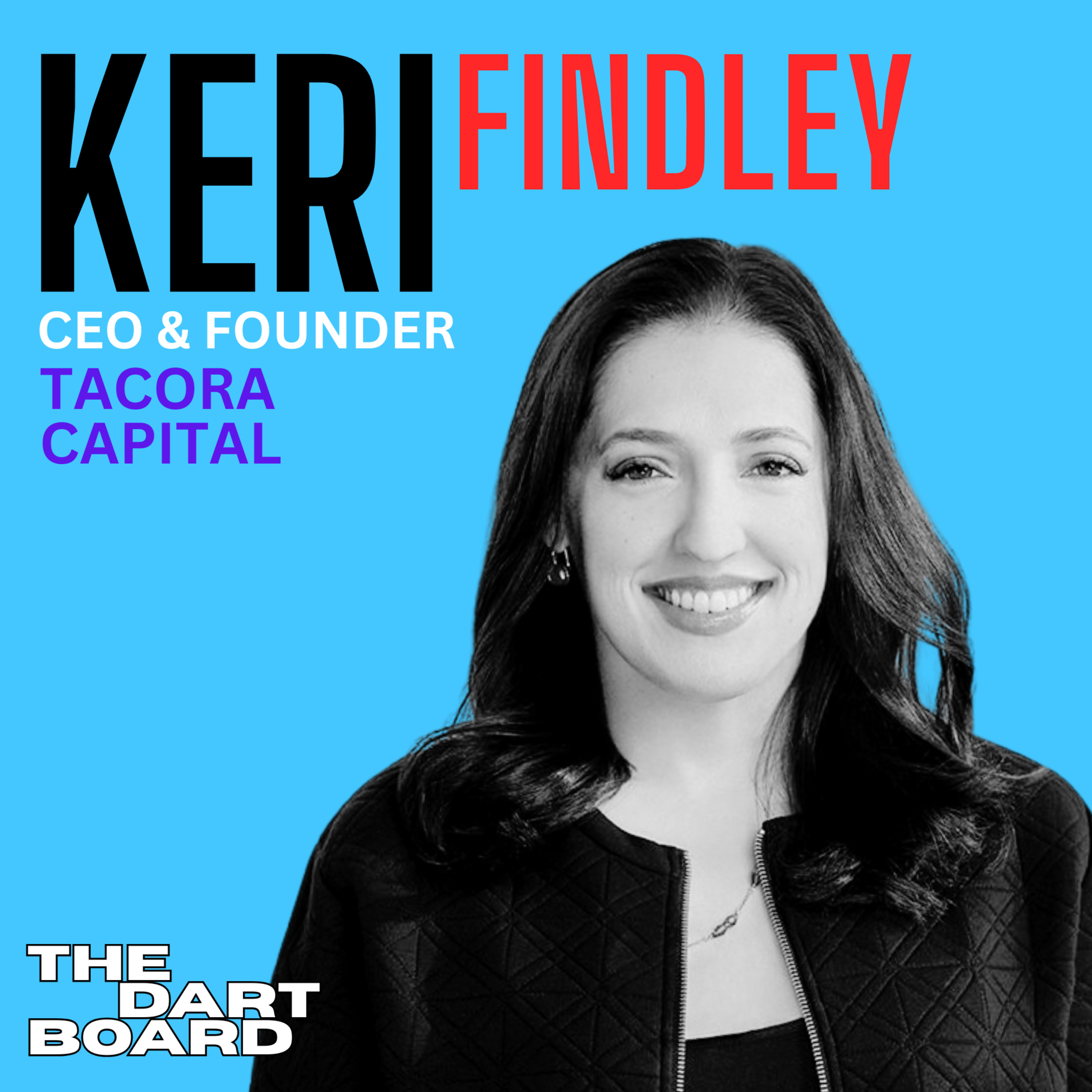
Meet Keri Findley, founder of Tacora Capital, one of the most exciting new specialty finance investment firms in the world today.
Keri started Tacora five and a half years ago with backing from Peter Thiel, after spending the back half of her career at Third Point cutting credit deals with some of the world's biggest new fintech companies like SoFi, Upstart, and Lending Club. But long before she made her mark on Wall St, she was building discipline as a competitive figure skater training at 5 am. In this episode, we dig into all of it, from the difference between lending against assets and buying them, why she thinks "follow your passion" is bad advice, and what a decade of compounding hard work actually looks like in practice.