Ask ChatGPT
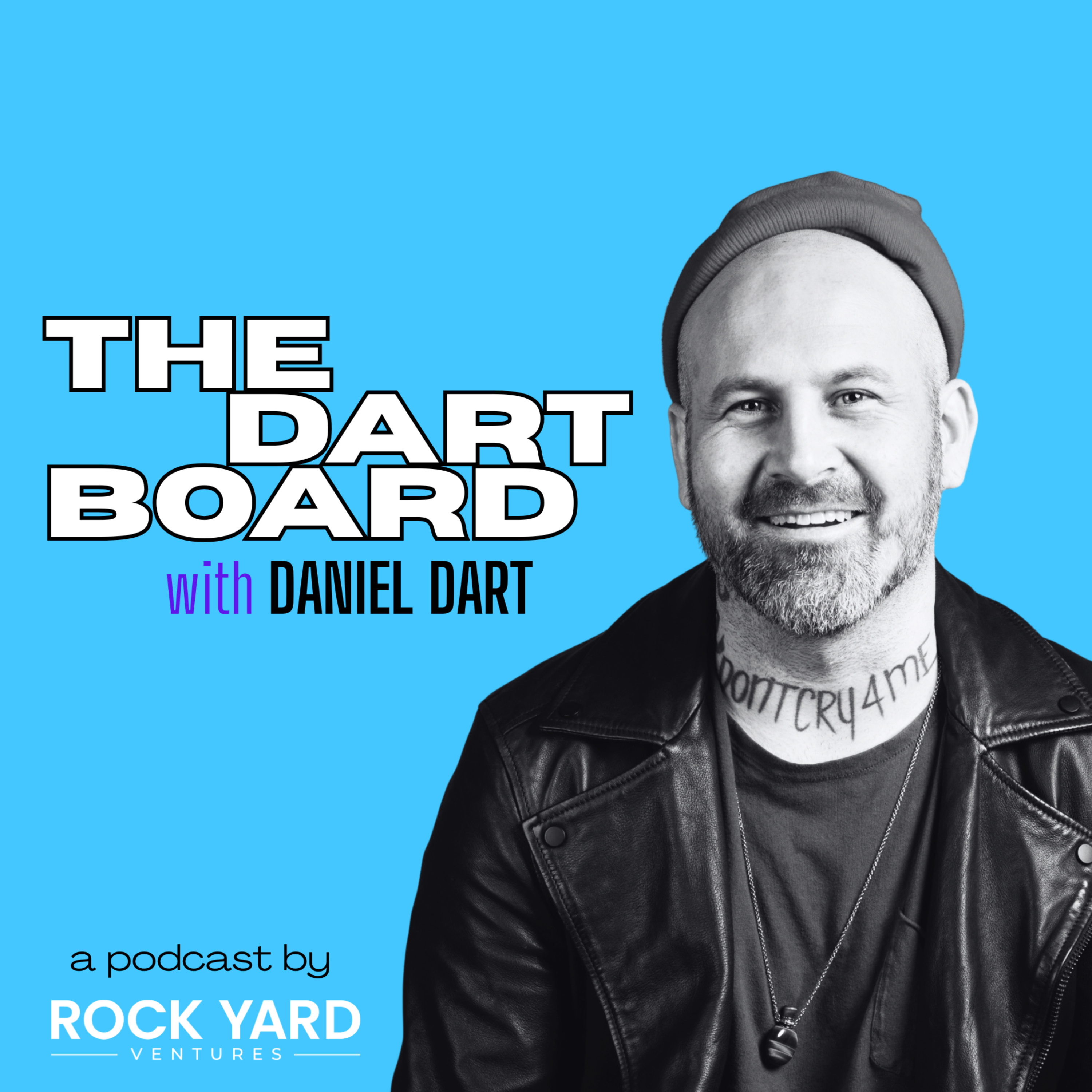
 The Dart Board with Daniel Dart
12 Aug 2026 · 34m · 16 chapters
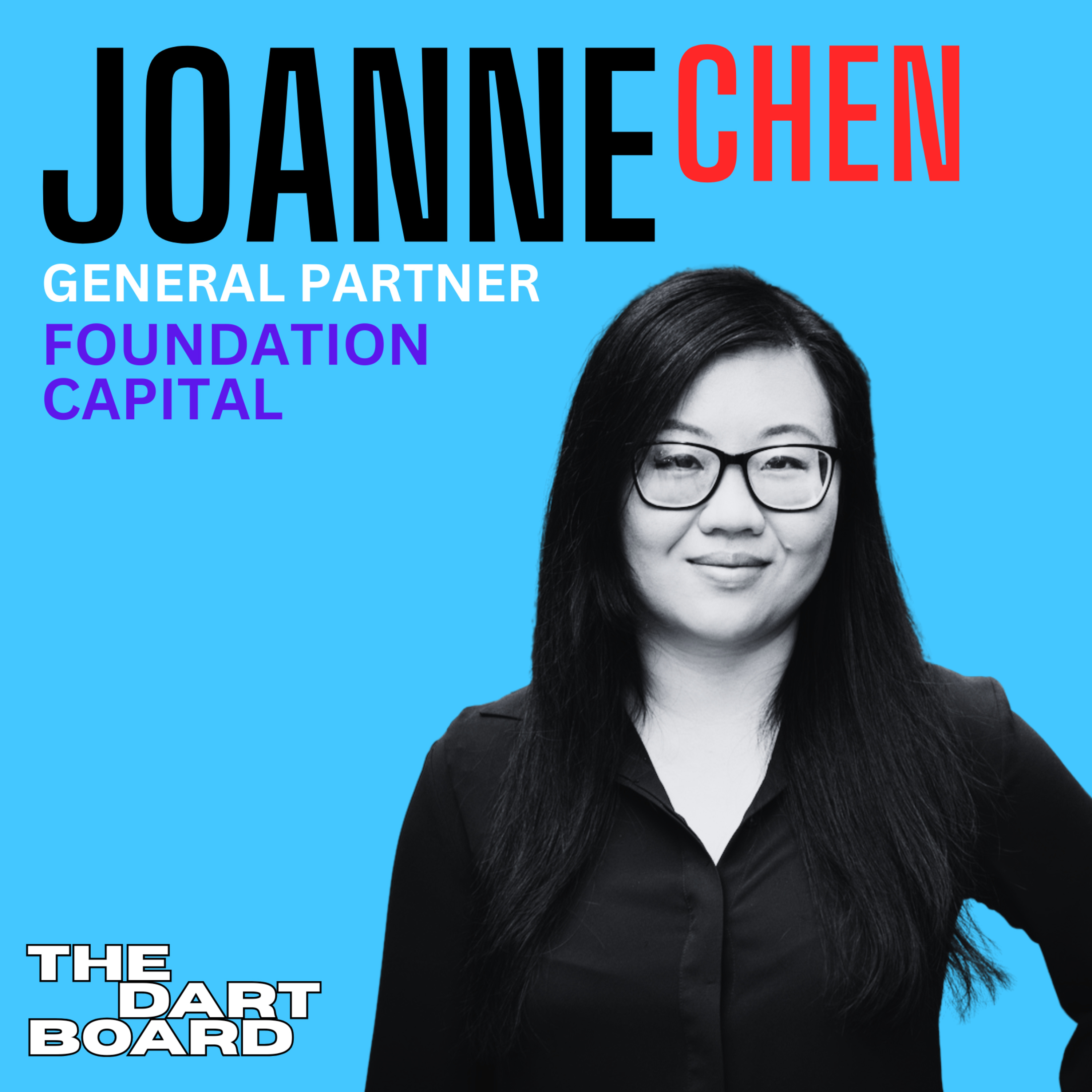
Joanne Chen, General Partner at Foundation Capital, discusses venture as a human-psychology exercise, Foundation’s early-stage thesis (seed/Series A; AI and blockchain; investing pre-product/market fit), and her “Great Reorg” research on how AI adoption is reshaping orgs—e.g., R&D and product/engineering converging, and new roles like validators and system architects. She also covers advice for emerging GPs (fund identity matters), lifecycle investing, and learning to “let go of outcomes” while focusing on inputs and growth.
Joanne Chen, GP at Foundation Capital (joined ~12 years ago). Background: engineer to banking to placement agent; cold-called Sand Hill Road to break into investing; previously worked in semiconductors investment banking; has led/participated in IPOs including Cerebrus (incubated in Foundation’s offices a decade earlier). Mentored by founder Catherine Gould (90%+ IRR; first-generation female investor of her era).
token-maxing isn’t a reliable success metric; accountability for human+machine performance is essential; human emotional needs and human-to-human relationships grow in importance; markets and org structures shift quickly, so investors must stay skeptical and detached from short-term outcomes.
Cerebrus IPO; Great Reorg findings from interviews with large and small companies; Waymo/driver-liability analogy; AI adoption leading to product engineers and merged functions; hiring domain experts to validate AI systems.
Written by AI. May contain mistakes.
Discussion about the importance of human psychology over pattern matching in venture capital.
“which they actually incubated in their own offices a decade ago.”
Joanne shares her background and how she joined Foundation Capital.
“She was a formidable investor, had a 90 plus percent IRR throughout her career.”
Joanne explains Foundation Capital's focus on early-stage investments in AI and blockchain.
“That's so epic because I feel like that is like the epic IPO of the year.”
Discussion of how Foundation Capital navigates broad investment themes while remaining specialized.
“And so we do a lot of work talking to customers, talking to buyers, forming our own hypotheses of what might happen.”
Exploration of how organizations are adapting to AI through changes in team structures.
“And then we talk as a team and we think about, hey, what do we think might happen five years from now?”
Joanne discusses the emerging roles and skills necessary in an AI-driven world.
“of tokens and some of the bad engineers are actually the ones that use ai the most right because they're like maybe trying to learn something from the ai or or querying it a lot prompting it a lot.”
Joanne highlights common pitfalls and misconceptions businesses have regarding AI.
“When you talk about like megafunds, how do you guys talk about it internally with the recent success you have?”
Understanding how investor mindset shifts towards outlier company outcomes.
“And for the infrastructure companies, you know, there's this like perception that they could be massive, massive outcomes, outlier outcomes for them to be interesting.”
Exploring strategies for network building and managing founder relationships.
“How do you think about network building and then calendar management?”
Discussing the evolution of markets and the implications for investment.
“There's a few questions I like to ask everybody.”
Insights into the cyclical nature of markets and the importance of being observant.
“I mean, we have new markets, new definitions of what a market is, new points of entries, and also markets have disappeared, you know, because of change.”
Reflecting on personal experiences that shape resilience and gratitude.
“For a long time, I wasn't a huge fan of blockchain.”
Learn about the transition from placement agent to investor and the lessons learned along the way.
“I feel like we're all very, very privileged to be even having this conversation or investing and working in this ecosystem.”
Discover strategies for overcoming doubts and successfully pivoting in your career.
“Because sometimes when we apply for roles, especially in tech, you kind of take the first role you have.”
Discuss future aspirations in investing and the perspectives on continuous learning.
“Because I think even just cold calling and doing all these little side jobs, when you've kind of made it and then you're going to talk to your B school and all of this, it's humbling.”
Joanne shares an interesting fact about her involvement in a parody show.
“I got one question before we leave on that note of the side projects and tinkering.”

Get the gist, explore an idea or ask about something said.
 Claude
On The Dart Board with Daniel Dart, what are the key points of this episode?
Searching your listeningAutomatic transcript. May contain errors.
0:00People talk about venture as a pattern matching exercise. And I think there is certainly a lot of things to learn from pattern matching. But it's much more a human psychology exercise than a pattern matching exercise, right? People are different. Their backgrounds are different. Their motivations are different. How they're going to approach situations is different. And I think as an early stage investor, understanding the people actually matters the most. Today, we have a really exciting guest joining us, Joanne Chen, General Partner at Foundation Capital. Foundation is a legendary firm and it's been around for over three decades.
0:41And just recently was part of some of the biggest IPOs of the year, including Cerebris, which they actually incubated in their own offices a decade ago. And Joanne herself is truly an unstoppable force. Going from engineer to banker to placement agent, she then cold-called her way up and down Sand Hill Road until someone finally gave her a shot. Now, she's helping lead one of the best firms in the industry. This was an amazing conversation, and I'm really excited to share it with you. So without further ado, Joanne Chen, welcome to the show. Thank you so much, Daniel. I'm super excited to have you here.
1:20Foundation Foundation has been absolutely killing it. So super excited to learn more about you and the firm. Just to set the tone for people, can you tell us a little bit about Foundation and then also how you got there? For sure. I joined Foundation almost 12 years ago at this point. I initially met one of the founders, Catherine Gould, who started the firm with two other gentlemen in 1995. And I met her. She was a formidable investor, had a 90 plus percent IRR throughout her career. And I was just struck by how much she understood investing. And so after I spent time with her, she introduced me to the rest of the team.
2:01She had already retired for a long time at this point. And that's how I joined the firm. And I have to say it's unusual. It shouldn't be. But you're one of the few kind of major GPs at major firms that's also a woman. So it's interesting that you had a woman mentor. That must have been so rare at the time. Very rare. I mean, Catherine was definitely the first generation of female investors of her time. Yeah. And for me, I guess I never thought about it. I've always worked in very male-dominated industries. And it is what it is. Yeah. But I have had the opportunity to work with some amazing mentors who have helped me along the journey.
2:43Can you give high level on just foundation, kind of the focus and thesis, and then we're going to peel back the layers on that a little bit? For sure. Foundation's been around for 31 years at this point. We invest at the very, very early stages, so seed and series A. Our two mega trends are AI and blockchain. We love to invest pre-product market fit, meaning oftentimes the companies don't have any customers or revenues. And it's really a few founders and an idea and a dream. And we are there for the entire journey. So in our history, we've had 35 IPOs, most recently Cerebrus, which went public a little over a month ago.
3:29And that was actually a company that we incubated in our offices a decade ago. And so we've done that over and over again. It's been a ton of fun. That's so epic because I feel like that is like the epic IPO of the year. Even though I know SpaceX is bigger, I actually am more excited about Cerebra. So, okay. One of the things I think is super interesting on the outside looking in is you guys kind of tread this line of being broad, but I wouldn't say generalist, but also not specialist. You kind of do a little bit of both. You write a lot, you research a lot. How do those conversations internally happen to get to where you're going?
4:09Because I know as an outside person, seeing how you kind of started to look into broader supply chains and different things within the stack, how do you think about that tactically? Yeah, so I'd say we are specialists in terms of stage and we have two broad megatrends, but we have multiple go-to market teams within foundation. So some of our colleagues focus on the intersection of AI and financial services. Others are spending time at the intersection of financial services and blockchain. Others are thinking about security and developer tools and the automation of the enterprise. So there are lots of different topics that I think we think are impacted by AI and crypto.
4:52And so our conversations internally are around what we're seeing, what are people building, what are some of the early crumbs that we are seeing which we want to pursue. And so we do a lot of work talking to customers, talking to buyers, forming our own hypotheses of what might happen. And some of that we turn into pieces that we want to share with the rest of the world, mostly because we want to attract like-minded founders to come and talk to us based on what they're building. Yeah, a recent one was the great reorg and just how people are getting AI pilled. When you were putting that together, what was that like in the early stages where you're like, hey, I want to write about this?
5:32Or was it a thread? And then eventually as you pulled it, it became that. How did you kind of do that from a tactical way? Yeah, so I think the great reorg was inspired because organizations were talking ad nauseum about how to adopt AI, right? So we wanted to understand what was the actual impact and what were people doing? So we interviewed a bunch of companies, big and small, to see what's actually happened. And I think phase one, folks were just telling their employees, please use AI however you want, however you can. Here's some token budgets, please use it as much as possible. And then slowly, we saw changes in the organization.
6:14For example, one big one was that some companies that were more mature in AI adoption were collapsing functions. For example, R &D or go-to-market or R &D specifically, the product and engineering orgs were starting to kind of converge. So instead of having someone run products, someone run engineering, they may have a product engineer. And same with design. Because you have these AI tools at your disposal where you can more quickly just build something. So that's one example of that. That's fascinating. And then when you do those customer discussions, are they pretty ad hoc? How do you formulate the questions you ask?
6:54And how are you thinking about pulling or extracting that information out? We just reach out, right? We reach out to people on LinkedIn. We, you know, ask them for a short conversation. And I think the beginnings of these conversations, you know, we observe what happens today, right? And then we talk as a team and we think about, hey, what do we think might happen five years from now? And so one of the natural questions that came out of this work was, so then what are people going to do? If we're going to have this team of agents and humans, what are the humans going to do after maybe an AI adoption is going to be more mature?
7:32And then from that, we kind of hypothesized that humans are going to do four different rules. One is that they're going to be accountable for the performance of both humans and machines. Right. Like, for example, why do people have drivers? Because, you know, if you have a car crash, the driver is also going to get hurt in addition to the passenger, which is why Uber works. And this is why, you know, one of the fears of Waymo, like what if Waymo does something that kills somebody like who's actually responsible. Right. But we need that accountability role in the performance of these AI systems.
8:04That's one thing. And the second is, you know, humans are still very emotional creatures. That is not going to change. We want to have conversations. We want to grab dinner. We want to feel. We don't want to just think. And so the human to human relationship is going to matter even more. That means salespeople, recruiters, those roles are going to be even more important in the organization. And I think the third one that we hypothesize is that instead of being individual contributors doing certain tasks, each person is going to be a system architect of agents, right, to design a fleet of agents working for them to do a bunch of things.
8:42And so the interdisciplinary approaches and the system thinking, that's what's going to matter. That's what's going to matter more in terms of skill set. And the last one, which is what we're seeing today, actually, is that startups and large companies are hiring more validators, right? So like if a startup is working on an AI system, who's going to be the one that says, okay, this AI system is doing what it's supposed to do, what I would have done as a domain expert, as a human, right? So these startups are hiring these domain experts, not technical, you know, say a doctor, right? And the doctor is going to say, hey, did this AI system do what I would have done?
9:21and they're doing this over and over again. And so we're seeing these validated roles become very popular at AI native companies because they need the human to basically say good job. That's so interesting. And then sometimes I like to invert that. And when you were seeing the discussions and having conversations with these people or meeting with startups, are there any things that may be on this kind of transition you're seeing that give you like warning alerts or things that people are doing wrong or, hey, you're approaching this with an impractical lens? People are doing something wrong with this whole AI thing.
9:58I mean, I think one of the obvious ones is just, I understand the whole token maxing culture, right? Because how do you get people to be comfortable with something that's new? You just want to normalize it, right? And how do you normalize it is to make them use it. So I think that's a good tactic, but as a measurement of success, that's that's probably not the right way to go about it in fact when i ask some vps of engineering about that many of them will tell me that their best engineers are not the most the biggest users of tokens and some of the bad engineers are actually the ones that use ai the most right because they're like maybe trying to learn something from the ai or or querying it a lot prompting it a lot.
10:46So there's probably this balance. And I think we need to figure out the definitions of return, even for this new technology. One question I have is, you're at a big firm. Do you have any advice for emerging managers or solo GPs? If you were kind of in our shoes, how would you think about going after a sector where you would have to pick one or one insertion point? How would you narrow down that focus? I mean, I think the world of capital is very fragmented and there are point solutions that are necessary in this market. Venture is quite mature now as an asset class. It used to be that when foundation was started, the firm was very much generalist.
11:28There wasn't that much sector specialization. But at the same time, there just wasn't that much competition for providing capital. Fast forward to today, I mean, even the mega funds are struggling with this identity issue, which is like, what do we stand for and what are we going to do in this very competitive and crowded market? I think the emerging managers have exactly the same question to answer. If the funds are smaller, what is it that we can uniquely do better, whether it's access or value add or something, but it has to stand for something very clear. When you talk about like megafunds, how do you guys talk about it internally with the recent success you have?
12:10Do you think, hey, we should go raise$5 billion? How does that conversation happen? Because you guys have been killing it lately. So I'm sure it must have come up, right? I mean, I think that there's always this draw to raising more capital. But raising more capital doesn't mean returning more capital, right? Like those two things were two different parts of a venture. And so for us, I think we want to be the first check into companies. and we want to be there over and over again, taking technology risk, taking pre-product market fit risk and being like the lead investor there. And so does that mean we need$5 billion to do that?
12:56It's unlikely because the check sizes are not that size, but we certainly do debate our strategy all the time, especially because the market is moving quickly. And as the market is moving quickly, being a seed in series A, There's like now people talk about this chasm between the two where it's just kind of fallen off a cliff. And then also from series A to series B, how are you working with your founders and setting goals? And what does that look like kind of post investment on a seed saying, hey, guys, you know, maybe the first 90 days we're going to kind of map this out. What does that look like to get them to series A?
13:32Yeah, I mean, I think that what's happened is because the growth rates for very few companies have been so strong, right, the bar for the entire industry has changed. It used to be that series A's can be raised, you know, when companies have a million or so in ARR, you know, now we're seeing series A's raised when they're much bigger, 3 million, 4 million, 5 million for the application companies. And for the infrastructure companies, you know, there's this like perception that they could be massive, massive outcomes, outlier outcomes for them to be interesting. So I think the mindset has shifted.
14:16And I think that has shifted because of two reasons. One is just like the growth rates and the other is like the huge, huge outcomes that we're seeing in the market. Right. So it kind of shows investors what's possible. And so now everyone's gravitating towards outlier investments. What do we do to prepare our founders? I think it's to prepare for that reality, right? I mean, at the same time, most companies don't have those kind of growth rates, you know, don't have maybe the outlier potential, at least at that stage. And the question is like, how do they get there? What is like the fundraising strategy?
14:53Do they need to, you know, have more capital and more time? Like, what are the things they can do to have the best shot? at being one of those outlier companies. So we have these conversations and we try to figure out a plan. And we're also fairly nimble because the target is always moving. And do you have a structural routine after you invest, you check in every week, you check in every two weeks? Yeah, I mean, we set up check-ins, which we, you know, it's like usually every two weeks or a month. I mean, it depends on the founder. Some founders are like, okay, please leave me alone. I'm just gonna, you know, I've done this before.
15:29You know, I'm just gonna do it again. Others are like, okay, we want to talk to you very, very often, right? Please text, you know, please let me text you for whatever issues I have. And, you know, others just want to talk every two weeks or four weeks or so it depends on the founder. And then we also have like portfolio operations where, you know, they, they kind of, you know, come in and, and help with our companies with talent, like recruiting people, like for C stage companies, getting someone to join is, kind of hard. And they come in and also help with talent, help with customer intros, because getting the first few customers make a huge difference.
16:06And then how are you also thinking about follow-on? Yeah, we typically are lifecycle investors, meaning let's say we lead the seed round. We're usually following on for the Series A and oftentimes the Series B. We do have a growth fund called our Opportunities Fund, where we can invest at the Series C and beyond as well. So we end up writing a pretty large check over the five or 10 years that we're with the company, despite kind of entering with a smaller check at the C. And then with the Opportunities Fund, is that only for existing portfolio companies or is that net new as well? Predominantly for existing portfolio companies, although we have in the past made investments outside of it as well.
16:51Wow, that's super interesting. How do you think about network building and then calendar management? So to kind of refresh your founder network, how do you think about managing that on day-to-day? I know you mentioned you do writing. How do you think about meeting other people in the ecosystem? And then can you also walk us through what the day-to-day looks like as well as the week-to-week? Yeah, I mean, I think the longer someone has been in venture, the more boards they have, right? So I think the portfolio companies usually come first, board meetings, check-ins, that kind of stuff, just because we have committed to those founders.
17:28And then there's like the new meetings and new founders and new investing. And with that, I'd say the younger investors probably spend more time on that. you know whether it's throwing events and going to happy hours or taking one-on-one meetings or you know writing content to attract that inbound deal flow or reaching out on linkedin or you know whatever it is that the go-to-market motion they choose to to do for us we we do some of that as well but it's um probably less less in volume and that's why usually you see an associate or whoever bring a deal to a general partner, you know, because of this dynamic.
18:06And then we spend time with our customers, which are our limited partners, who are the pension funds and the nonprofits and the endowments of the world who are giving us money. You know, we raise new funds every couple of years, but we're also like talking to them and keeping them updated and stuff like that as well. And let's say if someone just joins a firm, what would you want him to focus on or her the first 90 days? Just sourcing, figuring out their their go-to-market strategy, right? I think, depending on who it is, like, let's say we hire a new founder. This person might have an existing network they tap into, which is awesome.
18:44But the challenge is that network usually dries out. Then it's like, how do you keep on having a network that's fruitful? And I think that's something that every single investor that comes in takes some time to figure out what their strategy is and where do they want to invest time and who are their nodes, who are the influencers they rely on to attract more deal flow. Do they want to spend more time doing events or content? What do they want to do? And so that's what we want to see. I always think the same too with startups early on when they're hiring. I think something I see almost ubiquitously is they think they have a bigger network for hiring than they do.
19:27They're like, oh, I'll be able to fill these three roles super fast and then it'll get the first one really fast. Then it like drops off a cliff. And they're like, oh my God, it's so hard to find people. Super interesting. Okay, there's a few other questions. We're switching gears. There's a few questions I like to ask everybody. And the first is, what is the best advice that you have ever received? I think for me, a recent one that I'm kind of, that really resonates with me is like, I'm a little bit less tied to outcomes these days. I used to be so much more tied to outcomes. But I do care about growth.
20:03Like, am I doing better day over day or week over week or year over year as an investor? And what is it that I can do better or learn that I didn't do a year ago? Right. And so that's, that's really important to me. And then whatever happens beyond that is, is going to happen. Right. There's so many things about a startup journey that is unpredictable. You know, sometimes the best founders don't make it. Sometimes, you know, they get very lucky and, you know, they have a market opportunity that they didn't foresee. So all sorts of things happen and we do what we can as investors to increase the odds of success.
20:39Is there something that happened or an experience or a situation that made you focus more on the inputs than the outputs, so to speak? I think it's just, you know, I have this personality where I feel like I want to execute and kind of control the outcomes and just like drive to something. And the longer I'm in venture, the more I realize that's just not how it happens, right? As a CEO, you probably have the same, you know, someone probably has the same idea. But as investors, we're actually even one step further removed. And so I think for us to be the best advisors or the best board members, we have to be emotionally pretty regulated.
21:20And in order for that to be true, I think we have to have the right mindset for it. And that requires some detachment from the outcome, in my opinion. How do you think on the board situation, how many boards are you on? And then how do you think about how long you stay on them or how do you try to support them? I do have a lot of boards at this point. But I think that with Seed Stage, I usually don't officially join the board until the Series A. Otherwise, what's the point of having a board at the Seed Stage when there's an existential survival happening at that point? But once we get to the Series A, we have more investors, we join the board, we have more governance, that kind of stuff.
22:02Usually we are, we're there as long as we keep on investing money into the company. And sometimes these companies have an exit in which we get off the board, obviously. And if we, you know, if we keep going, then we're, you know, we stay on, we stay on the board. I think the founders also tend to realize that they like to have their very early stage investors on the board because we're the most aligned with them. Interestingly, most founders don't realize this until they have their little bit later stage. But the way that a seed stage investor thinks is quite different from a Series C investor.
22:41And the founders usually think very similarly to the seed stage investor. Yeah, that's so good to know. And then on the other side, a question I like is what's the worst advice that you've ever received or commonly held advice that you hear often that you disagree with? You know, like people talk about venture as a pattern matching exercise. And I think there is certainly a lot of things to learn from pattern matching, but it's much more a human psychology exercise than a pattern matching exercise, right? People are different. Their backgrounds are different. Their motivations are different. How they're going to approach situations is different.
23:17And I think as an early stage investor, understanding the people and the markets, because if you get those two things right, then you have increased the odds. Businesses are built by people. Everything else is just a byproduct. Yeah, that's so interesting that you say founder matters, but also Don Valentine was famous for saying he's a markets investor. He cares more about the market than anything. And you bring up both. That's fascinating. Last kind of high level question. I don't disagree with the markets because I do think without a good market, there's nothing to be built. But today, founders are shifting markets so quickly, right?
23:55Because the underlying assumptions are changing so quickly. Everything's changing. Well, kind of like you mentioned in the great reorg about roles merging, I think sometimes even sectors or functions where when I started, I was purely supply chain and I would see 30 different companies all going after different things. And now I feel like they're all merging into almost these mini tech conglomerates because they can do so many things that you just couldn't do two years ago. So it's changed so much, even what a market can look like. Yeah, no, for sure. I mean, we have new markets, new definitions of what a market is, new points of entries, and also markets have disappeared, you know, because of change.
24:38And so it's both easier in some ways to invest, but also a lot harder. Because, you know, what you assume to be true right now, it may not be true in a year. Yeah, it's interesting how things are cyclical. For a long time, I wasn't a huge fan of blockchain. I think more recently, I become more and more just with like validation as it gets so easy to do deep fakes and like all of these kind of like cyber attacks that I feel like, oh, wow, I'm more interested in it now because of proof of stake. And how do we actually show what's real? You've seen really the whole kind of, I would say, the winter, the summer.
25:15I'd be curious going back to that how do you think about it in a more broad scale of where it's going to go you know things are different things repeat and yet they're different when they repeat I remember in 2021 you know feeling a lot of you know maybe angst around just the the market moving and like how hard it is to invest and stuff like that and this time in this AI market there is a little bit of that as well right like the market dynamics but it's very different and so I I I think for me, I'm just much more observant of what's going on and more skeptical of like, you know, is this something, you know, I think a lot of new investors come in and say, oh my gosh, we have to, we had to under, we had to invest in everything.
25:59We had to move because it feels like we're going to miss out. And to me, I think this is part of like a much larger picture in the same way that, you know, for only four years ago where we shocked when, you know, chat GPT came out and people were like, oh my gosh, what is this? And today it's like, you know, content generation is like, just like you take it for granted at this point. So I'm much more, I'm able to kind of extract myself a little bit more and just like look at what might happen in a few years from now versus be like really caught up in what's happening today. Fascinating. And the last question I love to ask everyone is what's something in your life that was radically difficult at the time, but looking back with retrospect proved really valuable.
26:44Difficult at the time. You mean as an investor? It could be investor. It could be life. For me, I went to prison, but looking back, it's kind of the best thing that ever happened to me. I could make that argument. Not that I want to do it again, but I think in the long run, it made me a better person. And so I'm always curious when I meet people, just understanding the stories that shape why I am the way I am in a beneficial way. Yeah, I mean, for me, and maybe this is just like a fairly typical immigrant story, but I wasn't born here. I didn't have any business to be in Silicon Valley. My parents grew up in China.
27:26I was born in China. My grandparents were deeply affected by the Cultural Revolution. There were a lot of political challenges. is my father effectively left China because of that. I was a main, main driver. And so the start of life here was hard. And I see some of the sacrifices and compromises they made to create this opportunity for me where I can do whatever I want. And so I don't take that for granted. I don't think that whenever we see failure, that it's just a terrible thing. I feel like we're all very, very privileged to be even having this conversation or investing and working in this ecosystem.
28:10And that's something that I'm very grateful for every day. Yeah. On that note, you have a unique background. We didn't talk about it, but prior to investing, you worked in the placement agent space. I did. Yeah. For a few years. I think you're the only person that I've met that made the job from placement to investor. So like, I feel like you're a world-class trajectory changer. One of my colleagues did the same thing, actually. Okay. So there's two, there's two. And I think - There's at least two. I found that really interesting as someone who also did a pivot, because I think sometimes when we're young, we feel like we're on this path and we're like, oh my God, how do I change?
28:49And how do we do this? So it's really inspiring when you see someone who's done that. I'd be curious, just going back in time, how did that come together? How did you have the intuition to know you could pull it off? Or what were the steps you take to be like, hey, I want you to reimagine me and who I am? Because sometimes when we apply for roles, especially in tech, you kind of take the first role you have. But then as you grow up in the space, you're like, maybe I don't want to be in sales anymore. Maybe I want to be in product. What advice would you give people? Because you pulled it off at the highest level.
29:24I mean, I think at the time, the reason why I joined the placement agent was because one of my colleagues left. I was working in investment banking in semiconductors. And he left to go to that firm and was like, hey, do you want to come with me? And I was working 100-hour weeks and I was like really exhausted. And I wanted to, you know, I actually wanted to work on startups. I didn't really want to do that. And so I thought, hey, maybe I can take a bit of a break and do something that seems honestly quite easy. And I joined, I learned a bunch of stuff, certainly knew it wasn't something I wanted to do for a very long time.
30:06But I also built some connections with investors and LPs. And that was really helpful for an education of how this whole industry worked. And then after that, I went and worked on a startup and I went to business school and worked in at an angel investing group. And I called my way in up and down Sand Hill Road at some point, got an internship, you know, with with Joel Onsdale's first fund and kind of just like slowly built a bit of a resume and and contacts so that I was able to, you know, credibly like interview for investment roles. I don't know. I just, you know, multiple steps, but it didn't seem that daunting to me.
30:44It's interesting where on retrospect, I think some things feel so linear, but then sometimes when we're in it and you're just kind of chugging through, but it's very inspiring. And I'm glad you know someone else. So you're not the only one. When I was at business school, so many people wanted to pivot, but they felt like it was impossible. So so many people would end up back in the same industry. Because I think even just cold calling and doing all these little side jobs, when you've kind of made it and then you're going to talk to your B school and all of this, it's humbling. Most people, I think, I don't have the courage to say, hey, I'm going to have that beginner's mindset.
31:23My grandfather lived to 108. He passed away only last year and I'm 40. And so I think I still have so many years of my life. Why think that there's only one path? I I don't feel that way today. Yeah. Yeah. Well, speaking of which, then the question I like to finish on usually is where are you in 10 years? But I'm going to switch it for you specifically. Where are you in 20 years then? You know, I've really enjoyed investing. So I could absolutely see myself doing that. I think that irrespective of the financial part, I think this is a very privileged place to be. So I think I could definitely see myself doing that in 20 years.
32:10I think in addition to that, I, you know, I love, you know, learning about new places, new type of people, you know, I like to tinker with new tools. So maybe with a bunch of, you know, interesting side projects in 20 years as well. But I do see investing to be a core part of my life. Yeah, it really is such a great job. I got one question before we leave on that note of the side projects and tinkering. What's one thing about Joanne that we don't know that would be interesting for us to know? And you're the first person I've ever asked this, but like just the tinkering and the side projects, I'm like curious.
32:51I was just thinking, it's kind of funny. Many, many years ago, Chelsea Handler had a kind of a parody show called Silicon Valley. And in that show, I was the VC that she pitched to. So that's kind of like a fun. Oh, my goodness. I'm going to have to go look for that. That's amazing. You had to see that. I think that was in 2016. And here we are still playing that role. Yeah, you're still playing that role. And I think that is a wonderful place to wrap. So I just want to say thank you so much for coming on and spending some time with me today. Yeah. Thank you so much, Daniel. Thank you again for listening to The Dartboard.
33:30If you haven't already done so, please hit that subscribe button. It helps us a ton. You can also connect with me and the rest of the Rockyard Adventures team on LinkedIn. If you're building something great, we would love to hear from you. Until next time, I'm your host, Daniel Dart. Thanks a lot for listening. Thank you.
Meet Joanne Chen, General Partner at Foundation Capital.Foundation has been investing for over three decades, focused on seed and Series A, backing companies before product-market fit around two mega trends: AI and blockchain.
The firm has had 35 IPOs, including Cerebras, which it incubated in its own offices. Joanne joined almost twelve years ago after being introduced to the firm by co-founder Kathryn Gould. Before venture, she was an engineer, a banker, and even spent a few years on the placement agent side before making the jump to investing.
In this episode, we get into how Foundation turns customer conversations into investment ideas, what she found interviewing companies for what she calls The Great Reorg, why raising more capital doesn't mean returning more capital, why she got less attached to outcomes and more attached to growth, and why she thinks venture is a human psychology exercise rather than a pattern-matching one.