Ask ChatGPT

 The Dart Board with Daniel Dart
9 Sep 2026 · 39m · 21 chapters
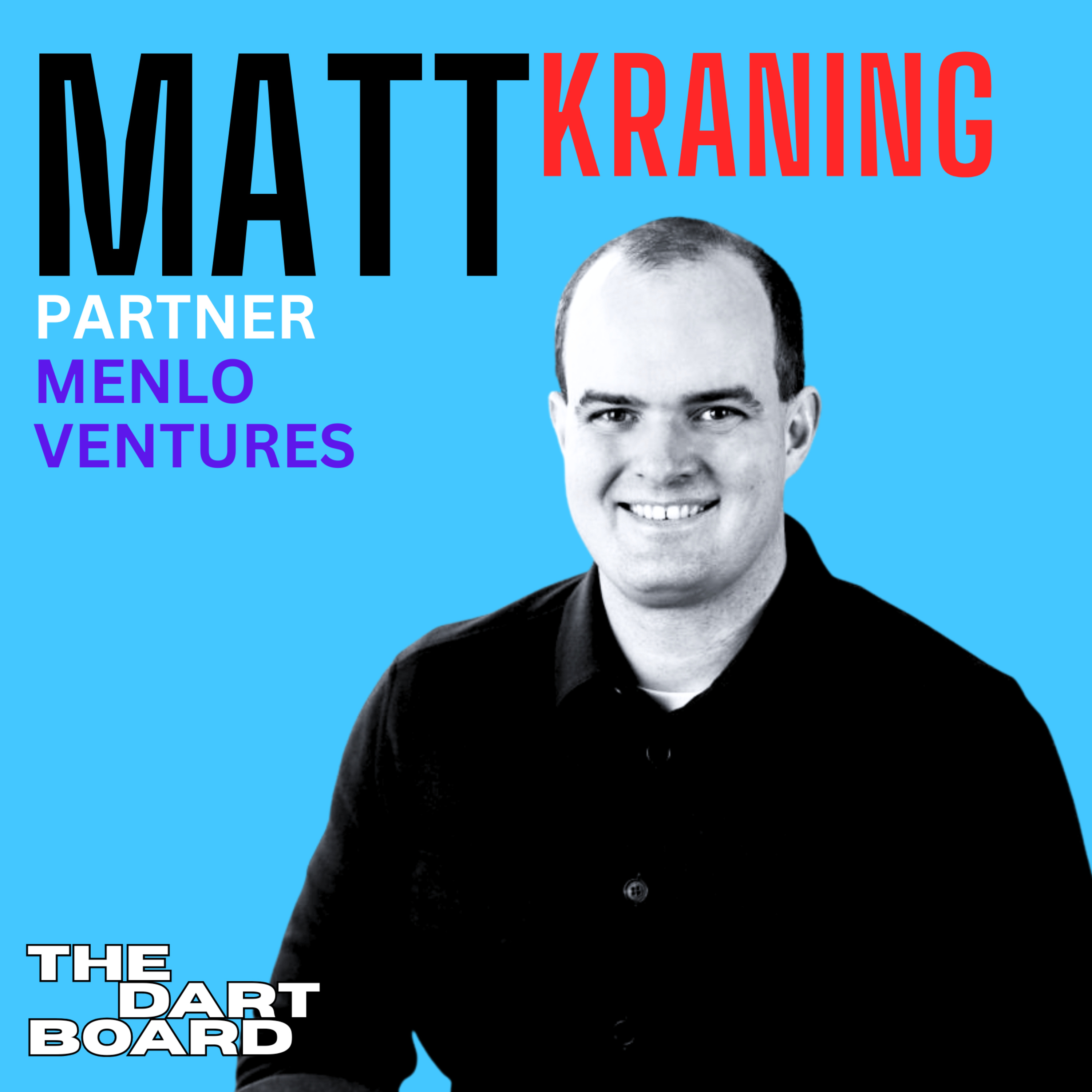
Matt Kraning (Menlo Ventures) discusses his path from Stanford PhD to DARPA data science in Afghanistan, building Expanse into an Attack Surface Management category, and then shifting to venture investing. He argues founders must be “right” (not popular), that startup success depends on measurable investor differentiation beyond capital, and that VCs should help with go-to-market, hiring, and strategic execution. Notable examples include Expanse’s DARPA-funded origins, its $6M seed led by Peter Thiel, and its acquisition by Palo Alto Networks for $1.25B; Menlo’s contrarian Anthropic investment; and Whisperflow’s growth from non-experts in growth marketing.
Matt Kraning, partner at Menlo Ventures; previously built Expanse (Attack Surface Management) and later worked at Palo Alto Networks (including leading GenAI data/model development).
Written by AI. May contain mistakes.
Explore the impact of high-stress situations on personal resilience.
“There was a suicide attack at one point that was just like less than 200 meters away from me.”
Learn about Menlo Ventures' history and its focus on cutting-edge technologies.
“So without further ado, Matt Craney, welcome to the Dartboard.”
Discover how Matt transitioned from academia to working with DARPA in Afghanistan.
“But now I think I want to dig into, you have an incredible past.”
Uncover the origins of Expanse and its focus on military contracts.
“I love her so much and she knows me so well.”
Learn about the successful journey and eventual sale of Expanse.
“We knew we wanted to be a product company.”
Explore Matt's experiences at Palo Alto Networks before joining Menlo.
“There was over a year of building our backend technology, and then we started sales in 2016.”
Understand Matt’s approach to venture capital and working with founders.
“But as I'm an investor, I take the opposite stance.”
Discusses the innovations in AI and robotics, emphasizing the importance of early relationships with founders.
“Some of it might be I know a little too much to be optimistic.”
Highlights the significance of deep curiosity and learning habits for founders' success.
“in that if you just want a 30 second clip, the AI will give it to you.”
Examines the role of robotics in defense and the rapid innovation in that sector.
“questions like this, are you looking for founders that are working in that space or are you just meeting founders?”
Discusses the importance of finding specific value in VC investments and the evolving landscape of venture capital.
“I could reverse myself in a few years, but generally speaking, for example, cybersecurity, despite the headlines, it's three to five percent of IT spend.”
Shares insights on how new angel investors can find deals and add value without hindering founders.
“And then they kind of bolt on in a Madlibs way, product packaging, pricing.”
Learn effective strategies for early-stage angel investing.
“But I don't think there's a right answer.”
Discover the importance of confronting reality in both academics and business.
“Okay, shifting gears, there's a few questions I'd like to ask everyone.”
Understand how to manage teams effectively and the significance of org structure.
“I think the best advice, and this is less present for early startup founders, but this is actually from Jeremy King, who was a CTO of Walmhart at the time.”
Explore the insightful idea that teams are always five headcount away from greatness.
Learn how to assess the need for fundraising beyond just numbers.
“And you see it a lot of times, I think when people go out to raise their seed or their A, one of the things that people advise me is like, okay, well, what is it that more money would give you that you can't do today?”
Understand the critical advice for startup founders about prioritizing being right.
“On the other side, what is the worst advice you have received or commonly held advice that you disagree with?”
Reflect on the quote about efficiency in doing the wrong thing.
“The more efficient you are at doing the wrong thing, the more wrong you become.”
Hear the valuable lessons learned from a challenging experience in a war zone.
“I need to put that up on a wall because I do think a lot of times people are like, oh, a step in the right direction is better than nothing.”
Discover Matt Kraning's hopes for the future in both work and personal life.
“And then before we wrap things up, where is Matt in 10 years?”

Get the gist, explore an idea or ask about something said.
 Claude
On The Dart Board with Daniel Dart, what are the key points of this episode?
Searching your listeningAutomatic transcript. May contain errors.
0:00Daniel Dart: The decisions mattered. There was a suicide attack at one point that was just like less than 200 meters away from me. And you're kind of understanding both, one, the very real sacrifices that people wearing the uniform are making, but also that taught me that when startup times got bad, there was one time in my career I actually couldn't get out of bed for about an hour. It's the only time that ever happened to me because of stress. I compared it to my experiences in Afghanistan and I very quickly got over my own self-pidding.
0:28Matt Kraning: Today, we have a really exciting guest joining us, Matt Craning, partner at Menlo Ventures. Matt's path to venture is pretty unusual. Although he started his PhD at Stanford, he took a big turn when he dropped out to join DARPA and spent almost two years as a data scientist on the first operational program the agency had run since Vietnam. He came home, finished his PhD and started his company Expanse, which would grow into a category-defining business and sell to Palo Alto for over a billion dollars. Now he's at Menlo Ventures, one of the oldest firms in Silicon Valley and the largest institutional investor in Anthropik.
1:11Matt Kraning: In today's discussion, we talk about what he learned in the war zone and why, no matter how bad startup hell gets, it doesn't compare, why he thinks founders need to be right instead of popular, and what actually separates VCs worth taking money from, from those who you should steer clear of. It was a fantastic conversation, and I am so excited to share it with you. So without further ado, Matt Craney, welcome to the Dartboard.
1:39Daniel Dart: Thank you so much for having me. Really excited to be here.
1:41Matt Kraning: Dude, I am super excited to have you. Before we kind of get into things, can you give high level just Menlo Ventures, and then we're going to dig into your past.
1:52Daniel Dart: Sure. So Menlo Ventures is one of the oldest firms in Silicon Valley. It's actually our 50th anniversary this year. And in particular, most recently, we've done kind of a number of transitions over those years, obviously starting from investing in semiconductors, investing in really early life sciences companies like actually Gilead and other ones to now being on the leading edge of AI. We're the largest institutional investor in Anthropic, but a number of other leading companies, including Lovable, Suno, Higgsfield, Open Router, Whisperflow. And recently we raised our largest fund ever at$3 billion.
2:29Daniel Dart: So really excited to put a lot of that capital to work.
2:31Matt Kraning: Wow. It's super exciting. And I was talking to one of your colleagues recently, when you guys did the Anthropic deal too, it was very contrarian. At the time, it was almost like the also ran. So it's awesome to see where that's gone. And now they're just crushing OpenAI. I don't know if I'm allowed to say that out loud, but anyways.
2:50Daniel Dart: I won't comment on that, but I won't correct you either.
2:52Matt Kraning: Yeah, yeah, yeah. Okay. But now I think I want to dig into, you have an incredible past. So I just want to kind of jump through a few things because after school, you ended up in Afghanistan. Can you give me a little thing before we talk about the company you built. I want to know how did that even happen and give me a little backstory on that.
3:12Daniel Dart: Yeah, absolutely. So I'm originally from the East Coast outside of Boston. Winter being optional is really, really nice. I feel very spoiled in California for a number of reasons, but originally came out to Silicon Valley a little over 20 years ago to undergrad at Stanford. And again, winter being optional was great. So stuck around for a PhD. In that time, I transitioned from physics initially to electrical engineering, but really applied math and machine learning, along with a little bit of operations research. And partway through my PhD, I kind of joked that I did the very old school Silicon Valley thing.
3:44Daniel Dart: I actually joined the defense department. In the defense department, there is a division called DARPA, the Defense Advanced Research Project Agency. It is responsible for everything from stealth technology, GPS, drones, and the internet itself all came out of originally DARPA-funded research. And they're usually known for acting on kind of long technology development horizons, very ambitious projects. They also run both classified and operational programs in war zones. And I joined the first operational program that they'd run since Vietnam. And the kind of high-level unclassified version was to do data science in Afghanistan.
4:16Daniel Dart: So a part way through my PhD, I actually stopped out for two years. And I joined this program two years overall, and then a number of months in Kabul in 2012 as the data scientist for DARPA and was in Koppel, Bagram, Kandahar, and a couple other places as well.
4:32Matt Kraning: Fascinating. And then just as a shout out to your mom, you did finish your PhD. I did.
4:38Daniel Dart: I met my co-founders on this program and we were all partway through PhD programs in different areas between Penn, Stanford, Caltech. And we had started the company and I'd come back from Afghanistan and I was thinking about not finishing and just doing the company. And my mom, who I love very dearly and very close to, just had one Christmas present for me. And she said, the only thing I want for Christmas is for you to finish your PhD next year. And at that point, I'm screwed. I can't not do it. I love her so much and she knows me so well. So I wound up both wrapping up my PhD next year and graduating and then also starting the company with my colleagues.
5:16Matt Kraning: Fascinating. And shout out, mom. You got it done for you. Okay, now shifting gears to Expanse. So you end up launching this company that was really seminal. Can you give the listeners a little bit of background on what Expanse is? Especially kind of, I would say, the pivotal aspect that at the time, defense companies weren't really a thing, right?
5:38Daniel Dart: So we started Expanse actually May 1st of 2012. It was actually exactly the one-year anniversary of Bin Laden raid, Neptune Spear. And we started Expanse actually, again, in a very different way from a lot of Silicon Valley companies. It was actually to bid on military contracts. And we then went eight for eight and got over$12 million in non-dilutive awards. I hired the half of my research group that could code and we got to about 25 people, a$4.5 million run rate and were profitable. At the same time, we had taken no outside investments. So we had all sorts of normal small business problems.
6:14Daniel Dart: I joked that we were doing at some points Lehman Brothers like accounting to make payroll. We always made payroll, but we had a huge cash gap. So at one point, my entire personal savings at the time, I think it was about$70 ,000, went between my personal Wells Fargo account and our corporate Wells Fargo account because we had the money and we were going to get paid at a markup, but we could only invoice the government net 30 days after we incurred costs. And then they would repay us within 30 days after that. So as we grew, we almost bankrupted ourselves because you have to kind of have about 45 days on average of operational cash.
6:49Daniel Dart: And it was actually founder loans that bridged that gap before we took any outside investment. Because at first we started off as a high tech R &D consultancy. We knew we wanted to be a product company. That took about two years. After we did that, we hit on our product. Then we raised VC.
7:06Matt Kraning: And can you explain a little bit, you ended up raising VC from some of the best firms in the world. and then you ended up selling for$1.25 billion to Palo Alto Networks. Can you give us a little bit about that journey?
7:20Daniel Dart: Yeah, absolutely. So the product and the category we created is now called Attack Surface Management. For people doing category creation, I think that was probably about the fourth name over five years we went through. Eventually, Gartner said, this name sounds great. And we, in a very proud tradition, did not take credit for inventing it. We agreed that they were correct in using our name that we told them about and went on. But high level, we developed a platform that these days talks to effectively every server on the internet these days about every three seconds. And we'll determine three things from that.
7:52Daniel Dart: We'll determine, is it vulnerable, risky, misconfigured? And what business purpose does this serve? Is this kind of an important system or a less important system? And who owns it? It turns out who owns it is actually by far the hardest question of the three of those to do very accurately. And when you combine all those, you actually have a real-time asset inventory of everything a company owns and a threat lens on here are all the vulnerable systems you know about. We grew that and created that category. The way we started out was, and this was an unheard of size seed round at the time, was we raised$6 million on 26 posts led by Peter Thiel at Founders Fund.
8:28Daniel Dart: At the time, we had$4.5 million run rate in consulting revenue from DARPA that we would take to zero over the next 12 months. And we had amazing product findings. And we took the money to actually build out the product, build out the front end. We had this massive backend system that would create the internet very frequently, gather petabytes of data. And then it was, how are we going to sell this and present this? And a lot of that was the most helpful journey we had was, how do you actually sell something that doesn't exist and doesn't really have a comparable? You're asking somebody to do something new that they've never done before.
8:57Daniel Dart: That was a great journey.
8:59Matt Kraning: Yeah, fascinating. And then so then from there, you ended up selling it and you stayed at Palo Alto Networks for four years before you made the shift. I'd love to learn a little bit about what did you learn there? Was there stuff that was new? And then what's the journey like from there to Menlo? Absolutely.
9:19Daniel Dart: So kind of over about five years, we built the real technology behind the company. There was over a year of building our backend technology, and then we started sales in 2016. And then from 2016 to 2020, we did about zero to 50 million in ARR in four years. I joke with founders now that that used to be considered fast. The AI era, it's a little different. It was above the T2D3 line at the time, grew to a little over 200 people and were acquired at the very end of 2020, still during the pandemic. And then at Paladin Networks, my girlfriend or Tim and I were running one of the divisions there. It was the small one with about a thousand people and a billion a year in rev.
10:00Daniel Dart: And then for the last three years, I oversaw a gen AI of data and model development across the company, which was very interesting. Halitab was one of the very first places to lean in very heavily to Gen.AI. And I really credit the CEO, Nikesh, for kind of having that foresight. As an example, Google at the time didn't even have an MSA for generative AI. We were the very first Fortune 500 company to work on an MSA to access generative AI services from Google. So it was a really exciting time to start applying those technologies. Wow.
10:32Matt Kraning: And then at the end of 2024, you're like, hey, man, I'm going to go to the bright side. Some people call investor the dark side. But as I'm an investor, I take the opposite stance. We are actually, you know, the rebellion. The other people is the empire. What made the jump? And with a background like yours, you could have gone anywhere. What was that conversation? And I have a little bit of inside baseball, so I know a little bit about it, but I think it's really fascinating and I'd love you to share the story.
11:00Daniel Dart: Absolutely. So I think there's a little bit of backdrop of one thing was I'd actually been doing angel investing since about 2015. And what I really loved was working early stage with founders to actually build the companies. I think that when we were fortunate at the Expanse to see a huge amount of the ecosystem and we had, you know, what I consider very, very iconic investors, including Peter Thiel, who led our seed round, Scott Sandell, who is the managing director of NEA, led our A-round. One person I still try to model a lot of my board behavior on was our independent director, Dave Dorman.
11:34Daniel Dart: Everyone's career is bad next to Dave's, in my opinion. He was, I believe, president of SBC before he was 40 and managed over 30 ,000 people and then CEO and chairman of AT &T for over a decade and literally connected America. And just one of the best business mentors I've ever had. I'm actually very fortunate to be on a board with Dave now as well. So I had been doing angel investing with friends since 2015. It was actually a really great experience because we were our own LPs and our own GPs. There were five of us. We were all operators. And the thing I enjoyed the most was we were never the biggest check, but we aim to be the most helpful check and most helpful investors based on our experience.
12:15Daniel Dart: And I think really early, especially I think before you've kind of hired a sales team and you really have to be right about the direction of the company. You have to have had PMF. There's a lot to do because all startups, you don't really have a product. You have kind of what I call a duct tape series of technical capabilities. And if you know how technology works, you know how that you can shape that duct tape series of capabilities and really help build out go-to markets as well. And that's what we helped a number of places with, sometimes from just one or two people as the founder, sometimes a little later when they had a few people.
12:46Daniel Dart: and that was really exciting. And when I was looking at what to do next, my first job lasted 12 and a half years. I did think about starting another company. Nothing really hit me. I did a few explorations with friends and part of my thinking was, could I do venture the way that I think it should be practiced, which is you actually help the companies and the founders. You're not just going to a board meeting, eating a donut and leaving. And if I could do it that way, that would be really exciting and innervating to be a little multi-threaded after spending 12 and a half years of my life on just one thing.
13:15Daniel Dart: And I had a lot of conversations with almost all the top funds and Menlo really stuck out among those.
13:23Matt Kraning: As you made the shift, how do you think about your focus in the thesis? Because you've done all sorts of stuff across dev tools, security, infrastructure, defense. How do you think about approaching and meeting founders?
13:37Daniel Dart: I have a thesis, which is probably not a hot take that especially early stage, the only thing you're evaluating is the founders. So I look for people that are ultimately curious, relentless, and practical, those three. And I think for myself, I really want to have people that are engaging at the forefront of technology. And we're at kind of a unique wave right now where I actually do not spend very much time in cybersecurity overall. Some of it might be I know a little too much to be optimistic. And I think there's great innovations happening there, but I think there's even greater innovations happening elsewhere, both obviously in AI more broadly, but also robotics and defense, which is where I spend the bulk of my time outside of AI.
14:16Daniel Dart: And I think that there's a lot of ways that people have systematic strategies. I generally have most of my networks for who to know who's early because in a lot of cases, I'll meet people before they've been founded a company. A good example of that, there's a company called Philo. They have a product called Biomany. It's do life sciences, biochemistry research. I met both the founders three months before they even founded the company. They had a prototype up and I could check it out, confirm that the agentic harness was amazing. Went to my partner, Johnny, and confirmed that it was actually biology that they're doing because I last took biology in ninth grade.
14:49Daniel Dart: And then I met with them for multiple hours, multiple times before they even formed the company, went to both of their PhD defenses, helped them with that, and then ultimately have co-led their seed round. So I really like people that I can go deep in as early as possible with conviction. And both people get both sides get to know each other better that way.
15:08Matt Kraning: When you're thinking about meeting a founder, and you said it's all about that curiosity and relentlessness. Is there anything that you think people overlook more or any character traits outside of those that you think you should double down or questions you like to ask? How are you trying to unsurface those traits?
15:25Daniel Dart: I think one thing that I think gets over-rotated on is people need to have a chip on their shoulder to succeed. Maybe that's from my own personal experience. I grew up in a very warm, loving household. My parents were married for nearly 50 years, and it was just a very warm, loving, learning, intellectual environment. I had this kind of intellectual feast in school that I loved, and it was more about just loving to see things both succeed and grow. So I actually look less for necessarily a chip on the shoulder. It's more, will you actually do what it takes and know that it's going to be very, very, very hard.
16:03Daniel Dart: And there's a lot of different motivations for that on the one hand. I think on the other side, effectively kind of, are they willing? And then I really look for how people will learn new things because very quickly, if you start to take off, you could be the most genius engineer, most genius product person. As soon as things start to take off, everything about the future success of the company are things that you have never done before that you have to learn yesterday that you're going to have extremely little data and time on. I didn't know this, but I think I became actually pretty good at enterprise sales.
16:36Daniel Dart: At Expanse, we would start at a quarter million dollars a year and the largest deal we ever closed with a huge credit to our national security team for this was 185 million, but you get good at that. I did not know enterprise sales when I was a 25-year-old PhD student. And you learn that over time. I think a good example in our portfolio is actually Whisperflow. I think the founders of Tanay and Sahaj are absolutely generational founders. They were not experts at growth marketing when the company started yet, I think, by all accounts wrote. Now you would say that they're doing an amazing job at that, in addition to doing an amazing job at product, in addition to doing an amazing job at engineering, in addition to doing an amazing job at AI research.
17:13Daniel Dart: And that's actually what I'm testing for is how are you going to learn new things because that's the most important thing for the success of the company.
17:20Matt Kraning: Yeah, I agree. And I feel like it's a lost art. A lot of times when I really want to learn something and I go out and I get books and I read and I do long form research, so many people now are like, hey, I want to learn it, but I want to learn it in 30 seconds. And if the art of deep curiosity, I think is being lost in many ways.
17:38Daniel Dart: I like the analogy that I think learning now with AI is actually very similar to a supermarket in that if you just want a 30 second clip, the AI will give it to you. And that's kind of like getting Cheetos on the main aisles. However, if you're thoughtful and tasteful, the AI can actually teach you things in a very customized way for you. And that's like going down the most amazing fresh produce aisle, getting a salad, getting some lean proteins, getting all of that. But it's actually on you for agency. So one thing I've done is I've still actually read up on technical topics and say current. Claude makes amazing textbooks for me that are actually customized based on my entire academic intellectual background so I can learn things much faster in a way that I like.
18:19Daniel Dart: For example, certain specific styles of machine learning jargon that even though I understand them, I prefer them to be in a different style. It can rewrite entire papers for me that way. And now if something is consumable in a customized way for me, I still need to do the work to understand the idea, but now it's just a much better experience overall.
18:36Matt Kraning: Yeah, I agree with that. When I was at MIT, we would always say that the best researchers aren't good researchers. They know which questions to ask. Learning how to ask good questions is more important than doing good research. Fascinating. Okay, now when we think about broader platform shifts, we've talked about bio, we've talked about voice. What are some other things? You mentioned robotics. What are you most excited about there?
18:58Daniel Dart: I think for robotics, it's most excited to see people start to deploy. And although a contrarian right now, there's a huge amount of money going in, and I'm kind of really excited for the rest of this year and next year because so far there's been actually very, very little deployed. And I'm really looking forward to that changing soon. There are a number of companies doing kind of a lot on that, but it's also looking at companies that are kind of excited to own a lot more of that deployment burden and not just assume that other people will take that up and also magically give them market power as they're also doing kind of the hard job.
19:32Daniel Dart: So I think that that's an area of where I'm very excited to see what is happening. I think the second one that is unfortunate that it has to happen, but the defense ramp up and kind of the eroding of Pax Americana, but also the need for places to be able to defend themselves and for the US and our allies to be able to defend themselves is going to be very important. And the timescales that we're seeing leading companies be able to operate in are in some cases 10X faster than Prime's. We have companies that have gone from a clean sheet to actually an initial prototype actually being tested in less than 90 days.
20:09Daniel Dart: And that's actually similar to the scale that we were capable of as a country and an economy in World War II, but we haven't really seen it in the last 40 years. So on the one hand, kind of unfortunate that we need more strength to have peace through strength, but also glad that we're able to actually build this now and not have that skill entirely atrophy.
20:28Matt Kraning: Fascinating. And when you're approaching questions like this, are you looking for founders that are working in that space or are you just meeting founders? Like, are you research first or kind of network first?
20:39Daniel Dart: I don't think there's a right answer. So it's usually both. I think that there are certain areas where insiders and insider knowledge matters a huge amount. And I think a lot of that is where you're going to be forced to operate within structures that no matter how much of a force of nature you are, you're not going to be able to change at least anytime soon. Examples of that where I know I have less experience, but I know they're dragons, there would be certain deep aspects of highly regulated fintech and certain aspects of especially healthcare delivery and marketplaces where it doesn't matter if you have a better idea or outcome, there are just regulatory restrictions.
21:18Daniel Dart: And until you're much larger, you will not even be able to afford a lobbying arm to have a snowball's chance in hell of fixing that. I think an area where it's more mixed and you can see both sides, but kind of new blood is needed is actually defense now. I think 10 years ago, 15 years ago, it was very hard and you only had kind of a very small number of places that could do that, that could either expand some smaller way, go in that direction with defense or larger places like Palantir and SpaceX that could raise billions of dollars over multiple decades and kind of survive that. But now the most interesting thing is that we want more people that are outsiders from this, because if you were bending metal over the last 30 years, you were probably working at a place that was not exactly high flying.
22:01Daniel Dart: There are some exceptions to that, but if you're working at a legacy prime, a lot of those things can go against experience. And if you have outsiders, on the one hand, they will need to relearn some things, sometimes painfully. But I think that right now that balance is in their favor.
22:14Matt Kraning: Fascinating. And then you said you don't do much in the cybersecurity space. Why is that?
22:19Daniel Dart: I think one, I spent 12 and a half years there. I think there are very interesting investments. So I have made a select number of investments there. I think also what we see overall is that although it's growing, I generally view the kind of top line of just AI and things that are generally value producing as opposed to value protecting as more exciting and where I'm focused. I could reverse myself in a few years, but generally speaking, for example, cybersecurity, despite the headlines, it's three to five percent of IT spend. And it still grows fast, but that it's three to five percent. And I'd much rather be playing at 100 percent of the economy than just kind of a small sliver within another sliver.
23:00Matt Kraning: Fascinating. And Whisperflow is a consumer product. And so you do consumer and B2B. Do you have any kind of preference there?
23:08Daniel Dart: Whisper is great founders. Great founders create a great product. So I met a ton and Sahaj as the company was forming. Actually, their first round was led by NEA and I entered them to NEA because Andrew Shane at the time, who was amazing, he was actually a principal at NEA on my deal at Expanse for my series A and I think the world of him and the firm. And I've known them now for over five years. So again, I think it goes down to if you want to be a great investor, ultimately you should be able to help companies. I believe I have helped them in great ways. I'll let them speak more. So I won't put words in their mouth about that, but that you should actually be able to say that founders in almost any company, if you're investing, what are you doing other than selling money?
23:50Daniel Dart: And I think that what we're seeing now is that VC is getting a lot more competitive. And if you're not able to develop both a real relationship, but also have something differentiated over money, which is the most fungible of fungible commodities, it's almost like it was designed that way. I think we're going to see the next era VC shake out a little differently because all founders know that money is available. And what they actually want is people that will help their company succeed in differential ways. And by the way, there's a lot of ways that people can do that, but that that's actually the standard is, how are you going to help me succeed differentially over everybody else?
24:28Matt Kraning: On the other side of that, is there something kind of putting your founder hat on that you would see VCs do often, you know, and recently I've seen it a lot on Twitter about how many bad VCs there are and what good VCs are. Right. So it's like kind of current. Is there something that you had where it's like, Hey, if I was giving advice to you as an emerging manager, I would not do X and I would focus on Z instead.
24:55Daniel Dart: I think there's a very different story. I tell founders a very different story. I would tell VCs. So probably I'll do both. And I will answer your question eventually. I think for founders, it's actually kind of do the five whys on investors. So for most investors that you'll be speaking with, they have some kind of track record. You're never the very first place that they're starting off, especially if they're a partner of the firm. They've worked on other firms. They've done angel investing. And the best one is actually do five whys when they have founder references. So what we found at Expanse for all of our rounds when we were diligently seeing VCs is that every VC will have some cadre of founders that they have, say, you know, three, five, 10, maybe even 20.
25:36Daniel Dart: And all of them will say something great. They'll be like, oh, you know, I'm trying to pick a name. This is not meant to target anybody. So I'll just say like James, James. OK, I'm sure there are a lot of great VCs named James, too. But that James is amazing. Like, oh, what did he do? Oh, he was so helpful. It's like, that's amazing. What did he do? Oh, he came to board meetings. Oh, my God, that's amazing what did he say and what strategies changed at board meetings well you know now that you mention it not actually that much but he's like great and you should totally take money from him and i think that's what we saw again and again was that there was a very small select group of people where every single founder intro both front door and back door everyone would rave about extremely specific things that they did that nobody else actually could do be it they had a unique strategic insight that actually saved all how we did pricing and packaging.
26:26Daniel Dart: They helped me hire a huge number of people across the entire company. They were able to intro me to business partners that actually truly changed the direction of the company. All of them were extremely specific. All of them were very measurable in terms of the impact they could do. And everybody else had a very generic, oh, they're great. And it's kind of because they gave money and they might be on my board and I shouldn't say something bad about them, but also are they really that differentiated. So for founders, I would say actually dig very deeply, get extremely specific and excruciating detail, and they should almost be a deal review of what have they actually done, but don't let people say they came to board meetings and had a donut and walked away, because that's not actually very differentiated or helpful.
27:08Daniel Dart: And then for fund managers as well, I think we kind of want a new equilibrium in the marketplace where everybody that survives and thrives earns it because they're not just providing capital, which is a commodity. and there are huge numbers of different ways that you can add value but the main one is understanding you should probably have a theory of how the operations of the company go and how you can fit into that and that can be anything from true strategic advice that actually changes the direction of the company helping founders hire especially early that's one of the very first things founders encounter for myself i really like helping people create go-to-market with product and even engineering i think that a lot of people really just think creating the products hard enough.
27:48Daniel Dart: And then they kind of bolt on in a Madlibs way, product packaging, pricing. And if you co-develop them all together, you wind up with a much better company, much better ways of operating because you've actually designed consistently from the beginning. But I don't think there's a right answer. You should just have an answer and should be different, credible, specific, articulatable, and measurable.
28:13Matt Kraning: Fascinating question. What about for very early people? What about angels? If you were starting your angel career and you're trying to be additive or find deals or like very first early days, how do you think to find deals? How do you think about system? Because obviously you don't want to get in the founder's way. You want to be easy. How did you think about that?
28:35Daniel Dart: I thought about that. I think one way is invest with other people you respect who are smarter than you in at least some ways, because one, you'll fuse networks. So the early fund that I was a part of, it was called Indicator. We all had different networks. It was very simple. We just had a handshake agreement between us to bring deals below a certain threshold to the partnership first. That was it. It was really simple. One, it was exciting. I got to invest with friends. We got to have great discussions. Two, you've learned from people that you respect. Three, you all have different networks, but just because somebody knows somebody, somebody else in the partnership might actually be in a much better position to evaluate that deal.
29:16Daniel Dart: And I think that's really important to have that kind of cross-training. And it's also good practice to learn what it's like to be at a firm and on a team for what that's like and how, if you respect the people around you, you will always make better decisions together.
29:29Matt Kraning: Yeah, I agree. Friction creates good things. Fantastic. Okay, shifting gears, there's a few questions I'd like to ask everyone. The first is, what is the best advice that you have ever received?
29:40Daniel Dart: some version of forced confrontation with reality continuously. And this happened both in academic context and in business context. I think it's very easy to have models and the models are completely wrong. And you want to make your model fit reality, not reality fit your model. And the best way I know to do that is just confront reality always. It will make you better. It will also get you outside of your comfort zone, but you'll actually start acting in a much, much better way. And then I think I have a lot of other fun advice for different stages. That's a little contextual, but I think if that's like one thing that's operated with my academic and my business career, it's been that.
30:20Matt Kraning: Okay. Give me another one. What are some of these other ones? Why are you gatekeeping me, man?
30:24Daniel Dart: Why am I gatekeeping you? I think the best advice, and this is less present for early startup founders, but this is actually from Jeremy King, who was a CTO of Walmhart at the time. And he said, Matt, at some point you'll manage hundreds of people and you'll manage people that are managing hundreds of people. And everyone below you will always be five headcount away from greatness. And that's ridiculous. You manage 150 people. You can't find 3 % efficiency in that, but you're always five headcount away from greatness. And I love that for two reasons. One, the real thing that models is that the team is the atomic unit.
30:56Daniel Dart: And I think that's true of any scale beyond just the initial founders. And a five-person team is something you don't have to trade off, that you can do something net new. And I think it also goes around kind of the paradox of people see their org structures as these kind of unfixed, as these unmovable things. And I think most innovation that's underrated is actually being careful and not doing this everywhere, but having specific taste on when you're going to have an org structure that's not normal or usual for good reasons, because every org structure is wrong. If it's not wrong, that means you've found the perfect way to organize people, acontextually always.
31:34Daniel Dart: By the way, if anyone listening has found that org structure, please let me know. I'm extremely interested in that. But we usually don't talk about subtracting things or changing things often. It's all just adding. And I think that that attitude is very helpful, both working in large hierarchies, but actually translates down much earlier to startups than I think people realize. Wow.
31:54Matt Kraning: That's very interesting. And I love it. People always five head count away from greatness because I've heard similar things, not from the advice level, but I just need this and I just need that. And you see it a lot of times, I think when people go out to raise their seed or their A, one of the things that people advise me is like, okay, well, what is it that more money would give you that you can't do today? Like, are we just funding your lifestyle? Will more money actually have meaningful and marginal change? And I think a lot of times people don't have good answers for that, unfortunately.
32:25Daniel Dart: Going off that, I would say that, I mean, I think being a good investor, I think these days requires also being able to look beyond a spreadsheet. And money is this interesting abstraction because it can course things into similar units. But if you just say, we're going to raise this money, what I actually want to know is like, no, how long are you going to use it for? What are you going to use it for? What is the ramp rate of the people involved? How do these people actually get hired? How do they become productive? What is your schedule that meets an operational reality for that? And the whole point is not that people need perfect answers to that.
32:57Daniel Dart: You'd over rotate on specificity. But if they're not thinking about that, fundraising can very easily become a vanity exercise. And there's just a lot of numerology. Why did you choose$20 million? It was a round number and we thought we needed 15.
33:10Matt Kraning: Okay, that could be right.
33:12Daniel Dart: But let's actually go through the exercise of like why we need this, how this is going to make the company successful. Let's not just say, oh, it sounded like 20 because we could get that.
33:20Matt Kraning: Yeah, I think Silicon Valley is very mimetic too. So like they see, you know, Bob go raise 20. And so their target may have been 12. But now that Bob raised 20, their target like overnight becomes 20. Okay. On the other side, what is the worst advice you have received or commonly held advice that you disagree with?
33:41Daniel Dart: I think probably the worst advice was kind of general business advice that was very staged and appropriate for startups, especially my own. I think there's a lot of talk about kind of your role as a leader and, you know, making sure that you hear everyone out. And I think that in large companies, you don't know so much that's going on that you actually have to listen quite a bit because it's really about information intake. But let's say as a startup founder, your job is to be right, full stop. And that all of the other kind of illities that people ascribe to that are wrong and especially harmful early on.
34:16Daniel Dart: It's actually very bad to get a wide diversity of thought early in a startup that in a larger company, when you have something to protect, it's actually good to be kind of at least more of an everything for everybody. I still think that usually doesn't work, but as a startup, your goal is to be right. You only have so many shots on goal. And if you're not right, the company fails, but it's actually guaranteed death the other way. If you try to listen to everybody and make everyone happy, there's again, Russ Acoff, who's a fun systems thinker. And he has a great quote that says, the more efficient you are at doing the wrong thing, the wronger you become.
34:49Daniel Dart: And I think that that's the other side of things, which is that most advice that I had for startups was from people that had not built, operated, or had any real knowledge of them. And they thought that all companies were the same. And I think that there's a lot of nuance wisdom. In my case, a lot of my receding hairline was built around kind of a much deeper understanding of kind of zooming in and really trying to understand the forest, the trees, and the leaves simultaneously, not just kind of looking at spreadsheets, companies like this, and they're all the same.
35:20Matt Kraning: Wow. Fascinating. I really love that quote. The more efficient you are at doing the wrong thing, the more wrong you become. I am going to use that. I need to put that up on a wall because I do think a lot of times people are like, oh, a step in the right direction is better than nothing. And I'm like, yeah, but you don't know it's the right direction, man. And then you could be further from your goal. Okay. Another question I'd like to ask is, what is something that you went through that was radically difficult at the time, but upon retrospect has proven really valuable?
35:51Daniel Dart: I think definitely my time in a war zone for there. And so this was when I was stopping out of my PhD and it was in Afghanistan. So one, I'd say that for people that are not as close to the military, I was not a uniformed service member. I could go home and be fired, but that's very different than being court-martialed and charged with things. So that being said, it was working shoulder to shoulder with people in a very kind of high stress, high impact environment. Even compared to a startup working there, you are no shit working 16 hour days, six days a week. On Friday, we could sleep in one extra hour.
36:26Daniel Dart: So we worked 15 hour days on Friday doing that. That is the hardest sustained period of time that I've worked with no time off in my career. And also the decisions mattered. There was a suicide attack at one point that was just like less than 200 meters away from me at one point. And you're kind of understanding both one, the very real sacrifices that people wearing the uniform are making, but also that taught me that when startup times got bad, there was one time in my career, I actually couldn't get out of bed for about an hour. It's the only time that ever happened to me because of stress. I compared it to my experiences in Afghanistan and I very quickly got over my own self-pity.
37:05Daniel Dart: And then that's never happened again since then.
37:08Matt Kraning: Wow. Thank you for sharing that, man. That's really powerful. And then before we wrap things up, where is Matt in 10 years?
37:17Daniel Dart: Ooh, that's a great question. I've loved being at Menlo for the first year. I'd say the rhetoric matches the reality. I think we're one of the few firms that has a really good esprit de corps and culture. And a lot of that is that the firm is really structured as a partnership, not a CEO dictatorship, where we're kind of not all. It's kind of the 1984. Some partners are more equal. It really is quite flat, which I love. So I would hope to still be at Menlo and hoping to have a number of kids. I joke with my wife, like, we're hoping to start with one. And then she said, no, we're going to wind up with four.
37:51Daniel Dart: And I said, like, OK, we can get there. And the last time we had a discussion like this, I wanted a cat and she wanted a dog. And we compromised and we got a dog. So I kind of know where we're going. Yeah.
38:00Matt Kraning: I love it. I love it. Well, dude, that's a great place to wrap. And I want to say thank you so much for coming and spending some time with us today.
38:08Daniel Dart: Thank you. This was fantastic.
38:10Matt Kraning: Thank you again for listening to The Dartboard. If you haven't already done so, please hit that subscribe button. It helps us a ton. You can also connect with me and the rest of the Rockyard Adventures team on LinkedIn. If you're building something great, we would love to hear from you. Until next time, I'm your host, Daniel Dart. Thanks a lot for listening.
Meet Matt Kraning, Partner at Menlo Ventures.
Matt's path to venture started accidentally through a stopover in Afghanistan. He was mid-PhD at Stanford when he stopped out to join DARPA, the Department of Defense's advanced research arm, and spent two years as their data scientist on the first operational DARPA program since Vietnam. When he came home, he co-founded Expanse with the people he'd met on that program, bootstrapped it on DARPA contracts, before eventually raising a seed round from Peter Thiel. He would go on to build Expanse into a category-defining business and exit for $1.25 billion to Palo Alto Networks
In this episode, we get into what that time in Afghanistan actually taught him about surviving startup hell, why he thinks founders need to be right rather than popular, how he tests for the ability to learn fast instead of a chip on the shoulder, and why he believes most VCs are a commodity and only a few actually earn the check they write.