
 Ask ChatGPT

 The Dart Board with Daniel Dart
19 Aug 2026 · 42m · 15 chapters
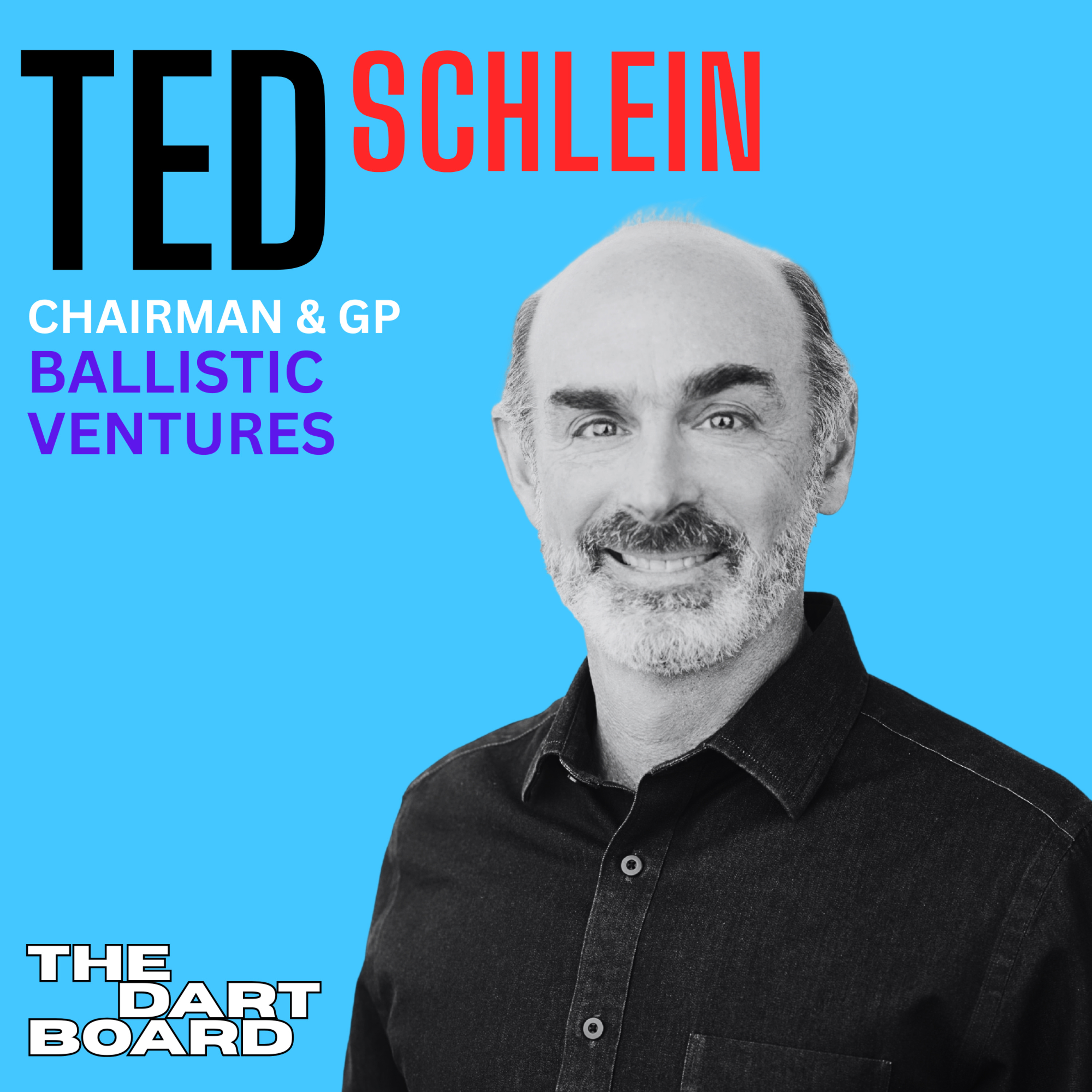
Ted Schlein discusses generational firm-building in venture capital, his 40 years in cybersecurity, and how investors must “earn the right” to be expensive capital. He compares influence vs authority on boards, explains how venture has changed (more capital, more investments, more founder autonomy), and forecasts AI-driven security risks and opportunities.
Ted Schlein is a long-time Kleiner Perkins partner (over 30 years) and executive chairman/founding partner of Ballistic Ventures, a cybersecurity-only firm. He previously worked at Symantec, where he designed and commercialized antivirus software, and co-founded Fortify Software (static code analysis for security vulnerabilities; later acquired by Hewlett Packard). He grew up around Apple via his father’s Apple board role.
Boards require influence, not authority. Venture is a services business; entrepreneurs are the customer. Ballistic is “throwback” and invests earlier with faster diligence and deeper operator-style support.
Symantec antivirus; first Kleiner investment in Internet Security Systems (ISS, first intrusion detection system; $2.7M check, ~15%); Fortify’s static code analysis; AI jailbreaks as a new threat wave.
Written by AI. May contain mistakes.
Ted Schlein discusses his early experiences with technology and his career beginnings.
“We have a really special guest joining us today, Ted Schlein, truly someone that has seen every facet of the venture capital industry at the highest level, that I felt like this could be almost a four-part series.”
Ted explains his shift from being a tech operator at Symantec to a venture capitalist at Kleiner Perkins.
“Yeah, McAfee was a shareware product that was doing well.”
Ted shares the motivations behind founding Ballistic Ventures and the changes in the venture industry.
“You know, I think there's so many changes in the venture industry.”
Discussion on the differences in investment approaches and experiences over Ted's career.
“People ask me now, what do we invest in at Ballistic?”
Explore how investment strategies have evolved in venture capital.
“I have no idea what the statistics are, but I'm guessing, you know, the average investor is making, you know, six investments a year or more.”
Discuss the changes in cybersecurity over the years and current challenges.
“Now, I will say, I think entrepreneurs are just so much more adept today.”
Learn about the importance of connecting experiences to identify opportunities.
“Kind of see everything through the risk lens, but I also see opportunity to protect.”
Insights on what emerging venture capital managers should focus on.
“You know, now I wish I did Fortify now because the companies doing basically that same thing now are a whole lot bigger.”
Understand how different entrepreneurs require tailored support from investors.
“And does the entrepreneur think you give a value-add unique service, and that's what's going to make your product, your fund, successful or not?”
Explore the motivations and strategies behind firm building in cybersecurity.
“I find it hard, but I always came home skipping.”
Ted Schlein shares invaluable advice for entrepreneurs and the venture capital industry.
“And having done Kleiner Perkins as long as I did, I kind of knew the things I liked about it and things I'd like to change and do differently and everything.”
Discussing prevalent misconceptions in venture capital and investment strategies.
“The thing that I have found the most useful, and it sounds so trite because these are really aha things, is understand the other person's point of view.”
Reflecting on personal challenges and the impact of upbringing on self-reliance.
“If somebody gives me a dollar, I want to be able to give them$5 or$10 back.”
Ted shares insights on finding balance in life and in venture capital.
“And I had to become far more self-reliant because of this.”
Discussing Ted's plans for the future and aspirations beyond venture capital.
“Don't get too excited and don't get too bummed that you will go crazy.”

Get the gist, explore an idea or ask about something said.
 Claude
On The Dart Board with Daniel Dart, what are the key points of this episode?
Searching your listeningAutomatic transcript. May contain errors.
0:00I was on the board with another very more experienced venture capitalist. And I just got done being an operator, right? Symantec and everything. You're in a board meeting and the CEO of the company is saying, hey, they're going to do X, whatever they're going to do. And I'm going, no, no, no, no. You should do this. And the other venture capitalist kind of leans over, but puts their hand on me. What Ted means to say is he thinks you might want to think about it this way. And that always stuck with me. You know what? You better learn how to be successful via influence versus authority, right? You don't really have authority when you're on a board.
0:38You can just only influence. And how do you get on the skills to influence the entrepreneur? Sure. We have a really special guest joining us today, Ted Schlein, truly someone that has seen every facet of the venture capital industry at the highest level, that I felt like this could be almost a four-part series. Ted was at Kleiner Perkins for over 30 years, and he's still active there. He's also the founding partner and executive chairman at Ballistic Ventures, a new firm built exclusively around cybersecurity. His path is astounding. From the early days, his father sat on the board of Apple, so he grew up with a firsthand view of what the world was like.
1:21He worked at some of the biggest companies in the world, like Symantec. He also co-founded Fortify Software. I mean, he's truly done it all. Today, we talk about a little bit of everything. I hope to have him come back soon and we can talk about even more. So without further ado, Ted Schlein, welcome to the Dartboard. Thank you very much, Daniel. Good to be here. I'm super excited. And as I was thinking about where to start this, rarely do I sit down with someone that has such a long and storied history. And so we're going to cover a lot of ground. First off, I want to start because you do a lot of cybersecurity thinking.
2:01It's very structural because you were at the very earliest days. And so before we even get to Kleiner or Ballistic, can you say a little bit about your background and how you entered even the technology sector? It kind of ties a bunch of stuff together. But if you think of the mid to late 70s to late 80s, my father was on the board of Apple Computer. Oh, wow. So as a kid, I grew up always with a computer. It was weird back then because I used to give every board member whatever they made. And my dad didn't know how to use computers. He used to give them to my sister. I am. And so, and I only say this, that I kind of always had, I think my first computer was a 2 +, then I had a 2E and a 2C and then a Mac and a Mac Plus.
2:45And we had a Lisa and the family. And some of your listeners are not going to even know what some of these computers are. But so I only bring that up is it made, it kind of, it turned me on to wanting to be in tech, like in a way. And so when I went off to college, I actually I did a bunch of startups in college as well as during my summers. That's kind of why I spent. And so my first job when I graduated was to go to a startup. That was like a natural thing I wanted to do, which seems so bizarre. I went to University of Pennsylvania and, you know, everyone either went to consulting or Wall Street kind of thing.
3:22I went to California to go do a startup and the startup was Symantec. And so I got to Symantec. There's probably, I don't know, 40 or so people there before revenue. And I spent the next 10 and a half years, you know, and Symantec became, you know, one of the biggest software companies in the world during that time. Now, in today's parlance, you know, it looks dinky, but it was really one of the biggest software companies in the world. Well, you know, since you asked about the security angle of this, probably my biggest contribution to Symantec was I designed and commercialized antivirus software.
3:57And so I put them in the antivirus business and that shifted what Symantec did. That wasn't why Symantec was founded or anything like that. There's a whole story about Symantec if you want to get into that. Yeah, I mean, for listeners who may not know, he's kind of underselling that it truly was a transformational, amazing, huge company that really was on the cutting edge of what really built a whole entire cybersecurity industry. Right? Like it was one of the first, you and McAfee and all of these different things. Yeah, McAfee was a shareware product that was doing well. And I thought we could do a commercial version.
4:34And I was a Mac head because I told you that before. So I did the very first one on the Macintosh. It was called Semantic Antivirus for the Mac. Very clever name. Sam. Then they let me do whatever I wanted Semantic. But I did some good stuff for them and some not so good stuff. But I spent 10 years there bouncing around. And it was better than any MBA I could have gotten. I got to see everything and do everything. At the core, I was a product guy. And I love starting product businesses. And then from there, you shifted to Kleiner Perkins. How did that happen? So Symantec was backed by Clannard Perkins.
5:10So on the board of Symantec was John Doerr, my longtime partner now. I mean, John and I have been together now basically 40 years in one form or a fashion or another. And so they, Clannard Perkins was asked by Sun Microsystems to start a fund to support Java, the Java programming language. Everything I talk about just makes me sound so old. You know, this is back in 1996 when Java, who had just been released by Sun Microsystems, and Sun was a Kleiner Perkins startup. And they wanted to start a Java fund to promote Java, to get people using the Java programming language. And so John and another Kleiner partner back then, Doug McKenzie, came and approached me and said, hey, would you like to come and do the Java fund?
5:57And I guess I looked at this as an IQ test. So, yeah, it's Kleiner Perkins. They asked me to come join them. Maybe that's a pretty good idea to do that. So I just made the leap from operator to venture capitalist. And that was in 1996 to run this thing called the Java Fund for Kleiner. And then I just joined the main funds after that. Wow. And so now we're going to kind of bounce around because there's a whole lot to cover. And then you're still actively involved in Kleiner. But in addition to that, you also started a new firm. So you're like this OG yet also emerging manager in your own right at the same time.
6:34And so can we talk a little bit about that? Like what was the impetus to think, hey, I've been here at Kleiner through all these iterations, but now let me go start Ballistic and do it again. You know, I think there's so many changes in the venture industry. I mean, which we should get into because I think it's fascinating. I mean, and I'm sure you know it, too. Just you're in it. Right. There's just there's there's there's been so much changes. And when I grew up in venture, it's very much about very early stage, smaller checks, get big ownership, work the companies and grow them and take a lot of risk, honestly, with the entrepreneurs and doing all that.
7:20And I think the venture industry is kind of bifurcating to some extent. And so the Kleiner platform is one of the greatest platforms in the world. And, you know, I was so lucky to be a part of it. But I also realized that for this change in venture, I actually think there's a better group to drive that and manage that than me, just the way that I'm wired. And so, you know, I always tell people when people want to know what the smartest thing I ever did is I recruited Mamoun. Yeah. You know, to come to KP and Ilya joined him. And those guys are just great. and participating, I think, in kind of the way platform venture is executed, much more so than I would have ever been.
8:02And so it was recognizing that, right? It was just kind of recognizing that, doing the right thing for the firm called Kleiner Perkins, but also saying, hey, you know, I got something I want to still give. Yeah, that's fascinating. And it kind of makes me think of this question that I had not thought of before, but I kind of want to ask now. And so it's a new question I have. You're the first that's ever happened, but I think I'm going to build it into a series, is the first investment. So I'd like to hear the story of the first investment you made while you're at Kleiner, and then also the first investment you made from Ballistic.
8:34And what was those experiences like from sourcing to DD to how you're engaged? And what does that look like? And what are the differences? The very first investment I made at Kleiner Perkins was a company called Internet Security Systems, ISS. And, you know, go figure. I was a security guy. And Internet Security Systems had developed the very first intrusion detection system, IDS, and was founded by a guy named Tom Noonan and Chris Klaus. And there was a friend of mine that had worked with me at Symantec that was over there. And when he saw I went to Kleiner Perkins, he said, hey, why don't you talk to Tom and Chris about ISS?
9:16And I kind of got it immediately because the Internet was just getting going. And you could easily understand why an IES was going to be necessary. And so that turned out to be my very first one. The good news is it went on to be a pretty valuable public company and eventually got bought by IBM. Yeah, it's a nice way to start a career. Question, how big was the check at what valuation? It was$2.7 million, I think, I remember. and I think we owned 15 % of the company or something like that. That's 30 years ago. Yeah, what did we call it? Did seed exist yet or was just the first check to Series A?
10:02What was that even? Yeah, well, I find nomenclature so bizarre today. I mean, seed, Series A, pre-seed. We got pre-seed, so we're going to eventually have, I guess, the embryo. Inception. We have inception. It's an inception, Chad. Come on. I think it's insane. I think honestly, that would have been a series A, to answer your question, directly on that. People ask me now, what do we invest in at Ballistic? I go, I'm not going to try and put a name on it, but we're the first institutional money you take. You tell me what that is. All this stuff is just shifted around. And you kind of got to go with the market and understand.
10:48But I'm much more interested in what's the stage the company's at? Where's the entrepreneur's head at and everything? And I've always loved super early. The earlier the better. Let's create the market together. I'm happy that there's no customer. I'm happy you don't have a product yet. And that's kind of how we fashion ballistic, honestly. Yeah. And then from meeting them with that first check, what was the timeline? You met them through your network from meeting them to writing the check. What did that look like? Oh, I'm sure it was months. I don't really remember, but I'm sure it was months.
11:21I mean, we would take months to do diligence on something. Yeah. And then nowadays, the first check from Ballistic, what was the DD difference there? Yeah, that would be more measured probably in weeks. And I've certainly been involved in situations where it's measured in hours. Yeah. Speaking of Mamoon, there was a time where I asked him, what's the quickest decision? And he's like, maybe don't tell people. But 30 seconds I sat down one time and I was like, I got to work with this guy. Fascinating. Fascinating. When you get your pattern matching going in this business, you figure out who you want to work with, who's got it, who you want to work with and who you don't want to.
12:01And so I think you can even come up with a no in 30 seconds too. Yeah. Yeah, I was saying to someone, because I'm a really small fund, and a lot of times I'll do a check before there's a lead, which is rare for small funds. And sometimes we're like, don't you get scared? What if they don't have a lead? And I'm like, yeah, but I feel like at this point, if I can't tell who's going to be able to get a lead check, I'm probably not the guy to be doing the job. So it feels very de-risked to me because I can tell right away, hey, if I'm feeling this way, I'm sure I can go find some other kind of collaborators.
12:32And I assume you're making the decision based upon the person. 100 yeah yeah yeah yeah i think um the way i kind of frame it is kind of that lens of like hey this is a person where i think that really good things are going to happen and it may not be direct but i think there's going to be something happening here and you know i i think at times i in reflection have a lot more theories on that in my memo than probably happened before the investments fade right like it's a great like in retrospect rationalization but sometimes i just feel like hey this is something really really special to do that okay now well forecasting is much easier to do in hindsight so 100 yeah i'm actually gonna steal that that being said do you have any truths about being an investor that maybe you had 30 years ago that you don't have now or vice versa again i i think the industry's changed a good amount i'm i'm a throwback so i still try and practice it in a lot of ways the way it it always was practiced but which is you would an average investor would make two investments a year about just looking statistically that's what we did at client program for you two in an entire year and you'd spend enormous amount of time with each company, each entrepreneur, helping them build their companies and recruit the management team and getting the first, helping them get the first couple of customers and getting the positioning right and the message right.
14:04I have no idea what the statistics are, but I'm guessing, you know, the average investor is making, you know, six investments a year or more. More, more. And, and so as a result, you know, you can't really do all those things. Like you, you, you can't, You don't do all those things. It's impossible. There's so much time in the day. So it's very much about access to an investment. And can you get into the investment? It's much less about the value you can add to it. Not that you can't add value, but it's just not the same intensity of value add. So, you know, I would say at Ballistic, we're kind of a throwback firm.
14:44You know, we're actually really want to grab on and work with the entrepreneurs, help them build it and do fewer. We even incubate our own companies here. So we'll start companies ourselves because we're all operators and built companies and really dive into it. It's different. The industry is different. Now, I will say, I think entrepreneurs are just so much more adept today. This takes nothing away from the unbelievable entrepreneurs I work with over the last bunch of decades. But the younger entrepreneurs just are really so much better and smarter about entrepreneurship. Shouldn't be shocking, right?
15:22We've had 30 plus years of learning how to do it right and wrong and all that kind of stuff. So maybe I need less help. Yeah. Well, you say the same about being a VC. I never existed as a venture capitalist prior to Carta and digital fund administration. So actually during my audit last year, the person who was helping the most was Sue. I'm like, hey, what about this? And she was saying, oh man, this is so much easier today than it was 20 years ago. And I think she's been CFO over at Kleiner for 30. A solo GP literally couldn't have existed 20 years ago, really. It would have been hard. Yeah, really hard.
16:01Another example is, I bet, and again, I don't know the numbers, but I just know from my own history. you would have to do a CEO search on 75 % of the companies that you were investing in before, 80 % of the companies. It was the rare case where that founding entrepreneur was the one that could take it the whole distance. I bet it's inverted now. So much more of the entrepreneurs are taking it much further, or at least being allowed to take it much further. I think that's a change. It's a maturity in the entrepreneur or it's a change in how venture capitalists and boards are approaching the business.
16:38And a question I have, I keep thinking about because you've seen cyber insecurity really since the beginning. It's evolved so much. When you think about the new stuff, I'd be curious what your thoughts are on the recent kind of jailbreaks and stuff that's happened with the AI models. Yeah, I get some version of this question all the time over the last 40 years. which is, oh, when I tell people, yeah, I'm kind of a security geek or whatever, they go, oh, that's a good space to be in. Is it going to be really dangerous this year and everything? And there's usually, you got to realize when I started the antivirus, there weren't even local area networks yet.
17:19Like it's coming on the scene. So once local area networks came, then viruses proliferate. Oh, well, then the internet comes along. And there's each one of these waves that multiplies the threat factor. Yeah. Yeah. AI is certainly one of those waves. Yeah. No, it's happening in spades and it'll have them faster. Kind of see everything through the risk lens, but I also see opportunity to protect. And I think the ability to use AI to protect against AI attacks is actually going to be great. It's going to take some time. Usually in these shifts, the adversary has the advantage and that's kind of where we're at right now.
17:56But eventually the good guys can catch up and start to make haze. And when you think about investing, are you more of like, hey, let me research, research, research, and then I come to a conclusion and go look for someone building in that? Or is it more of just meeting interesting founders in the space and kind of seeing and reacting to what they're sharing? I would sort of say it's a mix of a few things. I love meeting all the new founders and everything. And I love the conversations with my partners. And realistic, 100 % cybersecurity, that's all we talk about here, right? So it's very different than a regular firm where you're talking about all sorts of different topics.
18:32All we talk about is cybersecurity. So a constantly absorbing info, right? And I think as a venture capitalist, that's what you do. You better be just absorbing information, however you're going to get it. whether it's from entrepreneurs, whether it's from what you read, whether you go to listen to somebody speak or have your interactions and everything. And you got to formulate a point of view. You know, why is this going to matter? How big of a problem is it? And because I've been in cyber for 40 years, you know, I definitely am highly opinionated about what's going to matter, what's not going to matter.
19:05And it doesn't make my opinion right. But I think it's important to have an opinion in this business and to have a point of view. And I think it gets shaped by all those different things. One of the divisions I managed at Symantec in my final years, I had a whole bunch of product divisions, but one of them was compilers, programming languages and compilers reported into me. And Symantec had a pretty big compiler business. It's not that I knew a whole lot about compilers, but I found it fascinating. You merge that with I'm a security guy. And I started thinking about, wow, we ought to try and find security vulnerabilities in source code at the very beginning, at compile time, so there wouldn't be any vulnerabilities when we release software.
19:49So from that, as a venture capitalist at Kleiner Perkins, I started a company called Fortify Software, which is the very first time anybody used static code analysis to go find security vulnerabilities in source code. So I only tell the story just because you got to constantly connect dots. You have an opinion, you connect dots and everything. Fortify was great and wonderful. You know, now I wish I did Fortify now because the companies doing basically that same thing now are a whole lot bigger. Nonetheless, you got to listen and think what makes sense. You know, I've always been, you know, get at the source of security issues kind of guy.
20:25Yeah. And Fortify had some amazing success, right? For listeners who don't know, I believe Hewlett Packard bought Fortify. Is that correct? Yes. Yeah. And so, but you also started it while you were full-time at Kleiner. Yeah. And then it helped build it and sell it and all of that. Is that one of the things, prior to that, had that been done a lot at Kleiner? And then is that why you kind of integrated that back into the ballistic model? Yes, it had been done at Kleiner. It had been done, I can name up some really well-known ones. Vinod had done Juniper kind of in that mode. John Doerr had done at home kind of in that mode.
21:04Brooke Byers did a bunch of life science companies kind of in that mode. We call them incubations. Not every partner did them, but many of them did. And we would just start stuff from whole cloth. And then one of the greatest things is firing yourself. I love it. It's the greatest appreciation. Hey, Ted, you should no longer be CEO. I agree with you. Let me go find a CEO. You're fired. It's very, very painless. and you know you replace you put the team together to now take the baby the next step it's so interesting because that's kind of what you did with the moon in essence as well and i wonder are you going to do that with ballistic do you see it out outlasting you as well yeah the better outlast me uh you know i'm getting old man you know so but that's the interesting question yeah incubations are a key part of ballistic are we trying to do at least two incubations of fun they're long now Now I'm going to circle the block being like, let me invest.
21:54Let me invest. Okay. Question that I have for you that I think is very interesting because not only have you built stuff like Fortify and Symantec and then also helped kind of restructure Kleiner and then build Ballistic. One of the questions I like to ask individuals like you with the expertise is hypothetically, if you were to make a seed investment in my fund, Rockyard, and you were a board member, what would you want me to focus on or an emerging manager in a similar position for the first 90 days? If I was investing in your company? No, no. Think about it like as a startup. I'm trying to say as a board member, if you were to work with me, or you could say an LPAC member to use the linguistics of venture capital.
22:34Okay. All right. Right. Like what are the things that you would sit down and say, Hey, Daniel, with the experience that I have, let's talk threes through, let's go over X, Y, Z. You're focusing on this. What are the things that you would advise me to think about or at least kind of pay attention to that maybe others would not know? So let's start with the fact that there's a lot of capital available. A lot. So why are you any different, Daniel? I want you to explain to me what makes you different. Why should somebody take your money? Why should they work with you? And I would work with you to make sure that that answer is compelling.
23:12You know, at the end of the day, the venture industry is a services business. 100%. goal is provide the better service. And how do you measure the better service? Well, the entrepreneur will tell you. That's your customer. And does the entrepreneur think you give a value-add unique service, and that's what's going to make your product, your fund, successful or not? Tell myself the same thing here at Ballistic. I said, we better, we're expensive capital. So you better earn the right to be expensive capital. And that's on us. That is on us. And that's what I would be telling you, Daniel, with your funds.
23:50So on that, when you make an investment into a startup, do you have a structure like, hey, we're going to do the term sheet. We'd like to check in this much. We'd like to have this type of communication patterns. How do you think about that? I think that's all very personal. It's very partner-specific and it's also entrepreneur-specific. I work with some unbelievably experienced entrepreneurs now that call me when they need something, which is fine by me. And then there's others that just need a lot more work, a lot more help. And that's fine. And I think you have to be comfortable with that. As a venture capitalist, you got to say, OK, this entrepreneur needs more attention and help.
24:29And how do I do that? And they might be a first time entrepreneur and they don't know what they don't know. And how do you help them along with all that. So I think that's very, it's not formulaic. I don't think that's a formula you come up with. Did you always feel that way or is that something that you've learned and leaned into more over time? You know, time probably just gives you a lot more wisdom. I mean, I used to do things. I remember one of the first boards I was on, I was on the board with another a very more experienced venture capitalist. And I just got done being an operator, right?
25:06Symantec and everything. You're in a board meeting and the CEO of the company is saying, hey, they're going to do X, whatever they're going to do. And I'm going, no, no, no, no. You should do this. And the other venture capitalist kind of leans over, puts their hand on me. What Ted means to say is he thinks you might want to think about it this way. And that always stuck with me. You know what? You better learn how to be successful via influence versus authority, right? You don't really have authority when you're on a board. You can just only influence. And how do you own the skills to influence the entrepreneur to do that?
25:46And I bring that up to us. That's time. It's just wisdom. It's just doing it and screwing it up and then working on it and doing it better. And then you realize every entrepreneur is completely different. Every team is completely different. So it's really hard to be too formulaic. You got to be true to who you are. I'm sure if you talk to the, I've done 65, 70 companies or something like that, literally. If it's some line that goes through all those entrepreneurs that might say about me, how I act or how I behave in certain situations, how you interact with them, I think, is very different, kind of like a puzzle.
26:25And you got to put the puzzle together to create the optimal outcome. Yeah, it really is. Like you said, it's so individual because I found the same and sometimes LPs ask me like, well, how do you support? And I'm like, I don't know if I agree with the premise of the question because it's really hard to say because like you said, I have founders that have taken companies public before. Really, I'm just happy to be along for the ride. I'm just trying to cause as little friction for this person so I can keep investing as possible. And then, yeah, there's other people. You know, we got some people that are young, brilliant 18, 19-year-olds where they were just like paying themselves like 10, 9, 9, 10, 9 insurance.
27:06I'm like, guys, you guys should think about getting insurance for your employees eventually. Don't you have a lot of fun with those folks? It's so much fun. It's the greatest job in the world. I mean, realistically, we get to work with brilliant people who are radically optimist. And it's that kind of influence right there, just results in amazing things. I think when I first learned about just the venture industry, it almost felt fictitious. I'm like, oh my God, like you can not only get to do this, but get paid really well for it. And of course it's competitive. The thing I mentioned before we were recording the podcast is there's very few people that have made a career as long as yours decade after decade, because it's so hard.
27:47but I think the pursuit of that is just, there's nothing in my life I think that could be more enjoyable. I agree with you, Daniel. I just think it's really just an unbelievably fun business to be in. I'm always calling it a business. I find it hard, but I always came home skipping. It was fun to go to work and fun to come home. It wasn't like going to work. I think about what part of helping to create the future. And on the creation point, and so many of my questions are about firm building, after you did the client thing, you could really do anything you wanted. Why did you structure Ballistic at the size you did with the partnership you did?
28:27Like, why didn't you solo GP it? Why didn't you go a little bit more broader generalist? Why was it, hey, we're going to be super tight, narrow focused with this type of team? I think the generalist market is going to be seeded to the big platform companies. companies and the firms. And there's, what, 20, 30 of them that raised billions. Kleiner is one of the premier ones of those kind of thing. And so I think that if you want to participate in venture, at least the way that I'd want it to, you have to be focused. As again, I think it gets back to the conversation we had earlier, which is you have an opinion.
29:03You're an expert at something so that somebody wants to seek you out. Cybersecurity was in my blood. It's not the only thing I ever did at Kleiner Perkins, but I've done cyber for a long time. And I was able to convince a bunch of my cyber entrepreneurs to come do it with me. I think it's really hard. I've never done it, so it's tough for me to say, but I think it would be really hard to be a solo practitioner. I trust my instincts, but I don't know if I trust them that much. I want somebody else to pressure test and everything. So creating that spirit of debate, which is kind of what I grew up with at Kleiner Perkins and your challenge response.
29:39And I think you end up making really good decisions. And so if you got a group of folks that also love cybersecurity, that you have huge amounts of respect for, we're all very different. It's something else I'm also keen on. I think great things can happen. And honestly, I got to do a startup. Ballistic was a startup, right? And you get to set the tone. And having done Kleiner Perkins as long as I did, I kind of knew the things I liked about it and things I'd like to change and do differently and everything. You get to do it. Yeah, I think that's one thing that's really unique is you had the ability to take a story firm and then really think through what it would look like reimagined, which is very rare.
30:22And then like you did with Fortify, you had the chance to kind of fire yourself. So that's, I'm seeing, I'm seeing a trend here. I think being a solo GP, I kind of consider myself a rebel alliance, even though I'm an individual contributor to some extent, there's like five or six of us that almost are like Voltron and work together. And so on the outside, we're different, but it feels very much like that pressure testing. But one of the things I had mentioned to one of my friends at Sequoia was like, I never got the chance to experience a firm like Kleiner, which candidly, I think is the bummer.
30:57I would have loved that. At the same time I try to think of it that it allows me to be an orthogonal thinker. So maybe that's the optimist in me. So I'm like, hey, how do I do that? And then also try to stay as close to people like Mamoun and you to learn from. And then especially on the firm building, kind of be like, hey, question, I have this and I have that. But it is fascinating because there's so many ways to do the business. And I agree, the platforms are so powerful. Yeah. Even the platforms, prosecute the business differently they each have their own strategy and everything but i i don't know i don't think i i wouldn't be where i'm at and doing what i'm doing if i hadn't had that opportunity to sit next to you know in the room with john dore on a you know on the daily basis and debate things and vinod kosala and brooke byers and kevin compton and dud mckenzie i mean the list goes on and on it goes on and on man and i've had the opportunity to you know absorb from and learn from and debate with and everything.
32:01And I, I don't, I, you know, I think it was invaluable. And so now I'm getting to do it again. I mean, I'm listening and I think it's invaluable too. I'm like, man, that sounds like so much fun. Shifting gears a little bit. There's a few questions I like to ask everyone. The first is what is the best advice that you have ever received? I have a couple answers to this usually. Let's hear them all, man. I'll give you one. The thing that I have found the most useful, and it sounds so trite because these are really aha things, is understand the other person's point of view. And spending the time to understand the other person's point of view, I think, ends up leading to a much better business relationship or conversation or decision making, etc.
32:53et cetera, it allows you to work better with people. So often people just come at you. And I think it's really important to sort of say, well, this is what I think, but what do you think? And be willing to change your mind on that. The other piece that I remember John Doerr telling me, he says, you know, Ted, this industry, there's no time clock. Like there's no hours in the day. You don't know when your company is going to do well, when somebody's going to need you or whatever. There's no days of the week kind of thing. It can scare you, but it's very true that it's not a nine-to-five job kind of thing.
33:31It's like a piece of operational advice versus maybe strategic advice. Fascinating. On the other side of that, what's some bad advice that you may have heard or commonly held advice or dogma that you disagree with? There's a lot of people that believe you should get in at any price. They do. Yeah, they do. You do, and I just don't. I just don't. I can make the argument for and against that. The argument for is, well, if you do enough of them, one of them is going to hit, so it doesn't really make a difference about the rest of them. I get that. I mean, it's the game of venture in a way. But I think, especially an early-stage venture capitalist, every investment you make should be meaningful and matter.
34:14Because that's what you're promising to the entrepreneur, et cetera. And it kind of goes hand in hand with another dogma and something else that I've been religious about. Smaller is better. Smaller funds are better. I'm a big multiples person. If somebody gives me a dollar, I want to be able to give them$5 or$10 back. kind of thing. Like, I'm telling you, a billion dollars, then another billion dollars, and then another billion dollars, and then another billion dollars, and then another billion dollars. That's hard. It's hard. So I think smaller funds are better. And do we fashion blitz it that way, that way, too.
34:54So, I mean, I'm giving you some stuff where I've gone against the market or the commonly held dogma that maybe exists. Yeah, I think as I as I get older, too, there's also a reflection on myself of, hey, who do I want to be? One thing I say a lot is like who your heroes are matter. What do you want to grow up to be? And I think it took me a long time to to really say everything doesn't need to scale. Like I don't need to be Walmart. And yes, I'm going to forego those huge V-strings. I'm going to forego those, but I'm totally okay with that trade-off because I find so much joy in doing this. The kind of last big question I love to ask is what's something in your life that was really, really difficult at the time, but in retrospect provided a ton of value?
35:43Because so far, all you're doing is hitting home runs, man. We got to have a hit by pitch somewhere, you know? Yeah. Well, I mean, you asked about it. You made it so broad that it's anything in my life. Anything in your life? Like if I'd made it as an investor. No, it could be anything. For me, it's I went to prison and it was horrible, but actually I can make a much better argument that it's the best thing that ever happened to me. You know, one thing that's very important to me is investing is what I do, but it's not who I am. Right. I'm this very complex human that, you know, I think what me and Mamoun really bonded over is I did this nonprofit work.
36:20And part of that was building an ultra-grocerment program in Pakistan. And we ended up really bonding over that. And most people think like we just bonded over investing. You know, obviously we talk about investing, but also there's so much more to these kinds of complex human beings. And I would say the same thing about kind of how you're building the business. And when Allie, who introduced us, she never said, oh, you got to meet Ted, just invest, invest, invest. She's like, he is a great human being. He's a great mentor. He's super supportive. He's reliable. And so I'm always trying to understand what are the things that happened in our life that made us who we are instead of just the things we do.
36:59I think, so my parents got divorced when I was four, which happens too often in this country, but it happens. My father moved to California when I was 12, and I grew up with my mom in New Jersey and my sister. And everyone's got what they're, my mom is dealing with what my mom's, you know, dealing with trying to raise two kids and maybe find another spouse. She eventually married my stepfather, who was awesome, and all that kind of stuff. And I had to become far more self-reliant because of this. I have some unbelievably great friendships that I rely on, and I've had long-term friendships that have been a part of that.
37:43But I think by them splitting and moving 3 ,000 miles away, it makes you think, you know, eventually, I'm not so sure I thought this way as a four-year-old. So, you know, as you start growing up and sort of say, well, you know, at the end of the day, it's about me doing what I need to go do. Not that I don't have friends and support and all that kind of stuff. But how do you become self-sufficient and drive towards whatever your goals are and to do it? So I think that probably played a good part in that. And, you know, during adolescence, all you're ever trying to do is come up with how am I going to be?
38:23can you get confidence in what you do and everything? And I became a wrestler. It's kind of a cool way to build confidence and stuff like that. So it's all, I think, a mechanism of how am I going to take on the world? It gave me this belief that I could do whatever I set my mind to go do. And it doesn't always work out, but for the most part, it's worked out pretty well. Thank you for sharing that super powerful story. And I agree. I think you've done good figuring it out along the way. And I think sometimes even just the outlook of, hey, things work out, sometimes it's like a really powerful thing.
39:06Not everyone holds that. I think the best venture capitalists do. And it probably is what allows you to be a very supportive VC as well, because you can take things in context rather than maybe overreacting. Yeah. I mean, I think it's, actually, I think it's important as a venture capitalist, Don't get too excited and don't get too bummed that you will go crazy. Like so you deal with what you have to deal with. I have this chart on my wall here in my office that is a Venn diagram of things that are important and things that you can control. The overlap of those things. And then it sort of says what to focus on.
39:45You know, if it's not important, don't worry about it. If you can't control it and what you're going to do doesn't matter, don't worry about it. But those two things, when they overlap, that's what the focus on. And so I think you've got to do it as a venture capitalist to get that balance, to get the focus on what matters. I mean, think about it. You sit in board meetings and people just want to stop. I say, can we just talk about the one thing that's going to actually matter to this company? Yeah. And I think that's what you want to do. I think it's what you want to do. I think it's what you want to do in life.
40:17Yeah. But you can apply it to companies as well. Yeah, in life, it goes by so fast, don't it? I got to be at least 20 years older than you. I don't know, but you have to say, you're looking good for that age, man. And I love to see you just still active and crushing it. One more question before we wrap. Where is Ted in 10 years? I'd probably be an advisor to companies. I won't be a board member of companies, would be my guess. Maybe I'd serve on a couple boards. I won't be an active venture cap. us. I just, I don't, I don't think so. I do think there's something to age in our business. And, you know, the fact that I'm focused on cybersecurity only, I mean, I have some good wisdom for that.
41:01But if you really want to do this business where you got to, there's, you know, the energy to be out there and networking and doing and doing that left and right and everything. Yeah, come on. It's just not what I'm going to be doing. I've slowed down already and I'm not 10 years from now, it's not what I'm going to be doing. I'm going to always love this thing called ballistic. Now I know I'm going to hit you up in like nine and a half years. Be like, hey man, advisory role, rock. Let's go, man. Let's go. What I really want to do is become a rock and roll star. We're going to have to catch a show or a concert then, man, soon.
41:33Well, dude, I think that's a great place to end. And I just want to say thank you again for spending some time with us today. Daniel, thanks for having me. It's a pleasure.
Meet Ted Schlein, executive chairman and general partner of Ballistic Ventures, and general partner at Kleiner Perkins since 1996.
Ted has been in the cybersecurity industry really since it began, helping build one of the first major companies in the sector, Symantec. He then joined Kleiner Perkins, where he has been involved for over three decades, during which he founded another cybersecurity darling, Fortify Software. And if that wasn't enough, he recently founded another venture firm, Ballistic Ventures. Very few people have had the staying power and success of Ted, and in this episode we dig into a bit of everything spanning his generational run - which is still going on today.
We close by learning a bit about the stories that shape him and the best advice he picked up along the way.