 The Determined Society with Shawn French | Adversity & Mindset
26 Oct 2026 · 1h 4m

 Add vo to ChatGPT or Claude to ask about everything you hear
vo listened to this episode to put together the overview and transcript, so there may be the odd mistake.
Mark Shapiro recounts his life from entrepreneurial childhood and early real-estate deals to a federal securities-fraud conviction, a 85-year sentence commuted by President Trump, and his prison-to-purpose transformation through teaching real estate. He also argues that determination is applying one’s upbringing and skills to keep moving forward, and that social media often rewards instant success without substance.
Mark Shapiro is a real-estate investor and educator who says he founded Shapiro Capital and Shapiro University. He grew up in a family of real-estate agents (mother Carolyn Helene) and dentists (father Paul Arthur). He played Division II football (tailback) at Central Connecticut State University. He was convicted in a large business case with about 1,200 employees (Springfield, MA) and later served 15 years in federal prison.
He says he couldn’t explain receiving “85 years,” but believes prison gave him purpose. He credits God and fearlessness for survival, and says he taught GED math and then rewrote prison real-estate curriculum, creating multiple courses including “Money Matters.” He claims his sentence was commuted by Trump after 10 years.
selling gum/stickers in childhood; buying a Hartford-area multifamily building in college after 10 bank rejections; prison education assignment leading to teaching real estate; a shank incident early at Otisville; watching a Celtics game when commutation paperwork arrived; later closing a 372-unit apartment deal and building wealth through real estate education.
0:00I wouldn't have changed the fact that I went to prison. So you're sentenced to 85 years in prison. What does a man do with a sentence that is greater than the rest of his life? To this day, I can't explain it. And my mom, she became a commercial broker. And she would take me with her. And when I graduated, I had 58 apartments. We bought the property. I sold it. I made$108 ,000 within six months. I can't articulate it because it's gut-wrenching. it's I can close my eyes and I can listen to the judge. So football was extremely important to me. And one of my biggest regrets I have, I would say destroying my first marriage and not playing my senior year.
0:40Where at one point you actually had a shank pressed up against your eye. And it was the first night. Trump commuted your sentence, correct? Yes, commuted it, yes. What does determination mean to you?
1:00Picture a man walking out of federal prison after 10 years inside with almost nothing to his name, no money, no home, just a coffee cup. The men inside that he taught for years gave him as a gift. Six months later, he closed a 372-unit apartment deal. Now this man runs Shapiro Capital and Shapiro University and is helping thousands of people achieve wealth in real estate. This man has been through it all this is the determined society and this man has lived both sides of determination the drive that builds the empire and the choices that cost him and others dearly so today we welcome mark shapiro to the show welcome to the determined society buddy thank you thank you you look amazing man look at you that's a great that's a great suit custom i know you told me all about Staten Island.
1:52Listen. Bobby and Tommy from Staten Island. Of course their names are Bobby and Tommy. Bobby and Tommy. And they're cousins. Really? No way. Shocker. Shocker. No, you look good, man. Thanks again for coming. Let's start at the beginning, man. You know, you're a kid at your mother's table and she's teaching you some things. Walk me through those moments. So my mom was incredible. Her name was Carolyn. Carolyn Helene. And I had an equally incredible father, Paul Arthur. And my mom decided when I was about nine to become a residential real estate agent. And it simply became very basic for her. So after she had been working back in those days, She had to work for three years.
2:49She became a commercial broker. And she started focusing on multifamily apartment communities. And she would take me with her. So I would go and do her floor time. Back then, they didn't have social media. Back then, they didn't have computers. They had a big book, and it was MLS, the Multiple Listing Service. And that's where agents got their leads. and they got their leads from sitting at a desk for three hours called floor time. She would take me with her wherever she went. I was her baby. And I would ask her questions, and she loved to teach. And from that point, I was fortunate enough to have, and my mother's from here, my mother's from Coral Gables, my dad is from a little town in Connecticut called Winstead.
3:46and my father was stationed in the Army in Fort Meade, Maryland, and he had a two-week pass, so he drove from Maryland. He was a dentist, so he went to dental school in the University of Maryland, and his father got him a convertible, a red and white 56 Chevy convertible, and he drove it down. And I think my dad was handsome. And my mothers, both grandmothers had some common friend, and asked my mother to show my father around. My mother was engaged at the time. Well, she didn't marry that guy. Three weeks later, she got on a Grand Bus and went to Fort Meade, Maryland and married my dad. Wow. Yeah.
4:36And I will say that my dad was, he was a stand-up dentist in a small town, the town he grew up in. He tried to, he took the boards here back then they didn't like northerners the yankees so they made it very difficult or they just failed them automatically so he went back to connecticut took the boards there my grandfather opened them an office he happened to have two brothers who were dentists so i come from a family of five dentists interesting i did not want to be a dentist even though he had a plan and um i started just spending so much time with my mother and the there was a period where i took a year between my freshman and sophomore year and i stayed here i got a little apartment on mary street the grove before there was the grove and um i was selling towels and t-shirts at the hialeah flea market i got myself a bartending job at a place called bogey's barn on 152nd and coral reef drive but a ball fun for you huh yeah how old were you 19 19 oh 19 yeah yeah that's a target rich environment right yeah 40 47 years ago oh and the girls were smoking hot still still the same but they're different back then they were a lot different yeah yeah than they are today for sure for sure.
6:00So would you say, you know, your mom ushered in this entrepreneurial type mindset into you by being around her so much and watching her work and seeing how she approached her real estate career? Is that fair to say? My mom was relentless and she was fearless. And, uh, I think it just became innate by being around it. And if she didn't know something, she would figure it out. Now, I like to think that my dad was a very bright guy. New York Times, Sunday crossword puzzle, 45 minutes, boom, no crossword dictionary, just a smart guy. But my mom had such a business acumen, and she was the one that helped me with my first deal and my second and my third.
6:58all the way till my sixth building when I was in college. How many units was that building in college? Because you were like 24, 25 when you saw that building, right? Was it 275-ish? So my first building I bought, and you're going to say, how do you have this memory? I have no idea. But it was 4143 Crescent Street. Okay. I went to Central Connecticut State University, and this property was in Hartford right near a college called Trinity College on a one-way street. And my mother gave me the business plan. She found me the building. I couldn't find a bank loan. I went to 10 banks. They all turned me down because they said, you're in college.
7:39I said, well, what about the income from the building when I stabilize it? I didn't know to say that. My mother told me to say that. She convinced my father to help me get a bank loan. I had the money. I had made the money when I was selling towels and t-shirts and bartending here when I went back home to go to school or resume going back to school. And that was a three-unit building. We renovated it. We had the parents sign the lease for the kids at a much higher rent. And I sold it. And that was the first time that I did my first, on my first sale, on my first deal, a 1031 into two more buildings.
8:21and then those two buildings turned in they were two six unit buildings side by side on a street called school street right around the corner and i did this applied the same concept and then right around the corner was another street called bond street i bought a 12 there then i bought a 12 back on school street and when i graduated i had 58 apartments 58 by the time you graduated college that's insanity that's badass dude congratulations on that that's i wish i had them today right when you say you were having the parents sign on for the lease for a much higher rent was that because of the risk involved with the kids actually yes yeah yeah okay and it's odd because it was uh it's a one-way street the college now owns a whole street because we actually went back last year to do some filming fill my father's grave and this one-way street is now all dormitories for Trinity College, which is one of the small Ivy League schools and beautiful campus.
9:31The only way that I could get the higher rent that we wanted to get was to have the parents, but the way we did it was we put a general, like a three by five card, a little announcement in the student union on the board. Because that's, there was no iPhone. Yeah. There was nothing. So you were able to actually speak to people with reason back then. Today, it's a lot different. It is. You're able to have open discourse. You're allowed to disagree back then. Yeah. And as long as you can talk about your opinion intelligently, people respected it and they moved on from it. Now it's, it's not, it's, it's scary.
10:19Yeah. Yeah. It's, it's very scary. Basketball is back on prize picks. Pick a shootout in the West and a boards battle in the East. Pick it all on prize picks available nationwide. So what are you waiting for? I love this time of year because basketball is back. Football's rolling. And with prize picks, you can bring both into the same lineup. Make your basketball picks like points and rebounds, then add football picks like touchdowns and passing yards. The lineup possibilities are almost endless because everyone and everything is on prize picks. And prize picks makes it simple. Pick two to six players.
10:51Pick more or less on their stat projections. Submit your lineup and then watch your picks play out live. Download the app today and use code TDS to get$150 instantly in lineups if you win your first$5 lineup. Download the app today and use code TDS to get$150 instantly in lineups if you win your first$5 lineup. Prize picks. Run your game. So, all right. So you were selling gum in elementary school, right? Yes. So talk to me about that hustle. And what does that say about the kid that, as an adult, ended up in that federal courtroom? Oh. You know, no one's ever asked me that question. so um we sold bazooka bubble gum was a little common yep a little comic in it fireballs and uh those little things those little chewy things called mary janes and i would get a box of them from the drugstore they would sell me the box they didn't care and i would bring it to school and i would sell it to kids so instead of a piece of gum costing a penny, which is what it cost, I was selling it for a nickel.
12:04All right. That's a positive margin. And I started doing that, and, you know, I never stopped doing something, whether I was shoveling driveways or cleaning cars in the neighborhood while I used a snowblower or, you know, anything that I could do. I painted some houses in my teens. Really didn't like going up on the third story. I bet not. this but selling that gum i think it just was an innate feat you know it was it was innate for me to be able to see a need and try to fill the the niche or fill the gap and um you know kids will pay anything when you're when when you're the only source so gum is a drug because it's sugar A fireball is a drug because it's sugar.
12:59And eventually the vice principal was like, you can't sell this stuff here, and called my mother. So then I switched to stickers, like car stickers, like STP, oil treatment, these stickers. And how did I get them? Because next door was the Snap-on tool guy. And I would get all the stickers from him, Al Rosenfield. So it's interesting because you're explaining your whole childhood of, I mean, when you're, I think you're probably around the same age as me. I'm in my late 40s. Yeah, you're full of shit. So, you know, I'm 66. I didn't know that. I swear to you. You look great. Thank you. So do you.
13:44I thought you were in your 40s. I had no clue. 15 years in prison will preserve you. Jeez. I would think it would be the other way around. You put the fish oil on our face, you know. No. No, it's crazy because I'm looking back at my childhood and I would go around selling popsicles to my grandparents, neighbors, and I would make them. I would put Kool-Aid in a little ice tray. Yeah. I would wait to get a little bit, you know, to where the toothpick wouldn't fall out. Then I put it in and then I would go deliver them. And then we would sell blow pops in middle school for a dollar. I mean, it's just.
14:17Blow pops were actually a big seller. The blue ones, right? The blue raspberries crushed it in California. The Blue Raspberries, is that where you're from, California? Yeah, I'm from the San Francisco Bay. San Francisco Bay. East Bay. East Bay. So Concord, Walnut Creek area. Concord. So Sausalito is across the Bay. Yeah, that's east. Oh, no, sorry. That's more west. That's like towards the water, yeah. Yeah. I was east. East Bay. Have you ever been to Newport Beach? Oh, yeah, of course. Crystal Cove Shake Shack? No, I haven't been there. so I don't know where they claim the Shake Shack is it's Crystal Cove Shake Shack and you can see Catalina Island from there no way not a relatively even a clear day and they have the best burgers that's awesome better than In-Out In-Out sucks bro we have better burgers here oh my god I can't believe what a burger I have three adult daughters that are foodies okay very well very well known foodies okay So I have four daughters, but three that are from my first wife.
15:24And here, I think the best burger is Coney Burger. Okay. A lot of people like Skinny Louie's because it's greasy. There's a new place in Coral Gables called Star Burger. Okay. It's pretty phenomenal. Okay. Let's try it out. Coney Burger. Have you had it? I mean, that's not good. No, Coney Burger. You're probably Cowie guys. I mean, God. You're a Cowie guy? Coney's better. What do you like? He goes to Cowie Burger. Where? There's a bunch of burger places here in Wynwood. Okay. So Cowie Burger is a smash burger. Okay. You know, so Coney is a burger. They bake the buns every day. When they run out, they run out.
16:11It's a husband and wife. They just had a little baby. It looks like it's the building's falling down. but it's it's badass it's special they haven't taken me there yet special i don't live over here i live in i live in the west coast a floor here i live in like fort myers naples area a stare off a stare so um my mother's whole family relocated in the 2000s to fort myers um
16:44Sanibel, Naples, and I will tell you, I think some of the best pizza in the state of Florida is at a place called Three Cheese Pizza. Never had, what? In Fort Myers. Three G's? Three Cheese. No, Three City. Three City. Okay. So it's Detroit, New York, and Chicago. It's good pizza. I'm going to check that out. Yeah. We're going to end up talking about food the whole time. I know. I'm getting hungry. Yeah. I'm getting hungry. We'll shift. Sorry, guys. Will you listen? But this is this is great conversation. Robert Allen, that book. Right. Nothing down like nothing down shaped you. Right. When you look at it now, was that creative financing or was that temptation?
17:29So Bob Allen was all creative financing. Bob didn't have any money. He is a dear friend. and he started out figuring out how to solve needs of people who had properties that they really didn't want. And he calls them in his book, Don't Want Her. And my mother gave me Bob Allen's book going into my summer, my junior summer. She gave me his book because I had come back, I had the money, and that's when I told her, I said, I want to buy a piece of property. So after my sophomore year, going into that summer for my junior year, I told my mother, I said, you know, I want to buy, I have the money, I want to buy a piece of property.
18:23She said, where do you have the money? I said, I have it in a passbook savings account. She's like, you still have a passbook savings account? I'm like, of course. The bank is still there. and she she said okay read this book and i read the book in a day and i'm not a voracious reader i read slow very deliberate i like to underline things i like to think about them i read this book and it just it felt right inside my bones really and i went to her the next day and i said okay, I want to buy something. And she said, okay, how much you got? I said, I have$40 ,000. She said, you have$40 ,000? I said, yeah, I do.
19:09You know I do. She said, okay, we'll find you something. And that's what she did. Wow. And she put the whole business plan together. And I remember when I called her and I said, mom, we're going to have to request the deposit back because I cannot get a loan. And she said, I'm making meatloaf. I'm making meatloaf. I'm making meatloaf. I'm like, Mom, did you just hear what I said? She said, Mark. So West Hartford was the town I grew up in. The town I went to college was in New Britain. There were three towns in between, so it was a 35-minute ride. she said come over for dinner and bring the contract bring the uh contract from your uh construction company that's going to do the renovations and then bring the one page with the property stabilized called a setup that's what they used to call it back then now they call it performance or what fancy shit yeah decks blah blah yeah um she said bring that and um you're have dinner i'm like okay what am i doing with it she said after dinner you'll talk to dad like okay she said but don't bother him at dinner because we never talked business at dinner smart so um great meatloaf by the way that was a little potatoes so we did that and my dad said uh after dinner and after he had his cup of decaf coffee, he said, mom said, you want to talk to me about some business idea you have?
20:51I said, I want to buy a building. Is it okay? He said, you want to be like your grandfather? Cause my father's father, who I'm named after Milton was a real estate developer. And, um, he said, what do you got? I said, well, here's the contract. He says, your mother representing you. I said, dad, you know that she's representing me. stop he goes i just want to i want to give you a hard time he looks at the setup and he says all right i'll make a few calls i'll see what i can do that was it the whole 45 seconds what happened after that um he called my dorm room and he said what are you doing on wednesday i said uh well i have class um he said can you miss it i'm like well tell you you want me to miss class dad you know you're paying for my college he said no your grandpa milton's paying for your college he says i'm just in charge of the money and i said yeah yeah it's a class i can miss so he said meet me at the united uh united bank branch united bank of trust on la salle road and I'm like, okay.
22:05So I go there. It's the town I grew up in West Hartford. Sal Road's a nice little shopping area and there's a bank branch there. And out in front of the branch, he said, you ready? I said, I'm ready. And he said, what am I getting out of this? There it is. I said, what do you mean, what are you getting out of this? He goes, we're going to be partners, right? So that was your first lesson. Yeah. That nothing's free. No, no. And my father was the most kind, genuine, sweet guy, but he was tough. And he said, what are you going to give me on the deal? I said, how about 10 %? He looked at me like this, didn't say anything.
22:51I said, how about 20 %? He said, how about 60? I said, Dad, I'm going to do all the work. I'm putting up all the money. I said, how about 60 my way? I stuck my hand out. He shakes my hand. We go inside, and I'll never forget this. I can even remember walking back. We walked back to, his name was John Morris, who was the president of the bank. We walked back to where his secretary is. Back then they had secretaries. And my father goes off to get coffee, like to the lunchroom. I'm like, what's going on here? I'm thinking. Now I'm in panic mode. Sure. And she said, Mr. Shapiro, Mr. Morris will see you.
23:37So I go into his office, not knowing my father had already spoken to him. And he said, so you want to buy a building? That kind of made me, you know, it was a little giveaway. And he said, let me see the contract. And let me see what the numbers look like on the deal. Back then, they didn't care about comps. They basically went on your word. And he said, okay. Maybe it took him five minutes. He said, okay, I'll take care. I'll finance this for you. He said that your father said you have a passbook savings account at Society for Savings. I said, yeah, the bank right across the street. And we opened them when we were in second grade.
24:23So you'd like put a nickel every Tuesday. and I don't even know why I remember it was a Tuesday. Just weird. It's a good recall, man. So he said, would you transfer that to this bank? I'm like, is this going to get me the loan? He goes, I'm giving you the loan anyways. And I said, does my father have to sign for the loan? He goes, no. He goes, we're going to give you what's called a grid note, a 90-day note, two days before the closing, you'll come here. Your lawyer will give you a closing statement, and we'll make the money out to your lawyer's escrow account. You'll bring them the check. We'll close.
25:02And then when you want the money for the construction, you need the first money for the construction yourself. You'll put the money in the bank. You'll give us an assignment of the bank with the bank account. And when you need the money, you'll take it out. You'll start the construction, and then we'll fund you the whole thing. It was$24 ,000 to purchase it, and my construction was about$16 ,000,$15 ,000,$16 ,000. And I stayed right on budget because I didn't want to spend more than I had. I had$40 ,000. So we bought the property. I sold it. I made$108 ,000 within six months. $180 ,000 or$100 ,000?
25:39$108 ,000,$108 ,000. Wow. And that was back then, the olden days, capital gains was six months and a day. Today, it's a year and a day. So it either is ordinary income prior or capital gain. Right. And I did a lot of business with that bank. Wow. Yeah. What was the first amount you financed there at that day specifically? It was we financed the whole transaction. Wow. The whole transaction, the acquisition, and then the rehab. Basketball is back on prize picks. Pick a shootout in the West and a boards battle in the East. Pick it all on prize picks available nationwide. So what are you waiting for?
26:20I love this time of year because basketball is back, football is rolling, and with PrizePix, you can bring both into the same lineup. Make your basketball picks like points and rebounds, then add football picks like touchdowns and passing yards. The lineup possibilities are almost endless because everyone and everything is on PrizePix. And PrizePix makes it simple. Pick two to six players. Pick more or less on their stat projections. Submit your lineup and then watch your picks play out live. Download the app today and use code TDS to get$150 instantly in lineups if you win your first$5 lineup.
26:52Download the app today and use code TDS to get$150 instantly in lineups if you win your first$5 lineup. Prize picks. Run your game. As a college student, what did that feel like? I didn't even really think about it. You didn't think about it? I was so busy having a ball in college. one of the things that is probably the most unlikely thing that you would figure out about me is that I was actually a Division II tailback. I was an All-State tailback in high school. Okay. And I played at Central Connecticut State University. So football was extremely important to me until I actually started acquiring a bunch of units.
27:38and one of my biggest regrets I have, I won't say going to prison, I don't have a regret for going to prison. I would say destroying my first marriage and not playing my senior year. Those are truly my biggest regrets.
27:59And, you know, I'm a little guy, I'm not going on to the pros, but very fast and I wait a little bit lot more when i was in in college i was about a buck 87 yeah okay wow yeah so that's what made me tough enough to survive prison i would think you guys are pretty tough to survive 15 years it was yeah it's pretty crazy well it wasn't it wasn't like going to jamaica i wouldn't think so no not sandals in jamaica no and that started in 1998 right that's when you were uh you pled guilty you were convicted of i ended up getting arrested in 2006 okay so march 27 2006 they put the jewelry on you we were um a pretty decent sized business we had about 1200 employees we were based in springfield mass i lived here in in miami beach um off the venetian causeway
29:06and when I got divorced in 2000, 2000, 2000, my wife, Susie, she relocated back to the Northeast. And so I would go back and forth to have custody six days on, eight days off, six days on, eight days off. So actually I had a pretty good schedule. Yeah. Especially when you're single. Right. And you have a few bucks in Miami. And we are pretty, very active here. So like there was, there was multiple, there was two incarcerations, right? There was one for 30 months and then 15 years. So for the first 30 months, my question is, why wasn't there a change? Why have the second one? So the first one was not fully 30 months, and the first one was a family member had gotten himself in trouble.
30:14and I agreed to do eight months of what's called halfway house. And when I agreed to do that, I was married. And once I agreed to do that, I ended up filing for divorce and it was close to my, someone who was close to my wife, the father. and uh so we filed a motion to withdraw the plea we actually uh we won what's called a fatico hearing which proved the actual truth about what it was but um he's a very powerful man he's still very powerful today he's still alive live 92 the lord yeah the lord he was actually a really good father-in-law he and i got he and i got along really well so so the the plea you withdrew was the first time correct okay what were some of the thought processes behind like okay you pled guilty and then I need to withdraw this.
31:33What was going through your mind at that point? Well, I refused to until they came after my wife. I was not part of his case. When they came after her, because we had taken a, he owned a bank. He owned a large insurance company. You've probably heard of it, AIG. Holy shit. So he was partners with a guy named Ace Greenberg. Yeah, okay. And he bought a little bank called Enfield Savings and Loan. Savings and Loan of Enfield, I think that was it. And then they changed the name. And when they were cleaning up the balance sheet, he was on the loan committee. He was the chairman of the loan committee.
32:22And when they had several non-performing deals in their real estate loan department, he came to me and he said look i want you to buy all these i'm going to loan money to your wife she's going to form a mortgage company so you don't have to put up any of the equity you just turn them around resell them and you'll split the profit with me and with her mortgage company and that's called insider dealing was it in my opinion was it was it criminal i didn't think it was. And when you are the chairman of a loan committee, it can be. And he had for years kind of zigzagged in around the federal laws and they eventually said no more, no more.
33:18When you said when they started coming after your wife. So they came after her. First they served her with a subpoena. Then they brought her in front of the grand jury, and she said to me, she said, look, my father can't go to prison. I need you to do this for me. And I had three children. I wanted to have a really good life with her. I tried, and I eventually capitulated. It probably took her about two years of her nagging me. so to do it yeah that's a big sacrifice man well it was a pretty it was eight months eight months in the halfway house not bad yeah well i was thinking of where you know the mother of my children trying to protect her because you know you want to protect your children you also want to protect someone that you have this deep you know uh you love them so i don't know if yeah i loved my
34:32wife because i i don't know if i loved her the way i think i experienced love at this point in my life with someone who's very similar to me, close to me. Because she was really, I think she was the right person to marry. Does that make sense? Yeah, of course. Sure. And she was a good mom, good cook, just not a super great wife. I have an interesting question.
35:08And it's because I'm curious. why was it okay for you to do eight months in a halfway house, but her father couldn't go to prison? What made you the expendable figure there when you had three children with this woman? Because it was purely...
35:34He did not want to sacrifice. he did not want that tarnish on his. Yeah. Yeah. So you're, you know, it's funny because when he got indicted, it wasn't in the papers. Okay. And if you look at it, his case is sealed. And if you look at, like, on Nexus Lexus, you're not going to find it. So that's what money can do. Mm-hmm. and I was well off but I was expendable yeah and the funny thing was that shows you the difference between a husband and wife and blood it's a good point that's a good point you know as I get older I look at things it was always you know blood is thicker than water right and your parents your whatever it i have a differing i have a contrarian viewpoint my mom is my mom and my dad is my dad absolutely 100 my wife and my children are my family that's the that's my chosen family right my kids didn't ask to be here you know my wife and i fell in love we agreed to get married that's my family i'm wondering is it just a change of times?
37:13Human interaction has evolved so differently over the years. The way we communicate, the way we date, the way we fall in love, the way we vacation, all because of these cell phones. that's a big cell phone yep and there's no real substance today it's i see it on tiktok i see it on instagram and um i can go to i can be in the ukraine i can be in dubai i can pretend that I have a jet or a Lamborghini. That's what people do. And it took me a little while to actually realize that most of the people in social media, and I would say maybe 80 % of them are full of shit, maybe 90. And it took, it didn't happen.
38:17It just happened this year. but the problem is and it's systemic it can actually do something that's good when you call people out now since we've had this success since we dropped the book we you know we have a university we teach people and now we're acquiring larger scale multi-families all over of the place building something in North Bay Village.
38:52What we're trying to do is change the fact that my viewers looked at me as a comedian because I used reaction videos to garner some velocity. And I didn't even know who I was reacting to. I didn't know who Gary Vee was. I didn't know who any of these guys, and then I meet them, and then I become friends with them. That's the weird thing. It's like, you know, there are people who like Andy Elliott. There are people who don't like Andy Elliott. He's never been anything but a gentleman to me. When he needs me to be somewhere, I go. Same thing with Daniel G. Mark, I need you to be on stage. Mark, I need you to speak.
39:35Mark, I need you to Montreal. I'm like, fine, okay. I'm there. In social media, I think we are socially conscious to actually try to do some good. And until I actually realized that, until I actually saw that what I'm doing is not benefiting people. so we changed our complete direction and now we're doing things in a very pragmatic way to make people's lives a little bit better. What was the gap that you found or what you guys were doing? I fell in love and hired my CMO, the girl out there. And she said, you're not a comedian. Don't do that. Don't do this. And we changed the whole thing. And it's been extremely painful.
40:44I bet. Because I love talking shit. But there's really no long-term benefit. There's a long-term benefit of letting people know that there's one God and that he runs the world. He's the chairman of the board of the universe. And that if you apply yourself, you can achieve anything. And the kids today don't. The kids today want instantaneous success. And a lot of them get it, you know, through social media. They sell sneakers. They teach how to build a funnel. I mean, AI is insane, the insanity of AI is, you know. And I think someone like me who's lived six and a half decades, who has a Medicare card.
41:43Look at you. Yeah. It's incumbent upon them to inspire. it's incumbent upon you me to show people that there is a much better way and that wherever you are it's never too late to do anything wherever you're beginning it's right in front of you so i think i went off on a tangent and i'm really good at it But in order to evolve, you've got to do some things that aren't super comfortable. Yeah. So people want to get in shape. That's not comfortable. You got to eat left. You got to eat less. You got to get up. You got to work out. You got to be focused. Okay. You want to be a better writer. You got to write.
42:39I'm not a great writer, but I've become a better writer because I write.
42:49you want to be more true to your your code you want to be more true to your god you want to be more true to yourself to your legacy and basketball is back on prize picks pick a shootout in the west and a boards battle in the east pick it all on prize picks available nationwide so what are you waiting for i love this time of year because basketball is back football is rolling and with prize picks you can bring both into the same lineup. Make your basketball picks like points and rebounds, then add football picks like touchdowns and passing yards. The lineup possibilities are almost endless because everyone and everything is on prize picks.
43:27And prize picks makes it simple. Pick two to six players, pick more or less on their stat projections, submit your lineup, and then watch your picks play out live. Download the app today and use code TDS to get$150 instantly in lineups if you win your first$5 lineup. Download the app today and use code TDS to get$150 instantly in lineups if you win your first$5 lineup. Prize picks. Run your game. Live it. How has your code changed? I don't think it has. I think it has. It's my relationship with God. I'll give you this. This is a bracelet. It's what we go by. It says, I am third. Thank you. Inside it, it says, God is first, my friends and family are second, and I am third.
44:18I like that. And I didn't write it. There was an incredibly talented NFL player named Gale Sears. and he back in the 60s roomed with a uh the first interracial roommates brian picker who died of cancer and um you know they made a movie about it called brian song and they became friends they actually the way the movie shows it is they played together in their rookie season they roomed together in the rookie season. It was the third season. And they became friends after two seasons. But they were very, very close. And Dale Sayers' motto was, I'm third. And it's the same motto. It's the same mentality.
45:22It's the same focus. And if I hadn't had such a close relationship with God, if I hadn't become religious in my mid-20s, if I hadn't started putting on tefillin and wearing a yarmulke, I don't think I would have survived in prison because I survived because I wasn't scared of anything. And people can smell that. People can feel that. People know that. and I was able to actually find a purpose, which I had lost when I became well off, find a purpose, and my purpose was teaching. So the thing that's interesting to me is, let's talk about the big one here, right? It was something to do with IRS, right?
46:13You conspiracy to what? What was the... No, it was securities fraud. Securities fraud, sorry. Securities fraud. Securities fraud, yeah. So you're sentenced to 85 years in prison. Just a mere bucket of shells. And it's like, what does a man do with a sentence that is greater than the rest of his life? Well, it's equal to a life sentence.
46:38It's funny. We just were out to dinner and we were talking about the fact that when I had gotten sentenced and they brought me back to MCC, which is the Metropolitan Correction Center, when they had brought me back there, I had to meet with a psychiatrist. And the psychiatrist asked me, are you thinking of hurting yourself? and um i don't even remember what my response was and the psychiatrist and i said i think i told him i said i'm having anxiety and they're like well we can prescribe something for that so they prescribed something for anxiety um i can't think remember the name of it but i There's a ton of them, bro.
47:31Yeah, I was praying. And when I ended up getting to the prison in upstate New York, that I was at, they're like, you can't have this. We're not giving you this stuff. You could sell this on the compound. Oh, wow. So I'm like, give it to me. I'll sell it. Go back to the bubble gum days, man. Supply and demand, baby. Right here. You can get anything you want in prison, except back then you can't get a cell phone. Now you can get them very easily. Interesting.
48:11When, and by the way, you're a very good listener. Thank you. And when I ended up there and my immediate assignment, my job assignment was I was assigned to education to teach GED math. and within the first week I realized that the inmates, and they got$20 if they passed their GED math class. So there are guys who don't have any money in prison.
48:44And none of them wanted to learn. They wanted to just talk, listen to the radios, you know.
48:54And I went to the head of education and I said, nobody cares about math. Can I, you know, teach some of these other classes that you have? And they have like a catalog where they have these classes. And he said, well, we don't have a lot of teachers teaching them right now. And I said, can I see the catalog? And I looked through the catalog and I'm strolling through it and I see real estate. I said, can I have the syllabus for your real estate course? And he said, why? I said, I want to take a look at it and see if I can teach it. So he gave it to me. It was 10 pages. And I read it, and I went back my next day for work, and I said, can I rewrite it?
49:42And he said, why? What are you qualified? I said, I was a real estate developer. I was very focused in the multifamily business. And he's like, okay. Came back. I rewrote it that night.
49:59pencil on a pad. And I showed it to him and I said, do you want to read it? He goes, no. His name was Flynn, Mr. Flynn. He actually was a real educator, tough guy, but fair. And I started teaching that course within the first 30 days that I got there. And it gave me a purpose to wake up every day. and that turned into four courses in total. And one course that was a requirement, if they were getting ready to leave prison within 24 months, they had to take my course called Money Matters. And it gave me, gave me direction. It gave me a reason to get up every day. I mean, I got up every day anyway.
50:43Sure. And I knew that this is where God had put me so that I could find a way to redeem myself. Now, you asked me what it's like to feel that 85 years.
51:01To this day, I can't explain it. I can't articulate it because it's gut-wrenching. I can close my eyes and I can listen to the judge. I can close my eyes. I can see all the corruption from the judge and from the FBI and from the U.S. attorneys, and they do this all the time. I mean, they do this. They do it to a lot of people.
51:30But it's what God wanted me for my path, and now he's given me this path to make a difference, not in one person, maybe two or maybe three people in their life, through the ability to teach them how to own real estate and the ability to teach them how to find the good in each bad situation. So the 85 years was just a number. The 85 years is 1 ,020 months. I won't break it down to minutes and seconds, but I have. I bet.
52:10So you didn't ask me this, but I'll answer. I wouldn't have changed the fact that I went to prison because it gave me this ability to see things where I could have a crappy day. But I'm not sleeping in a 70-foot prison cell with a cellmate who chopped up his victim, and he was the best possible cellmate I could have had. The best one. No, I was his cellmate for nine years, okay? you know his name was Gregory J. Marschinski he was on the front page of the New York Times he was called the green-eyed monster but um and I really wish him the best he um literally chopped up his victim his name victim's name was Paul Gale so when you're in prison it's the same thing over and over again so that's why I remember Yeah.
53:40But, you know, I'm not trying to use God to fulfill my dream. It doesn't come off like that. So God is right behind me. Yeah, it comes off as genuine. It doesn't come off like what you said previously. In order to get through something like that, having no fear is important, as you said, because they can smell it on you. And the only way you don't have fear in a situation like that is if you're close with God. Now, there's an account where at one point you actually had a shank pressed up against your eye. Is that true? Yeah. Was there fear there?
54:21Yeah, of course. Yeah. It's natural. Sure. Unique. That was Robert Williams actually was his name, and he was the emergency plumber in the prison, and it was the first night that I got to Otisville. It was the first what? Night I got to Otisville. Okay. So I was in a place called MDC, Metropolitan Detention Center. And then I was in MCC for my trial, which is Metropolitan Correction Center, Brooklyn, Manhattan. And then from Manhattan, I moved to, I was going to Stewart Air Force Base. You don't know where you're going. I was supposed to go to a penitentiary called Canaan. I probably would have survived three weeks there.
55:08I would have been dead in three weeks. It's one of the most violent places there is. Instead, an organization here in Miami, in Surfside, called Olive. It's a very large Jewish temple, but it's an organization. They knew that I needed to go to Otisville, which had a bigger concentration of religious Jews, and that's where they got me. And when they wake you up at 2 o 'clock in the morning and you pack your stuff and you're being shipped off in a, this is a blue paper jumpsuit, not orange. And it's cold. This is in the middle of the winter. When I got to Otisville, a guard gets on the bus and he's calling off names and he calls my name.
56:01And as I'm walking off, you're shackled. You have what's called a black box, which is very painful. Your hands are locked like this. And they don't treat you any differently, whether you're a white collar or a white collar. And as I walked off in my boat shoes, I'll call them, as I walked off, one of the other guards put a jacket around me. and he said, can you make it over to the bus over there? It's the second bus. There's heat on. And walked over to the bus. It was myself and two other guys. And then there was another guard in there, and he said, are you guys hungry? Are you thirsty? And they had granola bars, and they had soda.
56:53And it was like God's ear, because you now were treated like a human being. In the other places, you were treated like an animal and a number.
57:11And when I got there, I was whiter than these walls, whiter than this, and I was able to actually go outside, smell the fresh air. It was off in the distance. there was a beautiful reservoir, and I would always look past. It wasn't walls. It was fences with barbed wire. I would look past it, and I would know that eventually I'm going to leave. So you knew it. I knew eventually something good was going to happen. Let's cover that real quick because I know we're getting close to some time. Trump communicated your sentence, correct? Yes, communicated it, yes. Communated it, yeah. Where were you when you found out about that?
57:57And what did you feel?
58:07It's just a lot. I can talk about it, and there's a lot I'm really not supposed to talk about. I've said that. The people that helped me.
58:18I was sitting. So back, let's go back 10 years. When I get there, I'm standing the night after Unique had put the shank to my eye. By the way, I became friendly with Unique three days later. And his boyfriend was Todd. Okay. Okay. And Unique was a six-foot Marine. Okay. This guy was a Marine, but he was, I don't want to call him transitioning. I don't know what he was. You know, he was very fat. Yeah, sure. Yeah. Very talented at sketching stuff. Okay. So I'm standing there, I'm looking at a TV, and I'm watching a basketball game. And so when I got to Otisville, it was an active gang yard. So this big Mexican guy said to me, you like sports?
59:08Is that it in English? And I said, yeah. I might have answered him in Spanish a little bit. You don't let people know you know Spanish when you're in prison. You just kind of listen. Oh, you don't. Because they talk about you. Yeah, okay. And he said, you like sports? I said, yeah. He said, right here. See this chair? You can sit here anytime you want. The second day I was there. So God was guiding me the whole way.
59:41So I'm sitting in the same spot 10 years later, watching the Boston Celtics warm up against the Milwaukee Bucks. And I'm going to watch the game. And I was having a cup of coffee in a Styrofoam cup. Taster's choice, instant coffee. Absolutely. Only the best.
1:00:06And I look and I see a guard. He comes in. He has a manila folder. His name is Christian. Comes in with a manila folder. Kind of looks around. doesn't make on contact with me leaves about 15 minutes later we're like 10 minutes from the tip off again and um so tip off like 7 30 he comes back in with another guard the size of this wall and he said uh mark because it's it's all the guards call me by my first name the captain called me by my first name the lieutenants they were all very respectful to me i don't know why i think maybe because i was so you know so involved in teaching you know it made their lives a little easier and he said can i see you in your room they didn't call themselves So my room was below grade, below the tier of the day room.
1:01:10It was a five-story building. And I said, sure. So we go down, and he looks at me, and he said, do you have five minutes to pack up? I said, I don't need five minutes. I'm out. I said, I packed up five years ago. My two bags are right there. I'm ready to go. At the same time, my co-defendant, which is why I ended up going to prison, was a lovely guy named Irving Stitzke, tattooed from ankle to neck, all in prison, who was Jordan Belfer's number four soldier.
1:01:56And probably for a part two. Why? This all happened.
1:02:04and I said, Irv, pack up. We're going home. He's since passed away from pancreatic cancer. Oh, damn. Yeah, and we left. See, that's amazing. Five minutes. Usually it's like a few days, and you got to worry about somebody messing with you so you don't get out. Well, so you're a free man once that paper is signed. Okay. that's why they are there to protect you. It's amazing. Yeah. Five years. The one thing that I want to leave the audience with real quick is the fact that if you stay ready, you never have to get ready. And for the audience watching and listening, this man was packed up five years prior to that day.
1:02:55Man, there's not a lot of people out there that will commit to that type of belief and faith that something's gonna happen. And I firmly believe that is why you've been able to come out and people still trust you with the money. They still, I mean, to this day, it is because it's an energy you give off. You give off the fact that like, hey, I have a tone for my stuff. I've done my shit. I've done my time. And I knew the whole time I was getting out. And now I'm here to help your lives get better because that's what you were doing in prison. You know, it's funny. Buying real estate is not a hard thing to do.
1:03:32It's having access to somebody that can explain it at a very basic, minimal level. And that's really typically what we do. And that's what Bob Allen figured out when he wrote Nothing Down back in 1980. He figured out that you could do it step A, step B, step D. And my second book is going to be a rewrite with Bob Allen of Nothing Down. Get out of here. Yeah. That's full circle for you, dude. Yeah. That's really freaking cool. Pretty insane. It's a blessing he's still here. Yeah. He's 78. Okay. He was, I want to say it was probably two months ago, we had like a fan appreciation cookout at our office.
1:04:17And he came in and I took him around to see some of the properties that some of my students are doing here in Allapata, in Little River, in Little Haiti. They're doing them in Buena Vista all over, all over South Florida. And they're actually doing pretty good. That's awesome. Yeah. That's awesome. All right, one more question. The show is called The Determined Society for a reason. Determination is a big part of my life, and I feel it's a big part of a lot of people's life, but a lot of people don't understand how to define it. What does determination mean to you? Well, I could break it down and say very simply never giving up, but that's not what determination is.
1:05:00Determination is being able to see what you're trying to achieve and see past it and know that if you apply what you were raised with, what you understand, whether it's becoming in shape or whether it's learning a new skill or whether it's starting a business, that's what true determination is. And that is what can separate you from the crowd. I love it. I love it. Thank you for coming on. Thank you for the bracelet, the amazing conversation i am sure we will stay connected i hope i hope you come by the office we can do that absolutely for sure thank you for sharing everything you know i know a lot of the stuff is sensitive and thank you for being so open man open it's it it's a big value and what i want the audience is for them to understand that half the things that they're dealing with right now aren't as it's all relative but you went through some shit and if they can look at your story and they can find some restitution on what they're dealing with.
1:06:04Maybe a relationship ending, maybe a foreclosure, maybe a car repossession. Just know like, hey, it could be worse, but if Mark got through that, I can get through this. So you can get through anything. 1 ,000%. I just appreciate you, man. Thank you so much. For the audience, please share this episode with somebody that you know would get a whole lot out of that. And again, thank you for listening and watching and until next time, stay determined. Thank you.
What happens when a successful real estate entrepreneur receives an 85-year federal prison sentence, loses his freedom, and has to rebuild everything from the ground up?
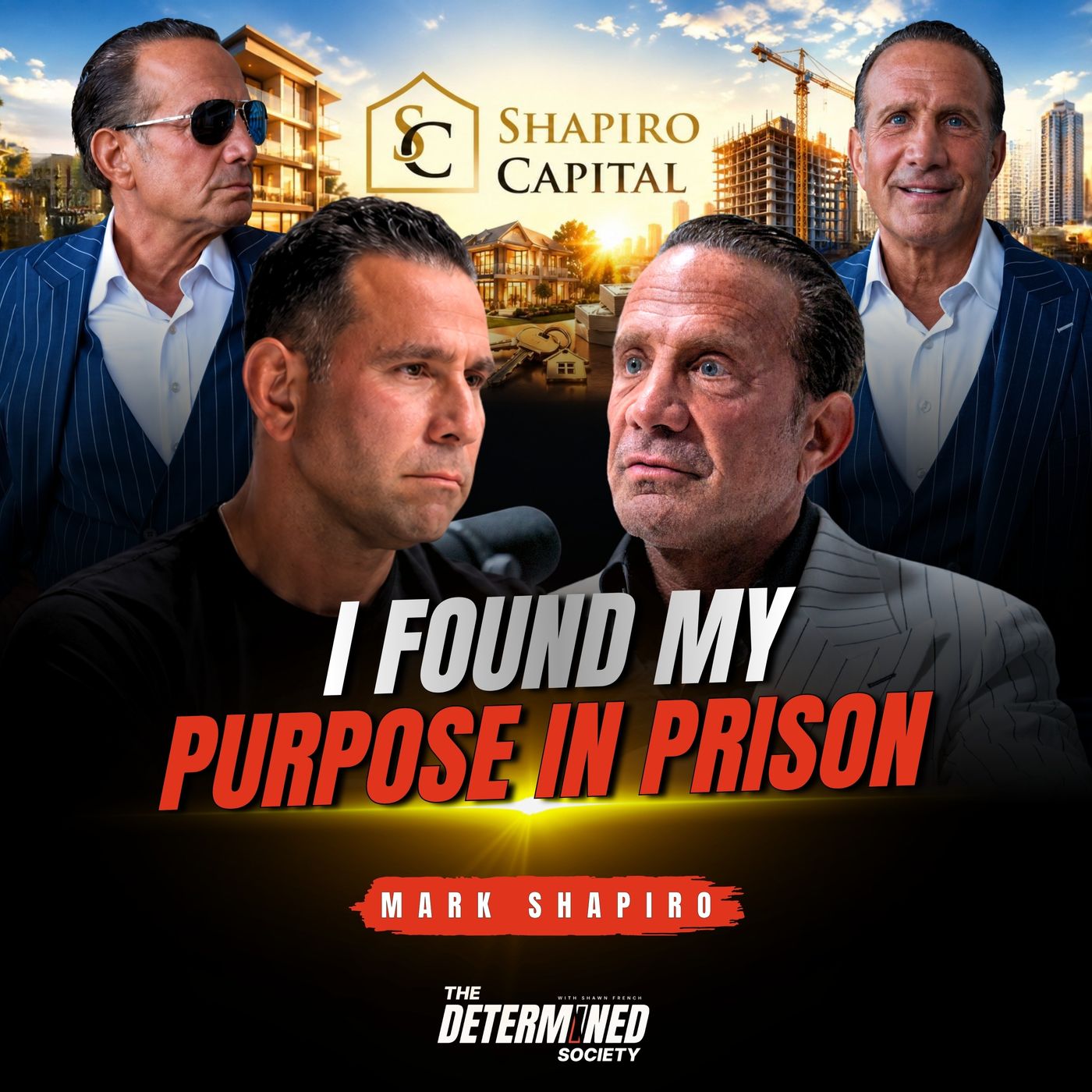
In this episode of The Determined Society, Shawn French sits down with Mark Shapiro, real estate investor, founder of Shapiro Capital and Shapiro University, for an unforgettable conversation on wealth, federal prison, faith, redemption, second chances, and the determination to start over.
Mark shares how his mother's influence helped him enter real estate while still in college, eventually building a substantial investment business before a securities fraud conviction changed his life. After spending years in federal prison, receiving presidential clemency, and returning home with almost nothing, he found his way back into real estate, closing a 372-unit apartment deal just six months after his release.
The episode dives into:
- Building a real estate portfolio while still in college
- The federal conviction, 85-year sentence, and reality of prison life
- Finding purpose through faith and teaching fellow inmates
- The presidential commutation that gave him a second chance
- Rebuilding through multifamily real estate investing and Shapiro Capital
- The influence of Robert G. Allen and creative real estate financing
- Why true determination means seeing beyond your circumstances
This conversation goes far beyond real estate and financial success. It's about losing your freedom, finding purpose in the darkest circumstances, and discovering that your past does not have to define your future.
If you've ever felt like life has taken everything from you, this episode is a reminder that the next chapter can still be built through faith, discipline, and the refusal to give up.
Watch the full episode now on The Determined Society.
Connect with Shawn
pillar.io/theshawnfrench
Subscribe to our newsletter for all updates and heavy doses of DETERMINATION:
https://thedeterminedsociety.com
Subscribe on Apple/Spotify:
Apple- https://podcasts.apple.com/us/podcast/determined-society-with-shawn-french-adversity-mindset/id1555922064
Spotify- https://open.spotify.com/show/5kS9tkLGQLcVyRgB3mDznw?si=184c18d1b9d44f53
The Determined Society is hosted by Shawn French — a show for people who refuse to quit. Every episode goes beyond the highlight reel to explore the real stories behind resilience, reinvention, and the relentless pursuit of a life built on your own terms.
Subscribe on YouTube, Spotify, Apple Podcasts, and all others.. If this episode moved you, share it with someone who needs to hear it — and leave a review. It helps more than you know.
Hosted by Simplecast, an AdsWizz company. See pcm.adswizz.com for information about our collection and use of personal data for advertising.
Scan the code with your iPhone camera
Listen in the app.