
 The Determined Society with Shawn French | Adversity & Mindset
19 Oct 2026 · 1h 8m

 Add vo to ChatGPT or Claude to ask about everything you hear
vo listened to this episode to put together the overview and transcript, so there may be the odd mistake.
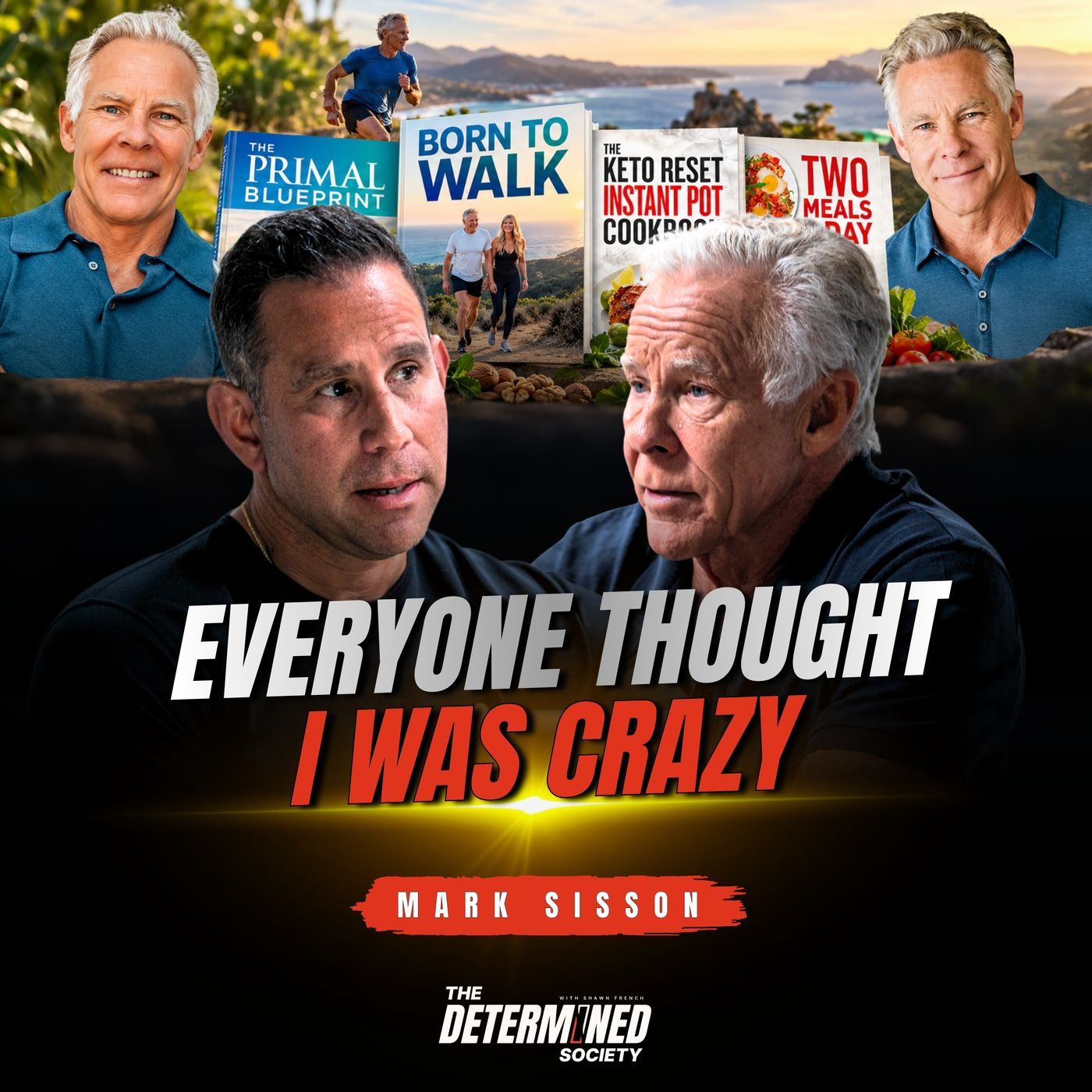
Mark Sisson discusses risk and resilience through his athletic setbacks, health transformation, and business pivots—especially redefining “health” versus “fitness,” and later challenging mainstream nutrition and footwear norms.
Mark Sisson, founder of Mark’s Daily Apple, Primal Kitchen, and paluva (shoe brand). Background: former endurance athlete (qualified for U.S. Olympic Trials; later Ironman competitor), founded supplement and media businesses; sold Mark’s Daily Apple to Kraft Heinz for $200M; later launched Primal Kitchen and paluva.
0:00Have you ever opened the fridge, stared into it for five minutes, and somehow convinced yourself there's nothing to eat? I feel like this happens way more than it should. ButcherBox solved that for me because I always know I've got something in the freezer that I actually feel good grilling. ButcherBox delivers 100 % grass-fed beef, organic chicken, wild-caught seafood, and more. And they've already done the work on sourcing, so I don't have to. Every box is customizable, so I can choose the cuts and proteins that actually fit how we eat at home. And whether I'm feeding the family, grilling, or just trying to avoid another takeout order, having great protein ready to go makes life a whole lot easier.
0:41For me, keeping quality protein stocked also makes staying on track with my nutrition a whole lot simpler. If you're looking for an easier way to get great meals on the table, give ButcherBox a try. Go to butcherbox.com slash TDS to get$20 off your first box, plus chicken breast in every box for life or filet or New York strips for a year with free shipping always. That's butcherbox.com slash TDS. Again, that's butcherbox.com slash TDS. Be sure to use our link so they know we sent you. This podcast is supported by GoFundMe. My name is Veronica. We started our fundraiser for Mariah. She was a close friend in my heart, but she was also family.
1:29She was my sister-in-law. She unfortunately passed from a car accident, so it wasn't something that we were prepared for. Shortly after we got the news, I was put in charge of helping with the funeral arrangements and everything. And just looking at the overall cost, it didn't feel right for me to ask the family that's grieving for money. That's what made me go to GoFundMe and it just became a network of people that were willing to come together to help. GoFundMe is the world's number one fundraising platform trusted by over 200 million people. You really do miss out on the opportunity to help people if you don't ask.
2:07When you actually put your heart, your soul into it and you're like, this is the reason I'm doing it, it helps a lot. Start your GoFundMe today at GoFundMe.com That's GoFundMe.com GoFundMe.com I had doctors telling me I was going to kill people with my advice There were times when I'd wake up one day and think to myself, it's all over But I felt the need to get up and push myself every day to prove that I wasn't a piece of shit You put a$9 million guarantee on a line of credit, put your house up I had a negative net worth, yeah I didn't know what I wanted to be when I grew up until I was 47 Be uncomfortable and just do the damn thing that you said you were going to do.
2:45I'm not afraid of failure. I've failed so many freaking times. There was winning involved, but there was also a lot of loss on the way to selling to Kraft Heinz for$200 million. What's it like going into business with your son, and what has he taught you? Initially, it was like, yeah, I'll work with you, Dad, and I'll learn from you, and now I'm learning from him. If today's my last day, I'm good with it. A lot of people watching this episode and listening to it are so scared to do the thing that they want to do, the thing that they believe so much in because they're afraid to fail in public.
3:26In 1980, a young marathoner from a small fishing village in Maine qualified for the U.S. Olympic Trials. He'd been on the cover of Runner's World three times, and get this, for the first hour of every morning he couldn't even walk. His body was falling apart and he didn't even make the starting line. So he found a harder race. Two years later, he ran the Hawaii Ironman and became fourth in the world. And at 61, this gentleman started selling$10 jars of mayonnaise. Everybody thought he was crazy. And a few years later, Kraft Heinz paid$200 million for that company. Today, he's 73 and he's building again with his son building a shoe brand called paluva i have with me today the founder of mark's daily apple primal kitchen and paluva mark sisson welcome to the show thanks for having me man it's so good to see you man appreciate that i mean listen i've been having i had your products for years and i didn't know who it was and and here i am sitting right across from you right now it's funny how the world works you know yeah so take me all the way back to 1980 You're a young man.
4:35You qualify for the U.S. Olympic trials, and you don't even get there because your body shuts down. What did that teach you about, first of all, how did you feel in that moment? And then the second part of the question is, what did that teach you about the difference between being fit and actually being healthy? All good questions. You know, I had started running when I was in my early teens. I found running to be, you know, my secret sauce, my superpower. I was good at running. I was kind of a scrawny teenager, so I was too small to play football, basketball, baseball, hockey. I grew up in Maine.
5:10So I gravitated toward running. I got pretty good at running and put all my efforts into improving my performance, which meant not just, you know, how do I, you know, what sort of workouts can I do to get faster, but what sort of foods do I need to eat? You know, there was a big investigation into carbohydrate management in those days, You know, carbo-loading became a thing. How can you fuel your body to be able to run 100 miles a week, you know, to run 15 or 20 miles a day every single day, day in and day out? So my natural inclination in this pursuit of performance was to optimize, maximize my diet, my performance, my training, my footwear, and all of these things that I thought I was doing right as I was leading up to getting better and better as a runner and starting to win races and starting to post some pretty good times.
6:08As I got better and better at performance, I found that my health was compromised. And this was one of the first lessons I learned about this sort of fine balance that we maintain or we probably ought to maintain in life, this balance between all in on one specific goal at all cost versus having goals and doing whatever necessary to achieve those goals, but also living your life at the same time and not compromising necessarily other areas of your life. That first lesson was I went all in on the performance aspect of my life. I didn't play tennis. I didn't ski. I didn't have fun. I didn't go out dancing, you know, in my late teens, early 20s, mid-20s, because I had to get up the next morning and race.
6:59So I put a lot of sacrifices on the line in pursuit of performance. I did everything that they said to do in terms of consuming a thousand grams of carbohydrates a day, usually in the form of complex carbohydrates. I used the footwear that was being prescribed at the time, which was thick, cushioned footwear that allowed you to put in more miles without beating your feet up so much. All these things I did ultimately led to my demise. So I had irritable bowel syndrome and gastroesophageal reflux disease and arthritis. As a result of my diet, as a result of this highly inflammatory diet that I was taking on, I realized that I had a real issue with gluten, which years later I caught.
7:47I realized that the footwear that I was wearing, the shoes that I was wearing, that were enabling me to do 100, 110, 120 miles a week of running were actually bypassing some of the important sensory inputs that my brain needed to keep me healthy, to keep my feet healthy, to keep my joints healthy. And so I got tendonitis in my hips from the footwear. I got overtrained just because the amount of miles I was putting in was too much for my personal physiology. So there I am at the end of 1980. I finished fifth in the U.S. National Marathon Championships. And it was the fourth or fifth qualifying time that I'd already qualified for the Olympic trials several times.
8:29This was my sort of highest performance. performance, and I couldn't toe the starting line because I'd, in pursuing all these things that I thought was exactly right, like I did all the research and I was really, you know, intentional about making sure I ate all the things that the book said I should eat and put in the miles and the training and more was better and wearing a footwear. And at the end of the day, you know, I fell apart. So how did it feel? It felt very frustrating to get to that point and just have to I literally cast it all aside and go, all right, what do I do now? And what I did now was because I'd set myself up for wanting to manage discomfort so much in my life.
9:14When you're an endurance athlete, all you do is manage discomfort. There's no point, very, very infrequently, when you're on a run or you're on a ride or whatever, where you're saying to yourself, oh, my God, this is amazing. This is so much fun. Aren't we having a blast? No, you're managing discomfort until it's over, at which point you go, okay, it's over. I had a great workout. I've improved my physiology. I've adapted to a higher level of pain tolerance, but it's not fun. So it was this, it's not a sickness, but it's a drive that certain people have to find out where that pain point is to try and manage that discomfort.
9:58And when I had to quit running, I had to find another way to manage discomfort. And so that's when I switched over to cycling and eventually doing triathlons because I could still run reasonably well. I just couldn't run at an elite level. And I could swim a little bit and I could ride really well. So the next thing you know, I'm spending a couple of years training for triathlons and doing fairly well in triathlons. But at the end of that, I'm just like, you know, this is too much beating myself up. I want to have fun for the rest of my life. And I want to make some money. That was the other part of it.
10:28I want to redirect this focus that I've had on managing discomfort in my physical world to maybe managing discomfort in the business world, taking on risk, as it were. Hmm. That's interesting. Before we get into that, because I do want to go right into Primal Kitchen and that whole journey, because it's incredible. The moment you had to give up running, was there a level of identity crisis? Because I remember when I was done playing baseball at the end of the College World Series, I didn't know who the fuck I was. Did you have an identity issue tied to being a runner or did you know exactly who you were?
11:04No, no, no. It was horrible. It was horrible for, you know, a year and a half. I mean, I was depressed. This is the thing I'd spent my whole, you know, so far, my whole life aiming toward, and then to have it sort of taken away from me, but, you know, partly by my own doing, which was training too hard and eating the wrong kinds of foods. But, yeah, it was a huge identity crisis, and that's, again, why I sort of gravitated over to triathlon. I had to figure out a way to continue to prove to myself that I was worthy. I mean, I think there's a whole psychology behind why you would go from being a runner to being an Ironman.
11:46It's an appropriately named event. It's a tough event. And Ironman was my first triathlon. The first triathlon I ever did was Ironman in Hawaii. So there was that. I think I just pushed. I kicked the can down the road a little bit in terms of my identity. I was still that guy who was willing to beat himself up every day in pursuit of performance until those wheels came off and until I just realized I'm just too beat up from training. I'm not having any fun. I'm not making any money. Now I'm in my late 20s, early 30s. I have a life to get on with. So that's when I really sort of shifted away from that identity as purely an endurance machine to becoming more of a business person.
12:34That's awesome. In that identity-finding era that you were going through, did you ever operate in a way that you're not proud of today? Basketball is back on prize picks. Pick a shootout in the West and a boards battle in the East. Pick it all on prize picks, available nationwide. So what are you waiting for? I love this time of year because basketball is back, football is rolling, and with prize picks, you can bring both into the same lineup. Make your basketball picks like points and rebounds, then add football picks like touchdowns and passing yards. The lineup possibilities are almost endless because everyone and everything is on prize picks.
13:10And prize picks makes it simple. Pick two to six players. Pick more or less on their stat projections. Submit your lineup and then watch your picks play out live. Download the app today and use code TDS to get$150 instantly in lineups if you win your first$5 lineup. Download the app today and use code TDS to get$150 instantly in lineups if you win your first$5 lineup. Prize picks. Run your game. No, not awesome. Never. I mean, there's nothing that I could say that I did that was, you know, beyond my moral or ethical boundaries at all. That's awesome. I don't, like, what does he even look like as a runner?
13:50Yeah, I don't know. because for me when it ended, I just had this massive void. So I would party a lot. It didn't matter. Like I was just running loose, man. And a lot of times athletes could do that. So I was just curious. I didn't have any preconceived notion or anything like that. But a lot of times people's coping mechanisms are not the best. Like yours truly was terrible. It's nice to hear that yours was not that way because it was painful for me. Yeah. Sometimes I wish I had. But literally, sometimes I wish I'd had more of a party era to look back on and go, you know, I was there, I did that, and now I learned from that.
14:29No, I was always sort of trying to maintain, you know, what's the next thing? I'm trying to always identify how I channel this energy into something productive. And that's why it went from performance-based endurance athletics and sports to performance-based business, for instance. When you were endurance running, you mentioned that there's a level of addiction involved in that type of training. Were you an addict of that? Yeah, it's weird. I was an addict in that, and that's a tough word for me because I will debate people on the definition of what addiction really is. I was habituated to a feeling of running myself into the ground and then creating these endorphins, these endogenous morphine-like substances that we all make, the body makes in response to a life or death situation.
15:33So to put yourself in what the body perceives as a life or death situation every single day to create these hormones, these endorphins that then occupy opiate receptors and make you feel a little bit better. You know, it's like, okay, that's kind of a weird form of addiction. It's also one of the reasons that so many actual opiate addicts, heroin addicts, cocaine addicts, you know, OxyContin addicts gravitate toward running in particular, but also other endurance activities is for that same reason, that it's a positive addiction. They're still creating those similar types of chemicals that are occupying those similar types of receptors in the body, but they're just not perceived as being deadly or necessarily bad for you.
16:24I would argue that you are replacing one addiction with another, but in my case, it's just habituation. I was just so – like I didn't feel a need to get up and address some lack of opiates in my system every day, which is what an addict would do. But I felt the need to get up and push myself every day to prove that I wasn't a piece of shit. And so that's the habituation. I think a lot of people, what we call obligate runners, have to run every day just so they don't feel like crap, so they don't beat themselves up, so they don't feel guilty. for having taken a day off, which they probably needed and deserved, but it's not in their mindset to be able to do that because I'm a tough guy.
17:10I'm an Ironman. I'm the guy who trains every day. So there's that habituation part of it that is more psychological than it is chemical. Does that make sense? Very much so. Now, all the chemicals and the hormones that you're talking about releasing that mimic the same as the opiate receptors, et cetera, is that what they call runner's high? Yeah. How long do you have to run to actually achieve that? I don't even know what the runner's high is. I've never felt it. No, a lot of people don't. And those who do, you know, again, I can't, I don't want to get into the. Are they bullshitting? Well, some probably feel relatively high, but, you know, I don't think anybody really enjoys running.
17:52I have to be really clear on this. People enjoy calling themselves runners. They enjoy having run and finished. but the actual running I mean, you know, people say, well, I put on my headphones I'm listening to Metallica and I'm running Oh, that's great. You're not, you know, you're doing a form of meditation. You're probably not running you know, well or fast or efficiently or whatever and you're listening to your music that's great. But if you really enjoy running, like I never wore headphones when I ran Never once. Jesus. No, no, no I know, but because the experience of running is experiencing the sounds of traffic and the bees and the dogs barking at you and the cars going by so you don't get hit.
18:33And all of the awareness is an incredibly important part of the experience of being a runner. And so anybody who puts on headphones and goes out and runs, whatever, I mean, you're doing that partly to escape the discomfort of running. So now you can say, well, I like running. Well, I like going out and listening to Metallica while I beat myself up, is what you're saying. I'm not picking on Metallica. I love Metallica. I mean, I understand, man. I'm going to go on. Then I'm done after that song. Yeah, exactly. Exactly. And they never play it in concert anymore. They don't. Can you believe that?
19:07We digress. It's okay, though. We digress. The audience loves that type of shit. Yeah, yeah. So in between that, you wanted to start to go into business, right? And you had a restaurant before. Walk me through the restaurant. And you also had a TV show, too. And this is all pre-Primal Kitchen, correct? Oh, yeah. Yeah, I've had 10 careers, some of which I haven't written much about. But, you know, I started a frozen yogurt shop in Palo Alto off of University Avenue in 1982. And it was quite successful. And with that, my partner and I decided to open a restaurant on Saratoga Sunnyvale Road in San Jose across from Apple Computer, which was just emerging.
19:46We lost our asses on that. So we went from a successful frozen yogurt shop trying to parlay that into a chain of things. A lot of things conspired against us, not the least among which was an 18 % interest rate for borrowing money from the banks to build anything. From there, I started a publishing company. I started a supplement company in the 90s. I was a personal trainer. I mean, I've done a lot of things. At one point, I was the Secretary General of the International Triathlon Union, the world governing body for triathlon. I wrote the anti-doping rules for triathlon. I administered them for 15 years.
20:27So I've done a lot of different things. But really, as I tell my kids, I didn't know what I wanted to be when I grew up until I was 47. That's when I started a supplement company. And that's when I really started to understand marketing, products, packaging, all of the elements that go into a successful company, certainly a CPG company. So I started a supplement company in the mid-1990s. I grew that company on the strength of my appearances on television. So I was starting to do some TV appearances on a TV show called Know the Cause. It was a health talk show, and I was a sponsor of the show. I did very well.
21:13I sold a lot of supplements doing that. When that show went off the air, I thought I'd do my own show. So that's when I invested a million and a half dollars into a TV show called Responsible Health. I shot 51 half-hour episodes of a talk show where I had a set. I had a guest every day. I had a co-host. And I was the sponsor of the show with my supplements. I lost my ass. I was on every morning on Travel Channel at 8.30 a.m. for a couple of weeks, and then it just fizzled. Damn. From that, I started Mark's Daily Apple. I realized from that negative experience, that massive loss, because at the time, now I was married with two kids.
22:00I took a lot of my money out of my savings to start this TV show. My supplement business was falling because the original TV concept had dried up, and now I'm trying this new one. So I scrambled, and I thought to myself, all right, I'm great at creating content. I know a lot. I have a lot of things I want to say to the public. I have a background in biology. I have an interest in evolutionary biology. I can put all these things together. I can create content. So I started Mark's Daily Apple, which is a blog that I started in 2006, on the heels of this failed television experiment. The blog took a couple of years to take off, but then it really took off, and it was the number one blog in the world in terms of ancestral health.
22:41Based on the blog, I wrote a book called The Primal Blueprint, which became the theme of a lot of my subsequent business endeavors. So the book did very well. I wound up publishing other books in that same space by other authors because I then had a platform from which to espouse this information and sell these books. My supplement business started to pick up again because I had this platform that I was using to disseminate information on how to live a better life. But at the end of the day, my supplement business did not grow that much. So I realized I was writing so much about food and what kind of food to eat to become healthy and to improve your performance, not as an athlete, but just as a human being.
23:33And I realized that I was writing so much about food and I was posting a recipe every Friday. Maybe I should be in the food business. And that's when I started Primal Kitchen. So Primal Kitchen grew out of the necessity of me wanting to have sauces and condiments and salad dressings and things that I could put on food to make the food taste better, but also that were healthy and were much more in line with all of the health advice that I'd been dispensing for the prior 10 years. It's interesting. First of all, what was the name of the supplement company? Primal Nutrition. Primal Nutrition. Okay.
24:11Okay. I think I remember that. Yeah. And I definitely remember Mark's Daily Apple, and you've recently brought that back to life, haven't you? Yeah, yeah. How's that been for you? It's good. I mean, look, Mark's Daily Apple was my baby, and I've written 4 ,000 blog posts. It's probably one of the most complete compendiums of ancestral health anywhere on the Internet. When I sold my company to Kraft Heinz, they acquired Mark's Daily Apple with it. They acquired the blog with it. And then through a series of misadventures, it got hacked about three years ago and shut down. And it got the vulnerability of WordPress, which is what it was on, was so striking that legal and financial higher-ups at Kraft didn't want to bring it online.
25:05They were afraid that if we brought it back online, there'd be a vulnerability that they could hack into the rest of the craft system. I don't know what went on there. So it languished for two and a half years. And it broke my heart because people would ask me all the time, whatever happened to Mark's Daily Apple? I'm like, well, nothing to do with anything I did, but it's been shut down. So we brought it back online about six months ago. And it's doing well? Yeah, it's doing well. But we had nearly a million subscribers, and they drop off after they don't. Yeah, of course. And then when you bring something back online, everybody has to re-opt in.
25:43So you start from zero again, basically. That's always fun, right? Yeah. You're so used to starting from zero. Yeah, I know. That's true. That's the beautiful part about your story. That's why I keep asking all the small questions, because I want the audience to really key on the fact that there was winning involved. but there was also a lot of loss on the way to selling to Kraft Heinz for$200 million. Yeah. And so let's dig into that, right? Your journey, you started cutting out grains for 30 days, and then you had some relief, right? Was a part of you pissed off? Some doctors didn't tell you before, like, that's probably the case.
26:18Yeah, but I mean, I think, you know, I could be pissed off. I could also say, look, if I found this out about myself at the age of 45, having defended my right to eat grains for the last 20 years, having done all the research on nutrition and diet, and not really realizing how powerful grains are and how detrimental they are to some people's health. If I'm somebody who didn't realize that, I can't imagine a doctor would realize that. So I was not pissed off. But what I did say to myself was, if I'm someone who's been doing this my whole life, assuming that grains are great and they're good for everybody.
27:00And then I had the kind of relief that I did. I mean, my life changed in that 30 days. I got rid of the IBS I'd had for almost 30 years, went away. The GERD went away. The arthritis went away. Skin cleared up. I mean, so many things changed in my life from just getting rid of gluten that I thought I need to tell the world about this. And so that's what really prompted me to start Mark's Daily Apple, to start with writing the books on the Primal Blueprint. And then from there, you create Primal Kitchen. Yeah. You started with mayonnaise. Yeah. And people thought you were a little bit nuts for doing it, right?
27:41I mean, you're going to sell$10 jars of mayonnaise. Well, it paid off for you. Yeah. So it goes to show that when you feel something, and you know it can serve a certain aspect of the community or a portion of the community, you go for it Because you have the experiential levels in that, and you took something going on in your life, and then you gave it to the public. Walk us through the early days of Primal Kitchen. Basketball is back on prize picks. Pick a shootout in the West and a boards battle in the East. Pick it all on prize picks, available nationwide. So what are you waiting for? I love this time of year because basketball is back, football is rolling, and with prize picks, you can bring both into the same lineup.
28:20Make your basketball picks like points and rebounds, then add football picks like touchdowns and passing yards. The lineup possibilities are almost endless because everyone and everything is on prize picks. And prize picks makes it simple. Pick two to six players. Pick more or less on their stat projections. Submit your lineup and then watch your picks play out live. Download the app today and use code TDS to get$150 instantly in lineups if you win your first$5 lineup. Download the app today and use code TDS to get$150 instantly in lineups if you win your first$5 lineup. Prize picks. Run your game.
28:56Well, it was, you know, I knew that I wanted to introduce a suite of products. So I'd hired a chef to come up with, you know, a salad dressing, a couple of flavors of salad dressing, a barbecue sauce, a ketchup, a mayonnaise. and it took about a year of work in the lab, in the kitchen, to understand that this was not going to be that easy to do, to get the taste right and to get the product, the label claims and the ingredients right. So at the end of the year, we had mayonnaise. And I had hired and then brought on as a co-founder a young lady named Morgan. And her name is Morgan Zanotti. It was Morgan Buehler at the time.
29:45And, you know, she's like, let's just go to market with the mayonnaise. And we had a bar, you know, a collagen bar that we've been developing for the supplement line. Let's bring that over into the new Primal Kitchen line. And then we had two flavors of salad dressing. So we sort of introduced this weird mix of a mayonnaise, a salad dressing, and a bar in three different aisles at Whole Foods. But I had a very good experience in that community because many of the buyers at Whole Foods were fans of mine from having read the Primal Blueprint, having understood paleo and primal and ancestral eating and how some industrial seed oils are bad for you, and there were others that were actually very good for you, avocado oil being one of those.
30:31So I was able to get into a lot of stores early on, which is, again, one of – Look, business success has a lot to do with the team, with the product, with the market, and with timing. And sometimes timing can throw everything off. I think if I'd started Primal Kitchen five years earlier, it would have failed because I don't think the world was ready for this healthy mayonnaise that was selling for$10 a jar. Anyway, we started the company. It was great. We thought we'd do$200 ,000 or$300 ,000 our first year in sales. We did$1 ,700 ,000. Then we sat down the second year to go, like, shit,$1 ,700 ,000 in the first year, and it was kind of a short year.
31:15Can we do$6 million in the second year? Is that asking too much? And we did$6 million by June of that year. So it was all coming together. But there were times when I'd wake up one day and think to myself, it's all over. I mean, we had a problem with making mayonnaise one day. Avocado oil is a very finicky raw material to work with, and we couldn't get this giant batch to emulsify. We, you know,$7 ,000 worth of ingredients, literally down, when I say down the drain, literally down the drain because it couldn't emulsify. And then we couldn't get time on the production line for another three weeks.
31:54Meanwhile, we had orders from all these stores, like, we love your mayonnaise, like, give us more. and three weeks later we tried to make mayonnaise, couldn't make it again. It was like we thought we were out of business, but we figured out a way. It actually was using these chilling. We would have to chill the avocado oil coming through a chiller pipe before we put it in the amount. Little secrets like that that no one ever kind of glommed onto until the necessity of having to survive brought that to a reality. It's crazy. When you're backed up against the wall and you're facing massive defeat, even death of a company, what you figure out is pretty impressive, right?
32:31That year, the second year in June, you were at six mil. What'd you end that year with? 11-7. 11-7. Yeah. Wow. Yeah. So you clearly knew something that everybody didn't, right? And I want to know what that is. I want the audience to know because the reason why this question is important, there's a bunch of people telling people they shouldn't do something. I don't think it's a good idea. You did that. You won. Explain it to them. Well, you know, I'm feisty. I'm scrappy. I'm a contrarian. You know, I grew up in a small fishing village in Maine. I've got a Puritan work ethic. I've got more than a healthy skepticism.
33:13You might even say a cynicism. I don't trust medicine. I don't trust the law. uh i'm i'm so i'm a guy who's kind of dangerous in that get me in a debate with somebody and i will i will hold my position pretty firmly so when it came to health uh and my first book the primal blueprint i had doctors telling me i was going to kill people with my advice about you know cutting carbs and eating more healthy fats and eating more meat and making meat fish and follow the basis of your protein, the basis of your food pyramid. The second year of the Primal Blueprint series, I did a cookbook called the Primal Blueprint Cookbook, and I made a top 10 list that year for cookbooks, worst cookbooks of the year from a physician's organization that said this is not good for you.
34:07I issued a press release after that thanking them for putting me on their top 10 list, and I sold more books as a result of it. I've always been one to—I mean, I feel like I can read the tea leaves pretty well, and almost everything I said in the Primal Blueprint 20 years ago, starting with March Daily Apple, is now being accepted as true, whether it's fat and cholesterol are not the proximate cause of heart disease. Statin drugs might be the greatest hoax ever perpetrated on the American public. Exercise is not a great way to lose weight. It's a horrible way to lose weight. Yes, there's a way to exercise too much, and it's not good for you, so the more you exercise isn't necessarily better.
34:47I mean, I can go on and on about all these counterintuitive ideas that I felt in my heart and just in my gut, like there's something going on here that people aren't exploring, and I'm going to explore it, and I'm going to dig into the research and prove to people that there's a way, a kinder, gentler way to be strong and lean and fit and happy and healthy and productive without so much pain and suffering and struggle and sacrifice. And that became my goal. So how do I make the world an easier place to navigate?
35:31so two years ago i was about 228 pounds 32 body fat on a dexa started eating like the way you're talking about a lot of meat i i only track protein and fats yeah that's it i started waking up with no pains in my neck. I started waking up without a headache, no brain fog. And to this day, I mean, I'll, I'll mix in carbs here and there. I mean, I like carbs and I'll, and I'll spoil myself at times, but I really don't need them. I have energy. I have more energy now than I ever have. And it's crazy because if I look at 20 years ago, they weren't talking about, I mean, you were the pioneer of paleo yeah dude i mean that's that's insane and from that came you know keto came carnivore and all that stuff it's kind of all the same thing to a degree yeah it is but but your influence 20 years ago is still being found today in nutrition that's what kind of that's why i kind of got just super quiet as i do like the things that i do yeah are the things that this man was talking about 20, 25 years ago when nobody wanted to hear this shit.
36:45Yeah, so keto is a good example. Keto, you know, I started looking more and more into an ancestral diet that eliminated grains and didn't have so much access to refined starches and carbs. So I became an advocate of keto and I had an entire medical community go, keto is dangerous. You're going to ketoacidosis, all of the association that keto had from misinformation from decades before, I sort of, I think I helped bring it back. And by the way, Atkins was a keto diet. Yes. So Atkins is an example of timing not being great. Atkins came on the scene, and he promoted this ketogenic diet. He had all the science right.
37:28He had everything right. It's just the execution was horrible. So Atkins came and went. They had crappy products named Atkins. They allowed certain, you know, any sort of fats on the diet. They didn't really pay attention to the quality of the food. It was just, you know, the macros. So keto, the Atkins diet came and went, and it died, and it ceased to exist for almost 15 years. And then it came back as keto, as a ketogenic diet, with new science, with a better execution. And now it's a real thing. Now it's a tool. Now it's a strategy that a lot of people use. I wrote a book called The Keto Reset Diet.
38:03It was a New York Times bestseller. or how to use keto to reset your metabolism. But it's another example of when I've said these things, I'm not the first guy to say keto, clearly, but I promoted it in a way that I was comfortable to say, yeah, there's nothing bad about a ketogenic diet if it's done the right way. In fact, everyone could benefit from a ketogenic diet if it's done the right way. Whether it's three days or a lifetime, I can show you how to do that. Most recently, I started a shoe company, And I'm telling people, all the shoes you've been wearing for the last 30, 50, 100 years are compromising your feet.
38:39They're screwing your feet up. They're causing bunions and plantar fasciitis and hammer toe and Morton's toe, Achilles tendonitis, calf issues, knee issues. And it's all a result of your shoes. You don't have bunions because of your family genetics. You have bunions because of crappy footwear that you've been wearing. So I decided to make a shoe that accommodated what a foot is supposed to do and wants to do. naturally, what the foot is designed to do. And people call me crazy. And timing. People said, well, that shoe existed 20 years ago. It was vibrant five fingers. I'm like, yeah. And I was their early advocate.
39:13And the science was right on. And they had the exact right idea. The execution was faulty. And so it died. Now we wait a generation later. Same information, more information about how strong the feet, how strong feet are integral to overall health, how having mobile and resilient feet is, you know, one of the greatest predictors of longevity, one of the lowest hanging pieces of fruit in the world of anti-aging and longevity is foot health. I've been saying this for the last 10 years, and I've been doing something about it the last four years with this shoe company. And yet people are like, I don't know, you know, you're overcoming, you know, years of technology in the footwear industry from Nike and Hoka.
39:57No, those guys are selling you a load of crap. But, you know, it's little old me with a conviction that I'm right and I know I'm right, but now I've got to fight the conventional wisdom and the hordes and the crowds and all the stuff where people are going, you know, how can you say that this little minimalist shoe is going to improve my health? Well, because I can prove to you that the shoes you've been wearing that have scrunched your big toe against the others for decades, raised your heel up off the ground, that have taken away all the sensation of the bottoms of your feet, all that stuff is horrible for you, and yet you're defending your right to wear that shit.
40:39It's so funny because I think it's because of the unknown. Yeah. I mean, I see those shoes all over the gym. They're everywhere at my gym in Fort Myers. I see them all the time. but you gotta love at this point when someone calls you crazy because your last your last venture yeah they called you crazy for primal so for yeah right about 200 million dollars yeah that's a pretty nice wire yeah right and when you did that you were a little bit bad shit i mean you put a nine million dollar guarantee on a line of credit put your house up yeah i had a negative net worth yeah i mean like that is that is insane like that that takes true conviction Walk me through those nights when you made that commitment to put a personal guarantee on a$9 million.
41:24What night? I mean, every night. All those nights. Every night was like, you know, I mean, my wife finally had to sort of convince me that, look, either get up and do something about it or go to sleep. Because you're not, you know, lying here thinking about it. Nothing's going to change. So either get up and fix it, which she knew I wouldn't because I was just worried about it. There was nothing I could do in real time. Or else don't worry about it. And turn your head on the side of your pillow and let that thought drip out of your ear into the pillow. Is that what she said to you? Yeah. Yeah.
41:58That's amazing. No, it was very cool, yeah. Because she had some stake in this, right? It's her life, too. Yeah. A lot of wives would be like, yeah, you're not doing that. Or if you're freaking out about it at night, it's like, hey, you made your bed sleep in it, dude. Yeah. She was there for you. Yeah. What did that mean to you? No, it was great. She was encouraging me the whole way, for sure. That's awesome. Yeah. That's awesome. It's interesting to me because when we build things, it's got to come from a place of not only helping the person that you once were. For you, you're in pain, massive amounts of pain.
42:38But it's also you have to work through the fact, are there other people like me? And the truth of the matter is there's always more people like you. And if you can hit, like you said, the timing and the market and no marketing, it can explode. So over the last four years, what have you seen with Paloova? Well, I mean, I've seen an adoption that makes me, you know, warms my heart. We have thousands and thousands of testimonies from people who never thought they'd walk pain-free again, whether it was their feet or their knees or their lower back, who are now, you know, putting in miles, reacquiring a natural pain-free gait walking cycle.
43:25You know, like you say, you've seen them in the gym. I see people in the gym lifting with them. I see trainers, you know, sort of acknowledging that their clients have better balance as a result of spreading their toes out more and articulating their toes and engaging their arch and building their arch back up instead of relying on an orthotic or some artificially raised shoe insert to offset what they thought was a flat foot, but it's not. It's just a foot that's out of shape because you've been coddling it. You've been binding it up in a shoe and then putting in an unnatural arch support, which unburdens the natural arch of having to do any work.
44:05and you do that long enough, your feet atrophy. Then they atrophy, and then you get the injuries that we talk about. Basketball is back on prize picks. Pick a shootout in the West and a boards battle in the East. Pick it all on prize picks, available nationwide. So what are you waiting for? I love this time of year because basketball is back, football is rolling, and with prize picks, you can bring both into the same lineup. Make your basketball picks like points and rebounds, then add football picks like touchdowns and passing yards. The lineup possibilities are almost endless because everyone and everything is on PrizePix.
44:38And PrizePix makes it simple. Pick two to six players. Pick more or less on their stat projections. Submit your lineup and then watch your picks play out live. Download the app today and use code TDS to get$150 instantly in lineups if you win your first$5 lineup. Download the app today and use code TDS to get$150 instantly in lineups if you win your first$5 lineup. PrizePix. Run your game. When you say atrophy, what does that look like for somebody? Because to me it means die, right? Yeah. Like muscles die. They get weak. Sarcopenia is another word we use for as you get older, your muscles get weak.
45:12But muscles atrophy when you don't use them. It's what happens if you're sick and you're in bed for a week, you might lose 30 % or 40 % of your strength gains just lying in bed for that week. Now, if you do the work, you can get them back. But if you don't do the work and you just continue on that path, you'll continue to go down a slippery slope toward ultimately death. I mean, we say once you stop moving, you start dying. But atrophy in the feet, it's really interesting. Like one of the things when I talk about timing of my footwear company, Puluva, versus the original one, one of the things that happened was the original footwear company that was five-toed was so minimalist that it didn't accommodate concrete and pavement and hardwood floors and things like that.
46:00It didn't allow for a little bit of cushioning to offset unnatural man-made surfaces. So people, and then at the time that the shoe was really starting to come on the scene, a book came out called Born to Run. And in that book, Chris McDougall postulated that people were born to run, but were born to run barefoot. And so all the runners who were like, yeah, that sounds good. I think I'll go run barefoot. Well, I can't run barefoot, so I'm going to go buy these minimalist shoes. And they got injured wearing the minimalist shoes. Why did they get injured? Because for decades they've been running in thick, restrictive shoes.
46:39The muscles of their feet had atrophied. And all the work is being done from the ankles up and the calves and the quads and the glutes. And, yeah, they're plodding along, running, jogging their heel-toe movement. But now you put on these minimalist shoes. And if you haven't trained your feet, if you haven't trained the small muscles of your feet, they got injured. The muscles were so detrained, so atrophied that now you say, well, I'm going to go run seven miles the first day. Now you get plantar fasciitis, you get Achilles issues, you get whatever you get as a result of this atrophy. So even people who claim to be running a lot, putting in a lot of miles in hokas or thick Nikes or whatever, their feet are still not working to their advantage.
47:25They're still bypassing the input, the haptic sensory input that the bottoms of feet need in order to know exactly how much to scrunch the arch, how much to roll the ankle, all that information, which becomes unavailable because of this restrictive shoe they're wearing. And they think in their brains, oh, well, I'm running on a cloud, so it must be okay. It's just bypassing all that information and driving all of the force up to the hips. Dude, whenever I run, my feet hurt like hell. Yeah. Like hell. Yeah. Like it's never a fun thing, right? You answered my next question. You mentioned, was it Chris McDougall?
48:01Yeah, Christopher McDougall, yeah. Christopher McDougall argued to the point that running barefoot is the best thing to do. My question was, are these shoes the best because it mimics barefoot walking as much as possible? And you kind of answered that. Yeah. Now, having said that, we tell people don't run in our shoes. Don't run in our shoes because we know what's going to happen. Unless you're a very good runner, unless you're lightweight, unless—look, I wrote a whole book last year called Born to Walk. And in it, I say that maybe 98 % of people who are running shouldn't be running. They should be walking and sprinting, but they should not be running.
48:36You also say not everybody should run a marathon. Well, that's what I'm saying. 100%. Yeah. Yeah, no, no. But most people shouldn't even be running. They should be walking a lot more than they're walking, and they should be sprinting once in a while, short bursts of speed, but not running metronomically 10-minute miles, plodding along at a high heart rate that's not burning fat, but there's tearing up muscle tissue and blah, blah, blah, all this stuff. So most people should be walking. And then if you're walking, you should be walking in a five-toed minimalist shoe so that your feet feel every step you take.
49:13If you step on cobblestones, if you step on sticks, if you step in a divot on the ground, your feet should know exactly. It should be able to inform the brain by the time you weight that forward foot how much to scrunch the arch, how much to articulate the toes, how much to roll the ankle out so you don't tweak the knee. All of this information, the brain wants to be able to orchestrate the kinetic chain. Your kinetic chain is ready to do everything perfectly if you give it the right information. But if you bypass that information with thick, padded, cushioned shoes that take the big toe, which is supposed to be splayed outwardly, the big toe is the most important joint in the foot.
49:51It's supposed to be splayed outwardly. It's supposed to be the last point of contact when you leave the ground. Now you've scrunched it over against the other toes, encased it, and then taken away all of its power. and then reduced all of that information the brain needs, the brain has to guess, like, how much do I bend the knee? How much do I torque my hip? How much do I engage my stabilizer muscles around my glutes and hips because I can't use my glutes because my big toe, which is normally required to be forced onto the ground to engage my glutes, now I've compromised that by scrunching it over against the other toes.
50:28So now I get pains in my hip because of stabilizer muscles that are doing too much work. You go to a gym and you watch guys lifting weights, heavy leg days, they want to take their shoes off because they know the big toe is what activates the glute. If you can't let the big toe splay outwardly, you can't fully activate the glute, and therefore anything you do in a deep squat or a leg press position is compromised. So all of this is to say we should be barefoot, but society will not allow that either from a polite point of view, polite society won't allow it, but also from just the surfaces that we built.
51:10Again, the concrete, the pavement, the hardwood floors, the glass tile, all that stuff we walk on. So we built a shoe that gives you the effect of being barefoot on a putting green. It gives you the feeling of being barefoot on a matted surface like grass or tamped down earth or something like that. That's badass. I didn't know a lot of these things that you're talking about, like the receptors, the chain. I just thought they were feet, man. Everybody thinks that. Right? Everybody thinks that. They're just these dangling appendages that, no, dude, they're the thing that connect us with Earth. Our connection with the universe is the two feet that we have on the ground.
51:44I'm sitting here as you're talking, and you're talking about the big toe. Yeah. And I don't know if you can hear the thing. I'm like, wait, my big toe is not on the freaking ground. Not in those covers there. No. No, I know. I know. They look good, man. They look, you know. Hey, listen, it's all show, right? Yeah. When someone goes, and let's say they do want to run, or let's just say someone wants to walk 30 to 45 minutes a day, is there a training method to build the feet back up for those that, I mean, who knows? Maybe my feet are atrophied. They are. Your feet are atrophied. So the training method is just walk.
52:18Just walk in palovas. Walk in these shoes that they force your feet into a neutral splay to start with. So some people have feet that are so messed up that even when they put on a wide toe box shoe, another wide minimalist shoe, the foot doesn't find some beautiful natural splay. It still stays messed up, deformed within that shoe. So we create five individual toe slots that sort of align, relax, and realign your toes and then strengthen them with every step. We say every step is a rep in Palovas. Now, again, we say don't run on these. they're the best running shoe you'll ever wear if you know how to run.
52:59But don't run in these shoes. Train everything else and walk, walk, walk. Walk in Palovas, walk every night, walk your dog, do your errands, drive your car, go to the gym, do everything you do that's going to involve steps. Do it in Palovas so that when you, if you do want to go run, God bless you, go put on your running shoes and go for a run. You know, go and put on your actual running shoes. But your feet will be stronger, much stronger and much more resilient for having to be able to handle a little bit better and then you just recorrected by putting the palubas back on afterwards yeah it's interesting it's interesting i've never i've never thought about it i've never i mean i've seen them around you know i see them a lot more now uh back in the day i know a lot of people were wearing it it wasn't really the buzz like if i look at both eras yeah i see it more often now than i did then yeah you know it's it's everywhere.
53:52You know, but you're like, look, you came back, you know, you tried to retire. I know. Why come back? Well, because I can't retire. I always have to be doing something. And I'm, you know, again, I have that feeling that especially with this, with foot health and with Paluva, if I don't do this, no one is, no one's going to do it because I'm so eminently equipped to do this. I have the history as a runner. I have the contacts in the shoe industry because half my running team from 1979 went on to become president of Nike and president of Reebok and whatever. I have the entrepreneurial drive. I have the deep pockets to be able to fund this, to finance this.
54:41I have knowledge of patent law and things like that that make it easier for me to play in this arena than anybody else. So there are a lot of things that come together for me. Again, timing. It's now 20 years after the first introduction of a five-toed shoe. And a whole generation has gone without understanding or having even ever having seen a five-toed shoe. And yet in my world, it's like, how have we not made every shoe a five-toed shoe? Imagine there's no gloves in the world, and everybody's just wearing socks on their hands, not even mittens, because a mitten at least has that big, that thumb articulation.
55:23Imagine everyone went around just wearing socks on their hand. How ridiculous would that be? Oh, but they look good. You know, the socks look really good. They're attractive socks. No, so it blows my mind that more people haven't understood the concept of toes being very much like fingers, like these digits want to work. You know, you see every once in a while, you'll see somebody who has been born with no arms. They use their toes as if with their fingers, you know, they can eat, you know, cut things and chop things and eat things and type things and write things with their toes. They're there for a reason.
56:02Those toes know what to do. It's just that when you, from an early age, you restrict them, you encase them, you put them in coffins and say, okay, you're going to clomp through life. Yeah. You know, looking good, maybe. Maybe. Yeah. It's interesting because like, as you're talking about that, I'm thinking about, you say you put them in coffins. A lot of people have like this foot thing, like they don't like feet. Yeah. You know, so when did it become socially unacceptable? I don't know. That's a thing. It's even on the internet today, we have some of our influencers like to show how dexterous their toes are, and they can't show them on Instagram.
56:41You can't post a reel with toes on Instagram. Wait, back up. You can't? Yeah, well, it gets flagged a lot of times. Do you see some of the shit that's on there? Yeah, I know, I know, I know, but I'm just telling you. What are we talking about, Mark? No, I'm telling you, some of our influencers have to gray out their toes because of, you know, whether it's complaints or whatever. So people, yeah, yeah. That's some wild shit. I know. I mean, I see some stuff. Yeah. You know, I mean, it's like way worse. I know. Good God. Can we figure it out, America? Holy shit. That's nothing to get outrageous about.
57:15You may not like it, but it's not like a flag. Anyway, I digress. So what's it like going into business with your son? And what has he taught you? What was the last question? What has he taught you? Have you learned anything from that? No, no, it's great. It's amazing. I mean, I think there's a part of every father that wants to go into business with his son. Now, it can go two ways. If you've ever seen the TV show Succession, it can go down a rat hole. But no, my son, he's amazing. He impresses me every day. He's very smart. I think he's a better, you know, he runs things better than I ever could or ever did.
57:55It's amazing to watch his enthusiasm increase as the company becomes more and more successful. and he really starts to sink his teeth. Initially, it was like, yeah, I'll work with you, Dad, and I'll learn from you, and now I'm learning from him. What's the one thing that you've learned most from him? Just, I mean, it's letting him be himself has been the real mentoring. So my wife would say, aren't you teaching him how to do that? I'm like, no, I'm literally letting him make mistakes, not that he's making mistakes, but I'm willing to let him make mistakes that I can cover, that I can pay, just to get in there and roll the sleeves up and get dirty and figure stuff out.
58:36Well, I think it's important though. Yeah. Because I run my own company. And a lot of times I feel the need to want to save. Like, well, hey, I don't think we should do it that way. Let's do this. But what am I doing then? Yeah. I'm just showing them that I have zero confidence in them, that they're going to mess it up. So why are they even there? Go do it. Yeah. Like, go do it. And if we have to clean something up, we can clean something up. But I think that's a great leadership, not even opinion, just like a really mindset that I want the audience to really tune into. If you're a true leader and you have people on your team, let them go do their deal.
59:11Like you can have suggestions and you can collaborate, but you can't save them. You got to let them rock. You got to let them rock. That's good. That's really good. You said something earlier, though, when you were talking about when I asked you why get back in the ring. And you listed off a bunch of reasons. I think you forgot the most important one. Remind me. The most important one is you give a shit. Oh, yeah. I mean, again, I'm passionate about what I'm doing. I think I'm more passionate about foot health and Paluva than I was about food and Primal Kitchen. Oh, really? Oh, yeah, yeah, yeah.
59:43Oh, wow. Yeah. I mean, food is food. I love it. And I wanted something for me that I could eat, you know, that I could put on. But if Primal Kitchen hadn't existed for me, I would have made my own salad dressings at home. I would have done a lot of the stuff myself. Not so with footwear. If Palua didn't exist, I would not have anything to wear. Wow. I mean, so this is, I'm like, okay, I'm passionate about what I'm doing here because I really am on a mission to change the way the world looks at movement. And to understand that walking is the single most important thing a human being can do. It's the quintessential human movement.
1:00:19It is the key to longevity. Like walk every day. Walk as much as you can every day. Find time throughout the day. Break it up into small sections if you have to. But walk every day, and every step is a rep. And walk in good, again, appropriate footwear. Because if you're walking on, again, in thick, padded, cushioned clouds, all right, you're getting a little bit of – you're getting outside. You're getting into the world outside, but you're not really reinforcing a positive gate that reacquires your perfect kind of style and stride and kinetic chain. Basketball is back on prize picks. Pick a shootout in the West and a boards battle in the East.
1:01:00Pick it all on prize picks, available nationwide. So what are you waiting for? I love this time of year because basketball is back, football is rolling, and with prize picks, you can bring both into the same lineup. Make your basketball picks like points and rebounds. Then add football picks like touchdowns and passing yards. The lineup possibilities are almost endless because everyone and everything is on prize picks. And prize picks makes it simple. Pick two to six players. Pick more or less on their stat projections. Submit your lineup and then watch your picks play out live. Download the app today and use code TDS to get$150 instantly in lineups if you win your first$5 lineup.
1:01:37Download the app today and use code TDS to get$150 instantly in lineups if you win your first$5 lineup. Prize picks. Run your game. When you're connecting with the energy source, because you talked about that earlier, do you feel differently? Well, so when I'm walking outside, I do a walk every night at 6.30. It's like my favorite time of the day. And so at the end of the day, it's not like, oh, my God, it's 6.30, I have to go walk. It's like 6.30, I get to go walk. and I do 45 minutes to an hour, and I don't take phone calls. I definitely don't listen to music. I'm out again. I'm experiencing the world around me.
1:02:16I walk along a boardwalk where there's a fair amount of people, so I might bump into somebody I see and chat for a little bit. But every step is intentional. So I walk with shoulders up, chest out, shoulders up and back, with a little bit of swagger in my arm swing, feeling every step, feeling the heel plant and then pushing off the big toe. Not like consciously, consciously doing it, but sort of subconsciously every footstep feels like, oh, my God, it's great. I can feel my hip being engaged, my glutes being engaged as a result of this big toe articulation. All these things I never used to feel walking in regular running shoes.
1:02:51I'm like, going out to do some steps, whatever. Now it's like every step is a rep. Every step I take in my paloovas at the end of the day is increasing my strength, my resilience, my mobility. And because the big toe not only is wired to the glute, the big toe, like in Chinese medicine, the big toe is wired to the brain. It's the big toe that's connected to the brain. So if you ever had a foot massage or reflexology, when they work in the big toe, they're working the brain. Okay. I really wonder if one of the reasons that people get dementia when they do earlier than they should is because they're wearing shoes and not using that big toe to touch the ground, to connect with source, to connect with the universe, to push off and to activate the brain.
1:03:40I would love to do a study on that. Dude, that's profound. Yeah. I think you should do a study on that. Yeah. Because if you can tie that together, it's going to help a lot of people. Yeah, and obviously it's a very detailed, longitudinal study. It's going to take a long time to freaking do. But just, again, I'm one of those things that intuitively I'm like, I guarantee you that this is a thing that should be looked at. When you're walking in the back of the day when you were running without music on, you're taking in the sounds, the smells, everything, the feeling of whatever service you're running on.
1:04:13Has it helped you? Because you have to stay present in those moments. Yeah. Just like what you are when you're walking every night. You don't listen to anything. You connect. Yeah. Has that helped you be more present in your business and just in your life in general? it's helped me be more present in my business I think it's really interesting I've had this conversation over the years but I think one of the things that ability to withstand discomfort to manage discomfort for a long period of time is great for business it's not good for relationships because you tend not to address concerns you tend to withstand the discomfort and just suck it up and go inside That's hard.
1:04:54Yeah. It's hard because you're in a relationship and you want to have this conversation. It doesn't matter if it's a friendship or a romantic relationship. You want things resolved, but you don't want to bring it up because you're afraid of how the person's going to take it. That, and again, it's just easy to just not do anything because I'm used to discomfort. Some people get so uncomfortable, they either have to leave the relationship or deal with it. But I'm just saying, one of these little psychological things I've thought about over the years is, was my 20-year apprenticeship in pain management and discomfort, was it serving me in relationships as much as it served me in business to hang in there when everything was going wrong and to figure out a strategy rather than give up.
1:05:38Do you believe in any discomfort? Oh, yeah. No, look, every day I say do something hard every day. Yeah, I love it. No, I'm totally, I'm one of those, you have to earn the day. I mean, you have to – I think that one of the biggest issues I have with AI is it's going to do everything for us and take away any – not just requirement, but any desire to do anything hard. And I've spent my life figuring out whether it's a hard workout, which is sort of the main thing I do that's hard every day. But some days I write for an hour. I hate writing. I'm a very good writer. I've written 12 books. I hate writing.
1:06:15So I have to force myself to do it. It's hard to do. I think it's great because you're pushing that resilience muscle, right? It's something so important, man. Like, be uncomfortable and just do the damn thing that you said you were going to do. Because oftentimes people wait for that moment of motivation, and I hate that work. Yeah. I hate it. Yeah. Because it's there for a second, and she's gone. Yeah. Like, if motivation was the key determinant in success, we would have no successful people. Of course. Of course. We'd be a society of freaking losers, right? Right. Discipline is massively important and it's important in business.
1:06:51It's an important in everything that you've done. Like even from just the concept of the idea of making your own, like Mark's Daily Apple, Primal Kitchen, Primal Supplements, and now Paluva and all the other things that you've created in your life. Is there anything you're afraid of now?
1:07:12Not really. Not really. I'm not afraid. of, you know, I'm not afraid of failure. I've failed so many freaking times that I know, you know, I rebound from that. I mean, not really. I mean, every day I get up and I'm like, I think to myself, I've done a lot of cool shit in my life. If today's my last day, I'm good with that. You're good with it. Yeah. But I got more shit to do, so let's go. Yeah, you do. You're 73 years young, man. Yeah. You're playing ultimate frisbee with people half an age and beating their ass. How does that work? Yeah. That's getting tougher and tougher to do. There's a point at which that shit doesn't work anymore.
1:07:51Yeah. But up until about two years ago, I was still able to compete with, you know, on the playing field, on a real, on a full field. I just can't find a game with enough people sort of my, and when I say my age, I'll take 45. I'll take, you know, but not 25. Come on, man. It's just don't. That's aggressive, right? Don't match me up one to one with a 25. It's losing college. I want you to address the audience on something really quickly, because you said something that was very profound, and it's something that I truly believe in. You're not afraid of failure. A lot of people watching this episode and listening to it are so scared to do the thing that they want to do, the thing that they believe so much in, because they're afraid to fail in public.
1:08:34What would you say to them? Look, I mean, all I can say is I've had a lot of failures. I would say that the TV show is a good example of like I risk my retirement account, possibly my kids' tuition, et cetera, on this TV show that I felt compelled to do. I'm glad I did it. I was able to use that and pivot to start Mark's Daily Apple, which then became everything else in my life. if I hadn't done it if I'd been risk averse and said you know fucking television's hard and you know save the money and do something else a couple things would have happened I wouldn't be where I am today I might have gotten there through a different pathway but I would also more importantly one day on my deathbed I'd go fuck I wish I'd done that TV show God I should have done that that was mine to do I should have done it I should have you know I should have sucked it up and done that no regrets man Yeah.
1:09:31Like fail. Fuck it. Yeah. Who cares? You know, it's, it's something that like in training, we always see. Yeah. But in public or in business or in anything, yeah. People tend to shy away from it. And again, guilty as charged. Like I, I, I've been afraid of failure, but now I just accept it. Yeah. And if I could fail early and fail often, I know where to move from, from there. Yeah. I think it's super important. Um, a couple more questions, man. When, when, when your grandkids are all grown. Yeah. What do you want them to say that Grandpa Mark figured out? Interesting. It's going to be a different world when they're grown.
1:10:08I mean, with... There could be robots flying around and shit. Yeah, yeah, yeah. You know, just figured out how to use his talents and drive in the best possible way that benefited society and his family, you know, and created generational wealth almost as a secondary offshoot of that. But basically, I was able to apply a real – like I'm a jack of all trades and master of none. I guarantee that. So I know quite a bit about a lot of things. I don't know a lot of things about one thing. So I was able to cobble together very different business ideas, whether it was a restaurant, personal training, a publishing company, a supplement business, a food company, a shoe business.
1:11:07I was in the clothing business for a while. I mean, it's like I've been all over the place. I was a contractor for 50. I forget that. I painted houses for 15 years. That's how I supported myself when I was younger. Yeah. You're not afraid to try shit, man. That's great. You don't judge the opportunity. Without Mark's Daily Apple, you're not where you're at right now. And you probably didn't even think of that when you started it. It was just something that you felt you needed to do. You felt led. And you didn't judge it. So I want the audience to really pay attention to that. Don't judge opportunities.
1:11:35Dive in. You never know what's going to come of it. How does one sign up for the new blog that you've kicked back off? I don't know. It's literally go to MarksDailyApple.com. There you go. And that's it. MarksDailyApple.com. I'm sure there's a place to sign up for there. Beautiful. And paluva.com? Paluva.com to buy the shoes. We're on Instagram as wear paluva, W-E-A-R paluva, P-E-L-U-V-A. Awesome. Cool. Well, thank you. One more question. Yeah. Finish the sentence. Determination is? Determination is mandatory. I love it. What's it look like to you, though? Is it loud? Is it quiet? Oh, it's quiet.
1:12:17It's totally quiet. Yeah, it's something that sits on your shoulder all the time and fights the other shoulder for supremacy, the other shoulder that wants to kick it in and go fire up a joint and take a nap and whatever. Hey, mail it in, go light up a joint, eat some freaking Oreos. That's what that one shoulder wants to do. No, thank you for that explanation. It is really quiet. I used to think it was loud. It's not. It's doing the thing that you don't want to do. It's one step forward. It's one rep at a time, one step at a time. And that's what determination is. So thank you so much for coming on.
1:12:54I've really enjoyed getting to know you a little bit. And you're a funny man, dude. I appreciate it. You're a funny man. I love the fire. And just thanks again for sharing your story with the audience. And for you guys, go check out MarksDailyApple.com. Go check out Wear Paloova on Instagram. Hey, and if it moved you, buy a shoe and share this episode with someone you know, love and trust that may be having some foot issues. or to mitigate future foot issues. And until next time, guys, stay determined.
What does it take to challenge conventional wisdom, risk everything, build a $200 million company, and still have the determination to start over at 73?
In this episode of The Determined Society, Shawn French sits down with Mark Sisson, founder of Primal Kitchen and Mark’s Daily Apple, bestselling author of The Primal Blueprint and Born to Walk, and co-founder of Peluva, for a conversation on entrepreneurship, health, longevity, failure, discipline, and the courage to trust your convictions.
Mark shares how his pursuit of elite athletic performance compromised his health, leading him to question conventional nutrition and exercise advice. From failed businesses and public criticism to risking his home on Primal Kitchen and eventually selling the company to Kraft Heinz for $200 million, his journey was built through years of setbacks, reinvention, and determination.
The episode dives into:
Why being extremely fit doesn't always mean being healthy
Challenging conventional nutrition advice, including paleo, keto, and the Primal Blueprint
The failures, financial risks, and decisions behind Primal Kitchen’s $200M sale
Why Mark believes walking, foot strength, and proper footwear are essential to longevity
Starting Peluva with his son and learning to lead by letting go
Overcoming fear of failure, embracing discomfort, and finding purpose at 73
Why determination matters more than motivation
This episode is for entrepreneurs, athletes, health enthusiasts, and anyone afraid to pursue an idea because others think it's crazy. Mark's story is a reminder that failure doesn't have to be the end of your journey. Sometimes it's the beginning of everything that comes next.
Watch the full episode now on The Determined Society.
Connect with Shawn
pillar.io/theshawnfrench
Subscribe to our newsletter for all updates and heavy doses of DETERMINATION:
https://thedeterminedsociety.com
Subscribe on Apple/Spotify:
Apple- https://podcasts.apple.com/us/podcast/determined-society-with-shawn-french-adversity-mindset/id1555922064
Spotify- https://open.spotify.com/show/5kS9tkLGQLcVyRgB3mDznw?si=184c18d1b9d44f53
The Determined Society is hosted by Shawn French — a show for people who refuse to quit. Every episode goes beyond the highlight reel to explore the real stories behind resilience, reinvention, and the relentless pursuit of a life built on your own terms.
Subscribe on YouTube, Spotify, Apple Podcasts, and all others.. If this episode moved you, share it with someone who needs to hear it — and leave a review. It helps more than you know.
Hosted by Simplecast, an AdsWizz company. See pcm.adswizz.com for information about our collection and use of personal data for advertising.
Scan the code with your iPhone camera
Listen in the app.