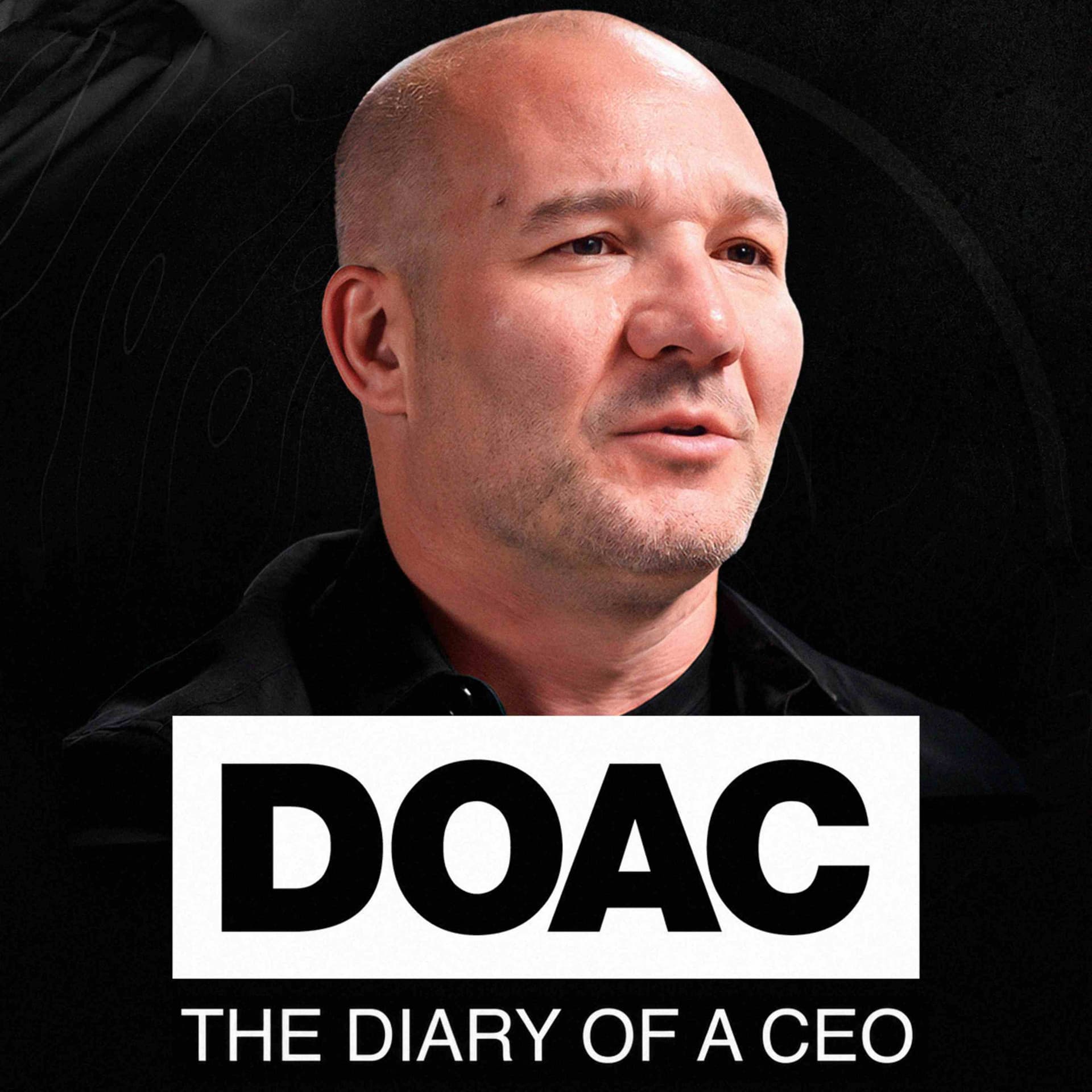
In short
```markdown The Diary Of A CEO with Steven Bartlett
Episode
Moment 142 - These Daily Habits Are Slowly Hurting Your Lifespan: Peter Attia
Guest: Dr. Peter Attia, Author of “Outlive: The Science and Art of Longevity”
Overview
In this episode, Steven Bartlett hosts longevity expert Dr. Peter Attia to discuss his concept of "Medicine 3.0." This new approach focuses on proactive health measures to prevent lifestyle diseases, which are the leading causes of death today.
Key Concepts
- Medicine 3.0: A proposed healthcare model that emphasizes early prevention and personalized medicine to combat lifestyle diseases such as cardiovascular disease and cancer.
Main Discussion Points
Current Health Paradigm
- Medicine 1.0 & 2.0: Historically focused on treating infectious diseases and later, managing chronic conditions.
- Life Expectancy: Hasn't significantly improved since the 1800s; the shift from infectious to lifestyle diseases.
Medicine 3.0
- Prevention Focus: Early intervention to prevent diseases before they manifest.
- Personalization: Tailoring treatments to individual needs, beyond generic medical advice.
- Risk Assessment: Considering the long-term risks of not taking preventative action.
Longevity and Health Span
- Lifestyle Diseases: Issues like heart disease and cancer start much earlier in life than commonly assumed.
- Lifestyle Interventions: Emphasize exercise, nutrition, sleep, stress management, and early use of appropriate medications.
Key Takeaways
- Early Action: Investing in health prevention is analogous to saving for retirement; the benefits are most substantial when started earlier.
- Health Assessment: Regular check-ups can identify risk factors long before they become severe.
- Exercise and Nutrition: Essential components for maintaining health and longevity, yet often underemphasized in traditional medicine.
- Sleep's Importance: Critical for overall health, with direct ties to cardiovascular health and cognitive function.
- Pharmacological Tools: Understanding the role of drugs, supplements, and hormones in maintaining health.
Recommendations for Personal Health
- Begin Early: Start focusing on health in your 20s and 30s to dramatically alter life outcomes.
- Customized Health Plans: Seek personalized medical advice rather than following generic guidelines.
- Monitor Biomarkers: Use blood tests to understand long-term risks for diseases like cardiovascular issues.
- Adopt a Holistic View: Consider physical activity, diet, sleep, and stress as interconnected facets of health.
Further Information
- Peter Attia: Learn more about his work on [PeterAttiaMD.com](https://peterattiamd.com) and [Instagram](https://www.instagram.com/peterattiamd/?hl=en).
- Listen to the full episode: [Podcast Link](https://g2ul0.app.link/JQXpDhSuTFb)
- Watch on YouTube: [YouTube Channel](https://www.youtube.com/c/%20TheDiaryOfACEO/videos)
---
Sponsorships and Promotions
- Sponsors: Me Undies and NetSuite, highlighting the importance of comfort and efficient business systems.
Additional Resources
- Steven Bartlett's New Book: [Link to book](https://g2ul0.app.link/DOAC)
- Connect on Social Media: [Instagram](https://www.instagram.com/steven), [LinkedIn](https://www.linkedin.com/in/stevenbartlett-123)
```
Written by AI. May contain mistakes. Listen to the episode to check what was said.
Transcript
Automatic transcript. May contain errors.0:00This episode is brought to you by Me Undies. While Me Undies can't totally help your love life this Valentine's Day, they can offer you insanely comfy undies and loungewear to buy or gift. Me Undies has so many awesome Valentine's Day prints and styles. Plus, you can match with your partner, friends, or even your pets. This Valentine's Day, give the gift that'll keep them thinking of you and score huge sight -wide savings at meundies .com slash Spotify. That's meundies .com slash Spotify. Me Undies. Comfort from the outside in. Q1 is often when businesses start implementing new systems and processes in hopes of creating efficiencies for the year ahead.
0:36And over the course of my career, I've learnt just how crucial having the right systems in places, one which has helped me across many of my investments is NetSuite. They're also a sponsor of this podcast. NetSuite is the number one cloud financial system through their streamlined platform. You'll find all of your accounting financial management inventory and HR in one place. Their technology has been a real game changer, especially for my team at Flight Studio. As over the last year, we've moved out of startup mode and into scale at mode. We no longer have to juggle multiple systems and having everything together has reduced the number of manual tasks and errors.
1:11Over 41 ,000 businesses have chosen to future -proof their business with NetSuite. So if you'd like to learn how it can help your business, head to netsuite .com slash Bartlett. And free download the CFO's guide to AI and machine learning. That's netsuite .com slash Bartlett.
1:29Today, most people listening to us are going to die from cardiovascular disease, from cancer, dementia, or other neurodegenerative diseases, complications of diabetes. And on the one hand, that's a sign of progress. It means like, hey, we're living long enough to die from those things. But we've made scant progress against those things. In fact, if you go back and strip out the top eight causes of infectious death or communicable death, death from communicable diseases or infectious diseases, today, if you strip them out, our life expectancy is not much better than it was in the 1800s. If we want to really figure out a way to live longer, and I would argue more importantly, live better, meaning when we're in the last decades of our life, not be in a state of total decline, we need a totally different playbook.
2:25And that playbook is medicine 3 .0 and it involves real prevention. So that means taking true steps, steps at prevention very early in life. It also involves being very personalized in how you do things. So it means you can't just do paint by numbers. You can't just sort of say the same thing to everybody. Clearly, there are certain things that make absolute sense across the board, such as sleep and exercise, you know. But the way you might use medications is going to have to be much more tailored to an individual. You say that there are four points to medicine 3 .0, which is the prevention being unique in your treatment to each individual, an honest assessment and acceptance of risk.
3:10One of the things that I don't think we think enough about as doctors sometimes is risk. Now, I think doctors are very good at thinking about the risk of doing something. I think usually a doctor is pretty good at understanding. If you have this surgical procedure, there's a risk of an infection, there's a risk of bleeding, there's a risk of all these things. If you take this medicine, there's a risk of this side effect or that side effect. But I don't think we spend enough time thinking about the risk of not acting or the risk of not acting when we do. So this is where I think it gets a bit more nuanced.
3:49Prevention doesn't come without risk. Right? I mean, you're still going to have to do something in the state of prevention. So the question is understanding the time horizon upon which you're considering risk. So I'll give you one very specific example. At least in the US and it might be the same in the UK. We only really think about the risk of heart disease over a 10 -year time horizon. So let's get someone like you, you're 30 years old, right? So what is your 10 -year risk of having a heart attack? I can tell you without knowing anything about you, it's really low. It's as close to zero as we could have in medicine.
4:38But what if I did a blood test on you and I found biomarkers in there that were predictive of very high risk later in life? Now that would be actually quite possible. There's about a one in 10 chance you might have a biomarker called LP Little A, for example, which is just a certain lipid in your body. About a one in 10 chance you have that dramatically increases your risk of cardiovascular disease. My uncle died very early, I believe in his 50s of a cardiovascular disease. Interesting. So knowing that, by the way, could be helpful because that would prompt me to ask you more questions and want to know more about all the people in your family.
5:19So here we have a one in 10 chance. And by the way, we wouldn't leave it to chance. We would just check it and let's say we checked your level and you had that you had that like a protein. Or you had an elevated level of another lipoprotein, apolipoprotein, little B. And again, these are kind of technical terms, but they're very common things and they're easy to measure. The medicine 2 .0 view here would be, well, there's nothing wrong with you now and there's not going to be anything wrong with you for the next 10 years. We don't need to do anything about it. Conversely, if I take a lifetime view of risk, I would say, yeah, but the risk to something happening in the next 40 years is actually quite significant.
6:01So my risk of doing nothing is probably much higher than my risk of doing something today. So my risk of doing something today would be non -zero but small. But my risk of doing nothing if I take the appropriate time horizon is much bigger. This is one of the things in your book that really, really got me thinking was I have to say, and I believe a lot of people probably feel the same way. I've gone through my life thinking to some degree, I'll worry about avoiding these diseases later. When I get to 45, then I'll start taking this thing seriously. Because then I'm getting into that territory where most people I know that get cancer or Alzheimer's or all of these cardiovascular things.
6:42That's when it tends to happen. So I'll think about it then. Totally understandable. And I'll frame this in the context of a question I get asked all the time, which is, hey, Peter, when is the best time to start thinking about this stuff? And I say, look, I can't answer that because there are two competing issues that are crossing. When I meet somebody who's in the last decade of their life, do you know how much they are thinking about this? Like it's all they're thinking about. It's all they're thinking about. Every minute of every day is a confrontation with their own mortality. The problem is they don't have much time to change the direction of the ship.
7:32You may recall in the book, I write these, sort of, I use the metaphor of the Titanic. It's not that the Titanic didn't see the iceberg. It's that it didn't see the iceberg in time. It didn't have enough runway to really move out of the way. And that's why the Titanic gashed the side of the boat. Now, at the other end of the spectrum, a 30 -year -old like you has unbelievable potential to change the arc of your life. You have so much runway to through manipulating nutrition and exercise and sleep and stress and all of these things to completely alter the disease trajectory of your life. The problem is, and I'm not just speaking to you personally, but more broadly to someone who's as young as you, it's harder to find the motivation because there are no reminders of your own mortality.
8:27You're Superman, right? The worst thing that happens to you is a hangover. So I always get asked, like, when is the right time to start worrying about this? And the short answer is, look, as soon as possible. But then there's a reality that says, for most people, it's not until they're in their 40s. Maybe once they have kids, that they start to appreciate their own mortality and that that provides some of the motivation to say, you know, maybe I'll be a little less focused on optimizing everything for today. And I'll start thinking a little bit about tomorrow. So again, another way to think about this is saving for retirement.
9:03A lot of people in their 20s and 30s who are making good money aren't necessarily taking the most prudent financial steps to ensure financial freedom when they're in their 70s. Because let's be honest, it's more enjoyable to spend money today than to set some of it aside. But there are a lot of people later in life who think, I wish I was a little bit more responsible earlier on. How early does some of these disease, if you looked at my sort of metabolic health, or if you were able to look inside my body which I'm sure you're able to do, how early does some of these diseases begin in my life? At what age do you see some of these things coming?
9:44Yeah, it's super interesting because there are some elements of you as a person that are going downhill the minute you're born. And there are others that are not. So let's use two examples. Let's start with something where your body is getting better and better. And you're probably only peaking now, but you haven't really started to age. Your muscle quality. Okay, so when you were five years old, your muscle quality was nothing like it is today. But as you enter your 20s, the quality of those muscle fibers, these type one and type two muscle fibers. So these are kind of slow to fatigue, but high endurance fibers are the type one fibers, the type two fibers are very, very powerful, but they're kind of quick to fatigue.
10:39The quality of both of those fibers is very high. And the more you train them, the higher quality they will be. But as you enter your 30s, you will now start to experience a shrinkage of those type two muscle fibers. You will be less powerful in your 30s, in your late 30s, especially, than you were in your mid to late 20s. So that's a form of aging. You are declining. It's not an accident that the most powerful athletes in the world are at their peak in their late 20s and early 30s. So sprinters, for example, that's a prime example of a pure, pure power sport. We look at other things like more of your muscular endurance, that will peak even a little bit later.
11:24You can keep that going a little bit later. We look at certain forms of cognition. So if we look at something called fluid intelligence, right, this is raw horse power processing speed. You have more of it right now than I do. Meaning you're going to have faster processing speed, better memory, all of these things are going to be better when you're 30 than at my age. I'm 50 because that's already started to decline in me. There are some things, however, that began aging in you the minute you were born. And one of them is actually going back to this idea of atherosclerosis or cardiovascular disease.
12:01Well, that's an example of a disease process that begins right away at birth. And even though it almost never rears its head as far as death before your 50, make no mistake about it. It's starting on day one. And we know this, by the way, because when we look at studies of people who die for completely unrelated reasons. So somebody who dies in a car accident or soldiers dying in war and we look at the arteries of their heart, we already see quite advanced disease. So the truth of it is you already have pretty significant disease in your coronary arteries. It hasn't risen to the level of ever causing a heart attack and it's unlikely to do so for another 20 years, maybe even another 30 years.
12:50But it's compounding. It is compounding exactly. And if you want to live to be 90 free of cardiovascular disease, it makes a big difference if you can slow it down when you're in your 20s and 30s. Medicine 3 .0 as we talked about earlier, you talk about these five core things that helped increase our chances of longevity as it relates to our health spans. What are those five things? Exercise. Again, we can talk a lot about it if you want a little about it, but the point is it is not remotely given anything beyond lip service by medicine 2 .0. Medicine, you know, if you go to your doctor here at the NHS and say, okay, tell me what my workouts should be.
13:31Like good luck, right? How much time should I be spending in zone two versus zone five? Like what type of lifting should I mean, there's no way they're going to give you that type of insight or specificity. The third one is nutrition. Again, sure, every doctor is going to tell you eat less exercise more, but they're not really for the most part going to be able to help you manage nutrition. Certainly, I didn't learn anything about nutrition or exercise when I was going through my medical training and most physicians don't. So I'm not saying that there aren't doctors out there who don't understand these things.
14:04What I'm going to say is they had to learn that stuff on their own outside of their traditional training. So crazy. The fourth one is sleep, and that fits in the same category. Sleep is an essential pillar of health, but we learn nothing about it in our medical training. In fact, most of our medical training is paradoxically sleep deprived. Sleep's really important to you, isn't it? For sure. Super important to me as well. In life changing. This little weep thing. Yeah, yeah, I see that. I see change in my life. And you've probably noticed how your weep score changes with and without alcohol. One glass.
14:36And it's all flashing red. And it's the first time that happened. I had one glass of wine and I woke up the next day and my vital signs, my heart rate variability was flashing red. And it literally says, did you have a drink last night? I think it changed my life. Yeah. It changed my life forever. And honestly, I'm absolutely obsessed with sleeping a very healthy way. Some people think, oh, that's, you know, you might be waking up and feeling bad. No, I look at it. And if I've not slept well, I'll adjust my day accordingly. You share some stats around sleeping in the book. What is the stat or the two stats that changed your perspective on sleeping or that really you would tell someone if you're trying to convince them of the importance of sleep?
15:12It's so interesting. I'll tell you it's not even a stat. I think it's more of, yeah, almost goes back to the type of discussion you'd have with somebody like a Daniel Lieberman, right? Thinking about this through the lens of our ancestors. So I was always someone who deprioritized sleep. You know, very busy person. High energy didn't really seem to need that much of it. Even in high school was sort of always go, go, go. And, you know, at one point I was sort of having a discussion with a colleague about sleep. And I was making the argument that like, I didn't really need any of it, you know, and I almost, you know, made a point like it's almost a shame we can't just work our way out.
15:58And he sort of posed to me in a very secratic way. Well, you know, given how evolutionarily unwise sleep would be, right? You are unconscious for a third of your life. And we know that our ancestors slept on an average of about seven to eight hours every 24 hours. They didn't do it always straight away. But we know that they're sleeping basically a third of their life. That's a time when you can't forage for food. You can't defend yourself against predators. You're not mating. Like there's nothing from an evolutionary perspective you're doing. Those are the three highest priorities of evolution.
16:40And you're not doing them. Why would evolution have kept this thing around? Like, and by the way, why has no species figured out a way out of it? And I think through that lens, I was sort of like, huh. Yeah, interesting. Maybe this thing does matter. So in some ways, I think that's probably one of the most powerful things that you can hear. And sure, there are lots of statistics about how fragmented sleep, broken sleep, or short sleep, can increase your risk. In particular, of cardiovascular disease and dementia, I think there's a less clear relationship to cancer. But I think the relationship is quite clear to cardiovascular disease and dementia.
17:18In addition to insulin resistance and obviously, therefore weight gain. So for people, even if you're just coming at this through the lens of weight or excess body fat, I mean, that's probably motivation enough for many people. And then of course, there's how you feel and how you perform. And your creativity and your ability to articulate yourself, which I noticed, and your mood, huge one for me, especially when you're running teams, unslap days in my last days. The fifth and final thing that you have as a tool in the longevity toolkit is all the molecules. So drugs, hormone supplements. And there, that's the one thing you sort of do learn in traditional medicine is you at least learn about the pharmacologic side.
17:59If you don't really learn anything about supplements, so most doctors don't really understand much about supplements. And interestingly, most doctors don't really understand a lot about hormones as well. So medicine 2 .0 is good at what it does, but it's very limited. So it's kind of like having a contractor that only has one tool instead of five tools. And as we discussed earlier, I think they're applying those tools too late in the game.
18:28Q1 is often when businesses start implementing new systems and processes in hopes of creating efficiencies for the year ahead. And over the course of my career, I've learnt just how crucial having the right systems in places, one which has helped me across many of my investments is NetSuite. They're also a sponsor of this podcast. NetSuite is the number one cloud financial system through their streamlined platform. You'll find all of your accounting financial management inventory and HR in one place. Their technology has been a real game changer, especially for my team at Flight Studio. As over the last year, we've moved out of startup mode and into scale at mode.
19:03We no longer have to juggle multiple systems and having everything together has reduced the number of manual tasks and errors. Over 41 ,000 businesses have chosen to future proof their business with NetSuite. So if you'd like to learn how it can help your business, head to NetSuite .com slash Bartlett. And free download the CFO's guide to AI and machine learning. That's NetSuite .com slash Bartlett.
From the publisher
In this moment, longevity expert and author of ‘Outlive: The Science and Art of Longevity’, Dr Peter Attia discusses ‘Medicine 3.0’.
Most people in today’s world will die from lifestyle diseases, such as cardiovascular disease and cancer. In fact, Dr Attia says that our life expectancy hasn’t greatly increased since the 1800s, medicine just means we don’t die from infectious diseases.
To live longer and better in our later years, Dr Attia says that we need a new playbook, or what he calls ‘Medicine 3.0’. This relies on taking preventative steps very early in life, as the risk of lifestyle diseases compound throughout our life. Dr Attia argues that while doctors practising traditional medicine are very aware of the risk of doing certain treatments, but often ignore the cost of not taking action to prevent future problems.
Dr Attia believes that too often we worry about our health too late in life, when the problems start and the risk of taking action is higher. Instead, he argues, that if we take action when we are younger we have so much potential to change the trajectory of our lives. He says that we should start worrying about our future health now, and should think about it the same way as we think about saving for retirement, if we invest now we will thank ourselves later.
Listen to the full episode here - https://g2ul0.app.link/JQXpDhSuTFb
Watch the Episodes On Youtube - https://www.youtube.com/c/%20TheDiaryOfACEO/videos
Peter:
https://peterattiamd.com
https://www.instagram.com/peterattiamd/?hl=en
Learn more about your ad choices. Visit megaphone.fm/adchoices