Ask ChatGPT
 The Dr. Josh Axe Show
12 Nov 2026 · 54m · 22 chapters
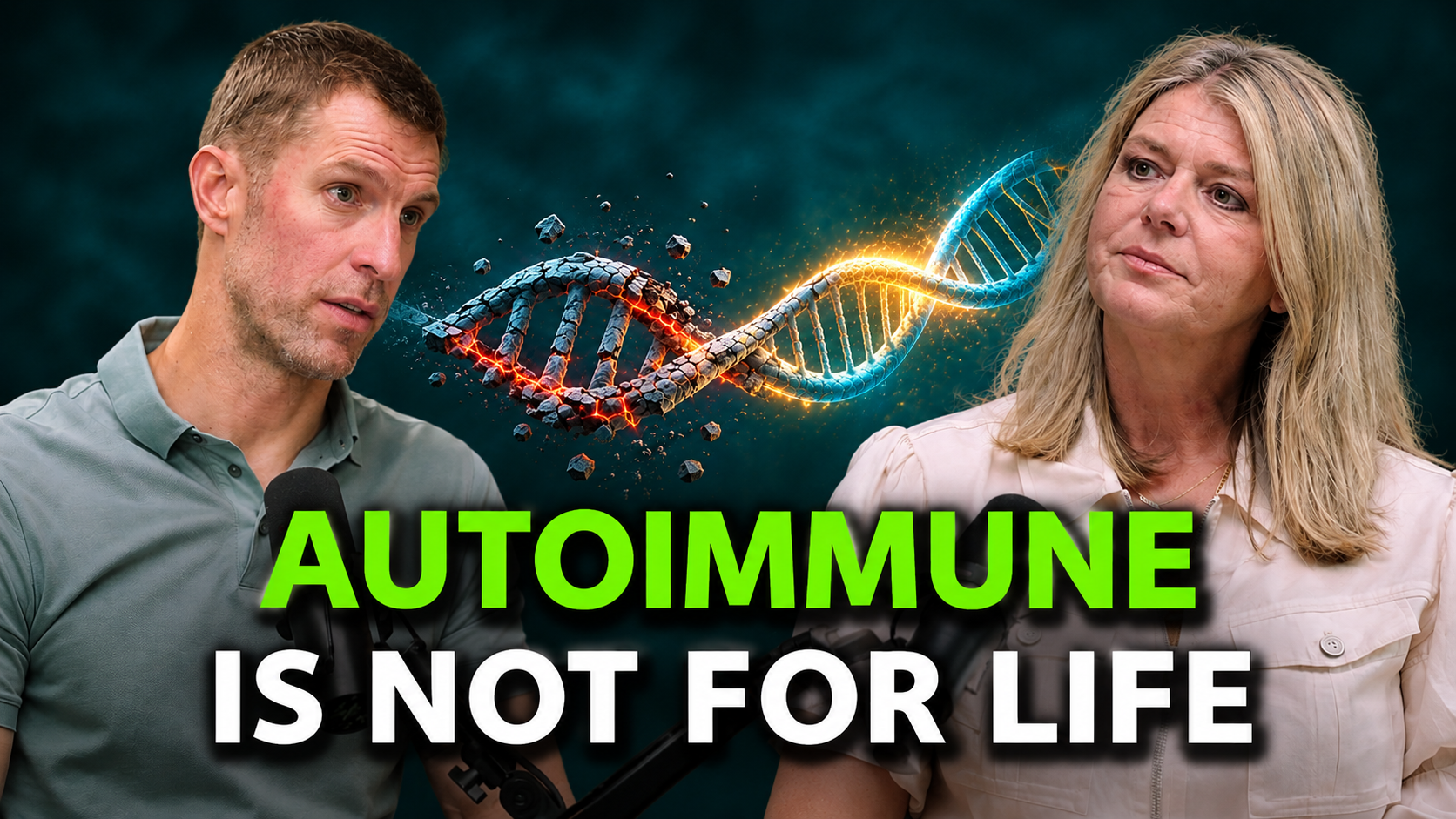
Healing autoimmune disease and thyroid conditions using functional-medicine “root cause” steps: gut repair (leaky gut), infection control, stress/trauma relief, and targeted nutrition/testing. Key claims include that many autoimmune issues begin after stressors and involve gut dysbiosis (SIBO/candida/parasites), and that thyroid symptoms may persist due to poor T4-to-T3 conversion and wrong dosing/brand.
Dr. Amy Myers’ Graves’ disease after her mother’s sudden death; a sibling reversing Hashimoto’s by removing gluten and casein; patients improving 50–60% then plateauing due to ongoing stress or past trauma; mold exposure triggering PTSD; and a JAMA-referenced claim that many women on levothyroxine may not benefit.
Dr. Amy Myers (functional medicine physician; best-selling author of The Autoimmune Solution; founded “Myers way” and runs a clinic/Health Institute; discusses selenium, iodine, thyroid antibodies, and autoimmune panels). Host: Dr. Josh Axe (interviewer; discusses cellular healing and bloodwork services).
Written by AI. May contain mistakes.
A discussion on common myths surrounding autoimmune diseases.
“Now, there are three autoimmune conditions that I say sort of fit in a different category, and that would be...”
Exploration of how conditions like Hashimoto's and Graves' disease can be managed.
“I remember 20 years ago, if someone was diagnosed with an autoimmune disease, it was typically, well, you're going to have this for life.”
The importance of thyroid hormone therapy and its differences from medications.
“to point out that there is such a big misconception that everybody thinks levothyroxine for instance, or most thyroid drugs, that they're like a synthetic conventional medication.”
Discussing the impact of nutritional deficiencies on thyroid function.
“But then, particularly like myself, if you don't have a thyroid, you are not converting well from T4 to T3, the active form.”
Linking gut health and autoimmune conditions and the significance of leaky gut.
“And it's because they're not getting the right care.”
Exploring how stress can trigger autoimmune conditions and their symptoms.
“You know, I would say that like when I look at these hormone conditions, I tend to think it's either gut or brain.”
Discussion on common nutritional deficiencies and the relevance of iodine for thyroid health.
“biggest nutritional deficiencies in ranking order that you're fighting with patients?”
Exploration of the connection between leaky gut and autoimmune diseases, including treatment approaches.
“And so talking about how the root cause of most autoimmune disease or one of the biggest culprits is leaky gut or intestinal permeability.”
Introduction to the 4R program for treating gut infections and restoring balance.
“I don't recommend kombucha and prebiotics and fermented foods right off the bat to people.”
The importance of stress management for digestive health and techniques to improve digestion.
“I mean, some things to kind of help that out.”
Insight into important blood markers for autoimmune conditions and differences in testing.
“And I'll take breaks because anyways, and so I'll do like 30 seconds to 45 seconds, breathe a couple times out of my nose, do it again, but do it for about two to three minutes.”
Learn about SIBO and alternative solutions for gut health.
“I've never been to a GI doctor personally, but they might be talking to you about leaky gut because somebody is creating the zonulin blockers and patenting that.”
Discover the four fundamental pillars to address autoimmune disease.
“So with that, I remember you getting into in the book, like five factors.”
Understand how emotional trauma influences autoimmune responses.
“you know, because this is what happened and I know you experienced the same thing.”
Hear personal stories about overcoming trauma and its effects on health.
“And most people aren't doing that, right?”
Hear personal stories about overcoming trauma and its effects on health.
“you'll also get all of the Heal Your Cells bonuses straight to your inbox.”
Explore advancements in healing methods and their increasing accessibility.
“hey, if somebody is dealing with some sort of trauma, Is there anything, even if it's just one thing, hey, you know, that you feel like it's helpful for overcoming that?”
Learn about the importance of mindset in the healing process.
“I remember talking about this years ago that when we're talking about food, I said, you know, there's more processed sugar, more fast food.”
Learn about the importance of spiritual identity and positive mindset in healing.
“I mean, in the midst of all of this, literally right after I've finished the mold story and then a lawsuit and I'm better.”
Discover how living in gratitude and a state of wonder can enhance well-being.
“I mean, you can either live in fear and have a toxic soup that your cells are living in, or you can live in empowerment, live in the life that you want to be living in.”
Explore the interconnectedness of physical, mental, and spiritual health.
“If you're dealing with trauma, typically that trauma has affected your sense of identity to where, are you a victim?”
Learn about Dr. Amy Myers' contributions to autoimmune disease management.
“I want to encourage everybody, check out all the incredible things Dr.”

Get the gist, explore an idea or ask about something said.
 Claude
On The Dr. Josh Axe Show, what are the key points of this episode?
Searching your listeningAutomatic transcript. May contain errors.
0:0020 years ago, if somebody was diagnosed with an autoimmune disease, it was typically, well, you're going to have this for life. That's still what most conventional doctors will tell you. You're going to have this for life. You have to be on this medication for the rest of your life. But when we're talking about root causes, hey, where did this all start? Anybody dealing with any type of autoimmune condition, whether it's thyroid or not, likely your issue is starting there that you have a leaky gut. Like when I look at these hormone conditions, I tend to think it's either gut or brain. It's like insulin or cortisol.
0:27When you take a history and you ask them, when did your autoimmune condition come out, it's typically right after some stressful event. For me, my mother passed away very unexpectedly from pancreatic cancer. And within a year, I had Graves' disease. What are some other big things people might misunderstand about autoimmune disease in general? Now, there are three autoimmune conditions that I say sort of fit in a different category, and that would be...
1:05I just wanted to say how incredibly grateful I am for each and every one of you who makes this community so special. And as a thank you, I'm going to be giving away over$5 ,300 in prizes to many of you. I'm talking about a sunlight and sauna, a red light therapy mask, cellular blood work testing, Manu Kora Manuka Honey, an Eco Hydrogen Water Flask, a signed copy of my New York Times bestselling book, and more. To enter, subscribe to the Dr. Josh Axe Show on YouTube. For 10 bonus entries, leave us a review on Apple Podcasts or Spotify. I'm excited for many of you to win free prizes. By the way, the only way you can be signed up in these is if you are subscribed to the podcast.
1:51The giveaway ends December 14th and we'll announce the winners on December 22nd. Make sure to subscribe and leave a review so you can be entered to win. Hey guys, today we're doing a deep dive on healing autoimmune disease, chronic infections, and thyroid issues. And today I've brought one of the world's leading experts on, a good friend of mine, Dr. Amy Myers. She's the best-selling author of The Autoimmune Solution. Today we're gonna talk about diet, herbs, supplementation, testing, all the things you need to know about how to heal autoimmune disease and so much more. Dr. Amy, welcome to the show.
2:28Thanks so much for having me. I remember 20 years ago, if someone was diagnosed with an autoimmune disease, it was typically, well, you're going to have this for life. Well, I think that's still what most conventional doctors will tell you. You're going to have this for life. You have to be on this medication for the rest of your life, immunosuppressive drugs, harsh side effects. So we know that's not true. Yeah. Yeah. We do know that's not true. So walk me through, that's one myth. What are some other big things people might misunderstand about autoimmune disease in general? I mean, I think that's probably the biggest is that you are destined to a life of these symptoms unless you take this harsh immunosuppressive medication that you're going to be on for the rest of your life.
3:09Now, there are three autoimmune conditions that I say sort of fit in a different category, and that would be Hashimoto's, that would be Addison's disease, and type 1 diabetes, autoimmune diabetes, where I think I'm different than most people. And this is where it's maybe a little controversial. A lot of people call it thyroid medication. And I actually like to call it life-saving thyroid supplemental hormone, because when you have diabetes, you're going to be on life-saving supplemental insulin. If you have Addison's, you're going to be on life-saving supplemental steroids. And if you cannot fully reverse your Hashimoto's because it got diagnosed too late, or if like myself, I had Graves disease, I don't have a thyroid, I would die if I did not take supplemental thyroid hormone.
3:55So I like to call it that instead of medication, because it is very different than these harsh immunosuppressive drugs that we're talking about for MS, lupus, rheumatoid arthritis. Yeah. You know, I had one of my siblings, but I had one, my brother had Hashimoto's and completely reversed it. This was quite a few years ago. And the big part was getting rid of gluten. I mean, it's so crazy, but he just removed gluten and casein and he reversed it that way. And then I had another family member who had Graves' disease. She was able to reverse it. And I've seen a lot of this with patients. I mean, again, if somebody's had it for a very long time, listen, it just depends upon the person.
4:33You did say this, and I do want to point out that there is such a big misconception that everybody thinks levothyroxine for instance, or most thyroid drugs, that they're like a synthetic conventional medication. But they're not necessarily, I mean, they really are, to your point, it's more hormone replacement therapy. Absolutely. Absolutely. And so I had Graves' disease in my second year of medical school, and I did everything to find a doctor like myself. Back then, functional medicine really didn't exist. So I had to have my thyroid ablated. I knew no other way. And then of course, that is what, you know, I eventually went into functional medicine, founded the Myers way and have since helped many people reverse their graves, their Hashimoto's, all of these things.
5:22I guess it's just for me, I hear influencers on, you know, on Instagram and other places and they are saying, oh, this person got completely off their medication for Hashimoto's. And I just want to say a lot of people, it takes five to six doctors to finally get diagnosed, six to 10 years. And if that's the case, or you're just now listening to this podcast and learning about functional medicine, and you've had Hashimoto's for years, there might be enough damage that you need to be on these supplemental hormones. No different than a woman going through perimenopause or menopause needing to go on estrogen or progesterone to have a better quality of life.
6:01Yeah, and I think the thing to understand is that everybody's body is different. And you and I know this as practitioners. Like, we've taken care of probably tens of thousands of patients. And when we look at all these individuals, it's like everybody is a unique case, needs something differently. Many people can reverse it. Some people need things supplementally. But I do want to mention this, and I'm sure you saw this because you probably posted on it. But a study came out, and a couple journals covered it. But the Journal of American Medical Association is the one most people are referencing that said 21 million out of 23 million women taking levothyroxine.
6:37It may not be doing them any good. What are your thoughts on that? Totally. I think everybody's an individual. You know, in my practice, I also wrote the book, The Thyroid Connection. And I talk about every supplemental thyroid brand out there can be different for each person. But levothyroxine, first of all, we know that the generic is not the same as actually taking Synthroid. So I do always recommend that people take brand name. But then, particularly like myself, if you don't have a thyroid, you are not converting well from T4 to T3, the active form. You're still having a lot of symptoms while you're on Synthroid that you likely may need something like Naturethroid, Armor, something like that.
7:22I mean, I personally don't have a thyroid, and I take armor and a little bit of Synthroid. Yeah. So it's very common that people are not making the conversion. Well, and this is a big deal. And this is the biggest thing I've seen. And looking at loads and loads of blood work of people with hypothyroidism, I think the biggest thing I see with a lot of women today is this lack of conversion from T4 to T3. Right. And the question is, why is that happening? Do they not have the nutrients? So when I wrote that book, I created a multivitamin that gives you zinc, vitamin A, gives you iodine, selenium.
7:56You need these nutrients in order to make that conversion. And just so for the people who are listening that don't know, T4 is an inactive form of the thyroid hormone. It does not go into the receptors of every cell. So when you're taking levothyroxine or Synthroid, even the brand name, that's all you're getting. and you are relying on your body to make that conversion. If you don't have the nutrients or maybe you're stressed, so you're converting more into reverse T3, which is a break versus free T3, which is the gas. There are all kinds of reasons why you could not be making this conversion.
8:31And if you don't, you know, then you're going to have these symptoms of low thyroid, your hair falling out, gaining weight, being exhausted, just, you know, a lot of these symptoms that many, many of those 21 million people, 21, 23 million people are suffering with still. And think about how crazy it is. 21 million out of 23 million. And it's because they're not getting the right care. Many of those people could be on nutritional supplements or some of them need to be on something like Nature Throid or Armor, a better option for them. You know, when we talk about this T4 to T3 conversion, we know it's really important that your liver and your gut microbiome are working well, right?
9:18And I think that, I mean, I will tell you when I was coming out of school, when I thought about liver, I thought detoxification, right? But over time, you just start to realize, okay, the liver is responsible for a lot going on with your hormones, especially estrogen, but even thyroid hormones. Clearing, converting. Absolutely. Yeah. Yeah. So, so, so talk to me a little bit about, Well, you know, one thing that I found is most of the time when we're talking about the thyroid, now not all the time because sometimes it actually is a thyroid problem. But when we're talking about root causes, hey, where did this all start?
9:52Most of the time it's not in the thyroid. Where do thyroid issues typically start? What are some of those big areas? Well, I mean, I think a lot of issues in general, and let's back up, many thyroid conditions are actually autoimmune thyroid conditions, right? Yeah, it's like 80%, right, of Hashimoto. And so then how does one get autoimmunity? And I say the gut is the gateway to health and that anybody dealing with any type of autoimmune condition, whether it's thyroid or not, likely your issue is starting there that you have a leaky gut, right? And so how do you get leaky gut? What foods are you eating?
10:26What infections might you have, such as SIBO or candida overgrowth or parasites? You know, what is going on there? So, of course, the issue can start anywhere, but I always think about leaky gut. We can talk about the liver. We can talk about, you know, just this HPA access of your brain, not really talking to your thyroid and sending those signals properly. But one of the first places I think of is the gut, for sure. Your mitochondrial health is foundational for all-day energy, resilience, and long-term wellness. When your mitochondria are supported, everything works better, from metabolism and recovery to how you handle stress.
11:07One powerful tool that supports mitochondrial function and simply feels great is infrared sauna. Targeted infrared light and heat are absorbed at the cellular level, helping support circulation, detox pathways, and mitochondrial efficiency, which is why sauna use shows up so consistently in longevity research. That's why I use Sunlighten. They've been leading infrared technology for over 25 years with patented systems designed to deliver high-quality infrared. Their Impulse sauna lets you customize wavelengths to match your health goals. If supporting mitochondrial health and sustainable energy is a priority for you, learn more at sunlighten.com slash axe.
11:54Use code AXE to save up to$2 ,100 off a sauna plus free shipping with additional savings throughout the year. Yeah, yeah, I do as well. You know, I would say that like when I look at these hormone conditions, I tend to think it's either gut or brain. It's like insulin or cortisol, right? It's like, you know, that's where so many of these issues begin. And so I remember my first few years of practice, I would get patients on a diet and they would start to reverse and heal, let's say somebody with irritable bowel disease. And we'd get them to where they were really good. And then they would come in and they'll say, hey, doctor, I'm a wreck right now.
12:32I say, oh, hey, what happened? Did you eat something? And then they would say something like, no, I just, and then I asked more questions and it was like, oh, I've got stress at work. Stress, yeah. Kids, whatever. It was always stress. Yes. Well, I mean, we know a lot of people, when you look at, when you take a history and you ask them, when did your autoimmune condition come out? It's typically right after some stressful event. For me, my mother passed away very unexpectedly from pancreatic cancer. And within a year, I had Graves' disease. So that is a, you know, when we look at the work of Alessio Fasano, who's really done much of the research surrounding leaky gut, and he was on the cover of Scientific America for his research stating with autoimmunity that it was this three-pronged event, right?
13:16Likely genetics. Now we've seen all kinds of people who actually get certain autoimmune conditions that don't even have the genetics. That's a whole different conversation. But leaky gut and then some sort of antecedent. And so that can be a stressful event, a death, a marriage, the birth of a baby. That could be you went to - A viral infection. Yes. I was just coming out. You went to Mexico and you got, you know, Montezuma's revenge. You had COVID and got long COVID, right? I mean, that a stressor on the body can be a mental or a physical stressor. Yeah. Yeah. It's so true. So talking about some of these thyroid issues, when you think of some of the most important things, and then I want to dive more into just fully autoimmune, but for thyroid in particular, when you run blood work or check on patients, what do you find to be maybe the biggest nutritional deficiencies in ranking order that you're fighting with patients?
14:13I mean, I would probably say selenium, right? I mean, we know that just taking 200 micrograms of selenium can reverse someone's antibodies, which is why I've got 200 micrograms in my multivitamin that I have for people for thyroid conditions. So selenium's there, B vitamins, Zinc is there. Iodine. So there's a huge controversy about iodine. I am a believer that we are all somewhat iodine deficient. I saw people coming into my clinic taking these very, very high dosages, 25, 50 milligrams of iodine. Again, I was seeing the cases that were not working out well for people, but that typically led to problems with the thyroid.
14:55I'm talking about micrograms. 150, 300 micrograms of iodine is very beneficial for people with thyroid dysfunction. From what I've seen and understand, the biggest risk is typically with somebody that has more severe Graves' disease with the iodine issues. Right. So when I had Graves' disease, it was avoided at all costs. But they don't really tell you to go avoid seafood, right? And that has iodine. They don't tell you to avoid iodine-rich foods, but they tell you to avoid contrast if you have to have a CT or something like that, right? So those are large dosages. But if it was really a problem, then wouldn't they be telling you to avoid iodine-rich foods?
15:41And 150 micrograms is such a small amount. Yeah, nobody's doing that. So we have fluorinated, chlorinated, and brominated our world. And these are all halides on the periodic table. And these halides displace iodine. So we no longer have salt that's been iodized. And then most people are drinking water that has fluoride in it, has chlorine in it. They're swimming in pools. They're eating baked goods that have bromide in them now. And so all of that together has led to we're not eating the seafood and the seaweed like we used to. So all of that, in my opinion, has led to some amount of iodine deficiency for people, which is also why I included iodine in my multi.
16:27Well, yeah, it's a huge deal. Well, let's talk more about autoimmune disease. I remember writing an article. I mean, this is back in like 2009. It was a long time ago. Yes. We've known each other for a long time. We have. And so talking about how the root cause of most autoimmune disease or one of the biggest culprits is leaky gut or intestinal permeability. What's so crazy is I had people responding saying that's unscientific. I don't know. But I'm quoting, you know, Alicia Fasano. Totally. And most of them just had never seen the research. But I was seeing this in practice, people healing and overcoming these issues because it was like we've got to focus on the gut microbiome.
17:02I know you wrote another – you wrote a book on candida, right? I have a candida program and SIBO program. A lot of people come to me for gut stuff. Yeah, and so those are major, obviously major issues related to leaky gut as well. Talk to us a little bit about how do you start to eradicate candida or issues with H. pylori or SIBO if that's one of your issues. Yeah, so I follow a functional medicine 4R program, very typical. And so one of the first things I do when somebody would come see me or the foundation of all of my books is looking at the gut. I say the gut is the gateway to health. And so the first step in that is to remove.
17:43So you're removing toxic and inflammatory foods like the gluten and dairy that we've discussed, but then you're removing infections. And so you need to look, does this person have candida overgrowth, SIBO, any kind of parasites? I like to think of the gut as a rainforest. Ideally, we have this perfect balance. you may actually have some parasites in there, but they're in there in a way that they're just stimulating your immune system enough. You know, there's this whole hypothesis, hygiene hypothesis that we're too clean. We used to dig in the dirt and we would all have parasites. You should have maybe a little candida, maybe you have some viruses.
18:21These might be normal and that they're sitting there in a beautiful symbiotic balance and you have a healthy gut. But when we are stressed, when we're eating inflammatory foods, processed foods, when we have to take antibiotics, then it can disrupt this balance and then these infections can take over. You can have an overgrowth of even good bacteria, which is actually what SIBO is, or you can have an overgrowth of candida. So my first step in removing any of these infections is to change your diet. Yeah. So I again, a controversial thing. I don't recommend kombucha and prebiotics and fermented foods right off the bat to people.
19:02If they're dealing with these infections, you need to hold off on that because it will feed these infections. You got to clear them and then you can add that stuff in. And then depending on what you're treating, if it is candida or SIBO, I usually use a biofilm disruptor. A lot of these things live like in a plaque that protects them from your immune system. When it comes to candida, I usually do try to eradicate that. So I say kill the candida and I have some supplements that I use for that. Or if it's SIBO, we want to just prune that back. We don't want to go in like, you know, blow up the gut and kill everything because it's just a mild overgrowth of some good bacteria.
19:42Yeah. You know, it's interesting. When you look at SIBO in Chinese medicine, they would call that a type of spleen sheet efficiency is what they would call it. But basically, the root cause is your digestive system is weak. It's stressed. It's stagnant. Yeah. So you really want to be able to – I mean, the biggest thing there is reducing stress. I mean, there are so many things that stress is playing a role in. And, of course, they have other things they recommend, like licorice root with oregano. I mean, some things to kind of help that out. But the bigger thing is when you're eating a meal, chewing, taking your time, going on a walk.
20:15Rest and digest. Get into the parasympathetic, right? There's also, back to the thyroid, a big connection between Hashimoto's and SIBO. Because when you have Hashimoto's or low thyroid, everything is slowing down. So your digestion can slow down as well. And so what happens with SIBO is that either you're stressed and your body's not prepared to digest. Or maybe you have something such as Hashimoto's. and you just have slowed motility and then the food is sitting there longer and then the microbes and the bacteria, even the good ones, have longer to be able to sit there and feed on it and then they continue to overgrow.
20:51So absolutely, I mean, adding in practices where you're stopping your breathing. I mean, digestion starts really with us smelling. You start to salivate, but certainly when we start to chew, right? You're salivating and you're physically chewing the food that is beginning to break it down. Hey, listen, if you're on more medications than you ever planned on and you still don't feel great and nobody's actually looked at why, then there's another conversation we should have. The root cause is likely deep down in your cells and our cellular healing protocols at the Health Institute address the issues that are lurking upstream naturally in the right order, which is absolutely key.
21:36The system I've created for helping people heal is so effective that you could go and read the hundreds of five-star Trustpilot reviews about folks getting their energy back, balancing their hormones, dropping weight, getting rid of brain fog, but most importantly, feeling alive again. I also have so many people saying they feel and look younger, but it all starts with a cellular blood work analysis, an at-home blood test kit, Plus a full hour with one of my senior health advisors. If you're ready to get to the root cause of your symptoms, go to mybloodwork.com. That's mybloodwork.com today so we can help.
22:13Yeah, yeah, absolutely agree. You know, one thing I started doing recently, and I'm a huge fan of it because I like breathing and I'll do it. But I notice an even faster response with gargling. So I've started gargling water and I'll do it for two minutes. And I'll take breaks because anyways, and so I'll do like 30 seconds to 45 seconds, breathe a couple times out of my nose, do it again, but do it for about two to three minutes. And it's amazing. I challenge everybody to do this. You will feel your entire nervous system just all of a sudden relax and let go. Humming as well. There you go. Yes.
22:47Humming. Yeah. You know, these, a lot of both Buddhists, but also Catholic monks would, would, would chant and hum. And it's amazing. It sort of gets you in this parasympathetic state, which allows you to go deeper and I think connect more with God, like in prayer. And when you're in this frightened flight or fight state, it's hard to think clearly. Yes. Well, and certainly your body, if you're back in the day getting chased by a lion or a saber tooth tiger, you do not want to be digesting your food. You want all your blood to go to your legs to run off. And so if you are sitting down to a meal in that same state, that's exactly what's happening.
23:28The blood is not going to your gut to help you digest all of this. I mean, also there's talking about digestive enzymes and also stomach acid. You're not producing these things when you are in a sympathetic state. Yeah, yeah, I totally agree. What are some of the most important blood markers you look at? And then here's another question with that, because I have this happen all the time. I know you do, too. Patients will get blood work done and they'll say, yeah, I had my blood work done and everything came back right. You know, so so so in regards to autoimmune, in regards to thyroid issues or a lot of these different things we're talking about here, chronic illness.
24:06What are some of those lab markers you really think are very important to run that maybe a lot of conventional doctors don't run? And then talk about just the difference between the ranges you look at versus maybe another doctor. Absolutely. So, I mean, first off, when it comes to autoimmunity in general, most conventional doctors, like when we started out this conversation, they don't believe that you can reverse your autoimmune condition. And so they're not proactively checking to see, do you have any antibodies? They're only doing that as a last resort when your symptoms are so bad they can't ignore it.
24:39So every patient that came to see me, I would do an entire autoimmune blood panel looking for an ANA as an excellent screening marker for a host of different autoimmune conditions. Looking at a rheumatoid factor, looking at antibodies for Sjogren's, of course, looking at TPO antibodies and antibodies for thyroid. So that's one of the first places I would start with people because these often come out six to 10 years before the autoimmune condition does. and it's much better to prevent something from coming out than trying to reverse it. We know we can reverse it, but it is easier to prevent it than having to reverse it to begin with.
25:16Absolutely. So that's the first and foremost is that most doctors are not checking anything proactively because they don't believe there's anything you can do for it. Secondly, when it comes to autoimmunity and thyroid in particular, again, as you know, they're really just checking that TSH. Maybe if you're lucky, they're checking a total T4 or a free T4. But we've already discussed when we were discussing Synthroid, this is an inactive form of the thyroid hormone. It is not the active form. It's not what's going in the receptors. So you have got to check a free T3. That is the most active form.
25:52And then back to the stress component. I recommend people check a reverse T3. So free T3 is the gas. And reverse T3 is the brake. And I myself have had times in my life when I've been very stressed and my free T3 is low, but my reverse T3 is high. So I am just converting more into the brake than where I into the gas. And that is a very frequent thing that's happening to people if they are in a heightened state of stress. And then, of course, I've already mentioned checking the antibodies as well. Yeah. So and we know just to your question about reference ranges, there is normal and then there's optimal.
26:31And definitely you want to be looking at optimal versus normal. And when it comes to the thyroid itself, we know that when they were doing the reference ranges for TSH, they had a bunch of people in there that actually had hypothyroidism. So the reference range is way too broad. Depends on your lab, but it can go up to, I think, 4.5 in some labs for the high end of a TSH. and I recommend that people are sitting somewhere between one and two or lower. Like I don't have a thyroid and I take armor. So mine's very suppressed. Yeah, I think that a lot of the modern blood markers that people, this always surprises me how long it takes.
27:12A lot of physicians just come around on things, you know, it's like with heart markers. We know you should be running ApoB right now and LP little a and like these other markers. And same thing with thyroid. You know she used to be doing T3 and reverse T3. in the antibodies, but most doctors still are not testing for those first. It's like, hey, what's your LDL cholesterol? Who cares? You know, there's way more important markers. But you and I have been talking about this forever. And people are like, oh, hearing about leaky gut now all over the internet. I said, I've been talking about it for almost 20 years.
27:45Right. But that's it. They say that it takes about 17 years for research to then get into clinical practice and we're there, right? I mean, Alessio Fasano was talking about this for 10 years before we were, right? And so now it's getting out there. Now I think, I mean, I don't know. I've never been to a GI doctor personally, but they might be talking to you about leaky gut because somebody is creating the zonulin blockers and patenting that. And then they're going to the doctor's office to sell it, right? That's right. Yeah. But when I first started practice, even the the GI doctors were not talking about SIBO.
28:21It's why I created my SIBO program and my SIBO supplements, because even though I had patients coming to see me paying out of pocket to get the prescriptions I've axed and would cost them thousands of dollars. And I had to have another solution for people because they just couldn't afford thousands of dollars for antibiotics. It may or may not work. Yeah. Talking about solutions. So I remember reading your book, The Autoimmune Solution, way back. You sent me a copy. Thank you for that. And you're about to release an updated version of the book. I am. A revised edition. Was this about 15? How long did you write this book?
28:56So the book came out in 2015. And so, yeah, 11 years ago, but I wrote it 12 years ago. Yeah, 12 years ago. Okay. So with that, I remember you getting into in the book, like five factors. There are certain things that you really want to do in order to address autoimmune disease. Walk us through what some of those critical things are you have to do in order to reverse autoimmune disease. So it was four pillars and I kept it as four pillars, but I added a few things to it. So the fundamentals are really the same. And what I've, what has, let me walk through the fundamentals and then what has changed.
29:31So it is, the first one is heal your gut, which we've discussed leaky gut and its role, get rid of gluten grains and legumes, tame the toxins. and then it's really the fourth pillar where things have been added. It's heal your infections, relieve your stress, and let go of trauma. So in infections, I've added COVID. The entire world between COVID and the COVID vaccination, the landscape has changed. And so I would be remiss to not have an entire section on both COVID and the COVID vaccine. And then I added in letting go of trauma. So it was early on in my career and I had not sat across the table one-on-one with thousands of patients like I have since I wrote the book originally.
30:15And hearing people's stories, their traumas played an enormous role in their getting their autoimmunity. I will tell you that, I mean, one of my biggest lessons over the last 10 years is, you know, because this is what happened and I know you experienced the same thing. We do the blood work. We do the advanced history. We know exactly what you're deficient in. We get you on the perfect diet. They keep getting better and better. They get about 50 % better, 60%. And then they hit a roadblock, and they're like, I'm not getting better. And almost every single time, it's one of two things. Either there's a current stressor going on, or there's an emotional trauma from the past.
30:48Or typically, this trauma from the past is what's causing. Causing the triggering of the, yes, the ongoing sympathetic response. Yes, exactly. I myself experienced it. I mean, since then, I've had three toxic mold exposures that caused me to lose everything. One of them, I was sleeping on a balcony for a month, all of which I reversed, got better, spent years building a very sophisticated home that is made out of pumice crete, steel, dins glass, and glass. I have no wood in my house. And six months in, the builder didn't follow one aspect of the plans. I had a drop of water and I had mold spores in my house.
31:29I was not exposed very long to the mold, but this time it tipped me over into a trauma response because I had spent all of this money, all of this time, all of this energy to build a house where I could be safe. And I was no longer safe. I was diagnosed with PTSD. I was unable to work. I was unable to function. I was reduced to nothing. And so I had my own story that I had to overcome with this. You know, how could I get back in this house? How could I be safe? What, you know, it just triggered this response. I went through EMDR. I did various meditations with Joe Dispenza. I went on a full-blown, literally a journey and got to a place where I literally, we had a rainstorm a couple of weeks ago and I had five leaks in my house.
32:16And I got to a place where my sympathetic nervous system did not go haywire. It's like, I am safe. I built this house in a way I can be here. I pulled out the dehumidifiers and I moved on with my life. But it was a long road to get there. Yeah. Wow. And most people aren't doing that, right? They're not going through really seeing what are these triggers? How did I get here in my life? You know, what, what is this doing to me and, and getting to the, you know, root of it? Yeah, I mean, I think, you know, I had recently put this in a book as well, really diving into, you know, we typically don't think of past trauma like this, but it's almost like candida or a parasite or a Lyme infection.
32:58It's an infection that is sitting there, you know, eating up your bandwidth. It's infecting your body and it's causing cortisol to stay high. It's causing you to react in ways you don't want to react. But it's a toxin. You know, it's a toxin. I was, I realized I was, and I don't have, you know, in hearing all of these stories that I've heard over the years of people's traumas, I don't have what anybody would consider a big T trauma in my life, right? I mean, I have the regular, my parents got divorced kind of stuff, but I don't have something big T trauma. Well, let me say this. I mean, I think divorce is incredibly traumatic.
33:38I also think losing your mom. Oh, of course. I mean, that is incredibly traumatic. Yes. I'm not diminishing it, but I'm saying, you know, I haven't been physically abused or, you know, something that somebody. In fact, I ended up in a lawsuit with this whole house situation and with my diagnosis of PTSD. And they said, well, she hasn't been to war. There's no way she could have PTSD. And my therapist said, well, actually, it's worse for her. And again, I don't want to diminish anybody who's been to war. I'm not trying to compare myself. But they said at least someone war leaves the war zone and comes home.
34:10She is in this home walking past where the war zone took place every single day. And so, yeah, I mean, we can't compare anybody's traumas. But I think just as an outward impression, I hadn't had any massive traumas in terms of, you know, starvation or abuse or neglect or any of these things. Yeah, I understand what you're saying. I think that there are, again, you know, it's funny. So I had a, it's not funny. I will just say that every I think we're all taught to do it. I just diminish it. You know, I mean, some people it's interesting. Some people amplify it, which makes it a big deal. And some people diminish it.
34:49I'm not trying to do either. Actually, as I was going through this, I was listing my things. My child. OK, well, I can listen. My childhood best friend. She's been missing for 35 years. I got held up at gunpoint in Sao Paulo, Brazil. I mean, I can name a lot of things. So she actually did say I had had a lot of traumas. My point being, I wasn't trying to purposely diminish them, but my point being, I was going through my life in fear. Yeah. And what all of this work on myself did was to realize I am safe. And it was a mental shift. And then it shifted my entire nervous system. And I've had what I normally would have reacted to in a very sympathetic way.
35:37I normally, I've had a leak in the bathroom. I've had these leaks at the doors. And I normally would have responded to these things in a very, very, very sympathetic way. And the way that I responded to them was vastly different. Yeah. And so I think in all of that, back to the fourth pillar, letting go of trauma is extremely important in the process of healing. I have a very exciting announcement. Heal Your Cells is officially a New York Times bestseller, and that's entirely because of you all. Thank you for showing up, sharing this work, and believing in the power of cellular healing. And here's something else we're excited about.
36:18We've decided to keep our lowest blood work price ever, only$79 for a limited time when you bundle it with the book with your at-home blood test. Just go to healyourcellsbook.com. When you order directly from us, you'll also get all of the Heal Your Cells bonuses straight to your inbox. No extra steps. That's the Cellular Peptide Guide, the Cellular Supplement Guide, 40 Longevity Recipes, and my top 25 blood work markers that matter most. Again, that's HealYourCellsBook.com. Yeah, yeah, I absolutely agree. Absolutely agree. Do you have any, I guess, practical tips or advice for, hey, if somebody is dealing with some sort of trauma, Is there anything, even if it's just one thing, hey, you know, that you feel like it's helpful for overcoming that?
37:10I found EMDR, which is the Rapid Eye Movement Desensitization, in this particular scenario was extremely helpful for me. I had tried it when my parents got divorced many years after the divorce. I didn't find it helpful, I think, because the trauma was so far away, I wasn't able to tap into that. But because this was so recent and triggering, it was very easy to tap into. But at the same time, it was very, I shouldn't say very easy, but I was able to reset my nervous system through that to the point that I flew this person into Santa Fe and she went and desensitized me to every room in my home.
37:49Oh, wow. So in the book, you know, I, you know, in the last 12 years, the fundamentals of the book remain the same. I've added some additional features, but one of the things that has really, the world has not gotten less toxic, you know, our food system, you know, sorry, it's bad news, folks. But what has the other thing that I've added to the book is that what has become more accessible is access to all kinds of things. Functional medicine, things such as plasma phoresis, doing ozone therapies, hyperbarics, infrared saunas. You know, everywhere you go, almost every street corner has hyperbarics, infrared saunas, ozons, IVs, all of these things.
38:37I understand they still are expensive. However, as it becomes even more and more accessible, the prices will come down. I know you started something where y 'all are seeing more patients and things like that. So the good news is it is more attainable to do these things and to reverse your autoimmunity. And the final thing that I added to the book is the last chapter of the book was a chapter of hope. And it was a bunch of patients that had seen me. They had flown, you know, sometimes from around the world to come see me. They spent a lot of money out of pocket. They worked one-on-one with me. And I said, this time we are getting testimonials and stories from people who all they did was read the book and follow the program.
39:22And so I actually have goosebumps right now talking about it because it was like, yeah, you would hope somebody got better if they'd flown across the country, spent all the money that had me to walk them through one-on-one what to do. But this is all these amazing stories from people who read a book and did it on their own. And so I think that's also just another amazing point that you can buy a$15 book and follow a program and reverse your autoimmune condition. Yeah, it is. It's pretty incredible. I remember talking about this years ago that when we're talking about food, I said, you know, there's more processed sugar, more fast food.
39:57There's more of all of this. But also, you know, For the first time in history, you can be eating goji berries from Asia and acai from South America. You have access to some incredible knowledge in terms of looking at what herb is best for what condition, what supplement. You can test to see what you're deficient in today. Yes. You can listen to free podcasts. The information out there, on the other end of the spectrum, it can get overwhelming for people. But I just say, pick the person that you feel that you're going to trust and follow that. Yeah. Yeah. Yeah, I totally agree. You know, one of the things I wanted to, I'm interested to hear your thoughts on this.
40:34You know, one thing that I've spent a lot of time and really since I had the spine infection and I needed to learn how to heal myself is I started focusing on healing my cells because I had this bone that had an infection and everything I read online was not good. that, hey, once you have an infection in the area, it eats away the bone. You have to typically have your spine fused. And so I thought, well, I need to find a way to heal this, what feels like this unhealable area of the body. And I started studying like cellular medicine. Okay, how do we, about cell membrane and mitochondria and all these different issues.
41:09When you think about, let's go with hypothyroidism, are any areas of the cell, like a cell membrane, mitochondria, cell receptor, or anything, any of those things that you do think, are they relevant to how you practice today and looking at, let's say thyroid health? Well, I think I would probably look at it, you know, back to our last conversation. I think you were on my podcast and you're talking about mindset and I would really turn the healing, which then I think feeds into what you're talking about with the cells is back to your mindset about all of this and the power of the mind to heal the body.
41:44You know, Joe Dispenza, he, you know, he too had some spinal problem and healed that through, you know, his meditation, which is really not your classic meditation. It's actually embodying a different way of life. And that was part of my own healing. I mean, in the midst of all of this, literally right after I've finished the mold story and then a lawsuit and I'm better. My half sister gets diagnosed with a very aggressive cancer. She did have six Pfizer vaccines and I then had a cancer. I literally came home like, oh, my life is good now. I'm finished this. The mold's gone. I'm healed, all these things.
42:30And then I get a call back and I get this cancer scare. My sister's dying and I'm thinking, OK, I've helped all these people with autoimmunity. I can do this. I know medically what to do here. Whatever this is, I can heal this. But my mind is not right and my spirit's not right. You know, after my mother died of pancreatic cancer, very, very suddenly. And she is the person who taught me to do everything right. Like I grew up with this very holistic being. I mean, she was that healthiest of all of her siblings. And four months she was dead. I stopped believing in God. Like, why would he do that to me?
43:06Why would he do that to my family? And so I went off to Joe Dispenza. I meant to, you know, get my mind and body and spirit right. And I felt God and I felt my parents. And you hear the stories of all of the people who have healed so many things doing this. And I thought that's what I was not lacking, but I just needed that. And I had this epiphany in talking to God that I was here to help heal humanity. I literally got that message. And then I was like, well, I can't be sick if I'm going to be here to help heal humanity. And I went and repeated all my tests and everything was fine. So there is something there.
43:47And it's not affirmations and it's not a, I sort of believe this, but I really deeply believe this. It is taking on a new persona of this is who I am and this is what I'm here to do. And I think in those thoughts, in that belief in you going through your life like that, you were healing yourselves back to the question that you asked me. Yeah. Right. I mean, you can either live in fear and have a toxic soup that your cells are living in, or you can live in empowerment, live in the life that you want to be living in. And your cells have an entirely different environment that they're a different soup, a healthy soup that they're living in.
44:31Yeah, yeah, I agree. I mean, I think that the power of knowing our identity, who we are in God, in Christ, I think is incredibly important. I mean, I think there's such a big difference. If you believe that God is all loving and loves you and wants what's best for you and is working things out for your good, you feel safe, you secure, you feel special, you feel empowered, right? versus he doesn't care, he's off there. He just kind of lets everything go. And you're like, oh, he doesn't care. That alone, for me, more than anything, creates a very different state of mind constantly. Think about that right there changes your state of mind 24 hours a day.
45:23Living in gratitude versus living in irritation and frustration. Look, it's not to say that you're late to an appointment and you can't get frustrated in traffic, but it's really living in the gratitude that you're here. Yeah, I kind of see the opposite of gratitude, which, again, to your point, living in the state of joy and gratitude is so incredibly important. There's an author I like. His name's Abraham Joshua Heschel. And he writes about one of the most important things to have in terms of whether it's somebody who's Christian or Jewish, just in terms of living in the right state of mind is living in a state of awe and wonder.
46:00And I love my two-year-old. She's living in this state 24-7. Everything's amazing. Everything's incredible. There's nothing better than having a child and seeing it through their eyes, right? Yes, exactly. And I think having more of that state of mind is so healing and so powerful versus what I was going to say is sort of this opposite of gratitude. I think a lot of people today are living in the state of I'm offended about everything. Everything's offensive all the time. And we're pitted against each other and it's different ends of the spectrum. Yeah, all the time. And so just living in that other state, we get to choose that.
46:33That's the amazing thing is we get to choose that every single day. Listen, I talk to people every week who have spent thousands on their health with no answers, who want to work with a healthcare team that actually treats their body as something to steward and their faith as part of the plan. And that's why we built the Health Institute and why we have hundreds of five-star reviews from people just like you who have finally felt seen, heard, and found lasting health. It starts with a cellular blood work analysis, an at-home blood test kit, plus a full hour review with one of my senior health advisors.
47:10If you're not a good fit for one of our cellular healing protocols, our team will tell you directly, and the blood work is still yours to keep and to take to your own primary or functional medicine doctor. If you're finally ready to work with a team who takes the whole person approach to your cellular health, then go to mybloodwork.com to learn more. That's mybloodwork.com today. So as we're talking about, I mean, just our connection to God, to each other, this spiritual identity and dealing with, and part of that is trauma, right? If you're dealing with trauma, typically that trauma has affected your sense of identity to where, are you a victim?
47:48Are you a hero who is, you know, has been overcome this great thing in your life, how you see yourself? And these are all incredibly important. One of the last things I want to ask you is this. You know, I've known you a long time. and you're one of those doctors that you're one of the first to do things, right? So, you know, treating autoimmune disease naturally, helping people heal and overcome thyroid issues, all these issues. You've been doing this now for about 20 years, helping people do this. What do you see the future is though? The next 10 years, the next 20 years, the next, what do you think the future is for the state of medicine?
48:24Yes. So I think it's everything that we've just been talking about. However you want to define it, whether it's God, consciousness, spirituality, frequency medicine. I think that's where it's going into this something that is intangible, but yet is so tangible. I mean, I do feel that I was on the forefront of the functional medicine. And I have personally, in my own personal life, moved the needle even further into this realm. I have a biocharger at my house. I meditate, I pray. I do all of these things that we've been talking about. And so I don't, consciousness might be the best word, but I don't know that that's a universal word.
49:07So it's whatever that means to you, this connection to something higher. Yeah. Yeah. Yeah. These are incredibly important. You know, I think that one of the, and this really hit me early on, I think it had to do with my mom with her cancer diagnosis. When she was diagnosed with cancer, I thought to myself, I've got to do everything I can to help her heal. And so I'm going to do, we're going to do diet. We're going to do supplements. We're going to do natural therapies. We're going to do, you know, she went and got a horse and started horseback riding again. We were praying. She was meditating.
49:38She was visualizing whatever we could to help her heal, you know? And so I do think that, again, as you and I both know, health is body, it's mind, and it's spirit. And so being able to, as a practitioner, help people heal in all of those different areas will get people the best results. And so I completely, completely agree with you. I want to encourage everybody, check out all the incredible things Dr. Amy's up to, especially getting her new book just re-released. Again, it was a bestseller 12 years ago. It is updated, The Autoimmune Solution. It is in bookstores nationwide. nationwide. It's on amazon.com.
50:20I want to encourage you guys run out and get her book, relaunched the autoimmune solution. If you're dealing with autoimmune disease, you want to fight it. You want to reverse it. That's the book to get. Also let us know more about where they can find you. Obviously you have a podcast and on social, where can they find you? Yes. So everything related to me is dramymyers.com. And if it's my supplement business, it's amymyersmd.com. Awesome. All right, everybody want to say, Hey, thanks so much If you're watching the Dr. Axe Show, remember each and every week we're diving deep into the science and principles of how you can heal physically, mentally, spiritually, and take your health and your life to the next level.
50:57Hey, do me a big favor. Subscribe. It's the number one thing you can do to support the show. Also, then you won't miss a thing. And it also allows me to bring in these incredibly high profile guests and experts like Dr. Amy here. Hey, if you're watching on YouTube, let me know what's the biggest thing that struck you about our conversation today. and also think about who's one person who needs to hear this information. And hey, you could be their hero, helping them heal by sharing this with them. Thanks so much for sharing. Thanks for subscribing. We can't wait to see you on the next episode.
Dr. Amy Myers was diagnosed with Graves' disease within a year of losing her mother to pancreatic cancer — and after having her thyroid ablated in medical school, she's spent two decades helping people reverse the autoimmune conditions most doctors say you'll have for life. In this conversation, Dr. Myers and Dr. Axe break down why autoimmunity so often starts with leaky gut and a stressful event, the nutrients your thyroid needs to turn T4 into active T3, and the labs most doctors skip — including antibodies that can show up six to ten years before a diagnosis. Dr. Myers also shares the four pillars of her revised book, The Autoimmune Solution, and how toxic mold, PTSD, and a cancer scare taught her that healing trauma is part of healing the body. If you've been curious about Hashimoto's, Graves', thyroid labs, gut health, or the mind-body side of healing, this episode gives you a root-cause roadmap that most doctors have never mentioned.
Learn more about your ad choices. Visit megaphone.fm/adchoices