Ask ChatGPT


 The Founder`s Code
10 Aug 2026 · 47m · 14 chapters
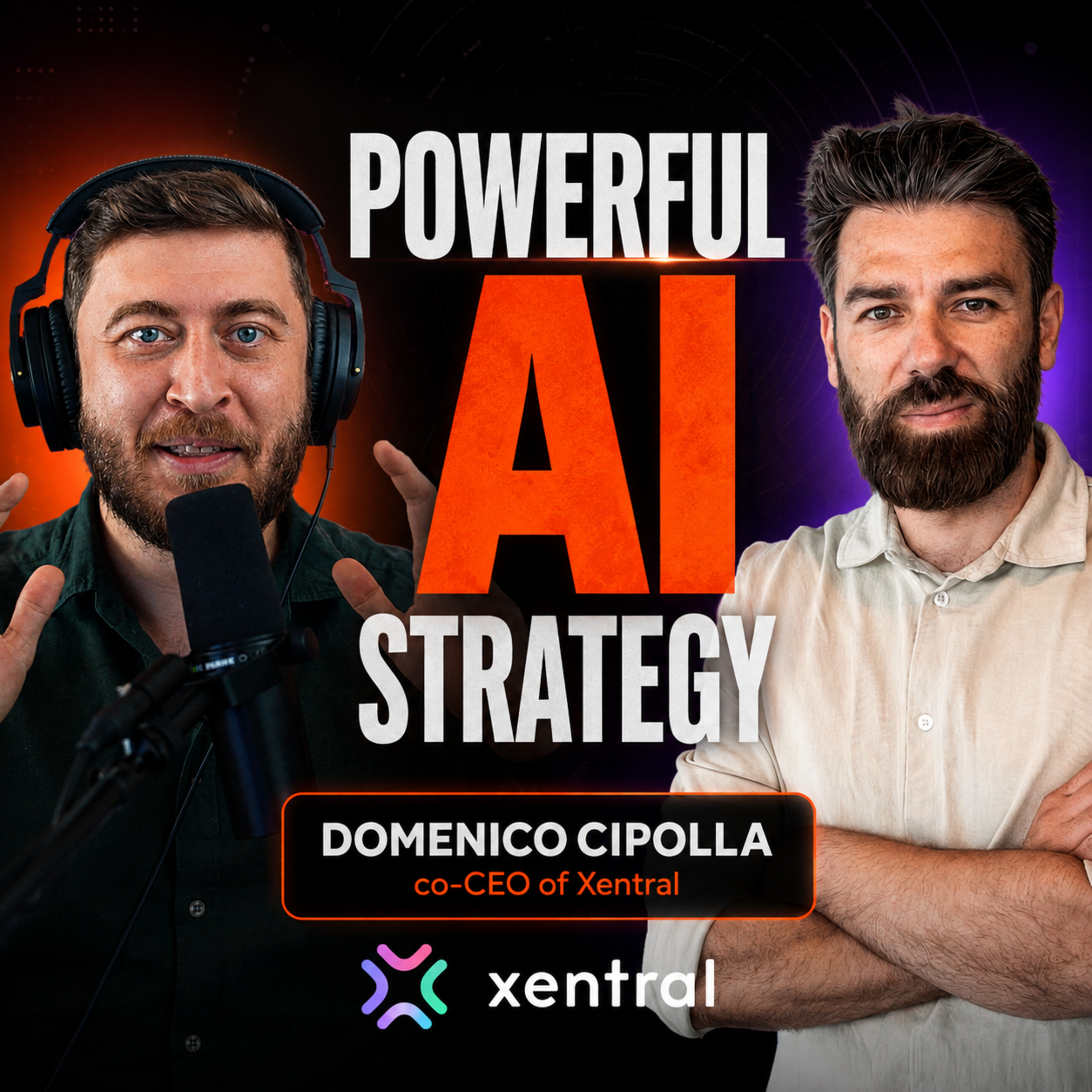
How Xentral’s co-CEO Domenico Cipolla thinks about AI in a cloud ERP—arguing that “grand AI strategies” are less important than practical, deterministic automation, clean data/tech stacks, and fast adoption for resource-constrained retail SMEs.
Domenico Cipolla, co-CEO of Xentral (Germany), cloud ERP powering operations for 1,800+ European companies; backed by Sequoia and Tiger Global. Background includes 15–20 years implementing and operating ERPs, plus joining Xentral ~3 years ago to rebuild/reposition it for the AI era.
ERP is deterministic, so AI must reduce errors and preserve audit trails/system-of-record behavior. AI is a tool for automation, not a value by itself. Outdated stacks limit AI impact; “nonsense in, nonsense out.” Many teams adopt slowly due to change-management and fear, but SMEs want “no-bullshit” delivery quickly.
Payment reconciliation—OCR to structure invoice text from emails/faxes/PDFs, then learning from customer feedback; internal AI built “over a weekend.” Natural-language reporting replacing SQL/report-writing. AI agents being tested by ~50 customers (invoice reconciliation, reordering, customer support, returns) launching April–May.
Written by AI. May contain mistakes.
Domenico discusses Xentral's journey and challenges in integrating AI.
“And it's a much more powerful tool than the one that we paid for.”
Exploration of practical AI strategies and the importance of internal processes.
“And I know with a lot of CEOs joining companies, especially with the last, I think, two to three years, there's a lot of like, what is the AI strategy of the companies going to look like?”
Domenico details the process of using AI for invoice reconciliation and its benefits.
“But at the end of the day, an ERP system is quite deterministic.”
Discussion on the AI adoption rates and challenges faced by SMEs in Europe.
“because we're talking about audit trail, system of record capabilities, and so on and so on.”
Discussing customer reliance on service providers for AI due to limited resources.
“where you have 10, 15 people in there and they're constantly fiddling with new things and experimenting with those things.”
Exploring the challenges of getting customers to adopt new technologies and modules.
“Or is it something that you usually have to message them and be like, hey, this is the new function.”
Examining how AI can integrate into business processes and enhance system interactions.
“order to migrate from an old model to a new technology.”
Explore the common misunderstandings about AI agents and their impact on industries.
“or that system of reference, where a lot of the data flows into, and then the agentic layer is basically sitting on top of that.”
Learn how to assess if your department's data structure is ready for AI integration.
“is that whatever was impossible yesterday, you know, so it seems already sort of outdated today because things are changing so fast.”
Understand how tech stack components influence AI effectiveness.
“I stick with it and just make my peace with it.”
Examine the disparity between AI technological advancements and their adoption in businesses.
“We believe that we're going to be able to develop faster, more efficient, cheaper agents for our customers that understand the business logic much better.”
Discover how internal curiosity drives AI project implementations across various departments.
“We are being quiet when in some meetings, external people are creating more of a panic than we would like them to do.”
Learn how fostering curiosity in teams can lead to innovative automation solutions.
“We have those use cases for our customers.”
Explore the challenges of facilitating innovation without stifling creativity.
“Well, obviously it's good that you have naturally people coming up like, oh, please give us all, I don't know, claw team accounts and we want to do some things.”

Get the gist, explore an idea or ask about something said.
 Claude
On The Founder`s Code, what are the key points of this episode?
Searching your listeningAutomatic transcript. May contain errors.
0:00Everybody is just listening to the same podcasts, reading the same LinkedIn articles. And then if you read this, I think it's a very distorted and small perspective on reality. And the reality that I'm seeing on the ground is very, very different.
0:12Shamil Malachiyev: Today, I'm joined by Domenico Cipolla, co-CEO of Xcentral, a cloud ERP platform out of Germany that powers operations for over 1 ,800 companies across Europe. They're backed by Sequoia, Tiger Global. And right now, they're in the middle of building AI agents directly into their ERP. If you've got nonsense coming into a system, then you've got nonsense coming out of a system, no matter how powerful the system is. A lot of people that have grand AI strategies, and then you ask them, what do you actually do internally? And they don't do nothing. Now we've done our own one because with AI, we almost vibe-coded it over a weekend.
0:47And it's a much more powerful tool than the one that we paid for. Our biggest competitor right now is Excel Sheets and Google Sheets and some old outdated legacy systems. Sometimes I'm asking myself whether they actually know that it's AI. They don't care whether it's AI. People are hugely underestimating the impact that AI is going to have in our industry. Whatever was impossible yesterday, it seems already outdated today because things are changing so fast. We're keeping our heads down. We are filtering out the noise. We are being quiet when in some meetings external people are creating more of a panic than we would like them to do.
1:26Panic hasn't helped anybody ever. So, you know, to understand what those elements are, how you can make use of them, what's useful for you, and then, so, you know, chart your own way forward.
1:36Shamil Malachiyev: Good morning, everyone, and welcome to Beyond the Signature, where we cut through the AI hype and cover what's really happening with automations and AI agents across the industry. Straight from the people in the trenches doing the work. Where's the adoption really at? What tools are being used? What are the real challenges? You know, forget about those shiny LinkedIn posts, because this is AI reality. And today, I'm joined by Domenico Cipolla, co-CEO of Xcentral, a cloud ERP platform out of Germany that powers operations for over 1 ,800 companies across Europe. They're backed by Sequoia, Tiger Global, and right now, they're in the middle of building AI agents directly into their ERP.
2:15Shamil Malachiyev: Domenico, welcome to the Beyond the Signature. Hi, Shamir. Thank you very much for having me. can you tell us a bit about what you currently do at central was the scale at which you operate and what are the real ai challenges that you're facing at the moment sure so i joined central almost to the day on three years ago bena and claudia the two founders are still in the company and they've built central initially for their own purpose and they've built it over years and years bootstrapping it and building it to a considerable size but at some point they said you know what running a company with 200 people is very different than running a company with 20 people.
2:54We need help. And I've been on the other side of the table, on the customer side for 15, 20 years. So I have lots of experience with operating ERPs, installing ERPs, implementing ERPs, and so on. And I think it was a marriage made in heaven. So, you know, they asked me, I joined. And for the last three years, we've really been rebuilding and repositioning Central from the very good beginnings that it had into this new AI era. And I think that we are very well positioned for everything that is yet to come.
3:26Shamil Malachiyev: And I know with a lot of CEOs joining companies, especially with the last, I think, two to three years, there's a lot of like, what is the AI strategy of the companies going to look like? And it was beginning at the stage where we've only just uncovered, you know, discovered this new technology like GPTs. and nobody really had an idea of like where it's going to go what what kind of solutions are going to be built like what's going to be used what's not going to be used how did you approach this whole like the beginning the you know the anxious scared moment it was like okay something's about to change what are we going to do with it yeah maybe maybe we are a particular bunch of people but sort of you know this whole holistic grand ai strategy we we hadn't had no so we we The AI was such a force and momentum with which it arrived.
4:17So it didn't really leave you a lot of time for strategizing and thinking about the future. And everything changed from week to week. So I'm currently on vacation. We're gone for four days. I'm already scared that you're going to ask me something that was posted yesterday. And I'm already out of the loop. So I think we've approached it very differently. So we weren't thinking about the grand strategy. I think we very early understood what AI could mean for us and what AI also isn't. Because at the end of the day, AI in itself, we don't believe that within the context of a business operating and business automation platform isn't a value in itself.
4:54It allows us to make things faster and sort of save a lot of effort and so on. But at the end of the day, an ERP system is quite deterministic. So in other words, it wasn't about a grand strategy. we very early on did two things. We started experimenting with it, both for our own purposes, but also sort of for our customers. And the second thing, and I think that's maybe what comes closest to a strategy, was that we were thinking how to best position and modify our platform to really be able to capitalize upon AI. Because at the end of the day, there's this old saying, which is sort of, I think I'm not sure what I'm allowed to say on your podcast, but if you've got nonsense coming into a system, then you got nonsense coming out of a system no matter how powerful the system is so you know we were really trying to get ourselves and our system ready to be able to fully capitalize
5:47Shamil Malachiyev: upon the power of ai and how did you make the evaluations like okay we have this technology where are we going to put it there is like obvious solutions like customer support but there is also like a legal department there are like recruitment how did you go about picking the departments and directions to implement ai and uh i i think sort of you know i i see a lot of i come across a lot of people uh that have grand ai strategies and then you ask them what do you actually do internally and they do they don't do nothing no so the first thing that we did is really to think about our internal use cases because it's the least painful area for us to experiment with our with ai without sort of you know negatively affecting our customers so the obvious areas were always within a software development but also sort of in our own knowledge management in our own internal processes and so on so we very quickly and very early on were developing solutions internally to automate make less error-prone, repeatable processes that we were able to automate internally and use AI there.
6:56Within that context, I think we very quickly discovered that if you have an outdated tech stack, you can have the best AI. Actually, you're not going to be able to fully leverage and sort of seize that power of AI. So, you know, we were making lots of internal adjustments to our own tech stack. Once we felt comfortable with that, I remember a meeting where we were sort of trying to determine what are the first use cases that we wanted to do for our customers.
7:25Shamil Malachiyev: It's a very easy matrix at the end. So it is how manual, repeatable, repetitive, stupid, sort of no brains involved processes are there. And how many of our customers are using them, how often. And whatever ended up on the top right quadrant in terms of it's really not that intelligent and it's causing a lot of friction or a lot of work for our customers. Think, for instance, one of the easy things is when it comes to payment reconciliation. So you're getting invoices in emails, fax, letter, PDFs. And at the same time, you have your incoming payments in the bank account. And sort of matching those, there isn't a lot of brains.
8:12But at the same time, it takes a lot of effort, it takes a lot of time. And so, you know, we tried to prioritize those processes and then took one by one. The important thing within the context of an ERP is that we're not talking about AGI. We're talking about AI. At the end of the day, we need to be able to do a process a thousand times, let's say, with the power of AI. and the result that that process yields 1 ,000 times needs to be identical all the time. So the moment that you have, let's say, one of the 1 ,000 times, it actually yields a different result, then we are going to be in trouble and our customers are going to be in trouble because we're talking about audit trail, system of record capabilities, and so on and so on.
8:56So at the end of the day, for us, AI is a powerful tool, but it's a continuation of we're talking about automation, machine learning and AI is the next step in that. I'm not downplaying the role because I think there are lots more things that we can do now but sort of at the end of the day it's an evolution from machine learning and sort of getting processes more automated more repeatable, safer, secure and faster.
9:25Shamil Malachiyev: And can you give us a bit more details because on this podcast I want to function about like the real how do people go through the processes? When you saw the opportunities with invoice reconciliation, what kind of tools did you look at using in order to automate that process? And how did you try to make it more deterministic within your teams to make sure that you don't get that one in a thousand where an invoice goes through, even though it shouldn't have? Yeah, I mean, I wouldn't say that we made it more deterministic. I think what we're making, we're making it faster now. So let's start from the artifacts.
10:04So the original process is you have an accountant that checks the bank account and checks the invoices and thousands of those and thousands of entries within the bank account and tries to match them. Typically, you have an invoice number, but people mistype it. Sometimes they forget it. Some people do it on purpose and so on. And so there's a lot of manual work that's a heuristic that tries to match it, But in the end, it's very flawed. And let's say from 100 invoices, you still need to manually touch whatever, 60 or 70 or 50, depending on the quality. So one of the first things that you can do with AI is the OCR.
10:44So the recognition of files, of text, and translate them into structured information that you can match. So that's a big step. And I think that those tools have become much, much, much, much better with AI. So in the past, we've been using a third-party tool. Now we've done our own one because with AI, we almost five-coded it over a weekend. And it's a much more powerful tool than the one that we paid for in the past, number one. Number two, one of the – and that's why I was saying let me qualify what I meant with AI is like an evolution of machine learning. Because one really important thing that you have there is the learning.
11:22So machine learning, basically, you do the same processes over and over and over. But with AI, now we actually take into consideration how customers have reacted to things in the past. So we thought this invoice and this entry, they don't match because whatever the data isn't. But the last seven times that we've suggested for those things not to match, the customer has manually said, no, no, actually, they do match because of A, B, and C. So the system learns and that's sort of what increasingly improves the quality of the output. And the third thing is that we also can do. We have, as you mentioned in your intro, 1 ,800 customers, more than that.
12:02And so we actually do have a lot of learnings across customers as well without sort of jeopardizing data protection and so on. But we can generate learnings that will help all of our customers in these sort of things. So hence, with AI, the structuring of text, the matching to the bank account, the speed at which you can do this, the learning within a customer and the learnings across the customers are opportunities that we didn't have in the past. Or if we had them, they were extremely complicated sort of to seize.
12:32Shamil Malachiyev: And when we look online, we see a lot of kind of information about the adoption among AI, among like Fortune 500 companies, you know, with the largest, which have to be cutting edge. using all of these technologies. When we look at reality, at real markets, especially like European market, how do you see the AI adoption, kind of AI tooling adoption rates within SMEs as compared to what's being advertised out there? Well, I don't know how it is with enterprises. So I suspect that, and there are lots of these statistics in terms of 95, and everybody's sort of exaggerating 95 or 97 or 99 % of projects are failing and don't have an ROI.
13:14So what I can say for our customers, Central is a business automation platform specialized for retail companies. Our ICP starts at two, three, four million euros where our customers typically hit a wall, a growth wall, not because they don't have the opportunity to scale, but because they lack the platform, the single source of truth for taking the next step in terms of workload, resources, complexity, and so on. That's where they come to us. And our ICP probably ends at 100, 150 million. We have loads and loads of customers that do 200, 300 million in revenues, but sort of in our sweet spot is probably between sort of those 20 to 150 million.
13:59And with them, they don't have big IT departments where you have 10, 15 people in there and they're constantly fiddling with new things and experimenting with those things. They are technically or technologically not particularly sophisticated, I would argue. And hence, they really rely on the service providers, such as ourselves, to pass on the benefits of AI. So they are not experimenting themselves. I'm going to qualify this in a second again, but they rely on us. And hence, this combination on the reliance upon us combined with limited resources. So they don't have time or money for like an 18-month AI implementation project.
14:43So they're very no bullshit. So they say, we see everybody's talking about AI. What can you guys deliver to us? Okay, let's not have it on next Monday, but the week after. So they are very, very fast in terms of adopting, but they are also very demanding in terms of speed. So hence, we tried in the features that we've already deployed. We mentioned the OCR part. We have another one that's super obvious. So we had a really powerful analytics platform. But in the past, you need to be quite good at SQL. So in coding, and sometimes they needed to actually commission a partner of ours to write reports for them.
15:23Nowadays, at the end of the day, it's just a language. And if you have a translator from natural language to sort of the coding language, now basically our customers end up doing reports by, I like to see this by then split into these categories over the last two weeks. Please generate it for me. And the system generates a report. And they say, oh, yeah, that's exactly how I want it. But I also would like to have sort of, you know, just the articles above that certain threshold. So there are lots of those smaller, very practical tools that really alleviate the day-to-day operations of our customers.
16:00And so sometimes I'm asking myself whether they actually know that it's AI. because I don't think that it's even that they, maybe they realize, but they realize it after because at the end of the day, they don't care whether it's AI, whether it's 10 ,000 people that are sitting somewhere and are just magically doing the work in the background or whether it's some other sort of technology. So I would argue that the real adoption of AI in our space is predicated on our customers not having a lot of resources. So there's no time for bullshit, waste of money, and so on and so on. I think combined with the pressures that everybody's under.
16:36It seems like we had COVID, then we had the Ukraine war, now we have the Iran war, now we have all of those supply chain issues and so on. We have price bumps everywhere. I don't remember, and I've been in the business for quite some time as well, I don't remember such an extended period of time where our customers, the retail businesses, have been under so much pressure for such an extended period of time. So the combination of limited resources, really tough times, not technically sophisticated, they are relying on us. And we really, I think we're doing a good job at focusing on things that really matter to our customers and not get lost in some major AI transformation projects, which, you know, yield nine months implementation time and no results.
17:22Yeah. And in your own experience, whenever you develop something that's obvious to you, like a really helpful kind of like even with analytical, allowing people to use natural language to bring like all of these different analytics into their dashboard.
17:38Shamil Malachiyev: Do people naturally start using them? Or is it something that you usually have to message them and be like, hey, this is the new function. Please try to use it. Or maybe you can get in touch with somebody from our side to show you how to use it. Because the big question is, we keep pushing all of those new technologies which use natural language and MCPs to connect to all these systems. But are we really seeing that level of like, oh, everybody's just jumping to use that? Or because people before that had their own old ways of building those analytical reports and everything. How easy it is for you to persuade them?
18:16Yeah, it's a very good question. There's a lot of stuff in that question. So forget AI for a second. If we launch a new module, so let's say we have those 2 ,000 customers. And let's say on average, those customers have 20, 30 users or something. So, you know, that gets you, if we take 25, that takes you to 50 ,000 users that are using the system on a regular basis, whether it's daily or monthly or weekly. You can have the most superior new module compared to your old one. Getting people to switch from one module to the next one, it's not done like in a second. Because people are just sort of used to do things a certain way.
18:59So that change management aspect is typically quite complicated. We are lucky because our system is super intuitive. And so because our ICP is used to being fast and adopted. So let me put it this way. In the size bracket that our customers are in, their processes, their routines, their structures are not set in stone for eternity. because they are still evolving themselves. So I think they're used to changing things. This day they're only offline. Next day they open an online shop. One day they say we're never going to be on Amazon. The next day they have a TikTok shop. And so on. So they are used to constant change.
19:40And probably with the point that I made before in terms of the pressure that everybody is under, probably even more so over the last couple of years. So I would argue that it's not easy to get 50 ,000 people onto a new process, a new module, independent of AI. But we've been quite lucky with it because we've really sort of innovated our product over the last couple of years. So now with AI, it's not different because at the end of the day, as I mentioned before, very often they don't even know whether it's AI or not. And they also don't care. And we're not marking things or marketing things as this is the new AI function.
20:15We just call it the new functionality. And it shouldn't matter to anybody how the engine under the hood is basically operating. The one thing that is certainly better with AI now is that you can support the change management process with AI. So let me put it this way. A lot of people see the need for a new ERP system. So our biggest competitor right now is Excel Sheets and Google Sheets and some old outdated legacy systems. Most people really sort of sticking to that system, them dinosaurs because they are afraid of that changing onto a new erp it has this aura of you know that's going to be a one and a half year implementation project going to cost hundreds of thousands of euros and to be honest they are right no so i've done this a few times in my in my in my so then there's this new era of modern systems such as central which uh where you know we onboard customers between two to four weeks if they are super super small and uncomplicated but let's say max two months, three months, four months, depending on the speed of the customer.
21:21So rather fast and rather cheap. So now with AI, a lot of the individual building blocks of switching from one system to the next or implementing an ERP system for the first time, you can actually have the customer being helped by data mapping, data migration, configuration, and so on. So what I'm trying to get to is that change management part, you now can develop tools, conceptualize tools that were not there before that alleviate that change management process and get to adoption faster. The one thing that maybe sort of helps, and sometimes I'm getting a lot of critique for it, if you provide an end of life for the old feature.
22:04So you're kind of forcing customers to their luck. So we have this new analytics module. The first way you do it with everybody who's the first adopters, the ones that want to do it, then there are all of the important ones that are too big, so you are helping them to do it. But the ones that are sort of the absolute laggers, the ones that wouldn't migrate, even if it's at some point you just need to sort of give them a little bit of a push by providing an end of life and an end of support for the old module. And then typically the customers, once they've migrated, they say, you know we should have done this a long time ago but let me put it this way last sentence on this one the less work we need to uh to our customers to do so you know to keep the system up to date and to migrate to new things the better is hence you know with newer modules there isn't even anything being done on the customer side all of those changes are being done in the in the sort of behind under the hood so that customers don't need to get involved or actively do anything in order to migrate from an old model to a new technology.
23:08Shamil Malachiyev: Yeah, sometimes, you know, when looking at the current tooling that a lot of large companies even use, I feel like even in 10, 15 years, we'll still have a lot of companies still using like Excel spreadsheets instead of like all of these new technological advances. Well, I mean, cloud software has been around for whatever, you know, it feels like 100 years and still people are sort of, you know, outdated legacy systems that are working on some what i forgot the name but all of the banking software in germany is run on i don't know if you remember but on some code that some guy developed and it's been long dead and if that ever crashes nobody knows how to safeguard the whole thing so there's a lot of inertia in the in the market for sure yeah and when thinking about ai and the way users will interact there are quite a lot of different kind of ideas floating around.
24:01Some of them say, you know, the UI will stay within your SaaS platform.
24:06Shamil Malachiyev: It's just going to have a lot more AI agentic features. Others say, okay, the future of work, everyone's going to work through Claude, like co-work, and then access all of your features through their interface. What is the future that you're planning for? What are you seeing? Yeah, that's a good question as well. So I'm not sure if we have like a final position on these things. So we are focusing on the things that we can affect. So what we have done, so we, from our perspective, early understood the power of AI. So we made all of our systems, modules, our tech stack accessible to the power of AI.
24:47So, you know, that when we are developing agents that they actually have all of the endpoints. So we have a data layer, a data foundation that is able to basically operate across our entirety of the tech stack. And on top of that, we are now developing our agents. So we currently have about 50 customers that are in addition to those tools that I mentioned before that customers don't even know whether it's AI or not, or at least we're not actively marketing them. So we are now deploying our first agents. We currently have 50 customers testing them, and we're going to be launching them now in April and May.
25:22It's a dunning agent. It's an invoice reconciliation agent. It's a reordering agent. It's the customer support agent, the returns agent, and so on. Product feedback is fantastic. People are sort of, you know, starting to queue in order to be in that next wave. So, and those agents are on top of that data layer that I just mentioned before. It wouldn't be a big thing for us to open that data layer also to external agents. So, you know, if they are, if you, let's say, let's say you had an agent that works across your CRM, your marketing analytics and your ERP, theoretically, you know, if the other two systems would be as open as we are, they could also sort of access across the board.
26:09Our position is that AI, as I mentioned before, is just a means to achieve something. The real power lies in the business logic, in the understanding of the business logic, the business processes, the requirements of our customers. So developing an agent without having that context of the business setting that our customers are operating in, we feel that would yield very, very inferior agents. Hence, our approach is let's build those agents. And we like those agents to also cross to access systems outside of our ERP and be that agentic layer to optimize and operate across systems. But rather than have like a third party do that, if we are being fast, if we are being good, and if we really understand our business processes, then there could be an agentic layer that is working, that we are developing, that is working on behalf of our customers across different systems.
27:09One thing that people need to understand is if I'm thinking about the tech stack of our customers, there are two gravitational points, if you want. So there's the shop, the online shop, where a lot of the marketing analytics, CRM, emailing, payment, and so on goes to. and then there's the ERP in the background where a lot of the CRM, warehouse management, inventory, exactly, accounting and so on. And so it's a very different software than a point solution where you're quite isolated. There's a couple of inputs and a couple of outputs, but the ERP is pretty much at the core of the business operation and hence I think we are destined together with a shop.
27:55So I think there could easily be something around shops as well. to be that data hub, that system of record, as we call it, or that system of reference, where a lot of the data flows into, and then the agentic layer is basically sitting on top of that.
28:10Shamil Malachiyev: And would we also be interested in learning your experience with, you know, when you talk to people about AI, about AI agents, what are the common things that everybody gets wrong? Like, how do we explain to people what AI agents are not? yeah um that's that's an easier one um i'm without giving away too much i'm currently looking at a at a software company together with a private equity fund that is interested in buying that company and um there is a commercial due diligence provider there's a technical due diligence provider, there's the private equity investor. And I'm sort of sitting on those calls as an industry or software advisor.
28:59And the level of the quality of that discussion around sort of, you know, the AI ability of that company is, if I were to say it's scratching the surface, I would be very generous. So everybody is just thinking about sort of, you know, yeah, you know, with AI, they're going to be able to do this and this and this. And nobody is understanding a sort of, you know, just if you pour AI into a really outdated system with outdated data structures, with sort of, you know, every data being super isolated and so on. It's not like, you know, you do that and then magically you have like the super powerful software.
29:39But there's a real difference between the quality of the tech stack and sort of the impact that it has on AI. So that's number one. Number two, I see a lot of companies that have like, you asked me before about our strategy, they have like grand strategy papers and all of these things that they do. And if you ask them, how do you guys use internally AI? And they say, oh, you know, we're mandating everybody internally to use ChatGPT at least once a day or something. And then they think that's going to be the trigger event for AI, for their AI strategy. So I think to answer your question a bit more concisely, I think everybody needs to be extremely aware that AI is just a means.
30:19So it's not a value in itself, number one. Number two, the quality of the tech stack, the accessibility of the tech stack plays an important role. If you have nonsense coming in, the best AI is only going to generate nonsense coming out. Those are two on the skeptical side. The third one that I would say is I heard a lot of skepticism at the beginning, sort of, you know, in my industry in terms of, yeah, this is never going to be able to do this. I think this is also wrong. No, I think people are hugely underestimating the impact that AI is going to have in our industry. So, yeah, I think it's been luring around for the last two, three quarters.
30:57But now I really do feel that it's manifesting itself in real powerful use cases that are generating real value. So I would be very skeptical or very cautious not to underestimate AI. As a matter of fact, we're banking on it. And also, you know, we're betting a lot of our sort of product development roadmap on AI. And the fourth thing maybe, so, you know, then I mentioned two negatives and two positives, is that whatever was impossible yesterday, you know, so it seems already sort of outdated today because things are changing so fast. I joked before that I have been on vacation for a couple of days and I haven't followed all of those posts.
31:34And on LinkedIn, everybody seems to have reinvented the wheel every day. So I wouldn't be shocked if yesterday a new model was launched or a new functionality was launched and suddenly this is now possible and so on. So I think keeping a very close eye to the developments, filtering out what's nonsense and what's actually actionable and valuable to yourself, and then implementing this and incorporating this into your own product roadmap, I think that's going to be key. Because to answer slightly differently, there's a lot of panic around this one. There's a lot of euphoria when you speak to people that are one or two degrees removed from this.
32:12So investors, potential investors, shareholders, consultants, advisors, and so on. So everybody's just listening to the same podcasts, reading the same LinkedIn articles. And then if you read this, I think it's a very distorted and small perspective on reality. And the reality that I'm seeing on the ground is very, very different.
32:31Shamil Malachiyev: well this is exactly the reason for this podcast that's exactly what we try to do and i have two questions uh in regards to that first for anybody recent listening who you know they're in their departments in their companies they're trying to understand like they have senior management shareholders you know who are like okay we need to integrate ai agents into departments, you've mentioned understanding like that your data structure is ready, that the tech sector, how can these people evaluate where the data structure within their department is ready for an AI to be involved in? I think the most practical advice I would give is just try to sort of think of a use case, of an internal use case that you find shouldn't be too big, but it sort of, you some real practical implications and then just try to get it done if you get it done no so it means that the data layer so you know you have the right endpoints you have the right access rights you have to i let me give you an example no so i'm not a technical person at all uh um but i but i'm i'm curious no so i like to experiment myself so when open clock got out i uh i tried to get it running so and no chance no so they've asked you do you want to do this on your machine or a virtual server and it's like an endless series of questions that every time i needed to use chat gp what do they mean what are the advantages so then claude co-work came came out and okay so you know this is the this is the open claw for dummy so you know i i need to be able to do this so i got much further but then I, so I live in Germany.
34:17I have like an old university account, which is my private email account. And one of the things I want to do, I just wanted to connect my email and say, you know, by the way, and then trigger sort of, you know, automation based on that.
34:28Shamil Malachiyev: And the practical reality was, because it was my university account, I asked the admin of the university, hey, you know, by the way, you know, Claude Cowork would like to access this. Could you please sort of, you know, give authorization and so on. And the practical reality was, yeah, that's a very good idea. thank you very much for your request but the answer is no so and that and the and the analogy of this is so you know if try off a use case try to do something internally within your tech stack and see where where you hit a wall no and when you hit that wall remove those walls and once you've done this two three times then you can try to abstract from that and say you know it's not that we're going experiment by experiment every time we hit a wall but sort of you know to understand what are those walls that you can run into and then try to sort of you know have a macro perspective on what are those words in our in our case look we had a couple of years ago we still had a pretty monolithic uh redundant spaghetti code uh text like no sort of and to separate this out into into um i don't want to into a microservices structure with very clear with a very clear business objects very clear business logic with like an application framework with the right api endpoints with and so on that that took you know that's not done over a couple of weeks but that's uh that's a complicated and protracted it transformation but we've done that and that's a prerequisite for uh so you know that new era in which ai is going to play a much bigger role it's funny it's it's familiar it's funny then no it's funny that because of this email account exam so and the tools for how do you call it the components of your tech stack let's say your email address in that the the compatibility with ai at the end is also going to play a major role you know it's going to determine quite a lot sort of you know who's going to survive this and who who doesn't know because my answer to that is now okay so i need to switch my email accounts now so I don't think that my IT admin at that university is going to change his mind anytime soon over the next 25 years, probably until he's retiring.
36:41So I have two options. So three options. I stick with it and just make my peace with it. I change my email address, my email account to somewhere where, so, you know, we are more AI friendly. I could theoretically also forward everything, you know, from that email account to another email account. but then the reply comes from a different account so it's not ideal but it's interesting how how i saw that when we jumped on this call i think you're using fireflies now as a as a trans transcription so i've been using something else in the past but then i wanted to connect that trans transcription software with my cloud co-work and it didn't work and hence i actually changed to fireflies as well because there's a native integration between.
37:28So it's very interesting how that ecosystem of modern components is evolving and is emerging and the ones that are staying behind are sooner or later going to fail. Your question before on the question whether we are thinking about our own agents or third-party agents, and I said, not sure whether we have a final option or a final decision on that, But if everybody is going into, you know, you have all of this, we're not going to stand in the way of the wish of our customers. We believe that we're going to be able to develop faster, more efficient, cheaper agents for our customers that understand the business logic much better.
38:09But at the end of the day, you know, we are servants of our customers and we will do whatever we need to do in order for them to strive and be more successful with us as their ERP provider.
38:24Shamil Malachiyev: and by the way a small thing if like with cloud co-work if you need access to your university emails something that i use when there is no existing capability to connect the systems i just do like open it in chrome and then log in with my credentials enjoy it like opens the emails it can scroll through them can give you all the information but it takes a long time I agree with it. So I said I'm not a technical person, but I'm a little bit of a design person. That's not the user experience that you want, that you need to open. Of course, you can use your Chrome extension, but suddenly if we invented AI and now we need to take all of these extra detours in order to make it work, that's not the idea.
39:17Shamil Malachiyev: And the other question I wanted to ask, You know, when we talk about hype, we look at the advancements currently. And every week we have like some new thing that's coming out, you know, models are getting better, hardware is getting more efficient. And then when you look at the real like adoption, like where the people are at using that, like the technology is advancing geometrically. But when you look at people using that, that kind of goes like very slowly, like almost at the start of the adoption curve that we normally see. and when we look at company valuations and you know all the linkedin posts we almost say like oh technology is there and people are like adoptions almost there too um and based on that logic do you believe that we live in an ai bubble well bubble uh is you know always you always need to define it so i saw i saw i said i'm on vacation but i actually did uh see a super interesting comparison, I think it was yesterday or the day before, which compared the internet bubble with now the so-called AI bubble.
40:25And I think they were talking about optical fiber and so the overproduction and then sort of took years for it to catch up and so on. While nowadays, when you talk about all of those data centers, all of these data centers are being built out, actually their usage is very, very high. So the data is being used very high. So I don't know about AI bubble clearly it feels insane that companies are adding a trillion euro of ARR per day and they are valued at whatever is more than a trillion and then two weeks later everybody's saying you know AI open open AI is the worst company in the history of mankind because it's all a hybrid so I think there's a lot of volatility in there and sort of, you know, when that hype that was there initially and now it's coming down again, I'm sure it's going to be there.
41:18Look, to answer your question, I don't get involved in there. We are running a really healthy business that is looking at the fundamentals of what AI can bring to us and to our customers. We're keeping our heads down. We are filtering out the noise. We are being quiet when in some meetings, external people are creating more of a panic than we would like them to do. And I think this very much unifies us at Central because I do feel that it's a very similar sentiment across the company. What I do like most about it is, so I mentioned before, so, you know, we're using our internal use cases. We have those use cases for our customers.
42:02I was joking about the company that is mandating chat GPT, so people need to log on once a day and so on. What I like most is we have a lot of curiosity in our teams. So you have people in the people department that are, we have once, twice a year, we have a talent review process and where everybody is being assessed and you're getting feedback and what's your development plan and so on and so on. And somebody in the people department just used Cloud Coworks to automate that process and to collect all of those inputs. And rather than doing a lot of that work manually, she now developed something that would help her, let's say, one day a week or so in that process.
42:48We have somebody else in the finance department that did something similar with the monthly clothing. We have people in the customer success departments that are, you know, whenever they have customer meetings, they're preparing a dossier about the customer and with all of the information. So what I do mean is there's a lot of curiosity and ability to experiment across the teams, which is not mandated top down, but where we have really talented people that, sorry, you know, in their departments, they think about, you know, what am I doing? How can I automate this? Can I use this? I'm sure a lot of those efforts fail.
43:23So that's just the nature of experimenting. But that curiosity that people start this on their own, in their own time sometimes as well, I think that's really remarkable. And I think a lot of good is going to come from that for those people, for us as Accentral, and in turn always for our customers.
43:42Shamil Malachiyev: How do you try to facilitate that? Well, obviously it's good that you have naturally people coming up like, oh, please give us all, I don't know, claw team accounts and we want to do some things. But for example, half a year goes by and you don't see anyone doing anything in terms of innovative, interesting projects. How do you actually try to be like, hey guys, let's do an internal hackathon or I don't know, a mandate, log into ChagipT twice a day? That's a really good question. So you ask, how do you facilitate this? So I have two hearts in my chest on this one. because facilitating could also very quickly turn into sort of impeding.
44:19So there are these green shoots everywhere and they are coming. So now the question, so the consequence of that is going to be they're not going to be synchronized with each other at all. So somebody is going to use code co-work, somebody is going to use open clause. But sort of in itself, everyone is going to do something and a lot of good is going to come out. but it's super heterogeneous. It's not going to work. So now your question is, should we step in and say, hey, from now on, you need to use Cloud Cowork and only that one is paid for. The other ones are not being paid for. And this is our application framework.
45:01And before you release anything, sort of, you know, needs to go to be QA'd by Peter. And by the way, you know, we shouldn't have infrastructure costs that run. so and yeah I think you have you want to make sure I'm not even sure if you make sure but you have a higher chance that things are going to be speaking to each other that you have those are better maintainable security is better and so on but on the other side sort of that recommendation you mentioned facilitation but that sort of you know that recommendation that rule based and so on so the question I think is when is the right time to do this and right now I'm rather erring on just let them so you know have fun when we are all a bit more experienced when we're all a bit more not professional but experienced is the right word about these things then it's maybe a good time to bring these efforts together but right now I would probably err on the side of experimentation and let them have fun for now
46:00Shamil Malachiyev: Perfect, thank you and I want to thank you for joining the podcast for sharing all of this information I think this has been incredibly informative and your kind of view into like how to adopt, how to facilitate. I personally got a lot of notes that I'm going to be going back to my teams and be like, hey guys, today I judge up here three times a day. Yeah, I want to thank you for being such a fantastic guest and sharing the reality of what AI adoption and thinking looks like. Thanks, Dominique. Very much enjoyed this. Thank you very much for having me. I think as you put it during the conversation, this topic is right on point.
46:41So it's trying to take a step back and looking sort of through the noise of everything that is being posted everywhere and everybody's speaking about it. So I think AI is extremely powerful, but panic hasn't helped anybody ever. So, you know, to understand what those elements are, how you can make use of them, what's useful for you and so on. And then, so, you know, chart your own way forward. I think that's really the recipe for being successful in this AI era. And that's what we're trying to do. So thanks again, Jamil, for having me.
47:15Shamil Malachiyev: Thanks, man. Appreciate it.
"If you've got nonsense coming into a system, you've got nonsense coming out of it, no matter how powerful the system is." Domenico Cipolla runs an ERP that powers 1,800+ companies, and he's putting AI agents inside it - so he has a very grounded view of what enterprise AI actually does.
On The AI Floor, Shamil Malachiyev sits down with Domenico Cipolla, co-CEO of Xentral, the German cloud ERP backed by Sequoia and Tiger Global, for a hype-free look at where AI adoption really is - straight from someone building it into the software that runs other companies' operations.
Before Xentral, Domenico spent 15 to 20 years on the customer side operating and implementing ERPs. In this conversation he explains why AI is "just a means, not a value in itself," why most companies with a grand AI strategy are doing nothing internally, and how his team rebuilt a paid vendor tool over a single weekend once AI entered the picture.
Expect to learn:
- Why "garbage in, garbage out" is the real ceiling on enterprise AI, not the model
- Why everyone has an AI strategy but almost nobody is actually doing anything with it
- How they replaced a paid invoice-reconciliation tool by "vibe coding" a better one in a weekend
- Why an ERP has to stay deterministic - the same process, run 1,000 times, must give the same result
- The simple matrix for deciding where to apply AI first (how manual a task is vs how many customers touch it)
- Why their biggest competitor isn't another vendor - it's Excel and dead legacy code
- The AI agents they're building into the ERP: dunning, invoice reconciliation, reordering, support and returns
- Whether the AI bubble is real - and how a Sequoia-backed CEO stays calm through the noise
If you're leading AI adoption, running operations or finance, or building software into the AI era, this is the from-the-trenches version.
CHAPTERS
0:00 Intro: cutting through the AI hype
0:54 Domenico's path: 20 years on the ERP customer side
2:24 No grand strategy - and why "AI is just a means"
4:31 "Everyone has an AI strategy. They do nothing." Where to actually start
6:35 Why an ERP has to stay deterministic
7:48 The flagship use case: invoice reconciliation, rebuilt in a weekend
10:56 What SMEs actually want from AI ("no bullshit, what can you deliver?")
13:03 Natural-language reporting: no more SQL
15:45 The hardest part is adoption, not the tech
21:31 The real competitor: Excel and dead legacy code
22:45 Own agents vs third-party agents - and the data layer underneath
26:34 What people get wrong about AI (four things)
30:55 How to evaluate if you're AI-ready: pick one use case and hit the walls
37:38 Is the AI bubble real?
40:00 Bottom-up curiosity: letting teams automate their own work
42:06 Standardize the tools, or let people play?
44:24 The takeaway: filter the noise, don't panic, chart your own way
👇 CONNECT WITH DOMENICO CIPOLLA
Domenico Cipolla ► https://www.linkedin.com/in/domenicocipolla/
Xentral ERP Software ► https://xentral.com
👇 CONNECT WITH SHAMIL
Shamil Malachiyev ►https://www.linkedin.com/in/shamilmalachiyev/
FluidLabs ► https://fluidlabs.com/
🎙 LISTEN to The AI Floor (The Founder's Code, Season 2)
Spotify ► https://open.spotify.com/show/7v6YOQ77R1xzbOiiHsDawd
Apple ► https://podcasts.apple.com/sa/podcast/the-founder-s-code/id1797768317
🔔 SUBSCRIBE for more unfiltered, ground-level conversations with the people building AI inside the world's biggest companies.
ABOUT THIS CHANNEL
The AI Floor (The Founder's Code, Season 2) - honest, ground-level conversations with the people actually building AI inside the world's biggest companies. No hype, just what's real.
#Procurement #EnterpriseAI #AIAgents #AI #TheAIFloor #SorenPetsch #RootInsurance #ProcurementAutomation #AIAdoption #Podcast