Ask ChatGPT
 The Growth Podcast
26 Oct 2026 · 55m · 22 chapters
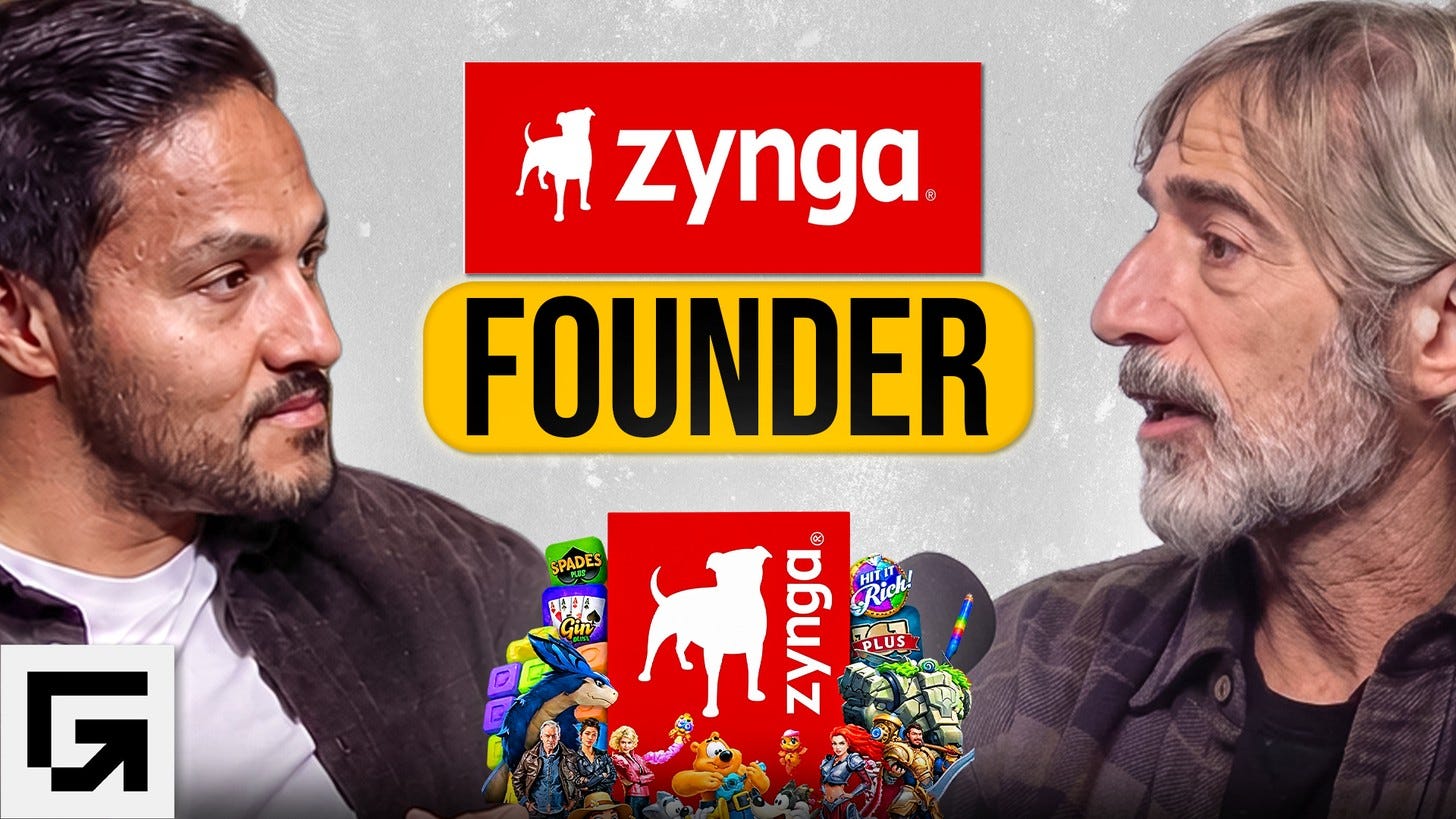
Mark Pincus argues that “copying” can be moral arbitrage and a product strategy, then lays out his Proven Better New framework (Proven = pixel-level proven experience to legally copy; Better = 10/10 improvements users say yes to; New = the novel hypothesis). He applies it to Zynga Poker and to competing with AI assistants (Instinct, Muse), and discusses testing many top-of-funnel ideas quickly instead of waiting for a full MVP.
Mark Pincus is founder of Zynga; his games reached billions of players. He later wrote Life at the Speed of Play and teaches product-building frameworks.
Most product teams should start from proven patterns, make micro “better” changes, and treat “all new fails” as the default. Early platform shifts require less new; later cycles require more. Don’t skip top-of-funnel validation even with fast AI prototyping.
Zynga Poker (copied leading poker UX; “no download” as Better; “real people via Facebook/MySpace graph” as New). Supercell’s Heyday as “proven with almost no new” for mobile. Retro (Instagram-inspired) failing due to poor onboarding. Think Weekend in Aspen (Zuck, Peter Thiel, Sean Parker).
Written by AI. May contain mistakes.
Explore the moral implications of copying in product development.
“That's going to make a lot of people angry.”
Dive into Mark's thoughts on successful product building and frameworks.
“If you've been working in tech for any period of time, you know Mark Pincus.”
Learn about the Proven Better New framework and its importance.
“Yeah, I love hearing that you use Proven Better New.”
Discuss how AI tools can enhance product design and development.
“like the claw bot craze of, you know, earlier in the year of nine months ago.”
Explore potential future applications of AI in product development.
“You can use Mobbin MCP for product audit, PRDs with real examples, or giving your AI agents examples grounded in real software.”
Learn how to effectively copy proven ideas while adding unique elements to create a successful product.
“And if I don't copy everything Instinct did or Muse did, and I'm like, I don't know, I'm going to put mine in WhatsApp, not an iMessage, or, you know, I'm going to make mine an app.”
Understand the distinctions between proven concepts, improvements, and new ideas in product creation.
“So let's say, what was proven, and what was better, and what was new?”
Discover how Zynga Poker applied proven strategies and avoided pitfalls in product design.
“from any other leading poker game by design.”
Explore how to identify and evaluate new ideas while balancing proven concepts in product development.
“And of course my new worked and my mantra, they still say inside of Zynga today is all new fails.”
Discuss the difficulties of innovation and the importance of context in product development.
“So if I was doing proven, better, new on them, but with Instinct, you know, what's proven is at this point, I would say SMS as a channel and delivery.”
Learn about the importance of context and timing in product development during platform shifts.
“Like, no, you're not taking what is proven about, first of all, the onboarding experience of a new social app today, new mobile social app.”
Explore how the necessity for innovation varies depending on the stage of a platform cycle.
“There's a thing you've always been doing now with AI inside.”
Discover the lessons learned from successful product adaptations and their market contexts.
“If you were trying to compete with Hay Day today, you couldn't say, oh, it's Hay Day available on mobile.”
Understand how focusing on achievable improvements can lead to business success during innovation phases.
“What they're clearly better at is they have every single crypto and meme coin where the other ones have 10.”
Learn about the strategic advantages of copying successful game features and the balance of innovation.
“we copied most of what was in Farmtown, legally.”
Explore the challenges of creating MVPs quickly and the importance of thorough initial testing.
“and that would have made our product less viral.”
Discuss how AI can enhance product testing processes and improve user engagement.
“that once we say viable, we're full of hope.”
Learn about innovative growth hacking strategies for apps.
“to come back with any winning variant in an absolute and relative there was just a great X posts from the founder of Pocket FM.”
Explore the shifting perceptions of AI and investment opportunities.
“And I'm not saying it's a good idea to who knows if you can go compete with them or whatever.”
Understand how to apply proven better new concepts to food products.
“I don't have a new AI weather app or AI camera or AI calendar, any of that.”
Discover the unique format and outcomes of the Think Weekend gathering.
“I have you here in person, So I have to ask you about kind of a story that you've pointed at a couple times in a couple different conversations that you've had with people, which is this Think Weekend that you had.”
Reflect on the conversation and explore ways to host impactful discussions.
“Should people be thinking about bringing their network together?”

Get the gist, explore an idea or ask about something said.
 Claude
On The Growth Podcast, what are the key points of this episode?
Searching your listeningAutomatic transcript. May contain errors.
0:00You said copying is okay. It's a form of moral arbitrage. That's going to make a lot of people angry. So walk us through this. Why is this even a defensible position? I think the actual question is like, why are we even debating it? Because that's all that we're all doing all the time. I copied the leading poker games, the table, the UX, like the sounds the chip made, the colors of the chips. Like you could not tell my table from any other leading poker game by design. There was no differentiation. Mark Zuckerberg, Peter Thiel, these are like names that are legends. Sean Parker was there. I've never really heard like the full story.
0:36What happened there? What did you guys do? Nobody was legends though. Zuck and Sean. It was 2006, so the Facebook was like two years old. Zuck was staying up all night drinking Diet Cokes and eating M &Ms and working. Peter did a brilliant presentation for all of us on housing bubble, which he was two years too early on. None of us had an agenda. No one was trying to network. No one was trying to like sell anything to anyone, get anything. And that's what made it great. It was just 35 people came together by choice to like all be in these conversations. That's what I call the Think Weekend. Talking about consumer, you said it isn't investable right now, but that's the reason to build it.
1:11Can you break that down?
1:26all of my favorite AI tools, I've gotten them to give you an entire year of their paid plans. Check out bundle.akashg.com for an entire year of Bolt.new, Airtable, Speechify, Descript, Magic Patterns, Linear, Dovetail, Arise, and Mobbin. And now, into today's show.
1:49If you've been working in tech for any period of time, you know Mark Pincus. He is the founder of Zynga. Billions of people, literally, have played his games. And like me, if you've been around San Francisco, it has been one of the institutions in San Francisco. Walking by the Zynga building every day for years myself, I've always looked up to Mark. He is a legend in the product space. He recently just published Life at the Speed of Play. Literally, the subtext for this book is, launch products people love. There couldn't be a better billionaire to have on this product podcast than Mark. He is somebody who has thought very deeply about how it is that you build really successful products.
2:40And he has a bunch of hot takes that we're gonna cover today. We're even gonna go to the whiteboard so you can learn his Proven Better New framework, which is a framework I personally use. when I'm thinking about building products, and so I'm at the edge of my seat to get a personal masterclass. I hope you enjoy this episode as much as I do. Marc, thanks for being here. Yeah, I love hearing that you use Proven Better New. Yes. There's, you know, frameworks get a bad rap, I think. There's some frameworks that what a good framework like Proven Better New does is it helps you actually in your work.
3:14It's not just something you put on a document to send to an executive. It's something that actually tactically shows you how to work better. So we'll cover that in just a second. I want to start with one of your most, I would say, controversial ideas. Yeah. Which is, you've said copying is okay. It's a form of moral arbitrage. That's gonna make a lot of people angry. So walk us through this. Why is this even a defensible position? I think the actual question is, like, why are we even debating it? because that's all that we're all doing all the time. There's a certain taste and sensibility where people...
3:53There's some line you cross where it's not inspired by and it's copying. And we feel that as consumers, when we're like, wait, this movie is a copy of this, or we don't like plagiarizing because that's cheating, right? So there's some paradoxes that have been deeply instilled in us, Yet at the same time, we kind of know all music, all movies, all stories, all games. You know, everything is a derivative work and everything artists have built on shoulders of other artists, right? And there's a whole philosophy we could get into on like, well, at what point is it copying or is it crossing a legal line of copying, right?
4:38of an illegal taking someone else's work illegally, but then there's a kind of moral line and a taste line. And where it really comes down to taste is, it's really about who does the magic trick better. And so Steve Jobs, he was a master of copying, and he had a deep appreciation for it. And there's some quote that I think was from Picasso but people credit Steve Jobs, right? Great artists copy and the masters steal, or something like that. Yeah. Bill Gates was not as good at the magic trick as Steve Jobs, and so it looked like Bill Gates was just copying Apple. Steve Jobs was, they were both copying from Xerox PARC's work, then they were copying each other.
5:27Mark Zuckerberg is arguably not that good at copying, because when you see threads in a lot of his products, they look like blatant copies, or, you know. But, so to me, the magic trick is just, can you learn from other people's proven success and emulate it, you know, perfectly, but have it feel new to people? And that's why I call it a magic trick. And I think it's intimately tied to the proven, better, new framework. So, I would say maybe only 10 % of my audience really understands the framework. So can you give us kind of the 101, we have the whiteboard here, Maybe you can even draw it out for us.
6:06And first of all, when we get into Proven Better New, there's a couple points. One is the underlying philosophy, the few underlying philosophies. And one is that my mantra as an entrepreneur for the last 30 years has, to myself, has been trust your instinct. Your instinct's more right than you know. So I like to say your instinct's right 95 % of the time. And assume your idea is probably wrong. either very wrong or a little wrong. And so if your instinct's right 95 % of the time, and if your idea is right 25 % of the time, what do you do with that? And what I mean is we have this instinct, and right now we're feeling an instinct around the product instinct or muse, right?
6:51That we've all talked about AI assistance for the last two years, and we've all assumed everyone in the world was doing it, and yet none came out. and now all of a sudden two have come out. And they feel to me at an instinct level, like the claw bot craze of, you know, earlier in the year of nine months ago. I've been using AI tools to build product lately. Clawd code, cursor, lovable, v0. The speed is crazy. Describe a flow and a few seconds later, you have working UI. But often it still doesn't feel like something a product team would ship. You see the same cards, the same rounded angles, that purple gradient, very much giving off the feel that I asked an LLM to build me this.
7:36The reason is obvious. The AI can write code, but without strong references, it has no clean way to understand what the best shipped products actually do. That's where the Mobbin MCP comes in. Bobbin has a massive hand-curated library of real product screens. 621 ,500 plus screens. 142 ,200 plus flows. All from shipped apps across SaaS, FinTech, consumer health, commerce, and productivity. Their MCP server lets your AI tools reference that library directly. Let me show you exactly what I mean. So let's say I'm improving the page for my PM operating system, a product I sell to PMs who want to get up to date on Cloud Code fast.
8:18Normally I'd ask Cloud Code, build me a good page that explains this product to someone and gets them to buy. This is what it build. And this is where the output gets generic. It's not terrible, but it has that built with a generic LLM feel. Now instead I'm going to ask it, use Mobbin to find how shipped SaaS, productivity, and education products structure paid product pages and onboarding flows. Look for patterns around the hero, proof, pricing, and checkout. Do not copy any one app. Summarize the patterns and help me redesign this PMOS page. Now you can see the agent is going out and referencing real product screens.
8:55You can see it's establishing how different products handle the moment. Concrete promise, proof before features, pricing that feels like the next step. One pattern makes the value prop concrete fast, another puts proof before a feature list, another makes pricing feel like the next natural step. So now as it's redesigning the page, it's using references to identify patterns and not copying anyone out. So let's see how Cloud Code did. The first version says basically, here is a PMOS. The new version says what changes for the PMs after they buy it. The proof is higher. The pricing block actually fits.
9:33This is closer to how good product teams work. Study shipped apps, understand the pattern, then make something original. And it's not just for generation. You can use Mobbin MCP for product audit, PRDs with real examples, or giving your AI agents examples grounded in real software. The point is not to clone anyone's work. It's to study the patterns behind good decisions. Good product builders study good products. Mobbin MCP gives your AI agent better references to work from. Mobbin MCP is on beta for all paid Mobbin plans. Setup took me under a minute, and it works with Cloud Code, Cursor, Lovable, and any other Vibe Coding tool.
10:09If you're building product with AI, check out Mob and MCP. You get a full year of the paid plan used from my bundle, which is just a one-year newsletter subscription, or you can check out the description URL. It feels like that was the beginning. The gun went off for agents and everyone said, it's going to be all, you know, you need to go and buy your own MacBook studio and set this up and give it access to your WhatsApp and all these things that a lot of us tried and scratched our and some people were living their lives off this. But it was an early shot across the bow that I think formed some instinct or informed us about how this agentic future might work at a consumer level, but then it kind of faded a little bit.
10:53And now Instinct, we can get into it, but Instinct AI came out and Muse, and they feel more consumer ready, right? Because you don't have to do all those things. It's dumbed it down, it's accessible. it's kind of doing the same thing, which is what is the big thing at an instinct level that they're doing? Well, they're moving from just being better than Google. Okay, I can get an answer faster on GPT than I could on Google. And if you think of this progression without, I'll get back to Proof Better New, but, you know, in search, in the beginning, it was Lycos and Ask Jeeves and all these kind of crappy search engines where you have to click into the second page results of links to find what you're looking for.
11:41It took a lot of time for links to load. And when Google came out and in the first three links, they got to what you wanted. And it was in nanoseconds. That felt magical. GPT comes out and feels like a magical leap because like, you don't have to click on a link. They're actually going to just read for you and give you the answer. And that felt magical. Okay. But then you get to this agentic thing, right? Which is now it's able to take actions for you. And that feels magical. Again, it's not just giving me an answer. It's booking me the table or buying me the thing on Amazon or whatever. And so that feels magical again.
12:23And instinct level, you're kind of like, yeah, I think I'm going to do that in the future. Will it be this product? I don't know. The idea that Instinct AI is doing this through your text, and it might be wrong. I think there's some trust questions like, do you really want to give this random chat AI company run by a 23-year-old somewhere access to your life and credit cards? How do I know it's not going to get hacked? And then you're like, well, Muse, maybe I trust Meta more because they have more to lose. But is Muse right? I don't know. So both of them, I think, at an instinct level, they're clearly onto something.
13:05And I think we all can tell and feel that. At an idea level, it's like, I don't know. The use cases, I'm still searching for the use cases in my head. And so we can get into that. But anyway, this is underpinnings of Proven Better new so where does proven better new come in it comes in that i was going to talk about this later in your pod but we'll go right to it so if we want to go after that space which a lot of people are probably thinking about well can i go and create a competitor to muse or instinct we can use proven better knew to say, okay, what have these products proven so far? And can I get to the pixel level of that experience?
13:50And so what have they proven? Where's my idea? So if I'm like, okay, I want to make instinct that is more narrow. It's just a family assistant. Okay. Am I going to very carefully copy every single thing instinct has done from their onboarding to how they work in text and then just isolate my new idea which is okay mine is going to be multiplayer so mine can have your whole family on this chat and mine is more trustworthy maybe mine is more narrowly use case focused, but I don't want to fail for the wrong reasons. And if I don't copy everything Instinct did or Muse did, and I'm like, I don't know, I'm going to put mine in WhatsApp, not an iMessage, or, you know, I'm going to make mine an app.
14:44I'm going to be just like Instinct, but I'm an app. I'm probably going to fail for the wrong reasons. I'm never going to get to my hypothesis. And one more recent example throughout you is like this product Retro. I don't know if you saw this, but it's from some of the early team from Instagram, and they called it retro, and they said, okay, we're going to make something that's more purely like the early Instagram. And Instagram's no longer just the beauty of social networking, and we'll be just that. Great. That might be a good shot on goal, right? I didn't make it past their onboard. It was so many clicks and so many questions that it was dead on arrival.
15:24Now, I don't know that, But to me, at my taste level, I'm like, who are they copying? My brain goes to like, where's the proven in this? And they might be applying proven, better, new the wrong way, which a lot of people do. And that's why let's get into like a very clear definition of it. But they might say, well, proven is Instagram. Dang, you lose. Okay, that's too broad. You can't say proven is the overall concept. So maybe it's worth stepping back for a minute to go through, like Zynga Poker, like why is that a perfect Proven Better New? I can put it on the whiteboard. That's a really good canonical example.
16:02It's a little simpler to understand if people don't know. So let's get into the concept. So if we go to Proven, and in my book, someone pointed out that if you get the audio of my book or if you get, I guess, the Kindle version, you don't get all of my whiteboard pictures and stuff, which I did myself by hand. So let's say, what was proven, and what was better, and what was new? Okay, and I want to make sure I define proven, better, or new here before I jump in. So proven is down to the pixel level of the experience, click to click, anything you need to pick, what experience that's close to yours, either your exact one or close to it, is was proven for this audience on this platform.
16:55And then anything that's proven, you are gonna legally copy. And the better product maker you are, the better you are at copying. The worst product maker, the worst, the more you change things. So Steve Jobs was amazing at it. Better is what 10 out of 10 of the existing users would say, fuck yes, I want that. Not what you think is better. This is where people do this wrong. What you think is better is called new. What they all think is better is better. So better is more micro-level innovations. It's more polished. It might be no download. It might be free. It might be less clicks. Better onboarding experiences.
17:40Something that people care about who use this, but it's every one of them says better. Okay, so it's very clear about it. New is your new novel idea, your innovation zone. New is what you're most excited about, great. But what we want to do is isolate that new zone so that you don't fail for the wrong reasons. Because if you have a shitty onboarding experience, another story is, you know, Sid Meyers did, came out with a social civilization on Facebook. And EA came out with a social SimCity. And in both cases, we were terrified at Zynga. We thought we were dead. And within five minutes of the launch of their products, Zynga PMs sent their deconstruct around the company and said, and already predicted dead on arrival.
18:29Because their onboarding experience was so bad. Because brilliant game designers want you to go through long tutorials to see all their brilliance. Yeah. Okay, on the case of Facebook games and most casual games, you've got to be at the good stuff in three clicks, not, you know, three minutes. So that proven, you've got to get right. And your new is great. I'm sure that there was amazing new from Sid Meier's or from Social Sim City, but no one ever sees it if they don't get past, you know, the onboard and the proven stuff. In the case of Zynga Poker, and I would say, I was so humbled after my failure with Tribe.net, after being one of the first 10 social networks.
19:15That was one of the first three social networks. There were 10 launched, eight succeeded on some level, two completely failed, and Tribe was one of the two failures. So after that, I was so humbled that I set my sights very narrow to start with, with Zynga Poker. So what was proven? Poker. I copied the leading poker games. I mean, like, the table, the UX, like the sounds the chip made, the colors of the chips, like you could not tell my table from any other leading poker game by design. Okay, there was no differentiation. Okay, what was better? Really clear, no download.
20:01So because why? We weren't playing for real money. We didn't care about security. All the other ones had a download because they cared about security. You probably know this, Akash. You lose 80 % of your users at least when you say download. There's a 90 % drop-off in the App Store. And that also is better for a casual audience that doesn't care that much about poker. What was new? It was real people with real identities through the Facebook graph and the MySpace graph. And sometimes you would join your friends at the table. It turned out to be 25 % of the time. One quick question on no download, though.
20:41Does that not fulfill the 10 out of 10 criteria? Because one or two out of 10 might want the payment and the security of it. Nobody wants a download. Even if you want to play for real money, if you were offered, do you want to click and download it? Or no download? They're still they're voting with their feet with their clicks every day. Yeah The 80 or 90 percent drop-off is all you have to know that that's just the no download Is gonna win at the upfront, you know, you're gonna get people in you know Your day one retention or even day 30 because you're not losing 90 % at the top of the funnel.
21:22Yeah in this case We are going after a really really casual, you know adult audience who were not going and playing real money gambling poker games and for them 10 out of 10 we're going to take the no download yeah and then our new and this is just the way life fucks with you we got to be dispassionate even though we're so passionate about building products dispassionate about this one product instantiation ready to kill it i like to say you're like in the lab with a white lab coat, you know, we're product scientists. I was not attached to this. And of course it worked. And of course my new worked and my mantra, they still say inside of Zynga today is all new fails.
22:10And if you start with the expectation that all new fails, you won't be disappointed and you won't go the other way and stay too long with a failing idea. The other point about all new fails is when we see new make it, we need to have a reverence for it. We need to, there's a sacredness to that. So under tune against the hope and the potential of new over tune against what works, which is again, proven, right? They knew proven thing. The fact that instinct and muse are now at least blowing up initially pay a lot of attention to that, you know, pay more attention to what is working outside that is new than to your own new.
22:54So that was Zynga Poker. Okay. So how do we determine what the right new to go after is? How did you identify real people and friends? That comes from your instinct. And the best new has been proven somewhere else. You know, like today, if I was trying to do new, let's say I'm trying to find different vectors to compete against instinct AI. Like, well, what have they proven? I think they've proven that text messaging is a better place to try to bring a new viral AI service to lots of consumers. They have for me. There's so much less friction, right? They've also proven that you can put something in the text message channel, which is the highest engagement channel.
23:45That's powerful, right? That's way more powerful than notifs that we all turn off and ignore. Now that might get ruined because people start putting things in it. But we've given them permission to send us text. That's a very powerful, exclusive, rare place to be. We have to be humble and curious. I don't have a fucking better. I don't have a 10 out of 10. 10 users. I don't know anything. I have no ideas today that I could say 10 out of 10 Instinct users would say that's better than Instinct. So if I was doing proven, better, new on them, but with Instinct, you know, what's proven is at this point, I would say SMS as a channel and delivery.
24:34I'd say also an LLM slash agent as an assistant. I mean, there's a lot of things that I think they prove it. the idea of putting little web app links in inside of like the way they create a vault for you or other things i don't have a better that's where i can't let my ego get involved then new to answer your question what about like tbh and gas or honesty box those early viral apps that were on Facebook and MySpace. So like the honesty box, like, okay, could I do something for high school and college kids that is a new version of that, but it's LLM-based and agent-based and it's in your SMS? I don't know.
25:32It will probably fail, but I try to look to things that have been proven in the past that that's how I start to build an instinct. Okay, I know that those apps have done well at the beginning of every, at least, social platform. This isn't necessarily a social platform. Look for use cases that resonate with you, have resonated somewhere before, that you can test. And so if I was doing ProveMatterNew here, I'd build this infrastructure. I might even not build this. I might just try to send text messages to my friends and family saying, hey, do you want to join me on this new service? And see if, you know, I had an idea two years ago to create a social secretary in text that's LLM agent-based, and I'd be like, hey, Akash, do you want to hang out more and be better friends?
26:29If so, talk to my social secretary, which then asks you to connect your Google calendar and surfaces to you places that you and Mark could hang out. You know, that'd be a proven better new again. A proven new, no better. So what I'm sensing is that this process is extremely hard, especially on the new. And one of the examples you wrote about in the book was how Supercell, they did great with almost no new at all when they copied FarmVille into mobile. So maybe we can create another row here. We can analyze what they did there without any new at all. because that seems like the hardest part. Yeah, and one of the points I really want to make sure people hear is similar to OKRs, you can use these tools the wrong way and then indict the tool or the tool inventor.
27:23And so many companies have implemented OKRs so badly that it's become like a Dilbert comic. And Proven Better New could be the next Dilbert comic, for sure. There's a few things to remind people. If you're gonna do Proven Better New, number one, it only works if it's your religion. You have to go really, really deep. If you and I are building a product together, we've got to be challenging each other. Like, gosh, that's not proven. You're calling that proven, that's not proven. You're like, Mark, that's not better. We've got to keep pushing each other, holding ourselves accountable to whether we're really using this correctly.
27:56Like, the retro team could say, well, proven is Instagram. Like, no, you're not taking what is proven about, first of all, the onboarding experience of a new social app today, new mobile social app. What is the best today? Where's your PhD in Fatui's? Or, wow, you're not doing proven at all because Instagram today doesn't look like the retro you're building. So you're saying, it's not proven today. It's proven 15 years ago. Yeah. Okay, it's a new idea. So it's okay, but let's be intellectually honest about what we're doing. So it's gotta be a religion, you gotta be intellectually honest. Number two, you've got to be aware of the context.
28:39Where are we in this platform cycle? And that gets to Supercell with Heyday or, you know, Zynga with Farmville, which is here's the other paradox that fucks with our brains, okay? The earlier we are in a platform shift, the beginning of the internet, beginning of mobile, the beginning of AI, the less new you should pursue. The platform is new. AI is the new thing. Yeah. It's like AI weather app. Do you want it? It's not AI app you've never used in your life, in my not-so-humble opinion. You're being too clever. Right now, at the beginning of a cycle, beginning of a platform, people are in a discovery mode.
29:24They're like, oh, really? There's an AI weather app? Tell me more. An AI camera? Tell me more. An AI Craigslist? There's a thing you've always been doing now with AI inside. Okay, if you were trying to build a mobile game today or not thinking of AI at all, the level... If you're mature in a cycle, late in a cycle, like we kind of are from mobile anything other than AI, you need... We're trying to find a vein. We need a lot of new. So this changes, right? So it goes to extremes. At the very beginning, when Supercell did Heyday, it was 0 % new. There's no new. So Heyday was Farmville 2. Better was...
30:11It was a copy. If you put the two side by side, you almost couldn't tell the difference. It was a beautiful... And I mean this with admiration. I have so much admiration for Ilka and that team. They are master product makers, and they've integrated the best of game design, you know, and the best of really being brilliant product makers, not just game designers. So, you held Heyday and Farmville 2 next to each other. You almost couldn't tell the difference. They had the same half-circle driveway that we had. They had the white mailbox, the house with the picket fence, the blue pickup truck. What did they do better?
30:54It was built for mobile. Yeah. And we brought out Farmville for mobile, and it was not built for mobile. What did that mean? They loaded faster. They also had shorter crop cycle times. They had touch. Was touch new or better? You could make a case. They optimized for the touch screen. The reason I'd say better is I think they nailed it so right that I think 10 out of 10 people would rather be able to touch their iPad screen than not. You could use a cursor. You could have said new, you know, and no new. Okay, so that was the right place to be at the beginning of the mobile cycle. If you were trying to compete with Hay Day today, you couldn't say, oh, it's Hay Day available on mobile.
31:46People are like, I already got Hay Day available on mobile. There's nothing better. So you would just be proven, no one's looking for a new farm simulation game today, right? You'd have to have a lot of new. You're like, it's AI, it's agentic. You're controlling robots and, you know, real farms. I mean, you really, to get people's attention today, it's hard. You're trying to find a vein. So how do you figure out... what type of product you should be building? Should you be building a product at the beginning because it's in the beginning of the AI cycle that has a lot more new or... A lot less new.
32:27So my argument is, and I apologize if people right now, you know, want to be in deep innovation, and I'm pouring cold water on that, but in my, I guess, not so humble opinion, right now, I was just with this brilliant class of kids at Harvard Business School Monday, and I was at Union Square Ventures annual portfolio gathering on Tuesday. Such smart people, but a lot of people who are being too clever for the moment. So now is not the time to try to come up with an idea the world has never seen or thought of before. Okay, so there was two brilliant women at Harvard Business School, working on an idea for, to come up with perfumes, like scents, that help you sleep better.
33:24Okay? I was like, guys, that'd be a great idea for five years ago. A great idea in five years. In my opinion, too clever for right now. Then at Union Square, I ran to the founders of FOMO, who I invested in in the spring. They are doing an idea that is not new at all. And I told them this, I meant this from a place of admiration. They built a social crypto trading app.
33:54In the last two rounds of the internet, people built social trading apps where you're doing something and I can follow your trades. And they did reasonably well in each of those periods. What they're doing is they're like more accessible crypto trading app. They're more accessible, easier to use than Robinhood, easier to use than Coinbase. What they're clearly better at is they have every single crypto and meme coin where the other ones have 10. So if you're a degen trader, you want that. And then the social is still a little bit of new, but their idea was going to work even if the new didn't work.
34:37And they're crushing it. They just hit 500 million ARR. Whoa. Yeah. And they're not being too clever for the moment. Are they doing something that's really riding the AI wave? Not directly. I'm an investor in a company called Paraform. I almost didn't invest because I was like, they're a recruiter marketplace. There's lots of those. They get paid a percentage on success, but they leveraged AI to do all kinds of smarter things to get a lot of leverage. And they're crushing it. I think they just hit 150 million ARR. So my point is just right now there's a lot of low-hanging fruit. And I have this problem, too.
35:21We just want to be too clever. I want it, too. Like, we just love the new. Yeah. And we've gotta be a little more disciplined right now and look at where can we be better because of AI, you know, better because of this moment. When there's opportunities to be better and people are in discovery mode, you don't have to dive into extreme new. How do you figure out what you shouldn't copy? I guess when we were making Farmville, which we built in six weeks, we copied most of what was in Farmtown, legally. Oh. FarmTown copied MyFarm and they copied Yeovil. So FarmTown took MyFarm, which was the first farm simulation game that was like an Etch-a-Sketch.
36:07You could move the whole board around, you could click anywhere, you could put crops anywhere, so it felt almost Minecraft-like. Minecraft was being launched around the same time. FarmTown took the Yeovil avatar, literally took our avatar, and dropped it into my farm, and that was Farmtown. We copied, very carefully benchmarked and copied gifting in Farmtown, which was brilliant. And gifting created a whole new level of virality and social. They were the first ones to have a lot of friction around the neighbor mechanic. So Playfish invented the neighbor mechanic. Having strong competitors, having really smart people copying you and going past you, builds markets.
36:54So you want people to copy you who are smart, okay? If you're ambitious. Playfish built Restaurant City, and they were the first to have the friend bar. And anyone else who you knew was playing, you saw there. And it was brilliant, okay? Farmtown created the neighbor bar. It would show you who you knew was playing the game, and then you had to send them a request to be your neighbor, and they had to accept it. It was a two-way opt-in. And you'd say, why would you do that? That creates friction. It created another level of engagement virality. Gifting and the neighbor request meant that you started playing this game and maybe forgot.
37:36You get neighbor requests from me and five other friends. It reminded you to come back to the game. This will sound really little, but it's not, because you want social density. you want to see that all of your friends are also doing this right now and it did that we copied those things okay those were brilliant they had one feature they had a marketplace in town square where you could go and meet anyone else in the game and trade with them and neighbor with them we cut that we didn't copy that because we thought that was stranger danger and we thought that was not in the ethos of what mainly middle-aged adult women on Facebook wanted.
38:19So there is a level of taste, but for the most part, if you are copying something that works, you want to default to copying everything that they've done as your base case. We're trying to be in the lab with white lab coats. If we're copying instinct, doing proven better new, even if instinct did something that that looks illogical to you and dumb, for your base case, I would say you should copy it. And then you can try a variation that you believe is better, but it's probably new. Because if we had not done the neighbor bar, and we'd call that better, that would have actually been a new thing, and that would have made our product less viral.
39:04Hmm. So as part of figuring out what not to copy, having a very specific target user in mind, like middle-aged women on Facebook. Yes, and yourself is the best. It's very tough to have empathy and build a great product, at least for consumers, if you're not part of the audience. Because it's like you're crawling around, you know, in the dark, and you're coming upon something, you're like, I think that's a plant. It feels like a plant. It might not be a plant. If I can go, oh, yeah, that's me. I know I don't like this. That's so much easier and faster. Yeah. So while we're on the topic of zero to one, an adjacent thing you've talked about is this idea of shipping a hundred ideas a day.
39:51Testing. Testing a hundred ideas a day instead of shipping one. So walk us through that. What is that idea, and how does that help us build zero to one products? And it's part of the paradox that we're in with AI, which is, I just ran into Eric Ries, and we got into a terrific debate about this. And basically, in this moment, we can build a quote-unquote MVP in three months instead of maybe a year. And so we're so tempted to do that. It feels like three minutes. Right. Well, at least a working version in three minutes. But the problem with that is that it's causing us to skip steps, and we're failing too slowly.
40:35We don't have time to wait three months to test the top of the funnel. I'm not saying don't build incredibly quickly, but there's a temptation to skip the top of the funnel and just go to the whole product. And I said the problem with MVP is the word viable, that once we say viable, we're full of hope. And we think this could be my launch product, so it's not done yet. And so we got to start if in consumer, but even enterprise, we got to find a way to start at the top of the funnel and test our early assumptions. And before we commit to building the product and I'm shocked that at this point, there is not a good product that I can just say to an AI agent.
41:21and maybe I should try it just doing it with instinct or with Muse, but why can't I say, and this is where the agentic thing isn't far enough yet and we haven't really gotten to RSI, why can't I just say to my agent, hey, I would like to do a proven better new and come up with something I can be with instinct on. I have these vectors. One vector is family assistance. and can you come back to me tomorrow and test a whole bunch of names and concepts come up with a whole bunch tell me if you need my help to brainstorm them and then i want you to go create ads web ads because mobile may not let me do ads without something in the app store and i want you to come back with any winning variant in an absolute and relative there was just a great X posts from the founder of Pocket FM.
42:18And he said their magic number, I can't believe he shared all this, but he said once they got to 2.25 % click-through rate on their ads in any country, they could grow to 10 million ARR in three months. I was like, wow, that's beautiful. Okay. So if I want to do proven better new on Pocket FM, no AI generated content is copyrighted. I could literally take pocket fm's own content i could you know vibe code something at least good enough to be an ad to a website and i could say go into these countries and try proven better new against pocket fm in france in italy you know in saudi see if you can get to a 2.25 percent click-through rate and come back tomorrow with it.
43:10Right. And if you do, then maybe I should build it. Right. So we're living in a moment where this kind of growth hacking at the top of the funnel. And I'm not saying it's a good idea to who knows if you can go compete with them or whatever. But the point is, there's all kinds of really valuable information that could help us build conviction that our idea has, you know, legs. And I don't really see anybody doing it. If you are doing it, I want to know. Like, go to, you know, at markpink on X and let me know. But if your product can do this, there was one, I think, called Icon that said they did this, and we tested it and it didn't.
43:51Talking about consumer, you said it isn't investable right now, but that's the reason to build it. Can you break that down? Well, and when I said it wasn't investable now, that was in June. Now we're in September. Now we have instinct at$10 billion valuation. It's feeling a lot more investable today than it felt in June. There isn't clear distribution. There's not clear distribution hacks. But every month that goes by, more of America and more of the world is starting to discover AI. We have to remember in Silicon Valley, my family in Chicago is just getting on the AI train and they're as much falling in love with AI as falling in fear with AI.
44:42Both are happening. So in Chicago to me is like very early indicator of mass market America. So we forget that the The rest of the country is not living and breathing AI every day the way that we are. And I went through this with the internet. I remember in 1996 trying to convince my friends that they would want email. And I remember in 1999 convincing them that they would want the web and not AOL. I have these wake up moments where it's like, don't assume everyone else is living your digital life. We can get through our day today just fine without AI. So we gotta be aware of where we are in the market.
45:27And at the same time, we gotta really pay attention to what's going on out there. And so anyway, I think that consumer is more investable. I think now is terrific time to be working on consumer ideas because the floodgates of VC funding is not open. We're not seeing hit after hit after hit. At that point, it might be too late. But I feel like a lot of low-hanging fruit because I don't have new AI-enabled versions of all the apps on my phone. I don't have a new AI weather app or AI camera or AI calendar, any of that. So it's a good moment. So that's consumer tech. What about broad consumer? You have a hot sauce called Hot Pink, I believe.
46:14I've had an idea, an instinct for a hot sauce. And I do have a thousand bottles of it, because my friends, like, made me a prototype. Whoa. And you've talked about maybe an olive oil or something like that. So how does this work for things that you don't code? Proven Better New is actually perfect for a hot sauce. So to me, the proven, at least at a product level, at a taste level, is a sauce called Caribbean hot sauce. Every time I put on the table with five other hot sauces, everyone comes back to it. I mean, I can just see that everybody I give this hot sauce to loves this hot sauce. So copy the formula.
47:02Now, it's a lot harder than I thought to copy the formula because you actually need to go and find the right chilies. You can't just go to a lab and have the same vinegar and the same pepper. It just doesn't taste the same. So getting to their exact formula is that taste is a lot harder than I thought it would be. I tried it twice in a lab. That's just the taste. Then there's proven on the consumer marketing and the distribution and all the other things. And that's just an instinct for me. I don't have proven on that. I haven't gone deep enough on all those parts of, is there a proven path to come out with a new brand of a hot sauce, get awareness, get it on shelves?
47:50So that's really just a hobby for me. I don't have any obvious better, and I don't even really have any obvious new. Is there even new in a category like that? Well, I think there could be new because you have a taste that does better, or a package that does better, or a direct-to-consumer marketing, or a different pricing model, or people keep coming out with new tequilas, right? Casa Gorgones, and they seem to be able to come out with new tequilas every five years or so that breakthroughs. So there is some proven better new that is working, you know, in those categories. Hmm. I have you here in person, So I have to ask you about kind of a story that you've pointed at a couple times in a couple different conversations that you've had with people, which is this Think Weekend that you had.
48:46I believe there was Mark Zuckerberg, Peter Thiel. These are, like, names that are legends. Sean Parker was there. But I've never really heard, like, the full story. What happened there? What did you guys do? Well, nobody was legends then. Oh, okay. Not really. I mean, this was in March of 2000. 2006, and I had these friends like Peter and Reed, and we really liked to just, at that time I'd say it was like geeking out, and just talk about more intellectual topics. Like Peter and I have always talked about macroeconomics, and I love the way his brain works and that he can go from big macroeconomics of geopolitics all the way down to micro-level things of like a product or how to invest in startups given that's going on in the world.
49:41He processes data amazingly. And Reid and I love talking about politics and the internet. We all love talking about the internet. And there was no channel for us to have the conversations we wanted to have because you go to conferences and they're boring or you're supposed to sit and listen to a speaker and we want to talk to each other. You sit next to each other at someone's dinner party or cocktail party, and we want to go deep on something. We don't want to make small talk. And so the point of the Think Weekend is like, what if we just bring the 30, 35 smartest people we know together, and there's no small talk?
50:17No one's going to ask you about your family. No one's going to, you know, talk to you about anything. We're only going to talk about really big topics the whole time. And we're all going to talk. If someone's presenting, it's to be the catalyst of a conversation. And we did it in Aspen in March, and I got, like, kind of classrooms at the Aspen Institute, and it was like an unconference. And I, a ranch down valley from Aspen, and, like, half the people stayed at my ranch, Zuck and Sean, and it was 2006, so the Facebook was, like, two years old, and Zuck was staying up all night drinking Diet Cokes and eating M &Ms and working.
51:02Peter did a brilliant presentation for all of us on the housing bubble, which he was two years too early on. Yeah, and it just was... And then it was the only time I did it, and everyone and some smart hedge fund people were there, and everyone was like, let's do this every year. And I was like, nah. I was like, I don't want this to be like a conference. I don't want to, like... None of us had an agenda, you know? Like, no one was trying to network. No one was trying to, like, sell anything to anyone, get anything, and that's what made it great. It was just, like, 35 people came together by choice to, like, all be in, you know, these conversations.
51:38That's what I call it a think weekend. Insane. And I can't believe it happened. I mean, could something like that happen today? Should people be thinking about bringing their network together? Yes, for sure. And it doesn't have to be Peter Thiel. Like, you have your own Peter Thiel, like your own really, really smart thinkers that are around you, and they have different superpowers. And yeah, it's great to just bring them all together, host it, make it like a kind of unconference, not too big. And I asked people to come and make some deeper presentations to the group on topics that they had kind of superpowers in, and then have a conversation about that, you know, and then a debate or whatever topics you wish you could.
52:27It's like the dinner party you want to have. What are the topics that you want to go deep on and who do you want to do it with? So it's not putting up a whiteboard of proven, better, new and talking about what next product you're going to build. No, but it's not trying to start a company or something. I would maybe present on my proven, better, new, present the points in my book and then have a debate. Like, a lot of people could be like, Mark, I don't believe at all that this is a good, you know, and they could give me counterfactuals of, Mark, you never would have created Angry Birds, or you never would have created, you know, I don't know, instinct.
53:05Maybe, you know, maybe there wasn't enough to copy, or how was that proven better or newer? There's a great debate, because frameworks are a lens to look at. You never want to be dogmatic. You want to have counterfactuals. You want to say, but here's where this isn't useful and here's where you're gonna miss things. Yeah, that's the point. Can't think of a better way to end it, guys. That's where the framework takes you. I think today, as far as I know, this is the deepest content on YouTube on Proven Better New that Mark has done. If they wanna find you online, where should they go? My only social network is Axe.
53:42You can go to at Mark Pink and, you know, post something to me. All right, everyone. I think that was the deepest dive Mark has ever done on Proven Better New. I hope you got as much out of the episode as I did. His new book, it's pretty awesome. If you watched till this far and you comment below, I watched till the end, I will reach out to ten of you guys, and we will get you a copy of his book so that you can learn more from Mark. And if you want more content like this, do make sure you are subscribed to the channel, and we'll see you in the next episode. I hope you learned as much from today's episode as I did.
54:21If you can do one thing that's totally free that would help the show, it would be to check that you're following on Apple and Spotify podcasts. Check that you've left ratings and reviews on those platforms. Check that you're subscribed on YouTube. Leave a like and a comment on this video and then share it with your friends. We're trying to make better and better podcasts. After two years, we think we've gotten something pretty good going. So let us know what we can do to make it even better who else we should interview, and we will put on the best shows we possibly can. Finally, don't forget my offer for the bundle.
54:54You get an entire year of my paid newsletter, plus my favorite AI tools. Bolt.new, Airtable, Speechify, Descript, Magic Patterns, Linear, Dovetail, Arise, and Mobbin. That's$27 ,000 worth of value for just$150. So check that out at bundle.akashji.com if it interests you, and I can't wait to share our next episode. Thank you.
Brought to you by
Mobbin: The internet's best library of real design patterns
Get a full year of Mobbin Pro, along with 8 other AI tools, at bundle.aakashg.com.
Today's Episode
I quote Mark Pincus more than almost anyone, and I still feel a little guilty every time I do. For years, the internet calls him a "FarmVillain," the founder who copies his way to the top.
Today he owns it.
Mark (founder of Zynga, author of Life at the Speed of Play) steps up to my whiteboard and draws Proven Better New, the framework I reach for every time I plan a product. He shows me how Zynga Poker copies the leading tables down to the chip sounds and still wins on one small new bet.
Then he makes the case that most AI founders today are being too clever for the moment.
If you're building anything consumer right now, this is the one episode to watch.
10 Key takeaways
1. Copying is what every product maker already does - Mark argues that all music, movies, stories and games are derivative work. The real skill is the magic trick: you learn from someone else's proven success and make it feel new. Steve Jobs did it better than Bill Gates, even though both copied Xerox PARC.
2. Trust your instinct, doubt your idea - Mark puts your instinct at about 95% right and your specific idea at maybe 25%. Proven Better New lets you act on both at once.
3. Proven means pixel-level, for this audience on this platform - You copy the experience click by click, legally. "Instagram" can't go in your proven column. Today's best version of the specific experience can.
4. Better is what 10 out of 10 existing users would choose - What you think is better is actually new. Better is usually small: no download, free, fewer clicks, a cleaner onboarding.
5. Isolate your new so you fail for the right reason - Zynga Poker copies the leading tables down to the chip sounds, drops the download and adds one new thing, your real friends from Facebook and MySpace. Mark says friends end up at the same table 25% of the time.
6. Onboarding belongs in proven - Zynga's PMs call social Civilization and SimCity Social dead on arrival because of their long tutorials. In casual games you need to reach the good stuff in three clicks, not three minutes.
7. All new fails - Zynga still repeats this mantra. Expect your new to fail so you kill it fast, and treat new that works in the market with reverence, because it just became proven.
8. Early in a platform shift, ship less new - Supercell's Hay Day launches with 0% new, just a FarmVille built for mobile. In the AI cycle, users sit in discovery mode, so an AI version of something they already do beats an idea that's too clever for the moment.
9. Copy everything by default, then cut on audience - FarmVille copies Farm Town's gifting and its two-way neighbor bar, friction included. It cuts only the stranger marketplace, because that doesn't fit its core audience of middle-aged women on Facebook.
10. Test the top of the funnel before you build - Mark's problem with the MVP is the word viable, because it fills you with hope. Test names and web ads first, and set a click-through bar before you write real code.
Go Deeper
How you need to think about product strategy in the age of AI (with Tim Herbig)
The Ultimate Guide to Onboarding
The PM's Guide to Governance with Eric Ries
Listen and watch on Apple, Spotify, and YouTube.
If you want to advertise, email productgrowthppp[at]gmail[dot]com.