 Ask ChatGPT


Whether SaaS can survive the AI era, and how to defend value amid SaaS multiple compression. Linda Tong (Webflow CEO) argues SaaS survives when companies create “system of record” domain context, governance, and critical workflows—not just a UI/API layer that’s easy to migrate away from.
Linda Tong, CEO of Webflow. Background: product leader at Tapjoy (CPO), AppDynamics (CPO; later GM after Cisco acquisition), led product at the NFL, COO/president at Webflow before becoming CEO.
Airtable valuation drop and acquisition; Miro compression; Salesforce headless/MCP direction; Adobe/Salesforce market recovery; Webflow’s shift upmarket and multi-product expansion (acquisitions Intellimize, Vidoso) and “Source” agentic marketing platform.
Written by AI. May contain mistakes.
Discusses the challenges and potential survival of SaaS companies in the AI era.
“Is it going to be like a SaaS reckoning that we are seeing in the multiples?”
Promotional content for Bundle.Akashg offering AI tools for a year.
“Before we get into today's show, please take a second to check that you're subscribed on YouTube and following on Apple and Spotify podcasts.”
Linda discusses how Webflow is adapting to AI advancements in website building.
“I think that ChatGPT, SiteBuilder, they just keep talking about the stats there.”
Explains how Webflow offers a collaborative platform for managing websites.
“But also how you think about iterating your website and actually managing it across a team of people who are using that website to drive brand awareness and growth.”
Linda shares insights on Webflow's focus on marketing teams and domain specificity.
“So is there like broader way to think about it strategically?”
Discussion on the advantages of building niche-focused SaaS products.
“I think one thing you said that I want to latch on to is being a marketing specific organization.”
Learn how identifying your core audience can drive product evolution.
“I would say we were marketing specific before.”
Explore strategies to carve out a niche in the SaaS landscape.
“It might be like maybe for your portfolio or maybe a blog and where we shine, where the biggest thing like stood out for us was collaboration.”
Discuss the potential impact of AI on the SaaS industry and its sustainability.
“If you just reflect on broader the SaaS landscape, is it going to be like a SaaS reckoning that we are seeing in the multiples?”
Understand the importance of TCO analysis for software decisions in SaaS.
“And then it's a question of how you run that business to adjust for how people want to interact with you in the future.”
Analyze how recent market adjustments reflect on SaaS valuations and trends.
“And I've had a couple of CMOs call me with, you know, colorful language, very colorful language telling me we went down this path and it's totally effed.”
Discusses the current state of SaaS valuations and market recovery.
“which actually lead the private valuations, public markets are starting to thaw.”
Analyzes Salesforce's new headless model and its implications for user experience.
“For example, Salesforce kind of went for this like headless model on top of their system of record.”
Explores the need for software to evolve towards hyper-personalization through AI.
“It's actually surfacing only the things that are relevant for me.”
Emphasizes the importance of building contextual software for better user interaction.
“And like, I imagine a world where when I look at my org chart, I'm going to have my team and my team is gonna be made up of my standard, like typical employees that I have, but also a team of agents that work with us.”
Discusses strategies for navigating growth in the SaaS market amidst changing dynamics.
“sustainable company that can continue to deliver value and continue to grow?”
Details the concept of agentic marketing platforms and their functionality.
“and views for our customers to be their partners and running and managing their marketing teams.”
Examines the implications of growth rate decline in SaaS companies post-COVID.
“So it feels like you're productizing what maybe like an AI native founder might do so that a big marketing team in an enterprise can actually do that.”
Discussion on growth trends following COVID-19 and market shifts.
“You're coming out of COVID and your growth is accelerating.”
Exploration of strategies for sustainable growth and funding decisions.
“But the question is like what are the areas that are driving acceleration and what are the areas that are creating friction?”
Insight into product strategy adjustments and innovation practices.
“But like my hope is that we can stick to our guns on the original mission of Webflow, which has been right now we've been talking about building for the teams that are shaping what's next.”
How AI is changing the product development process for teams.
“I am so impressed with our product team.”
The importance of customer engagement in product development.
“But more importantly, it's allowed us to unlock a very different level of speed that we've never seen before.”
Discussion on AI's role in improving efficiency for product managers.
“for the first time we had one, we had two keynotes because we just couldn't fit everything in one.”
How team structures are evolving in the tech industry.
“Like when I was like a senior PM, I probably spent like 75 percent of my time writing PRDs, writing status updates and responding to emails.”
Learn how to optimize team structures in a microservices architecture for better productivity.
“about even building teams when microservices got really, really big.”
Discover how the role of Product Managers is changing with AI integration and what skills are now essential.
“We heard this title that was really big in 2025 and 2024 in the PM field, AI PM.”
Explore strategies for balancing AI fluency with essential Product Management competencies.
“especially in an environment where every day something's launching, right?”
Understand how to assess candidates for Product Manager roles at Webflow, focusing on collaboration and skills.
“And so whether it's – maybe you don't know all the edges around Astra yet, but, like, you should be familiar with who are the big players.”

Get the gist, explore an idea or ask about something said.
 Claude
On The Growth Podcast, what are the key points of this episode?
Searching your listeningAutomatic transcript. May contain errors.
0:10The SaaS landscape. Is it going to be like a SaaS reckoning that we are seeing in the multiples? Like are certain companies not going to be able to draw that box? Are they going to be subsumed? How do you think about the broader SaaS landscape and whether it survives AI? SaaS is such a broad category. I don't think everything survives, but I do think a mass majority where you're in domain specific areas and you have deep contacts and there is some meaningful amount of data or company knowledge that's stored there. I think you've got an interesting moat. And then it's a question of how you run that business to adjust for how people want to interact with you in the future.
0:45We saw Airtable go from an$11 billion valuation at its peak to a$1 billion acquisition. Is that justified? I think it's partially justified. Now, if you're growing 10 or 20 percent, you need way more time to justify the multiple. So you now see two to three X multiples for them. Right. So the math itself isn't wrong. You guys raised at a$4 billion valuation at that same time period. I know, we're in the peak. With the 17 billion Miro, the 11 billion Airtable. So what can you tell us from the inside as an operator, how you're experiencing the SaaS multiple collapse?
1:30Before we get into today's show, please take a second to check that you're subscribed on YouTube and following on Apple and Spotify podcasts. If you want access to all of my favorite AI tools, I've gotten them to give you an entire year of their paid plans. Check out bundle.akashg.com for an entire year of Bolt.new, Airtable, Speechify, Descript, Magic Patterns, Linear, Dovetail, Arise, and Mobbin. And now, into today's show.
2:02Linda Tong is the CEO of Webflow. She is a product person at heart. She was chief product officer at Tapjoy, chief product officer at AppDynamics, led product at the NFL. And she's had a really cool post-product career, which I think will be an inspiration for us all. At AppDynamics, after they got acquired by Cisco, she became the general manager. Then she joined Webflow as chief operating officer, promoted to president and COO, and now she is the CEO. So she's got a really aspirational career arc. She understands product and she can speak to it intimately. And today we're going to talk about can SaaS survive the AI era?
2:44She has one of the most unique windows into that question because Webflow has been around before. And so we're going to explore all of that today. Linda, thanks for being on the pod. Oh my gosh, thank you for having me. So I want to start here, right? I think that ChatGPT, SiteBuilder, they just keep talking about the stats there. Even Claude, people are building their websites in Claude. So if you think about it, the frontier model companies, one of the first application level companies they attacked is companies like Webflow. So as the leader of Webflow, how do you think about that strategically and how do you counter position yourself?
3:22Yeah, so we saw this coming for a long time, right? People started using AI to write code, and especially front-end code, years ago. And what we realized was while AI can write code, a website is more than just assembling a bunch of HTML, CSS, and JavaScript. It's actually thinking about what happens once you hit publish. And that's actually where all the work happens. And what we've actually been doing over the past few years is expanding the Webflow portfolio. So where a lot of people think of us as a website builder, we actually are so much more than that. It's actually the majority of our business sits after you hit publish.
3:58Everything from your analytics, experimentation, personalization, localization, all those actions, right? But also how you think about iterating your website and actually managing it across a team of people who are using that website to drive brand awareness and growth. And so for us, how you want to build it, whether you want to use Webflow or use an AI code generator or use any other platform, that's fine. That's all great. What we actually want you to do is build your site, bring it to Webflow or build it in Webflow and use this to help you manage that site. The full life cycle of the thing that you're doing to drive brand and growth.
4:34What is the difference between managing your site on Webflow versus inside chat GPT sites or cloud? Yeah. And actually, this is something that we talk a lot with OpenAI and Anthropic about, which is a lot of people create those sites there. But then what's the management platform? What's the UI you interact with when you want to, say, publish another blog post or update the branding? You can either just go rebuild it, right, and you're just prompting it. Or you really want to work in a platform that is actually built to iterate. So with Webflow, you get not only the AI if you want to keep prompting, but there's a visual canvas that you can start to iterate and edit.
5:10So as you want to push changes, you have an environment that's built for you to actually manage those changes. And more importantly, the collaboration, because very rarely is the website a one-person job. It's usually a team of people coming in and doing a lot of things together. And so for us, it's the experience of how you collaborate with your teams to drive changes. And oftentimes, you know, we actually encourage a lot of people to use ChatGPC's site builder and then actually bring the site into Webflow and iterate from there. Why wouldn't they just iterate in the platform? How do you think about building offerings that would make it really like, I have to go to Webflow?
5:47It's actually the entire system around it. For example, when you're iterating it, you don't have a CMS built into ChatSheetBT or Anthropic. And so if you want to add a blog post because you've just launched a new product and you want to announce it, you can either prompt like some static page, which is not ideal, or you can come into Webflow and literally just add a blog post in a visual experience that is just, you know, for a content writer, it's just text fields and image fields and they're editing those and then visualizing it and then publishing it. And you don't have to touch the rest of the site and you don't have to worry about all the things that go around publishing some change to your website, the security that you have to think about, roles and permissions, staging environments.
6:29These are all things that it's so much harder to do in an environment where you're essentially going zero to one constantly, as opposed to having a system that's built around your organization, the roles and permissions of the people who have to go in and experience that digital experience, and a platform that helps you manage those changes effectively. So is there like broader way to think about it strategically? Like how do you carve out product areas that the frontier labs aren't just going to eventually build themselves? Some of it is about thinking about what can you build that they won't build themselves, But the other part is going really deep in a domain, right?
7:06Like I think the world right now is splitting between where you see horizontal capabilities and you see that a lot with the frontier labs. They are going really broad and unlocking so much for you, right? Like I am a million times more productive because of my ability to use codecs or cloud code. But we are going vertically deep and building domain expertise because the thing is in software like Webflow, it's, you know, you not only want to build a website, but like ultimately you're trying to drive growth or conversion or some sort of output with your site, right? Like you're driving traffic to it and you either want signups or you want purchases or you want people to engage something, some sort of action.
7:42And person who's owning that in your business is constantly iterating it and testing it and adding to it and growing it. And they don't necessarily know the right answer. And so you want to build a system around it that sets them up for success. So building an entire analytics platform, like you don't get that out of the box with a chat GPT or an anthropic, an experimentation platform to test variants, a personalization platform with targeting that hooks into your CDP that can show, let's say you're running a campaign and you want to target your top 50 customers. Those capabilities aren't built in.
8:14And that just goes deep into the domain. And so for us, we are a marketing specific organization and we want to support marketing teams and how they become AI native marketing teams. And I think that domain specificity is really how we differentiate in this world. Because not only do we bring the domain knowledge, but everything we build starts to cater to those personas more specifically. So they don't have to build the one-offs or the nuances themselves. And more importantly, we can take all the things that we build and build continuous learning into the agent workflows that we're building. So they're continuously improving upon themselves and getting you to better outcomes.
8:52Because what a user ultimately wants at the end of the day is when they're using AI, they want it to be just as smart. They want it to be just as effective and they want it to continuously learn. So if you treat your agent as like maybe an intern when you first start working with it, your hope is that it's not an intern 60 days from now, but rather it's at the level of sort of a full-time employee that you would hire that's got years of experience. And so we're building a system that not only unlocks the capabilities, but a training system that actually takes all the workflows that are built into it and improves them over that time.
9:24Something about the last two years doesn't add up. Of course, every product team I talk to has AI coding tools now. Cursor, Cloud Code, Lovable. So engineers ship faster than they ever have. And yet the roadmap still slips, the backlog still grows, and the feature you scoped in January, well, still lands in Q3. I believe the reason is that writing code was never the whole loop. Someone has to turn a discovery insight into a spec, Build prototypes. Build it in your actual codebase with your actual components. Test different versions and get them reviewed. Make an implementation decision and then lastly, get it merged.
10:00Yes, AI made the engineering's coding step faster. But the rest of the loop is still slow and product teams are still at the mercy of engineering. That's what Autonomy AI is unlocking. It runs the whole loop, discovery to merge production PR inside your actual codebase. All managed safely by product teams who historically were not empowered to work in the codebase. Let me show you what I mean. Before I give it a task, look at what it already knows. It's mapped the repo. Every component, the styling conventions, the coding standards, the PR template. So when it builds, it reuses what already exists instead of inventing a fifth button.
10:38It understands the codebase the way a senior engineer who's been at the company for a year does. That's the power of Autonomy AI's product harness. Here's the task. workspace admins keep asking what their team is getting out of our product help me prepare an analysis for an org performance screen which answers roi which teams are active and whether the integrations are healthy you see that's a pm prompt no file plots no component names first it plans against the existing architecture then it builds it knows how to align with your architecture and dependencies without being given technical requests and on the right it's rendered the real screen in a sandbox using components from my design system.
11:16This is the part I like. It built every state, not only the one where everything works. Empty workspace, lost connection, first integration. They're all modeled and I can flip between them. That's the stuff that usually shows up as a bug three weeks later. Let's say I want to tweak the ROI card. No reprompting is needed. Design mode lets me select the element and change it directly, the way I would in Figma. Every task also produces a spec doc requirements architecture every file touch so engineers get full context on day one let's say instead of going all the way to the code if i want to create a production ready ticket prototypes spec docs or even a presentation to share internally all grounded in the context of the product harness that's all possible for me when i'm happy send it to devs that opens a pull request for the engineering team an engineer reviews every pr before it merges nothing ships without them.
12:06And every merge teaches the system more about how your team builds. So the next feature is faster than the last. 170 plus SMB and enterprise product teams use Autonomy AI to work on production applications and they have seen zero churn. If your roadmap is slipping while everyone around you has AI coding tools, the loop is the problem. Book a demo at autonomyai.io. Link in the show notes. I think one thing you said that I want to latch on to is being a marketing specific organization. That seems like one area where a lot of startups are seeing a lot of success, whether we see like Harvey being very specific to legal or we see like different people focusing on one specific area.
12:48Is it that specificity that really allows you to create more of a lasting business because then you can really go deep on, well, this is what the marketing workflow is. And obviously we know that the frontier model companies aren't going to approach it that way, like just for one little function within, not one little, but one function within the company. Totally. I think that's a massive differentiator, right? Like if you're horizontal, you have a much larger TAM and so many more use cases go after. If you're vertical, you're really narrow, but you can actually go in and like support the nuance and you can build something that's so specific and so catered to an audience that you get much better outcomes.
13:27I mean, you even see this like when people think about models, right? your Frontier Lab models are great for everything but if you want a really narrow model for a really specific use case people are just training their own mini models because they can get that so much more effective and you don't want a model that's like you need to know that Washington was our first president there's just a lot of knowledge you don't have to build into a model to make it really effective for narrow use cases and you have the freedom to do that when you verticalize So were you guys marketing specific before AI happened or was that sort of a strategic decision you made in response to seeing it?
14:01I would say we were marketing specific before. I don't think we realized it though. Like as a company, we always, you know, we saw ourselves as a relatively horizontal product because every company needs websites. And those websites differ in terms of like how you use them and the complexity of them and things like that. But what we found was as we were growing as a company and where our customers were pulling us, you know, a lot of our evolution over the past, frankly, decade was evolution that was driven by our customers. them telling us what features they wanted, how they wanted to use a website, what they needed out of our CMS.
14:33It naturally pulled us in a direction where we realized that our core audience were marketers, and specifically larger marketing teams, right, as opposed to like sole individuals holding, standing up like a landing page. And the types of websites that are built on Webflow tend to be websites for larger corporations where they have large teams of dozens to hundreds of people in the marketing team who are collaborating to make that website the main source of growth for them in a digital era. And so as we started to see that evolution of how people use our product, we realized that our ICP really was marketing teams.
15:07It can be risky, I feel like. At least I perceived Webflow in the past, let's say like five, six years ago, as serving like many different functions and most likely getting like even just regular users like me who want to like put a blog up. Webflow is one that I strongly considered. So how do you make that decision to go all in on one specific area? It seems scary for the average founder or leader. I mean, it's terrifying. I think a big thing is recognizing you're not building something just for one audience and saying, I'm rejecting everyone else. But it's a, when you're a product person, you have to identify what is your ICP?
15:44What are the core use cases? How do people use your product? And you have to build for them. And naturally, you see sort of this cascade where other people will use it, but maybe not for that exact use case, but something adjacent or something similar. And it doesn't mean you can't address them, but like how you prioritize what you build, how you build should address that audience first and foremost. And for us, we realized it was less about sort of spinning a wheel and picking somebody. But we realized that despite the many different functions, because you're right, like PMs are using Webflow, developers use Webflow, designers use Webflow.
16:16So what we found was the way they were using Webflow was for marketing use cases. And so while not everyone personally identifies as like a marketer or like a product marketer, you know, whatever you want role-wise, they were using Webflow for marketing. And that's where we realized like we needed to target marketing use cases and marketing teams because oftentimes those developers were web developers for the marketing team or their PMs who are driving growth on the marketing team or their actual like product marketers who are using it to like update content. and deeply understanding that about our users was so critical and then making that call was important for us so that we would stay focused and not get lost.
16:55Because you're right, like there are other website builders whose entire purpose are standing up really simple landing pages for maybe like individual use. It might be like maybe for your portfolio or maybe a blog and where we shine, where the biggest thing like stood out for us was collaboration. And so an individual building website, while you can do it, I have my own website in Webflow, where we shine was when teams had to work together and they were pushing changes and they had all this complexity, we have all this built into our platform that allows them to collaborate and branch and actually work in staging environments so that they could manage this digital experience without stepping all over each other.
17:35And that complexity of how teams work together and collaborate was one of the key unlocks for our customers. And so it forced us to really focus on where we shine. And that's ultimately where we landed on marketing teams. I think there's a really deep insight there, which is that after looking at your own user base, you're identifying, well, a marketing team, they're not going to suddenly just give everybody full control to mess up the security of the site by vibe coding it in cloud code or pull down the site or require everybody to learn that to publish a simple blog post. or get the SEO guy to learn that.
18:13And so you had this sort of deep insight about a customer base that was pretty big for you. I imagine it's one of your business segments already. And so you went really deep on them. You said, okay, this is sort of a defensible box. Is that kind of the broader template most SaaS companies should be thinking about? Is like, what group of users can I draw a box around that the frontier labs aren't really going to be building product for? I would kind of tease that apart, right? There's the understanding your users and making sure you understand the shape of your business, how people are using it, and then picking the area of your business that makes the most sense to focus.
18:50And that's really where we drew that box. I think a consideration is, as we do this, does this give us a moat? And does this put us in a path of what does our competitive threat look like? What's the competitive landscape? And it's one consideration. For us, yes, as a vertical solution, I do think that it puts us in a space where I don't see a frontier lab directly coming after us in that sense. Maybe they will eventually. I think they all think that there's going to be one company in the future, so we'll see. But I think that's just a consideration as opposed to the goal. I think as a product person, you have to be bold and not necessarily say, if this is where everyone else is going, I'm going to go in this direction to avoid them.
19:30Sometimes your best strategy is going and competing in that space. And I wouldn't want to be avoidant in that. But we just happened to be for us where we drew that box. It really put us down into a more specific and narrow domain that probably isn't the first priority of a Frontier Lab right now. So that's what you guys did. If you just reflect on broader the SaaS landscape, is it going to be like a SaaS reckoning that we are seeing in the multiples? Like are certain companies not going to be able to draw that box? Are they going to be subsumed? How do you think about the broader SaaS landscape and whether it survives AI?
20:07It's such a loaded question. I would tease it into a couple of things. One, I do think that we're seeing like a little bit of a thawing of the SaaSpocalypse or SaaSmageddon, whatever you want to call it. Because I think we are seeing that there are what I would call companies that are like not at all threatened, but instead are actually going to find tailwinds with AI as opposed to this sort of extinction event because of Frontier Labs. And I think the characteristics that make those companies sustainable and, frankly, I think really strong long-term sustainable companies are that they have one, you know, people have been tossing around terms like system of record.
20:44Really what it is is they have context. They have domain context that makes them a center of gravity. And people have stored their data and their context in those systems. And no one wants to take it out. And you want to continue to work with those systems. And then the biggest change, and you can see this in how even like companies like Salesforce are operating, are do you continue to exist as like a software, like a UI solution for people? Or do you just stay a system of record? And maybe the opportunity right now is a software that's on top of how people interact with you. Because maybe it's just that no one wants to work with the UI that you were given before in a Salesforce CRM, but the data that's there and the structure, you don't want to move it.
21:23And the platform that's built around it with all the guardrails and the governance, the security, it's great. It's an excellently built product. No one wants to vibe code that. And so maybe the opportunity for them is how they can make that accessible and adjust their monetization and for other people to build UI on top of it. And maybe I'm leveraging cloud code to build my own workflows that actually talk to my CRM. I think companies that have that domain or that context gravity, I think they absolutely survive. I think companies that don't have that, where their entire value is a UI layer or an API layer that talks to other systems, I think that's where you start to run into potential risk of what is the right strategy for your business.
22:05And it's a question of what is the core value that someone gets out of your product? And is it something differentiated? And how easy is it to replicate and build? And if you don't have any real domain context in there, the speed at which someone can migrate off of you is also really, really fast. And so those are the considerations I would have. And so back to your question, yeah, I don't think anything, SaaS is such a broad category. I don't think everything survives, but I do think a mass majority where you're in domain-specific areas and you have deep context and there is some meaningful amount of data or company knowledge that's stored there, I think you've got an interesting moat.
22:42And then it's a question of how you run that business to adjust for how people want to interact with you in the future. So I think we've figured out that something that's very domain specific, you can definitely create some defensibility. Something that creates a system of record, you can create some defensibility. Are those the two main paths? Does everyone need to do that? Or how do we think about the rest of SaaS? Like let's say you're still just building a horizontal website builder. Are you doomed to fail? The two other things I would consider are governance and control is probably the most boring thing.
23:16But like governance, controls, rose permissions, compliance. If there's deep governance and controls in your system and they need to be there, let me tell you how few people want to vibe code that and build their own systems for that. So I think that that gives you a little bit of an advantage. And then the last piece is the criticality of what you build and whether it's something that is worthwhile to build internally. And so this is where actually I think the math is like starting to finally come to fruition. Because even if you don't have those prior three things, essentially it's a CFO question, right?
23:51What's the total cost of ownership of either paying someone to do this for you, right? Paying for some software that does whatever tasks you need, whether it's build a website or do some sort of accounting or manage project management, like a project management tool, right? Like all these things cost money. And the question is, how much money do you have to pay for something that meets your needs and does everything you need versus how much would it cost you to build it? And the problem is everyone's like, oh, yeah, I could vibe code that in an afternoon. And the answer is if you vibe code that in an afternoon, like software, just like everything else, it deteriorates over time.
24:25It's not like you build something and it's great and it keeps working. Like there's bugs, there's issues, there's more people come on it. You have to think about features and functionality. You have to keep investing in it. So a CFO has to say, how much time continuously and how much effort continuously do I have to put into maintaining the software versus buying the software? And if the total cost of ownership doesn't add up, then, like, no one's going to vibe code it because it is so much more expensive to hire great talent and have that talent building something that's not critical to your business.
24:53Right. And so that's why SaaS exists in the first place. That's why people don't, there are a lot of things that have turned into SaaS businesses, like companies that manage payments or companies that help you with literally authentication. These are all things you can absolutely build and people have built it on their own, but they've realized that managing just that part of their product makes no sense because it is so much effort to do something that someone else can build for you and you can put your resources on things that are really specific to your business. and so I think that that analysis is finally happening because like there's the joy of building anything and building everything on your own and then there's the realization of well you can't just like build it instead and forget it like you have to keep maintaining it and the cost of doing that is so painful and so you have to go do a TCO analysis and I do think that that's like frankly where people are starting to see change like we have a group internally we call them our boomerangs but it's folks who are like oh you know I'm going to vibe code my own website builder because, you know, I'm going to just go vibe my website and I'm going to do all this stuff.
25:55And I've had a couple of CMOs call me with, you know, colorful language, very colorful language telling me we went down this path and it's totally effed. I need to come back to Webflow. Please don't shut it off. We're back. And I've seen them turn in like 90 days. Okay. So let's talk a little bit about whether this compression is justified. If we look at even those categories you just talked about, like payments, for instance, PayPal's multiple has collapsed. And that's one of the categories we're talking about. Well, that might actually make sense not to pay for yourself. Or even companies like Avalara, which are figuring out your tax strategy across their multiples are collapsing.
26:41Then we see the two Bending Spoons acquisitions recently. We saw Airtable go from an$11 billion valuation at its peak to a$1 billion acquisition. We saw Miro go from$17 billion to$1.3 billion. So these are like, not just, they're like 100x multiple compression or something like that. So is that justified? I think it's partially justified. I mean, the way that people do the math, right, is if your growth is starting to slow, and let's say before you were growing like 50%, like you could get a 10X multiple because they're like, oh, to actually get that valuation, you only need like four or five years to get there.
27:23Now, if you're growing 10 or 20%, you need way more time to justify the multiple. So you now see two to three X multiples for them, right? So the math itself isn't wrong. I think the thing that's noted is one, a lot of these multiples that are compressing are multiples that are coming down from an era where people were giving 30, 40, 50 X multiples because I think just as a market, we were seeing this crazy sort of like, and we have booms and busts and I think we were coming from a time where things were frankly overvalued. And so we're seeing the compression from that. And two, we're seeing fear.
27:57And I think what you're seeing now is if you look at the public markets, which actually lead the private valuations, public markets are starting to thaw. So before you saw major SaaS companies like Salesforce and even Adobe down significantly year over year. And now you're starting to see their stock prices are starting to recover a little. They're not fully back, but like you're starting to see some recovery. And so people are realizing that there is more sustainability in these businesses. But I do think that right now, even these very low like 2X, 3X multiples, I do think that they're still a hangover of the fear.
28:31And I do think that there's upside. And frankly, like PE is probably the most, what I would say like vicious of all sort of like financial methodologies where they want to buy low and sell high, right? The entire PE model is buy as low as possible. And you would only buy it if you believe that in a couple of years, you can flip it for, you know, 2x, 3x return. So clearly someone's seeing a lot of value in these products that have great brand recognition, have great products, are still growing, have users have like embedded their businesses in it. And they believe that these things aren't going to decline, but rather they can hold them steady and actually create operating profit and be able to turn them in the coming years.
29:11And so I think even those acquisitions are a sign that a market that is arguably one of the most prudent markets are now acquiring these companies because they see opportunity on the horizon. So let's take those two examples a little deeper, Salesforce and Adobe. What are they doing right that's starting to allow them to recover? For example, Salesforce kind of went for this like headless model on top of their system of record. Is that a good move for companies to take? Absolutely. When I saw them make the announcement, my first thought was they nailed it. It's so important because people already, I mean, my business alone, like we spend a ton of time putting so much data into Salesforce.
29:50And the painful thing is people being like, oh, I have to log in, I have to go find it. Because the problem with software is software was built for what I would call sort of the static era. Probably the easiest analogy, and I've been telling people about this, is think about maps. Two decades ago, if you wanted to go from here to, let's say, the Moscone Center in San Francisco, you would print out a map on MapQuest, and it would give you turn-by-turn directions. And you'd follow those directions to a T. And if you missed it, it sucks for you. You're lost. Nowadays, you just get in a car, you use your phone or GPS or whatever, and you put in your address and as you twist and turn, it constantly updates for you.
30:33And it's iterating and it's personalized to your journey. Software needs to take that exact same evolution. And I think what's been unlocked now with AI is this concept, like people are talking about things like malleable software. I think of it as like hyper-personalized software. And right now, when you and I log into Salesforce, we're going to see the same thing or relatively the same thing. And the way we navigate is the same. We're going to have the same, sort of the same headings. We're going to have the same structure. we're going to have like search will turn out the same results like there are some personalization in terms of like access controls but like the ui is the same and that's ridiculous because there's so many features and functionality in salesforce i feel like it's like map quest right it's the same static thing that we're interacting with and what if suddenly and i think now headless opens that up is the way i can now interact with software can be a lot more malleable for me so I could maybe access it via an MCP and say, hey, I want to do this, I want to do that.
31:27And it's not showing me all of the UI. It's actually surfacing only the things that are relevant for me. And it's navigating me through the different features and functionality of Salesforce more effectively than anything else. And when you have dense products like Salesforce have thousands and thousands of features that have been built over decades, as a user, you don't want to have to know every single feature and where it's buried and how to find it. An MCP server can easily understand that. index it and then navigate you through it effectively and make the user experience infinitely better.
31:57And so I think all of us need to take a page out of that book to understand that as we build these like feature-rich products, how can we create user-centric experiences that don't force us into the age of MapQuest versus like modern-day Google Maps? How do you avoid just becoming like a database with rules? If people are just accessing you with MCP and Claude UI? it's the context it's a you know we actually just posted about this today so internally our team does a lot with how are we leveraging our own data to drive decisions and both on like features we build how to run the business etc etc right like every team has been like oh i can use ai and write sql queries and i can query our databases it's not as simple as just say hey you're a database and now people can query it but rather you want to actually put context around it so it's smart It's intelligent.
32:49It's constantly learning. And I think software needs to be the same thing. Like you need to build not only your harness around it, but like a context engine for your users. So as they're interacting with it, you can start to make recommendations. You can start to enhance the feedback that they get. You can change their behavior over time. So instead of it feeling like, oh, it's just this thing that you're querying and it's just like this massive like hoarder's yard of all of your data that someone's like going and seeking information out of, it actually becomes a foundation upon which you could build agentic partnerships.
33:23And like, I imagine a world where when I look at my org chart, I'm going to have my team and my team is gonna be made up of my standard, like typical employees that I have, but also a team of agents that work with us. And those agents will have context and will have learned and grown and will be interacting with us while we work on top of those foundational products and data stores ultimately that continuously improve and allow us to more effectively run our business. So you're the CEO, so I can ask you these tough questions. You guys are raised at a$4 billion valuation at that same time period.
33:59I know, we're in the peak. With the$17 billion Miro, the$11 billion Airtable. So what has happened to your valuation since then, your growth, what can you tell us from the inside as an operator, how you're experiencing the SaaS multiple collapse? Yeah. I mean, so luckily, and this is like kudos to the founders, right? Because I've only been at the company for four and a half years. But, you know, when we raised one, like always fun to get a big valuation, but more importantly, the way they ran the company was really efficient. So operationally, we have not needed more money. We've been relatively profitably.
34:40And then we did a little bit of burning, but we still have plenty of cash in the bank. And the business has been very close to break even for quite some time. And we've been signaling free cash flow. So it's a really healthy business. As a result, we actually haven't had to go and raise more money or do any sort of down round or revaluation. However, I think there is the reality of valuations from 2021 and 2022 just aren't believable. And so we have an opportunity to grow into that valuation. And that's what we've been focused on as a business. And we've been thinking about how do we strategically pivot and iterate and innovate in this time when sort of chaos is reigning in this vast sort of like ecosystem.
35:24And so evaluation is a point in time, but what really matters is, are you building a long-term, sustainable company that can continue to deliver value and continue to grow? And we have looked at areas of opportunity and growth and leaned into them. And so, past few years, one of the biggest shifts we've made was we found many of our customers were pulling us up market. And this is the best, right? When your customers tell you what to do, we have customers who are like, hey, we joined Webflow when we were just coming out of YC. We've now scaled. We need these features in longevity. We need better security.
35:56We need governance. Hey, do you have SOC 2, right? Those customers were pulling us because they were like, I don't want to move to one of these other older platforms. They're like, please, God, don't make me move off of Webflow. And so we grew with them. And we started moving up market, and we've made a really big enterprise push over the past few years, and that's really paid off. And we've seen accelerated growth there. The other thing we did was we saw how the market was moving back in 21, 22. And so we made a big shift to become a multi-product company. So instead of just being a web builder, we acquired a couple of companies.
36:29So we acquired a company called Intellimize and another company called Vidoso. And we added products. And so we not only can build a website, but an analytics platform, an optimization and personalization platform, an assets platform that does like media, video, imagery, like assets and editing and asset management. And we've also built a lot internally too. So rebuilding our foundation to be what I would consider like AI native, AI ready. And we've also been innovating. We just had our company conference, our big user conference a couple of weeks ago, and we just pre-announced a product that's coming real soon.
37:04We have a handful of people in our research preview, but Source is our next innovation, which is an orchestration and collaboration layer that sits on top of all of our products that allows people to get custom views for how they want to work inside a web flow to manage not only everything that has to do with the web, but frankly, it's expanding to become everything in marketing. So it's an agentic marketing platform that will run those workflows and build agents and views for our customers to be their partners and running and managing their marketing teams. Can you say more? What does it mean to be like an agentic platform?
37:40Because it sounds like this is a really big part of the bet you're making. Yeah. Going back to can SaaS survive the AI era? So how do people kind of take the lessons from the positioning you've chosen? Yeah. So what I found is there are two things within the way that people might use Webflow today, right? Like whether it's like building your site or oftentimes like the majority of the time is spent. It's like once you've built it, it's the tweaking, it's the edits, the changes. So let's just use a really simple example. I'm launching a product next week. I need to like put together a blog post.
38:14I need to create the assets for it. I need to get approvals. I need to make sure that the tone and voice of the content is written in line with my brand. I have to make sure the features are right. I probably want to load a demo on there. So I have to work with the product team to build it. That is a lot of work that happens in a mix of Google Docs and Jira and Slack and everything else. And then ultimately some person will come into Webflow, load that content, push it to a staging environment, get approval, and then publish it. And you're timing it for the moment of your launch because maybe it's 9 a.m.
38:46or 6 a.m. Pacific on the day of the product launch. And then you're kicking off a bunch of social efforts. We saw pieces of that workflow in Webflow. And we wanted to make the parts that touch Webflow really easy. And so it is. You can load it in there really easily. There's views catered to the content writer. There's approval workflows. But we realize there's so much more of that work that happens outside of Webflow that, frankly, would be easier if it happened in one place versus sort of some poor soul who's sort of like coordinating this whole marketing team in this effort. And that's what we think of when we talk about an agentic marketing platform.
39:18And we imagine a world where a user or team could actually come into source and they could kick off that work. They could say, OK, we're launching this product. We need to plan a product launch. and you can actually start to put together what are all the different assets we need? What's the build of materials, right? Marketers are always talking about the bomb. What's your bomb? I'm gonna need these assets for social. I'll need this content for my blog post. I'm going to need this content for a PR, you know, a press release that I'm going to put some sort of PR firm under embargo for and share with them.
39:49They can create all these assets in source and it'll leverage everything we know about them. So we have, you know, I was talking before with the domain intelligence. So we have their brand operating system. We have their tone and voice. We have their design guidelines. Those things will run as agents that look at all those materials or those assets and will actually generate them in line with your brand. Our asset manager can create variants of whatever images for social you have or a video clip that you want to edit and can generate it for you and can store it in one place. And then people can come in and edit and comment and provide feedback and iterate it.
40:22And then when you want to go publish it, we can actually just hook into all those systems for you and publish them on your behalf. But all that collaboration that was sort of hidden in all these different channels can now happen in one place. And it'll be a mix of people coming in and doing the work and agents that we've built, agents and products that will work together that will help actually move this through those workflows. So that asset agent could be one where you say, hey, I want to use this baseline video and create assets for these different channels. and our asset agent could actually cut up that video and create an Instagram reel and a TikTok video and a LinkedIn video and then one for YouTube for your blog.
40:59And all of that can be done agentically. And that's what I mean when we're talking about an agentic marketing platform. It's a team of agents that will pair with your team to execute a lot of this work that you already do, but do it with the intelligence of your business, do it with context, and do it in one place so your team can manage it more effectively. So it feels like you're productizing what maybe like an AI native founder might do so that a big marketing team in an enterprise can actually do that. Absolutely. So let's return back to that tough topic because I really want, because you're the only one who can talk about it.
41:34Did Webflow experience a decrease in growth? Because even like we look at Miro, right? They were, like you were saying, they were actually operating really efficiently, basically profitably is what we learned. Yeah. But really what killed them was the growth rate decline, like from like 100 percent to like 10 percent. So did you guys experience that as well? For sure. And I think it's twofold. Right. So if you think about the timeline, a lot of companies had COVID tailwinds. You're coming out of COVID and your growth is accelerating. And so then it starts to decelerate coming out of COVID because you're just like your ability to keep up that rate of growth.
42:10And frankly, that acceleration. Right. and doing it coming out of COVID and doing it as the size of your business, your book of business just gets bigger. There's natural gravity that pulls you down. So you should expect some slowing growth as you hit scale. The other thing that we saw was there was a slowdown as we shifted our market because we had a lot of our business coming in via our self-serve go-to-market motion. Yeah, your PLG motion was legendary. Now it's like all enterprise that I'm hearing. Yeah, we're seeing so much growth from enterprise. And so it was a big shift and how we're actually driving growth in our business.
42:43And so we started to see many more customers coming in at much higher ACVs and we're seeing acceleration on the sales side, but we're seeing relatively flat to continuous like growth on our self-service side. So blended, you start to see some decline in your overall growth rate. But what's been great is like in the areas of innovation, we're seeing that start to prop it back up and we're seeing that drive acceleration in our business. And so it's one of those things where you think about it in roller coasters, either going up or you're going down. And instead what we're seeing was like across the business, we're just starting to see like these ups and downs, like all these bumps.
43:16And when you average it out, you start to like we were continuing to grow. But the question is like what are the areas that are driving acceleration and what are the areas that are creating friction? Yeah. And when will you shift to operating a business more profitably? That also is going to be a gravity drag, right? Absolutely. So are you thinking like you have to make this decision, I guess, with the co-founders and founders. Are you trying to go out there and go raise again at some point once you grow into your valuation? Or do you want to grow more profitably and sustainably? Because once you raise at that$4 billion valuation, people think like, oh, they're going for the IPO.
43:50They're going for the big outcome. So do you have to make that strategic shift with the board and with your founders? Or how have you managed that personally? Yeah, I mean, for me, and this is just like old school, but I think building a sustainable default alive company is how you should always build a company. The only reason why I would want to look to raise more, because we have plenty of cash, it's not an operating problem, would be if we had a really specific reason for that cash. You raise because maybe you want to do a massive acquisition. Or you raise because maybe you want to make a massive investment and go big in an area.
44:25Or some people raise because they can. But that's just not my MO. No, it's, you know, as long as we can build a sustainable, high value company for our customers and continue to drive growth, that's how we're going to run it. And then, you know, the outcome of like, do you get acquired? Do you IPO? Do you like those are moments in time. But like my hope is that we can stick to our guns on the original mission of Webflow, which has been right now we've been talking about building for the teams that are shaping what's next. And more importantly, we want to create an environment. We've lately been talking about and I was just mentioning this sort of Google Maps analogy.
44:58But like we believe the future of the web is like a living web. And I want to position us in a way that we can unlock that vision. So whether that's joining forces with another company or having to go it alone and find a path to IPO, it doesn't really matter as long as we can continue to pursue our vision. So we've been talking a lot about product strategy, but now I want to really triple click into the product side of everything. So we've identified your product strategy, how you've shifted it, whether it's being more specific on marketing, building an agentic platform, making it available headless.
45:32So we've covered like the product strategy part, specifically how you're building product. Can that also be an advantage? Like can you embrace the new ways of building product, whether that's AI prototyping or AI evals in order to grow into this valuation faster? For sure. I am so impressed with our product team. And I've got this amazing leader, this guy, Ben Haefeli, who is just, every time I meet with him, he just blows my mind. I've been out of the day-to-day practice of being a product manager for some time now. And so it's been really fun to give visibility into how our team is transforming and help be a part of shaping that change.
46:14But he's really the one who's hands-on in this process. And I would say our product team is unlike any product team I would have ever worked with decades ago when I was building myself. Back in the early days, like, PMs would sit there. They would, like, talk to customers. They would write a spec. They would review the spec. They would have meetings and, like, talk through these things. And then designers would interpret it. They'd, like, create some prototype. Then engineers would go through the clickable prototype. They'd build essentially their first working prototype. And you'd, like, iterate from there.
46:44And as much as we hated the concept of a waterfall, it was very waterfall. Nowadays, RPMs start with a PR. The fact that they're writing, they're literally coding and they're building prototypes. And the way that teams can communicate, it's so much more of a swarm as opposed to a waterfall. And so PMs, designers, and engineers, they're building together. They're solving problems. They're testing these workable prototypes, these codified prototypes. And then they're actually iterating them and formalizing them and productizing them. And so just the way they build is so different. And whatever you want to call it, AI native or AI pilled, it's, yeah, like AI has completely changed the way that everybody in our company works.
47:26And I think it's made us more efficient and effective. But more importantly, it's allowed us to unlock a very different level of speed that we've never seen before. That's allowing us to just race headfirst into the future and unlock like a much bigger vision for our company. So this podcast has grown basically on the back of teaching PMs how to use these AI tools. You said on the other side of it, though, where we had Rachel, your other former CPO, on one of our most popular episodes ever. So she helped enable the product team for that. Absolutely. But then when you look at the results, are you seeing results from that, like them moving faster?
48:09Like, can you quantify it? And if I'm the PM who's doing that, how do I make sure that we achieve the same results that Webflow's product team achieved? We are absolutely seeing the results. Like, the team is moving faster. Like, the ways that you can measure it, and they're not perfect. You know, I think it's, product is so nuanced, right? So, like, I hesitate to be like, oh, yeah, you should just look at, like, PRs per engineer to see how much you're shipping or you see how many more features you're launching. Because the problem is, like, I'll give you the immediate like flip side is suddenly I might be like oh I shipped 100 features this quarter versus 25 last quarter then you're like yeah but over 80 of them stupid and so there is a quality question but where I'm seeing the team go really fast is yes our shipping speed has improved significantly and I've seen that but the other thing that's really great is that people talk about AI in terms of velocity and so just going faster with things and oftentimes it equates the quantity.
49:03So it's shipping more things or doing more things or writing more code. And the answer isn't necessarily just more is better, but it's like more with intention is better, right? Like you want to intentionally ship the things that you know are valuable. And what our team does really well is they spend a lot of time, they spend more time with our customers than they ever have before. So the things that they're shipping are landing. The things that they are building are informed by our customers' needs and wants. They're more informed because our PMs are spending more time with customers than they ever have before.
49:35And so, you know, if you take a pie chart of their day and break it up, I'm so happy to see PMs so much more in the field and talking to customers and talking to, we have a group of sort of what I would call like our early testers or sort of like insiders who are Webflow experts who give us direct feedback in our Slack channels. And we expose all these things that we're testing or we get their feedback on it. But our team is spending so much more time talking to them and then iterating and building and they can build so quickly they can get quick feedback on it. And that is what's really changed our product team.
50:06And it's, frankly, our entire EPD organization. At this conference I was just telling you about at Webflow Conf just a couple weeks ago, for the first time we had one, we had two keynotes because we just couldn't fit everything in one. So we had our main keynote and then we had a builder keynote where we talked about everything we were shipping. And we talked about like 140 new quality of life improvements, which is massive. And they're the top things our customers have been voting on in our wish list. But the other thing we did was we announced what we called our paper cuts bar. And so we flew a bunch of folks out, and we also had a bunch of our teams on call.
50:39And customers, anyone at the conference, could go to this paper cuts bar and say, hey, I want this feature. This is super annoying for me inside of Webflow. And they could just submit all these asks. And our team would just sit there and fix it on the spot. And it was such a hit. And we got so much feedback and engagement with our customers. But more importantly, it was awesome because our whole team was able to just jump in and build. And that, like, when everyone is a builder and they have customer contacts to build with, the productive value that you take, that you're able to generate out of it is magical.
51:11So I've been preaching this, of course. We've had lots of product leaders on the podcast. But I think where the rubber ultimately meets the road is, has that accelerated growth for you guys? Has that improved the type of investor conversations you're having? Like, has what the product team's doing with shipping so much more, the EPD org really as a whole, has that translated into business outcomes? Definitely. Like, we are seeing, you know, a good example is we launched our MCP server like last year. And it is unheard of to like launch a product and see such penetration. The growth and customer adoption in it has been massive.
51:51The things that we measure are number of customers using our MCP server, which has been growing consistently and sort of exponentially. But two, we look at how that changes behavior in our product. Because an MCP just is one way to access a product and do the things that you always did. It's just like a different sort of user experience, right? But what we're seeing is it's increasing what we call, like for us, our publish rate. So it's how often someone comes in, does a series of activities, and then publishes or updates their site. and we're seeing people publishing at a higher rate as a result because they're coming in and they're making changes and they're publishing.
52:25And that is a really strong signal because we're seeing deeper engagement with our existing customers and for new customers who are coming in, we're seeing them get to publish much faster. And so those changes are showing me that the products that we're building are stickier, are better, are driving better engagement of our existing base and are driving faster acquisition of new customers. And those sound to me like OKRs that individual PMs might be owning And it sounds like they're able to more quickly move their OKRs, more quickly exceed their OKRs because they're embracing this leaner way of working.
52:57Like I remember when I started as a PM, realistically, this is just the truth. Like when I was like a senior PM, I probably spent like 75 percent of my time writing PRDs, writing status updates and responding to emails. But now with AI, like you're saying, you can be more customer centric than before. You might be able to spend 50 % of your time with customers, which I never, ever did in my whole career. It's amazing. It is a complete change. I mean, even in, you know, if you think about the things that my first go as a PM was actually at Google. I did it as like a 20 % time project. I was working on two projects.
53:34One was the revenue tracking system at Google. And the second was sports. And so, like, if you ever search for, like, sports scores in, like, Google and you see, like, bills are playing tonight. So if you search like Bill's schedule, you would see like the schedule and the time of the game. Or if you typed in scores during the game, you'd actually see the live scoreboard. So that was something I built. It was a sports one box. And I remember being a PM, I thought the job was literally like constantly writing a spec, scheduling meetings, getting people to like talk, taking notes in the meetings and like sending it back up.
54:03These are the action items. This is what we're going to do. Here's when we're shipping. Like reviewing a blog post for when we announced it. And it just felt so, while it was important because you were the glue of how teams came together to execute a vision, it was so much documentation. It was so much, like, connecting dots. And now with AI, you can actually build in constraints that actually take, like, your core thesis and your purpose and you can, like, build it into how you work so that you're not constantly having to be like, remember, these are the OKRs. These are the goals. These are the metrics.
54:35Are we all aligned here? Like, AI can actually be your backstop for that. So then you're just like, I'm building, make sure everything I'm thinking about here falls in lines with those goals. And it's amazing just to see how the workflows have changed as a result. And yeah, there's no surprise that suddenly PMs have more time to spend time with customers and validate these things. And it's honestly, I'm like so jealous. I wish it was like, I wish we had this AI moment back when I was a PM. Because now I just feel so jealous of how you get to work and how you get to build. And, you know, I was one of those PMs that wasn't an engineer.
55:08and so I had to self-learn and the idea of like being able to be technically dangerous but not good enough to be an engineer is something that I think nowadays would be really perfect in that like now I can actually start to build prototypes and that would have been magical like two decades wow I'm aging myself two decades ago so you have to make decisions around funding teams funding product areas thinking about what the composition of that product area that you're funding is. Traditionally, it was something like five to 10 engineers, a product manager, maybe a fractional or a full designer. Is that still how you're thinking about funding a product area?
55:52Has that changed? Not at all. It's totally changed. So one, teams are much, much smaller. So I think this is more akin to how people were thinking about even building teams when microservices got really, really big. Like when Netflix first started talking about how they re-architected their whole system to a microservices architecture. You have these like tiny teams that are isolated, mutually exclusive, but then have these points of overlap. And the way you need to design your org is you need to break down what you need to do into independent pieces and then understand where those pieces come together.
56:26And you can have much smaller teams that can run independently in those spaces. and honestly it's like more like two maybe three engineers and a designer and a pm and you have these like smaller i mean like legitimate when you say like a pizza team like this is like maybe one pizza if you're on a glp like half a pizza but like you know you have a pizza team but you have all these pizza teams that can now run independently and then you have to have an architectural team that can really have oversight and understand where these things come together and help you plan sort of what the independent pieces are.
57:03But it's smaller teams going faster than ever, because if now you're constrained, like a PM's constraint, you're always thinking about four things. You're thinking about time, scope, quality, and then ultimately like resources. Your like time and scope are things that you have to calculate fundamentally differently because your resources are so much more productive than they've ever been before. So now you're not sacrificing time and scope. You're like, actually, I can go just as fast, and I can do just as much with a much smaller team. And so you're really thinking about who are the best people?
57:37Do I have the right people? And do I have the best people who understand what they need to do? And then the quality. And, like, quality should be a non-negotiable. It oftentimes isn't even a consideration. And so as long as you say we're going to have this level of quality and we have this great team, your time and scope ends up being, like, it's now, like, quite elastic. Does the profile of who's on these teams specifically from a PM point of view change? We heard this title that was really big in 2025 and 2024 in the PM field, AI PM. Are you looking for AI PMs now? No. So I think we missed that hype cycle.
58:12I think it got really big. And then I think everyone realized that every PM has to be an AI PM. The same way that in every job description in our company now, there are requirements around how AI pilled you are. right how are you leveraging ai to do your job and it's now become such a non-negotiable that it'd be redundant to put ai in front of any sort of title um so the expectation is that you're going to be using ai to do your job the same way that like i think it's become so common now it's the same way that now you don't even look at job descriptions where people are like oh you have to be able to type a minimum number of words per minute i mean like that used to be a thing right you'd be like oh you have to be able to type 200 words per minute you don't even put that in a job description anymore because it's just a baseline expectation.
58:55And that's just how it is for us as well. And so when I think about PM capabilities, of course, I'm expecting people who are curious and able to leverage AI, but more importantly, AI itself is changing. And I want people to really just be touching on that former point is curious and like growth mindset are the two most important things because I want them to be able to learn as technology evolves, because I want people who are pushing the needle of what we can do and how we can leverage technology to do that better. The one difference with typing is you just have to learn typing once. AI, it feels like a full-time job just to stay on top of, oh, Astra is now the best model.
59:35I guess I need to switch from cloud code to codex. It's exhausting. It's totally exhausting. So how do people manage that? If you're just a regular senior PM watching, how much time should you be taking to learn these new AI tools? Should you be learning AI tools that your company hasn't approved yet off in your personal time? Like what is sort of the right way to think about staying AI fluent if I wanted to land a PM job at Webflow? Yeah, it's honestly, even I struggle with this all the time. It's a question of how much should you be investing in your own self-improvement across the board, especially in an environment where every day something's launching, right?
1:00:14I first tried to stay abreast of this stuff by basically subscribing to every newsletter. And I wake up and I look at Twitter and I read these newsletters and I look at what's changed. And then I dedicate time to go play with these things. And you could spend your entire day trying to stay relevant. And then the very next morning, you're irrelevant again. And so I think it's about finding that balance. And the thing is, technology is going to continue to change. The pace at which it's changing is quite exciting and terrifying all at the same time. But I think this is an age-old problem of, like, staying on top of stuff.
1:00:49Before it was easier because, like, innovation happened in, like, longer cycles. So you could sort of, like, take time to learn things. Now it's happening in shorter cycles. You have to balance self-improvement with, like, a focus on your area of specialty. And I think it's a – because otherwise every person that could potentially become an employee at Webflow could spend, like, their entire day learning anything and everything about AI. But maybe not be as relevant to their job. Like you still have to be a good PM, right? Like AI is just a component of it's a tool set for you. You still have to have great judgment.
1:01:19You still have to have customer orientation. You still have to be able to like think strategically and then translate that into structured like structured like sort of design and thought process. You have to collaborate well with others. And so if you want to be a PM at Webflow or frankly I think if you want to be a PM anywhere, one, you need to like make sure you're investing to be great as a product manager. Two, I think you have to invest to be great at the domain that you want to go into. It helps if you really understand the business that you want to go into. And then last, I think keeping up on the skills.
1:01:49I think it's awesome when companies give you time and resources to do it on their dime. But I think every person should have some amount of just internal motivation to go build these skills themselves. And I encourage people to experiment and test things. I don't expect you to be the forefront expert on everything, but I do expect you to stay abreast of the times. And so whether it's – maybe you don't know all the edges around Astra yet, but, like, you should be familiar with who are the big players. What are the different models? What are the sort of the core areas that they're better at? And just, like, keep abreast of how it's changing.
1:02:23And then where the things are most relevant to you, that's where I would, like, dive deep and be like, oh, actually, this is an area I should go deeper on. So for PM at Webflow, they should go deeper on things like WebMCP and the standards that are coming out on how agents will navigate websites because that is highly relevant to our space. But maybe less relevant to study models that are out there that are improving music generation, which is not our space but interesting. The last area I want to touch on, and I think Ben and Rachel are probably closer to the individual PM hiring, but you would certainly be close to the product leader hiring.
1:02:59How do you guys at Webflow evaluate prospective candidates for having these skills? Has your interview process changed? Has what you're asking in interviews changed? So what we ask has changed for sure. We definitely ask people about, you know, what have they built? The best ways to test things like curiosity and a growth mindset is ask people what they do outside of work. Like when they have free time, like where do they spend it? Are they learning something new? Do they have a passion? Are they like pushing themselves to learn and grow? And so we do ask a lot about that. And oftentimes we ask like, what's something you built with AI?
1:03:32Or what's some way that you're using AI to improve your life? That gives us a lot of insight into what are their own personal drivers? How curious are they? What is their technical capability? Where do they experiment on their own? But the other thing that we do that we've always done as Webflow is we do sort of the one-on-one interviews and we have certain criteria we look at. And AI fluency is one area. Domain competency is another area. Culture fit is an area. So we look at all those in the individual interviews. But then we've actually always done a final round sort of working session where we give someone a prompt that's relatively relevant to the role that they're applying for.
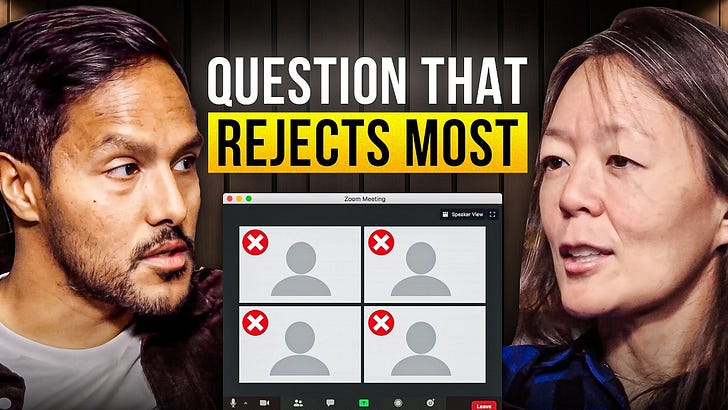
1:04:09And we actually just have them go through a problem set with us in a group setting. And so it might be a group Zoom or they might come in person. But that's actually a really, really important part of the interview. and we've kept it since the beginning. I remember when I first interviewed, I had to do it and I was like, this is weird. But you realize actually the number of people we have actually rejected after that interview has been quite high. And it's because at the end of the day, when you bring people together, you're bringing people together to be on a team and to work together. And you have to be able to see, can I work with this person?
1:04:44Can I work through problems with them? Can we solve things together? Or is that gonna be terrible? Because no matter how talented an individual is, You're hiring them to be part of a team. And if they can't work well in a team setting, like that just says a lot. And so that's actually been one of the critical things about, you know, I'm really proud of the people we hire at Webflow. I think we have some of the best talent out there. And I think part of it is because they are people who are not only individually quite amazing, but they work really well together as a team. And it shows in how we execute as a company.
1:05:16Well, guys, we've covered their product strategy. We even touched a bit on their corporate strategy. We've covered what they're looking for in PMs. I hope you got out as much out of this episode as I did. Let me know in the comments below. Should I have more CEOs that were former product people on or should we stick to the product audience? And we will see you in the next episode. Linda, thank you so much. Thank you so much. This is awesome. I hope you learned as much from today's episode as I did. If you can do one thing that's totally free that would help the show, it would be to check that you're following on Apple and Spotify podcasts.
1:05:50Check that you've left ratings and reviews on those platforms. Check that you're subscribed on YouTube. Leave a like and a comment on this video. And then share it with your friends. We're trying to make better and better podcasts. After two years, we think we've gotten something pretty good going. So let us know what we can do to make it even better. Who else we should interview. And we will put on the best shows we possibly can. Finally, don't forget my offer for the bundle. You get an entire year of my paid newsletter. Plus, my favorite AI tools. Boltut New, Airtable, Speechify, Descript, Magic Patterns, Linear, Dovetail, Arise, and Mobbin.
1:06:26That's$27 ,000 worth of value for just$150. So check that out at bundle.akashg.com if it interests you, and I can't wait to share our next episode soon.
1:06:45Thank you.
Brought to you by
AutonomyAI - Go from a product manager to a product builder and ship changes to the codebase as PRs
Get a full year of my favorite AI tools, plus my paid newsletter, with the bundle: bundle.aakashg.com
Today’s Episode
Companies like Webflow were among the first frontier labs targeted.
ChatGPT has a site builder, and OpenAI is claiming 5 million sites in 3 months! People are building their websites in Claude too. If you run a website builder, that’s about as direct as competition gets.
Bending Spoons just bought Airtable for $1.28 billion, a company once valued at over $11 billion. Then it bought Miro for $1.36 billion, down from $17.5 billion.
Webflow raised $4 billion in that same era.
Webflow’s CEO, Linda Tong, told me about CEOs who vibe-coded their way off Webflow, only to call them back 90 days later.
Watch the full masterclass as she walks through how she’d judge any SaaS company.
10 Key takeaways
1. Most of the work happens after you hit publish - AI can write a site's first version, but most of Webflow's business sits in what comes after, from analytics and experiments to a CMS a whole team can edit. Linda even tells people to start in ChatGPT's site builder and bring the site over.
2. Pick a box the labs aren't building for - Webflow's users had all kinds of titles, but they were using it for marketing. So Webflow went deep on marketing teams with dozens to hundreds of people, a group that probably isn't a frontier lab's priority. Linda called the decision terrifying.
3. Hold context and governance people won't move - Products that store deep domain context become a center of gravity, and roles and permissions are something few people want to vibe code. A product that's only a UI or API layer over other systems is the one customers can leave fast.
4. Run the total cost before you vibe code it - You can build a tool in an afternoon, but software deteriorates and someone has to keep maintaining it. Webflow calls the customers who learned that the hard way boomerangs, and Linda has seen CMOs come back within about 90 days.
5. Low multiples are part math and part fear - A company growing 50% can earn a 10x multiple, while one growing 10% to 20% gets 2x to 3x, so some of the drop is fair. Linda calls the rest "a hangover of the fear" and points to PE buyers, who only buy when they expect a return.
6. Software has to go from MapQuest to Google Maps - Most SaaS still shows everyone the same static screen on top of decades of features. Linda wants products that adapt to what each person is trying to do, with a context engine that learns so a new agent isn't still an intern 60 days in.
7. Valuations from 2021 and 2022 aren't believable - Webflow raised at $4 billion in 2022 and hasn't raised since. Linda says it has plenty of cash and has run close to break even for a while, so she'd only raise for a specific reason, like a big acquisition.
8. PMs start with a PR, on half-pizza teams - Webflow's PMs code the prototype, and designers and engineers swarm on it while it's rough. A funded product area is now two or three engineers with a designer and a PM, which Linda jokes is half a pizza.
9. Track the behavior your AI feature should change - Webflow tracks how many customers use its MCP server, and it also tracks publish rate, how often someone comes in and publishes a change. People publish more once they use MCP, and new customers reach their first publish faster.
10. Webflow hires for how you work with a team - It skipped the AI PM title because every PM has to use AI now. After one-on-ones that score things like AI fluency, a final working session with a group decides it, and the number rejected there has been high.
Go Deeper
n8n's CEO on why n8n isn't dead
How to think about product strategy in the age of AI
How product leaders should use AI, with Rachel Wolan
What an AI-native product team looks like at Salesforce
The PM's guide to agent distribution and MCP servers
Zapier's AI fluency rubric for PMs
Where to find Linda Tong
Where to find Aakash
Listen to The Growth Podcast
Interested in sponsoring the podcast? Email productgrowthppp[at]gmail[dot]com.