Ask ChatGPT
 The Healthtech Marketing Show
2 Nov 2026 · 36m · 17 chapters
Account-based marketing (ABM) in life sciences, where the market is small and buyers are scientists; how to define accounts, identify buying committees, interpret engagement, and create evidence-based messaging and thought leadership that drives adoption (not just awareness).
Life sciences ABM is “one-to-few/one-to-one,” not one-to-many; engagement ≠ intent; content must be evidence-based due to scientific skepticism and compliance scrutiny.
Pfizer is “dozens of accounts” when segmented by therapeutic area/function (e.g., oncology clinical development). Thought leadership must be actionable, bold, and credible (FDA guideline triggers). Scientists read to stay current; social engagement can be disagreement.
Written by AI. May contain mistakes.
Learn why evidence-based marketing is crucial in the science community.
“Scientists are trained to reject hypotheses first until the evidence is presented.”
A deep dive into the application of ABM within the life sciences sector.
“And a special thank you to Roberta and Carol for their continued support.”
Meet the guests and learn about their backgrounds in life sciences and marketing.
“Matthew, you've been on before, I think, but Abdul, it's nice to have you and looking forward to you having you introduce yourself.”
Explore what life sciences encompasses and the various segments within it.
“Abdul Rastegor, thank you so much for having me on.”
Understand the nuances of B2B marketing specific to the life sciences field.
“So for folks who may not be in specifically in life sciences, maybe in there and other aspects of healthcare, what does life sciences mean?”
Learn how buying committees function within life sciences organizations.
“There's many, many buyers in a major industry, so it's not different in that regard.”
Explore the influence of regulatory and compliance in life sciences marketing.
“Could you, Matthew, maybe you could do this, is unpick the buying committee a bit.”
Learn about the complexities of buying and veto rights within life sciences companies.
“So they really tend to put solutions through the ringer.”
Explore how Account-Based Marketing (ABM) uniquely applies to the life sciences sector.
“that you can target those accounts very clearly.”
Discover the importance of understanding engagement signals and skepticism in life sciences marketing.
“Sounds like in life sciences that it's much more about one to few and one to one than one to many.”
Understand the role of thought leadership and how to balance boldness with compliance.
“I call it evidence-based marketing because, gosh, if you don't have it, you're in trouble.”
Examine the mindset of scientific buyers and how to effectively communicate with them.
“certain areas of what you're doing in life sciences, but anything that's specifically about the science itself has to show evidence behind it.”
Learn how honesty and humility in messaging can enhance ABM strategies.
“They will appreciate much more an honest discussion where you reveal the boundary levels and limitations of your solution as much as its strengths.”
Discover key marketing practices from life sciences that can benefit all B2B marketers.
“What is it that life science marketers do well that can teach everybody else the thing or two?”
Understand how to facilitate behavior changes in healthcare through effective marketing.
“I mean, other than that, the baseline is the same, Adam.”
Explore the importance and methods of hyper-personalization in the life sciences sector.
“Change behavior within a health system, within a physician's practice, with the way that oncologists interpret data, which is fundamentally disruptive.”
Summarizing key points and actionable advice for launching an ABM program.
“So I think that's what I would add to it.”

Get the gist, explore an idea or ask about something said.
 Claude
On The Healthtech Marketing Show, what are the key points of this episode?
Searching your listeningAutomatic transcript. May contain errors.
0:00Matthew Piette: Scientists are trained to reject hypotheses first until the evidence is presented. And so if you're developing some ABM content, you'd better base it on demonstrable evidence. Otherwise, you'd be just laughed out of court. They're reading with a cynical eye. Absolutely. I call it evidence-based marketing because, gosh, if you don't have it, you're in trouble. You'll be laughed out.
0:26Abdul Rastagar: Welcome to the award-winning Health Tech Marketing Show. I'm your host, Adam Turina, CEO of Health Launchpad. First, thank you for listening. If you find the show useful, please follow or subscribe wherever you get your podcasts and take a look at our library of more than 140 episodes on health tech marketing. In fact, this episode is actually a small milestone. It's episode 150. I never quite thought we'd get to this number of episodes, but I'm loving it and don't plan on stopping anytime soon. A big thank you to our sponsor, Healthcare Now Radio, the 24-7 radio network dedicated entirely to healthcare, which also syndicates this show and many other great healthcare podcasts through their podcast syndication network.
1:20Abdul Rastagar: And a special thank you to Roberta and Carol for their continued support. Now, today's episode, this is a little different. We're going to talk about account-based marketing. And we talk about ABM a lot, but always through the lens of health tech, which is primarily selling to providers and payers. Today, we're going to go deep on a very specific thing. and that is the application of ABM in life sciences. It's in a world where the entire market might fit into a single ballroom and where one big pharma company is actually really more like a dozen different accounts. And the buyers, well, rather than being commercial people or or physicians, they're scientists.
2:15Abdul Rastagar: And many of them will say they're allergic to marketing. My guests know this world inside out from both sides of the table. Matthew Piet leads our life sciences and biotech practice here at Health Launchpad. And before this, he was at Exact Sciences. And in early on in his career, he led brand at Philips Healthcare North America. My other guest is a great friend and the wonderful Abdul Rastegar joins us. Abdul is the CEO and co-founder of Sirona Marketing, a B2B life sciences agency. He's also a former medicinal chemist who's spent his career in biotech, pharma, and life sciences technology. We're going to get into how to define an account, who really sits on the buying committee, why engagement isn't the same as intent, and why evidence-based marketing is the only kind that works with scientific buyers.
3:23Abdul Rastagar: So with that, let's get on into it and meet Matthew and Abdul. Matthew and Abdul, welcome to the show. Matthew, you've been on before, I think, but Abdul, it's nice to have you and looking forward to you having you introduce yourself. So before we get started, Matthew, tell everybody a little bit about yourself.
3:45Matthew Piette: Yeah. Hey, Adam. It's great to be back on and back in the ring with you. It's always a pleasure. Yeah. So I'm Matthew and I came to Health Launchpad to help kickstart the life sciences and biotech practice. So I'm a principal here and I was most recently at Exact Sciences, which is a major in a molecular diagnostics company, well known for Cologuard and Cancer Guard, multi-cancer early detection. So my background is very much in diagnostics in the life sciences space. And before that, I was head of brand for Philips Healthcare, a Dutch company for North America. So I was head of brand for Philips Healthcare North America.
4:25Matthew Piette: And there, The focus was obviously on medical devices. So I think what I bring to the table is a sense of the yin and yang and how medical devices, ABM and life sciences kind of work in tandem to career healthcare markets. So I'm delighted to be here. Great. Abdul, how about you? Abdul Rastegor, thank you so much for having me on. I'm the CEO and co-founder of Sirona Marketing. I'm a former medicinal chemist turned marketer. and most of my, essentially my entire career has been on the life sciences and life sciences tech space. So I started out in biotech and then worked with some of the larger pharma companies, probably heard of Glaxo, AstraZeneca, a few smaller companies, and then kind of transitioned my way into the tech side on the vendor side, always serving those large pharma companies and something that I really enjoyed over the years.
5:16Matthew Piette: So coming through Viva, Benchling, some of the other bigger known tech companies. So that's a little bit about my background.
5:22Abdul Rastagar: You mentioned Glaxo. It's funny. These days, it's GSK. But my first job out of college, which was in the 80s, was I had two job offers. One was from Glaxo, and one was from a sexy agency in London. I went for the sexy agency. I don't know. I think in retrospect, I probably would have, should have, I wonder whether I should have gone the other way. Anyway, So we're going to talk about ABM and life sciences, which is not something we've ever really covered on the show. I think when we talk about ABM on this show, we're really more focused on ABM as it relates to health tech, and that's selling to payers and providers.
6:05Abdul Rastagar: We did have a guy on Todd Ladderak a while back to talk about ABM as it relates to medical devices, but today we're going to talk about it as it relates to life sciences. Now, a lot of different people listen to this. So for folks who may not be in specifically in life sciences, maybe in there and other aspects of healthcare, what does life sciences mean? Because there's a lot actually underneath it.
6:29Matthew Piette: Yeah, I'm happy to take that one. I think life sciences, I mean, how much time do we have on this podcast if I go through all of the various sub-segments, right? It's quite broad. People lump it into one category, but they're very different when you think about even like the ones that people lump together, biotech and pharma. Those are two different subsegments and sub industries, if you want to call it that. Within each space, there's also different functions, department functions. If you think about how large some of these pharma companies are, they're full manufacturing companies, but they also have commercial organizations, they have medical and regulatory.
7:01Matthew Piette: So what does life sciences mean? It's impossible to answer in one sentence, really. You really have to think about what is the target market that we're selling to, and that'll help you answer your question. Yeah, I agree with all that. And And going back to the absolute heart of life sciences, it's about biology. It's about human makeup. It's about disease states. It's about screening and therapeutics, what happens to patients along the patient journey and how you can intervene. And so it's deeply steeped in science, maybe more so than in health tech. But at the end of the day, when health tech is looking at bits and bytes, life sciences is looking at molecules and how they behave and how they could be approached.
7:44Abdul Rastagar: Now, this is a B2B podcast, B2B marketing podcast. And so B2B marketing in health tech is pretty straightforward, right? It's technology and services companies selling to healthcare systems and payers. When we talk about B2B marketing in life sciences, characterize like who are the organizations and who are the buyers within those organizations?
8:13Matthew Piette: Yeah, I can take that. There's many, many buyers in a major industry, so it's not different in that regard. But when you peel back the onion in life sciences, there are entire departments in diagnostics, for example, in a fairly narrow field because it's very broad, cancer screening. There's everybody from scientists looking at molecular profiling, genetic characteristics of a tumor. They'll be looking at minimal residual disease, what happens sort of after cancer intervention, survivorship. They'll be looking at hereditary cancer, infectious diseases, and diagnosis. And for each of those problem areas, let's call them, there are entire teams devoted to determining how to approach those challenges.
9:00Matthew Piette: So you may have oncologists or pathologists or laboratory leaders or health systems leaders who are looking at from an operational perspective. And that's just one discipline within life sciences. So it's extremely complex and extremely nuanced. So you have to go in knowing that, but that's not one place, but it's all that messaging at least be adapted to the nth degree for each of those sort of departmental and functional programs.
9:27Abdul Rastagar: It makes me think of like, well, okay, the atomic unit that we always focused on is the account. And so in health tech, the accounts are that healthcare system might be a hospital, but typically looking at the system and a payer might be, you know, one of the blues. When you think about an account, what does an account look like in life sciences, Abdul?
9:50Matthew Piette: I think it really depends on who you're looking to sell and what you're looking to sell to them. Actually, Matthew made a great point. There are different therapeutic areas, right? So you may Maybe you're thinking, I'm going to be selling into, again, into a pharma organization. Well, are you selling into the ophthalmology group or the oncology group, CNS, right? Those are all different scientists with different priorities, different things or ways of looking at things. And then within that, are you selling to the commercial department there, within the medical group, within the brand teams or more on the scientific side?
10:19Matthew Piette: So it's a very complex question to answer, right? In the kind of abstract, you really have to understand what's driving the science, what are they trying to achieve? And then what are you trying to sell to them at the end of the day? So that's really how I would answer that question.
10:33Abdul Rastagar: But if you take an organization like Pfizer, you know, Pfizer probably in terms of size, I mean, it's tens of billions of dollars in revenue and value, but that's not one account. If you're planning an account-based marketing approach, how would you typically structure, think about a large pharma client in terms of maybe breaking up into multiple accounts?
11:00Matthew Piette: Yeah, I mean, it comes down to which functional group you're trying to sell to, right? Let's say you're selling it to the clinical development team, right? So now you have a specific clinical development leader that you might want to target if you're selling across the board, across all services across that entire organization versus, well, only within the oncology department within Pfizer, right? Then they have their own department leaders as well, functional therapeutic area leaders. So really, it comes down to that. I would structure an account in that sense as, okay, I'm targeting this particular oncology group, right?
11:30Matthew Piette: And that's really where you have to kind of define it. And that's very complex because that information is not always available and easy to find, like, who is the clinical operations leader for this particular therapeutic area, right? That's a level of complexity that I think a lot of other industries don't have to deal with.
11:48Abdul Rastagar: Could you, Matthew, maybe you could do this, is unpick the buying committee a bit. So, you know, in a healthcare system, you're selling to, everybody talks about the CIO, right? If it's technology, but usually it's like people within the technology department. And then there might be chief medical officer, chief operating officer, chief financial officer, and chief nursing officer, and then leads underneath them. In the type of organizations that we're selling to from a life sciences standpoint, what do the buying committees look like? What are the differences?
12:19Matthew Piette: Yeah, I think at the end of the day, the buying committees, at least in the diagnostic space and perhaps in pharma as well, to some degree, they boil down to sort of two baskets, two categories. The one committee that, and it's an ecosystem and there's overlap, but that hovels around the idea of clinical validity, meaning will a clinician order the test or solution? And that's a scientific review. And that might be entirely dependent on the integrity of a large-scale clinical trial. So that committee will have the chief medical officer, but also the clinical ops folks who look and review clinical trials.
12:59Matthew Piette: And that might be the laboratory leaders who decide on whether to implement the trial based on the merits of it. And then the second basket is around clinical utility, which is can the physicians within a network actually successfully apply and use this test in the marketplace? And that might go down to, you know, how does the specimen sample collection workflow in a tie with what they already have as an installed base, electronic health records and integration with their EPIC system? Is it robust enough? Coverage issues? Reimbursement? And a lot of new tests and a lot of folks that we deal with are introducing new tests and need marketing support.
13:38Matthew Piette: They don't have FDA clearance, so then you have patients who are doing self-pay and there's not even a reimbursement pathway, which presents real difficulties. And then generally, they'll look at past performance on patient adherence to a given life sciences solution and say, well, is that an indication of whether we will get adoption going forward? And they'll be quite cynical about it. So many, many biotech and health life sciences companies knocking on the doors of major health systems, for example, and the seat is still warm from the biotech startup that just sat there and tried to pitch something very, very similar.
14:15Matthew Piette: So they really tend to put solutions through the ringer. They choose essential biocommities around validity and utility. I'd like to add to that as well. I mean, so that's a great summary there that Matthew provided. it. I think one of the things that when you look into selling to health systems, you have the buying groups, but you also have the kind of the veto rights groups, right? The influencers and so forth. And you see that same in the life sciences industry as well, right? You do have to deal with regulatory affairs or compliance and legal, right? They're all going to have a point of view on it.
14:47Matthew Piette: And the information security, right? Just as important in life sciences as it is on the healthcare provider side. So those are, you have your economic buyers, you have your users, and then you have the kind of other parts of the buying committee that are essentially veto holders.
15:03Abdul Rastagar: Yeah. Just sort of following up on this, as you guys were talking, what occurred to me is that one of the differences about the use of ABM in life sciences versus other industries is like, whether it's other health tech interests, whether it's health tech or financial services, whatever it happens to be is, you know, in other markets, you know, the ICP could be several thousand organizations. It's much, much narrower in life sciences. I mean, in some cases, particularly if the buying committees are quite small, you could literally take the entire market you're selling to and fit them into a ballroom, right?
15:41Abdul Rastagar: You could be talking about dozens of companies at most and maybe hundreds of people. So help me get my head around how the role of ABM in those situations?
15:54Matthew Piette: I mean, there's a lot of truth to that, right? It's a very small industry at the end of the day. It's not that many accounts, right? And most of the money is within a handful of large accounts at the end of the day as well. ABM in this case actually means that you can target those accounts very clearly. You generally know who they are or they're relatively easy to find. Now, finding the right individuals within those accounts might be a little bit more complex. I used to work at a company, this is years ago, called Relsys, which sold pharmacovigilance software. into pharma and we absolutely dominated that market not through the technology although i'll be biased i'll say the technology was the best out there of the options but we dominated that market through the user group it became such a strong network because it was a relatively small group of people they all knew each other it was going to be their next employer as part of this relative user group right so once you joined the relative technology once you purchased that technology you wouldn't leave because everyone around you were all the all the movers and shakers in the pharmacovigilum space were there, right?
16:51Matthew Piette: Why would you ever leave that? It was a very compelling selling point as well. We sold the user group as much as we sold the technology. It was highly, highly effective. Yeah, I agree with that. You know, I'll take your question kind of literally about the ballroom, Adam. And, you know, when I look back at the many experiential marketing events that we held at the leading diagnostic shows like ASCO and AACR and ESMO in Europe, But looking back at it, the five very carefully prepared conversations of leading health systems personas in a meeting room, whether it was in the booth or somewhere else, was worth hundreds and hundreds of batch scans.
17:34Matthew Piette: So the intimacy, the fact that everybody knows each other is correct, but it's about continuing the conversations that you had last time. So the fact that everybody can almost gather in one ballroom just makes the business interactions is just more fluid and it's not sort of meat and greed. It's, hey, let's continue the dialogue that we have our stuff and deepen the relationship. Yeah.
17:56Abdul Rastagar: I mean, it sounds from what you're both saying is that in terms of what types of ABM, and I think, you know, as many people listening to this know that there are different flavors of ABM and people call it different things, but kind of the general way of thinking about ABM is one to many where you might be taught marketing to several hundred accounts, one to few where you might be marketing to a few, like several dozen accounts, maybe segmented, and then one to one where you're talking to a few. Sounds like in life sciences that it's much more about one to few and one to one than one to many. Absolutely.
18:37Matthew Piette: We recommend that generally for most of our clients because it's a very narrow set of people they're selling to or accounts they're selling into. And the other thing about it is it's very much a trust-based industry because everyone within the buyer side, they all know each other. It's easy to find their corresponding person at another company that's using their technology. So they'll talk to each other, right? And that's part of the reason those user groups and those communities are so important in that space is that they'll validate you before they even talk to you as a vendor. And that's a huge component, right?
19:08Abdul Rastagar: Yeah. I mean, we've talked here about some of the approaches to ABM. Can you compare and contrast where ABM goes well versus when ABM goes off the rails and doesn't work well in life sciences?
19:22Matthew Piette: Yeah, I think ABM is all about accurately listening to signals, intense signals, and providing and matchmaking content with signals to provoke a response. And I think in life sciences, there are some dangers there because and where it differs a little bit in ABM and where things could go wrong is that when you're listening to the market and life sciences, as the word sciences suggests, you have a lot of scientists reading a lot of stuff, right? And where in health tech, you might say, oh, well, this leader is engaging with this content. They must be interested in buying something. Well, no, it might be as simple as a scientist is keeping up with the latest science.
20:04Matthew Piette: And so you can't make that assumption of engagement equals an intent maybe as given in the linear fashion that you might do in health tech. So, you know, a chief marketing officer that's studying circulated tumor DNA, you know, if you have a multi-cancer early detection solution, say, oh, well, they must be religious. No, not necessarily. It's their job to be, you know, up to date on all related scientific innovations, but not necessarily, they're not in market. So you've got to separate the signal from the noise a little bit more carefully after you can license it. Very well said. The other thing about it is the skepticism that comes, right?
20:40Matthew Piette: And we see that some of our clients, they'll be posting content on social media or whatever channels they're using. And they're talking to a highly scientific audience. And you'll see a lot of engagement, actually, some of the highest levels of engagement that I've seen. And it's not necessarily agreement, right? And just because they're disagreeing doesn't mean you're wrong. but that's the nature of scientific debate and scientific progress is disagreement, right? That's how you push forward in those spaces. So you really have to know what you're saying. So one of the ways you lose trust is if you're making broad claims that are overly ambitious, no one in this space will accept that.
21:16Matthew Piette: The baseline belief is skepticism to whatever you say. Yeah, I totally agree with that. I mean, scientists are trained to reject hypotheses first until the evidence is presented. And so if you're developing some ABM content, you'd better base it on demonstrable evidence. Otherwise, you'd be just laughed out of court. Absolutely. They're reading with a cynical eye. Absolutely. I call it evidence-based marketing because, gosh, if you don't have it, you're in trouble. You'll be laughed out, you know.
21:43Abdul Rastagar: Can you differentiate with that? I mean, versus, the reason why I'm asking is that one of the topics, Matthew, you covered this in a couple of sessions you ran with the Health Tech Marketing Network, which is Thor Leadership. right? Thought leadership, a lot of people confuse thought leadership with educational content with thought leadership. You know, thought leadership done well has a strong point of view, might be provocative, might even sort of basically polarize people. In life sciences, where evidence and you're selling to the people who are reading it are scientists and they're looking for facts.
22:16Abdul Rastagar: They're used to reading academic journals. What's the role of thought leadership?
22:21Matthew Piette: Yeah, I'll take that since, yeah, we have covered this a bit before and I've thought about a little bit more since is in life sciences, there's a sort of ABC to thought leadership. As you said, you can't just participate in thought. You have to lead it for it to become thought leadership. And the A really is, it's got to be actionable first. So what you're looking to create in thought leadership is a response to a triggering event. Very often, it might be a new guideline that's been issued by the FDA and so on. So everybody's thinking about it and you need to come in with your POV and you need to come in hard and strong.
22:56Matthew Piette: So that's the B, right? It's got to be really bold and it's got to cut through. And the C is it's got to be credible, which relates to what Abdul said, it's based on evidence. But the B is where things sort of can get really tricky. Being bold in a highly, highly regulated market puts you at risk. You've got to be compliant in everything you say. And if you speak to any life sciences person, Abdul in the world of Viva, where every single word is scrutinized before it can be by multiple lawyers, before it can ever reach a marketing pamphlet. That kind of conservatism is built through fear of risk because people can darn in life sciences if you make a false claim.
23:37Matthew Piette: So how do you address being bold in a deeply compliant world is a challenge that all life sciences people have. But if you can, if you do succeed, especially in an AI universe, you're creating the kind of authority that leads to citation. And then you start to win in the language model world. So it's worth it. It's difficult. Odysseus was trapped between Scylla and Carybdis. The rocks and the sirens. It's a narrow path, but you've got to get that. Absolutely.
24:09Abdul Rastagar: Yeah, it's interesting. You mentioned AI and, you know, something we're certainly seeing for our own business and across all of our clients and prospects we talk to is buyers are increasingly using the LLMs to do their research. And that clearly in any B2B sector, getting the content right so it gets cited is becoming a priority. But I would think in life sciences, it's even more so because of the sort of because of the behavior of scientists who are researching it.
24:44Matthew Piette: Yeah, and one of the things that actually holds you back a little bit is the fact that you have to, and it's a good thing, but you have to source everything, right? You have to point to a source on any claim you make, right? Whether that's internal data, if you can even publish that, right? Sometimes it's IP, you can't publish it. Other times you have to, if it's an external reference, your regulatory teams are going to want to see that before they approve any sort of external messaging, right? And that has a pretty significant impact on your ability to develop content, right? And when we're talking about thought leadership on the thought leadership end of the side, in my opinion, thought leadership should be polarizing, right?
25:19Matthew Piette: If everybody agrees with you, it's not thought leadership. And those two ideas are in conflict of each other that, hey, everything needs to be sourced and well-established, whereas here I'm on the leading edge saying, no, this is different, this is new, right? Finding that balance is not easy. It may be a little bit more easy on certain aspects, certain areas of what you're doing in life sciences, but anything that's specifically about the science itself has to show evidence behind it.
25:45Abdul Rastagar: Let's go back to the scientist as a buyer. I'm very intrigued about this because in my past life, before I was a scientist, I got a degree in physiology. I didn't have a future ahead of me as an academic. But I can tell you when I told the academics that I was involved with, my professors that I wanted to follow a career in marketing and probably in advertising. I lost all credibility with them very quickly. And I can't remember, somebody said that scientific buyers are allergic to marketing. So how do you tread that line in life sciences?
26:25Matthew Piette: I'll take that first. That's okay, Matthew. As a former scientific buyer myself, as a scientist, I can tell you when salespeople came in, the level of skepticism, there was a wall there. I would be polite, but it wasn't just me, like across the board, the entire scientific team. We would not take a word you'd said at face value, right? The level of expectation and demanding, the probing questions. What really helped is if that salesperson was a former scientist themselves and if they could speak at our level in our language. And if there is, I mean, some of these people were PhDs, right? So they'd come in and talk to our PhDs.
26:58Matthew Piette: And then you have a deep scientific discussion. You're like, okay, at least this person knows what they're talking about. I may not, again, I'm a scientist. I'm skeptical. I may not fully agree, but let's have the conversation." That made a big impact. If that wasn't the case, if it was a marketer, I guess allergic is probably the right word. It's very, very apt. You would just put up a wall and not want to talk to them. Yeah, I totally agree. Antihistamine or whatever for life's plans is avoiding marketing speak. I mean, many, many startups, for example, are convinced, rightly so, that their product is revolutionary or innovative.
27:37Matthew Piette: Their customers don't know that. A health system struggling with low margins with the tests or life-signances solution that's working perfectly well is not going to be convinced. And we'll just say, look, we're not involved in the revolution, we're involved in providing everyday care to our patients. So thank you. So you've got to show them what the evidence shows and what it will do for their practice and be really honest about the limitations as much as the strengths of your solution. They will appreciate much more an honest discussion where you reveal the boundary levels and limitations of your solution as much as its strengths.
28:19Matthew Piette: So it's just going in there and being credible and being humble is actually going to work better than holding forth with allergic marketing. Yeah, I think that's very wise.
28:31Abdul Rastagar: So we've talked a lot about how to apply the principles of ABM to health, to life sciences. What can other B2B marketers, particularly in other aspects of healthcare, what can they learn from life sciences? What is it that life science marketers do well that can teach everybody else the thing or two?
28:52Matthew Piette: Yeah, certainly I can take the first. We've covered it, right? The claims and the evidence behind the claims, the narrowness of targeting, really honing in on your messaging and positioning for the right persona, right? Right message to the right person. Those are things that are so fundamental and they're fundamental across the board for any B2B customer, right? I think in life sciences, it's at a whole new level, especially what I said about the backing things up with evidence. And it just forces you to operate at a much higher level than perhaps non-industries. And now if you can borrow that scientific rigor and apply it to your own system as well, maybe that'll give you an advantage over your competitors who aren't doing that.
29:30Matthew Piette: Yeah, I agree with that. And that's it. I mean, other than that, the baseline is the same, Adam. I mean, you know, if you're doing ABM, just get your strategy right, understand your personas and understand what messaging words for each persona and create channels that make sense and be where the life sciences customers are. I mean, all the old ways are sort of biblical and there's not that much of a difference in terms of tactical execution between life sciences and health tech. That's very helpful. Final question for you both.
30:02Abdul Rastagar: If a CMO were launching an ABM program in life sciences next week, what's the one thing that they should do differently?
30:11Matthew Piette: Yeah, I was going to wax lyrical on thought leadership, and we'd already covered that because I do think it's really important. And I think to summarize, at least from my point of view, don't confuse raising awareness with enabling adoption on behalf of your customers. Because what you have to do very often with a novel test, for example, in life sciences is fundamentally change behavior. Change behavior within a health system, within a physician's practice, with the way that oncologists interpret data, which is fundamentally disruptive. and so be bold about a how you're going to introduce something that will will create maybe problems for your customers that they'll have to address until they're changing their behavior which is a barrier for entry and then talk them through the rewards and go through the reverse waterfall and so on that allows them to see how that fundamental change in behavior of their side triggered by a new solution is going to pay dividends over time.
31:14Matthew Piette: So before you launch, you know, maybe identify just 10 customers, not all of them that have a kind of susceptibility or readiness associated with your solution. Get case studies really fast because without them, you're not going to have the credibility to move forward. So I would say just don't confuse just general engagement and awareness with the ability to serve your customer to create true adoption. Yeah, so well said, Matthew. I mean, absolutely spot on. I think one thing I would add to it, because the space is relatively small, you're not talking about tens of thousands of accounts here, right?
31:49Matthew Piette: You're talking about a few thousand at the end of the day. You have the ability to really hyper-personalize and do it in a meaningful way, not the kind of cheap AI generated where it just doesn't feel convincing in the first place, right? You actually have the ability to sit down and think about the accounts and hyper-personalize to that persona within the account. So take advantage of that, right? Other industries don't have that luxury. So I think that's what I would add to it.
32:13Abdul Rastagar: Matthew and Abdul, thank you so much. But before we go, where can people find you both? Matthew and Abdul?
32:20Matthew Piette: I'm Matthew Piette, two Ts and then P-I-E-T-T-E on LinkedIn. So check me out and drop me a direct message. Yeah, absolutely. Same here, Abdul Rastagar. I'm on LinkedIn as well. Maybe I'm on there too much, but I'm always happy to connect and chat with people.
32:36Abdul Rastagar: Well, and Abdul, I think just as an aside, quite often when I have other folks from other agencies, they really, because I'm like this, is they push their agency. They try not to push their agency really hard, but they can't help themselves. You know, Matthew and Abdul, you've both been really thoughtful, I think, for the listeners in not pushing either Health Launchpad or Serona marketing, but I will put information about, well, there's always health information about Health Launchpad. But I'll put some information about Sirona Marketing. You know, we sometimes compete with each other, but I always think of us as greater friends than competitors and always appreciate you.
33:15Matthew Piette: Absolutely. Thank you. I told Adam, this is a couple of years ago, I told Adam, I want to be where you are someday, right? You guys are way ahead on the curve. I want to throw Sirona Marketing to where Health Launchpad is. I want to create a statue in honor of Adam. Oh my God.
33:33Abdul Rastagar: No. This is definitely getting deleted.
33:37Matthew Piette: It's getting edited out for sure. Guys, thank you. I really appreciate you and appreciate having you on the show. Thank you so much.
33:47Abdul Rastagar: Well, that's a wrap on ABM in life sciences. A big thank you to Matthew and Abdul. So here are my five takeaways. Number one, redefine the account. A company like Pfizer isn't one account. Break it down by therapeutic area and function, such as clinical development and oncology, and target the leaders in those particular units of a company. Go one to few and one-to-one. When your whole market fits into a ballroom, a handful of well-prepared conversations beats hundreds of badge scans. And community matters. Abdul's user group story shows you can sell the network as much as the product. Number three, engagement is not intent.
34:39Abdul Rastagar: Scientists read constantly just to stay current. Separate the signal from the noise before you treat a click as a signal. Number four, practice evidence-based marketing. Skip the hype and source every claim. Thought leadership should be actionable, bold, and credible. And getting that balance right in a regulated market is what earns citations from the AI tools. And those are the tools your buyers are using right now to do their research. Last one, drive adoption, not just awareness. Be honest about limitations. Help customers through the behavior change your solution requires. Start with 10 accounts that are ready and get case studies to them fast.
35:30Abdul Rastagar: Because the market is small, you can hyper-personalize in a way that actually really mean something. You can find Matthew Piet and Abdul Rastegar on LinkedIn, and I put those links down below, and both of them are going to be happy to connect with you. If you enjoyed this episode, please follow or subscribe and share it with a colleague who markets to life sciences. Thanks again to Healthcare Now Radio. And with that, I'm Adam Cherenis, and this has been the Health Tech Marketing Show.
36:05Thank you.
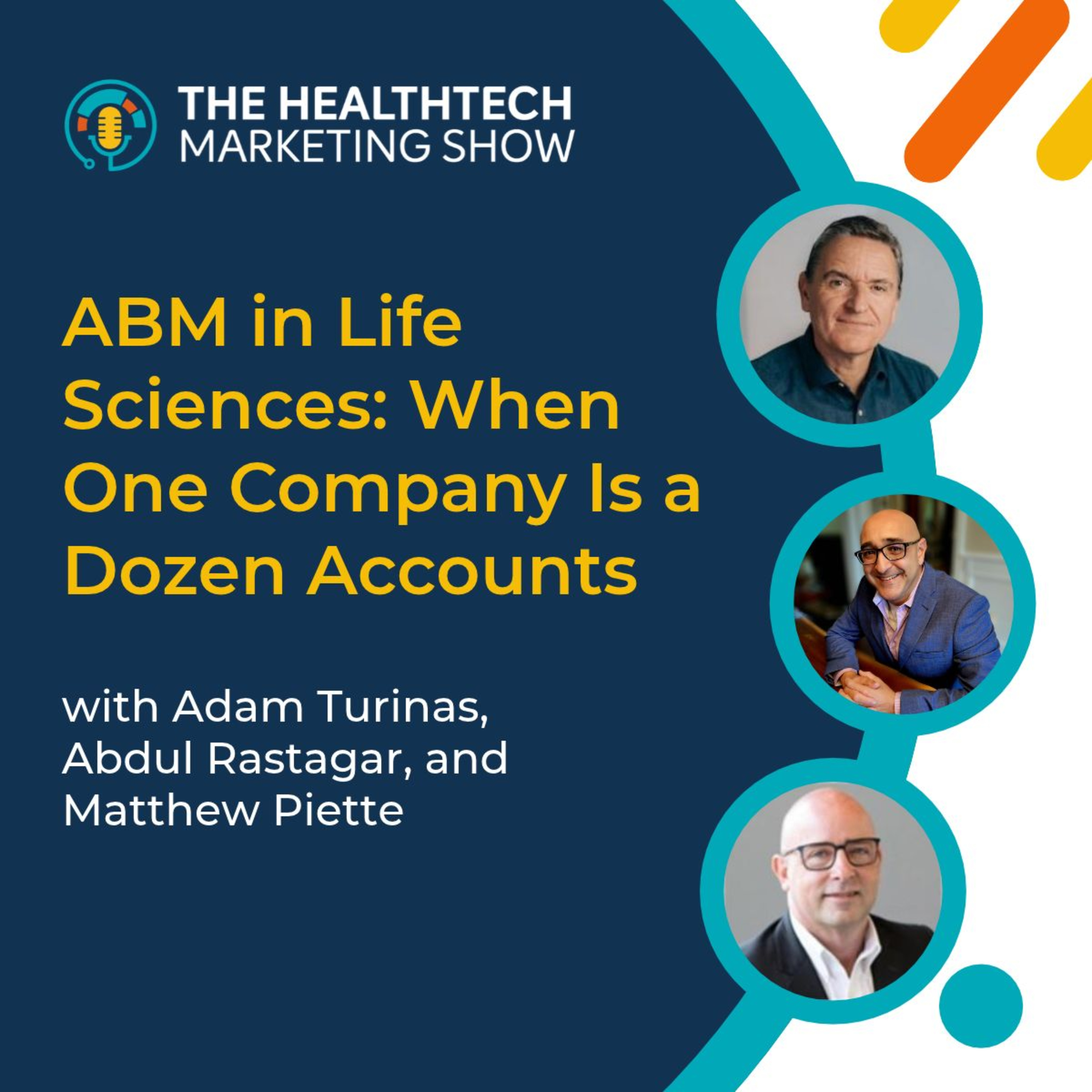
If you market to pharma, biotech, or diagnostics companies, you already know the standard ABM playbook doesn’t quite fit. One big pharma company can really be a dozen different accounts. Your whole market might fit into a single ballroom. And your buyers are scientists, and many of them will tell you they’re allergic to marketing.
I was joined by Abdul Rastagar, co-founder and CEO of Sirona Marketing and a former medicinal chemist, and Matthew Piette, who leads the life sciences and biotech practice at Health Launchpad and previously worked at Exact Sciences and Philips Healthcare. Between them, they’ve seen this world from both sides of the table.
We talk about how to break a large pharma organization into real, targetable accounts, and who actually sits on the buying committee, including the veto holders marketers tend to forget. We get into why engagement isn’t the same as intent when your audience reads constantly just to keep up with the science. We also cover why evidence-based marketing is the only kind that works with scientific buyers, and how to be bold with your thought leadership in a heavily regulated market.
If you market in life sciences, this episode will help you sharpen your ABM strategy. If you’re in another part of healthtech, you’ll come away with ideas on rigor, targeting, and personalization that you can use right away.
Key Topics Covered
If you are interested in discussing this or any other topic, let's have a chat. Reach out to me directly to schedule a no-obligation discussion. This isn't a sales call, but rather an opportunity to talk through your questions and challenges.
Subscribe to The Healthtech Marketing Show on Spotify or watch us on YouTube for more insights into marketing, AI, ABM, buyer journeys, and beyond!
Find all of our episodes on the Health Podcast Library.
Thank you to our presenting sponsor, HealthcareNOW, 24/7 expert shows, interviews, and podcasts, powering healthcare leaders with innovation, policy, and strategy insights.