Ask ChatGPT


 The Healthtech Marketing Show
9 Nov 2026 · 36m · 16 chapters
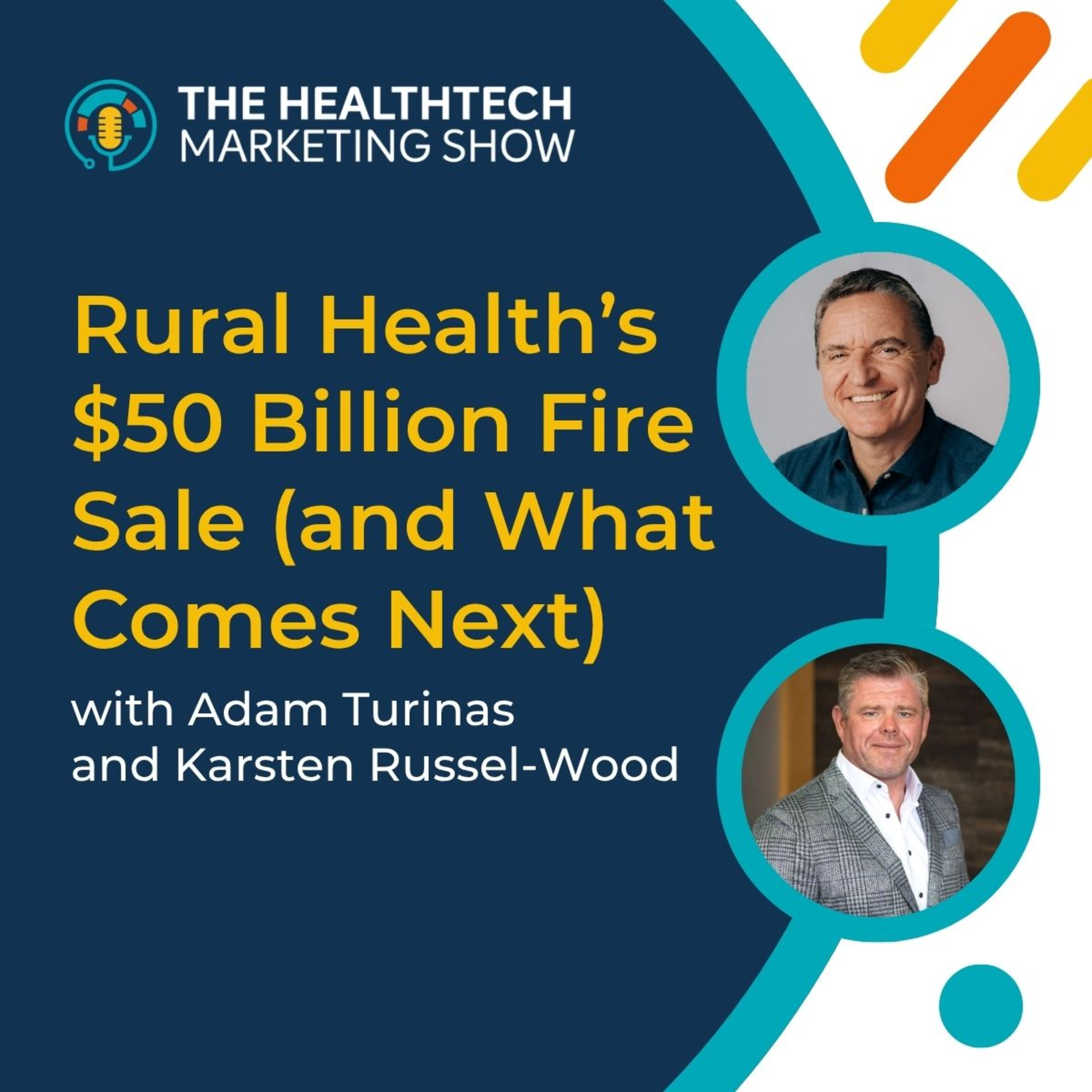
Part 1 of a two-part series on Rural Health Transformation Program (RHTP) under the “Big Beautiful Bill,” describing the $50B budget over five years ($10B/year; first-year state awards averaging ~$200M), why year one felt like a “fire sale” to translate policy into fundable projects, and how vendors should sell into rural health ecosystems.
Carson Russell-Wood, Chief Marketing and Experience Officer at Equa Medical; 25 years at the intersection of digital health and healthcare delivery; involved with the RHT Alliance; participates in NRHA’s Rural Fellows Programs; has written on clinically integrated networks.
RHTP is a five-year redesign with CMS “gates” requiring measured value, not just grant money. Year one required speed and collaboration (CMS language discourages going it alone). Rural hospital CEOs aren’t buying “innovation”—they’re trying to keep hospitals viable; buying groups can include CNO/CMO/legal.
West Virginia hospitals using ambient monitoring tied to workforce retention; specialist access models for cardiology/neurology to reduce leakage; “VISTA” in New York—$3M supporting an 11-hospital specialty access collaborative.
Written by AI. May contain mistakes.
Explore the concept of a fire sale in health transformation.
“A fire sale in our consumer lives is all about a race, right?”
Meet Carson Russell-Wood and learn about his expertise in rural health.
“Here's the scale of this $50 billion over five years,$10 billion a year with first year state awards averaging $200 million each.”
Discussion on the economic landscape and challenges in rural health care.
“So let's get into it and have a chat with Carsten.”
Focus on the importance of sustainability in rural health transformation.
“And this is a relatively new legislature, right?”
Understanding the urgency and challenges faced during the first year of RHTP.
“You know, there's an old saying, which I think it's like an African proverb, and it's used quite a lot, called, if you want to go fast, go alone.”
Explore changes in company strategies adapting to rural health needs.
“That was even written in some of the original CMS language.”
Insights on effectively approaching and selling to rural health systems.
“You said sort of when you show up, I'm kind of curious, who are you selling to?”
Learn about the structure and challenges of rural hospitals and the stakeholders involved.
“When we talk about rural hospitals, there are critical access hospitals and there are regional community hospitals located in rural counties and zip codes.”
Explore how technology initiatives shape rural health strategies and partnerships.
“interpret with them the requirements and opportunities in RHTP available to them and how the solutions might be made up.”
Discuss strategies for health tech companies to align with rural health needs.
“And that occurs at the year one gate, but then for each day's funding thereafter.”
Examine how vendors are positioning themselves in the rural health market.
“So for those following along, I'll give you 10 seconds to type NRHA into your laptops.”
Learn about the funding landscape and what states are rewarding in rural health.
“We're not selling enterprise thousand bed endpoints.”
Learn about the recent health systems receiving RHDP funding and their diverse uses.
“And the short answer there is it seems like a little bit of everything.”
Discover how hospitals are creatively using funding for innovative healthcare solutions.
“And these come in the sense of EMR infrastructure.”
Understand the implications of year one funding and the urgency to adapt to RHTP changes.
“you know, those patients and patient care in the community.”
Identify key strategies for health tech marketers to leverage rural health programs effectively.
“is getting shorter as time moves forward.”

Get the gist, explore an idea or ask about something said.
 Claude
On The Healthtech Marketing Show, what are the key points of this episode?
Searching your listeningAutomatic transcript. May contain errors.
0:00A fire sale in our consumer lives is all about a race, right? Something that we want to get to quickly. And I do think RHTP was a fire sale with respect to year one, mainly because it was a race to translate policy into fundable projects.
0:27Karsten Russell-Wood: Hello and welcome to the award-winning Health Tech Marketing Show. I'm your host, Adam Turina, CEO of Health Launchpad. Thank you for listening. And if you haven't already done so, please follow or subscribe. There are more than 150 episodes in the library. And a big thank Thank you to our friends at Healthcare Now Radio, the 24-7 healthcare-only radio network and podcast syndication service. Roberta and Carol, we always appreciate everything that you do. Today is part one of a two-part series on rural health transformation. Here's the scale of this $50 billion over five years,$10 billion a year with first year state awards averaging $200 million each.
1:20Karsten Russell-Wood: And that's a lot of reasons to pay attention, even if your company doesn't think of itself as rural. My guest is no stranger to this podcast. He's been on before and a great friend of a lot of what we do, Carson Russell-Wood. Carson is the chief marketing and experience officer at Equa Medical, and he's one of the people actually building this market. He's deeply involved with the RHT Alliance, and he's part of NRHA's Rural Fellows Programs, and he's written on clinically integrated networks. And by the way, if you didn't know what all of those initials stand for, we'll get into that in the episode.
2:04Karsten Russell-Wood: In this episode, we cover the landscape and the states, why year one was a fast out, who you're really selling to in rural health, and why the window to get in is closing faster than a five-year program suggests. Next week in part two, we're going to get into execution. So let's get into it and have a chat with Carsten. Carsten, welcome to the show. You know, I think you've been on before and it's been a while. So, So, you know, for folks who don't know you, Carson, tell everybody a little bit about yourself. Adam, I appreciate it. I appreciate being here. I will say I do believe I've been here before.
2:44And each time I learn something from you and get to concentrate on a new topic of interest that's top of mind. So for everybody listening, my name is Carson Russellwood. I'm the chief marketing and experience officer at Equa Medical. I've been at the intersection of digital health and healthcare delivery for about a quarter century, 25 years, going through some of the large companies, but then moving into clinical workforce, which I have a passion in today.
3:10Karsten Russell-Wood: Oh, great. Now, I invited you on because over the last few months, we've talked a lot about rural health. And I've just always been, I've been really impressed with your knowledge, which is hard own because you're in the middle of it, not just in terms of the way that you're helping with what the impact that Equim's making in rural health and the rural health transformation in particular, but also in the way that you're engaged with the community that's organized around it. So, you know, for someone in health tech marketing who's maybe heard about rural health transformation, but hasn't really gotten close to it, what is it really?
3:50Karsten Russell-Wood: What do most people get wrong about it. Yeah, Adam, and let me start by laying a little context because I would believe for your listeners, those that live in very urban areas may not fully appreciate what rural America looks like and how care is delivered equitably to Americans that live in rural America. For myself, it was a personal journey moving from larger urban environments to a more rural community and facing personally access to care challenges. And through that, working even with my local health system executives to make sure that we could keep care local for our community. And let's translate that to what Rural Health Transformation Program through the Big Beautiful Bill is and set it up from who are we serving?
4:46So just a real high-level statistic, Across the U.S., 66 million Americans, that's roughly one in five, live in rural America. And those rural Americans are serviced by over, let's say, 1 ,500 rural and community hospitals. And that serves to form this critical healthcare infrastructure. Yet, that infrastructure has been facing higher closure and inpatient services reduction since roughly 2000, 2005. And if we think about the economics of those health systems, over 40 % operated at a loss, and almost 30 % are considered vulnerable to closure, which was recently reflected in Becker's Healthcare.
5:39So we think about the infrastructure, we think about the people, and then we think about the specialists. And this is even more striking as statistics show us that urban communities have nearly seven times as many specialists per capita as rural communities. So again, what we're talking about is equitable access to care and how do we achieve that. The benefit from being either a marketeer or an organizational presenting solutions to these challenges of access to care is demonstrated and provided through rural health transformation. Got it.
6:16Karsten Russell-Wood: Excellent. And this is a relatively new legislature, right? It was a legislature, I think, that was basically part of the one big beautiful bill, right? You're absolutely right. You're absolutely right. And, you know, when we look at that, the funding, if you will, is coming to rural America over the next five years. And those five years are going to be broken up into the opportunity and the ability to translate new funding opportunities into realistic and achievable and deliverable programs today. or learning from those organizations that have been successful in year one to build out opportunities in the following years.
6:58Karsten Russell-Wood: Got it. And it's a$50 billion budget. Yeah, that's a lot of reason to get interested in rural. What do you think? Yeah, I think so too. Yeah, it's definitely interesting. What do people get wrong about it? So, you know, when I think about the conversations over the past 18 months relative to rural health transformation, the majority of those conversations focus on the opportunities that are translated through funding versus, I believe, the larger construct, which is redesigning rural healthcare through funding. And that's an interesting nuance because if it was only the funding that comes through periodic USDA and federal grants, We often find that to be reactionary, and we often find that those funding opportunities, while excellent, also service a small episodic need, and oftentimes that is not translated into sustainable change.
8:04The way RHTP has been formulated focuses on careful evolution across a five-year period. So really, Adam, to me, this is an opportunity for a health system or a individual company or a series of companies in a collaborative to approach solving and redesigning rural healthcare, not only through an action, but also then through sustainability. on it.
8:35Karsten Russell-Wood: You know, there's an old saying, which I think it's like an African proverb, and it's used quite a lot, called, if you want to go fast, go alone. If you want to go far, go together. And one of the things that I've really learned by talking to you is the importance of either creating or being part of an ecosystem. So I think you described it. It might have been you. I don't want to give you the blame for this, all it, but, or also don't, but I also don't want to steal the attribution if it was, if you're, was you, it said you described year one as a fire sale. What did you mean by that? Where's the money going?
9:11Karsten Russell-Wood: Well, sure. I mean, a fire sale in our consumer lives is all about a race, right? Something that we want to get to quickly. And I do think RHTP was a fire sale with respect to year one, mainly because it was a race to translate policy into fundable projects. And that's very important to understand because this didn't exist before. I've had conversations with large health systems, small hospitals, and if you would translate new funding opportunity into a strategic plan, Adam, oftentimes you would need to invest to support that strategic plan 12 to 18 months ahead of the funding. Here, RHT was released relatively quickly.
10:04And so there were many health systems that approached the year one funding and even states with less than a complete picture of how to approach it, how to roll it out, how to measure it, and then how to actually even identify those partners that will make rural health transformation programs successful. I mean that because many of the states in their proposals clearly emphasize this is about collaboration. That was even written in some of the original CMS language. Do not try to attempt this on your own. You will likely not be successful. And there are wonderful examples coming out through RHT proposals in year one that emphasize and highlight the word cooperation, collaboration, multiple partners, eligible hospitals, not
11:01Karsten Russell-Wood: hospital. And they center on communities and regions specified through county zip codes, areas with higher need. And so I do believe a lot of thought has gone into this, the execution of which is requiring people to be hasty in understanding and interpreting it and coming up with solutions to meet rather tight timelines. And so, you know, a year into this, sounds like companies that are going up pursuing this have adapted. What are some of the big changes from where you've seen companies start, maybe your own experience with Equim, and where you've kind of recalibrated to sort of a year later?
11:41Yeah, I think that's a really good point, because even if we look at this through the lens of a corporation, you would need to first assess which internal growth team is aligned with rural health and how are they supported by a corresponding marketing and messaging team. And I believe through the year one run-up, we saw many companies pivoting to language that attempted to translate their solutions to be appropriate to rural health needs. And that makes a lot of sense because we want to know our audiences. I'd say secondly, what we've seen in the market is, of course, the opportunities for individual companies to realize what is missing from a complete solution relative to the five CMS initiatives.
12:42Karsten Russell-Wood: And let me just drill into that a little bit more. As we know, CMS released RHTP to align with five different initiatives from community engagement to workforce retention to technology and innovation. So if we look at those buckets alone, it is not just buying new technology or hardware or software. It also has to be a cooperative to make sure it is delivered, it is implemented, it is measured. And of course, then there's consideration how to build those year one successes into a sustainable year two through year five initiative. Got it. That's very interesting. You said sort of when you show up, I'm kind of curious, who are you selling to?
13:33Karsten Russell-Wood: With IT solutions, it's just selling to the CIO and their team and their other influencers. If it's more of a clinical, you might be selling to the chief medical officer. How do you go about, as an organization, selling into one of these rural health systems? Yeah, that's an interesting point. And let me just clarify one statement you made. And this is really an understanding that many companies have captured over time here. When we talk about rural hospitals, there are critical access hospitals and there are regional community hospitals located in rural counties and zip codes. However, at the same time, there are very large systems of care, like the Advocates, like the LifePoints, like Ardents, I can name them all, or even state-based organizations that do have affiliated and non-affiliated rural hospitals as part of their networks.
14:34Why that's so important is this conversation doesn't start by talking to a rural hospital CEO alone. It really can follow the path of working with your existing account networks to understand how you can align potential programs and projects that will optimize their ability to deliver care to the rural communities that are part of their catchment area. This can come from leakage analysis, specialist shortage analysis, or even looking into the maturity of their virtual care or EMR infrastructures.
15:17Karsten Russell-Wood: Right. So who's the who? I mean, as a marketer, I'm always, you know, I'm kind of thinking like, who's the buying group and what are we selling them? And this is, again, very interesting because as I speak with hospital CEOs, the amount of voicemail and email traffic has gone through the roof, right? And that's opportunistic buying. I see it in trade shows and events that are oriented to rural hospitals and the surge in vendor participation to present themselves to that audience. Who are we selling to? Let's start with the core. We're selling to a rural hospital CEO that really isn't trying to buy innovation.
16:04They're trying to keep their hospital open and viable for care. Those hospital CEOs can be part of larger systems. And in that instance, we are going to be working with individuals identified by the hospital with titles surrounding rural health or strategy or transformation. But earlier in this conversation, I mentioned that this came pretty fast. And so in my conversations with health systems, Adam, I've had chief nursing officers, I've had chief medical officers, I've had CEOs, I've had legal officers participate and lead rural health transformation
16:44Karsten Russell-Wood: program applications for their hospital. To me, what seems most genuine and familiar is looking at the current partners and clients an organization may have in a certain market and interpret with them the requirements and opportunities in RHTP available to them and how the solutions might be made up. I'll point to an organization called the Rural Health Transformation Alliance. And what I like about the example they've set to the industry is they've brought together over 18 different companies that align with the CMS initiatives one through five. So now the answer isn't for that time-constrained hospital CEO or executive, thank you for your solution.
17:37Let me go find the next three to make a complete offering. It is a one-stop shop. And I think that's very, very important to focus on the ecosystem development, not just traditional enterprise selling. Because you have state leaders, you have hospital CEOs, you have clinical teams, you have regional networks, you have implementation partners. Everybody is working and participating separately. And part of the value is encouraging them to do it in unison.
18:09Karsten Russell-Wood: That's so interesting. And who'd be typically like the orchestrator of this? Who's the lead? Is it like a big consulting organization? Is it one of the leading technology companies? Who's usually the prime contractor, if you like? Since so much of the CMS initiatives revolve around technology in year one, we have seen many of the major technology companies, if it's on the EMR side or the telehealth side, leading those initial conversations. I will also point out that CMS did, you know, issue fairly clear language and verbiage on how services that would duplicate CMS payment for physician services could participate.
18:59So I do translate much of year one to focus on technology, which will then be the foundation for transformation. Those conversations majorly come from partners today. Those health systems looking for new opportunities that have a solution that they can extend and scale thanks to new funding or conceive an innovative idea based on an existing or partner solution they have.
19:32Karsten Russell-Wood: That's interesting because it feels like the value proposition is a different issue. So it's thought about differently than it is in more typical tech and services sales. So what we hear is that CIOs or hospital CEOs and CFOs are looking for 90-day payback, absolutely crystal clear, bulletproof ROI cases. From what I'm hearing from what you're describing, they're evaluating the proposals in a different way. Is that true or is the need to provide a quick payback just is important? So there are two sides to that question. One, RHTP could be very distracting for a health system that has a robust strategic plan because it's entering new ideas and initiatives that may not already be contemplated or considered or built in.
20:27So first, the organization needs to understand and appreciate what the opportunities are for them to participate and leverage RHTP to build or evolve one of those core initiatives. I think that's very important to understand, Adam, because yes, getting a lot of money is great, but you also have to demonstrate the value in this case. And that value comes through RHTP by being measured and having gates by CMS set that you have to deliver on the promises you set forth for that funding. And that occurs at the year one gate, but then for each day's funding thereafter. I think if I was going to just try and think on exactly the value and the meaning of why you would create a five-year model than a one-year model, Adam, I believe it allows organizations to start on a journey of transformation that we all know will not take one year.
21:34And the reason why is because change is hard. And we also want to learn from our peers. So as organizations move through year one, year two funding brings with it not only, you know, a horizon of new cash, but it also brings a benchmark of demonstrated programs in year one that you may eventually build into your strategy for year two and beyond.
22:03Karsten Russell-Wood: quick word from me before we get back into it if you're rethinking your growth strategy for 2027 whether that's where your pipeline is coming from which accounts to focus on or how to get marketing sales pulling in the same direction that's something that we help health tech companies do all the time at health launchpad so if you'd like some help just reach out to me directly there's a link in the show notes to book a conversation okay back to carsten and rural health transformation so let's just change gears a bit and talk about how vendors are approaching it so i think you were telling me about the nrha conference and for folks listening to this tell everybody what nrha is and then i'm curious is like when you saw what other vendors were doing How are different companies positioning themselves for this?
22:58Yeah. So for those following along, I'll give you 10 seconds to type NRHA into your laptops.
23:06Karsten Russell-Wood: And you're probably going to find five or six different organizations. And those will range from, you know, rodeo to many things. NRHA. NHRA is the National Hot Rent Association. So you really want to get it the right way around. Otherwise, you will be pursuing different things. What's this NASCAR thing? Equally exciting, but you might not have quite as much luck with CMS. NRHA is the leading national organization that brings together a national rural health association for hospitals that are in rural America. And I would suspect, you know, without having the statistics in front of me, more than 75 % of those 1 ,800 hospitals participate in NRHA.
23:56It is a leading academic and thought leadership venue and organization, but also it convenes at least twice a year executive level conferences where organizations can come together to share best practices and also support each other through community learning. I'm a big fan. I got to join NRHA five years ago. And really the most important aspect of selling into rural health that I've learned over this period, it's about trust and it's about familiarity. You're not going to find the large-scale vendor attribution and RFPs that we may be fortunate to uncover at the national level or the IDN level.
24:45What you're going to find is an invested constellation of independent and affiliated hospitals that care most for care of their communities. And that's critical because your audience is incredibly invested in what is new. And also relative to the executive cycles of larger systems, we do find that rural hospital executives generally have a tie, a family tie or a community tie to the organizations that they lead. So for them, as I translate NRHA and how, you know, RHTP has affected the content, but also the communication of vendors, I always come back to being a hospital CEO, listening to the noise and the traffic.
25:42What is that cohort attempting to pursue? And what is the rural problem they are attempting to solve? And this may not be the most technologically innovative ecosystem of partners. However, their energy and appetite to deliver value to their communities is incredibly high. And so the strongest opportunities I've seen across rural America ties to where there's a genuine clinical need and the opportunity to deploy a scalable model that has measurable results, but also measurable patient impact. We talked a little bit about what NRHA does and how it looks a little bit differently. We've had two events so far this year, one in San Diego and one in Kansas City.
26:38The attendance by vendors has certainly increased measurably, and it's visible to see the energy and excitement. What has worked great in those meetings is when vendors translate what they do at a larger system to the market needs of a rural population. And this can go for telehealth. We're not selling enterprise thousand bed endpoints. we're selling access to care for a patient census that may flex between 0.8 and 7, right? So critical access hospitals have a maximum of 25 beds. So you have to adjust your solution to meet those market constructs and market definitions. So we get there, we get to have those conversations.
27:26We also get to educate. And the reason we get to educate is because hospital CEOs are busy And they don't have large teams to translate new opportunities. And so really coming in with that genuine mindset of partnership, exploration, and discovery, but then focusing on the end goal of partnership, moving through together and finding that solution that you can translate RHTP applications to is very positive. And it's also very becoming in the sense of recognizing the value you can deliver.
27:59Karsten Russell-Wood: So a year in, what are the states actually rewarding when they decide who and what's going to get funded? Yeah, and this is exciting. And the short answer there is it seems like a little bit of everything. I'll point to a recent Becker's healthcare article that evaluated the first 10 health systems receiving or hospitals and health systems receiving RHDP funding. You know, these, you know, ranged from a few million dollars to multiples of million dollars, right? And these come in the sense of EMR infrastructure. These come in the sense of patient monitoring, remote patient monitoring, home activation, community learning.
28:43What's evident is hospitals have used creativity to explore each of the five CMS initiative categories that's been funded to deliver innovative concepts. And so really what I see is year one has translated almost fully the ambitions of RHTP, which is be innovative, be transformative. You'll see in that West Virginia, there's a series of hospitals in West Virginia that have aligned around ambient monitoring and how ambient monitoring could align with workforce retention.
29:22Karsten Russell-Wood: That's another one of the CMS pillars. We've seen health systems apply specialist access to deliver highly trained cardiologists and neurologists to communities that otherwise experience a very high leakage rate. And I can use one of my personal examples that I really, you know, took a lot of pride in the relationships and ecosystems we've developed around, which was called VISTA. stuff. This was a$3 million program in New York that was fully funded to support an 11 hospital specialty access collaborative with the idea to share specialist resources and maintain, you know, those patients and patient care in the community.
30:09Karsten Russell-Wood: I see. Are we still in year one? I think we're still in year one, right? But there's, yeah, We're kind of at the end of it. So with four more years left on this program, is there still plenty of time or is there like real urgency to get moving? You know, I've had different conversations on that. I believe year one is starting to taper off. And in some of my conversations, I find systems that either participated in year one or found it to be too challenging to now look at a little bit more of the runway to year two as an opportunity to participate in a greater way. I certainly think the window to influence the design of RHTP funding at a funded hospital is getting shorter as time moves forward.
31:03But the opportunities to engage and build is very, very much in the opportunities for today and happening now. Year one, in my mind, is either, you know, did you participate or did you not? And if you did, have you created an infrastructure or a strategy that now I'm translating to operation? And from that, moving in a direction that will become much harder as time moves on. So I would translate that to get involved today, complete a landscape assessment, as there are many reports on year one funding out in the market now.
31:48Karsten Russell-Wood: Look at what health systems are doing. Look at what has won. Look at what has not won. And then understand how do you build on that year one infrastructure to support continuity. If a health system in year one has laid an infrastructure for EMR and interoperability, you'd expect that maturity is going to move them through virtual care and telemedicine in year two. Consequently, if a health system is already submitted to form a clinically integrated network in year one, you would then translate that into a larger multi-hospital collaborative that probably wants to orient towards systematization and optimization of scale.
32:36Karsten Russell-Wood: There's a lot to unpick in that. It's very practical advice. Just as a sort of closing question here, for any health tech marketing leader who's listening to this, what's the one thing you should focus on between now and the end of the year to position your company to take advantage of the rural health program and at least the last four years left on it? Yeah. So, Adam, as a marketeer speaking to my marketing peers, I would challenge you to spend less time building a campaign and more time building the market. Pick a handful of states where your capabilities genuinely fit. understand those strategies and meet with those rural leaders to identify the complementary strengths that can deliver a valuable but also compelling application proposal.
33:32That's great.
33:33Karsten Russell-Wood: Very actionable. Karsten, thank you. Looking forward to the next episode we're going to do next week. Looking forward to it, Adam. Thank you so much for your time. All right, let me bring this one home. Five takeaways from my conversation with Carsten. Number one, rural health transformation isn't just a funding program. It's a five-year redesign of rural care with gates where you have to prove the value you promised. Number two, year one was a race to turn policy into fundable projects. And the programs that won were built on collaboration. CMS was clear, don't try this alone. Takeaway number three, the rural hospital CEO isn't buying innovation.
34:24Karsten Russell-Wood: They're trying to keep the doors open and the lights on. The buying group can include anyone from the CNO to the legal officer. So this is a buying committee problem before it's a messaging problem. Number four, trust and familiarity win in rural health. Right-size your solution. A critical access hospital has 25 beds at most, not a thousand. And finally, number five, the window to influence how the money is spent is getting shorter. Look at what won in year one and build on it. Here's what I'd encourage you to do. In Carsten's words, spend less time building campaigns and more time building the market.
35:09Karsten Russell-Wood: Pick a handful of states where you're a genuine fit and meet the leaders there. Next week in part two, Carsten's coming back and we'll be joined by Angela Connor of Connor Communications, who's executing an RHT program grant right now. She's like a guide, a navigator to a lot of these healthcare systems. And we're going to get into what happens when a governing body stops spending and starts convening, including a 15 hospital group that has drawn hard lines on what it will and what it won't take on. And so if you're preparing for the next state funding round, don't miss this episode. If you haven't followed the show yet, please do and share this with a colleague.
35:56Karsten Russell-Wood: Thank you so much for listening and I'll see you next week.
36:03Yeah.
Rural Health Transformation is a $50 billion, five-year federal program, with first-year state awards averaging around $200 million each. Even if your company doesn’t think of itself as “rural,” that’s a lot of reasons to pay attention. But most of the conversation so far has been about chasing funding, not about what it really takes to win in this market.
In Part 1 of our two-part series on rural health, I’m joined by Karsten Russell-Wood, Chief Marketing and Experience Officer at Equum Medical. Karsten is helping build this market. He’s deeply involved with the RHT Alliance, he’s part of NRHA’s Rural Health Fellows program, and he has written on clinically integrated networks.
If you’re a healthtech marketer wondering whether RHT is worth your time, this episode answers the questions you need answered first. Why does Karsten call year one a “fire sale”? Who are you really selling to when a chief legal officer or a chief nursing officer may be leading the application? Why is a rural hospital CEO not buying innovation, and what are they buying instead? And with four years left in the program, why is the window to influence how the money gets spent closing faster than you’d think?
Karsten shares practical lessons from the NRHA exhibit hall, explains why trust and familiarity matter more than features in rural markets, and walks through what states are rewarding, including an 11-hospital specialty access collaborative in New York. He closes with advice every marketing leader should hear: spend less time building campaigns and more time building the market.
Next week in Part 2, Karsten returns with Angela Connor to get into execution.
Key Topics Covered
If you are interested in discussing this or any other topic, let's have a chat. Reach out to me directly to schedule a no-obligation discussion. This isn't a sales call, but rather an opportunity to talk through your questions and challenges.
Subscribe to The Healthtech Marketing Show on Spotify or watch us on YouTube for more insights into marketing, AI, ABM, buyer journeys, and beyond!
Find all of our episodes on the Health Podcast Library.
Thank you to our presenting sponsor, HealthcareNOW, 24/7 expert shows, interviews, and podcasts, powering healthcare leaders with innovation, policy, and strategy insights.