Ask ChatGPT
 The Hidden 20%
10 Sep 2025 · 25m · 12 chapters
Practical sleep guidance for neurodivergent sleepers (and parents) focused on creating “nervous system safety” anywhere, not just getting “eight hours.”
Sleep quality improves decision-making and coping; genetics matter but behavior can override genetic tendencies; people may wake at night but can still feel rested if they shift into a restful state; nightmares/parasomnias reflect nervous-system overstimulation; light, sound, and smells strongly affect cortisol and sleep architecture.
removing phones from bedrooms; parents modeling phone-off behavior; “don’t look at the time”; using blackout curtains or gradual light; white noise via an old-fashioned fan; weighted lavender eye pillow and somatic reset (stroking dog, toilet, reapplying pillow); hotel “bed safety” rituals (covering visual time cues, bringing familiar smells like lavender/eucalyptus, removing dirty cushions).
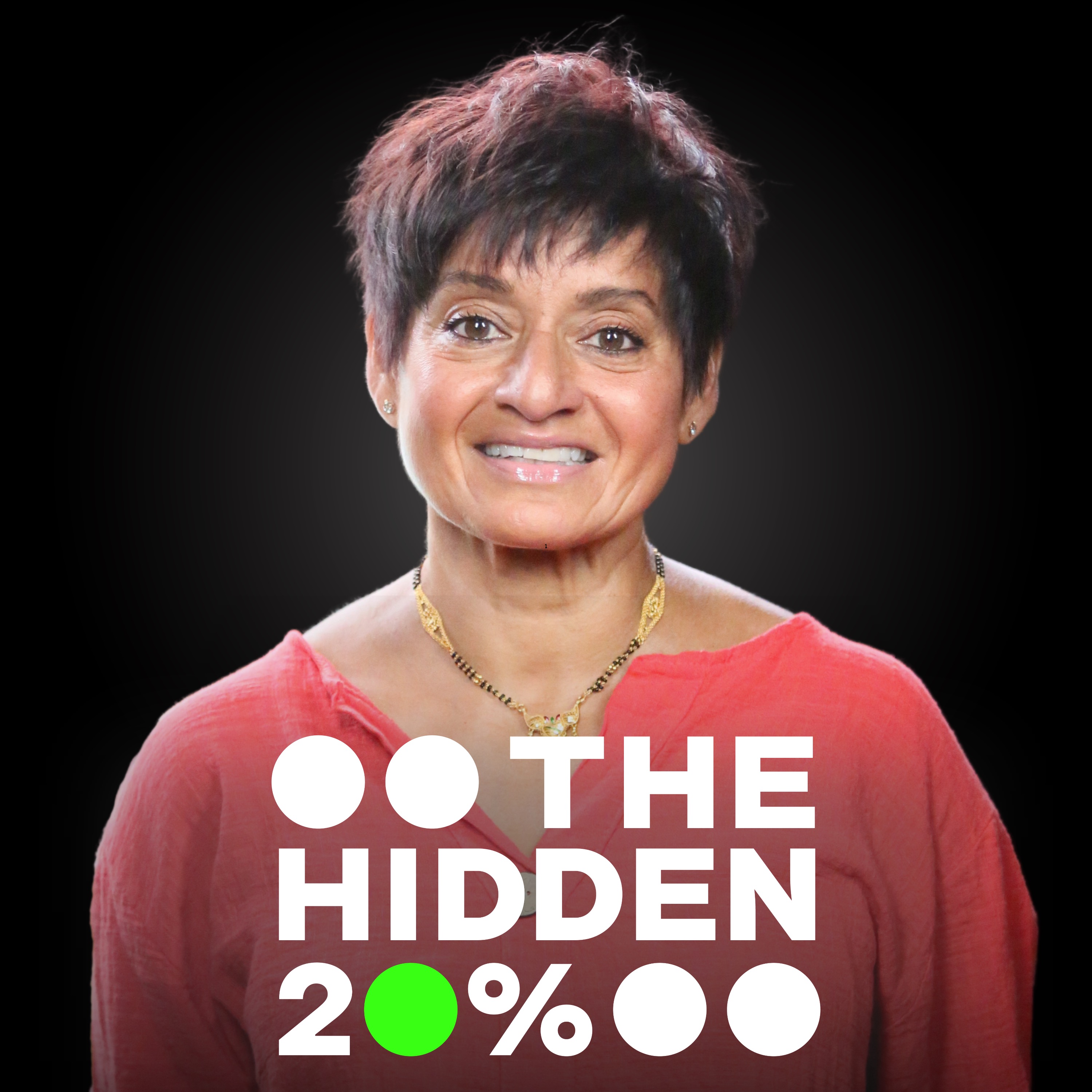
Dr. Nerina Ramlakhan, sleep expert and neurophysiologist (PhD King’s College London), bipolar/PTSD survivor; has worked with neurodivergent footballers, CEOs, and burnout cases. Also mentioned: her daughter Maya (21) as a “second green badge” recipient.
Written by AI. May contain mistakes.
Discussing strategies for parents to help neurodivergent kids sleep better.
“Let's see how great minds think differently.”
The importance of personal behavior in creating a safe sleep environment for children.
“And that's where the hard work of being a parent, because we were in that leadership role.”
Exploring hereditary factors and learned behaviors related to sleep.
“What do people most often ask you about sleep?”
Understanding the core benefits of sleep and how to improve sleep quality.
“And then I lovingly teach people meditation.”
Examining the purpose and impact of dreams on sleep quality.
“Yes, I go, whoopee, let's work on this one.”
Identifying nightmares and their relation to sleep disorders and stress.
“It was just that you remember it because it was so vivid because it happened in that phase just before you woke up.”
Discussing the impact of light, sound, and temperature on sleep quality.
“That's a way of breaking the cycle of the nightmare.”
Learn how to enhance sleep quality through environmental adjustments.
“But now, yeah, all of us actually want a fan on.”
Explore techniques for making hotel bedrooms feel safer for neurodivergent individuals.
“But also the fact that when you go and sleep somewhere new, I guess, as neurodivergent people who like routine and like their comforts.”
Understanding the role of smells and familiar items in promoting sleep.
“So for me, it's a mixture of lavender and eucalyptus on a tissue, which goes into my little handbag and I get it out and smell.”
Discussing the importance of creating intentional sleep conditions and routines.
“Yeah, well, knowledge is not wisdom, is it?”
Insights on how parenting influences perspectives on sleep and well-being.
“It's just she was born, she was due on the anniversary of my sister's death.”

Get the gist, explore an idea or ask about something said.
 Claude
On The Hidden 20%, what are the key points of this episode?
Searching your listeningAutomatic transcript. May contain errors.
0:00If we can sleep better, we can make better decisions. Sleep is the thing. Thomas Decker said it's the golden thread that unites everything. Dr. Nerina Ramlakhan is a leading sleep expert and neurophysiologist with a PhD from King's College London. Four books under her belt and decades of experience helping people sleep better. She's worked with neurodivergent footballers, high-powered CEOs, and people who've burnt out, broken down, and hit the wall because she's been there herself. After being sectioned and diagnosed with bipolar disorder and PTSD at 31, her entire life and career shifted, pushing her to rewrite everything we know about sleep, recovery, and the nervous system.
0:48Just a heads up, we do touch on some difficult topics such as mental health and abuse. Let's get into it. Let's see how great minds think differently.
1:04What about parents, as I am one, with neurodivergent kids and helping young people who are not thinking about powering down and when they're eating and don't have phones? But getting our children to have really good sleep when the world, in my view now, is more stimulating than it was in the 80s when I was growing up. Absolutely. We were in that generation, Gen X, where we knew the world before tech and with tech. So we are the space holders for these young generations. If we want them to do it, we have to do it ourselves. you want your children not to have a phone in the bedroom when they're a bit older you need to get your phone out the bedroom if you don't want your children to be in a high anxiety state you need to work on that for yourself you need to steady because we are constantly lending our nervous systems to the microcosm of our the macrocosm of our family we are a microcosm of the macrocosm of our family.
2:13You want the macrocosm of your family to be one of safety and steadiness and conscious choice. I have a red chair, a red velvet chair in my conservatory and my daughter watches me put the phone away. But she also watches me not put the phone away. Sure. And she goes, Mom, but why are you on your phone? It's true. And so I give it to her and I say, can you switch it off for me? You actually switch it off and put it in another room. So I guess the answer is we have to hold the space. It's really hard. You have to be the change. And that's where the hard work of being a parent, because we were in that leadership role.
2:46And I say this when I go into corporate environments, if you want a culture in your organization of safety, there's no amount of talking about trust and allowing people to make mistakes. It's absolute shit if you don't walk around with a nervous system, an embodied state of safety in your nervous system. You have to exude that as you go through the spiral doors of your organization and that lovely shiny glass and chrome building, if you're not exuding that yourself, your staff will not feel safe. And until people get this, until leaders get that, until our generation get this, and we need to stop whinging about the world that we've created and do something about it.
3:31What do people most often ask you about sleep? The eight hours thing, or I've never slept well, everyone in my family's never slept well. And is there a hereditary or genetic component to how well we sleep? Yeah, there is a biopsychosocial. Okay. I mean, you know, there is the biology of this. And then there's learnt behaviours within the family. I mean, I remember my father, he was diagnosed, they called it back then, manic depressive, highly driven, tenacious individual. Growing up in the tropics, I'd hear him walking up and down. He couldn't sleep at night. I'd hear him crying out at night.
4:08You know, highly traumatized man. My poor wife. Yeah. Who tells herself that when she wakes up at four o 'clock in the morning, she can't get back to sleep. Yeah. And that's a typical one. So I, and I say, how do you know it's four o 'clock? I looked at the time. And I'll go, you're on week six of the program. I'm still looking at the time. All right. So, I mean, I'm diminutive, but sometimes I have to get really fierce. Of course. So, you know, I just took a group of people in January through a six-week journey, and over 75 % of them are neurodivergent. And the beautiful human beings, the young ones, were lovely.
4:51And they wrote to me, and they said, God, it's changed my relationship. I'm able to study now. I'm at uni. But often it's the older ones who would say, no, I need my phone in the room. I need to look at the... And then I'm like, okay. Because, you know, they've got these tram lines of behavior. So we've got the genetics, yes, but we've got such a leeway of potential in terms of changing our behaviors. When you know that this is not working for you, you can do it different. You can override the genetics, change your behavior. So I tell them, you know, get off the phone, get the phone out of their mind.
5:26Yes, stop checking the time. And then I lovingly teach people meditation. So once they've been doing the five non-negotiables for two or three weeks, and I can sense a softening in the nervous system. They come back to me. I don't ask them, are you feeling safe? They're already telling me. They might be the management consultant who's going, yeah, I'm now seeing a career consultant because I can't be in this environment anymore. I knew day dotty that actually that job is not helping you. You don't feel safe and it's not the space for you. But I'm not going to take them into career coaching. I have to help them feel safe.
6:00But I find that interesting. I think it's easy to kind of go, oh, I've got a lot going on at home or there's some family stress situation and therefore I'm not sleeping. And you can kind of easily explain that away. And I guess there can be, obviously, work worries that can creep in. But when you're talking about actually the job, like the actual your career choice is not conducive with you and sleep. Absolutely. What are the benefits of sleeping? God. I have so many files open in my brain right now so do I oh and it's hang on I just need to take a deep breath because you know as you said right at the beginning of this interview sleep is the thing Thomas Decker said it's the golden thread that unites everything right mind body spirit so if I can get them to start feeling better because they're feeling more rested I'm not even promising them you're going to sleep better.
7:00I'm promising them to get them feeling more rested. And I'm going to be fierce about that. And I'm going to say, you will still wake up during the night. But it won't matter so much because I've helped you to tap into a restful state, which starts to give you more resource and energy. So you can then start addressing whatever it is, the relationship, the bereavement, the trauma from whatever happened when you were seven years old that you now are ready to deal with or the work situation because your boss is a you know whatever it is or that thirst within you to write that book you've now got the resource to do it yeah you're more quick and i learned this when i started repairing my relationship when i was 34 that i started being resourced to then deal with all of the stuff of my life.
7:48My sister died shortly after that. The trauma of grief, the trauma of my childhood, I was then able to go back and unpack some of that. If somebody tells you that they have a lot of dreams, what does that tell you about their sleep? Yes, I go, whoopee, let's work on this one. Let's work. I mean, that's probably three sessions worth of unpacking. First of all, let's get your nervous system cleaner. Dreams, we dream for all sorts of reasons. It might be that you're just overstimulated from the world. It could be overstimulated from stimulants. It could be the vaping. It could be the caffeine. Should we be dreaming?
8:22We should be. Everyone dreams. Not everyone remembers their dreams. So I spend a lot of time educating people about the value of dreams, the purpose of dreams, the different types of dreams. We are dreaming a lot of dreams that are related to simply handling too much information because we're on our phones and our devices too much. So we want to get that a little cleaner. And then you drop down. And let's get the caffeine out of the system and get you off those energy drinks. Then we drop down a bit more. Okay, what's happening to the dreams now? And then you might get to this point, you might get them doing breathing, journaling, meditating, calming, being able to sit in stillness.
9:00You know, walking in nature without the phone. And then the dream quality starts to change. Then you might go, ooh, can we start doing some dream journaling? Look at the stories you're unpacking. How long do dreams last? There's all sorts of science around this and there are all sorts of specialists. Dreams can last microseconds but feel like hours. Really? My dreams last night felt like hours. And also we dream when we go into phases of sleep, REM sleep. If you break down the science and architecture of sleep, dreaming in 90 minute cycles, there's a slice of REM sleep that happens just before you wake up in the morning.
9:35And that chunk of REM sleep is your longest period, can be your longest period of REM sleep. And you can have your most vivid dreams then. And they're most vivid because your deepest deep sleep happens in the earliest phases of sleep. So just before you wake up, your deep sleep becomes shallower. In other words, you're transferring the information from your subconscious into your conscious pot more efficiently. Long-winded way of saying you're going to remember more. Yes, yes. Yeah. And you wake up and you go, I think it's true. I was dreaming all night. You weren't. It was just that you remember it because it was so vivid because it happened in that phase just before you woke up.
10:16So then what's the difference apart from good and bad between a dream and a nightmare where sleep is concerned? Nightmares are, I don't have them as often now, but it belongs to a group of sleep disorders called the parasomnias. And within that category, you have things like nightmares, night terrors, sleepwalking, sleep talking, teeth grinding, bruxism. Surprise, surprise. A lot of people. I'm seeing so much more of that now. People grinding their teeth at night, having to wear mouth guards. So nightmares is definitely an overstimulation of the nervous system. Often when I start breaking it down and working with it related to an overload of emotion.
10:59And that can be most recent stress, everyday stress. It can be related to trauma related stress that needs unpacking. You talked quite a bit before about, you know, sight, sound, smells. And obviously when you're asleep, you close your eyes. I am assuming that our eyelids can detect light when they're closed. Yeah. You're going to have a different night's sleep if you sleep in the dark versus with the lights on. Yes? Let's unpack sight, sound, smells. Okay. Let's start. Let's get really practical about this for your audience. Yeah. You can even see through the closed eyelids as well. So the hunter-gatherer will perceive changes in light levels and the neurodivergent sensitive sleeper, very, very sensitive to sights.
11:48So they'll know the streetlights. They will perceive as the light levels increase throughout the night, they will know as you're going into the 2 to 4 a.m. They'll know and that can supercharge the cortisol response even more. so it's really important that you have those blackout blinds or you have those clocks that can bring the light levels up gradually if you have to wake up to an organizational timetable for example and you've got blackout blinds or you have the chink of light as i have with my curtains or if you want to sleep a bit more so i use a weighted lavender eye pillow which has a dual effect the weight it has a triple effect probably the weight is a somatic exercise if i wake up from a nightmare.
12:32I go to the toilet. That's a way of breaking the cycle of the nightmare. Don't look at the time. Come back. I stroke my dog. That's a somatic way of bringing myself into safety. My rescue dog is one of my greatest therapists. I come back into the bed. I put the weighted eye pillow back on my bed. It restarts a sleep cycle, somatically brings me out of my head back into my body. The horizontal brain is more likely to go into overthinking than the vertical brain so you get horizontal again your mind goes crazy but i put the lavender weighted pillow there so it stops the light from intruding so it helps to guide me back in again to my so this is beautiful for your children to get these and i don't like sleep masks yeah i was gonna well i don't like them yeah i've never found one that really works for me but i like the fact that i can go into phases of sleep and the lavender eye pillow drops off and that's okay i don't need the wait on my eyes anymore.
13:27Do you recommend a sleep mask? I recommend eye pillows, yoga eye pillows. Okay. You know, the ones you use in yoga classes where at the end they put you in shavasana and that. So I love those. I have one beside my bed, but for some people, I mean, on an airplane, I use an eye mask because if I'm not paying to lie down, which is often the case, then I'm sitting upright and I've got an eye mask. So that's sight. Let's do sound. White noise. White noise, really important. Good. Good. Right. So the white noise for me is always a fan. I think when it was hot. Okay, let's get some air in. But now, yeah, all of us actually want a fan on.
14:06We do. And hospitality industry, can you freaking well get this right, please? I am sick of going to hotels where you ask at reception, please, can you put a fan in the bedroom? And they'll say, we've got an air conditioning unit that's got a fan function. You cannot use that for white nose it's pathetic it doesn't cool the room down sufficiently just an old-fashioned fan in the bedroom white noise it can create white noise but you can also create the right temperature for you as well if you hate air conditioning which i do you need your bedroom to feel right it needs to be a fraction of a degree cooler than your core temperature to switch on the circadian timer so get a fan in the room you can get white noise machines but then obviously it'll be on your phone you'll need to switch that on but i've just come back from a holiday where they refused to look for a fan for me even though I said I'm a sleep expert I'll give you an amazing trip advisor anyway you know hospitality get fans in bedrooms this will give you a USP yep you know not so much on the pillow menu I have a pillow that is molded to my right shoulder that I bought from Amazon because it helps my neck and my back and 90 % of the time I take it when I travel yeah a recent trip to the US I didn't two nights I had on planes as well and then three nights in two hotels without my pillow my neck and back really painful yeah and I had poor sleep yeah I know my daughter has the same and she has a chronic pain condition so the pillow is really important for her as well sleep position but it really varies from one person to the next and we sleep when we feel safe and they would purists would say sleep on your back in corpse position but i always have to be on my right side clutching a pillow i don't like those neck pillows like the one you've got i like of extra soft down one that i can even plump during the night but tactile somatic sense is really important i travel most places with a blanket this is really important for the neurodivergent sensitive sleeper sight sounds smell touch touch weighted blankets for some people not for others I can't I can't get on with it no I can't either I'm hypermobile which is often the case with neurodivergence I have actually sprained an ankle with a weighted blanket even though it was the right weight for me it didn't work so I feel trapped in a weighted blanket a bamboo blanket I love and that went to the tropics with me one side is cooling the other side is heated but sheets don't work I need a critical weight in order to feel safe I think we need to be more fussy about our sleep basically we really do And hospitality industry, get this right, because the neurodivergent population percentage is growing.
16:49Yeah, it is. But also the fact that when you go and sleep somewhere new, I guess, as neurodivergent people who like routine and like their comforts. Totally. Makes you feel safe. You know, going and sleeping in a hotel can be exciting, but also it's a total change of everything. First thing I do, since from May till now, I've slept in three spaces. the most stressful one was going back inverted commas, home to the tropics my sleep nervous system, I needed recovery when I got back because I used every trick in the book including audiobook so most nights I'd be listening to the same book and for my daughter hers is Harry Potter and mine is this You Are A Channel it's downloaded so I don't need the wifi and I'm listening to Sarah Landon's voice over and over again what about smells?
17:36It smells ultra, ultra, ultra important. So important. I've even traveled in here with a particular smell. So I was using it on the underground. So for me, it's a mixture of lavender and eucalyptus on a tissue, which goes into my little handbag and I get it out and smell. I don't need it in this interview because I feel safe. Yes. You know, but I'll use it on the trains on the way home. But then bedrooms. In bedrooms, the first thing I do when I get to a hotel room is get the crap off the bed. those dirty cushions and throws which have been on the floor get them off the bed for me I've got a thing about dirt on the bed anyway yeah so get that off how can you make this bed feel as safe for yourself as possible sights and smells get your side of the bed working for you negotiate with your partner who might not be neurodivergent have this conversation tell them why you need your side of the bed okay choose the book that you're going to read when you're on holiday set up your bedside table set up your smells which you have used in your sleep space before you came out so now your nervous system knows to receive the smell as soon as I get into my hotel room I sprinkle very liberally albersoil and lavender onto my bedsheets so that it smells like my bedroom at home interesting yeah I will put my blanket on the bed and I'll have my book there I'll have a picture of my late sister that just the sight of her makes me feel safe yeah you make it your bed i make it my bed yeah that's my water bottle there so i'm not going to wake up i look for visual signs of the time in the bedroom and i cover them over i close the curtains and i walk around the room in the darkness looking for where's the toilet where's the this i don't want to wear the cupboards during the night you know where's the this how do i get to the toilet in the darkness because i don't want to put all the lights on Yeah.
19:29You know, and I learned this with my daughter when we went to Egypt when she was little and split her eyebrow. You know, she walked into a door in the night. Yeah. You know, so you've got to get those. Do you need safety lights that you can travel with? Yes. All of that kind of stuff. It's so great to talk to you. And I'm hoping for our audience of just like some of this stuff we know. We know what kind of being overstimulated or having a coffee before bed or eating too late or watching something really high intensity stressful before trying to get to sleep. We kind of intellectually know some of this.
20:07Yeah. But it's difficult to put into practice. Yeah, well, knowledge is not wisdom, is it? And common sense is not always common. No. And then sometimes we don't really know. I mean, my daughter and I, we're different, but we're so similar. But we sit and watch television. She's coming over to stay tonight. I can't wait. Just the smell of her makes me feel safe. I adore her. But she'll want to watch something on TV, which really dysregulates my nervous system. And it's a bloody reality show. And I know it dysregulates me because my wearable tells me. And it took me years to work that out because I thought there's no one being killed, but they're just having arguments all the time.
20:45And it's so capitalistic. There's a billion word in there. And I love it, but it just regulates me. I'm going to have to really power down before I go to bed. And me and little rescue dog are going to have to sit on the decking for 10 minutes afterwards. But the one big thing I am taking away from chatting to you today is this kind of idea that I do have the power to create the right conditions for myself to feel safe enough to go to sleep. That sounds so simple, doesn't it? It is, and I love simple. But regardless of like kids waking me up or dogs or whatever, you know, all the other stuff that goes on.
21:29That power lies inside of you. Yeah, yeah, I really can't do that. And there is a place in all of us. There is a place in all of us where that lies and we can all get to it. And it's not expensive. It's not about tech and wearables and tracking and lights or crazy devices or stuff they try and sell you on Instagram. There's a whole powering down the brain and that first choice of the day that you make, let it be one of meeting yourself. Just put your hands on your belly. Keep your eyes closed. breathe into your belly meet yourself and it might be a storm or it might be i'm going to talk to ben today or whatever but just do that even do it for 60 seconds and do it for the next 10 days and notice the difference notice what starts to happen to your i'm going to see because two of my girls and my wife have been away for a few nights yeah we're all back tonight and so and I will be back for bedtime and so I think I'm gonna have a bit of fun taken out of me for oh god here we go here's another like I get can get a bit sergeant major of like right guys family meeting let's talk about sleep yeah my last question is who would you give your second green badge to my second green badge undoubtedly no brainer would be Maya my daughter Maya Nirvana she's my greatest teacher and she's amazing and she's very wise and she's incredibly wise she's 21 we've been on such a journey and I was so scared to be a mother but she teaches me every time she blows me away and we're so different so incredibly different but she grounds me in many respects and she infuriates me as well every time you talk about her your eyes glaze I know.
23:24It's just she was born, she was due on the anniversary of my sister's death. And because she hates transitioning to the next thing, she took 10 days. And that's her. She takes not always 10 days. I'm driving me nuts. But she takes ages to go from one thing to the next thing because she finds transitions really hard. And she's my inspiration because, you know, I see a lot of young people feeling a bit hopeless at the moment. and she reminds me to keep doing the work that I do because I think there is hope. Yeah, and please, please keep doing the work that you do because if we can sleep better, we can make better decisions.
24:06Absolutely, it's the golden thread. It's the golden medicine that nature's given us. Yeah, it's the good stuff. Thanks, Norena. Thank you, Ben. You've been listening to The Hidden 20%. If you're still knocking about, then let me introduce you to the band. First up, main man on the mic, host Ben Branson. Our wonderful producer, Bella Neal. And the man who'll probably try and cut this bit, video editor James Scriven. Not forgetting our wondrous theme tune by Jackson Greenberg. Lovers or haters, we want to know. So be sure to leave a review wherever you're listening. For the lovers amongst you, you'll find us on TikTok and Instagram at Hidden20Podcast or over on Hidden20.org where you can join our mailing list.
In part two, Ben and sleep expert Dr. Nerina Ramlakhan dive into the practical side of sleep. They discuss how parents of neurodivergent children can better support rest, the most common questions on sleep, and why it’s the “golden thread” that unites everything.
Nerina unpacks the science of dreams, the role of our senses, and shares practical tips - from sleeping in new places to strategies for emotional regulation. With warmth and wisdom, she reveals how small, intentional choices can transform the way we rest.
CW: Mental health and abuse
00:00 Introduction
1:05 Sleep Tips for Parents of Neurodivergent Kids
2:46 The Corporate World & Creating a Safe Nervous System
3:31 The Most Common Questions About Sleep Answered
5:08 How to Change Unhealthy Sleep Behaviours
6:29 Sleep as the Golden Thread That Unites Everything
7:58 Why Do We Dream? The Science Behind It
9:12 How Long Do Dreams Actually Last?
10:16 Dreams vs. Nightmares: What’s the Difference?
11:07 How Sights, Sounds & Smells Impact Sleep
15:40 Touch & Sleep: Best Accessories for Better Rest
16:50 Dr. Nerina’s Top Tips for Sleeping in a New Place
19:43 Emotional Regulation & Setting Boundaries for Better Sleep
22:41 Dr. Nerina’s Green Dot Badge
_________
On "The Hidden 20%," host Ben Branson chats with neurodivergent [ADHD, Autism, Dyscalculia, Dyslexia, Dyspraxia, Tourette's etc.] creatives, entrepreneurs, and experts to see how great minds.. think differently.
Host: Ben Branson
Production Manager: Phoebe De Leiburné
Video Editor: James Scriven
Social Media Manager: Charlie Young
Music: Jackson Greenberg
Brought to you by charity The Hidden 20% #1203348
______________
Follow & subscribe…
Website: www.hidden20.org
Instagram / TikTok / Youtube / X: @Hidden20charity
Ben Branson @seedlip_ben
Dr. Nerina Ramlakhan @drnerina
If you'd like to support The Hidden 20%, you can buy a "green dot" badge at https://www.hidden20.org/thegreendot/p/badge. All proceeds go to the charity.
Hosted on Acast. See acast.com/privacy for more information.