
 Ask ChatGPT


 The Hidden 20%
29 Apr 2026 · 1h 3m · 31 chapters
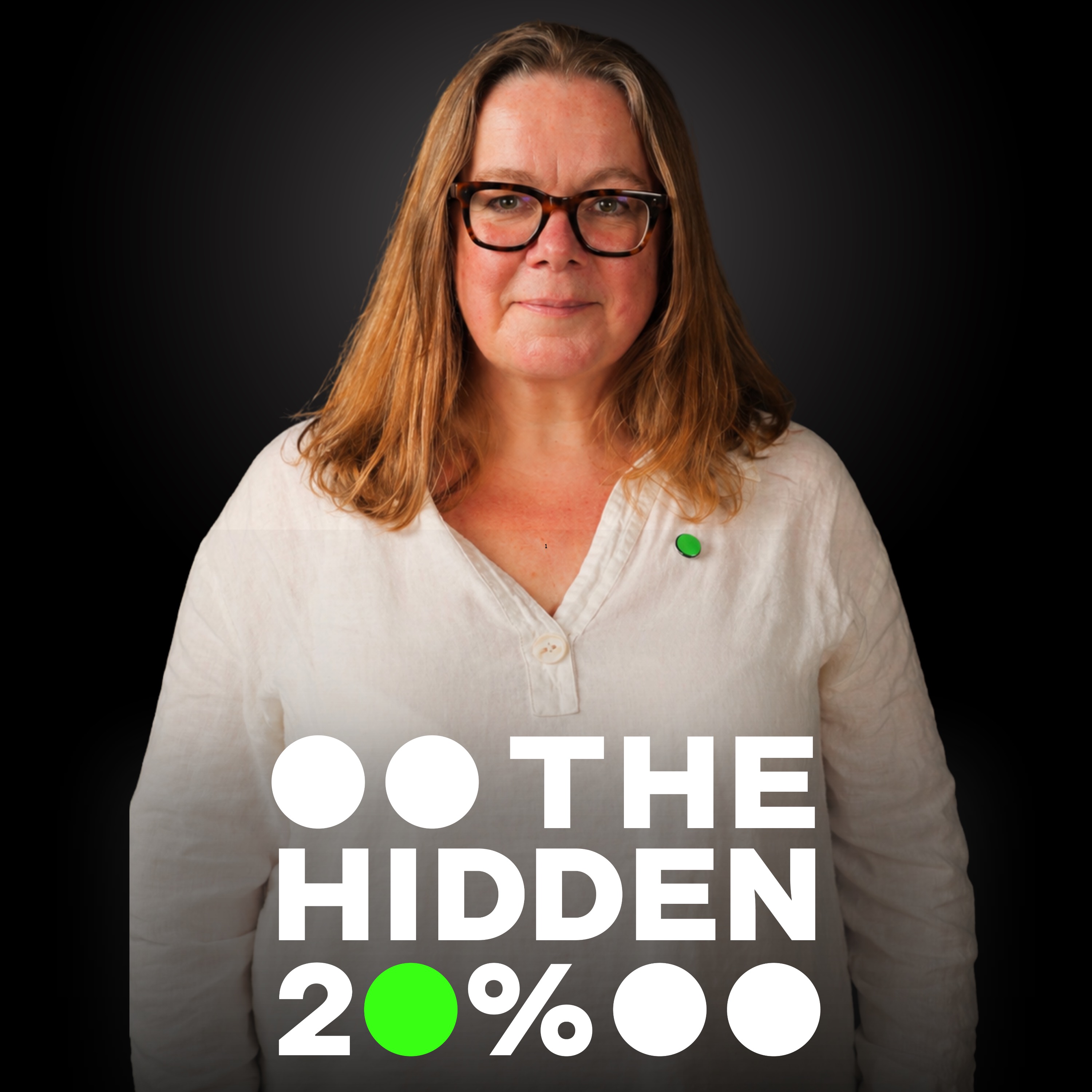
Late autism diagnosis in leadership, using nature as regulation and arguing for neurodiversity inclusion in workplaces and conservation.
Emma (autistic, late-diagnosed; grew up on a farm; internal intensity, masking at school; later became a board director and senior leader at the RSPB; works on communications, campaigning, technology; has misophonia and hates networking; describes herself as people-pleasing with rejection sensitivity dysphoria). Ben is the host.
Nature helps autistic brains “calm and slow down,” and autism plus environment leads to better outcomes. Female autism is often missed because masking hides traits. Leaders should role-model integrity, speak openly, and make reasonable adjustments easy to access. Society-level neurodiversity talk is “going backwards” amid blame-driven headlines, but workplace support is improving.
Lapwings on flooded backfields; high school noise triggering overwhelm; flirting example showing literal rule-following; RSPB inclusion systems (neurodiversity hub, manager tips, an adjustment “passport”); food-waste study campaign; sand eel campaign for 30 years to protect puffins; misophonia rage at eating sounds (leaving train carriages).
Written by AI. May contain mistakes.
Introduction of the guest and topics to be discussed, including nature and leadership.
“The best way you can help is really simple.”
Emma shares her upbringing on a farm and her connection to nature.
“Other times I'd just be on my own and I'd build little dens.”
Discussion on how nature provides calm and a sense of grounding.
Emma discusses her childhood memories of birds and the current state of nature in the UK.
“to do it just at least once in your life.”
Emma describes her experiences and challenges understanding social cues as a child.
“One in six species in the UK is at risk of extinction.”
Discussion on the concept of masking and the pressures of being different.
“You know, it's a really small village school.”
Emma reflects on her school reports and the importance of structure in her education.
“Just overthinking, constantly overthinking, analysing everything, questioning everything, mostly questioning myself and then questioning the world.”
Emma discusses her autism diagnosis and the importance of self-kindness.
“So yeah, I was good at certain subjects.”
Emma offers advice for neurodivergent children in schools, emphasizing kindness and self-acceptance.
“for females in school who are autistic, they're not going to be listening.”
Explore the complexities of autism, especially in women, and the challenges of social masking.
“And so then how do you hold the stereotypes around autism and that history and all those people we've missed versus your experience?”
Discuss the transition from school to career and the search for purpose after university.
“I felt so adrift because all the rules had gone again.”
Follow the speaker's diverse career path, from policing to environmental advocacy.
“Can you just give us a whistle stop of your career with that thread in mind?”
Delve into the initiatives aimed at reducing food waste and promoting sustainability.
“So as part of that, we started getting funding to look at food waste.”
Learn about the speaker's role at RSPB and its impact on wildlife and nature conservation.
“The head office of the Midlands sector was in Banbury where I was at the time, which was just like, this is too freaky.”
Discover how neurodiversity enhances work in conservation and the importance of inclusivity.
“Why is it wonderful being an autistic person working at the RSPB?”
Reflect on the speaker's realization of their own autism through discussions and experiences.
“So it was when someone just started working for me and they asked to have a conversation about reasonable adjustments.”
The speaker shares their journey of discovering their autism through a significant conversation.
“And also autism for me was autism displayed in men and boys.”
Discussion on how rejection sensitivity dysphoria impacts personal and professional life.
“How do you wrestle that with a strong sense of moral justice and speaking up or saying, hey, no, I don't think that's right.”
The speaker reflects on their initial excitement and subsequent challenges in sharing their diagnosis publicly.
“And I was like, no, this is really exciting.”
Exploration of the speaker's role as a leader and the responsibility it entails regarding neurodiversity.
“and, yeah, some of the stuff that you've obviously done at the RSPB because of saying you're autistic.”
Discussion on the historical significance of the RSPB's founders and their impact on wildlife conservation.
“I think because I feel this real sense of justice and honesty and the need for integrity, I think I am very open with people about my values and what I expect.”
Highlighting the ongoing campaigns for bird conservation and the challenges faced in the current climate emergency.
“Oh, well, survival of species, to be honest, it is an emergency.”
Learn about the various threats to bird species in the UK and how to help.
“And yet, so we're feeding our pets, but we're killing puffins.”
Explore the current state of neurodiversity discussions and societal attitudes.
“So, yeah, they would be the two things that I would absolutely say.”
Understand best practices for fostering a neuro-inclusive work environment.
“particularly around the change of menopause that's a really big factor for quite a lot of women where kind of again the rug's kind of pulled from under your feet the rules have disappeared again So I'd say more research.”
Discover the specific challenges autistic individuals encounter, including networking and sensory sensitivities.
“subjects like this so that people know it's not a bad word or there's nothing that can't be talked about.”
Delve into the complexities of bird feeding and its implications for conservation.
“to then going in networking and I just couldn't do it.”
Learn about the risks of feeding birds during specific seasons and the importance of cleanliness.
“That's a huge decline in species population.”
Discover the lack of resources for autistic females and the importance of proactive support.
“If I gave you a magic wand and said, forget about the birds again for the migrant.”
Hear about the vital role of allies in supporting neurodivergent individuals in the workplace.
“I think it is, you said it earlier on, we just need to talk about this stuff.”
Understand the significance of the Avocet badge in the context of conservation and neurodiversity.
“because it's very much to say thank you for being an ally to the birds and also an ally to those of us who are neurodivergent in the conservation sector.”

Get the gist, explore an idea or ask about something said.
 Claude
On The Hidden 20%, what are the key points of this episode?
Searching your listeningAutomatic transcript. May contain errors.
0:00That's when I started realising that I wasn't like everyone else, but I didn't know why, and so I blamed myself. No one ever talked about autism. No one ever talked about ADHD. No one talked about neurodivergence. I couldn't understand social cues. I couldn't understand the rules of the game. I've got this very fierce sense of justice, and I hate it if people aren't honest, but so many people aren't, even on a minor level, and I just couldn't get my head round it. Welcome to The Hidden 20%, our neurodiversity charity on a mission to rewrite the future for people who think differently. Together with you and an eclectic range of brilliant guests, we can break the cycle of silence by smashing outdated stereotypes, exposing the myths and sharing the most up-to-date truths about what it really means to be just different, not deficient.
0:54The best way you can help is really simple. Subscribe so you never miss an episode and if you can donate to our charity through the link below. Enough preamble. I'm Ben, your host. Let's get into today's episode.
1:15Emma, I'm super glad you're here for a couple of reasons. one we get to chat about birds and nature which is a wonderful topic two we get to talk about leadership and setting an example and being a good role model three we get to talk about change and how you have so much amazing experience of campaigning and how communication and changing perception and people's behavior is so key to that which is obviously incredibly important for the neurodiversity movement but I'd like to take us both back and start on the farm because that's where we're both from. Indeed. Tell us about your upbringing. Yeah yeah so born on a farm and my dad was a farm worker so we were in a tied cottage and two siblings and the fields the hedges were my playground basically my first memory is of sitting in the garden with an empty plastic ice cream tub one of the really massive ones yeah back in the day walls absolutely walls and full of mud and just being in heaven just having my hands just in the mud first memory can't remember anything else but out on the farm just yeah I would spend the entire day out there and sometimes I'd be with my cousin who lived in the village.
2:44Other times I'd just be on my own and I'd build little dens. And yeah, it was incredible. Very lucky to have that experience. It was always transitory because we didn't own it. We were a rural working class, but it felt very much like home. It was very grounded. And what do you think that gave you or what did that teach you? Oh, a completely innate love of nature like I have more affinity with nature than I do humans so I can just spend hours just sat listening watching it made me really appreciate how the rhythm of nature that is now my rhythm and vice versa and so as soon as I'm back out in nature everything calms everything slows down I've heard you say that nature gives you that sense of when everything's just right yes utterly there's something about my heartbeat goes down and I feel a complete sense of calm and the world's okay yeah particularly if I take my shoes and socks off and stand I can stand on mud or grass and it's like yeah all right no matter what's going on I'm all right yeah it's so simple isn't it yeah actually can feel weirdly out of reach or inaccessible to be able to take shoes and socks off and be grounded.
4:10Completely and kind of like if you're out and about like oh I look a bit weird doing this it's not weird it's really natural it's more weird actually having shoes on but you know so I would encourage everyone to do it just at least once in your life. And what are your memories of birds in childhood? Probably the bird that sticks so much in my head is the lapwing because there used to be thousands of them on the backfields. It was always flooded. And so it was just humming with them. And, you know, when they were doing their displays during breeding season, it was so wonderful. And they're mad because they've got this kind of bouncy kind of flap on the top of their heads.
4:49And they're just, their tails just bob, bob, bob, bob, bob. Completely. They're just amazing. And the noise. Let's not, yeah. It's just wonderful. And I would just spend kind of hours watching them. But I think the reason they stay most in my head is because there's hardly any left. You probably see about two or three in the backfields now. But yeah, it's really showed to me just how depleted this country has become with nature. Yeah. And we are, and I've also heard you say, we are one of the most nature depleted countries in the world. We are. All four UK nations. It's not just England. You always think, oh, Scotland must be much higher.
5:25All four nations, completely nature depleted. One in six species in the UK is at risk of extinction. That's terrible. Even higher for birds, 43 % for birds. Really? Yeah. And we're just kind of taking them for granted, watching them disappear. Yeah, it's crazy, isn't it? And the hedgehogs. Let's not forget the hedgehogs. How would you describe your brain as a child? So I was very quiet. But if I was inside, I was happiest if I was sat under something watching. So I would often sit under the sideboard and just watch out. Because I always used to like watching people. I found them really confusing.
6:04But I quite liked watching them. And then I'd mimic them. Yes. It's my way of learning. But yeah, I was quite an intense child, I would say. I took things very seriously. So I wanted to understand why. Yes. And I think my mum found that very annoying. But overall, it was just, yeah, watching, thinking. I kind of would lose myself for days in books. And if not, then I was out on the farm. So, yeah, my brain was very fast until I got outside. Okay. Then it would calm. And how was school? Primary school was okay. We were a tiny school. So in my year, there were seven of us. The year below us, there were three.
6:46You know, it's a really small village school. So it was never overwhelming. Kind of even in the playground, I think the total in the school was about 30. So you could have your space. As soon as we went to high school, that became just too loud, too much, because high school was then 2 ,000 kids. Wow. And you suddenly stopped everyone knowing your name. And that's when I started realising that I wasn't like everyone else, but I didn't know why. And so I blamed myself. Okay. So, but yeah, I couldn't understand social cues. I couldn't understand the rules of the game. I've got this very kind of fierce sense of justice.
7:24And I hate it if people aren't honest. But so many people aren't, even on a minor level. And I just couldn't get my head around it. And so I would just feel this deep sense of injustice if people didn't play by the rules that I thought they should be playing by. So, yeah, I kind of struggled for quite a long time. and ended up just copying my friends. So I remember one very particular example. I didn't understand flirting. It made no sense whatsoever. And I had two friends who were brilliant at it. I was like, come on, you've got to tell me how to do this. And they said, oh, well, you know, you just push the boy and then you giggle and run away.
8:06And I just looked at them and thought, this is not for me. I just went back to reading a book. Because I was like, that's just madness. what's the point of that exactly I'm not a fool so yeah I would copy to up to a point and then if I couldn't make my brain process it I just yeah would kind of step back that sounds tiring very sounds like you internalized and obviously masking yeah not that I knew that it was sure but yeah sure and what was going on around you in terms of neurodiversity ADHD or autism what were you aware I mean, pretty much nothing, basically. No one talked about it. My mum's view was, Emma, don't be different.
8:48Sure. So I didn't know why I was different, but it was just, just don't be different. You know, working class, you don't want to stand out. And so that was always the thing that I was always told is just don't be different. So more and more I would mask to make sure that I was like everyone else. Yes. But no one ever talked about autism. No one ever talked about ADHD. No one talked about neurodivergence. I knew someone who was dyslexic. Okay. That's probably about it. Yeah. And what were your school reports saying? So I was quite intense, because back to my childhood brain, and I was good at particular subjects where I would really lose myself.
9:25But I just want to clarify the intense thing, because I think sometimes we can take that as being external intensity. No, internal intensity. Absolutely internal intensity. Just overthinking, constantly overthinking, analysing everything, questioning everything, mostly questioning myself and then questioning the world. Yes. So yeah, my brain never stopped that kind of whirring in the background. And then I'm guessing nature played a role in that as an outlet. Yes. So that's when I would spend as much time as possible outside if I could. Yeah, completely. I relate to so much of that because being outside on a sports field or being outside in the woods or being outside in a tractor or a field or on a horse or whatever, that space and like air.
10:15Yes, complete air. Yeah, just fresh air. Yeah. Often those times needing to be on my own. Yes. Because school was so intense, so many people, so much noise that, yeah, being outside quiet on my own, that was key. And who did you share this with? Who did you like say anything to? Did you? I don't think I did, to be honest. So my closest friend at that point would have been my cousin. We were only three of us of teenage years in my village. So, yeah, me and my cousin would share a lot of that. But then as I got older, I didn't want to be a freak. So I wouldn't really share that kind of stuff. So yeah, no, it was all in my head until I met my husband, which was, I was 16 when I met him.
11:03So that was the first person who I went, oh, your brain works like mine. Okay. And that was a wonderful revelation. Okay. I'm so sorry, I just take you back because I interrupt you to your school reports. So yeah, I was good at certain subjects. As they would say, I was kind of very kind of committed, I would say. It was always a good school report. There was never anything difficult. I really quite liked the classroom. Okay. It was outside the classroom that I struggled. Interesting. So I liked the structure, the order. Timetable. Exactly. I knew how everyone should behave. You know, the rules were quite clear.
11:39Yes. We had quite strict teachers. That was marvellous. My history teacher, Mr. Headley, was really strict. I thought he was wonderful. Everyone else was kind of like, oh, he's so strict. I was like, oh, no, it's great. I know where I stand. Yes. Leave the classroom. That's when I had to kind of find it really difficult because there were no rules at that point. And what interests did you have? So it was mostly books, to be honest. I was a real bookworm. So I would lose myself in different worlds. I liked quite historical books. But yeah, give me anything to read and I will read it because my brain just likes whirring and kind of having all of that information.
12:17Yeah, that feeds you. And so now you are diagnosed autistic. How do you reflect back on your childhood? So I think I was lucky in that growing up in a really small village, I had my space. Yes. I think I'm kind of glad I didn't know because I'm me because of what I went through. So I don't kind of have that regret, but I do wish I'd been kinder to myself because I thought it was all me. I thought there was something wrong about me because I wasn't like everyone else. And now I know I'm just wired a bit differently. So yeah, it would have been nice to have had many years of being kinder to myself.
12:59And therefore for children in school at the moment who will be doing a lot of what you said you were doing, and we know this to be incredibly true for females in school who are autistic, they're not going to be listening. But what would you say to them if they were? I think it does go back to be kind to yourself. Sometimes you're going to have to mask. I do honestly think, I still do. I think you just have to. The world is not designed for us. But be kind to yourself about it. Kind of know when you're doing it so that you can step back a bit and not let your brain go into overdrive with it. And then the other thing is find something just for you outside of school.
13:47Something where you can be truly you. You don't have to pretend to anyone. It's just you. You and your brain. And know that that's a great space to be in. I think if you don't know that you need that space, it can be a really unsettling time. And so then how do you hold the stereotypes around autism and that history and all those people we've missed versus your experience? How do you wrestle with those? I think it's really hard for girls because everything you're told about autism is not what actually presents in female autistic girls. Yeah. Girls. And so that's really hard because you just don't realise, no one's going to spot you if you're masking really, really well.
14:32Yeah. You know, told that, oh, you'll be a loner. Well, actually, yeah, I was masking so that I could be the person at the front trying to make people laugh. Yeah. Do you like socialising? No. No. No. I mean, I do with people I trust. Okay. So those people. Do you like connecting with people? I do. I like connecting with people, but I don't like socialising. Yeah, it's exactly that. When you meet people that you feel you can actually connect with and also you meet people that you feel you can trust. Yep. Lovely. Love it. It's the bit where you've got to interpret social cues, where everything's on a surface level.
15:11I just, I really hate that. And I hate loud rooms. Yes. Because I can't hear anything. Yeah. It's all just one big noise. Yeah, I'm with you on that. So you leave school. Yes. With a strong sense of moral justice, well-versed in masking, what did you want to do? So, well, the first job I ever wanted to do was be a toilet cleaner. Okay. I came across some lovely toilets when I was about seven in Lowestoft. They had little kind of vases of flowers. I thought, this is lovely. Anyway, that soon passed. I then wanted to be prime minister. Okay. I was absolutely determined. I wanted to change the world.
15:48Yeah. The world didn't seem right to me. Yeah. I remember writing to Margaret Thatcher complaining when she took away the milk from schools. I was so young when this happened. I kind of felt that I needed to change things, to change the world, to make things right. And then the world wasn't quite as easy to change. So I went to university. Mum and dad did not want me to go into anything to do with the land. I was the first person in the family who had the opportunity to go to university. Okay. And that was just massive, the whole kind of extended family. So that's what I did. And they didn't want me to do the land because they felt the family had always worked the land and actually it was time for something else.
16:30So I did my other love, which is politics. So I went and did international relations and politics, which was fascinating. But my whole end goal had been to go to university and get a degree. So the point when I kind of got my degree, it was like, I have no idea what to do. Absolutely no idea. I felt so adrift because all the rules had gone again. And the structure of my life had just vanished. But this keeps cropping up around these transition times, just hearing from parents or teenagers, these key moments where the rug gets kind of pulled. Yeah, completely. Yeah, and the structure goes and the timetable goes.
17:17And there's no rules to take you into the next phase. You're just suddenly supposed to know how to do it. Yeah. And I found that so hard, so hard. I didn't really know what I wanted to do. Jobs market was kind of pretty horrendous I moved back home But that was to a tiny village in the Midlands So there was nowhere to go for jobs So in the end actually I went and moved down to London for a job Which was very full on Yeah To go from a small village to London It was a graduate scheme with the Met Police It hadn't been anything I ever wanted to do But it ended up being very interesting But it gave me structure Yeah And from then on I kind of worked my way through The through line of your career from my perspective right now to your role with the RSPB seems to have this incredibly strong undercurrent of moral justice.
18:11Like everything you've done. Can you just give us a whistle stop of your career with that thread in mind? Because you have changed stuff and you wanted to change stuff and you are changing stuff. and I think you're an amazing role model in that sense. That's very kind of you. So I went to work for the Met Police and witness liaison for two years of my life. Absolutely fascinating. Was all about, again, trying to do the right thing, believing in the right thing. But I realised it wasn't kind of the full career for me because I wanted to go into protecting animals because the Met had then a really amazing wildlife crime team.
18:53Couldn't do it for many reasons. to do with all kind of internal stuff there. So I decided I needed to move on, go and try the commercial sector. You know, I'd always been told you need to work in the private and the public. So I went into the commercial sector working in mobile data and ended up working back with the police, putting mobile data back into their cars. So that was dispatching police officers out and about on the road. So nothing that I'd ever done before, but it was my first kind of journey into the world of technology. but again I was so longing for something that was to do with the environment that was to do with climate that was to do with nature just really wanting to get back to that so I took a year out sold the flat worked with HDRA as was then now garden organic so doing in their horticultural field worked with BTCV which was the British Trust for Conservation volunteers for a bit worked at a vineyard for a bit just kind of really building up my skills kind of to try and get into that sector and then saw a job with RAP the Waste and Resources Action Program and they had just been set up by the government to turn around everything on waste and recycling yeah and I went to work for them as a program manager using kind of the technology skills and started off doing communications on recycling helping councils and it was the early days so it was at the start of when the government was kind of doing all the communications about recycling helping people to use their bins and it was such an i mean it's people who don't like waste of recycling it doesn't sound exciting but i am still a bit of a waste of recycling nerd i still like looking at bins if you ever meet a waste of recycling professional whenever they go on holiday they will send you a picture of bins that they have found italy always had the best ones okay Sorry, I divulge.
20:45So as part of that, we started getting funding to look at food waste. I kind of kept peering in at the team that were looking at it. And it was absolutely fascinating. We did the first ever study of what people waste in terms of food from their homes. Hadn't been done anywhere else in the world. And we did diary surveys. We had professionals going through people's bins with their consent. Sure. And it turned out that we were just wasting as a country a staggering millions of tons of food. Why was your brain so good for that project? A, because I loved how fascinating it was because it was new.
21:25And B, because it was wrong. You should not waste food. I come from a farming background. I know how much it takes to grow the food that people are throwing away. So I was just really indignant about it. So I worked with this incredible chap, Andrew Parry, who was the brains behind it, did all the research. And another lady called Shona, who did all the communications. And there were Bronwyn and others who just, together we created a campaign and work with retailers to basically help the public, not waste food. we kind of dedicated our lives to it for quite a number of years and managed to actually turn around the amount of food that was wasted we juiced it down by i think it was gosh something like five percent over kind of a couple of years and even more over time and it's still going on now so that was really powerful because i knew we were doing good yeah that was fantastic but i kind of got to the point where i was like actually i need to hand this on to someone else because I've achieved what I set out to do.
22:30And the world of nature and wildlife was really calling out to me. I spotted this incredible job as a regional director for the RSPB. The head office of the Midlands sector was in Banbury where I was at the time, which was just like, this is too freaky. I went for the job and amazingly got it. So took on to be the director of the RSPB in the Midlands, which was just incredible. a wonderful team of people looking out across a number of nature reserves from Otmore in the south up to some beautiful places like Samwell Valley and yeah Coombs just really stunning places and I did that for a few years and then I was promoted to be the director for RSPB England so took on many more reserves across the whole of England a lot of reserves I mean as the RSPB we have over 200 nature reserves.
23:21233, isn't it? It is indeed. Thank you. Well done. Thank you. And we're the fifth largest landowner in the UK. Yeah, that is... All dedicated to nature. I didn't know that. That's a... It's brilliant. And it's... Most of those spaces are completely open to the public as well. Yeah. So we're doing it for the country to have that space to see the most incredible wildlife. And kind of a couple of years ago, I then took on responsibility for all of our communications, campaigning and technology yeah so yeah i mean rspb is just the most incredible organization i loved rap i still have a bit of my heart there but the incredible science the incredible knowledge i think the conservation that the rspb does is second to none it is just superb we have brought species back from extinction in the uk yeah i mean that is just and in and around the world yeah It's just so wonderful.
24:17Why is it wonderful being an autistic person working at the RSPB? So partly because the organization is incredibly inclusive. So we have lots of support networks. We have a neurodivergency hub, which has loads of information to understand more about neurodivergence. But also there's a hub for kind of tips for managers. managers, there's a whole section where as an individual you can find out kind of what reasonable adjustments are reasonable basically and then you have a passport that you can take throughout your entire career at RSPB. So every time you change your manager you don't have to go through the palaver of telling them all about it, it's just there and that is really helpful and partly because it's been found.
25:03So Joe Harkness did a book called Neurodivergency by Nature and came out in the last couple of years and he discovered that it's about double the amount of people in the nature and conservation sector you're a divergent why do you think that is oh so nature so exactly taking me back to being a child nature is a place where we all find our rhythm it's incredibly good for our mental health. It allows us to kind of work in a space which you're surrounded by stuff that keeps you calm. And particularly if you're actually working out on a nature reserve, that's incredibly helpful. You can lose yourself in special interests.
25:49That's a big one. You can go into the finest details about particular species. And overall, I think we think very differently. and it to solve the crisis of nature that we are actually in at the moment you have got to have all the brains on it and it is wonderful at rspb where you get the most incredible brains all coming together you know i always like to think of it's like you've got biodiversity everyone knows that's brilliant because you've got all of kind of the natural world there and then you've got neurodiversity you've got all of the brains and when you bring the two together actually you can change the world yeah and that for me is well it goes back to my kind of what I always wanted to do which was to change the world yeah but I'm reminded of Dr Luke Bearden who sat in that chair and his equation that I keep telling everyone about because it's so wonderful which is autism plus environment equals outcome absolutely and when you talk about and we know the high sense of sort of moral justice coupled with the impact and wonder of nature put those two things together from a conservation and a and a climate crisis perspective yeah you you would hope that's a recipe for for change completely where in this journey did autism then as a word and a phrase start entering into your psyche?
27:20So it was when someone just started working for me and they asked to have a conversation about reasonable adjustments. Okay. And, I mean, they are the most incredible person anyway, but then they were talking through all of these adjustments and they were really nervous, like, oh gosh, you know, is that possible? I was like, well, of course it's possible. You're a genius. Of course I'm going to make space for you. And as they were talking, more and more, the more conversations we had, It was like kind of looking in a mirror and I thought, crikey, this is very, you know, but no, it's fine. I'm just, I'm a bit different, but I'm not autistic.
27:55Why couldn't you be autistic? Because I would keep going back to one, my mum saying, don't be different, Emma, that kind of constantly stays with me. And also autism for me was autism displayed in men and boys. Not, I didn't, I'd never heard of autism in girls. It was just one of those things that we kind of never, ever talked about. So that kind of stayed with me. And I became really interested so that I could help kind of anyone that worked for me. So I was very interested, but kind of still wasn't viewing it back at me. And then someone very close to me was diagnosed. And whilst I was helping them go through the process, the person who was doing the pre-diagnosis said, I think you might like to have a conversation.
28:42and she specialized in female autism and I was like I suppose so you know it's not gonna harm and then by the end of a four-hour conversation it was like oh this explains my life and one of the most interesting bits of it was when we started talking about rejection sensitivity dysphoria and that just explained so much about my life right from childhood where I could not bear upsetting anyone and I took it like a physical punch if I was criticized even if it was not really criticism sure and then all the way through with professional work I'm such a people pleaser such a people pleaser and it's all through that because I just I don't want the physical sensation of letting anyone down or feeling as if I'm being rejected so I'll constantly try and be this perfectionist so that everything I do is even better than anyone thought it could possibly be which again is exhausting.
29:40How do you wrestle that with a strong sense of moral justice and speaking up or saying, hey, no, I don't think that's right. How do you wrestle those two? Well, I mean, it's that I have to speak out. So that is my perfectionism in that space. So if I don't speak out, then I feel that I am letting everyone down. And being dishonest. And being dishonest. I really feel that. Yeah, yeah, yeah. where you're complicit if you're not calling it out. Yes. Then I'm just hiding like everyone else. Yeah. And I'm as bad as the people who are judging others for being autistic or neurodivergent. So, yeah, I feel I have got to speak out.
30:23I have got to show that our brains are wired differently. It doesn't mean we're flawed. It doesn't mean we're wrong. Just different. And actually, you can be anything you want within reason. Sure. But yeah, people are just incredible. And when you get all the different brains in one room. Yeah. And so how was that moment when you realised that you might be autistic? To start with, I was kind of like a bit giddy about it. And then I overshared. Okay. And someone said, whatever you do, don't overshare because you'll regret it. And I was like, no, this is really exciting. And then I overshared and I got one negative comment where someone in a professional context said to me, oh, well, I've heard that autistic people can possibly live a full and wonderful life.
31:12And I was like, oh, it floored me. Absolutely floored me because I knew that they weren't trying to be horrible. Sure. But it was such a strange thing to say. And I felt like I was being kicked in the teeth along with everyone else that was neurodivergent. Yeah. It kind of was quite a sucker punch, really. And so I withdrew a bit from it. And then I started questioning lots of stuff. And that's when I went quite reflective around it for quite a while. Okay. And then it's only kind of the last, I'd say, six months that I'm getting much more comfortable talking about it. And how is it here today talking about it?
31:47It's great. Yeah. Because it feels a safe space. Yeah. And I feel like this is a great place to talk about it. Yeah. We're kind of one tribe, as it were. Yeah. And the more we can talk about it, then that's so much better for everyone else, especially for young kids coming through. If they can see people talking about it confidently and actually really enjoying life, then I think that's great. What I love most is that this was someone in your team that had the courage. And there's clearly something in you that meant that that risk was worth taking for them to kind of come and start sharing with you.
32:23but that that started to hold that mirror up to you. We hear a lot of, oh, my child was assessed and then I started thinking about myself or friends, peers, it reflecting that way. I've not heard it in that work context of, yeah, someone in your team reflecting it back to you. Yeah, and this individual is such a gentle, wonderful person that it was kind of like, oh, you know, it's just, yeah, it's a really lovely thing. And then tell me about the decision to actually be disclosed at work and, yeah, some of the stuff that you've obviously done at the RSPB because of saying you're autistic. Yes.
33:07So I shared my news with the person that I'd originally talked it through. What did they say? They said it wasn't a surprise, which is when you know it's really real. And then got to know a few others through the support group. So that's anyone that joins that, it's all confidential. So you've got a little network. And I didn't throw myself entirely into it because I'm a board director. I never want to be in a room that causes other people to feel slightly on edge. So I'm a bit of a distance from it, but I know there are individuals there who are wonderful and will support me if I need it. And so kind of having those conversations and then knowing that quite a few people felt as if it was still a bit of a thing that people didn't talk about as a whole.
33:58And we're feeling, well, we've got kind of information on the intranet about it, but no one really talks about it. No one truly understands. So I thought, well, actually, I'll start talking about the neurodiversity hub because then at least it's being seen that it's coming from a board director. so I started doing that and then more and more people were interested so I did a bit of a session with my own directorate talking about it and shared a bit of me about it and one of the things I shared was I have misophonia so I'm sure everyone will know what it is but utter rage at the sound of people eating in my case had it all my life and I was talking it through and I had so many people contacted me afterwards going that's what it is then who felt this rage at the noise of other people but didn't know what it was a few people kind of radically transformed because now they understand it and they can have that conversation and I realized the power of speaking out and it still felt awkward but then I did a spotlight talk for the organization around neurodivergency and in particular lived experience of a late diagnosed autistic female and had loads of people turn up, people who were autistic, people who wondered if they were autistic, people who had friends or family or were just interested.
35:17And it was so nice to be able to enable people just to talk about it and in such a positive way. It was really about the strengths and the brilliance of the different minds in the room. And yes, there was some about support, but mostly it was about really positive stuff, which you never hear anywhere else. Yeah. And people started feeling more confident as a result. And so, yeah, I haven't really looked back since that point. I think that there's so much power in that permission and therefore responsibility that you have as a senior leader to an organisation. Tell me about your sense of responsibility of being a leader as both a leader in an amazing organisation that has such strong female roots and then also a leader from a neurodiversity perspective because they're two big forces.
36:12Yeah. And so kind of from being autistic, being a leader in the organisation, I think because I feel this real sense of justice and honesty and the need for integrity, I think I am very open with people about my values and what I expect. and what I stand for. And I've always had a lot of respect back for that, which I really, really welcome. I think, I once read, it must have been about two years ago, that autistic people make really bad leaders. And I was like, oh, I'm going to prove you wrong. So I've spent a lot of time making sure that I lead kind of with integrity, so I'm true to myself, but also that I'm kind of taking everyone with me and I can support everyone.
36:57But I do feel such a sense of responsibility being a female leader at the RSPB because of our origins. Can you just explain, because I think, big generalisation, most people will not understand the significance of the origins of the RSPB. So we started in a little room in Didsbury, Emily Williamson, who was outraged at the fact that women were using the plumage of birds to decorate their hats. And the trade was so big that it was essentially the same as gold in terms of value. And the trade was huge and it was causing a number of species to be at threat of extinction. Like the great white egret.
37:51If you've ever seen a great white egret in its breeding plumage, it is stunning. And a bit of a warning here, but the way that they would take the plumage, they would rip entire wings off. They would just stuff entire birds. It was a cruel, abhorrent trade. They put wings on hats, right? Yeah, they would put entire birds on hats. It was becoming just nonsensical and the birds of paradise and just the most beautiful birds who would just be slaughtered. This is 1880s? 1880s. Yeah. And she was outraged. She brought some of her friends together for afternoon tea and they decided to start a letter writing campaign to all of the politicians.
38:33And they wanted to join the ornithological union as was, but it was men only. They wouldn't let women in. And so they decided, well, they would set up the Society for Protection of Birds. And they joined alongside the Fur and Feathers, I think it was. And so there's Etta Lemon, there's Eliza Phillips, and there's Emily Williamson, three incredible women who campaigned tirelessly to stop the plumage trade. And at the same time, there were the suffragettes as well. And Emily, Etta and Eliza were going against the norm of the day. You know, it's like if you were anyone, you had a feather in your hat.
39:12Yes. But if you were really posh, like the Queen, Queen Victoria would wear this plumage, but they lobbied the Queen. They lobbied very wealthy ladies and were relentless. And then 1920s, they got the Plumage Act, which I think is absolutely incredible. At a time when women didn't have the vote, they were told to be seen and not heard. Being seen to be beautiful, that was your point in life. And yet they turned all of this around. And they got royal assent. And yeah, we've never looked back. So to have those three women go out of their comfort zone against the whole way of society for birds. I feel that very deep in my bones.
39:57So to now be in charge of campaigning for RSPB, that's quite a legacy and quite a weight. But one that kind of, yeah, my sense of justice keeps going. Yeah. And what do we need to change? What do we need to campaign for? Oh, well, survival of species, to be honest, it is an emergency. The climate and nature emergency is very real. We are reaching tipping points where birds are often seen as the first indicators of kind of habitat and species destruction. And as I said, 43 % of birds are at risk of extinction in the UK. So even just within the UK, we are seeing a situation where even though we don't see it quickly, if we could see back 100 years and how much our skies were full of birds, our fields were full of birds, we would be horrified.
40:49But because it comes very slowly, you don't see it. Yes. And so people are kind of just not aware of how bad the situation's got. And we're campaigning as a whole to basically protect and support our species. But we're also doing specific campaigns. So we did a sand eel campaign for 30 years. So we're quite tenacious at RSPB. You know, been here for 136 odd years. We don't do kind of one-off one-year campaigns. 30 years is about, you know, politicians know if we've got the bit between our teeth, we're not going away. We're not going to give up. So with sand eels, sand eels are the food of puffins.
41:29and they have been overfished for so many years that one of the big factors for the reason the puffins are really in danger was that their food was running out. And other marine birds will need sand eels too, but puffins are the big one. And so we worked really closely with politicians, with other campaigning groups to stop sand eel fishing in our seas. Why were we fishing for sand eels? So, sadly... Because I'm not seeing them on any menus. No, pet food. Okay. Yeah. Okay. And yet, so we're feeding our pets, but we're killing puffins. And so, yeah, we managed to achieve the ban. It's still in operation, which is fantastic.
42:16And it's giving a lifeline to puffins because there's so much against them. You know, we've got climate change is causing no end of trouble for our bird species. they're losing their feed, they're losing their breeding grounds. There's so much pressure on them. Overfishing was really kind of going for them. So at least that's kind of relieved a bit. And then we have avian flu, which is just a nightmare for marine birds as well. What's the best thing someone listening or watching can do for birds in the UK? I'll give you a couple of things. One is write to your MP or your decision maker. tell them you care and you will vote on that basis too many politicians right now talking down nature they're saying it's a blocker they're saying oh it's the reason things don't get built it's not it never has been government-owned reports show that nature has never been a blocker governments just don't think that people care about nature and if we don't write in if we don't lobby them they will never know so please do it writing a letter is really good because that really does tend to get in front of an MP, whereas an email often doesn't.
43:30So please keep that going. Lobby as much as you can. Secondly, I would say if you've got a garden or a balcony, plant for nature and don't tidy up too much. So planting things like holly, things like ivy, teasels, all of the stuff that will sustain a bird throughout its life. It's just something you can personally do. So you have your own personal connection and then you can do that wonderful thing by lobbying MPs to make sure that we can change the UK, the world. Yes. So, yeah, they would be the two things that I would absolutely say. I sort of want to borrow your brain a bit now, Emma, and kind of get you involved in what things need to be changed from a neurodiversity perspective.
44:12So, like, it's part of the birds in nature for a second, although they need your amazing input. but let's bring you over onto our side, I guess, into neurodiversity. What do you see, what's your sense of where we're at society-wise with neurodiversity? I would say we're going backwards. Okay. And that really scares me. So I see more and more people kind of pulling back from talking about it because they're worried, because societal conversations have got quite divided. but actually in the workplace away from all of the news headlines I think it's quite solid perhaps you know I'm biased from where I work but actually developments and conversations and support continue to increase because there's a recognition that again we need all of the brains we need everyone and we're not going to fix the issues we've got in society without it but I do worry about the headlines, the conversations at that kind of media level where everyone needs someone to blame.
45:20And so it's just too easy for people to pick people who are neurodivergent or anyone that's different. And it's always been the case in society. When things get tough, you pick on someone that's different. But I think we are in a difficult space. And so the more people that can speak out about it and go I'm not weird I'm just different I think the better because then it becomes normal and I think it's really important that we don't go back to a space where people were scared to actually talk about it yeah to take that down a level what are your thoughts around neurodiversity and females given there's such a large cohort um body of population that we've missed or misdiagnosed?
46:10Yeah I mean I think we need a lot more research and evidence there's so little research done in terms of the implications for women particularly late diagnosed women particularly around the change of menopause that's a really big factor for quite a lot of women where kind of again the rug's kind of pulled from under your feet the rules have disappeared again So I'd say more research. I would say more understanding for people in authority to look out for the signs as well. But ultimately, what I would really like is that in any workplace, for example, it doesn't matter whether someone's neurotypical, neurodiverse.
46:53You're looking at someone as an individual because that's all it is. you're looking at the individual factor of what is it going to take to help this person be the best they possibly can yeah and hubs information all of that is brilliant because it can give you good ideas but ultimately it's just listening to someone and finding out what small thing can i do yeah to help you kind of be your best at work or be your best at home that's the key and not lumping people together because it kind of shows up for people and presents in so many ways i think then it only becomes really confusing when you're like, oh, but I only know this area of it.
47:33Absolutely. And you can constrain yourself by going, oh, well, that's not an autistic trait, so therefore I'm not. And we've just got incredible brains. Everyone does. And so actually understanding the powers and the limitations of that is just a good thing. So therefore, for leaders of organizations at whatever size, scale, profit non-profit etc what are your big do's and don'ts for having a high-performing safe empowered neuro-inclusive organization so role modeling is the number one so integrity I will never ask any of my team to do something that I wouldn't do myself ever I will always be as honest as I possibly can be and if I can't be honest I'll tell them I can't tell them what something is and why or I'll go and find out.
48:26I'm not hierarchical in the sense that I will only work through my direct line reports. I want to know everyone as much as I possibly can. And that's hard in a massive organisation. But I do want to know the people that I work with because they are going to deliver the outcomes that I want to deliver. I think there's something about the clarity of who you are and why you're there as well so that people can kind of invest in you. If they don't know what you stand for, why would they? So I think that's really important. And then for me, it's talking honestly about subjects like this so that people know it's not a bad word or there's nothing that can't be talked about.
49:08So I'll do a fortnightly update with the whole directorate and no question is a bad question. No, nothing is off limits. So I'll say if I can't answer it, I'll tell you I can't answer it. But I don't want there to be anything that people don't feel they can ask. Because if they do, then that's when all the myths and the rumors and the assumptions take place. And 99 % of those will be wrong. And they're never good for people because you spend an inordinate amount of time overthinking about something that's never going to happen. Or is that just my brain? But, you know, it's, yeah, for me, integrity, honesty, and respecting the people you work with as equals, that for me is really key.
49:45What do you find challenging being autistic? So misophonia is a real challenge. It is like pure rage, physical, emotionally. For me, it's about people eating. And I've had it since I was a young child. So it could be someone crunching on something. They could have a kind of sloppy way of eating. They could be slurping. they could not even be making a sound but I can see their mouth is slightly open so therefore in my head I can hear them even the sound of someone's nose whistling I will leave a train carriage if someone near me is eating I have almost hit my sister when she was eating a yogurt once when we were very young I could I cannot tell you the rage it it makes me want to physically hit someone Is misophonia specific?
50:36I know I always hear about it in the food context, but is it specific to food? It's noise. It's noise. So for some people, it could be the ticking of a clock. I find the ticking of a clock annoying, but it doesn't make me want to smash the clock. Okay. Whereas food makes me want to hit someone. But yeah, it could be any noise that's particularly triggering. And people have sensitivity to light and other things, but I think it's just noise for misophonia. Okay. And is the correlation between misophonia and autism? Yes. Okay. It's quite well known that for people who are autistic, it's kind of, yeah, misophonia is a common symptom.
51:17What about watching Paul Hollywood eating something on TV or Tom Kerridge eating something on Great British Menu? generally if I can't hear it and their mouth is closed I can tolerate it but sometimes and it's getting more frequent they will do the sound of someone eating and I can't bear I have to basically mute and turn away I can't even look at it while it's happening it yeah I just literally I want to scream and punch something when it happens wow okay what else do you find challenging Networking. I hate networking. I have always hated it. I thought it was my fault because I just couldn't do it.
51:59Now I know that actually it's something quite common. What is networking? Exactly. So you have to talk to people about banal stuff for a very short period of time in order to build up a relationship. But to me, you can't build up a relationship unless you talk about deep stuff. so to me it's all kind of just fake and I don't do fake because that doesn't feel right to me and so therefore I'll kind of stand there and think I don't see the point and so I'll go and spend half an hour in the toilet kind of reading my phone because I just can't bear the fakeness of it and I used to have a similar thing with kind of if you'd go to an event and do a speaking opportunity so if you had to do all of the networking stuff I'd go and find a way not to and with speaking opportunities.
52:44So I really enjoy doing speaking. I enjoy doing interviews, but I am so exhausted afterwards. I have to be in a kind of dark space on my own. And I used to really struggle for thinking I couldn't do this career because I'd have to go straight from doing a big kind of keynote speech to then going in networking and I just couldn't do it. But now I've learned, just don't do the networking thing afterwards. Talk to people you want to get to know, but that doesn't have to be in a fake situation and I've managed to kind of do it now and people know that I'm never going to go to one of those events but I would like to meet people to get to connect with them.
53:23Yeah I've only literally just thought about this around the difference between socializing and connecting with people because I'm really clear with myself and actually with most people that know me like I am I'm not a big socializer and I don't like it but then I've also thought god but then why do i come and sit and talk to people for an hour and a half i do it because i'm fascinated by people yes and i'm curious about people and how i connect with people is definitely not via small talk yeah right absolutely is by light let's get into it and let's talk about stuff and that's not socializing no yeah if you were a bird which bird would you be I would probably be the wren so my favorite bird I have two favorite birds one's the wren one's the curly but the wren just brings me so much joy when I go outside in the morning and it's there and it's hopping around and it's so loud I mean they are tiny little creatures such a loud song and yeah I just think isn't that marvellous like it just brings so much joy and it's it's letting everyone know it's there.
54:35And why the curlew? So the curlew is an incredible bird have you ever seen one? Yeah. I think they're the largest UK wading bird and they have this incredible really long thing curved beak which they use to kind of feed within mud generally and they have this beautiful bubbling cry which you can just hear across the moors and it's so evocative of land and just oh it's amazing but they are seriously in crisis they are real risk of extinction in the uk and i just every time i see one which isn't very often i just think how lucky am i to have seen this yeah because it's just so beautiful let's talk about feeding birds just for a second i could get on my high horse a bit about this i'm going to try not to because I'm going to ask you to give me your and the RSPB's view on this.
55:24Should we be feeding birds? So it's really interesting. In some circumstances, it can help birds. Some, we're finding, it doesn't help. So we've been doing a whole heap of research ourselves. So we have a team of conservation scientists at the RSPB. They've been looking at their own research, but also others' research around the world at this. And in particular, we've been looking at the Finch family and trichomonosis, which is a parasitic disease. And green finches in particular, they've gone down by about 65 % since the late 80s. That's a huge decline in species population. And we've been looking at all the reasons for that.
56:06And one of them, we believe the evidence is showing that it's related to feeding those birds. Particularly where finches will cluster on feeders. and so they're mixing in saliva and feces with the rest of the food so you get one infected bird on a bird table they then infect all the other birds that visit it now this is mostly in summer and autumn it seems so that's when it's most at risk of a transmission and we've been kind of working with our policy folk as well and the scientists to say what should we do and what's our advice people look to us for advice on garden birds and all birds so we are now recommending that we shouldn't feed seeds and peanuts during spring and summer okay so from the first of may put away the seeds put away the peanuts and then you can start again on the first of november During the summer, a few mealworms, fat balls, suet, pretty much fine, but move your feeders around.
57:13But definitely not in the summer months, nuts and seeds. Also, absolutely essential is keeping feeders really clean. So, washing them weekly, daily if you can. And the same for water. If you've got a pond, you don't need extra water. But if you don't, then changing it daily using tap water is really important. But the easiest way to remember it is to feed safely, feed seasonally. So remember, kind of stop doing it from 1st May, restart 1st November and keep it clean. Yeah, but I think that's really important because it's not don't do it. Absolutely. It's when and how. Completely. If I gave you a magic wand and said, forget about the birds again for the migrant.
58:00I can't. I know. You've got a magic wand to help autistic females. What do you do? More information and support. Okay. Because there is so little information out there for autistic girls and women because all of the research has been done about boys and men. so I would make sure there was much better support, GPs understanding, support professionals understanding, workplaces understanding what it is that's needed for those individuals and for that to be proactively offered. Right now we have to seek it out and hunt for it and kind of beg for it half the time but actually can we proactively offer that kind of support to young women?
58:45It's mad that I feel like we are even at the basics of, did you know that women and girls can be autistic? I know. I really do believe like we are at that, like day one. Yes. You know, I was case in point four years ago. If you'd asked me, can girls be autistic? I would have said no. It's just boys, isn't it? And purely because all the research was done about boys and their symptoms. And they're very different to how girls and women present. Yeah. And so, yeah, where people kind of go, well, you don't seem autistic. Yeah. How many times have I heard that? You don't look autistic. Exactly. What does autism look like?
59:32Yeah, exactly. We're all different. So, yeah, I completely agree. And if you're a young girl growing up now, your mind will be overthinking completely. And if no one's going, hey, it's okay, then that's really dangerous. Yeah. Because they need just as much support as young boys. And yeah, I think there's just a lot that can help young people to navigate this stuff, allowing them to be the wonderful, unique people they are, but also told that they're okay. Yeah. And I think visibility and representation, which is ultimately, Emma, what you are doing in terms of taking on the appropriate level of responsibility of like, well, if I'm not going to talk about this stuff, then I'm not part of the change.
1:00:23I think it is, you said it earlier on, we just need to talk about this stuff. Yes, we do. And it is okay to talk about. Yeah. And we don't need to be experts in it. and the worst thing is if somebody feels like they can't completely because they're scared of saying the wrong thing putting their foot in it offending someone etc yeah I really believe that this is a language that we just need to practice get used to and there's a vocabulary and there's some stupid long words and yeah but it is a bit like I don't know there'll be the same in ornithology right is ornithology you know like the will they'll be the same technical terms and but everybody can appreciate birds absolutely and everybody can talk about birds absolutely yeah that's my bird autism analogy over i've got a second green badge emma talking of visibility and representation and support who would you like to give it to so i would like to give it to Mike who was the person I spoke about who helped me to kind of look in a mirror I won't give his surname because that's his world but he was such a rock to me in those early days and he would turn around and say he didn't do anything but he was amazing and he is a real calm force for good within the organization so I would like it to go to him yeah well thanks Mike because Yeah, otherwise we wouldn't have Emma's brilliant brain sitting here with us today.
1:01:54And I would like to offer this to you, which is an RSPB Avocet badge, because it's very much to say thank you for being an ally to the birds and also an ally to those of us who are neurodivergent in the conservation sector. We've both got badges. How cool is that? Really cool. The Avocet is the symbol, isn't it? It is our logo. Yeah, of the RSPB. It is. Why? They went extinct in the UK for a period of time and they started breeding for the first time on site at Minsmere in Suffolk. Yeah. Many years ago. Amazing. I love the RSPB badges. They're great. Thank you, Emma. Thank you. It's been great.
1:02:40That's it for today's episode of The Hidden 20%. But just before you go, a favor. The Hidden 20 % is a charity and we do this to bring you the truth, the latest research and the real stories that matter. So if this episode spoke to you, then please hit subscribe. And if you can, donate via the link below. Finally, a big shout out to you all for listening and our brilliant team who make this all happen. Phoebe, Charlie, Kristen, James, John, and the guys at TYX Studios We'll see you next time.
Executive Director at the RSPB, Emma Marsh, joins Ben for a conversation that connects leadership, late autism diagnosis, and the often-overlooked role of nature in how we regulate and function.
Diagnosed autistic in 2023, Emma reflects on what it means to navigate senior leadership as an autistic woman, the decision to disclose at work after years of masking, and how that moment reshaped both her identity and the way she leads.
Ben and Emma dive into the power of nature and how fundamental it is for neurodivergent brains. From birdsong and the dawn chorus to simple ways of reconnecting with the natural world, Emma explains why nature can feel like a reset for the nervous system in ways modern environments often can't.
They also explore why so many workplaces still unintentionally exclude neurodivergent people - and what it looks like to move beyond awareness into systems that actually support people and their brains.
Join us at hidden20.org/donate.
________
Host: Ben Branson
Production Manager: Phoebe De Leiburné
Video Editor: James Scriven
Social Media Manager: Charlie Young
Music: Jackson Greenberg
Head of Marketing: Kristen Fuller
The Hidden 20% is a charity founded by AuDHD entrepreneur, Ben Branson.
Our mission is simple: To change how the world sees neurodivergence.
No more stigma. No more shame. No more silence.
1 in 5 people are neurodivergent. That’s 1.6 billion of us - yet too many are still excluded, misunderstood, or left without support.
To break the cycle, we amplify voices, challenge myths, and keep showing up. Spotlighting stories, stats and hard truths. Smashing stereotypes through honest voices, creative campaigns and research that can’t be ignored.Every month, over 50,000 people turn to The Hidden 20% to feel safe, seen and to learn about brilliant brains.
With your support, we can reach further, grow louder, and keep fighting for the 1 in 5 who deserve more.
Join us at hidden20.org/donate.
Become a monthly donor.
Be part of our community where great minds think differently.
Brought to you by charity The Hidden 20% #1203348
______________
Follow & subscribe…
Website: www.hidden20.org
Instagram / TikTok / Youtube / X: @Hidden20charity
Ben Branson @seedlip_ben
Emma Marsh RSPB LinkedIn
http://www.rspb.org.uk/
If you'd like to support The Hidden 20%, you can buy a "green dot" badge at https://www.hidden20.org/thegreendot/p/badge. All proceeds go to the charity.
Hosted on Acast. See acast.com/privacy for more information.


