Ask ChatGPT
 The Hidden 20%
30 Jul 2025 · 45m · 18 chapters
Autism research through late diagnosis, burnout/shutdown, gender differences, trauma-informed and trans-diagnostic approaches, autism and talent (including savant-like abilities), the “double empathy” debate, neglected research areas (motor issues, language disorder), and vaccines/MMR controversy.
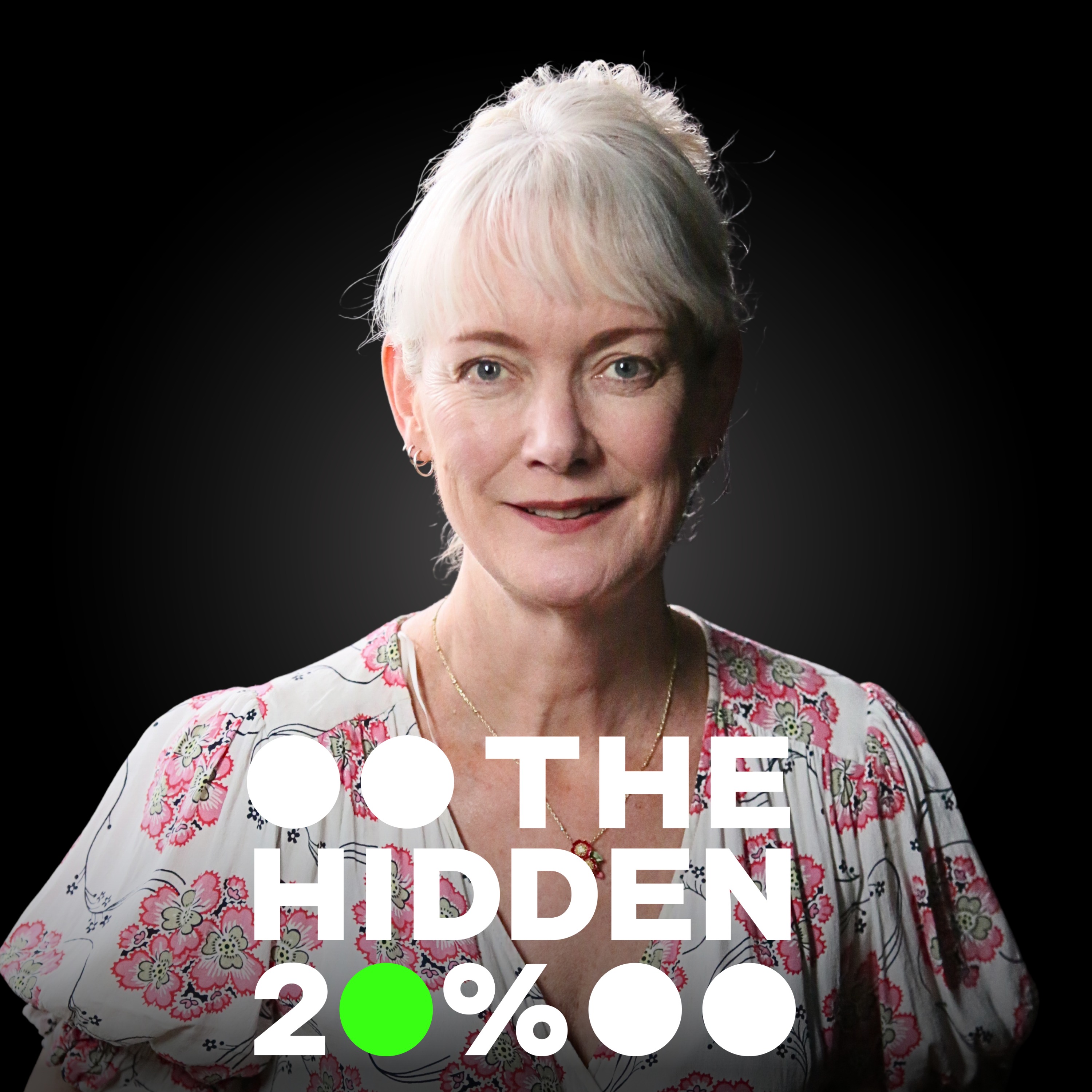
Professor Francesca Happe is a world-leading autism researcher with 30+ years in the field, author of 150+ scientific papers, focused especially on autism in women and what gets missed (including PTSD/burnout and late-identified autistic people).
Labels shouldn’t be siloed; multidisciplinary teams and trauma-informed pathways should be integrated. Autism traits exist on continua (behavioral, genetic), with possible qualitative differences in social cognition. Talent is real: about one-third of autistic people show unusually strong abilities linked to autistic traits like eye-for-detail. “Double empathy” evidence is mixed; mindreading vs emotional empathy should be separated. Vaccines do not cause autism; Wakefield’s claims were fraudulent and retracted.
Stephen Wiltshire’s memory/art; Nadia’s drawing despite early motor delays; a twin-study linking genetic influences on eye-for-detail to music/math/art/memory talent; taxi-driver hippocampus findings; autistic vs neurotypical decoding of facial emotion; anecdotes about MMR timing at ~18 months.
Written by AI. May contain mistakes.
Discover how perspectives on autism and other neurodivergent conditions have shifted over time.
“Let's see how great minds think differently.”
Explore the debate around autism labels and their significance for advocacy and identity.
“So it'll be interesting to see whether where this society is, people want to move towards saying, I'm neurodivergent with high sensory needs, low intellectual support needs, etc, etc.”
Understand the importance of integrated teams in addressing neurodevelopmental conditions.
“And we know actually that the combination is very common.”
Investigate the concept of neurodiversity as a continuum rather than distinct categories.
“We talked a little bit before, sort of slightly rolling our eyes, you know, the kind of colloquial where everyone's a bit ADHD.”
Learn about how autistic thinking differs from neurotypical thinking and its implications.
“it's a pattern like the genes underlying height.”
Discover the common talents seen in autistic individuals and their significance.
“So I always feel like I have to begin by being aware that for a lot of parents and autistic people, the rain man thing can be really irritating.”
Delve into genetic and environmental factors that contribute to talents in autistic individuals.
“So that was like when I was an undergraduate.”
Discusses how genetic factors influence both autism traits and talent, particularly focusing on detailed skills.
“have this hereditary genetic understanding we understand you know much more about traits behavior do we know what's yeah what it is that is common to talent with autistic people So I guess not fully, of course.”
Examines the differences between neurotypical and autistic brains regarding social skills and focus on detail.
“But to get back to the profile in autism and talent, so I think that the eye for detail is part of it.”
Introduces the double empathy problem, highlighting communication challenges between autistic and neurotypical individuals.
“So this is a theory by originally Damien Milton, who's an autistic autism researcher.”
Explores the difference between emotional empathy and cognitive understanding in autistic individuals.
“So I get quite annoyed when people do conflate empathy and cognitive mind reading.”
Discusses neglected areas of research, focusing on autistic burnout and strategies for managing it.
“It's not necessary to do with occupation and work and so on.”
Learn about the importance of understanding burnout and self-regulation techniques for children with autism.
“and then I know my response to that has to be withdraw, reduce demands, let myself rest in that and then get better.”
Explore the historical context and evidence regarding vaccines and autism, debunking common myths.
“And I've got to ask you your thoughts on vaccines.”
Discuss how public perception and funding issues affect autism research and the scientific community.
“And if that made me angry, what's happening in the States makes me much, much more angry.”
Identify the key differences in how autism presents in boys versus girls, and the implications of these differences.
“Can you give me the three key differences between boys and girls with autism?”
Hear about the speaker's wishes for future research and support in the autism community, focusing on various neglected areas.
“And the work that we were doing in schools, for example, suddenly comes online.”
Explore the deep connections formed in autism research and teaching.
“You can, and I'm assuming here you can't do what you do without that lineage of people who want to come and know more about autism.”

Get the gist, explore an idea or ask about something said.
 Claude
On The Hidden 20%, what are the key points of this episode?
Searching your listeningAutomatic transcript. May contain errors.
0:00We know that in autism, talents often fall into recognised areas. So maths, music, sometimes being able to play by ear or play a piece of music you've only ever heard once. I certainly know one chap who is a wonderful artist, definitely in the savant realm, also has absolute pitch for environmental sounds. He named the pitch of the cork coming out of the bottle. Neurotypical people are using a lot of their brain to do social. So imagine if you weren't using all your brain for all that social stuff, maybe you could use it for other things.
0:37Our next guest is one of the world's leading autism researchers who has spent over 30 years changing how we understand autism, especially in women. Professor Francesca Happe has written over 150 scientific papers and her work has helped expose what gets missed. the PTSD no one talks about, the women who slipped through the cracks, and the aging autistic still in need of answers. In this episode, we unpack some of her biggest findings and why they matter now more than ever. This was an absolute treat sitting down with Francesca. I can't wait for you to hear this episode. Let's get into it. Let's see how great minds think differently.
1:24When we think back to 2013, when people could be diagnosed autistic and ADHD. For the first time. For the first time, which is wild. How long do we sort of need these labels where we are siloing everything? when the more time goes on, the more we see these neurodivergent profiles that touch various different neurotypes in various different ways? Yeah, it's a really good question. And I think a lot of people in research would really like to move towards a trans-diagnostic approach where instead of thinking about necessarily autism, ADHD, etc., You thought about things like alexithymia, the difficulty in understanding your own emotions.
2:16How does that apply for somebody? Or intolerance, uncertainty, difficulty with coping with uncertainty and change. How is that relevant for somebody? But I have to say that I had experience some years ago, pre-pandemic, so it's always longer ago than you think, where I was in a group that were talking about how we could improve recognition of autism and other developmental difficulties and delays in low and middle income countries. Okay. So there were representatives from lots of different countries. And one of the things that some of us researchers were saying was this could be a great opportunity to forget about the labels and just have, like you have a growth chart that everyone uses, you could have a developmental milestone chart and it could have your sort of expected social profile and your expected communication profile and so on.
3:07And then you could say, where is my child sitting in this multidimensional space? And I have to say that the family support groups from most of those low and middle income countries said, no, don't take away the label. This is the only thing we've been able to gather under as a banner to try and lobby for services, to try and get recognition, to try and break down stigma, you know, it's our battle cry. You take away autism, you start saying, oh, this is a child who is, you know, fifth centile for this and whatever. It won't work. It won't work for them. So it'll be interesting to see whether where this society is, people want to move towards saying, I'm neurodivergent with high sensory needs, low intellectual support needs, etc, etc.
4:01Yes. I don't know. I mean, what do you think? Do you think we'll ever get away from wanting that identity? I don't. Short answer, I don't know. What I guess I see and hear and that just doesn't make any sense to me is that somebody's on an autism waitlist and on an ADHD waitlist. Okay. You know, I went for an autism assessment and that was it. And then I went for an ADHD assessment six months later. So like infrastructure wise. Yeah, that's much easier to solve, much easier to solve. So we need multidisciplinary teams who are expert across different neurodevelopmental conditions and even broader because the other thing that is siloed, I think, is the pathway that children and families go down.
4:52where the concern is that this is an attachment difficulty or the child's had very difficult adverse life experiences. So that's why they're struggling. And the pathway that says you're neurodivergent, you were born like this, and that's why fitting in with our neurotypical world is difficult. But actually, they shouldn't be separate pathways because being autistic doesn't protect you from having adverse life experiences. And we know actually that the combination is very common. So we're trying to bring trauma-informed approaches in schools that I'm involved with alongside autism and neurodiversity awareness approaches in school and bring them together.
5:33Yeah. But you're right, that siloing is a bad thing. And it came about, again, historically because autism was under-recognized. We lobbied to get better recognition, specialist services, people who were really good at recognizing autism even when it was complicated. Yeah. And then you get specialists and they only see autism. Yes. But there are lots of good examples where multidisciplinary teams see all kinds of neurodivergence and they can say, OK, this one looks to me like ADHD with social anxiety. I'm not sure that autism is the best explanation in this case. But in this case, let's look at how your OCD traits are playing in with X and Y.
6:11Let's get the full picture. We talked a little bit before, sort of slightly rolling our eyes, you know, the kind of colloquial where everyone's a bit ADHD. And I sit here sort of listening to us going, well, maybe everyone is a bit ADHD. Maybe everyone is a bit dyslexic and maybe everyone is a bit OCD. But it's where it tips into being a challenge or an absolute asset and where it's sort of, yeah, pervasive or dominating. Yeah. And I think that question of, you know, are we all a bit or is it all on a smooth continuum? I think if we just take the case of autism, I think it depends the level of description you're talking about.
6:54So if you talk about behaviours, you can fill in one of those checklists that asks about, you know, do you like making small talk? Would you rather everything stayed the same, etc.? You can fill in those and you will get a normal distribution. Everybody is somewhere on that. There isn't like a lump of people who have all that stuff and everybody else has none. So that's behavioral. You can be a bit autistic behaviorally. Then there's a genetic level. Genetic level, we know that the genes responsible or underlying autism for most autistic people, it's a pattern like the genes underlying height.
7:28hundreds and hundreds of common genetic variants that we all share. Somebody has more, somebody has less, somebody has a different combination, and it tips them over into more autistic traits, gets them diagnosed. So again, we can all be a bit autistic genetically. And then I think it's the cognitive, it's the psychological, it's the thinking style. There it becomes interesting. Is it qualitatively different or quantitatively different? What do you mean by that? So, quantitatively different is, it's just a matter of degree. Okay. And qualitatively different, there's something about how autistic people think that is different by quality from how non-autistic people think.
8:10Yes. So, there's two sort of different possibilities. Yeah. And again, when I was talking about the animal models, I said, eye for detail, executive function, and then social processing. And if we just think about those things, and of course you have lots of other theories, eye for detail, probably on a continuum. Some people are better at gist, some people are better at details. Executive function, probably on a continuum. People are different in working memory planning, et cetera. Social processing, interesting. Could be qualitatively different. Yes. Could be that when an autistic person watches a social scene or is processing socially, they're doing so differently.
8:52And that neurotypical people, for example, automatically jump to conclusions about what somebody else is thinking. And they're modeling what the other person is thinking. The autistic person, not so much. And that leaves autistic people free to be far more original in their train of thought. because if you think about, you know, neurotypical kids, or any of us actually, if you're walking along the street and everyone's staring up or something, you can't help but look there too. Neurotypicals can't help but look there too. And when kids go to school and they become teenagers, they want to do and think what others do and think.
9:29And there are certain kinds of blinkers that go on where we see and think the way that other people see and think. And I think that a lot of autistic people, that's not true. they're not automatically absorbing other people's thoughts in that way and that leaves them free to have much more original ideas which can be brilliant, some of them won't be brilliant they'll just be really unusual but they're not being trammelled by other people's thoughts in the same way Let's talk about autism and talent You've written a book on it and you've clearly studied it It's an area that I'm personally really interested in What do we know about autism and talent?
10:09Yeah. So I always feel like I have to begin by being aware that for a lot of parents and autistic people, the rain man thing can be really irritating. Yeah. And I know parents where, you know, they'll bump into a neighbor who's just watched a documentary about autism and talent and the neighbor will say, oh, your son's autistic, isn't he? What's his talent? What's his amazing talent? Yes. And the mum wants to reply, well, his talent is having a meltdown in the supermarket because the lights are too bright and they flicker. So it can be really irritating. But it is the case that autistic people have a much higher incidence.
10:51And in one study, about a third of autistic people had something they were unusually good at compared to their own profile, compared sometimes to peers and sometimes compared to even people much older, you know, everybody in the world. Yes. So it is important to recognize. We've learned a lot more about how the autistic mind works by looking at what autistic people are good at compared to always looking at how are they not doing as well as neurotypical. So that's important. And it's also the case that for a lot of autistic people, the neurotypical world erodes their self-esteem. And so finding that thing you are good at and enjoying it for its own right, but also sometimes the way it allows you to connect with other people is really important.
11:35So I do think talent is worth talking about. What do we know about talent? Well, we know that in autism, talents often fall into recognized areas. So maths, which can be lightning calculation or it can be calendar calculation where you can say the day of the week that any date will fall on far into the future or past. Art, often being able to draw incredibly realistic pictures, very detailed pictures. Music, sometimes being able to play by ear or play a piece of music you've only ever heard once. So extraordinary memory, particularly for facts that people are interested in, but also sometimes for events.
12:12So I remember very early on in my PhD, going back to visit somebody who had quite high support needs, an adult who's autistic. And I was actually when I was an undergraduate because we were testing his memory because he had amazing memory for, I think, the bus routes in Liverpool. Love it. And I tested him then. So that was like when I was an undergraduate. And then I went back at the end of my PhD and I happened to be in Liverpool where he was. And I went to see him. And he remembered the exact date I'd visited him on and what we talked about and everything about it. And I really felt like who's testing who because I could not have given any of that information.
12:50So amazing. So yeah, memory is the other one. And talents tend to fall in those areas. And they can vary from, as I say, being just better at that than at other things. So a child who, a classic example is Nadia, who was a young girl who, at the time she was being studied, she was about three or four. She couldn't do up her own buttons or use a knife and fork at that age. But if you gave her a biro, and it had to be a biro, it couldn't be any other kind of drawing item, she could draw absolutely beautiful. I mean, they look like, I don't know, Percassas or something, pictures of horses and men on horseback and all kinds of things.
13:28It's just extraordinary that you would not have guessed. She was pre-verbal then and, you know, had lots of high support needs. So relative to your own skills and then sometimes relative to everybody in the world. So if you've seen Stephen Wiltshire's drawings. Incredible. And he will draw, for example, as you would have seen, the cityscape of Tokyo after a 20-minute helicopter ride from memory. Yeah. Extraordinary. Yeah. And we do think their eye for detail is a really important part of the starting engine for talent. so you'll see if you watch him draw that he's filling in detail to detail he doesn't need to sketch the whole yeah and then fill in he's got it all yeah do we know what's driving that if we have this hereditary genetic understanding we understand you know much more about traits behavior do we know what's yeah what it is that is common to talent with autistic people So I guess not fully, of course.
14:24It's a far too big of a topic, but to answer it in two different ways. So we've done a twin study. Twin studies are really good to look at whether things are more natural nurture. But they're also really good to look at whether the same genetic influences are affecting two different things. So what we found was that in a big twin sample of all the twins born in England and Wales in 94, 95 and 96, we found that when we ask parents about is your child unusually good at music, math, art or memory and we take the, parents are quite generous so they tend to say yes but if we take the highest level of endorsement so are they better even than children much older than them we find that the children for whom parents say yes in one of those areas parents are also reporting higher autistic traits and specifically higher non-social traits so those eye for detail traits So when we do the twin modeling, we find not only is there a correlation in the scores, but the genetic influences on talent and on autistic traits, specifically the eye for detail, are overlapping.
15:30So some of the genes that influence autism also influence and predispose to talent. Yes. And therefore, family history. Yep. When you take a family tree, a good family tree, You should be asking about people who are unusually good at things as well as social challenges and other things that you might be thinking about when you think about autism. And what do we know about maybe the payoff of some of the talent in terms of people being especially good at some things? Do we know that there's a significant sort of payoff, but then they really over-index in struggling with other areas? So when I've tried to think about why you might see such high levels of talent in autism, One of the kinds of things that one might say is neurotypical people are using a lot of their brain to do social.
16:27And we think that Stephen Wiltshire is a savant, and for sure he is. But if a Martian came down and tested the average neurotypical on their face recognition abilities, they would be pretty amazed. Because even if you're not very good at remembering names of people, our ability to recognize that's a face I know is pretty astonishing. It's one of the things that at least neurotypicals use a lot of brain for. So imagine if you weren't using all your brain for all that social stuff, maybe you could use it for other things. So that's a sort of a fairly pop kind of idea. But I don't think there's any evidence that Stephen Wiltshire being good at art and developing his art has had a cost for any other parts of his functioning.
17:13We know that in autism there is anyway an uneven profile. Yes. So for neurotypical people, you can more or less guess how well somebody would do on the next aspect of an IQ test based on the last little puzzle they did. Autistic people, not so much, could be really, really super good at this jigsaw puzzle and really struggle on this verbal reasoning or something. Yes. So you get that kind of profile, but it's not clear that one is at the expense of the other. Yes. Having said that, there's, of course, that famous study of taxi drivers and the development of the hippocampus. And the interesting thing that's often not said about that is that while one part of the hippocampus got bigger, correlated with the knowledge of the streets of London, another part of the hippocampus actually got smaller.
18:00So it's not clear that there was a functional cost to that. Okay. But in a sense, we have finite brains. Yes. Do we have finite brains? In theory, you know, when people do neuroimaging studies, you get increase of blood flow in some areas and decrease in other areas. But to get back to the profile in autism and talent, so I think that the eye for detail is part of it. That social uniqueness, not having everyone else's thoughts get in and crowd out your head, I think that's really important for the originality. and then obviously there are latent talents that sometimes get developed and sometimes don't.
18:41A colleague of mine did a very nice study showing that most autistic children, even when they've never learned an instrument, nobody thinks they have a perfect picture or anything, they can retain a note in mind much better than an autistic child. So nice little experiment. You go into school and you play a note and you say that's the note the cat likes, different note that's a dog likes the mouse likes the parrot likes go back the next day neurotypical kids play a note which animal liked that note what no no i can name all the animals you said but i don't know which note it was autistic children very likely to get it right interesting and there's something about relative pitch versus perfect pitch or absolute pitch that again fits in with this detail focus yes if you think of melody is the big picture we learn to transcribe when you're very little apparently very young children if they sing a song that they know they will begin it at the same pitch each time but as they get older they extract the melody and they can start singing it at any pitch you know okay yes so you can choose the pitch yeah it's not locked into the details but for autistic people it seems to remain locked into the details in a way that perfect pitch is brilliant for learning an instrument yeah so start an engine for talent yeah Are all savants autistic?
20:04Not by definition, no. So I certainly know one chap who is a wonderful artist, definitely in the savant realm of talent, also has absolute pitch. He interestingly, he helped us with the study because he has absolute pitch for environmental sounds. You think about absolute pitch being for tones or pure tone frequencies. But he was first noticed because his parents are French, he named the pitch of the cork coming out of a bottle. Whoa. I like the sound of him. Yeah. But one of our speculations was whether he was slow to speak, as many autistic children are, because of his perfect pitch. He didn't speak until he was about five.
20:45But when he spoke, one of the things he said was, why do you, mum, say hello in a C-flat or something, and you, dad, say hello in a, you know, be mine. I don't know what the actual pitches were. Yeah, yeah. And you think if what you're listening to was the pitch, it would take quite a long time before you realise those two words are the same word. Yeah. And that the pitch isn't significant to anybody else. Yes, that no one else is thinking about the pitch. It's coding that, yeah. Love that. What, Francesca, is the double empathy problem? So this is a theory by originally Damien Milton, who's an autistic autism researcher.
21:26And he suggested that rather than the traditional notion that autistic people find it difficult to know what other people are thinking, autistic people and neurotypical people find it difficult to read each other's minds. With the implication being that autistic people are good at reading other autistic people's minds and neurotypical people are good at reading other neurotypical people's minds. So that's a double empathy problem. Now, I don't really use empathy in that way. Empathy to me is about emotional resonance. And what I just described is really mind reading or theory of mind. Exactly, more cognitive.
22:02But it's been taken now more widely to be a suggestion that when traditionally we've talked about social difficulties in autism, actually it's just a difficulty in crossing that cultural divide, as it were, from autistic to non-autistic. Yes, and that is both parties' responsibility. Yes, so I agree with that part, certainly, that it's both parties' responsibility. I'm not sure that I'm completely convinced by the evidence yet that two autistic people will read each other better than an autistic and neurotypical person if they don't know that they are both autistic. So most of the studies, your group membership is explained or is clear because you get to talk about something.
22:47relevant. And we know that in group, out group, there are big effects. So just by, you know, if we start off the conversation by, oh, you're left-handed, I'm left-handed too, we will find a point of connection. And we may, if people are analyzing our body language or something, say, oh, they're clicking better. They're communicating better. There's more engagement. There's more interest. So when you have a point of connection, everything flows better. Yes. And of course, something like a neurodivergent identity is a massive point of connection. Sure. So I think I'd like to see a little bit more research, a bit more blinded, just to get to the bottom.
23:25Because we, for example, a researcher recorded autistic and non-autistic people posing an emotional expression. So please look angry. Okay. That's artificial. We know that. Also, now look in a mirror and pose an expression. Still artificial, but now you've got feedback. Yes. And then trying to make it as natural as possible. So please watch this film and we will have a camera on you. Forget about it. You know, you're going to watch film for two and a half hours. Okay. And during that, you're going to go and you're going to do all that. Spontaneous. Okay. Exactly. Spontaneous. What happened? She took those images and videos and things and she showed them to autistic or non-autistic people.
24:06And the double empathy theory would say those autistic expressions will be read well by autistic people. and badly by non-autistic people and vice versa. Yep. But what she found was that the autistic expressions were less easy for everyone to decode. They were more idiosyncratic. Whether you're autistic or not. Yes. It wasn't like there was a language of the face of emotion that is autistic. Yes. It was more that autistic people had slightly more idiosyncratic or maybe sometimes a little bit more still expressions so it's hard for everyone to read. So that's sort of counter the double empty problem but it's a scientific field that's still moving forward.
24:42It's relatively recent theory. So I would say the jury's out, but others are bigger fans. What makes you angry, Francesca? So I get quite annoyed when people do conflate empathy and cognitive mind reading. Okay. Because they're just different things. So to give you the double dissociation, most autistic people I know care a lot about others' suffering and often have a very heightened sense of social justice. if they're reading that people are being hurt by natural disasters, they're hungry or whatever, they will really feel for them and want that to be changed. At the same time, they may find it difficult to put themselves in somebody else's shoes cognitively to know that, you know, I think that the dress she's just come in in really doesn't suit her, but I really shouldn't say wear the other dress, you look fat in that, because she's thinking something different.
25:36Yes. Whereas on the other hand, you can have somebody who's a psychopath or sociopath, really good at mind reading cognitive bit, can deceive you, can manipulate, will know exactly what you're thinking and play with that. Doesn't give a damn how you feel. Yes. So the emotional and the cognitive are really separate. Yes. So I don't like it when people talk about empathizing or roll those two things together. And equally, I don't like it when I hear autistics aren't empathetic. Exactly. Exactly. Exactly. I think that's just a myth and a harmful myth as well, I think. Yes. Okay, so that's one. What's another one?
26:14What's another peeve? Well, I suppose it's not a peeve like that. It's more that there are some really neglected areas of research. I think we've touched on developmental language disorder, which is really neglected. Motor difficulties in autism, I think, are really interesting and neglected. So at the extreme, that's catatonia, so freezing or freezing mid-movement, but also inertia. so autistic people talk about inertia which during a shutdown can be really i can't speak you know i'm somebody who can speak but now i can't i just can't generate that impetus so that to my knowledge hasn't been explored at all i think that's really important how much do we know about shutdowns not very much i mean i had one last week that lasted for three days oh wow okay it was really really horrible and hearing you say talking about not being able to talk like i'm not in shutdown now and but i look back on being in shutdown i couldn't talk i could not talk yeah i could not talk to my wife i think that's an area of that's completely neglected we really need to move into that i've got a phd student who's doing some really good work on autistic on burnout in autistic people i don't want to call it autistic burnout because part of the point is to know is it different yes We know it's brought on by different things.
27:26It's not necessary to do with occupation and work and so on. It can be just the strain of everyday life. But is the experience of burnout unique in autistic people? Or is it that horrible burnout experience but brought on by other things? So she's working on that. I think that'll be really helpful. And we are finding that for some people who are diagnosed younger, they have a better handle on sort of energy accounting and coping with shutdowns. and much less of a fear of long-term burnout. Okay. And they're understanding it much more in terms of, I have overwhelm, and then I know my response to that has to be withdraw, reduce demands, let myself rest in that and then get better.
28:08So they're more practiced in it. They are. It seems like that. I mean, obviously, again, it needs replicating. But those who were diagnosed later didn't have an explanation for why they got overwhelmed, so they thought they just had to battle through it. Yeah, I mean, that's my experience. In long bouts of burnout, months or worse. That's really interesting in terms of understanding what works for a lot and knowing that and practicing that for longer. Yeah. And it being more normal to do that rather than later in life, unmasking, getting an assessment and then kind of going, well, I'm allowed to do this.
28:48Even having a vocabulary around it when you're young. Yeah. Yeah. And I guess the people around you knowing about it, so being able to support you in that. Yeah, I mean, I've learned sort of what to do or how to help my daughter if it's having a meltdown or how to help manage her energy levels. Yeah, yeah, yeah. So that she's not burnt out. Yes. I guess it's then, yeah, that a child understanding that and experiencing that and then adopting that into their own. Yes, regulation. Choices of regulating. Okay, that's pretty interesting. And I've got to ask you your thoughts on vaccines.
29:31Yeah, I've got to ask you your thoughts on vaccines and autism, Francesca. So when I had my first child and she was maybe a month old, my mother very kindly was coming along with me to support me because I had said yes to writing the MRC, Medical Research Council report at the time. So this is 2001. Wakefield has done his terrible harm. The world is terrified about whether vaccines are causing autism. And I say terrified because that was also the narrative. This would be a disaster. And so the MRC got together the great and good, and I was sort of the scribe who was putting it all together into a report.
30:16And it was clear even then that there was not only no evidence in support of the idea that vaccines caused autism, there was positive evidence against things like the change in Japan that had been from a triple vaccine and taking that away and no reduction in autism, the cases of autism continue to rise as they had secularly because of changes in diagnosis, etc, etc. So to my mind, there is not a scrap of evidence that vaccines cause autism. And there's plenty of evidence that measles kills children. So it's a simple decision. Can you just explain to listeners about that study? I won't give it the pleasure of airtime in too much detail.
31:00But the suggestion was that, so Andrew Wakefield suggested from a small number of patients that he was seeing where he had done some biopsies that were unethical. There was a body's response to measles that was unusual in children who were autistic, a very small number. And he extrapolated from that, that the measles vaccine, and particularly the MMR, the triple vaccine, might be causing autism. He then went on again to have some fraudulent studies that suggested that might be the case. And at the time when that was happening, I was a young researcher in autism. I was going around to a lot of autism parent groups and giving talks.
31:43And parents before that study had often come up to me and said quietly after the talk, I know this sounds silly, but when my son was about 18 months, we moved house. And after that, he was never quite himself. And now he's autistic. Could it have been that the trauma of moving house made him autistic? And I could always say confidently, no. Put your mind at rest. It wasn't that. Somebody else would come up to me and say, I know it sounds silly, but round about 18 months, I was very unwell with my next pregnancy. And I had to give my son to be looked after by my mother. And she lived miles away.
32:26And he didn't see me for six weeks. And after that, things were never quite right. He was autistic. Like, could it have been that I broke an attachment bond with him? And I could say, no, put your mind at rest. And then suddenly after Wakefield, people would come up to me and say, at 18 months, my son had the MMR vaccine. And after that, he had a fever. And after that, he was never quite right. Could it have caused autism? And for some horrible time, I couldn't say, put your mind at rest. Because we didn't have any evidence. We just had his fraudulent evidence. And so it was really important that we did gather the evidence.
32:59Looking back, I would say, and you asked me what makes me angry, millions of pounds were diverted from what could have been helpful autism research just to try and prove a negative. Yes. And if that made me angry, what's happening in the States makes me much, much more angry. To finish the question about Wakefield's work, he was struck off. His work was retracted. I have to say the journalism at the time was not responsible. For example, going after more and more personal stories of this 18-month, sorry, I should say 18 months is when the MMR is given. More and more stories, personal stories of families that felt their child had become autistic because of the MMR.
33:41And no stories of families where their child had been harmed by measles. Just to balance it, balance the stories. And we know autism is strongly genetic. We know that in many cases you can see small brain changes that date back to the first trimester. vaccines are not the problem. And what's happening at 18 months old? I mean, aside of the MMR vaccine. So 18 months is when you begin to see the first signs of autism. Not always. Sometimes it takes longer to see it. But in a typical case, around 18 months, you're beginning to see that transition from maybe some single words to putting words together really for communication.
34:23You're beginning to see pretend play, a repertoire of social behavior, pointing and following pointing, eye contact, a whole range of things that are showing typically that the most autistic children are no longer following the trajectory of social development. That's the typical child is following. Yes. And so that's when you begin to see things. And of course, if at that point your child has a fever, is upset by something, then you may notice their difficulties a little bit quicker. And you think about typical development, things take a while to unfold. What do you think is going to happen in the US?
35:02It looks like in the wider picture, they will lose a generation of scientists. The cuts are hitting early career scientists hardest and they're losing their jobs overnight. In autism research, I don't know, there are very, very good autism researchers in the States and autism teams. Historically, there's been a lot of investment. Some of that might be in areas that the autistic community here are not particularly interested in. Sure, sure. So genetics or early intervention and so on. But a lot of it is in good stuff like, you know, how do we help with epilepsy, for example, or how do we help with co-occurring anxiety, depression and so on.
35:42and I don't know whether their funds are going to be diverted to crazy investigations into a dead story about vaccines. I just don't know. And I guess that potentially the same thing happens where there has to be loads of time, attention, focus put into disproving something again. For which there was no reason to think there was a link anyway. Yeah. But what we should be careful of, And because you reach a huge audience, what's happened in the States is that a large proportion of the population don't trust science. Yeah. And that's really scary. And don't trust research. Don't trust research. Don't trust science.
36:27And we mustn't let that happen here. Yeah. Yeah, I totally agree. Can you give me the three key differences between boys and girls with autism? So again, I want to say this is on average. It's not going to be true for a particular boy, a particular girl. But I would say special interests have a more neurotypical focus in girls than in boys on average. On average, girls' superficial social skills may look better, so stand out less for an observer. And that probably relates to maybe on average a bit more camouflaging, a bit more copying others to fit in. And what would be my third one? Or maybe the camouflaging goes into that one.
37:23Yes, I'm not sure. I think maybe it's the camouflaging is separate from the sort of social motivation. may look less socially odd on the surface. Yes. May be working harder to compensate and camouflage and may have special interests that look on the surface more typical in their focus, more like their peers in their focus. Yes. But I also don't want to forget the quiet boys who are also flying under the radar because they're at the back of the class and they're not running around causing any annoyance to the teacher, but they're still not in with their, you know, they don't have a nice friendship group, they might be being bullied and they might be working really hard to not stick out.
38:09So it's not, it doesn't divide neatly by sex or gender. On average, people tell women and girls in the street, cheer up, love, smile. Don't say it so much to boys and men. Of course, they say man up. Yes. But there are different kinds of pressures, aren't there? Yeah, there are. and they just become adopted as norms. I'd like to give you a magic wand. What would you do with it for autism? So I would like to put a lot of research money into autism and ageing. I think it's important. I think there's been an assumption that whereas if you do research with children, you can make a big difference to ability or functioning or adaptation or quality of life.
38:53but I would like to say you can make a big difference to a 65 year old's quality of life functioning adaptation and so on if you put things in there as well so aging I really would like to look into those motor symptoms I think the shutdowns and so on are really really interesting we need to understand those more and maybe related to that because I think it is related would be really good research on sensory processing it is happening in some pockets but most people and we're guilty of this too just give a questionnaire tell us about your sensory experiences and unfortunately recent research shows that self-reported or self-experienced sensory things don't correlate very well with the kinds of things you would measure with physiological measures that doesn't mean that they're not right they can both be right sure but they're measuring different things yes so if we want to get to the bottom of understanding sensory and autism we need to do a lot of the physiological stuff too.
39:50And the third wish, I guess, would be, and I'm guilty of this, in recent times, we've neglected the portion of the autism spectrum where there's intellectual disability or language impairment. That's partly thanks to COVID. And the work that we were doing in schools, for example, suddenly comes online. And what can you do online? You can reach adults who can take part in things in surveys and stuff. But we need to harness the new tools we have, the things like wearables and eye tracking, to be able to involve in research people that have been hard to involve because they don't have a spoken voice.
40:34Yes. So devices as well. Yeah. All the different clever ways that we can ask questions to people who can't tell us in words. Yes. Okay, that's three. I only gave you one magic wand, but you've taken three. You get three wishes with a wand. Last question. Who would you like to give your green dot to? Well, this is very difficult. So I thought about giving it to Dame Steve Shirley, who is a wonderful philanthropist, mother of an autistic son who sadly passed away. And she has given away all the money that she made in her business that elevated women to do computing back in the day from their homes with their families.
41:17She's given it all away and she's founded wonderful autism schools and other support services for autistic people. So I thought about giving it to her, but she is a very stylish lady. I don't know whether she would pin it on her very stylish clothes. And you should invite her on the program anyway, and then you can give her her own dot. She is in her 90s, you won't mind me saying, but she is indomitable. So I would like to give my dot instead to all my students, present and past, because I've learned so much from them. I've had over 30 PhD students who finished so far and I've got a good handful with me now.
41:54And they've taught me so much. And they've allowed us to take forward research in aging, in trauma, in all these things where other people wouldn't give us funding, but they've come in with their energy and their belief and they've transformed things. So can I give them the dot? You can, and I'm assuming here you can't do what you do without that lineage of people who want to come and know more about autism. It's a real privilege to work with somebody for three or four years and go on that journey together. And I was so lucky myself to be a fifth PhD student. That was such a transformative experience for me.
42:35and I don't say it to them, my PhD students, because I don't want to pressurise them, but they are like my children. They are like family to me and like your children, whether they go off and you barely see them or whether they stay in touch, you still always are thinking of them and you cheer them on in their successes in whatever area they go into. Yeah. Well, thank you, Francesca. I've been so excited about you coming on and I've already told you that. And I said at the beginning that this is a treat and it still feels like a treat. I've really loved hearing you. I am coming away with loads of things to think about.
43:11And I don't know, I just sort of feel not that I have any need or right to do this, but I just kind of feel to say, oh, my God, please keep doing what you're doing. because we as the autistic community and my daughters, this is so important what you're doing and so new and so needed and so misunderstood. So yeah, thank you and please don't give up. Thank you for that. I won't. As long as anyone lets me, I'll carry on. Yeah, yeah. Great, thank you. Thank you.
43:53You've been listening to The Hidden 20%. If you're still knocking about, then let me introduce you to the band. First up, main man on the mic, host Ben Branson. Our wonderful producer, Bella Neal. And the man who'll probably try and cut this bit, video editor James Scriven. Not forgetting our wondrous theme tune by Jackson Greenberg. Lovers or haters, we want to know, so be sure to leave a review wherever you're listening. For the lovers amongst you, you'll find us on TikTok and Instagram at hidden20podcast or over on hidden20.org where you can join our mailing list.
In this episode, Ben sits down with Professor Francesca Happé - one of the most distinguished and respected voices in autism research. With over 30 years at the forefront of the field, Francesca has reshaped how we understand autism, from exploring social cognition to uncovering the hidden experiences of autistic women, the elderly, and under-researched groups.
In this chat with Ben, they unpack hidden autistic talents like perfect pitch and detailed memory, why late diagnosis fuels burnout, how emotional care differs from cognitive mind‑reading, and why research on sensory processing and inclusion is needed more than ever.
This is part two of a two-part episode. To catch all the groundbreaking discoveries, be sure to check out last week's episode!
___________
On "The Hidden 20%," host Ben Branson chats with neurodivergent [ADHD, Autism, Dyscalculia, Dyslexia, Dyspraxia, Tourette's etc.] creatives, entrepreneurs, and experts to see how great minds.. think differently.
Host: Ben Branson
Head of Production: Bella Neale
Assistant Producer: Phoebe De Leiburné
Video Editor: James Scriven
Social Media Manager: Charlie Young
Music: Jackson Greenberg
Brought to you by charity The Hidden 20% #1203348
______________
Follow & subscribe…
Website: www.hidden20.org
Instagram / TikTok / Youtube / X: @Hidden20charity
Ben Branson @seedlip_ben
Francesca Happé @happelab
If you'd like to support The Hidden 20%, you can buy a "green dot" badge at https://www.hidden20.org/thegreendot/p/badge. All proceeds go to the charity.
Hosted on Acast. See acast.com/privacy for more information.