Ask ChatGPT
 The Hidden 20%
27 Aug 2025 · 10m · 5 chapters
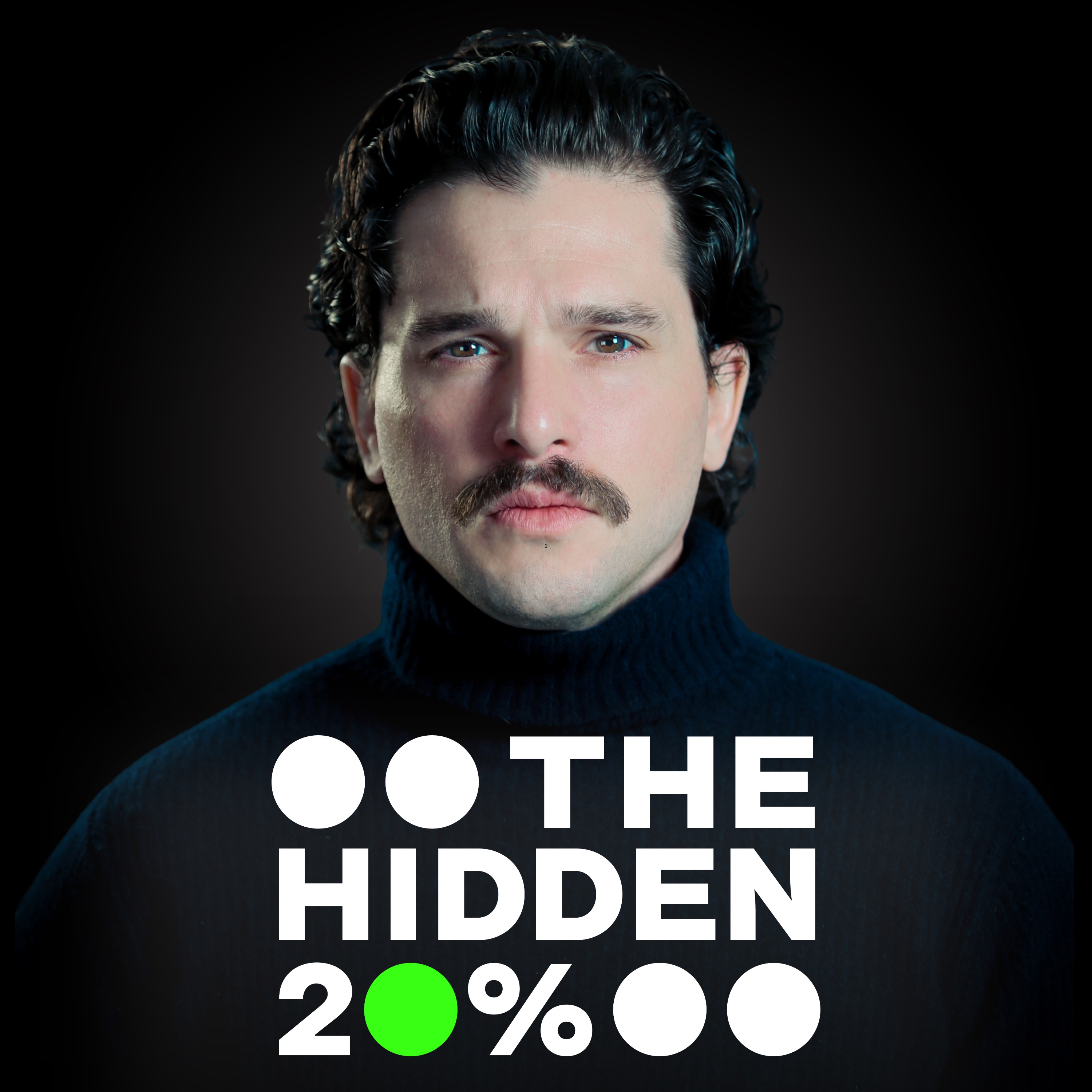
Kit Harington discusses ADHD-like traits, anxiety, and addiction recovery, focusing on how he manages overwhelm as a dad and actor. He describes “freeze mode” when multiple demands collide, and using resets like showering to restart the day. He also reflects on social anxiety, avoidance behaviors (hiding in cupboards/under beds), and how alcohol and cigarettes were escape tools.
Kit Harington is a Game of Thrones actor and a recovering alcoholic/addict; Rose (host/partner) supports and prompts his reset strategy.
he can separate character from self; he multitasks poorly and gets overwhelmed when more than one thing is in his head; sobriety improved his ability to handle social situations and silences; labeling himself as an alcoholic is more important than an ADD/ADHD label for his recovery.
forgetting lines after family interruptions; needing to fill uncomfortable silences with drinking; leaving a quiet restaurant table to breathe in the loo.
Written by AI. May contain mistakes.
Kit discusses his struggles to balance acting and family responsibilities.
“And I won't lie, it's not going very well.”
Kit shares his methods for coping with anxiety and overwhelm.
“I get incredibly fretty, anxious, and then I have to go take a shower.”
Kit reflects on his experiences with social anxiety and reliance on alcohol.
“And maybe that goes back to the start of our conversation about, actually, maybe there is more in me that wanted to be an actor because I didn't want to be myself.”
Discussion on how identifying as an addict influences Kit's life.
“I have always been a sociable person, but I just, the anxiety surrounding a conversation felt like the end of the world if there was a silence.”
Kit elaborates on the importance of understanding his addiction and sensitivity to the world.
“And it's more than just not drinking now.”

Get the gist, explore an idea or ask about something said.
 Claude
On The Hidden 20%, what are the key points of this episode?
Searching your listeningAutomatic transcript. May contain errors.
0:00Welcome to Refocus, where we rewind the moments too good to miss. Short takes, big takeaways, no attention span required. Let's get into it. Let's refocus.
0:18I'm very British in my approach to acting which is that I have a very clear line between I think between character and me which is I don't live in them I kind of approach that side of things of the actual practicality of getting down to my work I'm at the moment finding quite tricky I think because I've got multiple things going on and I'm terrible so I've got kids at home and I can't separate seemingly at the moment my work and my home life I find it very difficult to do that so I'll go into a room and I'll start prepping the movie that I'm about to do and trying to learn the lines and I'll hear something from the other room and before I know it I'm caught up in the family stuff and then before I know it the whole day's gone I haven't learnt a single line or I haven't done any preparatory work you know so I at the moment I'm trying to juggle this new life of being a dad of two alongside what has to be as an actor quite intensive work on your own to get ready for a job.
1:43And I won't lie, it's not going very well. I don't multitask well. I have to be on one thing. And more than that, if there's more than one thing going on in my head, I get overwhelmed. I get incredibly fretty, anxious, and then I have to go take a shower. I literally have to go up. But a shower's a reset for you. Yeah, I go up, I take a shower, I get in a different set of clothes, and I go and try again. Rose will say, just go take a shower because I'm all over the shop in my head. At whatever point in the day? Yeah, yeah. At any point in the day, yeah. Okay. And how did you know, how have you discovered that that works?
2:22It's something about starting the day again. Okay. It's like, okay, at any point I can start the day again. This has all got on top of me. My head's all over the shop. I'm in three different places at once. I can't deal with it. I go into a sort of freeze mode. I go like that. at which point Rose says to go and take a shower and I go okay because it's sort of like my brain short circuits yep because it sort of I don't know how to explain it get overwhelmed by it all is that overwhelming feeling because there's too much going on or it's the pressure of one of those things that is happening or what is that I'm not good at
3:11delineating. Wow, you're getting some good words in here, mate. Preparatory. Saying all the great words wrong. Delineating. I'm not very good at, like, separating off things. But you're great at separating your character from yourself. Yeah, because that's one job. Okay. That's in that box. It's a brave thing to confront yourself, right? Mm. and I guess do the work to understand yourself. Yeah. Or did you learn coming out of that? Do you know what I learned, which is the most positive thing I kind of have learned, is that I'm much better at being me than I thought I was. And maybe that goes back to the start of our conversation about, actually, maybe there is more in me that wanted to be an actor because I didn't want to be myself.
4:04I was very socially anxious. Are you still socially anxious? I am, but I know how to deal with it now. Okay. And I think I project some confidence, but I'm walking into a room, a party or whatever, when I was younger. You know, I remember in my like sort of drama school days, I'd be at a party and even with the alcohol, I would find myself walking out of the room, going and finding a cupboard and standing in the cupboard and just breathing or hiding under a bed. I remember my girlfriend at the time finding me hiding under a bed and like, what are you doing? I was like, I couldn't. It's that short-circuiting thing.
4:45That frozen. That frozen freeze moment. And so, of course, alcohol was like my go-to. It's the only thing that was kind of helping. It's the only thing that meant that I could function socially. the trouble was that then I you know it wasn't just socially it was alone I loved nothing more than drinking alone because it took me out of myself took me out of that headspace, took me out of that anxiety instantly it was the one thing that could do that so what I learned from rehab and the process of getting sober which to really kind of get a kind of handle on, took about a year of solid work, was that actually I'm much better as a sober person socially, now I know how to deal with it, than I ever kind of thought I was.
5:48Are you a sociable person? I have always been a sociable person, but I just, the anxiety surrounding a conversation felt like the end of the world if there was a silence. Okay. Like it had the same effect of me as if someone was saying there's a nuclear bomb heading to London. Like it would be like if there was a silence, an uncomfortable silence, then it was awful. So you felt you needed to fill it? Yes, I had to fill it. and to fill it I had to, or to fill any of those little silences I had to drink. The similar thing. How are you with silences now? Much better. Should we have a bit of silence?
6:29Yeah, great.
6:34How do you feel? This is a planned silence. So it doesn't count. Hold on a minute. This is like a meditation. There's not many rules around the silence. It's more that my kind of anxiety around things would be like, say we're in a restaurant and you're speaking a bit loudly. I get incredibly anxious for the table over there that we're disrupting there. I'm so with you. Do you know the thing? I'm so with you. I'm like, if my table's making too much noise, I'm like, but we're disrupting the other people's experience. And so could you be, and so that sort of thing would get to me. Or if there was the opposite, so our table suddenly descended into silence.
7:17I immediately am up out of there straight to the loo breathing or when I used to smoke outside fag and that's why I got so hooked on cigarettes as well they were the perfect escape to leave a room totally agree have a cigarette you know then I can reset come back in it's the same as the shower reset come back into the room okay can we talk about labels? yeah you know I find identifying as an addict and an alcoholic incredibly powerful it's my first go-to place of not drinking uh is to kind of label myself as that to know that yep right so i can't deny the power of identifying and diagnosing something i was also you know we've spoken about this i was also when I was at rehab I was they they identified me as being ADD I think some people find it very empowering and um uh and useful to have that particular um diagnosis label for me when I got to rehab and they went you know it's almost the first day then they went look we've assessed you and we think you're ADD I was like that's great but how do I stop drinking priorities yeah priorities here yeah right yeah uh it's not doesn't help me with how do i not drink yes i think it's it's interesting and now i'm able to look at myself a bit more because i'm not clouded and all of the stuff i was clouded in it's i can see a bit how my brain works which i can notice when i'm my brain's a bit maybe as they were referring to but the that particular uh whatever it was diagnosis you know for me it's not it's not nowhere near as important as being an alcoholic um because i think that helps me with my brain more i'm like oh i know how i'm thinking right now because i'm an addict because i i crave more i have this restless anxiety i have this um this feeling of having one layer less of skin in the world, this oversensitivity towards things, that label of being an alcoholic is incredibly important to me because it's changed everything.
9:48And it's more than just not drinking now. It's about how I feel about the world, you know, why I feel the way I feel, why I go into that kind of Prince of Darkness kind of depression I talked about. So if you're talking about how we perceive people as far as like labels, yeah, it's really important for me.
Our Refocus series rewinds the moments too good to miss. Short takes. Big takeaways. No attention span required.
In this episode, Kit Harington opens up about the reality of multitasking with a neurodivergent brain - from overwhelm and social anxiety, to addiction, labels, and the unexpected power of a shower.
CW: references to addiction
_________
On "The Hidden 20%," host Ben Branson chats with neurodivergent [ADHD, Autism, Dyscalculia, Dyslexia, Dyspraxia, Tourette's etc.] creatives, entrepreneurs, and experts to see how great minds.. think differently.
Host: Ben Branson
Head of Production: Bella Neale
Assistant Producer: Phoebe De Leiburné
Video Editor: James Scriven
Social Media Manager: Charlie Young
Music: Jackson Greenberg
Brought to you by charity The Hidden 20% #1203348
______________
Follow & subscribe…
Website: www.hidden20.org
Instagram / TikTok / Youtube / X: @Hidden20charity
Ben Branson @seedlip_ben
Kit Harington
If you'd like to support The Hidden 20%, you can buy a "green dot" badge at https://www.hidden20.org/thegreendot/p/badge. All proceeds go to the charity.
Hosted on Acast. See acast.com/privacy for more information.