
 Ask ChatGPT


 The Hidden 20%
3 Sep 2025 · 47m · 17 chapters
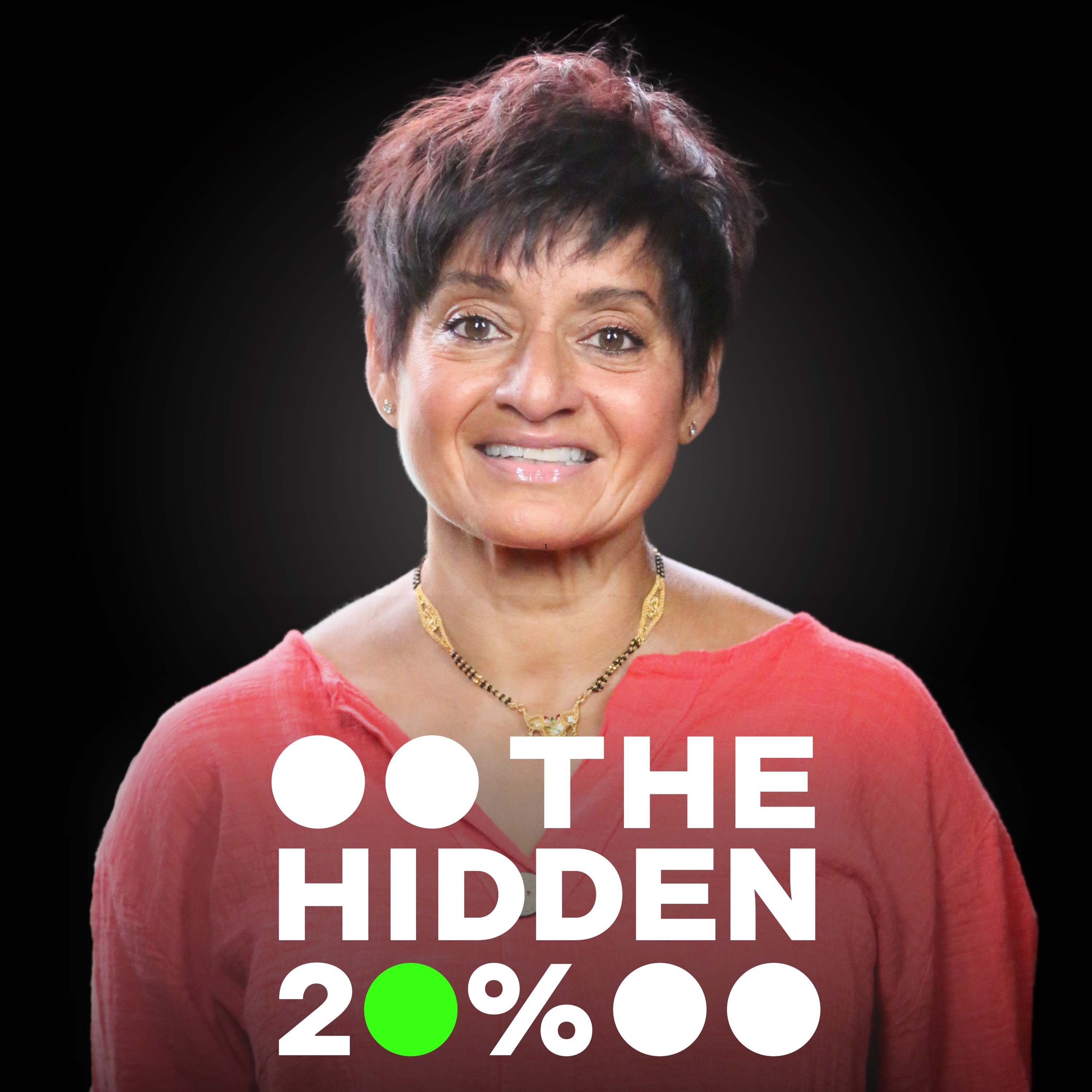
Sleep as a nervous-system safety process. Episode argues that people sleep when they feel safe enough to shift into parasympathetic state; neurodivergence increases “neuroception” (sensitivity to sights/sounds/smells), making bedtime harder. It also challenges sleep myths (e.g., waking up is normal; wearables/phone-based time tracking can fuel anxiety) and gives “step one” reset actions.
Dr. Nerina Ramlakhan, neurophysiologist and sleep expert (PhD King’s College London; four books). Background includes being sectioned and diagnosed with bipolar disorder and PTSD after a psychosis at 31; complex trauma history; later rebuilding her career (including working at a psychiatric clinic where she’d been a patient). She’s worked with neurodivergent footballers, high-powered CEOs, and burnout cases.
“We sleep when we feel safe.” Cortisol isn’t the enemy; high-alert parenting can over-stimulate. Phone/number checking can push into beta and worsen sleep anxiety.
Ring/wearable data used to track nervous-system regulation during travel/interviews; “sensitive sleeper” vs “martini sleeper”; “vomit journaling,” dim lighting, and removing tech from the bedroom.
Written by AI. May contain mistakes.
Explore the significance of sleep and Dr. Ramlakhan's personal experiences with it.
“Let's see how great minds think differently.”
Discover how Dr. Ramlakhan uses wearable technology to understand her sleep.
“But it was when I got to the age of 34 that there was a moment, a turning point where physiologically I had an embodied experience of feeling safe.”
Understand how family trauma shaped Dr. Ramlakhan's relationship with sleep.
“So my parents were born in Guyana in South America and my grandparents were born there.”
Learn about the concept that we sleep when we feel safe and its implications.
“And in his heyday had an engineering company that hired 30, 40 people and did some amazing work in Guyana.”
Dr. Ramlakhan reveals the intrinsic link between safety and sleep.
“Well, you're not safe because you're asleep.”
Dr. Ramlakhan shares her journey from patient to teaching about sleep and safety.
“So I was, you know, at this podium, this phrase just shot out of my mouth.”
Learn about the speaker's journey to feel safe and present in their body.
“And they said, we don't think you should go to groups yet.”
Explore the basics of neurophysiology and its connection to sleep.
“My sister dying very suddenly and traumatically.”
Discuss the relationship between neurodivergent traits and sleep issues.
“You take the blood, I was a phlebotomist as well, and you'd spin the blood down in the centrifuge.”
Learn about the concept of the sensitive sleeper and how it relates to neurodivergent individuals.
“It strikes me as really sort of obvious that neurodivergent people with busy brains or different brains struggle with sleep.”
Discover practical strategies to achieve inner safety that promotes sleep.
“But for the neurodivergent human being who is struggling with sleep, and not all of them, because, you know, it's a spectrum.”
Learn about different brain wave states and their relation to sleep.
“So I'm very careful about using my daughter's compassion and empathy.”
Discover how blue light and phone usage can disrupt sleep patterns.
“beta, then delta, and even deeper, you know, one could go into a gamma state, very deeply meditative.”
Explore common myths and misconceptions surrounding sleep and rest.
“So wouldn't it be great if you could start to train yourself not to be in high alert, but to be in a comfortably, reasonably energized state for the safety of your little offspring?”
Learn actionable strategies to improve sleep quality and routines.
“If I know the time, I'll calculate how many hours.”
Understand how to prepare your environment for better sleep.
“Wake up in the morning, tell the hunter-gatherer physiology that it's safe.”
Learn effective strategies for creating a sleep-friendly environment and routine.
“So for me, I just knew I wanted to watch the last episode, but I wasn't going to.”

Get the gist, explore an idea or ask about something said.
 Claude
On The Hidden 20%, what are the key points of this episode?
Searching your listeningAutomatic transcript. May contain errors.
0:00We're making choices throughout the day that are going to take us closer to being able to sleep or further away from it. If you think about sleep, the place where this all lands, where you're lying there and you have to be in the right part of your nervous system in order to feel safe enough to sleep. In other words, you have to be in the state where you're in your parasympathetic and you have to be able to say, the world is really noisy. and all day my nervous system has been reverberating my neuroception, sight, sound, smells. I've picked up so much noise, but I need to be able to get myself into a state of inner safety.
0:38How do you do that? Dr. Noreena Ramlikan is a leading sleep expert and neurophysiologist with a PhD from King's College London, four books under her belt and decades of experience helping people sleep better. She's worked with neurodivergent footballers, high-powered CEOs, and people who've burnt out, broken down, and hit the wall because she's been there herself. After being sectioned and diagnosed with bipolar disorder and PTSD at 31, her entire life and career shifted, pushing her to rewrite everything we know about sleep, recovery, and the nervous system. Just a heads up, we do touch on some difficult topics such as mental health and abuse.
1:23Let's get into it. Let's see how great minds think differently.
1:33Norena, I'm so excited to talk to you. So many questions. And I really do genuinely believe that sleep is the most important thing in the world for me. Yeah. And for other people. You've written four books on sleep. what have you learned about your own sleep yeah that you have now for the last few decades been helping other people with well like many people and yourself you know we share from our lived experience and as a baby my mother would say to me you're so restless and as I grew older you know you can't sit still and she would often deride me about that and it was a bit of a family joke that I was the one that couldn't sit still.
2:19But I didn't realize that this restlessness was linked to my inability to sleep at night as well, which wasn't a joke. But I didn't realize it was a thing because people didn't talk about insomnia and sleeplessness back in those days. So I'd lie there in bed beside my sister. We shared a bed and I would make up stories in my mind to try and put myself to sleep to make myself feel safe. So I think looking back on it, I was always moving towards trying to find a sense of inner safety. And it was when I finally found that when I was 34. And there was a bit of a journey to get to that point, a messy journey in many respects.
2:57But it was when I got to the age of 34 that there was a moment, a turning point where physiologically I had an embodied experience of feeling safe. And from that moment, I started, if I can say, healing my relationship with sleep. and so I had an amazing night's sleep last night. So do you monitor your sleep? I was given this ring as part of a project with Audible. We were making a film with a well-known basketball player who was renowned for having sleep problems and they said, we need to compare your sleep with his and I said, well, I don't do wearables. I'm really anti them. And they said, no, no, no, we really need to measure your sleep.
3:35So I was sort of dragged, kicking and screaming into the world of wearable technology and that was about four years ago and I kind of fell in love with what this thing was telling me, but not so much in relation to my sleep. So it takes me about 45 minutes to an hour before I'll look at the data because my phone's normally switched off in the mornings. It's not in my bedroom. And then eventually when I switch it on and then I look at the data and I go, okay. But what I do like looking at is, you know, what happens when I travel into central London? What's happening to my nervous system? You know, what happened during that interview with Ben?
4:13You know, what happens when I'm standing on a podium or if I'm on television or live TV? And what I've loved that this does for me is it's enabled me to track the level of regulation in my nervous system. Now that I'm in my early 60s, that, you know, it's quite, dare I say, a journey. It hasn't always been like this. Can you tell me a bit about what you termed the messiness in your early 30s? So my parents were born in Guyana in South America and my grandparents were born there. My great grandparents travelled from India to Guyana as indentured labourers or slaves. And the joke in the Caribbean or Caribbean is that the runt of the litter went on to Guyana.
5:02So, you know, my ancestors came from extreme poverty and there was a lot of trauma, to use that word, complex trauma in my family. There was a lot of alcohol abuse, physical violence, alcoholism, and even incest throughout my lineage. And a lot of loss of spiritual moorings. What do you mean by that? My ancestors were Hindus, but for my uncles, some of them to get jobs, they had to convert to Christianity. So there was a lot of, I would say, anchoring that was lost. Many of the rituals and habits. And then there was poverty. Both my parents came from very large families, eight or nine children.
5:46My mother lived in a mud hut with her siblings. And if she heard her father coming down the road at the end of the day, he was a fisherman. And if he was singing, you know, their hearts sank because they knew that he was drunk and they wouldn't eat. He would have spent his day's catch. He would have spent the money on alcohol in the rum shop. So they wouldn't eat. And he might be in a very turbulent frame of mind, which he would release on my mom's mother, my grandmother. Growing up as a child into my 30s, there was a lot of turbulence, a lot of adverse childhood experiences. And I do speak about this openly.
6:24My father has passed. My sister didn't survive our childhood. She died when she was 42. She passed, my brother and I, but we would witness my mother being beaten. And actually, my father has passed, but I feel closer to him now. Interesting. I have a belief that our souls choose our journey. Sure. And I actually feel that he helps me quite a lot now. But he was a very tenacious man who worked us out of poverty, actually. And in his heyday had an engineering company that hired 30, 40 people and did some amazing work in Guyana. But a lot of this trauma spilled over into my ability to be still and restful and sleep.
7:05and I was a very disembodied human being for the first three decades of my life. It wasn't safe to be in my body. Yeah. You talk a lot about safety as it relates to sleep. And I notice in myself that my safe place is home for sure. You know, my happy place is outside in nature for sure. And I know those things really well. but then I am increasingly aware that being in bed and sleep is a real safe place. Yes. Can you just talk a bit about why sleep and safety? Because it feels, when you first hear that, it sounds kind of counterintuitive. Well, you're not safe because you're asleep. You're vulnerable.
7:55Well, I suppose the phrase is, we sleep when we feel safe. okay we sleep when we feel safe and this is a phrase that shot out of my mouth decades ago when I was in an auditorium and about 500 plus people there and I think I was just in the flow of speaking even though I was this child who'd had all this stuff happening I always had this vision of writing books and being on the stage I thought I'd be a Bollywood dancer but actually it was probably the speaker in me then back then. So I was, you know, at this podium, this phrase just shot out of my mouth. We sleep when we feel safe. And I noticed there was a hush in the room when I said that.
8:38And I noticed that there were a lot of people in the room who then wrote that down, that phrase. And I realized that something that I was feeling myself resonated and it was a very subconscious, unconscious connection that I had experienced. And then I I verbalized it and I think it took years for it to make its way out of my mouth. And they wrote it down and that's back in the day when people weren't using their phones as much. So I actually had pen and paper. And I realized I was on to something. And I hadn't even written my first book yet, Tired But Wired. But you obviously started work within the sleep arena.
9:11Yes, I started work within the sleep arena after going through my own journey at the age of 31, having a psychosis when everything really hit the fan. I couldn't control these energy surges, couldn't control my restlessness, couldn't sleep. Dysfunctional behaviors, risk-taking behaviors, all the things, addictive behaviors, and ended up being hospitalized at the Capio Nightingale, in and out of hospital for four years, on and off medication, diagnosed complex trauma, diagnosed bipolar. they didn't quite know what to label me as. And the age of 34, I'm really trying to summarize the messiness of the story, but getting to a point where I had to walk out of the marriage, a good job at Bupa, I was a director at Bupa.
9:56And I'd already started on this journey of starting to speak to groups of people, but it hadn't really come through with conviction yet. But it was going to Brisbane, going cold turkey, coming off medication without support, leaving a very kind man who I was married to at the time, but it wasn't a marriage, saying I can't do this like this anymore and free falling I'm not recommending that anyone do it that way but something told me to do it that way and something interesting happened Ben I would sit in this Mary Ryan's bookshop in Brisbane I went there with this romantic notion of traveling Australia and realized I couldn't do it I'm terrible at traveling I get panicky this is what happened on the way here but you you guys made it very comfortable for me and helpful but I work on my ability to travel and loud spaces.
10:40But back then I realized I was terrified to go traveling on my own, sat in this coffee shop, started journaling and something landed, a sense of inner safety. Came back to the UK with this embodied sense of safety, which I wanted to investigate as the neurophysiologist and started teaching from that place. And as if by magic, Like, life started giving me opportunities to teach from that place to the extent that the hilarity of being headhunted to work at the same psychiatric clinic where I'd once been a patient. I mean, that's just... You can't make that up. You can't make it up. I can't make up that I was sectioned also into Capio.
11:21I know. We both know that place. That place and B14 and the smell of the place and probably some of the same nurses. But then years later going back there to work, this time on the other side. It's an amazing story and it sort of feels like your life is kind of in two halves. You get to your mid-30s and then you have this kind of total meltdown and then rebuild and heal and find what you're meant to do in this life and on this planet. How could you describe that in a sense of safety? Well, right now, I feel so safe that I can feel my feet tingling on the floor. I can feel my butt on the chair.
12:15I feel my breathing in my belly. I can feel a lot of emotion. And I feel so safe that I could cry and I don't really want to. But I feel very here and I feel very present with the conversation that we're having. And so if I wind back to 1999 sitting on this balcony, I, up until that point, had lived my life in a very disembodied way. He was a great thinker. And my father and I would have amazing conversations and exchanges. And we connected on, you know, if I did very well at school. And, you know, I lived in South America for seven years in Guyana between seven and 14. And, you know, this Catholic convent school, that was confusing for a Hindu child.
13:06But anyway, and but, you know, it was very competitive. And, you know, I'd come home at the end of the day and my dad would say, how did you do? And if I said I'd come first or something, I'd be rewarded. And we would sit there and we would play Scrabble. It was a very disembodied childhood. It was all about thinking cleverly and being in your head. And we weren't really allowed to feel. So things would happen at home and we weren't allowed to talk about that or feel what had happened or feel the tears, the pain. And I think when I got to Brisbane and I spent two weeks weeping And I did learn to cry at Capio the first day there, the first day of groups where I just sat in the group after trying to take over the group and facilitate the group and being put in my place.
13:56Do you know that feeling? I had to sort of zip it and sit with a tsunami of discomfort in my body. And they said, we don't think you should go to groups yet. Okay. And I went to see my therapist for the first time and she said, how do you feel? And I wept. And I then spent two days refusing to leave my room and just crying. And then a few years later going off to Brisbane, but there without any support of medication or husband or the therapist or whatever. Again, not saying that people need to do this. But sitting on that balcony, writing, surrounded by books written by people like Caroline Miss, Louise Hay, Neil Donald Walsh, The Celestine Prophecy, all these sort of spiritual books and occasionally taking them off the shelf, highly skeptical neurophysiologist.
14:49what's this all about then but then putting my pen on the page and writing and a different sort of voice starting to come through which would every now and then make me put the pen down and just go what happened there and slowly finding the safety to come back into my body while every now and then being able to return to the page with some words so dancing between intellect and embodied response and I suddenly had this feeling of I'm sitting here on a veranda and it's warm it was spring and I can see these very vivid green colors I can feel sun coming through my senses coming alive sight sounds smells and being very present with the senses in a way that felt safe yeah and that was really different yeah and it was glorious and it was quite a peak experience.
15:45And there was no chemical assistance other than some caffeine. And, oh gosh, this feels really good. What is this? And then spent the next 30-odd years trying to get back to that feeling. And share. And share. And want other people to feel that feeling. I want you to feel this. I felt like this kind of weird village elder sitting on a high fence looking in at the village going, I this stuff that we can do try this thing yeah try yoga try breathing try kundalini and this happens but while that was happening the trajectory of my sleep just being able to lie in bed go oh I feel safe and in those decades after this I call it an awakening experience I mean I'm not saying It was aromatherapy-centered bliss.
16:39During that time, another marriage ended. My sister dying very suddenly and traumatically. My daughter being born. A whole series of events. But you're able to deal with it. I can deal. I can lie in my bed and go, this is really hard. Yeah. I feel heartbroken. What is a neurophysiologist? Physiology is the study of the body. Yeah. And how it works. And neuro is the brain. Yeah. And I stumbled into that. I had this idea of being a doctor. because that would earn me huge brownie points with my family, my dad. And couldn't really sit still enough, you know, to study and actually to learn things by rote.
17:19So I ended up not doing medicine, but studying physiology. But actually realizing that the lectures I was able to turn up to set me on fire. I wanted to understand how does the body maintain a constant internal environment? When we're faced with a constantly changing external environment, so the concepts of Collard Bernard's work on the maintenance of a constant internal state, homeostasis, sinusoidal rhythms started to light me up and I didn't know why I was excited. What did we know about sleep 30 years ago? Very little. It was, you've got some circadian rhythms, you might have had a one hour lecture, which you fell asleep in.
18:04And societal wise, what was the... There wasn't much narrative at all. So dare I say, back then I was a kind of, can I say, trailblazer? As in starting to talk about it because I was working in health screening. Okay, I'd studied in the 80s. University lectures were really dry. You know, lecturers didn't really know how to talk about this stuff. Although there was some interesting research taking place. Stephen Porges' work on polyvagal theory and safety science, 1990s. But it hadn't landed on the scene. It wasn't commonplace. And in the workplace? In the workplace, no. I'm in this little health screening laboratory in Moorgate, City Healthcare.
18:46My first job where I got this experience of, I love what I do. I think I am made for the world of work. Until then, I kept failing at every job, hated it, made me depressed. Every job I walked into couldn't sit still. The restlessness made me take time off work. You know, but there I was at City Healthcare in a white lab coat as a physiologist, measuring the health of corporate employees from places like JP Morgan, Goldman Sachs, Merrill's, then Coopers and Librand. Now you walk into reception, you pick up your client. They're going to be with you for two to two and a half hours. You're measuring blood pressure, breathing, spirometry, VO2 max, taking blood from them, looking at the blood and trying to get these tight-lipped corporate employees to talk to you.
19:29Now, if I'm going to ask them, how do you feel? Yeah. They'll never talk to me. Did you ask them how they sleep? That's what got them talking. How'd you sleep last night? Okay. And then I started saying, was it a bit tired but wired? Speaking about my own sleep, of course, I hadn't started healing yet. Okay. But then even the most tight-lipped corporate employee would say, yes, I was so wired. And I was also noticing some of the physiological parameters, breathing pattern when you looked at spirometry, truncal thickening or girth or the body fat. They were laying down fat, even though they were exercising type A, you know, young corporate employees putting on truncal thickening when you did the caliper test because the body was storing fat to arm them because the world was stressful.
20:19The world was stressful. It weren't safe. And even the blood results. You take the blood, I was a phlebotomist as well, and you'd spin the blood down in the centrifuge. There'd be a layer of fat on top of the plasma. And you just look at it and you know, this skinny person is internally fat because they're storing fat because their body's reading that they're in famine state. So I would know from looking at that, that they weren't eating breakfast, that they were highly driven, caffeinated, adrenalized and weren't sleeping. So I started all this pattern recognition, which back then, without being labeled or assessed for anything, I was very good at pattern recognition.
20:56Yeah. I know you were diagnosed bipolar, CPTSD. You're not a big fan of labels. Well, I'm on the verge. I'm on the cusp for myself. Sure. And I totally understand where it really can be helpful. Totally understand. Now at my age, I'm just in my mind, I'm a village crone. I'm a big bellied old woman sitting at the campfire with a big cigar rubbing my belly going, I don't need any labels. I am who I am. And I'm going to talk what I need to talk. But for my little babies, for my babies, I only have one. I have a daughter. But for her sake, I think it would be useful. And we're going to go through an assessment process because she's teaching me so much.
21:40and the mirroring back to me of stuff that I thought was normal. Yeah, yeah. I could cry because I'm watching her and I want her life to be easier. When Dr. Elze Eepon said to me at the Capio Nightingale, we're going to call it bipolar disorder. Maybe this will help your family to understand who you are. I don't think it did. But it gave me a sense of safety. Yep. Because I stopped hating myself. Yep. and shaming myself for the dysfunctional, inverted commas, behaviors. Highly. Some of which had landed me up in police stations. Sure, sure. Right? Yeah. I don't have a record, thankfully. They were very kind.
22:23And I was let off the hook. But there were some pretty extreme behaviors, even while being highly functional and gaining degrees and doing very well, even though I don't really have very many memories of turning up to lectures. Sure. But doing very well. It strikes me as really sort of obvious that neurodivergent people with busy brains or different brains struggle with sleep. That's a big generalisation. Can we get into the detail of sort of these neurodivergent brains and sleep? So I started using a label years ago, decades ago. I started talking about the sensitive sleeper as opposed to the, I would laughingly call it the martini sleeper.
23:15Okay. Okay. You can sleep anytime, anyplace, anywhere. But on the other end of the scale, you had your sensitive sleeper. Sights, sounds, smells really impact the sensitive sleeper. And so this was before the conversation around neurodivergence had exploded onto the scene, really. I was talking about the sensitive sleeper, of whom I was one. But I have started to see that neurodivergence comes with a level of sensitivity, and then, of course, neuro, meaning of the nervous system. So there is a sensitivity that comes with neurodivergence. And there's an overlap then if you look at sleep. and the sensitive sleeper.
23:58So I went, oh, that's interesting. Neurodivergence and sensitive sleep, are they one and the same? And then if you look at safety science and the work of Stephen Porges, he's the leading safety scientist, where he talks about the nervous system and polyvagal theory, polyvagal relating to the many branches of the vagus nervous system, the autonomic nervous system, and the vagus having the ventral vagus and the dorsal vagus and then you have the sympathetic nervous system. But with neurodivergence, if we see this as a kind of reverberation, and this sometimes is how I see it when I'm working with people where I almost think, you know, every human being is different, but if I almost imagine putting them on a kind of plinth and looking at them, I almost see a kind of sparking, a sparkliness to the nervous system.
24:48It's so sensitive. And what does that mean? Well, Stephen Porges would call it their neuroceptive abilities, how they're perceiving the world. They're highly sensitive to the world. And he would then talk about interoception, how they're making sense of their internal world in relation to the external world. And then if you think about sleep, the place where this all lands, where you're lying there and you have to be in the right part of your nervous system in order to feel safe enough to sleep. In other words, you have to be in the state where you're in your parasympathetic and you have to be able to say, the world is really noisy.
25:28And all day my nervous system has been reverberating, my neuroception, sight, sound, smells. I've picked up so much noise, but I need to be able to get myself into a state of inner safety. How do you do that? How do you do that? So my journey, that inner safety that landed in 1999, was my first taste of it, conscious taste, because I think the journey in Capio was certainly, they were leading me towards that, but they weren't talking about that. My studies at King's College was leading towards, you know, all of this, pieces of the puzzle. But for the neurodivergent human being who is struggling with sleep, and not all of them, because, you know, it's a spectrum.
26:10For those who are neurodivergent and can't sleep, what is helpful is to start paying attention to sights, It's sounds, smells. At bedtime? At bedtime, but even throughout the day. We're making choices throughout the day that are going to take us closer to being able to sleep or further away from it. Okay. And in fact, I'm writing a meditation, creating meditation for this moment, which is about choosing to sleep. So if you think about from the minute you're waking up, you are making choices, a myriad of choices, which either are going to land in your nervous system, either in a helpful way or not so helpful.
26:46So the minute I wake up, I wake up, I start sort of traveling up a travelator in my consciousness. I become aware, this is me this morning, of thoughts, a myriad of thoughts, a shitstorm of thoughts. What am I doing today? I'm not worried about the hidden 20%. I am positively excited about this. What I'm worrying about is the travel. Why? Why? Because my nervous system. I was in the city yesterday. So the double dose of travel, two days in a row for me, is really hard for me. And watched something on television last night, which really worried me as well. Switched it off, worked on feeling safe last night.
27:26How do you prepare to go to bed? Right. It started from 9pm. Okay. When I realized that the person who I've really connected with on Race Across the World, actually this series is dedicated to him because he has passed okay and he had an accident in may 2025 and that was right at the end of this bbc program and i thought what broke my rules switch my phone on google yeah he had he was in a car accident so my nervous system is in disarray and switch the phone off so 9 15 i'm working on my breathing i'm standing on the decking i'm with my dog i'm stroking the dog and my daughter phones she doesn't live with me she lives up the road she's dropped out of uni works in hospitality lives on a golf course and i said can i tell you what i've just found out and she said yeah mom tell me and i said i've just found out that sam die has died and she goes oh and i'm really careful with her as well because she's ended her shift at 8 o 'clock.
28:30She's opening up at 8 a.m. I've got to be mindful of her. So I'm very careful about using my daughter's compassion and empathy. But then I journaled for 20 minutes and I prayed. And I brought myself into a state of safety. And so you don't have your phone in your bedroom? No, I don't have my phone in my bedroom because that can become very much a crutch for me. I can find myself in a myriad of rabbit holes looking for a podcast to make me feel safe. Yeah, yeah. When you're asleep, can you absorb information?
29:07Subliminally, subconsciously, you might drop into an alpha-theta state. So when you're fully alert right now, I'm in beta waves. If I start to drop down, it wouldn't take me long. I'd drop into alpha meditative. If we went deeper, I'd start to go into a theta. beta, then delta, and even deeper, you know, one could go into a gamma state, very deeply meditative. Now, when you're in bed at night, you're cycling in and out of that on a 90-minute roughly cycle. Hopefully not into beta waves. If you go into fully alert, you go and you look at, you wake up during the night, you look at your phone, you go into fully alert, not helpful.
29:44I definitely do this where last night Moss comes in at midnight, wakes me up. Yep. I am struck into high alert because it's my child and she's out of bed and not happy. I do have my phone by my bed. I then want to see what the time is. I do that on my phone and it's bright because I have everything on full brightness. What's that doing to our brains? having phones as stimulus around sleep time, bedtime, wake up time, go to bedtime? Well, there are some sleep experts, inverted commas, who would say that blue light is going to dampen the melatonin response. It's going to inhibit the production of the sleep hormone, melatonin.
30:33It's going to speed up the production of when you say high alert, so you've already got a burst of cortisol, the stress hormone. So the two hormones that are dancing around, which will impact sleep or not sleep are melatonin, the sleep hormone, which you start to produce as the light levels drop below about 200 lux, light coming in through the retina, hitting the pineal, produce melatonin. So you start getting sleepy early evening. And then in the early hours of the morning, roughly around 2 to 4 a.m., I don't know what time Moss came in. At midnight and then at 5 a.m. And then 5 a.m. So your cortisol is going to start to kick in around 2 to 4.
31:10That's normal. for the hunter-gatherer to start thinking, hmm, now might be a good time for me to become more active and go out hunter-gathering for my survival. There may be animals that are sleeping, that are in a drowsy state, so I'm more likely to catch them. So it is a survival instinct. So cortisol is always, people talk about it as if it's the enemy. It's not. It gets a bad rap. It gets a bad rap. But if you're in high alert because you're a leaned-in, highly caring parent, then you're going to overly stimulate those little adrenal glands sitting on your kidneys to produce more cortisol.
31:43That's not helpful. So wouldn't it be great if you could start to train yourself not to be in high alert, but to be in a comfortably, reasonably energized state for the safety of your little offspring? You know, you can be there for her, but not on high jangled alert. You want to be in a relaxed state of engagement, not high alert. Now, going onto your phone, the blue light, in truth, the blue light effect is, although in the night then, if you'd already jangled, that's going to hit your pineal. It's not helpful. The light. Yeah, but it's not sufficiently that high, you know. It's not high enough to really suppress melatonin, but it's the combination of association with a device that tells you lean into life.
32:28If I go onto, for example, if I'm reading through emails. But you've looked at a number. Let's go with the number first. You haven't even looked at your email. No. But you're on the number. The number is going to put you into beta wave mode. Okay. In order to be able to register a number, to calculate, to risk assess. Yeah. You know, you've done all of that already. You've subtracted, you've risk assessed, likely impact on sleep, no sleep. How am I going to feel tomorrow when I'm talking to Norena? All this kind of stuff is already happening. Yeah. You've calculated how many hours of sleep you're going to get.
32:59What about my wife's succession with number of hours? Not helpful. Like quantity versus quality. You don't know. Sorry, Sam. For Sam here and the rest of you, and this is what I learned when I started working at Capio, you get these highly perfectionistic patterns. They've noticed that if they tell themselves, they've looked and they've calculated, then they've extrapolated to that to likely impact on performance the next day. They've created a story, which is not very helpful narrative around when this happens, this is how I perform the next day. which is actually crap to some degree. Unless you're wired up to a polysomnograph, 60-odd electrodes stuck to you, and they're measuring what's going on with your sleep, it's not actually that easy to measure how much sleep you're getting or not getting.
33:46Okay. Because we noticed this at Capio when the patients would say, do you see what I mean? I only got so many hours of sleep. And the nurse said, no, we came in to check you. We actually touched you gently. You are fast asleep. But the perception, reality, mismatch, fueling this anxiety of this highly intelligent management consultant who's had a breakdown, is now in the psychiatric unit, who's now doing a spreadsheet on how much sleep they have or haven't got. Yeah, yeah. It's not helpful. I know our audience love this and it's obviously part of why we have this charity is to break down myths.
34:24Yes. And misinformation. what's the number one myth about sleep? I need to know the time. If I know the time, I'll calculate how many hours. That's another one. I need so many hours of sleep in order to function well. I need to believe everything my wearable says. Take it with a smallish pinch of salt. I shouldn't be waking up so many times during the night. No, it's normal. If you didn't wake up, we'd be extinct. If we'd been designed not to wake up during the night, saber-toothed tiger would have had at it wouldn't it because i guess we have that sort of perfection idea of you sleep through with your you know eight hours and that is perfect sleep yeah and it's not you know i spend a lot of time if i have one-to-one sessions with clients in my one-to-one work normally first session is wrestling with them okay around these myths and misconceptions Yeah.
35:22And if you are walking around and I say this with compassion, you're walking around in a state of high sensitivity. You don't feel in control of your external environment. You want to find control in whatever way you can. And that might mean I want to feel in control of my sleep. I want to take control of that. I'm going to measure it. So for some of my clients, you know, if they're going to work with me and they've bought into it, you're going to ban the wearable for a bit. Let's get you off your wearable. Don't measure your sleep for a bit. Get your phone out of the room. That's one of my non-negotiables.
35:54I have five non-negotiables. These five things, they are not my entire sleep methodology. They are step one of the resetting of the nervous system, giving your autonomic nervous system a fighting chance of being able to get itself into a state of safety. So do these things for the next two to three weeks, please. Number one, eat a nutrient-rich breakfast if you are struggling with your sleep. That means protein, fat, carbohydrate. Wake up in the morning, tell the hunter-gatherer physiology that it's safe. So eat. And so this would be not just your young population. It might be the perimenopausal woman, menopausal, postmenopausal, who's just realized her neurodivergence and has had that assessment.
36:44They'll be going, oh my God, I've been skipping breakfast in the hope that I would lose some of this belly fat that's come on during my menopause. Stop the fasting. If you're having difficulty getting to sleep, staying asleep, non-restorative sleep, edgy sleep, fitful sleep. Breakfast. Start eating in the morning and a very good nutrient-rich breakfast, protein, fat, carbohydrate. Number two, don't use caffeine as a substitute for food. Eat first. The caffeine is going to send you into the sympathetic nervous system. It's basically... First thing I have in the morning. Yeah, I know. I could have told you that.
37:17You have the profile, I hate to say, of the client where we would wrestle a bit to start with. I'm saying that with compassion. That was my profile. up until the age of 34 because i do i we're going to get back to number three four and five but i historically until i was 25 slept dreadfully and between 20 and 25 lots of flashbacks dripping in sweat nightmares etc very bad very very bad sleep and since being 25 so for the last 17 years and aside of the uncontrollable aspect of having small children yeah disrupting my sleep I feel and I've never measured it but I feel like I sleep quite well good but I have my phone in my bed yeah I look at my phone before I go to sleep yeah I will if I'm sleeping on my own if my wife's not there definitely listen to a podcast to go to sleep I mean I listen to a meditation with my kids now because I also get to do a bit of the kids meditation as well lovely which I've only done in the last couple of weeks but that's really helping yes and I spend quite a long time in bed before I go to sleep yeah good there's some lovely stuff happening here and I would happily work with you and and your family because there's some beautiful stuff I can teach you a meditation that you do with your kids and that you can do it without needing any sound any audio any phone because it's back to having the phone out yeah exactly I know I know carpet totally You know, the treehouse meditation.
39:10Oh, I love it. You know, I can teach you one that you can all do together. And all my kids have lights on. Safety inducing. All my kids have lights on. But even if you have a little light, that's okay. I know, they're big bunny lights. Okay, there's a lot to unpack in there. But you said that you were waking up. If you think you're getting good sleep, that's a really good indication that you're getting good sleep. If you're feeling good, we don't just get our energy from sleep. physically, emotionally, mentally, spiritually. I could have the worst night's sleep ever because of whatever. I'm traveling early, early the next day.
39:47I'm going to speak in front of the King of England or whatever, and I don't sleep so well. But I am so admissioned by my work. I am so passionate. That's an enormous source of energy for me. I'm also extremely fit. I also look after myself. I look after myself emotionally. I had a blowing good cry this morning. I needed to. I'm a crier. I've learned how to cry. And I'm really proud. It took me 34, 31 years. Anyway, number two, though, please don't use caffeine as a substitute for food. If you're really struggling with those sleep issues, difficulty getting sleep, staying asleep, fitful sleep, waking up feeling like you haven't slept, cut the caffeine out completely.
40:24What about decaf? Decaf is okay. I'm loving the adaptogenic coffees. I have coffee with legal mushrooms in it. I had a really lovely one this morning, mid-morning after my first breakfast with the second breakfast. What's the best last drink to have? I have to say last night I did have a sleep tea bag after I saw that the chap had died in real life. I was really upset and I needed a bit more settling. So I just had a supermarket blend or one of the common blends of sleep tea. I love passion flower. That really works for me. Valerian doesn't work for me. It does something really weird to my nervous system, but it works really well for other people.
41:03So I would say look at adaptogens, you know, go see a nutritional herbalist, get them to get something that really works for your nervous system, but also investigate with the supermarket blends. Bringing this moment of being really intentional on preparing to be able to go to sleep. I am sitting here going, oh my God, my body and brain won't go to sleep. I can't force it to go to sleep. So I have to give it the right conditions where it can wind down, relax and actually feel tired. Number four. Number four is the get to bed earlier. Start powering down earlier. And for the neurodivergent mind that's not sleeping, this is one is so important.
41:51You know, just you've had that crazy day, overstimulation, sight, sound, smells, draw, draw in. It's like the beam of a torch. You're winding it in, bring it in so that your interoception, you're in your body, draw yourself back into your body. So for me, I just knew I wanted to watch the last episode, but I wasn't going to. I know that it's, I have to power down. So I have the tea. Now for me, powering down happens even way before that, when the light levels in the house come right down. My lighting in the house is very dim. Very, very dim to the point where my best friend will often come in.
42:29She used to come in and start putting lights on. And it took me years to say to her, Carolyn, can we not have those overhead lights on? Yeah, I see my wife loves it nice and bright. And there is science. There is science. The photoreceptor cells on the sides of the retina help you to power down as the light levels drop below 200 lux, sends messages to the photosensitive cells on the side of the retina into the pineal to start producing melatonin. So much intelligence in that. But then what happens in simplistic terms, summer to winter, when it's light till 10.30 at night? Yeah. Or it's dark at 4.30?
43:10You have to be even more mindful. Okay. And that's why they're having the blackout blinds. And our conservatory is our living room, so it's extremely bright. So I'm going to have to work at other things, not overdoing the stimulants, not having extra spicy foods in the evening, not having too much chocolate. definitely no more than one caffeinated drink nothing after midday making sure that i'm well hydrated but throughout the day making sure that in the mornings you're using the photosensitive cells at the top of the retina which respond to light levels up above when the sun is directly above so when you get up in the morning i don't keep my blackout blinds completely closed there's a little chink of light coming through so i know when there's light coming through in the morning getting out into natural daylight first thing, stand on the decking, get that natural daylight, stimulate.
44:05So this is circadian science. Even if I was to open the curtain and look out the window. You don't want the glass there. You want to be fully in nature with the sun above you, ideally barefoot. All of this stuff. And what's number five? Number five is get your tech out of the bedroom. Get a clock in your bedroom, even if it means having, like I do, an old-fashioned landline. Because a lot of people will say, but I need to be in touch with my child or I need to be in touch with my mother. My mum, even though she has Alzheimer's, can remember the landline phone number. So that's there. That's outside my bedroom.
44:43The phone is out of my bedroom in another room, charging and switched off. because I know during the night if I go into my sensitivity mode because I'm stressed, I'll want to go and look at my phone because it becomes my thumb sucking. Give me those five as a list. Right, number one, breakfast, nutrient-rich within 30 to 45 minutes of rising. And, you know, look at my website or Google or whatever. There's loads, I break it down and I talk about types of breakfast. Number one, eat breakfast within 30 to 45 minutes. Don't skip. Number two, don't use caffeine as a substitute for food. no caffeinated drink until you've studied blood sugar you've eaten number three be well hydrated the state of hydration of your brain will directly impact your sleep science that the ability for sleep hormones your sleep biochemistry and physiology to work number four start powering down earlier for around nine ish 9 30 start bringing the stimulation levels down think about what you eat.
45:39Think about sights, sounds, smells. Think about even what you watch on television. Think about everything that's going to overstimulate you, the conversations. If you've had to have that difficult conversation with your teenager before bed, then get into bed and vomit journal to get it out of your system. 10 minutes of vomit journal. Number five, get your phone out of the room. get an old-fashioned clock don't look at the time during the night allow yourself to not know
46:15you've been listening to the Hidden 20 % if you're still knocking about then let me introduce you to the band first up main man on the mic host Ben Branson our wonderful producer Bella Neal and the man who'll probably try and cut this bit video editor James Scriven. Not forgetting our wondrous theme tune by Jackson Greenberg. Lovers or haters, we want to know, so be sure to leave a review wherever you're listening. For the lovers amongst you, you'll find us on TikTok and Instagram at hidden20podcast or over on hidden20.org where you can join our mailing list.
47:02Thank you.
In this first of a two-part episode, Ben sits down with Dr. Nerina Ramlakhan - a Neurophysiologist, Author and Sleep Expert with over 25 years experience in the field, whose work is shaped by both science and lived experience.
She shares her personal journey, from early struggles with insomnia and being sectioned at 31, to later returning as a practitioner in the very same psychiatric unit. Nerina brings rare honesty and depth to the conversation about why humans sometimes find it difficult to sleep.
Together they explore the hidden science of sleep, how neurodivergent brains seek safety and rest, and reveal why the choices we make every day can dramatically improve the quality of our sleep.
CW: Mental health and abuse
_________
On "The Hidden 20%," host Ben Branson chats with neurodivergent [ADHD, Autism, Dyscalculia, Dyslexia, Dyspraxia, Tourette's etc.] creatives, entrepreneurs, and experts to see how great minds.. think differently.
Host: Ben Branson
Production Manager: Phoebe De Leiburné
Video Editor: James Scriven
Social Media Manager: Charlie Young
Music: Jackson Greenberg
Brought to you by charity The Hidden 20% #1203348
______________
Follow & subscribe…
Website: www.hidden20.org
Instagram / TikTok / Youtube / X: @Hidden20charity
Ben Branson @seedlip_ben
Dr. Nerina Ramlakhan @drnerina
If you'd like to support The Hidden 20%, you can buy a "green dot" badge at https://www.hidden20.org/thegreendot/p/badge. All proceeds go to the charity.
Hosted on Acast. See acast.com/privacy for more information.


