Ask ChatGPT

 The Hidden 20%
28 Jan 2026 · 52m · 24 chapters
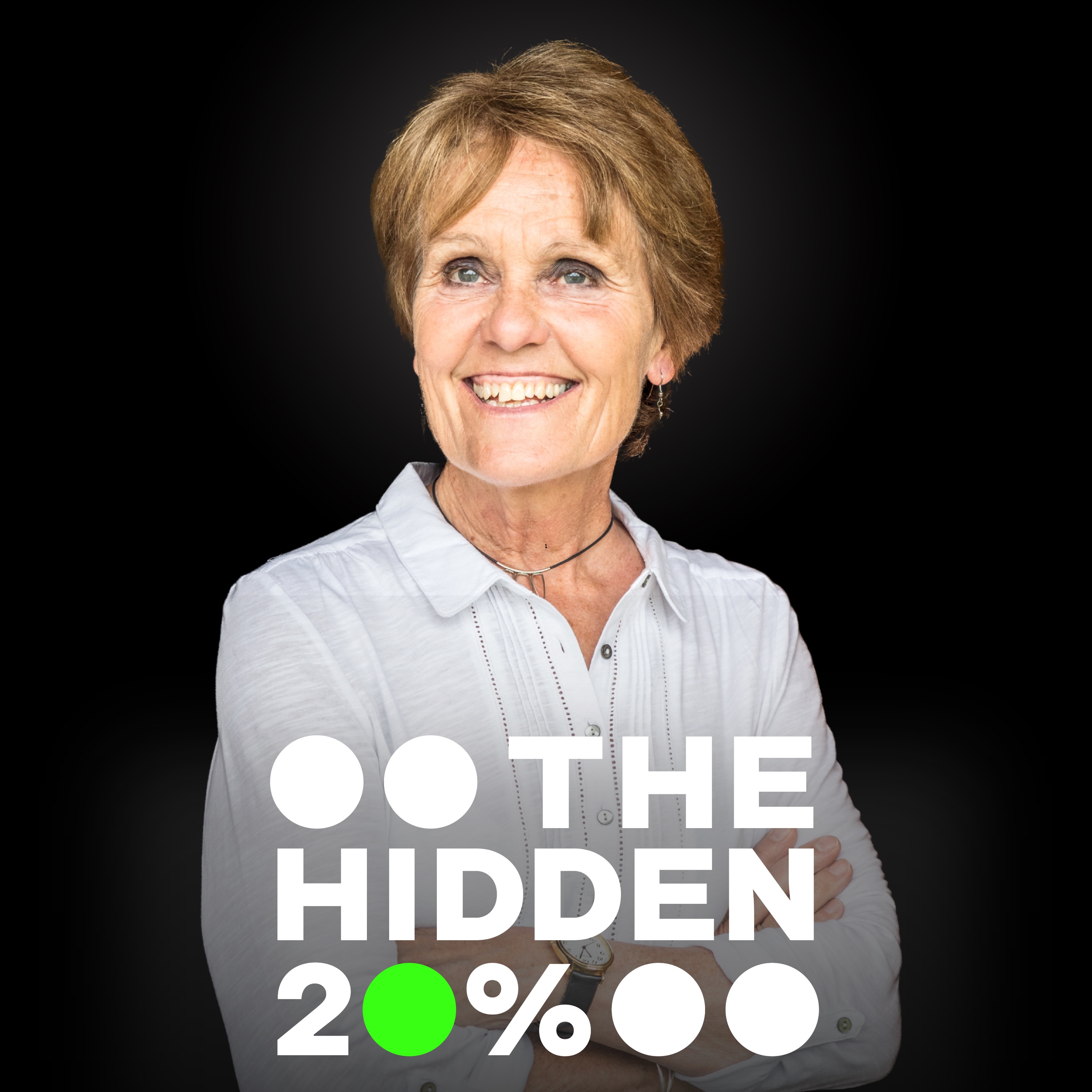
Neurobiologist Gina Rippon challenges popular brain myths, especially “male vs female brain” claims, the “10% of the brain” idea, and brain-scan overinterpretations. She argues brains are structurally similar across genders, that overlap between groups is large, and that experience and plasticity shape differences. She also explains modern imaging limits and why “reverse inference” (inferring what someone is doing from a scan) is unreliable.
Gina Rippon is a long-time neurobiologist/neuroscientist (lab work since 1975; ~50 years) and also a psychologist. Her work includes autism research and studying brain frequencies using techniques like MEG.
Men’s and women’s brains are more similar than different; “male/female brain” framing is counterproductive. Brain images are not “windows” but products of complex statistics. The “right/left brain” story is metaphorical. “10%” comes from early electrode limitations, not biology.
London cabbies show hippocampal enlargement that fades after retirement (plasticity). Neurogym “stand on one leg/rub knee” can activate motor cortex but doesn’t prove improved cognition. “God spot/chocolate spot” and “Mars/Venus” headlines misread imaging.
Written by AI. May contain mistakes.
Gina Rippon shares her extensive experience and lifelong interest in studying the brain.
“1975, I think I first started setting up a lab.”
Discussion on the evolving nature of brain research and the role of technology.
“Well, for me now, and certainly having studied it for so long, as you pointed out, it's the fact that it's the basis of who we are.”
Exploration of new techniques for studying brain activity in children.
“lying down in a scanner, which makes a lot of noise, some of them, and showing them a video of a, you know, social situation is pretty far removed from reality.”
Overview of brain frequencies and their relation to behavior and brain activity.
“Oh, that particular technology is really in the last 10 years.”
Debunking the myth of left and right brain functions and their persistence in culture.
“but they got packaged into different ranges.”
Discussion on the origin of the myth that we only use 10% of our brain.
“And I think that's really where I came in, because as well as being fascinated by brains, I've always been fascinated by how brains get to be different.”
Explore how the brain's motor cortex and nerve pathways function.
“So I think it may have come from that because the other electrodes weren't picking up the signals.”
Learn about common myths regarding male and female brains and their implications.
“I mean, there are books like The Right-Brained Way of Drawing, for example, So that people are harnessing that idea and saying, to unleash your creativity, you should use your right hand.”
Discover how technology has influenced our understanding of brain function.
“Or learn the poem by keeping rubbing your left knee while you're doing it, sadly.”
Understand how brain plasticity varies with experience and throughout life.
“Do London cabbies who've done the knowledge have a different brain?”
Examine how career transitions can lead to changes in brain function.
“What changes and can change is the connections between them.”
Discuss the concept of neurodiversity and its implications for understanding brains.
“So then why do some people find some things really easy for the first time?”
Critically evaluate the notion of distinct male and female brains in terms of neuroscience.
“And that's actually not what you see when you're scanning a brain anyway.”
Discusses the misuse of the terms 'male brain' and 'female brain' and their implications.
“and the term female brain has become misused.”
Explores historical biases in neuroscience that misrepresented female brains.
“But that would still make people think male brains are like this.”
Examines how scientific research has been manipulated to justify gender inferiority.
“the takeout being, not me, Gov, nothing to do with us men.”
Highlights how metrics in brain research have changed to fit biased narratives.
“Cart before the horse, fit the narrative.”
Explains the myth surrounding fixed differences between male and female brains.
“So those people with more developed frontal lobes, and this intersects with some of the racial aspects of the argument, were more intelligent.”
Discusses how gender stereotypes propagate the myth of fixed brain differences.
“So they were doing all sorts of tasks, verbal tasks, logical tasks, mathematical tasks, etc.”
Introduces the idea that structurally, male and female brains are more similar than different.
“Certainly the origin of the bias at the beginning.”
Describes the backlash faced by those promoting gender equality in brain research.
“Which is not the kind of at last the truth headline which…”
Learn about the pushback against gender-neutral science and perceptions of male and female brain differences.
“You know, interesting, the idea was, you know, as a scientist, I was reporting on the findings.”
Explore the complex nature of thoughts, consciousness, and their connection to brain activity.
“should we be referring to brains by gender?”
Delve into the relationship between autism research and sex differences in the brain.
“But that gets us into a whole minefield of consciousness and we are what our brains can do and we aren't what our brains can't do.”

Get the gist, explore an idea or ask about something said.
 Claude
On The Hidden 20%, what are the key points of this episode?
Searching your listeningAutomatic transcript. May contain errors.
0:00Overall, structurally, men's and women's brains are much more similar than they are different. Wow! Welcome to The Hidden 20%, our neurodiversity charity on a mission to rewrite the future for people who think differently. Together with you and an eclectic range of brilliant guests, we can break the cycle of silence by smashing outdated stereotypes, exposing the myths and sharing the most up-to-date truths about what it really means to be just different, not deficient. The best way you can help is really simple. Subscribe so you never miss an episode and if you can, donate to our charity through the link below.
0:45Enough preamble, I'm Ben, your host. Let's get into today's episode.
0:56so I woke up this morning Gina and my brain was just on fire knowing that I was coming to talk to you just so many questions and start with two simple ones how long have you been studying people's brains I suppose all my research career which goes back quite a long way how long give me a number of years. 1975, I think I first started setting up a lab. So 50 years. That's true. 50 years. You are officially the most experienced person who's had the longest career on the brain that I've spoken to. Oh, right. Okay. That is a real treat. I'll live up to it, hopefully. second question why that is a great question i've always had and it literally is apparently a lifelong obsession with brains apparently when i was very small i wanted to know what a brain was i think it was possibly seeing a dead bird or something and that set off a lifelong fascination with family myths i used to tripan my teddy bears to see if they had brains etc yes so i suppose my childhood obsession translated into my research career in a strange sort of way.
2:15And what is it about something that is actually very tangible, but we can't see? What is that intrigue about for you? Well, for me now, and certainly having studied it for so long, as you pointed out, it's the fact that it's the basis of who we are. And I really believe that. And because I'm also a psychologist and I'm kind of intrigued in issues of who we are and why we do things, it brings me naturally back to the brain. So I think the brain is egocentrically the answer to everything. Yeah, but I'm kind of with you. It feels like it's the beginning of so much. How much do you think we know about the brain?
2:58We're in the foothills, if you like. I think every time there's a new technique comes along, we learn a bit more. We learn to ask better questions, then another technique comes along and we can ask even more complicated questions. And the answers are always, this is much more complicated than you think it is. So the goalposts are always moving, but every step forward is a step forward, I think. Okay. And the progression in technology is a big driver of that? I think so. If you're not just interested in the brain as an anatomical organ, which of course is fascinating anyway. But if you want to know how the brain does what it does and how that affects its owner, which of course is for me the key question, then the techniques which allow you to put those two together, those developments are really important.
3:49So, you know, having somebody lying down in a scanner, which makes a lot of noise, some of them, and showing them a video of a, you know, social situation is pretty far removed from reality. But we're now moving towards It's a state where we can actually use brain imaging techniques while people are moving around. And also, I think with the advent of things like virtual reality makes things better than just a video game of some people playing with a ball or something. And is that about wanting, I guess, as much quote unquote reality as possible in terms of the data and the scan? Yes, if you're a social cognitive neuroscience, which is a bit of a mouthful, what you're interested in is everyday behaviour, people interacting with each other.
4:38I mean, the history of cognitive neuroscience is how does the brain process language, how does it perceive different colours, etc. So a sort of very individual study. So you could just have an individual in a scanner and show them different colours or play different sounds or whatever. But if you're interested in behaviour, not only an individual's behaviour, but behaviour between people, then you really need that kind of reality to even pretend you're asking the right questions. And when you say we can now look at people's brains while they're moving, what does that mean? Well, it means, for example, if you're very interested in how the brain develops in small children, or perhaps if you've got children whose brains don't appear to be developing normally, then it's a bit much to ask a small child to sort of lie very quietly and not move, etc.
5:29So now that we can get really quite sophisticated techniques which allow the child to move around, for example, in the lab, you can now allow a child to move around while you're actually picking up the magnetic fields from the surface of the brain. So, yeah. So once, I mean, you know, something one would never have dreamed of until actually quite recently. With them not realising? Not invasive at all? Not invasive at all. It does involve wearing a sort of clunky type of helmet. But you can dress it up for them, you know, let's play spacemen, for example. Sure, sure, sure. Let's pretend you're walking on the surface of the moon or something.
6:08So it's not everyday reality, but as close as you can get to it. And how new is that technology? Oh, that particular technology is really in the last 10 years. Can you give me the long name? Well, it's to do with magnetometry, which is actually picking up magnetic fields from the surface of the brain. So the brain has a magnetic field? It does. It does. Yes, because the activity in the brain is electrochemical. And everywhere there's an electric current, there's a magnetic field associated with it. And the very early types of brain imaging were to do with picking up the electrical field, which is Hans Berger way back in, actually 100 years ago now.
6:47putting an electrode on the surface of the skull and picking up these tiny signals. But the electrical signals are distorted by the skull and the tissue that's moving through. And there are mathematical ways of correcting for that. But the skull is transparent, if you like, for magnetic fields. So you're actually getting an undistorted signal, which again requires a lot of sort of mathematical wizardry to work out where it's coming from and how it's changing depending on what you're asking the person to do, etc. Does the brain therefore have a frequency? The brain has lots of frequencies. Okay.
7:21Yes. And Hans Berger was in fact the person who first discovered what we call alpha rhythms. And that was where he noticed that people who were more or less awake or paying attention or not paying attention, there was a particular rhythm of the brain which you could pick up. And then as that research advanced, we found that there were, I mean, a huge array of different frequencies, but they got packaged into different ranges. so we have theta and gamma and beta and alpha etc and that was then linked to different aspects of behavior originally eeg was to do with looking at epilepsy and seizures for example so you could see that quite clearly where there was a dramatic change but if you then said oh i want to know what's happening when i'm asking somebody to pay attention how does the rhythm change and where does it change which is a key issue as well so it's it's not just how it changes it's where it changes and when and the timing is a key issue.
8:17If I showed you 100 brain scans and didn't tell you anything about the person whose brain you're looking at, would you be able to tell me 100 stories? Depends. Classic academic answer. What kind of brain scans? Do you mean like FMI or MEG? Some other acronym. You tell me. Yeah. So FMI is what most people are familiar with, that gives you a really, really good structural image so you can see the structures. Functional MRI has taken that a stage further because that's to do with blood flow in the brain. So it can then pick up how the blood flow changes depending on what you're asking the person to do or the state that they're in.
9:01That's actually quite slow. But you get a very, very good spatial resolution. If you want what we call very good temporal resolution, when is this happening? because if you think about it, our behavior is in milliseconds. We don't, you know, thinking doesn't come in seconds. So you want something with very good temporal resolution and that's what you get from the magnetic fields. So you can kind of put them both together, which is really the last tranche of my work involves that. So you can actually see where the changes occur and when they occur. So if you gave me an MEG scan, you'd probably have to tell me what the task was.
9:38There's a thing called reverse inference. where people say, oh, could you look at the scan and say what somebody's doing? And as yet, no. You need to know, were they speaking? Or, you know, people in the kind of weird neurotrash years when people were talking about the God spot in the brain and the chocolate spot in the brain and things like that. Oh my God, hold those thoughts. Keep going. People would actually say, oh, you can talk about the brain lighting up. That was another thing. Yes, I've heard that. Once the brain imaging became a more familiar technique. And it is still based on electrochemical signals, which are really boring to look at.
10:16So somebody came up with a brilliant idea of translating these signals into colour-coded images. And that's what we're familiar with now. But lots of people think that somehow brain scanning is a bit like kind of opening a window into the brain and seeing, you know, different colours flashing across the surface. Yes. Unfortunately, it's the end of a very long chain of quite complicated statistical decisions. Sure. So that's one kind of myth that hangs around. But if you said, right, here's 100 people who are reading a poem, for example, or here's 100 people who are looking at a picture, or here's 100 people who are looking at or trying to remember a list of words or something, you could possibly tell, probably not tell 100 different stories, but you could probably say group them into people who are responding differently to the same experience.
11:04And I think that's really where I came in, because as well as being fascinated by brains, I've always been fascinated by how brains get to be different. Because if you look at a brain on the surface, every brain looks pretty much the same as every other one, unless there's been damage of some kind. and when people started looking at how the brain produced if you like behavior they were starting to say well we now know that if somebody's had injury to the left side of the brain for example very often language is affected so there must be a part of the brain on the left side which processes language and the early metaphors with right and left brain etc were actually only metaphors and quite simple and actually didn't really link directly to how the brain works.
11:52But they have become amazingly persistent. So we still get right and left brain metaphors being misused. Does the concept of a right and left brain actually exist? Yes, because before we really had much idea about how the brain works, you know, an intact living brain in an intact living human being, the only way we really understood the link between brain and behaviour was by looking at people who'd had some kind of damage and how their behaviour changed, either because of an accident or disease or whatever. And it did look, for example, as if particular types of behaviour were more often affected by damage to the left side of the brain, other types of behaviour by damage to the right side of the brain.
12:34So that idea grew up that the left brain did language, logic, etc., whereas the right brain did emotion and creativity. Creativity. That's right. Which at one level, as long as people remember it's a metaphor and that's not how the brain works. Okay. But people say you're using the right side of your brain or that's using your left side of the brain. I mean, I myself, I kind of, I think about myself driving the car as the perfect analogy for my left brain is fully engaged and kind of on autopilot driving the car. And I do a load of great thinking and get a load of great ideas driving the car. Well, I think that's a reasonable way of describing your experience, which I think is the other thing.
13:22So coming in from the outside, it's a pretty reasonable way of describing what's going on. But is that what's going on in pipe rain? It's not really what's going on inside, no. I mean, it comes back to another myth about we only use 10 % of our brain. We actually use all of our brain all of the time. that the variation is just across, you know, within that huge amount of activity. Where has the 10 % come from? I think it's because when very early on you were only looking at, you know, you might have 12 electrodes on the surface of the brain or something, you might only get activity from one of them or something when somebody was listening to a foreign language or something.
14:01So I think it may have come from that because the other electrodes weren't picking up the signals. But that was very much a function of the technology, not really of how the brain works. So I suppose that's where it came from. Never really thought about it, actually. And do we see anything in right brain, left-handedness, that kind of... The motor cortex, the basic control centers, the motor cortex is very much left and right. So we have a crossover and you can track the nerve pathways. So if you're using your right hand, it means the left side of the motor cortex is activated. similarly left and people the same if you've had a stroke for example how people know that it's on the left side of the brain is partly because language is affected but also you may lose movement in the other side in the other side but you can see that in the nerve pathways they do cross over so at the kind of very fundamental control center of the brain there is a crossover and there's a great saying about if the left side of the brain controls the right side of the body then only left-handers are in their right minds.
15:07Do you want to think about that? I'm very left-sided. Oh, are you right? Okay. Yeah, very left-sided. What other myths are there about the brain? What annoys you? Well, if you don't want to get me going, there is a myth that there is a female brain and a male brain. That is a myth that needs examining and discussing. It links to thinking and learning. I mean, there are books like The Right-Brained Way of Drawing, for example, So that people are harnessing that idea and saying, to unleash your creativity, you should use your right hand. And there's a very weird set of explanations about the brain buried in education, which I think has been put right now, called Neurogym.
15:51And the idea was that you could stimulate children's brain in the classroom by getting them to stand on one leg or rub the left knee or something like that. And there were councils spending quite a lot of money sending teachers off to be trained to use Neurogym. Really? So there are some really weird ideas out there. And is that sort of proven and, I guess, neuroscience-wise possible to rub your leg and stimulate your brain? I know it sounds a stupid question and you're laughing. No, no, it isn't. Because in a way, as ever with these things, it's a kind of kernel of truth. If you're using your right hand to rub your left leg, then the motor cortex will be activated.
16:39But it's at that level. It's not going to affect your cognition. Yes, you're not suddenly going to be able to remember a poem. No, no, no, that's right. Or learn the poem by keeping rubbing your left knee while you're doing it, sadly. Yes, so I think there is a fascination out there with how we might do something with our brains and stimulate our brains. So there is a kind of, you know, a good side and a bad side to our understanding about the brain. Sometimes it's people just trying to explain to non-experts, this is how the brain appears to do what it's doing. And I think this is where the right and left brain came from.
17:14What have you found to be the best analogy to explain to someone how a brain works? Well, very often the analogies are very much tied to the technology at the time. So they used to be like the telephone exchange model of the brain. And of course, now I'd come to software and hardware. You know, you think of the brain as hardware and the computer. And the key thing is it's not necessarily the hardware, it's the software and the connections between it. And I'm sure if I was a physicist, I'd, you know, go on to quantum mechanics or something like that. Yes. Quantum computing probably as well. That's right.
17:48Yeah. So the thing that I think is important that people realise that we get these amazing images of the brain, which are all about the different structures, But we don't really learn a lot from that if we're interested in why people are different or why there are gender gaps in society, for example. You know, there's not much point looking at the amygdala and saying, oh, that person's got a big amygdala. That means they're very emotional. It doesn't work that way. Do London cabbies who've done the knowledge have a different brain? That's a great question. And almost an exception to what I've just said.
18:22Yes, they do. Okay. They do. I mean, bearing in mind this takes about three or four years to do. If you look at the brain of a London cabbie, the part of the hippocampus which deals with visuospatial, you know, remembering the 10 ,000 roots within six miles of Charing Cross, that does become enlarged. And therefore, the idea around the plasticity of the brain and its ability to be quote unquote trained or developed is totally real. Oh, yes. And what's interesting also coming back to the taxi cab drivers is when they retire, that difference disappears, which demonstrates just how flexible and plastic the brain is.
19:02Wow, I didn't know that. Yeah, that's right. And I think that has become really important because the idea was you could see brain changes in the developing brain, you know, child, tiny little brain and then doubles in size within months and then stops growing adolescence, maybe late teens, early 20s, etc. And people assume that was it. You know, you've got the brain that was going to carry you through the rest of life till you got to a certain age and you fell off the cognitive cliff or whatever. Where does the idea hold true that we hear that our brains are fully developed at 25 years old? Structurally, probably a bit earlier than that.
19:38Okay. Yes. Yeah, yeah. But structurally. Yes. What changes and can change is the connections between them. And that's where the newer understanding of the brain has come through. So very early on, the massive brain growth is to do with connections between different parts of the brain. Yeah. or not depending on you know issues of atypicality and then adolescence which is an even more recent understanding of how the brain changes all of that wiring you get the sort of period of pruning so partly the wiring is disconnected so anybody who's got an adolescent child will know that emotional regulation just goes out the window and that is a brain-based change okay so there's a lot of pruning back of unused or too many connections and then a reforming of different kind of connections, particularly to the control centers in the frontal part of the cortex.
20:37So that changes quite dramatically. But those changes can continue. So if, for example, anybody who learns a musical instrument, I mean, for example, coming back to your idea about looking at brain scans, you could, this is perhaps stretching it a bit, but you could tell if somebody's a keyboard player for example because their hand movements would be symmetrical or a string player because their hand movements would be asymmetrical by looking at their motor cortex. Whoa. So that just again Can you tell if someone was a singer where you don't you're not using your hands? I don't know is the answer to that question.
21:13You might be able to see if you've got somebody who's a trained singer and then played them different music or particularly if they've got perfect pitch for example I'm just thinking our producer Phoebe trained opera singer. Oh right. Okay. Get her in the scanner. Yeah, get her in the scanner. Yeah, yes. Yeah, no, I mean, I think the keyboard and the string is just to demonstrate, yes, there is this plasticity. And luckily, it shouldn't be surprising. We keep it all in our lives. I know, yeah. And our lives change. Yes. And we're always learning different things. Different experiences. So therefore, if you looked at somebody who had a very varied career.
21:54Yes. versus somebody who'd been in the same job for 40 years. Yeah. I would expect there to be difference there. Yes. Yeah. I think one of the things that also is counterintuitive is when you're first learning a skill, a lot more of the brain is involved. So, for example, somebody who's a footballer who then goes on to be a lawyer. Their brain will change. Their brain will change. To adapt to that career and that profession. Yes, the aspects of their brain which reflected their footballing skills will change to the aspects of their brain which reflects their legal abilities. So, for example, if somebody was a footballer early on in their life and then became a lawyer, the characteristics of their brain would change.
22:43In what way? So those aspects of their brain, for example, motor control, anticipation of movements in different parts of the football field, would become less active. And the parts of their brain which required them to remember huge amounts of preceding cases or to make abstract judgments, for example, they would become more active in their legal career. So their brain, I guess, literally would adapt. Different parts of their brain would be involved. There would be some core elements which remained, but there would be other ones which would be less active than those fed into their new career.
23:27So then why do some people find some things really easy for the first time? Like we have the saying, they're a natural. And other things we do for the first time where it takes a lot of effort. What does that tell you about someone's brain? I think it comes back to the issue of every brain being different from every other brain. And I think that's absolutely true. No two brains are the same? No, I don't think so. No. I mean, very often if I'm giving a talk, I say, if you're sitting next to your identical twin, your brain will be different from your identical twin's brain. Because your brains reflect your lives as well.
24:06It's not just a kind of fixed template. It means, you know, even if you've got an identical twin, but you're almost invariably your identical twin, however identical you are, will have had slightly different experiences and more and more as you get older, for example. And I think that's a really important issue because it covers the whole area of neurodiversity, for example, and also possibly neurodivergence. Although the difference between those two is something that probably needs to be thinking. Sure, sure. What is the God spot and the chocolate spot? The chocolate spot. Okay. Once brain imaging became more accessible and people started demonstrating what brain imaging could do in terms of these colour-coded maps, That was a real gift to non-experts, self-help gurus who, what we call the Mars and Venus genre, if you're going to just randomly talk about differences between male and female brains.
25:03So they were able to take these lovely coloured brains, which showed in intense detail the structure of the brain, which were superimposed, different colours, saying this is the brain more active here, this is the brain less active here. And that's actually not what you see when you're scanning a brain anyway. But it tells a nice story. It comes back to telling the story. And it was very much the brain lights up and this is where the brain lights up. And so you then got onto the God spot and the chocolate spot. What does that mean? What does the God spot mean? It came back to the idea that the brain was very, and the early pictures of the brain, a bit like phrenology, you know, there was pictures of the brain and, you know, this brain does justice and this does maternal behaviour.
25:46and this does genius or something. So we have this picture of the brain like a jigsaw. And each piece of the jigsaw did a different bit of human behavior. That's not what happens. Because, for example, language. There was this idea, which, again, based on truth, that you have part of the brain which deals with understanding language, another part of the brain producing language. So you might not be able to speak, but you could understand, or you might not be able to understand, even though you could produce words. So that then generated this nice little modular picture of the brain. And that kind of stuck with the advent of brain imaging because all of these ideas had come from before we could really look at intact human brains, living human brains.
26:33And therefore the idea of the God spot was, is there something in the brain which becomes more active in religious people or more active when they see a religious image. Wow. And there was a kind of, I call it the neurotrash years, neuro-nonsense. Yeah, when were those years for you? It was by the 1990s. Neuroscience itself started saying this is all getting a bit silly because at one level you think it's really great that non-experts, the great public are interested in what we're doing and looking at our brain images and open the Sunday Times colour supplement and there's a picture of the brain.
27:10And then we started thinking this is actually being misused a bit. I mean, I got involved because the idea of the female and the male brain was driving the arguments because it was, you know, at last the truth. I always come back to these headlines that you get where some neuroscientist somewhere has published a paper which demonstrates the males respond differently to language than females. and you've got a nice image with females with light-up spots on both sides of the brain and males with light-up spots on only one side of the brain. So at last the truth, men and women really are different and that's why, you know, men will rule the world and women will have to support them kind of thing.
27:53So let's clear up some of this stuff. Is there a male brain and a female brain? The trouble is the term male brain has become misused. and the term female brain has become misused. And due to a book by Simon Baron Cohen. I've had him in that chair, Gina. I know, I know. Called The Essential Difference. Opening lines. The male brain, so there is such a thing, is hardwired, and that's another issue. Yes, concrete. Right, for understanding systems. And the female brain, there is such a thing, is hardwired for empathy. Okay. So those two sentences kind of at that stage, and I will obviously say that things have changed a lot since then, really summarized the problem that this caused.
28:43Because first of all, the idea that there's a male brain, which Simon does say later in his book, you don't have to be a man to have a male brain. I don't know about you, but I think most people, particularly non-experts, might read the term male brain and assumed that that was a brain from a man. Sure. And that wasn't how it was meant, but of course that's what was heard. Yes. And I think that's where the problem came from. It was a misunderstanding of what was being said. I think male type brain, but it doesn't roll off the tongue quite so well. Yeah, another word. Masculine brain even. Yes.
29:18But that would still make people think male brains are like this. But it's all about what's loaded into male, masculine men as a concept, right? in terms of what is then interpreted from that to go, this frog has a male brain, for example. You're interpreting that based on your biases and views on what the word male means. Yes. Not brain. No. No, no, that's right. Yes. And I mean, that goes right back to the end of the 18th, beginning of the 19th century when people were starting to explore, you know, thinking actually it's not the heart or whatever or the liver, it's probably the brain we should be looking at in order to understand human behavior.
30:05And the male, in both senses of the word, neuroscientists at the time were pretty biased. So Gustave Le Bon, you know, notorious person who would say, effectively, there was an assumption that females were different, were inferior. Looking at the, you know, the social status of women at the time, yes, they were, you know, they weren't allowed to do anything. Anything, that's right. And so what they were looking for at the beginning was the explanation for this inferiority by saying, we need to find out why the female brain is inferior. So they'd kind of come up with the answer that they were looking for and then work backwards.
30:42But they came out with a biological answer rather than a cultural or societal answer. Yes, so they were working back from the status quo. They were saying females are inferior. We think people's position in society is due to their brain. So we need to explain their inferiority in terms of their brain. So they were working backwards. i.e. the takeout being, not me, Gov, nothing to do with us men. There's a biological component as to why women are inferior. This was an explanation of the status quo. And of course, characteristically in these sort of arguments, size matters was the first answer. So male brains on average, and this is true, are about 8 % bigger than female brains.
31:29Why? Because males are about 8 % bigger than females. Sorry, I love that. I'm afraid that is the answer. So you can get females with bigger brains. Not 8 % cleverer, not 8 % stronger, not 8 % anything else, just 8 % bigger physically. Yep. On average. And in order, you know, you've got a skull of a certain size, you have a brain that goes in that. Sure. So in fact, if you had a whole, you know, coming back to your 100 brains, if you had 100 brains which varied in size, you would find that some of the small ones would be female, but some of the small ones would be male. And ditto. So then they had to readjust it and say, oh, well, it was, you know, they were working backwards, saying, looking at body-brain ratio, for example.
32:17Yes, yes. And saying, you know, maybe the bigger the body, the bigger the brain or something, or the bigger the head. And then somebody, again, unhelpfully pointed out that, you know, chihuahuas, if you were looking at intelligence in dogs, would therefore be the most intelligent dogs. because their head-body ratio is of such. And then somebody else pointed out, well, actually, chihuahuas are not renowned for being the most intelligent of dogs. So those are the kind of arguments that are going on. But what was interesting is that the metrics were changing all of the time in order to fit the answer.
32:52Sure. Cart before the horse, fit the narrative. So if you took a measure where, for example, the frontal lobes were at some point, you know, part of the brain, most evolutionary, became the focus in terms of why people are more intelligent. And this intersected, of course, a lot with race and class arguments. Okay. So the aim of the metric was to prove that white, upper-class, educated males were at the top of any achievement scale. And if any metric didn't come up with that answer, there was obviously something wrong with the metric. Well, you just ignore that. Yes. Well, yes. An anomaly. Or just, oh, that's a different way of measuring it.
33:33And actually, there was a female psychologist who was interested in head size and intelligence and did a big survey at that point, mid 19th century, possibly, looking at managing to get head sizes from different high achieving men and some women as well. and then finding out that some of the women had actually bigger heads than some of the men. And one of the men whose head she measured turned out she then did a PhD. He was going to be her examiner. He had one of the smallest heads. So a bit of problem with that. So don't publish that. Obviously, a reviewer would say, obviously, some kind of measurement problem here because that can't possibly be right.
34:18So that went on for a long time. There was a focus early on in brain research where the understanding was that the newly developed, evolutionarily speaking, part of the brain, the frontal lobes, underpinned intelligence. So those people with more developed frontal lobes, and this intersects with some of the racial aspects of the argument, were more intelligent. And there was lots of reports of the fact that men had much more developed frontal lobes than women. But there was a phase where another part of the brain, the parietal lobes, there was a model which suggested that actually the parietal lobes were that part of the brain which served intelligence.
34:58So there was a whole lot of data out there showing that women had larger parietal lobes. So then they decided that actually there was a lot of problems with that research. So they withdraw it because obviously anything that showed that women had a larger part of their brain, which served intelligence, didn't fit the narrative of the time. What is the impact of this sort of gendered bias on this male-female brain? You've given me the origins and you've given me the kind of beginnings of it. How has that then played out to today? Well, I think the origin of it was pre our understanding of plasticity.
35:38The idea was that you had a fixed brain. You were born with a particular kind of brain, male or female, and it grew in size and then at a certain stage of your life stopped growing. So the idea was that there was something fixed and invariant about that brain. So if you had a male brain, in quotes, then that's what you had. And associated with that male brain, because psychologists weighed in on this as well. So they'd have this classic go-to list, which I've referred to, where they were very interested in differences between males and females in behavior. So they were doing all sorts of tasks, verbal tasks, logical tasks, mathematical tasks, etc.
36:26coming up with this nice list of, you know, males are like this and females are like that. Two things about that. First of all, in a way, you're begging the question by already dividing your participants into two kinds. And one of the things that very rarely got pointed out until quite recently, it was a huge amount of overlap between the data you got. So you might have, you know, even if you were testing a thousand people, which early on you probably weren't, you would get an average difference between those two populations, which was quite small. But if you actually drew out the data, you could see there was a sort of distribution of findings for the two groups.
37:03But there was a huge amount of overlap. Okay. So actually, at each end, there were people to whom this really didn't apply. Yeah, it's not the neat little boxes. No, no. Here's one box and here's another. You know, yes. So that kind of contributed again to the myth because the idea was that, oh, you know, scientists approved. You know, there's a paper published in wherever talking about a standard deviation and significant difference. Again, the language is crucial because if, you know, somebody says a significant difference, you mean that was really important. A bit like the essential difference, coming back to Paul Simon's book, about, you know, it sounds like something that's really important as opposed to a biological essence, which is what it really referred to.
37:45But of course, that's not necessarily what's heard. So the significant difference between, you know, females' language ability or men's mathematical ability, men's visuospatial ability, etc. So we had two sets of arguments tying neatly together, saying you've got a brain which makes you visuospatially superior, which means you go on to be a great architect, a great designer, a great painter, you know, whatever. And you've got a brain which seems to make you better with words, better at interpreting emotions. And therefore you'll go on to be an underpaid nursery nurse or a primary school teacher, etc.
38:29Because you'll be good with people. And so you had a kind of scientific argument which was relating to how people saw the world. Because, you know, it was the status quo. And say, oh, right, you know, we've got an explanation for this. But of course, what you then had was, well, if the brain can't change, then you're going against nature by saying that women could just as well be Nobel Prize winners or mathematicians, etc. The astronauts and architects and all those. And you say, no, you can't because you've got the wrong sort of brain. So is this also a kind of self-fulfilling prophecy of white men leading the research and narrative?
39:08Certainly the origin of the bias at the beginning. Yeah. Yes. Yeah. And then I'm struck by the slight timing of some of this, of when I think about the kind of industrial revolution and when I think about this idea and consciousness around mass producing things, uniformity and conformity being highly efficient. and then I apply that to some of your thinking and what you've just explained about the idea that, hey guys, there are only two brains and one does this and that's how it is and one does this and that's how it is and that's it. And literally it's repeat, repeat, repeat for females and repeat, repeat, repeat for males.
39:55Does that tally? It does. I mean, certainly the terms of self-fulfilling prophecy is also in terms of self-identity. So six-year-old girls, you know, by the age of six, girls are saying maths is a boy thing. And I'm a girl, so I can't do maths. So you then get the maintenance of these differences and gender gaps, you know. And people are saying, well, you know, hand-wringing about gender gaps, we must do something about it, et cetera, saying, well, you know, that's just the natural world playing out. And there are, of course, the odd exceptions, which comes back to Gustave Le Bon, who'd said something along the lines of, there are occasionally intelligent women, but they're as rare as a two-headed gorilla.
40:42Actually. Yeah, absolutely. So, you know, and this is your non-biased scientist. And he was the person who was, you know, looking for the inferior female brain and finding it. So what do we know about the difference between a man's brain and a woman's brain? Right. In simple terms. Simple terms. Overall, structurally, men's and women's brains are much more similar than they are different. Wow! Which is not the kind of at last the truth headline which… No, but it is a, sorry, excuse my language, that isn't at last the truth headline. Yeah, it should be. There are differences. And I mean, this is where I get slightly anxious because when I wrote The Gendered Brain, there was a certain amount of pushback.
41:38And what was that pushback and what was that like for you? Well, the epitome of the pushback was a headline in the Daily Telegraph, which was somebody reviewing the book saying, smacks of feminism with an equality fetish. And I just love the idea that if you're interested in equality, it's some kind of perverse practice. Because I then got invited onto some Harper's Bazaar panel, speaking truth to power. You know, interesting, the idea was, you know, as a scientist, I was reporting on the findings. But this was, you know, you're challenging the world order by saying this. And there was sex difference denier.
42:18What does that mean? It means that effectively I was being accused of saying there are no differences between men and women's brains. Okay, okay. Which is not what I was saying. You'll say it. And then somebody will say, so how come I've reared my children gender neutral? And my little girl, if I give her a fire engine, she'll wrap it in a blanket, put it to bed. And if I give my son a piece of toast, he'll cut it into the shape of a gun. So this is the kind of pushback I was getting, you know, as a, of course you're wrong because, you know, this is a, I am a person who has a daughter and a son.
42:56And therefore I am an expert on the difference between males and females. And you have to be wrong, you know, because people were saying, but that's not how the world is. So we started speaking about differences between male brain and female brain. What do we then know about a male neurodivergent brain and a female neurodivergent brain and the differences or similarities? One of the areas I've been looking at most recently is the fact that there isn't a lot of research into those differences. And the term neurodivergent in itself is interesting. and also when you refer back to the idea there's a huge amount of overlap between the two types of brains if you are beforehand dividing people into male and female.
43:40And the same is true in neurodivergence. Although there is a suggestion that perhaps the more extreme differences of behaviour, the kind of behaviour which might attract in quotes diagnosis, maybe the differences in themselves are more marked and maybe this is something we should be looking at. Should we, and just so that people listening, so it's really clear, Gina, from your perspective, should we be referring to brains by gender? I think dividing brains into being male or female has been very counterproductive. Yes. So I think, no, we shouldn't. Excellent. That we should be talking about people's brains that are all different.
44:26Yes. Or if you're interested, rather than getting away from being male or female, if you're interested in somebody who has a huge ability to pay attention to detail or ability to pay attention to detail, let's have a look and see what the brains of people who are very good at that, as opposed to people who are not very good at that. Yeah. The bigger picture type brain. Yes. Love it. Those would be much more interesting. Yeah. And helpful. And helpful. What we're going to talk about in part two is how autism is very connected to everything that we've been talking about, especially biases, the research that's been done, males, females, presentation, what we knew versus what we now know.
45:14I mean, I have so many questions for you, Gina. I'm going to ask you one last question because I'll kick myself if I don't. Right. What are thoughts? You laugh at most of my questions, Gina. Sorry. I know it's not because they're funny. Wow. As a neuroscientist, how would you explain a thought? As a neuroscientist, I'd have to bring in the whole concept of consciousness, which is another whole huge area. You know, what is consciousness? Is consciousness a product of the brain? Do we think we're conscious, whereas actually we're a kind of Truman Show product of our brain? But can you see, even from like an imaging perspective, can you see someone thinking?
45:58I can see people processing information differently. Okay. And actually it's quite interesting because more recently people have started looking at the so-called resting activity of the brain. Yes. Where you say somebody just lie in the scanner and think of nothing. Sure. Well, the worst thing you can do to anybody is to say just think of nothing. Yes. Because you can't do that. Yes. So what you will see is people thinking, oh, I wish I'd had some lunch before I lay in the scanner. Or I wonder what time this is going to finish because I'm going to miss my bus otherwise. But it could be processing information.
46:35And you could say a thought is awareness of that process. Okay. Or you could completely dismiss that and say, you know, if you're a philosopher, this is, you know, the mind-body split. But what about the idea that, and this, you know, ADHD is, I think this comes up a lot of like, you've got to turn your brain off, switch off, racing thoughts, just the kind of idea around, I guess, that sort of Zen meditation of just not thinking anything. Mindfulness, yes. Well, I think, again, you could say that the whole of our brain is active most of the time. Some people, maybe the way in which the pathways were laid down because of experience or because of genetic contributions or both, are able to focus more on some pathways than others.
47:24Other people find that really difficult. And actually, I always think of the ADHD brain as a bit like one of those old-fashioned pinball machines. You know, you set something going and it bounces off there and then it goes there. And I know when I'm tired, that's how my brain works. I'll start to do something and then something will come up. And, oh, while I'm doing that, I must follow that through. And then you get there and you find you've gone down a rabbit hole or something. And I find that I know I'm tired. When I'm less tired, I'm able to think, just park that. Yes. Park that thought. Park that thought, yeah.
48:01So, yeah. I mean, I think it could be awareness of processing information. Yeah. But that gets us into a whole minefield of consciousness and we are what our brains can do and we aren't what our brains can't do. But I just I love thinking about this conversation in the context of like where do good ideas come from, for example. And we're not going to answer that today. But you are leaving me with a lot more questions and answers, Gina. And what a treat. What like a huge privilege it feels to sit down and talk to you about that. Even though I don't think I've answered any of your questions. No, I think you've absolutely been brilliant.
48:40Last question. Why did you decide to write the second book? It was partly because of the pushback against the first book. Because my day job was autism research. At a very technical level, we were looking at different frequencies in the brain. and how this demonstrated what we talk about, about the predictive brain, by saying, you know, our brains help us get through the day by anticipating what's going to happen. And I believe that the techniques we've developed allows us to track that. That was with any autistic person we could find so that we could try it out. And I wasn't paying attention to the fact that any autistic person we could find, they were always, always male.
49:30so there was that kind of going on at one level but the pushback was saying you're a sex difference denier which means that you're undermining any opportunity any research which is trying to look at conditions where there are known sex differences a not sex difference denier and certainly that wasn't the intention yeah but top of all was the list if you're looking at brain-based conditions which are more common in females and this is on average you know overlap etc. Alzheimer's, top of the list. If you're looking at brain-based conditions, which are more common in males, Parkinson's and autism, always top of the list.
50:08And they say, you're an autism researcher. How dare you deny that there are sex differences when we know, you know, that autism is a male thing. And the only way we're going to understand that is by looking at sex differences. So I thought, you know, that's fair enough. I will write a book on sex differences in the autistic brain or exploring research into sex differences in the autistic brain. And that was the point at which I think I say in the preface of the book, I realised it was going to be a very, very short book because nobody was looking, including me. That's where we'll end it. Thanks, Gina.
50:49that's it for today's episode of the hidden 20 but just before you go a favor the hidden 20 is a charity and we do this to bring you the truth the latest research and the real stories that matter so if this episode spoke to you then please hit subscribe and if you can donate via the link below. Finally, a big shout out to you all for listening and our brilliant team who make this all happen. Phoebe, Charlie, Kristen, James, John and the guys at TYX Studios. We'll see you next time.
In part one of this two-part conversation, neurobiologist and author of The Gendered Brain and The Lost Girls of Autism - recently awarded the British Psychological Society’s Popular Science Book Prize - Gina Rippon joins Ben to unpack what we really know, and don’t know, about the human brain.
From left-brain/right-brain myths to the rise of gendered brain science, Gina explains why many of the ideas we’ve grown up with simply don’t stand up to scrutiny. Drawing on decades of research, she explores how brains change across the lifespan, how experience actively shapes neural pathways, and why no two brains - neurodivergent or not - are ever the same.
They dive into alpha rhythms, brain plasticity, ageing, and the cultural bias baked into neuroscience, including why the idea of distinctly “male” and “female” brains has caused more confusion than clarity.
Join us at hidden20.org/donate.
________
Host: Ben Branson
Production Manager: Phoebe De Leiburné
Video Editor: James Scriven
Social Media Manager: Charlie Young
Music: Jackson Greenberg
Head of Marketing: Kristen Fuller
00:00 Introduction
00:57 Why Gina Rippon Became Obsessed With the Brain
2:54 What Science Really Knows About the Neurodivergent Brain
7:18 Brain Waves Explained: Alpha Rhythms & Neurodivergence
10:24 Debunking Common Myths About the Neurodivergent Brain
12:00 Left Brain vs Right Brain: Does It Actually Exist?
17:14 The Best Analogy for How Brains Really Work
18:17 Why London Taxi Drivers’ Brains Change
19:30 How the Brain Changes With Age
21:46 Brain Plasticity, Careers & Learning Over Time
23:27 Why Every Brain Is Different And Neurodiversity
26:45 Gender Bias in Neuroscience: “Neuro Trash” Research
27:53 Is There Such a Thing as a Male or Female Brain?
35:18 The Real Impact of Gendered Brain Science
40:56 Neurodivergence, Gender & Brain Differences Explained
44:07 Moving Beyond Gendered Brains to Human Brains
45:22 What Are Thoughts, Really?
48:40 Why Gina Decided To Write “The Lost Girls of Autism”
The Hidden 20% is a charity founded by AuDHD entrepreneur, Ben Branson.
Our mission is simple: To change how the world sees neurodivergence.
No more stigma. No more shame. No more silence.
1 in 5 people are neurodivergent. That’s 1.6 billion of us - yet too many are still excluded, misunderstood, or left without support.
To break the cycle, we amplify voices, challenge myths, and keep showing up. Spotlighting stories, stats and hard truths. Smashing stereotypes through honest voices, creative campaigns and research that can’t be ignored.Every month, over 50,000 people turn to The Hidden 20% to feel safe, seen and to learn about brilliant brains.
With your support, we can reach further, grow louder, and keep fighting for the 1 in 5 who deserve more.
Join us at hidden20.org/donate.
Become a monthly donor.
Be part of our community where great minds think differently.
Brought to you by charity The Hidden 20% #1203348
______________
Follow & subscribe…
Website: www.hidden20.org
Instagram / TikTok / Youtube / X: @Hidden20charity
Ben Branson @seedlip_ben
Gina Rippon https://www.ginarippon.com/
If you'd like to support The Hidden 20%, you can buy a "green dot" badge at https://www.hidden20.org/thegreendot/p/badge. All proceeds go to the charity.
Hosted on Acast. See acast.com/privacy for more information.