 The Indicator from Planet Money
23 Nov 2026 · 9m

 Add vo to ChatGPT or Claude to ask about everything you hear
vo listened to this episode to put together the overview and transcript, so there may be the odd mistake.
Europe’s defense spending surge—driven by Russia’s 2022 invasion of Ukraine and U.S. pressure under Trump—doesn’t automatically make Europe safer, due to fragmentation, political/institutional barriers, and industry structure. It also examines American venture capital funding European defense startups and whether that creates dependence risk.
Johannes Binder, economist and researcher at the Kiel Institute for the World Economy (Berlin).
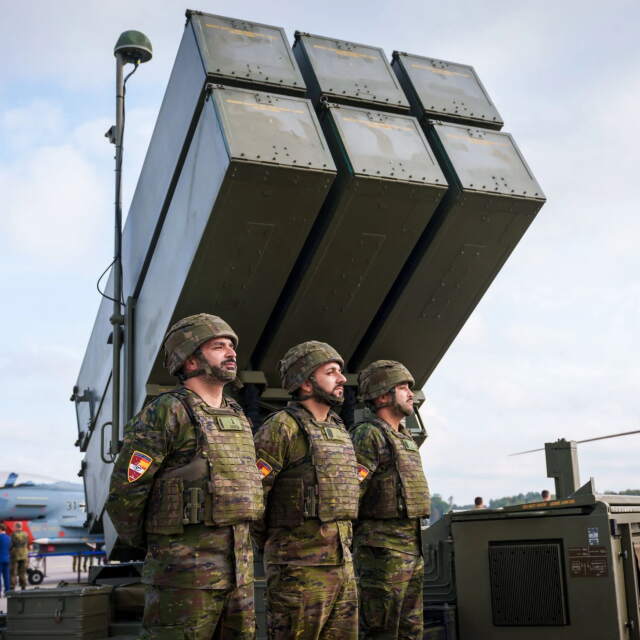
EU defense spending is projected at about $500B in 2024 (over double a decade ago); including non-EU NATO members like the UK and Norway brings it to ~$600B. Europe remains fragmented, building parallel systems that don’t interoperate, wasting money. Large firms dominate procurement (top 10 get ~80% of contract value in Europe vs ~60% in the U.S.), enabling price power. Big firms prefer “big ticket” platforms, while drone/small-systems growth needs riskier startup investment.
“Zeitung Wende” mindset shift after February 2022; need for European-made fighter jets, air defense, strike missiles, comms/intelligence, logistics, and nuclear-related capabilities if the U.S. were absent; up to ~50% of VC in European defense startups coming from American firms.
0:01NPR.
0:06This is The Indicator from Planet Money. I'm Patti Hirsch. And I'm Waylon Wong. Now, brace yourselves, because we're going to throw a number at you, and it's a big one. $500 billion. That is the amount that European Union countries are expected to spend on defense this year. And it's not just that this is a big number. It's that it's more than double what the EU was spending on defence just a decade ago. It is a veritable fountain of money. Yes, it is. And it doesn't even include non-EU European members of NATO. Add in the UK and Norway, and you're up to$600 billion. And wait, there's more. Billions of private dollars invested in small firms, much of it by US investors.
0:48It all adds up to a bonanza for defense firms, a veritable geyser of green. Or if it's in local currency, many colors besides green. It's a rainbow. But just because there's a huge amount of money being pumped into European defense doesn't necessarily mean that Europe's getting super safe, super fast. There are all sorts of obstacles in the way. On today's show, we'll talk to a German economist about why a big bag of money doesn't necessarily translate into a better defended Europe, certainly not overnight, and how private American investment in European defence is both welcomed and seen as a threat.
1:27That's coming up after the break. Stay tuned for the following announcements and messages from our sponsors. This message comes from Zatva. Big days require deep, restorative sleep the night before. The kind of sleep Sotva mattresses are designed for. And now save up to$625 on$1 ,000 or more at sotva.com slash NPR. Support for NPR and the following message come from Washington Wise. Decisions made in Washington can affect your portfolio every day. Washington Wise from Charles Schwab is an original podcast that unpacks the stories making news and how they may affect your finances and portfolio.
2:06Host Mike Townsend and his guests explore policy initiatives for retirement savings, taxes, trade, and more. Download the latest episode and follow at schwab.com slash Washington Wise or wherever you listen. This episode's sponsor is HubSpot, which offers the following message. What if instead of updating your CRM, your CRM updated you? HubSpot's self-updating CRM keeps your customer context current so you can win more deals. Learn more at HubSpot.com. There are two reasons why Europe is spending on defense like a drunken sailor on shore leave. The full-scale invasion of Ukraine was the first.
2:47This new threat of a Russian attack on Europe prompted what former German Chancellor Olaf Schultz described as a shift in times in how we think about the world. I think the word you're looking for is Zeitung Wende. Oh, wow, Patty, coming in with the German. Johannes Binder is an economist and researcher at the Kiel Institute for the World Economy in Berlin. We were living in a blissful environment, thought everything would be great and happy and peaceful. And then we woke up one day in February 2022 and found out that this is definitely not the case anymore. That shock was followed by the re-election of President Trump.
3:21Now, U.S. administrations, both Democrat and Republican, have been complaining for most of the current century that Europe hasn't been paying its way on defense. But Mr. Trump amped those grievances up to a whole new level. The protection of NATO was at one point questioned and people woke up and thought we need to spend more to become sovereign in our defense policy and really be able to defend ourselves without the U.S. if needed. That's a big ask. After almost 80 years of integration, Europe has come to rely on the U.S. for fighter jets, air defense systems, strike missiles, communications and intelligence networks, and logistics support, not to mention the nuclear umbrella.
4:07Defending ourselves without the U.S. would mean coming up with European-made versions of all of these things. And from some people's point of view, this is a great idea. The people in the defense industry are likely very happy at the moment. There's a lot of money pouring in. Johannes says in the past, the European defense industry was a bit of a backwater. There was no sense of need to grow a European arms manufacturing capability. The U.S. had thrown a protective umbrella over Europe, and governments felt free to shrink defense budgets in favor of social programs. This is what they call the peace dividend.
4:41We were just not used to building a lot in a short period of time because we came from the years of the peace dividend, where the military industry was, they were there, but it was a side economy or a side industry to the main industry, and nobody really cared about that. Today, thanks to the money fountain, that geyser of green, the arms business in Europe is hot, hot, hot. And if Europe was one country, well, you can imagine a doubling of the defence budget over 10 years would result in a pretty impressive result, like, I don't know, maybe a bigger army or a better spy network or flotillas of drones.
5:15But Europe isn't a single country. We have these 27 countries in the European Union, And one of the biggest weaknesses that we have in Europe is that we are still very much fragmented. We are building so much stuff in parallel instead of pooling our resources. And this is really costing a lot. So the waste of money is incredible. Every European nation wants to get a chunk of this money to build up their own defense industries. They want to make their own tanks or drones or whatever. Having an Italian tank and a Dutch tank and a Greek tank is great for those individual economies. but for European defence overall, it's a nightmare.
5:53Even if you procured all these systems, they don't work together. You need different repair lines for different types of tanks at the end and it's just a horrible waste of money. It's not just this lack of integration and cooperation that's slowing Europe down. There's a lot of political opposition to diverting money to defence from other parts of the economy. Then there are the institutional barriers that have been built up in the defence industry over the last 80 years. So if you look at the top 10 companies that receive procurement contracts, so what share of total procurement value goes to the top 10 companies?
6:29In Europe, it's about 80 percent. In the U.S., it's about 60 percent. In other words, big companies dominate in Europe. That gives them a huge amount of market power. And if you hold a lot of market power and there's a lot of demand coming in, you might be very happy and just increase the prices, especially if you know that the government has a lot of money to spend. and wants to spend this money with some sense of urgency. So you're just in a very good bargaining situation. Another problem, the big Euro arms companies generally prefer making big ticket items like tanks and planes and submarines.
7:02They tend not to mess with ticky tack, low margin, small stuff. But as we've reported on this show before, the biggest area of growth in the defense industry right now is in small weapons systems like drones. So it's an opportunity. But moving into a new area like this is risky. What if the government changes direction on spending and decides to appease Putin? What if America and Europe become bosom buddies again in two years' time? Yeah, this kind of uncertainty is stifling risk-taking by the big firms, which could be a great opportunity for early-stage investors like venture capitalists. You know, they're comfortable with making big bets on long shots.
7:41I think venture capital is very important in this sector because the government cannot fully fund all these small companies and see which projects work out and which do not. There are startups working on defense projects in Europe, but progress has been slow, and it's been difficult for these companies to scale. Europe simply doesn't have the kind of early-stage startup culture that we have in the U.S. Europeans are, relative to the Americans, are just worse at doing venture capital, right? So if you look at the amount of venture capital raised in the U.S. And in Germany or Europe, it's just way out of proportion what the U.S.
8:16is doing. Johannes says there are a bunch of reasons for this. There's sometimes almost a cultural aversion to risk in Europe. There's the legal and regulatory fragmentation that makes it difficult to do business across national borders, even within the EU. And there are environmental, social and government rules that restrict investments in arms. So in Europe, there's not the same kind of money for small and early stage ventures in defense as there is in the U.S. And that's got an American VC noses twitching. Yeah, and it's got American venture money flowing. As much as 50 percent of the venture capital invested in European defense startups has come from American firms, which is great for European startups.
8:58Or is it? After all the abuse handed out by President Trump, J.D. Vance and Elon Musk, a lot of Europeans don't think so. If we want to get autonomous from the US and get independence, should we have a lot of American venture capital in our defense industry? We do not know what is going to happen, what kind of control will be exerted there. Will they move the company to the US at one point? Will they block technology access? You don't know, right? To drag out a hoary old military cliche, American venture money is a double-edged sword. Oh, we're back to swords. It could help European governments develop the new technologies they need to defend themselves.
9:39It could help build out Europe's moribund startup market. It could help save Europe. Yeah, but it could also be a Trojan horse, Waylon. Europe's experience with the Trump administration has taught it not to trust America. So far, that mistrust doesn't appear to have extended to American money. but it's still early days.
10:25Your CRM updated you. HubSpot's self-updating CRM keeps your customer context current so you can win more deals. Learn more at HubSpot.com.
Scan the code with your iPhone camera
Listen in the app.