
 Ask ChatGPT


 The Intelligence from The Economist
21 Oct 2026 · 24m · 11 chapters
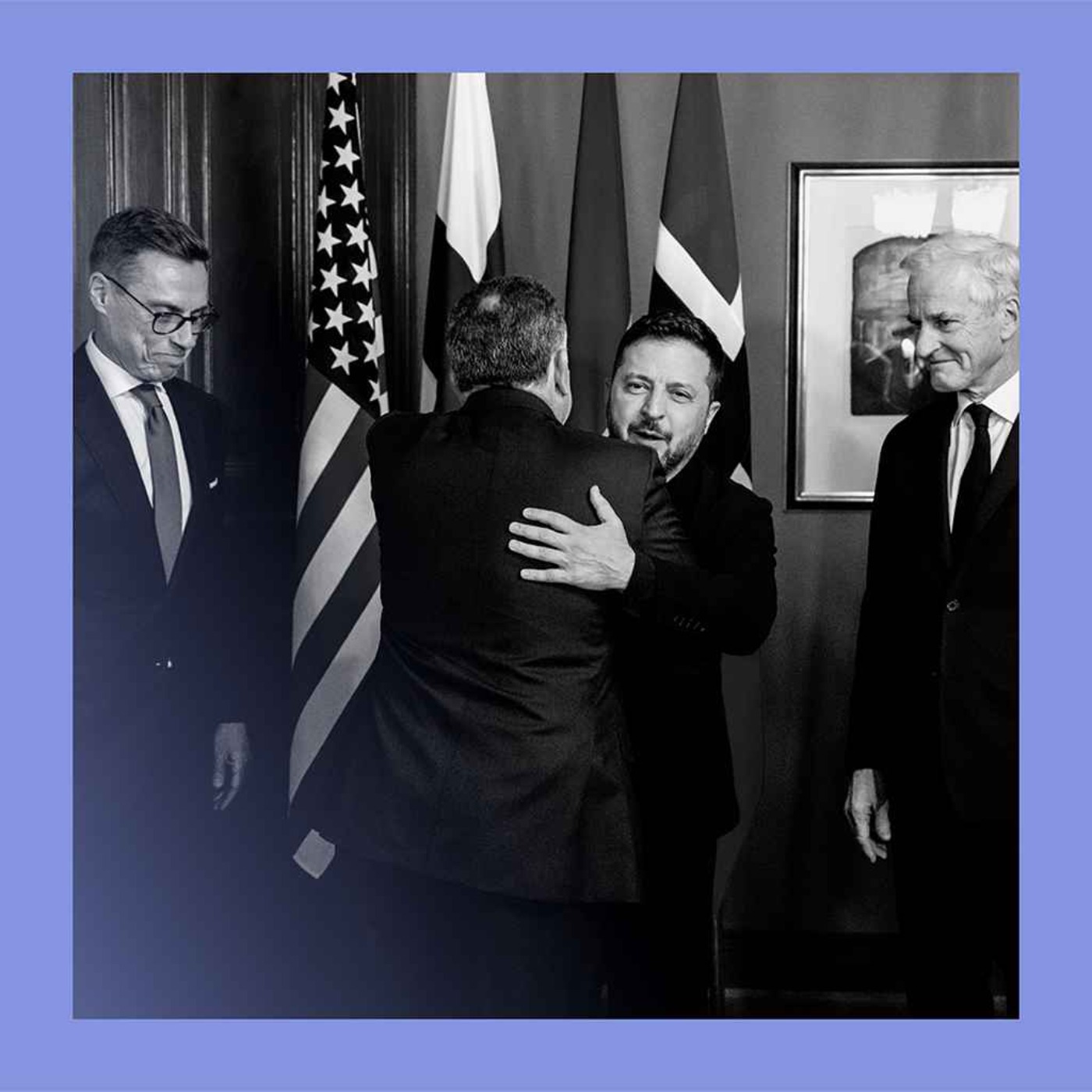
Episode “Cash test: can Europe support Ukraine alone?” (The Intelligence, Economist) argues Europe is increasingly funding Ukraine but may struggle to fully replace U.S. capabilities if American support weakens. Anton LaGuardia (diplomatic editor) says Trump’s transactional approach and closer ties to Putin raise risk; Zelensky is less conciliatory, calling the diesel deal weak and praising Europe.
Europe is paying most bills (about a $90bn loan; Ukraine requests $70bn more), and boosting artillery shell production, but lacks U.S. early-warning for ballistic missiles, Patriot systems, and Starlink satellite internet. Europe also faces domestic fiscal strain and protests over living costs, making continued support politically harder; leaders debate using frozen Russian assets (over €200bn, mostly in Belgium).
Trump’s G7 sanctions pledge reversal; Anchorage red-carpet for Putin; Vienna museum art theft and Louvre copycat thefts are separate segments.
Anton LaGuardia; Shira Aviona (private science); Wendelin von Bredow (museum security).
Written by AI. May contain mistakes.
Discussion on Europe's capability and willingness to support Ukraine amidst challenges.
“and European museums see a spike in art theft.”
Analyzing Trump's influence on U.S. support for Ukraine and European reactions.
“have frustrated his plans to lower fuel prices.”
Exploring Europe's internal issues affecting their support for Ukraine.
“And the third is Starlink, which is this dense constellation of satellites run by Elon Musk's SpaceX, which provides satellite internet to people on the ground, which Ukraine has used.”
Speculations on the impact of U.S. midterm elections on Ukraine support.
“And many of them are starting to turn once again to the question of Russian assets, which are currently frozen.”
Examining the shift towards private science institutions in the U.S.
“There are no hidden costs and no limits on features or data.”
Explore how new forms of private science are emerging to solve complex problems.
“New institutions are looking at the way that science is currently done in America and seeing that there is room for new types of institutional forms and funding models that are outside academia.”
Understand the federal government's increasing support for new scientific approaches.
“But really, then, this isn't the rise of a third thing.”
Examine the implications of applying venture capital models to science funding.
“questions and problems and disciplines, ways of doing things don't necessarily fit into one bucket or another.”
Investigate the rise of art theft in European museums and its implications.
“is a beautiful platinum necklace bedecked with 673 diamonds.”
Learn about potential solutions to enhance security in museums post-thefts.
“It is widespread in Europe in particular, because Europe is a place with a lot of top art and they are not concentrated necessarily in the capitals, in Paris or Berlin or Vienna.”
Learn about the importance of reinvesting dividends and rebalancing your portfolio.
“and realizing that I needed to reinvest dividends and rebalance my portfolio and if there was an opportunity to tax loss over time.”

Get the gist, explore an idea or ask about something said.
 Claude
On The Intelligence from The Economist, what are the key points of this episode?
Searching your listeningAutomatic transcript. May contain errors.
0:00This show is supported by Odoo. Business software is expensive and when you buy software from lots of different companies it gets confusing, slow to use and hard to integrate. Odoo solves that because all Odoo software is connected on a single affordable platform. Save money without missing out on the features you need. There are no hidden costs and no limits on features or data. Check out Odoo at odoo.com. That's odoo.com. Therapy's biggest impact doesn't show up in some dramatic breakthrough. It shows up in the smallest moments. You bite your tongue instead of escalating. You put your phone down instead of firing off that text.
0:42You say what you actually mean instead of what would hurt someone else the most. Nobody applauds those moments, but they quietly change your life. That's what growing feels like. And that's exactly what Grow Therapy is here for. Grow is therapy that works, covered by insurance. Sessions average$21 with insurance, and some pay as little as$0, depending on their plan. There are no subscriptions, no long-term commitments. You just pay per session. Grow connects you with thousands of high-quality, licensed therapists across the U.S., offering both virtual and in-person sessions, nights and weekends.
1:18You can search by what matters, like insurance, specialty, identity, or availability. And you can book a therapy session in minutes and begin in as little as two days, not the national 48-day average. See if you could pay as little as$0 for therapy in seconds at growtherapy.com slash ACAST. That's growtherapy.com slash ACAST. growtherapy.com slash ACAST. Availability and coverage vary by state and insurance plan.
1:53Shera Avi-Yonah: The Economist
1:59Hello and welcome to The Intelligence from The Economist. I'm Rosie Bloor.
2:04Shera Avi-Yonah: And I'm Jason Palmer.
2:09Today on the show, private science institutions thrive in Trump's America and European museums see a spike in art theft.
2:23But first...
2:53Shera Avi-Yonah: Will it work this time? Experience doesn't inspire a lot of hope. And what if it doesn't? America has struck a deal to buy Russian diesel, knocked back new sanctions on the country, allegedly pinched off intelligence to Ukraine. One adjective you might use to describe President Trump is transactional. We've given a lot to Ukraine. We've gotten absolutely nothing back except grief, death, tremendous monetary loss. The Ukrainians hardly need a lesson on grief and death and loss. And Mr. Trump's casting of aid as a deal from which he's yet to profit is telling. The United States has spent a fortune.
3:35Europe has spent a fortune. Europe's tired of it right now. They're tired of it right now.
3:40Shera Avi-Yonah: Europe doesn't yet seem as tired of it as Mr. Trump himself is. But the continent's ability to keep up the fight does have its limits. The Europeans are increasingly alone in supporting Ukraine. Anton LaGuardia is our diplomatic editor. They have real problems. They can't match all the capabilities the Americans provide. And they're increasingly under pressure at home because of their deteriorating fiscal position and now growing protests on the streets. well let's wind back a bit and and talk about how things had been between america and europe on the ukraine question before all of this there have been lots of ups and downs and every time that donald trump seemed to lean towards russia the europeans would rush over and try and bring him back they were very proud in june of having got donald trump to sign up to a G7 statement pledging to strengthen sanctions, including on oil and gas.
4:43But Donald Trump has changed his mind again and has gone quite a long way towards embracing the Kremlin.
4:50Shera Avi-Yonah: And in your mind, is this all still strongly tied to the midterm elections and what Mr. Trump thinks he can do to put his thumb on the scales there? That's the assumption of what's happening. But he does have a longstanding admiration for Vladimir Putin. You remember that red carpet he rolled out for the Russian president in Anchorage last year. So the Europeans hope this is a passing phase. They just have to grit their teeth for a bit and then things might revert to something more normal. But there is a real danger. If Donald Trump loses both houses of Congress and is humiliated, he may lash out even more, especially against countries that he thinks have frustrated his plans to lower fuel prices.
5:32He's a very vindictive guy who bears grudges and likes to project away from himself any blame.
5:39Shera Avi-Yonah: And what's your read on the dynamic between Mr. Trump and Mr. Zelensky now on that vindictive point? It does seem that Mr. Zelensky this time around doesn't seem to be capitulating as much. It seems a little worked up, as it were. Well, he never capitulated, but he has, since that bust up in the White House, has been very careful to adopt Trumpian language and try and turn it into his perspective. So he'll say, yes, of course, we want a peace agreement now and we're doing everything we can, but the Russians just aren't playing ball with your ceasefire plans. He's not doing that this time quite as much.
6:17He has come out and said Donald Trump's deal with Russia on diesel is weak, that he feels betrayed and has call the Europeans the real leaders in the world, at least as far as he's concerned. So he's no longer pulling his punches quite the same way with Donald Trump. And the question is, and I don't think it's been answered yet, whether this is simply him responding to domestic pressure or him thinking that he can somehow help to turn Congress against Donald Trump. We've certainly seen more bipartisan condemnation of Donald Trump's position in recent days in Congress.
6:55Shera Avi-Yonah: And coming back to the question of Europe being among the last standing in wholeheartedly supporting Ukraine, what are the capabilities? How likely is it that Europe could fill the void? Europe has done a lot more for Ukraine of late. It's now essentially paying the bills entirely. They extended a$90 billion loan earlier this year, supposed to cover this year and next, and Ukrainians have come back and said, we need 70 billion more next year. So on the money side, the Europeans are doing most of the heavy lifting. On the weapons side, the Europeans are providing a lot of their own stuff, including artillery shells where production has gone up.
7:34But there are certain capabilities that only the Americans can supply at the moment. One of them is early warning of ballistic missile launches. Another is the Patriot missiles that you need to shoot down ballistic missiles. And the third is Starlink, which is this dense constellation of satellites run by Elon Musk's SpaceX, which provides satellite internet to people on the ground, which Ukraine has used. There are some workarounds for this. Europeans have a thinner constellation and they're desperately working to build it up, but it's just not what Starlink can provide. So those things, if they're lost permanently, would be very difficult for the Europeans to fill for many years and the Ukrainians would have a weaker hand.
8:26They have other advantages. They've become very good at drone warfare and having unmanned ground vehicles and mixing them up together with their own ground troops. And they have in recent days being able to take back some territory. But they would be even more constrained were they to lose American support permanently.
8:45Shera Avi-Yonah: And you said, quite apart from the military hardware question, that Europe has its own troubles that are muddying this picture further. Well, yes. I mean, you've seen on your television screens, violent protests in France, violent protests in Italy, general unhappiness among students and young people, all to do with the cost of living, rising prices, especially rising fuel and energy prices, which is weakening governments at a time when there's some big elections coming up. And moreover, the Ukrainians keep coming back and say, we need more money to keep fighting and to stay in the war. So European governments are, for the most part, highly sympathetic to Ukraine, but they, I think, will find it increasingly difficult politically to keep providing this high level of support.
9:31And many of them are starting to turn once again to the question of Russian assets, which are currently frozen. It's more than 200 billion euros worth of assets frozen mostly in Belgium. And a lot of leaders are saying we should use Russian money to help Ukraine fend off the Russians rather than European taxpayer money. But the Belgians are very worried because they think this will cast doubt on the credibility of property rights and particularly whether Europe and Belgium in particular is a safe place to park your money.
10:04Shera Avi-Yonah: Because this question of Ukraine's advantage or otherwise in the war has hinged always mostly on American support, do you suppose this conversation is going to change a lot after the midterm elections, if that's the sort of the central dynamic that's shaping what's going on right now? The great hope is that the midterms will be the turning point, that Trump will either move on to other things or relent and continue to help the Ukrainians given the pressure he's getting domestically. And the hope is that if he loses control of both houses of Congress or at least of one, that pro-Ukrainian types in the Republican Party will feel better able to speak out.
10:45The converse is also true, which is that, as you well know, Jason, the American president is largely autonomous when it comes to foreign policy. And when his domestic agenda is likely to be held up in Congress, he may turn to foreign affairs and may lash out at his perceived foes. So we don't know what's going to happen. Everyone hopes the midterms will be the end of this particularly acute phase, but it could get worse.
11:12Shera Avi-Yonah: Anton, thanks very much for joining us. Thank you, Jason.
11:25Shera Avi-Yonah: Okay, real talk. Every time I open up my inbox, I've got this vision of the day I'm going to have. Deep work. Big ideas. The project I keep meaning to start. Three hours vanish into replying to threads and hunting down a file someone sent last week. I've tried AI tools that promise to fix this. They didn't. They were just another tab I had to open, explain myself to, and abandon by Thursday. Superhuman is different. It's at your service, not after your job. It's already where you work, so I'm never starting from a blank tab. It's from the makers of Grammarly, living right inside of the tools I already use, like Gmail and Slack.
12:03Shera Avi-Yonah: When I'm drafting a message or making sense of a messy thread, it just helps. Like a thought partner that's already caught up, so we get to the hard part together. The problem was never too little time. It's that busy work crowds out the work that actually matters. Start streamlining your workflows with Superhuman. Try today at superhuman.com.
12:47There are no hidden costs and no limits on features or data. Check out Odoo at odoo.com. That's odoo.com.
13:03Shera Avi-Yonah: For much of the post-war era, America enjoyed the global top spot in science. Thanks in large part to a brilliant guy called Vannevar Bush, a kind of top-down government funding model developed. Federal agencies funded research based at universities and national laboratories, which became just innovation machines. Some firms ran their own labs, notably AT &T with its Bell Labs or Xerox PARC. And in more recent times, companies fund universities or researchers directly and skim off some of what emerges. All of this worked. For a while. America won the space race, mostly. It gave the world modern computing and then the internet.
13:46Shera Avi-Yonah: it kept topping the charts of publications and patents. But these days, China seems to be stealing a march, and that has plenty in America, thinking about whether there are other ways to do it all. America is going through the beginnings of a new golden age of private science. Shira Aviona is The Economist's U.S. business correspondent. New institutions are looking at the way that science is currently done in America and seeing that there is room for new types of institutional forms and funding models that are outside academia.
14:26Shera Avi-Yonah: But to a degree, private science has already been a thing, and in particular in American science already. What's different here? So the private in private science refers not to the source of funding, but the place where science is being done. So by private, what I really mean is not in universities and not in national labs that are funded by the U.S. government. But that itself isn't new either, right? Like Bell Labs famously where the transistor was invented, this kind of thing's been going on for some time. Yes, but Bell Labs and Xerox PARC and their ilk declined eventually because they were, generally speaking, attached to money printing corporations.
15:02And as those corporations lost their monopoly or their patents, they no longer shockingly seemed as interested in funding blue sky research.
15:11Shera Avi-Yonah: Okay, so what form is this taking now? So one thing that's interesting about it is that it's taking many different forms. So some places, like these things called focused research organizations, try to experiment with, well, what if we set up a nonprofit to fund new time-bound organizations that would, say, spend three to five years attacking a specific question or trying to develop a specific tool? And after that period, they can say, well, we did it. And, you know, great, now we're done. They can try to spin it off into a for-profit company. They can attack a new problem that's come up, or if they failed, then, well, we took a few bets and we learned something along the way, hopefully.
15:53Other ones are more like Bell Labs, but not attached to AT &T. So they're trying to think about how do we do science that is very interdisciplinary and possibly with a specific commercial use in mind, but that's not attached to a larger organization.
16:11Shera Avi-Yonah: But why is the old way evolving here? What kinds of questions can these new efforts solve that couldn't reasonably be solved before? It's hard to paint with a broad brush because different types of new institutions are trying to attack different problems. But I would say broadly, some of them identify a quote-unquote valley of death. That is that you get to a certain place with a problem within an academic context, but it's not quite ready for a startup or a larger corporation to pick up. So this type of institution helps push it through that valley and get it to a place where it can be relevant to the general public.
16:47Others are trying to do things that say, well, academia is quite siloed. Some university departments don't, for example, have the means or interest in doing very engineering-heavy or use-driven projects. So let's try to think about new institutional forms that can do that. For example, if you have to publish papers or have other sorts of incentives, then you might not work on problems that are either very uncertain or where the result is not a scientific finding that fits into a particular literature, but rather, for example, an open access tool. So one of the focused research organizations or FROs, Cultivarium, tries to attack the problem of, well, we know E.
17:29coli or other kind of model microorganisms that are really common in labs, but what about all the other fungi or microbes? Has anyone looked into cataloging those and thinking about whether or not they might be useful? So their endpoint is not a product and it's not a series of research papers, but it's like a public access library of various characteristics of these microorganisms.
17:53Shera Avi-Yonah: Sort of implicit in all of that is a known endpoint, either an open access tool or a product or you mentioned spinoffs multiple times, this notion of getting to a known place. What about all the science that doesn't know where it's yet going? I think most of the people involved in this would say that while they're doing something good, this is not a wholesale revolution in the way that science is done, nor is it really meant to replace what's currently being done. It's supposed to complement it. There's still obviously a place for very basic blue sky, exploratory, academic, wacky research. So these things won't then be in competition.
18:31Shera Avi-Yonah: This new way of doing things isn't going to eat into the old way of doing things. Well, that question remains to be answered, in part because the federal government and the White House have recently given this sort of science experimentation a big boost. Over the summer, the White House Office of Science and Technology Policy released a report saying that the federal government should also try to support these new ways of doing science and new kind of quirky experiments in the private sector. So for example, the National Science Foundation is set to put$1.5 billion toward X labs that can be in universities, they can be outside of them, but they're just supposed to represent novel organizations that are meant to propose ways to attack a specific set of problems that the NSF has suggested, for example, novel sensing technologies.
19:23And the worry is that now that the federal government, which has long funded a lot of university science, is interested in this, that really does mean that they're in competition, whether or not people who have advocated for this or been interested in it intended for that to be the case.
19:38Shera Avi-Yonah: But really, then, this isn't the rise of a third thing. This is just a further blurring of the lines because lots of private money has been flowing into university departments and the like in recent decades. It's just smooshing everything together in a way. A little bit, yeah. I think it's definitely blurring the lines between academic, non-academic, basic, applied, and so on and so forth. And I think a lot of people would say that that's a good thing because many scientific questions and problems and disciplines, ways of doing things don't necessarily fit into one bucket or another. I think it's definitely produced already some really good and interesting things.
20:14And it seems like with a relatively modest amount of money, for example,$30 million, you can at least try a new approach, whether or not it works. And I think that is in the spirit of the scientific enterprise.
20:28Shera Avi-Yonah: Yeah, but then kind of overlaps with the notion of venture funding, of let's throw a bunch of bets at things and hope that, you know, some come really big rather than a systematic, this proven track record, this proven discipline, this proven researcher, what have you. You're spread betting science. For sure. I think, in fact, the White House Office of Science and Technology Policy report or explicitly does use the analogy of venture capital to talk about the way that the government wants to approach not all of science funding, but some set aside pool of science funding. And it's up to people to decide whether or not they think that's a bad thing.
21:03I think the venture model of power law, if it applies here, means that a few of these things will become incredibly successful platform technologies that are hugely influential. And I think we would say that that's a good thing. The question is, is all of science funding going to become like venture capital or is this a way to attack a certain set of problems for which it might be particularly suited? And time will tell.
21:28Shera Avi-Yonah: More research is needed, as it were. Shira, thanks very much for joining us. Thanks very much, Jason.
21:50Among the treasures owned by Vienna's Museum for Applied Art is a beautiful platinum necklace bedecked with 673 diamonds. It was designed in 1939 for Queen Nazli of Egypt, and it's now valued at over$4 million. But in August, two men entered the museum building in Vienna, bought tickets and wandered into the exhibition, and then smashed the armoured display case. To get through the glass took 41 blows from a hammer the men had brought with them. They snatched the necklace and made off with it, on foot. European museums are seeing a spike in high-value art theft. Wendelin von Bredow is our senior Germany correspondent.
22:38There's of course most famously the heist at the Louvre. about a year ago, where jewellery worth about 90 million euros was stolen from the Apollo Gallery, one of the very famous galleries at the Louvre Museum in Paris. We'll come to the Louvre in a minute, but of course it has happened at this museum in Vienna, and it sounded like a really low-budget, low-tech heist. How was that possible? It's hard to understand, so I went to Vienna and entered this beautiful museum. It's a New Renaissance building on Ringstraße. It's an amazing place, but it's an old building. So that's the case for most European museums.
23:19They're in old buildings. They're difficult to secure. Thieves entered the museum, bought a ticket. They were unmasked, wandered into the exhibition. They had hidden under their clothes a hammer and a pistol. And the reason the guards didn't interfere is they saw they were armed. And it's protocol that they don't interfere when thieves are armed. and they just focused on making sure the visitors were safe. There was very little security. I heard afterwards that the big bags were not checked. So basically you bought your ticket, you entered the exhibition. So there was very little in terms of screening the people who entered the exhibition.
23:52Surely it would be possible to make these sorts of galleries much more secure. Yes, it is possible. And that's why there's a big rethink going on. So it was opened on the day after the heist, but with metal detectors. And of course, the thieves could not have entered with a pistol and a hammer had they gone through a metal detectors. And that's not such a complicated thing to do. It's basically like an airport-style security that could have prevented this. So how widespread is this problem? It is widespread in Europe in particular, because Europe is a place with a lot of top art and they are not concentrated necessarily in the capitals, in Paris or Berlin or Vienna.
24:27They're often in smaller places. And first of all, these museums tend to have far less funding, maybe a tiny, almost no budget for security, but still it's top art worth millions. And so it's not very safe in these places. That has clearly been the case for a long time. So why then are these thefts on the rise? One thing is copycats. So they see something like the Louvre and they say, well, actually, that's a good idea, so to speak. And only 12 hours after the big robbery at the Louvre, about 2000 gold and silver coins were stolen also in France. The thieves now tend to focus less on paintings because very recognisable paintings, let's say by Degas or Renoir or Rembrandt, are very difficult to sell because it's a crime to actually buy them.
25:09Whereas gold can be melted down, jewellery can be dismantled and just flogged off. And of course it's worth less than as a beautiful work of art, but they still get some money out of it. And what's the solution? It's a trade-off actually between access and security. So if you want to be really safe, you don't show the art to the public. But I think it's too easy to say, oh no, you know, know, we just have to live with it. And one of the experts I talked to said, well, every major museum in the world has been robbed. And these are, of course, sometimes small thefts. So it will always happen. But you can make it particularly this high value art, you know, let's say the Mona Lisa is, of course, an extreme, but you know, the Rembrandts, you can protect them more than is the case at the moment, I think.
25:50AI enables security cameras, much more accurate, of course, than human beings monitoring the cameras, because it's impossible to monitor, I don't know, 125 cameras and then you know you might fall asleep or something. Metal detectors people are not comfortable with that in Europe but that is also you know maybe for big museums that's a solution. There are things but the thing is they are very expensive so there are glass cases that the moment you smash them or there is something violent happening to them they disappear in the ground but of course it is a time when museum budgets are generally tighter so there's maybe even more of a squeeze on security.
26:26And museum directors like to focus on the fun stuff. So high profile exhibition that join the crowd, fundraising. So they sort of basically hope nothing will go wrong. Benderlin, thank you very much. It's always a pleasure, Rosie. Thank you.
26:55That's all for this episode of The Intelligence. We'll see you back here tomorrow.
27:18This show is supported by Odoo. Business software is expensive. And when you buy software from lots of different companies, it gets confusing, slow to use, and hard to integrate. Odoo solves that because all Odoo software is connected on a single affordable platform. Save money without missing out on the features you need. There are no hidden costs and no limits on features or data. Check out Odoo at odoo.com. That's odoo.com. This message comes from Betterment. Dan Egan, VP of Behavioral Finance and Investing, explains how Betterment takes the time-consuming work out of smart investing. I grew up learning about finance and investing myself and realizing that I needed to reinvest dividends and rebalance my portfolio and if there was an opportunity to tax loss over time.
28:09And then I realized that I was doing all of these things that were pretty straightforward to implement. I just needed to spend my time doing them. Betterment automates the same good practices, so that I know I'm doing portfolio management and goal-based planning in a way that makes sense and is responsible without me having to spend hours of my life doing it. Learn more at Betterment.com. Investing involves risk, performance not guaranteed. Betterment does not offer tax advice. TLH may not be suitable for all customers. Learn more at Betterment.com slash TLH dash terms.
Donald Trump’s administration is turning against Ukraine. But as European powers confront trouble at home, they are struggling to replace American support. Are US private science institutions entering a golden age? And the climb in art crime.
Guests and host:
Topics covered:
Listen to what matters most, from global politics and business to science and technology—subscribe to The Economist.
Hosted on Acast. See acast.com/privacy for more information.


