
 Ask ChatGPT


 The Intelligence from The Economist
24 Aug 2026 · 22m · 6 chapters
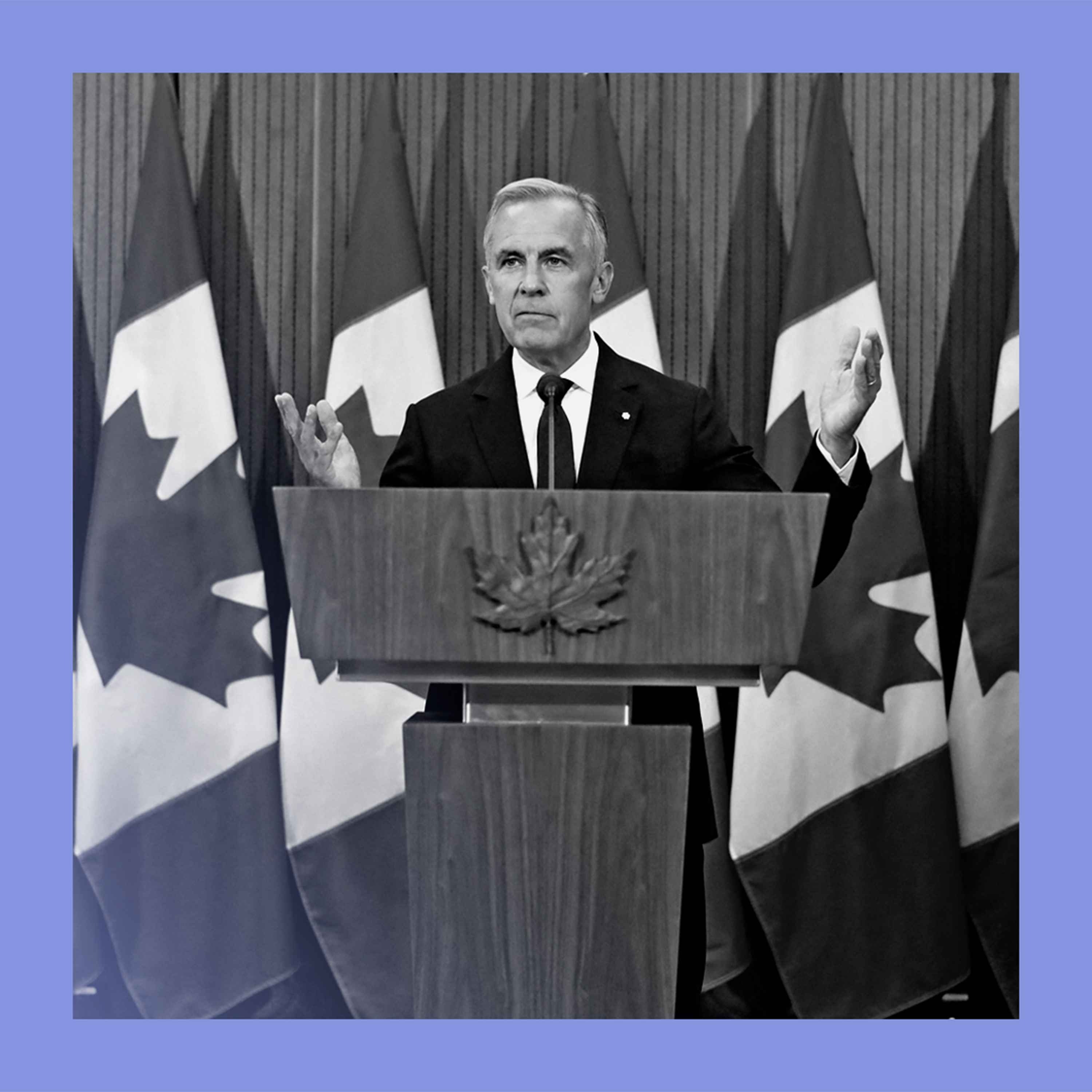
The episode has three segments. 1) US-Canada trade flare-up: Jason Palmer and Hal Hodson discuss why Canada’s Prime Minister Mark Carney walked away from late-stage talks.
the US proposed excluding medium/heavy trucks from tariff reductions (hurting Canada’s auto supply chain), asked Canada to limit its ability to strike trade deals with other countries (undermining Canada’s diversification goal), and sought weaker French-language/culture protections (politically toxic ahead of Quebec elections).
Quebec’s French-language “third rail”; Alberta’s near-zero tariff exposure and oil leverage, but Carney avoids energy retaliation to not inflame Albertans amid a referendum risk. Result: new tariffs on about $20B of Canadian exports; ~90,000 jobs threatened; Carney plans dollar-for-dollar matching by Sept 8. 2) Japan’s “ice age” generation: Moeka Iida interviews Torigoe Atsushi (50, Tokyo, former luxury fashion stock-room worker) and explains the “employment ice age” generation (1993–2004 grads).
deflation-era entry led to precarious irregular work; earnings remain lower even after moving into regular jobs; future risks include pension strain and welfare costs, plus hostile rental housing. 3) Sieges in history: historian Jeremy Black outlines “totemic” sieges (e.g., 1683 Ottoman siege of Vienna; 1836 Alamo) and “utilitarian” sieges (e.g., Alexander’s Siege of Tyre; WWII Siege of Leningrad; Great Siege of Malta).
Written by AI. May contain mistakes.
An analysis of the recent breakdown in trade talks between the US and Canada.
“On Roe, I've gone from struggling to run a mile to running farther every day.”
An analysis of the recent breakdown in trade talks between the US and Canada.
“and how the fates of civilizations have turned on sieges.”
Exploring the implications of increased tariffs and Canada's response.
“Yes, there seemed to have been three big things.”
Understanding the struggles of Japan's Ice Age generation in the labor market.
“And perhaps the biggest thing he's waiting for is the American midterms.”
Explore how the irregular job market has affected Japan's ICE generation and their future prospects.
“And in fact, the ratio of job openings to college applicants fell significantly from a peak of nearly three to less than one by the year 2000.”
Learn about the importance of sieges throughout history and their strategic implications.
“The Odyssey is a senior digital editor at The Economist.”

Get the gist, explore an idea or ask about something said.
 Claude
On The Intelligence from The Economist, what are the key points of this episode?
Searching your listeningAutomatic transcript. May contain errors.
0:00You know that feeling when too many things fall through the cracks? Monday.com was built for that gap. The AI work platform where people and agents work side by side to deliver more together. Create your first Monday agent today at Monday.com. I'm Hannah. I've lost 75 pounds in 20 months with GLP-1s, plus diet and exercise. On Roe, I've gone from struggling to run a mile to running farther every day. You can access FDA-approved GLP-1s online. Get the support you need to reach your weight loss goals. Go to row.co.weight to see if you qualify. I'm a paid row partner. 20 % average weight loss in one year in non-diabetics with obesity or overweight with a weight-related medical condition versus 3.1 % in placebo arm.
0:41Rx only. To stay informed about serious side effects, go to row.co.safety.
0:51The Economist.
0:57Hello and welcome to The Intelligence from The Economist. I'm Jason Palmer.
1:06Today on the show, the struggles of Gen X workers in Japan's labor market and how the fates of civilizations have turned on sieges.
1:21But first...
1:32If you were keeping an eye on trade talks between America and Canada before the weekend, you'd have thought things were pretty well zipped up. The deal with Canada is moving along and we should be able to have a deal with Canada. We're also starting on a new deal with Mexico. A much better deal for the United States. But when making deals with the Trump administration, nothing is assured. Prime Minister Mark Carney called off the deal-making at the last minute. Without an agreement, new trade barriers came into force. Mr. Carney promised retaliation. Canada will match Washington's new tariffs, dollar for dollar, in order to protect Canadian workers, farmers, families, and businesses.
2:14He seems lately to really relish calling them like he sees them. We were attacked. Like, you're at war when you get attacked. We got attacked. But there's more to navigate here than just tariff tantrums. The difficulty for Carney and the Canadian officials here is that in order to survive Donald Trump's caprice and his trade assaults, they need to diversify to trade with other places, to reorientate the Canadian economy. They need to do a lot of work. Hal Hodson is our America's editor. But in order to do that work, they need quite a lot of money. And not many people with a lot of money want to invest in a country that is embroiled in a massive trade war with Donald Trump.
2:58So in order to escape Donald Trump, Mark Carney needs to make peace with Donald Trump. And that is slow work and difficult work and, frankly, quite annoying work. So let's wind back a little bit and sum up where we are with Canada and terrorists, because Canada has been in Donald Trump's crosshairs for quite some time. Actually, since before he took office, he's been banging on about Canada being the 51st state. Canada and Mexico were the two countries that Trump placed tariffs on first before anyone else. This dispute with the Canadians and with Mark Carney, who took over the liberal leadership from Justin Trudeau early on in Trump's term, then won the general election while in office, is just never ending.
3:45Sometimes you think maybe they're going to pull a deal out of the hat and then something happens that allows it to rumble on. And you can sum it up as Trump is bullying the Canadians and Carney and his officials are pretty much for the most part having to take it because the costs of retaliating against Donald Trump are really, really high for the Canadian economy, which is very integrated with the American one. And when you are attached to a very, very large thing and you are quite a small thing, you don't have that many options. The most recent thing that's happened with Carney walking out of the negotiations, that's the closest that he's come to defiance in almost the entire time.
4:27And Canadians will love that because they want him to stand up to Trump. But in reality, Carney's going to come back to the table and keep trying to get a deal here. So bring us right up to date because going into the weekend, these were promising trade talks and then suddenly they were off. What broke down? Yes, there seemed to have been three big things. And even though both sides claimed that the other side was at fault, it does very much seem like it was the Americans proposing things at the 11th hour. The first big thing is that the Americans wanted to exclude from the reduction in tariffs, medium and heavy duty trucks.
4:59And these are one of the lifebloods of the Canadian auto industry and large numbers of them get sent to the United States. So that was almost on its own, ruling this deal out. The next thing that the Americans asked for was the Canadians to curb their ability to strike trade deals with other countries. And if you go back to the paradox that we discussed at the beginning, that's not going to fly for Carney because the whole point of this trade deal for him is to get enough stability to make Canada investable enough that it can start to diversify its economy away from the United States. He's not going to say that to the Americans, but that's the idea.
5:33And then the third thing and the most interesting thing was that the American strategy would weaken the protections on French language and culture in Canada. You can see that these are potentially a trade barrier, right? Americans have to put French on their packaging if they want to sell to Quebec, that kind of thing. And this is the political third rail in Canada. You cannot touch it. It is politically toxic to try and make proposals like this. Importantly, the province of Quebec has provincial elections coming up. And if Carney had agreed to limit the protections on French language, he would have been handing an enormous gift to the separatist party Québécois in Quebec because he would have been accused of kowtowing to the Americans and erasing French culture.
6:14So all in all, it was pretty unacceptable for the Canadians. But what's interesting there is that there is a kind of internal politics angle to this. This is not necessarily a plain, simple, unified, elbows-up Canadian response. No, each province has their own stakes. And for the Québécois, that became French language at the end of the talks recently. But perhaps the bigger story is in Alberta. Alberta is kind of like a mini Texas on the other side of the border. It supplies more than half of all the oil that America imports from outside of its borders. If you look at the effective tariff rate on the provinces, Quebec has a pretty high tariff rate.
6:52Alberta has almost zero tariff supplied to any of its exports to America. There has been talk of using that supply of oil and energy into America, to hurt America, to cut off Canadian energy supplies as a way of retaliating against Donald Trump. But Carney is very, very loathe to do that, in part because doing so would really piss off the Albertans. And that would be a problem because the Albertans have a referendum coming up on whether or not to remain in Canada. Likelihood is that the vote will go against that, that Albertans will vote to stay in Canada. But you do not want to be irritating your richest province in the middle of a trade war in order to strike a deal with someone who may well tear it up the next day and in doing so increase the risk.
7:42So in the absence of this trade deal that was torn up over the weekend, what changes? So the most immediate thing that changes is more tariffs, unsurprisingly. Tariffs came into effect at one minute past midnight on Saturday morning on about$20 billion of Canadian exports. And that's on top of tariffs that were already in place on aluminium and wood and cars and vehicles. Canada's economy was really battered around by tariffs last year. It shrank in the beginning of 2025, and then it was flat for the second half of the year. And it had just started to tick up. The chances are that these tariffs sort of batter that back down into something between stagnation and shrinkage.
8:21Inflation is also likely to tick up. There's about 90 ,000 Canadian jobs that are threatened by these American tariffs once they come in. What Carney has said is that he will take two weeks and at the end of those two weeks on September the 8th, he will match the American tariffs dollar for dollar. If he does that, then that's just going to create more pain for more Canadians. But it may be that politically that is his only option, is certainly his only option to say that that's what he will do. So it seems that Mr. Carney is kind of stuck in the paradox that you laid out at the start, being able to diversify depends on a deal he's struggling to get.
8:58That's right. And the only play he seems to have is to wait. And so then the question is, what's he waiting for? And perhaps the biggest thing he's waiting for is the American midterms. That is the event on the horizon that has the greatest chance of changing the foundations that or underneath Donald Trump in a way that might force him to come back to the table with the Canadians a little less aggressively, a little more conciliatorily, because perhaps the tariffs that he's put on Canada are going to start to pinch Americans. And they are already pinching Americans. Americans in Maine are already cross about the higher prices they're paying for Canadian goods.
9:38So Carney just has to hope that that price pressure leads to another Donald Trump taco and it may well. Hal, thanks very much for joining us. Thanks for having me, Jason.
10:13Create your first Monday agent today at Monday.com.
10:43you achieve it. Take the first step to make your impact. Visit waldenu.edu. Walden University, set a course for change. Certified to operate by Shev.
11:02I'm sitting in a cafe with Torigoe Atsushi, a 50-year-old man in Tokyo. Mr. Torigoe tells me about the time he graduated. Moeka Iida is an East Asia reporter for The Economist. It was a time of bad economic conditions, he says. All he could find was low-paying jobs. Mr. Torigoy has spent most of his career working in the stock rooms of a luxury fashion firm. His income has barely gone up over the years, and recently it actually fell. His employer suddenly cut bonuses and revised its payment scheme. But then, to his surprise, he came across recruitment ads by the firm offering higher base salaries for younger recruits.
11:43His predicament is emblematic of something broader in the country. He belongs to the country's so-called employment ice age generation. So what does that mean? Why is it called that? The ice age generation are people in Japan who graduated college and entered the workforce roughly between 1993 to 2004. These people are now in their 40s or 50s. So I guess the English equivalent would be the Generation X or Gen X. The ISIS generation's experience is shaped by the burst of Japan's economic bubble in the early 1990s. And a lot of them, having entered the workforce at a time of economic downturn, struggle with precarious, insecure work and also low pay.
12:26And in fact, their struggles are quite familiar to a lot of Japanese people. So the woes of the ISIS generation is something that gets discussed a lot in politics. and in the news. And their economic hardship is also associated with a lot of social problems that Japan has, for instance, like hikikomori or social recluses. Japan's recent economic changes are adding a new twist to their story. So what's happening in Japan now is that the country is emerging from decades of deflation. Prices are finally going up and firms are able to pass down prices to consumers and are able to give them back to employees in the form of salaries.
13:05But these pay rises are concentrated among younger workers, and the Ice Age generation is left behind once again. As you say, they're squeezed on both sides. It was a good working environment before them. It appears to be a better working environment after them. They ended up stuck. Yes, exactly. The struggles of the Ice Age generation becomes even clearer when you understand what came before them. So looking at the people who graduated during the bubble era, What happened in the bubble era is in the 1970s and 1980s, companies hired in huge numbers. And there's a lot of stories about this time period.
13:40So students would find their mailboxes filled with recruitment letters from companies keen to woo them or being treated to fancy meals by prospective employers. But everything changed when the bubble popped in the 1990s. Because Japan's employment system is very rigid and it's hard to shed existing workers, Even in the face of an economic downturn, the people who were already employed by companies clinged on to their positions, but the firms froze hiring instead, so it affected younger people and students. And in fact, the ratio of job openings to college applicants fell significantly from a peak of nearly three to less than one by the year 2000.
14:19So then what did they all do? Where did they all go? So because they couldn't land into stable jobs offered by companies, many of them ended up in so-called irregular work. So Japan's labor market has a very polarized system. On one hand, you have regular workers who enjoys a lot of labor protection or labor rights, and they enjoy seniority-based pay rises as they age. And then on the other hand, you have people in the irregular track, who are in fact often performing the same kind of work as their regular peers, but they're just working on more precarious contracts. So they are the first to be cut in economic downturns, and they also receive much lower pay.
15:01So a lot of the ICE agers ended up being recruited as irregular workers. And around this time, the term freeter became popular. So that refers to young people who are bouncing between casual jobs. And there was also growing discussion about parasite singles or young people who continue to live with their parents and rely on them economically. And so is that still the case? Are there a lot of ICE agers who are still just flitting around between jobs? Some of the narrative around this generation is a bit overblown. So I spoke to some analysts who walked me through the data. And if you look at the share of the ICE generation in regular employment, that has actually caught up with older cohorts.
15:38A lot of them have actually landed in stable jobs. But even there, the damage is very visible when it comes to their earnings. So the Ice Age generation, if you look at their earnings, it tends to be much lower than the older generations. And in terms of why, if some of them were in irregular work for long stretches, even if you managed to transition to the regular track, your salary is likely to be lower than your peers. And also, when the Ice Age generation entered these companies, a lot of the upper ranks of these organisations were filled with bubble-era workers who are occupying the higher managerial roles.
16:15And I guess it's not that many more years that these Ice Agers will be in the labour market anyway. Exactly. So there is a big question that people are asking about what happens, say, 10 years down the road, 20 years down the road, when these Ice Agers hit retirement age, Their earnings are low and Japan's pension scheme is tied to lifetime earnings. One solution might be for people to work longer, as a lot of older people in Japan already do. One expert I spoke to warned that a lot of the ISA generation end up on welfare, but the welfare system is not designed to support the elderly in long periods.
16:52That could be very costly for the government. So what we're going to see in the future is fewer productive young people supporting the old. Well, Japan is a state that thinks about demographic issues more than probably any other. What sort of policy changes or ideas are around to fix these problems, these worries? When you talk about the ISIS generation, the government has been talking about them for a very long time. But a lot of their programs have been focused on helping them find stable jobs and getting them into regular jobs. And then another big issue is housing. So compared to older generations, ice ages are less likely to own homes and they rely on the rental market.
17:32But Japan's rental market is actually very hostile towards older tenants. So there might be a really big housing issue in the future as well. And the government is belatedly starting to think about this. So recently it came up with a three-year plan. They mentioned things like asset building and housing. But a lot more serious thinking will definitely be needed. Thanks very much for joining us, Moika Thank you so much for having me, Jason
18:24The Odyssey is a senior digital editor at The Economist. With a run time of nearly three hours, the viewing experience is an odyssey in itself. Still, it seems of Odysseus and his men descending from the belly of a wooden horse to sack Troy are striking.
18:46So much so that it got me thinking about real sieges from military history.
18:54Sieges are often the hinge points of a conflict. The fates of campaigns and even civilisations have often depended on them. The military historian Jeremy Black helpfully identifies two types. The first is totemic. These have what he calls civilisational significance. Often, they mark a turning point in history, or they come to embody some wider cultural importance.
19:26For example, take the 1683 Ottoman siege of Vienna. The city at the time was the capital of the Holy Roman Empire and withstood two bloody months of assault. The failure of the Ottomans to take it ended their ambitions to expand into Christian Europe.
19:51Elsewhere in history, sieges gained cultural weight.
19:58In 1836, 200 Texans resisted a much larger Mexican force, led by the ruthless General Antonio López de Santa Anna. The Texans included, of course, Davy Crockett, the frontiersman and politician.
20:25The heroic defence was also a heroic failure and a tactical disaster. And yet, remember the Alamo, became a rallying cry that cemented itself in Texas culture and indeed in American military culture ever since.
20:47Mr Black's second category is utilitarian sieges. These are strategically important, often involving vast numbers of men and material.
21:02Alexander the Great Siege of Tyre in 332 BC was one of the greatest military feats of the ancient world. His army had to construct a giant causeway to invade the island fortress of Tyre on the coast of what is now Lebanon.
21:28More recently, the over two-year siege of Leningrad in the Second World War by German-led forces comes to mind.
21:42The city was flattened and up to 1.5 million people were killed, nearly half the city's pre-war population. In terms of devastation, it is amongst the worst.
22:02The Great Siege of Malta in 1565 was also a monumental struggle. 500 knights Haspitala and their foot soldiers held out for four months against a vast seaborne Ottoman force of at least 40 ,000. It was also monumentally gruesome. At one point, the Ottomans floated over the decapitated bodies of captured knights on mock crucifixes. The knights returned the favour by beheading their own prisoners and firing their heads from cannons back into the Turkish camp. This might make suitable subject material for Mr Nolan's next cinematic project.
23:11That's all for this episode of The Intelligence. We'll see you back here tomorrow.
23:46We'll see you tomorrow. HR, finance, and IT with AI-driven insights and automated workflows that simplify the complex and power what's next. Because when everything comes together in one place, growth comes easy. Experience one place for all your HCM needs. Start now at paylocity.com slash one. Self-directed investing, trading, full-service wealth management, automated investing, financial planning, thematic investing, retirement planning. And to think, that's just a small taste of what Schwab offers. because Schwab knows that when it comes to your finances, choice matters. No matter your goals, investing style, life stage, or experience, Schwab has everything you need all in one place.
24:26So you can invest your way. Visit schwab.com to learn more.
Promising trade talks imploded after a literal 11th-hour change from the American side. We examine the new trade barriers being erected, and the complex calculation for Prime Minister Mark Carney. In Japan Gen X workers are even still bearing the costs of an economic bubble-burst from the 1990s. And how fates of civilisations have turned on sieges throughout history.
Guests and host:
Topics covered:
Listen to what matters most, from global politics and business to science and technology—subscribe to The Economist.
Hosted on Acast. See acast.com/privacy for more information.


