In short
Podcast Notes: The Interview with Andrius Kubilius
Episode Overview
- Podcast Title: The Interview
- Episode Title: Andrius Kubilius, EU Commissioner for Defence and Space: A New Era of Defence Readiness
- Presenter: James Copnall
- Producers: Lucy Sheppard, Ben Cooper, Owen Clegg
- Editor: Nick Holland
- Duration: ~20 minutes
Key Themes
- Defence Readiness in Europe: Importance of Europe being able to defend itself without over-reliance on American military support.
- Budget and Commitment: Discussion of the need for increased defense spending among NATO members, with emphasis on the 3.5% GDP target.
- Threat of Russian Aggression: Recognizing Russia as a significant threat and the necessity for Europe to bolster its military capabilities.
Major Points from the Interview
- Background on Andrius Kubilius
- Former Prime Minister of Lithuania and current EU Commissioner for Defence and Space.
- Focused on the challenges Europe faces from Russia and the ongoing war in Ukraine.
- Shift in European Defence Strategy
- European Complacency: Acknowledgment that Europe has become too reliant on American military support post-Cold War.
- Call for Change: Emphasizes the need for Europe to enhance its defense capabilities in light of shifting global military dynamics.
- Financial Commitments to Defence
- Current NATO goal of 2% GDP for defense spending is not being met by several member states.
- Countries like Poland, Estonia, and Lithuania are increasing their defense budgets to 5%.
- The necessity for a collective European response to military threats.
- Concept of Defence Readiness
- Definition of a new strategic posture termed "defence readiness time."
- Advocates for expedited processes in military production and funding to establish necessary capabilities swiftly.
- The Russian Threat
- Identifies Russia as the primary existential threat to Europe.
- Emphasizes the need for Europe to develop its defense strategies to deter Russian aggression, especially as Russia continues to produce military resources rapidly.
- Role of Ukraine
- Ukraine's ongoing conflict with Russia is highlighted as pivotal for European security.
- Calls for stronger support and collaboration with Ukraine as a critical component of Europe's defense architecture.
- NATO and EU Cooperation
- Clarifies that the EU is not competing with NATO but can provide additional resources and frameworks to enhance collective defense.
- Highlights the importance of maintaining a united front against Russian aggression.
- Future Considerations
- Urges for a division of responsibilities between Europe and the U.S. regarding security—Europe focusing on European security and the U.S. on Indo-Pacific concerns.
- Emphasizes the need for political unity in the West to deter potential military aggressions from both Russia and China.
- Psychological Aspects of Defence
- Discusses the perceived need for strength to achieve peace, encapsulated in the phrase "peace through strength."
Key Takeaways
- Europe must prioritize defense readiness and increase military spending to effectively counter threats from Russia.
- A collaborative approach with Ukraine and the EU's role in defense must be strategically enhanced.
- The shift in American focus towards Asia necessitates that Europe assumes greater responsibility for its security.
Closing Thoughts
- The discussion underscores the urgency for Europe to rethink its defense strategies in light of current geopolitical challenges. The interview with Andrius Kubilius presents a clear call to action for European nations to unify and prepare for a potentially volatile future.
Listening Information
- You can listen to The Interview on the BBC World Service or as a podcast on BBC Sounds and various podcast platforms.
Written by AI. May contain mistakes. Listen to the episode to check what was said.
Transcript
Automatic transcript. May contain errors.0:00This BBC podcast is supported by ads outside the UK. If journalism is the first draft of history, what happens if that draft is flawed? In 1999, four Russian apartment buildings were bombed, hundreds killed. But even now, we still don't know for sure who did it. It's a mystery that sparked chilling theories. I'm Helena Merriman, and in a new BBC series, I'm talking to the reporters who first covered this story? What did they miss the first time? The History Bureau, Putin and the apartment bombs. Listen on bbc.com or wherever you get your podcasts.
0:59Monday to Friday. For interviews with sports stars, big talking points and the stories behind the headlines. More Than The Score from the BBC World Service. Listen now, search for More Than The Score wherever you get your BBC podcasts.
1:19Hello, I'm James Copnell, presenter of the BBC's Newsday and this is the interview from the BBC World Service. The best conversations coming out to the BBC. People shaping our world from all over the world. There have been so many disagreements between me and my family. Putting on a show, that is what it means to be Lady Gaga. Only the things that you can't solve with government and private sector is where you bring philanthropy in. There's no place in the world where women are equal. Every generation, every generation has to fight to maintain democracy. For this episode of The Interview, I speak to the former Prime Minister of Lithuania, Andreas Kubilis, who has taken on the new role of EU Commissioner for Defence and Space.
2:10The post was created at the beginning of last year and comes at a time when Europe deals with a number of challenges on its doorstep, including the ongoing war in Ukraine and increasing tensions with Russia to the east. These challenges have been compounded with the re-election of US President Donald Trump, whose rhetoric around NATO, the Western Defense Alliance, established after the end of the Second World War to protect the continent, has created significant uncertainty over its future. As a result, Mr Kubilis believes that Europe must be more prepared to defend itself. When peace can no longer be taken for granted, we need to understand that we need to move into some kind of defence readiness time.
2:57And when really defence readiness needs to become a priority in all our activities, that demands enough of financial resources, enough of production capabilities. We need to have processes which are much more speedy, much more clear, in order really to build those defence capabilities which we need to have. Welcome to the interview from the BBC World Service with Andreas Kubelius. This position of European Commission on Defence and Space was created because the European Union can play quite an important role in defence, bringing some kind of special added value to what NATO and NATO member states are doing.
3:38and there is no competition between the European Union and NATO. But if NATO and NATO member states are designing NATO defense plans and so-called capability targets, which recently were agreed among NATO member states, then the European Union can come with its own added value because we can raise additional funds, which NATO cannot do, or we can have special programs, special legal instruments, legal regulations to assist our industries in order to produce what is needed for member states defense. Had Europe then become too complacent, too reliant on the big American brother? That's a reality since 1990s.
4:22Definitely. We in Europe were living what we call peace dividend. We were enjoying that peace dividend. We were not taking care too much about our defense. We're relying on American presence. Definitely, we need to change that attitude, and that is what we are speaking out very clearly. Because Americans also are saying in a very simple and transparent way that they are concerned about rising Chinese military power, and that they will need to shift more and more of their attention towards the Indo-Pacific. And that's why perhaps their presence on the European continent will start to diminish. and that is why the European Union needs to take care about the defence of Europe.
5:04That's a message which we hear from our transatlantic partners and that is what we need to do. And in order to do that, it will take time. It's quite a substantial investment needed for us to replace American capabilities. It will take time, but we need to have very practical and rational agreement with our transatlantic partners how we shall do that. There's a figure out there from a security think tank to replace America's security investment would take something like a trillion euros, I think the number is. Is that a figure you think is about right? Well, for me, it's quite difficult to say.
5:39I saw that article, really. It looks into what capabilities we need to develop. And definitely, we are moving to that direction to have much more clear picture what is an aggregated demand on the European continent of what kind of capabilities we need to develop. So then we shall know how much it costs, who can produce, what to produce in what timetable. So we are really moving into that direction. The steps which were done by this commission on strengthening European Union defense capabilities are quite significant, like white paper, which we proved a few months ago on the future of European defense, like the REAM Europe program with the possibility to raise additional 800 billion euros and to spend them by member states during the next four years.
6:29During those days, we passed very important defense readiness omnibus with simplifications. So we are moving fast, but still there are a lot of things which we need to do. And really, we need to have a very clear picture of what is demanded, what we need to build in Europe in order for us to be ready to defend ourselves and in such a way to deter the possibility of Russian aggression. Because what we are doing, everything is very much influenced by our intelligence services, which are warning us that Russia, during the next three or five years, can be ready to test Article 5. You clearly see Russia as the greatest threat to Europe and by extension to NATO countries right now.
7:07Is that correct? Definitely. This is a prevailing threat for Europe. that very clearly was stated in all the different policy documents of the Council of Commission, of Commission President. And everything what we're doing now is based, first of all, on this urgent that we need to develop our own defense capabilities because really we are lagging behind what we need to have. Quite recently, publicly, one of the military leaders of NATO, Admiral Pierre Vontier, who is leading NATO on transformation issues, he announced that new capability targets which are great among NATO and member states will be 30 % bigger than if to compare with the previous targets but the previous targets still are not implemented by 30 % also.
7:57So simple mathematics is saying that we are somewhere around at 50 % level if to compare what we need to have. So really there are a lot of things which we need to do in that way. Second, definitely, we need to see also this longer-term perspective, with Americans shifting more and more towards Indo-Pacific, that we need to have also some kind of longer-term strategy, how we shall build our capabilities, where we now are very much dependent on American services, and especially in so-called strategic enablers area. I'm interested in your own background, growing up in the Soviet Union, a political history of pushing against Moscow's domination, running a country in the shadow of Russia's threats.
8:52What has that taught you about Vladimir Putin, about Russia as a whole? No, definitely we know in our region what threats we're facing. Unfortunately, I think that Russia is facing some kind of its own tragedy with such leadership, with authoritarian leadership, with aggressive leadership, which really pushes Russia out from all the global community. The trajectory of Russia, from my point of view, is going down. And, well, for time being, I do not see that Putin wants to change this trajectory. and definitely he does not want to end the war. That is why all that so-called diplomatic efforts to bring Putin to negotiations table, to negotiate ceasefire or peace agreement, I do not see that they can become fruitful.
9:46If on our side we shall not understand one very simple principle that Putin understands the strengths of his opponents And that is why, in order to achieve peace, this formula, peace through strength, is the only way how peace can be established. And strength to Ukraine can come only from our side, from us, from the United States. And that still needs to be implemented. So that's my understanding of how our situation is developing and what we're doing. But is it really feasible that Russia, which is struggling to overcome a much smaller country in Ukraine, would be then prepared to take on a NATO country after that?
10:34Well, what are the calculations of Putin? It's not so easy perhaps to answer very clearly. But for time being, he reformed all his economy into so-called war economy. As NATO General Secretary Mark Ryutia is saying, now Russia during a three-month period is able to produce more ammunition than all NATO member states, including the United States, and all European members of NATO are able to produce during one year. So it means capacity to produce ammunition on the Russian side is four times bigger than on our side. And second, what is most important for us to understand, that now on the European continent we have two battle-tested armies, which have the ability to use millions of drones.
11:21And one army is the Russian army, preparing for the next wave of aggression. And another army, second army, is Ukrainian army, which is defending not only itself, but also us. So to face for any NATO member state battle-tested Russian army, if really they will decide to go for aggression, it will not be an easy task. And while talking with Ukrainians recently, I talked with Ukrainian ambassador to Great Britain, former General Valery Zaluzny. He is very much concerned that we Europeans are not learning the lessons from the war in Ukraine. to adapt ourselves to possibility to face really battle-tested Russian army, which is much stronger if to compare how it looked like back in 2022.
12:11And I suppose as well as a battle-tested Russian army, you were also talking about Russia shifting towards being a war economy. Is that what you want for Europe? Mass production of drones, of artillery shells, putting Europe on a war footing even before a possible wider conflict? Well, definitely what we need to do, we need to have enough of those defense capabilities in place very soon, at least before 2030, in order really to deter Putin. Because Putin understands only French language. And if he will consider that we are weaker than his capabilities, then that will be temptation for him to start this new aggression.
13:03So this is one thing. Second, and exactly when we recently adopted what we call omnibus on defense readiness, The whole package of different regulations and simplification regulations are also pushing for the permits to expand military production down to 60 days. When now practice is that sometimes in different EU member states it can take even four or five years. So we are doing very clear steps forward in bringing our new attitude, because till now we were now thinking in some kind of very simplified terms that there is either peace or war times. So all our legislation is built on such kind of approach.
13:58All the regulations are built on such an approach. And in some ways, this is a wrong approach, because we need to recognize quite a simple truth. One piece can no longer be taken for granted. like now we hear from our intelligent services about possibility of aggression against us, we need to understand that we need to move into some kind of new thinking, which we call defense readiness time. And when really defense readiness needs to become a priority in all our activities, and definitely that demands enough of financial resources, enough of production capabilities, We need to have processes which are much more speedy, much more clear and simplified in order really to build those defence capabilities which we need to have.
14:57You're listening to the interview from the BBC World Service. People shaping our world from all over the world. If journalism is the first draft of history, what happens if that draft is flawed? In 1999, four Russian apartment buildings were bombed, hundreds killed. But even now, we still don't know for sure who did it. It's a mystery that sparked chilling theories. I'm Helena Merriman, and in a new BBC series, I'm talking to the reporters who first covered this story. What did they miss the first time? The History Bureau, Putin and the apartment bombs. Listen on BBC.com or wherever you get your podcasts.
15:40From the Winter Olympic and Paralympic Games to the European Athletics Championships. The 2026 sporting calendar is packed full of big events. Keep up with all the action with More Than The Score, the podcast that goes beyond the score sheet. Join expert BBC sports journalists every Monday to Friday for interviews with sports stars, big talking points and the stories behind the headlines. More Than The Score from the BBC World Service. Listen now. Search for More Than The Score wherever you get your BBC podcasts.
16:21For this episode of The Interview, I'm speaking to Andreas Kobilius, the EU Commissioner for Defence and Space and former Prime Minister of Lithuania. Throughout our conversation, he appeared sure of his answers, sure, too, of the direction in which he wants to push Europe. As he himself says, Mr Kubilius has spent much of his life thinking about Russia and how to respond to what he considers the existential threat it presents. OK, let's return to my conversation with Andreas Kubilius. There will be people listening to this thinking, if Europe is rearming, if Europe is increasing its defense and military capabilities, that may simply poke the Russian bear, that may provoke rather than placate.
17:12You know, what is the choice? Not to build our capabilities, and in such a way also to create temptation for Putin to test us, or really to start to build our capacities. We are, yes, looking into the future, we need to build quite a lot. That's what we need also to have in mind. But when we're talking about the future, we need to understand that if such kind of difference in defense production, like now is existing in between Russia, which is now in war economy, and our side, then really after a few years, Such kind of difference can become really a very big one, and that really will create a temptation for Putin to test us, to test Article 5.
18:00You mentioned Russia's battle-hardened army, and you also talked about Ukraine's battle-hardened forces. Do you see Ukraine then as a key part of Europe's defense capabilities? and if so, I suppose that implies certain obligations in terms of helping Ukraine from the rest of Europe. Definitely, you know, Ukraine with its, again, battle-tested army, with all their experience, very tragic experience, but nevertheless, you know, in building their defence capabilities which are not allowing Putin to prevail. Also, with their very rapidly developing industry and very innovative industry, Ukraine is a big asset in our all defense and security architecture.
18:46And that is why I'm always repeating that it's time for us to discuss not only material side of our defense, when we're talking about weapons, artillery, guns, tanks or drones, and how to produce them, how to finance them. But also we need to start to talk about security architecture. We need to start to talk about some kind of institutional arrangements. How we are ready to organize our security on the European continent when all those circumstances are quite rapidly changing, when Russia is becoming more and more aggressive. And what, you know, again, looking into a longer term perspective, we understand that Americans really have their own concerns and challenges and threats while talking about Indo-Pacific and they will move to that direction.
19:40So that's why, and especially when we are talking about our need to be ready to defend ourselves against aggressive Russia with its battle-tested army, Ukraine is featuring as one of very important resources which we need to, together in agreement with them, to look how we can strengthen all European defense capabilities. The same as with Great Britain. Great Britain has such capabilities in defense and security, which are very much needed for all European defense systems. And that is what I would be really ready to start to discuss both with Europeans, with Ukrainians, with Brits, you know, about what next on that direction, what kind of European defense union we are ready to build.
20:31The former head of the CIA in the US, General Petraeus, believes that any potential Russian attack on Europe is likely to come through Lithuania. Is that the sort of thing that keeps you up at night? Well, we know all the vulnerabilities in our region. Somebody always talks about Narva in Estonia. Others are speaking about so-called Suvalki Gap, Suvalki Corridor, which is in between Lithuania and Poland, and where the distance in between Belarus and Kaliningrad district is really just around 70 or 80 kilometers. Well, that is the reality which we know and we understand, and that is what we are prepared to defend.
21:21And that is why in Lithuania, there is strong agreement that our defense spending should be increased from next year above 5%. We have German Brigade as NATO presence in Lithuania. So, first of all, we need always to remember that in Europe and in NATO, we are always having our defense as collective defense. So, we are not looking how individual countries are prepared for defense, but we need to look how all the community is prepared, because definitely all of us will need assistance from others. and that is where European solidarity is played well in Polaroa. The big presence or perhaps absence in some ways is Donald Trump in terms of NATO and his pivot away from providing security to Europe.
22:19Do you think that that might change after Donald Trump leaves or does Europe simply need to plan for a future without America? Well, what America and how America will look like, you know, in the case to come, Well, it's difficult to predict, really. We see some domestic developments, which really are quite important, but that's not for us to discuss and to make any kind of prognosis. But what is important really is that if you look into what Americans are speaking about, their long-term goals, long-term challenges or threats, of course they are very much concerned about how Chinese rising military power can influence all the developments in Indo-Pacific.
23:11And, well, I can agree that there are reasons to be concerned. And if we in Europe, we are much more concerned about Russian threats, so we should not forget also about the feelings and how Americans are evaluating security situation when they are saying that Chinese rising military power can be a big threat to everybody around. Let's have some kind of division of responsibility that Europeans are taking care about security of Europe, Americans are taking care about security in the Pacific. So this is a pretty rational approach, but we need really to have some kind of clear agreement among ourselves that we are really ready to go looking through the longer future into implementation of such an agreement.
24:02And of course, we Europeans will need to invest quite a substantial financial resources in order really to take that responsibility on security in Europe on our shoulders. So definitely, again, it would be quite a mistake to allow both Russians and Chinese authorities to think that we, the West, the United West, that we are disunited and that we are weak. and that we are not able to support, for example, Ukraine in a proper way and things like that, because definitely Chinese authorities will make a conclusion that if the West is weak, why not be more aggressive? And that is what we need to avoid.
24:47So that is why our political unity has a very important role to play. Do you believe Europe is already at war? Well, I can quote what Mark Rutte was saying. We are not at war, but we are certainly not at peace either. So we are living through a very specific period of time, which is demanding from us defence readiness approach to everything that we are doing here in Europe. Thank you for listening to the interview from the BBC World Service. If you enjoyed today's programme, You can listen to The Interview wherever you get your BBC podcasts. Until the next time, bye for now.
25:54sparked chilling theories. I'm Helena Merriman, and in a new BBC series, I'm talking to the reporters who first covered this story. What did they miss the first time? The History Bureau, Putin and the apartment bombs. Listen on bbc.com or wherever you get your podcasts. From the Winter Olympic and Paralympic Games to the European Athletics Championships. The 2026 sporting calendar is packed full of big events. Keep up with all the action with More Than The Score, the podcast that goes beyond the score sheet. Join expert BBC sports journalists every Monday to Friday for interviews with sports stars, big talking points and the stories behind the headlines.
26:39More Than The Score from the BBC World Service. Listen now, search for More Than The Score wherever you get your BBC podcasts.
From the publisher
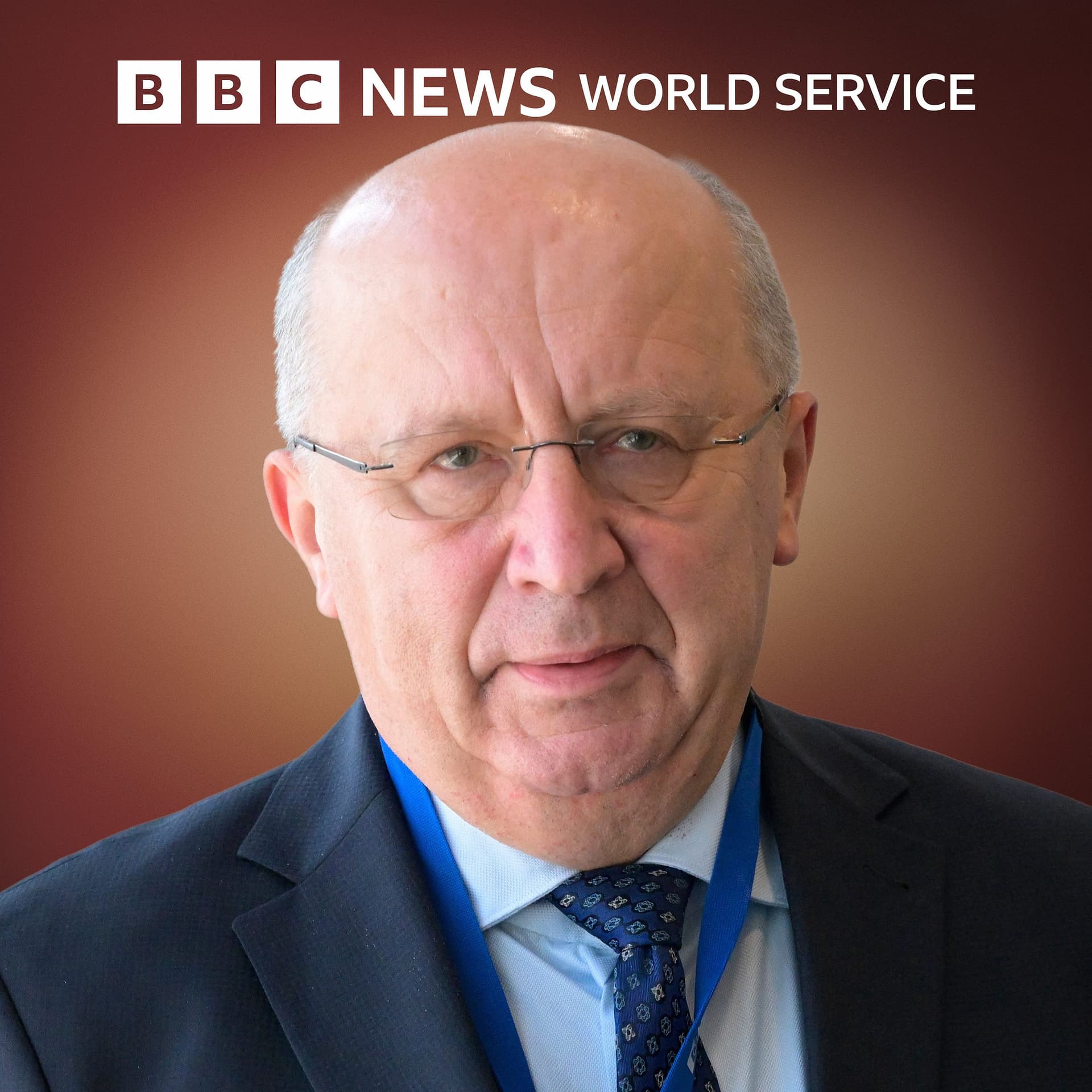
James Copnall, presenter of BBC Newsday, speaks to Andrius Kubilius, EU Commissioner for Defence and Space, about the need for Europe to be able to defend itself.
In an interview recorded before the Nato summit on 24/25 June 2025, Mr Kubilius, a former Prime Minister of Lithuania, says peace in Europe cannot be taken for granted and that Europe can no longer rely on American military backing. Therefore, defence readiness must be a priority, meaning increased spending commitments from Nato members, and a unified, quick and clear approach across Europe to building defence capabilities. This, he believes, is the only way to deter the threat of further Russian aggression.
But some Nato member states may struggle to meet the proposed increased spending target of 3.5% of GDP on defence. A few still haven’t met the current goal of 2%, set more than a decade ago. However, other European nations are already boosting spending to 5% including countries living in close proximity to Russia, such as Poland, Estonia and Lithuania.
Overall, Europe still only accounts for 30% of Nato's total military spending, a figure that has prompted US President Trump to demand a much greater contribution from European members. The Interview brings you conversations with people shaping our world, from all over the world. The best interviews from the BBC. You can listen on the BBC World Service, Mondays and Wednesdays at 0700 GMT. Or you can listen to The Interview as a podcast, out twice a week on BBC Sounds, or wherever you get your podcasts.
Presenter: James Copnall Producers: Lucy Sheppard, Ben Cooper and Owen Clegg Editor: Nick Holland
Get in touch with us on email TheInterview@bbc.co.uk and use the hashtag #TheInterviewBBC on social media.
(Image: Andrius Kubilius. Credit: John Thys/EPA-EFE/REX/Shutterstock)