In short
Podcast Notes: The Interview - Carsten Breuer, the German Chief of Defence
Episode Overview
- Title: Carsten Breuer, the German chief of defence: NATO faces "very serious threat" from Russia
- Host: Frank Gardner, BBC Security Correspondent
- Guest: General Carsten Breuer, German Chief of Defence
- Key Discussion: The significant threat posed by Russia to NATO and the preparedness of NATO members.
Key Themes and Discussions
Current Threat Landscape
- Serious Assessment: General Breuer describes the threat from Russia as unprecedented in his 40 years of military service.
- Military Buildup: Russia is reportedly increasing its military capabilities significantly, including production of 1,500 main battle tanks and 4 million rounds of artillery annually.
- Timeline for Threat: Breuer emphasizes the need for NATO to prepare for a possible attack from Russia by 2029, but notes the urgency to be ready immediately.
NATO’s Preparedness
- Military Readiness: Breuer insists that NATO must enhance its military forces and capabilities to defend against potential Russian aggression.
- Focus Areas:
- Air defense systems
- Main battle tanks
- Precision strike capabilities
- Ground forces and digitalization for better coordination
Hybrid Warfare and Cyber Threats
- Hybrid Warfare Tactics: Breuer highlights Russia's use of hybrid warfare, including cyber attacks and espionage, which undermine Western security without overt military action.
- Examples of Incidents: Attacks on undersea cables and infrastructure in Europe, as well as drone sightings over German installations.
The Role of the U.S. in NATO
- Concerns Over U.S. Military Presence: The discussion touches on the potential drawdown of U.S. forces in Europe under past administrations.
- European Responsibility: Breuer asserts the need for Germany and its allies to take more responsibility for their own defense.
Investment in Defense
- Increased Defense Spending: Breuer discusses Germany's decision to allocate an additional 100 billion euros to defense, indicating a shift in the national budget to prioritize military readiness.
- Long-term Commitment: Emphasizes that security underpins prosperity and development.
Unity within NATO
- Cohesion Among Member States: While some NATO countries have differing relations with Russia, Breuer argues that there is strong unity among military leaders regarding the need for deterrence and collective defense.
- Recent NATO Expansions: Notably, Finland and Sweden's interest in joining NATO has strengthened the organization's collective security.
Future Security Considerations
- Connecting Global Threats: The conversation highlights the interconnectedness of regional security issues, urging for a multifaceted approach to defense that includes cooperation among nations facing shared threats.
Cultural and Historical Context
- Historical Perspective: Breuer reflects on past tensions during the Cold War and the evolution of NATO's role in ensuring peace and stability in Europe.
- Sovereignty and NATO Membership: Stresses that countries seeking NATO membership do so for their own security and sovereignty.
Key Takeaways
- Urgency in Defense Preparation: NATO must ramp up military readiness to address the looming threat from Russia, with specific emphasis on modernization and increased spending.
- Hybrid Warfare Awareness: There is a critical need to address hybrid threats beyond traditional military confrontations.
- Collective Responsibility: European nations must be prepared to take more responsibility for their own defense, especially regarding the potential reduction of U.S. military support.
Conclusion The episode underscores the pressing security challenges Europe faces from Russia and the vital steps NATO must take to ensure collective defense and deterrence. General Breuer's insights emphasize the importance of military readiness, investment in defense capabilities, and the need for unity among member states in the face of evolving threats.
Written by AI. May contain mistakes. Listen to the episode to check what was said.
Transcript
Automatic transcript. May contain errors.0:00This BBC podcast is supported by ads outside the UK. If journalism is the first draft of history, what happens if that draft is flawed? In 1999, four Russian apartment buildings were bombed, hundreds killed. But even now, we still don't know for sure who did it. It's a mystery that sparked chilling theories. I'm Helena Merriman, and in a new BBC series, I'm talking to the reporters who first covered this story. What did they miss the first time? The History Bureau Putin and the apartment bombs Listen on bbc.com or wherever you get your podcasts From the Winter Olympic and Paralympic Games To the European Athletics Championships The 2026 sporting calendar is packed full of big events Keep up with all the action with More Than The Score The podcast that goes beyond the score sheet Join expert BBC sports journalists every Monday to Friday For interviews with sports stars, big talking points and the stories behind the headlines.
1:07More Than The Score from the BBC World Service. Listen now. Search for More Than The Score wherever you get your BBC podcasts.
1:19Hello, I'm Frank Gardner, the BBC security correspondent, and this is The Interview from the BBC World Service. the best conversations coming out of the BBC, people shaping our world from all over the world. Every generation has to fight to maintain democracy. There is no place in the world where women are equal. There have been so many disagreements between me and my family. I will give away the vast majority of my money. Putting on a show, that is what it means to be Lady Gaga. For this interview, I met General Carsten Breuer, the German chief of defense. I spoke to him in Singapore at the Shangri-La Dialogue, a major defense summit organized by the think tank, the International Institute for Strategic Studies.
2:08He tells me that the threat to the Western alliance, NATO, is very serious. He said he'd never seen a situation like this in his 40 years of service. He believes that NATO members need to prepare for a possible attack from Russia within the next four years. What we see at the moment is that Russia is building up their forces to an enormous extent. It's clear that there's an intention and there's a buildup of the stocks. And this culminates, I would say, and this is what the analysts are assessing in 2029. So we have to be ready by 2029. Welcome to the interview from the BBC World Service with Frank Gardner.
2:50General Breuer, how serious is the threat? facing NATO right now from the east, from Russia? It's a very serious threat. I've never seen a situation like this in my 40 years of service. It's really coming to a point where I must say we have to be prepared. And we have to be prepared to be ready to, of course, being able to defend ourselves, but at the same time to do deterrence, just to show Russia that it's not easy to have an attack against NATO territory. I think one of the biggest lessons, I would say, from the military side of this war in Ukraine is that mass matters, in other words, numbers.
3:33And the Russians have got a lot of numbers. Their army isn't very good, but there's a lot of it. And there isn't very much of NATO troops. Germany, UK and others, we've wound down our militaries. can NATO build up its forces enough in time before you and others like you think that Putin is going to have another go at another country? You're absolutely right. What we see at the moment is that Russia is building up their forces to an enormous extent. We see that they're producing 1 ,500, approximately 1 ,500 main battle tanks every year. And out of these main battle tanks, it's not every single tank is going to Ukraine, but it's also going in stocks and into new military structures facing the West.
4:24At the same time, there's a production of 4 million rounds of artillery ammunition, and it's also not going into the war in Ukraine. So what we see is quite a huge buildup. And what we assess, and when I'm talking to all the analysts, it's clear that there's an intention. And Putin has stated it several times now, and not only Putin, but the entire administration in there. There's an intent and there's a buildup of the stocks. And this culminates, I would say, and this is what the analysts are assessing in 2029. So we have to be ready by 2029. And we are taking our part in Germany for this as well.
5:08If you ask me now, is this a guarantee that's not earlier than 2029? I would say, no, it's not. So we must be able to fight tonight. That's extraordinary. I mean, I don't think I would be able to say the same about the UK in terms of numbers, because they're so small. What do you think is the priority for NATO right now to build up, to meet this challenge? Of course, we can fight tonight and we are able to do so, but we can do much better in building up our own forces, our own stocks, our own weaponry. If you're looking into the future, what is needed, I think the war in Ukraine is not a blueprint for the war in the future.
5:54So we have to think both. we have to see that it's a trench war, what we see in Ukraine, that it's at the same time, you also have drones, parts of the future war you can see in there as well. Of course, I think there are priorities. I've set these priorities in Germany in saying, okay, what we need is, of course, air defense in all layers. Of course, we need main battle tanks. Of course, we need infantry fighting vehicles. Of course, we need deep precision strike and also strong air force in there. And I would also add homeland defense. Building this forces up and tying it together, the glue of all this is digitalization.
6:37Bringing this together, it costs a lot of money, but we are on the way to do so. President Trump's administration have indicated that they are going to be drawing down US forces in Europe, including Germany. Are you now having to make plans for how you would defend Europe without US forces, land forces? Well, what I got out of President Trump's words and also out of the discussions afterwards is that we have to be ready to defend ourselves. We have to take our part. We have to take over responsibility in the case of Germany as one of the biggest economies in Europe. And to take over this responsibility also means that we have to take on military responsibility in there.
7:32Does this mean or do I have any indications that the U.S. is withdrawing? No, I don't see this at the moment. and talking to my military counterparts, I don't see indications that it's going to happen like this. But on the other hand, it's clear that we have to take our part. And therefore, this, I would say, trade-off, all this balance we have to bring in, it's clear to me and we are doing this and we are taking our part of this. Now, every time NATO countries have supplied one more step up in terms of main battle tanks, long-range missiles and so on. There's been a fair bit of saber rattling from Moscow with every now and then President Putin raising the threat of some of using nuclear weapons, tactical nuclear weapons, but still.
8:21What would you say to those that say it is a dangerous provocation to supply long-range missiles such as Germany's Taurus that could reach Moscow, that this is needlessly poking the Russian bear? For me, it's clear that there's a threat from one direction, and this direction is from Russia. So our problem is not sitting in Washington, like you indicated a little bit with your question. Our problem is sitting in the Kremlin. And therefore, there's a threat. I think it's absolutely clear that we have to do something against this threat. This means deterrence. And deterrence also means that we have to have the possibility to reach out for command posts.
9:06that we can reach for the backyards of the front line. So this is necessary. This is modern warfare, and we've seen it over all the time. So there's no provocation out of my perspective. And the other issue is I always recommend not to discuss nuclear options within the public. Now, you're here in Singapore at the Shangri-La Dialogue. What's brought you here? We're a long way from home, both of us. For me, it's always the opportunity to meet with my counterparts here out of the region to catch up with all their issues. Because I think what we have done over years and years to separate the warfighting theaters, to separate the security policy theaters, we can't afford this for the future.
9:52We can't afford this in our times. So when I was, as a chief of defense, first time on Munich Security Conference three years ago, we were discussing Ukraine. A couple of weeks later, I was here in Singapore and we were discussing South China Sea. But nobody was talking about Africa, nobody was talking about Middle East, and nobody was talking about how to connect the dots between those. I think for a sensible security policy, for a sensible security policymaker, you have to connect the dots. You have to see in the theaters and you have to see the impact from one theater to the other. If I may, an example on this.
10:27During our Indo-Pacific deployment, I visited also Korea and I talked to my Korean counterpart. And we were discussing that from North Korea, weapon systems and ammunition was sent via Moscow to the theater of Ukraine. And at the same time, parts of nuclear weapon systems from Moscow over to North Korea. So this trade-off, this trading of weapons destabilized both theaters, the European theaters in Ukraine, and at the same time also the Korean peninsula. So this is an example for what I mean with you have to connect the dots. You can't see it separately anymore. Do you think China should exert more effort to restrain North Korea, or is that a lost cause?
11:16I think North Korea is playing between Russia and China and it's bringing itself in the best position for their country. So therefore, also, they should see that there is a kind of balancing which North Korea is trying to do to get themselves in a better position. You have to see this. You're listening to the interview from the BBC World Service, people shaping our world from all over the world. If journalism is the first draft of history, what happens if that draft is flawed? In 1999, four Russian apartment buildings were bombed, hundreds killed. But even now, we still don't know for sure who did it.
12:03It's a mystery that sparked chilling theories. I'm Helena Merriman, and in a new BBC series, I'm talking to the reporters who first covered this story. What did they miss the first time? The History Bureau Putin and the apartment bombs Listen on bbc.com or wherever you get your podcasts From the Winter Olympic and Paralympic Games To the European Athletics Championships The 2026 sporting calendar is packed full of big events Keep up with all the action with More Than The Score The podcast that goes beyond the score sheet Join expert BBC sports journalists every Monday to Friday For interviews with sports stars, big talking points and the stories behind the headlines.
12:49More Than The Score from the BBC World Service. Listen now, search for More Than The Score wherever you get your BBC podcasts.
13:02For this episode of The Interview, I'm speaking to General Carsten Breuer, the German Chief of Defence. As a career soldier, an ex-infantryman, his grey German uniform tunic is showing plenty of medals. I point out that both of us are a long way from home here in Singapore. He replies that this is indicative of the global interconnected nature of threats these days. He and I are both old enough to remember the Cold War, a time when his country, Germany, was divided into East and West, with the Russians stationing troops in the East. Today, there are renewed fears about Russian aggression, and Germany is embarking on a massive uplift in defence spending.
13:44In the second half of our conversation, I ask him whether Russia is engaging in hybrid warfare. This is when a hostile state carries out an anonymous, deniable attack to harm their opponent, but one that stops short of engaging in open hostilities. Russia has been accused of carrying out cyber attacks on Western public transport networks, flying drones over German power stations and sabotaging the undersea cables that bring internet and power to Europe. Moscow denies involvement in such incidents. I also wanted to know whether he thinks Europe is doing enough to be ready to face the threat of a future war in the region.
14:23You've spoken about the industrial challenge and I think again another lesson from the Ukraine war is that it's not just about numbers, it's not just about munitions, it's about the ability of countries to get their industries to sustain a much longer conflict than people have necessarily been planning for. You mentioned 2029 as the sort of notional deadline by which time Europe needs to be ready to meet a possible Russian attack. haven't we left it very late in Europe to get our industries up to where they need to be to generate the kind of munitions, the kind of long-range weaponry that is needed for this kind of operation?
15:12You know, this is a little bit like Monday morning quarterbacking, what we are always trying to do. So there has been a decision in the past, there have been different assessments, and out of this it was clear how to position not only the military but also politics and at the same time also industry. If you can't perceive a threat, if you don't see the framework for this, if you don't see the precondition for this, why should you get up your own production lines for producing something which is then not coming into the market, it's sitting on your shelves. what we probably did not do right was that we have seen a development and we were not acting early enough on this but once again who am i that i have to criticize the decision for more times what we can do now and what we have to do now is really to lean in and to tell everybody hey ramp up the production get more into it because we need it we need it to be able to defend ourselves and therefore also to build up deterrence.
16:15In Germany, we did this in a first step with an extra budget of 100 billion euro, which was a clear sign towards also the industry. But we also found out that this 100 billion euro only fills in some of the potholes on the street of more readiness. So the change now is a change in Germany of the constitution so that we have a part of our budget which is dedicated to defence and security, which is outside of our regulations for limiting the debts which we are able to take. This is a clear sign to the industry as well. It's reliability and it's a reliability for the next couple of years and therefore for building up the forces for the future.
17:03You and I were both in the Bundestag in Berlin the day that that vote was taken. and it was historic. What would you say to those in Germany and elsewhere in Europe that this is such a waste of money, this is money that should be spent on social care, on housing, on hospitals, on roads, universities, peaceful things? What we have done in Germany, what we have decided is that without security, everything is nothing, everything else is nothing. So we have to start with what is the baseline for all our prosperity, for all our development, for all our future. And I would argue that security is really this baseline.
17:46So I understand, of course, that there are other political areas where you need money. And therefore, there has to be also a balance. But once again, without security, everything else is nothing. What shape is NITO in? And this is a loaded question because you've got two countries, Hungary and Slovakia, who have got very good relations with Moscow. You've got Robert Fitser, who even attended President Putin's show parade in Moscow on Victory Day. the cohesion, the unity that NATO had in the immediate aftermath of the full-scale invasion of Ukraine in February 22 is looking a little bit rusty, isn't it?
18:33Well, I would argue the other way around. So what we have seen is after the invasion of Russia and Ukraine, we have seen two countries, two nations joining NATO with Finland and Sweden. We have seen that they're coming very much together. I've never seen such unity like it is now in the military committee. Everybody understands, all the nation, all the military leaders. Including Hungary? All of them understand how the threat is at the moment approaching NATO. All understand that we have to develop more into a direction of, again, deterrence, into the direction of collective defense. This is clear to everyone.
19:16The urgency is seen. We see the NATO alarm plans are boosting up. So I would argue that the military understanding or the understanding of the military leaders, of the chief of defense, there is, first of all, unity. And then it's readiness and that we have to take this readiness for the alliance. We talked about the possible future threat, but we've also heard at this dialogue quite a bit about hybrid warfare, about the existing actions that Russia is alleged to be taking. How serious is the threat in Germany and other parts of Europe? I can only answer yes. And this yes means it's already there.
20:00So Russia is seeing war not like we are doing it with a clear distinction between peace, crisis and war. Russia is seeing it as a kind of continuum. Russia is testing Western countries. And we see this with drone attacks over power stations in Germany. We see this with attacking underwater cables in the Baltic Sea. We see this with cyber attacks against public transportation, for example. General David Petraeus has been quoted recently in the press, the former US head of the CIA, as saying that Lithuania is a country that Russia would be most likely to attack. Is that something you would agree with?
20:47I mean, Germany's got forward-based troops, haven't you, in the Baltics? Yeah, we stood up a brigade a week ago in Lithuania. I see exactly General Petrieu's point. I can't assess if it is more likely Lithuania, is this Latvia or is this Estonia. I would say the Baltic states are really exposed to the Russian threat. And once you are there, you really feel this in the population. You really feel this in the talks we are having over there. My Estonian counterpart gave an example and she said, well, if I'm looking over my fence and my garden, I see a wildfire and I see the forest, the trees burning in there.
21:29I feel the heat. I see the flames. I smell the smoke. If you in Germany, if you look at this wildfire, you probably see a little bit smoke over the horizon and not more. And this shows how the threat perspective is different or differs between the Baltic countries and probably the rest of Europe. We have to make sure that we have the same understanding. We have to make sure that we are supporting the population in the Baltic states in their perception of security. And I think one of those steps was standing up the German brigade permanently stationed in Lithuania a week ago. The numbers, though, are relatively small.
22:11I mean, a brigade is 3 ,000 to 5 ,000 troops. It's 5 ,000, yeah. Yeah, but Russia has large numbers of not very well-trained, not very well-equipped, not very well-led troops, but it's got so many of them. If Russia was to make an attack on Lithuania in the coming years, your brigade and the multinational brigade there, that would just be a tripwire, wouldn't it, just to try and delay them? how quickly would reinforcements be able to arrive? I don't know what your assessment about Ukraine forces on the evening of the 24th of February 22 was, if you would also have assessed that the Ukraine forces were only a tripwire.
22:52So I'm not sure if this wording and also our assessment about the abilities, the capabilities of the Russian forces is exactly right. Russia is not winning in Ukraine for years now. So if we have not only one brigade, but the forward land forces at the NATO eastern flank, and this is not only in the Baltic states, but also over the other countries, this shows to Russia that we are willing and able to defend ourselves and that we can cause a serious problem for them. In having a full-fledged brigade stationed at the eastern flank in Lithuania, this means they're combat-ready. So they have all the supplies in stock, they have all the ammunition, they have all the forces they need, and they are on a level of more than 90 % on personnel.
23:47So this means something, and you can't outflank a brigade, you can't outflank the forward land forces being stationed over there. General, you and I are both old enough that we remember the days when Soviet forces were stationed in East Germany, in DDR, and German Democratic Republic, and in East Berlin, for that matter. And of course, President Putin was a KGB officer in Dresden at the time that the Berlin Wall came down. A lot of people have said that NATO has been needlessly provocative by expanding eastwards. What would you say to that? I think it's very clear that NATO is an attractive model for all those sovereign states.
24:30And I think sovereignty means that you can choose what alliance you are joining. And therefore, there was a decision of the sovereign states and it was a free decision they've taken to join NATO. They are seeking for security. They are seeking for prosperity for themselves. and NATO can provide this. And you and I understand this because we have been NATO members nearly from beginning on. So we have seen for our countries what this alliance, the most successful alliance in the world, has provided to our countries. I think those who have joined NATO recently, Finland and Sweden, they have also seen the security aspects in there.
25:15And therefore, it's their decision. And I think it's the right decision. Thank you for listening to The Interview from the BBC World Service. If you enjoyed today's programme, you can listen to The Interview wherever you get your BBC podcasts. Until the next time, goodbye.
25:37If journalism is the first draft of history, what happens if that draft is flawed? In 1999, four Russian apartment buildings were bombed, hundreds killed. But even now, we still don't know for sure who did it. It's a mystery that sparked chilling theories. I'm Helena Merriman, and in a new BBC series, I'm talking to the reporters who first covered this story. What did they miss the first time? The History Bureau, Putin and the apartment bombs. Listen on BBC.com or wherever you get your podcasts. From the Winter Olympic and Paralympic Games to the European Athletics Championships, The 2026 sporting calendar is packed full of big events.
26:21Keep up with all the action with More Than The Score, the podcast that goes beyond the score sheet. Join expert BBC sports journalists every Monday to Friday for interviews with sports stars, big talking points and the stories behind the headlines. More Than The Score from the BBC World Service. Listen now, search for More Than The Score wherever you get your BBC podcasts.
From the publisher
Frank Gardner, BBC Security Correspondent, speaks to Carsten Breuer, the German chief of defence.
General Carsten Breuer gives his assessment of the threat that Russia poses to the Western alliance Nato. He says that Russia is building up its forces to an "enormous extent" and says that members of the alliance need to prepare for a possible attack from Russia within the next four years, according to assessments from defence analysts. He cites recent attacks on undersea cables in the Baltic Sea, and unidentified drones spotted over German power stations and other infrastructure, as possible evidence that Russia is continuously looking for weaknesses in the defence capabilities of Western countries. Russia has denied involvement in these incidents. General Breuer argues that Nato members should build up their militaries, and that European nations should consider security a baseline for prosperity and development. The Interview brings you conversations with people shaping our world, from all over the world. The best interviews from the BBC. You can listen on the BBC World Service, Mondays and Wednesdays at 0700 GMT. Or you can listen to The Interview as a podcast, out twice a week on BBC Sounds, or wherever you get your podcasts.
Presenter: Frank Gardner Producers: Viv Jones Editor: Nick Holland
Get in touch with us on email TheInterview@bbc.co.uk and use the hashtag #TheInterviewBBC on social media.
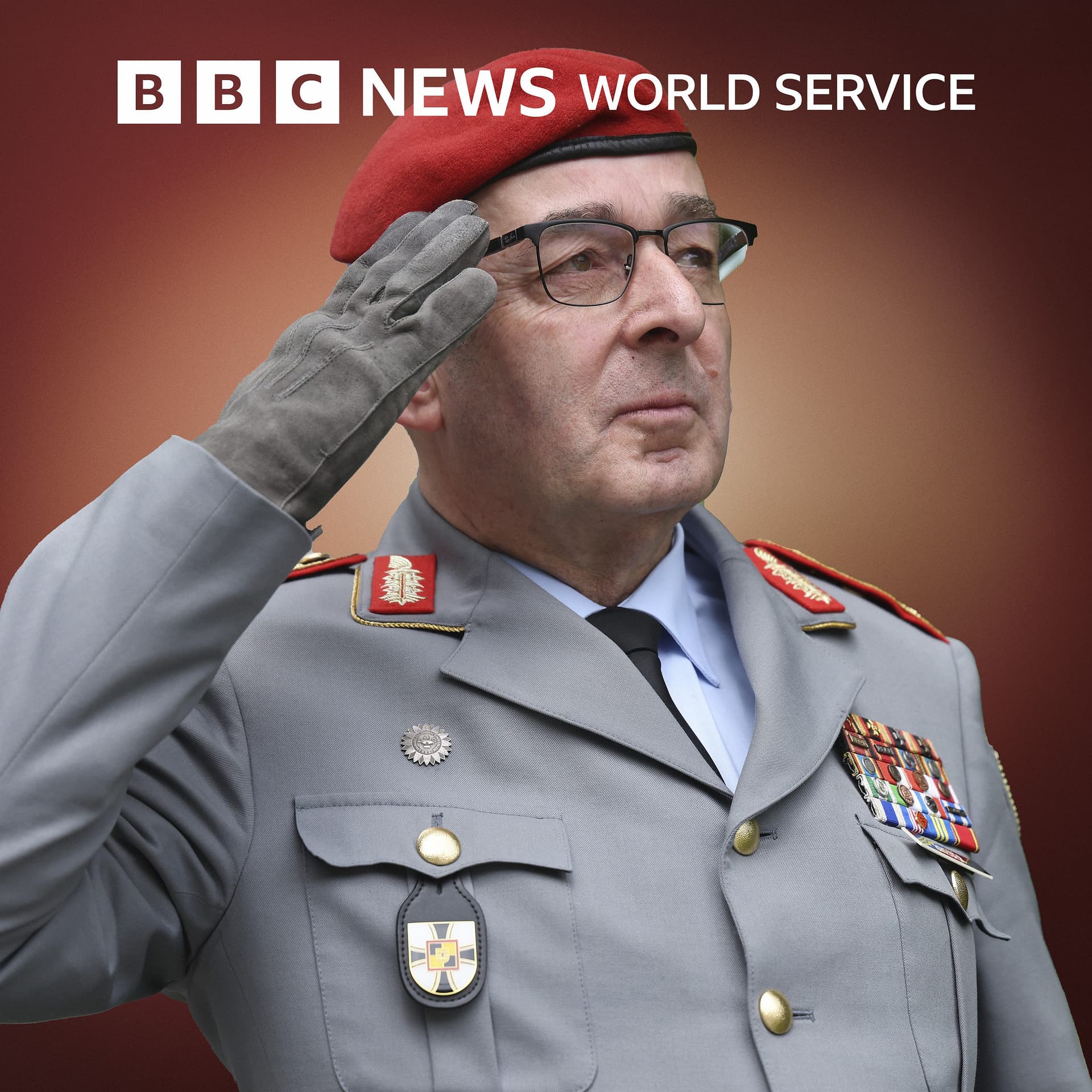
(Image: General Carsten Breuer. Credit: Sean Gallup/Getty Images)