In short
Podcast Episode Summary: The Interview - Duma Boko, President of Botswana: The World Will Listen to Africa
Podcast Overview Podcast Title: The Interview Podcast Description: Conversations with influential figures around the globe, focusing on business, politics, finance, sports, and culture. It features insights from global leaders, decision-makers, and cultural icons. Each episode is around 20 minutes long, providing analysis on significant issues of our time.
Episode Details Episode Title: Duma Boko, President of Botswana: The World Will Listen to Africa Episode Description: A deep dive into President Duma Boko's vision for Botswana and Africa, covering economic revitalization, diamond resource management, and collaboration among African nations.
Key Themes and Discussions
Economic Revitalization Plans
- Control Over Diamond Resources: President Boko aims to take greater control of Botswana's diamond reserves, diversifying the economy beyond diamonds.
- Tariff Negotiations with the US: Currently facing high tariffs on diamond exports to the US, Botswana is nearing a tariff-free deal for diamonds, which is crucial for economic health.
Vision for a United Africa
- Collaboration Among African Nations: Boko advocates for a unified African continent that leverages its resources collectively, transforming Africa into a significant economic force.
- Importance of Inter-Africa Trade: Boko emphasizes the need for African countries to trade among themselves to enhance economic resilience and reduce dependency on external powers.
Historical Context and Political Change
- Background of Duma Boko: A human rights lawyer educated at Harvard, Boko is the leader of the Umbrella for Democratic Change and became president after defeating the Botswana Democratic Party, which had been in power for nearly 60 years.
- Women in Leadership: Boko's administration has made strides in increasing female representation in government, showcasing Botswana’s commitment to gender equality.
Challenges Facing Botswana and Africa
- Declining Demand for Diamonds: The rise in the popularity of lab-grown diamonds has impacted Botswana's economy, emphasizing the need for diversification.
- US-Africa Relations: Discussion on how some African nations are pressured into agreements with the US, which may not always align with their interests.
International Relations and Representation
- Calls for UN Representation: Boko supports increasing Africa's representation in the UN Security Council, advocating for two permanent seats for African nations.
- Global Perception of Africa: He highlights the need for the world to recognize Africa as a rising force, changing the narrative around the continent.
Future Prospects and Strategic Goals
- Digital and Industrial Transformation: Botswana aims to become a logistics and digital hub, focusing on industrialization and processing critical minerals domestically.
- African Growth and Opportunities Act (AGOA): Boko expresses concern over the potential non-renewal of AGOA and its implications for Botswana's economy while stressing the importance of resilience and internal trade networks.
Conclusion In this episode of The Interview, President Duma Boko articulates his ambitious vision for Botswana and Africa, emphasizing the need for economic diversification, unity among African nations, and a stronger voice on the global stage. His administration’s focus on empowering women and addressing public health concerns highlights a commitment to progressive governance.
Episode Contributors
- Presenter: Waihiga Mwaura
- Producers: Lucy Sheppard, Kasra Karimi, Priscilla Ng’ethe Koinange
- Editor: Justine Lang
Additional Information
- Listen to the podcast: Available on BBC World Service and BBC Sounds.
- Contact: Email TheInterview@bbc.co.uk; use #TheInterviewBBC on social media.
Written by AI. May contain mistakes. Listen to the episode to check what was said.
Transcript
Automatic transcript. May contain errors.0:00This BBC podcast is supported by ads outside the UK. If journalism is the first draft of history, what happens if that draft is flawed? In 1999, four Russian apartment buildings were bombed, hundreds killed. But even now, we still don't know for sure who did it. It's a mystery that sparked chilling theories. I'm Helena Merriman, and in a new BBC series, I'm talking to the reporters who first covered this story. What did they miss the first time? the History Bureau Putin and the Apartment Bombs listen on bbc.com or wherever you get your podcasts with the European Athletics Championships the Men's FIFA World Cup and the Commonwealth Games all taking place 2026 is shaping up to be a terrific year for global sport and the More Than The Score podcast will be following all the action bringing you interviews with sports stars and exploring the stories beyond the score sheets with the BBC's expert sports journalists More Than The Score from the BBC World Service.
1:05Listen now. Search for More Than The Score wherever you get your BBC podcasts.
1:31There have been so many disagreements between me and my family. Putting on a show, that is what it means to be Lady Gaga. Only the things that you can't solve with government and private sector is where you bring philanthropy in. There's no place in the world where women are equal. Every generation, every generation has to fight to maintain democracy. For this interview, I met Duma Boko, president of Botswana in New York. You're going to hear about his plans to take greater control over Botswana's diamond resources, but also diversifying the country's economy. He believes he is close to securing a tariff-free deal with the United States on diamonds.
2:15President Boko calls on his African neighbors to do more to work together. That way, he says, the world will have to listen to Africa. And he adds his voice to those calling for greater representation at the United Nations. He tells me Botswana has not yet been targeted by the United States as a possible destination for deporting migrants, so-called third country deportation. But he acknowledges that despite ethical concerns raised about the practice, some African nations might find it difficult to refuse. There are certain concessions that African countries need from the U.S. And the U.S. is now presenting certain demands.
2:59It's something of a quid pro quo. You give me this in exchange for that. And a lot of the times the African countries have very little choice in the matter. And so strategically, one appreciates why some or many of them might, in the short to medium term, take the propositions that are given to them by the United States. President Boko shares the success of his party's efforts to bring more women into government at the highest levels, and also of Botswana's athletes on the running track. The election of Dumaboko, a Harvard-educated human rights lawyer in 2024, overturned nearly 60 years of rule by the Botswana Democratic Party.
3:41It was his third bid for the country's leadership as the head of the Umbrella for Democratic Change. Welcome to the interview from the BBC World Service with Dumaboko. Maboko. Botswana has embarked on a journey of transformation. We are looking to become not just a logistics hub, we are also looking to become a digital hub. We are looking to digitalise our economy very rapidly, very robustly. We are also looking to now assume control and ownership over our diamonds. And that is why with the divestment of Anglo from Debeers, we are looking to increase our stake. In fact, we are looking to acquire the entire shareholding of Anglo in Debeers.
4:36And we will, with other partners, other investors, now organize ourselves around that shareholding. So that's what we're doing, and that's what Botswana is positioning itself to do now. How big a hit would you say your economy has taken from the fact that lab diamonds now have become as popular as they are? And diamonds have been your major export. Yes. Well, we've been overly dependent on diamonds. We've taken a very heavy knock on that front. But we are also looking to diversify within the mining sector, look at critical minerals, which we have plenty of, We have copper, nickel, we have cobalt, we have many other critical minerals.
5:23And we will be looking to leverage on our endowment in these regards to now begin industrialization, beneficiation, light manufacture, and processing of all these minerals so that we don't export them raw. I mean, we recently saw, I think, the formal reopening, opening of the Tataki mine, and I believe that's part of what you're referring to. What can other governments learn from Botswana on how to secure adequate mineral revenue from critical minerals or what you have in the ground? I'm talking about governments in DRC and elsewhere. What lessons would you have for them? We would encourage, from my example, partnerships.
6:06Partnership between governments and the private sector. We have the longest lasting partnership between ourselves and DBS in which we are a 15 % shareholder. We have the minerals they are produced in Botswana. We produce 70 % of the beers' minerals across the world. And so that partnership is an example of what can obtain if governments and the private sector come together and focus with the investors, the private sector investing its resources and the government deploying regulation and deploying access and efficiency. And so that can guide. But also there has to be a predictable, safe, and credible environment to do business in.
6:54And Botswana is just about the best exemplar of that on the African continent. But wouldn't you agree that these partnerships haven't always worked for African countries? Where have they gotten it wrong in the past? A lot of the wealth of the continent ends up in other jurisdictions. The biggest downside has been to allow the product, the minerals mined on the African soil to be carted away in the raw. This has been the critical difficulty where jobs are exported. And so the approach now for Botswana and for the rest of the African continent has to be that processing of these minerals must take place in country, must take place within the continent so that value is extracted, so that each country and Africa as a whole becomes a hub for value addition, for innovation, and for industrialization.
7:49This is what Africa needs to do. I believe since you won the election, will we be hearing your voice on the push by Africa to have two permanent seats at the UN Security Council? Yes, indeed. We are resolute on that. We join the chorus of voices on the African continent pushing for that. And so our voice will be added too. Why do you think that voice hasn't been heard? We've been here before, you know, many African governments calling for that. But the countries that have veto power in the UN Security Council are the same countries that Africa relies on for aid, for security support and so much more.
8:21Is there any leverage on the continent, President, if you were to be honest? I think what the African continent needs to do, and it's what it has begun to do, is to recognize that it must now lean on itself more than it does on external players. The Africa Continental Free Trade Area Agreement is an attempt to ensure there's inter-Africa trade. And once Africa trades in that way, Africa opens up these channels of trade within the African continent. Africa then becomes a formidable force in the world economic order. and when you are at that level, when you have asserted yourself and established yourself as a force, not just as a source of raw materials, but as a solid trading partner that produces goods and products that the world needs, the world will have to listen to Africa and Africa will take its results.
9:16Has Botswana benefited from the Africa free trade area in any way so far? It's still in its nascent stages and Botswana is looking to benefit. That's why Botswana is reaching out. Because in critical respects, there will be aggregation of produce in order to service certain markets which each country operating individually would not be able to service. Botswana, for instance, has a quarter to supply beef to Europe. It has met but only a quarter of that quarter over time. So we will need, for instance, Namibia. We'll need others to come on board so that we are able to aggregate our produce in terms of both scale and quality to service these markets together.
9:55That will unlock value. It will enable us to collaborate among ourselves as African countries. On this matter of trade, if the Africa Growth and Opportunities Act, which allows duty-free access of certain African products to the U.S., is not renewed, what does that mean for your country? Well, it presents immense challenges because it will block off access to what has been a very huge market and a very lucrative market for African goods. If you take the country of Lesotho, for instance, which is big on textile and has been anchored and supported by the African Growth and Opportunities Act, a huge blow.
10:35But of course, we need to now be resilient enough. And if we are able amongst ourselves on the African continent to open these trade channels, that market that we would otherwise lose, we should be able to at least claw back a substantial part off from the African continent, the 1.5 billion. Any sense on how many jobs could potentially be lost in your country? What are your economists telling you? Look, with Botswana, the biggest export commodity for us is diamonds. And that is why our focus, in terms of Agua, there isn't much textile that we've exported. And that's why I'm giving the example of Lesotho, which relies on textile more than us.
11:19For us, the biggest commodity that accounts for trade between us and the United States is our diamonds. And that is why our focus has been to push for a zero tariff, especially on diamonds. But of course, we are pushing for a better deal on Agua, not just for ourselves, but for the rest of Africa. How far are your negotiations on zero tariffs for your diamonds? at an advanced stage. I think we are on the verge of reaching an agreement. And it looks like Bozana will probably be the first to conclude an agreement, which will then be broadened to cover other African countries. You're listening to the interview from the BBC World Service, people shaping our world from all over the world.
12:09If journalism is the first draft of history, what happens if that draft is flawed? In 1999, four Russian apartment buildings were bombed, hundreds killed. But even now, we still don't know for sure who did it. It's a mystery that sparked chilling theories. I'm Helena Merriman, and in a new BBC series, I'm talking to the reporters who first covered this story? What did they miss the first time? The History Bureau, Putin and the apartment bombs. Listen on BBC.com or wherever you get your podcasts.
13:03BBC's expert sports journalists. More than the score for the BBC World Service. Listen now. Search for more than the score wherever you get your BBC podcasts.
13:20For this episode of The Interview, I'm speaking to Duma Boko, President of Botswana. When I spoke to President Boko, it was already his third public engagement of the day, with several others still to come. He is a man clearly at ease with the press and with public speaking. He also appeared to be a man in a hurry, determined to get his message out to the world about what he and his administration are trying to achieve in Botswana. For now, he seems to enjoy support both at home and abroad, as many first-term leaders do during their honeymoon phase. But with the challenges of declining diamond demand, punitive U.S.
14:01tariffs and broader geopolitical headwinds, he'll need to secure some early wins to keep his approval rating steady. OK, let's now return to my conversation with Duma Boko. Speaking of agreements between African countries and the United States, what do you make of the third country deportations that the U.S. has been championing for? Many of your neighbours have signed up onto it. Well, it is a, if you like, a quid pro quo in the sense that there are certain concessions that African countries need from the U.S. And the U.S. is now presenting certain demands to these African countries and saying, in order for us to give you these that you are asking for, would you consider the following from our side?
14:57So it's something of a quid pro quo. You give me this in exchange for that. And a lot of the times the African countries have very little choice in the matter. And so strategically, one appreciates why some or many of them might, in the short to medium term, take the propositions that are given to them by the United States. Have you been approached to receive migrants? No, we have not. There's been no formal approach to us, but we've been talking about the tariffs. So maybe in the context of that, we might hear and we'll have to contend with. What would your choice be off the top of your head?
15:38You are the ultimate. You're the CEO of the country. We'll concede it when it comes. We want to do whatever is in the best interests of our country. Do you think it's ethical? I mean, these deported parties, their lawyers are in U.S. courts at the moment asking for justice. They are legal questions. Is it ethical for the U.S. to make such demands? Well, I was assuming that these demands are being made in anticipation of the fact that the litigation and the courts will conclude at some point. And it seems that whatever the outcomes, the American government would want to remove certain of these individuals.
16:16And so in anticipation of whatever the outcome is and an outcome that may allow them to remove, then they are preparing in advance. That was my understanding. And there would be nothing ethically wrong with preparing yourself in advance. You say some of the African countries may have made the choice because they have no choice. They have almost no choice. Probably a Hobson's choice for them. There's an African union. The African continent now should have a louder voice than ever before. or can they not say no if that was not in their interest to begin with? The difficulty with some of the challenges that face the African countries is that multilateralism is taking a beating.
17:01It's receding, it's being pushed back, and pushed back vigorously, with the result that as survival responses, countries are approached individually, not in the context of a bloc. So there's no negotiation on bloc. It's individuated engagements with countries. And when engagements occur at that level, and each country is forced to look at its circumstances, it makes whatever artful manoeuvres, without, I believe, compromising the broader picture of the African Union, that would enable them to survive in the short to medium term even. I'm imagining someone on the African continent listening to you and wondering, so when we hear these grand speeches from African leaders on the floor of the UN General Assembly, behind the scenes are the realities altogether very different?
17:53Each country is simply fighting for survival? Yes, indeed, they're somewhat different. And it's a function of strategy. when you are faced with a behemoth of a situation or a block and you have to survive in order to then build yourself into the formidable force that you ought to be in order to engage at par. What option do you take? You take an option that poses an immediate existential threat to you, or you take an approach that gives you some play at the joints in order to refocus your energies. It's a fair point that you raised, but we had a Nigerian foreign minister who went on a TV interview and said, we have enough problems as it is.
18:44Let us first deal with the citizens in our borders before we receive citizens from other nations. One would expect that there'd be more African leaders rising up and saying, hang on, as a continent we need to discuss if this is going to be the future of our engagements with other parts of the world? I would expect that those who have been approached will take a decision. Nigeria, if it has determined that that's the way they should go, then I'm sure certain other African countries will also look at their circumstances and say, Paul, wait a minute, there's a voice, a formidable voice here that is pushing back.
19:18Maybe let's join the chorus and move in that direction. So I think it will resonate, hopefully, with others. who are facing similar circumstances. And at the same time, some of these initiatives that the African Union is putting into place, among them the African continental free trade area, the digital trading platforms that are now coming up to enable seamless trade, should enable African countries to rely more on domestically mobilized resources. The moment we get to that point where we don't need to rely on external finance, then I think the African continent will be well on its way to asserting itself and pushing back against some of the movements and machinations that are at play.
20:02How significant do you think it will be for Africa to host a G20 for the first time in November, very close to your country? In South Africa? Yes. While it is significant, it brings all these players on the African continent first for them to come and see and experience Africa and realize that some of the stereotypes and presuppositions that they've peddled about Africa are palpably incorrect and somewhat malicious at times, and that might be a lesson for them. But also to now begin to engage with Africa and realize that Africa is rising and Africa is asserting itself. The world will need Africa.
20:38It needs Africa. I think soon enough the world will wake up to the fact that it needs Africa, and it needs Africa desperately. Which world's leader will you be hoping to attend this G2? Are you hoping to see President Trump there, for example? I'm not sure whether President Trump will personally attend. I know that the Vice President of the United States will go. I'm not sure whether that means the President is not coming. But if he's there, it would be good to have some engagement with him. But we're also seeking to interest the Vice President in stopping by in Botswana so that he can see what Botswana is about and he can begin to realize that there's leadership in Africa, especially in Botswana.
21:25Your government has stood out for having a host of young leaders, specifically women, in very high-ranking positions, including in the cabinet. Why has this been important for you? Well, it's important first because we have lots of able women, highly educated, very competent and it only is fair that they are given a platform to shine. The political space is inhospitable, we know, and so we have devised ways in which we can empower women. We have, for instance, the instrument of specially elected members of parliament, which we invoke and bring young women into parliament and therefore elevate them into becoming ministers and in other positions of responsibility and decision making.
22:15It's something that has to be done. We must do it. It is the way to go for the country. The public health emergency that has been ongoing in your country, what's the status of that? The state of emergency was declared for a period of 21 days. The 21-day period has elapsed and the state of emergency has ended. We've resolved the immediate and pressing challenges in the health sector. We are now developing sustainable and durable means of ensuring that the shortages of medicines in our health facilities do not recur. Those who may have participated in leading to a public health emergency either by acts of omission or commission, anyone been arrested?
22:59Any investigations? There are investigations going on. There's a forensic audit that is taking place in the country that covers all these government entities and departments. And at the end of it... It's taken a bit longer than one would have expected. Well, it takes a bit of time. We calculated that it would take about nine months. Nine months to investigate? Yes, because you have several entities of government. You have to look at systems that failed. You have to look at what happened. and then investigation is about gathering evidence that you can stack up in a court. It's not suspicions, however strong.
23:38So it's also very important. We are a country that subscribes to and promotes the rule of law and so we do everything by the letter of the law. And so we take our time, we ensure that everything is properly done and that there's no perception that there's some witch hunting. And finally, I'll give you a last word on the performance of Botswana's team on the athletics front. We saw the feats of the World Athletics Championships. It's begun to stand out beyond Kenya and Ethiopia. Tell us more. I've been supporting very closely. I've had engagements with them. I've had meetings with them to encourage.
24:13But it also is a function of the belief that we have in our young people. The dynamism, the resilience of our young people, the growing self-belief, and now showcased on the international stage. We believe that we draw from such countries as Kenya that have been in that space and others, and now Botswana comes along. We believe other countries will now be inspired. We believe you have a new kid on the block. And Africa will now not only emerge in the area of trade and commerce, in sport, Africa will also take its rightful place.
24:56Thank you for listening to The Interview from the BBC World Service. You'll find more in-depth conversations on The Interview wherever you get your BBC podcasts, including episodes with the Somalian President Hassan Sheikh Mohamud, U.S. Energy Secretary Chris Wright, and the Deputy Secretary General of the United Nations Amina Mohamed. Until next time, it's bye for now.
25:29If journalism is the first draft of history, what happens if that draft is flawed? In 1999, four Russian apartment buildings were bombed, hundreds killed. But even now, we still don't know for sure who did it. It's a mystery that sparked chilling theories. I'm Helena Merriman, and in a new BBC series, I'm talking to the reporters who first covered this story. What did they miss the first time? The History Bureau, Putin and the apartment bombs. Listen on BBC.com or wherever you get your podcasts. With the European Athletics Championships, the Men's FIFA World Cup and the Commonwealth Games all taking place, 2026 is shaping up to be a terrific year for global sport.
26:14And the More Than The Score podcast will be following all the action, bringing you interviews with sports stars and exploring the stories beyond the score sheets with the BBC's expert sports journalists. More Than The Score from the BBC World Service. Listen now. Search for More Than The Score wherever you get your BBC podcasts.
From the publisher
The world will have to listen to Africa
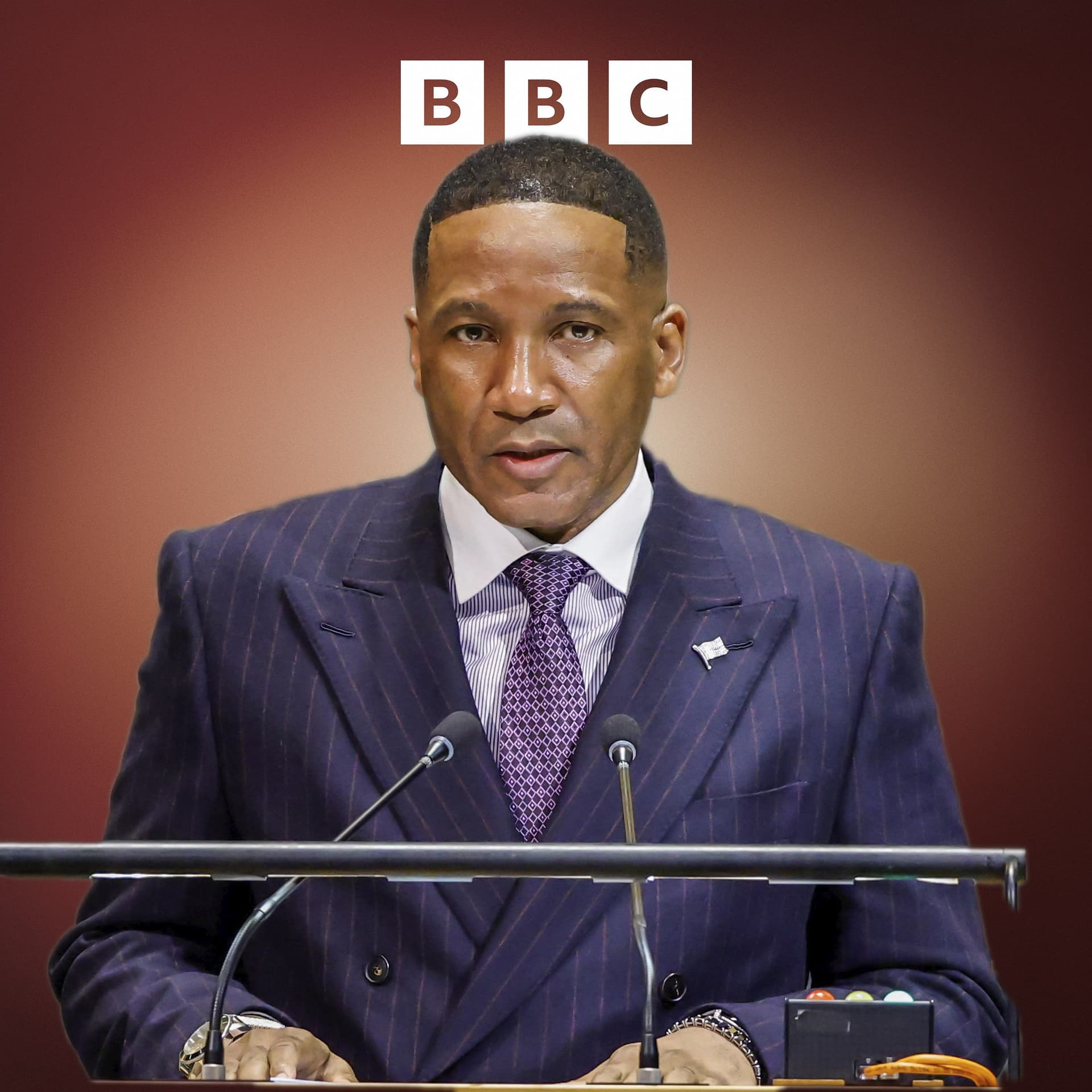
Waihiga Mwaura speaks to Botswana’s President Duma Boko about his plans to reinvigorate the economy, taking greater control of the country’s diamond reserves, but also diversifying its mining and other sectors. Currently facing hefty tariffs from the US, he claims to be close to securing a tariff-free deal for Botswana’s diamonds at least.
But President Boko also has a vision of a reinvigorated Africa, a continent that works together to become a formidable economic force, where its own people reap the benefits of its rich resources. Africa, he says, is rising.
Duma Boko, a human rights lawyer who was educated at Harvard, helped to create the party he leads, the Umbrella for Democratic Change. His victory in the 2024 presidential election, at his third attempt, finally ousted the Botswana Democratic Party from power after almost 60 years.
Thank you to Waihiga Mwaura, Kasra Karimi and Priscilla Ng’ethe Koinange for their help in making this programme. The Interview brings you conversations with people shaping our world, from all over the world. The best interviews from the BBC. You can listen on the BBC World Service, Mondays and Wednesdays at 0700 GMT. Or you can listen to The Interview as a podcast, out twice a week on BBC Sounds or wherever you get your podcasts.
Presenter: Waihiga Mwaura Producer(s): Lucy Sheppard, Kasra Karimi and Priscilla Ng’ethe Koinange Editor: Justine Lang
Get in touch with us on email TheInterview@bbc.co.uk and use the hashtag #TheInterviewBBC on social media.
(Image: Botswana's President Duma Gideon Boko addresses the 80th United Nations General Assembly at U.N. headquarters in New York, U.S, Credit: Eduardo Muñoz/Reuters)