In short
Podcast Episode Summary: The Interview - Friedrich Merz: Europe was free-riding on US
Podcast Overview Title: The Interview Description: Conversations with influential figures across various sectors, bringing insights on pressing global issues. Hosted by Nick Robinson, each episode features interviews with leaders in politics, business, culture, and more.
Episode Details Episode Title: Friedrich Merz: Europe was free-riding on US Description: An interview with Friedrich Merz, the new German Chancellor, discussing Europe's defense strategy, Germany's military investment, and the growing threats posed by Russia.
Key Insights from the Episode
Introduction of Friedrich Merz
- Position: Newly elected German Chancellor (after initial defeat).
- Political Affiliation: Leader of the centre-right Christian Democratic Union (CDU).
- Purpose of Visit: Signing the first friendship treaty between Germany and the UK, covering diverse topics like migration, defense, and economy.
Shift in Germany’s Defense Policy
- Historical Context:
- Previous chancellors were cautious about military strength due to WWII implications.
- Merz advocates for a strong military in response to Russia's threats.
- Current Stance:
- Germany must invest in its defense and not rely solely on the US for security.
- Acknowledges the past as a "free-rider" in NATO security.
Relationship with the United States
- Merz's Connection with Trump:
- Reports of a positive relationship with former President Donald Trump.
- Coordination on defense efforts and the war in Ukraine.
- Indifference of US Administration:
- Merz expresses concerns about the US's commitment to Europe's security under Trump, indicating a need for Europe to become more self-reliant.
European Security Challenges
- Threat from Russia:
- Emphasizes the long-term threat Russia poses beyond just Ukraine.
- Acknowledges a need for Germany to have an independent defense strategy.
- Military Investments:
- Plans to develop new long-range missiles as part of NATO commitments.
- Germany’s defense budget is set to scale up significantly.
Economic Challenges and Reforms
- Europe’s Economic Competitiveness:
- Merz agrees with critiques regarding Europe's declining economic status relative to the US.
- Discusses ambitious reform agendas to improve Germany's competitiveness and address infrastructure needs.
Migration Issues
- Changes in Migration Policy:
- The new treaty with the UK also addresses migration control, aiming to prosecute people smugglers.
- Merz faces challenges from domestic courts regarding border control measures.
- Current Migration Situation:
- Acknowledgment of high numbers of migrants affecting local resources in Germany.
- Emphasizes the need for a European solution to the migration crisis.
Response to the Rise of the Far-Right
- Concerns about the AFD:
- Merz addresses the rise of the far-right Alternative für Deutschland (AFD) party.
- Encourages optimism for democratic values and the ability to manage internal challenges, despite rising extremism.
Closing Thoughts
- Merz's Leadership Philosophy:
- Compares political leadership to piloting an aircraft, requiring foresight and risk management.
- Vision for Germany and Europe:
- Strives for robust national and European defense and economic strategies to enhance Germany's role in Europe amid growing global challenges.
Conclusion The episode provides a comprehensive overview of Chancellor Friedrich Merz's perspectives on Germany's defense strategies, economic competitiveness, and migration policies, framed within the broader context of European and global security challenges. The conversation highlights the need for Europe to assert its independence in defense and economic matters while addressing internal political dynamics.
Additional Information
- Presenter: Nick Robinson
- Producers: Lucy Sheppard, Ben Cooper, Kirsty McKenzie
- Sound: Dave O’Neill
- Editor: Nick Holland
- Listening Details: Available on BBC World Service and as a podcast on various platforms.
Written by AI. May contain mistakes. Listen to the episode to check what was said.
Transcript
Automatic transcript. May contain errors.0:00This BBC podcast is supported by ads outside the UK. This advertisement feature is paid and presented by Poland's Ministry of Foreign Affairs. Looking for the perfect place to grow your business? For over 30 years, Poland has been a launchpad for innovation at the heart of Europe, powered by world-class research and ambitious young talent. From bold startups to established powerhouses, Poland offers the momentum, resources and reliability you need to take your business further. Poland, where businesses don't just grow, they're built to last. Find out more at polandyourplacetogrow.com. Every day, millions of customers engage with AI agents like me.
0:42We work round the clock and have the facts at our fingertips. We're fast and effective, but incredibly patient. And we're built on Sierra, the leading AI-powered customer experience platform. No hold music, just answers and action. Visit sierra.ai to learn more. That's sierra.ai.
1:06Hello, I'm Nick Robinson, BBC presenter, and this is the interview from the BBC World Service. The best conversations coming out of the BBC. People shaping our world from all over the world. There have been so many disagreements between me and my family. Putting on a show, that is what it means to be Lady Gaga. Only the things that you can't solve with government and private sector is where you bring philanthropy in. There's no place in the world where women are equal. Every generation, every generation has to fight to maintain democracy. For this interview, I meet Friedrich Metz, Germany's Chancellor at the German Embassy in London.
1:49He's in the UK to sign the first ever friendship treaty between the two countries. It's a wide-ranging agreement covering everything from defence to the economy, migration and energy. You're going to hear about Chancellor Merz's decision to invest heavily in defence, unlike his predecessors, who in the shadow of World War II were keen to reassure the world that German military strength was not a priority. But he tells me a strong army is now essential for Germany, thanks to the grave threat posed by Russia to European peace and stability. Germany, he says, must be able to protect itself and not rely on America.
2:30We know that we have to do more on our own. And we have been free riders in the past. And the Americans guaranteed our freedom and our security. And they are not willing, understandably, They are not willing to do that any longer, and they are asking us to do more, and we are doing more. In our conversation, Chancellor Mertz, a successful businessman himself, tells me about how he's formed a good relationship with the dealmaker President of the United States, Donald Trump. He also dismisses concerns about the rise of the far-right AFD, or Alternative für Deutschland, now the official opposition party in Germany.
3:16Metz is a private pilot and says many of the qualities needed to fly a plane are needed to lead a country as well. Welcome to the interview from the BBC World Service with Chancellor Friedrich Metz. We have to be able to defend ourselves, which is actually not the case. We are not strong enough. Our army is not strong enough. So that's the reason why we are spending a lot of money, more than ever before, after the Cold World War. So that we are spending a lot of money, which we have to borrow. We changed our constitution and we are seeing a big threat. And the threat is Russia. And this threat is not only on Ukraine.
4:00It's on our peace, on our freedom, on the political order of Europe. And that's the reason why we are doing that. To be clear, you think there's a wider and a longer term threat? It's a wider and a longer term, far beyond Ukraine. Yes. Now, you know Russia well. Perhaps your adult life has been defined by it. You were born just a few months after Germany joined NATO. Right. Same year. You did national service at the height of the Cold War. Does your view of Russia in many ways shape your entire approach to the world? Well, I think our view on Russia has fundamentally changed over the last decade.
4:43We all hope that after the Cold War, we were able to form a new political order in Europe. And we had agreements on that. The 2 plus 4 agreement with former Soviet Union, the Paris Carta. We had so many points of good relation with Russia. Business went pretty well. Oil and gas was one of the basics of our economy. So this has fundamentally changed the latest with 2022. You could say also since 2014 when this terrible war began. When the invasion of Crimea. When the invasion of Crimea and parts of Ukraine began. And the open war began on February 24 in 2022. Now we are faced with a complete different world.
5:31And this world has been changed by Russia mostly. Now, Germany has had a learning process. You, in a sense, have had to abandon your dependence on Russian gas, to abandon the idea that better trading will lead possibly to peace. Is President Trump on the same journey now, learning that you can't trust Vladimir Putin? Well, you might know that President Trump and myself, we are in good speaking terms. We are trying to coordinate our efforts. He on the American side, me in person on the European and on the German side. We are trying to act together and to try to bring this terrible war to an end.
6:10And I fully trust that President Trump is really willing to put this war to an end. We are talking about measures. We are talking about weapons. We are talking about actions. And yes, I think that President Trump is on the same page. We are trying to bring this war to an end. Donald Trump told the BBC just this week, I'm not done with him, with Putin, but I'm disappointed in him. Do you think he should be done with him? Is it over this idea that you can talk to the Russians? At least I'm happy to see that he is in the meantime convinced that this is not over within a couple of days. and that he is now disappointed, as he says, is a good sign that he is now moving on and taking actions, at least sanctions, and the delivery of weapons.
7:00We have an agreement on new weapons for Ukraine. He is still delivering ammunition to Ukraine, so I very much hope that he will stick to that. This treaty that you're signing with the Prime Minister, the first ever, has defence at its heart. And one of the practical things that you're doing is developing new long-range missiles, missiles with a range of, what, more than 2 ,000 kilometers. Is there need for those missiles because you wish to have at least the possibility of hitting deep inside Russia? Yeah, well, this is part of our NATO membership. And this has been part of, by the way, being part of the EU membership of Great Britain, because we have a similar article in the European treaty like Article 5 in the NATO treaty, which is 42 in the European treaty.
7:49And this is now renewed by our bilateral treaty between Great Britain and Germany today. We are ready to defend ourselves and long-range fire is part of our defence. And long-range beads deep into Russia. This has always been the doctrine of NATO and is now the doctrine of our joint treaty. Now, part of the need for Britain to be close to Germany and indeed France, you sometimes talk of a triangle of powers in Europe, is because of something you said on the night you were elected to lead Germany. And it was very striking. You said this U.S. administration is largely indifferent to the fate of Europe.
8:31Is Donald Trump indifferent to the fate of Europe? Well, at least he is not as clear and as committed as former U.S. presidents were. And that's the reason why we are all looking for more independency from American defense. We know that we have to do more on our own. And we have been free riders in the past. And the Americans guaranteed our freedom and our security. and they are not willing, understandably, they are not willing to do that any longer and they are asking us to do more and we are doing more. They are telling us, take care for your own and we are doing it. Now, people were rather nervous before you went to the White House.
9:17They had seen what had happened to Zelensky, but you seemed to get on okay with Donald Trump. Are you now friends, soulmates, allies? Do you have him on speed dial? We had met now for three times in a row in Washington at the G7 in Canada and a week later at the NATO in The Hague. And we are on the phone once a week. We are coordinating our efforts. One issue is the war in Ukraine. And the second is our trade debates and tariffs. And we are trying to come to results. Germany is one of the key countries outside the Americas to do business with America. You are until he puts tariffs on German exports, on European exports, and he's threatening still to put 30 % tariffs on those exports.
10:12You warned recently that if he went ahead, it would interfere with everything. It would hit the German export industry to the core. How worried are you now? Well, I'm concerned, but not pessimistic, because we are now seeing the deadline, August 1st, and I very much hope that we will come to an agreement. The Americans are putting tariffs in place. I know that we will not have a symmetric agreement, but 30 percent is unacceptable. It's killing our export industry. but let's wait and see what will come up in the next couple of days. My observation is that the president himself is seeing the challenges and that he is willing to come to an agreement.
11:00He gets it. I think. Yes. We all have to work out what Donald Trump might be thinking, you more than most. You see, you speak quite calmly these days about the president. That's the nature of modern diplomacy, isn't it? Some people think Europe is just too scared to stand up to him, scared to threaten him with the sort of tariffs he's threatening you with. My approach to this conflict is quite simple. Keep calm and work on the issues. And we are doing that and nobody is benefiting from a trade war between the US and Europe. So that's my view on that. And that's the reason why I'm trying to come to an agreement.
11:43shoulder on shoulder with the European Commission, with Ursula von der Leyen. She's the president of the EU Commission. The EU is the partner for the United States of America. Now, another big part of this treaty that you're signing with the prime minister is about the economy. Is the backdrop to this, these extraordinary comments made by Jamie Dimon the other day, you know him well, I think, and you will know the comments, but he effectively said to Europe, You're losing. Pointing out that over a decade or so, Europe had gone from having an economy almost the same size as America, 90 % or so, to 65%.
12:21Is he right that Europe is losing? Well, the figures are very clear. We are lacking behind in terms of our competitiveness. And we are lacking behind in terms of our productivity. That's the reason why we are implementing such a big and ambitious reform agenda in Germany. That's the reason why we are working very hard in this government on competitiveness. We achieved within 10 weeks first fundamental legislation in Germany on tariffs, on tax burden. And as soon as Parliament comes back from the summer break, we will put some new legislation on the table in Parliament. So we are really working hard in improving our economy.
13:07And yet, as you mentioned, you decided to do something that no other German Chancellor has done. You scrapped something that is almost like a biblical text, the so-called debt break, the constitutional limit on borrowing. And you, a conservative politician, I'm told, an admirer of Ronald Reagan and Margaret Threatcher, You said, let us borrow, what, half a trillion, a trillion maybe? So this is on two purposes. The one is defense. We know that we have to do much more than we did in the past. And we are now scaling up to 5 % of our GDP. And the second big challenge is our infrastructure. We are having not that infrastructure we need for our economy.
13:53That's the reason why we are with not good feelings, but that's the reason why we changed our constitution. So to be able to spend this money on defence and infrastructure, and that is the purpose. You're listening to the interview from the BBC World Service, people shaping our world from all over the world. This advertisement feature is paid and presented by Poland's Ministry of Foreign Affairs. Looking for the perfect place to grow your business? For over 30 years, Poland has been a launchpad for innovation at the heart of Europe, powered by world-class research and ambitious young talent. From bold startups to established powerhouses, Poland offers the momentum, resources and reliability you need to take your business further.
14:37Poland, where businesses don't just grow, they're built to last. Find out more at polandyourplacetogrow.com.
14:47For this episode of The Interview, I'm speaking to Germany's Chancellor Friedrich Metz. We met in the German embassy in London at the beginning of a day that saw Germany's leader travel to the Victoria and Albert Museum in central London to celebrate a partnership between a British monarch and her German husband. A fitting backdrop, he clearly thought, for the first ever friendship treaty between the two countries, and something that he and the British Prime Minister Keir Starmer clearly thinks is vital coming nine years after the UK voted to leave the European Union. OK, let's return to my conversation with Chancellor Friedrich Metz.
15:32Now, Keir Starmer says he wants your help now, and in the treaty that you're signing, there is some commitment to help because pretty much every boat and every engine that is used to transport migrants across the channel from France to the UK travels through or is held for some time in your country in Germany but under the law people smugglers cannot be prosecuted. How quickly will you change that law? Well this is part of our treaty and we are decided on both sides of the channel to change that as soon as possible. And that's the reason why we are now laying that down in our agreement today. And we will do our homework immediately after and then we will criminalize all these guys who are trying to bring refugees illegally to our countries.
16:22Changing law takes time. Are we talking years? We will not need that much time. When we come back to Parliament in September, October, we will be willing to change that and the treaty is the legal basis for that. You said when you got elected, we've reached the limit, you said, about people coming over Germany's borders and you're now locked in dispute with German courts, with some neighboring countries. How important is this battle for you? First, let me say that we are really coordinating all our efforts in terms of bringing these numbers down with our European neighbours. There is no neighbour we are not talking with within the European Union and we are having a very, very intensive debate with them.
17:08Our ministers of the interior are working closely together and they are doing everything what they can to do that on a European level. And is it make or break for Europe? If this is not resolved and you have tried to turn migrants away at the border saying they should be dealt with elsewhere and the courts are frustrating to you. Is it that significant? Well, the numbers are still too high and the first results are to be seen. The numbers are going down and within the last two months, we brought the numbers down about roughly 50%. So first results are there. We have to work on that. This will remain a big challenge for us for the next month, if not years.
17:57But the answer is not just local, not just domestic, it's European. But as long as we do not have the sufficient protection of our European borders, we have to protect our borders internally. Your predecessor, Angela Merkel, famously said back in that refugee crisis, almost, what, 10 years ago, We can do it in English. Are you now, as Chancellor of Germany, saying, We can't do it anymore. Well, the results are very clear. We are seeing that our communes are not able to bring these refugees to school, to hospitals. We are not having enough housing for them. So the numbers are too high. And that's the reason why we are working hard on that, knowing that this will not change the entire picture overnight.
18:54But we will make it like it is today and we will resolve the problem. You will know that her concern, and she has been critical of you, she said we could see Europe being ruined, is in effect that having knocked down the wall that divided your country, that divided Europe, that you effectively re-erect walls across Europe and Germany? The key message is that we all want to preserve the internal market program, the Schengen space, and that we know how valuable free move of capital persons, goods and services are within the European Union. But on the other hand, we have to tackle these problems with illegal migration.
19:42And we are on a good way. We are seeing now a new initiative within the European Union coming from Italy, Denmark, the Netherlands, 18 member states as well behind these initiatives. Germany is on the way. So we are on the way to improve the European legislation on that as well. My optimism is that we will tackle the problem. There's a political reason for you to be concerned too. We've seen the rise and rise of the far right. Some of your own government bodies describe them as neo-Nazi, the AfD-alternative for Deutschland. Should we be frightened, Germany's friends looking in? No, let's be optimistic that those who are in favor for a free and open society, for democracy, for a wide range of political convictions, really having seen the challenges coming from the far right and, by the way, from the far left as well.
20:45And that's the reason why we are trying in this coalition, out of the Social Democrats and the Christian Democrats in Germany, to resolve the key problems. And the key problems are migration and economy. And we are on a good way. There's a serious question, a bigger one even, underlying it, isn't it? That as you talk of a stronger Germany, a stronger Germany militarily, but also the rise of the far right, you know there'll be some listening. You remember the debates about German unity saying, now hold on, we don't want that. History suggests we should not have a strong military Germany. What do you say to them?
21:22Well, we are witnessing now a completely different world. This period of our history after 1990 is over. And if we want to be able to defend ourselves, not just as a country, but to defend our democracy, our freedom, peace, wealth in our countries, we have to do more than we did in the past. Now you in many ways represent a change for Germany too. Chancellor Merkel got used to visiting supermarkets for the cameras. You're a pilot of private planes. You're a successful businessman, a corporate lawyer. Are the qualities that make a good pilot suitable for someone who wants to be a country's leader?
22:14For a pilot, it's important to be always ahead of your aircraft. So always thinking ahead, always driving a car or flying an aircraft ahead of where you are, actually. So, by the way, I go to the supermarket as well, but I don't take cameras with me. Pilots also, they're risk takers. They need to be quick on their feet. Is Friedrich Merz the potential pilot of Europe, taking a few more risks? Well, I try to do what I can as a German chancellor together with my colleagues within the European Union and beyond. and that's the reason why I'm here today, to drive this European continent forward together.
22:54Now, you mentioned some of the difficulties facing your government going forward. You've got big debates, haven't you, about reforming social benefits, about health and so on. And the backdrop is that the boss of Allianz, huge company, said that Germany is the sick man now of Europe. Has your coalition, because it is a coalition with the social democrats on the centre-left, has it got the resolve to really take the decisions that need to be taken? When you are taking a look at our coalition agreement, you will see a coalition agreement which is really addressing these challenges we are having ahead of us.
23:38And this is not just economy and migration. This is as well R &D. This is technology. This is modern economy, service-oriented, much more than we did in the past, open for AI, computing, a modern society and a modern industry. That is our goal. And we are moving ahead. And now we are in week number 10 out of 200 where we are elected for. And we are doing that step by step moving forward. Yes. Thank you for listening to the interview from the BBC World Service. You'll find more in-depth conversations on the interview wherever you get your BBC podcasts, including episodes with US President Donald Trump, tennis great Martina Navratilova and British Prime Minister Sakia Starber.
24:31Until the next time, goodbye for now.
24:53an ambitious young talent. From bold startups to established powerhouses, Poland offers the momentum, resources and reliability you need to take your business further. Poland, where businesses don't just grow, they're built to last. Find out more at polandyourplacetogrow.com.
From the publisher
Europe was free-riding on US
Nick Robinson speaks to Friedrich Merz, the new German Chancellor, about the future of Europe’s defence amid the growing threat posed by Russia. Merz, the leader of the centre-right Christian Democrat party, was elected as Chancellor earlier this year at the second attempt, following chaotic scenes in the German Bundestag that saw him lose the first parliamentary vote. He’s been in the UK to sign the first-ever friendship treaty between the two countries - it’s a wide-ranging agreement covering everything from migration to energy, and business to defence.
Unlike his predecessors who, in the shadow of World War Two, were keen to reassure the world that German military strength was not a priority, Chancellor Merz has decided to invest heavily in defence.
He says that a strong army is now essential, thanks to the grave threat Russia poses to European peace and stability - and that Germany must be able to protect itself, and not rely on America.
Chancellor Merz also talks about his good relations with US President Donald Trump and the rise of the far right AFD (Alternative für Deutschland) party in his country, which is now the official opposition.
Thank you to the Today programme team for their help in making this programme. The Interview brings you conversations with people shaping our world, from all over the world. The best interviews from the BBC. You can listen on the BBC World Service, Mondays and Wednesdays at 0700 GMT. Or you can listen to The Interview as a podcast, out twice a week on BBC Sounds, or wherever you get your podcasts.
Presenter: Nick Robinson Producers: Lucy Sheppard, Ben Cooper and Kirsty McKenzie Sound: Dave O’Neill Editor: Nick Holland
Get in touch with us on email TheInterview@bbc.co.uk and use the hashtag #TheInterviewBBC on social media.
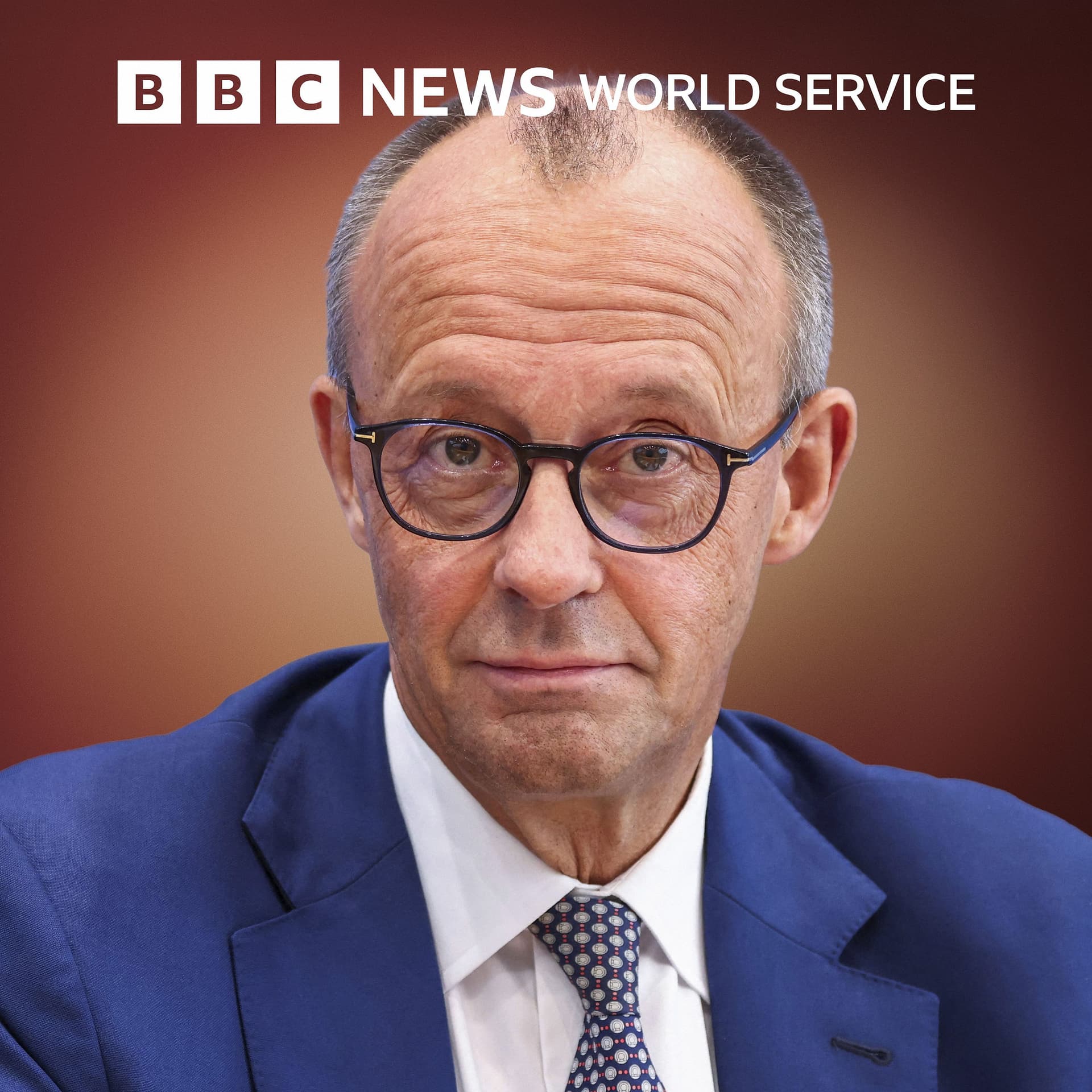
(Image: Friedrich Merz. Credit: Reuters)