
In short
Podcast Episode Summary: The Interview with Matt Garman, CEO of Amazon Web Services
Podcast Overview Podcast Title: The Interview Description: A series of conversations featuring influential figures in business, politics, finance, sport, and culture, produced by the BBC. Each interview is approximately 20 minutes long, focusing on significant global issues.
Episode Details
- Episode Title: Matt Garman, CEO of Amazon Web Services - What is the Future of Big Tech?
- Host: Simon Jack, BBC Business Editor
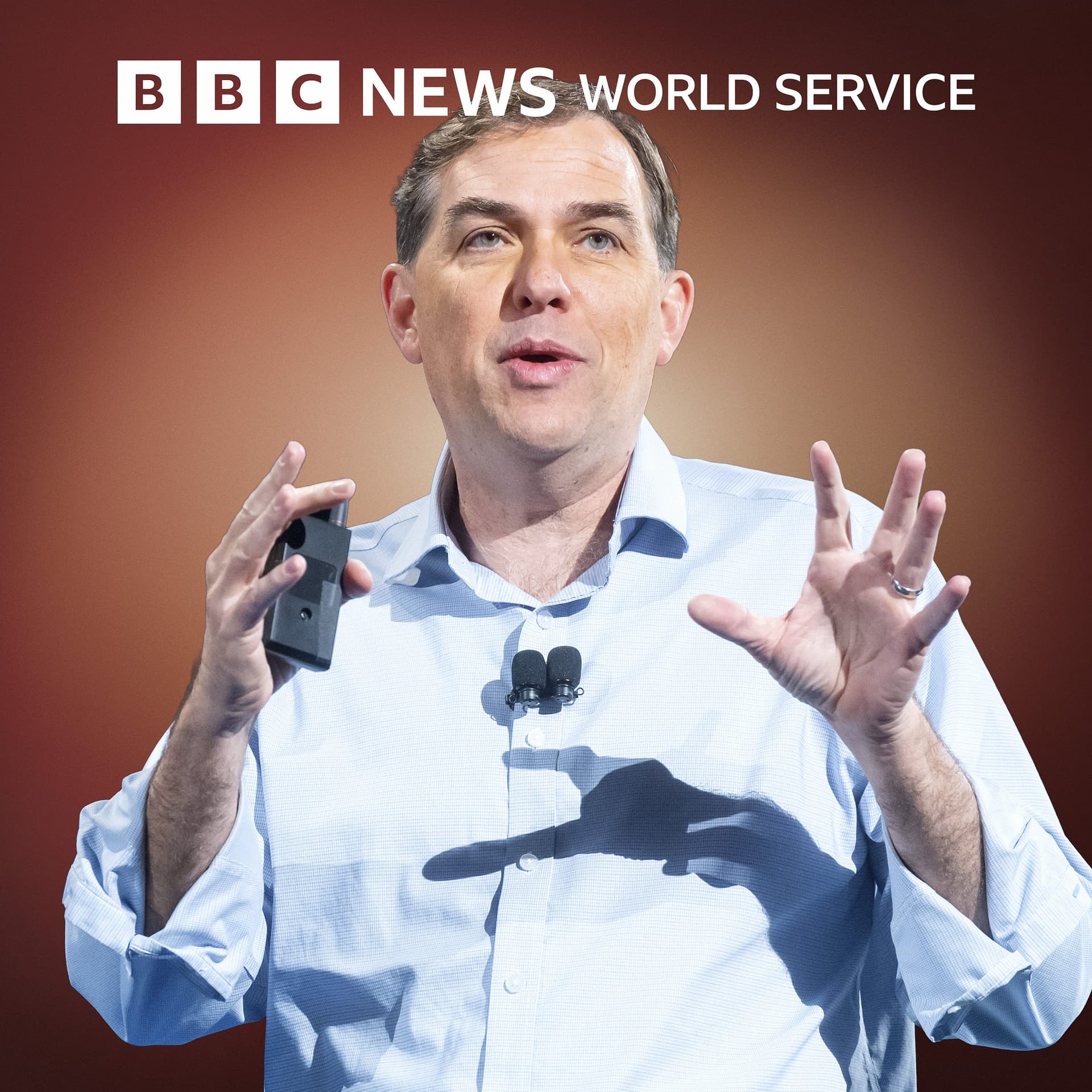
- Guest: Matt Garman, CEO of Amazon Web Services (AWS)
- Key Topics: Cloud computing, artificial intelligence (AI), economic growth, nuclear technology, regulation in big tech.
Key Insights from the Interview
Introduction to Matt Garman
- Career Path: Garman began at AWS as an intern and has risen to lead the world's largest cloud computing company.
- AWS Overview: AWS provides IT resources globally, serving millions of businesses.
Future of Big Tech and AI
- Transformative Role of AI:
- Garman believes AI is one of the most transformative technologies since the internet, with potential to significantly improve efficiency and productivity.
- Emphasizes the need for education around AI to alleviate initial fears and maximize its benefits.
Power Requirements for Data Centers
- Energy Consumption Concerns:
- Data centers require massive amounts of power, comparable to small towns.
- Garman discusses AWS's investments in renewable energy and nuclear technology as viable long-term power solutions.
Regulation and Competition
- Market Competition:
- Garman argues that the cloud computing market is highly competitive, contrary to claims of monopolistic behavior.
- He highlights the risks of over-regulation, suggesting it could stifle innovation and harm consumers.
The Importance of Security
- Cybersecurity Measures:
- Garman acknowledges the constant threat of cyberattacks, especially utilizing AI.
- Discusses AWS's proactive measures and advanced technologies to protect customer data.
Skills for the Future Workforce
- Adapting to Technological Change:
- Garman stresses the importance of familiarity with AI for future workers, suggesting that learning about AI will be crucial for career success.
Responsibilities and Ethical Considerations
- Concerns about AI Misuse:
- Garman reflects on the ethical implications of AI and the responsibility AWS has to prevent misuse of technology.
- He advocates for thoughtful regulation, warning that poorly informed regulations may hinder innovation rather than promote it.
Global Competition and Regulation
- Foreign Competition:
- Garman expresses a focus on delivering value to customers globally, regardless of political climates or foreign competition pressures.
- U.S. Government Relationship:
- He emphasizes the importance of partnerships with varying administrations, without commenting on their broader economic impact.
Conclusion The conversation centers around the evolving landscape of big tech, particularly in cloud computing and AI, highlighting both the opportunities and challenges ahead. Garman's insights present a vision of a future where technology can significantly enhance productivity while emphasizing the need for responsible development and regulation.
Contact Information
- Email: TheInterview@bbc.co.uk
- Social Media: #TheInterviewBBC
---
This markdown file captures the essence of the podcast episode, summarizing key points while providing structure for easy navigation and understanding.
Written by AI. May contain mistakes. Listen to the episode to check what was said.
Transcript
Automatic transcript. May contain errors.0:00This BBC podcast is supported by ads outside the UK. If journalism is the first draft of history, what happens if that draft is flawed? In 1999, four Russian apartment buildings were bombed, hundreds killed. But even now, we still don't know for sure who did it. It's a mystery that sparked chilling theories. I'm Helena Merriman, and in a new BBC series, I'm talking to the reporters who first covered this story? What did they miss the first time? The History Bureau, Putin and the apartment bombs. Listen on bbc.com or wherever you get your podcasts. Hello, I'm Simon Jack, the BBC's business editor.
0:44And this is the interview from the BBC World Service. The best conversations coming out of the BBC, people shaping our world from all over the world. I will come back to Russia. I will participate in the elections. There's an increase in violence according to the coca crop. There is no place in the world where women are equal. I will give away the vast majority of my money. It's my full time focus for the rest of my life. For this interview, I spoke to Matt Garman, the chief executive of Amazon Web Services, part of the online retailer Amazon from his office in Seattle. You're going to hear his take on the future of big tech from cloud technology to artificial intelligence, regulation to renewable energy.
1:29Amazon Web Services, or AWS, is the world's largest cloud computing company, providing IT resources primarily to businesses all over the world. Mr Garment tells me about his belief in the enormous potential of AI to improve efficiency, reduce costs and deliver economic growth. And he says there's a future for nuclear technology in supplying the huge, power-hungry data centres that make up the AWS network. Despite the domination of the cloud computing market by a small number of giant corporations, Mr. Garmin rejects claims it's uncompetitive and cautions against too much government interference.
2:05We think that it's a really competitive area and that oversight probably isn't needed on that. Oftentimes, when you look at regulations, particularly in these spaces, it harms consumers. It actually limits innovation. It limits what you can do. I often, when I talk with regulators, caution against regulating areas where they actually may get the inverse outcome that they were originally trying for. Welcome to The Interview from the BBC World Service with Matt Garman.
2:33I think AI is one of the most transformative technologies that we've seen probably over the last 20 years, since cloud computing, maybe since the internet. And I do think that it is going to have a significant transformative effect on almost every part of our lives. It's going to change the way we work. It's going to change customer experiences. It's going to change what's possible. And it's really going to lead to a growth and explosion in my mind of GDP and growth in the world. Now, I think with any new technology that is sufficiently new or hard to understand, people are probably appropriately scared of it initially until they can better understand it.
3:10So that initial response is not particularly surprising. What I'd say is us and many of our partners are doing a lot to help people understand what AI can do, put guardrails around it to protect from some of the kind of scarier or bad outcomes that people are worried about. But also, we're spending a lot of time helping educate our customers and actually communities about how they can leverage AI to be more efficient in their jobs, to be more effective in their jobs, to be more productive in their daily lives. And that's part of why I'm really excited about what's possible. Let's talk about some of the potential bottlenecks.
3:43It's no secret that data centers are incredibly power hungry. How confident are you that you're going to be able to plug these data centers into something which will be a reliable power source because they use as much electricity as some small towns? Yeah, that's absolutely true. And it's something that we've planned for, for many years in the past and continue to plan many years out. And so that's part of what we bring and that we help customers not have to worry about as we think about kind of how much power are we going to have available. We're making huge investments in renewable energy. In fact, we're the single largest purchaser of brand new renewable projects around the world for each of the last five years.
4:21And so we invest ahead, right? These are not just going and buying credits, but they're actually building with partners projects to bring on new renewable energy to the grid. And we look many years out to try to make sure that we have enough of that renewable energy. And I think the world is gonna have to continue to build new technologies. I believe nuclear is a big part of that as we look, particularly as we look 10 years out, that is going to have to be one of the solutions that are likely the world is going to need for the electricity demands that we're going to have. And so that's something we spend a lot of time on.
4:52It's something we invest a lot of money in. And it's super important for us that we have a sustainable energy source for our world. We've just seen big blackouts in Spain and Portugal, which were blamed on the Iberian Peninsula's over-reliance on renewables. And there is an intermittency, something wind doesn't always blow, the sun doesn't always shine. And I'm guessing a data center needs an uninterruptible power supply because it's mission critical to so many functions that you talked about. Is renewables the answer to that? Or is it nuclear? What are you doing in the US? Yeah, I think it's got to be a combination of some of those things.
5:23In the intermediate term, it's renewables. Some of that is supplemented with natural gas and other fossil fuels. And nuclear is a great solution for that in the future, because obviously it's an excellent source of carbon zero, 24 by 7 power. I think there's lots of also research going into batteries and other storage facilities that allow you to do 24 by 7 and capture more of the solar and wind power. But I think it's going to be a combination of those. And it's a portfolio effect. It cannot be one technology that's going to solve all of those things. And are you actually putting money into that yourself?
5:57I mean, you're taking out long term contracts. I'm just trying to, how do you plan that? Because, you know, you need that stuff to be in place before you switch the data center on, right? Yeah. A lot of times we'll partner with energy companies to do some of those long-term deals. And so we'll go and fund a solar farm or a wind farm or a nuclear project or any of those things. And we'll agree to offtake the energy for 10, 20, 30 years, whatever it is, and fund some of that upfront piece. And so we won't operate that. We usually go through that through partners, but yes, that's part of what we're doing.
6:28Okay. You talked about the regulatory environment. I mean, you know, there's no secret that big tech has run into regulatory difficulties both in the UK and particularly in the EU. Some people will say, particularly in cloud computing, you're the biggest. And there are three main companies who make up nearly 70 % of the entire market. I mean, do you think it's a sufficiently competitive market or should there be concerns around that? that's an incredibly competitive market um you know i think you have large competitors out there you have small competitors are out there too there's folks that are building kind of new ai clouds and other things like that so it's an incredibly competitive market um and i think if you go and talk to any of our customers um they're often talking with many of the various clouds out there um you know there are some economies of scale like it it takes a lot of money to to go and build some of these clouds and so um you know there is sufficient capital that's needed to go and deliver the infrastructure that our customers need.
7:27But it's an incredibly competitive market. And actually, if you see prices continue to come down pretty aggressively, and so from a customer perspective, there's lots of options that customers have out there today. I'd say with the regulatory market, I think we think that it's a really competitive area and that oversight probably isn't needed on that. What I would say is also that oftentimes when you look at regulations, particularly in these spaces, it often harms consumers. It actually limits innovation. It limits what you can do. And so I often, when I talk with regulators, caution against regulating areas where they actually may get the inverse outcome that they were originally trying for.
8:08But doesn't it make, I mean, the sheer amount of capital needed to be a player in this, in cloud computing, some would say is a very high barrier to entry. You've You've got, you know, huge megacorps like yourselves in there. And that is the opposite of, you know, encouraging innovation and competition. And you'll know full well that people like Meta have been saying, you know, snuffing out competition. The barriers to entry are pretty high in this market. Would you not agree? I don't think so. You know, like when you ask anyone who uses AWS, we've built our services such to help customers try to get up and running quickly.
8:48And so the idea is that we actually are, in theory, it is easier today than it ever has been to start a brand new company. And part of that is what we enable them to do. And so when you look at companies and startups out there, there's like Fidoform in the UK, who's going and trying to build a new model so that they can have disease-resistant crops that they can grow and help food be more available, that wouldn't be possible. That company would not be possible without a cloud computing environment for them to run in. And so it really is, if you look, there are more startups today than there have ever been.
9:20There are more new companies starting than there have ever been. There's companies that were startups that are now really large, like an open AI or others like that that are going and building their own data centers. And so I'd say that there's never been an easier time to start a company because of cloud computing than it is today. But in a way that you will end up owning a big chunk of the foundations on which these companies are made and built. And it's sort of like having the land rights to whole areas of commerce, that they rely on you so much for this. You're the fundamental building blocks, the plumbing beneath their companies and just puts you in an incredibly powerful position.
10:01Well, we take that responsibility incredibly seriously, by the way, and it's why, as a company, we focus a huge amount of our effort on security and operational excellence because I 100 % agree. Customers that trust AWS are trusting their critical business functions to us, and we take that incredibly seriously. And so we spend a lot of time and energy making sure that we have outstanding security and outstanding operational excellence for those customers. That's absolutely right. But we also build our services such that it's really easy that if we don't do a good job and the customers don't trust what we're doing and we're not delivering great value and lowering prices for them, that it's easy to move off.
10:37Most customers are building on open source on top of the cloud. And so unlike kind of traditional vendors in the past where they would lock you into proprietary formats, most customers building in AWS are building on open source software. And so it's quite easy for customers to move to another vendor or another offering if we ever don't deliver on that promise that we're giving them of great price performance and outstanding security. You talked about security. We've just had in the UK, I don't know if you've been aware of this, a number of big retailers get hit by ransomware. And if AI is so smart, what's to stop the bad guys mobilizing it to get as good at attacking you as you are defending, I guess?
11:20Yeah. Well, you can be sure that they will likely try. I mean, I think that's true of any new technology that has come out, whether it's the Internet or whether it's computers or whether it's AI. And our job is to stay ahead of that. And we invest a lot of time, a lot of money, a lot of research into identifying patterns, figuring out where customers are going. One of the interesting things that we do, actually, because of our global footprint, we have a service that we call, it's an internal service that we call MadPot, where we actually can look at the global set of traffic. And we have honeypots out there.
11:52And we can see patterns and using AI detect when people are trying to do security infiltrations of customers. And we take that information, match those traffic patterns that we see in these honeypots that we build to try to identify where there's nefarious agents out there. And then apply that to protect our legitimate customers. And so, you know, it's a constant battle and it will always be in the security space. But that's why a lot of customers use AWS, because they know that we spend a lot of time focusing on protecting them. You're listening to the interview from the BBC World Service, people shaping our world from all over the world.
12:34If journalism is the first draft of history, what happens if that draft is flawed? In 1999, four Russian apartment buildings were bombed, hundreds killed. But even now, we still don't know for sure who did it. It's a mystery that sparked chilling theories. I'm Helena Merriman, and in a new BBC series, I'm talking to the reporters who first covered this story. What did they miss the first time? The History Bureau, Putin and the apartment bombs. Listen on bbc.com or wherever you get your podcasts. For this episode of The Interview, you, I'm speaking to Matt Garman, Chief Executive of Amazon Web Services.
13:17We had a few false starts getting Matt's diary and the time difference between London and Seattle in the Pacific Northwest of the US to align. But it was worth the wait to get his views on AI and in particular, where the energy that will power these electricity hungry data centres will come from. Let's return to my conversation with Matt Garman. Just about skills and of the future and what kind of things kids growing up now will need in the future. I think a lot of people will be listening to this saying, I've got a 16-year-old, I've got a 20-year-old. What skills do you think that younger people will need to navigate this in the future?
13:55I do think a familiarity with AI is incredibly important. And I would encourage folks that are out there looking to learn new skills to learn how these technologies work. I think there is an enormous potential for us to improve efficiency. And there's, you know, when you think about your work life, there's a lot of things that you do that aren't necessarily value added. They're the in-between kind of muck that you have to do as part of your job to get to the interesting pieces of that thought-provoking piece that you add to it or those real problem-solving pieces you as an employee add to the business.
14:30But when you think about, you know, entering forms in places or going and looking for information or collating information or connecting, all that stuff is actually what takes up 60, 70 % of the time. And I think that's where a lot of AI is going to help us really improve efficiency. And so the more we can help people learn how to use tools, learn how to use services, and we're building many services that help customers be more effective, particularly in a work environment, to be able to leverage all the information that's available for them. I think that that's going to to be critical to the workforce of the future.
15:04You went from intern to being the boss. Is this true? And what have you learned along the way? I started out as an intern at AWS. And it's been a fantastic journey so far. And I think one of the most interesting things that I've learned is that it's still just the very beginning. AWS is a$117 billion run rate business. And we're just in the early stages of what's possible from a technology perspective, from a scale perspective. And so, you know, what I've learned is when you build things to help customers and you keep customers first, good things generally happen. But it's been an exciting place to be for sure.
15:41We've all had fun chatting to ChatGPT or other AI, LLMs and what have you, because they can be kind of fun just to sort of engage with. I've yet to see many real world critical use cases, maybe in recruitment, maybe in legal. Where is it actually making a real fundamental difference? Can you point me to an industry where that's happening? Yeah, absolutely. I'd say today we've seen huge material gains in areas, particularly like customer support is one really good example, where many of our customers, we have a product called Amazon Connect, which is a cloud service contact center. And it's fully AI enabled.
16:20And so when customers come in, they can ask questions. The AI has a full history of everything that they've done, everything they've purchased, what they're likely to be asking, and can very quickly answer many of the questions that they have when they're coming to talk to your company, including when a live agent gets on the phone. It can actually bring up all the information that agent needs, and it can do sentiment analysis to know if the person's getting upset and you should bring a supervisor over to proactively jump in and help and other things like that. We see CSAT or customer satisfaction is increasing a ton and costs are going through the floor as customers are much more efficient and not having to scale their customer support as their business grows.
16:57It's one area that's fantastic. What really, though, and this is where I think the value is going to be enormous for our customers and for the world, is as we get into agentic AI. So most of the generative AI that we've used over the last couple of years, like you mentioned with the ChatGPT, is kind of interacting back and forth and generating content. But once that AI can actually go and accomplish things out there in the world, it can actually go and put information into your system of record or actually execute a return. when you're talking, in my customer service example, when it can go and actually execute the return, send a signal out to the warehouse and ship you a different product because you ordered the wrong one.
17:34And it can do that whole thing autonomously. That's when you actually, I think you're gonna see the efficiency and effectiveness and the return for customers really go through the roof. I've seen Bill Gates say recently in an interview that humans might not be needed for a lot of tasks. Is there any part of you which has misgivings about the direction we're headed? Does anything keep you awake at night and say, boy, we're about to unleash something which we may regret. Almost like an Oppenheimer-like responsibility. Well, a couple of things. One is on that question, I feel responsibility for our customers every single day.
18:07So every day I wake up, I worry, how are we doing the right thing for our customers? What about the whole human race? Well, I'm not sure if I'm responsible for the whole human race, but I think it's all of our responsibilities to think about that. And so with regards to this technology, absolutely. We try to think about what are the belts and suspenders that we can put on this technology to as best our ability prevent it from being used for some bad purpose. And I think we think a lot about that. We think about safe AI and we think about controls that we can have in place and both for our own technology as well as putting in the customer's hands, allowing them to have guardrails and other things so that they can limit kind of the impacts that the technology can have to be focused on the area that they want to drive.
18:49And so we do spend a lot of time thinking about that. We'll continue to spend a lot of time in that area. I think it's an important area. Anytime you're building that much of a transformational technology, it's important to think about those controls and guardrails so that it can go towards the betterment of society, not the detriment. So absolutely think a ton about that for sure. It's a technology with great power, as we've discussed. Do we need something like a kind of Geneva Convention on this? Do we need international accords on how it's being used? There are a lot of bad actors out there.
19:19How are we going to guard against that? I think those discussions are being had. But again, I would caution that because the technology is so new, and you mentioned agentic AI, I failed to mention agentic AI. What that means is this is an AI model that's able to interact with computers. It's able to interact with digital tools. And it's able to understand not just a pre-programmed set of things it can do, but it can understand how to go accomplish what you're asking it to go accomplish by actually interacting with the interface that it sees. And so if you ask it to say, please go purchase something for me on Amazon, it can actually go navigate the website, find a Mother's Day present, click it, put it in your basket, assuming it has your credentials, and purchase it on your behalf.
20:06And you can do that all on your behalf. And so that's an example of what agentic AI can do versus kind of what traditional AI can do. If you think about regulation, the technology is moving at such a rate that I don't believe that there's the knowledge of the folks that are building those regulations are going to be able to keep up. I think that the most likely case is that those regulations would accomplish the exact inverse thing that they're trying to do. One of the reasons why customers are so excited about cloud technology in general and AI technology is that it really frees them to go and invent.
20:41And I think if you look at the world today, it is not getting less uncertain, right? There is an uncertainty everywhere we look. And going back five years of the pandemic to global uncertainty, to economic uncertainty, to business uncertainty, cloud technology and AI are one of those things that can really help customers move quickly and adapt quickly and adapt to changing environments. having to move fast and take advantage and deal with an uncertain environment is not going away. And we only see that increasing. During Davos, the talk of that conference was what happened with DeepSeek. There was a moment, a kind of oh gosh moment when it was felt that the hundreds of billions, trillions maybe that companies like yours are investing in AI might be overspending because DeepSeek seemed to have achieved similar results at a fraction of the cost.
21:36And that really rocks markets for a little while. Where are we with that?
21:43Yeah, these models are still incredibly expensive to go train. And really, the potential is all around the use cases, though. I think all of these investments aren't going to make sense if we don't actually get useful ROI for return on investment. That return is the critical piece. And as AI is actually implemented in end-use cases, that's where you really start to see the explosion of use. And so, you know, I think that continues. I think DeepSeek was a fantastic model. That team did some really interesting innovations there. And we made it quickly available, by the way, inside of AWS so that our customers could take advantage of using DeepSeek, and many of them have.
22:24and we have a whole set of models and we support a broad range of models so that our customers can take advantage of all the technologies out there because it really is taking advantage of that technology to go build an interesting application that's really the useful outcome. Okay, and so you're perfectly comfortable with China having access to the latest supercomputers, the best chips, what have you. It seems to me the US is getting a little bit more relaxed about that. How do you feel about foreign competition, particularly from China? Well, look, we follow all of the laws that each of the places that we operate in put into place.
23:04And so, you know, I'm not going to comment on those. I think we absolutely will follow the restrictions than any of the places that we operate put into place. What I'll say is we focus on how do we deliver outstanding value to our customers. And so we want to give our customers the access to the best technology that's available and legally available to them and give them a wide range of choices. And so that's what we do, whether our customers are in the US, whether they're in the UK, whether they're in Japan, across the world, we focus on how do we give the best technology and make it available for them to use.
23:35And is President Trump good or bad for the world economy? Look, I think this is our, I've been in AWS 18 years now. It's the fifth administration that we've worked with. And I don't really comment on if they're good or bad. I think they're an incredibly important partner for us. We partner very closely with the US government and they're an important customer of ours. We love working with that administration and are happy to continue to do it. Thank you for listening to the interview from the BBC World Service. If you enjoyed today's program, you can listen to the interview wherever you get your BBC podcasts.
24:10Until the next time, bye for now.
Read the full transcript
24:20is the first draft of history. What happens if that draft is flawed? In 1999, four Russian apartment buildings were bombed, hundreds killed. But even now, we still don't know for sure who did it. It's a mystery that sparked chilling theories. I'm Helena Merriman, and in a new BBC series, I'm talking to the reporters who first covered this story. What did they miss the first time? The History Bureau, Putin and the apartment bombs. Listen on bbc.com or wherever you get your podcasts.
From the publisher
Simon Jack, the BBC’s business editor, speaks to Matt Garman, chief executive of Amazon Web Services - part of the retail giant Amazon, and the world’s largest cloud computing company.
Mr Garman started his career at AWS as an intern, and has risen to oversee a global network of huge data centres, providing IT resources for businesses worldwide. In this conversation, he shares his vision for the future of big tech through cloud computing and artificial intelligence, and the potential for economic growth and opportunity he believes they hold.
He also sets out his support for the role for nuclear technology in powering the data centres at that sit at the heart of big tech - and the risks of over-regulation, dismissing claims that the industry is uncompetitive and dominated by huge corporations such as his. The Interview brings you conversations with people shaping our world, from all over the world. The best interviews from the BBC. You can listen on the BBC World Service, Mondays and Wednesdays at 0700 GMT. Or you can listen to The Interview as a podcast, out twice a week on BBC Sounds, or wherever you get your podcasts.
Presenter: Simon Jack Producers: Lucy Sheppard, Viv Jones Editor: Richard Fenton-Smith
Get in touch with us on email TheInterview@bbc.co.uk and use the hashtag #TheInterviewBBC on social media.