
In short
Podcast Notes: The Interview - Muhammad Yunus: We dream of creating a new Bangladesh
Episode Overview
- Podcast Title: The Interview
- Episode Title: Muhammad Yunus: We dream of creating a new Bangladesh
- Presenter: Rajini Vaidyanathan
- Date: 2025
- Key Guest: Muhammad Yunus, interim leader of Bangladesh and Nobel Prize-winning economist
Introduction
- The podcast features influential individuals shaping global narratives.
- This episode focuses on Muhammad Yunus, best known for founding the Grameen Bank and pioneering microfinance.
Key Topics Discussed
Background of Muhammad Yunus
- Age: 84 years old.
- Recognition: Acknowledged as the "banker to the world’s poor" and awarded the Nobel Prize for his microfinance initiatives.
- Controversy: Criticized by former Prime Minister Sheikh Hasina, accused of exploiting the poor and facing allegations of embezzlement, all of which he denies.
Political Landscape in Bangladesh
- Recent political upheaval led to Sheikh Hasina's government being overthrown amidst allegations of election rigging and human rights abuses.
- Student-led protests resulted in Yunus being named the interim leader to unify the country.
- He emphasizes the need to address corruption and manage a refugee crisis while navigating cuts to foreign aid.
Challenges as Interim Leader
- Yunus discusses the challenges of governing a divided nation and managing expectations from the youth, who are largely responsible for the recent uprising.
- His vision for "New Bangladesh" includes:
- Democracy
- Human Rights
- Freedom of Speech
Refugee Crisis and Foreign Aid
- Yunus addresses the Rohingya refugee crisis, noting significant cuts in aid from the US and UK.
- Emphasizes the importance of repatriation as a long-term solution for the Rohingya population, while also recognizing the immediate humanitarian needs.
Relationship with Former Prime Minister Sheikh Hasina
- Discusses the ongoing legal trials against Hasina and her associates.
- Expresses a desire for Hasina to return to face justice, while highlighting the struggles of the interim government in dealing with her influence.
Economic Context
- The episode touches upon Bangladesh's garment industry and the impact of US tariffs on the economy.
- Yunus discusses the potential opportunities arising from challenges, indicating a proactive approach toward economic negotiations.
Key Takeaways
- Youth Involvement: The youth's role in the political upheaval is emphasized as critical for future governance.
- Vision for New Bangladesh: Yunus articulates a hopeful vision for a democratic and equitable society, driven by the young population of Bangladesh.
- Navigating Political Tensions: Yunus faces criticism for how inclusivity in future elections is handled, specifically regarding the Awami League's participation.
- Commitment to Refugees: Despite resource constraints, Yunus demonstrates a commitment to addressing the Rohingya crisis and seeks international cooperation for their repatriation.
Conclusion
- Muhammad Yunus shares insights into his journey from microfinance pioneer to interim leader, outlining both challenges and aspirations for Bangladesh’s future.
- The episode highlights the complexities of governance, particularly in a nation facing significant social and political transformation.
Additional Notes
- The episode serves as a snapshot of a pivotal moment in Bangladesh's history, with Yunus at the forefront of political change.
- Listeners are encouraged to engage with the content and share thoughts via social media or email.
Related Links
- Podcast Listening Platforms: Available on BBC Sounds and various podcast platforms.
- Social Media Engagement: Use the hashtag #TheInterviewBBC for discussions.
Written by AI. May contain mistakes. Listen to the episode to check what was said.
Transcript
Automatic transcript. May contain errors.0:00This BBC podcast is supported by ads outside the UK. If journalism is the first draft of history, what happens if that draft is flawed? In 1999, four Russian apartment buildings were bombed, hundreds killed. But even now, we still don't know for sure who did it. It's a mystery that sparked chilling theories. I'm Helena Merriman, and in a new BBC series, I'm talking to the reporters who first covered this story. What did they miss the first time? The History Bureau Putin and the apartment bombs Listen on bbc.com or wherever you get your podcasts From the Winter Olympic and Paralympic Games To the European Athletics Championships The 2026 sporting calendar is packed full of big events Keep up with all the action with More Than The Score The podcast that goes beyond the score sheet Join expert BBC sports journalists every Monday to Friday For interviews with sports stars, big talking points and the stories behind the headlines.
1:07More Than The Score from the BBC World Service. Listen now. Search for More Than The Score wherever you get your BBC podcasts.
1:20Hello, I'm Rajini Vaidyanathan, BBC News presenter and correspondent. And this is the interview from the BBC World Service. The best conversations coming out of the BBC. People shaping our world from all over the world. There have been so many disagreements between me and my family. Putting on a show, that is what it means to be Lady Gaga. Only the things that you can't solve with government and private sector is where you bring philanthropy in. There's no place in the world where women are equal. Every generation, every generation has to fight to maintain democracy. For this interview, I met Mohamed Younis, the interim leader of Bangladesh, while on a visit to the UK.
2:08The 84-year-old is perhaps one of the world's best-known Bangladeshis, known as the banker to the world's poor. He gained international recognition as a Nobel Prize-winning economist who founded the Grameen Microfinance Bank, which delivered small loans to the underprivileged. It was a model applauded by many, one which now operates across more than 100 countries worldwide. But it's also a model which was criticised by his political rival, Bangladesh's former Prime Minister Sheikh Hasina, who accused Mr Yunus of sucking blood from the poor. Her government made a series of allegations against him, including embezzlement, all of which he denies.
2:52And it was the overthrow of Sheikh Hasina's government last August which saw Muhammad Yunus thrust into the political spotlight. Student-led protests saw thousands take to the streets in an uprising against Hasina's Awamili government, which was accused of election rigging, human rights abuses and of jailing critics. When Sheikh Hasina fled to neighbouring India, student leaders picked Muhammad Yunus to unite a divided nation. As well as promising to stamp out corruption, he's also faced the challenges of managing a large refugee crisis on his doorstep and navigating cuts to foreign aid. So, after nearly a year in the job, how is he faring?
3:37Try to calm down. Enormous amount of outbursts of hatred and outbursts of anger. It's an impossible task for 180 million people. When the outburst comes, you burn everything. So what I would say our prisons, me and my colleagues in the interim government, cool it down. They're not killing each other. They're getting back to work. They're going back to the factories. They're going back to export interest. Our empty banks are filling up again. And we didn't have any money. Now we are paying the bills. Welcome to the interview from the BBC World Service with Mohamed Younes. We are trying to bring all the people together, all the political parties together.
4:27Of course we will have different opinions, but we work together. Build this whole image that students, people who participated in the uprising, dream of creating New Bangladesh, which is absolutely different. What does the New Bangladesh look like to you? It's freedom, freedom of speech, it's a democracy, human rights, all the great things we were always dreaming about and never had it in Bangladesh. So this would be a break from that. And we discover ourselves and we establish ourselves in a way that dreams can be turned into realities. And this is also something very important, this is done by the young people.
5:07Bangladesh is an interesting country, half the population is under the age of 26. So this young population, they led the whole uprising and made it happen. And yet, with the greatest respect, they picked an 84-year-old man to be the chief advisor. Yes, I tried to persuade them that that may not be a good choice, but somehow they kept on insisting. And finally, I agreed, and this is where I'm right now. OK, we'll talk more about the future of Bangladesh in a second, but I want to ask you a bit more about your trip to the UK. You're meeting the king, but why are you not meeting the prime minister, Sir Keir Starmer?
5:40Well, we're very happy to meet him somehow, probably he's busy or whatever. But that kept me in a great opportunity too, because now that he's busy, I invite him to come to Bangladesh. But what reason did Downing Street give you for not arranging a meeting? I don't think we have received an explanation for that kind of thing. Probably he's busy with other important things. Let's talk about one of Sir Keir Starmer's MPs, the Labour MP, Tulip Sadiq. Of course, she's the niece of the former Prime Minister Sheikh Hasina. A Bangladeshi court has issued an arrest warrant for her, accusing her of illegally receiving land.
6:18Now, that's something that she denies. She's written to you. We've seen the letter. She's asked to meet you while you are here. Will you meet her? No, I'm not, because it's a legal procedure. I don't want to interrupt the legal procedure. Let the procedure continue. You are here also to talk to British officials, I understand, about the money that is said to have been siphoned off and brought here to the UK. How much money do you think was siphoned off, stolen money as they call it, and brought here to the UK? In total, globally, we have a figure, $234 billion, stolen money and stolen resources that are siphoned off from Bangladesh.
7:05I don't have the exact figure for United... I'm in Great Britain. Were you shocked when you took over as chief advisor to discover the scale of this and the amount of money, the billions that you're talking about? I mean, I was looking at Transparency International who've done some work on this, And they say just in one constituency alone, cities of London and Westminster, something like 151 million pounds. That's just one part of London. You know, I deal with micro credit, tiny loans,$10,$20,$100. So these numbers is mind boggling for me. I get lost completely. How people can handle that kind of figures, even for conversation set, it just numbs me.
7:49I don't know how to respond to those kinds of things. Speaking of money, Bangladesh has been one of the top ten recipients of UK aid. We've heard in recent weeks and even yesterday in the spending review that the foreign aid budget is going to be dramatically cut. How is that going to affect the people of Bangladesh? If it's not available, we still will continue to make our own efforts in doing things, increasing our own income. How much of a blow is it, Professor? It's a big law. The British one, this is part of the life that goes on, ups and downs. Today, it reduced. Tomorrow, there will increase, depending on situations, what you have here.
8:30But we have to deal with the situation. Like, suddenly, we hear that USAID stopped all the money completely, 100%, done, finished. And we see around what happened. Major, major things that happened in Bangladesh. Rohingya issue that we have, all the money is cut off, zero. So the US funding cuts are the biggest blow? Absolutely. Just one case, the USAID, not all the money. The whole Rohingya issue suddenly became terrible news for us. And then ICDDRB, the most leading international research organisation, which brought us a cure for cholera and many, many diseases globally, 100 % of the money cut off.
9:11But we have to deal with that. Rohingyas cannot disappear just because money disappears. Rohingyas are there. How are you going to deal with that? A huge shortfall of funds from the US, from the UK. It's a massive hole, isn't it? Absolutely, it's a massive hole. So we're around talking to people. One government has cut off, another government says, OK, we'll help you because it's our responsibility. We never expected you to take care of them, and we are very happy that you are accumulating them. So they are getting together. We are having an international conference together on Rohingya to see how it can be done.
9:42In the meantime, as an interim arrangements, countries coming forward to take care of this interim solution. So people find a way to overcome the sudden situation that arises. Let's talk about the Rohingya because you mentioned them just now. It is a huge crisis, a refugee crisis that in some ways the world has forgotten. I've been to the camps in Cox's. I've seen with my own eyes how people have no freedom. They struggle for food. Food aids continuing to be cut. and children there do not really get a proper education. This is a crisis on your doorstep. Why aren't you doing more to help them? I am doing my best.
10:24I just visited, along with the Secretary General of the United Nations, the Rohingya camps, and met over 100 ,000 of them around us, discussing what needs to be done and made appeal to the world, facilitated them to go back. Repatriation is the only solution to that. They are not destitute people. At the moment, Professor Yunus, it's not a solution because of what's happening in Myanmar. And I've spoken to people who would be absolutely terrified to go back because of the military junta there. So why can't you do more to ingratiate the Rohingya population and integrate them into Bangladesh? That will not be a solution.
11:03Why not? Already people are very hostile to the Rohingya people who are living with them around the camps. The hostiles, because they see that it's international money coming to them, they're quote-unquote kind of taking it easy. Outside the camp, people have to work hard. But you've seen with your own eyes how dire the situation is. Children in the UN schools in the camps are not taught the Bangladeshi language. They're taught Rohingya local languages. So those who are growing up could not go and get jobs outside because they're not even given that basic education. and it's something that people in the UN that we've spoken to in the camp say would change things dramatically.
11:42Why not teach in the schools Bangladeshi languages? Camp authorities have to decide, this international community has to decide what thing they will be familiar with, those young children. But the Bangladeshi government could also encourage that and does not, to my understanding. The Bangladeshi government will not encourage them because they don't want to take them back. So if you're learning the language and you are facilitating them to... Well, I guess that goes back to the broader question, which is a question around the world when it comes to refugees. And I come back to that same question.
12:13Why can't you do more to integrate these people who've suffered so much into mainstream Bangladeshi society, particularly the youngest? The policy for Bangladesh is not to let them come in and settle down. We have enough problems ourselves. We can't take a whole new population coming into Bangladesh. Even though they're suffering. Yes, that's why we gave them the accommodation. We then said, no, don't enter. We could have stopped them at the border. We took them, and international committee assured that they will take care of them, and they assured that they'll take them into their own countries.
12:49They divided the numbers, which country will take them. That's the relationship that we built. Recently, India has been pushing some, quote-unquote, Bangladeshis into Bangladesh to the border. So we're receiving them, and we checked them. Many of them are Rohingyas. So this is not only spread in Bangladesh, they spread in India, they spread in other countries. What's your message then to the international community? The community is we have to solve this problem by repatriation. That's the only way you can solve this problem. And that's where we focus on. I was talking to the head of Myanmar government.
13:22He was in BIMSTEC conference in Bangkok. In the discussion, we were talking about the future of the Rohingyas. He said there's something very, very significant. He said we have already identified 180 ,000 Rohingyas as legitimate people to come back. So that's a big news for us. Except many of them don't want to go back. No, no, that's something else. Our problem is authority is not accepting them as their own citizens. They said we have nothing to do with them. They are not our people. Saying that we have identified 180 ,000, that's a big news for us. And that opens the door. You're listening to The Interview from the BBC World Service.
14:05People shaping our world from all over the world. If journalism is the first draft of history, what happens if that draft is flawed? In 1999, four Russian apartment buildings were bombed, hundreds killed. But even now, we still don't know for sure who did it. It's a mystery that sparked chilling theories. I'm Helena Merriman, and in a new BBC series, I'm talking to the reporters who first covered this story. What did they miss the first time? The History Bureau, Putin and the apartment bombs. Listen on BBC.com or wherever you get your podcasts. From the Winter Olympic and Paralympic Games to the European Athletics Championships.
14:50The 2026 sporting calendaries packed full of big events. Keep up with all the action with more than the score. the podcast that goes beyond the score sheet. Join expert BBC sports journalists every Monday to Friday for interviews with sports stars, big talking points and the stories behind the headlines. More Than The Score from the BBC World Service. Listen now, search for More Than The Score wherever you get your BBC podcasts.
15:25For this episode of The Interview, I'm speaking to Mohamed Younis, the 84-year-old Nobel Prize-winning economist and interim leader of Bangladesh. The last time I'd interviewed Mr. Younis was at the start of 2024. He'd just been sentenced for a number of crimes, including embezzlement relating to his Grameen bank. He denied all the charges and said they were politically motivated. At the time, Mr. Younis was in Bangladesh, and back then, he and other prominent critics of the Hasina government said they lived under a veil of fear, concerned by reports that the government was jailing those who spoke out against them.
16:06Fast forward to central London in 2025, and this was our first time meeting in person, a stark reminder of how much has changed for people like him in Bangladesh. Mr Yunus spoke freely and seemed relaxed. But as he pledges to tackle corruption, he's now being accused by some of baselessly targeting his political opponents. The most high-profile case involves Tulip Sadiq, a British Labour MP and the niece of former Prime Minister Hasina. A Bangladeshi court accused her of corruption, charges she strongly denies. She was cleared of any wrongdoing by the British Prime Minister's ethics advisor and says the authorities in Bangladesh have yet to produce any evidence against her, despite saying they have it.
16:54OK, let's return to my conversation with Muhammad Yunus. You talked briefly about the US and the US aid cuts. Let's turn to another topic which affects the relationship between Bangladesh and the US, and that is, of course, those tariffs that come in. Bangladesh's garment industry is such an important exporter. Just tell me where we're at when it comes to discussions between Bangladesh and the US on tariffs. We were shocked, just like any other country, trying to see what does it mean, and we have slept 37 % tariffs on that. So we said, what does it mean for our business? Because this is a very important item for our economy.
17:33Our importer is the United States for the governments. So what happened to that because of the tariff and so on? Then while we were discussing, ideas came, well, this is shocking news, but it could be also an opportunity to revisit our own policies and see where we can have new opportunities doing business with the United States and so on. So we are still in the middle of that, whether it's something terrible for us or it's going to open some new doors for us. We submitted our ideas, what we can do to the US government, and the US government responded to that, raising some questions. So we are going to negotiate.
18:10Let's talk about the future of your country. You've called for elections. You're the interim leader of the country. You said that the elections should be inclusive and participatory. But one criticism has been that you're excluding the Awami League, the party, of course, of the former Prime Minister Sheikh Hasina, from taking part in the elections. I'm just going to read what Human Rights Watch says. It says Sheikh Hasina's government abused legal powers to silence political opponents, but using similar methods against the supporters of her Awami League would also violate those same fundamental freedoms.
18:43Why are you not letting them take part? We have explained it many times. I'll explain it again. First of all, inclusiveness. The election will be inclusive if Amalek is not participating. Recently, the resident coordinator of the United Nations in Dhaka, she has explained it very well. She said inclusiveness doesn't mean a particular party. Inclusiveness means participation of all people. It's inclusive. There are many people in the country who still support the Awami League. We know that. Let them decide whether they want to vote or not, but they're available. They won't be able to vote for a candidate from the Awami League, though, will they?
19:19As long as they're a voter, they're free to vote. But not for an Awami League candidate, unless the Awami League are allowed to take part. We have not banned Awami League yet. So there is a possibility, you're saying, that they could... No, first of all, to make it clear, the Awami League is not banned. Activities of Awami League has been banned. Which would include an election. Intemporarily. Intemporarily. Whether the election will be included or not, it depends on the election commission to decide. So there's a possibility then that they could be on the ballot in the next election? Again, it will be the decision made by the election commission.
19:50OK. Let's talk about, since we're talking about the Iwami League, Sheikh Hasina, she fled the country. Obviously, then you took over. She's taking refuge in India. What's your message to the Indian government? You've met Modi on a number of occasions, but ultimately you want her back, don't you? you want to try her for all the crimes that she's accused of? Trial has already begun. Trial is active, it's going on. And it will go through the legal process, looking for her to come back to face the trial and so on, use the international system, how to get the accused person back to your country and so on.
20:24So these are, again, the legal procedures. But how are you going to get her back? I mean, you meet Modi a lot. Well, use the international system. We don't have any power to grab her. But are you not frustrated with Modi for allowing her to stay there for so long? given all that you accuse her of and all that the country has gone through under not just her but her associates who were also accused of crimes against humanity, of corruption, all the other things. It's not about hosting her in India. That probably will not bother Bangladesh very much. It is her voice which creates problems. She's always addressing people in Bangladesh, using airwaves to address that.
21:00So that's what creates tension and creates a lot of hatred against the party, Amalek and so on. You see, we thought our whole uprising, the sudden outburst of anger coming out of this killing and all that, ended on 5th of August after she left. So the chapter is closed. Let's move on to new life and so on. But for Amalek, it seems like it didn't end there. They want to continue. And it creates a lot of tension within the country. We don't want to look back on the horrible thing which they have done in terms of killing people, disappearance of people, massive amount of money taken away from... One after another, the cruelty of it, an unbelievable thing that they have done.
21:48We thought we'll deal with it gradually. No. She wants to remind you that I'm here, I'll still come back. So you think India should do more to stop her being able to make her addresses? You said it. Just on that point, since the interim government took over, hundreds of supporters or sympathisers of the Awami League have been arrested, many of them on murder charges. And one columnist wrote that many hoped that the fall of the Awami League would end the culture of arbitrary detention that flourished under its rule. But instead, the new government, despite saying it would change things, appears unwilling to break from these old repressive habits.
22:28Some people would ask, are you doing exactly what they did in silencing critics? It would be a shame to say that because if you compare interim government with Aumalik government, I don't think you understand Bangladesh. You understand the reality of Bangladesh. These aren't my words. No, no, somebody's saying that. I'm just saying that you have been to Bangladesh. I'm sure you have your own judgment what Aumalik was, what your interim government is. So that's absolutely not correct. And just on that, the other criticism that some have had, even a Labour MP raised this in Parliament at the end of last year, is incidents of violence towards minorities, notably the Hindu minority in the country.
23:08There's been a lot of concern in India as well. And in Parliament, an MP said that there were 2 ,000 incidents of violence from August to December. So that's since you took over, mostly targeting the Hindu minority. Are you doing enough to protect Hindus? This has been answered probably a million times. We said invite all the journalists to come identify those places where Hindus have been killed, how they were killed and what happened to them and so on. This is all fake news coming up one after another. So we said come and count them. We're here. We are not running away. What about the Hindu monk who was attacked?
23:45Did that not happen then, for example? If there's one Hindu monk who was attacked, you go and law will take care of itself. It's not about massive killing and so on. That's a completely different picture. So we're trying to make people aware of the reality of it. If you keep on saying Hindus are being killed, that's not describing what Bangladesh is all about. You've done a lot in your life. What would you say has been your greatest achievement since you've taken over running Bangladesh? TREVOR GARCIA, U.S.A.D.: Try to calm down. Enormous amount of outburst of hatred, an outburst of anger. It's an impossible task for 180 million people, and mostly young people, as you mentioned.
24:27When the outburst comes, you burn everything. So what I would say our prisons, me and my colleagues in the interim government, cool it down. They're not killing each other. They're getting back to work. They're going back to the factories. They're going back to the export. Export increased. Instead of export declining and getting to zero gradually, it's increasing from the previous level. Our empty banks are filling up again. Our outstanding bills to be paid to international suppliers and contractors, a huge amount, and we didn't have any money. Now we are paying the bills. Our foreign exchange deserve us going up and up.
25:11And will you stay on longer in the job? We have declared the election after the election. That's it. New government comes. And then you retire. Thank you very much. No, retire. Go back to my work. Thank you for listening to the interview from the BBC World Service. If you enjoyed today's programme, you can listen to the interview wherever you get your BBC podcasts. Until the next time, bye for now. If journalism is the first draft of history, what happens if that draft is flawed? In 1999, four Russian apartment buildings were bombed, hundreds killed. But even now, we still don't know for sure who did it.
25:52It's a mystery that sparked chilling theories. I'm Helena Merriman, and in a new BBC series, I'm talking to the reporters who first covered this story. What did they miss the first time? The History Bureau, Putin and the apartment bombs. Listen on BBC.com or wherever you get your podcasts.
Read the full transcript
26:31Monday to Friday. For interviews with sports stars, big talking points and the stories behind the headlines. More Than The Score from the BBC World Service. Listen now, search for More Than The Score wherever you get your BBC podcasts.
From the publisher
Rajini Vaidyanathan, BBC News presenter and correspondent, speaks to Muhammad Yunus, interim leader of Bangladesh.
The 84-year-old is perhaps one of the world’s best-known Bangladeshis. Described as the banker to the world’s poor, he gained international recognition as a Nobel prize-winning economist, who founded the Grameen microfinance bank, which delivered small loans to economically deprived people.
It was a model applauded by many and is one which now operates across more than 100 countries worldwide.
But it’s also a model which was criticised by his political rival - Bangladesh’s former Prime Minister Sheikh Hasina, who accused Mr Yunus of sucking blood from the poor. Her government made a series of allegations against him, including embezzlement, all of which he denies.
And it was the overthrow of Sheikh Hasina’s government last August that saw Muhammad Yunus thrust into the political spotlight.
Student-led protests saw thousands take to the streets in an uprising against her Awami league government, which was accused of election rigging, human rights abuses and jailing critics.
When Ms Hasina fled to neighbouring India, student leaders picked Muhammad Yunus to unite a divided nation. As well as promising to stamp out corruption, he’s also faced the challenges of managing a refugee crisis on his doorstep and navigating cuts to foreign aid.
So, after nearly a year in the job, how is he faring? The Interview brings you conversations with people shaping our world, from all over the world. The best interviews from the BBC. You can listen on the BBC World Service, Mondays and Wednesdays at 0700 GMT. Or you can listen to The Interview as a podcast, out twice a week on BBC Sounds, or wherever you get your podcasts.
Presenter: Rajini Vaidyanathan Producers: Ben Cooper and Junaid Ahmed Editor: Nick Holland
Get in touch with us on email TheInterview@bbc.co.uk and use the hashtag #TheInterviewBBC on social media.
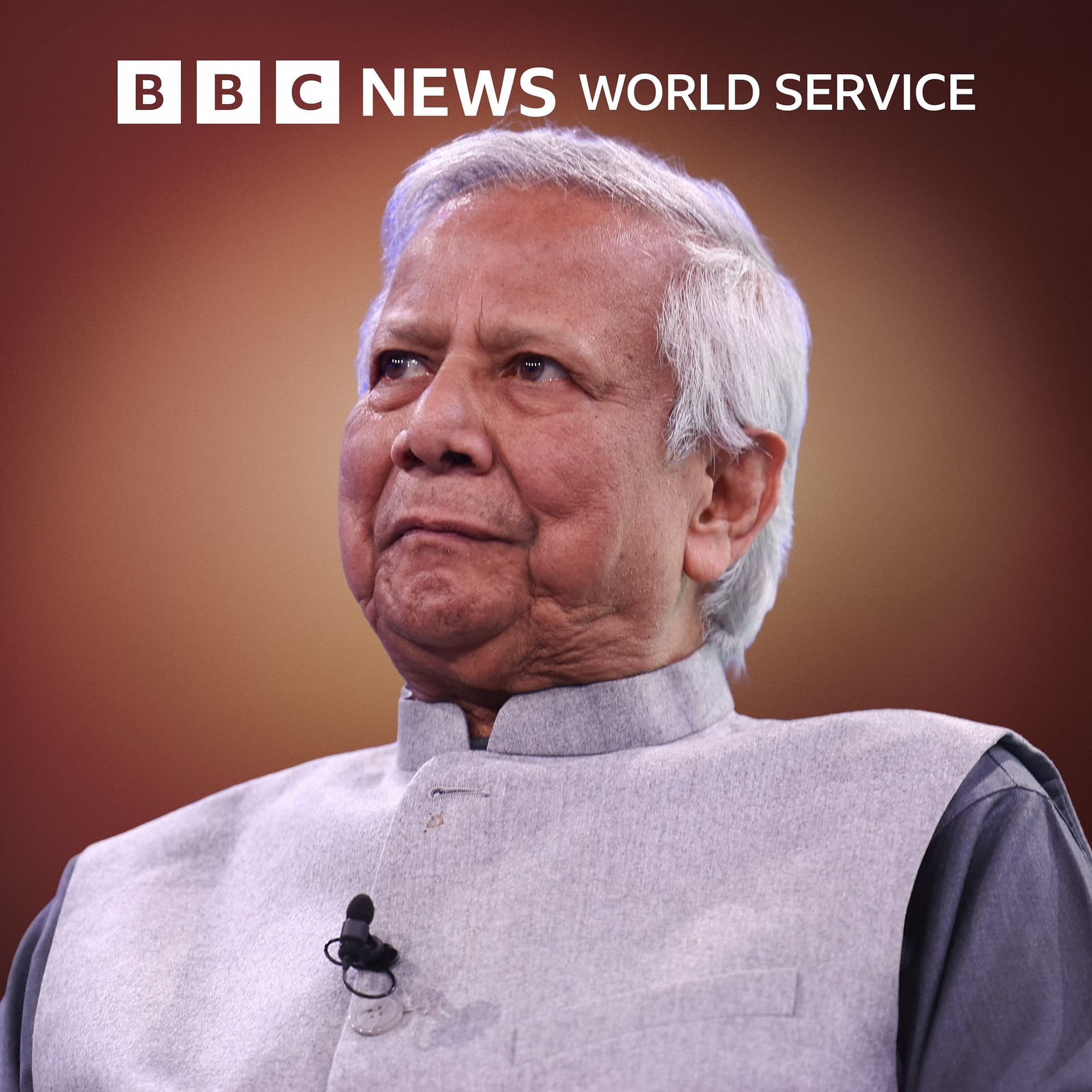
(Image: Muhammad Yunus. Credit: Reuters/Yves Herman)