In short
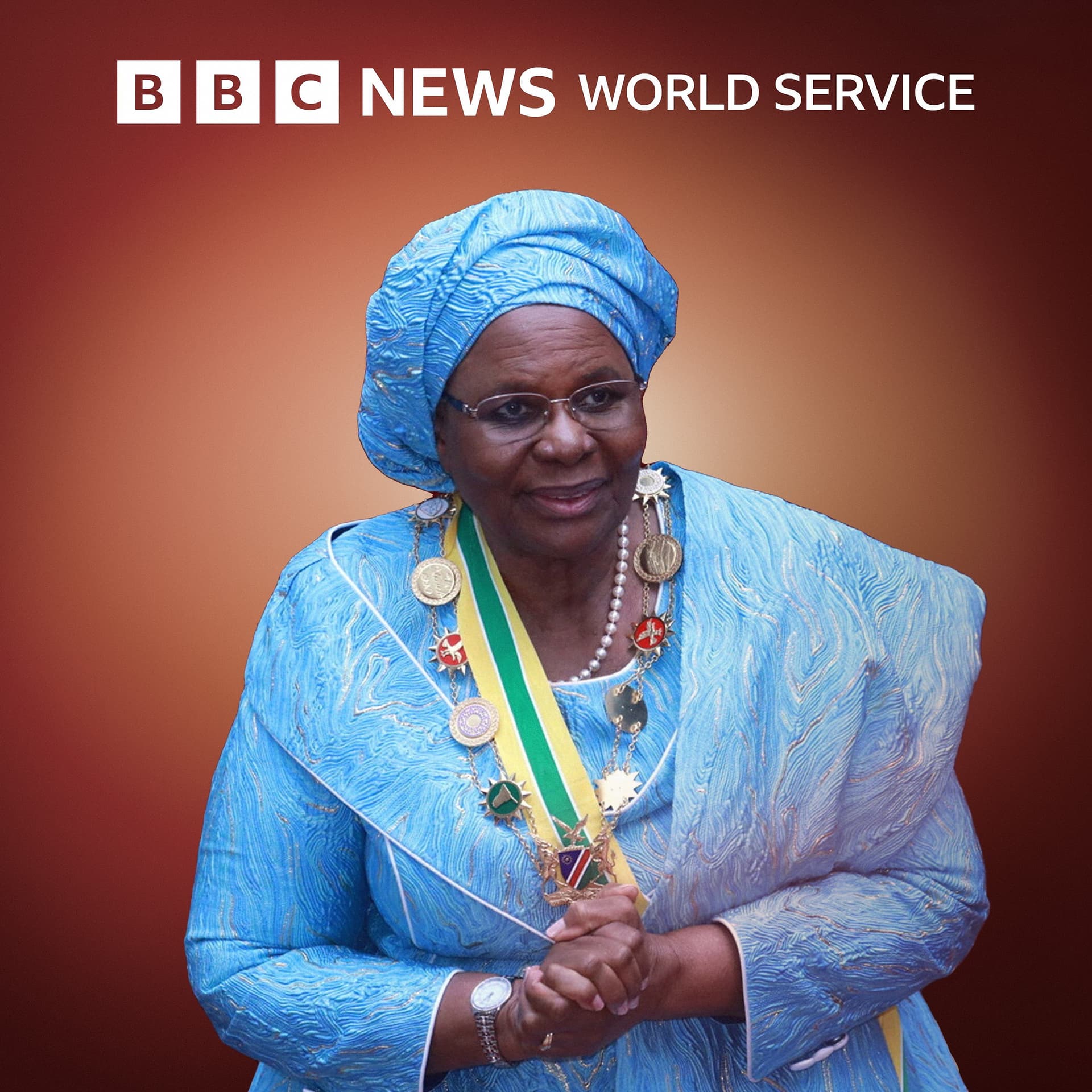
Podcast Summary: The Interview - Netumbo Nandi-Ndaitwah, President of Namibia
Podcast Details
- Title: The Interview
- Description: Conversations with people shaping our world from the BBC, featuring leaders across various sectors including business, politics, and culture.
- Episode Title: Netumbo Nandi-Ndaitwah, President of Namibia: What challenges does she face?
- Episode Description: Mpho Lakaje interviews Netumbo Nandi-Ndaitwah, Namibia’s first female president, discussing her leadership, challenges, and priorities as she navigates a male-dominated political landscape.
Key Figures
- Netumbo Nandi-Ndaitwah: First female president of Namibia and the second directly elected female leader in Africa.
- Mpho Lakaje: Presenter of the BBC’s Africa Daily podcast.
Episode Highlights
Introduction
- Mpho Lakaje introduces the episode and the significance of having the first female president of Namibia, marking a potential shift in male-dominated African politics.
Leadership and Gender
- Nandi-Ndaitwah emphasizes the importance of female representation in leadership roles:
- Encouragement for Young Women: She aspires to inspire young women to accept responsibilities, helping dispel myths of gender inequality.
- Public Expectations: Acknowledges the pressure of being a female leader, as her successes are often viewed through the lens of gender rather than individual merit.
Challenges in Namibia
- Land Reform:
- The historical context of land ownership in Namibia, where most agricultural land is still controlled by the white minority.
- Current Policies: Discusses the ‘willing buyer, willing seller’ approach and recent efforts to pass a new land bill aimed at improving land redistribution.
- Youth Unemployment:
- Highlights rising unemployment rates post-COVID-19, with a focus on job creation in agriculture, the creative industry, and mineral sectors.
- Plans to retrain the youth in response to new opportunities in oil and gas sectors.
Colonial Legacy and Reparations
- Discusses Germany’s acknowledgment of genocide and its commitment to reparations, emphasizing:
- Ongoing Negotiations: Despite an initial agreement, final terms and funding are still being negotiated due to political changes in Germany.
- Development Funding: Recognizes the significance of reparations for development projects in Namibia.
Personal Life
- Offers a glimpse into her personal life beyond politics:
- Enjoys cooking, spending time with her grandchildren, and engaging in traditional agricultural practices, reflecting her connection to her roots.
Closing Thoughts
- The episode concludes with Lakaje expressing appreciation for Nandi-Ndaitwah's insights and perspective on leadership in Namibia and broader issues affecting the continent.
Key Takeaways
- Representation Matters: Nandi-Ndaitwah's presidency represents progress in gender equality within African politics.
- Land Reform is Critical: Addressing historical injustices regarding land ownership remains a significant challenge for the nation.
- Youth Employment Initiatives: The government is focused on developing sectors that can create job opportunities for the youth.
- Ongoing Discussions on Reparations: The dialogue around reparations from Germany highlights the long-lasting impacts of colonialism and the importance of accountability.
Listening Details
- Availability: The Interview airs on the BBC World Service and is available as a podcast on BBC Sounds and other platforms.
- Contact Information: Listeners can engage with the podcast via email at TheInterview@bbc.co.uk or on social media with the hashtag #TheInterviewBBC.
Written by AI. May contain mistakes. Listen to the episode to check what was said.
Transcript
Automatic transcript. May contain errors.0:00This BBC podcast is supported by ads outside the UK. If journalism is the first draft of history, what happens if that draft is flawed? In 1999, four Russian apartment buildings were bombed, hundreds killed. But even now, we still don't know for sure who did it. It's a mystery that sparked chilling theories. I'm Helena Merriman, and in a new BBC series, I'm talking to the reporters who first covered this story? What did they miss the first time? The History Bureau, Putin and the apartment bombs. Listen on bbc.com or wherever you get your podcasts. Hello, I am Mpo Lagaje, presenter of the BBC's Africa Daily.
0:47This is the interview from the BBC World Service, the best conversations coming out of the BBC, people shaping our world from all over the world. I will come back to Russia. I will participate in the elections. There's an increase in violence according to the coca crop. There is no place in the world where women are equal. I will give away the vast majority of my money. It's my full-time focus for the rest of my life. In this episode, I'm speaking to Netumbo Nandindaitwa, Namibia's new president. She's the country's first female head of state and only the second ever directly elected female president in the whole of Africa.
1:31Could her resounding victory, with twice the number of votes as her nearest rival, mark a turning point in the heavily male-dominated politics of Africa? I would want young women to take up that courage to accept a position of responsibility so that we can dispel that myth of inequality between men and women in the public life. President Nandindaitwa is a former freedom fighter and veteran of the ruling Southwest Africa People's Organization, better known as SWAPO. The legacy of the apartheid she fought still looms large in Namibian politics. Land reform has been an ongoing priority since independence in 1990, yet most agricultural land still remains in the hands of the white minority.
2:21Namibia's former colonial power Germany apologised in 2021 for the genocide under its rule, but development funding promised has not yet materialised. Despite her formidable intray, she tells me she still has time for family, for the field, and for making food. Welcome to the interview from the BBC World Service with Netumbo Nandindaitwa, President of Namibia. In the world, including Africa, we have very few women presidents, but the most important person is that the people have voted the person among other citizens, the one they feel will be able to carry the country forward to build on the strong foundation that is created by our first president, our second president, our third president, and our fourth president.
3:17So that is really what the people look at. It was on your merit that the people who nominate and support looked at you. But it's a good thing that we as nations, as countries, we are realizing that just as men, women can also hold the position of authority in our respective countries. But does that then put pressure on you? Do you feel that there are extra expectations from you considering that you are a female leader? Yeah, to a certain extent, because unfortunately, the emphasis now is not on Netumbo, the person. The emphasis is on women. And it's like doing extremely well. I believe it will still be taken that women can do it.
4:15But if anything then happen, like what it can happen in an administration under men that we see them, There are also those who not talk about Netumbo, but rather says, look at women. So that's a certain extent is a pressure. But I would want to lead in the way I feel is the best for the Namibian people. And I believe that is the characteristics which the people have seen in me. Of course, I would want young girls, young women also to take up that courage and to accept a position of responsibility so that we can dispel that myth of inequality between men and women in as far as what we can both do in the public life.
5:09You see, there's context to this. I'm asking these questions because, you know, we saw what recently happened in Nigeria. Senator Natasha Akpoti-Adwagan says she's been facing sexual harassment at work. So I wonder what goes through your mind when you hear stories like these, especially in relation to this particular topic, in relation to female leaders. You know, I'm a woman activist and I have been and I will continue to fight against, to fight gender-based violence. That is not a unique story coming from Nigeria. We are hearing it all over the world that women are being sexually victimized.
6:00You are hearing women being asked sex favor in order maybe to be employed or to be promoted. And of course, it's a very, very difficult issue to deal with because not all the victims are ready to come out for the issues to be dealt with. But definitely, one cannot rule it out. But we have to fight it. The laws are there, but laws on themselves, they don't mean anything. It's people that have to implement. Right. I would like us to move on to other equally pressing issues. I would like us to talk about some of your country's challenges. Land reform is among them. We know that white people in Namibia continue to own the majority of agricultural land, which means that black people really don't have much of a say.
7:05This is troubling, is it not? You are right in a way, but maybe not necessarily the full statement as you are making it. Truly, land is a serious problem in this country because the colonizers, they have taken land away from the citizens. It's one of the countries, if not among the few, where you have quite a chunk of land which is fenced off. At independence, we have to work on our constitution. One of the elements is the land rights, that the land belongs to the state, except that one is privately owned, which can be expropriated with fair compensation. knowing what was happening in Namibia, the hatred that has been there between black and whites.
8:05Our founding president declared the policy of national reconciliation. So we then say, fine, we will not go to outright expropriation, but let us have a policy of willing buyer, willing seller. So quite a number of farms were bought by the government and people resettled. Then we start to have now the land tax. And that to a certain extent is pushing some to sell it so that we have land redistribution. But it's true we still have some of our white citizens and more particularly the absent land owners who are occupying the land. We have now a law on the land bill which was only recently finalized in terms of drafting.
9:01And it is my hope and my wish for that law to be passed. But please allow me to push you a little bit, Madam President. I would argue that many of these interventions that you've just mentioned have failed because land continues to be at the hands of the white population. It means that none of these interventions have succeeded. I don't really think if you can say that none of them. It's only that at this stage, I cannot give you the number of hectares of land that the government has bought and hectares of land, which some farmers have handed over. They are quite a number and there's quite a number of people who are resettled.
9:52There is progress that has been made, but of course, not everything is done to our satisfactory. And that's why even in the swap election manifesto of 2025, 2030, we are now saying we have to push for this land bill to be enacted. because if you do something in Namibia without really being empowered by the law, you just create a problem. This is a very tricky issue because I would imagine you have to address the issue of land without upsetting global players. I have no idea you would have seen what happened to South Africa. President Cyril Ramaphosa spoke about land expropriation, and Donald Trump, the President of the United States, became extremely upset.
10:53For us, one can be upset, but it will be a concern to me, it will be a concern to the government, if something was done outside the Namibian laws. But if we are doing it in accordance to our laws, will not allow interference. Speaking of America, what is Namibia's attitude towards the Trump administration? It's really not in Namibia to have an attitude towards the Trump administration because it's an administration that is elected by the Americans and the Americans are hurt about it. So for us, we have no reason to have an attitude, but we believe in cooperation with other states of the world within the framework of international instruments that are guiding the relationship between member states.
11:58Right. What sort of relationship are you hoping to have with President Donald Trump? Do you call him? Does he call you? I have not talked to President Trump, but I received a letter under his signature congratulating me when I was elected in November. Also, I looked at our protocol list of those who are coming to our third, fifth anniversary, as well as to the inauguration and the recent envoy from President Trump's office, who is representing the government of America. You are listening to The Interview from the BBC World Service. People shaping our world from all over the world. With me, Mpa Lagage.
12:59If journalism is the first draft of history, what happens if that draft is flawed? In 1999, four Russian apartment buildings were bombed, hundreds killed. But even now, we still don't know for sure who did it. It's a mystery that sparked chilling theories. I'm Helena Merriman, and in a new BBC series, I'm talking to the reporters who first covered this story. What did they miss the first time? The History Bureau, Putin and the apartment bombs. Listen on bbc.com or wherever you get your podcasts. For this episode, I'm speaking to Netumbo Nantindaitwa, Namibia's first female president. Now, on my way to the old state house in the capital, Verndhuk, I noticed lots of flags flying across the central business district.
13:52It was two days before the nation celebrated 35 years of independence. When I arrived at our interview venue, I was greeted by the president's entourage, who comprised mostly women. And I have to be honest, they were really friendly and helpful. Moments later, President Netumbo Nandi Ndaitwa slowly walked into the room, shook my hand, asked me my name before we both took a seat. What I saw was a confident and warm motherly figure. Okay, let's turn to my conversation with Netumbo Nandi Ndaitwa. I would like us to talk about the issue of youth unemployment. I'm looking at some statistics here. According to the World Bank, Namibia was able to halve the proportion of citizens living below the national poverty line to nearly 30 % in the first two decades of independence.
14:51So this sounds like progress, but then youth unemployment remains a challenge. How are you looking to deal with this? Yes, youth unemployment is a challenge. From 2019 upward, our unemployment rate has gone up. And that is because during the COVID period, the whole economy shut down. And you know, ours is a very small economy. The population is last year statistics are the only one that give us now 3.0 something million as a population. And any drop that causes a shake in the country's economy would have a long effect. But what we are going to do, we have identified in our election manifesto some of the sectors that we have really to look into seriously as part of the job creation.
15:59We are talking about the agriculture and we have to engage into serious irrigation, agricultural irrigation programs. And then when we increase our agricultural production, we are also talking now about agro-processing. We have to get into the industry. We have also to create jobs in other sectors like the creative industry, the fishing industry. And also, you might be aware that Namibia is a mineral-based economy. And this is going very well. At least 15 % of the continental raw material should not leave the continent unprocessed because in so doing, we are just exporting labor and then leave our young people in the continent unemployed and to retrain them.
16:53For example, now in Namibia, we have discovered the oil and gas. So now our educational institution has to retrain our young people, rescale them, give them new skills. It sounds good, but I would say that it sounds good on paper. I'm just wondering how practical this is. I'm asking this question because you mentioned energy. And I know that Namibia's green hydrogen, a big chunk of it goes to Germany, even though you have electricity problems of your own. So I just wonder if projects like that would be more beneficial to your people or would be solving the problems of Europe. It all depends on how you are designing it.
17:41Even if they have to solve the problem of Europe when it comes to energy, it's not the Germans who are coming to create that energy here. It will be Namibians who will be working in those factories. And really, we have also to make sure that some of it is living here. When I talk about oil and gas, who is going to serve these companies? You talk about catering. You talk about engineering work. You talk about servicing their machines. We need to train the Namibians for them to do this work. And the green hydrogen is mostly on transport. This way it's mostly used. And for us, if we have oil and gas, the oil, we can transport with the oil and then we can benefit from what is coming from the green hydrogen in order for us to invest in other sectors because those industries, they can create jobs.
18:47In 2021, Namibia's former coloniser Germany apologised for the killings of 65 ,000 Herero and 10 ,000 Nama people. Now, in addition to its apology, the European nation promised to fund development projects worth more than a billion dollars. How far are you with that process? Yeah, first, what is at stake here is not really funding development project. You know, this process started after our parliament discussed the issue of German genocide against the Namibian people and where more than half of the population of the communities in which they were operating were extinct. We then, our parliament took a decision and directed the Namibian government to engage the German government for three things to happen.
19:56One, for German to accept that they have committed a genocide in Namibia. Number two, for German to apologize. And number three, for German to give reparation. They agree and we start using the word genocide in the documents. And then they agree that they will be coming to Namibia and apologize to the Namibian people. The Namibian people have to decide the format of the apology and where it can be done. But then in the negotiation we were saying nothing is agreed until everything is agreed. so then we came now to the reparation that is where we spend a lot of time because while they were offering it started very very very very low until now we reached to the 1.1 billion euro and that again when we took it to our parliament our parliament felt that is nothing and we engaged the Germans and then the Germans said fine we will be ready to give additional funding to the programs that are going to be conducted within the framework of reparation.
21:17We have not yet completely finalized the negotiation. We have a joint declaration was brought to our parliament and some amendments were made. We have at least reached to a certain level. and because we were having elections, it has become difficult for us really to finalise. So we agree with the Germans, we can do it early January, but you remember, you know what is happening in Germany. They had a government that collapsed. We are waiting the two governments to have their two governments in place so that the process could be concluded. Just to be clear, the stumbling block right now is Germany.
22:06Because they were in their elections. But are they happy with everything so far? Are they willing to comply? To our understanding, what we have agreed now with them is what is the understanding of both parties. So it's now the question of refining and make sure that truly all the parties have agreed and then it can be signed. Are there timeframes? Not necessary timeframe, but the document was ready to the extent that even our cabinet have taken a decision authorizing the minister to sign. So definitely, I cannot see it. I cannot say definitely. But as a person who's following the process, unless something really dramatically happened, I cannot see this process going to next year.
23:05Finally, on a lighter note, when Madam President is not engaged in politics, what do you do? I cook. I take care of my grandchildren. You have to live a natural life. Not artificial. It's no good. I go to the village. I like to be in the field, doing the normal traditional work. I enjoyed it a lot. You are cultivating, you are harvesting, and play with the kids. It's very nice, refreshing, basically. I like that, being with my grandchildren. I just like to be with Kampana people. You talk, you... Yeah, we love. When you're in the village, you say family. Thank you so much for listening to the interview from the BBC World Service, a conversation with Netumbo Nandindaitwa, Namibia's first female president.
24:04If you enjoyed today's programme, you can listen to the interview twice a week wherever you get your BBC podcasts. Until next time, bye for now.
24:21If journalism is the first draft of history, what happens if that draft is flawed? In 1999, four Russian apartment buildings were bombed, hundreds killed. But even now, we still don't know for sure who did it. It's a mystery that sparked chilling theories. I'm Helena Merriman, and in a new BBC series, I'm talking to the reporters who first covered this story. What did they miss the first time? The History Bureau, Putin and the apartment bombs. Listen on BBC.com or wherever you get your podcasts.
From the publisher
Mpho Lakaje, presenter of the BBC’s Africa Daily podcast, speaks to Netumbo Nandi-Ndaitwah, president of Namibia.
The former freedom fighter is the country’s first female head of state - and only the second ever directly elected female leader in Africa.
Namibia is celebrating thirty five years of independence this year - yet most of the country’s agricultural land remains in the hands of the white minority, and land reform is a key priority for President Nandi-Ndaitwah.
Namibia’s former colonial power Germany has apologised for the genocide committed under its rule at the start of the twentieth century, but it has yet to make good on the promise of reparations. Mrs Nandi-Ndaitwah remains confident the development funding will be provided - however, she is not able to give a clear time frame.
The Interview brings you conversations with people shaping our world, from all over the world. The best interviews from the BBC. You can listen on the BBC World Service, Mondays and Wednesdays at 0700 GMT. Or you can listen to The Interview as a podcast, out twice a week on BBC Sounds, or wherever you get your podcasts.
Get in touch with us by emailing TheInterview@bbc.co.uk or using the hashtag #TheInterviewBBC on social media.