
 The Intrinsic Value Podcast - The Investor’s Podcast Network
25 Oct 2026 · 1h 15m

 Add vo to ChatGPT or Claude to ask about everything you hear
vo listened to this episode to put together the overview and transcript, so there may be the odd mistake.
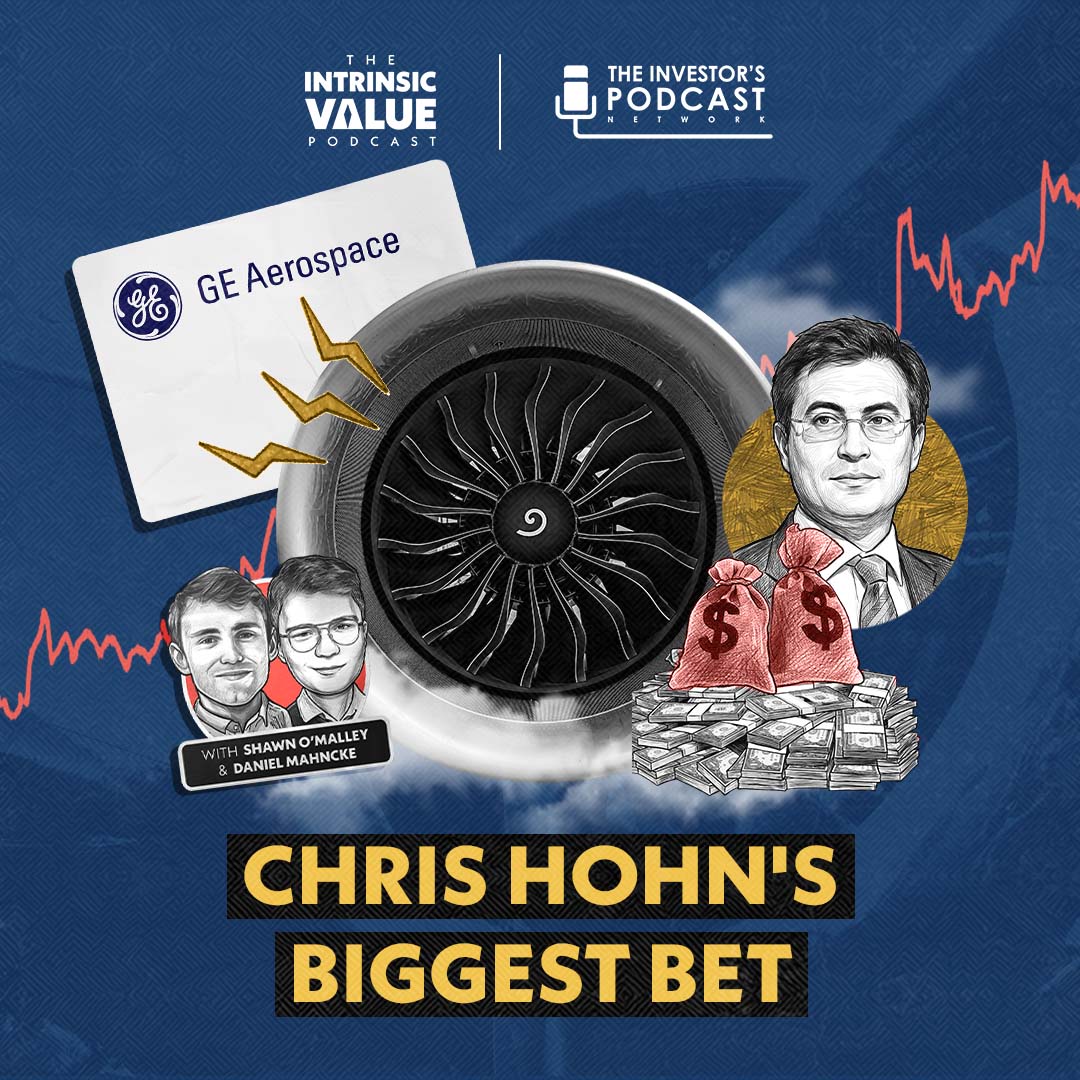
GE Aerospace as Chris Hohn’s largest, highly concentrated holding; why GE’s aerospace engine aftermarket (repairs/overhauls) is structurally advantaged, with discussion of GE’s history, competitive moats, and current financial/business drivers.
Daniel Mahncke and Shawn O’Malley (hosts). Chris Hohn is the investor being profiled (highly concentrated, ~20% annual returns for 20+ years, ~30% of his ~$50B portfolio in GE Aerospace). No other guests are named in the transcript.
GE Aerospace is “pinnacle” quality in aviation; aftermarket dominates profits (services >70% of revenue; services likely most profit). GE is ~40% of global engine MRO market; barriers are extreme (decade+ development, billions, long loss-making programs, certification lock-in). OEM choice creates multi-decade commitments; GE engines “bring back” ~3.5x original revenue in services.
GE origins (WWI turbo-supercharger; WWII jet engine “Hush Hush Boys”); CFM International JV (GE/Safran) and 737-300 breakthrough; GE breakup under Larry Culp (GE Healthcare, GE Vernova, GE Aerospace). Engine examples: LEAP on 737 MAX/A320neo; GE old generation vs LEAP backlog (10k+ delivered; 10k+ backlog).
0:00Shawn O’Malley: Chris Hone has completely crushed the market for more than two decades now and I feel like he just sneaked up the ladder of the best investors of all time without being in the media a lot.
0:10Daniel Mahncke: What I love about him is his relentless focus on buying only the best companies in the world. And many investors claim to do that, but very few follow up on that promise in the way that he does.
0:21Shawn O’Malley: He's so good at spotting these exceptional businesses before the market realizes that they are actually the best in the world at what they do. And today we'll talk about a holding that is an insane 30 % of its$50 billion portfolio. And the company is GE Aerospace.
0:58Shawn O’Malley: every week, helping you uncover intrinsic value. This show is not investment advice. It's intended for informational and entertainment purposes only. All opinions expressed by hosts and guests are solely their own, and they may have investments in the securities discussed. And now, here are your hosts, Sean O'Malley and Daniel Moncker.
1:25Shawn O’Malley: Welcome back to The Investor's Podcast, episode 854. And in our last episode, Sean, I pitched LVMH and MS2U, two incredible businesses that are currently struggling mainly because of the macro environment globally, and then especially in China. And I would argue personally that today's business is even higher quality than those two, which is definitely not easy. No, it's not easy to do.
1:49Daniel Mahncke: And we'll be talking about GE Aerospace, which is actually the biggest position in Sir Christopher Hone's portfolio. And Chris Hone is probably one of the top 10 investors of all time, truly. Delivered roughly 20 % annual returns for over two decades now.
2:06Shawn O’Malley: We actually got a lot of heat for skipping him in one of our latest YouTube live zooms. We basically rank the best investors in the world, but you don't have to worry. Eventually, there will be a part two, and we'll definitely not disrespect Hohen like that again.
2:20Daniel Mahncke: There's just so many great investors to include. You can't give them all the proper shout out that they deserve. But I would say the interesting thing about Hone is that he is a really very highly concentrated investor. So when you cover his ideas, you know that it's not just some position that he sort of made a casual bet on and then allowed to run up in size in the portfolio. Instead, he has maybe the highest bar for investing in a company of any investor I've ever studied. And that's saying a lot. And with GE being more than 30 % of his$50 billion portfolio, that is just, it's insane. And so we covered Heiko and Transteim recently on the podcast, and those are fantastic businesses in the aviation space too.
3:07Daniel Mahncke: But I feel like GE Aerospace really is the pinnacle of quality in that industry. And it's definitely valued that way too, though. It's no secret to the market how good of a business this is.
3:19Shawn O’Malley: It's not cheap, that's for sure. And actually, one of the things that I like so much about Hone is he tends to find these businesses where not the entire market is actually thinking it's one of the best businesses in the world, which is why he's mostly paying pretty good prices for them. And then over time, they go up. But I should also say that as Edwin, one of our inner circle mastermind members pointed out at our New York City conference just a week or two ago, he basically spent decades managing money at Fidelity and then many other places in the financial world. And he said that there's something to say about the gap approach, G-A-A-P, and that's not supposed to be the accounting term, but actually growth at any price.
3:54Shawn O’Malley: So Howard Marks would certainly not agree with that because he's famous for saying there's always a price too high. And it doesn't sound too value investor-like to say you buy any company at any price. But I think if you adjust it to say there's growth and quality at any price, GE Aerospace is actually a company that fits that profile quite well. because I feel like it's just a company that we need to cover so that if at any point there's a more severe drawdown, we are ready to buy that stock.
4:21Daniel Mahncke: We are already in a bit of a small drop down at the time of recording here. GE's shares are down about 20 % recently. And of course, that is a pretty small blip when you zoom out and look at their meteoric rise post-COVID. But before we get lost in the stock action, how about you just take a moment and walk us through the history of the company and what it is exactly that GE does and then how that differs from their peers in the aviation space of Heiko and TransTime.
4:53Shawn O’Malley: Yeah, GE has an interesting history, I would say. You and I actually just went to the Air and Space Museum in DC where we spent a couple of days after our conference in New York City and the history of aviation is incredibly interesting, I gotta say. So going from Leonardo da Vinci's first prototypes to the actual first motorized airplanes and then eventually landing on the moon and working on going to the Mars, whether that will be the case in the next decade or maybe in the next two or three decades. But all of that is basically happening in just 500 years, which might seem like a long time.
5:23Shawn O’Malley: But if you compare that to the history of humans, I think it's fair to say that this is not a very long time. But let me tell you guys, I figured that out when we were looking at all this stuff in the museum. Aviation innovation would have definitely been slower if they would have needed to count on more value universes. I got to say, there's absolutely no way I would have been part of any of those early airplane experiments because I just kind of felt there's no margin of safety when they showed me the things that, you know, actually humans went into and then started to fly in that thing.
5:52Daniel Mahncke: We were talking beforehand about turbulent flights, and I barely like getting on commercial flights, especially when there's turbulence. I don't think that if you look at some of these early, what they call, you know, quote unquote, airplanes that they tested, you just have to have a very different risk tolerance than I think either of us do. So I wouldn't have been the one testing out these planes. And I think calling them planes is probably very generous. Perhaps the aviation innovation folks of the 16th to 19th century were sort of like the maybe crypto investors of their time at the very boundaries of markets and risk taking.
6:27Daniel Mahncke: And I own some Bitcoin, but I certainly don't have what it takes to go all in and make it 100 % of my portfolio.
6:34Shawn O’Malley: It's probably more the Dogecoin people that would have tried to test those planes back in the day. I gotta say, it gave me a pretty good feeling about all the flights that I usually went on when I went into the hall where all the GE engines were. So those seem like the type of engines that I would want to have on a plane when I stepped foot into it. But the aviation business of GE is actually older than most people would think. So it started in 1917 in the middle of the First World War where the US government asked GE and an engineer called Sanford Moss to build a turbo supercharger for military aircraft.
7:07Shawn O’Malley: And that's a device that basically compresses the air going into a piston engine so that it still works at very high altitude. And as I learned, this guy Moss appeared to be a pretty fun character. He wrote his doctorate on gas turbines in, I think it was 1903. And then he carried quarters in his pocket to basically demonstrate to people probability. So for example, he flipped a coin and then he said that over time, it should be 50-50. So he could stand there for like an entire day, flip the coin to show that if you just do it long enough, there's a 50-50 likelihood of having either had all the numbers.
7:39Shawn O’Malley: So my favorite detail though is that just like the two of us, he hated flying and actually refused to fly in the test aircraft that he used his own product on. So who knows, perhaps he would have actually been a pretty good value investor and didn't actually need to bought any of the planes that he built the engines for.
7:57Daniel Mahncke: It sounds like he was very thrifty and sounded like he very much would have been a good value investor for sure.
8:03Shawn O’Malley: I'm sure he would. So actually going back in time, the first world war was something that basically was the start for GE. But then by the end of the second world war, GE had built more than 100 ,000 of those turbo superchargers. And that's why in, I think it was 1941, the US army was sent the first British jet engine and they decided to give that design to GE to basically scale that and build the same for the US. And that project was back then top secret and was codenamed Type 1 Supercharger so that factory workers and also spies would assume that they were simply building standard engine parts rather than this revolutionary jet engine.
8:41Shawn O’Malley: And the small team working on it called themselves the Hush Hush Boys just because they couldn't talk about it, not even to families or, you know, very close relatives. And the engine, which is called the IA, first ran in April of 1942. And then later that year, it first started flying. And that was basically the first time there was an American jet engine.
9:00Daniel Mahncke: It's always cool to get a kind of peek behind the curtains at the history of these things. There's always some sort of top secret project, it feels like when we're talking about the history of aviation. And I was surprised by how many of them had to do with aircraft and engine development. And so another thing that I found fascinating at that museum was seeing the incredibly long history behind airlines like United and Delta. And then the big joke that we had at the museum was seeing how during those periods, they effectively created no shareholder value during those times, as Buffett would say.
9:34Daniel Mahncke: And then on the other hand, you have GE and Transdime and Heiko and other similar businesses that all operate phenomenal and really highly profitable businesses tangential to the aviation space sort of from a different perspective and so it just it shows once again that pretty much every industry has successful players and if you can figure out where they are in the value chain you can make a lot of money and sometimes it's not the most obvious player you know the airlines taking folks from point a to point b who actually make the most money in this case you know it's the parts providers the builder of engines and other of the inputs that go into a service, you know, flying that has become immensely revolutionary for society, but yet hasn't actually created a ton of value for shareholders.
10:25Daniel Mahncke: And that's maybe an interesting parallel to keep in your head when you think about AI these days. And so I think the most important questions to ask are, you know, first, how mission critical is what you built for the overall operation? So how critical is it to ensuring that a plane flies smoothly in these cases? And secondly, is there any reason that competition would be limited, maybe by regulatory oversight? And so, you know, can you operate sustainably at high margins?
10:57Shawn O’Malley: Both of those things are certainly given now for GE, but the business was not always that easy. So it was pretty tough in the beginning, actually. So GE wasn't as dominant as it is today back in, for example, the 1940s, when demand for the engines after the Type 1 supercharger was so massive that GE didn't actually have the capacity to build them all. And then the government simply decided, hey, if you can't do it, we'll license it out to somebody else who can do it. And that was General Motors Allison back then. So it was, you know, if you didn't have the scale to build all the engines that were in demand, you would basically just get another competitor in.
11:32Shawn O’Malley: and that's also part of the mode that GE nowadays has, where you have the scale and then it's just incredibly difficult for anybody else to compete with you. That's a risk when you have a highly concentrated customer and when much of your mode is basically of regulatory nature, which is also what we discussed with TransTime and then with HighGro to some extent. The government grants it, but then the government can also take it away. And especially when an industry is young and there are no advantages of scale yet, that's a very, let's say, fluid way for competitors to come in. And then GE eventually won the business back in the 50s.
12:04Shawn O’Malley: So it didn't take them a long time when a new generation of military engines called G47 and G79 dropped. And the G79 was a so-called Mach 2 engine. So it's powered the, I think it was the F4 Phantom and the F104. And I got to say, I don't know much about them, but I do have a feeling that you might know them because I learned that your family has plenty of connections into the space. So one way or the other, you might have come across these.
12:29Daniel Mahncke: Yeah, apparently. I never thought of myself as being somebody with a lot of connections to this industry, but the more I thought about it, the more I realized I did. I have a friend who flies cargo planes for the Air Force, and my brother-in-law is trained to potentially become a fighter pilot for the Air Force, too. So definitely through them, I've learned a few things about planes. And what I do feel confident about is that a very specific type of person is needed for these jobs, right? Not just anybody wakes up and decides that not only do they want to fly for the airports, but they want to fly fighter jets as well.
13:02Daniel Mahncke: So the planes are obviously incredible, but so are the
13:05Shawn O’Malley: people who decide to fly them. It's yet another industry where probably not too many value investors operate in. The only thing I could have told you about it is that it was designed by a team under a person called Gerhard Neumann, who had a pretty cool life story, I would say. And he basically was a German Jewish engineer who fled the Nazis and then ended up as a mechanic for the Flying Tigers. And that was a group or basically a nickname for a group of US volunteers in the Chinese Air Force that fought against the Japanese in World War II. So he even got his US citizenship through a special act of Congress because of what he achieved basically.
13:39Shawn O’Malley: And then he ran GE's aviation business from 1961 to 1978. And GE's headquarters in Cincinnati actually called First Newman Way. So he left quite a mark in what he did there. But beyond the military operations, the commercial business started with the CF-6 in the early 1970s, which went on the DC-10, which is a plane that I have never heard of, and I don't know if it's still in production. But it also went on the Boeing 747 and the Airbus A300, and then also later on the Boeing 767. And those are pretty, pretty popular planes by now. And then came what you could probably call the most important decision in the company's history, which is the joint venture between the French company Snegma and GE.
14:21Shawn O’Malley: The new company was called CFM International and was basically a 50-50 venture between GE and the company Snegma which by the way is now called Saffron but I feel like all the names are kind of confusing all the time. So GE builds the core of the engine which is what they're doing best. So you have the high pressure compressor, you have the combustor and you have the high pressure turbine. Those are basically parts of the engine which are the hottest and also the most technically demanding parts. And then Safran builds the fan, the low pressure turbine and the booster. So each side assembles about half the engines in its own factories and sells and services them with its own people.
14:56Shawn O’Malley: And the reason this joint venture exists in the first place is once again, we go back to war, the Cold War that we had between the US and Soviet Union.
15:04Daniel Mahncke: I think that'll be a theme for today's episode that war generally has been a big driver of advancements in aviation science.
15:11Shawn O’Malley: It definitely was. And you could probably say that it still is to some extent. And the GE engines were used in the B-1 bomber back then. And engines were seen as so vital to the success of the military that it was almost always a political question of who you sold them to. So in 1972, for example, the US State Department refused the export license for those engines. And I think it was Henry Kissinger personally who signed the refusal for all of those engines. But then only a year later, at a summit in Enrique Week, the French President Pompidou and U.S. President Nixon made a deal that GE was actually allowed to ship the engine cores to France, but only as a sealed unit built in the U.S.
15:51Shawn O’Malley: And then France would pay, I think it was about$18 million as a royalty to the U.S. government. And at Seferin's plan, the GE core was even kept in a lock room that not even the president of the company was allowed to enter. Wow.
16:04Daniel Mahncke: Imagine you're the CEO of a company. you're walking through your own factory building and then there's some random locked room that you're just told you're not allowed to enter. I mean, that's pretty crazy. And interestingly though, the engine actually turned out to be a major flop, at least in the beginning. Anyways, for five years, there were no orders. And then in the spring of 1979, French government threatened to stop funding it. And GE and SNECMA were reportedly two weeks away from freezing the whole program. And so only then did United Airlines order it to re-engine some parts of their old fleet.
16:37Daniel Mahncke: And, you know, the U.S. Air Force followed then closely after that and chose it for some of their tanker series planes. And then in 1981, Boeing made it the exclusive engine for the 737-300. And that was the first major breakthrough the engine needed. The 737 is a name that I'm sure even people generally not familiar with aircraft will probably be familiar with. It is one of the most sold aircraft lines in the world. So it went from two weeks away from cancellation to being the best selling commercial jet engine in history. So that's one of those random breaks of fortune that seems almost lucky and totally improbable.
17:20Daniel Mahncke: And now it's a partnership that has extended for another two decades up until 2050.
17:28Shawn O’Malley: But it also shows you how important timing can be, right? Most people that nowadays think of GE, think of this company that's incredibly stable, cash printing machine, but at the right time, you also need luck with the timing, right? You have this engine, it's very powerful, but if all the engines right now on the airplanes work quite well, there's nobody who demands a new engine, you can actually sit on a very product and you can sell it, which, you know, in this case, fortunately worked out. That's sort of the risk that most people don't see anymore, but it certainly exists. And I did find it incredibly interesting when I looked into it.
17:57Shawn O’Malley: And also, I think if you have a business that relies on the government for large parts of its orders and R &D, and then also has all of these regulatory modes, I think you better understand why that relationship exists to then understand whether it will continue in the future. And what's also interesting is why we only talk about GE as an aerospace company when most people, actually me included, think about a massive conglomerate whenever GE comes up. And the most popular name in this story is Jack Welch. He basically ran GE from 1981 to 2001, so two decades, and took the market value from about$12 billion to over$400 billion and made GE back then one of the biggest companies in the world.
18:36Shawn O’Malley: And he was called NutriJack because he cut the workforce from 411 ,000 people to only 299 ,000 people in his first five years at the job. And then he also built GE Capital into a giant financial business. So he basically expanded this conglomerate and grew it into a way, way bigger company. After him though, Jeff Immel took over in September 2001. That was actually just four days before 9-11 happened. And under him, GE Capital grew to more than half of the company's profits by 2007. So although you had this conglomerate was pretty concentrated in where the profits actually came from. And GE Capital provided commercial lending, consumer financing, and also asset leasing to the customers who bought these heavy GE equipment products.
19:19Shawn O’Malley: So for example, the engines. And that turned out to be a massive problem because maybe you follow the timeline here. It's 2007. So just one year later, the financial crisis came and killed almost the entire business because you were sitting on so many financial contracts and lending. And then no other than one Buffett stepped in and put$3 billion into GE preferred stock in October 2008 at a 10 % coupon.
19:42Daniel Mahncke: Even that didn't really help though. Immelt made some pretty massive mistakes during his tenure, I think it's fair to say. And it might be really one of the best case studies for how not to run a business. And I remember reading case studies on Jack Welch and it was always framed as how to run a business. And then there's been some controversy that's come out in hindsight about maybe managing earnings during his tenure. but it certainly didn't seem like he made sort of the catastrophic mistakes that Immelt did. And so, for example, Immelt bought Alstom's power business for about$10 billion back in 2015.
20:17Daniel Mahncke: And that was right before the market for gas turbines collapsed. And then he also spent$93 billion on buybacks during his tenure. And most of that was at a price above$30 for share. Well, for context, stock ended up being below$7 eventually. And so in 2018, things got so bad that GE was removed from the Dow Jones after having been a member for over 100 years, going back to 1907. So I just I remember all of this actually pretty well because I actually bought GE stock back in 2014 as one of my first investments ever. And I figured they'd eventually get things sorted out since they were such a blue chip name for many years.
20:59Daniel Mahncke: But that was really as much logic as I had to put into the thesis as a teenager at the time. And yeah, I'm certain that I lost money on that investment. And so obviously, a lot of this looks bad with the benefit of hindsight. But ultimately, results matter. And Immelt certainly didn't deliver for large parts of his tenure. And then at that point, the famous activist investor Nelson Peltz became quite involved. He built a$2.5 billion position for his fund Trion in 2017. and there's this really great quote from a piece released by fortune just a couple of months ago where pelt said quote i was sure ge was going to file for chapter 11 then larry arrived and performed the most amazing rescue i've ever read about or born witness to if you're a fundamental investor like me you need financial data that actually keeps up with you that's why me and my colleague daniel monka use fiscal ai for every episode of the intrinsic value podcast fiscal ai is a modern financial data provider for global stocks.
21:59Daniel Mahncke: And we use their web-based terminal all the time in the show. It pairs a clean, modern interface with institutional-grade data, over 20 years of financial statements, plus company-specific segments and KPIs that I love digging into. You want Uber's gross bookings? It's there. You want to see Caspi's payment volumes? It's there. And I know because we pulled these metrics for our podcasts on Uber and Caspi. But what's new is that they've just launched their own AI connector. What that means is you can plug all of that data, 20 years of financials, earnings call transcripts, fund letters, news, filings, and much more directly into Cloud, ChatGPT, or whatever AI you use for investment research.
22:39Daniel Mahncke: So your AI is working from institutional quality data straight from the source. Whether you want a powerful out-of-the-box stock research terminal or a data connector to supercharge your AI, use our link fiscal.ai.tivp to get 15 % off. Again, that's fiscal.ai.tivp. And you'll find the link in the show notes as well.
23:03Shawn O’Malley: He also said that Lowry Kulp is the greatest industrial CEO on the planet. So GE not only delivered us a masterclass basically on what a CEO shouldn't do, but also one of the greatest CEOs of all time and basically how you can perform a turnaround, which, as we all know by Peter Lynch, doesn't work out too often. And Larry Karp has also been the first outsider CEO at GE in more than 125 years. And apparently he was offered the job before, three times actually, before he finally accepted it. And on his first day, GE's market value was about$96 billion. dollars and then four weeks later he did the first measure so he cut the dividend to one cent a quarter and wrote down 22 billion dollars in the power business but by far the most important decision and what we are known for has been that he split up the company into three parts in 2021 so you had the big conglomerate now going into a GE healthcare spinoff a GE energy spinoff which was the company GE Vinova and then what was left was the aviation business with the original GE ticker that was basically turned into GE Aerospace, the company that we are discussing today.
24:07Daniel Mahncke: And when we look at the history of maybe the best CEO decisions ever, this actually might very well be up there. And so as you mentioned on Culp's first day, General Electric was worth $96 billion. And so the three companies that he would then split it into are now collectively worth over$600 billion today. And that is already accounting for GE Aerospace having dropped 20 % from its high this summer. So that's more than six times your money in eight years with a blue chip company, right? This is not a small cap name. So that's roughly 26 % a year compounding. And so the S &P 500 for context, it's about 13 % a year over that same stretch, which is actually a really great rate of return for the index.
24:54Daniel Mahncke: But GE pretty comfortably doubled it. And GE Aerospace specifically has more than doubled since the energy business was spun off in April 2024 alone. So a little more than two years ago. And how about though we dive a bit deeper into the current business. And since we've covered quite a lot of companies in this aviation space by now from Copa as an airline to Transdime and Heiko as part suppliers, I do think it'd be interesting to better understand where in the value stack GE operates and fits in and how that compares to Heiko and TransTime in particular.
25:34Shawn O’Malley: And there is sort of spoiling. I would say it's an even better business than the two of them. So Heiko and TransTime. And it basically feels like the higher up the value chain you go, the better the economics actually become. And airlines have the worst economics. Then you have these OEMs like Boeing and Airbus. And despite having a duopoly, which should give you some kind of market and pricing power, they haven't actually been able to produce great margins over time. And their highly capital intensive business models have made them mediocre investments. Of course, GE is also capital intensive and working in an oligopoly, but their economics have still worked out quite differently.
26:08Shawn O’Malley: So GE primarily has the advantage of benefiting from the aftermarket, just like Heiko and Translam do. So that is the most profitable market in the aerospace industry. Just like the two of them, GE basically sells its products. So in their case, the engines at a loss initially and then makes its money when they are repairs or when they have to go in for service.
26:28Daniel Mahncke: And so from your perspective, do you see GE as being a monopoly or are there competitors out there that can hang with them that are of a meaningful size?
26:36Shawn O’Malley: It is an interesting dynamic because there are three big engine makers. You have GE, you have Pratt & Whitney, which belongs to RTX or Raytheon as it used to be known, and then you have Roller-Royce. So we saw all of them in the Air and Space Museum. But GE is by far the biggest of them all by a wide margin. I think they control about 40 % of the global engine maintenance, repair, and then the overhaul market. So you could probably say that it is technically an oligopoly, but because of how contracts are structured, which we will still talk about, I don't have a problem with calling GE maybe also a monopoly, looking at their market position.
27:11Shawn O’Malley: The reason for why there is so little competition in general is that the barriers to entry are just enormously high. So a new jet engine takes roughly a decade and several billion dollars to develop before the first one is ever delivered, which is why we got to, you know, we talked about it in the history section. A lot of these engines were huge strains on the balance sheet. And then you didn't even know if at the time of finishing them, there will be enough demand and also space on the planes to actually get them into the market. So you basically have a program that loses money for years. And then after the engine is sold, you're still sitting at a loss for many years after.
27:43Shawn O’Malley: GE's newest engine, for example, has done more than 30 ,000 test cycles and is still losing money for them. And GE says the losses will actually double this year and then peak around 28, so in two years' time. And the LEAP engine, which is the newest one, is on the 737 MAX and on the A320 NIO. And they entered service in 2016. And then they only broke even as a program last year. So we're talking nine years of losses. And that's nine years of losses that basically the balance sheet has to absorb. and you as a company have to still spend on R &D and all of that.
28:15Daniel Mahncke: And you have the major regulatory mode that we mentioned earlier too, right? So the FAA and the EASA require thousands of test cycles. And once an engine is certified for an aircraft type, basically it's locked in. So competitors can't really come into that market easily. And that's the same logic that applies to why a lot of investors really like Transdime and Heiko and although I would say the consequences are a little more severe when we talk about GE's products failing than when we talk about Transdime or Hycos.
28:49Shawn O’Malley: I wouldn't want either of them to fail to be completely honest but yes I mean if we think about let's say a luggage store not closing fully or maybe a seatbelt being slightly loose I think that's a lot better than having your engine fail especially mid-air but when you have to spend more than you know 100 years in this business one of the other big advantages, and GE has done that, is that you build over time a huge in-sort base. So that is very hard to disrupt because the contracts are just going for such a long time. And for GE, for example, we talk about 50 ,000 commercial engines and 30k military engines in service around the world.
29:22Shawn O’Malley: So those are basically locked in customers for decades to come. And then even to sell an engine to an airline, you also need a global network of repair shops, you have to have the spare parts, you have to have spare engines and technicians, and then also the airline usually wants pilots and mechanics who already know your engine, right? Who, for example, when they, you know, started flying, they use your engine for those lessons. And then last but not least, airlines are just incredibly difficult to build. So you probably, it's not an over-exaggeration if you say that they are sort of marvels of the modern day.
29:52Shawn O’Malley: I mean, a modern turbine blade is a single crystal of nickel super alloy that operates at temperatures above the melting point of the metal it's made from. So it's basically cooled by air channels inside the blade, and that has to be enough so that it's not melting. And then every generation of engine tends to be more efficient and more resilient. It's just incredibly difficult to build that. So you also need a lot of talent.
30:13Daniel Mahncke: Well, and as soon as any original equipment manufacturer, OEM, chooses a GE engine for their new fleet, they're basically signing what is a multi-decade commitment, as I understand it. And that is also why they can offer their engines at a discount to the list price to win over business when they first sell them. Because really, they're selling at a discount to lock in many, many years of services and repairs that are going to be sold at a much higher margin over time.
30:45Shawn O’Malley: I don't know if you remember, but when we were in DC, we talked about these speakers, right? This little hardware company that is now selling speakers. And we basically talked about how they sell them at a loss. and we don't know whether they will actually ever make money from them. And then we had people who were not in the investing world asking us why people sell anything at a loss anyway, because it doesn't make sense. We kind of had to explain why in public markets that can happen and then maybe over time you have certain services where you can actually make money with the hardware, although you initially sell it at a loss.
31:12Shawn O’Malley: And this is sort of what happens with these engines as well, where they typically fly for about 25 to 30 years. So that's the time when GE actually makes money and margins on them, because during that time, it has to come into the shop for a major overhaul roughly three times during its usual life. So each of those shop visits can cost millions of dollars, mostly in spare parts that only GE can make. And then GE's own math is that every engine they put on a plane brings back about three and a half times the original revenue in services over its life. So that's how they actually make the money.
31:45Shawn O’Malley: And in GE's commercial engine segment, services are more than 70 % of revenue. And although GE doesn't break out profit by services and equipment, basically everything in the numbers tells you that services are the vast majority of the profit. So the segment as a whole, it's a 27 % margin. And it does that while basically selling all these new engines at roughly break even. And that's kind of similar to TransTerm's numbers because one third of TransTerm's revenue is aftermarket, but it's 75 % of EBITDA. And GE's returns on investor capital are also outstanding at close to 40 % in recent years, which is kind of remarkable for any manufacturing business and actually any business for that matter.
32:22Shawn O’Malley: And by the way, if you look at, for example, Fisk AI or some other services, you would see that the return on investor capital seems to be much lower. That's only because they still include the insurance business or the book. So that basically messes up the number. Technically, they have way higher returns on investor capital than it seems on those websites.
32:38Daniel Mahncke: As an investor, I read a lot, including way too much email. The task I dread most is digging through a long thread for one detail, a deadline, a guest's availability, a number someone sent weeks ago that used to follow me out of the office and eat into my evenings. Now I use superhuman mail. With Ask AI, I just ask a question and it pulls the key details out of my threads in seconds, no more putting off that search. When I'm away from my desk, write with voice on the superhuman mail mobile app lets me say what I mean and turns it into a polished reply that sounds like me. I can answer on the go without getting pulled back into work mode.
33:21Daniel Mahncke: Superhuman mail is part of the superhuman productivity suite, which works inside the tools you already use. It's built for long-term productivity, not just clearing today's pile. Get out of your inbox and back to what matters. Get one month of superhuman mail free at superhuman.com slash T-I-V-P. Sign up and get one month free of superhuman mail at superhuman.com slash T-I-V-P. And just to give listeners an idea of the size of the business, GE generated a little more than $40 billion in revenue last year. In comparison, Transdive did about$9 billion, and Heiko did half that at$4.5 billion. So clearly, GE is significantly bigger than these other companies.
34:12Daniel Mahncke: And yet, at the same time, it is similarly profitable. It looks like GE has about a 20 % overall margin. And so I do ask myself whether all of the aftermarket actually goes to GE or whether companies like TransDem and Heiko went over some of the aftermarket revenue with their parts businesses. And if you think of it through that lens, then technically it would seem like they are something more akin to being competition.
34:38Shawn O’Malley: So the default is to go with parts from the engine maker, which in most cases is GE. And there's basically a similar asymmetry to the one that we discussed with TransDem, where if anything should happen to the engine or even worse, let's say the plane made air, and you were the one deciding to go with an unoriginal part, you would be in big trouble. So generally, I think you could say that the higher the cost of failure, the more loyal customers tend to be to proven systems and products. So for a long time, you even had the problem that GE waived the warranty once you as an airline or even as an OEM used a non-original part for the repair.
35:13Shawn O’Malley: But that changed some years ago since airlines actually came out and complained about the market power that this policy has given to GE. But even then, often these airlines are not actually the ones even choosing which part is getting used anyway, because half of all the commercial aircrafts are leased and not owned by the airlines. So the leasing companies are the ones actually making the decision about the engines and the services. And they almost always go with the original parts because it protects the resale value of the plane. So maybe you have it for, let's say, 10 years, and then you want to sell it, you get a much better price if you only used original parts while carrying out the service on the engine.
35:48Shawn O’Malley: And then if you look at the two companies, Transom and Heiko, probably the biggest competitor of those two would be Heiko, not Transom. Because, you know, Transom is famous for seatbelts and cabin doors and pumps and so on. Those are basically parts of the airplane that are everywhere except for the engine. And Heiko, on the other hand, is a competitor where, you know, they also offer parts for repairs in the older fleets of engines, for example. So their PMA parts, which are these manufacturer approval parts from the FAA, they are a lot of times on these older mature engines and mostly on the less critical parts, but they are in the engines.
36:24Shawn O’Malley: So, you know, they wouldn't have any copy of a LEAP high-pressure turbine blade made from ceramic matrix composites. And I actually spread that out because I want to make sure that it sounds as complex as it is. But again, they don't have these sort of parts, but it could happen in the future. No, I'm not so much into the industry that I could tell you what the FAA will do in the next five or 10 years. Perhaps over time, they are allowed and able to build those tools. And then you would certainly talk about them as a competitor to GE.
36:52Daniel Mahncke: And so the LEAP, the LEAP, is the most important engine right now. I believe it's on three aircraft. It's on the Boeing 737 MAX, and there it's the only engine and then on the Airbus A320neo family. Airlines choose between the Leap and then Pratt and Whitney's geared turbofan. And then the Leap has somewhere between 55 to 60 % of that market. And then it's also even on a Chinese plane, which I wouldn't have immediately thought of given their manufacturing capabilities and sort of the sensitive geopolitics surrounding plane engines. But again, I think that's another testament to the market power of GE.
37:33Daniel Mahncke: CFM delivered 1 ,800 leaps last year, up 28%, and more than 1 ,000 in the first half of this year, which is up 40%.
37:43Shawn O’Malley: I honestly, I really hope our listeners can keep up with all the abbreviations that we use today. But I think it's also quite interesting not only to say what these engines are actually called, then also to give some numbers. So for example, I wouldn't have known before doing this research how many engines you actually sell, right? Like, of course, you could look at the general size of all the airplanes or aircraft outside, but then how much of the engines are actually part of the GE company, and then how much are part of Rolls-Royce, and so on. So I think it's kind of interesting, even though it might be a bit too much, and people got to listen to it twice.
38:13Shawn O’Malley: So I will still try to keep it simple, and won't drop too many of them anymore. But just a rough overview, in case you sort of, you know, zoomed out, when you heard all of these abbreviations, about three quarters of the revenue, and almost 90 % of the profit come from the commercial aviation part and the rest is defense. And the reason for the relatively low contribution to profits is that GE's defense margin is only about half and even a little less of the commercial margin. And I know we've already talked a little bit about, you know, the different types of airplanes and engines, but we might want to give it a quick overview of just how they differ in terms of profitability for GE, because in general, there are three families of planes and you just mentioned it.
38:52Shawn O’Malley: So the first family are, you know, the small planes, the ones said I will take when I go from Hamburg to London, for example, our Inner Circle Mastermind dinner next week, or the one I took from Charlottesville to DC for our intrinsic value conference a few weekends ago. Although the one I actually took to DC was even smaller. And man, I told you before the call, that plane was shaking. That was probably the first time I was actually getting nervous on a plane because it was just, you know, we had some turbulence and it was a very small plane. So we were going up and down and left and right. And I was like, Jesus, you know, The flight is only 17 minutes, but knock on wood, I will actually make it.
39:26Shawn O’Malley: But fortunately, I'm sitting here today and we'll record this episode. So that means the plane landed. And I can say that was an extra small one. Usually I take, you know, Boeing 737 or an Airbus A320. And together, those two are about four out of five planes that get sold in the world. So chances are those are the planes that you will fly wherever you go. And then on the 737, GE is the only engine option. And then on the Airbus one, so the A320, the airline chooses between GE and Printer Whitney, and GE gets somewhere, you know, around 55 to 60 % of all the engines there. So on the planes that matter most, GE has roughly three quarters of the market, which is also why I told you before that you could potentially talk about them as a monopoly, because if you own three quarters of the market and you have those contracts for, let's say, 30 years, that's a lot of market power.
40:11Shawn O’Malley: Within that family, though, there are two more generations of the GE engines. So you have the old generation, which is the one that GE has been selling since the 1980s. And there are somewhere between 19 ,000 to 28 ,000 of those. You would think that you get a more precise number, but it kind of depends on who you trust. GE says it's 19 ,000 and then Safran says it's 28 ,000. So there's quite a delta there, but somewhere in that range we are. And that's the largest number of any engine ever built. And it's sort of the cash cow because those engines are old. They need a lot of maintenance and every part actually comes from GE.
40:42Shawn O’Malley: and then you have the new generation which is the leap that we have mentioned now quite a bunch of times and it's been in service since 2016 and more than 10 000 of those have been delivered and you know it's sort of the growth engine quite literally yeah the the backlog on that one is is
40:57Daniel Mahncke: really substantial too and officially saffron says more than 10 000 engines are in the backlog but as you told me a bit earlier if you do the math from boeing's and airbus's order books it's probably closer to 15 ,000, which is six to eight years of production. So GE honestly knows what it will be building probably well into the early 2030s. And so besides the small family of planes, you do also have the big ones, sort of like the one that you would have taken to go across the Atlantic to New York. And on Boeing's big planes, GE is either the only option or has about two thirds of the market. And so on Airbus's big planes, Rolls Royce is actually the only option.
41:40Daniel Mahncke: And so on white bodies, it's essentially GE for Boeing and Rolls for Airbus. And then last but not least, you have this angle of working with the military.
41:49Shawn O’Malley: Although you might argue that it's, you know, last and least, because again, the defense margin is only 12%, which is about half the commercial business. And basically, why is that? So the government buys on what they call cost plus contracts with profit caps. So there's no catalog for spare parts where GE can actually raise prices every single year, which is kind of what we see in TransTime. And therefore, a lot of the development is actually paid for by the government. So it's a pretty stable, decent business, but it's not a fantastic one. So the advantage is that, you know, for example, the fighter jets that some of your friends fly, they always fly even in a recession, while that might not be the case for the commercial business.
42:24Shawn O’Malley: Then for TransTime, the military business is quite profitable as we said because the difference is that its parts are usually far below the two million dollar threshold for which the military signs these price bounder contracts and then many parts are classified as commercial items under the 1994 federal acquisition streamlining act which exempts them from cost data even in larger buys this is basically exactly what we talked about in our transom episode with no competitor a quote-unquote fair and reasonable price can just mean that you take basically whatever price it has been last year and then you add a quite sizable increase to that.
42:58Shawn O’Malley: And another reason is that a good chunk of the R &D that goes into GE's engines, actually about half, is financed by the government. And that's a lot of money. So GE's total R &D is about 8 % of all aerospace revenue. And half of that is government funded. So basically to make sure that GE will keep having the most up-to-date and the most innovative military engines to have the US with the strongest planes in the air. And then in return, it acquires data rights and licensing rights, which is why a lot of the services then run through their own depots. So GE's military aftermarket is basically a negotiated spares and support business often structured as performance-based logistic contracts.
43:41Shawn O’Malley: So it's not a catalog business where GE controls the shop visit. And that's also why the services are only 50 % of the defense revenue versus more than 70 % of the commercial revenue or business. And that's also why defense spare parts earn significantly lower margins than a commercial part. So again, for TransTime's parts, the government doesn't buy the data rights, either because the company designed the part on its own dime, or because it acquired another company that basically built these way before the contracts with the government existed. And then, you know, as we talked about reverse engineering, a$2 ,000 part when the government is only spending$50 ,000 a year on them makes no sense economically.
44:18Shawn O’Malley: And that's why people don't care about TransTime. But if you have these huge expenses for the engines, the government very much does care.
44:25Daniel Mahncke: Well, for as much as I don't like the fact that TransDime generates a lot of their value for shareholders through what you could argue is really price gouging, it does seem like they have found really the exact niche where they can do that and be able to squeeze out the last dollar in pricing power while also still not being relevant enough to really be held accountable for doing so. But the flip side is that I would be constantly concerned that something happens to Transdive on the regulatory front. And so ultimately, they are protected primarily by a regulatory moat while using that position to gouge the government and as a consequence, the American taxpayer.
45:04Daniel Mahncke: And so that is a sensitive construct, even if nothing significant has happened yet on that front. And it reminds me of FICO, which is interesting because FICO was a fantastic investment for a long time. But at one point, the pricing power really turned from an advantage to a risk. And then when you have the company trading at multiples of beyond 40 times earnings, it just becomes far too much risk for us to get comfortable with. And so that's why we pass on it. And that has looked like a pretty good decision in hindsight. So when we go back to GE and look at their military and government business being lower margin, the thing that deserves to mention is that it is highly protected.
45:44Daniel Mahncke: And there is really almost no world imaginable in which GE would lose that business or generate a margin below at least a low double digit margin and so my opinion that does actually warrant a higher multiple and might even be worth even more overall than the commercial side of things I think that's fair to say and I like
46:05Shawn O’Malley: the point about FICO where you know if you have a lot of pricing power but you also show it and basically on the other side of that trade you have the government you have the taxpayer that's not a great place to be. And I think it's also not as easy to regulate TransTime if you, for example, compare to FICO, just because you talk about thousands of products in individual contracts, and while TransTime basically is a company owning all of them, there are still dozens of individual companies behind those products. But of course, it's still possible, right? So if it's, you know, a matter of they definitely want to do it, it just is like, how much time do you want to spend getting it done?
46:37Shawn O’Malley: And how complex is it supposed to be? And another factor of stability and predictability for GE is a massive backlog. So the revenue that's already under contract, but not yet realized is about$210 billion. And of that, almost$180 billion is services. So that's the spare parts and maintenance, the high margin part of the business. And that's more than four years of the company's total revenue. And about 85 % of it is the high margin part. The problem for GE right now is that they actually don't even have enough spare parts for the demand that they are seeing in terms of servicing. So for one, that's because the global fleet of airplanes right now is quite old, still due to COVID halting the order of new airplanes for a while.
47:19Shawn O’Malley: And then also because Boeing and Airbus are currently running slightly behind on their internal schedules to build new ones. And that's basically creating this, you know, traffic of where it kind of stops and nobody is building enough airplanes. And then GE doesn't have enough of the spare parts. And then you have IATA, which is estimating that the industry is short about 5 ,500 aircraft compared to where the fleet would be if the pandemic wouldn't have happened. And you don't have these sort of production problems that we just talked about. And that means that the average commercial aircraft is now more than 15 years old.
47:51Shawn O’Malley: And so for just context, for the last 35 years before the pandemic, the average was about 13 and a half years old and was 13 years in 2019. So the fleet has aged two years in six years time, which in this industry is pretty unprecedented, even if it might not sound that much if you just hear the numbers.
48:08Daniel Mahncke: So that's a real headache on the supply side. But on the demand side, an older fleet is definitely a good thing for GE, right? Engines have parts with hard limits enforced by regulators on when they need to be serviced and replaced and performance naturally sort of degrades with age. So older engines come off the wing more often for repairs and each shop visit tends to be more expensive. Plus, planes that would normally be retired are still flying and thus need maintenance too. And so when we look at the leap engine we talked about earlier, it's just now reaching its first wave of shop visits.
48:45Daniel Mahncke: And so GE guides leap shop visits to grow about 25 % a year through 2030. And the more expensive second visits arrive in around 2028 or 2029. And so Culp said on the Q2 earnings call, and I quote, it's much more a supply side challenge than it is demand. And that's because demand for spare parts is so far ahead of what GE can produce that the parts GE owes customers and hasn't yet shipped yet went up 20 % in the second quarter alone.
49:16Shawn O’Malley: And there's one more thing that is kind of important to understand, or at least it's interesting for understanding the economics of the business. An airline can basically pay GE in two ways. So the first one is the obvious one where GE gets paid for the parts and for the labor directly. But the other way is through a long-term service agreement, which the industry calls rate or revenue per flight hour. So the airline basically pays a fixed amount of money for every hour the engine flies. And then in return, GE takes care of everything. So it's sort of like an insurance policy that they can buy directly from GE.
49:48Shawn O’Malley: And about 40 % of GE service revenue is structured in exactly that way. And total expected billings over their lifetime are close to$175 billion. But I got to say that when I first looked at this, the accounting seemed a bit weird, or at least it took me a minute to understand it. So GE basically books revenue on these contracts based on the costs that it expects over the whole contract. So if those estimates change, there's obviously a catch-up adjustment that GE has to make. This usually is surrounding error. But should an engine turn out to be more expensive to maintain than GE assumed, and we talked about quite a margin, well, then the profit gets revised down by quite a margin too.
50:27Shawn O’Malley: And GE only gives you this number because, you know, when they book a billion dollars in costs, they don't want you to lose perspective because$1 billion can sound like a lot. But if you then compare it to the$170 billion of contracts, that's a very small amount of money. So it's important to understand, and this is where I sort of tripped in the first moment, is this is not a sort of second backlog. This number is already part of the backlog. So if you look at the$210 billion of GE's backlog,$170 or$180 billion of that is the service part. And then a large chunk of that is basically this insurance-like policy.
51:01Shawn O’Malley: So if this was too complex, you can just remember the backlog is$210 billion and$170 to$180 billion of that is the high margin service business.
51:11Daniel Mahncke: Well, to maybe try and put it in my own words, with a flight hour contract, the airline is, as you said, basically buying an insurance policy from GE and they're paying a set rate for every hour, the engine flies and the GE is covering whatever maintenance comes up during that period of time. And the GE books the revenue based on what it expects the whole contract to cost. And so if an engine turns out to need more work than GE planned for, then GE will eat the cost and the profit it expects to book will get revised down. And so the risk of an engine being expensive to maintain actually sits with GE, not the airline.
51:48Daniel Mahncke: And that works great as long as GE's estimates for how well and for how long its engines will hold up are pretty accurate. That's exactly how it works.
51:57Shawn O’Malley: And it's actually quite a problem with the LEAP engine right now because it's known to be more efficient and burn about 15 % less fuel than its predecessor. However, it does that, but basically running hotter, which means that the downside of that is that parts wear out faster, especially in places that are hard and dusty anyway. So, you know, imagine the Middle East or maybe India. And instead of going through the first engine overhaul after five years, in those regions, some of the engines needed their first overhaul after only a year and a half.
52:26Daniel Mahncke: Wow. It sounds like that would be a good thing for GE, but actually GE is the one paying for this, given the dynamic that we just described. So it does align well with customers, because GE is obviously incentivized to build very capable and sustainable engines, but then that can also be an expensive burden for them. And so that's why the maintenance business on the new engines lost money for years and only broke even in 2024. And you can't see that in the margins, but you told me that would be because the profits on the old engines were so large that they basically covered it. And so how about we shift gears for a moment and talk more about management and capital allocation and how that factors into the picture here?
53:11Shawn O’Malley: Well, we did introduce the CEO, Larry Kulp, before, right? And again, he's somewhat of a genius for what he did to GE. He spent basically his whole career before GE at Danaher. So he joined the company in 1990, became its CEO about 11 years later in 2001. Then he stayed until 2014. And under him, Danaher's revenue and market value both went up fivefold. So he came with quite a lot of success from his previous job. And nowadays, Danaher is famous for its so-called Danaher business system, which is basically the Toyota production system applied to an industrial conglomerate. And, you know, that's all about lean manufacturing Kaizen, which, you know, is this continuous improvement.
53:51Shawn O’Malley: And Karp once said that, quote, if you've never been yelled at in Japanese while building air conditioners, you haven't lived. So I can't say that I've been there yet. So perhaps I haven't lived.
54:02Daniel Mahncke: Now, I don't think we have lived, Daniel. And I guess we just haven't been exposed to that opportunity yet.
54:07Shawn O’Malley: Well, perhaps we should do our next intrinsic value conference, not in New York City, but in Japan. I mean, that certainly increases our chances. So, you know, jokes aside, one controversial thing about Karp, because not everything was great, was his compensation. So his 2018 contract was worth up to$300 million if the stock would go up about 150%. And then in August of 2020, in the middle of COVID, the board extended his contract and it reset the target slower, because again, it was COVID, not best time for GE and all of the airlines. And in May 2021, almost 60 % of shareholders voted against his pay, which at that scale of the company rarely happens, I would say.
54:42Shawn O’Malley: And GE actually cut his equity award the year after and canceled about$20 million of awards that were targets, but he missed them. So his 2024 pay was still quite high. We're talking about$88 million, including a one-time$49 million grant. But I don't know. I would always say that if you have a CEO who does a fantastic job and might quadruple or five-fold the stock over, let's say, five or 10 years time, I'm okay with him being paid very well for that. We've seen that with other CEOs. If the alignment is not that great and they don't have any skin in the game, they get paid money without actually doing a lot for shareholders.
55:16Shawn O’Malley: I think that's different, but that was certainly not the case here. So one thing that I actually do criticize a bit is the capital allocation. In the last few years, GE spent pretty much all of its free cash flow on share buybacks, which, by the way, is also what Immelt did back when he was the CEO and he spent, you know, 93 billion bucks while the stock was valued at quite high valuations. And this is sort of the same problem here. So while you and I like share cannibals, the problem is that GE is trading at price to free cash flow 40 times, which means they put a lot of billions into buying back stock at hefty valuations.
55:48Shawn O’Malley: And when you spend all your cash flows, which is about$8 billion a year, and then the buyback yield that you as a shareholder get is only 2.5%. I don't feel too good about that.
55:59Daniel Mahncke: What I would give them credit for is that they only started the buybacks when they'd already drastically reduced long-term debt. And so GE used to be actually a highly indebted company with more than$100 billion in long-term debt just sitting on the balance sheet. And that was about a decade ago. And by now, that debt is down to a much more manageable $17 billion. And with the company's massive cash flows, that should be not too problematic for them. And so in order to repay that pile of debt that they had incurred, GE basically massively dialed down the dividend so they could instead spend that money on repaying debt instead of paying that out to shareholders.
56:37Daniel Mahncke: And so that actually seems like a very good capital allocation decision in terms of maximizing the value of the business over the longer term and taking out some of the baked in risk.
56:50Shawn O’Malley: That's true though. And all of this also happened on the CUB. So technically you could also, you know, account for that in the capital allocation grade that you would give them. They basically paid down about$80 billion in a matter of just five years time. So part of the truth is that the cash balance has also come down while they were paying down the debt significantly. But, you know, compared to the debt, it still looks very healthy. And as you said, they have like eight to nine billion dollars of cash for the year. So 17 billion of debt is certainly very manageable. And so it's not really the same situation as, for example, the trans time.
57:19Shawn O’Malley: I don't think there's any need to worry about trans time, but you certainly have to look a bit more closely at the debt that they have, and especially the interest rate, because trans time has quite a lot of debt, and with their interest rates currently going where they are, you at least need to pay attention to how much money they will have to spend on just servicing the debt over time. And I think that's a problem that you will never run into with GE, because again they spent a lot of money on bringing down the debt and now they sort of have the luxury of being able to spend money on buybacks they also still spend money on acquisitions whenever it makes sense so for example just a couple of weeks ago GE acquired Consolidated Precision Products in short CCP which is a castings maker and castings are these metal components that turbine blades and structural parts of the engines are made from and they paid about 12 billion dollars I think it was$11.75 billion.
58:08Shawn O’Malley: And about$7 billion of that was paid in cash. And then you also have a bit of new debt coming on the balance sheet. And that's supposed to close in the second half of 2027. The price was quite high. So they paid about 26 times of CPPs expected 2027 EBITDA.
58:23Daniel Mahncke: Is that acquisition part of trying to take more of their parts manufacturing operations in-house, given that this is one of the biggest bottlenecks for the company? Or how do you think about that?
58:36Shawn O’Malley: Yes, that's certainly how I would think about it. So CPP already supplies about a quarter of GE's airfoils. So, you know, the blades and the veins inside the engine. So this is a supplier that GE knows well. And then about 60 % of CPP's$2 billion of revenue comes from the commercial engines. And then the rest is from defense and some power generation customers. So it's a company that GE knows quite well. And they could certainly use more of that manufacturing process in-house. So they don't have the same supply problems. And the way that GE justifies paying this, again, rather hefty multiple, is that they can control supply much better with CPP in-house.
59:12Shawn O’Malley: And they also say there could be about$200 million in cost and productivity synergies. And I feel like synergies is, you know, somewhat of a bad word in value investor circles. But I can see how it makes sense in this case.
59:24Daniel Mahncke: Well, it definitely makes sense, I think, to take a supplier in-house that is critical for your supply. And I can totally see how they can make it more efficient in the process of doing so. So I guess$200 million isn't too much money for GE anyways. So it is nice if those synergies come to fruition. And if not, you still have maybe a smart, but although not cheap, strategic acquisition. And so we'll get to the valuation soon. But before we go there, how do you think about the risks with GE for investors? I mean, the market is willing to pay 40 times multiple on cash flows. So it doesn't seem like there's too much on the horizon that markets are immediately worried about?
1:00:04Shawn O’Malley: Well, I mean, GE has a business with lots of physical assets, obviously. So that means there's also lots of operating leverage. And as we all know, that can work in different directions. So for example, in 2020, GE Aviation's revenue fell 33%, then profits fell by 82 % in just a single year. And then it took until 2024 to get back to 2019 level. So services are more resilient than new engines. But when airlines are in trouble, They even defer shop visits and run engines on what's called green time. So that means they operate an older engine with some flight hours left on critical parts before it hits the regulatory limit.
1:00:40Shawn O’Malley: So you always have the risk that there's some macro shock happening and people fly less. And then you could quickly see those profits that GE is currently earning tumble down. And beyond that, if you compare to, let's say, Transom, GE is certainly more concentrated. So, you know, Transom is known for having hundreds of small monopolies. GE's mode is essentially one enormous product line. And while GE can certainly lock in decades of demand when it is accepted for a new airline, with each new generation, it also has to fight for that spot again, right? That's what we talked about earlier. If you have an engine that is just not in demand for one new generation of airlines, they might switch to one of the competitors and then you lose revenue for the next 20 or 30 years.
1:01:19Shawn O’Malley: So that's a huge one. And then probably the other big risk is what you and Kyle liked so much about Heiko. So the more GE uses its pricing power, in the aftermarket, the more pressure that is for airlines and the more they will push for regulation, which is then allowing them to use cheaper parts instead of the original ones from GE or, you know, Transarm.
1:01:38Daniel Mahncke: So as you mentioned, there is a push in that direction already, right? That's what it sounds like. And so GE can no longer waive the warranty when airlines use cheaper but certified parts. And so the EU also forced Pratt and Whitney Canada, the GE competitor to drop contract terms that block used parts. So things are slowly changing and it kind of reminds me of how Apple uses its monopoly power to say, you know, anybody else has ever worked on repairing your phone, all of a sudden it's out of warranty and there's nothing we can do for you. Right. And that's sort of a similar game that they play.
1:02:12Daniel Mahncke: And so when we go back to GE, they're very differentiated in the complexity of the parts that they sell. And that gives them some resistance to competition where you don't have Heiko coming in and just selling one for one the same pieces that GE really relies on to drive their business. But with all that said, what do you say? How about it's valuation time?
1:02:36Shawn O’Malley: Valuation time, the best part of the episode. So let's get to the model. On the revenue side, I have the services business. So that's the spare parts and the shop visits going 21 % this year, which is basically in line with guidance. And then it's actually slowing down to about 9 to 10 % a year through 2030. So the end of the decade, and then new engines grow 20 % this year, and then the cycle slows down and it will go to about 7 % after that. And that's mostly dependent on how fast Boeing and Airbus can build planes so that you have new engines going onto those planes. And I'll have the defense segment grow about 10 % this year, and then half of that for the remainder of the decade.
1:03:14Shawn O’Malley: And that gets you to about$70 billion of revenue in 2030. And overall, you have a compounded rate of about 10 % of the top line.
1:03:22Daniel Mahncke: Considering the major backlog here, I'm actually pretty surprised that you would only expect 9 % to 10 % growth annually beyond this year.
1:03:31Shawn O’Malley: Well, the service contracts of that backlog run for about 10 to 20 years time, right? So they're on average only a fifth of the way through. So$180 billion sounds enormous, next to$25 billion of service revenue right now, but spread that over the left of the contracts, and then it actually converts at a slower pace than one might initially expect. And I actually thought the exact same thing when I looked at it for the first time. And then when you take apart today's 20 plus percent growth, a lot of it actually comes from short term factors that will not be there in the long term. So the long term base is the installed base of, you know, the engines on the airplane that grows low to mid single digits a year.
1:04:07Shawn O’Malley: And then you have pricing, which adds, let's say, another mid to high single digits. So in a normal year, it might give you the, you know, 9 to 10 % growth that we're also now expecting for the next five years ahead. And what gets you from 10 to 25 % right now is that old engines aren't being retired because again, Boeing can deliver replacements. And then you have the new LEAP engines coming into the shop early because of the durability problems that we also talked about. And then you still have the aftermath of, you know, the deferred maintenance through COVID catching up. And all of those things are temporary, but they are also why currently you can add at least another 10 % to what's considered a normal growth rate per year for GE.
1:04:45Daniel Mahncke: And the leap shop visits that are growing around 25 % a year are only replacing the shop visits of older engines that are being retired in the years to come. So they don't necessarily add additional volumes either. Right.
1:04:59Shawn O’Malley: That's part of it. And then in terms of margins, I do see them go up. So for example, for commercial margins, they go from 26 % to 29 % in 2030. And part of that is that, you know, we talked about the margin drag that the leap engine because of the service contract had before. If we assume that normalizes, you should see margins continuing to go up from this level. And, you know, that's basically happening in about 2028. That's the guidance that we've currently been given by the management team. And then defense might also see some slight improvements on the margins. But again, GE is sort of limited in how much margin they can actually earn on their business.
1:05:34Shawn O’Malley: And then thanks to GE's buybacks, which I'm not a huge fan of, but they're still adding to your return, you have the share count shrinking by 1 % to 2 % a year. And the dividend will also likely keep increasing. And that might be by growth rate of, for example, the mid-teens. And then if you put that together, I could definitely see earnings per share growing at about 16 % a year for the next four to five years.
1:05:56Daniel Mahncke: We never love when it comes down to this, but in this case, it seems like the most important input really will be trying to figure out what a reasonable exit multiple to put on the stock is. And that just, it's a very arbitrary thing to do, but is that sort of the right way to think about it?
1:06:12Shawn O’Malley: Yes, I mean, that's why we always say that these models are definitely not the most important part of our episodes, right? Probably they are the least important ones. And all that we want to show with these models is how are you supposed to think about valuing companies, right? This time, for example, as you said, it's basically all about the exit multiple. If you do all kinds of assumptions and then you get 10 % growth instead of 15 % growth, it doesn't really change a lot if you just get two different scenarios and you have one bull case and you have a bear case and you just change the multiple rate.
1:06:40Shawn O’Malley: I mean, that's sort of similar for companies that we looked at like MS or Ferrari that when you look at them and they're trading at 30, especially 40 times earnings, if you expect that in five years time, it will be trading at 20 times earnings. It doesn't even matter how fast earnings have been grown because they couldn't outgrow the sort of drag that the multiple compressing has done to this stock. So that's why I say it's incredibly important to buy these businesses. And we talked about in the beginning at cheap prices because growth and quality at any price, going back to hard marks, will still give you quite bad returns.
1:07:11Shawn O’Malley: We've seen that with a whole lot of components right now. You mentioned FICO. We talked about the trade desk. We saw it with the entire software companies in the SaaSpocalypse, you have these companies trading at 30, 40 times earnings. And then even if the numbers keep coming in, if the market is seeing a different future for those companies, and the multiple goes down to 20, it's almost impossible, no matter what numbers they will produce, to still have good returns on those companies. So that's why I say, well, if you go into the model, and then you just put a different multiple on the assumptions 20 times, 30 times, 40 times, you will find that only if you stay in the 35 to 40 times earnings range, you will still be able to get a good return on GE Aerospace.
1:07:52Daniel Mahncke: And that's, yeah, that's the key point is that you basically have to be comfortable with paying a premium multiple. And then that's ultimately up to you as an investor. But, you know, it's not a it's not a perfect comp. But I actually think Hermes is a really interesting business to think about when we contrast it with GE here. And so on the one hand, Hermes is seen as the most durable and prestigious luxury brand where their products, you know, in theory, never go out of style. Right. So that makes their earnings incredibly resilient. And thus, that sort of warrants a premium market multiple, especially compared to at least their industry peers.
1:08:23Daniel Mahncke: And obviously, GE is a vastly different business. But at a super high level, the earnings could very well be even more durable than Hermes is because there's a degree of contractual and regulatory guarantees that are sort of inevitable. And also, there's no risk of the end user changing their preferences in the same way in this industry, right? I mean, flying is an ingrained part of modern life that, you know, without getting into it, I think we can all reason out why and how it will continue to grow as an industry with more people in more countries being able to fly more often. And so passenger tastes and preferences are clearly not a factor in determining which plane engines are chosen.
1:09:03Daniel Mahncke: then just generally demand for plane engines will likely continue to increase over time. And I'm sure there are people out there who know all the specs about whatever engine is powering their commercial flights, but that's pretty rare. And the final decisions on the demand side are based on functionality and compliance about the best engine. It is not necessarily like with AirMaz, where you have this risk that there's customer preference changes in some way or another and that some of their products go out of style. And so that's just a fundamental difference, of course, between these two very, very different industries that they operate in and compete in.
1:09:41Daniel Mahncke: And so when you see, though, that companies like Ferrari or Hermes have traded at multiples well above 30, even 40 times earnings on average, I don't think it's just completely unreasonable at all to think that a business that's as well insulated and competitively as advantage as GE would warrant something like a 30 times exit multiple or more. And so, yeah, I mean, that could even prove to be a conservative assumption, but it's clearly not on sale at the moment in some big way either. And so at best, it sounds like you're paying maybe a fair price for what is a very, very good business. And look, I think you could do a whole lot worse than that as an investor generally.
1:10:21Shawn O’Malley: You could definitely do worse. And as you said, like you generally have a business that's incredibly stable. But even at your 30x multiple, the return that, for example, in my model would be suggested, it's still in the high single digits, if even. Just because you're currently trading at 40 times and you only expect about 10 % earnings worth going forward, right? So it's definitely on the more expensive side. And I would be surprised that, you know, for example, Chris Hone, over time, if this keeps being a third of his portfolio, wouldn't sell some stock if we are these valuations. So it's certainly a stock that I would like to buy if it's a bit cheaper.
1:10:52Shawn O’Malley: And it's a cyclical business. If you just look at the stock chart, for example, it's going up and down quite a lot. So it's not like this straight line to, you know, up at the right. As many of the components, especially in the software business, looked like for a long time. So I do believe there will be an opportunity to buy this stock at a cheaper price at some point. One thing that I found quite interesting that you just brought up, and we talked about it a lot in the transom episode, is that I very much like the idea of having this long-term tailwind of more people traveling and using, you know, airplanes and aircraft to go around the world.
1:11:22Shawn O’Malley: I think that will be a trend that over the next 20-30 years time will be a massive tailwind. We talked about it with the MS and LVMH episode 2 where a lot of people spend more time and money not chasing after luxury goods but actually chasing after visiting Hawaii and visiting other parts of the world so they will spend a lot more time and money on flights. So that's a beautiful tailwind to have and then still as you said I think if the company is trading at these multiples. For me personally, that's a bit too high. So currently, I would say high up on the watch list. It's not a position in our portfolio yet.
1:11:57Shawn O’Malley: All right. If you don't have anything to counter with that one, I would say I'll close it for today with a quote by the GE legend, Jack Walsh. And he said, quote, good business leaders create a vision, articulate that vision, and then passionately own the vision and relentlessly drive it to completion. So I think He definitely did that with GE. Actually, they had a couple of CEOs who were able to do that. And I guess it's fair to say that those leaders are part of why GE is currently trading at 40 times earnings. And again, it's an outlier. At some point, we might like to own it. I hope you enjoyed today's episode.
1:12:29Shawn O’Malley: See you in the next one.
1:12:33Daniel Mahncke: Just a quick note before you go, this episode would not be possible without our friends at Fiscal AI. It is the complete stock research terminal that Daniel, Kyle, and I use on every single episode. with every company we dig into, pulling 20 years worth of financials, digging into segment level data and grabbing quotes from the latest earnings calls, real time institutional grade data all in one place. And now with our new AI connector, you can plug that same data, financials, transcripts, fun letters, news, filings, and more straight into cloud chat, or whatever AI you use for your own research.
1:13:08Daniel Mahncke: If you want to try it yourself, head to fiscal.ai slash TIVP to get 15 % off. The link is in the show notes. That's fiscal.ai slash TIVP. Thanks for listening.
1:13:21Shawn O’Malley: Thanks for listening to TIP. Follow the Intrinsic Value Podcast on your favorite podcast app and visit theinvestorspodcast.com for show notes and educational resources. This podcast is for informational and entertainment purposes only and does not provide financial, investment, tax, or legal advice. The content is impersonal and does not consider your objectives, financial situation, or needs. Investing involves risk, including possible loss of principle, and past performance is not a guarantee of future results. Listeners should do their own research and consult a qualified professional before making any financial decisions.
1:13:52Shawn O’Malley: Nothing on this show is a recommendation or solicitation to buy or sell any security or other financial product. Hosts, guests, and the Investors Podcast Network may hold positions in securities discussed and may change those positions at any time without notice. References to any third-party products, services, or advertisers do not constitute endorsements, and the Investors Podcast Network is not responsible for any claims made by them. Copyright by the Investors Podcast Network. All rights reserved.
1:14:36Thank you.
Daniel Mahncke and Shawn O'Malley follow up last year's TransDigm pitch with the biggest monopoly in aviation: GE Aerospace (NYSE: GE), the engine maker behind nearly three out of every four commercial flights in the world. With roughly 50,000 commercial and 30,000 military engines in service, GE has the largest installed engine base worldwide. That’s the reason Chris Hohn bets about 30% of his $50+ billion portfolio on it.
Daniel and Shawn dig into the mechanism behind how GE sells its engines at roughly zero margin because every engine comes back as three and a half times its sale price in spare parts and shop visits over 25 to 30 years. They also cover the Cold War deal that put a GE engine core in a locked room in France, how Larry Culp turned a company Nelson Peltz was sure would file for Chapter 11 into three companies worth more than $600 billion, and whether Heico's copycat parts and the regulators now circling the engine aftermarket can dent the pricing. In the end, they walk through the valuation model and decide whether the best business in aviation is worth its price — and whether GE earns a spot in The Intrinsic Value Portfolio.
IN THIS EPISODE YOU’LL LEARN:
(00:00:00) Intro
(00:03:40) About the history of aviation and GE
(00:14:22) Why engines became a political product
(00:23:26) What makes GE such a great compounder
(00:24:26) Why the aftermarket is so attractive
(00:25:46) Why GE is the pinnacle of aerospace
(00:52:21) How CEOs destroyed and turned around the business
(01:01:50) What GE’s stock is worth
(01:10:08) Whether GE will be added to The Intrinsic Value Portfolio
Disclaimer: Slight discrepancies in the timestamps may occur due to podcast platform differences.
BOOKS AND RESOURCES
If you are interested in a Community for investors to learn, share ideas, network, and join calls with experts: Apply for The Intrinsic Value Mastermind.
If you are interested in more personal meet-ups, meeting superinvestors, and discussing investing and things that go beyond: Apply for The Mastermind: Inner Circle.
Track The Intrinsic Value Portfolio.
Check out Rijinkberg Investing.
Culp Capital Group Interview.
Investing Breakdown’s Episode.
Check out our previous Intrinsic Value breakdowns Uber, Nike, Reddit, Nintendo, Airbnb, AutoZone, Alphabet, Ulta, John Deere, Madison Square Garden Sports.
Portfolio Review Submit Tool.
Related books mentioned in the podcast.
Ad-free episodes on our Premium Feed.
NEW TO THE SHOW?
Get smarter about valuing businesses through The Intrinsic Value Newsletter.
Check out The Investor’s Podcast Starter Packs.
Follow our official social media accounts: X | LinkedIn | Facebook.
Try our tool for picking stock winners and managing our portfolios: TIP Finance.
Enjoy exclusive perks from our favorite Apps and Services.
Learn how to better start, manage, and grow your business with the best business podcasts.
SPONSORS
Support our free podcast by supporting our sponsors:
Fiscal.AI
Superhuman
References to any third-party products, services, or advertisers do not constitute endorsements, and The Investor’s Podcast Network is not responsible for any claims made by them.
Support our show by becoming a premium member! https://theinvestorspodcastnetwork.supportingcast.fm
Scan the code with your iPhone camera
Listen in the app.