

 The Intrinsic Value Podcast - The Investor’s Podcast Network
22 Nov 2026 · 1h 18m

 Add vo to ChatGPT or Claude to ask about everything you hear
vo listened to this episode to put together the overview and transcript, so there may be the odd mistake.
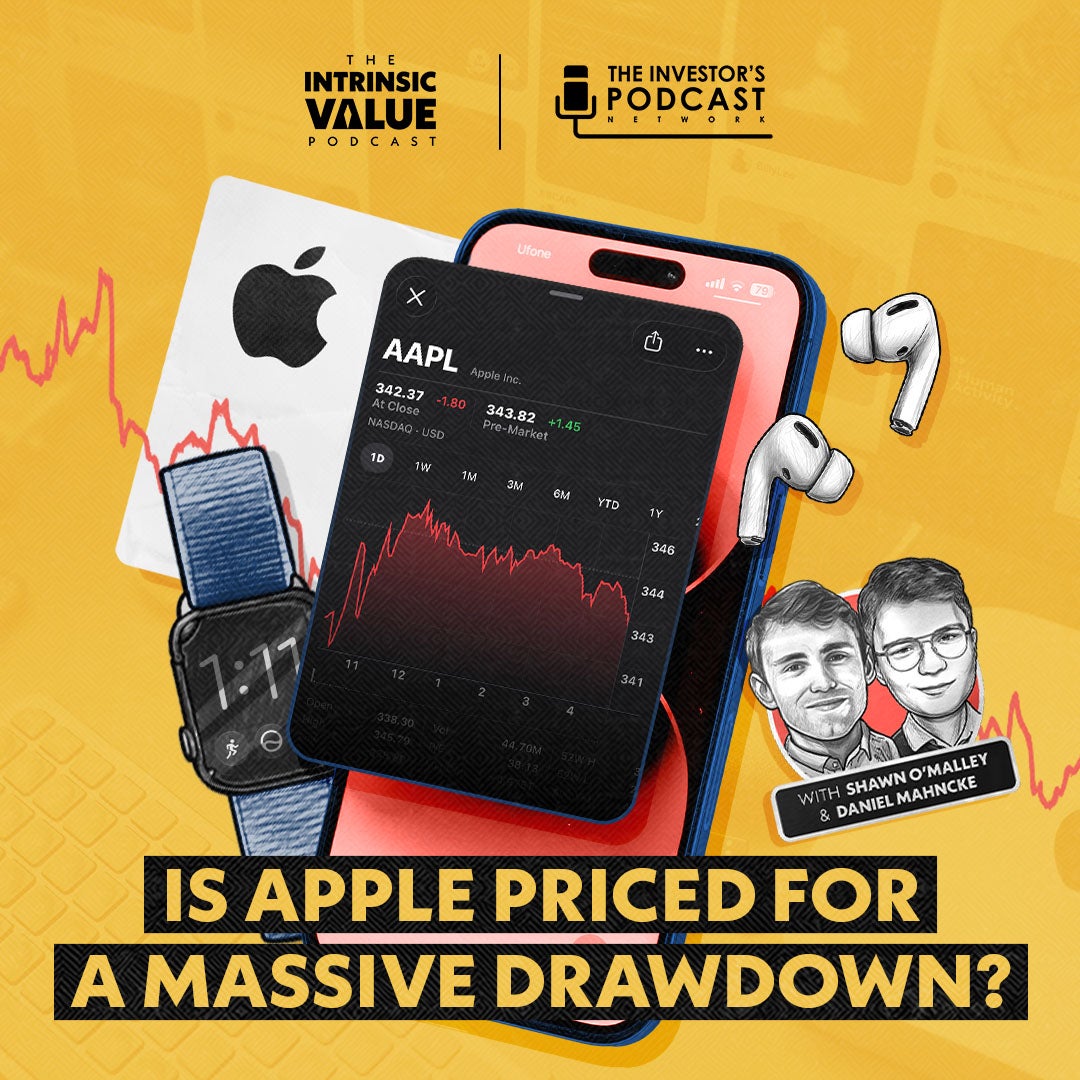
Episode topic: Whether Apple (AAPL) is fairly valued or vulnerable to a “massive drawdown,” given its premium valuation, AI strategy, and services economics. Hosts argue Apple has strong ecosystem lock-in and services margins, but faces risks from AI capex competition, potential App Store take-rate declines, and supply constraints (notably memory).
Daniel Mahncke and Shawn O’Malley (hosts). No other guests are interviewed in the transcript.
Both are value-investing podcasters/analysts discussing Apple and other “Mag 7” firms; they reference Daniel’s intrinsic value portfolio work and prior episodes covering Meta and Alphabet.
0:00Shawn O’Malley: If you held Apple at any point in the last two decades, you would be very happy with the performance that you have in your portfolio today. Buffett notoriously never had a more successful investment in absolute dollar terms.
0:11Daniel Mahncke: The question is whether investors in 10 or 20 years can say the same. Apple is the most valuable company in the world and trades at a pretty hefty multiple. And we even had conversations with members of our investment community who mentioned potentially shorting the stock.
0:25Shawn O’Malley: Well, we tend to avoid shorts in general, but I definitely needed to look at Apple and figure out whether the market is right and Apple is a buy or whether it's actually an obvious short at these valuations. And that's what we'll figure out today.
1:13Shawn O’Malley: And now, here are your hosts, Sean O'Malley and Daniel Munker.
1:26Daniel Mahncke: Apple is just an interesting one. I'm really excited to get into it today. I mean, we've been covering companies on this show for over a year and a half now, and we never really have come around to talking about Apple much. It just felt like everybody knows it. And, you know, we also waited a long time to pitch the other Mag 7s too. So Apple was not on the priority list within the Mag 7 for us to cover. But especially in the last few months, Apple really has stood out more and more because of their very unique stance on AI CapEx.
1:59Shawn O’Malley: I still remember one of the first episodes of the show that basically we discussed prior to recording those episodes. We don't want to cover the Max 7 immediately. We want to cover some companies that not everybody knows about. And then over time, the more companies you cover, we can get to those bigger names. And that's the point right now. And I think it's interesting because at the start of 2025, so just last year, Apple was seen as the company that had missed AI, similar to Google, actually. And the new Siri that they showed on stage in, I think it was 2024, got delayed indefinitely. And the head of AI then stepped down and actually had a dozen of their best researchers leaving for meta and open AI.
2:35Shawn O’Malley: And that was also about the time where Buffett sold a large chunk of his Apple holding around the same time. And then I would say that's mostly not because he was worried about AI and their stance in that market, but simply because the position at that point has been quite expensive, I would say. There is a person, though, who did not sell a steak, and that's Tom Gaynor. And I think, Sean, you have some exciting news to share regarding Tom, right?
2:57Daniel Mahncke: I do. I do. Yeah. So we just put together the annual plan of events for our inner circle community. And one of the headlining events will be in March. We're going to have an intimate dinner with Tom Gaynor, the CEO of Markel, an incredible, incredible company, a legendary investor. And so basically, if you are interested and you want to be able to sit down at a table of a dozen or so or maybe fewer people and have a multi-hour conversation with Tom and being able to learn from him, go ahead and head to theinvestorspodcast .com slash inner circle. You can hit pause on Spotify or wherever you're listening to us now.
3:38Daniel Mahncke: Go there and you can apply to join our Inner Circle community, which is a recurring group of investors from our audience who meet to support each other in this journey of value investing. And so anyways, the opportunity is only available to members of our Inner Circle, which is our most exclusive investment community. And yeah, we'd love to have you there. And if sitting down with Tom Gaynor for dinner sounds like something you're interested in, then absolutely go ahead and head to theinvestorspodcast.com slash innercircle.
4:12Shawn O’Malley: That's a special event. And I got to admit, I don't know how you feel, but if you would have told me a couple of years ago that I would be sitting at a dinner meeting investors like Tom Gaynor in such an intimate setting, I would have definitely not thought that would be possible. And talking about him and Apple, he did quite well not selling his day compared to Buffett because Apple turned out to be the best performing stock of the Max 7 last year. It even took back the title for the most valuable company in the world from NVIDIA, which held it for quite some time after its huge hype. But now Apple is back on top.
4:41Daniel Mahncke: I mean, a huge part of that seems to be the market increasingly being worried about AI spending. And as you said, Apple was sort of a hedge against that in a way. Apple only spent$13 billion a year on CapEx, basically. And Amazon, for context, is spending$220 billion this year alone on rolling out data centers and the like. And so Microsoft, Alphabet, and Meta are each somewhere between$130 and$190 billion in annual CapEx spending. And there are estimates from Wall Street that basically these four companies will spend more on CapEx in the next four years than Apple's entire market capitalization.
5:24Daniel Mahncke: which is$5 trillion. So we're talking about just astronomical numbers here.
5:29Shawn O’Malley: Those are incredible numbers. I mean, now we have the midterms and I think people decided they don't want to have more data centers. So we will see how that will impact CapEx in the next couple of years. And I also made the argument that perhaps it strengthens the position of companies like Microsoft and Amazon and also Meta because they have already built some capacity. But for Apple, all of that is not that important because they are not invested there. And I definitely knew I wanted to cover Apple when I was doing my research for Meta, which is a company that I personally like a lot. I have in my personal account and probably will add to it soon for the intrinsic value portfolio too.
6:00Shawn O’Malley: And the two of them seem like such an antithesis to each other right now because Meta is trying to position its glasses, which is the main hardware it currently has, as an alternative to smartphones. And it seems more and more successful with the releases. I mean, while Apple canceled the Second Vision Pro, which is not an AR, but an VR glass, and Apple is not expecting to put out any glasses before at least late 2027. And it kind of brought a new dynamic to this AI race, I would say. In one of our latest YouTube live streams, I said that I think AI could be some sort of connective tissue or glue, basically, that finally makes Matter's ecosystem work together, which it didn't do for a very long time.
6:35Shawn O’Malley: And it's not a given yet, obviously, but it's definitely possible. And that would also mean that Matter is a much bigger risk for Apple now than it ever has been in the past.
6:44Daniel Mahncke: I feel the urge. Just jump into the AI debate here. It's very, very tempting, but we should give a proper introduction to Apple's business first. And of course, everybody knows what Apple does, but we did learn when we recently recorded with McDonald's, sometimes there is a real gap between the consumer perspective of what a business does and then how investors think about the company. And for Apple, just to name an example, there's a major difference between the profitability of its segments, which some people might not find that to be immediately obvious. But it is important to know that in order to really understand Apple's decision making and capital allocation.
7:23Shawn O’Malley: That's a good point. There were actually some things that I found out in my research that I didn't know before and we'll get to them. One important thing generally is that Apple likely generates about$470 to$480 billion of revenue this year, with roughly three quarters of that coming from products and only a quarter from services like Apple Cloud, the App Store, Apple One, Apple TV, all the stuff that we know in our daily lives. And the iPhone alone is half of the companies of 50%. And then you have the Mac, the iPad and the Warbils, which is, you know, the watch that you own, but don't use that often.
7:52Shawn O’Malley: And the AirPods that we also don't use that often, but own and all of that stuff. And each of those is around$30 billion. So basically, to your point, while services are only a quarter of revenue, they come at a margin in the mid 70s, which is an insane margin to think about, especially at their scale. And then hardware only, quote unquote, has a margin of high 30s. And that's why services generate over 40 % of the gross profits and likely even more of the net profits, despite being such a small part of overall revenue.
8:19Daniel Mahncke: And while a quarter of revenue doesn't seem like a ton, I mean, we are talking about close to$110 billion, which is more than the revenues of Netflix, Spotify, and Adobe. And because of the margin profile, Tim Cook, the now famous ex-CEO of Apple, was very keen on growing the services businesses. And so he said in 2017, he wanted to double services by 2020. And incredibly, they did it. And then they doubled it again, which is really important because iPhone sales have actually really not gone anywhere in terms of volume in the last 10 years. Apple sold roughly the same number of phones every year, somewhere between this range of about 220 and 240 million.
9:02Daniel Mahncke: And then Apple actually stopped reporting units in 2018. So those are based on estimates.
9:08Shawn O’Malley: I kind of wonder whether back in 2018, people and especially analysts looked at this as a negative sign because we talked about Reddit and also Netflix stopping to report certain metrics. And we saw that as a negative. And then it's always, it can turn out both ways. Either it's actually negative or the company is trying to push you into the new direction that the company is going. I think everybody would agree now that for Apple, This wasn't a negative factor at all. But if you're the strongest consumer brand in the world, part of why it's not negative is you will likely find a way to grow the business.
9:35Shawn O’Malley: So while volume was more or less flat since then, iPhone revenue actually went from$155 billion back in 2015 to over$200 billion, to be exact$210 billion last year. And that was primarily due to price increases and also the fact that you just released more iPhones and versions of iPhones whenever they come out. And I should say, and this is the part that I found quite surprising, and we'll talk about it later, Apple didn't take much price with its iPhone. So this is primarily an inflation adjustment at best, and they're not using the pricing power they undoubtedly have to sort of gouge the customer.
10:08Shawn O’Malley: And the margin increase seen under Tim Cook, because it was certainly there, is almost entirely mixed with. So you see more services and less of the product. And he basically 20X the stock under his tenure by taking services from 11 % of revenue, where it has been 10 years ago in 2016, to 26 % today. And that caused the overall margins to increase by almost 10 percentage points and was by far the biggest impact. And then if you add to that$850 billion that they spent on buybacks, that's how you get to a stock that basically 20Xs over that time period. Of course, we should also add it helps if the multiple keeps expanding, which it did for Apple.
10:44Daniel Mahncke: It's interesting that the price increases have not necessarily even been obvious to consumers in some way. And so I I don't know if it's similar in Germany, Daniel, and Europe more broadly, but in the US, 75 % of iPhones are sold through carriers, namely Verizon and AT &T. And they sell you the phone on these 24 or 36 month plans, usually with zero interest, which is great. Bundled into your monthly bill is sort of how it works. And so a$1 ,200 phone shows up as maybe$33 a month next to a$90 cell phone plan. And then on top of that, you get maybe$800 or$1 ,000 worth of trading credits for your old phone, depending on how old it is.
11:25Daniel Mahncke: And if you sign up for more than three years, usually is the lock-in. So basically, cellular carriers give you new iPhones as bait to try and win new customers that are locked into multi-year cellular contracts. So in many cases, Apple isn't actually selling to the consumer directly, but to these cellular carriers, AT &T and Verizon, who are paying full price. So the average customer never experiences Apple's price increases as really direct price increases. They just realize that their monthly bill goes up by a few dollars. And Apple actually started doing a partnership this summer with Klarna, where you lease the phone and swap it every year.
12:06Daniel Mahncke: And Klarna is a buy now, pay later company. So it's getting easier and easier than ever to be able to finance and purchase an iPhone.
12:15Shawn O’Malley: Sean, you had to tell me when you were a kid, was I the only one who thought that an iPhone cost$0 when there was this advertisement that you could get the phone for$0? Because I definitely couldn't understand how my mom doesn't get me the new iPhone if it literally doesn't cost anything. So by now I figured out that unfortunately it does cost something. And I also figured out that you don't get a lot of money if you give up your old iPhone. When I was giving up my, or trying to give my iPhone X to buy the new one. Apple told me I could get 25 bucks for it. So that was not a huge relief to buy the new phone.
12:43Shawn O’Malley: And that's why I still have the iPhone X as, you know, the backup iPhone, just like you have the MacBook Neo. But, you know, getting back to the partnership, I think was only a matter of time before Klarna and Apple partnered. Not necessarily because Apple would need that funnel, but as you said, everything that makes it easier to bring your phones to the consumer is a huge plus for Apple. And the strategy overall has not been to sell as many iPhones as possible at the best price, but primarily to increase the ecosystem, get more of the hardware into people's hands, and then sell the services.
13:11Shawn O’Malley: And what's interesting, by the way, is that for most of the last decade, and this is what I'm getting at, Apple didn't increase prices at all. So you talk about an iPhone that costs$1 ,100, that was the iPhone 17 Pro, for example, and that's about$890 in 2020 dollars, so adjusted for inflation. So that was basically cheaper than the$999 iPhone Pro that you could actually buy in 2020. So inflation adjusted, Apple didn't increase prices at all. And the main reason is what I just said that they wanted to focus on services. So getting as many iPhones into the hands of consumers and then make money with the high margin segment of the business.
13:46Shawn O’Malley: Now you've actually seen, and they just talked about in the last earnings call, they will increase prices simply because of what you see with memory prices starting to go through the roof. So they actually start taking some price there mid cycle, which is the first time that Apple is doing it. And I think if I had to summarize Tim Cook's tenure, he, I would say, did a phenomenal job managing Apple as a mature company. But I would also say that Apple's innovative power arguably has significantly declined. So the last new and successful product, I would say, have been the AirPods. And that was 10 years ago.
14:16Shawn O’Malley: They still feel quite new, but it's an entire decade ago they pushed them out. And that didn't come back to haunt them yet. So when Cook took over in 2011, Apple was worth about$350 billion. Now, as we said, it's worth$5 trillion. dollars. So revenue went up four times and profits went up even more. But I would say that a lot of people think Tim Cook didn't do enough on the innovative front.
14:36Daniel Mahncke: Come on, Dan, you don't think the Apple Vision Pro headset was a big enough hit?
14:42Shawn O’Malley: Well, I think especially if you compare to the Meta Glasses, they could have done better. Yeah, yeah.
14:47Daniel Mahncke: No, I think that's fair. I think that's fair. And, you know, it's interesting because I think Apple as a business is, they've always wanted to be more of a services company than they are, even though it's a massive part of business. It's really not the defining feature of their margins. And still, I think Tim Cook has been very successful in optimizing Apple financially. It's almost ironic that the CEO who created more shareholder value than any other CEO, with the exception of Jensen Huang of NVIDIA, perhaps, has nowhere near the same sort of reputation as many other tech CEOs out there. You know, people don't talk about Tim Cook in the way they talk about Mark Zuckerberg.
15:29Daniel Mahncke: And maybe it is this lack of vision that people attest to him, right? I mean, he maximized service revenue when it was the right time to do so, I think. And he smartly concentrated supply chains in China as a way to bring down costs and boost efficiency and doubled down on the app store being this toll booth, which has been incredibly profitable. But under him, it is fair to say Apple stopped being a place for serious innovation. I mean, the Vision Pro was interesting, but I don't think I've ever seen anybody in real life walking around using a Vision Pro or gone to somebody's house and seen them using it in their house.
16:06Daniel Mahncke: I don't know who they sold them to or where they sold them, but they don't seem to be in the real world. And if you ask me whether I wanted to invest in a company, though, with either Tim Cook's capital allocation approach or Mark Zuckerberg's, despite the criticism on innovation, I would want to probably go with Tim Cook. And maybe that'll haunt me in a couple of years. I think we'll talk more about the Meta bull case and how that might play out today. But still, Tim is a very practical operator who did a great job over the years creating shareholder value. And actually, in your Meta episode, you talked about how Meta's ecosystem seems much stronger than ever before, while Apple's didn't really stand to benefit from AI much, which is sort of crazy when you think that there are 2.5 billion active Apple devices worldwide for them to roll out, as they call it, Apple intelligence as their play on AI too.
17:05Daniel Mahncke: And despite the iPhone buyer base really being flat and not growing, there was growth of about 150 to 200 million devices a year in the last couple years because many people keep the old phone as a backup they give it to you know maybe a kid or they sell it or they you know acquire more of these you know wearable devices to complement what is kind of like i see the core product ecosystem being maybe your iphone and your mac it's quite interesting
17:33Shawn O’Malley: because that's exactly what happened with the iphone x when i kept it i didn't need it because add a new one and then it just gifted it to someone and that person actually afterwards bought AirPods. So you now have someone who has an old iPhone so they didn't spend money on a new one but you have them in the ecosystem. So now they use the App Store, they buy some of the wearables so that's how the ecosystem grows even though you don't sell many new iPhones to new customers and again like as long as people stay in the ecosystem that's something that's unique to Apple. Meta and Google have that reach too but Meta reaches its users through for example an iPhone or maybe an Android phone.
18:05Shawn O’Malley: And Google doesn't control Android the same way that Apple does with their phone and their systems. It's not exactly a one-to-one comparison. And we talked about that in much detail, I would say, in our meta episode a couple of weeks ago. And that customer base is unsurprisingly incredibly sticky. So I read that close to 90 % of people who bought an iPhone last year were replacing an iPhone. So just anecdotally, I think I don't know a single person who switched from an Android to an iPhone and then switched back at any point. So I know a lot of friends who, just as I as a kid had an Android phone.
18:35Shawn O’Malley: But once they started using an iPhone, they never switched back. And again, I don't have strong feelings for Apple, at least I think I don't. As you said, maybe I do. But Apple is so incredibly good at creating that customer lock-in with their ecosystem that it's just amazing. And I can just quickly air drop something from my phone to my Mac or my iPad, which I unfortunately always have to do when I do my taxes. And then you have all your photos in the iCloud. And if you, for example, have a watch, you can just connect everything. You have your watch, you have your MacBook, you have your iPad and then obviously your iPhone too.
19:03Daniel Mahncke: I think for me, the closest I've ever come to leaving Apple was simply just switching my headphones from Beats to Sony because the Sony had better noise canceling. But I mean, really that's about it, right? All of the photos from the last 15 years of my life are stored in Apple's cloud. And I've used a Mac since high school. So even just learning to use another computer, I think would be a hassle for me. And I'm certainly not switching off my iPhone anytime soon. That would be insane, Daniel. And there's a ton of value. And at least for me, and having my computer and my phone perfectly synced up, I basically used my computer as an extension of my phone.
19:41Daniel Mahncke: So for me to switch computers and kind of sever that relationship that I have with my Mac, I mean, there would have to be something that was going off kind of the innovator's dilemma, something like an order of magnitude better for me to make that switch.
19:59Shawn O’Malley: I think a huge thing for Apple, and we talked about this in some episodes in the past, is this difference between a minimum viable product and the best product possible, where Apple, you just know you get the best thing out there. And the iPhone Duo is actually a good example of two things. First of all, that you get the best product out there. And also, how you can make more money with iPhones today than a couple of years ago if they don't take price. Well, you just put out new iPhones that are more expensive because they offer new things, right? For example, the iPhone Duo sold for$2 ,000 and sold out in the pre-orders within 30 minutes.
20:29Shawn O’Malley: So there's a lot of demand for even the most expensive iPhones. And the more interesting part of customer lock-in is what it means for pricing power in the services section. So again, not raising the price on iPhones, but on everything that comes with it once you're locked in. And Apple reports services as basically five buckets. So they talk about advertising, they talk about AppleCare, about cloud, and then about content and payments in general. And I would argue that the two most important segments are actually sitting within them and are not reported themselves standalone. So the first one would be the App Store, which, as we all know, historically took a 30 % fee on all digital goods sold through the apps or in the App Store itself.
21:06Shawn O’Malley: And then Apple doesn't disclose the number today, but it's probably a quarter or even a third of the entire services bucket. So it's a huge part. And then what we discussed in our Google episode, Google pays Apple to be the default search engine in Safari. and Google initially paid Apple, which is kind of interesting, I didn't know that before, just$1 billion. And that was in 2014. And then they bumped it up to$15 billion seven years later in 2021. And then by 2022, they had reached the$20 billion payment that they're now still paying it. That's another 20 % of services revenue. And because there's no cost against it, it's a much bigger share of the services profits.
21:41Daniel Mahncke: It's been a controversial arrangement. And it's one of these contracts that was under a lot of scrutiny when we were looking at actually Alphabet. And even earlier than that, it started in 2024 when a federal judge ruled that Google is a monopolist in search. And the main evidence was these payments to Apple. And so the DOJ wanted them banned outright, which would have cost Apple$20 billion overnight. That would be a pretty painful loss on the revenue side. But in September 2025, the judge's remedies actually ended up being a whole lot softer. And so they decided Google can keep paying Apple this fee and the deals just they can't be exclusive.
22:21Daniel Mahncke: They're limited to one year terms and Apple is free to promote rifle search or AI products, even though I think implicitly nothing has really changed. This episode is brought to you by Fiscal AI. Fiscal AI is a modern financial data provider for global stocks. We use fiscal AI all the time for this show, and I can tell you that it has truly become foundational to our research process. With 20 years of financial data on any company, as well as earnings calls, transcripts, news, hedge fund letters, and much more, they are truly a one-stop shop for investors. And this Black Friday, they are offering 25 % off all their products.
23:01Daniel Mahncke: Whether you want a successful web-based research terminal or a financial data MCP to connect to. Claude, both products will be 25 % off from November 25th to the 30th using our link, fiscal.ai slash T-I-V-P. Again, that's fiscal.ai slash T-I-V-P. 25 % off from November 25th to the 30th. The link will be in the show notes below.
23:26Shawn O’Malley: Yeah, I think the actual change of what this meant for both companies was very minimal. And actually at the same time, Apple signed a deal in January announcing that Apple's new Siri is built on Google's Gemini models. So Apple is paying about a billion dollars a year for that. And I only bring that up because it does show that, to some extent at least, they have the leverage there. Because if you get$20 billion to be the number one search engine on Apple, and Apple receives that money, and now they pay Google to help them with AI, but they only pay$1 billion, that's not a lot of money. And you could argue that the model is worth significantly less because it's a more competitive space, I would say, than being the number one search engine on Apple, which obviously there's only one spot.
24:04Shawn O’Malley: And I could imagine that Google gives Apple a great deal here too on purpose because as long as Gemini is that cheap, Apple has no incentive to ever seriously try to build its own frontier model and basically just license the one that Google has. And that's kind of similar to what happened in Search, although I would personally argue that Google's mode in Search has been much wider than its competitive advantage in AI has ever been. And now we all know that Gemini is probably one of the weaker models compared to OpenAI or Anthropic. And just one last thought on the search deal. What I found interesting, we talked about it back then when the judge made this decision, they could have just stepped away.
24:39Shawn O’Malley: And I mean, Google, when I say they, and basically start paying the$20 billion after the ruling when there was so much scrutiny about the payment, but they didn't do it. So to me, that says that they get a whole lot of value from that deal to want to pay Apple those$20 billion, even now that we discussed it, traditional search is likely a business where the terminal value, at least, is very questionable. So the fact they didn't do that shows they're quite confident this deal is still worth it.
25:04Daniel Mahncke: Well, speaking of lawsuits and Apple services business, how about we talk about the Epic Games lawsuit? Or I don't know, do you want to go straight to the AI debate? Or I think it's worth lingering on Epic Games.
25:16Shawn O’Malley: I think it is. I mean, the case is still going on. So I think we should go there quickly. So for anyone who hasn't heard about it, Epic Games, which is probably most famous for Fortnite, the game, sued Apple in 2020 over this 30 % fee that they take on Apple Store payments and also the limited ways to link people to their own site. So basically to not go through the App Store, but through Fortnite site, for example, standalone. And the judge ordered Apple back then to let developers link to lower prices on their web pages. And then Apple complied by charging 27 % on those links, which obviously makes it all quite useless.
25:50Shawn O’Malley: And then in April 2025, the same judge held Apple in contempt and banned any commission on link outs. The appeals court said that Apple can charge what they call reasonable commission. So that's not zero. And now the case is with the Supreme Court. So there will be a ruling this summer and maybe we'll get a glimpse of what it could look like if we look at Europe, because the commission over there fined Apple half a billion dollars and then Apple changed its terms to 26 % when Apple payment is used, 20 % when the app is basically having the payment on its own website. And then for link outs, where Apple has basically nothing to do with that anymore, it's 5%.
26:24Shawn O’Malley: So then if you distribute outside the app store entirely, and Japan basically passed the same law. So I think that's what you could expect, even in the US, maybe a bit more mild than that.
26:34Daniel Mahncke: I just shows how much power they have that they can still get paid 5 % when this is happening outside of the app store entirely. That's pretty incredible. So I mean, what is happening though, is that the take rate is going to go down slowly, and it might end up at something closer to 15 % than the 30 % that we've seen in the past. And that is already starting to show up in the numbers. Third-party trackers have U.S. App Store consumer spending down about 6 % in June, from what I've seen, after it grew close to 10 % a year earlier. And there are even estimates that put Apple's U.S. Commission revenue down close to 20 % this year, which is massive.
27:11Daniel Mahncke: And since the App Store is such a major part of the entire services business segment, we saw service growth slowing recently, unsurprisingly, where last quarter it decelerated from 16 % growth to 12%.
27:26Shawn O’Malley: And the CFO actually pointed out that the App Store take rate was a huge problem and basically one of the reasons for that shift.
27:32Daniel Mahncke: Yeah, it's an interesting dynamic that Apple is so popular with consumers. But for a long time now, it really has not been popular with developers.
27:42Shawn O’Malley: Yeah, and I mean, we discussed it with some other companies too, where for the longest time in this case, Apple didn't need to worry about that. So if you were a developer, you basically had to be in the app store. Otherwise you just massively limit the reach of your app. And while I don't expect that to change anytime soon, I think developers definitely have an incentive now to switch as soon as it would be possible. And whether that's Meta or anyone else, I think that's an open question, but there at least is the incentive. I know that back when Meta first rolled out their sort of own app store and what they spent$80 billion on this metaverse, there were few developers actually switching.
28:15Shawn O’Malley: So I think it's a way more sticky business than some people might imagine, but you know, it's possible. And it also kind of reminds me of Adobe, which is famously hated by many people in the industry. Although I should say probably it's a small but loud group that actually hates Adobe. And usually that's not where you make your money. In this case, for example, for Apple, it's most important that they keep the reach in the app store because as long as most people spend their time there, developers have no choice. They got to be in the app store because that's where your app gets downloaded. And if you pay 30 % for that, or 20 or 15, that's the deal that you got to pay.
28:49Shawn O’Malley: And again, those small groups, if they grow, they can reach a tipping point when the environment changes. And then there's a new wave of competition coming in, which in this case, if it should ever happen, is most likely AI powered competition.
29:02Daniel Mahncke: Well, we've been dancing around Apple intelligence and AI for long enough. How about we get to their AI strategy, or maybe I should say their lack thereof strategy.
29:15Shawn O’Malley: Well, I would actually say that after looking into it, it might not be a lack thereof. It might even be, you could say, the most deliberate AI strategy in the whole Mac 7. The question is only, is what Apple is currently doing the right call?
29:27Daniel Mahncke: At least in the beginning, it was a bit all over the place. I think we can agree on that. In mid-2024, Apple debuted a new Siri on stage that could see what's on your screen and act across your apps and said it was coming within a year. And in March, 2025, basically, they delayed that indefinitely, which sounds more like something Google would do, not necessarily something Apple would do. But the software chief at Apple later admitted that the old approach didn't quite converge quality wise, which is a very diplomatic way to put it. And before the team could really build something that did work, Apple experienced a very significant brain drain that I I do remember seeing the headlines due to basically Meta making this massive effort to poach its talent.
30:11Daniel Mahncke: So Ro Ming Pang, who ran the foundation model team, first left for Meta on a reported$200 million package. Just like a pro athlete sports deal before joining OpenAI a couple of months later. And then about a dozen more would then follow him to Meta, OpenAI and also Anthropic as well. And then in December, the head of AI at Apple retired. So it just seems like there's a time when Apple wanted to be maybe more of a player in AI, and it just absolutely did not work out for them. And what's less talked about is that the brain drain really didn't just stop at AI researchers. OpenAI has hired more than 400 former Apple employees, and a lot of them are from the hardware side, led by Tang Tan, who used to run product design for the iPhone and the Apple Watch.
31:02Daniel Mahncke: And that's the first time in Apple's history that a competitor has gone after its hardware and operations people at any kind of meaningful scale like that and had success. And Apple reportedly started doing basically these out of cycle retention bonuses to its iPhone designers to try and stop the bleeding. And Apple even went as far as suing OpenAI and TAN for trade secret theft just a couple months ago.
31:25Shawn O’Malley: I don't know how you feel, but I think it's quite a good time to work for one of those companies. I think OpenAI paid salaries in stock and options worth about$1 to$1.5 million per employee. And then, as you said, Apple had these bonuses where they basically ranged from$200 ,000 to$400 ,000. They were investing over four years to then ensure that people will actually stay at the company for a longer time. And despite that, you can actually see that, you know, Apple is paying significantly less than competitors because they didn't want to enter any cost wars even here. So ultimately, I think that's part of why they moved away from trying to do AI on their own, at least for now.
31:59Shawn O’Malley: And to be precise again about the Gemini Siri deal, because I think it's important, the small models that run on the phone itself are still Apple's own models. So they're not entirely out of the race. But what's built on Gemini is the big model in the cloud that handles all of the hard requests. And then Apple is basically doing its own training on top of that model. So Siri is still an Apple product, but it's kind of based on rests on the Google Foundation. And under this new partnership, Apple also rebuilt Siri AI from scratch. and it was released in September of this year. And then the reviews are, well, I would say they're quite mixed.
32:31Shawn O’Malley: So some people say it's a major improvement from the older version. And then others say it's still quite far away from any of the other LLMs or basically the agents out there. And that said, I think you probably shouldn't compare it to Cloud or ChatGPT. I think that's just not fair. I think the strength is not in having the strongest ad running the system, but more about the context that Apple can deliver just because of everything it knows about you in the ecosystem. And unfortunately, as so often, I can't test it myself since it's only released in the US and Canada for now. And it may actually be a long time before it comes to Europe, because when I did my research, it seems that the commission's position is that any assistant, not just Siri, should have the right to your personal data and your apps, which Apple obviously refuses because then they would give away a whole lot of valuable data.
33:17Daniel Mahncke: Between booking guests, coordinating with the team and answering listener emails, My inbox doesn't shut off when the workday ends. I'd sit down to dinner and I'm still thinking about the thread I never answered. Superhuman Mail fixed that. It is the most productive email app I've ever used. And it's part of the Superhuman Productivity Suite. So it works inside the tools and sites I already use. My go-to feature is Ask AI. Instead of digging through a month old thread for what a guest said, I just ask and it pulls the answer in seconds. And on the mobile app, write with voice turns what I say into a polished draft in my own tone so I can reply on the go without getting pulled back into work mode.
34:05Daniel Mahncke: Email should be a system built for the long haul, not a daily fire drill. Get back to what matters. One month of superhuman mail free at superhuman.com slash T-I-V-P. That's superhuman.com slash T-I-V-P I've been playing around with it on my phone and honestly, it is actually the first time probably in years that I've had any remote interest in using Siri. And so asking something vague like when's my next dentist appointment and then having it dig through my texts and emails and calendar. I mean, that is fairly useful. It's definitely not going to replace Claude, right? We've joked that I'm absolutely Claude-pilled for my work productivity.
34:51Daniel Mahncke: But that is also sort of the point, right? Siri doesn't need to be the most cutting edge commercial model out there for doing your work on. It just needs to know my personal stuff. And nobody has that context about me in the way that Apple does. And so we're going to summarize. I mean, Apple's bet is drastically different from any other MagSav. I mean, Google's bet is that really trying to offer the full stack, right? They want to build a model in Gemini. They want to build the chips, the TPUs. They want to own search. They want to own cloud. And they even want to own the operating system in Android.
35:24Daniel Mahncke: And then if you look at Microsoft, their bet is more enterprise focused. So they have OpenAI as a partner and Azure as the infrastructure and co-pilot included in the office product suite. And they don't have a consumer device. So it only makes sense, right, for them to focus on enterprises instead of mass consumers. And as Anthropic has shown, that actually tends to be a better market anyways.
35:47Shawn O’Malley: And then you have a company like Amazon, for example, which is completely and primarily focused on infrastructure through AWS and also their chip business, which by now is a major business that they actually start talking about more on the earnings call. And as well as improving their own business using AI and robotics, which obviously there's a whole lot of potential to especially save money, but also make the user experience better. And of course, they have a major stake in Anthropic too. So while they don't build their own model, they are involved through the ownership in Anthropic. And when you look at it, I think the pattern is that purely digital companies like, for example, Matter and then mostly digital companies like Google, especially the part of where they make the profits is digital.
36:25Shawn O’Malley: They build models because they have to win attention every single day. And a lot of that attention, obviously, in the last couple of weeks and months has been in the LLMs, the cloud, and then also chips recently. And if you think about Apple and Amazon, those are rooted in other parts of your daily life. So Apple, obviously, with the hardware and then Amazon through shopping and logistics, probably you had another five Amazon packages coming today. So for them, it's enough to access and integrate good models and they don't need to own them. And I would say the only problem with that is for Apple, these software first companies plan, almost all of them, to now expand into hardware.
37:02Shawn O’Malley: So they're basically realizing that there's an opening for a major hardware shift where MetaSpot is that it will own both the model and the next device. And on the model side, they've gone from open sourcing Lama to building a so-called super intelligence lab that came up with Meta's Muse Spark model. So the new generations and then also the Muse agents, which are sort of based on that. And the cost was paying hundreds of millions of dollars to individual researchers. A lot of them, as you mentioned, came from Apple and then hundreds of billions of dollars in CapEx commitments to build the data centers and to build the lab.
37:33Shawn O’Malley: And the idea is to basically combine those AI improvements with the device side and then especially with the glasses. And there have been more than 7 million pairs of the Ray-Ban Meta glasses sold last year. And compared to the numbers we mentioned for Apple's iPhone, that's obviously ridiculously low. But compared to where Meta is coming from, I would think it's a success if you look at it. And obviously it's about the vision behind what it could become with AI and, you know, a new platform that rivals Apple's platform. And I don't know if you've seen it, but just recently I turned on the TV and I saw this new meta ad for the glasses that, you know, has been playing at this tennis game.
38:09Shawn O’Malley: Have you seen which one I mean?
38:10Daniel Mahncke: Oh, yeah. No, it's a striking ad, right? The one at the tennis match. Yeah, I mean, what you see is basically a person sitting in the stands watching the game with meta glasses on while all the other people have their phones out to record the game. And it kind of just makes them look like lemmings. And the message is obviously that with Meta's glasses on, you can still experience everything firsthand with your own eyes while also still using your phone in a way and being able to record things. And so you're just not experiencing things the same way as everybody else for the better. And really the ad makes it pretty obvious that Meta sees glasses replacing phones in the long run.
38:48Daniel Mahncke: And that would be a very fascinating change in consumer habits and, of course, a huge disruption to Apple.
38:57Shawn O’Malley: What I like so much about the ad is that it goes back to this deeply human thing of you wanting to experience things firsthand. I know that I oftentimes don't do videos or photos because I feel I shouldn't and I should just watch and enjoy the moment. And this ad is basically going at exactly that, where you have 100 people sitting there and nobody's actually in the moment except for the person who wears these glasses because they don't need a phone and just look through the screen. So I kind of liked how it touches on exactly this part of probably like human experience. And obviously Apple used to be in that space too, which makes it so interesting to look at the two of them because Meta spends now$130 billion on CapEx, exactly 10 times more than Apple.
39:35Shawn O’Malley: If you look at the charts of CapEx and you compare Apple to all of the other players, it just looks insane. And Apple is basically saying it doesn't feel threatened by any of these AI developments and their potential connection with hardware. And most likely, at least that's my gut feeling, they're right about it. So it's incredibly hard to imagine Apple being replaced because, you know, Siri is not as good as other agents or LLMs. And the two of us are always blown away by the speed with which AI has improved and become better and how much easier it is to have certain tasks that used to take five hours, now taking only two hours.
40:09Shawn O’Malley: And I also think that's kind of the point where people use advanced AI much more as employees, and we talked about this, than as consumers, where if you have Muse, that's not successful, despite not being as powerful as Claude Fable's 5.1, for example, because they are consumers. They do not care about how efficient am I getting at a certain task. and then Apple obviously addresses consumers. So it doesn't need these top-notch models that compare to Fable. And if Glasses should ever take a share on the hardware side, I think Apple still has a good shot at just getting back into the business. I mean, the differentiator will not be whether Apple has its own frontier model.
40:43Shawn O’Malley: It will just be about how good is the hardware. And then also do you have the consumer base that wants to buy from you? And if there's one company that has a consumer base that wants to buy stuff from you, it's definitely Apple. So I think they will just license other models in a world that most likely will have multiple equally good models or at least somewhat good models out there, while the money they save on CapEx can easily be spent on paying for those licenses, even if it's more expensive than the$1 billion a year they currently pay to Google. And if you compare training a model, which costs tens of billions of dollars and basically gets leapfrogged every six months to just license it for significantly less money, I think the bet doesn't look that bad.
41:23Daniel Mahncke: I go back and forth on Apple's strategy, but I mean, it makes sense. especially after the brain drain we talked about. Maybe their hand was forced, but it does look very pragmatic comparatively. And basically we should mention though that Apple spends a lot of money on R &D, which shows up differently on the income statement than depreciation from CapEx. So it's a little bit of a financial accounting thing. But Apple is still spending a lot of money on reinvesting into their business in a way, right? So Apple's research spending is actually up more than 30 % this year to$45 billion. And so while they're really not taking part in this LLM and GPU arms race, they are spending on chips and on device models and on software.
42:09Daniel Mahncke: But of course, that's still significantly less than what their competitors are spending on this AI CapEx rollout.
42:16Shawn O’Malley: The problem, if you want to call it that, is, or at least that I have, with the GPU spending is, and I mentioned that in one of our latest live streams, that you don't know if that's growth CapEx or actually maintenance capbacks. So when I look at Amazon's latest earnings report, for example, it's incredibly bullish to hear that management thinks that AWS, their cloud business, will eventually generate a trillion dollars in revenue. And then if you just extrapolate the 35 % margin that they currently have, that would be a business generating$350 billion of profits, which is obviously incredible.
42:45Shawn O’Malley: But then the hyperscalers are also spending $600 billion this year between them on data centers. And much of that goes to GPUs. and those GPUs depreciate over five to six years. And maybe it will even get to a slower cycle when the GPUs start improving even more. So starting now, there's going to be$100 billion plus a year of depreciation hitting the income statements. And with increased investments, I think that number will only go up. And when AWS is a trillion dollar business, if it should ever reach that point, how much will it then spend on maintenance CapEx and how much has it spent on growth CapEx?
43:20Shawn O’Malley: That's all part of the equation that you as an investor have to do. And Apple seems, if not better positioned, at least much more predictable with its R &D spending.
43:29Daniel Mahncke: Yeah, which is why the market is clearly treating Apple as a bit of a safe haven to park money in. The entire AI and semiconductor space has been incredibly volatile. It's not even worth commenting what we're trading at the time of recording, because it'll probably be completely different by the time you hear this episode, just because that's how rapidly things are evolving in this market. And yet, like I said, Apple seems like sort of a safe harbor. Apple almost feels like a hedge for the possibility that AI will disappoint in some ways and not reach the highs that Anthropic and OpenAI and the Mag7 are preaching.
44:06Daniel Mahncke: And we say this before Anthropic has IPO'd, but leading up to it, there's a lot at stake there for the market. And so at the same time, if we do have a situation where AI keeps improving more and more and more and the returns really do start to pay off, Apple is at least still involved because it controls the hardware and can partner with those players to build on top of the Apple ecosystem. I think that's a pretty valuable asymmetry for them to have. I mean, Apple wins when AI is less valuable than expected, but it's not like they're totally made irrelevant in the opposing scenario where AI becomes increasingly integrated into our lives and Apple is still in a strong position to be an intermediary of that.
44:55Shawn O’Malley: There are some disadvantages, though, that they already feel by not spending the same amount of money. So for example, for the last 20 years, Apple was the most important customer in the world for chips. So it was pretty much the first customer on every new TSMC process. And it prepared to fund TSMC's largest customer. And it got whatever capacity it wanted and needed when they had a new iPhone coming out. And that has certainly changed. NVIDIA is now TSMC's largest customer. And the AI chips from NVIDIA, AMD, Amazon, and Microsoft all want the same 3nm capacity that also Apple needs for their iPhone.
45:28Shawn O’Malley: And so the result is that Apple has been supply constrained over the last year or two, which is definitely something that you don't know from the geniuses of supply chains that work at Apple.
45:38Daniel Mahncke: Memory is a similar story, I think, right? Memory prices exploded because AI data centers take all of the high end memory in Apple, which used to lock in supply years ahead of time, really doesn't have that same priority anymore with its suppliers. And that's also why, as you mentioned earlier, Apple is increasing prices for its iPhones mid-cycle for the first time, right? It sounds like a short-term story since demand for memory at some point should normalize. But I could easily see how that in a couple of years out, it does have an impact. Apple's weaker-than-expected guidance has been due to supply problems.
46:17Shawn O’Malley: And memory prices have definitely been one of the major factors in Apple's latest Q4 earnings score, too. And there's actually a part where Ternus, the new CEO, talks about memory in itself. And probably we should just listen to it. So let's play a clip here of what exactly he said in that earnings call.
46:32Daniel Mahncke: Let me give you an overall view on memory. What we're seeing with memory pricing right now is unprecedented. And as we said earlier in the September quarter, we did see higher memory costs as compared to the June quarter, which were partly offset by the benefit of carrying inventory and lower costs on certain non-memory components. Now, for the December quarter, we expect even higher memory costs, partly offset by a few factors. So, as you know, we changed the price on many of our products, including Mac and iPad at the end of June and iPhone in September, and these price increases provided some offset.
47:05Daniel Mahncke: We also expect to see some benefit from carry-in inventory in the December quarter as well, as well as lower costs on certain non-memory components. And looking beyond the December quarter, we see the pricing for memory purchases continuing to increase. As we said before, we do believe we'll see a decreasing benefit from the carrying inventory on memory over time. And there's one more thing I wanted to add. As we work to improve supply, our manufacturing purchase obligations have increased by$33 billion from June to the September quarter, which you'll see in our annual filing when it comes out tomorrow.
47:39Shawn O’Malley: And it makes Apple even more of an outsider compared to the other Mac 7 who have taken priority seed with all those chip makers because of the amount of money they spend. So it came at a hefty price, but at least they get what they need. And I kind of feel like I repeat myself, but if AI keeps improving as it has in the last few years and potentially even achieves faster improvement, well, then Apple might lose share before they can license their way into good AI models. And I don't want to be the one bringing up the Nokia and BlackBerry analogy, since I think that they're used so often. But also, it's kind of hard to see Apple lose share.
48:14Shawn O’Malley: But we've seen that before. I mean, I don't know. It's a completely different example. But look at Nike. Nobody would have thought five years ago that Nike would actually lose market share because they were this huge global brand and everybody loved Nike. And it still happened. So completely different thing. But I just want to say that just because you cannot imagine something to happen does not mean that it won't in the near future. So for example, Nokia owned the customer in the mid 2000s and then BlackBerry has primarily focused on the enterprise customer, was pretty dominant there. And then both of them were convinced that this quote unquote new smartphone thing was a feature that they would add to their phones when it matters.
48:48Shawn O’Malley: And then that didn't work because this new smartphone thing turned out to be not a feature, but actually a completely new interface that ended up disrupting them.
48:56Daniel Mahncke: And one of the biggest paradigm shifts in consumer technology, maybe ever. But I guess we can talk about whether AI is a feature of the phone today, of smartphones today, or whether it's going to be a thing that through some manifestation replaces the iPhone as the interface, maybe when combined with glasses or some other type of wearable device. But it'll be a while before we know the answer to that. And of course, timeline matters a lot here to us as investors. Since our meta episode that we put out, I think you're more bullish on the idea of glasses than I am. But we do agree that despite all the improvements and AI, it will still be a long time before we're talking about a really viable alternative to the smartphone.
49:40Daniel Mahncke: I mean, in my opinion, the iPhone is the greatest product in the history of capitalism. So it's going to be quite a difficult thing to displace. And until then, I think Apple has plenty of chances to get things right and, you know, continue to cement its role in whatever the next platform will be for interfacing with technology.
50:01Shawn O’Malley: And obviously, we should mention that both Nokia and BlackBerry never had the same flywheel. And that's also not the same mode that Apple has right now. And I think generally we're in a time right now where the Max 7 seemed so invulnerable because they've built these insane network and scale and switching cost modes coupled with the strong brands that just made it seem unlikely that you would have the same sort of rhythm, which usually you have. That if you look at the S &P 500 top five companies, 20 years from now, most of them won't be there anymore. And it just feels so unrealistic. The same repeats with the Max 7.
50:33Shawn O’Malley: And now that AI came up, it's the first time ever that at least my gut feeling says, well, maybe this is what changes the picture of, you know, the top five of these companies in the S &P for fun. And again, Nokia never had any of those modes that these companies have. But a couple of years ago, again, you know, Google, which was this completely indisruptible business, suddenly saw its search, let's say, business model in at least jeopardy of being disrupted by AI. And then over time, you know, the market thought, okay, maybe it's good. And Google stock went up again, which was good for our portfolio.
51:04Shawn O’Malley: But now you're getting back to the same debate and you by now have this, I would say, narrative that is pretty dominant that Google search in its traditional sense is actually that, which again, two or three years ago was a pretty unlikely thing. And you would have probably been laughed out of every room in an investment bank to say that this would happen in the next couple of years.
51:23Daniel Mahncke: I definitely think that's right. And well, when we think about Apple here, I mean, what are the scenarios for them around AI that you see as being plausible, right? I mean, even if we can't definitively answer the question about how Apple's future will unfold today, of course, it would certainly help to be able to lay out some of the most likely scenarios that we can imagine and what the implications might be.
51:49Shawn O’Malley: I think we talked about all of them, but didn't yet put them into just, you know, a couple of sentences to actually figure out what it is. So I think the first scenario is that the phone stays the interface and then AI is basically a layer on top of it. So you talk to Siri, Siri does things in your apps and the apps obviously then are still there and you still buy them through the app. So in that world, Apple is completely fine. And it's basically the bet of them not spending heavily on AI playing out and being the right call. And then it licenses, for example, the intelligence for a couple of billion dollars a year from let's say Google or maybe even some other provider that runs most of it for free on your iPhone.
52:24Shawn O’Malley: And it has a whole new set of things to charge for, which, you know, there's a new business model for many things. Actually, they just make a lot of money through all of these AI apps in the App Store right now. And Cook already said on the July call that they expect iCloud to have different tiers for, for example, heavy AI users. And then remember that the judge in the Google case banned exclusivity. So nothing stops Apple from selling the default AI assistant slot the same way they sold the default search slot on the iPhone. and OpenAI, Google, and Anthropik could all end up bidding against each other for that slot on Siri.
52:58Shawn O’Malley: And also iOS 27 already lets you hand general questions from Siri to a third-party assistant, which is currently ChatGPT, but Gemini and Claude supposed to be coming online soon as an alternative to ChatGPT. And Google is reportedly even asking to buy a Gemini-branded slot inside Siri. So those are just a couple of examples of how AI for Apple, despite not investing, could become a money-making machine. And there's one more way I would say that Apple makes a ton of money with AI. And that's what I just mentioned, that basically ChatGPT is the number one top-grossing app in the App Store, even right now.
53:31Shawn O’Malley: So when somebody subscribes to ChatGPT on their phone, Apple takes its 15 to 30 % commission, depending on the case. And in the world where, you know, the phone stays, the interface, and then OpenAI and ThawPic and so forth are all Apple's basically tenants in the App Store. That's a good business model to have. And in 2025, actually, Apple erected nearly$900 million, so close to a billion dollars in app store fees strictly from generative AI apps. So chat, GPT alone accounted for roughly 75 % of that.
53:59Daniel Mahncke: I think I'm going to be one of those, I can already see it now, people paying for the different iCloud tiers, one of the heavy AI user iCloud tiers. And I imagine it's not going to be cheap. But overall, I mean, it seems like Apple is just continuing to follow the good old fashioned toll road playbook, which is not such a bad thing to do. But those numbers also show how dominant chat GPT is on the consumer side, even though we've seen Anthropic actually surpass open AI and revenues pretty dramatically. And I don't want to go on another rant here about how much more I like Claude. But yeah, I mean, if you haven't tried Claude yet, come on, what are you doing?
54:37Daniel Mahncke: I would highly recommend it. It's been a game changer for my productivity to be able to use Co-Work. And I should also mention we're not sponsored by Anthropic. Anthropic, if you're listening, I would love to be sponsored by you. But we just happen to love the product. And it's truly an organic endorsement. But going back to Apple, what is the second scenario here for Apple all about that you were referencing?
55:01Shawn O’Malley: I should quickly mention that I'm still kind of proud of the fact that I transitioned you from ChatGPT to Claude many, many months ago. It was definitely a good thing for TIP to happen. But to your question, the second scenario that I could see at least is where agents basically make apps useless, or at least a significant amount of them. So think about what an actual AI agent does. So you would say, you know, book me a table at this Italian place for Friday night, and then it does it. So it doesn't open the OpenTable app, which maybe a lot of people have still used before, and it also doesn't open a browser.
55:34Shawn O’Malley: The app becomes basically a database that the agent talks to in the background. And if that's how it works, the App Store as a storefront matters a lot less than it has in the past because nobody's actually browsing a storefront. And then the commission on digital goods, which is probably a third of services right now, is definitely a threat because the transaction doesn't happen in-app anymore. And as we said earlier, for such a scenario, Apple is only getting about 5 % today. And technically, you would get zero if there's no connection to the App Store at any point of the transaction. And again, that would have huge implications for Apple.
56:06Shawn O’Malley: And you would also question who would own the agent in that case. And the answer currently does not seem to be Apple. So it doesn't look too good for them here.
56:13Daniel Mahncke: And I would add that the Gemini deal likely makes that even more unlikely in the long run, right? It's a bargain really right now. But Apple is now dependent on Google for the most important software layer on its own phone. And it's dependent on Google for$20 billion of services profit. And that's a lot of interdependence on a company you're simultaneously competing with in some ways, at least in the appeals courts. If Apple can't build a competitive model itself, though, and the talent exodus and lack of investment suggests that that is the case, then really this billion dollar bargain today could become whatever Google wants to charge in five years.
56:52Daniel Mahncke: And that would be a real liability for Apple. Google would have a lot of leverage over them.
56:58Shawn O’Malley: There's also a more technical reason to worry about the setup right now. And that's the big jumps in agent quality over the last year didn't come from the models alone. They primarily came from how the model is wired into the software around it. And that's what people often call the harness. It's also what we often discussed in the AI courts that we have. So the companies that built both together are the ones that currently seem to win. So Microsoft, for example, initially tried the opposite where they were model agnostic and plugging in whichever model was best at the time. And by now, they figured out that focusing on one model is better since you then can harmonize the harness and the model significantly better.
57:36Shawn O’Malley: And that's essentially Apple's plan. So you would buy the model from Google and then you build the harness yourself with the Apple ecosystem and Siri.
57:44Daniel Mahncke: I mean, it's similar to the search deal, to be fair. So, I mean, it doesn't have to be a bad decision. Apple never built a search engine and that was a good decision because Google ended up paying$20 billion a year for the privilege anyway. And it's possible that that model works the same way here, where owning the customer is worth more than owning the technology. And the risk is that it plays out differently this time, given that AI is much more of a competitive space than even search has been in the last two decades. And so Google really had no competitor. And it was really pretty unrealistic for Apple to compete with them in search.
58:21Daniel Mahncke: But in AI, there is no clear winner yet. And we have actually seen Gemini comparatively underperform against other models over the last few months. So Google, in some ways, doesn't even feel like the best horse to bet on.
58:35Shawn O’Malley: That's part of the risk, obviously, that you pay a model which underperforms in the long term. Although I would also say that the market thought Google is behind by a mile two years ago. And, well, as we all know, that turned out differently.
58:47Daniel Mahncke: Yeah, in general, I think it's a bad business to be in of betting against Google. You certainly don't want to do that. But as we come back to Apple here, what is that third and last scenario about the rollout of AI and its effects that you can imagine for Apple?
59:04Shawn O’Malley: Yeah, well, I think now we have to pull up our visionary glasses because this would be basically an entirely new device. So for example, Meadows glasses and even Johnny Ives hardware device that he built for OpenAI, which looks kind of similar to the Meadows Muse charm that they put out. So basically, the idea is a completely new device. We don't yet know what it will look like, but it most likely will not have a touchscreen and does not look like an iPhone. And most of it will be decided by voice and recognition of how can you interact with an AI. And I don't think the phone would just vanish.
59:37Shawn O’Malley: But if you think about it, it hasn't been built for an AI first experience. And neither Apple nor Samsung nor any other players have shifted in that direction. Probably if you ask me, my gut feeling would be that probably Chinese competitors would be the quickest one adjusting to this new sort of AI experience. Anyway, so I think the chance of something suddenly coming up that is a much better fit is not as low as it may seem today. I mean, the glasses would be my bet. Yes, they can see what you see. They can listen while you speak and they can also respond. And it's basically the perfect device that does not only tap or swipe anything, but you can actually have your voice do everything you need and immediately see the result through your eyes.
1:00:18Shawn O’Malley: And it might sound a bit dystopian today because, you know, there is so much privacy that's sort of going away. But I would also say there are a hundred bad things about smartphones today. And in the end, the reality is that the pros massively outweigh the cons. And whenever the technology reaches that level where the pros outweigh the cons, it tends to spread quite fast and gets mass adopted. So I think there will be a point where that could be true for a new device. And again, even this scenario doesn't automatically mean that Apple loses because they have a good shot at dominating this product too.
1:00:46Shawn O’Malley: And you said they invest$45 billion in R &D. Their money is going somewhere. I wouldn't be surprised if at some point they put out glasses and they're just fantastic.
1:00:55Daniel Mahncke: Apple has a history of not being first, but better once they step into the ring. And the iPhone duo sort of proved that again recently. And as you mentioned in your meta episode, they do seem far ahead and have patents that protect their tech in many ways.
1:01:10Shawn O’Malley: Although it's somewhat questionable, at least to me, how far those patents will actually go. Because knowing how big tech is treating patents and rules in general, I have a hard time believing this would stop Apple from jumping in when they feel their business is actually critically threatened.
1:01:24Daniel Mahncke: So we're going to backpedal a little here, but it's important to make clear that we don't think that these three scenarios have the same likelihood, right? I mean, today's smartphones, especially the iPhone, are remarkable tools for everyday life. And so each new piece of hardware has to be compared to today's smartphones. And when you said that Meta sold 7 million of its new glasses, I mean, that's how many iPhones Apple sells in two weeks. And think of how many big and small changes go into each generation of them. And while an improvement has slowed down in some ways, they have become much better optimized in other ways.
1:01:59Daniel Mahncke: And glasses would really need to do an outstanding job. You know, the old rule of thumb of being an order of magnitude better to be able to replace said. Perfect voice recognition, a perfect blend between everyday glasses and being able to chime in as a tech device and not having that be weird in any type of everyday encounter where people feel like you're spying on them with your glasses. There's a lot to be nailed down before this becomes a realistic outcome.
1:02:27Shawn O’Malley: There are a lot of those details that whenever you look at a demo, things look pretty good and you only see what works. Although we saw it matter when they showed some of their glasses that even those demos not usually work. But I also remember just from everyday life when I tried teaching my grandpa how to use his iPhone, I was basically trying to walk him through it on the phone, which doesn't make it easier because now you suddenly have to explain things that you don't even see and you can't show him. And that just made me realize how many things you do just because they intuitively make sense or they feel right, but you don't know exactly what you're doing.
1:02:58Shawn O’Malley: So it's hard to explain it. And honestly, I think this is one of Apple's greatest strength where iOS feels so intuitive. So for glasses or any other device to become a mainstream solution, they would need to be as intuitive as smartphones and especially iPhones feel nowadays. And usually that takes a lot of time and a lot of optimization. And you got to nail the timing too, where if you put them out too fast and people don't like them, they might not give them a second chance. And that's at the same time an argument for glasses, because I think the powerful thing about them is there is so much less to optimize on a screenless voice-only device.
1:03:32Shawn O’Malley: And I should mention for the sake of completeness, again, Apple is spending money on R &D and there are rumors about Apple's own plan for smart glasses in late 2027. We don't yet know much about it, but potentially there will leapfrog a new generation of glasses.
1:03:47Daniel Mahncke: Where does that, if I put you on the spot a little bit, Daniel, I mean, where does that leave you on AI for Apple?
1:03:54Shawn O’Malley: Well, I think it's pretty clear that Apple has made its decision on how to play AI. Now, there's no way going back. You can't outspend any of their competition anymore because you spend hundreds of billions of dollars less than each other individual competitor. So choosing Gemini and then making also its hardware chief, the CEO, feels very much like doubling down exactly on that sort of AI strategy that we discussed today. And for Apple, I think that's a reasonable bet because Apple can be wrong about AI, and you mentioned before, and still be a wonderful business more than any other of the Mac 7 companies that need to be successful here much more than Apple.
1:04:32Daniel Mahncke: And this has mostly been Tim Cook's decision, right? But now John Ternus needs to manage it. So we should talk a little bit more about who Ternus is. And for context, Tim Cook stepped down on September 1st, and John Ternus is the new CEO, and he joined Apple all the way back in 2001, originally as a product design engineer. And he ran hardware engineering for the last decade. So the iPad, AirPods, the Apple Watch, and the Mac transition to Apple ships were all something that he oversaw. So after a product guy was Steve Jobs and a supply chain guy in Cook, Apple is now run by a hardware engineer.
1:05:12Shawn O’Malley: Again, it's a pick that pretty much on lines, the AI strategy we explained in this episode, although I would also say that we just don't know a lot about him right now. So Hugo was on the last two earnings calls that I've listened to. He was basically there as CEO elect, and he didn't say too much. The one real decision that we've seen from him so far is that he killed the second Vision Pro within weeks of getting the job. And now, just a few days ago, we actually had the full first call with him as a CEO. And I think he did a good job, but it was nothing world moving that he announced there. He's paid close to$60 million a year.
1:05:45Shawn O’Malley: So that's a good paycheck. Although almost all of it is in stock and three quarters of it is tied to Apple's performance against the benchmark index, which is the S &P 500. And what's a bit more unusual to me in this entire new setup is that Tim Cook didn't leave. He stayed on as executive chairman, which is a normal thing, because usually you don't leave the company immediately. You're there to still give advice and give recommendations. But Tim Cook is being paid$45 million in an equity package for that job, which is, as you would know, enormous for a chairman. So that in itself tells me he's most likely still having to have a say in how things are going.
1:06:22Shawn O’Malley: And then the other thing I would flag is how much of the top team has turned over. So in just 18 months, Apple changed its CEO, its COO, its CFO, its general counsel, its head of AI, and its head of design who left for meta. So even the head of Chips reportedly told Cook that he was thinking about leaving and then he was promoted in order to keep him at the company. So long story short, tournaments will have a lot to do with just setting up and coordinating this completely new team.
1:06:51Daniel Mahncke: It's a long list of departures. And in a way, it's not so different from what we've seen at Berkshire, honestly. When the same team has run a company for 15 years or longer, and now they're getting into their 60s and 70s. I mean, you're not going to get an orderly one at a time succession. You sort of get the whole generation leaving at once. And I don't think that's a red flag on its own, but we won't know for years whether the next generation is as good. And if we pivot to another note here, one thing we haven't talked about so much is China. And China is about 17 % of revenue and reflects most of Apple's manufacturing.
1:07:31Daniel Mahncke: But Apple's position there has been very volatile. And so the company Huawei is now number one in China, growing about 20 % a year in what's actually a shrinking smartphone market with its own chips and its own operating system. They're basically the only company in the world that has successfully copied the Apple model and is now dislodging Apple locally. And now also is the government on its side. And so, yeah, in China, Apple is very much number two.
1:07:58Shawn O’Malley: Although we should say that Apple had a couple of fantastic quarters in China right now. They're up more than 30 % year over year, closing the gap to Huawei again. So probably one of the reasons why Cook has this$45 million contract as executive chairman is because he essentially built the entire China business. So he's the one with the best connections and also the know-how on how to do business there. The other big thing he was known for is that he was very good at paying shareholders back their money. So since 2012, when Cook reinstated the dividend and started the buybacks, for which Apple is now quite famous, Apple has returned more than a trillion dollars to shareholders.
1:08:35Shawn O’Malley: And that's over$850 billion of just buybacks. And then every spring they announce another$100 billion or so, and then they spend it. So the share count is down about a third since 2016, which at that scale is incredible. And it also means that every remaining shareholder owns a third more of the company than he did 10 years ago. And then the dividend by comparison is a pretty small factor, but still a bit more than a dollar a year, which is a yield of less than half a percent. but you can add it to the buyback yield, which is quite a good result.
1:09:03Daniel Mahncke: And that's how you get to revenue growing around 6 % or 7 % a year in the last decade. But earnings per share grew at 11 % a year. And the five points between revenue and earnings per share is a mix of margin expansion. So more of each dollar converting to profit and then buybacks, reducing the denominator in that earnings per share calculation. And so Buffett often praised Apple for its buyback discipline, But he did sell a large chunk of his holding in the company in the last two years. And part of that is undoubtedly because Apple is trading at a hefty multiple given its growth. And Apple is now buying back stock at 40 times earnings, which is something we're sort of allergic to as value investors.
1:09:44Daniel Mahncke: And that's a free cash flow yield of under 3%. And if we look back in 2016, it was buying back shares at 12 times earnings, which is a very different return on that buyback spending. And I don't know what else Apple should do, though, with that$100 billion a year. I mean, they're not putting into AI CapEx, and I guess they could dividend it out, but it's sort of a high-class problem to have.
1:10:09Shawn O’Malley: It's the same problem that we also discussed with GE. So the share cannibal is only great when the shares are actually cheap. And I mean, technically, Apple's own cash earns about 4 % in treasuries right now. So on pure arithmetic, they would probably be better off piling up cash than buying their stock at this price. And that probably wouldn't be a popular choice since it's a factor for Wall Street to say, hey, if we keep buying back our own stocks here, it does mean that we don't think the company is overvalued. And I think generally it's something that I like more than just spending money on stuff that you don't need just for the sake of spending money.
1:10:43Daniel Mahncke: So with that, we have sort of, to some extent, spoiled what we think of Apple's valuation. But nevertheless, we should go into the valuation model and try to make a fair effort at estimating the fair value and intrinsic value of Apple.
1:10:58Shawn O’Malley: While we might have spoiled a bit, I think that everybody already knew we will likely see Apple as overvalued at today's price. I mean, it's a fantastic business, but you're not paying up for growth. But for Apple's brand and also the consumer mode and to some extent, the fact that they're not spending money on AI, which is fine, but not necessarily what we want to see. So otherwise, we could have probably also bought companies like GE, MS, and so forth, which were all a bit too expensive, but fantastic businesses. So because of that, I'll keep the model quite short today. I basically split the business up into its five main segments.
1:11:29Shawn O’Malley: So you have the iPhone, you have the Mac, you have the iPad, you have the wearables, and then you also have services. But I gave the entire hardware business a margin of 30%, and then the services business a margin in the mid-70s, because that's what we usually have seen historically. And then in terms of growth, I have services growing at like 10 % and then hardware in the mid single digits. So considering that Apple keeps buying back shares, that would still result in 10 % EPS growth, which I believe is realistic, but I also think it's quite low considering the huge amounts of money Apple is putting into these share buybacks.
1:12:01Shawn O’Malley: You still only have 10 % EPS growth, and that's certainly not worth a 40x multiple. And at that point, again, it primarily comes down to the multiple you want to pay for the business. And I might not appreciate enough what a fantastic business Apple actually is. Although I feel I know it because I have all this Apple stuff right in front of me, but still I would probably only want to pay a mid-20s multiple for Apple. And if that's the case, you would get a fair value of about$250.
1:12:29Daniel Mahncke: That is a condemnation of the current share price, Daniel. If you were going to actually add a margin of safety to that too, I mean, you would probably want a price closer to$200 given the uncertainty around Apple's AI bet. And yes, I mean, for me, it's a pass at this price. And I mean, don't get me wrong. It's an incredible business. We talk a lot about using consumer insights to shape how we think about things as investors. There are limits to that just because we love the product does not mean we're going to buy the stock at any price. And if we get a crazy market sell-off, and this would wipe out trillions of dollars in market capitalization, so there would be blood in the streets.
1:13:08Daniel Mahncke: But if we did ever get the stock at a price closer to that$200 range, I would be very excited to take a look at Apple. And I recognize that that's a long way for it to go and probably not super likely to happen. But right now, you're paying a premium for a company that is growing in the mid single digits, the brand new CEO, a huge question mark around AI, rising input costs. And there's just so much more uncertainty than I think is reflected at this multiple. And we're not the types of investors to short things, though, of course, even if it's overvalued, in our opinion, you do have this very sticky customer base and a company that's buying back$100 billion a year of its own stock.
1:13:51Daniel Mahncke: So I would not want to bet against that in the short term. And the problem with shorting is that an expensive stock can stay expensive for a whole lot longer than you can afford to be wrong. And people have been calling Apple overvalued for years and it's kept grinding higher anyway. So I don't want to be on the other side of that trade, at least not for now, but very happy to sit on the sidelines and not make any investment decisions on Apple.
1:14:17Shawn O’Malley: I definitely won't bet against Apple, but you also saw me, especially over the last year, which is why we didn't cover it up until now, that I was saying it's overvalued. And now it's even higher than at that point. So it's not a huge surprise. I definitely wanted to look into it just to understand the strategy and also compare it to all the other Mac 7 companies, in part the ones that we even own in the portfolio. So it's far from being an attractive bet to me at these prices. What did surprise me though is how little Apple has tested its pricing power for the iPhone. So there's probably much more potential there.
1:14:47Shawn O’Malley: And yet that's definitely not worth buying the stock at these prices. And while I see how the little exposure to the data center build out and also the AI expenses is attractive to investors who believe the other Mac 7 are spending too much money and are on the wrong path. I don't believe that's worth paying a premium for that 40x multiple in the long run. I do believe that Amazon, Google, Microsoft and Meta will benefit from those investments today. Otherwise, we wouldn't be invested in Amazon and Google and I would be invested in Meta either. So even if I'm a bit scared of the GPU expenses and what they mean for maintenance cap-ex going forward.
1:15:21Shawn O’Malley: Long story short, I don't see myself owning Apple if it doesn't come down significantly from today's price. We're probably talking in the range of about$200, which would be a significant downturn for the stock. And again, with that, I would say it's probably time to close it for today. I'm glad we looked at the business and I wanna close it with a quote by no other than Steve Jobs. And he said, quote, everything around you that you call life was made up by people that were no smarter than you and you can change it. And I love that quote. I feel like it's one of the most motivational quotes out there, in my opinion.
1:15:52Shawn O’Malley: So I hope that had some value for you at the end of the episode. And with that, I would say see you all in the next one.
1:16:19Daniel Mahncke: quotes from the latest earnings calls. It is our go-to place for real-time institutional-grade data all in one spot. If you want to try it yourself, head to fiscal.ai slash T-I-V-P. And for Black Friday, all plans will be 25 % off. That's fiscal.ai slash T-I-V-P. Thanks for listening.
1:16:41Shawn O’Malley: Thanks for listening to TIP. Follow the Intrinsic Value Podcast on your favorite podcast app and visit theinvestorspodcast.com for show notes and educational resources. This podcast is for informational and entertainment purposes only and does not provide financial, investment, tax, or legal advice. The content is impersonal and does not consider your objectives, financial situation, or needs. Investing involves risk, including possible loss of principle, and past performance is not a guarantee of future results. Listeners should do their own research and consult a qualified professional before making any financial decisions.
1:17:12Shawn O’Malley: Nothing on this show is a recommendation or solicitation to buy or sell any security or other financial product, hosts, guests, and the Investors Podcast Network may hold positions in securities discussed and may change those positions at any time without notice. References to any third-party products, services, or advertisers do not constitute endorsements, and the Investors Podcast Network is not responsible for any claims made by them. Copyright by the Investors Podcast Network. All rights reserved.
1:17:53Thank you.
Daniel Mahncke and Shawn O’Malley take on Apple (NASDAQ: AAPL). In 2025, Apple was widely seen as the company that missed AI. Since then, it has become the best-performing Mag7 stock and reclaimed the title of the most valuable company in the world. Apple just closed a record fiscal year, with revenue up 15% to $479 billion on the strongest iPhone cycle in years. It spends about $13 billion a year on capex, while Amazon, Microsoft, Alphabet and Meta are spending around $600 billion between them this year. The stock now trades at close to 40 times earnings, against roughly 12 times a decade ago.
Daniel and Shawn break down how Tim Cook turned a hardware company into a toll road. Services is now a $109 billion business with mid-70s gross margins that brings in over 40% of Apple’s gross profit, and more than $850 billion of buybacks have cut the share count by a third. They explain why that toll is under pressure, with the courts pushing App Store fees toward 15% and Services growth slowing to 10% last quarter. They also cover why Google pays Apple $20 billion a year for search, while Apple pays Google only about $1 billion for the Gemini models behind the new Siri. From there, they dig into Apple’s AI bet, the opposite of Meta’s and Google’s: own the device, rent the model. That leads to the question that decides the whole thesis: does the phone stay the interface for AI, or do agents make the app economy, and Apple’s cut of it, matter less? In the end, they walk through the valuation and explain what they would be willing to pay for the stock.
IN THIS EPISODE YOU’LL LEARN:
(00:00:00) Intro
(00:00:44) About Apple’s Revenue Streams
(00:06:03) Why Services Became So Important
(00:10:02) Why Apple Doesn’t Take Price with the iPhone
(00:28:21) How Apple’s AI Strategy Differs from Competitors
(00:36:52) What Meta’s Glasses Mean for Apple
(01:10:02) Apple’s Valuation Discussion
(01:11:43) What Apple’s Stock Is Worth
(01:12:03) Whether Apple Will Be Added to The Intrinsic Value Portfolio
Disclaimer: Slight discrepancies in the timestamps may occur due to podcast platform differences.
BOOKS AND RESOURCES
If you are interested in a Community for investors to learn, share ideas, network, and join calls with experts: Apply for The Intrinsic Value Mastermind.
If you are interested in more personal meet-ups, meeting superinvestors, and discussing investing and things that go beyond: Apply for The Mastermind: Inner Circle. As an Inner Circle Member, you also have the opportunity to join us at a private dinner with Markel CEO Tom Gayner in March!
Track The Intrinsic Value Portfolio.
Portfolio Review Submit Tool.
Original Meta Episode.
Apple Investor Relations.
Check out Stratechery.
Check out our previous Intrinsic Value breakdowns: Meta, Snapchat, Trade Desk, Doximity, AppLovin.
Related books mentioned in the podcast.
Ad-free episodes on our Premium Feed.
NEW TO THE SHOW?
Get smarter about valuing businesses through The Intrinsic Value Newsletter.
Check out The Investor’s Podcast Starter Packs.
Follow our official social media accounts: X | LinkedIn | Facebook.
Try our tool for picking stock winners and managing our portfolios: TIP Finance.
Enjoy exclusive perks from our favorite Apps and Services.
Learn how to better start, manage, and grow your business with the best business podcasts.
SPONSORS
Support our free podcast by supporting our sponsors:
Fiscal.AI
Superhuman
References to any third-party products, services, or advertisers do not constitute endorsements, and The Investor’s Podcast Network is not responsible for any claims made by them.
Support our show by becoming a premium member! https://theinvestorspodcastnetwork.supportingcast.fm
Scan the code with your iPhone camera
Listen in the app.